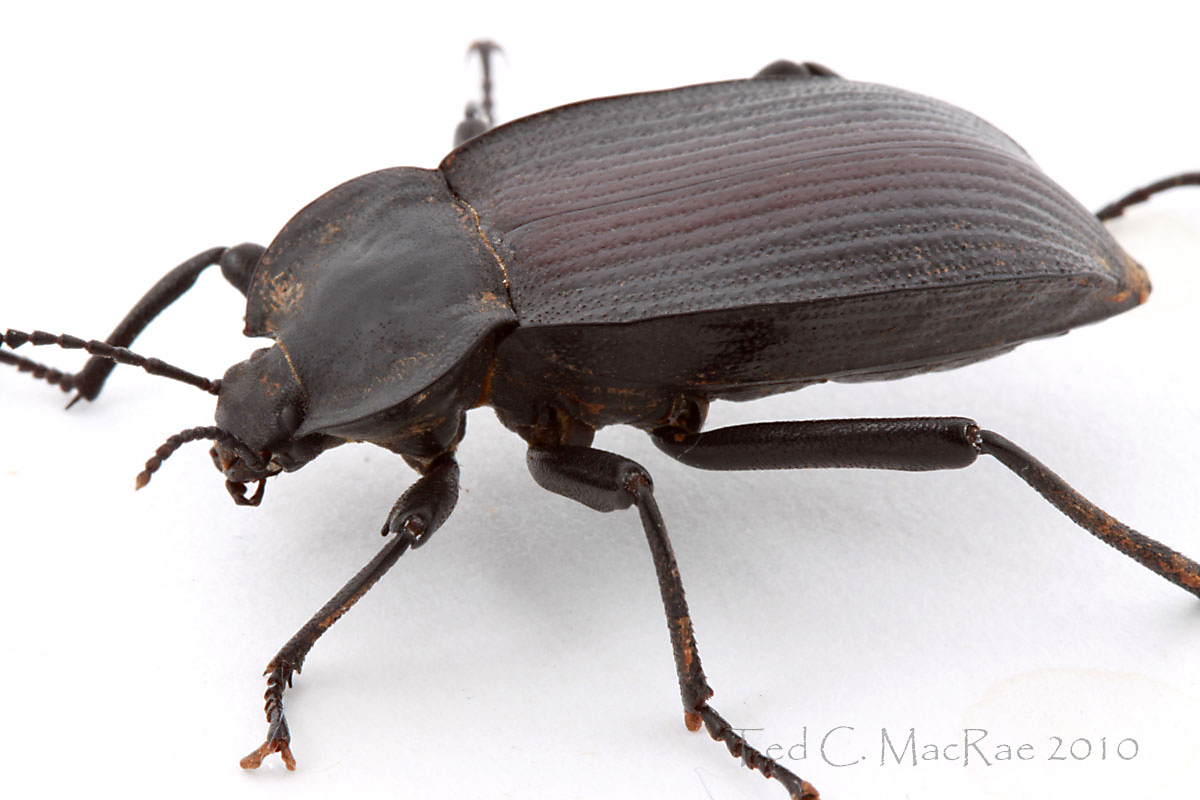
…the “better” Eleodes suturalis

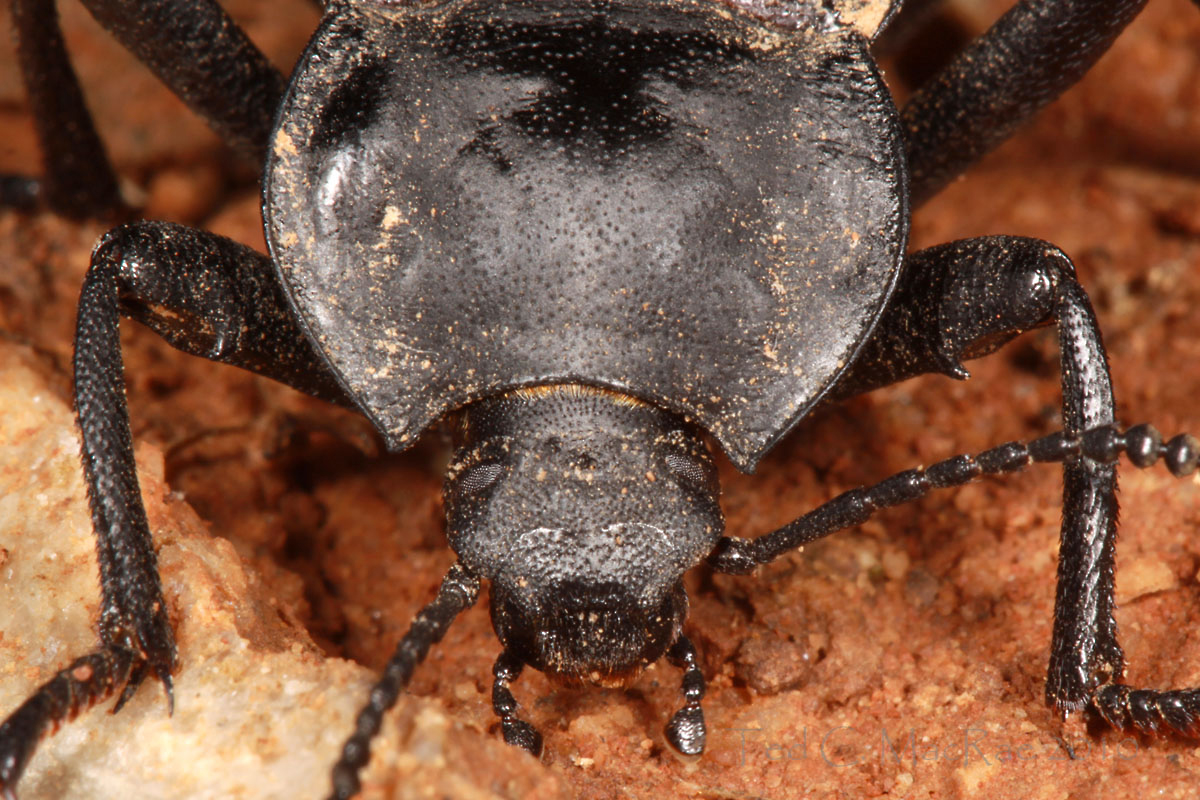
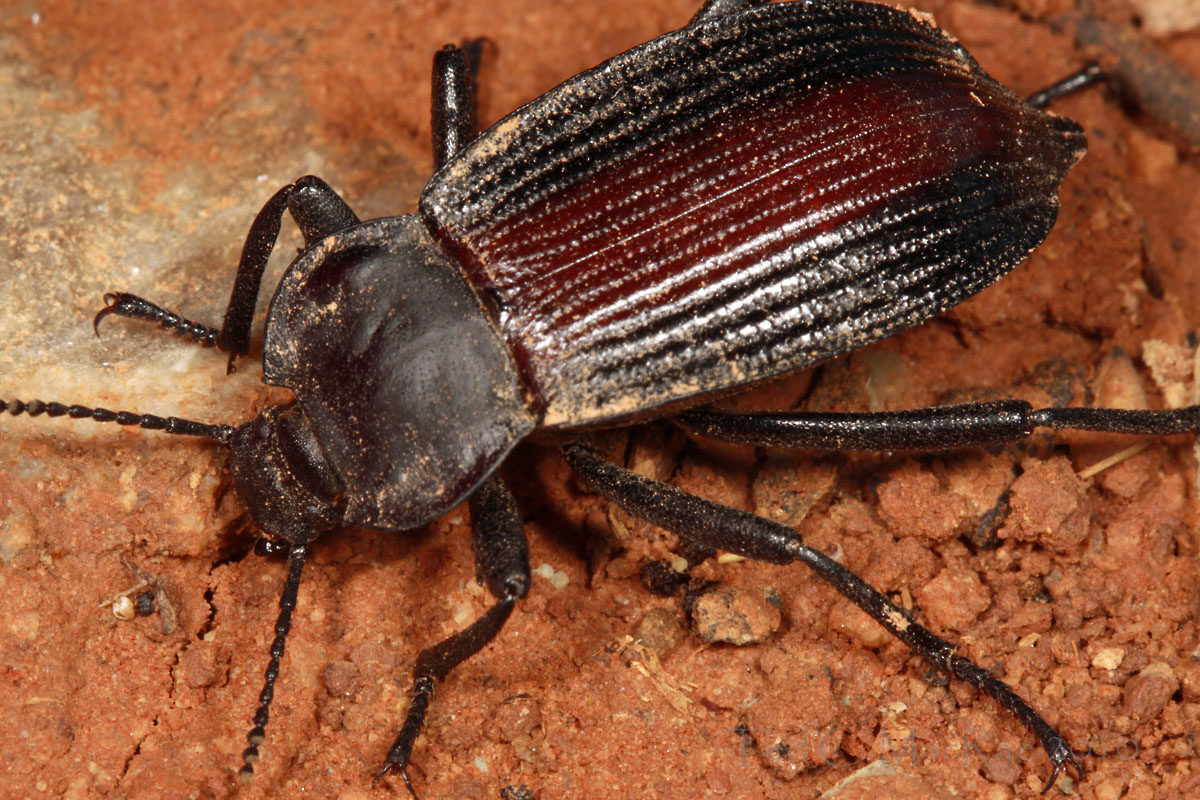
As I mentioned in my previous post, I really wasn’t satisfied with the photographs I took of the clown beetle, Eleodes suturalis, that I brought back from Oklahoma. I had placed the beetle in a terrarium of native soil and taken the obligatory whole beetle and head close-up photographs, both showing all the characters needed to identify the species in adequate detail. They were good, scientific photos, but they weren’t very exciting. In fact – they were boring! Now, I know not every subject I photograph is going to be a wower (the giant desert centipede I recently featured probably setting that standard), but it is important to me that the photographs I post here at least be interesting. After taking those first E. suturalis photographs, then being underwhelmed as I brought them up one-by-one on the computer, I started thinking about whether certain insects are just ‘homely’, and no matter how you photograph them they will still be homely. Eleodes suturalis is by no means a homely beetle in real life, but that is due mostly to the impressiveness of its size – a quality not easy to project in photographs.  Beyond that, its somber coloration, lack of unusual morphological modifications, and “beady little eyes” (fide Adrian) don’t offer much else in the way of help.  Combine that with the unflattering salmon coloration of its native soil as a substrate and an exoskeleton just shiny enough to cause annoying specular highlights, and you’ve got a recipe for really boring beetle photographs!
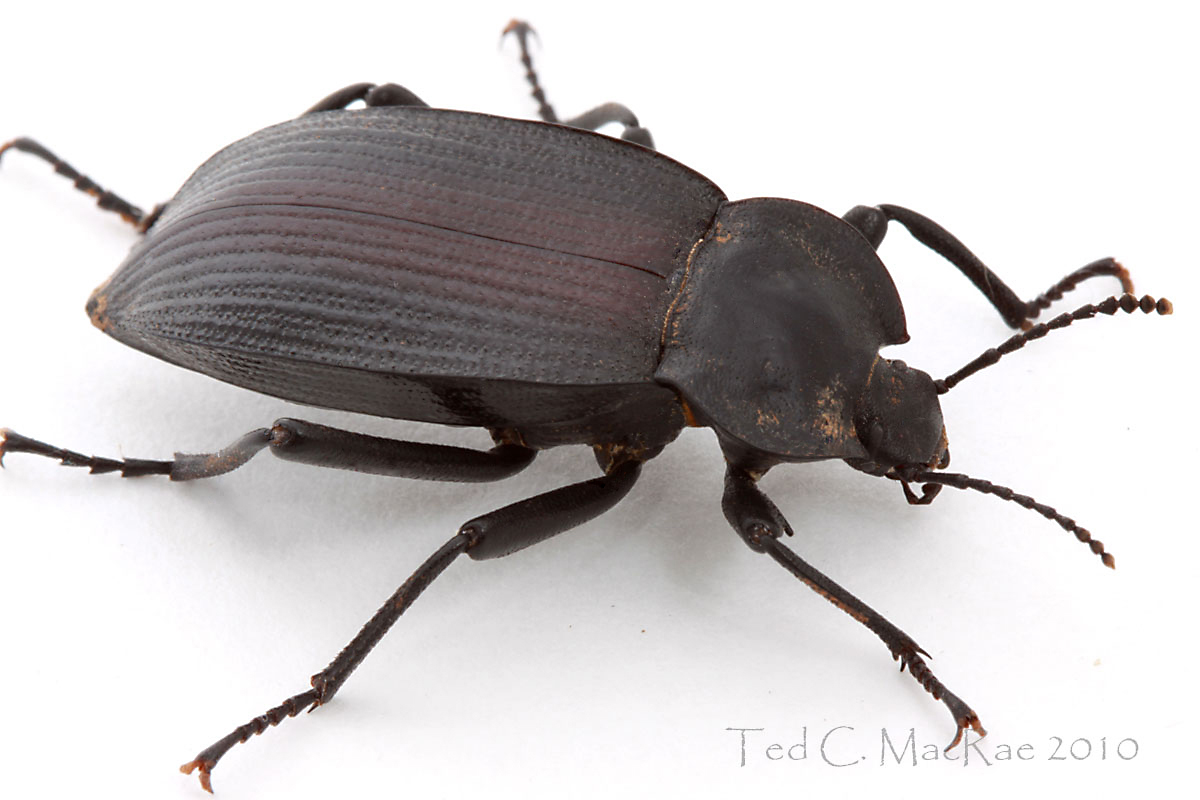
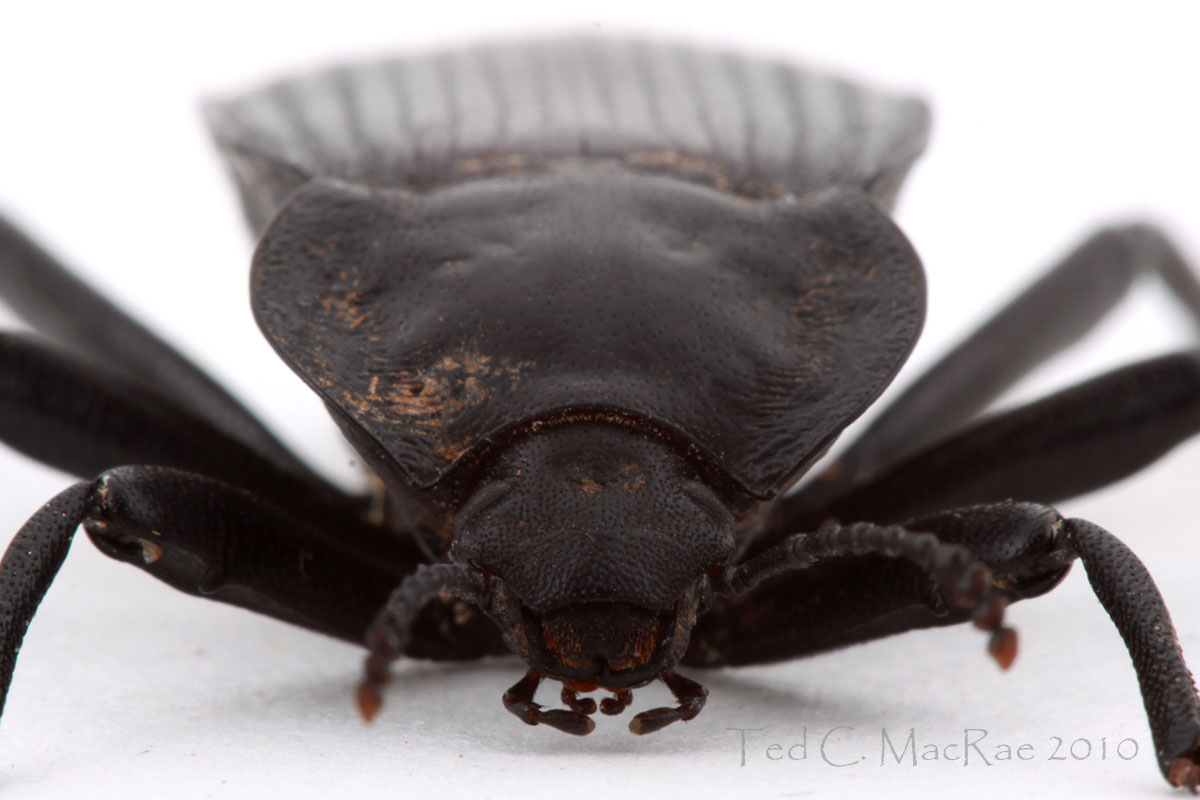
That’s when it occurred to me to try photographing the beetle in a white box.  I’ve only just begun to experiment with this technique and have been impressed with its ability to make somber-colored subjects (e.g., Gromphadorina portentosa) attractive and truly beautiful subjects (e.g. Buprestis rufipes) simply stunning.  The sharp, clean environment of a white box demands a clean beetle, so I gave the beetle (who had done much digging since the previous photo shoot) a good soaking and scrubbing (to the beetle’s great disapproval!).  Yes, I know there is still some dirt on him, but I think a dental pick and wire brush would have been needed to remove every last bit, caked on as it was!  Despite that, I think I achieved the desired effect – specular highlights… gone!  Boring background… gone!  Clean and crisp and ready to impress! The photos also do a much better job of highlighting the 3-dimensionality of the beetle than the original photographs.  Of the many photos I took, my favorite is featured above, and below I present two more that closely approximate the vantage of the two photos I posted from the first shoot in a side-by-side comparison.
For those of you wondering how I managed to secure the beetle’s cooperation for these photos, I used a modification of the “lens cap” technique, covering the beetle with a large glass bowl instead.  The beetle crawled around under the bowl for a bit but eventually would end up settled down against the edge.  By carefully lifting the bowl I was able to avoid disturbing the beetle and fire a few shots before it would start wandering again.  I just repeated the process until I was satisfied I had a few good shots in the sequence.

Does this mean an end to my preference for in situ photographs?  Certainly not.  But some beetles just look better in white!

Photo Details:
White box: Canon 50D w/ 100mm macro lens (ISO 100, 1/250 sec, f/18-20), Canon MT-24EX flash, indirect. Typical post-processing (levels, minor cropping, unsharp mask).
Terrarium: same except f/18, direct flash w/ Sto-Fen diffusers.

Copyright © Ted C. MacRae 2010
Lens and lighting comparisons

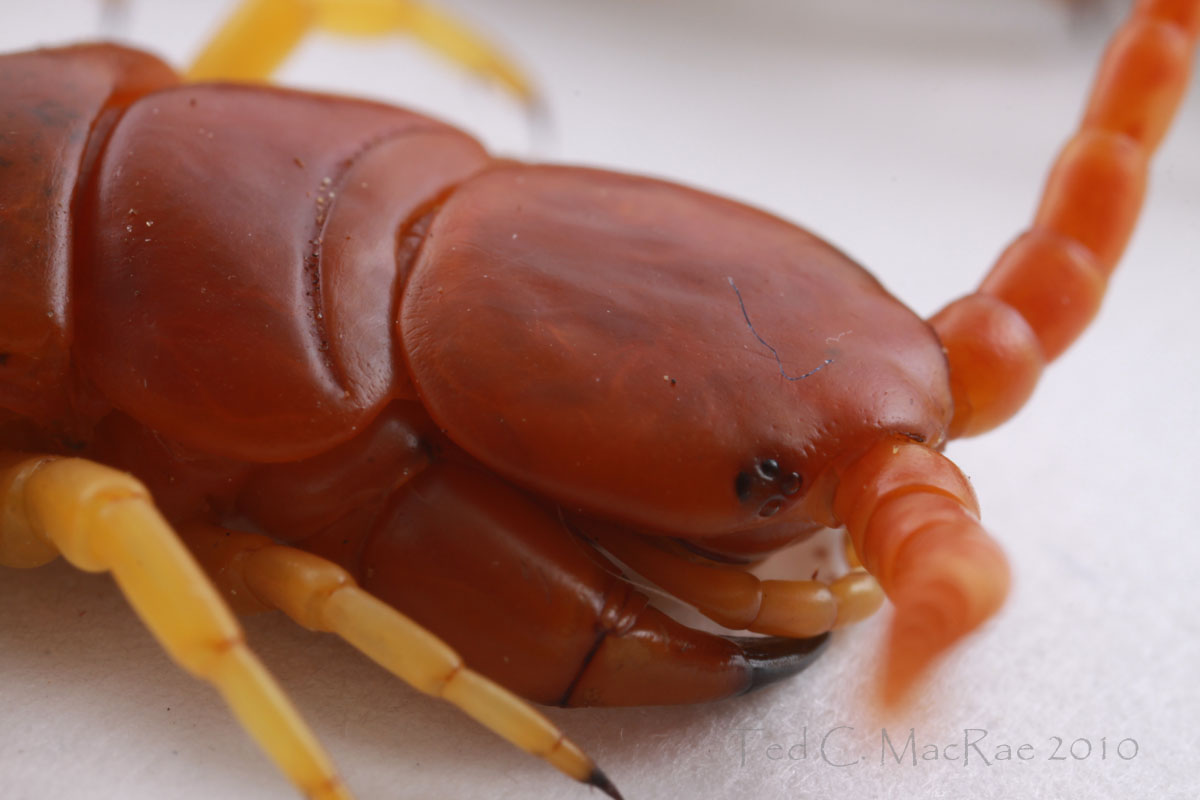
I’ve had my macrophotography rig for one year and a summer now, and while I still hesitate to regard myself a bona fide insect macrophotographer, I’ve learned a lot, feel I’m on the right track, and have had immeasurable fun in the process. I’m a tactile learner – i.e., I do best just trying different things for myself and seeing the results. The photos I show here are some “comparison” shots that I did during my recent giant desert centipede white box photo shoot.

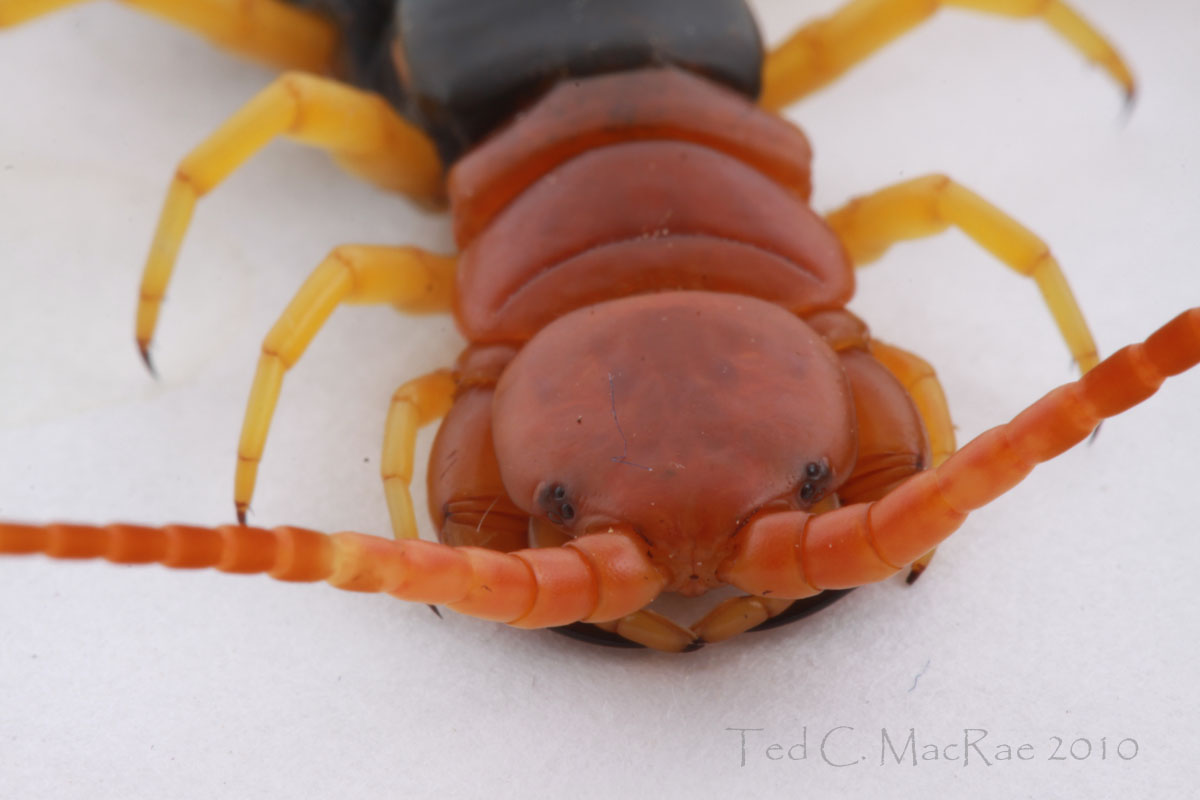
For my photography, I use two macro lenses, both Canon, with almost equal frequency: the 100mm lens (up to 1X), and the MP-E 65mm lens (1X to 5X).  Although the choice is clear if I am much above or below 1X, I find that a large part of my shooting is right around the 1X level.  I’ve often debated which lens I should use in such situations – the longer working distance of the 100mm lens makes it easier to use in the field and less likely to spook the insects I am photographing, but lighting is also more problematic since the flash units are farther away from the subject.  One thing I hadn’t thought about, however, is the possibility of differences in image quality between the two lens (all other things being equal).  The white box session gave me an opportunity to look at this, since the use of indirect flash largely eliminates subject-to-flash distance as a variable.  The two shots below show 1X shots of the centipede – one taken with the 100mm lens and the other with the 65mm lens.  The photos have not been post-processed at all (except size reduction for web posting) to give the truest comparison possible – normally I would do some levels adjustment and unsharp mask (and for these, clone out that annoying blue fiber that ended up on its head!).

Canon 100mm macro lens @ 1X

Canon 65mm macro lens @ 1X

I think one can easily see how much more detail is captured by the 65mm lens (click on each for a larger version, as always), even despite its more limited depth of field (f/14 for the 65mm versus f/22 for the 100mm). This makes me re-think my strategy of using the 100mm when I can and switching to the 65mm only when I have to. In fact, I’ve occasionally opted to add extension tubes to the 100mm when I needed just a bit more magnification, but these photos make me think I should use the 65mm when I can and reserve the 100mm just for sub-1X shooting.

Both photos in the second comparison were shot using the 65mm at f/13, the only difference being the use of indirect flash in one photo and direct flash in the other. I’m not quite sure what to make of this – the direct flash photo is better lit and shows more detail, but this could be an artifact of insufficient flash unit power in the indirect photo. I probably should have done this comparison (or both, for that matter) using E-TTL rather than manual mode on the flash unit (and I may have to do that).

Canon 65mm macro lens, indirect flash

Canon 65mm macro lens, direct flash

Anyway, nothing earth-shattering here, and I may just be figuring out what others have learned long ago. Although I prefer the field for photography, I’m finding the white box – or at least a controlled, indoor environment – valuable for this type of experimentation.

Copyright © Ted C. MacRae 2010

New blogs of note

Every now and then, I like to feature some of the more interesting blogs that I’ve encountered recently. This update features six blogs – five dealing with entomology and one dealing with herpetology.


Aphonopelma: Tarantulas of the United States

© Kory Roberts

Aphonopelma: Tarantulas of the United States is a relatively new blog by Michael D. Warriner. With only a single U.S. genus (Aphonoplema), this may seem a rather narrow scope for a blog.  However, as Michael points out, research on ecology, conservation, and taxonomy of U.S. tarantulas has been surprisingly limited.  Their taxonomy, in particular, has been quite problematic, making accurate species identifications almost impossible.  Michael has begun summarizing known distributional information for states from which tarantulas are known (Missouri south to Louisiana and west to California) and providing detailed discussions for selected species with an eye towards enabling better conservation efforts for this neglected group of spiders.

Nature Closeups

© Troy Bartlett

Nature Closeups is the new blog by insect photographer extarordinaire and BugGuide (“a community for fellow naturalists devoted specifically to arthropods”) founder Troy Bartlett.  Featuring stunning photographs of mostly insects from his home near Atlanta, Georgia and his frequent trips to Brazil, Troy often adds interesting details about the natural history behind the photo.  As Troy explains, photography is “more a means than an end. Looking over the photographs afterwards and researching the things I’ve found is even more rewarding.”  Those with a lot of confidence in their insect identification skills may wish to try their hand at Troy’s occasional identification challenges (prepare to be humbled!).

Up Close With Nature

© Kurt (a.k.a. orionmystery)

Up Close with Nature by Kurt (a.k.a. orionmystery) is one of my favorite insect macrophotography blogs.  Kurt lives in Kuala Lumpur, Malaysia, giving him access to an insect fauna that is extraordinary in both its diversity and beauty.  Kurt uses the stunning insects of this rich fauna to share with readers his excellent tips and techniques for insect macrophotography.  His latest post features one of the best explanations I have seen on the use of Flash Exposure Compensation in Macro Photography, and previous posts have given me some great ideas on diffusers and the use of backgrounds to optimize flash lighting.  If you’re interested in the science of insect macrophotography, you will enjoy this blog.

Living With Insects

© Jonathan Neal

Living With Insects is the new blog by Jonathan Neal, Associate Professor of Entomology at Purdue University and author of the textbook, Living With Insects (2010).  Jonathan is interested in exploring the intersections of people and insects, and though he just began blogging a month ago he has already covered such topics as the evolution of insect flight, the consequences of virus infection in domestic cricket colonies, insects and burial practices, raising monarchs, insect cuticle, and the importance of insect museums.  It’s a daily dose of erudition!

6legs2many

© Alison Bockoven

6legs2many is written by Alison Bockoven, an entomology graduate student at Texas A&M University.  While her research focuses on genetic variation in the foraging behavior of the red imported fire ant, Alison is also having fun discovering the broader field of entomology.  Her enthusiasm is palpable as she features some of the insects that she has encountered and the techniques used for their collection and curation.  Her latest post covers the Embioptera, or webspinners – a group that I, after nearly three decades as a practicing entomologist, still have not encountered.  By the way, the title of the blog is derived from this humorous quip by Joseph W. Krutch:

Two-legged creatures we are supposed to love as we love ourselves.  The four-legged, also, can come to seem pretty important.  But six legs are too many from the human standpoint.

Field Notes

© Bryan D. Hughes

Although I am a devout entomologist, I do enjoy a good herp blog, and Field Notes by Bryan D. Hughes is one of the best herp blogs that I’ve seen.  Focusing on Arizona’s venomous snakes, Bryan provides stunning photographs of these striking animals (heh heh… get it?) and other assorted reptiles and amphibians from that unique fauna.  As Bryan explains, “I like spending my Saturday nights in hot cars on dirt roads in the middle of nowhere, being attacked from all sides by mosquitoes while searching for deadly snakes.”  His dedication to these oft-misunderstood animals is clear by his role as a volunteer for snake relocation calls and his hope that his website will help local homeowners to become interested in native wildlife rather than killing it.

Copyright © Ted C. MacRae 2010

“A good photographer is invisible…”

Yesterday I shot down to the southeastern lowlands of Missouri to spend some quality time in the field with friend and fellow cicindelophile Kent Fothergill. We were primarily looking for migrants of the Ascendent Tiger Beetle (Cicindela trifasciata ascendens), a Gulf Coast species that doesn’t normally occur in Missouri but is well known for its vagility and late-season northward migrations and which has been seen in the state once before (Brown and MacRae 2005).  No such individuals were found, but no matter – the day was really about just getting out and enjoying the camaraderie.  Nevertheless, there were some successes.  We located burrows of 1st- and  2nd-instar larvae of the Ant-like Tiger Beetle (Cylindera cursitans) at a site along the Mississippi River where Rich Thoma and I found adults last year.  Previous attempts to rear this species from larva to adult have not succeeded (Brust et al. 2005), but I collected a number of larvae and transferred them to a rearing container anyway in hopes that the techniques I’ve developed for rearing the closely-related Swift Tiger Beetle (Cylindera celeripes) might work also with this species.  We also found the beast that I am photographing above – I’ll leave it to your imagination for now to figure out what it is.

In between stops there was plenty of time for discussion on subjects entomological and non.  One thing Kent knows a thing or two about is insect photography, and during a discussion about such he made an interesting comment. Beyond focus, exposure, and composition, he noted that good insect photographers have the ability to become invisible – i.e., they combine patience and persistence with knowledge of the subject’s behavior to make it forget about the big glass eye staring at them from 6 inches away and return to going about their business.  It brought some clarity to my mind about the things I’ve tried in my own attempts to photograph insects that really did not want to be photographed (and there have been many).  The point was emphasized when I came into the office this morning and found the above photograph in my email inbox – Kent had taken it yesterday while I was photographing the bug-to-be-named-later, and I was completely unaware that I was being photographed!  Yes, a good photographer is invisible…

REFERENCES:

Brown, C. R. and T. C. MacRae. 2005. Occurrence of Cicindela (Cicindelidia) trifasciata ascendens (Coleoptera: Cicindelidae) in Missouri. Cicindela 37(1–2):17–19.

Brust, M. L., W. W. Hoback, and C. B. Knisley. 2005. Biology, habitat preference, and larval description of Cicindela cursitans LeConte (Coleoptera: Carabidae: Cicindelinae). The Coleopterists Bulletin 59(3):379–390.

Copyright © Ted C. MacRae 2010

Add to FacebookAdd to DiggAdd to Del.icio.usAdd to StumbleuponAdd to RedditAdd to BlinklistAdd to TwitterAdd to TechnoratiAdd to Yahoo BuzzAdd to Newsvine

Email to a friend

Collecting in Australia’s remote McIlwraith range

The following is an invited post by Alex Wild of Myrmecos Blog:

Myrmecologists Gary Alpert & Phil Ward mucking about with magnetic termites. Cape York Peninsula, Australia, 2004.

Ted MacRae so graciously guest blogged for me last week, so I figured it’s time to turn this around and send one Ted’s way. One of the great joys of Beetles in the Bush is Ted’s photojournalistic coverage of various insect collecting adventures. In that vein, I will recount an Australian expedition with famous ant guys Gary Alpert and Phil Ward from back in 2004. I never blogged the trip because, hey, I didn’t blog back then.

Continue reading

My first jumping spider

As a long-time professional and avocational entomologist, I find beauty and fascination in all manner of joint-legged creatures. Of course, beauty is in the eye of the beholder, and most people don’t exactly share my passion for these animals. Sure, butterflies enjoy almost universal approval, but beetles are just too crunchy, flies too filthy, wasps too aggressive, and cockroaches… well, eww! Even crabs and lobsters, tasty as they are, just move too robotically to engender any feelings of affection. None of these groups, however, seem to be as universally reviled as spiders – scuttling blurs of leg and fur with beady little eyes, just waiting to launch a sneak attack with their venomous gnashers. Few other coin-sized animals can cause an otherwise lucid adult to run screaming from their bathroom with such terror.

Except jumping spiders! Jumping spiders (family Salticidae) possess many of the same traits that condemn other spiders to the ranks of the creepy – hair and venom and lots of eyes; yet they have other unique qualities that make them nevertheless endearing, almost cuddly, to all but the most ardent of arachnophobes. Their human-like “face” featuring two large, forward-facing eyes and inquisitive nature give them a charisma that almost invites interaction. Approach any other spider, and it scampers back into the nearest crevice. Jumping spiders, on the other hand, turn and face the intruder – you can almost see them sizing you up – perhaps even moving forward a little to have a better look. It makes them seem, well… intelligent. Add to that their stunning diversity (~5,000 species), dazzling colors, and the sometimes impressively elongated choppers of the males, and you’ve got the perfect recipe for charm. Bouncy, furry, smart, cute, and big bright eyes – almost sounds like a kitten!

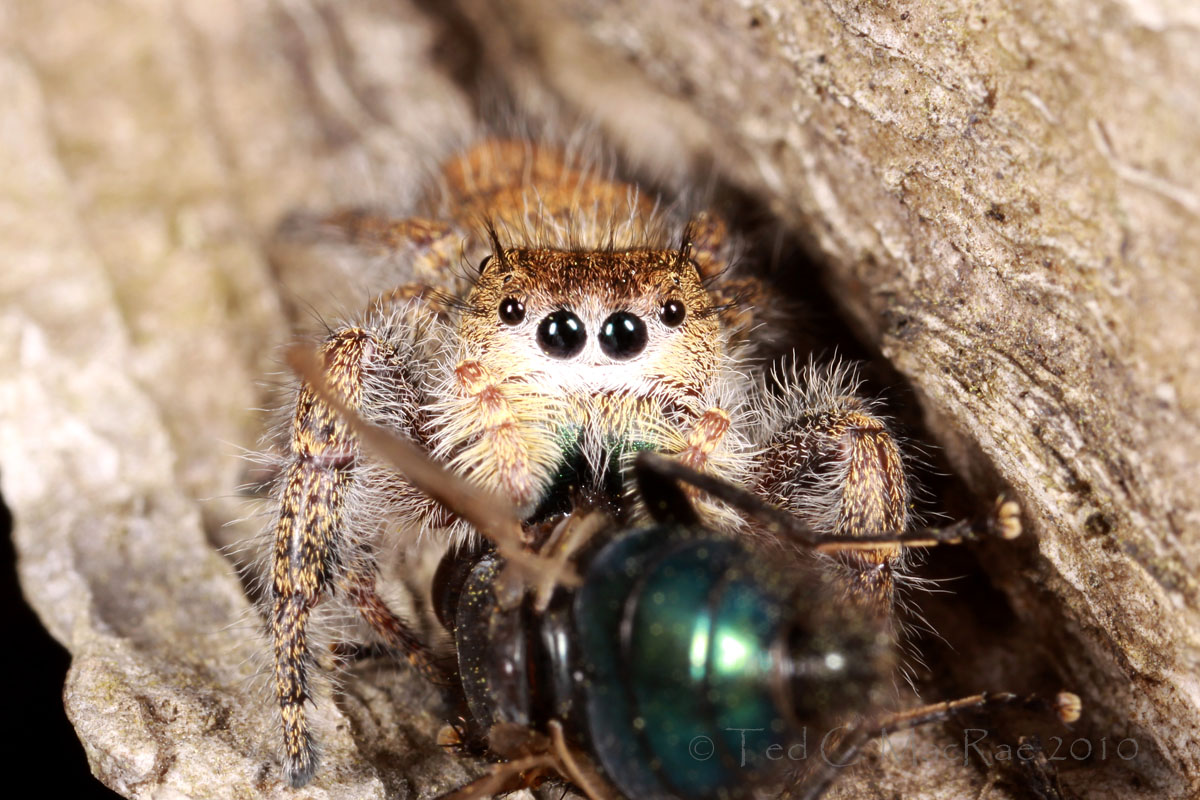
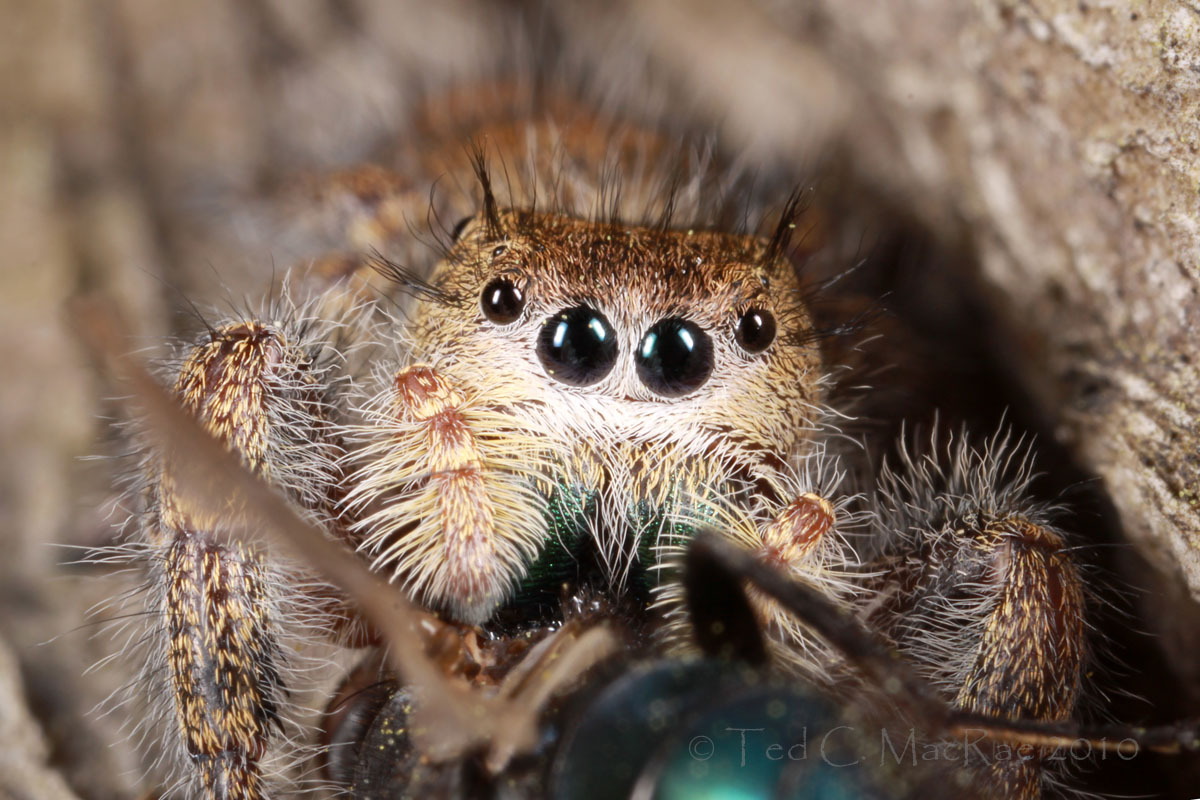
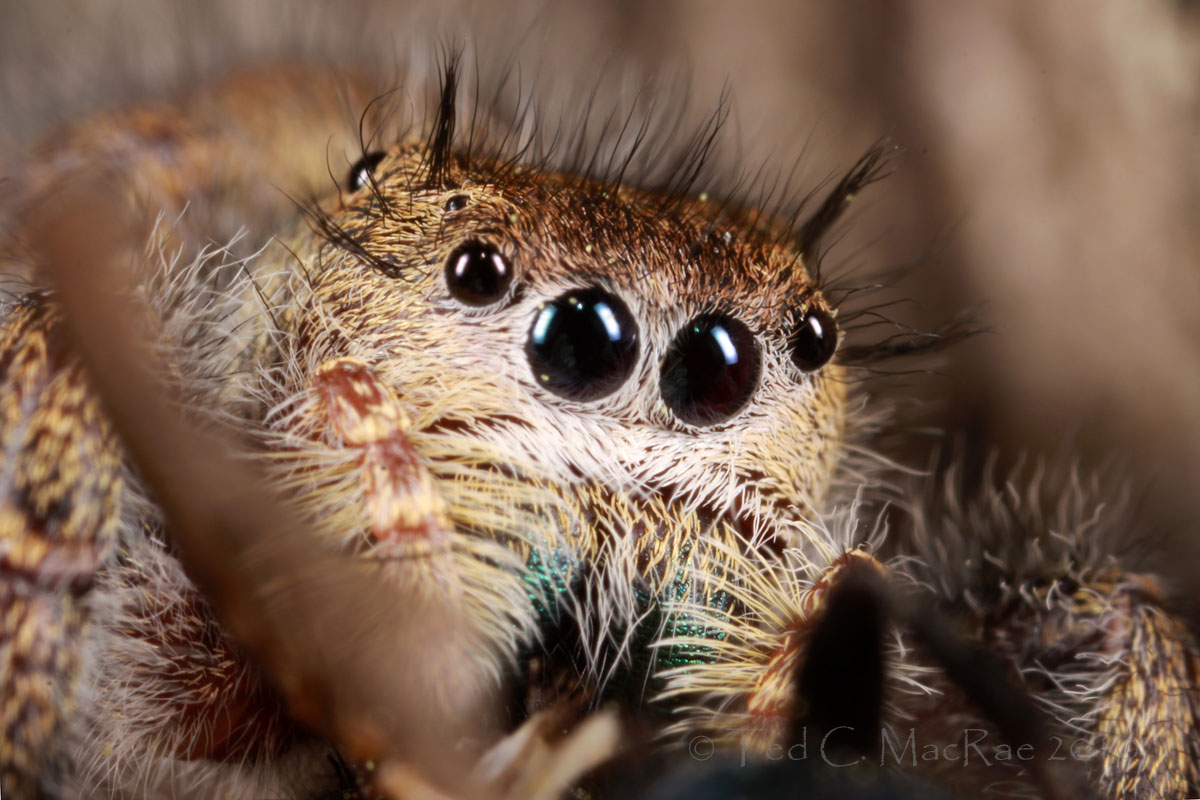
The result of all this charm is that jumping spiders are wildly popular subjects for macrophotography. Accordingly, there has been a veritable explosion of online photographs of jumping spiders, dominated by close-ups of that irresistible face. These shots here represent my first attempt to photograph one of these endearing creatures, and while I’m happy with them considering my relative newness to the field, they are a far cry from the spectacular images being produced by some other photographers. Perhaps the best of these is Thomas Shahan, whose focus-stacked facial shots of these spiders are among the most stunning that you will find. Another photographer who has produced some excellent photographs of Malaysian jumping spiders is Kurt at Up Close with Nature. Perhaps someday my jumping spider photographs will be considered on par with those that these two gentlemen are producing – if that day comes, you can say it began right here!

I’m a beetle-man, so except for a brief attempt at ant taxonomy my area of expertise lies with the Coleoptera. Nevertheless, perusing the well-stocked archives at BugGuide leads me to believe that the individual I photographed is a subadult female in the genus Phidippus – perhaps something in the putnami species-group.  I found her on a lower branch of sweetgum (Liquidamber styraciflua) in a wet-mesic bottomland forest along the Black River in Missouri’s southeastern Ozarks feeding on a blow fly (family Calliphoridae).  While relatively drably-colored compared to many other species in the family, a glimpse of her bright blue-green chelicerae (fangs) can still be seen.  I tried to get her to drop her prey to get a better look at the fangs, but she wasn’t having anything to do with that – mealtime is mealtime!

Photo Details: Canon MP-E 65 mm 1-5X macro lens on Canon 50D, ISO 100, 1/250 sec, f/13-14, MT-24EX flash 1/8 power w/ Sto-Fen diffusers. Minimal cropping and post-processing.

Copyright © Ted C. MacRae 2010

Add to FacebookAdd to DiggAdd to Del.icio.usAdd to StumbleuponAdd to RedditAdd to BlinklistAdd to TwitterAdd to TechnoratiAdd to Yahoo BuzzAdd to Newsvine

Email to a friend

The “New” Gromphadorina portentosa

I don’t pretend to be a photography guru – I’m learning, and though I still have much to learn I’m happy with my progress so far.  The photographs I posted earlier this week of Gromphadorina portentosa, the Madagascan hissing cockroach, were the results of my first attempt at photographing insects in a white box, and I was reasonably happy with the results.  However, a commentor suggested the photographs could benefit from increased contrast – and he was right!  I admit that I haven’t focused much on post-processing so far, as I’m still in a rather steep part of the whole insect macrophotography learning curve thing. I have played around with the different enhancement tools in Photoshop Elements, but for some reason I don’t find them all that intuitive, and just playing around with them hasn’t helped me understand how they work or the best way to use them.  The Photoshop online help site wasn’t much help either – in fact, it was all gibberish to me!  I started to wonder if maybe I just lacked some basic talent when it came to understanding post-processing.

Fortunately, the commentor provided a link to an excellent article at EarthBound Light called The 1-2-3 of Photoshop Levels.  That article opened up for me a whole new world of understanding!  It explained that Levels is a better alternative for optimizing photos that Brightness and Contrast, and it did it in plain English!  I actually understood it!  Well, my appetite whetted, I started browsing other articles at the site and found the object of my desire: a clear explanation of the seemingly misnomored “Unsharp Mask” in an article called Behind the Unsharp Mask: The Secret World of Sharpening.  I read it excitedly, just waiting for it to become unintelligibly technical, but it was as clearly written as the previous, and for the first time ever I actually felt like I understood the basics of how to use Unsharp Mask.  Well, I couldn’t wait to take my newfound knowledge and apply it to my photos of the already spectacular Gromphadorina portentosa to see if I could make them really pop. The following comparison shows the original photo of the male (size reduced to 1200×800) and the optimized photo adjusted for levels, color, and sharpness (also slightly cropped). What do you think?

Original photo

Optimized photo

Here are paired comparisons of the other photos I included in the original post with their optimized versions (click to see enlarged versions). I would be most interested in hearing any specific comments you might have about these optimizations.

Original

Optimized

Original

Optimized

Original

Optimized

Original

Optimized

Copyright © Ted C. MacRae 2010

Add to FacebookAdd to DiggAdd to Del.icio.usAdd to StumbleuponAdd to RedditAdd to BlinklistAdd to TwitterAdd to TechnoratiAdd to Yahoo BuzzAdd to Newsvine

Email to a friend

Gromphadorina portentosa

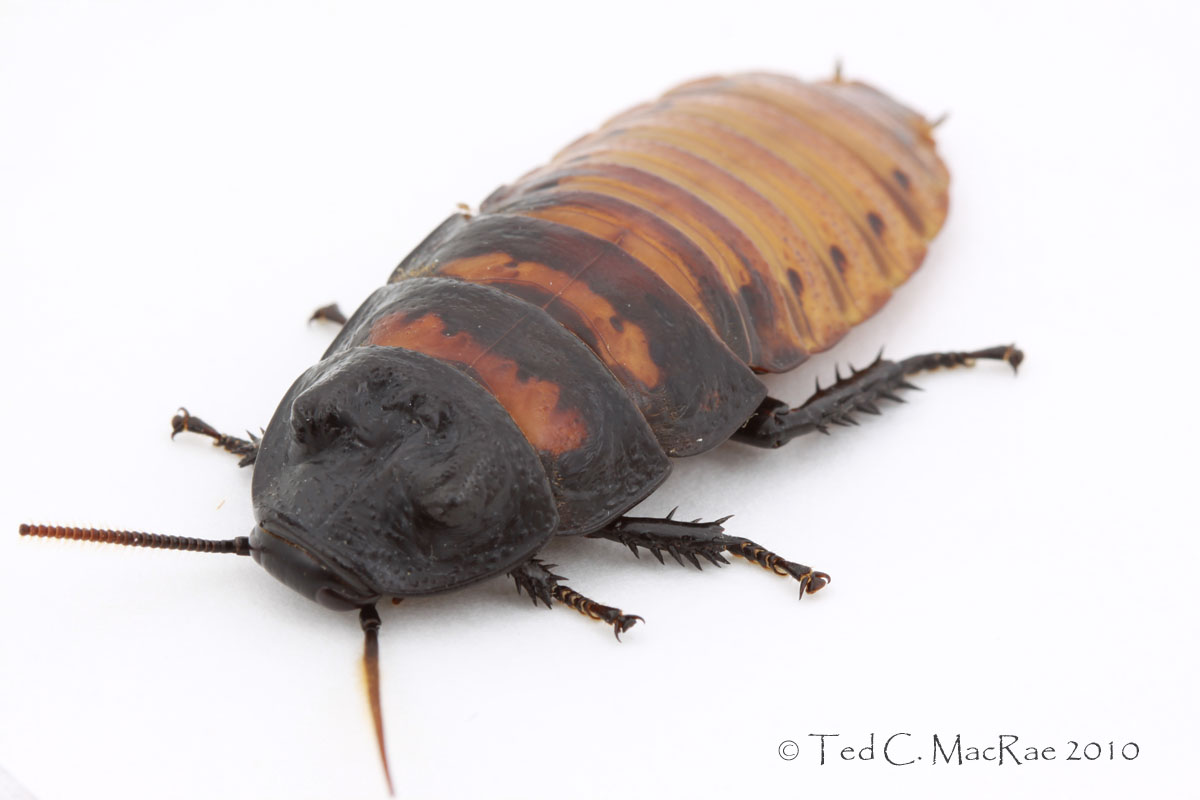
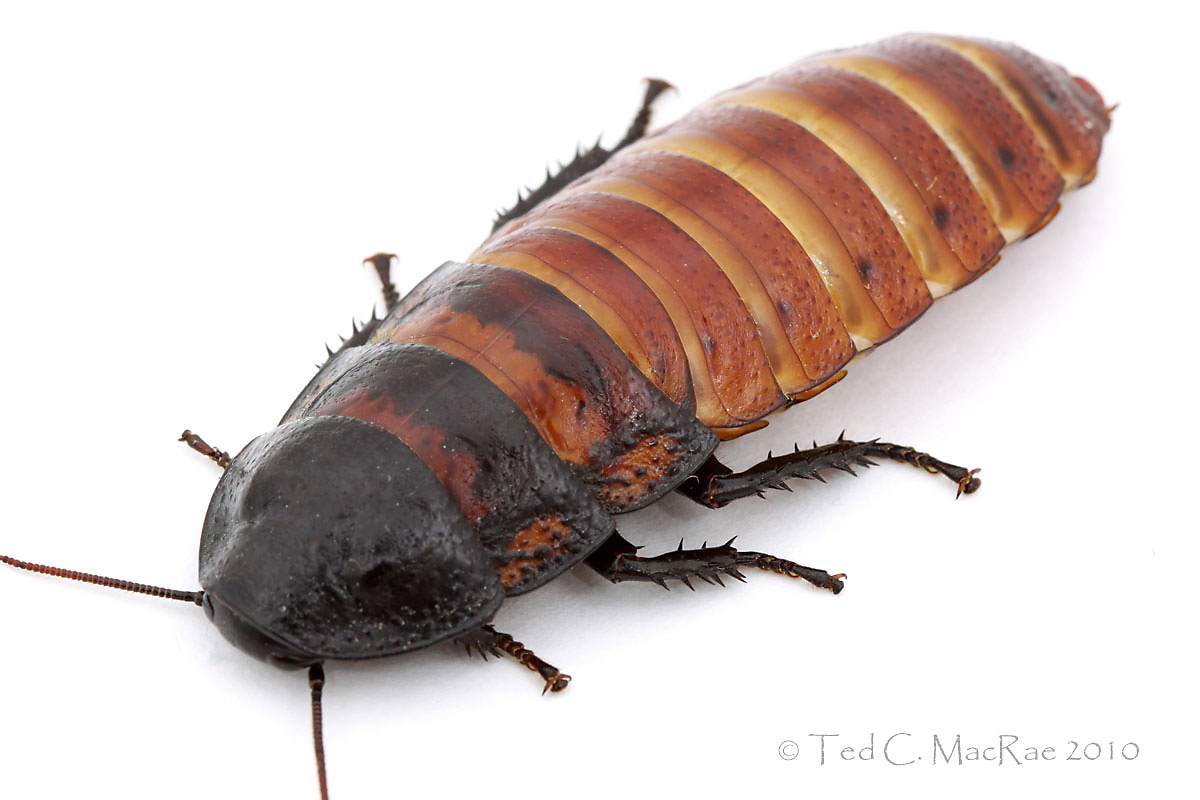
I found myself with a few spare moments this weekend, so I decided to finally put together a white box and see what I could do with it.  And what better subject for a white box maiden voyage than Gromphadorina portentosa, the Madagascan hissing cockroach.  Grotesquely beautiful, it also presents a challenging subject for flash-based macrophotography because of its hard, shiny exoskeleton that produces strong specular highlights with all but the most highly diffuse of light sources.  It was also the only live subject I had on hand at the moment, other than a few larval noctuids – not nearly as impressive as these behemoths!  There were some early glitches – the enormous size of these insects made for long working distances, with the result that my box was almost too small!  However, placing the subjects at the back of the box allowed the camera lens and flash units to sneak just inside the front drape, and the closer shots went more smoothly.  I’m quite happy with the results – at least as a first attempt, and I think the method shows even more promise for some preserved specimen photographs that I am planning.

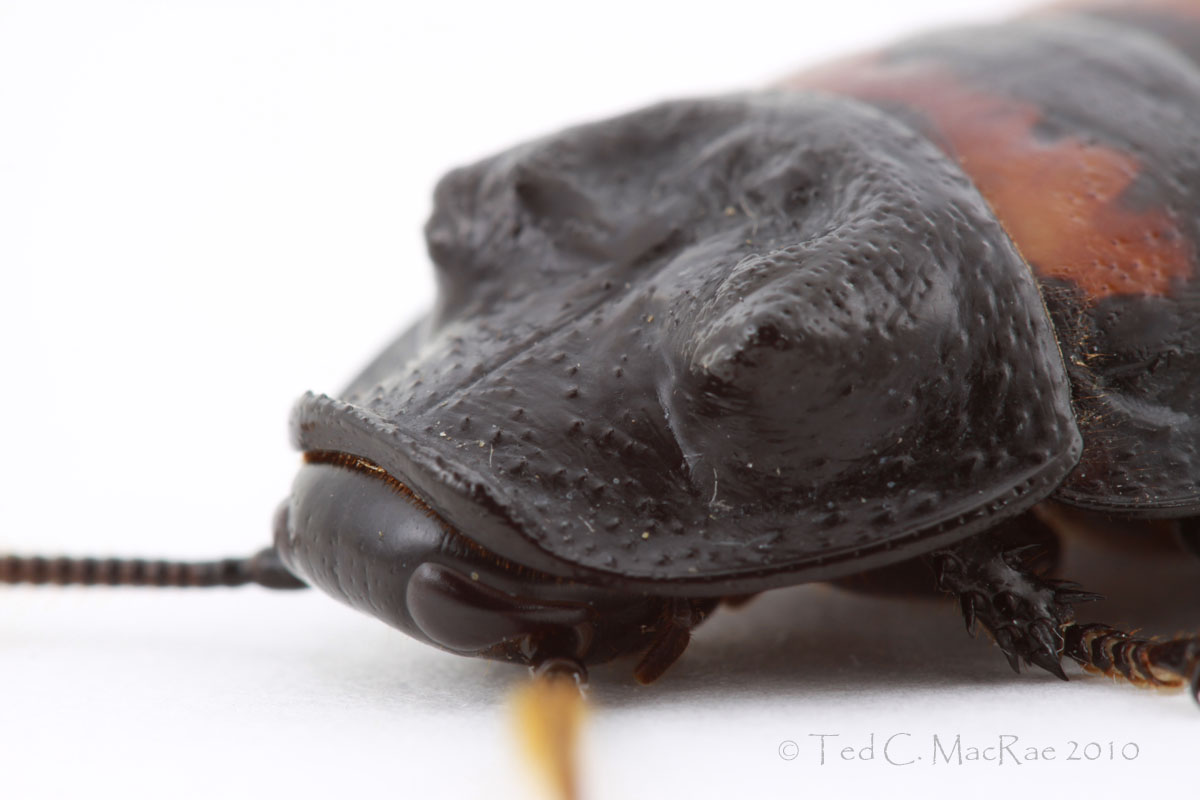
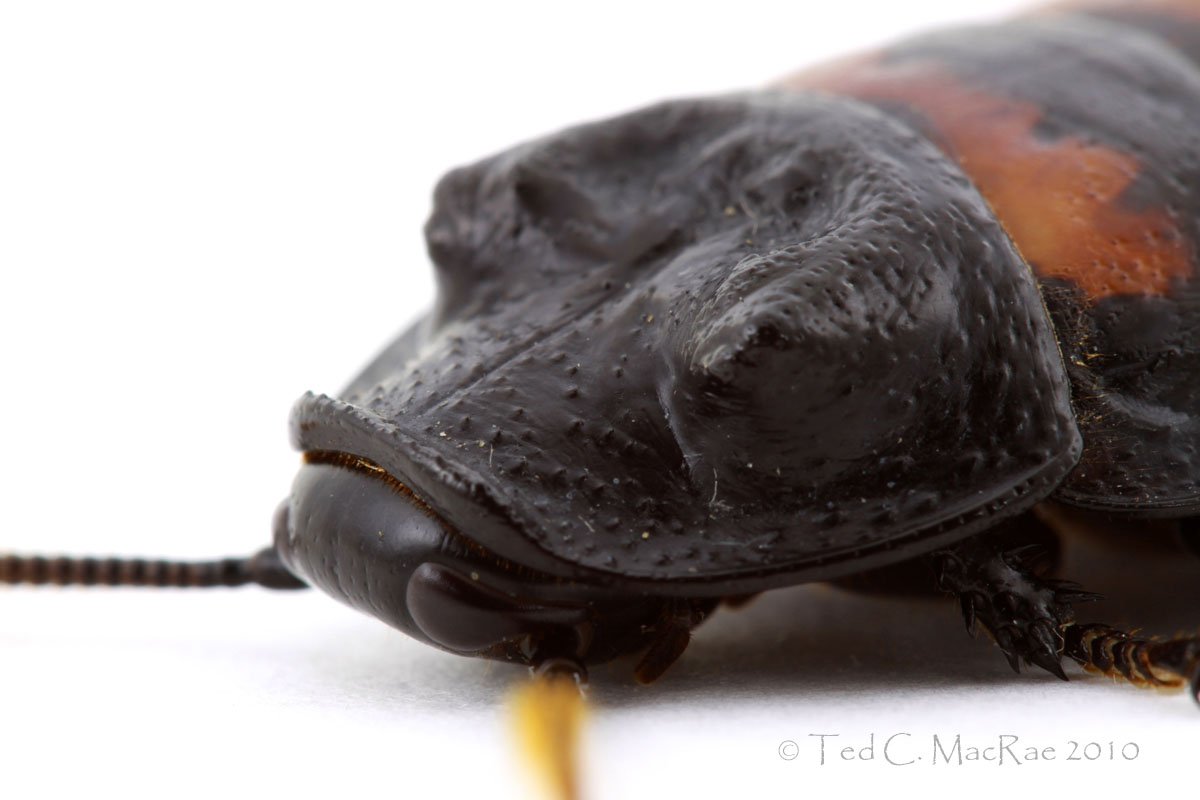
The males, of course, have “horns” on the pronotum, but one thing I had never noticed before is the well-developed lip at its anterior edge.  This is certainly an adaptation to the “shoving” matches that males engage in with each other frequently.  This face-on shot shows him for the formidible opponent that he is!

Sexual dimorphism is fairly evident in this species, as least compared to your average cockroach.  Like most insects, females tend to be a little larger, especially when they are gravid as the one below appears to be.  In my colony I note that they also tend to be more uniformly dark in color than the males, although that is not quite so evident with this particular female.

The big difference is, of course, the weakly developed pronotal protuberances.  Females don’t engage in the shoving matches that males do, so there is no need for the heavily armed pronotum.  Nevertheless, small pronotal humps are still found in the adult females.  Note also the lack of a well-developed lip on the anterior edge of the female pronotum.

Photo Details: Canon 100mm macro lens on Canon 50D, ISO 100, 1/200 sec, f/8-11, indirect MT-24EX flash in white box.

Copyright © Ted C. MacRae 2010

Add to FacebookAdd to DiggAdd to Del.icio.usAdd to StumbleuponAdd to RedditAdd to BlinklistAdd to TwitterAdd to TechnoratiAdd to Yahoo BuzzAdd to Newsvine

Email to a friend