Clown beetle surprise

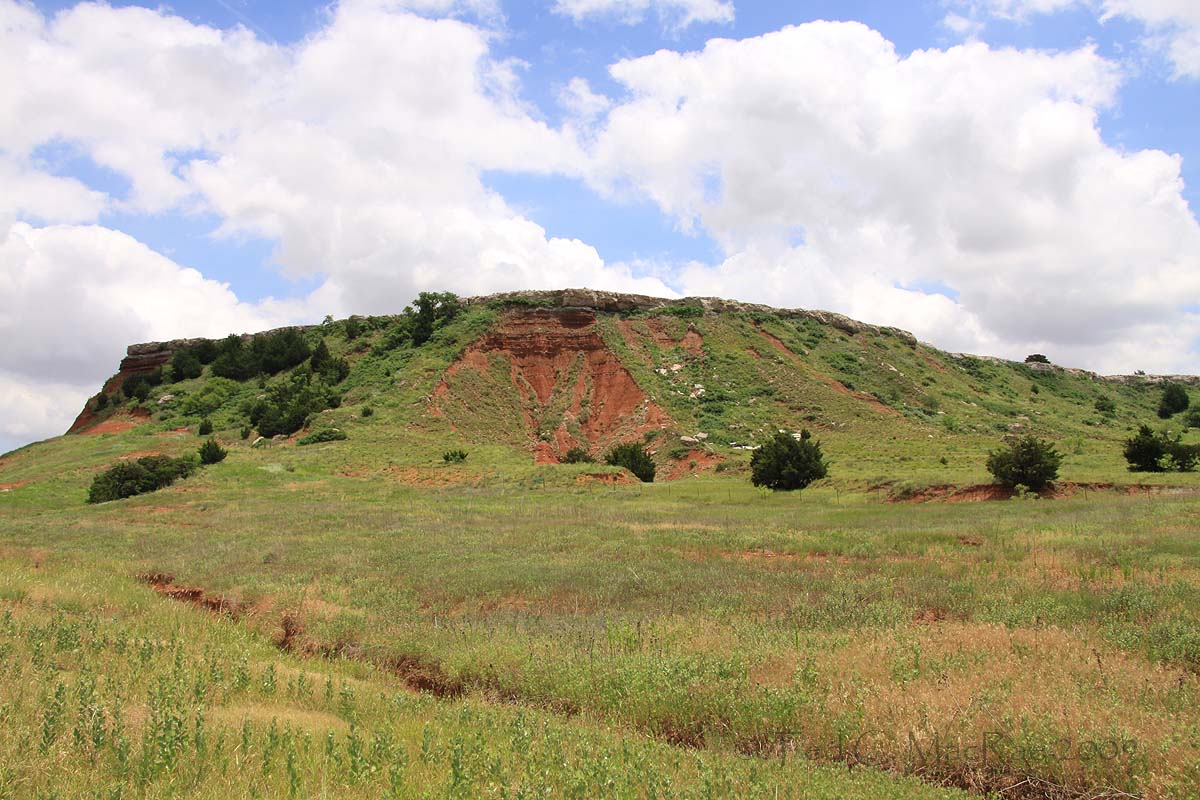
As I slowly scanned my flashlight through the darkness across the mixed-grass prairie in the Glass Mountains of northwestern Oklahoma last July, there was one thing that I hoped not to see (prairie rattlesnake, unless from afar) and one thing that I hoped more than anything to see (Great Plains giant tiger beetle, Amblycheila cylindriformis). Fortunately, I encountered none of the former and found several of the latter.  It took awhile before I saw the first one, but in the meantime I saw all too abundantly the clown beetle, Eleodes suturalis.  A member of the family Tenebrionidae, this species is one of the most conspicuous components of the Great Plains beetle fauna.  Adults are commonly encountered walking about the grasslands or crossing roads, especially after summer rains.  I recall my first encounter with this species when I made my first insect collecting trip to the Great Plains in 1986, marveling as I literally watched hundreds of individuals crossing a remote highway in southwestern Kansas.  Now, they were just an annoyance – close enough in size and appearance to the object of my search that I had to pause and look at each one I encountered to verify its identity.¹

¹ In fact, a mimetic association has been suggested for Amblycheila cylindriformis and Eleodes suturalis due to their similarity in size, shape and coloration (black with a reddish-brown sutural stripe) (Wrigley 2008).  This may be true, as Eleodes suturalis is an abundant species capable of defending itself with noxious sprays that contain benzoquinone and other hydrocarbons, while Amblycheila cylindriformis is a much rarer species (as mimics tend to be) that lacks defensive compounds.

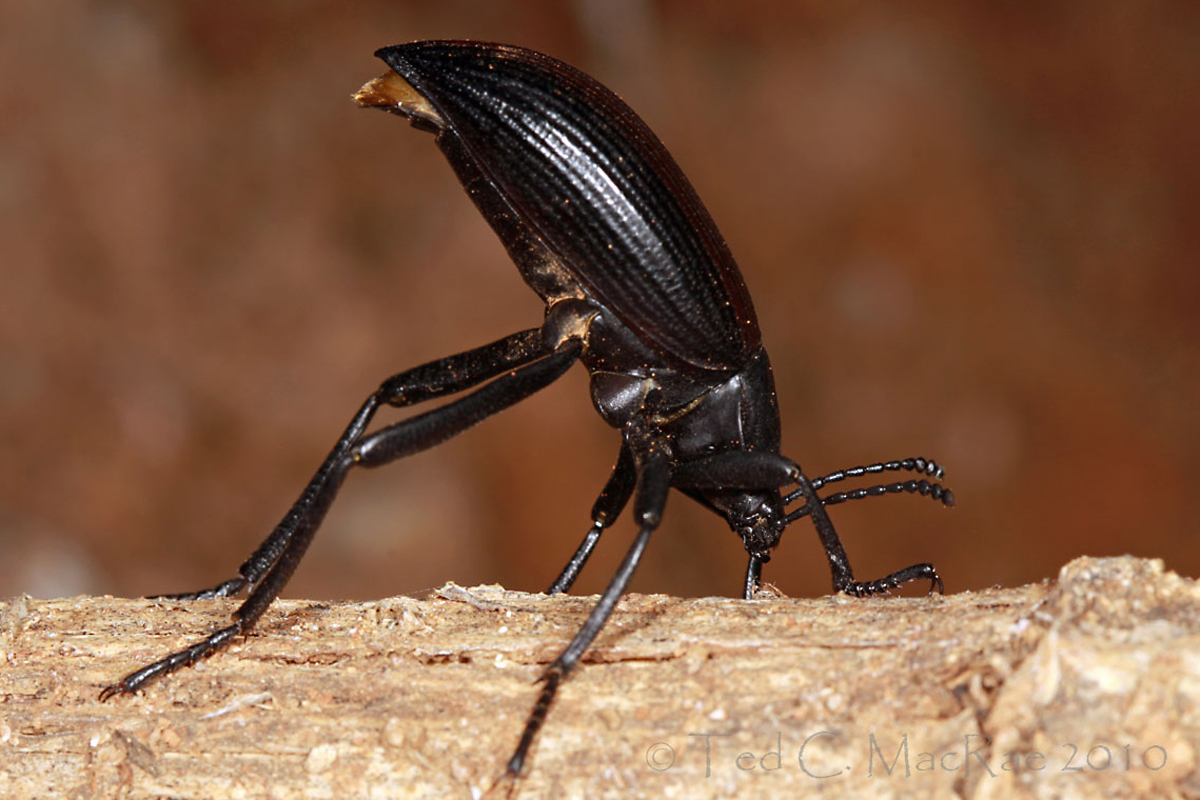
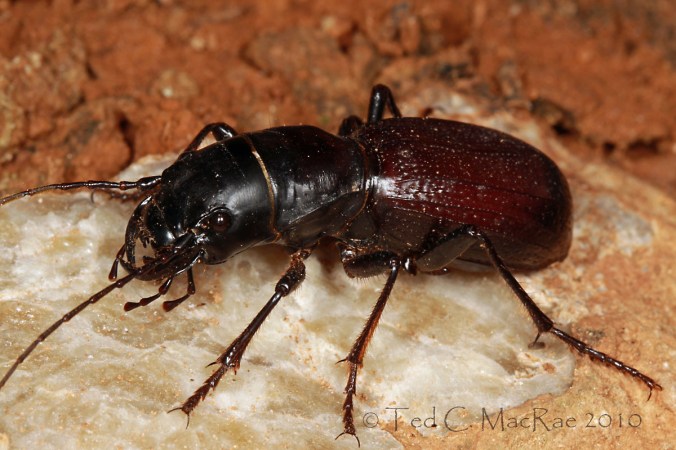
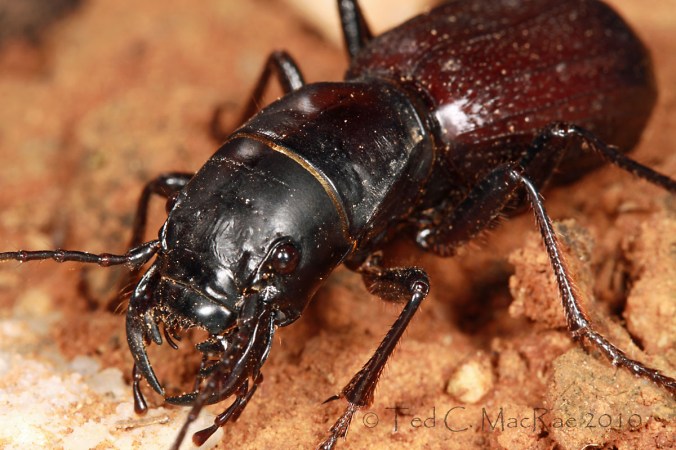
After finding a few of the Amblycheila, I encountered this particular individual clinging to a root sticking out of the side of a wash.  My closer look caused it to immediately assume its characteristic defensive headstand pose (from which the name ‘clown beetle’ comes), so I decided to take a few photographs (not an easy task at night).  The photos have been sitting on my hard drive since, but in examining them more closely, I realized that this particular beetle is not E. suturalis.  Rather, it is one of several similar appearing species that co-occur with E. suturalis in the Great Plains and sometimes resemble it due to their large size, sulcate elytra, and occasional presence of a similar reddish-brown sutural stripe.  From these species, E. suturalis is at once distinguished by its broadly explanate (flanged) pronotum and laterally carinate, distinctly flattened elytra.  This individual clearly exhibits more rounded elytra and as best as I can tell keys to E. hispilabris – distinguished from E. acuta and E. obscurus by possessing a normal first tarsal segment (not thickened apically) on the foreleg (Bennett 2008).  Presumably this and the other related species of Eleodes also possess chemical defenses similar to E. suturalis – an example of Müllerian mimicry where multiple species exhibit similar warning coloration or behavior (in this case headstanding) along with genuine anti-predation attributes.

Photo Details: Canon 50D (ISO 100, 1/250 sec, f/14), Canon 100mm macro lens, Canon MT-24EX flash (1/4 ratio) w/ Sto-Fen diffusers. Post-processing: levels, unsharp mask, slight cropping.

REFERENCES:

Bernett, A. 2008. The genus Eleodes Eschscholtz (Coleoptera: Tenebrionidae) of eastern Colorado. Journal of the Kansas Entomological Society 81(4):377–391.

Wrigley, R. A.  2008. Insect collecting in Mid-western USA, July 2007.  The Entomological Society of Manitoba Newsletter 35(2):5–9.

Copyright © Ted C. MacRae 2010

Hunting the Great Plains giant tiger beetle

In the early 1980s, I was a young, green entomologist, fresh out of school with a budding interest in beetle taxonomy, a zeal for collecting, and a desire to meet other like-minded individuals. Among the first collectors I had the good fortune to meet was Ron Huber, one of the country’s leading tiger beetle experts and co-founder of the journal CICINDELA (now 42 years as co-editor). Although my interests had by then already begun narrowing to woodboring beetles, I liked tiger beetles well enough and managed to secure from him a single specimen of what Erwin and Pearson (2008) would later dub the “Great Plains giant tiger beetle,” Amblycheila cylindriformis – the largest tiger beetle in North America. I don’t remember what prompted Ron to part with this spectacular specimen – perhaps it was the lone Proserpinus gaurae (Lepidoptera: Sphingidae) adult that I possessed, which I had reared from a field-collected larva around that time, or maybe Ron had such a nice series of the species that making the day of a young collector was in itself reward enough. While clearly a tiger beetle, it was still so different by virtue of its enormous size (the species ranges from 25-38 mm in length), somber coloration, small eyes, and strictly nocturnal habit. For much of the past 25 years, that specimen has sat in my cabinet amongst a small assortment of other, mostly mundane tiger beetles that I had opportunistically taken on my woodboring beetle-focused collecting trips. While I longed to someday see the species for myself, to do that would mean making a special trip out to the Great Plains – woodboring beetle desert that it is – during the middle of summer and stumbling through the prairie in the dark with a flashlight. Such an effort always seemed too great for the sole purpose of finding a single species, and not even a woodboring beetle at that.
Interests evolve, however, and while I still consider woodboring beetles to be my primary interest, tiger beetles have increasingly occupied my attention over the past several years. Contrary to woodboring beetles, the Great Plains are a mecca for tiger beetle diversity, and in recent years I’ve made a number of trips to Nebraska, Kansas, South Dakota, and Oklahoma specifically to look for them. Such was the case in June of last year when I went to the Glass Mountains in northwestern Oklahoma on a hunch and found Cylindera celeripes, Dromochorus pruinina, and a large tiger beetle larva that I just recently concluded must represent A. cylindriformis. I had been rearing the larva for a year by the time I figured out its identity, and when I did I sudden found myself facing a “perfect storm” – an upcoming holiday weekend, adults presumably in peak adult activity, and I knew exactly where to look for them. Impulsively, I decided to use my July 4th weekend to make the 525-mile drive from St. Louis to the Glass Mountains – this would give me 2 nights to look for them and still allow me to make it back to work on Tuesday morning. Anything else I could find during the day would be icing on the cake, but even if I found nothing, the chance to see A. cylindriformis in the wild seemed worth the gamble.
I made it to Joplin, Missouri near the Oklahoma border by midnight on Friday but awoke to threatening skies the next morning. The threat of rain became a promise as I drove further west, and by the time I arrived in Enid, Oklahoma – just 30 miles from the Glass Mountains – it was raining heavily. I stopped at a coffee shop to access Wi-Fi, and checking the radar showed a line of storms moving up through Texas and western Oklahoma into Kansas – sitting right over the Glass Mountains! The forecast gave no reason for optimism, with a 50% chance of thunderstorms through the weekend. Smartly, I had recorded the locality of the Huber-specimen – collected in northwestern Kansas – and checked the forecast for that area, but it was even worse (50% chance of thunderstorms through Sunday and 80% Sunday night). Clearly this was not good, but I had made the drive and was determined to make something happen. I decided the best thing to do would be to just continue driving west – however far that was – until I got past the storm system and see what was around – wherever that might be. I gassed up amidst a gusty, torrential downpour and headed west out of town. As I drove, the rain lightened up and eventually ceased. The roads were wet, but at least it wasn’t raining, and when I arrived at the Glass Mountains even the roads seemed to be drying. Winds were still strong, but the clouds had broken somewhat, allowing brief periods of sun to further dry things out, and what followed was a most fascinating day on top of one of the Glass Mountain mesas (highlights include C. celeripes, D. pruinina, Microstylus morosus, Trichodes sp. – look for these in future posts). As dusk approached I searched the grasslands below hoping to see a rattlesnake or two – I had seen a western pygmy rattlesnake here last year, and western diamondbacks are also in the area, but I saw none.

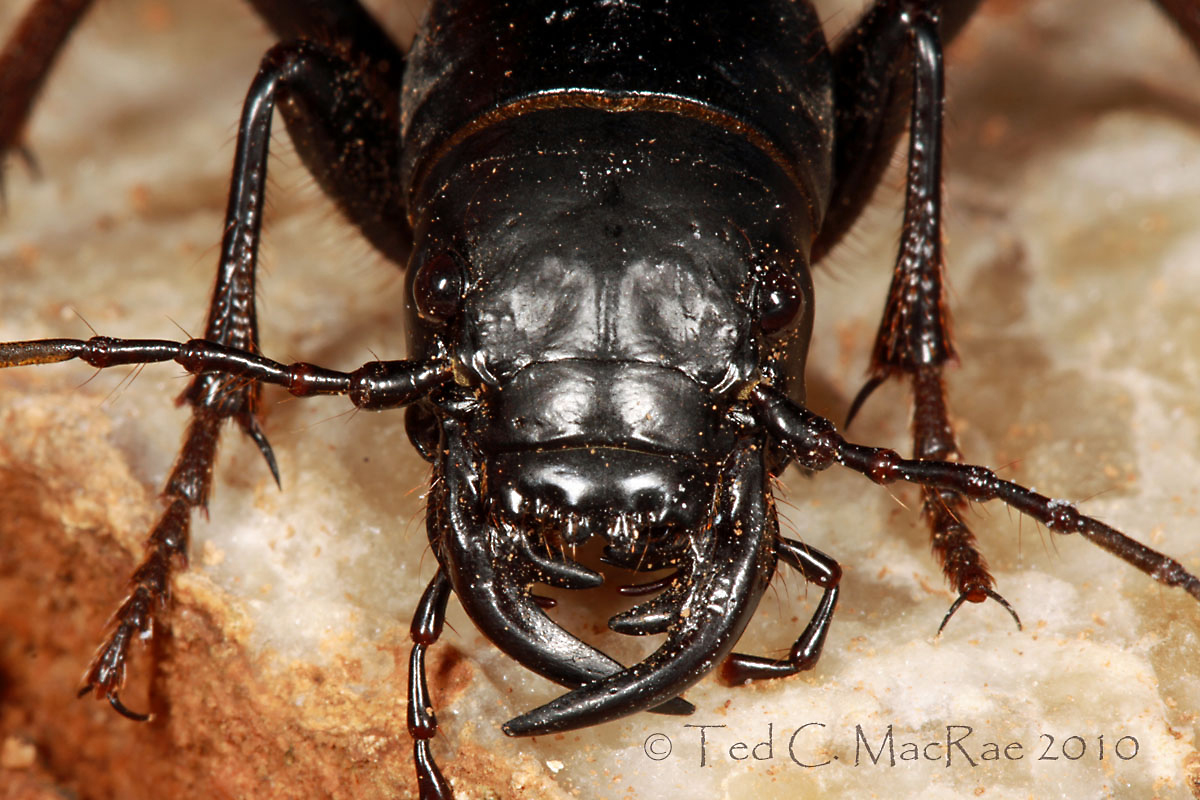
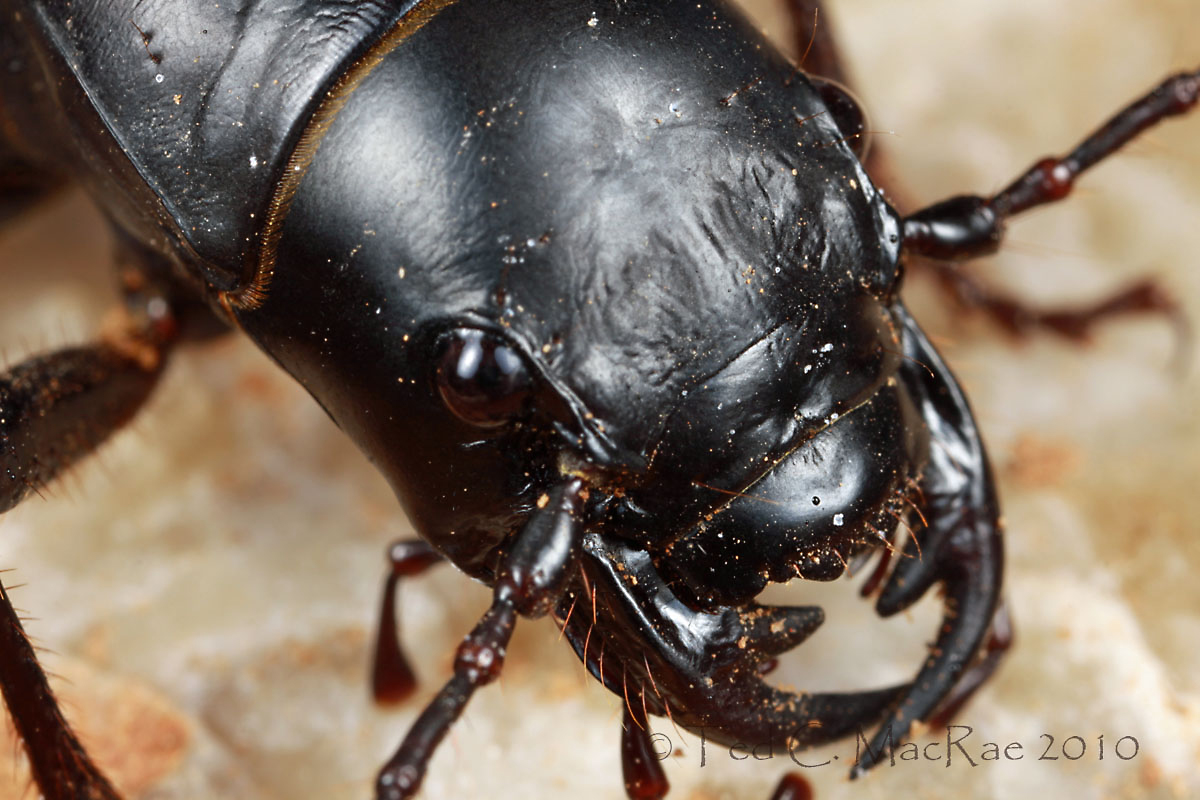
Of course, all this was really just passing time – waiting for nightfall and hoping the rain continued to hold off so I could begin searching the prairie down below for A. cylindriformis. It had sprinkled once or twice during the day, and I couldn’t tell if the darkening western sky was truly rain or the just the coming dusk. At 9pm, with darkness fast approaching, I set out with my headlamp and made a beeline for the native prairie habitat on the lower talus slopes where I had last year collected the larva and observed additional larval burrows that I took to be the same species. I must admit that the thought of walking alone through the prairie at night in western diamondback rattlesnake habitat made me more than a little nervous, and I kept just as much an eye out for them as I did the tiger beetles that I was looking for. As the night wore on, my hopes began to dim – I had searched for almost an hour and had covered most of the area where I had seen larval burrows last year. With no sign of the beetle, the negative thoughts started to enter my head – did I make this drive for nothing? How sure was I that the larva really represented Amblycheila? Did I have the right search image? I mean, they’re huge black beetles – they should be easy to spot, right? Oh great, I made all this fuss on my blog about looking for the species – how embarrassing to have to say, “Uhm, well, I didn’t find it.” Just as I began wrapping back around the bottom of the talus slope, there it was – no doubt about it! I just watched it for a while and noted that it moved with some urgency, but it was not the speedy, jerking walk of ‘regular’ tiger beetles – rather, it was more lumbering, seeming to pick each foot up rather high, like a cat with rubber bands on its feet (how would I know about that?). There seemed little risk of it escaping me, so I got out the camera and began following it to take photographs – no way! While it may have lacked the speed of other tiger beetles, it also lacked their propensity to occasionally pause long enough to allow a shot or two. Add the darkness, fear of rattlesnakes, and constant bumping of the flash unit on my headlamp, and it was soon apparent that getting good field photographs was going to be a low percentage proposition. I resigned myself to taking photographs later in a terrarium (several shown here) and spend my time in the field more productively looking for additional individuals.
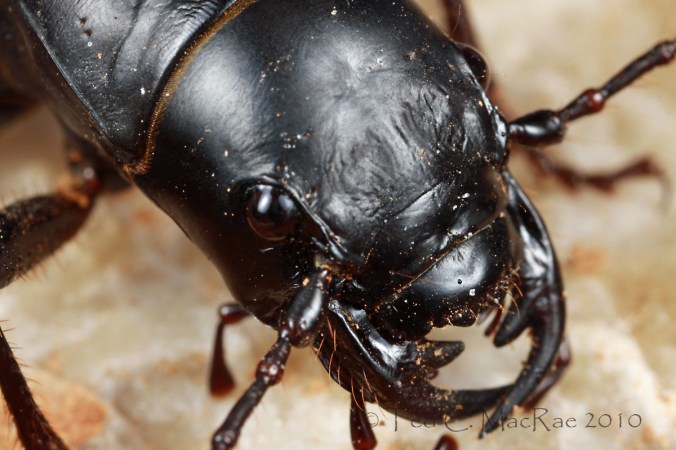
Finding the first individual did wonders for my motivation, and though still nervous about the potential for rattlesnakes I continued searching an ever-widening swath of the talus slope and adjacent areas. Another hour passed, and I had searched not only the native prairie below the talus slopes, but clay exposures on adjacent somewhat altered habitat. Again, the negative thoughts started creeping back into my mind – am I really gonna walk away from here with a single individual? I can say I found it, but that was a long drive for one beetle! I continued searching along an adjacent drainage ditch, and by 11:30pm I conceded that my victory was small and walked back to the truck to get a container to fill with native soil for a terrarium. Though it was a bit of a walk back up to the talus slope where I had seen the larval burrows, I wanted to take soil from that area specifically to give myself the best shot at obtaining eggs from my single (hopefully female) individual for an attempt at rearing more specimens from larvae. As I approached the exact spot where I had collected last year’s larva, I saw another, even larger adult! I don’t know which was greater – my excitement at finding such a large individual, or my relief in knowing that I would not go home with only one. Of course, with the second individual came a new shot of motivation, so once again I scanned across the talus slopes, and during the next half hour I found two more very near to where I had found the second one. By then it was past midnight, so I set about the business of digging soil for the terrarium. I finished the job (getting stung something terrible by three red, big-headed ants that had crawled up my pant leg while I was digging), took one last sweep across the immediate area, and turned to walk back to the truck when I saw the biggest one of all – I later determined it to be a male measuring 35 mm in length (that’s just about an inch and a half, folks!). With five individuals now, the urgency to find more was gone, and I decided I’d done what I needed to do and should get into town and find a hotel room. As I walked back to the truck, rain began to fall – lightly at first but ever increasing. Once back at the truck it was raining persistently enough that I could only hurriedly take some quick photographs of the beetles in their terrarium as in situ documentation of the momentous occasion!
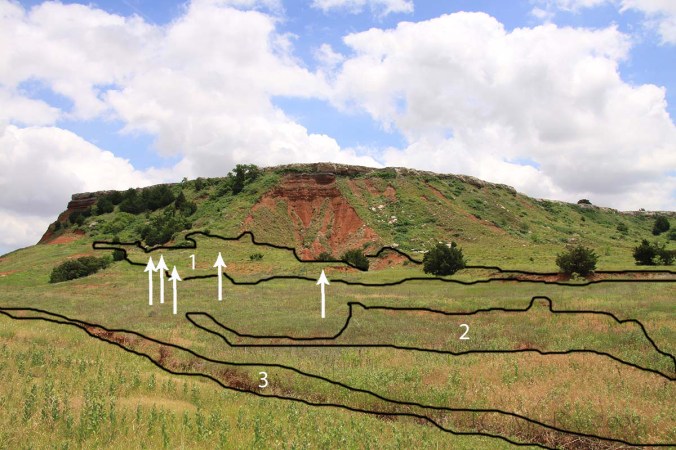
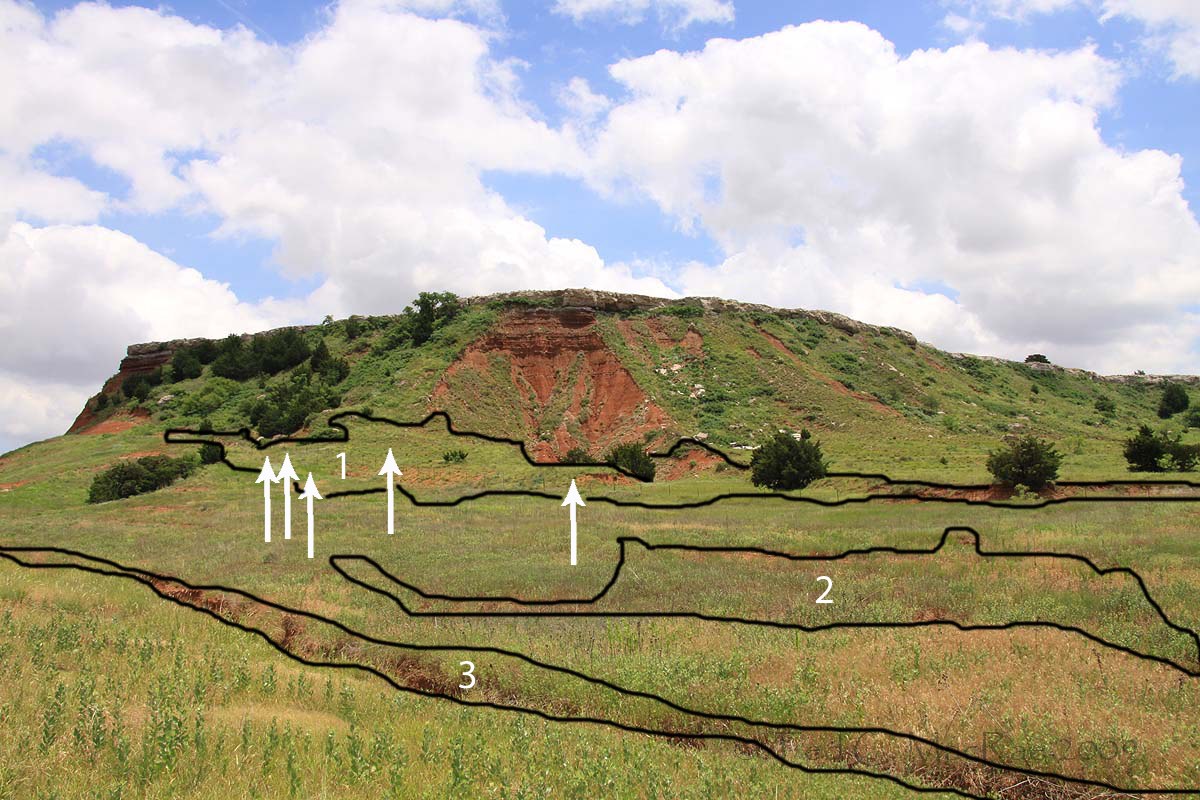
Occurrence of Amblycheila cylindriformis. White arrows indicate where adults were found, all of which were on red clay/gypsum exposures on lower talus slopes in native prairie habitat. No adults were seen in clay/gypsum exposures further below the slopes in either native (zone 1) or altered prairie (zone 2) or further down in roadside drainages (zone 3).

Although I had accomplished my main goal, I looked forward to the opportunity the next day to search for C. celeripes at other nearby sites to better understand the extent of the area’s population.  Sadly, the rain that had held off for nine hours before returning just after midnight was back for good, with radar the next morning showing a broad swath of rain extending across the entire western part of Oklahoma and north into Kansas.  There wasn’t much for me to do but savor the previous day’s experience while I made the 525-mile drive back east.  This may represent a significant record for the species – Vaurie (1955) in her review of the genus did not see any specimens from Oklahoma (although she did examine a few specimens from adjacent areas of Kansas), and Drew and Van Cleave (1962) reported only a single specimen from the state in nearby Woodward County.  Significant record or not, it was an experience that I’ll not soon forget.

Photo Details: Canon 50D (ISO 100, 1/250 sec), Canon MT-24EX flash.
Photos 1-3: Canon 100mm macro lens (f/14-20), flash 1/4 power w/ Sto-Fen diffusers.
Photo 4: Canon MP-E 65mm 1-5X macro lens (f/14), flash 1/8 power w/ Sto-Fen + Gary Fong Puffer diffusers.
Post-processing: levels, unsharp mask, slight cropping on photo 1.
Note to self: clean specimens with moist brush to remove dirt before photographing them!

REFERENCES:

Drew, W. A. and H. W. Van Cleave.  1962. The tiger beetles of Oklahoma (Cicindelidae). Proceedings of the Oklahoma Academy of Science 42:101–122.

Erwin, T. L. and D. L. Pearson. 2008. A Treatise on the Western Hemisphere Caraboidea (Coleoptera). Their classification, distributions, and ways of life. Volume II (Carabidae-Nebriiformes 2-Cicindelitae). Pensoft Series Faunistica 84. Pensoft Publishers, Sofia, 400 pp.

Vaurie, P. 1955. A review of the North American genus Amblycheila (Coleoptera, Cicindelidae). American Museum Novitates 1724:1–26.

Copyright © Ted C. MacRae 2010

Add to FacebookAdd to DiggAdd to Del.icio.usAdd to StumbleuponAdd to RedditAdd to BlinklistAdd to TwitterAdd to TechnoratiAdd to Yahoo BuzzAdd to Newsvine

Email to a friend

The Power of Impulse

Glass Mountains, Oklahoma

Since figuring out a couple weeks that I had the larva of North America’s largest tiger beetle (Amblycheila cylindriformis, or Great Plains giant tiger beetle) in a rearing tub in the lab, I haven’t been able to think about anything except how cool it would be to go back out to the Glass Mountains in northwest Oklahoma (where I collected the larva last June) and look for the adults.  I have every reason not to do this trip – I just spent a long weekend up in northwest Missouri on follow up surveys for our newly discovered population of Cylindera celeripes (swift tiger beetle) (my second such trip in the past three weeks¹), and in a mere week and a half I leave for a 2-week trip to France.  Bills need to be paid, the grass needs cutting, and (as of today) a broken spoke needs to be repaired.  My collecting trips are normally planned far in advance – their timing and frequency part of a delicate balance between the goals I set for the season and the responsibilities that go along with having a job and a family.

¹ More on this in an upcoming post.

But for Amblycheila, it’s now or never – at least for this season, and the thought of waiting until next year before I can take my first valid shot at finding this species in the wild (and perhaps a previously unrecorded population, at that²) is just too unbearable.  So here I am, halfway to the Glass Mountains on as impulsive a trip as I’ve taken in a long time, hoping that my hunch pays off and I’ll find the strikingly large adults of A. cylindriformis lumbering below the flat-topped mesas in the mixed grass prairie where a little more than a year ago I was collecting its enormous larva. It’s a drive-collect-drive trip, and if successful I won’t be the first person to photograph them, even well, but it will nevertheless fulfill my longtime desire to locate this species in the wild and see it with my own eyes – a far more gratifying experience than looking at the lone dead specimen acquired long ago through trade that sits in my cabinet. Wish me luck!

² Drew and Van Cleave (1962) saw only a single specimen from the state in neighboring Woodward Co., although this is now a rather old reference.

REFERENCES:

Drew, W. A. and H. W. Van Cleave.  1962. The tiger beetles of Oklahoma (Cicindelidae).  Proceedings of the Oklahoma Academy of Science 42:101–122.

Copyright © Ted C. MacRae 2010

Add to FacebookAdd to DiggAdd to Del.icio.usAdd to StumbleuponAdd to RedditAdd to BlinklistAdd to TwitterAdd to TechnoratiAdd to Yahoo BuzzAdd to Newsvine

Email to a friend

Are we loving our prairies/glades/woodlands to death?

I had such high hopes for last weekend’s collecting trip – late May is boom time for insects across Missouri, we have had good moisture this spring, and I would be visiting some high-quality natural communities that I had not visited for a long time.  My stated goals (the jewel beetles, Agrilus impexus and A. frosti) were long shots – I knew that and would have been fine coming home without those species (which I did) had the the collecting been otherwise productive (which it was not).  Still, I’ve been doing this for a long time now, and I’ve learned to draw on my accumulated experience when things don’t go as planned to give myself the best shot at turning a bad collecting trip into a decent one when things don’t go as planned.  The itinerary with which I start is rarely the one that I actually follow, and this past weekend was a good example of such.

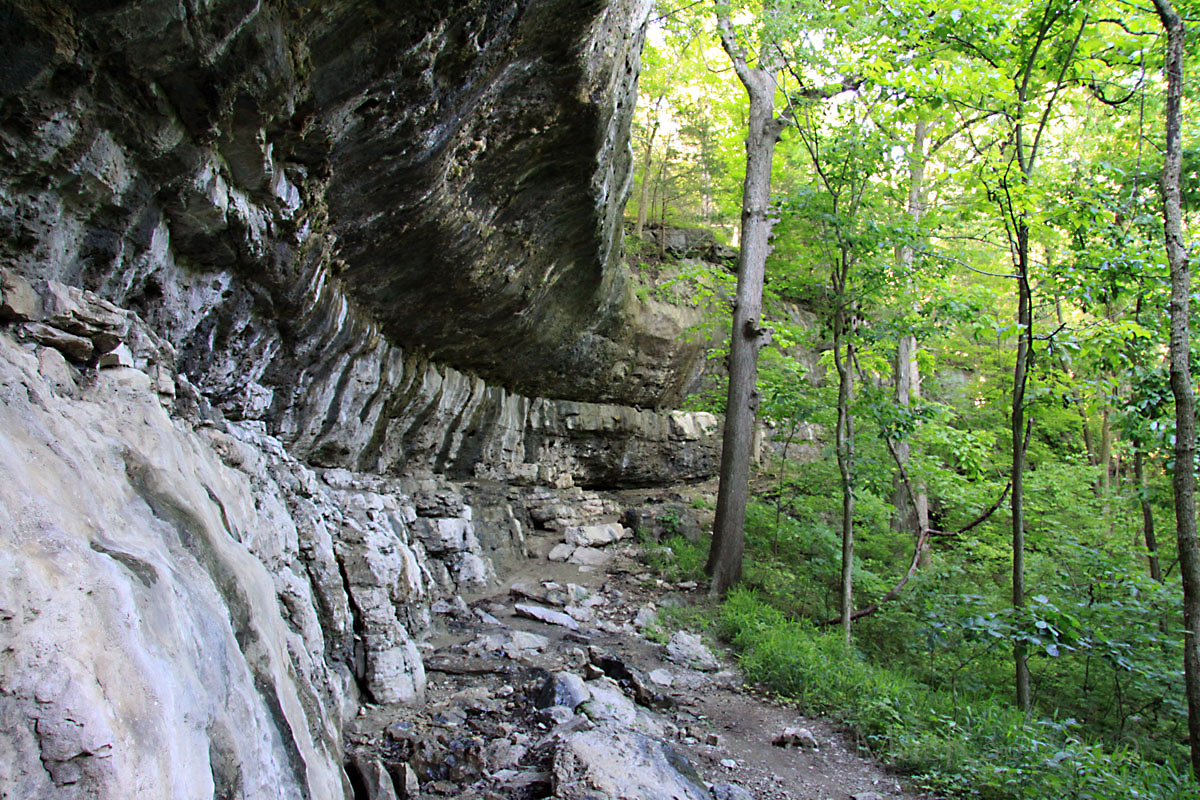
My first stop was Ha Ha Tonka State Park, one of Missouri’s premier parks, boasting high-quality chert, dolomite, and sandstone savanna interspersed with dolomite glades.  It is on these glades and savannas that I hoped to find Agrilus impexus, or failing that at least collect a nice diversity of other jewel beetles on the oaks and hickories of the savannas and surrounding woodlands.  However, it was with some reservation that I even came here after being told by my colleague at the Department of Natural Resources just 2 days before my trip that 75% of the park’s grasslands and woodlands had been burned within the past two years.  For an insect collector, this is never good news – in all my years of collecting insects, my experience in relatively recently-burned habitats has been consistent: collecting sucks!  I decided, however, to visit Ha Ha Tonka anyway because of the quality of the natural communities it contains, thinking perhaps I might be able to find pockets of unburned habitat supporting good insect populations.  This was not to be. I beat oak after oak in the savannas and woodlands – nothing!  I swept little bluestem and Indian grass in the glades – nothing!  The foliage was lush and green and the savanna and glade landscapes highly diverse – given the time of season the place should have been teeming with insect life, yet it almost seemed sterile. Were it not for a few Chrysobothris quadriimpressa jewel beetle adults that I found attracted to a recently wind-thrown black oak tree, I would not have seen any insects here at all.  It appeared my fears about park-wide depression of insect populations had been realized.  However, not one to waste a visit I decided to explore some of Ha Ha Tonka’s fascinating geological features.  Ha Ha Tonka contains one of Missouri’s best examples of karst geology, with complex structures formed from the collapse of a major cave system.  The Devil’s Promenade is one of the more spectacular examples of such, its horseshoe-shaped cliff representing the former interior walls of a now-collapsed cave.  As dusk approached, the day’s poor insect collecting caused me to abandon my plans to stay here and blacklight for nocturnal beetles.  Instead, I decided to break from the itinerary, drive further west and explore Lichen Glade Natural Area in the morning before heading to the Penn-Sylvania Prairie BioBlitz later that afternoon.

Devils Promenade, Ha Ha Tonka State Park

Lichen Glade Natural Area is a small area owned by The Nature Conservancy that boasts a high-quality sandstone glade surrounded by post oak/black jack oak forest.  My first visit to the area more than 20 years ago was during May, and it was one of the most productive collecting trips I’ve had with a number of Agrilus spp. (including A. frosti) beaten from post oak (Quercus stellata) along the woodland edge.  I didn’t visit again until fall of 2002, when Chris Brown, Rich Thoma and I found claybank tiger beetles (Cicindela limbalis) sunning on the exposed sandstone outcrops, and I made one more visit the following May to beat more insects off of post oak.  The Lichen Glade that I returned to this past weekend was a very different place from when I last visited – the surrounding woodlands had been extensively opened (I would guess within the past few years based on the size of the post oak resprouts), and fire had been used throughout the area.  Anticipation turned to frustration when no amount of beating of the woodland vegetation and sweeping of the glade vegetation turned up beetles in any appreciable numbers (or any insects for that matter) and two hours worth of effort yielded not a single buprestid beetle!

Sandstone glade community, Lichen Glade Natural Area

With resignation, I headed on over to Penn-Sylvania Prairie, where during the introduction to the BioBlitz I learned that nearly half of the 160-acre prairie was burned last December and all of it had been burned within the past few years.  I knew what I was going to find – nothing!  Okay, I shouldn’t say nothing, as there actually were some beetles present.  However, the numbers and diversity were low, with all of the species encountered representing common, widespread species.  Moreover, it was not just beetles – all of the invertebrate group leaders (which included experts on snails, ants, butterflies, and bees) reported low overall abundance and diversity in their groups of interest.  Only the vascular plants – the metric by which the value of prescribed burning is always assessed – showed high diversity, with 300 species of mostly native prairie plants recorded for the site.  It was a fun event, with probably ~75 attendees and a delicious pot luck dinner that evening; however, it would have been more enjoyable had there actually been a nice diversity of insects present to document for the preserve.

My comments may make it seem that I am against the use of prescribed burning.  This is not true – I understand the critical role that fire as a management technique plays in restoring and maintaining examples of Missouri’s historically fire-mediated landscape. Without fire and other processes to mimic natural disturbance factors, most of Missouri’s historical grasslands and woodlands suffer relentless encroachment by woody vegetation. However, the modern landscape is very different from the historical landscape, where fires of unpredictable scale, intensity, and frequency operated within a vastly larger scale to create a shifting mosaic of natural communities in various stages of ecological succession. Such processes cannot be recreated on today’s severely fragmented landscape, where the precious few remaining tracts of native habitat are relatively to extremely small and more often than not separated from each other by vast expanses of homogeneous and “inhospitable” habitat (e.g., agricultural, urbanized, or severely degraded lands).  It is in that context that I have great concerns about how aggressively fire has been used in recent years on our state’s natural areas and the impact this is having on insect populations – specialist and generalist alike.  Fire proponents will point to published studies that show little to no effect by the use of fire for managing small, isolated remnants on specialist insects (see review in Henderson 2010).  However, there are an equal number of studies that suggest such concerns are well-founded (see review in Panzer 2002). A consistent limitation in all of the studies that have been conducted is the lack of very large and long un-burned remnants.  Prescribed burning has been adopted so rapidly and pervasively that there just aren’t any significant un-burned remnants left to properly include as controls in such studies.  As a result, the insect fauna present at a given site at the start of such a study is already skewed towards those species that successfully recolonized the area post-burn.  At a minimum, the data to this point are inconclusive, and certainly the potential for impacts has not been given the consideration it warrants in designing fire-management plans for our own state’s prairies and glades. Furthermore, as rapidly and aggressively as fire has been adopted on our few, small, widely disjuct remnants, the opportunity for proper investigation of those potential effects may be gone.  A particularly egregious example of the lack of consideration being given to prairie invertebrates in designing fire management plans is shown in these photos of Iowa’s Sylvan Runkel State Preserve before and after a late May burn and the impact of that burn on a resident population of Nevada buck moths (Hemileuca nevadensis).

Here in Missouri, as in Iowa, it’s a problem of scale – the landscape is too fragmented and remnants too disjunct to manage based strictly on floristic response.   Populations of generalist insect species will recover, and even specialist species may be able to overcome such management practices if they are widely distributed and sufficiently mobile. But what about conservative species with low vagility, such as the swift tiger beetle (Cylindera celeripes) and our disjunct population of the frosted dromo tiger beetle (Dromochorus pruinina), flightless species restricted in Missouri to the few tiny remnants of loess hilltop prairie in northwestern Missouri and a single 2.5-mile stretch of roadside habitat in west-central Missouri?  Until directly relevant data, gathered here in Missouri, are forthcoming to suggest otherwise, I believe the most judicious use of fire possible should be practiced in restoring and maintaining our grasslands and woodlands.  In-season burns may have been a part of the historical landscape, but their use today has great potential to result in local extirpations and should be used only after the most careful consideration.  Leaving un-burned refugia within remnant habitats to accelerate recovery would also be prudent – yet many land managers disregard this practice because of its logistical difficulties. This is especially true in small parcels, yet it is precisely these remnants that have the most to gain from their use (or lose from not doing so!).  In the historical landscape, every burn was a patch burn – no matter what its size, there were always adjacent or proximal unburned habitat from which recolonization could occur.  Elk and bison, too, were integral components of the presettlement prairie landscape – their roamings caused intermittent, localized disturbances that were likely not only crucial to the tiger beetles that I study but may also have contributed to vegetational diversity through patch succession.  Techniques that mimic these natural disturbance factors include mowing, haying, and managed grazing.  They can be utilized to mimic those disturbances as well as delay woody encroachment, and their use in land management should be considered for their ecological value rather than deprioritized because of their relatively greater complexity and cost to implement. Mechanical removal and selective use of herbicides offer additional tools for addressing woody encroachment while minimizing potential impacts to insect populations. An effective management program that considers all of the flora and fauna of a remnant may not be possible unless all of these management tools are utilized, or at least properly considered. As my good friend James Trager said in a recent email (quoting Andrew Williams), habitat restoration “cannot rest on any single management practice, nor practicing it too extensively.”

REFERENCES:

Henderson, R. A.  2010. Influence of Patch Size, Isolation, and Fire History on Hopper (Homoptera: Auchenorrhyncha) Communities of Eight Wisconsin Prairie Remnants.  Wisconsin Department of Natural Resources, Research Report 189, 22 pp.

Panzer, R. 2002. Compatibility of prescribed burning with the conservation of insects in small, isolated prairie reserves. Conservation Biology, 16(5):1296-1307.

Copyright © Ted C. MacRae 2010

Add to FacebookAdd to DiggAdd to Del.icio.usAdd to StumbleuponAdd to RedditAdd to BlinklistAdd to TwitterAdd to TechnoratiAdd to Yahoo BuzzAdd to Newsvine

Email to a friend

Euhagena nebraskae in Kansas

Gypsum Hills region of south-central Kansas (Barber Co.)

One of my favorite destinations for insect collecting is the Gypsum Hills region in Barber County of south-central Kansas.  I first went there in May 1986 after seeing a diverse selection of more typically Texan Buprestidae that J. Richard Heitzman, an iconic lepidopterist in the Kansas City area and author of Butterflies & Moths of Missouri, had collected there on soapberry (Sapindus saponaria).  I had my own success with Buprestidae as well during that trip, but in recent years I have returned to Barber County several times during the fall to look for one of North America’s most beautiful tiger beetles, Cicindela pulchra (Beautiful Tiger Beetle).  This species had been recorded in the area by the well-known cicindelophiles Ron Huber and Dave Brzoska, who suggested that I look in the red clay hills just west of Medicine Lodge.  My first trip to look for this beetle in 2004 was unsuccessful, and I suspect the early September timing of my trip may have been a tad too early.  I returned again in 2005, this time in early October and also enlisting the help of local entomologist “Beetle Bill” Smith, who knew of a population on private land near his home in Hardtner (south of Medicine Lodge).  Although at first it looked like success might again elude me, in the end I saw a robust population of these spectacular beetles and published an account of that marvelous experience (MacRae 2006).

As with so many of the things that I have seen over the years, they came before my interest in photography, and I now find myself wanting to re-find some of the more spectacular insects that I’ve previously found so that I can properly photograph them.  Such is the case with C. pulchra, so in October of last year I returned to Barber County in hopes of seeing this species armed not only with an aerial net, but also a Canon 50D.  Sadly, this would not come to pass – the same sudden cold snap that dashed my hopes of finding this species in nearby Woodward/Major Counties, Oklahoma would keep any tiger beetle activity to a bare minimum the following day in Barber County as well.  Despite bright sunny skies, I would see only two tiger beetles the entire day, both representing the dreadfully ubiquitous Cicindela punctulata (Punctured Tiger Beetle).  Not all insect activity, however, was squelched, and after scanning the red soils for an hour or so without seeing the object of my desire I began to notice some of these other not-so-temperature-finicky species.  One of the more magnificent of these is shown in the photo below — Euhagena nebraskae in the family Sesiidae (cess-EYE-id-ee) (formerly Aegeriidae).

Euhagena nebraskae

Euhagena nebraskae (Lepidoptera: Sesiidae)

Although I wasn’t sure of the species at first, I recognized it immediately as a clearwing moth.  I had an interest in this family of moths for a time in my early days as a field entomologist with the Missouri Department of Agriculture.  Many species are important pests of woody plants in orchard and ornamental landscapes, and it was during that time that synthetic pheromones became widely used for monitoring purposes.  I often walked around with a pheromone tag pinned to my bag to attract the male moths — it was fun watching people seeing these moths “buzzing” me and thinking I was under attack by the wasps that they so effectively mimic (despite my calmness in these situations, I still found it hard to actually grab one from the air with my hand – so convincing is their mimicry).

Euhagena nebraskae is one of two species in the genus in North America, both of which develop as larvae in the roots of plants in the evening primrose family (Onagraceae) (Eichlin and Duckworth 1988).  In fact, I had seen its congener — E. emphytiformis — many times in the 1980s in pheromone traps that I used to place in the glades of Jefferson County just south of St. Louis, where it presumably breeds in one or both of two Oenetherea species growing there (O. gaura and O. macrocarpa).  Euhagena nebraskae is a more western species that does not occur in Missouri, occurring instead across the Great Plains west to California and from southern Alberta and Saskatchewan south to Mexico.  It is likely that many entomologists never see this species, as adults are active only during late fall.  Thus, its perception as an uncommon species may be an artifact of its late seasonality. 

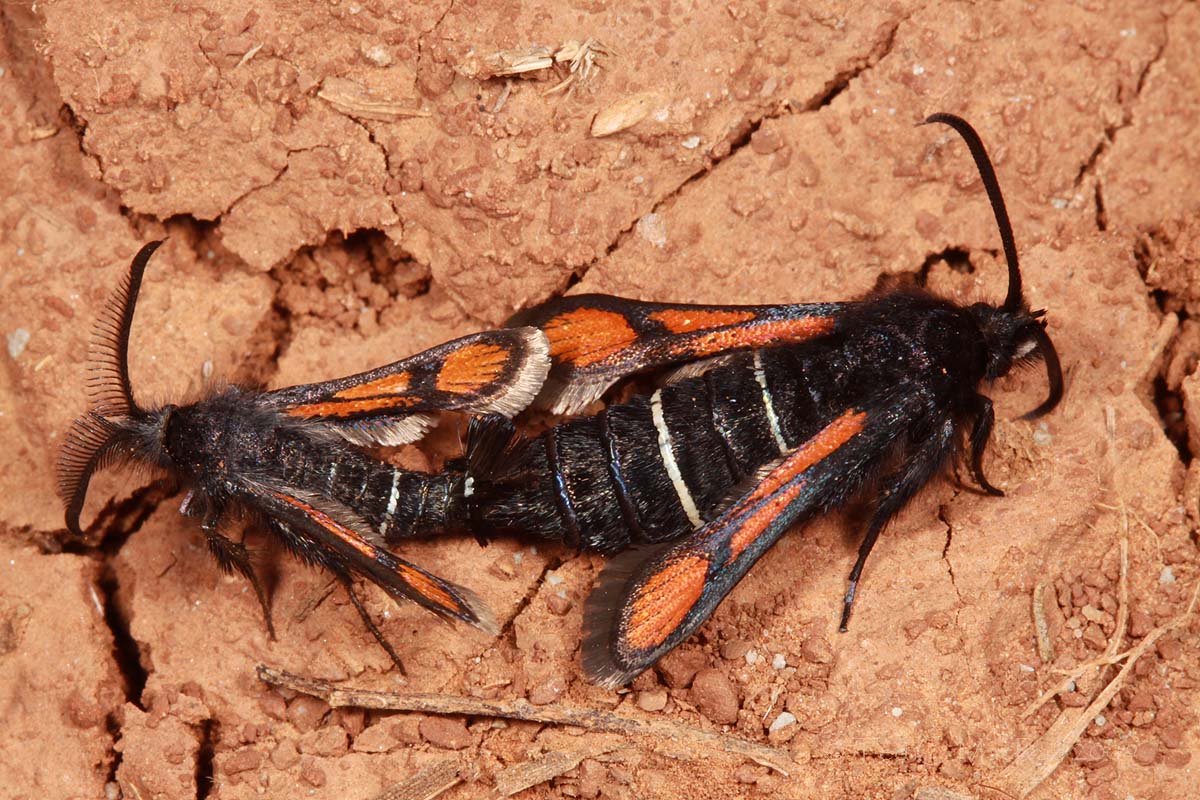
I thought it odd that nearly every individual that I saw was sitting on the ground rather than perched higher on a plant.  At first I wondered if the cold temperatures were a reason for this, perhaps causing the moths to seek out the ground as a source of radiant heat.  This seems doubtful, however, since females always seemed to be “calling” – their tufted abdominal tips raised in the air with the scales spread apart, apparently releasing pheromone.  I was fortunate to find this mating pair, which shows nicely the rather high degree of sexual dimorphism seen in these moths.  Note the much more highly bipectinate antennae of the male (pectinate = resembling a comb, bipectinate = ‘teeth’ on both sides of the main stem) versus the simple antennae of the female — males use their antennae for detecting female pheromones, and the bipectinate form presumably provides greater surface area for placement of sensory pores. Note also the male’s smaller size, “hairier” head and thorax, and greater amount of white coloration on the abdomen and wings.  Engelhardt (1946) supposed that the excessive hairiness of adult Euhagena species was an adaptation to their late-season emergence (principally during October and sometimes as late as November), a time when frosty nights prevail in their high-elevation haunts.    

REFERENCES:    

Eichlin, T. D. and W. D. Duckworth. 1988. The Moths of America North of Mexico, Fascicle 5.1, Sesiodea: Sesiidae. Wedge Entomological Research Foundation, Washington, 176 pp.

Engelhardt, G. P. 1946.  The North American clear-wing moths of the family Aegeriidae. Bulletin of the United States National Museum 190:1-222.

MacRae, T. C. 2006. Beetle bits: The “beautiful tiger beetle”. Nature Notes, Journal of the Webster Groves Nature Study Society 78(4):9–12.

Copyright © Ted C. MacRae 2010

Add to FacebookAdd to DiggAdd to Del.icio.usAdd to StumbleuponAdd to RedditAdd to BlinklistAdd to TwitterAdd to TechnoratiAdd to Yahoo BuzzAdd to Newsvine

Email to a friend
Cicadetta kansa in Oklahoma

Photo details: Canon 100mm macro lens on Canon EOS 50D, ISO 100, 1/250 sec, f/14, MT-24EX flash 1/4 power w/ Sto-Fen diffusers.

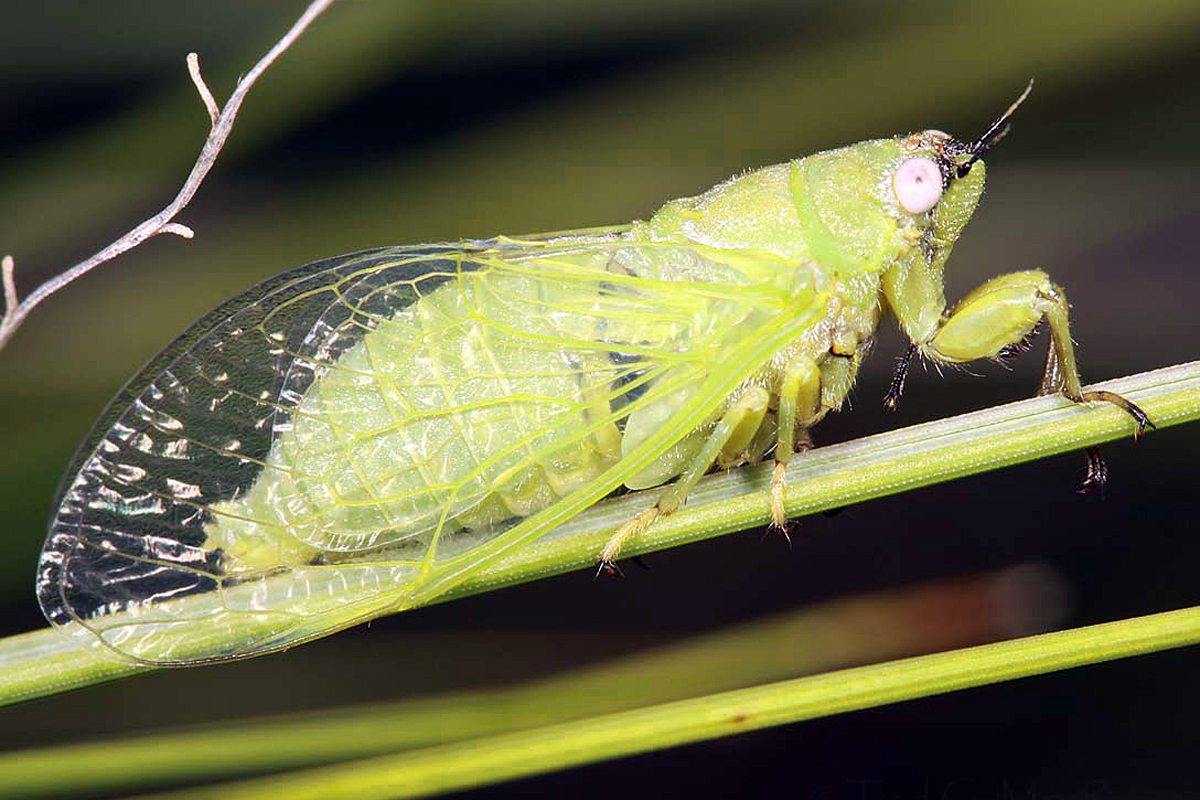
Another of the insects that I saw this past June at Four Canyon Preserve in northwestern Oklahoma was this small cicada, Cicadetta kansa. Though not as small as the diminutive Beameria venosa (see North America’s smallest cicada), their barely audible call – a soft buzz – makes them even more difficult to notice.  I only realized what they were after noticing something odd about the small, green “grasshoppers” that flitted in front of me as I walked through the mixed shortgrass prairie.  They didn’t quite fly “right” and landed delicately within the grass rather than crashing into it clumsily.  Even after realizing that they weren’t grasshoppers, it was difficult to say what they were at first due to their wariness and lime green coloration that helped them blend marvelously into their grassy surroundings.  A few sweeps of the net solved that problem, and I discovered what was at the time the smallest and most beautiful cicada I had seen to that point (Beameria venosa took both honors later that month in the Loess Hills of northwestern Missouri).

Despite being the only world-wide genus of cicadas, Cicadetta is represented in the U.S. by only two species—C. kansa and C. calliope.  In addition to its pale green coloration, C. kansa is distinguished from C. calliope by having only 4 or 5 apical cells in the hind wing (6 in C. calliope).  Cicadetta kansa occurs from Texas north to South Dakota, while C. calliope is found from Texas to Florida and northwards to Iowa, Ohio and New Jersey.  Little is known about the biology of Cicadetta kansa; however, presumably it is similar to that of C. calliope, which emerges and lays eggs in late spring.  Eggs hatch by late summer, at which time the nymphs burrow into the ground again begin feeding on the roots of grasses.  This feature of their biology protects them from the negative impacts of managed spring and fall burns, and indeed C. calliope is known to increase in prairies that are managed by such burns.  This is in contrast to other prairie cicadas (genus Tibicen), which overwinter as eggs in the above-ground portion of grasses and, thus, are negatively impacted by fall and spring burns.

A number of websites are dedicated to these charismatic insects; however, Cicada by Andy Hamilton at the Canadian National Collection of Insects, Arachnids and Nematodes is the most informative and comprehensive that I’ve found.

Copyright © Ted C. MacRae

Add to FacebookAdd to NewsvineAdd to DiggAdd to Del.icio.usAdd to StumbleuponAdd to RedditAdd to BlinklistAdd to TwitterAdd to TechnoratiAdd to Furl

North America’s largest robber fly

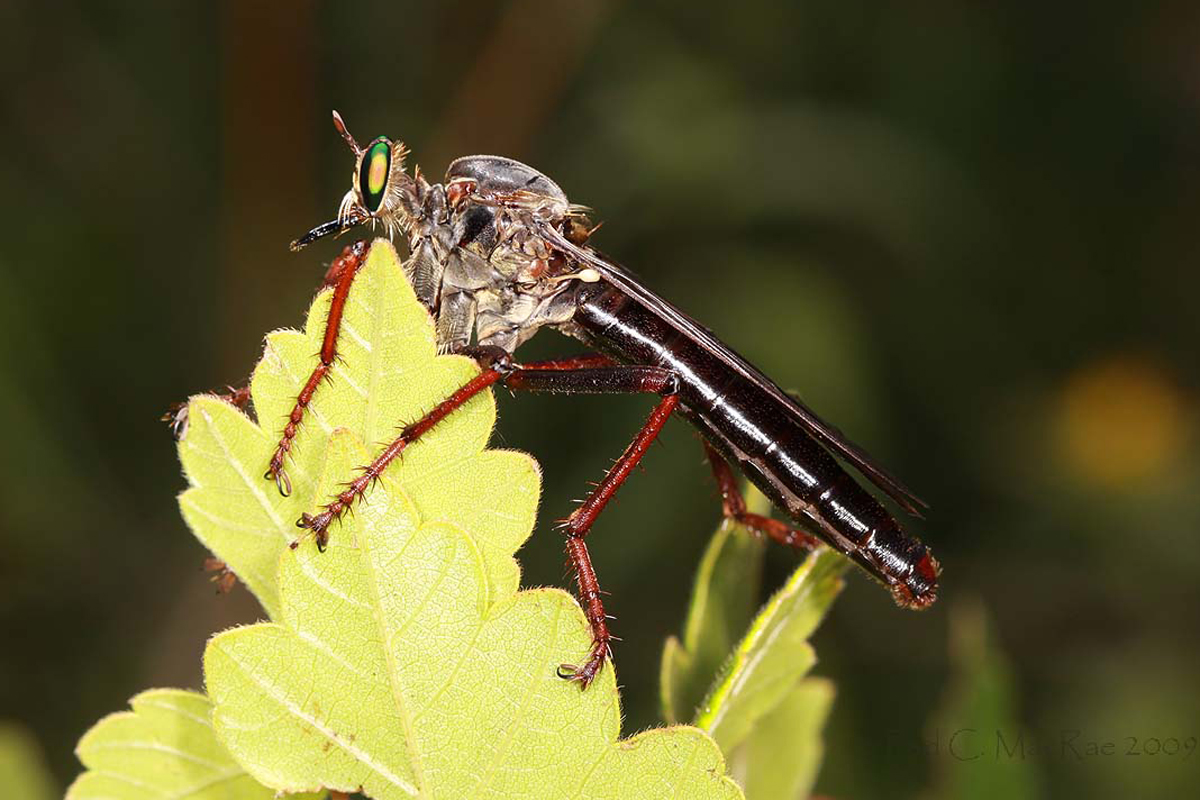
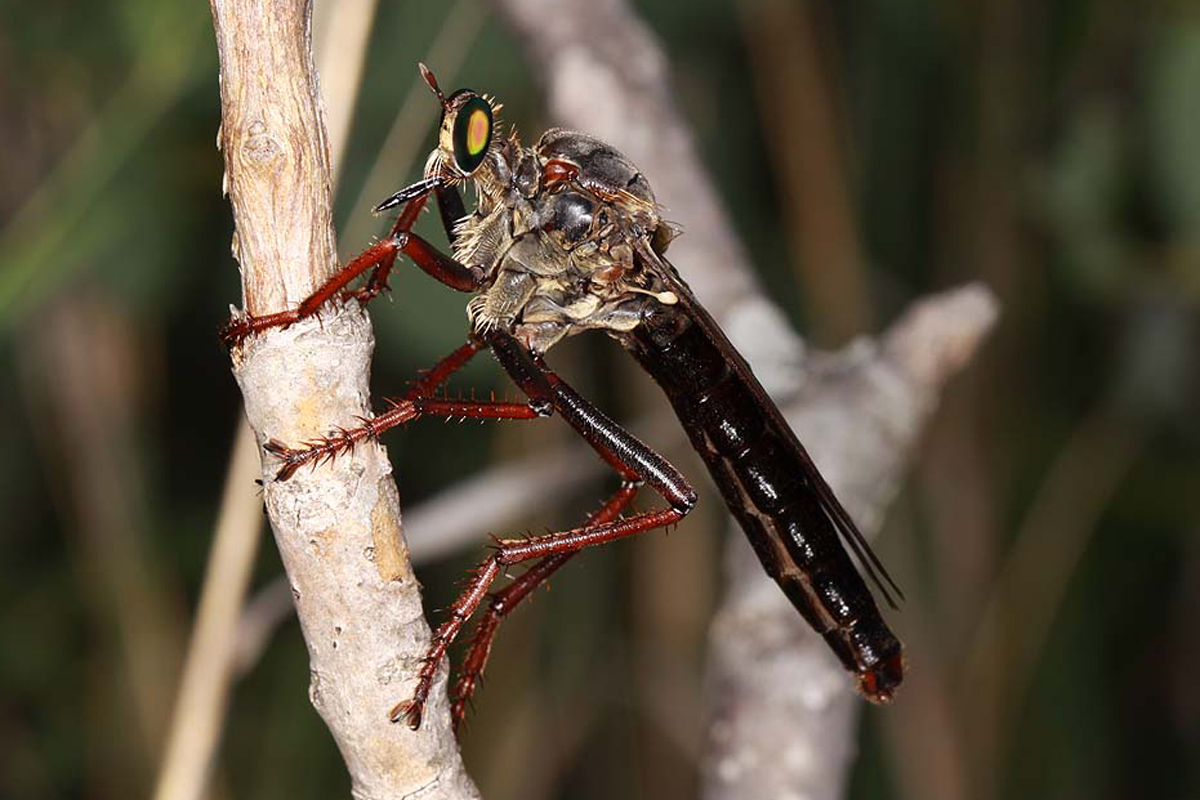
Female Microstylum morosum perched on fragrant sumac (Rhus aromatica) bush

Female Microstylum morosum perched on fragrant sumac (Rhus aromatica)

A few days ago, I featured Promachus hinei, one of the so-called “giant robber flies” and a common inhabitant of the glades and grasslands that dot Missouri’s largely forested landscape. That individual was seen at Long Bald Glade Natural Area in Caney Mountain Conservation Area, one of the many limestone glades that are a prominent feature of extreme southwestern Missouri’s White River Hills, as it snacked on a small carpenter bee (Ceratina sp.) and posed obligingly for a series of super close-up photographs. Promachus and its congeners are impressively large; however, I would see an even larger robber fly that day. I didn’t know what it was at the time, but I knew that never before had I seen such a magnificent fly, with its large, shimmering, emerald eyes, streamlined body almost devoid of setae (hairs), and ludicrously large size. These monsters were actually quite common at the glade, so I failed to appreciate the significance of what I was seeing as I chased one after another – more intent on securing photographs than specimens. This was not an easy task – they were extremely wary, rarely allowing me to approach within 12 feet no matter how cautiously and slowly I moved. Not one to back down from such a challenge (remember, I stalk tiger beetles), I persisted, traversing the rough, rock-strewn terrain amidst clumps of big bluestem (Andropogon gerardii), Indian grass (Sorghastrum nutans), and fragrant sumac (Rhus aromatica) until, at last, I got within striking distance of the impressive female shown in these photos. Taking flight before I felt assured of a good shot, I followed her repeated long, loping escape flights until I was able to get another few shots and she disappeared for good.

Same individual as in previous photo after flying to another perch.

Same individual as in previous photo after flying to another perch.

It didn’t take long after I returned home to figure out what I had seen, as there is really nothing that can be mistaken for Microstylum morosum, North America’s largest robber fly (Back 1909)¹. At 35–40 mm of length, this individual didn’t quite match the astounding 50-mm upper body length for the species (that’s 2 inches, folks!). Nonetheless, it was an impressive beast indeed! It is not surprising that North America’s largest robber fly should be a species of Microstylum, as it is this same genus that contains the world’s largest robber fly – the aptly named M. magnum from Madagascar, with a body length of 60 mm and an almost preposterous wingspan of up to 84 mm (that’s over 3 inches folks!). I don’t know if any flies exist that are larger than this, but certainly none can be more imposing.  While I’m happy with the photos that I did obtain, I must confess some disappointment that I wasn’t able to get more than these basic lateral profile shots.  Of the several photographs of this species that can be found on the web, this female, photographed by Greg Lavaty of Houston, Texas, is (in my humble opinion) certainly the most stunning.

¹ Puzzled by the use of the prefix “micro” in the genus name – hardly seeming appropriate for such an enormous fly – I asked Eric Fisher (retired, California Department of Food and Agriculture) about the name’s derivation, to which he replied, “The name refers to the quite small ‘stylus’ of the antenna apex; Macquart specifically mentions this character in his 1838 original description of the genus. (This is not a very helpful diagnostic character, as many asilids share this feature…).”

Even more significant than its size, however, was its very occurrence on this glade. Like Ospriocerus abdominalis, which I had seen just a few weeks earlier in the Loess Hills of extreme northwestern Missouri, M. morosum is a denizen of the Great Plains, and also like that species it has until now not been known from Missouri. That’s right – another new state record!  Unlike O. abdominalis, however, the Missouri occurrence of M. morosus represents a significant northeastern extension of its known range.  The species was long considered a Texas endemic until Beckemeyer and Charlton (2000) confirmed its occurrence in southeastern Arizona and documented significant range extensions into Oklahoma, Kansas, extreme southeastern Colorado, and extreme northeastern New Mexico.  Its eastern distributional limit was thought to occur along a north-south line from Douglas County, Kansas to Mayes County, Oklahoma to Brazoria County, Texas; however, Warriner (2004) documented its occurrence some 200 miles east of this line in the blackland prairies of southwestern Arkansas.  The occurrence of M. morosum in the White River Hills of Missouri represents yet another significant eastern extension of its known range – Long Bald Glade lies 185 miles NNE of the collection site in Arkansas and 155 miles ENE of the nearest known record in Mayes County, Oklahoma (Locust Grove), making it the easternmost known locality for this species.

As in Arkansas, where the collection site represents one of the highest quality blackland prairie remants in the state, Long Bald Glade represents a high quality remnant of the limestone glades that once occurrred much more extensively within Missouri’s White River Hills.  Like the blackland prairie of Arkansas, the limestone glades of the White River Hills have been dramatically reduced since EuroAmerican settlement due to land use conversion, and fire suppression and overgrazing of the remaining tracts have resulted in significant woody encroachment – chiefly by eastern red-cedar (Juniperus virginiana) – and loss of vegetational diversity. This has caused dramatic reductions in populations of the many Great Plains plant and animal species that are found here and nowhere else in the state.  Considering the overall distribution of M. morosum, it is unlikely that it occurs more extensively within Missouri than the White River Hills, emphasizing the importance of continued conservation and restoration activities in this unique part of Missouri.  However, since the White River Hills extend into northwestern Arkansas, M. morosum may occur in that part of Arkansas as well as the southwestern part of the state.

I thank Eric Fisher and Herschel Raney for confirming the identity of this species and its status as a new record for Missouri.

Photo details: Canon 100mm macro lens on Canon EOS 50D (manual mode), ISO-100, 1/250 sec, f/10-11, MT-24EX flash 1/2 power through diffuser caps.

REFERENCES:

Back, E. A. 1909. The robberflies of America, north of Mexico, belonging to the subfamilies Leptograstrinae and Dasypogoninae. Transactions of the American Entomological Society 35:137–400.

Beckemeyer, R. J. and R. E. Carlton.  2000.  Distribution of Microstylum morosum and M. galactoides (Diptera: Asilidae): significant extensions to previously reported ranges.  Entomological News 111(2):84–96.

Warriner, M. D.  2004.  First Arkansas record of the robber fly Microstylum morosum (Diptera: Asilidae).  The Southwestern Naturalist 49(1):83–84.

Copyright © Ted C. MacRae 2009

Add to FacebookAdd to NewsvineAdd to DiggAdd to Del.icio.usAdd to StumbleuponAdd to RedditAdd to BlinklistAdd to Ma.gnoliaAdd to TechnoratiAdd to Furl

A bit of housekeeping

I hope you’ll forgive the lack of pretty bug pictures and witty prose in today’s post – I have a few updates and adminstrative issues that I’d like to take care of.

Circus of the Spineless
This notice is a few days late, but Circus of the Spineless # 43 is up at Wanderin’ Weeta.  Susannah has done a great job of assembling blog posts on a diversity of invertebrates from anemones to annelids, bryozoans to barnacles, decapods to gastropods, and of course – insects.  In the latter group, all of the major orders are covered (including beetles by some guy that likes tiger beetles).

Expanded Blogroll
It has been quite a while since I last made mention of new additions to my ever-expanding blogroll.  I’m trying to maintain a fairly comprehensive list of blogs that either focus primarily on insects or feature compelling natural history discussions, and it seems that almost every week I find another one that either began recently or somehow escaped my earlier attention.  A few of these more recent additions deserve special mention for their interesting subjects, superior writing, quality photographic content, etc.

Rate My Posts
WordPress has a new widget that allows readers to rate the quality of posts.  I thought I would open myself up to this potential for praise or criticism and have activated this feature on this blog (and also my other blog, Bikes Bugs and Bones).  It’s a little jickery in that the “comments” link must be clicked in order to see the rating widget, which appears at the bottom of the post as 5 blank stars.  It’s a typical rating scale, with 1 star being the worst and 5 stars being the best.  I know a lot of readers don’t like to leave comments (although I heartily encourage them), but perhaps you would be willing to provide feedback in the form of a rating.  The ratings are completely anonymous – no IP addresses are recorded by the rating widget, so there is no way for me to know who voted or how.  Over time, as ratings accumulate for posts, I will be able to see what kinds of posts people really like (and which they really don’t).  This can be your way to contribute to the future direction of this blog!

  • 5 Stars = Excellent – use this for my very best pieces.
  • 4 Stars = Very Good – you really liked it, maybe just minor criticisms.
  • 3 Stars = Average – not bad, not great, it did the job.
  • 2 Stars = Fair – not one of my better pieces, a bad day perhaps.
  • 1 Star = Poor – well, let’s just hope I don’t get too many of these.

Editorial Duties
One of my long term goals is to be Managing Editor for an entomological journal.  Despite the volunteer nature of such a position, it’s not one that somebody can just walk into – dues must be paid.  I got a foot in the door a few years ago when I began serving as Coleoptera Subject Editor for The Pan-Pacific Entomologist, the journal of the Pacific Coast Entomological Society (we would welcome your manuscript dealing with western entomology in any aspect).  It has been an enjoyable experience, and I guess I’m doing a decent job since I was invited this summer to join the editorial team of the online journal Zootaxa.  This “mega-journal for zoological taxonomists in the world” has quickly become the leading journal for new taxa and taxonomic or nomenclatural acts, based on the coverage and indexing of Zoological Record since 2004.  This is possible only because of its team of 141 editors that cover the entire breadth of animal taxa – 17 of which (including me) handle the vast insect order Coleoptera.  Ever the glutton for punishment, I’ve also just accepted an invitation by the Webster Groves Nature Study Society to take over editorship of their monthly newsletter, Nature Notes.  I suppose the combination of these three editorial positions will let me know if I really want to pursue full editorship of a major journal at some point!

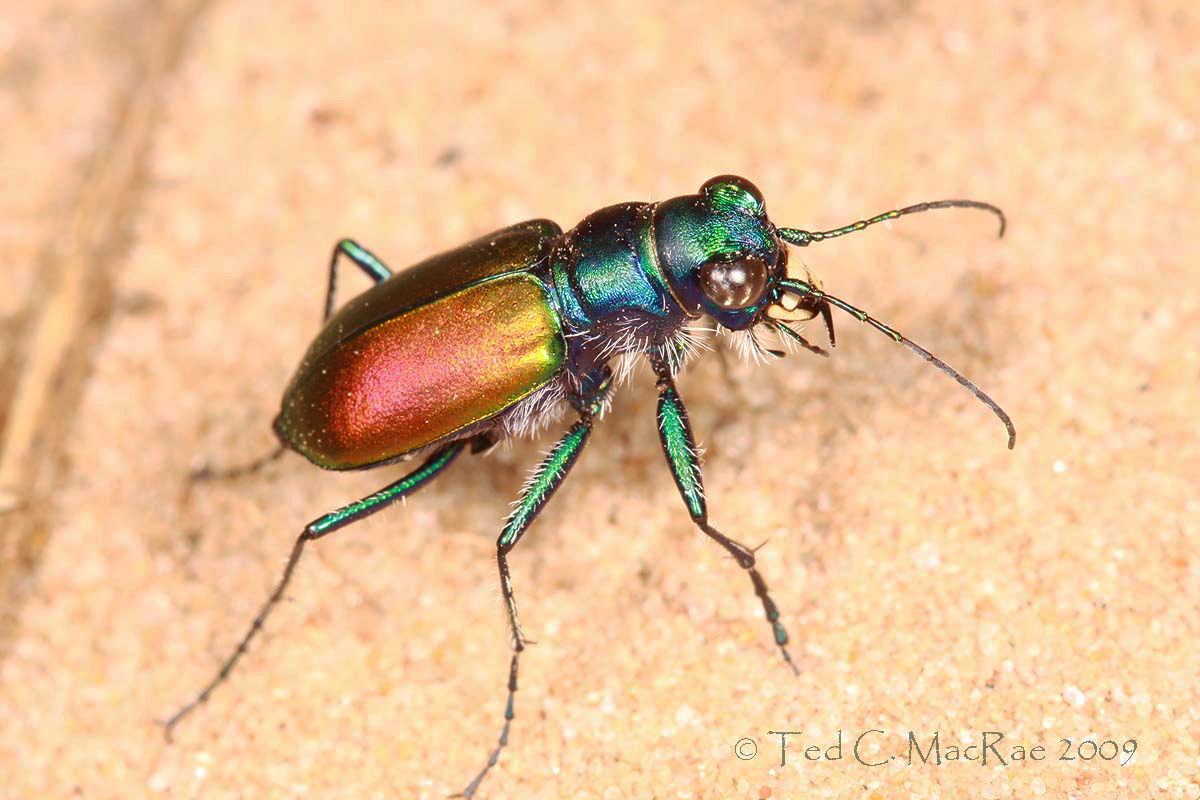
Okay, I can’t leave you without any kind of photograph – here are a couple of shots of Cicindela scutellaris, or festive tiger beetle. This male individual represents the stunningly beautiful nominotypical subspecies occupying the western part of the species’ range – it was photographed on sand exposures in shinnery oak shrubland habitat at Packsaddle Wildlife Management Area in extreme northwestern Oklahoma this past June.

IMG_0540_1200x800_enh

IMG_0547_1200x800

Photo details: Canon 100mm macro lens on Canon EOS 50D (manual mode), ISO-100, 1/250 sec, f/14-16, MT-24EX flash 1/4 power through diffuser caps.

Copyright © Ted C. MacRae

Add to FacebookAdd to NewsvineAdd to DiggAdd to Del.icio.usAdd to StumbleuponAdd to RedditAdd to BlinklistAdd to Ma.gnoliaAdd to TechnoratiAdd to Furl