Revisiting the Swift Tiger Beetle – Part 2

…continued from Revisiting the Swift Tiger Beetle – Part 1.

The rain that cut short my visit to Alabaster Caverns in northwestern Oklahoma followed me as I drove east towards Tallgrass Prairie Preserve in northeastern Oklahoma. I had called Mike when I began my drive to tell him the great news – I had located Cylindera celeripes at Alabaster Caverns, and the population appeared to be quite robust. This was great news for the species, which seems to have disappeared from many parts of its range and is holding out primarily in the Flint Hills of Kansas. Mike and Jane had just arrived at Tallgrass Prairie when I called, and I told them to expect me to show up in about three hours. Tallgrass Prairie preserve is the largest intact tallgrass prairie remnant in the world, but my interest in it was due to the fact that ecologically it lies within the southern realm of the Flint Hills. I thought there might be a chance of finding C. celeripes in the preserve, extending its currently known distribution further south into northeastern Oklahoma as well. As I continued the drive, however, the rain came down harder and harder, and after I had driven about halfway to the preserve, I got a call from Mike. It had started raining there as well, and the weather forecast was calling for rain through tomorrow and possibly into Friday. They had decided to call it quits and start heading back towards St. Louis.

Me? I wasn’t nearly ready to punt on the trip. However, I hadn’t made any contingency plans and, thus, didn’t have a clue what to do next. I decided to drive into the next town and look for a coffee house where I might get a wi-fi connection, study the weather forecasts for surrounding areas, and then decide what to do next. There were several possibilities – I could drive north up into Kansas to look for the Flint Hills population of C. celeripes, but that area still seemed in the path of the frontal disturbances that would be ripping through Oklahoma and Texas for the next day or two. Or, I could continue on into southern Missouri and do some blacklighting in the Ozarks, but that just seemed like spending time without a real purpose, and eventually the rain would make it there as well.  While studying my map of Oklahoma, I noticed that Alabaster Caverns was actually one of a cluster of state parks in Woodward and adjacent Major Counties.  I thought maybe I could look for similar habitats in or near these other parks to see if C. celeripes might actually be more broadly distributed in northwestern Oklahoma. There was also Salt Plain National Wildlife Refuge in the area, which had impressed me during two recent October trips with its diversity of tiger beetles associated with saline habitats. Thus, I decided to head back west over the very roads that took me to the east earlier in the day.

IMG_0620_1200x800

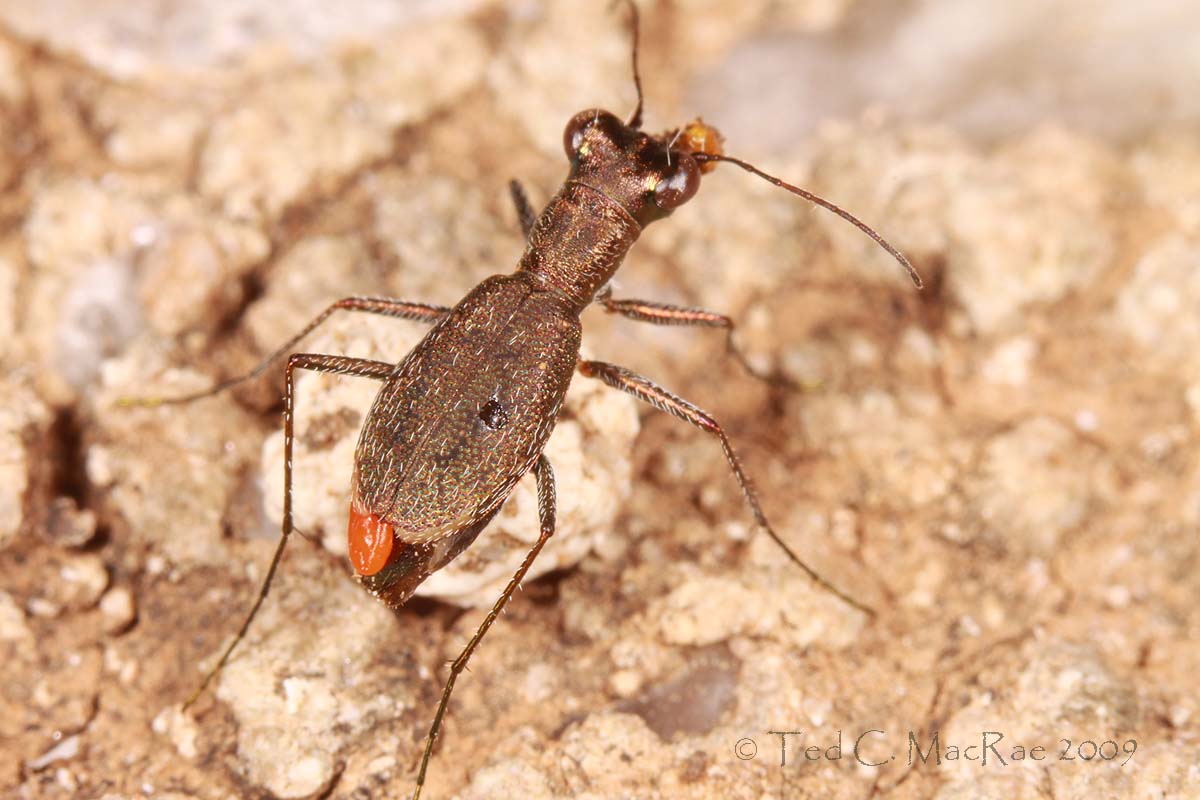
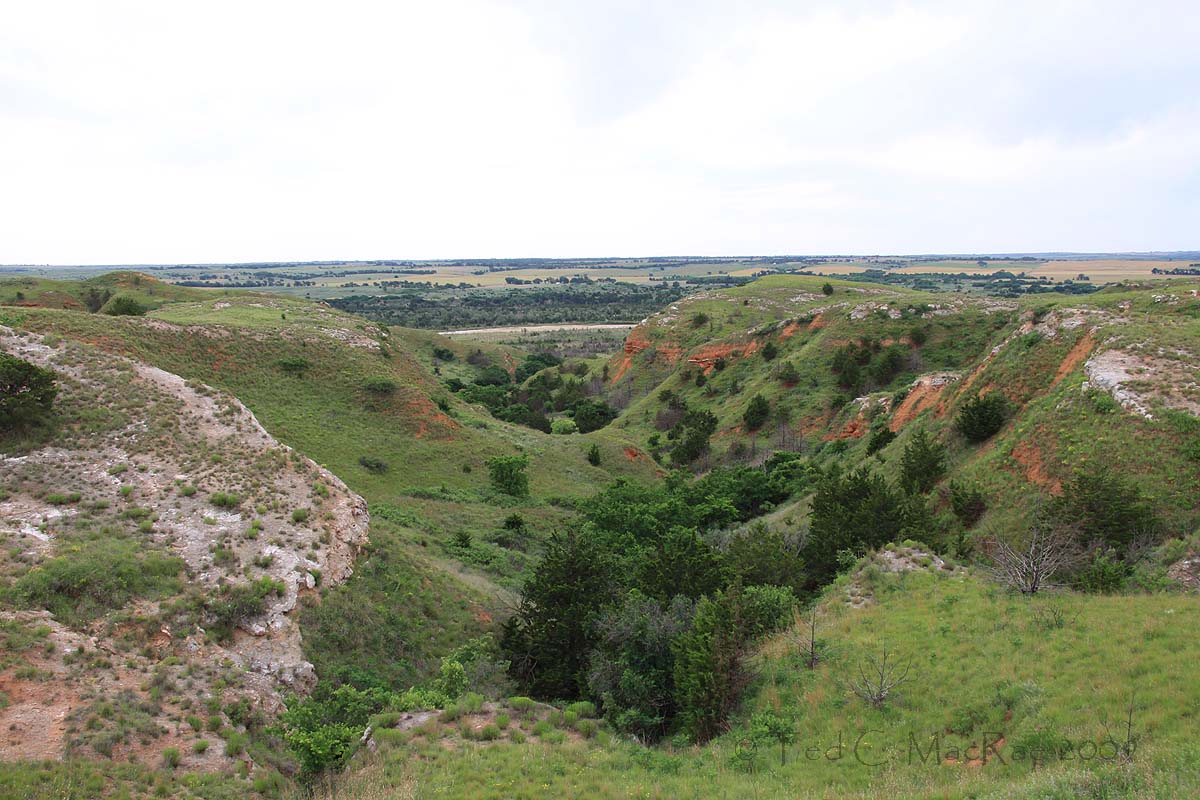
Gloss Mountains State Park, Major Co., Oklahoma

The following day, my plan was to visit the three state parks I had seen on the map and assess their habitat – if any looked promising I would try to obtain permission to collect, and failing that I would try to hunt out similar habitats in areas adjacent to but outside of the parks. One of these parks is located on a feature called the “Gloss (Glass) Mountains,” and the highway that cut through the area was designated on my map as a scenic route.  I don’t know why this place picqued my interest above the others – perhaps it was the idea of “mountains” in Oklahoma, but I pretty much made a bee line for the Gloss Mountains in the morning.  As I approached coming from the east on Hwy 412, I saw the massive, flat-topped mesas rising above the surrounding landscape and knew, if nothing else, it would be interesting scenery.  At the entrance to the state park there was a parking lot right along the highway for a designated scenic overlook – yeah, maybe I could find some good habitat to kick around in outside of the park.  I spent some time walking along the roadsides – there was plenty of exposed clay that would be a typical situation to look for tiger beetles, but I didn’t see anything in these areas.  Across the highway there were two mesas – a small one (visible in the photo above on the left side) accessible in its entirety and another very large one (also visible in distance at center) that was accessible only on its northern flank.  I walked to the smaller one first and looked it over but didn’t find much – certainly none of the little “flashes” that I was hoping to see that would confirm a broader occurrence of C. celeripes in northwestern Oklahoma (although I did find one Dromochorus pruinina – another flightless tiger beetle that just sneaks into Missouri as a highly disjunct population).  After looking over the smaller mesa, I walked over the the large mesa and cut across the lower talus slope – much of it seemed disturbed, probably from when the highway was constructed, and still I saw little of interest. 
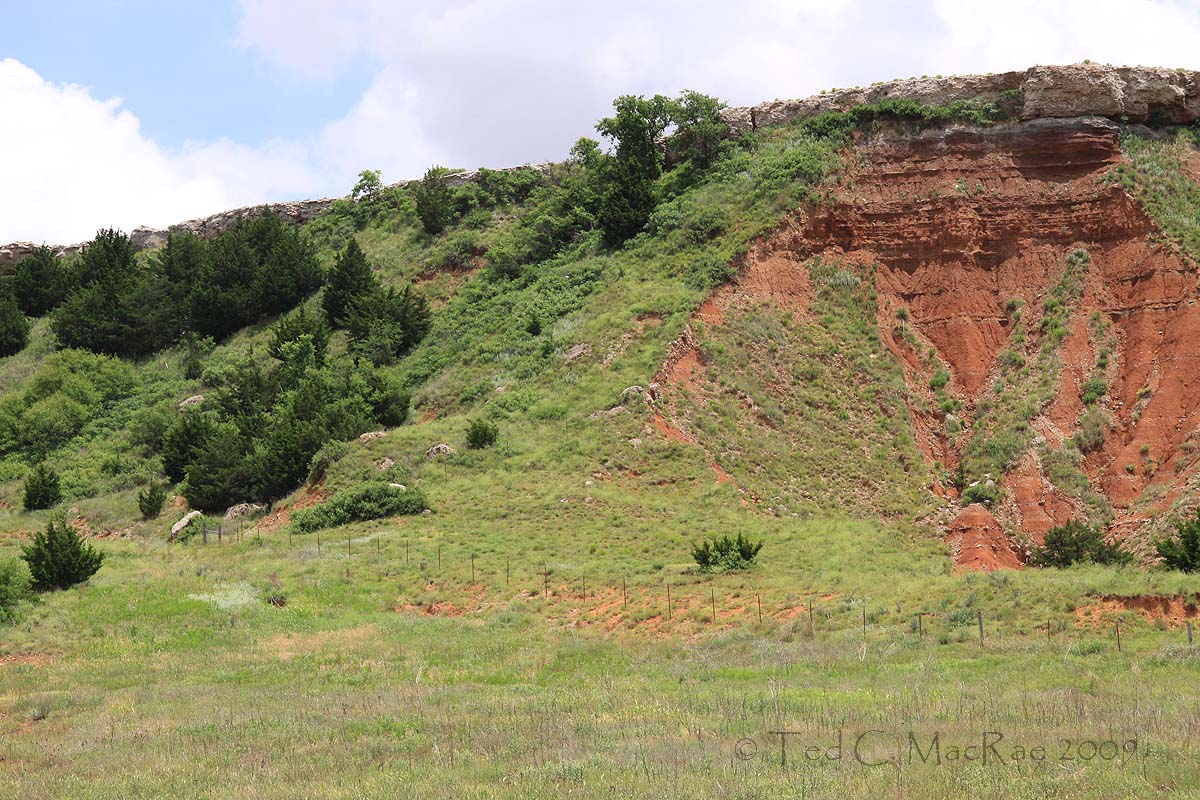
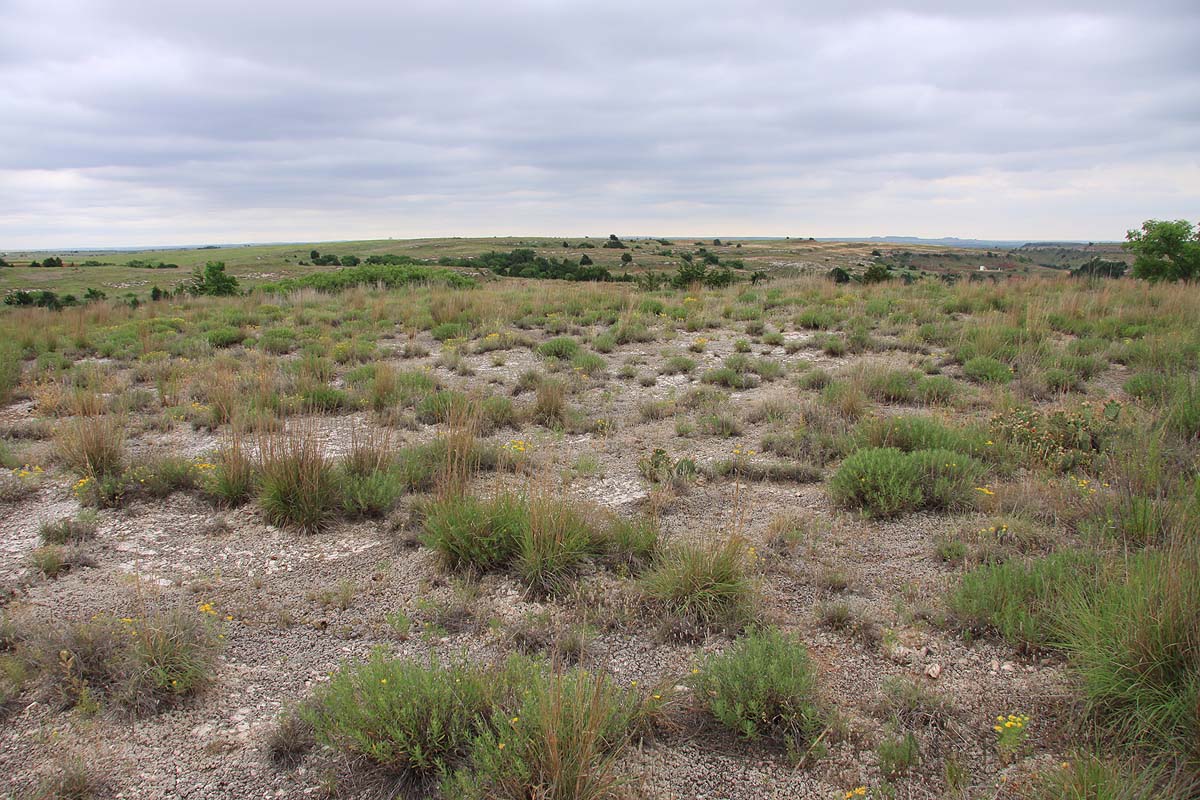
Cylindera celeripes macrohabitat along Hwy 412 in the Gloss Mountains

Cylindera celeripes macrohabitat along Hwy 412 in the Gloss Mountains. Adults were encountered primarily on lower talus slopes (lower center).

As I reached the western edge of the talus slope, I began walking along a natural drainage down towards the roadside – and I saw it!  The appearance and movement were unmistakable and didn’t fool me for a second.  I bolted straight for it and slapped at the ground as it zig-zagged erratically amongst the grass clumps before finally eluding me.  Arghh!  However, my frustration at missing the capture was completely overshadowed by my excitement at having found the species at an entirely new locality.  This prompted a much more deliberate and thorough examination of the surrounding area, and it wasn’t long before I saw another, and another…  While not quite as abundant as I had seen them at Alabaster Caverns, they certainly weren’t uncommon, and it wasn’t long before I had collected a sufficient voucher series to allow spending some time observing the behavior of the beetles in their habitat. The beetles were primarily on the lower (and milder) talus slopes and away from the roadside in more undisturbed areas.  They appeared to prefer areas of moderate vegetation cover with grass clumps spaced approximately 12-24 inches while avoiding more barren areas.  As I had observed the previous day at Alabaster Caverns, the beetles were first noticed primarily upon being disturbed by my approach as they ran from the grass clumps against which they were hiding and into the open.  They look very much like large ants when running, but the style is a little more urgent and erratic.

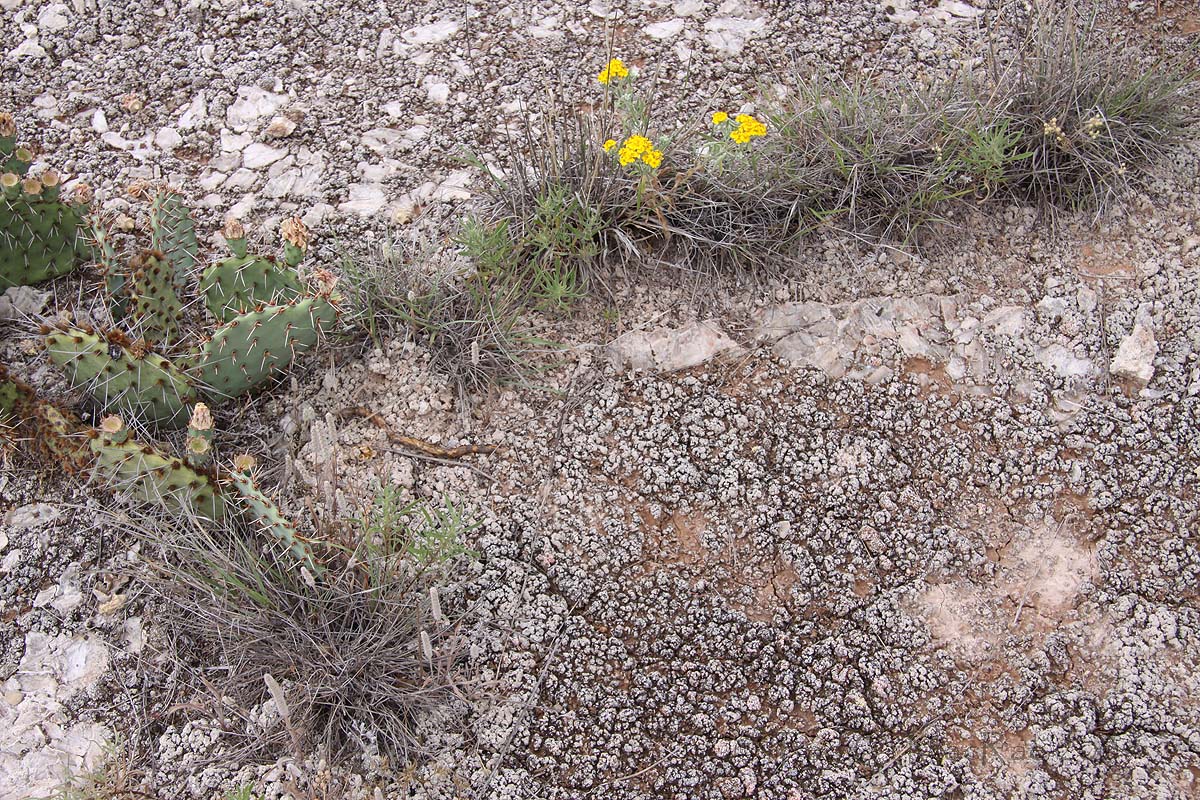
After several hours at this site, I decided that I should check the two other State Parks that I had seen on the map. Niether had promising habitat.  The first of these – Little Sahara State Park – lies midway along the Cimmaron River between Alabaster Caverns and the Gloss Mountains, but in contrast to the red clay/gypsum exposures that characterized Alabaster Caverns and Gloss Mountains, Little Sahara featured primarily sand substrates – great for other tiger beetles such as Cicindela formosa (big sand tiger beetle) and C. scutellaris (festive tiger beetle), but not for C. celeripes.  The other one – Boiling Springs State Park, lies in another drainage system along the Canadian River and features a wooded, riparian habitat with mostly sandy substrates along the northern slopes of the river valley (where I did spend some time looking around).  Between these parks and Gloss Mountains, however, along Hwy 412 I saw vast expanses of the same red clay/gypsum exposures that characterized the two localities where I had seen C. celeripes.  About 20 miles west of Gloss Mountains, I stopped at a rather unspectacular example of one of these exposures along the roadside – just to see if I could find the beetle in as pedestrian-looking a place as that.  I didn’t take 20 steps from the car when I saw the first one, and as before, I quickly encountered enough individuals to adequately voucher the site and allow some time for observation.  This site was very similar to Alabaster Caverns, with numerous lichens encrusting the clay substrate between the white gypsum exposures.  I looked out onto the broad expanse of clay supporting shortgrass prairie as far as the eye could see, and I knew the beetles were running around out there in untold numbers.  Cylindera celeripes not only occurs in northwestern Oklahoma, but its population is robust and likely extends throughout the red clay/gypsum exposure that characterizes the Cimarron River Valley in this part of the state.

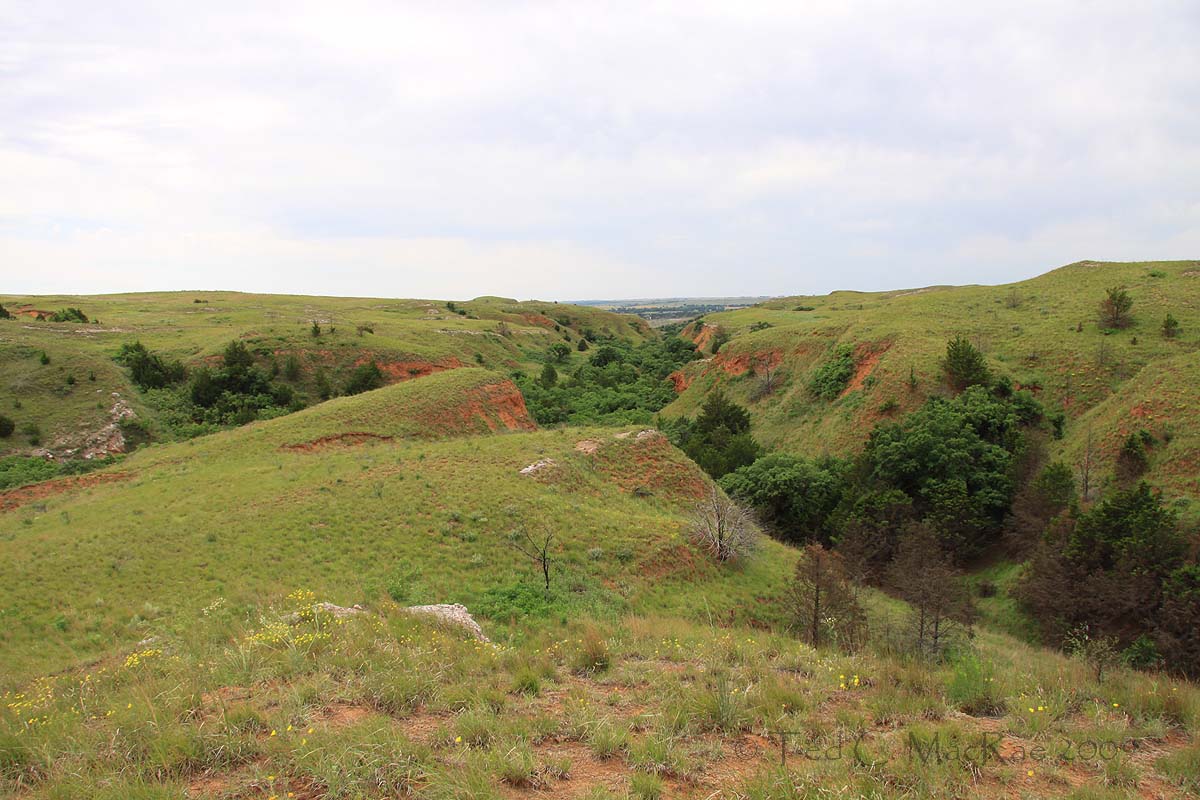
Cylindera celeripes macrohabitat at Gloss Mountains State Park.  Adults were quite common on the mesa top.

Cylindera celeripes macrohabitat at Gloss Mountains State Park. Adults were quite common on the mesa top.

 With some time left in the day, I decided to head back to Gloss Mountains State Park – I hadn’t even looked in the park proper, and with the beetles occurring abundantly at three other nearby sites offering similar habitat, it seemed a sure bet that I would find them there as well.  The park offers no real facilities but for an incredibly scenic trail that ascends the steep southern flank of a large mesa to allow access to the top.  Once on top, it was only a matter of minutes before I saw the first beetle, and I would eventually see numerous beetles running between the grass clumps over the lichen-encrusted clay.  The views from the mesa top were spectacular as well, and only the impending dusk chased me from enjoying both the site and the beetles.  I had a tremendous feeling of satisfaction – not just from finding the beetles, but also in the newfound knowledge that the beetles were doing so well in this part of its range.

The next day I looked for tiger beetle species associated with saline habitats at nearby Salt Plain National Wildlife Refuge – that will be the subject of a future post, and it the evening I completed the drive over to northeastern Oklahoma to resume the originally planned itinerary at Tallgrass Prairie Preserve.  Like Four Canyon Preserve, this TNC property is heavily managed with prescribed burns to maintain diversity of the prairie flora and prevent invasion by woody plants.  And likewise I observed verdent seas of grass interspersed with classic prairie forbs – and few insects.  I won’t blame this on the burns because I lack any empirical basis for making such claim.  However, each visit I make to freqently burned prairies further increases my skepticism that the invertebrate fauna isn’t somehow being impacted.  The lack of litter and absence of lichens on the soil surface results in an almost ‘sterile’ look that I don’t see in areas where fires occur with less frequency. I looked at a few different places within the vast preserve but didn’t find much, and midday I sighed and began the 7-hour drive back to St. Louis.  The trip was over, and so was the hunt for C. celeripes. Or so I thought… (to be continued).

Copyright © Ted C. MacRae 2009

Add to FacebookAdd to NewsvineAdd to DiggAdd to Del.icio.usAdd to StumbleuponAdd to RedditAdd to BlinklistAdd to Ma.gnoliaAdd to TechnoratiAdd to Furl

Revisiting the Swift Tiger Beetle – Part 1

Photo details: Canon 100mm macro lens with 68mm extension on a Canon EOS 50D, ISO 100, 1/250 sec, f/13, MT-24EX flash 1/4 power through diffuser caps

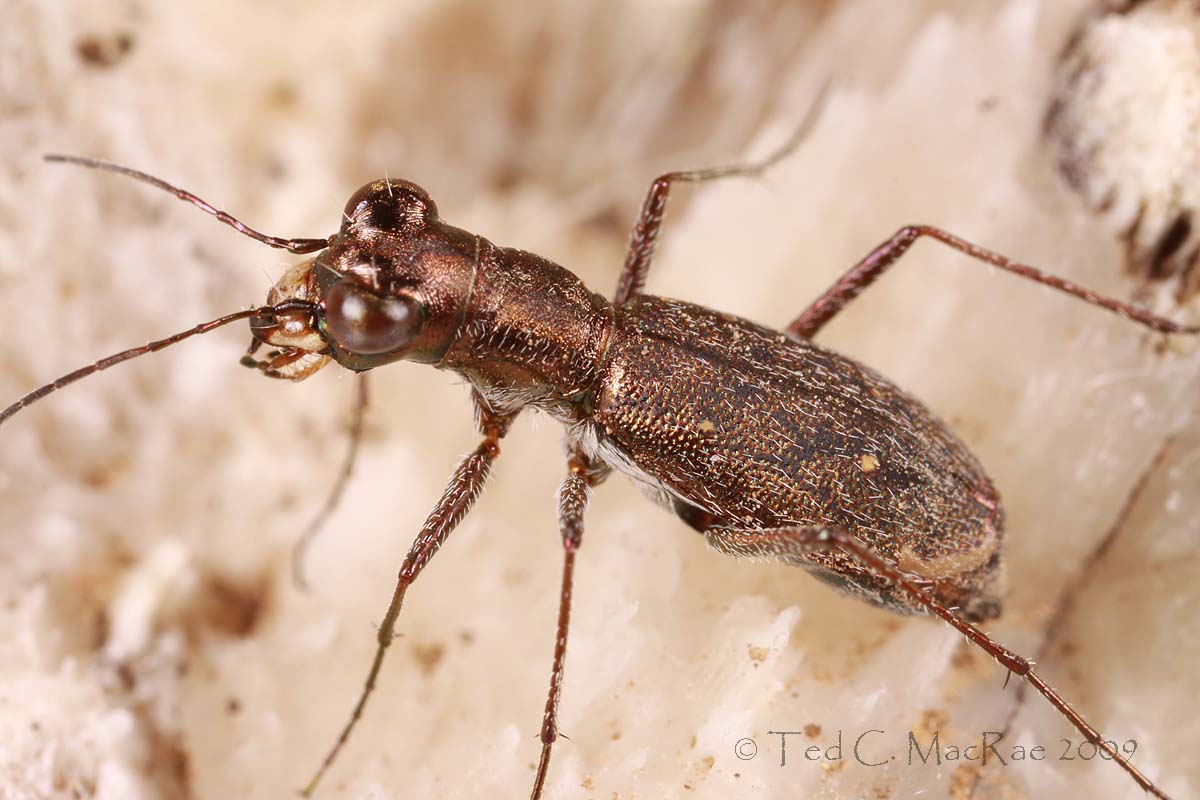
Photo 1 - Cylindera celeripes at Alabaster Caverns State Park in northwestern Oklahoma.

When my hymenopterist friend, Mike Arduser, came back from his first trip to Oklahoma’s Four Canyon Preserve last September, my first thought upon seeing his photos of the area was, “Ooh, that looks like a good place for tiger beetles!” Its rugged red clay and gypsum exposures reminded me of similar country I had seen in the not-too-distant Gypsum Hills of south-central Kansas, where I was fortunate enough to observe a nice population of the fantastically beautiful Cicindela pulchra (beautiful tiger beetle) back in 2005. When I later realized that the area was only 30 miles southwest of a confirmed recent sighting of Cicindela celeripes (swift tiger beetle, now Cylindera celeripes), I thought, “Ooh, I wonder if celeripes might occur there also.”

Photo details: Canon 100mm macro lens with 68mm extension tube on a Canon EOS 50D, ISO 100, 1/250 sec, f/13, MT-24EX flash 1/4 power through diffuser caps

Photo 2 - Cylindera celeripes on lichen-encrusted clay soil at Alabaster Caverns State Park.

Recall that C. celeripes is one of North America’s rarest and least understood tiger beetles. This tiny, flightless, ant-like species has been recorded historically from eastern Nebraska south to north-central Texas, but its range appears to have become highly restricted over the past century. It hasn’t been seen in Nebraska for nearly 100 years now, and most recent records have come from its last known stronghold in the Flint Hills of Kansas. In 2003, however, a photographer by the name of Charles Schurch Lewallen posted on BugGuide a photograph of this species taken at Alabaster Caverns State Park in northwestern Oklahoma, and last year small numbers of adults were seen in the Loess Hills of western Iowa. This last sighting triggered an immediate trip to the site by myself and Chris Brown, who has been co-investigating the tiger beetle fauna of Missouri with me for several years now. The occurrence of this species in Iowa’s Loess Hills had reignited our hopes – faint as they were – that the beetle might yet occur in extreme northwestern Missouri, where the Loess Hills reach their southern terminus. We wanted to see the beetle in the wild to better understand its habitat requirements before resuming our search for this species in northwestern Missouri. We succeeded in finding the beetle – an amazing experience in itself – and brought three adults of this never-before-reared species back to the lab for photographs and an attempt at rearing. We did manage to obtain viable eggs, but we were not successful in rearing the larvae beyond first instar. I wrote about that experience last August in a post entitled, “The hunt for Cicindela celeripes” (that post is now currently in press as an article in the journal CICINDELA).

Photo details: Canon 100mm macro lens with 68mm extension tube on a Canon EOS 50D, ISO 100, 1/250 sec, f/11, MT-24EX flash 1/4 power through diffuser caps

Photo 3 - Cylindera celeripes on gypsum exposure at Alabaster Caverns State Park.

Thus, when my friend Mike asked me earlier this year if I might be interested in joining him on his return trip to Four Canyon Preserve in June, I jumped at the chance. I figured I could look for celeripes at the preserve, and if I failed to find it there then I would go to Alabaster Caverns and see if I could relocate the beetle where it had been photographed in 2003. My goals were modest – I simply wanted to find the beetle and voucher its current presence in northwestern Oklahoma (and if possible photograph it in the field with my new camera!). Before leaving, I wrote to Charles Lewallen, who graciously responded with details regarding the precise location and time of day that he had seen the beetle at Alabaster Caverns, and on the first Friday of June I followed behind Mike and his lovely wife Jane during our ten-hour drive out to Four Canyon Preserve. For three days, I roamed the mixed-grass prairie atop the narrow ridges and dry woodland on the steep, rugged canyon slopes of the preserve – always on the lookout for that telltale “flash” between the clumps of bluestem and grama, ever hopeful that one would prove not to be the ant or spider that it appeared to be (and, indeed, always was). Many tiger beetles would be seen – chiefly the annoyingly ubiquitous Cicindela punctulata (punctured tiger beetle), but celeripes would not be among them. Whether this is due to historical absence from the site or a more recent consequence of the wildfires that swept the area a year earlier is hard to say, but its absence at Four Canyon meant that I would need to make a quick, 1-day detour to Alabaster Caverns before rejoining Mike and Jane at Tallgrass Prairie Preserve in northeastern Oklahoma, where we planned to spend the second half of the week.

Photo details: Canon 65mm 1-5X macro lens on a Canon EOS 50D, ISO 100, 1/250 sec, f/13, MT-24EX flash 1/4 power through diffuser caps

Photo 4 - Cylindera celeripes on gypsum exposure at Alabaster Caverns State Park.

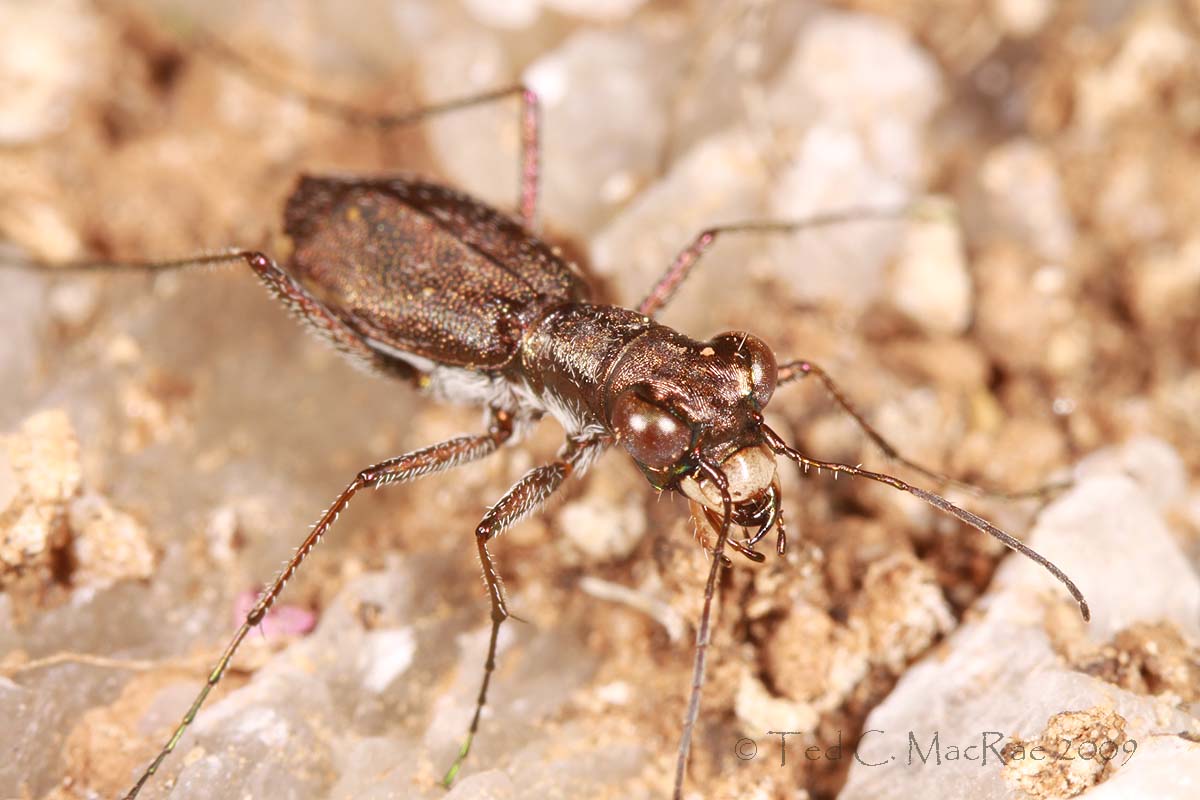
Arriving at Alabaster Caverns I was filled with nervous, excited anticipation. Would I find the species, as Charles Lewallen had, or would I get skunked? I kitted up and started walking towards the area where Charles wrote that he had seen the beetle, noting the annoying “Removal of plants and animals prohibited” sign along the way. I hadn’t taken ten steps off the parking lot when I saw it! I froze at first, hardly believing that I had found it that quickly, then started watching the tiny beetle as it bolted urgently from one grass clump to the next. Recalling my experience with this beetle in Iowa (and fearing I would lose it amongst the vegetation), I captured the specimen and placed it live in a vial – I would talk to the park staff later about taking the beetle, but for now I needed to guarantee I had a backup for the lab in case I was unable to get field photographs of the beetle. I started walking again, and within a few minutes I saw another one – okay, they’re here in numbers. I carefully took off my camera bag and assembled the components, all the while keeping my eye on the beetle, and then I began trying to do what last year had seemed impossible – getting field photographs. It was easier this time – the vegetation was not so dense, so I could keep an eye on the beetle as he darted from one clump to another. I tried to wait until he settled in an open spot, but it soon became apparent that just wasn’t gonna happen without a “helping” hand. I started blocking the path of the beetle as he tried to dart away and then removing my hand to see if he would stay put. There were a few false starts, where the beetle looked like he would sit still and then dart just as I was set to take the shot, but eventually it wore down and started sitting still long enough for me to shoot a few frames. Torn between the need to get as many photographs as possible and the desire to look for more beetles, I decided to look around more to see how common the beetle was. As I walked out into the shortgrass prairie above the canyons, I began to see adults quite commonly. Most often they were seen as they bolted out into the open from a clump of vegetation when disturbed by my approach. The substrate was red clay and gypsum – just as I had seen in Four Canyon Preserve, but unlike that area the clay exposures were heavily colonized by a mottling of green, blue, and gray lichens. It made the beetles almost impossible to see when they were not moving – even at close range! I spent about an hour taking photographs of several individuals, even managing to photograph one that appeared to be parasitized by what I take to be a dryinid hymenopteran.

Photo 5 - Cylindera celeripes with parasite (dryinid hymenopteran?).  Note also the ant head attached to right antenna.

Photo 5: Cylindera celeripes with parasite (dryinid hymenopteran?). Note also the ant head attached to right antenna.

After getting a sufficient series of photographs (is there really such thing?), I went to the park office hoping to convey the significance of this find to the Park Naturalist and to convince him/her to let me take some live individuals with me for another attempt at rearing. The Park Naturalist was out of the office, but the Park Historian was there. I could hardly contain my excitement as I explained to her what I had found, why it was so important, and my hope to try to rear the species with adults collected in the field. She not only responded as positively as I had hoped, but accompanied back out into the field so that I could show her the beetles. She told me it would be no problem to take some live individuals for rearing and to please let them know if there was anything else they could do to help me.  She then provided me with the day’s natural history “dessert” by pointing out a Mexican free-tailed bat (Tadarida brasiliensis) – Oklahoma’s state flying mammal – roosting up in the top of a nearby picnic shelter. Standing atop the picnic table put me within arm’s length of the little chiropteran – close enough to see his tiny little eyes looking quizzically back at me.

Photo 6 - Cylindera celeripes macrohabitat, Alabaster Caverns State Park, Oklahoma.  Note rather widely spaced clumps of vegetation (photo details: Canon 17-85mm zoom lens (17mm) on a Canon EOS 50D, ISO 100, 1/64 sec, f/8).

Photo 6 - Cylindera celeripes macrohabitat at Alabaster Caverns State Park. Note rather widely spaced clumps of vegetation.

It had begun sprinkling rain by then, so with some urgency I got my tools, extracted a couple of chunks of native soil and transferred them to the small “Critter Totes” that I had brought for the purpose, and began searching for live individuals to place within them. The beetles had become scarce as the drizzle turned to light rain, and by the time I had split about a dozen individuals between the two containers the rain was coming down hard enough to start puddling. I continued a last ditch effort to find “just one more,” but a lightning strike within a mile of the park put an end to that – the air now felt electric as I hurriedly walked back to the car (gloating unabashedly inside) and began the three-hour drive towards Tallgrass Prairie Preserve… (to be continued).

IMG_0580_1200x800

Photo 7 - Cylindera celeripes microhabitat at Alabaster Caverns State Park. Note thick encrustation of lichens on clay substrate amidst white gypsum exposures.

Photo details:
-3, 5: Canon 100mm macro lens w/ 68mm extension on Canon EOS 50D, ISO 100, 1/250 sec, f/13 (photo 3, f/11), MT-24EX flash 1/4 power through diffuser caps.
#4: Same except Canon 65mm 1-5X macro lens, flash 1/8 power.
#6: Same except Canon 17-85mm zoom lens (17mm), 1/64 sec, f/8, natural light.
#7: Same except Canon 17-85mm zoom lens (35mm), 1/100 sec, f/7, natural light.

Copyright © Ted C. MacRae 2009

Add to FacebookAdd to NewsvineAdd to DiggAdd to Del.icio.usAdd to StumbleuponAdd to RedditAdd to BlinklistAdd to Ma.gnoliaAdd to TechnoratiAdd to Furl

Four Canyon Preserve, Oklahoma

IMG_0295_1200x800

Looking SE into lower Horse Canyon towards Canadian River

On my recent week-long collecting trip, the first three days were spent at Four Canyon Preserve in far northwestern Oklahoma.  This nearly 4,000-acre preserve features a stunning landscape of rugged, wooded canyons dissecting ridges of mixed-grass prairie which provide critical habitat for several rare plants and animals.  Despite years of overgrazing, fire suppression, and invasion by exotic plants, The Nature Conservancy (TNC) recognized the restoration potential of this landscape and began management practices to restore its ecological function and integrity after acquiring it in 2004.  The land was rested until April 2008, at which time a wildfire swept through the area and burned approximately 90% of the property.  This event was actually welcomed by TNC, who was already in the process of initiating a prescribed burn – they simply pulled back and let it rip!  The burn, combined with mechanical removal of eastern redcedar (Juniperus virginiana) that had invaded many areas of the preserve, did much to confine woody growth to the canyons proper, and good rains during the past two springs following that burn have resulted in a lush, green, diverse landscape brimming with prairie wildflowers.  The vivid contrast between the green vegetation and the red clay canyons with their white gypsum exposures has created spectacular vistas of a rugged landscape.  This year, cattle have been reintroduced at low levels to simulate the irregular, patchy disturbance experienced in pre-settlement times when native grazers (bison and elk) dotted the landscape.

The flora (Hoagland and Buthod 2007) and avifauna (Patten et al. 2006) of the preserve are well characterized, but (as nearly always seems the case) arthropod and other micro faunas need much additional study.  My hymenopterist colleagues and I were welcomed enthusiastically by TNC staff, who are anxious to incorporate the results of our insect surveys into an overall fauna.  Apoid hymenopterans appear to have benefited greatly from the recent rejuvenation of the preserve’s floral character.  Results for the beetle populations that I encountered, however, were more mixed. Certain groups, such as scarabaeine dung beetles, were quite abundant and diverse (due to the reintroduction of cattle), but others, including the tiger beetles, jewel beetles, and longhorned beetles that I was most interested in finding, existed at rather low and not very diverse levels.  I had hoped to find the very rare Cylindera celeripes (swift tiger beetle) running amongst the clumps of vegetation on the preserve’s red clay exposures but instead saw only the ubiquitous Cicindela punctulata (punctured tiger beetle), and the few jewel beetles that I managed to beat off the lower branches of hackberry (Celtis laevigata) and soapberry (Sapindus saponaria var. drummondii) trees were found only in the small parts of the preserve that escaped last year’s burn.  This seems fairly typical – I generally don’t find many insects in these groups whenever I survey areas that have experienced a significant amount of recent burning.  Some ecologists might take exception to this statement, and they would have little difficulty citing studies that show rapid recolonization of prairies by a majority of prairie insect specialists within two years after a prescribed burn.   Nevertheless, the impact of prescribed burning on invertebrate populations and its potential for causing local extirpations has become a contentious issue among ecologists and entomologists in recent years.  While my experience hardly passes for rigorous investigation, I am becoming increasingly convinced that a certain amount of caution is warranted when designing burn management plans for prairie relicts.

I’ll discuss more about the beetles and other insects (and even some vertebrates) that I saw during my three-day visit to Four Canyon Preserve in future posts.  In the meantime, I share with you some of my photos of this spectacularly beautiful landscape (note the abundance of woody cadavers from last year’s burn in some of the photos).

IMG_0382_1200x800

Looking S into upper reaches of Mulberry Canyon

IMG_0384_1200x800

Looking S into upper reaches of Mulberry Canyon

IMG_0399_1200x800

Looking E across upper Harsha Canyon

IMG_0402_1200x800

Looking SE into Harsha Canyon towards Canadian River

IMG_0403_1200x800

Looking E across lower Harsha Canyon

View of Mulberry Canyon bluffs from Canadian River valley

Looking NE towards Mulberry Canyon bluffs from Canadian River valley

REFERENCES:

Hoagland, B. W., and A. K. Buthod.  2007.  Vascular flora of the Four Canyons Preserve, Ellis County, Oklahoma.  Journal of the Botanical Research Institute of Texas 1(1):655–664.

Patten, M. A., D. L. Reinking, and D. H. Wolfe.  2006.  Avifauna of the Four Canyon Preserve, Ellis County, Oklahoma.  Publications of the Oklahoma Biological Survey (2nd Series) 7:11-20.

Copyright © Ted C. MacRae 2009

Add to FacebookAdd to NewsvineAdd to DiggAdd to Del.icio.usAdd to StumbleuponAdd to RedditAdd to BlinklistAdd to Ma.gnoliaAdd to TechnoratiAdd to Furl

On the road again!


IMG_3397_0006_006_enh

By the time you read this, I’ll be on the road again for yet another extended bug collecting trip.  I don’t think I am ever happier than when I am on one of these trips – whether it be a once-in-a-lifetime visit to Africa or a one-week jaunt to the nearby plains.  With so many places to see – each with their own unique story – I don’t understand how anyone ever ends up getting bored.  The main destination for this trip is the Nature Conservancy’s recently established Four Canyon Preserve in northwestern Oklahoma.  This nearly 4,000-acre preserve contains a stunning assemblage of rugged, mixedgrass prairie ridges dissected by deep, chinquapin oak-lined canyons that drain into the Canadian River in southern Ellis County.  Although past grazing and fire suppression have reduced shrub cover, lowered vegetation complexity and promoted expansion of eastern redcedar (Juniperus virginiana) throughout the area, the preserve nevertheless supports a number of species of conservation concern such as Cassin’s sparrow, Swainson’s hawk, least tern, and Arkansas River shiner.

IMG_3285_0024_024_enh

As is typical with many protected areas, studies of the biotic diversity of this preserve have dealt primarily with its flora (Hoagland and Buthod 2007) and avifauna (Patten et al. 2006). Arthropods and other microfauna, on the other hand, remain essentially unknown.  I’ll be joining a group of entomologists – primarily hymenopterists – who began conducting surveys of the preserve’s insect fauna last fall.  While my colleagues gaze at the hyperdiversity of asteraceous flowers looking for things with stings, I’ll be staring at the red Permian sandstone and shale exposures – watching for any darting movement between clumps of grama and little bluestem that might indicate the presence of the enigmatic Cicindela celeripes (swift tiger beetle).  I’ve written previously about the occurrence of this rare, flightless tiger beetle in the Loess Hills of Iowa and our ongoing search for this species in northwestern Missouri in my post The Hunt for Cicindela celeripes.  Although this beetle has not yet been recorded at the preserve, it was seen very recently in nearby Alabaster Caverns – some 60 miles to the north, and a historical record is known from just south of the preserve.  My optimism is bolstered by the fact that the Alabaster Caverns individual was observed in late May – much earlier than the typical late June and early July records for this species further north in its stronghold in the Flint Hills of Kansas.  Of course, I will be looking for other things as well – other species of tiger beetles are likely to occur on the reddish loamy upland soils and quaternary alluvial deposits along the Canadian River, and any number of woodboring beetle species are likely to be found on herbaceous flowers and dead branches of the 51 species of woody plants recorded in the preserve.

After getting our fill of Four Canyon Preserve, we’ll visit the world’s largest remaining tract of tallgrass prairie, Tallgrass Prairie Preserve in northeastern Oklahoma.  Encompassing nearly 40,000 acres, we can do nothing more than only scratch its surface.  However, the tallgrass prairie habitat should provide a nice contrast to the mixedgrass prairie of Four Canyon Preserve, and it will be interesting to compare and contrast these two distinctive plant communities and their associated insect faunas.  After a week on the road¹, I’ll return to St. Louis for a brief respite before beginning a hectic four-week survey in northwestern Missouri for – you guessed it – Cicindela celeripes!

¹ I’ll be without internet access, so please forgive my nonresponsiveness to comments. I do have a couple of posts scheduled to appear during my absence.

My thanks to Mike Arduser, an expert hymenopterist and also a good friend, for bringing Four Canyon Preserve to my attention.  His spectacular photographs that I share here were all I needed to convince me to join him on his return trip this season.

REFERENCES:

Hoagland, B. W., and A. K. Buthod.  2007.  Vascular flora of the Four Canyons Preserve, Ellis County, Oklahoma.  Journal of the Botanical Research Institute of Texas 1(1):655–664.

Patten, M. A., D. L. Reinking, and D. H. Wolfe.  2006.  Avifauna of the Four Canyon Preserve, Ellis County, Oklahoma.  Publications of the Oklahoma Biological Survey (2nd Series) 7:11-20.

Copyright © Ted C. MacRae 2009

Add to FacebookAdd to NewsvineAdd to DiggAdd to Del.icio.usAdd to StumbleuponAdd to RedditAdd to BlinklistAdd to Ma.gnoliaAdd to TechnoratiAdd to Furl

Goldenrod Leaf Miner

Microrhopala_vittata_IMG_0183_enh2

Photo details: Canon MP-E 65mm macro lens on a Canon EOS 50D, ISO 100, 1/200 sec, f/16, MT-24EX flash 1/8 power through diffuser caps

While photographing Acmaeodera tubulus and A. ornata a couple of weekends ago (see Springtime Acmaeodera), I came across this leaf beetle (family Chrysomelidae) of the genus Microrhopala¹.  When I took Systematic Entomology (so many moons ago), beetles in this and related genera were placed in the subfamily Hispinae.  That taxon has since been subsumed by a more broadly defined Cassidinae (Staines 2002), which also includes the delightfully odd tortoise beetles.  There are several species of Microrhopala in North America – this individual can be diagnosed as M. vittata by means of its dull reddish elytral stripes, eight-segmented antennae, and smooth (not serrate or toothed) elytral margins (Clark 1983). 

¹ Derived from the Greek micr (small) and rhopal (a club) – presumably a reference to its small-clubbed antennae.

Many leaf beetles are expert botanists, restricted to and able to discriminate a single plant species or group of closely related species for hosts.  Microrhopala vittata is no exception, specializing on true goldenrods (Solidago spp.) and flat-topped goldenrod (Euthamia graminifolia) (family Asteraceae).  Adults feed on leaves in the upper part of the plant, leaving numerous small holes, but it is the larvae that have the biggest impact on their host by mining within the leaves between the upper and lower surfaces.  Larval mining eventually causes the leaves to turn brown and shrivel up. 

This species has been widely studied by ecologists interested in understanding the impacts of herbivorous insects on their host plants and associated changes to plant communities that result from their feeding.  While population densities of M. vittata are normally low, they occasionally reach densities that result in severe damage to their host plants.  Such effects are not limited to the host plants themselves – Carson and Root (2000) found that outbreaks of this species on stands of tall goldenrod (Solidago altissima) in an old field dramatically reduced the biomass, density, height, survivorship, and reproduction of tall goldenrod, resulting in higher abundance, species richness, and flowering shoot production among other plant species as a result of increased light penetration.  Conversely, in experimental plots where the beetles were removed, tall goldenrod developed dense stands that inhibited the growth of many other plants.  These effects lasted for several years after the outbreak.  Thus, the beetle can act as a keystone species² in old field communities, indirectly promoting woody plant invasion and speeding the transition of the old field to a tree-dominated community.

² A keystone species is one whose impacts on its community or ecosystem are large and greater than would be expected from its relative abundance or total biomass (Paine 1969).  Popular examples include the beaver, which transforms stream communities to ponds or swamps, and elephants, which prevent grasslands from converting to woodlands through destructive tree removal.  In contrast, trees, giant kelp, prairie grasses, and reef-building corals all have impacts that are large but not disproportionate to their also large total biomass and, thus, are not considered keystone species.

REFERENCES:

Carson, W. P. and R. B. Root.  2000.  Herbivory and plant species coexistence: Community regulation by an outbreaking phytophagous insect.  Ecological Monographs 70(1):73-99.

Clark, S. M. 1983. A revision of the genus Microrhopala (Coleoptera: Chrysomelidae) in America north of Mexico. The Great Basin Naturalist 43(4):597-617.

Paine, R. T. 1969. A note on trophic complexity and community stability. The American Naturalist 103(929):91–93.

Staines, C. L. 2002. The New World tribes and genera of hispines (Coleoptera: Chrysomelidae: Cassidinae). Proceedings of the Entomological Society of Washington 104(3): 721-784.

Copyright © Ted C. MacRae 2009

Add to FacebookAdd to NewsvineAdd to DiggAdd to Del.icio.usAdd to StumbleuponAdd to RedditAdd to BlinklistAdd to Ma.gnoliaAdd to TechnoratiAdd to Furl

Do the Doodlebug Flip

I’ve been on a doodlebug kick ever since I finally figured out how to find the little buggers on my trip down to southeast Missouri.  I even found one in one of the tiger beetle terraria that I setup with native soil brought back from that trip, so I’ll get the chance to try to rear one out.  Shortly after finding those first antlion larvae, I traveled to Rock Island, Illinois to attend the Second Illinois Hill Prairie Conference as a panelist for the insects discussion group.  During a field trip to a nearby hilltop prairie, I spotted a pit in a bed of sawdust that had the unmistakeable look of an antlion pit.  I can’t say that I’ve ever seen an antlion pit in anything but sand, so I dug up the larva to confirm that that was, indeed, what it was.  The larval pit site must have been selected by the adult female who laid the egg, so apparently the loose sawdust had the appropriate texture to induce oviposition.  The larva was fat and happy, suggesting it was feeding well in its sawdust pit.

Antlions flick sand with their head and elongated mandibles to create the pit, and they also flick it on prey that has fallen in their pit to thwart their escape.  Watch how this one also use its head flicking ability to right itself in a most humerous manner after being flipped over:

Copyright © Ted C. MacRae 2009

Add to FacebookAdd to NewsvineAdd to DiggAdd to Del.icio.usAdd to StumbleuponAdd to RedditAdd to BlinklistAdd to Ma.gnoliaAdd to TechnoratiAdd to Furl

Blackjack oak “flower”

Quercus_marilandica_P1020923_2

This blackjack oak (Quercus marilandica) was found on one of southeastern Missouri’s finest sand prairie relicts a couple of weeks ago on my ‘Annual Birthday Season Opener Bug Collecting Trip.’ Growing near the edge of the prairie at the transition to dry sand forest (Nelson 1985), the arrays of soft, red, newly-expanding leaves at each branch tip had a distinctly floral quality to them. Of course, as with all oaks, the actual flowers of blackjack oak are much less conspicuous, with the staminate (male) flowers borne on drooping catkins, the pistillate (female) flowers on separate spikes on the branch, and pollination accomplished by wind.

Missouri is oak country – nearly a quarter of North America’s 90 oak species (Nixon 2009) occur naturally within the state. This high diversity is explained partly by Missouri’s ecotonal continental position – straddling the east-west transition from the great eastern deciduous forest to the western grasslands. The boundary between these two great biomes is a dynamic, ever-changing interdigitation of woodland, savanna, and prairie that ebbs and flows with the prevailing climatic conditions. Unlike the more mesic forests further east, these dry woodland habitats were often subjected to fire during presettlement times – to which oaks in general (and blackjack oak in particular) are supremely adapted with their thick bark and ability to resprout repeatedly after being burned or grazed back. Sadly, the suppression of these fires post-settlement has caused many of these unique, fire-mediated natural communities to shrink drastically amidst a choking growth of junipers (“cedars” ’round these parts), maples, and other fire-intolerant species. Only on publicly owned preserves and a few private parcels under progressive ownership (such as the sand prairie relict where this photograph was taken) is fire once again shaping the landscape.

Oaks are among my favorite trees, and among the oaks I have several favorites. White oak (Quercus alba) – tolerating many forest types but forming nearly pure stands in high-quality, mesic sites, its tall symmetrical crown, pale bark, and brilliant fall colors are unparalleled among Missouri’s other oaks. Post oak (Q. stellata) as well – lacking the elegance of white oak but achieving its greatest character in fire-adapted savannas and open woodlands as squat, gnarled, massively-trunked trees with broad, spreading crowns¹. Blackjack oak has none of these qualities, yet somehow, it is still one of my favorite Missouri oaks. Stunted and gnarled (‘scrub oak’ to some), it occurs mostly in sandstone and limestone glades, savannas and woodlands on dry, nutrient-poor soils that support few other tree species. The dark green of its tough, waxy (to limit the loss of water), pear-shaped leaves contrasts beautifully with its rough, blocky, almost black bark. Blackjack oak has virtually no timber value, although it is sometimes used for charcoal and firewood. Nevertheless, for me, it is almost an icon for the unique natural communities in Missouri in which it occurs – communities that face ever-increasing pressure from human and forest encroachment.

¹ Please refer to this lovely essay about post oaks in Missouri, by the talented Allison Vaughn.

REFERENCE:

Nelson, P. W. 1985. The Terrestrial Natural Communities of Missouri. Missouri Natural Areas Committee, Jefferson City, 197 pp.

Nixon, J. C.  2009. Quercus in Flora of North America, Vol. 3.

Copyright © Ted C. MacRae 2009
Add to FacebookAdd to NewsvineAdd to DiggAdd to Del.icio.usAdd to StumbleuponAdd to RedditAdd to BlinklistAdd to TwitterAdd to TechnoratiAdd to Furl

Now you see me…

Myrmeleon_sp_P1020915_2

…now you don’t!
Myrmeleon_sp_P1020914_2

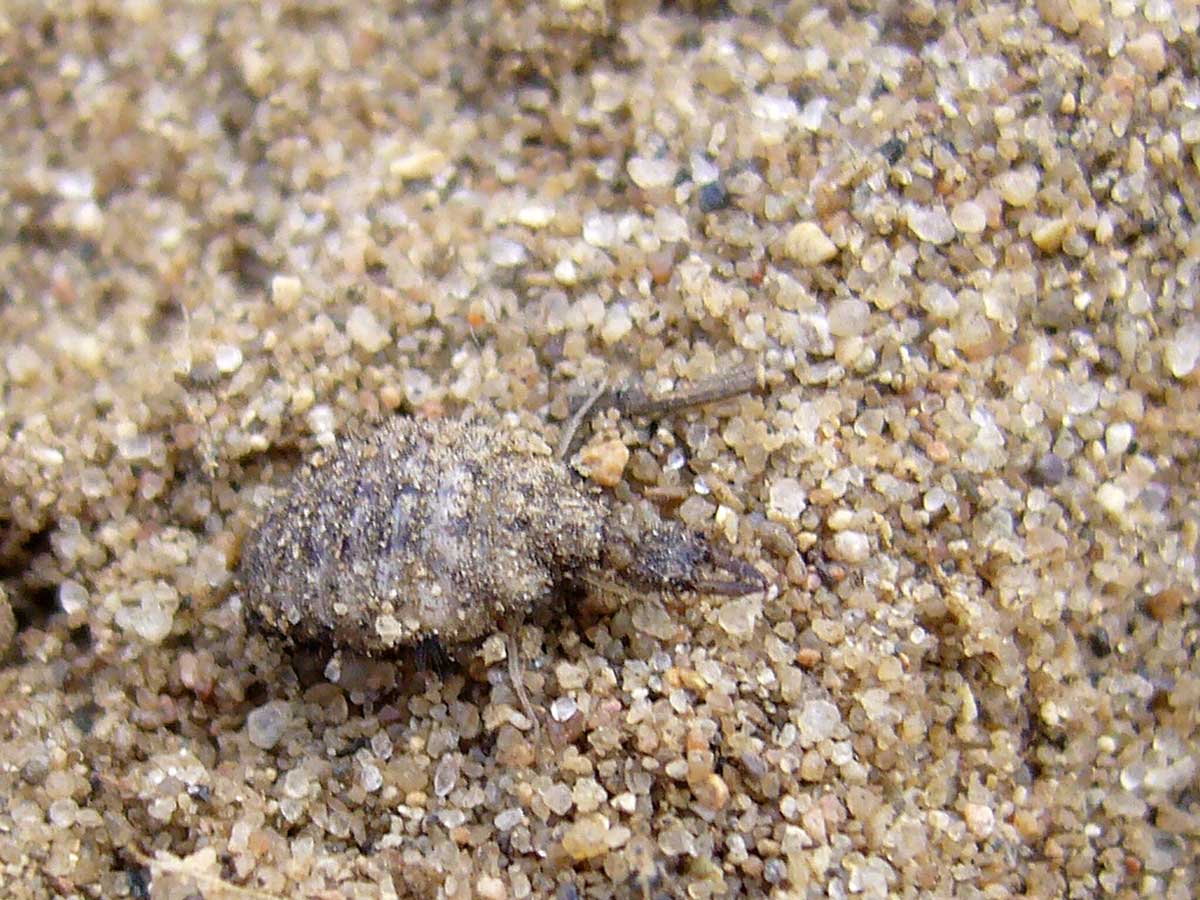
In a previous post, I lamented the fact that I had never actually seen a live antlion larva, or doodlebug (family Myrmeleontidae). Lovers of sand, I’ve seen their famous pitfall traps many times, especially in recent years as I’ve searched sand habitats for my beloved tiger beetles. Occasionally, I’ve stopped to jab my knife under a pit, give it a quick flip, and search the freshly turned sand for the maker of the pit – never seeing anything. It never bothered me much either – there were always beetles to catch!  Two weeks ago I returned to the sand prairies of southeastern Missouri to look for additional sites for Cicindela scutellaris (festive tiger beetle), and as we searched one particular site on the Sikeston Sand Ridge I once again saw the characteristic funnel-shaped pits amongst sparse vegetation in the sandy soil.  I decided this time I needed to give it a good effort – how can any self-respecting entomologist accept not having ever seen a live doodlebug?  As I’d done many times before, I kneeled down, gently put the tip of the knife about an inch away from the edge of the pit, and then jabbed its full length assertively into the sand and under the burrow and flipped it over.  Like previous times, I studied the turned sand and saw nothing.  I stirred the sand gently with the tip of the knife and studied it again – nothing.  I tried another burrow – again, nothing.  I decided right then and there that I was doing something wrong – I could not simply be picking ’empty’ pits.  I continued staring at the turned sand, and then I saw movement – I looked closer, and it seemed as though the sand itself was moving.  At last I made out its outline – I had finally succeeded in finding a doodlebug!  I dug up another burrow, and knowing what I was looking for this time I had no problem quickly locating the little creature.  I watched it as it lay motionless – perfectly camouflaged by its color and with sand grains sticking to its body, and chuckled as it buried itself almost instantly with a quick, backwards shuffle into the sand. Who knows how many doodlebugs I’d successfully dug up in the past, completely overlooking them as they lay disguised and motionless in the sand.

More than 100 species of antlions, representing at least 19 genera, live in the Nearctic Region, although much of this diversity occurs in the southwestern U.S. and Mexico.  Despite the commonly drawn association between antlions and pitfall traps, in North America only those in the genus Myrmeleon actually exhibit this behavior.  This larva dug a pit and so must represent a species of Myrmeleon – perhaps M. immaculatus, a common species in North America and one whose adult I observed last fall on a nearby sand prairie remnant.  Species in other genera have free-living larvae that hide under objects or roam underneath the sand, from where emerge briefly to hunt for prey.

For those interested in learning more about antlions, Mark Swanson has an excellent website called The Antlion Pit.

REFERENCE:

Swanson, M.  1996. The Antlion Pit: A Doodlebug Anthology. http://www.antlionpit.com/

Copyright © Ted C. MacRae 2009
Add to FacebookAdd to NewsvineAdd to DiggAdd to Del.icio.usAdd to StumbleuponAdd to RedditAdd to BlinklistAdd to Ma.gnoliaAdd to TechnoratiAdd to Furl