Some years ago, I wrote about the skulls on my desk, asserting that any scientist worth their salt should have at least one. My skulls, however—six of them until recently, are not just “ordinary” modern human skulls (much as I would love to have one), but rather replicas of famous fossil hominid skulls and crania. It has been a while since I’ve added to my collection, but Santa was good to me this past Christmas, bringing me a replica of the “La Chapelle-aux-Saints 1” skull of Homo neanderthalensis, and for today’s birthday my wife gave me a replica of the “Toumaï” cranium of Sahelanthropus tchadensis.
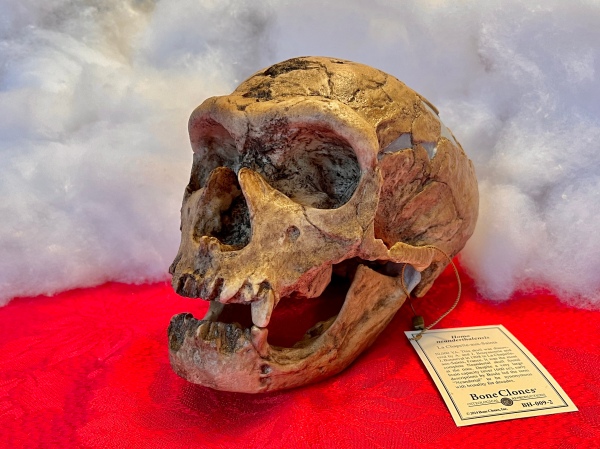
The “La Chapelle-aux-Saints 1” skull was discovered in 1908 in La Chapelle-aux-Saints, France and is thought to be about 50,000–60,000 years old. It was the most complete Neanderthal skull at the time it was discovered and had a brain capacity exceeding 1600 cc—more than most modern humans. Unfortunately, initial reconstructions of Neanderthal anatomy based on la Chapelle-aux-Saints material depicted the species with thrust-forward skulls, stooped posture, bent hips and knees, and a divergent big toe—reinforcing existing synonymy of the term “Neanderthal” with brutality and savagery. The errors were eventually corrected, but only after decades had passed, and even today this unfair characterization lingers still among the general public.
This particular individual was a male, probably around 40 years of age at the time of his death, and in poor health. He had lost most of his teeth and was suffering from resorption of bone in the mandible and arthritis. This has been widely cited as an example of Neanderthal altruism, since with most of his teeth missing he would have been unable to process his own food. Later studies, however, have shown that the La Chapelle-aux-Saints 1 individual still had enough teeth in place to chew his own food, although perhaps with some difficulty (Tappen 1985).
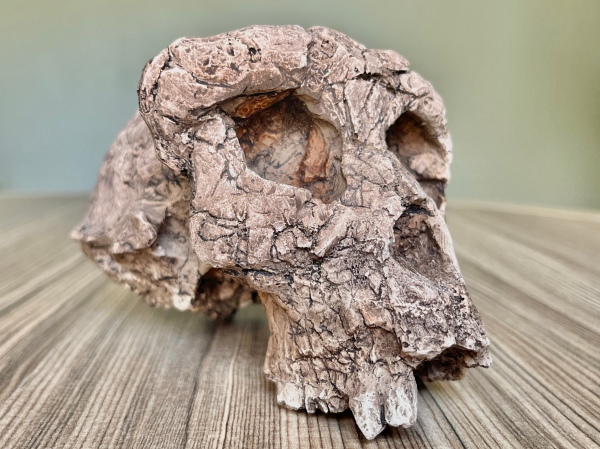
Sahelanthropus tchadensis was formally described in 2002 based on cranial remains of at least six individuals dated to about 6–7 million years ago during the Miocene epoch. “Toumaï” is the most complete of all the cranial remains, although it was crushed and badly deformed. To date, all the fossils found of Sahelanthropus have come from a small area of northern Chad.
The age of Sahelanthropus puts it around the time of the human-chimpanzee last common ancestor (HCLCA). At the time it was described, only cranial fragments were included in the original description, and the position of the opening for the spinal chord was used to infer that the species walked upright. However, a femur was also found alongside the cranium but was placed with animal bones and excluded from the original analysis. Later analysis of the femur concluded that Sahelanthropus was not bipedal (Macchiarelli et al. 2020), putting its status as a possible relative of the HCLCA into doubt. One alternative possibility that has been raised is that Sahelanthropus is not ancestral to either humans or chimpanzees, but rather to gorillas—a no less significant possibility since fossils attributed to the presumed gorilla lineage at this time consist only of teeth dating to about 10 million years ago.
Literature Cited
Macchiarelli, R., A. Bergeret-Medina, D. Marchi & B. Wood. 2020. Nature and relationships of Sahelanthropus tchadensis. Journal of Human Evolution 149:102898. doi:10.1016/j.jhevol.2020.102898
Tappen, N. C. 1985. The dentition of the “Old Man” of La Chapelle-aux-Saints and inferences concerning Neanderthal behavior. American Journal of Physical Anthropology 67(1):43–50. doi:10.1002/ajpa.1330670106
©️ Ted C. MacRae 2022
 Beetles In The Bush