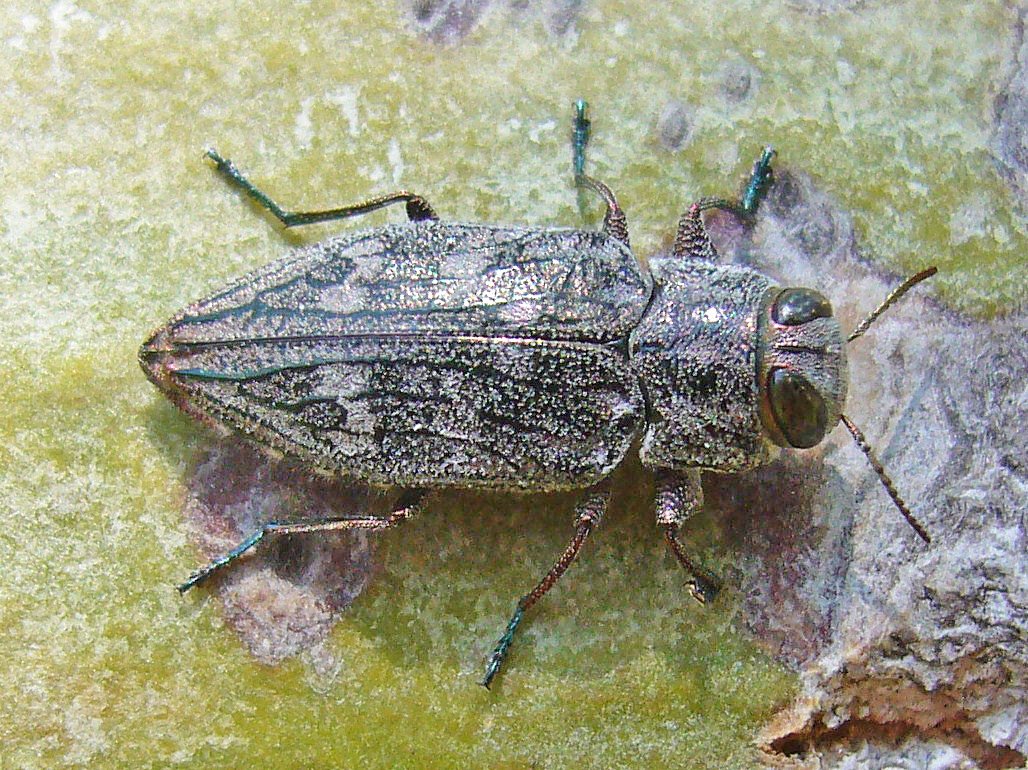
 I found a young cottonwood tree (Populus deltoides) the other day that had recently fallen over in one of the many storms we’ve had this spring. Anytime I see one of these “windthrows” I immediately think – woodboring beetles! Windthrows are attractive to numerous species of Buprestidae and Cerambycidae, and when I find one I try to revisit it often as the season progresses and different beetle species – active at different times and attracted to wood at different stages of dying or death – are encountered. This particular tree was only partially uprooted and so still had fresh foliage in the crown. While death is inevitable, it will be a slow, lingering death as the remaining soil-bound roots try in vain to sustain the fallen tree. This is an ideal situation for attracting species of the genus Chrysobothris, which seem to respond to plant volatiles emitted from trees under duress or recently killed. In the deciduous forests of eastern North America, C. femorata and related species are the most commonly encountered Chrysobothris attracted to these situations. Nursery growers and landscapers know this insect as the “flatheaded apple tree borer” – in reference to the appearance of the larvae as they tunnel under the bark of one of its favored hosts. The species has in fact, however, been recorded breeding in some two dozen genera of deciduous woody plants throughout the continental states and Canada, an unusual level of polyphagy for a genus of beetles in which most species typically exhibit a fair degree of host fidelity.
 The problem is, “C. femorata” is not really a species, but a complex of closely related species. Entomologists have recognized this for some time, and while diagnostic characters have been identified for some of the more distinctive members of the group, such characters have remained elusive for C. femorata and its closest relatives. As a result, the species has become sort of a “trash can” for specimens that could be not be assigned to one of these more distinctive species, and in many museum collections large series of specimens can be found labeled simply “C. femorata species complex”. Fortunately, some much needed clarity was provided earlier this year by Stanley Wellso and Gary Manley, who after years of careful, systematic study at last published a revision of the Chrysobothris femorata species complex. In their work, six new species were described and one species resurrected from synonymy under C. femorata. Three of the new species occur in the western U.S., another is restricted to Georgia and Florida, and the remaining two new species and one resurrected species occur broadly across the eastern or southeastern U.S. This brings to 12 the total number of femorata-complex species in North America, with nine occurring in the eastern U.S. and seven in Missouri. The characters used to distinguish the species are subtle but consistent, and available biological data seem to support the species as now defined.
.jpg) Of the dozen or so Chrysobothris individuals I collected on the fallen cottonwood during this past week, all but one represent C. femorata (as now defined). The photos I share here show some of the characters that distinguish this species from its closest relatives – primarily the straight rather than curved lateral margin on the last third of the elytra and the generally distinctly reddish elytral apices (most easily seen in the full-sized versions of the photos – click to view). Females (first and second photos) tend to show distinct reddish tinges behind the eyes and on top of the head as well. Males (third photo) can be distinguished from females by their bright green face (I tried valiantly but could not get one of these guys to pose in a position showing such). The photos also illustrate some of the typical behaviors displayed by these beetles, with males rapidly searching up and down the trunk looking for mates (third photo), and females probing cracks and crevices in the bark with their ovipositor looking for suitable sites to deposit their eggs (second photo). Of the two dozen host genera recorded for this species, many likely refer to some of the newly described species. In particular, records of this species from oak (Quercus spp.) and hackberry (Celtis spp.) may refer to the new species C. shawnee and C. caddo, respectively. As now defined, this species is still quite polyphagous and occurs throughout the continental U.S., but it is more common east of the continental divide and appears to prefer maple (Acer spp.), birch (Betula spp.), sycamore (Platanus occidentalis), poplar (Populus spp.), and especially rosaceous hosts such as hawthorn (Crataegus spp.), apple (Pyrus malus), pear (Pyrus communis), and cherry (Prunus spp.). Also, of all the species in this complex, C. femorata appears to be the most partial to stressed or dying trees (as with these individuals collected on live, windthrown cottonwood) rather than completely dead hosts. Wellso and Manley note that considerable variation still exists among individuals assignable to their more restricted definition of C. femorata. Thus, it is possible that more than one species is still involved, particularly among those utilizing hardwood hosts (e.g. apple, maple, etc.) versus softwoods (e.g., poplar, birch, etc.). Detailed biological studies will likely be required to identify any additional species that might be hiding amongst these populations.
Of the dozen or so Chrysobothris individuals I collected on the fallen cottonwood during this past week, all but one represent C. femorata (as now defined). The photos I share here show some of the characters that distinguish this species from its closest relatives – primarily the straight rather than curved lateral margin on the last third of the elytra and the generally distinctly reddish elytral apices (most easily seen in the full-sized versions of the photos – click to view). Females (first and second photos) tend to show distinct reddish tinges behind the eyes and on top of the head as well. Males (third photo) can be distinguished from females by their bright green face (I tried valiantly but could not get one of these guys to pose in a position showing such). The photos also illustrate some of the typical behaviors displayed by these beetles, with males rapidly searching up and down the trunk looking for mates (third photo), and females probing cracks and crevices in the bark with their ovipositor looking for suitable sites to deposit their eggs (second photo). Of the two dozen host genera recorded for this species, many likely refer to some of the newly described species. In particular, records of this species from oak (Quercus spp.) and hackberry (Celtis spp.) may refer to the new species C. shawnee and C. caddo, respectively. As now defined, this species is still quite polyphagous and occurs throughout the continental U.S., but it is more common east of the continental divide and appears to prefer maple (Acer spp.), birch (Betula spp.), sycamore (Platanus occidentalis), poplar (Populus spp.), and especially rosaceous hosts such as hawthorn (Crataegus spp.), apple (Pyrus malus), pear (Pyrus communis), and cherry (Prunus spp.). Also, of all the species in this complex, C. femorata appears to be the most partial to stressed or dying trees (as with these individuals collected on live, windthrown cottonwood) rather than completely dead hosts. Wellso and Manley note that considerable variation still exists among individuals assignable to their more restricted definition of C. femorata. Thus, it is possible that more than one species is still involved, particularly among those utilizing hardwood hosts (e.g. apple, maple, etc.) versus softwoods (e.g., poplar, birch, etc.). Detailed biological studies will likely be required to identify any additional species that might be hiding amongst these populations.


















.JPG)
























 Beetles In The Bush