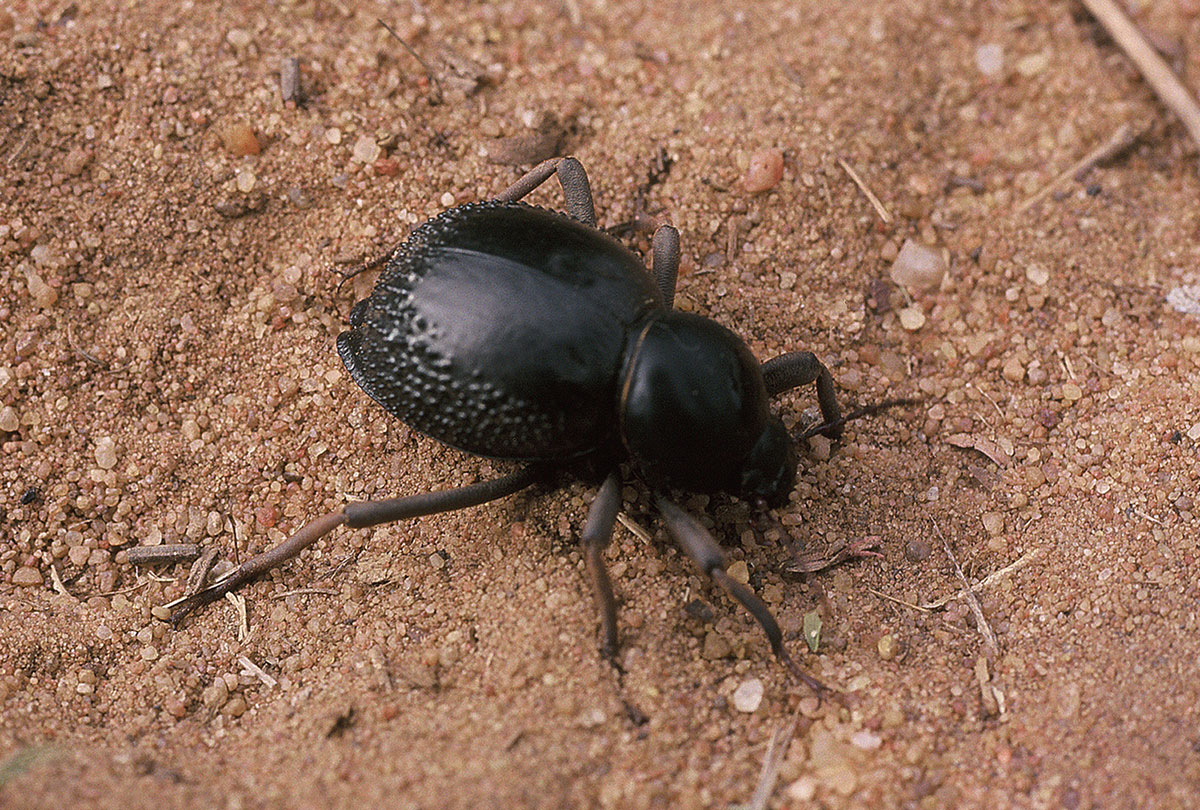
“Armoured tank beetle”

anomalipus-elaphus1

Photo details: Panasonic DMC-FX3 (macro setting w/ auto exposure, aperature, and focus), illumination by two 23w compact fluorescent light bulbs. Post processing details: Adobe PhotoShop Elements 6.0 to crop, adjust brightness and contrast, remove pinhead, erase background, and sharpen.

In my last post, I briefly mentioned a beast of a beetle that we had given the nickname “armoured tank beetle.” Using (Picker et al. 2002), I determined this beetle to represent the species, Anomalipus elephas (family Tenebrionidae) – whose actual common name of “large armoured darkling beetle” was amazingly close to our made-up common name (not to mention the appropriateness of its specific epithet) – and linked to an online photograph of the species. As it turns out, the genus Anomalipus is quite large, with 51 species distributed throughout eastern and southern Africa – 34 of which have been recorded from South Africa proper (Iwan 2002). I’ve learned better than to ascribe species names to specimens in diverse groups of which I am not an expert based on a photograph of a common species, so for now this specimen will have to be called Anomalipus sp. Endrödy-Younga and Tschinkel (1993) report that all species in this genus are heavily built with strong legs, with most species being restricted within their geographical range to dense bush-covered patches of woody savanna.

After I wrote that post, I got to looking at the larger of my two specimens and thought, “Gee, I bet I could get a nice shot of that thing.” After all, it measures an impressive 32 mm in length (that’s 1¼ inches, folks!). Here is the result, and I have to admit I’m quite pleased given my equipment limitations (I only wish I’d thought to brush him off a little bit). This really has to be the most beautiful “big, black, ugly beetle” I’ve ever seen. I recall when I was pinning these two specimens that the exoskeleton was so hard I literally had to use my scissors to hammer the pin to get it going into the specimens. I like “armoured tank beetle” better.

In unrelated news, there are a couple of Carnivals everyone should be aware of – I’m doing my part to get the word out:

Circle of the Spineless – Ed Baker over at Invertebrate Diaries is set to host the next issue on March 2, 2009. There’s your deadline!

Linneaus Legacy – The January issue, hosted at Greg Laden’s Blog, was a good one.  Seeds Aside is hosting the February edition and is hoping to post it later this week if he gets enough submissions!  Go to this post for details on where to submit your post (or those from other blogs you enjoy).  EDIT: Too late – edition #16 is now posted.

REFERENCES:

Endrödy-Younga, S. and W. Tschinkel. 1993. Estimation of population size and dispersal in Anomalipus mastodon Fåhraeus, 1870 (Coleoptera: Tenebrionidae: Platynotini). Annals of the Transvaal Museum 36(4):21-30.

Iwan, D. 2002. Catalogue of the World Platynotini (Coleoptera: Tenebrionidae). Genus 13(2):219-323.

Picker, M., C. Griffiths and A. Weaving. 2002. Field Guide to Insects of South Africa. Struik Publishers, Cape Town, 444 pp.

Copyright © Ted C. MacRae 2009

Add to FacebookAdd to NewsvineAdd to DiggAdd to Del.icio.usAdd to StumbleuponAdd to RedditAdd to BlinklistAdd to Ma.gnoliaAdd to TechnoratiAdd to Furl

Tempting tok-tokkies

In the 19th and early 20th centuries, some of the America’s greatest entomologists were coleopterists.  Army surgeons John L. LeConte and his protégé George W. Horn, California’s Henry C. Fall, Col. Thomas L. Casey (much maligned for his mihi itch¹ affliction, although in recent years regaining due respect for his insight on generic relationships), and “the Professor” Josef N. Knull, just to name a few.  What did these fine men have in common?  They studied beetles – not just tiger beetles or jewel beetles, but the entire order!  The world was much smaller then, and new information was generated at a much more leisurely pace.  Today such an approach is impossible.  With 300,000 described species in the order (conservatively) and growing, today’s students of Coleoptera must narrow their focus in one way or another – either by concentrating on one family or ecological guild, or by restricting their studies to a small geographic region.  I’ve tried, more or less successfully, to follow suite – jewel beetles are my primary focus, and I restrict my work with the ecologically similar longhorned beetles only to North American species.  Well, and I’m also working on tiger beetles, but only in Missouri… although I have begun taking fall tiger beetle trips to neighboring states.  Hmm, on second thought, I guess I haven’t been that successful at focusing (sigh! – and a likely explanation for my perpetual backlog of specimens unprocessed and papers unwritten).

¹In taxonomy, a term usually cast towards those who have a combination of disregard for quality over quantity when describing new taxa and a demonstrably high ego (Evenhuis 2008).

Whatever focus I do manage, it all goes out the window when I have the chance to collect in another country – especially someplace as exotic as Africa.  This is not a huge problem, as I can at least stay pretty much focused on just beetles.  Moths and butterflies are pretty, but it just takes too much effort to keep each specimen in good shape.  Bees and wasps also capture my interest, but I never know for sure whether I’ll get stung, and the extra precautions required to avoid such possibility are enough to make me pass on them.  Orthopterans don’t generally excite me unless they’re big and gaudy – in which case just one or two for the collection is fine.   And flies? Well, they’re flies! About the only non-coleopterans that regularly distract me are treehoppers – running into a mess of them, with their bizarre, fantastical shapes will always stop me in my tracks.  Fortunately, they’re not so abundant that they are constantly grabbing my attention.

Beetles, though – that’s a different story.  While I can resist the temptation to collect many of the groups outside of my sphere of interest, there are others that are consistently too tempting for me to pass up.  One of these is the Tenebrionidae, or darkling beetles.  With some 20,000 described species worldwide, it is among the most speciose of beetle families (larger than my beloved Buprestidae), and this diversity combines with difficult taxonomy to make them truly challenging for even the most serious students of the family.  For hacks like me, they’re impossible.  Moreover, they’re not even especialy pretty – usually just black.  Why do I collect them? Mostly because of their (in many cases) large size, comically awkward shuffling gait, and often exaggerated surface sculpturing.  Especialy diverse in more xeric habitats, I’ve collected quite a few in my frequent trips through the southwestern U.S. and even managed to get many of them identified by tenebrionid icon Charles A. Triplehorn.  Southern Africa is a true center of diversity for this group, with some 3,500 species recorded from the area – nearly 20% of the global diversity!  A number of particularly large species that go by the common name “tok-tokkies” make their homes in the dry Namib desert and surrounding bushveld.  Along with dungers and chafers and tyrant ground beetles, tok-tokkies would prove to be one more distraction in my nevertheless successful quest for African jewel beetles.

Psammodes hirtipes

Psammodes hirtipes

“Tok-tokkie” refers not to a particular genus or tribe of tenebrionids, but rather a number of flightless species that have developed a unique “tapping” method of communication between males and females.  The name “tok-tokkie” is onomatopoeic, referring to the sound these beetles make when they tap their abdomen on the ground.  In the same way that fireflies have species-specific patterns of flashes, different species of tok-tokkies tap with differing frequencies.  The beetle makes the noise by raising its abdomen and then bringing it down on the surface of the ground several times in quick succession.  Males initiate the tapping and await a response from a receptive female.  Signals are exchanged back and forth until, eventually, the two locate each other and mate.  Females lay eggs in shallow excavations in the dry, sandy soil, and the larvae that hatch feed within the soil on the roots of small plants. The dry Namib Desert has some of the most astounding species of tok-tokkies. Some – called “fog tok-tokkies” – have developed specially modified grooves to trap moisture from fog banks rolling onto the Atlantic coast. Others drink by doing a “head-stand” to allow condensed dew to trickle down to their mouths. Heat avoidance is another challenge in the Namib. Some species extrude dots of white wax from small pores on their elytra in response to increasing sunlight intensity, eventually appearing white-spotted or striped. The wax reflects the sun’s rays and helps keep the beetle cool. Other species beats the heat by running – in fact, the fastest running beetle in the world is one of the Namib tok-tokkies (and not, as I would have suspected, a tiger beetle). Unlike its mostly clumsy brethren around the rest of the world, this beetle blasts across the scorching sand at lighting speeds. A related species boasts the longest relative leg length of any beetle in the world.

Psammodes virago

Psammodes virago

I knew none of this in 1999 when I was in South Africa’s Northern (now Limpopo) Province, and while the tok-tokkies we encountered in the bushveld habitat below the Waterberg Range were not quite as marvelous as those of the nearby Namib Desert, they were still irresistible to this indefatigable beetle collector. Not knowing their names, we came up with our own names for them based on their appearance. Psammodes hirtipes was “wrinkle butt” due to the numerous prominent tubercles at the sides and rear of its otherwise smooth elytra. Psammodes virago, was “helmet beetle” because of its smoothly domed “army helmet” shape. Our designation of “armoured tank beetle” for Anomalipus elephas (photo credit) was amazingly close to its actual common name of “large armoured darkling beetle” (Picker et al. (2002), as was “white legs” for Dichtha incantatoris (photo credit), which Picker et al. (2002) call the “white-legged tok-tokkie”. In all, I collected some dozen species of tenebrionids during my stay at Geelhoutbos farm. Most of the smaller ones are still unidentified, but hopefully someday they will prove useful to some tenebrionid specialist.

The online magazine Travel Africa offers an informative article about the Namib tok-tokkies and this humerous video from National Geographic:

Vodpod videos no longer available.

more about “Namib beetles – Travel Africa Magazine“, posted with vodpod

REFERENCES:

Evenhuis, N. L. 2008. The “Mihi itch”—a brief history. Zootaxa, 1890:59-68.

Picker, M., C. Griffiths and A. Weaving. 2002. Field Guide to Insects of South Africa. Struik Publishers, Cape Town, 444 pp.

Copyright © Ted C. MacRae 2009

Add to FacebookAdd to NewsvineAdd to DiggAdd to Del.icio.usAdd to StumbleuponAdd to RedditAdd to BlinklistAdd to Ma.gnoliaAdd to TechnoratiAdd to Furl

Lions in South Africa

Joerie, Joerie, botter en brood,
as ek jou kry, slaat ek jou dood.

Doodlebugs, joerie, shunties, toritos—these are but a few of the many colloquial names given to amusing little creatures that many people know simply as antlions (or translation of such) (Swanson 1996).   Larvae of winged insects resembling (but unrelated to) dragonflies, they are best known for their habit of digging smooth-sided, cone-shaped pits in sandy soils and concealing themselves under the sand at the bottom.  There, they lay in wait for some small, unsuspecting creature—often an ant—to fall into the pit.  When that happens, the hidden antlion bursts forth, using its oversized, sickle-shaped mandibles to “flick” sand at the prey to keep it sliding towards the bottom of the hole.  Once it is within reach, the antlion grabs the prey using those same, deadly mandibles (how delightfully morbid!).  So otherworldly is their appearance and behavior that, in addition to inspiring children’s charms, they have served as an unmistakable model for the “Ceti eels” featured in Star Trek: The Wrath of Khan!1  Adults of this group, on the other hand, have inspired far less imagination in nomenclature and culture, to the point that even their common name “antlion lacewing” is merely a reference back to their unusual larvae.  Even the scientific name of the family—Myrmeleontidae—has failed to garner complete adherence, with “Myrmeleonidae” (who needs the “t”?) and “Myrmelionidae” (perhaps from English-speakers focused on the English spelling of “lion” rather than the Latin spelling of “leo”) still appearing in popular and even scientific literature.

1 Sadly (and ironically), actor Ricardo Montalban, who played the villain Khan Noonien Singh in that movie (reprising a character he played 15 years earlier during the debut season of the Star Trek television series), died just eight days ago at the age of 88. I must confess that I am a life-long Star Trek fan (though not a “Trekkie”), and “Wrath” was certainly among my favorite of the movies, due in large part to Montalban’s steely, venomous portrayal of Kahn. My favorite line occurs as Kahn is about to put a Ceti eel in Chekov’s ear, explaining how they wrap themselves around the victim’s cerebral cortex. He then says, “Later, as they [pauses deliciously] grow…”

myrmeleontidae-larval-pitI’ve seen antlion pits on several occasions (especially in recent years as I’ve spent more time in open sand habitats searching for my beloved tiger beetles).  However, the pit pictured here—encountered at Borakalalo National Park in South Africa’s North West Province, was the first I’d ever seen in which there was actually an ant inside the pit.  The ant was dead, presumably having already been sucked dry by the joerie. I didn’t know it at the time, but southern Africa is a major evolutionary center for antlion lacewings and some of their striking relatives such as spoonwinged and threadwinged lacewings (family Nemopteridae) and silky lacewings (family Psychopsidae) (Grimaldi & Engel 2005).  Relatively few of South Africa’s antlions, however, actually dig pits—a habit restricted to species in the genera Hagenomyia, Cueta, and the cosmopolitan Myrmeleon (Scholtz & Holm 1985).  Rather, the majority of species have free-living larvae that hide under objects or roam under deep sand from where they emerge to hunt other insects.

Palpares lentusThis adult antlion lacewing came to an ultraviolet light at our encampment on the Geelhoutbos farm near the Waterberg Range (Limpopo Province). Its tremendous size and distinctly patterned wings placed it in the tribe Palparini, of which the genus Palpares is the most diverse. These are the true giants of the family, with forewing lengths that can reach 75 mm (that’s 3 inches, folks!) and both wings bearing conspicuous patterns of black and yellow markings (the yellow doesn’t show well in this photograph due to illumination by the ultraviolet light).  The larvae, understandably, are also quite large, and have even been observed to capture ground resting grasshoppers (Capinera 2008).  I sent this photograph to Dr. Mervyn Mansell, an expert on African Myrmeleontidae, who kindly identified the individual as a female Palpares lentus, endemic to northern South Africa and Zimbabwe. When queried for more information regarding its biology, Dr. Mansell responded:

We know nothing about P. lentus, except for distribution records. Nothing is known about its larva or biology, although the larvae of all Palpares and related genera are obviously large, and live freely in sand well concealed and almost impossible to find.

Palpares lentus is one of 42 species of Palparini in southern Africa—half of all known species in the tribe.  Nearly two-thirds of them are endemic to “open” biomes in the dry western parts of the subregion (Mansell & Erasmus 2002).  This high level of endemism results from the occurrence of large tracts of sand and exposed soil that are conducive to the large sand-dwelling larvae.  Eastern parts of the subregion containing forest or thicket biomes are not as favored by antlion lacewings, and consequently the diversity of species in these areas is much lower.  Because of their great size, palparine adults are especially vulnerable to predation, with the result that they have evolved elaborately patterned wings to enhance their camouflage—apparently an adaptation to the dappled shade provided by the fine-leafed plants found in these biomes.  While many species in the tribe are diurnal, a few in the related genus Palparellus pulchellus and P. ulrike are known to be attracted to light, spending the day resting concealed amongst vegetation. The attraction of this individual to our ultraviolet light suggests Palpares lentus has similar habits.

Everything you want to know about antlions can be found at Mark Swanson’s excellent website, The Antlion Pit. For information specific to Africa, Mervyn Mansell has assembled a checklist of The Antlions (Neuroptera: Myrmeleontidae) of South Africa, and a nice summary of antlions in Kruger National Park by Dave Rushworth can be found at Destination Kruger Park. I thank Dr. Mansell for his identification of Palpares lentus.

REFERENCES:

Capinera, J. L. (ed.).  2008. Encyclopedia of Entomology, 2nd Edition. Springer, Dordrecht, The Netherlands. 4346 pp.

Grimaldi, D. and M. S. Engel. 2005. Evolution of the Insects. Cambridge University Press, New York, xv + 755 pp.

Mansell, M. W. and B. F. N. Erasmus. 2002. Southern African biomes and the evolution of Palparini (Insecta: Neuroptera: Myrmeleontidae). Acta Zoologica Academiae Scientiarum Hungaricae 48 (Suppl. 2):175–184.

Scholtz, C. H. and E. Holm (eds.). 1985. Insects of Southern Africa. Butterworths, Durbin, South Africa, 502 pp.

Swanson, M.  1996. The Antlion Pit: A Doodlebug Anthology. http://www.antlionpit.com/

The “buzzard signal fly”

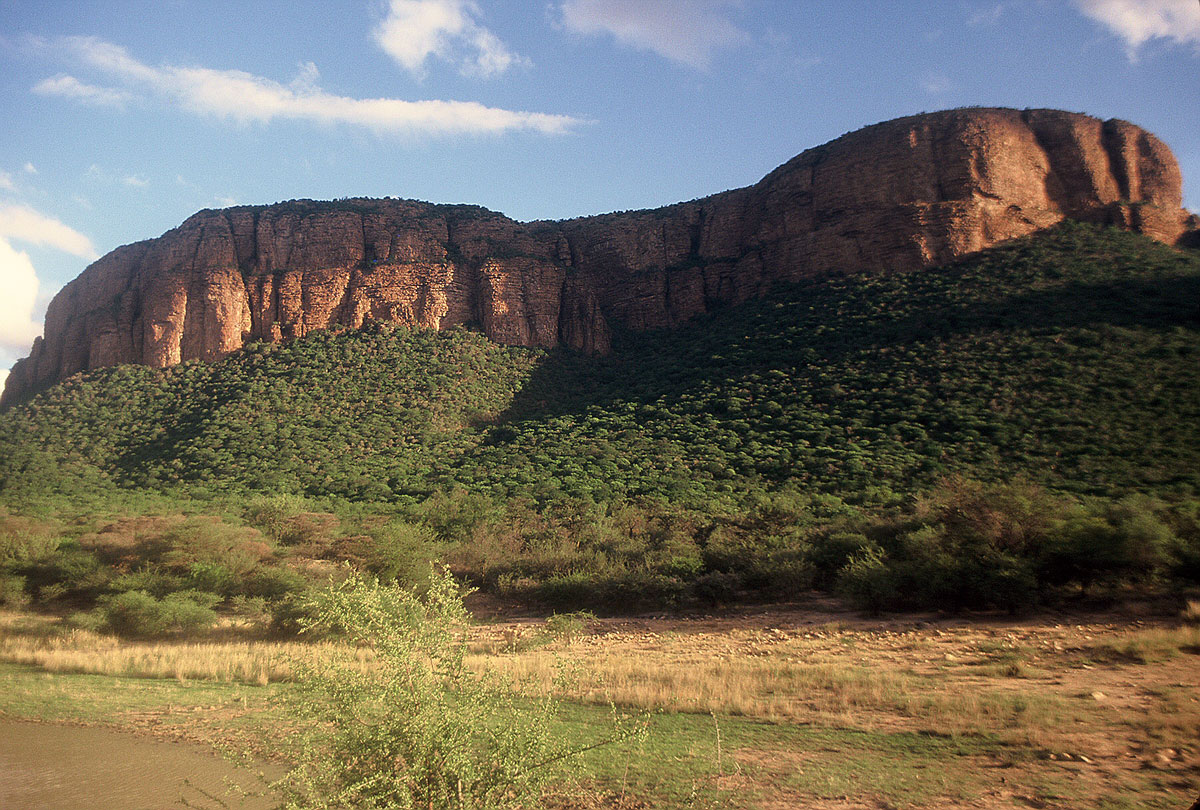
Waterberg RangeDuring our time at Geelhoutbos farm in South Africa’s Northern (now Limpopo) Province, we spent most of our time in the foothills below a magnificent north-facing escarpment of the Waterberg Mountain Range. We were here to collect Buprestidae (including the magnificent Evides, featured previously in this post), and it was in the low bushveld woodland where the greatest diversity of buprestids would be found. Many of the buprestids we encountered were associated with the acacias that abundantly dotted the landscape – especially the iconic “umbrella thorn” (Acacia tortilis) and “sweet thorn” (Acacia karoo), providing sustenance for everything from bitsy beetles (including our beloved buprestids) to giant giraffes. Still, I kept eyeing the mountains, yearning to clamber up on top of the billion year old massif for no other reason than because it was there. Chuck had the good sense to stay down below amongst the acacias and buprestids while I spent an afternoon winding my way up the escarpment in the company of our hostess, Susan Strauss. I didn’t collect many buprestids during that trek, and if success is measured solely by numbers of buprestids collected then Chuck won. But if success also includes the chance to see spectacularly endless vistas from an otherworldly landscape on a once in a lifetime trip, then I didn’t do too badly.

Bromophila caffra

While I didn’t see many buprestids during that afternoon, I did see a few other insects interesting enough to attract my attention and maybe an attempt at a photo. This stunning fly was one of those insects. Even though it exceeded a full inch in length, it still wasn’t the largest fly I had ever seen. However, with its black body, metallic blue wings and large, round, wax-red head it was certainly among the most impressive. A quick scan through my recently acquired Field Guide to Insects of South Africa (Picker et al. 2002) has at last identified this fly as Bromophila caffra. It is a member of the family Platystomatidae, commonly known as signal flies and part of the great superfamily Tephritoidea of fruit fly fame (i.e., true fruit flies – not “the” fruit fly which belongs to the family Drosophilidae and which are more properly called vinegar flies).

Signal flies are interesting on several fronts, firstly because of their catholic tastes – Sivinski (1999) records rotting tree trunks, bulbs, roots and fruit, dried flowers and dead grass stems, dung and fungus as breeding sites, and notes – gruesomely – that mass graves dug in World War II sometimes produced huge numbers of the species Platystoma lugubre. It is some of the Australasian species, however, that have truly made a name for this family. In the tropical rainforests of Guinea and Queensland, males of many species exhibit modifications of their heads that are used in agonistic interactions with sexual rivals. These vary from broadening of the face into a surface used to push against the face of another male, to extremely well-developed stalk eyes used to gauge rival male’s size and strength in face to face combat.

But what about Bromophila caffra? Aside from being one of the most recognizable of flies in Africa, it’s sluggish disposition and apparent noxiousness were obvious even to early naturalists. Marshall (1902) noted the similarity of its coloration (black body, blue wings, red or yellow head) to that of two Pompilus spp. and one sphecid wasp with which it occurred sympatrically. Regarding its habits, he also noted:

The Bromophila fly is very plentiful; it is the most sluggish fly known to me, and settles about on trees and bushes in a very conspicuous manner. It ejects a yellow liquid from the mouth when handled, and was refused when offered to my baboons and Cercopithecus monkey.

Andrew Whittington, commenting on a photo of this species posted on DipteraInfo.com, provides further clues that seem to confirm the noxious qualities of this species, explaining not only its striking color and brazen habits but also the ease with which I obtained the above photograph:

Our knowledge of larval habits is very rudimentary. There appears to be an association with the roots of Terminalia trees (Combretaceae), from which the larvae sequester various toxic compounds (probably cyclic triterpenes) possibly for defense. This may render the adults toxic too, as a defense against predation – not a thoroughly tested hypothesis.
Adults are slow moving and ponderous … and photogenic!

I find it surprising that a large, strikingly distinctive, abundant insect such as Bromophila caffra should lack a common name, but it appears this is the case. None was given in Field Guide to Insects of South Africa, nor amongst the several South African wildlife and dipteran websites which I encountered featuring photos of this insect. In thinking about what common name Bromophila caffra could have, I can’t help but draw comparisons between this insect and the turkey vulture (Cathartes aura), or “buzzard,” of North America (despite their belonging to entirely separate phyla). Both species are among the larger members of their respective orders and make their living eating repulsive foodstuffs. Hulking black with naked, red, plastic-like heads, most predators regard them as too vile and noxious to bother with, leaving them free to pass their lives in unmolested disdain. With this in mind, I hereby propose “buzzard signal fly” as the official common name for this insect 😉

Additional photographs of Bromophila caffra can be seen at Joan Young’s fine blog, South African Photographs, and at Biodiversty Explorer, the web of life in Southern Africa. This is the fifth in a series of posts covering a natural history excursion to South Africa in November/December 1999. Click on “South Africa” under “Tags” to see links and summaries for other posts in this series.

REFERENCES:

Marshall, G. A. K. 1902. Five year’s observations and experiments (1896-1901) on the bionomics of South African insects, chiefly directed to the investigation of mimicry and warning colours. Transactions of the Entomological Society of London, 1902:287-584.

Picker, M., C. Griffiths and A. Weaving. 2002. Field Guide to Insects of South Africa. Struik Publishers, Cape Town, 444 pp.

Sivinski, J. 1999. Breeding habits and sex in families closely related to Tephritidae: Opportunities for comparative studies of the evolution of fruit fly behavior, pp. 23-39. In: M. Aluja and A. L. Norrbom [eds.], Fruit Flies (Tephritidae): Phylogeny and Evolution of Behavior, CRC Press, Boca Raton, 984 pp.

Tyrant ground beetles

I return to my Afrikaans theme with a distinctive group of ground beetles (family Carabidae) called tyrant ground beetles or spotted ground beetles (tribe Anthiini). I think I prefer the former. This tribe is largely restricted to Africa and is especially diverse and abundant in the arid, sandy Karoo and Kalahari regions of southern Africa (Scholtz & Holm 1985). These beetles are large, powerful predators that rely on speed and agility for capturing prey, and since they are also flightless these characteristics come in handy for avoiding becoming prey themselves. Failing that, they employ chemical defense in the form of secretions from a pygidial gland located in the area of the ninth abdominal segment. The chemical cocktail within these secretions contains concentrated organic acids or quinone that can be squirted at potential predators in a strong jet. This is an effective deterrent to small mammalian and avian predators, and I suppose a careless beetle collector might also regret handling these beetles without due respect. These defensive spray capabilities give rise to another common name for the group, “oogpister” – an Afrikaner word that literally translates to (ahem) “eye pisser.”

Anthia (s. str.) thoracicaDuring my time in Africa, Chuck Bellamy and I were primarily focused on collecting buprestids. However, we still couldn’t resist hanging an ultraviolet light in front of a sheet and searching the ground with flashlights at night to see what diversity of other African insects we might encounter. Truth be told, one of the non-buprestid groups that I’d really hoped to encounter was a near relative of these beetles – the so-called “monster tiger beetles” of the genus Manticora (family Cicindelidae1). We never did see any monsters, but we did encounter several species of anthiine ground beetles around our encampment at Geelhoutbos farm near the Waterberg Range in Limpopo Provice. Anthia (s. str.) thoracica, the giant African ground beetle (above), was the most impressive of these. Click on the photo to see a larger version – only then will it begin to convey how truly appropriate such a common name is for this species. It is certainly the largest ground beetle that I have ever seen – a full 50 mm in length! That’s 2 inches, folks! This species is easily recognized by the depressed lateral expansions of the pronotum covered with dense white/yellow pubescence, and the slightly smaller male that I caught exhibits more elongated mandibles (though not so incredibly as in Manticora) and marvelous lobes extending backward from the pronotum.

1 Increasingly placed within the Carabidae as subfamily Cicindelinae on the basis of molecular phylogenetic analysis, along with Paussinae and Rhysodinae (e.g., Beutel et al. 2008).

Anthia (Termophilum) omoplataIn addition to true Anthia, we saw two species of the subgenus Anthia (Termophilum)2. The species shown right is A. (T.) omoplata3, with the common name “two-spotted ground beetle” (Picker et al. 2002). It was almost as large as its giant brother above, measuring 47 mm in length. Of this species, I only saw this one individual, but I did also find two individuals of a related species, T. fornasinii. Unfortunately I was unable to photograph the latter species, which is equally large but with the elytral white markings limited to a thin marginal band and the surface of the elytra bearing strong longitudinal intervals – a handsome beast, indeed! Picker et al. (2002) mention T. homoplatum being a diurnal hunter, but we found all of our anthiines active nocturnally.

2 Treated variously in the literature as either a full genus or as a subgenus of Anthia. I follow Carabidae of the World, in which it is given subgeneric status. The name is often cited as “Thermophilum” in the literature, but this is an incorrect subsequent spelling according to Alexandre Anischenko (in litt.), coordinator/editor of Carabidae of the World.

3 Usually cited as “homoplatum” or “homoplata” in the literature, but this is an incorrect subsequent spelling (Anischenko in litt.).

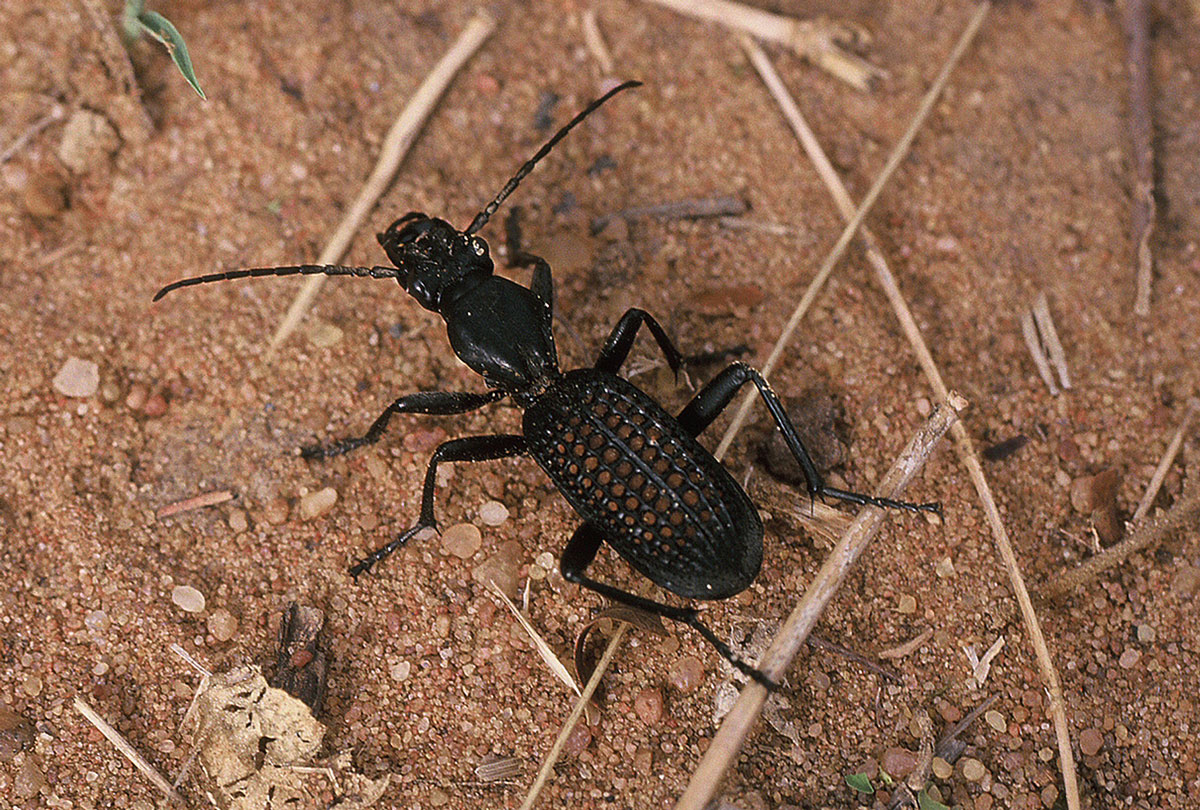
cypholoba-alveolataA second genus in the tribe is Cypholoba, represented here by C. alveolata. As far as I can tell it lacks a common name, which is not surprising since it is somewhat smaller than the Anthia species mentioned above. Still, my two specimens measure 38 and 35 mm in length – not puny by any standard. There can be no doubt as to the origin of the specific epithet of this species’ scientific name, with its marvelously alveolate elytra. I don’t think I’ve seen such an extraordinary example of this type of surface sculpturing on a beetle of this size, making the species every bit as spectacular as the larger anthiines.

A truly fascinating aspect of Africa’s tyrant ground beetles is their role as models in Batesian mimicry systems. That these beetles should serve as models is not at all surprising due to their chemical defensive capabilities and obviously aposematic coloration. What is surprising is the mimic – juveniles of the lizard species, Eremias lugubris, in what is believed to be the first reported case of a terrestrial vertebrate mimicking an invertebrate (Huey & Pianka 1977). The juveniles not only copy (roughly) the black and white coloration of anthiine beetles but also mimic their rapid, skitty movements – foraging actively with “jerky” motions and arched backs. Their tails remain somber colored, however, allowing them to blend into the sand. These adaptations combine to give the harmless little lizard the size, color, profile, and gait of the beetles. As the lizards reach adulthood (and their greater size makes them less prone to predation), they take on a more typical cryptic coloration and move in a slower, more deliberately lizard-like manner. This mimicry association effectively reduces predation of the juveniles by potential predators, who quickly learn to avoid the noxious, and more frequently encountered, anthiine models.

REFERENCES:

Beutela, R. G., I. Riberab and O. R. P. Bininda-Emonds. 2008. A genus-level supertree of Adephaga (Coleoptera). Organisms, Diversity & Evolution, 7:255–269.

Huey, R. B. and B. R. Pianka. 1977. Natural selection for juvenile lizards mimicking noxious beetles. Science, 195 (4274):201-203.

Picker, M., C. Griffiths and A. Weaving. 2002. Field Guide to Insects of South Africa. Struik Publishers, Cape Town, 444 pp.

Scholtz, C. H. and E. Holm (eds.). 1985. Insects of Southern Africa. Butterworths, Durbin, 502 pp.

Afrikaans ants

A few for Alex

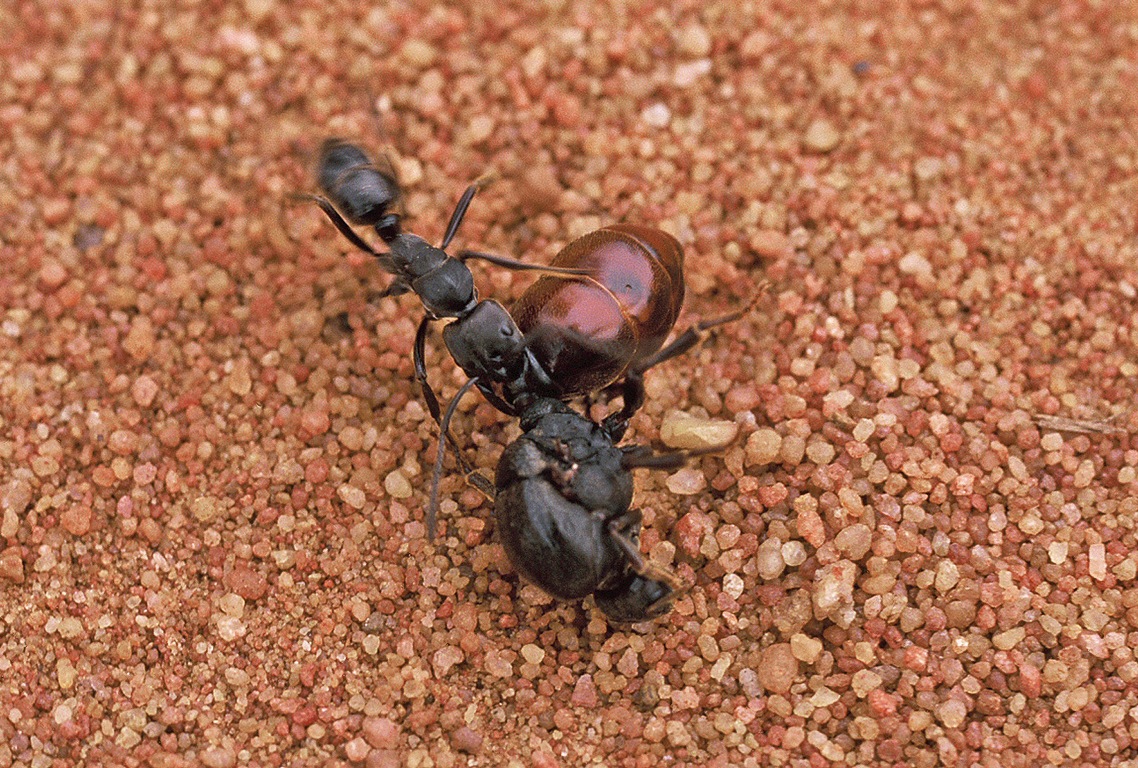
I photographed these ants in South Africa during my visit to Borakalalo National Park (North West Province) in November 1999.  Dr. Brian Taylor, author of the impressive Ants of Africa website, kindly identified and provided some information about the ants in these photos.  Pachycondyla tarsata - South Africa, North West Province, Borakalalo National Park, 25.xi.1999The first photo shows a worker ant dragging another dead ant.  Dr. Taylor identified the worker as Pachycondyla tarsata, which according to his website is known as the ‘Stink Ant’.  This pan-African species usually forages singly and nests directly in the ground, with the entrance often surrounded by excavated soil and remains of arthropods and other food. He wasn’t sure about the identity of ant being carried but guessed that it could be the queen of Camponotus (Myrmopiromis) fulvopilosus1.  That species is South African and appears to be of the right size for the individual in this photo.  Ants may have taken over the world, but at least they clean up after themselves.

1 Edit 01/17/09: Dr. Taylor sent an email to me saying that, after a second look at the above photo, he now believes the queen being carried by the Pachycondyla tarsata worker probably represents Carebara vidua, discussed below.

These next photos might have been better posted on Wednesday (ahem… “hump” day).  424046-r1-e009_009_mating_ants_21Dr. Taylor identified them as Carebara vidua. According to Lepage and Darlington (1984), colonies of this termitophagous species produce broods of alates ready to fly during the short November rains (as we experienced during our visit), as well as the longer April rains. Male and female alates are usually produced in separate nests, and after the flight the alate males seek out the females. The mating swarm I photographed shows several males attempting to mate with a single female – I counted five males at first, although one dropped off while I continued taking photos trying to get a good shot of the “lucky fellow”. 424046-r1-e010_010_mating_ants_21I am pleased that Dr. Taylor considered these photos informative enough to post on the species page at his Ants of Africa website. Lepage and Darlington (1984) reported nests of this species established in 2-10% of Macrotermes termite mounds  in Kenya, although nests can also occur well away from mounds. In the laboratory, dealate female ants exposed to Macrotermes workers remained passive and elicited no aggression. After 39 days, the mated females were capable of producing broods of about 1,000 workers, able to overpower, kill and eat the much larger Macrotermes workers.

REFERENCES:

Taylor, B. 2008. Ants of Africa. http://www.antbase.org/ants/africa/antcover.htm.

Lepage, M. G. and J. P. E. C. Darlington. 1984. Observations on the ant Carebara vidua F. Smith preying on termites in Kenya. Journal of Natural History 18(2):293-302.

Buppies in the bush(veld)

In writing an article for the most recent issue of SCARABS, I found myself reliving some long-dormant memories of my trip to South Africa. It was nine years ago right about this time of year when I made what was to become the collecting trip of a lifetime. What a completely different November/December experience compared to the gray skies and bare trees I see outside my window today. Writing that article was a lot of fun – going back through my slides (yep, slides – no digital for me then), reviewing material in my collection, and trying my best to recall some long forgotten details. Using a long-handled tropics net to collect Evides spp. from upper branch terminals of Lannea discolor at Geelhoutbos FarmOf course, scarabs were not my reason for going to Africa – buprestids were! Although I did manage to sneak a few buprestid photos into the SCARABS article, for the most part I was a good boy and kept my focus on the that newsletter’s intended subject. It wasn’t hard, given the gorgeous diversity of “dungers” (dung beetles) and flower chafers that I encountered in that spectacular country. Here, however, I offer a sampling of the Buprestidae I encountered during that trip.

Much of trip was spent in the bushveld (pronounced “bushfelt”) tropical savanna – a mix of grassland and semi-deciduous forest – below the rugged and rocky Waterberg Mountains, their rugged exposures of 2.7 billion year old sandstone and quartzite providing a spectacular backdrop. I’ve already posted a photo of Evides pubiventris, the largest and most spectacular buprestid seen there. A handsome, iridescent green that must be seen to be believed, these elusive beetles spend their days high off the ground on the upper branch terminals of their host trees, Lannea discolor. Success in collecting these beetles comes only to those willing to give it considerable effort. In this photo, I use a long-handled tropics net and tap the rim of the net on the undersides of the branch terminals. The adults are alert and quick to fly but often enough drop from the foliage into the net before taking flight. Many hours were spent during the several days we were at this spot with my neck craned upwards, but my efforts were richly rewarded with several specimens of E. pubiventris and the closely related E. interstitialis.

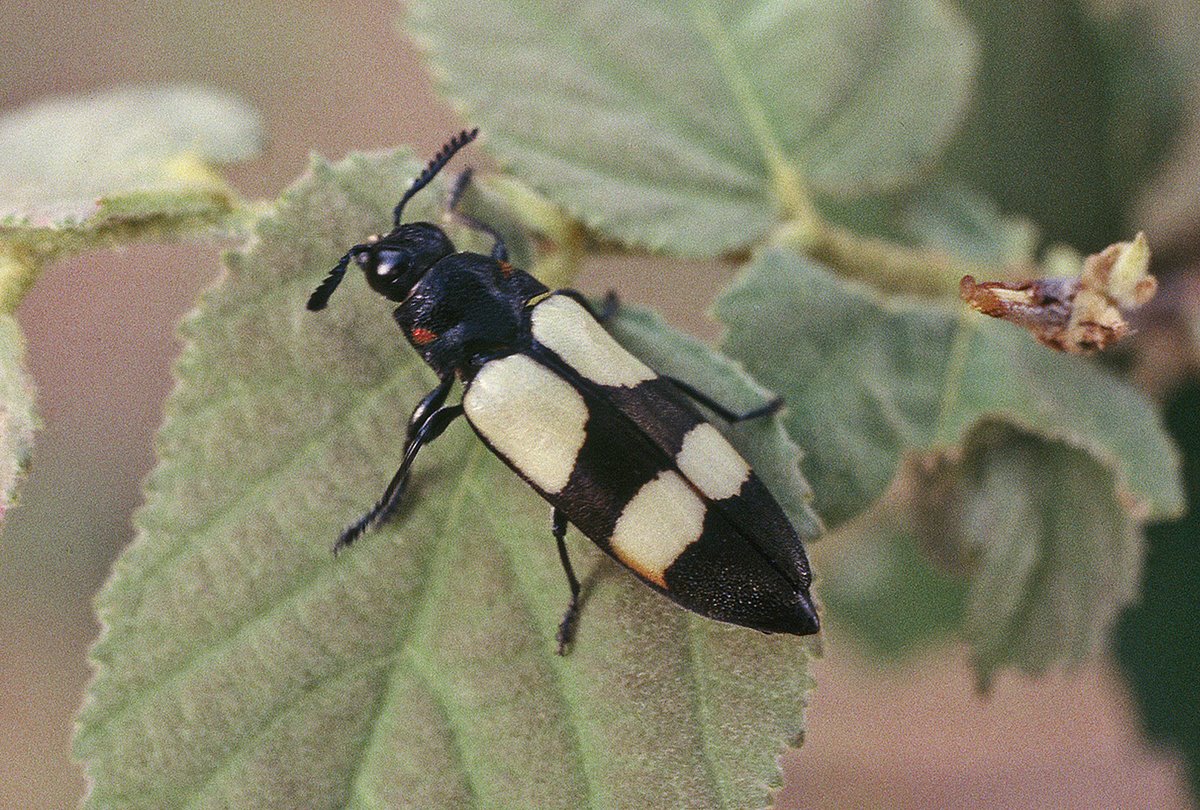
Agelia petalii - South Africa, Limpopo Province, vic. Waterberg Mountains, Geelhoutbos Farm, 30.xi.1999, on Grewia monticolaAnother of the more spectacular buprestids seen on the trip was Agelia petelii, a not too distant relative of Evides (both are in the subfamily Chrysochroinae, containing the bulk of the “classic” jewel beetles). Several individuals of this species were seen here in the Waterberg and also at Borakalalo National Park in North West Province. Their bold markings would seem to make them conspicuous targets for predation by birds but actually serve as protection by mimicking the warning coloration of Mylabris oculata, a common blister beetle in southern Africa that occasionally reaches pest status on leguminous crops and that is – like all blister beetles – largely protected from predation by the cantharidins in its hemolypmph. Many of these blister beetles were seen during the trip, and I had to pay close attention to each of them in order to secure my half dozen or so specimens of the much less common A. petelii.

Meliboeus punctatus - South Africa, Limpopo Province, 8.5 km S of Piesmoor River, 4.xii.1999, on unidentified Grewia-like shrubThis gorgeous little beetle, seen south of the Waterberg near the Piesmoor River, belongs to the enormously diverse but poorly known tribe Coraebini. This tribe – a cousin to the even more diverse genus Agrilus (see this post) – is represented by only a few species in North America but is richly represented in sub-Saharan Africa and Madagascar. Chuck Bellamy – my friend, colleague, and host during this trip – probably knows more about coraebines than anybody alive and has identified this as Meliboeus punctatus. The plant on which the beetles were found remains a mystery – it looks similar to plants in the rhamnaceous genus Grewia on which we saw so many other buprestid species but is clearly not a member of that genus. It is one of the few buprestids I collected on the trip for which I did not obtain host information (I hate that!).

Acmaeodera (Paracmaeodera) viridaenea swierstrae - South Africa, North West Province, Borakalalo National Park, along Moratele River, 24.xi.1999, on Grewia flava blossomThe genus Acmaeodera is another of the hugely diverse groups in the family, having radiated in all the biogeographic realms except Australian. This group is especially well represented in North America, with some 150 species occurring in our desert southwest and many more occurring down into Mexico. The vast majority of these are variously patterned with yellow and/or red markings on a black background. In southern Africa the genus is also diverse but shows greater diversity of form and has, accordingly, been divided into a number of well-defined subgenera. Like our North American species, adults of many African species are frequently found on flowers, where they feed on pollen and petals. I encountered at least a dozen Acmaeodera spp. on the trip, with one of the more striking species being A. (Paracmaeodera) viridaenea. Acmaeodera (Rugacmaeodera) ruficaudis - South Africa, South Africa, Limpopo Province, vic. Waterberg Mountains, Geelhoutbos Farm, 1.xii.1999, on Grewia flava blossomLike other species in this subgenus, adults are brilliantly colored and sexually dichroic, with the individual pictured here (above, left) being a female and the males being greenish brown with coppery sides. Other species are quite somber colored, such as A. ruficaudis in the subgenus A. (Rugacmaeodera) (right). Both of these individuals were found on flowers of Grewia flava.

Discoderoides immunitus - South Africa, South Africa, Limpopo Province, vic. Waterberg Mountains, Geelhoutbos Farm, 1.xii.1999, on Grewia flavaNot all “jewel beetles” do their name justice. This small species – Discoderoides immunitus (another member of the tribe Coraebini) – appears to resemble a piece of caterpillar frass. Several individuals were seen, all sitting on the leaves of Grewia flava like this individual rather than visiting the flowers like Acmaeodera. This beetle reinforced an important lesson I have learned repeatedly about field identification – upon my return to St. Louis, when I had an opportunity to examine these individuals more closely under the microscope, I found one specimen mixed in the batch that was, in fact, not this species, but a species in the closely related genus Discoderes. Moreover, that individual appears to represent an as yet undescribed species. Pity that I found only the single individual, since describing species from such uniques is not very desireable. Regardless, I’m glad I didn’t assume this individual was yet another D. immunitis in the field and pass it by – keeping the species in the still too-swollen ranks of the unknown and unseen.

One of the most exquisite species that I collected was Anadora cupriventris – a very large (by coraebine standards), heavily sculptured species densely covered with curled swaths of gold and brown pubescence. I regret not having the opportunity to photograph the single individual that I found. Another impressive species that I was not able to photograph was Agrilus (Personatus) sexguttatus, surely close to, if not the largest species in the genus and boldly patterned with black and rust red spots on olive green. One last species for which I have no images but is worthy of mention is an undetermined species of the genus Pseudagrilus. Looking like a chunky, brilliant green Agrilus with saltorial (jumping) metafemora, adults would “pop” off the Solanum plants on which they were found as soon as I looked at them. I eventually decided that “Flipagrilus” would have been a more appropriate name for the genus. All told, I collected some 66 species of Buprestidae, including several genera not previously represented in my collection (e.g., Brachmaeodera, Brachelytrium – a few becoming paratypes of new species then being described by Chuck Bellamy and Svata Bílý, Chalcogenia, Galbella, and many of the other above mentioned species). I should mention the assistance of Chuck and Svata for helping me with some of the identifications, as well as Gianfranco Curletti who identified all of the material in the difficult genus Agrilus. I sincerely hope that I have another chance to visit this incredible land of beauty and contrast!

“Dungers and Chafers – a Trip to South Africa”

Those of you who enjoy field trip accounts should check out the December 2008 issue of SCARABS. The lead article – authored by your’s truly – is a scarabcentric travelogue of an insect collecting trip I took to South Africa several years ago. Scarabs?!, you say? Well, even though I focus on bups, ‘bycids, and tigers (some would argue that actually demonstrates lack of focus), I never pass on the opportunity to collect “cool” insects of all types when traveling somewhere as “exotic” as Africa – and scarabs are definitely cool! Still, I did manage to sneak past the editors a few words and pictures about buprestids, one of the more impressive of which I offer here as further enticement. You can also read about heart attacks, flying Tonka trucks, and evil minions.

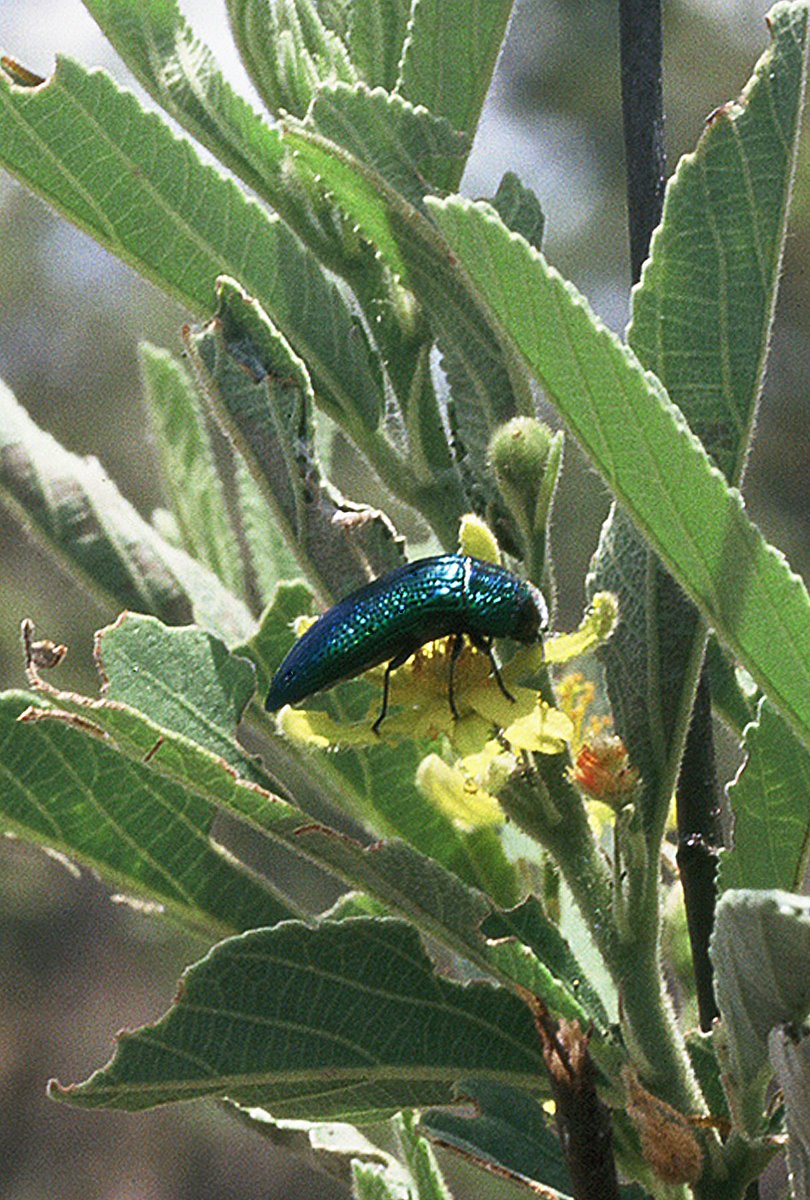
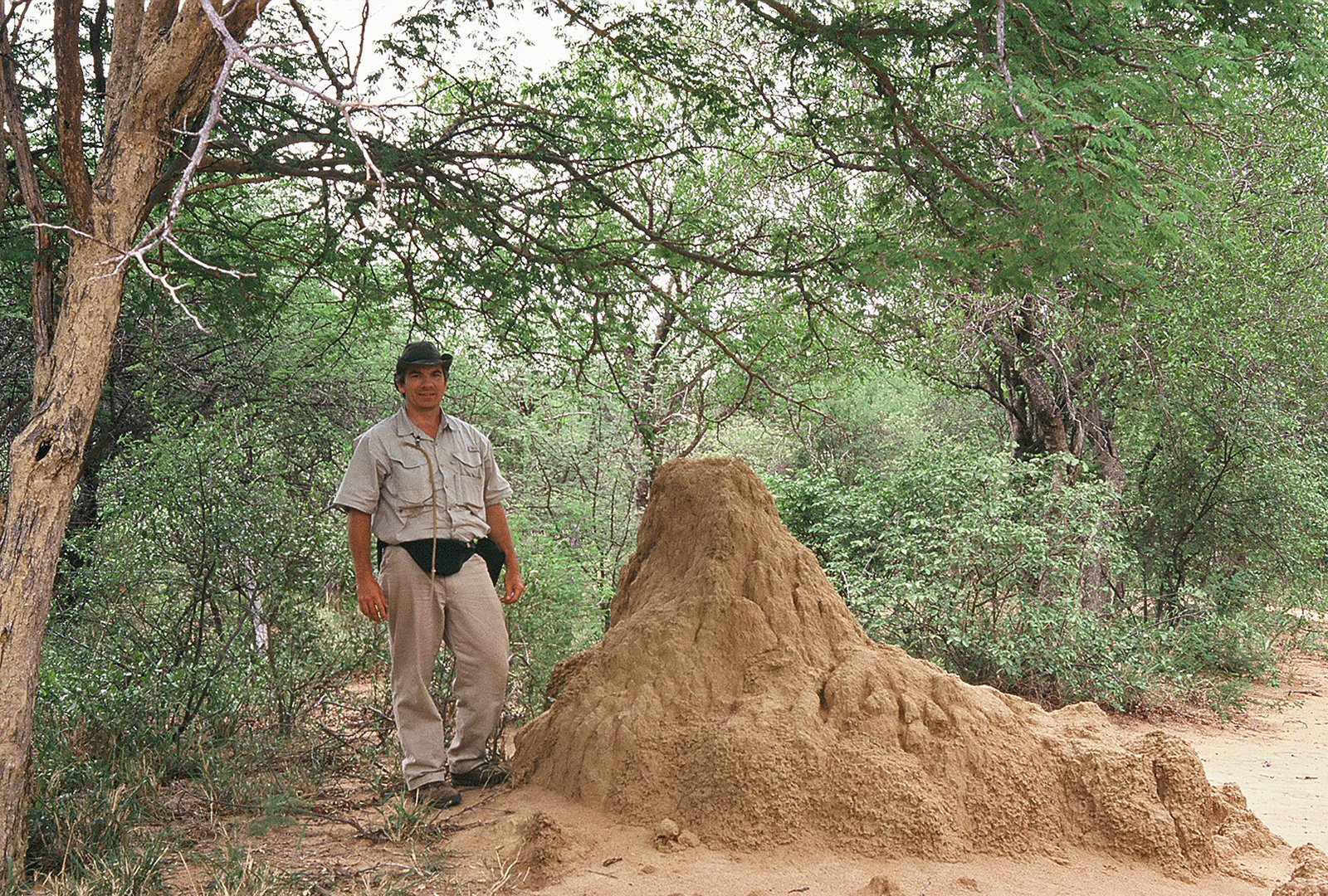
Photos: (above) me standing next to a termite mound near the Waterberg, Northern Province (photo by Chuck Bellamy); (left) Evides pubiventris (family Buprestidae, tribe Evidiini) suns itself on high terminal foliage of Lannea discolor (family Anacardiaceae), Waterberg, Northern Province.