9th Annual Fall Tiger Beetle Trip: Day 1

Once again, I have embarked upon my Annual Fall Tiger Beetle Trip, this being the ninth consecutive year that I have done such a trip. Unlike previous editions, however, the quarry on Day 1 (Sept. 15) was not a tiger beetle but a longhorned beetle. Ataxia hubbardi is not uncommon in the eastern and central U.S. and breeds in the living tissues of a variety of herbaceous plants, but especially certain species of Helianthus, Ambrosia, and Silphium in the family Asteraceae. I was hoping to see a distinctive population of this beetle that is associated with prairie dock (Silphium terebinthinaceum) in the dolomite glades just south of St. Louis. This population is interesting because individuals are smaller, darker, and narrower in form than is typical for the species, and I would like very much to get some photographs of the adults, which seem most abundant in the fall, on the tall flower stalks of their host plant.

Victoria Glades Natural Area | Jefferson Co., Missouri

I first discovered the population many years ago—back in the 1980s when I visited one particular glade, Victoria Glades Natural Area, almost weekly over a period of several years. I left Missouri for a few years in the early 1990s but returned in 1995, and during my absence fire was implemented in Victoria Glades and other glades in the area as a management practice for controlling invasion by woody plants (primarily eastern red-cedar, Juniperus virginiana). While the use of fire has certainly done much to restore the glades and improve its floral diversity, it seems more than coincidental that insect abundance and diversity on the glades is only a fraction of what I observed during my pre-burn collecting in the 1980s. There are a number of beetle species that I found at the glade historically that I have not seen now for more than 20 years; one of which is this distinctive population of A. hubbardi.
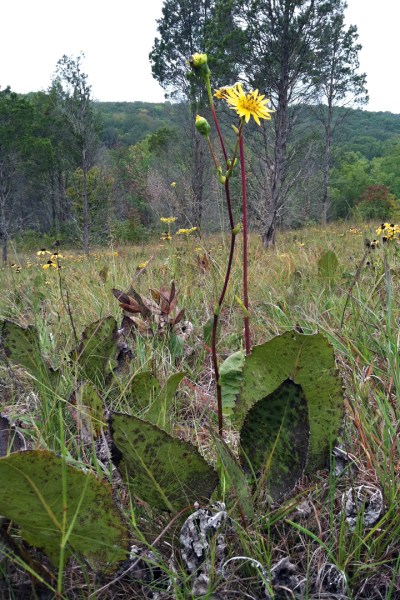
Prairie dock (Silphium terebinthinaceum) – host for Ataxia hubbardi

The prairie dock plants were at the height of bloom, but the flower stems seemed shorter and the normally large, spatulate basal leaves of the plants generally smaller than typical—perhaps a result of this summer’s severe drought. How such conditions affect the beetles is unknown. The day was also rather cool due to unbroken cloud cover and light drizzle, with temperatures in the low 70s during my visit. I spent the better part of two hours inspecting the stems of every prairie dock plant that I encountered and did not see a single beetle, so it has now been 23 years—almost a quarter century—since I’ve seen this once fairly common species at the glade. Can I prove that fire management has extirpated the beetle? No—populations might have been knocked down by the drought, or maybe the adults hide on cool, cloudy, drizzly days. Still, the pattern is too consistent to ignore, and I become increasingly worried that a special feature of these glades has now been lost.
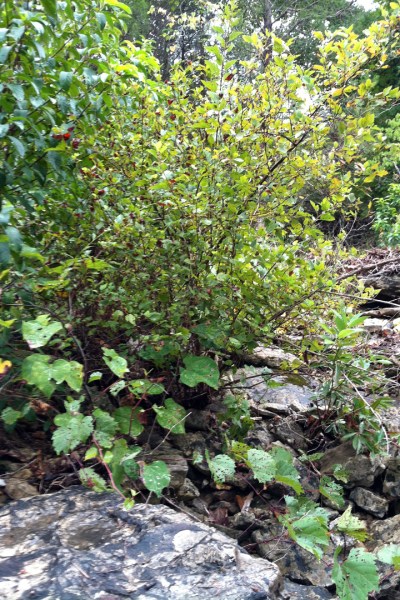
Ninebark (Physocarpus opulifolius intermedius) – host for Dicerca pugionata

On the other hand, another quite rare beetle that I encountered abundantly at Victoria Glades in the past seems to have rebounded from its long absence—the jewel beetle Dicerca pugionata. This beautiful beetle is associated with the scraggly clumps of ninebark (Physocarpus opulifolius intermedius) that hang on in the moist toe slopes of the glades. I wrote about this species earlier this year after re-discovering it in the glades; however, I couldn’t resist taking a few more photographs of this stunningly gorgeous species. This species also makes its appearance in the fall as well as spring, and in the two hours I spent searching I counted 13 beetles—more than I’ve ever seen on any one day. Interestingly, most of these were associated with a stand of plants in an area at the south end of the glade that I had never searched before and that appears not to have been subjected to fire management (cedar removal has been effected instead with a chain saw). Only a few of the beetles were found in the much more abundant plants growing in the area of the glade I am more familiar with and that has obviously been subjected to repeated burning. It’s not proof, but I’m just saying…

Dicerca pugionata on ninebark branch.

Adult beetles are colored almost precisely the same as the bark of their host plant.

More even lighting in this face shot compared to my previous attempts.

The cool temperatures and light drizzle were not conducive to much other insect activity, but while crossing the small, shallow creek that separates the south end of the glade from the main glade, the biggest male tarantula (Aphonopelma hentzi) that I have ever seen caught my attention as it crossed the creek. Situated only 30 miles south of St. Louis, Victoria Glades must represent the northeastern limit of distribution for the species, and although I once saw a tarantula crossing the road very near to this location, this is the first tarantula that I have actually seen in the glades that lie so close to St. Louis. Males are famous for their fall wanderings, presumably in search of the females that tend to stay within their burrows. This male was missing part of one of its hind legs but otherwise appeared quite healthy and robust. I hope he succeeds in finding a mate and sires many offspring and is not discovered by any of the poachers who regularly scour the glades and steal its more unusual inhabitants—the glades have already lost enough of their unique residents…

Can you find the tarantula crossing the creek? (Hint: 0.60X, 0.37Y)
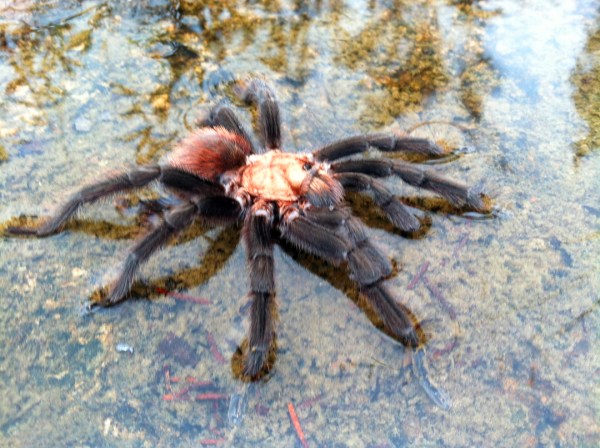
Male Aphonopelma hentzi | Jefferson Co., Missouri

Copyright © Ted C. MacRae 2012

Not quite a one-shot

This little jumping spider (~8 mm in length) was in one of my soybean fields in west-central Illinois last week. She(?) was quite fidgety and kept jumping from the leaf on which I found her as I tried to carry the leaf out of the field to a more open and convenient place  to take photographs. Once I got out to the grassy field border, I managed to get one photograph (not shown but similar to this one) right before she jumped off the leaf yet again. However, I was able to find her and coax her back onto the leaf for this last shot before she jumped off again—never to be found again! I presume this spider belongs to the genus Phidippus based on the cephalic tufts, and within that genus maybe a species in the P. clarus group (corrections welcome!).

When I look at insect macrophotographs, I like to do reverse engineering on the lighting to figure out what was the flash/diffuser setup. I have a few different diffusers that I use depending on which lens I’m using and how important the photographs are. In this case, I was taking photographs of soybean insects for work purposes and didn’t bother putting on the larger concave diffuser that I use when I’m really concerned about getting more even lighting. Instead, I was just using my snap-on Sto-Fens+Gary Fong Puffers. The difference between these two diffuser setups and their effect on lighting is minor in many cases, but when photographing very shiny surfaces (such as the eyes of this spider) the differences are much more apparent, and it is obvious from this photo that I was using a twin flash unit with separate diffusers on each flash head.

There is one more feature apparent about the lighting in this photograph—note that the “left” flash head appears much more diffuse than the “right” flash head. This is because the right diffuser had actually fallen off of the flash head without me noticing (also never to be found again!). As a result, the light from only one of the flash heads was diffused, while that from the other hit the subject in all its harsh glory. I don’t really like the twin highlights that are the hallmark of twin macro flash units, and if I had known I was going to be photographing jumping spiders when I was in the soybean field I would have gone ahead and used my concave diffuser. I’ve also learned, however, that great photographs are not something that I can expect to pop off while concentrating on other activities—I need to concentrate fully on the photographs and spend a good amount of time doing it until I feel like I’ve gotten the shots that I want. I never really liked the Sto-Fen+Puffer diffusers, as they were only marginally better than no diffuser (and this photograph shows it), so losing one of them might be a blessing in disguise as now I’ll be motivated to try out some of the many other diffuser ideas I’ve been toying around with but never really taken the time to sit down and try them out.

Copyright © Ted C. MacRae 2012

Ghosts in the night

This summer I’ve spent quite a few nights hanging out along the Mississippi River—lamp on my head, vials in my pocket, and an ultraviolet (UV) light setup on the sandy banks. UV light collecting for insects (also called “blacklighting”) is a popular method among us beetlers, but for a number of reasons it’s been a while since I’ve done a lot of heavy blacklighting myself. That all changed this year when I decided I needed to get a better handle on the Missouri distribution of two species of tiger beetles, Ellipsoptera cuprascens and E. macra, found only in sandy habitats along the shores of the state’s two big rivers—the Missouri and Mississippi—and, fortuitously, attracted to blacklights at night. Blacklighting alongside these big rivers is a relatively new experience for me, as my previous experiences have been mostly in forests—either here in the Midwest or out in the desert southwest. Along the big rivers, as soon as the sun dips below the horizon hordes of hungry mosquitos descend upon me and choking swarms of caddisflies quickly envelop the blacklight. Liberal application of Deet keeps the mosquitoes at bay, but checking the sheet behind the blacklight to see if anything of interest has landed requires a bit of a mad dash and a quick retreat, all the while holding my breath and clamping the shirt cuff around my neck to prevent the swarming bugs from flying into spaces where I don’t want them.

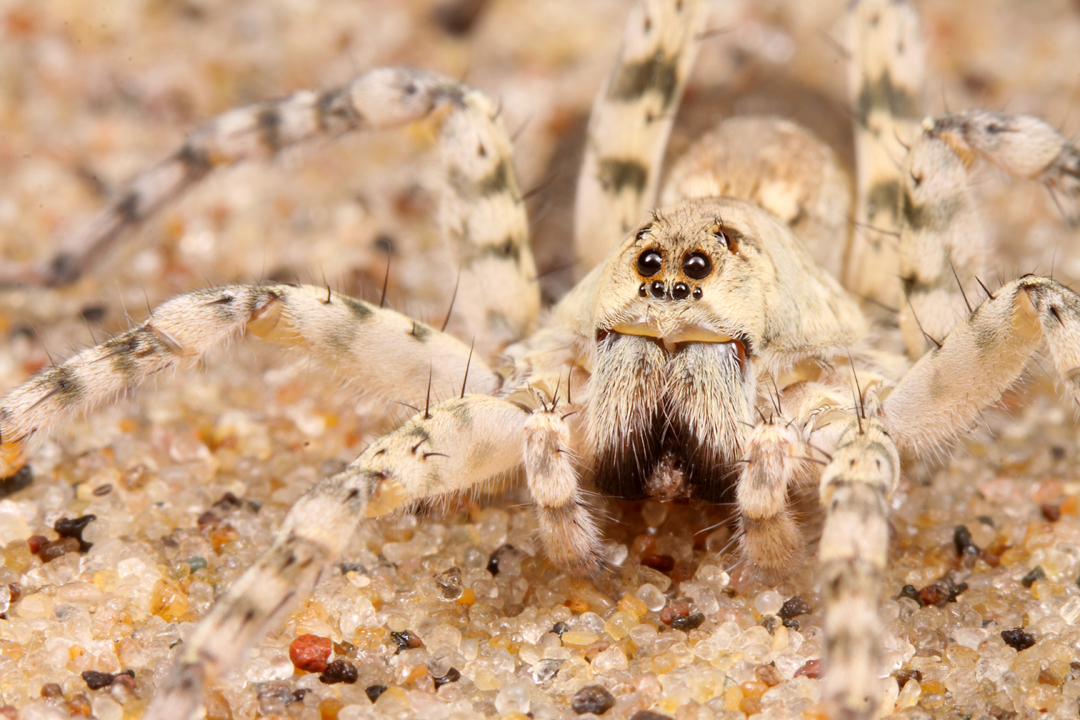
Arctosa littoralis (beach wolf spider) | Lewis Co., Missouri

Wandering away from the blacklight and exploring along the beach in the black of night is also a relatively new experience. While I’ve done a fair bit of night collecting away from the light, again this has tended to be in forests and woodlands with a beating sheet in hand looking for jewel beetles, which still hang out on the same host plants they can be found on during the day but are far less inclined to zip away as soon as they hit the sheet like they do when the sun is high overhead. I haven’t spent much time shining a lamp on the sand of a big river beach, so I wasn’t quite sure what to expect (other than hopefully a tiger beetle!). As I walked along the beach, I occasionally saw blue-green glowing dots on the sand—I recognized these fairly quickly as the eyes of spiders reflecting the light from my headlamp. However, at first when looked closer at the spot where I thought a spider should be sitting I didn’t see anything. It took a few tries before finally I saw ghost-like movement on the sand, and when I moved cautiously and got down close to the sand I finally saw a magnificent, white wolf spider sitting motionless—perfectly colored to blend into the sand on which it was sitting.

The mottled, white coloration is conspicuous on wet sand…

I quickly hurried back to the car and got my camera, set it up with a 100mm macro lens and extension tubes (hoping I could get real close), and went back to the spot where I’d seen the spider to see if I could find it again. I didn’t, but not too much searching was required before I found another one. Unfortunately, I didn’t succeed in photographing that one either. It was apparent to me that I was going to have to use the same ultra-cautious and slow movements that I use with tiger beetles if I was going to succeed in photographing one or more of these spiders. I quickly figured out that they were easier to see if I looked right along the water’s edge, as in that situation the white coloration of the spider actually stood out against the darkened, wet sand. (Of course, photographing them on the wet sand was a tad dirtier for me, but I’m not afraid to get filthy dirty when it comes to photographing arthropods.) I also figured out that I could more easily find the spiders on the wet sand and then follow them up to the drier sand for photos that better showed just how marvelously cryptic their coloration was.

…but provides perfect camouflage on the dry sand further away from the water’s edge.

Those of you familiar with my work know that I love frontal portraits, but I found this to be almost impossible during my first attempts. It was hard enough approaching the spider from the front without it bolting before I could get set behind the camera, but in the few cases where I did actually manage this then it would bolt as soon as I made any microadjustment in the position of the camera to compose the shot. It occurred to me that the spider was sensing vibration from moving the camera on the ground (ground-resting the camera is a technique that I use commonly to get the lowest possible angle on my subjects)—makes sense, as spiders are intensely tuned into vibrations for  prey capture. Once I began keeping my hand flat under the camera as sort of a makeshift “beanbag” I was able to make the final adjustments necessary to get shots like the one shown below and in ID Challenge #20.

Active primarily at night, the spider’s eyes glow blue-green when hit by light.

According to Dondale & Redner (1983) this should be Arctosa littoralis—widespread in littoral habitats across North America but, at least at the time of their revision, not recorded from Missouri [in fact, it seems no species of Arctosa was known from Missouri until A. virgo was recorded from oak-hickory forests in the southern part of the state by Bultman (1992)]. I’ll leave it to the spiderphiles to determine if this actually represents a new state record or (more likely) if I just haven’t dug deep enough into the literature.

Congratulations to 3-time champ Ben Coulter, who swooped in from his hiding place with 30 pts to win ID Challenge #20—the final challenge of BitB Challenge Session #6. It wasn’t enough, however, to disturb the overall standings, and Brady Richards maintained his overall lead with 28 pts to win Session #6. Sam Heads was just one point away from the win in this challenge, but his 29 pts were enough to earn a tie for 2nd place in the overall standings with Mr. Phidippus, who finished a respectable 4th place in this challenge. Nobody else came close to these three gentlemen in the overalls, so they deserve their accolades and loot (please contact me for details on the available choices). In case you haven’t been following along, here is a summary of the BitB Challenge champions to this point, listed by session:

  1. Ben Coulter
  2. Ben Coulter
  3. Max Barclay
  4. Ben Coulter
  5. Mr. Phidippus
  6. Brady Richards

REFERENCES:

Bultman, T. L. 1992. Abundance and association of cursorial spiders from calcareous fens in southern Missouri. Journal of Arachnology 20:165–172.

Dondale, C. D. & J. H. Redner. 1983. Revision of the wolf spiders of the genus Arctosa C . L. Koch in North and Central America (Araneae: Lycosidae). Journal of Arachnology 11:1–30.

Copyright © Ted C. MacRae 2012

ID Challenge #20

Has it really been seven weeks since the last ID Challenge? BitB Challenge session #6 overall leaders Brady Richards (66 pts), Mr. Phidippus (58 pts), and Sam Heads (54 pts) must think I’m trying to duck the final standings so I don’t have to doll out any loot. Let’s finish this session with a straight up ID Challenge—3 pts for order (der!), 4 pts for family, 5 pts for genus, and (to separate the imagos from the neonates) 6 pts for species. Bonus question worth 5 pts—what is the best way to search for this species? That’s a whopping total of 23 pts up for grabs in this one challenge (not including any discretionary bonus pts that might be awarded), so not only are the leaders not safe from each other, but from any number of other participants lurking just below them in the standings.  Please read the full rules if you are not already familiar with them—good luck!

Copyright © Ted C. MacRae 2012

A black background is better… sometimes

Eriophora ravilla (a tropical orb weaver) | Pinellas Co., Florida

If there is one subject that causes more disagreement among macrophotographers, it is the pitch black background. Granted, black backgrounds are common—almost ubiquitous in macrophotography, since they are easily created by using full flash illumination and ensuring that nothing lies behind the subject close enough to reflect the light from the flash. Detractors, however, claim that it gives subjects an ‘unnatural’ look, as they are rarely seen this way in nature. This may be true, but I still believe that for some subjects the black background simply cannot be beat for its aesthetics, even if the subject is not normally seen in this manner. Take, for example, the Great Plains ladies’-tresses orchid—nothing but a pitch black background could better showcase the delicate, white blossom and its almost crystalline lower lip!

That said, however, there are some subjects for which a pitch black background actually can be considered a ‘normal’ background. This tropical orb weaver spider (Eriophora ravilla) is one example. Unlike many other members of the family Araneidae (orb weavers), species in this genus are strictly nocturnal and not seen hanging on a web during daylight hours. Hiding in a curled leaf during the day, they emerge at night and build a large web (up to 1 meter wide), only to consume it by morning and return to their hiding place until the next evening. My nephew Jack and daughter Madison and I first saw this spider during our nighttime foray into the intertidal mangrove marsh behind my sister-in-law’s condominium in Seminole, Florida last month while discovering rare, endemic beetles and their larvae. Knowing that it would likely build its web in the same place on subsequent evenings, I went out a few nights later with my camera and took a few shots.

Some claim that black backgrounds are undesirable for even nocturnal subjects; that there is nothing ‘natural’ about an artificial, narrow beam of light illuminating a single subject at night since no animal other than a person with a flashlight would see something like this. This contention seems a little strained, as one could take such a stance on illumination of any kind. Technically speaking even colors don’t actually exist, so the rendering of subject images on camera film/sensor, whether by natural or artificial illumination,  is itself biased towards human sensibilities. Regardless, the sight of an eerily glowing spider hanging in the blackness strikes a familiar chord with anyone who has wandered the bush by night. A black background not only recreates that human experience, but also emphasizes the subject’s (in this case strictly) nocturnal nature with stark elegance.

At first I took this spider to represent the very common barn spider, Neosona crucifera—widespread across North America. However, after noting the dark femora and yellow “shoulders” of the abdomen I began to rethink that ID. Fortunately, I took one photo of the ventral side (not shown) that shows well the color pattern diagnostic for the circum-Caribbean species E. ravilla.

Copyright © Ted C. MacRae

Poised for the bounty

Misumenops pallidus on soybean | Santa Fe Province, Argentina

By mid-April I was near the end of my 8-week stay in Argentina. One of the more enjoyable tasks during this time was to go back out and visit some of the soybean fields that I had seen earlier in the season. I enjoy watching the progression of soybeans over time—both in plant phenology and in the guilds of insects present. Defoliating caterpillars like Rachiplusia nu (oruga medidora) and Anticarsia gemmatalis (oruga de las leguminosas) abound during the late vegetative and early to mid-reproductive stages of growth, feeding day and night on the lush, green foliage. As the days grow shorter and cooler, the soybean fields slowly morph from dark green to tawny-yellow, and leaf-feeding guilds give way to seed-feeding stink bugs like Piezodorus guildinii (chinche de las leguminosas) and Nezara viridula (chinche verde).

Ever present amongst the plant-feeding insects are their natural enemies, with spiders being among the more numerous predators. This small (~10 mm length) crab spider (family Thomisidae) was seen in a soybean field in Santa Fe Province with the plants at R6 stage of growth (pods completely filled). I’m fairly certain it represents Misumenops pallidus based on its close resemblance to the spider in this photo. Piezodorus guildinii stink bugs were especially abundant, and just as the crop of newly hatched nymphs was poised to take advantage of the fat, juicy seed pods, this spider seemed poised and ready to take advantage of the fat, juicy nymphs. In fact, M. pallidus is the most abundant crab spider in soybean agroecosystems in the Humid Pampas of Argentina (Liljesthröm et al. 2002), which as a group comprise nearly half of all spiders in those systems (González et al. 2009). Perhaps one reason for this is their generalist prey selection tendencies, feeding on prey species such as R. nu and P. guildenii when they are abundant and switching to non-pest prey species (except the heavily sclerotized weevils and the large and noxious adults of N. viridula) when they are absent (González et al. 2009).

REFERENCES:

González, A., G. Liljesthröm, E. Minervino, D. Castro, S. González & A. Armendano. 2009. Predation by Misumenops pallidus (Araneae: Thomisidae) on insect pests of soybean cultures in Buenos Aires Province, Argentina. The Journal of Arachnology 37:282–286.

Liljesthröm, G., E. Minervino, D. Castro & A. González. 2002. La comunidad de arañas del cultivo de soja en la provincia de Buenos Aires, Argentina. Neotropical Entomology 31:197–209.

Copyright © Ted C. MacRae 2012

Best of BitB 2011

Welcome to the 4th Annual BitB Top 10, where I get to pick my 10 (more or less) favorite photographs of the year. As an insect macrophotographer I still feel like a relative newcomer, although with three seasons under my belt fewer and fewer people seem to be buying it anymore. Granted I’ve learned a lot during that time, but the learning curve is still looking rather steep. I don’t mind—that’s the fun part! With that said, I present a baker’s dozen of my favorite photographs featured here during 2011. I hope they reflect the learnings I’ve had the past year and maybe show some progress over previous years (2009, 2008 and 2010).

One more thing—I’m including a special bonus for the first time in this year’s edition. Each of the photos shown below is linked to a 1680×1120 version that may be freely downloaded for use as wallpaper, printing in calendars, or any other use (as long as it’s personal and non-profit). It’s my way of saying thanks for your readership and support.


From  (posted 8 Jan). I’ve done limited photography with prepared rather than live specimens. However, the recreated aggressive-defensive posture of this greater arid-land katydid (Neobarrettia spinosa)—or “red-eyed devil”—was too striking to pass up. A clean background allows every spine and tooth to be seen with terrifying clarity.


From  (posted 6 Feb). I had never seen a cactus fly until I encountered this Nerius sp. I’m especially fond of the bizzarely-shaped head and un-fly-like spines on the front legs.


From  (posted 17 Feb). This photo of a fungus weevil, Phaenithon semigriseus, is one of the first where I nailed the focus right on the eye at such a magnitude of closeup (~3X) and also got the composition I was looking for. I didn’t notice at the time, but the beetle seems to be “smiling.”


From  (posted 28 Mar). One of the field techniques I’ve been practicing this year is actually holding the plant with the subject in one hand, resting the camera on my wrist and controlling it with the other hand, and manipulating the position of the plant to achieve a desired composition. It’s a difficult technique to master, but the results are worth it. The jumping spider, Euophrys sutrix, represents one of my earliest successful attempts with this technique.


From  (posted 30 Mar). This South American tree fruit weevil looks like it is sitting quite calmly on a branch. In reality, it never stopped crawling while I attempted to photograph it. Crawling subjects are not only difficult to focus on but also almost always have a “bum” leg. I achieved this photo by tracking the beetle through the lens and firing shots as soon as the center focus point flashed, playing a numbers game to ensure that I got at least one with all the legs nicely positioned. I’d have been even happier with this photo if I had not clipped the antennal tip.


From  (posted 4 May). Face shots of predatory insects are hard to resist, and in this one of the fiery searcher beetle, Calosoma scrutator, the angle of the subject to the lighting was perfect for showing off every ridge and tooth in its impressive mandibles.


From  (posted 10 May). I’ve taken plenty of lateral profile shots of tiger beetles, but I like this slightly panned out one especially because of the sense of scale and landscape created by the inclusion of the plantlets and the view over the small rise.


From  (posted 18 May). I found these Edessa meditabunda stink bug eggs on the underside of a soybean leaf in Argentina almost ready to hatch. The developing eye spots in each egg gives the photo a “cute” factor rarely seen in such super close-ups.


From  (posted 15 July). Some of my favorite insect photos are not only those that show the bug in all its glory, but also tell a story about its natural history. This nymphal lichen grasshopper, Trimerotropis saxatilis, is almost invisible when sitting on the lichens that cover the sandstone exposures in its preferred glade habitat. 


From  (posted 23 Aug). I know this is the second beetle face shot I’ve included in the final selections, but it was while photographing this rare Florida metallic tiger beetle, Tetracha floridana, in the middle of the night that I discovered the use of extension tubes to improve the quality of flash lighting (decreased lens to subject distance results in greater apparent light size). This is perhaps one of the best illuminated direct flash photographs that I’ve taken, and I also like the symmetry of the composition.


From  (posted 17 Sep). The three-cornered alfalfa hopper (Spissistilus festinus) is a common pest of alfalfa and soybean in the U.S. However, despite its abundance, I’ve never noticed the bizarre zig-zag pattern of the eyes until I took this photo. Even though both the insect and the background are green, there is sufficient value contrast to create a pleasing composition. Bumping up the ISO and a lower FEC setting prevented overblowing the light greens—easy to do with full flash macrophotography.


From  (posted 4 Oct). This longhorned beetle had settled in for the night on its Ericamera nauseosa host plant, allowing me to use higher ISO and lower shutter speed settings with a hand-held camera to achieve this very pleasing blue sky background, while retaining the sharpness of detail of the subject that comes from full-flash illumination. The blue sky background provides a more pleasing contrast with the colors of this particular beetle and flowers than the black background that is more typically seen with full-flash macrophotography.


From  (19 Dec). An uncommon underside view of these purple tree fungus (Trichaptum biforme) caps and use of flash illumination allows the colors to literally glow against the bright green lichens also growing on the tree. Keeping aperture at a moderate setting allows blurring of the caps further back, adding three-dimensionality to the photo and preventing it from looking ‘flat.’


Well, there you have it, and I hope you’ve enjoyed my selections. Please do tell me if you have a favorite among theses (and if there were other photos posted during 2011 that you think deserved making the final selections).

Copyright © Ted C. MacRae 2011

BugShot 2011 – Final Thoughts

As I suspected would be the case,  has proven to be an especially difficult challenge.  As a result, instead of posting the answer tonight I’m going to give folks another day to make their play for points (remember, nobody walks away empty-handed).  In the meantime, I’ve had a chance to ruminate over this past weekend’s BugShot insect photography workshop at Shaw Nature Reserve in Gray Summit, Missouri, and now seems to be an appropriate time to post some final thoughts while they’re still fresh in my mind. Suffice it to say that it was an incredible experience—both technically and socially.  I learned far more than I thought possible (and hope I can remember even a portion of it) and made some great friends in the process.  It’s really not possible for me to summarize here all of the techniques, insights, equipment choices, etc. that were covered, nor do I want to—such a list would be boring to read and not very meaningful without the context to go with it.  What I would like to do is shout out a few people who, beyond the collective, helped make the weekend what it was for me.

Instructors.  The three instructors, all accomplished insect photographers of the highest caliber, typified three very different yet complimentary approaches to the art.  Alex Wild (University of Illinois), ant photographer extraordinaire and author of the insect blog I’ve most tried to emulate, gave me tremendous insight on lighting and practical approaches on how to use it effectively.  My discussions with John Abbott (University of Texas) about equipment will be very helpful for the type of photography that I like to do (I’m not sure I’m ready for the tripod yet, but maybe the other ideas we discussed will be the “slippery slope”).  Finally, I thoroughly enjoyed my time with Thomas Shahan (Norman, Oklahoma), whose great artistic insight helped me see a whole new world of possibilities for tiger beetle portraiture.  I must admit to feeling a little star-struck when I first began talking to him, but his infectious enthusiasm and exuberance quickly put me at ease.

Friends.  I can’t begin to list everybody whose company I enjoyed, but standouts include Jo Holly (Alex’s better half!), as well as fellow bloggers Crystal, Lee, Dave, and DragonflyWoman.  Even though I only met them this weekend, it was if I had known them for years.  My time “fishing” tiger beetle larvae with Crystal and Lee was not only a highlight of the trip (watching them “jump” as the larva came flying up and out of the burrow was a real treat), but also represented a discovery in the truest sense of the word (as will become clear in a future post).  No discussion of friends would be complete without mentioning James Trager, not only for opening up Shaw Nature Reserve to this weekend’s event, but also for the access he’s given me over the past several years and our frequent, humorous email discussions about all things entomological (or botanical, ecological, etc.).

Gratitudes.  I want to thank Alex for inviting me to take part in this event as something more than just an attendee.  I hope my contribution, however small, was beneficial.  My thanks also to Patsy Hodge, who was so helpful and gracious to me in the days leading up to and during the event.  I also appreciate the kind comments that many of the attendees made to me about my blog and my photographs—your encouragement means a lot to me.

Regrets.  In an event like this, packed as it was with seminars and group discussions, it is sad but unavoidable that one cannot spend at least a little time with each and every person in attendance.  To those that I did have a chance to talk to, the pleasure was all mine.  To those that I missed, I will catch you next time!

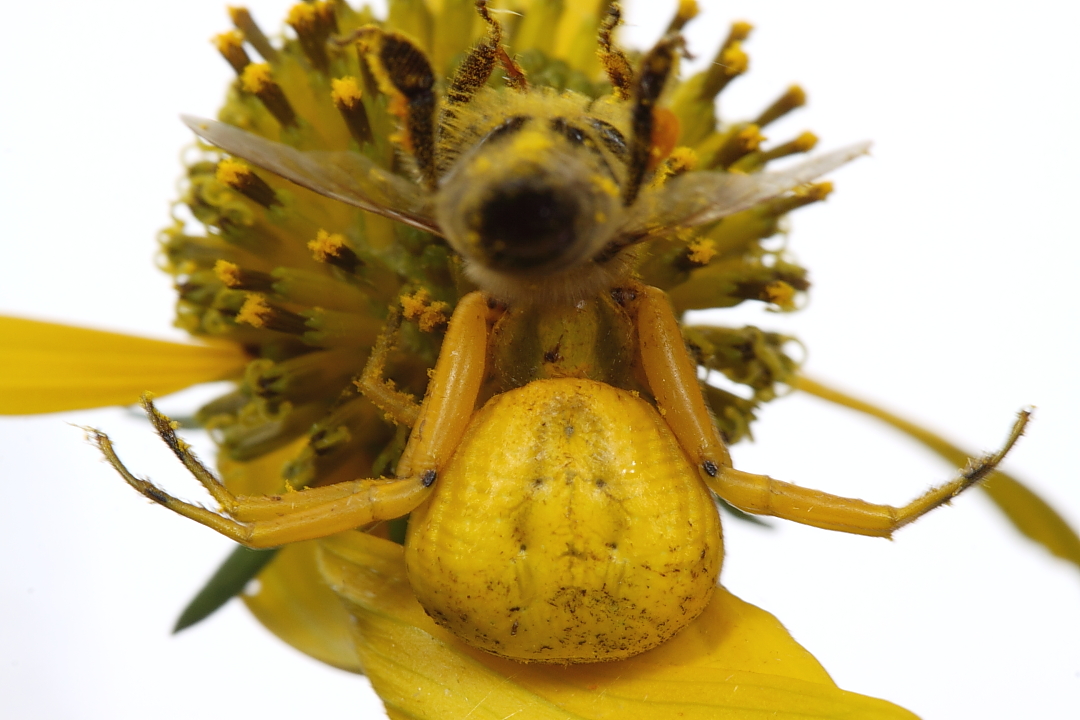
I think I’ll close with this minimally processed photograph of what I take to be Misumenoides formosipes (whitebanded crab spider) and its honey bee (Apis mellifera) prey.  Although I photographed this spider using flash and looking straight up into an overcast sky, I managed to properly illuminate the subject and avoid blown yellows and an all-black background by using some of the very techniques and principles that I had just learned earlier that day.  I hope to learn more at BugShot 2012!

Misumenoides formosipes (whitebanded crab spider) | Shaw Nature Reserve, Franklin Co., Missouri