Bichos Argentinos #6 – Jumping Spider

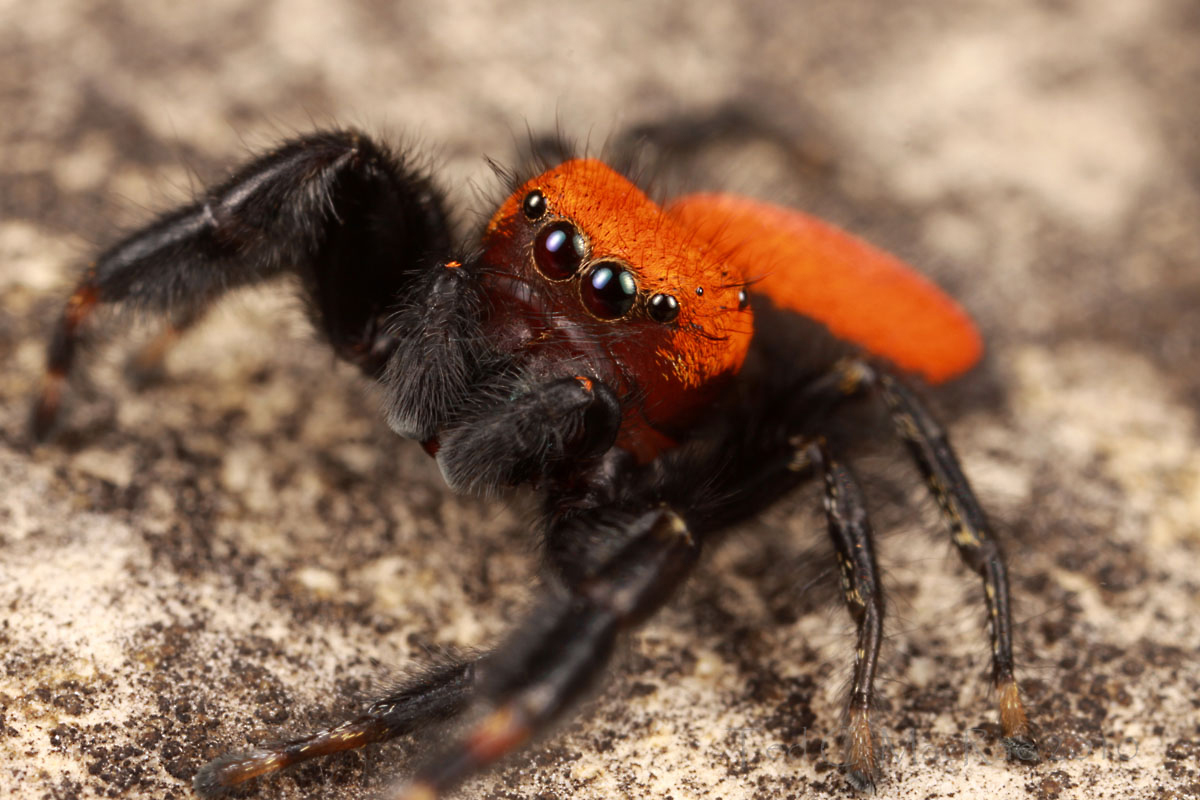
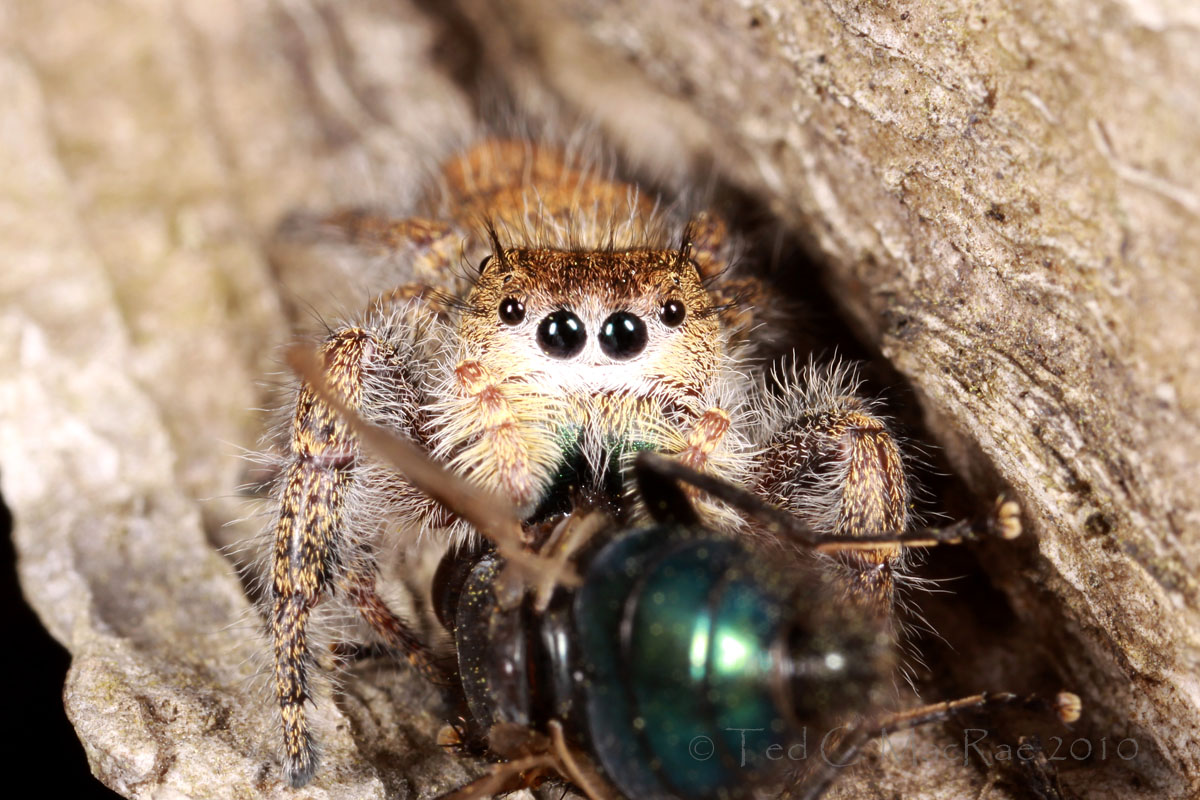
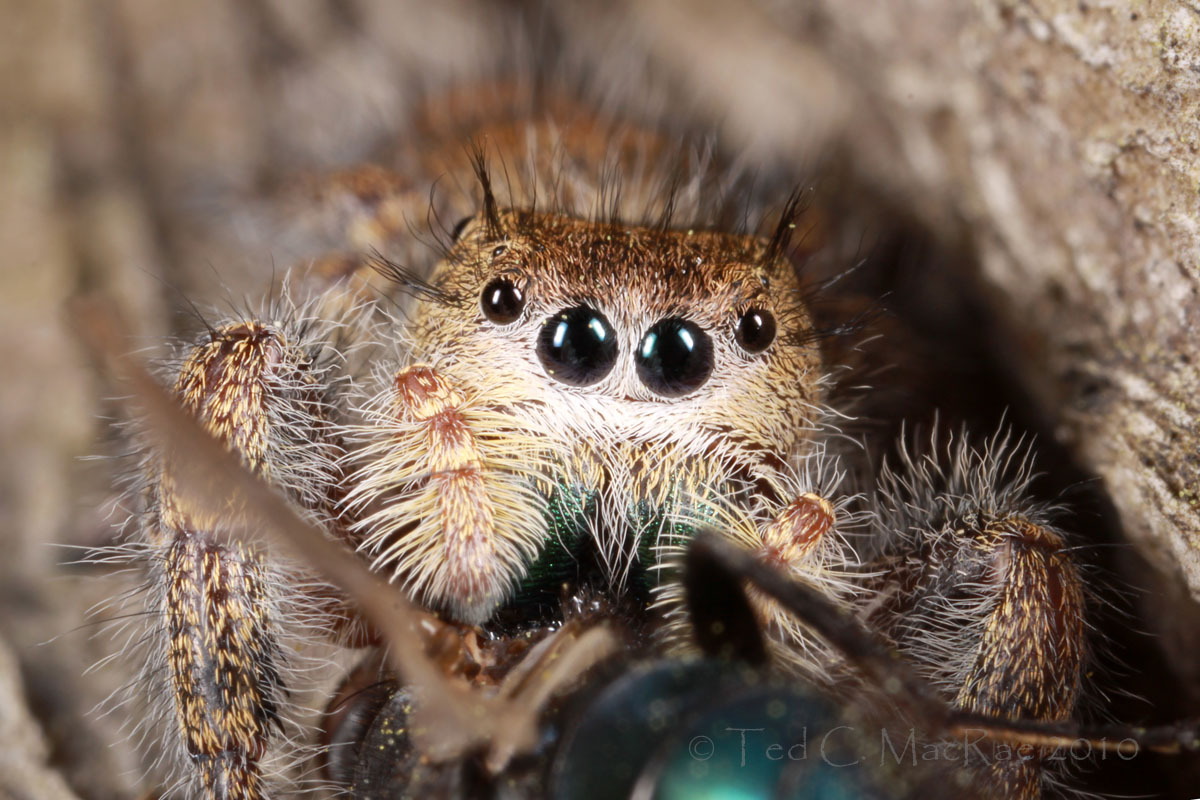
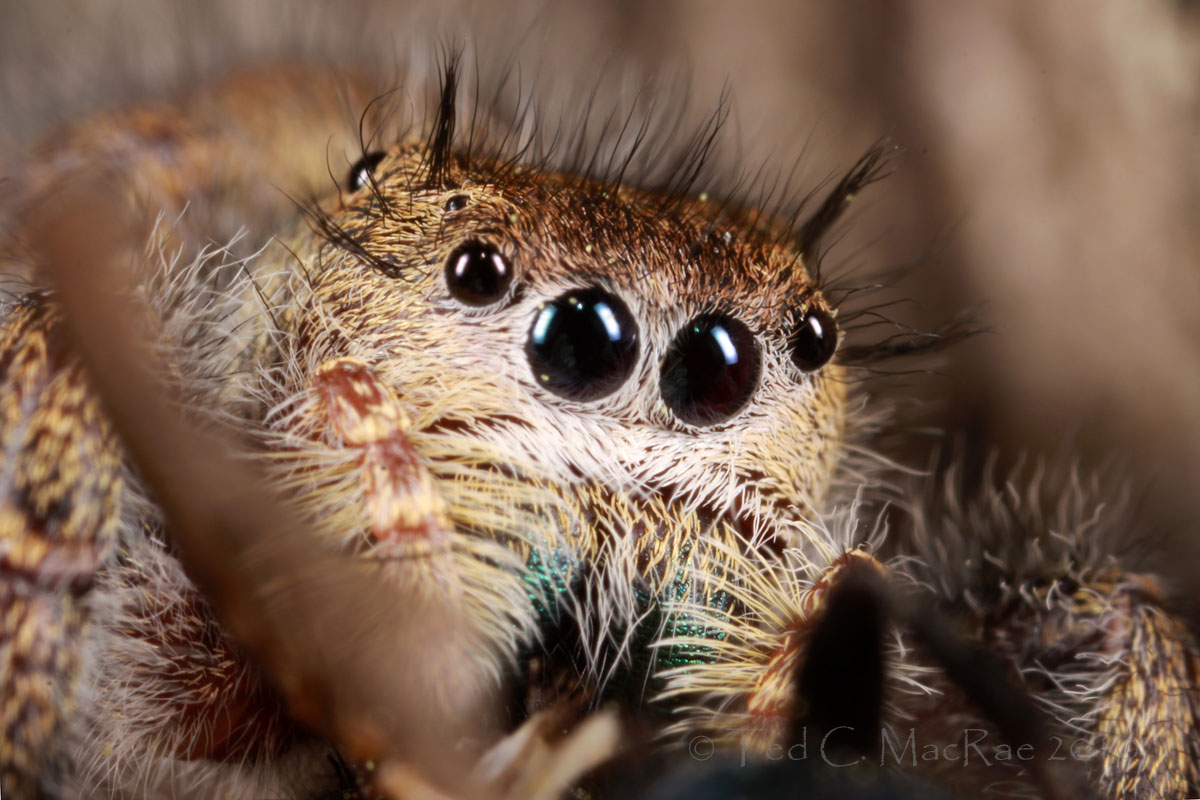
I photographed this jumping spider (family Salticidae) two weeks ago in Buenos Aires, Argentina at La Reserva Ecológica Costanera Sur. In gestalt it is very similar to our North American species of the genus Phidippus, but I can’t say for sure whether it actually belongs to that genus. I found it crawling on the foliage of a tree just about eye height, and I’m guessing from the muted markings and roundish shape to the abdomen that it is a female (I saw another individual later that I took to be a male of the same species – it was similarly but more boldly marked and with a much more tapered abdomen). I hope you’ll forgive my hubris, but I’m rather pleased with how these photographs turned out (although, admittedly, there were others that were not so good). In my opinion, they represent further improvement over my first two attempts at photographing jumping spiders (with the standard caveat that I am still no Thomas Shahan). These improvements involve primarily sharpness and detail but also composition, and I consider them to be largely due to lighting and learning how to handle the subject.

The detail in these photos results not only from proper focus, but also lighting techniques. All of these photos were taken hand-held using a Canon MP-E 65mm macro lens at f/13 with full flash lighting. Although I used an exposure setting of 1/200 sec, the actual exposure is determined strictly by the duration of the flash pulse, which is much shorter than 1/200 sec. While flash pulse duration can be set manually (and I started out doing so), I now prefer to use E-TTL mode (Evaluative Through The Lens), which adjusts the flash duration automatically based on the amount of light that the camera senses coming through the lens from a short pre-flash at the aperture chosen. The more light that is sensed, the shorter the flash pulse – the less light sensed, the longer the pulse. Obviously, with a shorter flash pulse there is less likelihood that image sharpness will be affected by movement – either by the subject or by the camera-holder. Since light intensity decreases in proportion to distance, it is desirable to get the light source as close to the subject as possible to achieve the highest intensity and, thus, shortest flash duration.

It’s not that simple, however. Most insect macrophotographers agree that diffused light gives better results than undiffused light, but no matter what diffuser one uses there will be loss of light. Loss of light leads to longer flash pulse duration and, thus, increased potential for movement during the flash pulse (especially in hand-held photography). The trick, then, is to diffuse the light as much as possible, while at the same time minimizing light loss. I continue to favor my Puffer+Sto-Fen double diffuser for use with the 65mm lens, because it places the outer diffuser almost right on top of the subject for maximal apparent light size. This is not to say that improvements still are not possible – the open-side design likely results in some loss of light, and a thin inner diffuser film to replace the Sto-Fens would probably further reduce light loss and allow for even shorter flash pulses (and probably also allow a bit more battery life). I’ll get around to effecting these improvements someday, but in the meantime the current setup is working pretty well.

Compositionally, I like this last photo the best due to the placement of the subject within the frame (all photos are shown completely uncropped, although I’m not above doing so), its slight upward-looking pose, and the evenly-blurred light-green background. This was achieved by using my left hand to hold the leaf on which the spider was sitting and to also serve as a brace for resting the camera, which I held with the right hand. This minimizes wind-movement and fixes the distance between the subject and the lens (as long as the subject sits still!). By carefully twisting and turning the leaf as the spider moved upon it, I was able to turn the spider into the desired positions, and by paying attention to what was behind the spider I could compose a nicely colored blurred background. Understanding subject behavior was a tremendous advantage in this case, as it allowed me to predict and anticipate how the spider would move in response to my finger-prodding and leaf turning to get desirable poses. I tend to get my best compositions after I’ve worked the subject for awhile and taken several shots to learn its behavior and get it accustomed to my presences – this is reflected in the accompanying photos, which are posted in the order in which they were taken. Make no mistake – patience and practice are still required. However, it’s techniques such as these that can make the difference between good photographs and great ones!

Edit 3/30/11, 11:50am: My thanks to G. B. Edwards, Curator at the Florida State Collection of Arthropods, who just sent me the following message:

Hi Ted,
Nice photos.  Most likely it is a female “Euophryssutrix, which is not a Euophrys nor even a euophryine, but a freyine, so eventually will have another genus name. It is one of the larger species in the subfamily.

This species is called “aranhas papa-moscas” in southern Brazil, where it is a principal predator of fruit flies in peach orchards (Wikipedia).

Copyright © Ted C. MacRae 2011

BitB Top 10 of 2010

Welcome to the 3rd Annual BitB Top 10, where I pick my 10 (more or less) favorite photographs of the year.  My goal for 2010 was to continue the progress that I began the previous year in my quest to become a bona fide insect macrophotographer.  I’m not in the big leagues yet, but I have gotten more comfortable with using my equipment for in situ field photographs and am gaining a better understanding of lighting and the use of flash.  I also began experimenting with different lighting techniques (e.g. white box) and diffusers and am putting more effort into post-processing techniques to enhance the final appearance of my photographs.  I invite you to judge for yourself how successful I’ve been toward those goals by comparing the following selections with those from 2009 and 2008 – constructive feedback is always welcome:


Best Tiger Beetle

Cicindela denverensis - green claybank tiger beetle

From ID Challenge #1 (posted December 23).  With numerous species photographed during the year and several of these dramatic “face on” shots, this was a hard choice.  I chose this one because of the metallic colors, good focus throughout the face, and evenly blurred “halo” of hair in a relatively uncluttered background.


Best Jewel Beetle

Buprestis rufipes - red-legged buprestis

From Special Delivery (posted July 13).  I didn’t have that many jewel beetles photos to choose from, but this one would have risen to the top no matter how many others I had.  The use of a white box shows off the brilliant (and difficult-to-photograph) metallic colors well, and I like the animated look of the slightly cocked head.


Best Longhorned Beetle

Desmocerus palliatus - elderberry borer

From Desmocerus palliatus – elderberry borer (posted November 18).  I like the mix of colors in this photograph, and even though it’s a straight dorsal view from the top, the partial dark background adds depth to the photo to prevent it from looking “flat.”


Best “Other” Beetle

Enoclerus ichneumoneus - orange-banded checkered beetle

From Orange-banded checkered beetle (posted April 22).  The even gray background compliments the colors of the beetle and highlights its fuzziness.  It was achieved entirely by accident – the trunk of the large, downed hickory tree on which I found this beetle happened to be a couple of feet behind the twig on which it was resting.


Best Non-Beetle Insect

Euhagenia nebraskae - a clearwing moth

From Euhagena nebraskae… again (posted October 21).  I photographed this species once before, but those photos failed to capture the boldness of color and detail of the scales that can be seen in this photo.


Best “Posed” Insect

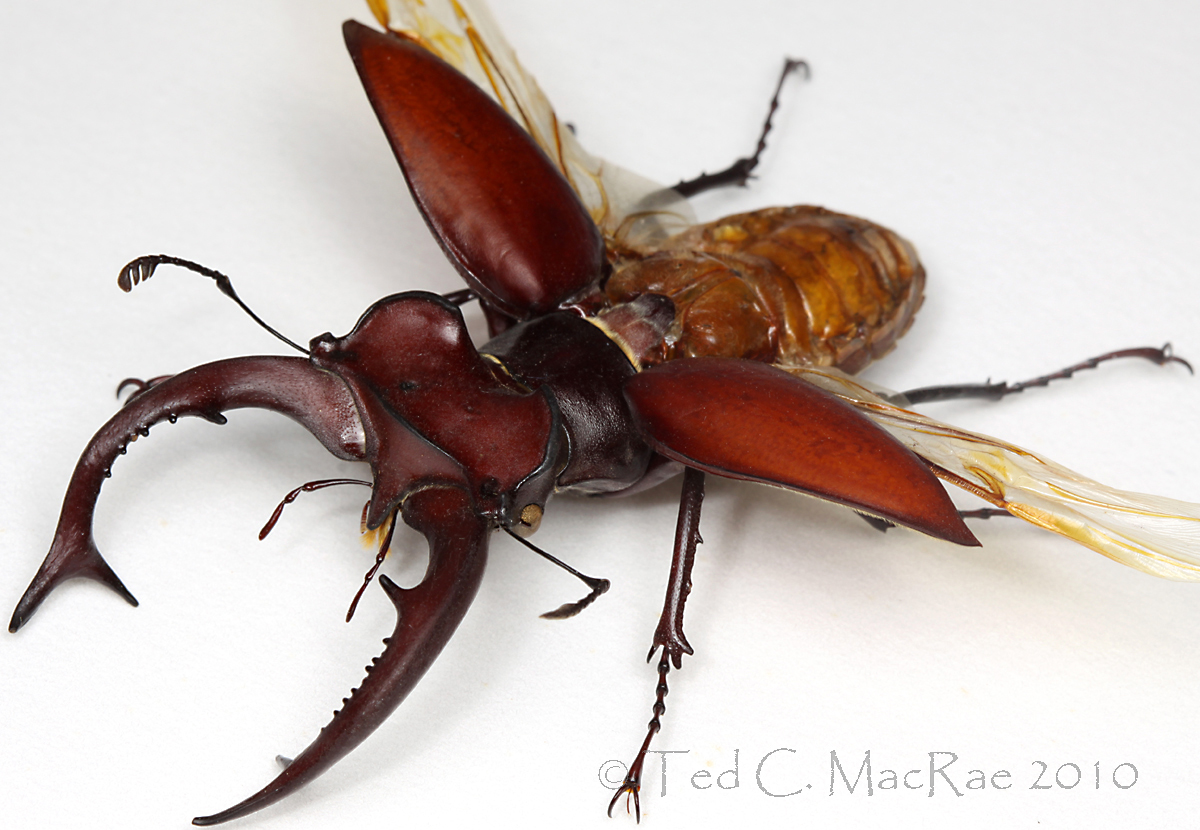
Lucanus elaphus - giant stag beetle

From North America’s largest stag beetle (posted December 30).  I’ve just started experimenting with photographing posed, preserved specimens, and in fact this male giant stag beetle represents only my second attempt.  It’s hard to imagine, however, a more perfect subject than this impressively stunning species.


Best Non-Insect Arthropod

Scolopendra heros - giant desert centipede

From North America’s largest centipede (posted September 7).  Centipedes are notoriously difficult to photograph due to their elongate, narrow form and highly active manner.  The use of a glass bowl and white box allowed me to capture this nicely composed image of North America’s most spectacular centipede species.


Best Wildflower

Hamamelis vernalis - Ozark witch hazel

From Friday Flower – Ozark Witch Hazel (posted March 26).  The bizarre form and striking contrast of colors with the dark background make this my favorite wildflower photograph for the year.


Best Non-Arthropod

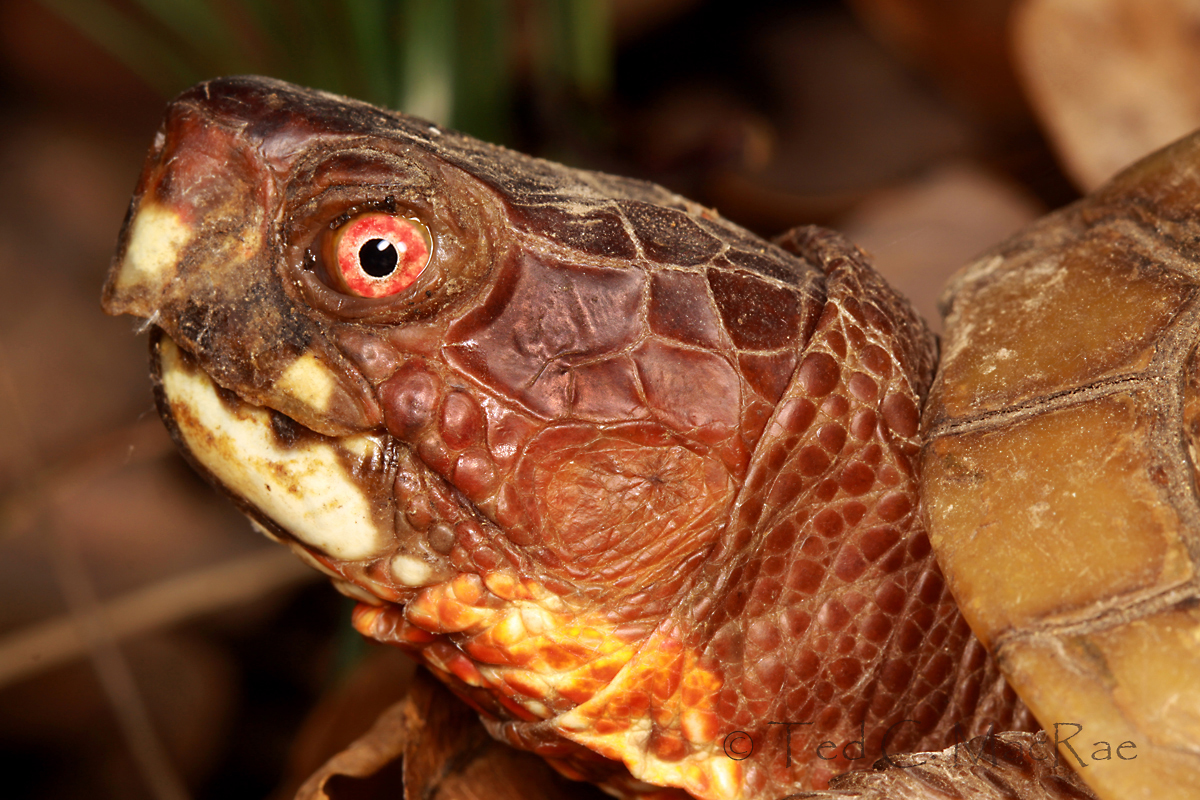
Terrapene carolina triunguis - three-toed box turtle

From Eye of the Turtle (posted December 10).  I had a hard time deciding on this category, but the striking red eye in an otherwise elegantly simple photograph won me over.  It was also one of two BitB posts featured this past year on Freshly Pressed.


Best “Super Macro”

Phidippus apacheanus - a jumping spider

From Jeepers Creepers, where’d ya get those multilayered retinae? (posted October 5).  I’m not anywhere close to Thomas Shahan (yet!), but this super close-up of the diminutive and delightfully colored Phidippus apacheanus is my best jumping spider attempt to date.  A new diffuser system and increasing comfort with using the MP-E lens in the field at higher magnification levels should allow even better photos this coming season.


Copyright © Ted C. MacRae 2011

Answer to Super Crop Challenge #2

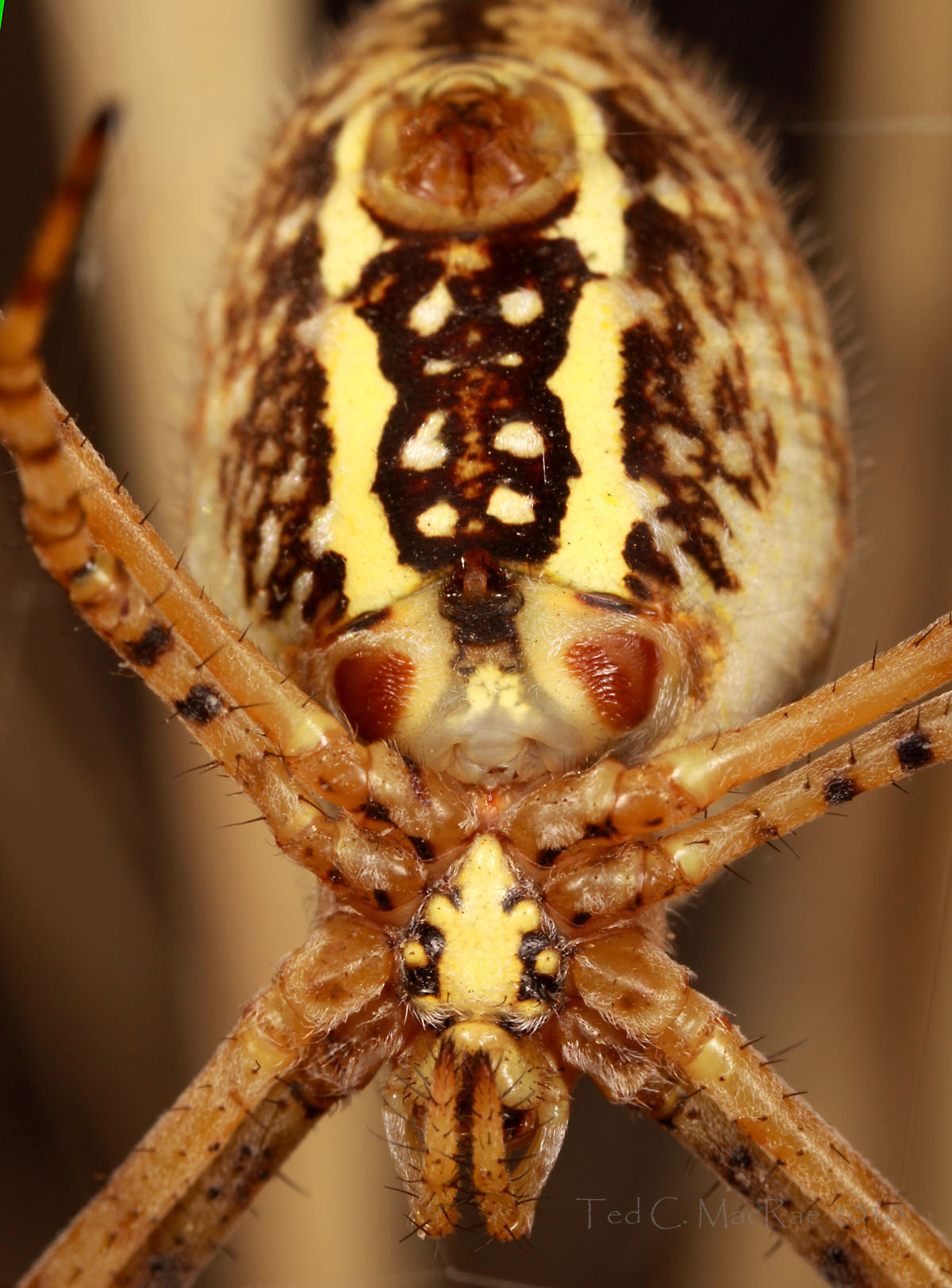
I was hoping that Super Crop Challenge #2 would prove a little more difficult than the first one, but first responder Troy Bartlett quickly sniffed out the correct answer – the top part of the abdomen of the marmorated orb weaver, Araneus marmoreus.  As the first correct responder he earns bonus points.  Dennis also came up with the same answer after temporarily being led astray, and Colton got it right as well (once he realized the challenge was here and not over on FaceBook).  I might be justified if I deducted points for misspellings in the genus and common names (if there is any field unforgiving of spelling errors, it’s taxonomy); however, I’m watching a Christmas movie with my family and am feeling the holiday spirit.  That spirit extends to Dave as well, who earns pity points for refusing to believe that I would offer consecutive spider challenges (actually the first Super Crop Challenge was an opilionid, but the ID challenge before that was another spider, making this the third straight arachnid challenge I’ve posted – it wasn’t by design).

The crop I used for this challenge was taken from the above photo – not the best of the series, but it had the most symmetrical view of the dorsal abdominal pattern that some think looks like a face.  This is just one of many color variations exhibited by this most variable of North American spiders – see this BugGuide page for a pictorial summary of the extraordinary amount of variation found in this species.

My friend Rich and I encountered this individual – a female – in an upland oak/hickory forest while hiking the lower North Fork Section of the Ozark Trail in extreme southern Missouri.  These spiders normally hide in a retreat during the day (usually a curled leaf) and spin a new web at night – I’m not sure why she was out during the day, as it didn’t appear she was recycling the web, tattered and torn and probably still remaining from the previous evening.  When I first approached, I accidentally brushed against one of the support lines, which sent her scampering up into her retreat.  I figured “tapping” on the leaf might cause her to drop back out – Rich was skeptical, but after a few taps, the spider not only dropped out but obligingly went right back down to the center of the web and stayed in place long enough for me to get a few shots of the ventral surface.  (I couldn’t suppress a smug chuckle as Rich muttered in exasperated disbelief!)  Moving around to the other side disturbed the spider again, and she once again took refuge in her retreat.  This time, rather than fight it, I carefully uncurled the leaf that formed her retreat, working gingerly to avoid disturbing her, and took a series of photos of her attractive dorsal surface as she sat in the retreat.

Photo Details: Canon 50D w/ 100mm macro lens (ISO 100, 1/200 sec, f/16), Canon MT-24EX flash w/ Sto-Fen + GFPuffer diffusers. Typical post-processing (levels, minor cropping, unsharp mask, etc.).

Copyright © Ted C. MacRae 2010

Halloween ID challenge answer – Argiope trifasciata

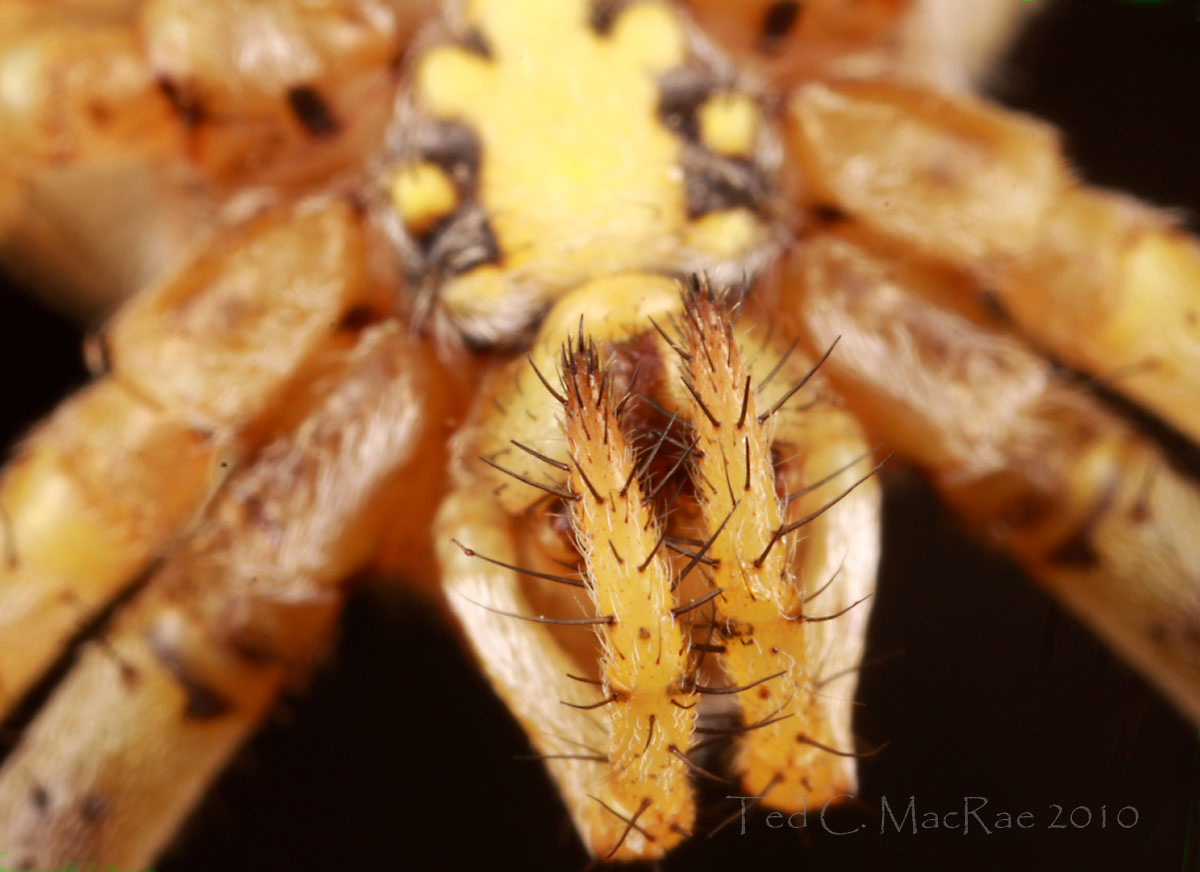
Here is another photo of the spider in the previous post with a closer view of its spiny pedipalps (mouth feeler thingys).  Troy Bartlett and BitB’s own James Trager got it right – the spider is, indeed, Argiope trifasciata, the banded garden spider (a.k.a. banded garden orbweaver, banded argiope, whitebacked garden spider, etc.).   I figured the genus would be easy, but the species might be a little tricky – at least for those in North America who might be tempted to conclude it was the larger A. aurantia (black and yellow garden spider, etc.).  The broken banding on the femora and generally lighter ventral coloration are usually enough to distinguish A. trifasciata from its more conspicuous congener.  Argiope trifasciata is also distinguished as one of the few truly cosmopolitan arthropod species, occurring naturally on all continents except Antarctica.

Both Troy and Dave Walter mentioned the conspicuous stabilimentum (heavy zig-zagging pattern) that Argiope spiders are perhaps best known for and that they often add to the center of their otherwise cryptic webs. Originally thought to possess a web-stabilizing function (hence the name), a variety of alternative explanations have since been proposed.  These include camouflage (to break up the body outline of the spider and make it less visible to predators), web protection (to make the web more visible to birds and prevent them from flying into and damaging it), prey luring (since it reflects ultraviolet light efficiently), thermal protection (by providing a shield against the sun), and a repository for excess silk.   An alternative hypothesis that I had not heard of but mentioned by Dave is that they serve as sponges for accumulating water for the spider to drink.  Webs with stabilimenta are more common and larger in exposed versus sheltered locations, and a recent study by Blackledge and Wenzel (1999) using A. aurantia found that webs with a stabilimentum suffered significantly less damage from birds (45% on average) than those without, but that they also caught fewer insects (34% on average).  The presence or absence of a stabilimentum, however, was not a significant factor in predation of the spiders by birds.  This implies not only a web protective function for the stabilimentum, but that there is an evolutionary trade-off between web protection and foraging success.  These authors concluded that variation in stabilimenta might be accounted for by a cost—benefit trade-off and that the decision by the spider to include a stabilimentum when building a web may be influenced by external factors such as prey density and web exposure.

Specific to A. trifasciata, a less well known but equally interesting aspect of its behavior is the use of web orientation for thermoregulation.   Tolbert (1979), in a study conducted in the southeastern US, found that web orientation was non-random during the hottest part of the summer, when spiders largely occupied east-west oriented webs with their silver/white dorsal surfaces facing south and their dark ventral surfaces facing north, and during October when the situation was reversed.  Orientation of the white/silver dorsal surface towards the sun presumably is done to help lower body temperatures, while orienting the ventral surface of the spider, which changes from silver to black as the spider reaches maturity, would maximize solar radiation for heat gain.  In contrast, Ramirez et al. (2003) found the species in coastal southern California never oriented their webs in a non-random fashion – rather, they always oriented them along an east-to-west axis with the mostly dark ventral surface of their abdomens facing south.  They suggested that dealing with a high heat load is not a significant problem in the predominantly cool environment of coastal southern California and that staying warm is the greater challenge for this mostly fall active species.

I’ll give 6 points to Troy for agreeing with me on everything, 4 to Dave for playing Devil’s advocate with the species and his unique alternative stabilimentum hypothesis, and 2 points to James for agreeing with Troy’s species ID. 🙂

Photo Details: Canon 50D w/ MP-E 65mm 1-5X macro lens (ISO 100, 1/250 sec, f/14), Canon MT-24EX flash w/ Sto-Fen + GFPuffer diffusers. Typical post-processing (levels, minor cropping, unsharp mask).

REFERENCES:

Blackledge, T. A. and J. W. Wenzel. 1999. Do stabilimenta in orb webs attract prey or defend spiders? Behavioral Ecology 10(4):372–376.

Ramirez, M. G., E. A. Wall and M. Medina. 2003. Web orientation of the banded garden spider Argiope trifasciata (Araneae, Araneidae) in a California coastal population. The Journal of Arachnology 31:405–411.

Tolbert, W. W.  1979. Thermal stress of the orb-weaving spider Argiope trifasciata (Araneae).  Oikos 32(3):386–392.

Copyright © Ted C. MacRae 2010

Halloween ID challenge

Class and order are gimmes – can you name the family, genus, and species? Common name? Something significant about its biology or behavior?

Photographed 25.ix.2010 in shortgrass prairie habitat atop the Pine Ridge in Sioux Co., Nebraska.

Photo Details: Canon 50D w/ MP-E 65mm 1-5X macro lens (ISO 100, 1/250 sec, f/11), Canon MT-24EX flash w/ Sto-Fen + GFPuffer diffusers. Typical post-processing (levels, minor cropping, unsharp mask).

Copyright © Ted C. MacRae 2010

Jeepers Creepers, where’d ya get those multilayered retinae?

A few weeks ago I was fortunate to get a chance to blast down to the White River Hills in extreme southwestern Missouri.  Cicindela obsoleta vulturina (prairie tiger beetle) was my quarry – I had made arrangements to meet up with fellow cicindelophile Steve Spomer (principal author of Tiger Beetles of South Dakota & Nebraska, Spomer et al. 2008) and show him a few of the better sites I had found for this species.  We would have good success due to gorgeous fall weather and perfect timing, and the next day I would be fortunate to extend its known distribution further north and east.  Still, the beetles are not early risers, and I found myself that second morning with some time on my hands while waiting for these sleepy-heads to arise from their slumber and begin their foraging activities.  As I trolled the thinly soiled dolomite exposures of a new site I had identified the previous day, a spot of red jerking erratically through the sparse vegetation caught my eye, and looking closer I was delighted to see this small but brilliantly colored jumping spider (family Salticidae) trying to evade my gaze.

Jumping spiders are perhaps the most diverse of all spider families, but it is their extraordinary visual capabilities and complex predatory and courtship behaviors that they are best known for.  Popular as research subjects, to the rest of us they are simply endearing little animals.  Some of the largest and most colorful jumping spiders belong to the genus Phidippus, which is also one of the most diverse genera in the family and boasts some 60 species in the continental United States (Edwards 2004).  The genus is characterized by details of the eye placement and carapace shape (Richman 1978) but can often be recognized by their relatively large size, numerous erect hairs, and conspicuous iridescent chelicerae just below the front eyes.  The species can be quite difficult to identify, especially the females, but I feel reasonably confident that this individual is a male of the widespread species P. apacheanus.

I wasn’t always so confident – browsing images on BugGuide left me confused after finding images of P. apacheanus and P. cardinalis males that looked almost identical. However, further digging reveals P. apacheanus is characteristically a more intense red, while P. cardinalis is more orangey with lighter bristles which may appear silvery.  Also, P. cardinalis often displays makings on the abdomen – generally a light line running around the anterior part of the abdomen and sometimes tiny light spots on the dorsum – that are absent in P. apacheanus.  (This begs the question as to whether some of the BugGuide photos may be misidentified?)  Another Phidippus species that might be confused with P. apacheanus is P. clarus; however, that species has a black cephalothorax and bright abdominal markings.  According to Herschel RaneyP. apacheanus is most often seen in fall.

This was a very difficult subject to photograph.  He refused to come out in the open, preferring to duck and peek from behind whatever vegetation he could find.  Realizing that my desire to photograph him without any manipulation would be a lesson in futility, I used my finger to prod him towards and onto a small, flat, lichen-encrusted rock, where he would look at me with ever-increasing alarm and try to flee at the approach of the camera.  Lots of failed shots were discarded in the field before I finally got a few I thought I could live with (which, I think, are a decided improvement over my first jumping spider photos).  As I zoomed in for the closeups, I saw for the first time the shimmering of his multilayered retinae moving in the depths of his primary medial eyes.  The retina is the darkest part of the eye, thus, when the eye is at its darkest the spider is looking straight at you!

Photo Details: Canon 50D w/ MP-E 65mm 1-5X macro lens (ISO 100, 1/250 sec, f/13), Canon MT-24EX flash (1/8 ratio) w/ Sto-Fen + GFPuffer diffusers. Typical post-processing (levels, minor cropping, unsharp mask).

REFERENCES:

Edwards, G. B.  2004. Revision of the jumping spiders of the genus Phidippus (Araneae: Salticidae). Occasional Papers of the Florida State Collection of Arthropods 11:i-viii, 1-156, 350 figs.

Richman, D. B.  1978. Key to the jumping spider (salticid) genera of North America.  Peckhamia 1(5):77–81.

Spomer, S. M., M. L. Brust, D. C. Backlund and S. Weins.  2008. Tiger Beetles of South Dakota & Nebraska. University of Nebraska, Department of Entomology, Lincoln, 60 pp.

Copyright © Ted C. MacRae 2010

My first jumping spider

As a long-time professional and avocational entomologist, I find beauty and fascination in all manner of joint-legged creatures. Of course, beauty is in the eye of the beholder, and most people don’t exactly share my passion for these animals. Sure, butterflies enjoy almost universal approval, but beetles are just too crunchy, flies too filthy, wasps too aggressive, and cockroaches… well, eww! Even crabs and lobsters, tasty as they are, just move too robotically to engender any feelings of affection. None of these groups, however, seem to be as universally reviled as spiders – scuttling blurs of leg and fur with beady little eyes, just waiting to launch a sneak attack with their venomous gnashers. Few other coin-sized animals can cause an otherwise lucid adult to run screaming from their bathroom with such terror.

Except jumping spiders! Jumping spiders (family Salticidae) possess many of the same traits that condemn other spiders to the ranks of the creepy – hair and venom and lots of eyes; yet they have other unique qualities that make them nevertheless endearing, almost cuddly, to all but the most ardent of arachnophobes. Their human-like “face” featuring two large, forward-facing eyes and inquisitive nature give them a charisma that almost invites interaction. Approach any other spider, and it scampers back into the nearest crevice. Jumping spiders, on the other hand, turn and face the intruder – you can almost see them sizing you up – perhaps even moving forward a little to have a better look. It makes them seem, well… intelligent. Add to that their stunning diversity (~5,000 species), dazzling colors, and the sometimes impressively elongated choppers of the males, and you’ve got the perfect recipe for charm. Bouncy, furry, smart, cute, and big bright eyes – almost sounds like a kitten!

The result of all this charm is that jumping spiders are wildly popular subjects for macrophotography. Accordingly, there has been a veritable explosion of online photographs of jumping spiders, dominated by close-ups of that irresistible face. These shots here represent my first attempt to photograph one of these endearing creatures, and while I’m happy with them considering my relative newness to the field, they are a far cry from the spectacular images being produced by some other photographers. Perhaps the best of these is Thomas Shahan, whose focus-stacked facial shots of these spiders are among the most stunning that you will find. Another photographer who has produced some excellent photographs of Malaysian jumping spiders is Kurt at Up Close with Nature. Perhaps someday my jumping spider photographs will be considered on par with those that these two gentlemen are producing – if that day comes, you can say it began right here!

I’m a beetle-man, so except for a brief attempt at ant taxonomy my area of expertise lies with the Coleoptera. Nevertheless, perusing the well-stocked archives at BugGuide leads me to believe that the individual I photographed is a subadult female in the genus Phidippus – perhaps something in the putnami species-group.  I found her on a lower branch of sweetgum (Liquidamber styraciflua) in a wet-mesic bottomland forest along the Black River in Missouri’s southeastern Ozarks feeding on a blow fly (family Calliphoridae).  While relatively drably-colored compared to many other species in the family, a glimpse of her bright blue-green chelicerae (fangs) can still be seen.  I tried to get her to drop her prey to get a better look at the fangs, but she wasn’t having anything to do with that – mealtime is mealtime!

Photo Details: Canon MP-E 65 mm 1-5X macro lens on Canon 50D, ISO 100, 1/250 sec, f/13-14, MT-24EX flash 1/8 power w/ Sto-Fen diffusers. Minimal cropping and post-processing.

Copyright © Ted C. MacRae 2010

Add to FacebookAdd to DiggAdd to Del.icio.usAdd to StumbleuponAdd to RedditAdd to BlinklistAdd to TwitterAdd to TechnoratiAdd to Yahoo BuzzAdd to Newsvine

Email to a friend

The Inexorable March of Spring!

Granted, the progress of spring seems to advance in halting baby steps with occasional falls onto its muddy bottom, rather than as a determined forward march, but spring is welcome, no matter how it arrives. When little green tips start poking up and there’s a bit of that “spring smell” in the air, I simply must get out and catch up on the status of Nature — the old-fashioned way (she doesn’t have a Facebook account). Over the last week, I’ve gone forth in search of signs that everything else living is about as tired of winter as I am, and wants to get this spring show on the road! There is already so much happening, I can’t recount it all here — A partial list of unphotographed notables: owls breeding; hawks nesting; woodcocks doing their silly, repetitive and almost invisible (because it’s nearly dark) courtship displays; wood ducks on forest ponds; year-round resident songbirds reestablishing territories; spring peepers, chorus frogs, wood frogs and southern leopard frogs singing, especially in the fishless ponds; winter crane flies and midges swarming in sun flecks in the woods; wild filberts, silver and red maples flowering, etc…

Formica pallidefulva sniffs the spring air


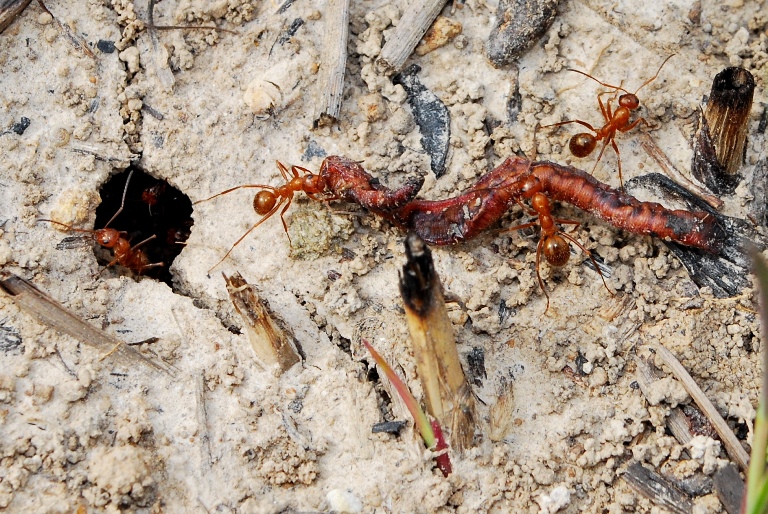
Of course, I look for the first ants out at this time of year, though with the exception of 10 March, when the temperature exceeded 70F, they haven’t been notably active. However, that afternoon I encountered, among others, a worker of Formica pallidefulva poking its head out cautiously to sniff the spring air. This is one of my favorite local ants — largish (5-6mm), abundant, active in daylight even when it’s hot, usually shiny bronzy red to red-brown, usually with a darker gaster (the apparent abdomen of ants) around here, but ranging from a beautiful reddish gold (in the deep South) to almost pure black-coffee brown (New England and southern Canada) across its wide geographic occurrence (Rocky Mountain foothills of Wyoming to New Mexico, all the way east to Québec and Florida). It has the added charm of being the host species to a wide range of social-parasitic and dulotic (“slave-making”) ants both in its own and in another closely related genus, with which it lives in temporary or permanent mixed colonies (as with the Polyergus illustrated in my last post). The image below of these ants bringing home a charred earthworm was taken almost one year ago, as one of Shaw Nature Reserve’s prairie areas was beginning to resprout after a prescribed burn a few weeks earlier. Ants will take their food raw or cooked!

Formica pallidefulva with charred earthworm


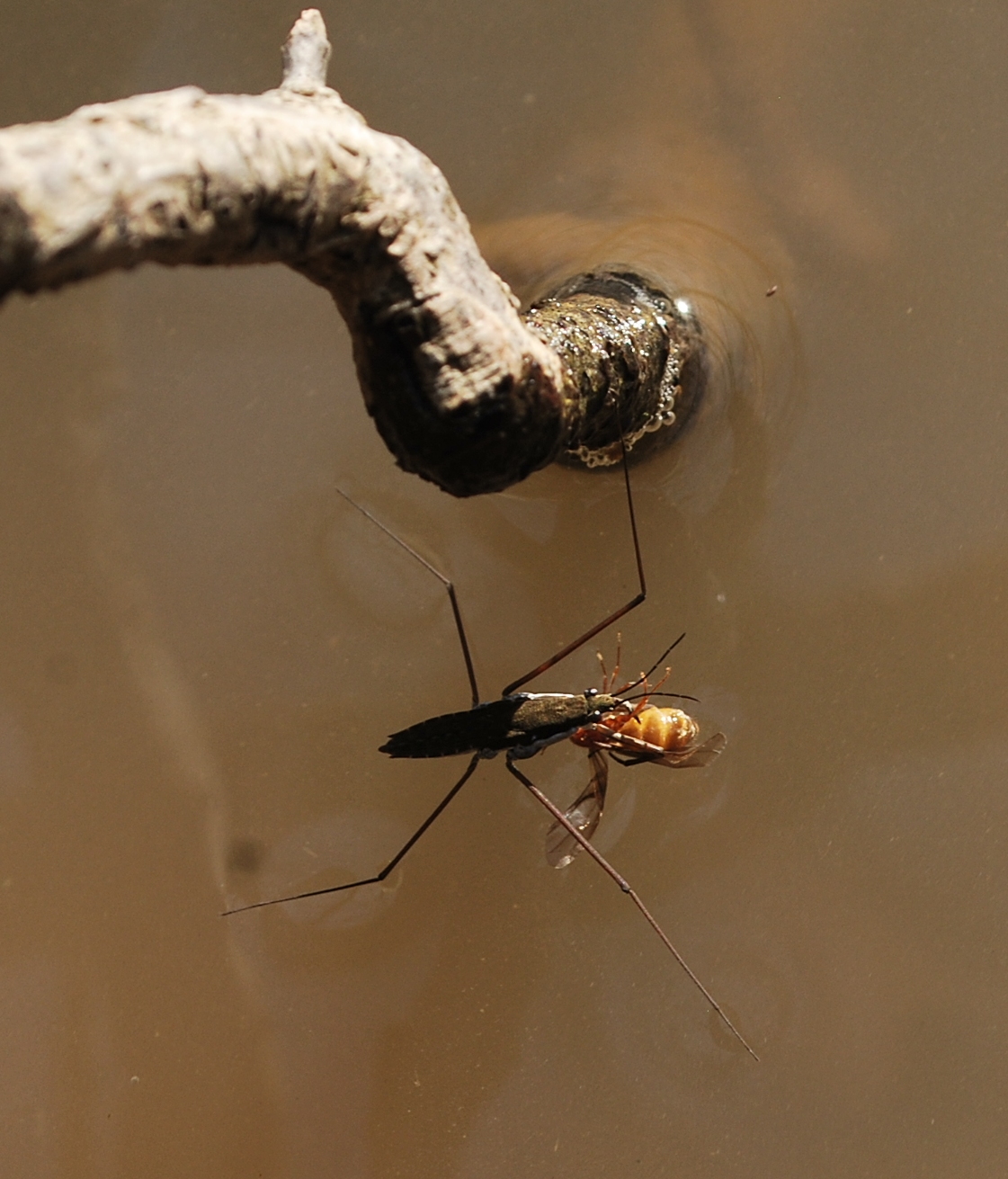
Prenolepis imparis alate in the clutches of a gerrid

Another ant I mentioned last time I was with you, Prenolepis imparis, has the distinction of being the only ant in our fauna that has mating flights while there is still a good chance of frost in the forecast for the next few weeks. In this picture of a mating pair at  BugGuide, note the size difference that inspires their name “imparis”, Latin for disparate. Any time after mid-February when it is sunny and not too windy, and the temperature rises above 65F, the winged males and females reared the preceeding fall, fly out to partake of a grand insectan orgy. Typically, they have big flights on the first couple of appropriately warm days, then some smaller ones (i.e., fewer individuals participating) over the next few weeks. The flying males look like gnats, bobbing up and down in drifting swarms, a few feet off the ground over a shrub, near a woodland edge or in a sunny opening. (One of my co-workers got into the midst of a group of such swarms once when we were conducting a prescribed burn in a wooded area, and I recall her commenting she “felt like Pigpen with all the little bugs flying around”!) The much larger, golden-brown females lift slowly off the ground, fly ploddingly (or is it seductively?) through the male swarms, are there mobbed by the tiny fellows, and then glide away and slightly downward, mating in flight with the winner of the males’ tussling. Rather clumsy fliers, the females do not always land in a good spot, as occurred to this hapless one that ended up as a feast for a water strider. Those that survive break off their wings, dig a burrow, seal themselves in, and raise a small brood of workers on food produced in their own bodies (like say, milk in mammals or “cropmilk” in doves and some other birds.)

But lest you to think I only have eyes for ants, I feel indeed fortunate to have encountered a tarantula this week, of the same species as Ted recently posted and I didn’t even have to go to Oklahoma for it. This bedraggled individual was at the mouth of its completely flooded burrow in what is most often a very dry habitat — a dolomite glade. Stunned and muddy at the time, my guess is this creature, belonging to a resilient and ancient lineage, will dry off, clean up, and saunter away as soon as she warms up.

Aphonopelma hentzi in flooded burrow


And speaking of emerging from flooded burrows, how about this handsome fellow, a male three-toed box turtle, his sex revealed by his bright orange and red markings, coming up for a breather? In truth, it was perhaps only just warm enough to make him need air, but not really enough so for him to be up and about, so he just sat there, nearly immobile, looking pretty, notwithstanding mud and leaves glued onto his shell.

Male box turtle emerges


Copyright © James C. Trager 2010

Add to FacebookAdd to DiggAdd to Del.icio.usAdd to StumbleuponAdd to RedditAdd to BlinklistAdd to TwitterAdd to TechnoratiAdd to Yahoo BuzzAdd to Newsvine

Email to a friend