“My peripatetic quest for North America’s rarest tiger beetles”

This week I gave a presentation on my latest Annual Fall Tiger Beetle Trip to the Entomology Group of the Webster Groves Nature Study Society. With the exception of a brief 5 year period in the early 1990s while I lived in California, I’ve been active with this local nature study group for the past 30 years (and serving as newsletter editor since 2009). I’ve given my share of entomology presentations over the years to both professional and amateur audiences, but no matter how far I might travel or the size of the audience, I always enjoy my time with this small group of local entomologists. They are my roots—the people with whom I learned to collect and began my explorations of Missouri and beyond. We are joined not only by the bonds of common interest, but by shared experiences as well. There was a good turn out for the presentation, and my thanks to the Group for the interest they showed.

Nine days, ten states, 4,300 miles:
My peripatetic quest for North America’s rarest tiger beetles

The photographs used in the presentation have been seen in various posts here over the past few months, but I thought some may appreciate the chance to see them all together in presentation format. A PDF version of the original Powerpoint presentation can be downloaded by clicking on the link above (although with a file size of just over 18 MB a high-speed internet connection is recommended). My thanks to David Pearson, Professor of Biology at Arizona State University, for permission to include in the posted version scanned images and distribution maps from his supremely useful A Field Guide to the Tiger Beetles of the United States and Canada (the bible of North American cicindelophiles¹).

¹ If you have not yet bought this most excellent book, paperback versions can be bought new for as little as $41.74. Buy it and you’ll never fail another BitB tiger beetle ID Challenge!

If you download the presentation, please remember that all materials are copyright Ted C. MacRae unless attributed otherwise and may not be used without permission (personal use excepted) .

Copyright © Ted C. MacRae

Memories of summer – Neoclytus scutellaris

Neoclytus scutellaris | 9 July 2011, Wayne Co., Missouri

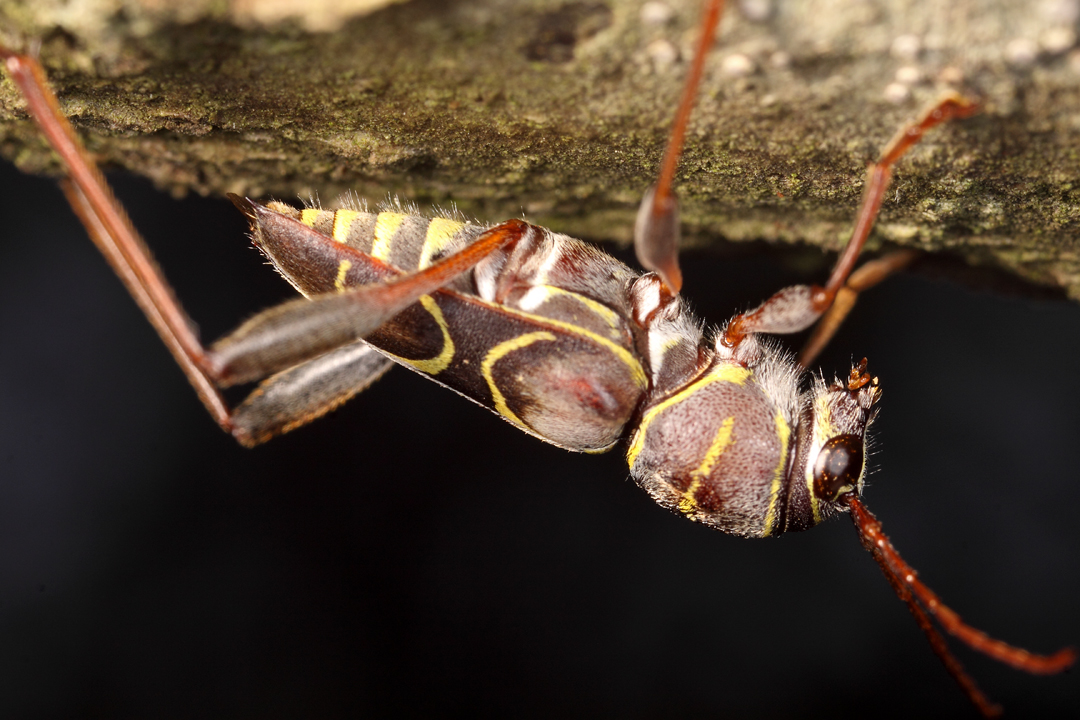
During the short, cold days of winter it’s nice to take a break from the curatorial activities that dominate the season and look back on some of the insects seen during the previous summer. This is Neoclytus scutellaris, a longhorned beetle associated almost exlusively with dead/dying oaks in the eastern U.S. The species is sometimes confused with the very similar N. mucronatus but is distinguished by the transverse yellow band on the pronotum and its host (the latter being associated with hickory and hackberry).

Copyright © Ted C. MacRae 2011

Something for Adrian

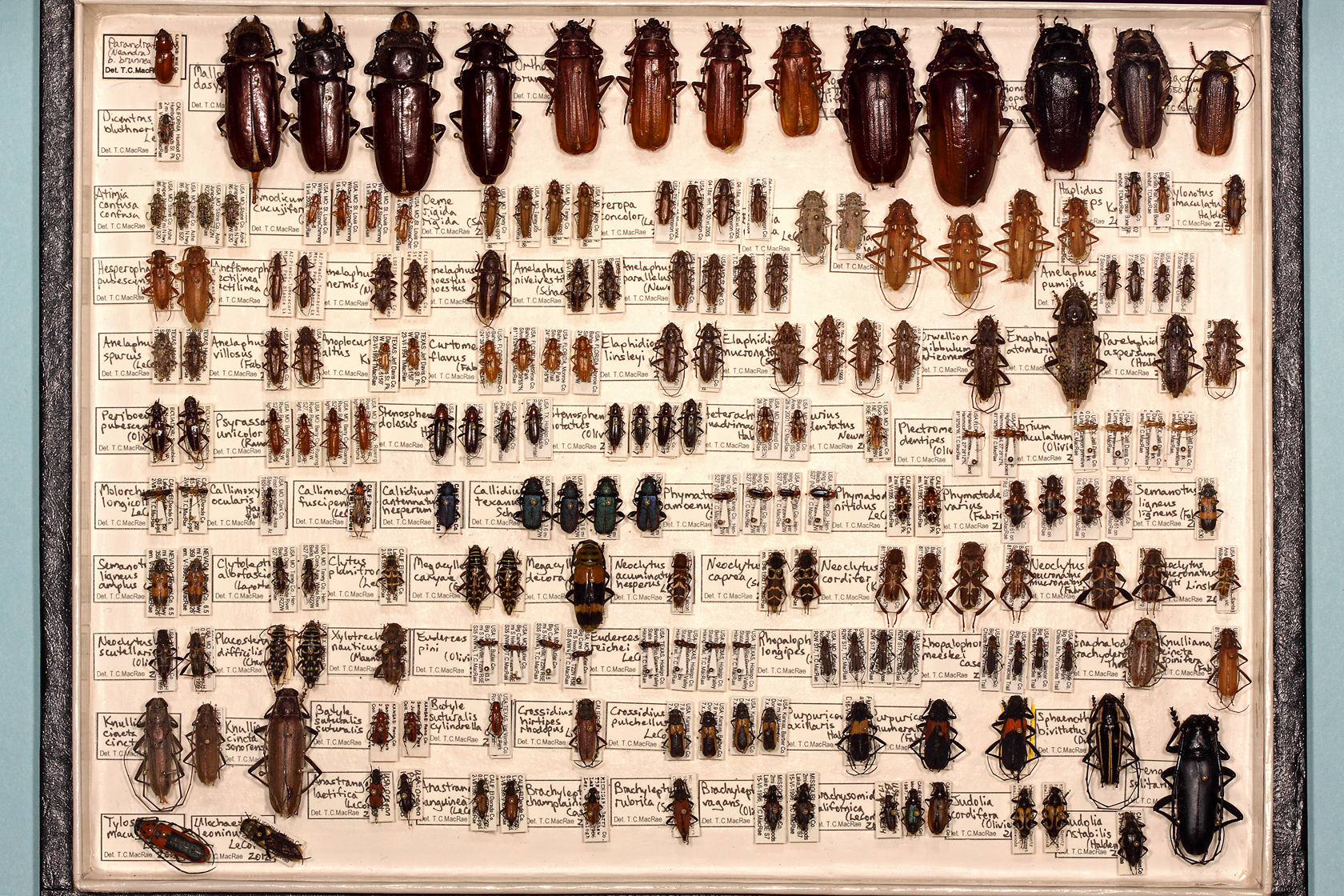
Miscellaneous North American Cerambycidae - click for larger version (1680 x 1120).

In a comment on my  post, Adrian Thysse asked to see hi-res images of specimen drawers from my own collection. Like any good North American entomologist, Adrian was a little bothered by the card-mounting technique used by the sender of the specimen box featured in that post and wanted to see what a nice collection of properly pinned specimens might look like. It’s actually not the first time he’s made this request—back when I first moved this blog to WordPress (more than three years ago) he did so when I put up my Collection page featuring a photo of my “Oh wow!” insect drawer. I’ve thought about doing this ever since he first made this request, but the problem, or at least my problem, with photographing specimen drawers from my main collection is a combination of large drawer size (reducing the size of the specimens in an image of the drawer) and long series of a relatively small number of species in the same genus or closely related genera (making the drawer contents look rather uniform in appearance). I suppose some might still be interested in seeing drawers from a “working collection” such as mine, but I just never had enough motivation to start pulling out drawers and taking photos.

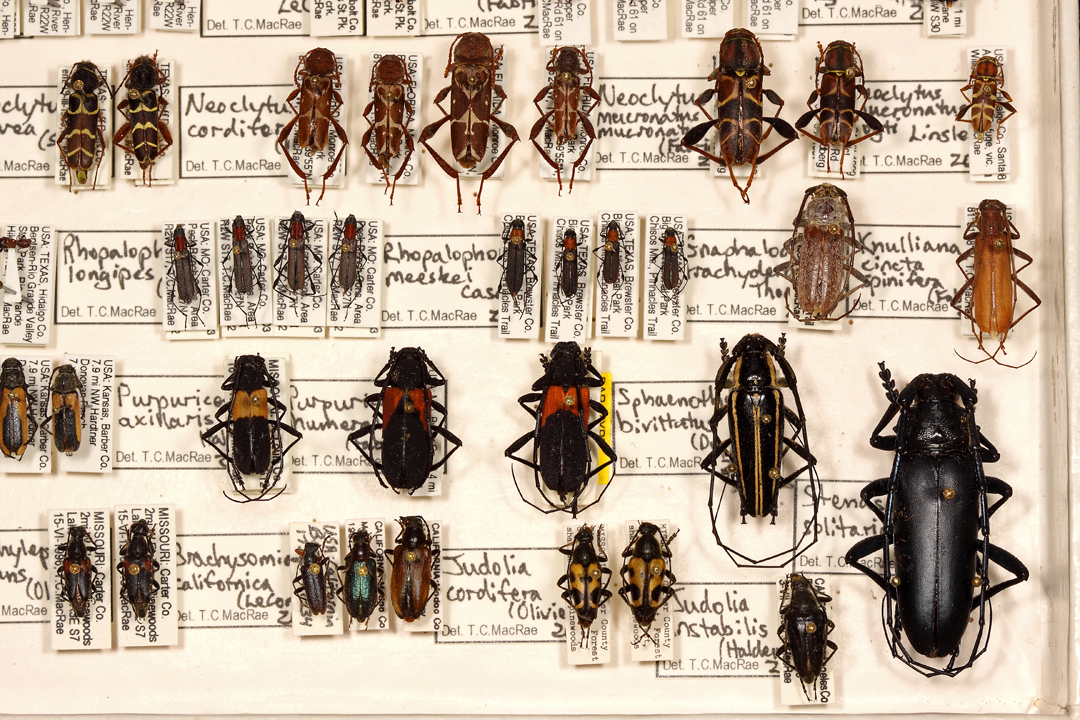
Adrian is in luck, however, as I just happened to be putting together a shipment of miscellaneous North American Cerambycidae for a collector in Europe (to whom I’ve owed insects for longer than I like to admit). The box I’m using for the shipment is smaller than a normal collection drawer and is packed with close to 100 species of this diverse beetle family. There might be a specimen here and there that was collected by someone else, but the vast majority were collected, mounted, labeled, and identified by me. I show this as an example of my curatorial technique, and as a bonus the above image is linked to a fairly large version (1680 x 1120) for those who might be interested in getting a really close look at the specimens and their labels. Here also are closer looks at the specimens in the bottom left and bottom right corners, respectively:

Hmm, is that a wasp at the bottom?

What species is that without the ''normal'' ID label?

Copyright © Ted C. MacRae 2012

Buprestidae exchange

With my queue of specimen identifications now clear, I can turn my attention to another major backlog that I haven’t been able to give proper attention recently—exchanges. For those of you not into insect collecting, exchanging is something that most collectors eventually end up doing, especially if the goal is to build a taxonomic reference collection within one’s chosen group that has broad representation of species and higher taxa from multiple geographical regions. Truthfully, I don’t do nearly as much exchanging as some collectors I know. It’s not that I don’t want to, but simply a matter of time—receiving and incorporating shipments while preparing and sending out returns is not as quick and easy as it might seem, not to mention the time involved in mining and corresponding with prospective exchange partners. I wish I could do more, but since I can’t I deal with it by limiting myself almost exclusively to exchanging Buprestidae (although I’ve been known to do a tiger beetle exchange or two). I focus on Buprestidae because that is my primary group of taxonomic interest.

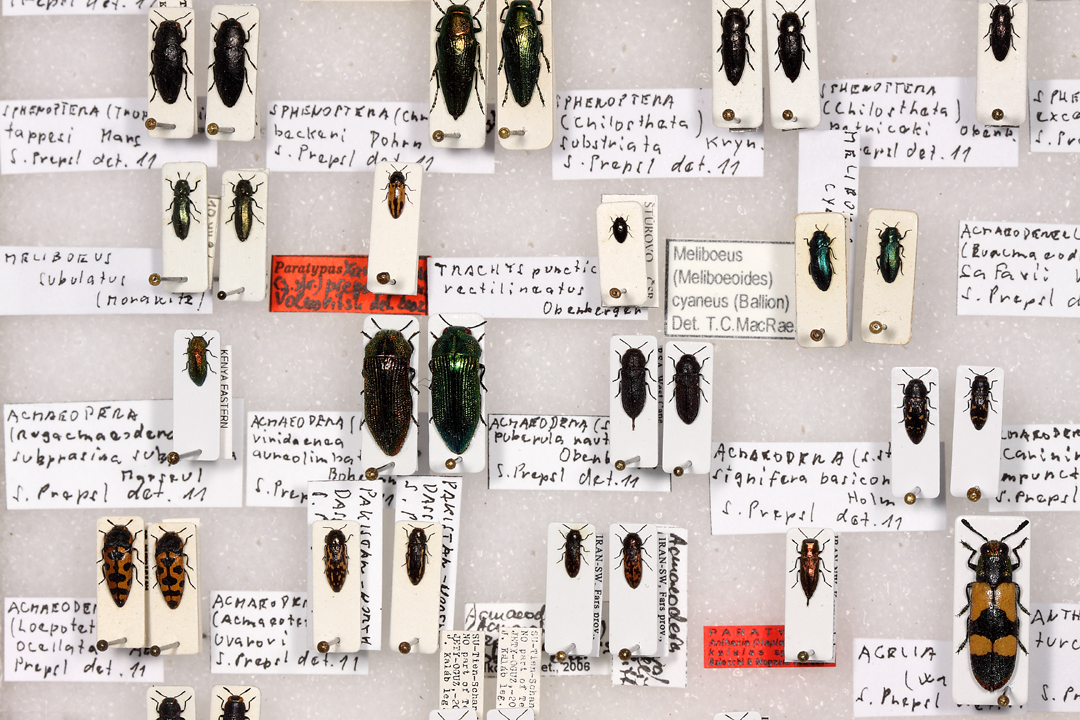
Buprestidae received in exchange from Stanislav Prepsl, Czech Republic

These photos show some of the Buprestidae I received this past year, this particular box coming from Stanislav Prepsl in the Czech Republic. This is the first time that I’ve exchanged with Stan, and I must say I am impressed with the quality and taxonomic diversity of his buprestid holdings. In this exchange, I received 73 species, most of which are represented by a male/female pair and four represented by paratype specimens. These are all Old World species, and while a few are from the well-known fauna of Europe most were collected in countries seldom visited by (or even off limits to) American collectors such as the former USSR, Iran, Pakistan, Kurdistan, Turkey, etc. There are a nice few species also from Namibia, Kenya and Ethiopia. In return, I sent to Stan more than 100 species of Buprestidae from mostly the southwestern U.S. and Mexico where I have done a large part of my collecting. Stan was less demanding about receiving both one male and one female for each species, thus the larger number of species I was able to send him for approximately equal numbers of specimens.

Close-up view of lower left corner of box

Some collectors avoid Buprestidae because of their taxonomic difficulty and the overwhelming numbers of small, difficult-to-identify species. I think this is exactly why I like the group, and though many of the species are small they are certainly no less beautiful than their larger, flashier, more ostentatious brethren. I include this close-up view (you might recognize the specimen in the lower right corner as the previously featured Agelia lordi) to show the meticulous preparation of the specimens included in the shipment—an example of a well-curated collection by someone who knows what they are doing. Incidentally, the cards on which the specimens are mounted are standard fare among European collectors, and although as an American I prefer direct pinning of larger specimens and mounting smaller specimens on points versus cards, I’ve come to appreciate the exacting care with which some Europeans practice this card-mounting technique.

It’ll take me a few hours of dedicated attention to move all of these specimens into the main collection—not only must their proper placement be determined, but there is usually a lot of reshuffling of specimens within and amongst unit trays whenever such a large number of specimens is incorporated into it. With 15,000 described species and counting, this sending of Buprestidae represents only a modest increase (0.5%) in my representation of species; however, it adds representation from geographical areas that previously had virtually no representation in my collection at all. I hope Stan is as pleased with the material that I sent to him as I am with this material, and I look forward to the opportunity to exchange again with him in the near future.

Copyright © Ted C. MacRae 2012

Extreme sexual dimorphism in Buprestidae: Xenorhipis hidalgoensis

Yesterday I received in the mail a package of specimens for identification from Dan Heffern in Houston, Texas. I first began corresponding with Dan about 25 years ago—not long after I myself became interested in Coleoptera, and as an avid collector of longhorned beetles (family Cerambycidae) Dan knows a thing or two about jewel beetles (family Buprestidae) as well. Over the years, Dan has come up with a number of great buprestid species from Texas, especially through rearing, many of which he has graciously sent to me examples for my cabinet.

Xenorhipis hidalgoensis (male, length 5.3 mm) | Hidalgo Co., Texas

The present package was no exception, as it contained a male/female pair of one of North America’s least frequently encountered buprestids, Xenorhipis hidalgoensis. Dan had reared them from dead branches of Condalia obovata collected in south Texas as part of a multi-year beetle survey in the Lower Rio Grande Valley. He had mentioned to me that he would be including them in the sending, but that did nothing to diminish my excitement upon seeing the specimens when I opened the box. The species was first described from Hidalgo Co., Texas (Knull 1952), and other than a single record from the neighboring Mexican state of Tamaulipas (Nelson et al. 1981) subsequent mentions of the species have been limited to catalogue listings and inclusion in keys to species. Thus, these specimens represent not only a nice addition to my collection, but also the first reported larval host for the species.

Xenorhipis hidalgoensis belongs to the tribe Xenorhipini, the males of which exhibit a distinctive specialization of their antennae in that the distal segments are highly modified into a very extended flabellate or lamellate condition. Females, in contrast, retain the serrate antennal condition that is more typical throughout the family.  Differences in antennal morphology aren’t the only sexual differences exhibited by members of the tribe, as males and females often exhibit differences in coloration as well. This is especially true in the genus Xenorhipis, and I’m not aware of a more striking example of this than X. hidalgoensis (compare these photos to those of male/female pairs of X. bajacalifornica, X. brendeli and X. osborni in A new species of Xenorhipus from Baja California).

Xenorhipis hidalgoensis (female, length 6.4 mm) | Hidalgo Co., Texas

The highly modified male antennae are interesting from both an evolutionary and functional standpoint. Similarly modified male antennae are found in a few other groups of Buprestidae, including the genus Knowltonia in western North America (four species), the monotypic genera Mendizabalia and Australorhipis in South America and Australia, respectively, and two species in the enormous Australian genus Castiarina (Bellamy and Nylander 2007). The Xenorhipini, however, with 20 species distributed throughout the Western Hemisphere, is by far the most diverse group exhibiting the condition. Despite the similarity of their antennae, the taxonomic distance between these groups and differences in the detailed structure of the numerous olfactory sensillae that cover the modified segments (Volkovitsh 2001) suggest that the modifications have arisen and evolved independently in these several disparate taxa.

All Buprestidae exhibit sensory structures on their antennae, presumably with olfactory and/or thermosensory functions; however, Wellso (1966) provided strong evidence that females of X. brendeli release pheromones that are highly attractive to males and detected by their elaborate antennae. Caging studies with virgin and mated females revealed that males were highly attracted to virgin but not mated females, and that mated males were not attracted to either virgin or mated females and died shortly thereafter.  Further, more than 80% of males were attracted within a 1-hour period just past midday. It is assumed that chemoreceptors for detecting female pheromones are located on the male antennae, as males with their antennae removed were not attracted to caged virgin females but were able to mate when caged with them. This suggests that the male antennae evolved in response to selection for greater surface area, which allows placement of more sensillae to detect female pheromone. Wellso observed also that adults are very short-lived, with no individuals living longer than 48 hours (perhaps due to reliance on pheromone attraction rather than longevity for mate location). This, along with their very short daily activity period, may explain  why adults of species in this tribe are so seldom encountered in the field.

Male with highly flabellate antennae

Female with unmodified serrate antennae


REFERENCES:

Bellamy, C. L. and U. Nylander. 2007. New genus-group synonymy in Stigmoderini (Coleoptera: Buprestidae). The Coleopterists Bulletin 61(3):423–427.

Knull, J. N. 1952. A new species of Xenorhipis from Texas (Coleoptera: Buprestidae). Entomological News 63(7):177–178.

Nelson, G. H., D. S. Verity, and R. L. Westcott. 1981. Additional notes on the biology and distribution of Buprestidae (Coleoptera) of North America. The Coleopterists Bulletin 35(2):129–152.

Volkovitsh, M. G. 2001. The comparative morphology of antennal structures in Buprestidae (Coleoptera): evolutionary trends, taxonomic and phylogenetic implications. Part 1. Acta Musei Moraviae, Scientiae biologicae (Brno) 86:43-169.

Wellso, S. G. 1966. Sexual attraction and biology of Xenorhipis brendeli (Coleoptera: LeConte). Journal of the Kansas Entomological Society 39(2):242–245.

Copyright © Ted C. MacRae 2012
2,171 pieces of chitin…

Specimen boxes ready to ship out.

There are many reasons to look forward to the Holiday Season—time with family and friends, a break from the normal routine, the chance to engage in favorite activities leisure and otherwise, or maybe just kick back and not do much of anything. Okay, that last one is so not me—I really have a hard time sitting around and doing nothing no matter how tired I am. It makes me antsy. What did I do on my Holiday Break (a nice generous chunk of time starting the day before Christmas Eve and ending the day after New Years)? I spent lots of time with my family immediate and extended. I had quality time with a few close friends (including a 10-mile hike on the Ozark Trail with my friend Rich). I rode my bike. Lots! (315 miles precisely.) And (here comes the best part), I identified beetles. Lots! When I wasn’t riding or hiking or making merry, I was in my man cave with football on Tivo, beetles under the scope, and primary taxonomic literature sprawled all over the place. Maybe not the average Joe’s idea of a relaxing break, but it works for me.

Truth be told, I actually depend on the period between Thanksgiving and New Years Day to kick-start my winter curatorial season. As an entomologist with taxonomic leanings living in a temperate region, there is a seasonality to my activities. Summer is field season, and no matter what good intentions I may have for accomplishing other things, the constant siren call of the field makes this all but impossible. Reprints pile up. Boxes of specimens received for identification or exchange accumulate in the various nooks and crannies of the room. All the while I’m out collecting even more beetles! By the time fall arrives I’m well inundated and looking forward to the onset of winter so I can actually accomplish something other than growing the backlog.

It’s a new year, and with my plate now cleared of beetles needing identification, the specimens—all 2,171  of them—can be returned to their rightful owners. I’ve said it to each of them individually, but it bears repeating here that I truly appreciate the opportunity they give me to look at their material. Their specimens fuel my research with new data, allow me to gradually increase species representation in my collection, and occasionally even bring to light undescribed species. Without this network of collaborators, from full professors to citizen scientists, the Holidays for me would be just a bit too boring.

Copyright © Ted C. MacRae 2012

Sometimes the best collecting…

Anambodera sp. (prob. undescribed) | Nothing, Arizona

As a practicing (albeit non-professional) taxonomist, I spend a goodly amount of time examining specimens collected not only by me, but by others as well. I’ve mentioned before the benefits of doing this—both to the collector, who gets names for the specimens in their collection, and to my own research in being able to cast a broader net in my search for new distributions and host associations within my two primary focus groups—Buprestidae and Cerambycidae. Such information remains surprisingly incomplete for these two popularly collected groups of beetles, and every few years I assemble whatever records that I’ve accumulated to that point for publication in the form of a “notes” paper (e.g., Nelson and MacRae 1990, Nelson et al. 1996, MacRae and Nelson 2003, MacRae 2006, MacRae and Rice 2007). Occasionally I encounter species that I have not yet collected myself (although with ~70% of Nearctic species now represented in my collection, this is becoming more and more infrequent), and in most such cases the collector graciously allows me to keep an example or two (leading to the saying, “Sometimes the best collecting is in other people’s collections!” ☺). The ultimate find, however, is a specimen or series of specimens that represent an undescribed species. Yes, even amongst North America Buprestidae and Cerambycidae there are many species still awaiting discovery (imagine the situation with other families of beetles, many receiving far less attention than these two popular groups).

The beetle shown here, a member of the genus Anambodera, represents one such species. This individual is part of a small series collected in Nothing, Arizona this past summer by Paul Kaufman, an indefatigable amateur beetle collector who has routinely over the years provided fodder for my research in the way of new state records and, more recently, new larval host records through rearing. While the key characters that separate Anambodera from the closely related and exorbitantly speciose genus Acmaeodera (front margin of epistoma not reflexed or plate-like, front angles of pronotum rounded in side view, suture between 1st and 2nd abdominal sterna visible, etc.—see Barr 1972), the coarse elytral punctation and heavily sculptured and bronzed pronotal surface are classic gestalt for Anambodera and unlike any of the small, vittate species of Acmaeodera that they resemble. This specimen keys to A. gemina, but it clearly differs from that species in a number of characters. Anambodera is restricted to western North America, and species tend to be poorly represented in collections due to their more cryptic habits (unlike Acmaeodera, most tend not to visit flowers, but are instead found alighting on rock surfaces or bare soil). As a result, the genus is still incompletely known and in bad need of revision. Dennis Haines and George Walters are working on such a revision and have already found several undescribed species among material collected in Arizona—I’m sure they will be pleased to include these specimens in their study as well.

My sincere thanks to Paul Kaufman for faithfully sending to me for examination his “catch” at the end of each season and allowing me to publish information gleaned from the included specimens. Keep it up, Paul!

REFERENCES:

Barr, W. F. 1972. New genera and species of North American Buprestidae. Occasional Papers of the Biological Society of Nevada 39:1–13.

MacRae, T. C. 2006. Distributional and biological notes on North American Buprestidae (Coleoptera), with comments on variation in Anthaxia (Haplanthaxia) viridicornis (Say) and A. (H.) viridfrons Gory. The Pan-Pacific Entomologist 82(2):166–199.

MacRae, T. C., and G. H. Nelson. 2003. Distributional and biological notes on Buprestidae (Coleoptera) in North and Central America and the West Indies, with validation of one species. The Coleopterists Bulletin 57(1):57–70.

MacRae, T. C. and M. E. Rice. 2007. Distributional and biological observations on North American Cerambycidae (Coleoptera). The Coleopterists Bulletin 61(2):227–263.

Nelson, G. H., and T. C. MacRae. 1990. Additional notes on the biology and distribution of Buprestidae (Coleoptera) in North America, III. The Coleopterists Bulletin44(3):349–354.

Nelson, G. H., R. L. Westcott and T. C. MacRae. 1996. Miscellaneous notes on Buprestidae and Schizopodidae occurring in the United States and Canada, including descriptions of previously unknown sexes of six Agrilus Curtis (Coleoptera). The Coleopterists Bulletin 50(2):183–191.

Copyright © Ted C. MacRae 2011
 

Zygogramma Desmogramma leaf beetles in Argentina


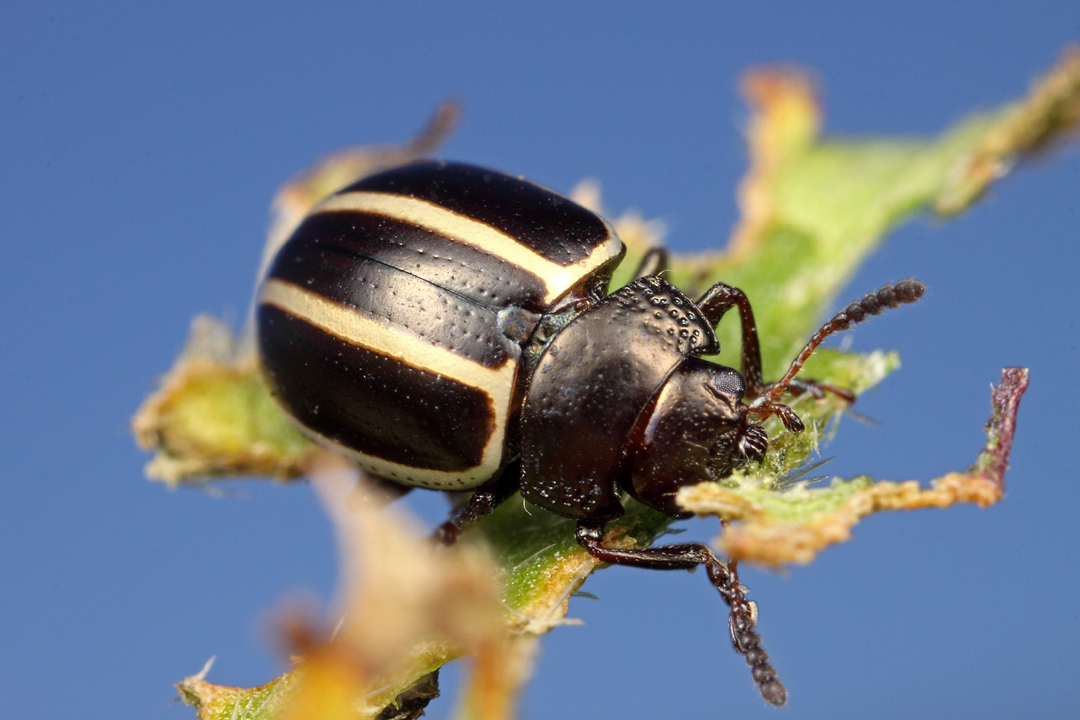
The east end of  in Buenos Aires offers a quiet contrast to the more populated central and western areas. Few people leave the levee-trail system that surrounds the famous wetlands and pampas grass stands in those latter areas; however, those that do find in the east a mosaic of pastures and young woodlands that offer a greater diversity of sights and invite a more leisurely pace. November is spring in Buenos Aires, and as such there were a number of plants beginning to bloom in the Reserve. One plant I found blooming in abundance in one small part of the east area was a member of the family Malvaceae that I take to be Abutilon pauciflorum, a few of which were being devoured by these leaf beetles (family Chrysomelidae).


These beetles are clearly members of the subtribe Doryphorina within the nominate subfamily, looking very similar to the North American species Zygogramma suturalis (ragweed leaf beetle) or the vittate species of Calligrapha (subgenus Bidensomela), e.g. Calligrapha bidenticola. Both of these genera are represented in Argentina, and at first I was inclined to believe the beetles belonged to the latter genus since its Central and South American members are associated almost exclusively with malvaceous plants (North American species of Calligrapha have adapted to plants in several other families). However, a view of the tarsus in the last photo suggests that the claws are joined at the base, a character that immediately separates members of the genus Zygogramma from the genus Calligrapha (species of Doryphora also have fused tarsal claws but exhibit a completely different gestalt). Eight species of Zygogramma have been recorded from Argentina, but I wasn’t able to find photographs of any that look reasonably similar to the individuals in these photos.  The identification will have to remain, frustratingly, non-specific.

Update 12/6/11: I just received an email from Shawn Clark (Brigham Young University, Provo, Utah) saying that he suspects the beetles belong to the genus Desmogramma. This genus is distinguished from both Zygogramma and Calligrapha by having the prosternum sharply angled upward anterior to fore coxae or mesosternum with a distinct horn directed anteriorly (Flowers 2004) and the claws widely separated and unarmed. Unfortunately, neither character is visible in these photos. Three species of Desmogramma are recorded from Argentina, and the coloration of these individuals resembles that described by Stål (1862) for D. striatipennis (D. semifulva and D. nigripes have the 3rd, 5th and 9th elytral interstices light).


These photographs represent continued efforts with the so-called ‘blue sky background’ technique that I’ve been trying to perfect as an alternative to the black background one typically gets in insect macrophotography with full-flash illumination of the subject. All of these photos were taken at ISO 640 using an MP-E 65mm lens at f/13 with 1/160 sec (1st photo) or 1/125 sec (2nd and 3rd photos) exposure and F.E.C. -1. These are similar settings to those used in my previous and not as satisfactory attempt, but this time the results were much better. Not only is the color of the sky spot-on blue, but these photos have much better detail than the previous. In this case, I believe “locking'” the subject relative to the lens to prevent motion blur was the key—I used my left hand to hold the leaf with the beetle towards the bluest area of the sky, rested the camera lens on my left wrist, used my fingers to fine tune the leaf position as I looked through the viewfinder, and held my breath!

REFERENCE:

Flowers, R. W. 2004. The genera of Chrysomelinae (Coleoptera: Chrysomelidae) in Costa Rica. Revista de Biología Tropical 52(1):77–83.

Stål, C. 1862. Monographie des Chrysomélides l’Amérique. C. A. Leffler, Upsal, 365 pp.

Copyright © Ted C. MacRae 2011