“Sunflower looper” – Rachiplusia nu

Rachiplusia nu ''oruga medidora'' | Santa Fe Province, Argentina

With a planted area approaching 20 million hectares, soybean has become Argentina’s most important agricultural crop.  Most of the planted area is located within the so-called “Humid Pampas” region of central Argentina (Buenos Aires, Córdoba, Santa Fe and Entre Rios Provinces), but the crop continues to expand in the northestern part of the country as well (Chaco, Tucumán and Salta Provinces).  More than any other crop in Argentina (except perhaps cotton), soybean is attacked by a tremendous diversity of insects.  The most important of these are the defoliating Lepidoptera, primarily species in the family Noctuidae.  Anticarsia gemmatalis (velvetbean caterpillar) is the most consistent and widespread defoliator, but an increasingly important species in Argentina is Rachiplusia nu (“oruga medidora del girasol,” or sunflower looper).

Eggs are laid primarily on the undersides of leaves

Rachiplusia nu belongs to the noctuid subfamily Plusiinae, the larvae of which can be recognized by having three pairs of prolegs and the “looping” manner by which they walk.  Chrysodeixis includens¹ (soybean looper), much better known because of its status as a major pest of soybean in the southeastern United States (and of growing importance in Brazil as well), also belongs to this group, and in fact the larvae of the two species are quite similar in appearance.  While R. nu is the primary plusiine species affecting soybean in Argentina, C. includens has appeared with increased frequency on soybean in Argentina in recent years, primarily in the more northern, subtropical growing regions adjacent to those areas in Brazil where it is now a major pest of the crop.

¹ Although still widely referred to in the literature as Pseudoplusia includens, the genus Pseudoplusia was synonymized under Chrysodeixis some eight years ago by Goater et al. (2003).  More recently the synonymy was accepted and formally applied to the North American fauna by Lafontaine and Schmidt (2010). 

Neonate larva on soybean

Despite their similarity of appearance, larvae of the two species can be rather conclusively distinguished by the shape of their spinneret (Angulo and Weigert 1975).  This is not a very convenient character for use in the field, however, leading to misidentifications in areas where the two species co-occur.  This is not an insignificant problem, as the two species exhibit differing susceptibilities to pesticides labeled for their control (C. includens especially having become resistant to a number of pesticides).  The result is control failures and subsequent application of even more pesticides in an effort by farmers to protect their crops.  While not as conclusive as the shape of the spinneret, in my experience R. nu larvae (at least older larvae) tend to have a darker, smoky-blue cast to the color (compared to the bright yellow-green of C. includens) and rather distinct patches of tiny black asperites on the thoracic ventors that are not apparent in C. includens.

Younger larvae consume only the lower surface between veins, resulting in ''window paning''

As the common name implies, soybean is not the only crop attacked by R. nu.  Early season infestations tend to occur in alfalfa and flax, after which the populations spread to soybean and sunflower.  The latter crop especially is heavily attacked by this insect, primarily in the drier western regions in Córdoba Province.  Dry conditions seem to favor an increase in the populations of this species, while moist conditions promote increased incidence of pathogenic fungi that are very effective at suppressing R. nu larval populations.

Older larvae consume entire tissues but still avoid veins, resulting in a ''skeletonized'' appearance

Like many defoliating lepidopterans, eggs tend to be laid on the undersides of leaves, where the larvae begin feeding after they hatch.  Young larvae consume only the lower epidermal layer of the foliage between the veins, leading to an appearance in the foliage called “window paning”.  As they larvae grow they begin consuming the entire tissue layer but still preferentially avoid vascular tissue, resulting in a skeletonized appearance to the foliage.  A single larvae can consume more than 100 cm² of soybean foliage, which translates to several trifoliates.  As a result, it doesn’t take many larvae to cause significant loss of foliage on the plant.  Soybean has the ability to compensate for loss of foliage due to increased photosynthesis in lower foliage exposed by feeding in the upper part of the plant, but losses exceeding around 15% during the later reproductive stages of plant growth are enough to significantly reduce yields (and it is during these reproductive stages of growth that R. nu infestations tend to occur).

Rachiplusia nu adult | Buenos Aires Province, Argentina

Rachiplusia nu is the most widely distributed of three South American species in the genus, occurring in Argentina, Bolivia, Brazil, Chili, Paraguay, Peru and Uruguay, while a fourth species, R. ou, is widely distributed throughout North and Central America (Barbut 2008).  Unlike R. nu, its North American counterpart R. ou has not gained status as a pest of soybean or other crops.

In a BitB Challenge first, nobody was able to correctly ID the larva of this species beyond the level of subfamily.  This, despite the huge Argentina hint bomb that I dropped when I posted the challenge and my well-known vocation as a soybean entomologist.  I figured the answer would be forthcoming as quickly as one could Google the search phrase “Argentina soybean Plusiinae” (which, in fact, shows the following except for the very first result “Pseudoplusia includens is the most common soybean Plusiinae in the Americas (Herzog, 1980). Rachiplusia nu in southern Brazil, Uruguay and Argentina, and…” [emphasis mine]). Most participants guessed, predictably, soybean looper, while only a few were fooled into guessing Geometridae (the true loopers, and distinguished by having only two pairs of prolegs).  As a result, I’m not declaring a winner for ID Challenge #14, although the appropriate points will still be awarded (when I get around to assigning them, that is.  Hey, I’m working in Argentina right now—it was enough for me just to get this post out!).

REFERENCES:

Angulo, A. O. and G. T. H. Wiegert. 1975. Estados inmaduros de lepidópteros noctuidos de importance economica en Chile y claves para su determinación. Sociedad Biologico Concepción, Publicación Especial 1:1–153.

Barbut, J. 2008. Révision du genre Rachiplusia Hampson, 1913 (Lepidoptera, Noctuidae, Plusiinae). Bulletin de la Société entomologique de France113(4):445–452.

Goater, B., L. Ronkay and M. Fibiger. 2003. Noctuidae Europaeae. Vol. 10, Catocalinae, Plusiinae. Entomological Press, Sorø, 452 pp.

Lafontaine, J. D. and B. C. Schmidt. 2010. Annotated check list of the Noctuoidea (Insecta, Lepidoptera) of North America north of Mexico. ZooKeys 40: 1–239.

Copyright © Ted C. MacRae 2011
The Methocha

As pointed out in my recent post, , there is much to learn still regarding tiger beetle larval parasitoids. In addition to bee flies (order Diptera, family Bombyliidae) of the genus Anthrax, tiphiid wasps (order Hymenoptera, family Tiphiidae) in the genus Methocha also parasitize tiger beetles in their larval burrows. Unlike bee flies, however, which sneakily lay their eggs in and around tiger beetle burrows when their victim isn’t watching, Methocha females aggressively engage the larva and even allow themselves to be grasped within the beetle larva’s sickle-shaped mandibles in order to gain entry to the beetle’s burrow.

Methocha appears to be a rather diverse genus, but it’s taxonomy is still incompletely known. George Waldren from Dallas, Texas is working on a revision of the genus and has found several new species in Texas alone. George is interested in seeing Methocha material from other areas as well and recently sent me the following reminder that adult females are active now:

…if you know of any areas with many tiger beetle larvae, now is the time to find Methocha. They superficially look like Pseudomyrmex ants, but once you see one you’ll catch on to them quickly. I collected more than 70 females today in a large aggregation of Tetracha carolina burrows.

In a subsequent message he adds:

Collect as many as you can, since they seem to be highly seasonal and rare most of the year. I almost always find them around beetle populations in sandy creek beds and receding bodies of water. A pooter works best if they are abundant and there isn’t much for them to hide under. Using your fingers also works—the sting is mild and usually doesn’t pierce the skin (depends on the person and size of the wasp). Vial collecting one by one works just as well.

Methocha females are generally overlooked due to their specialized life history and few specimens are in collections. Males are better represented since they’re easily collected with malaise traps.

If you have any Methocha specimens or manage to collect some, please contact George (contact info can be found at his BugGuide page). BugGuide does have a few photographs of these wasps to give you an idea of what they look like, but this excellent video titled “The Methocha” from Life in the Undergrowth with David Attenborough provides an unparalleled look at their appearance and behavior:


Copyright © Ted C. MacRae 2011

Cicindela formosa gibsoni… or not!

Last Friday I began the 2011 Annual Fall Tiger Beetle Trip™. This year’s edition was actually a last-minute change—my original plans to collect wood for rearing wood-boring beetles in south Texas thwarted by that state’s long and continuing drought (along with the unwillingness of some of the area’s federal wildlife refuge managers to grant my research study permits despite the work I’ve done there in past years—apparently only institutional and not personal research is now deemed credible by these courageous individuals who are doing their best to protect the natural resources in their charge). My travel funds are limited, and rather than throw good money at a bad situation, I decided to pursue greater chances of success and make the trip that I have wanted to do for some time now—the Great Sand Dunes tour through the Rocky Mountains and Great Basin. The target species include many of the classic western sand dune species, and I hope to feature most of them in the days and weeks after the conclusion of the trip this coming weekend.

Cicindela formosa gibsoni | nr. Maybell, Colorado

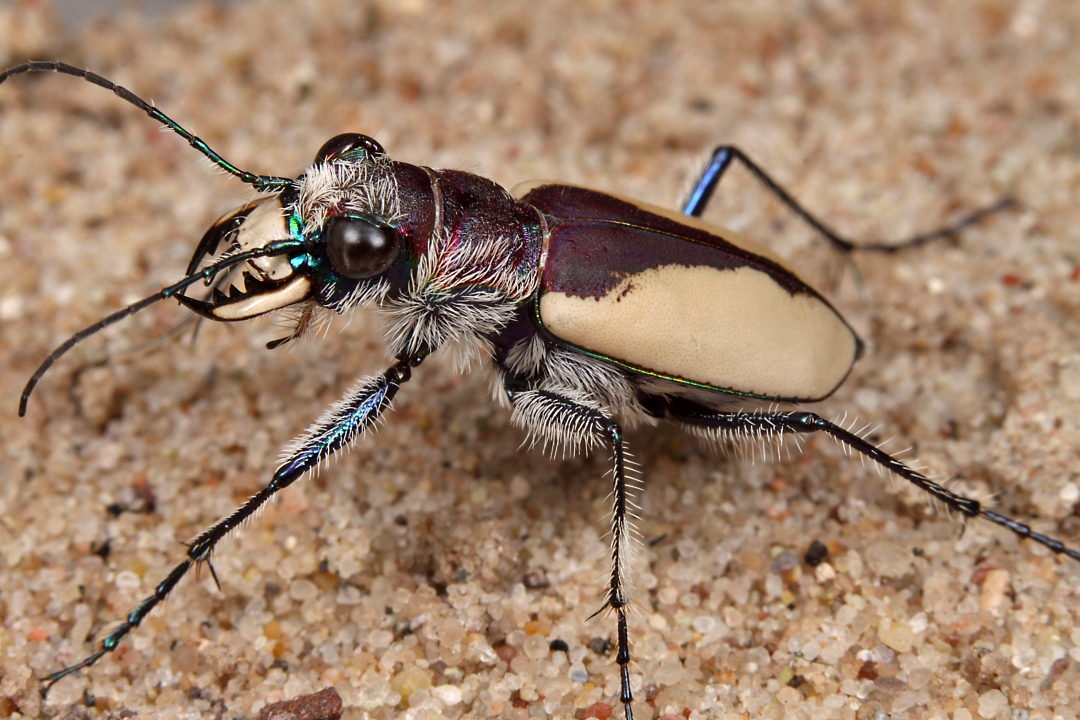
The first of these target species that I encountered is the subject of this post, Cicindela formosa gibsoni (Gibson’s Big Sand Tiger Beetle).  This large, robust, and gorgeously marked subspecies is highly restricted in occurrence, curiously to two areas separated by more than 1,000 km—the Maybell Sand Dunes in northwestern Colorado (Moffat County) and the Great Sand Dunes of southwestern Saskatchewan.  It is distinguished from the nominate form and other subspecies by having the white markings of the elytra so expanded in most individuals that they coalesce and cover nearly the entire elytral surface.  The result of such a large white surface with contrasting red-purple head, thorax, and elytral sutural area is one of North America’s most spectacularly marked tiger beetle species.  The individual photographed here was one of many observed a few days ago on the Maybell Sand Dunes¹, and I feel truly lucky to have been able to personally witness these striking beetles flying powerfully across the dunes in their small home range, landing far away with the comical bounce and tumble that is characteristic of this and the other subspecies.

¹ In the interest of full disclosure, these photos were taken later in the day using subjects confined in a terrarium of native substrate. I had intended to photograph them in the field; however, they unexpectedly began digging burrows around 2 p.m., and my efforts to stalk the last few stragglers before they disappeared were not successful.


An interesting situation occurs regarding the taxonomy of this subspecies.  Despite the nearly identical appearance of adults from both the Saskatchewan and Colorado populations, logic and differences in larval coloration suggest that these two populations have arisen independently, their common appearance a result of convergence rather than shared ancestry.  Molecular studies are in progress to determine more conclusively whether this is true (hopefully augmented with material collected during this trip).  The subspecies was originally described based on specimens collected in Saskatchewan, thus, if convergence is confirmed the Maybell population will find itself needing a new name.

Congratulations to Doug Taron, who narrowly beat perennial heavyweight Ben Coulter, Tracy Mormon and Mr. Phidippus for the ID Challenge #12 win.  The overall standings remain unchanged, with Ben still in the lead with 65 points, Mr. Phidippus 2nd with 54 points, and Roy completing the podium at 39 points.  The final standings may seem like a lock, but there will still be one more challenge in the session—anything can happen!

Copyright © Ted C. MacRae 2011

Two things I love about glades during fall…

…prairie dock (Silphium terebinthinaceum) in bloom…

Prairie dock (Silphium terebinthinaceum) in bloom | Caney Mountain Cons. Area, Ozark Co., Missouri

…and prairie tiger beetles (Cicindelidia obsoleta vulturina) on the prowl…

Prairie tiger beetle (Cicindelidia obsoleta vulturina) | Caney Mountain Cons. Area, Ozark Co., Missouri

On the last weekend of August I made another trip to the White River Hills of north-central Arkansas in a last gasp effort to confirm the occurrence in the area of the swift tiger beetle (Cylindera celeripes).  Records of this species include a single individual collected in 1996 at a site near Calico Rock, but two trips to the area this past June had already failed to reveal its presence.  I didn’t really expect that I would find it this time either, and such was the case.  However, what I was expecting/hoping to see was the beginning of the fall emergence of the prairie tiger beetle.  The Missouri/Arkansas disjunct population of this handsome species is perhaps my favorite tiger beetle of all, not only because of its good looks but because of the many spectacular fall collecting trips I’ve taken through the White River Hills to look for it.  In this regard I had success, although only two individuals were seen all day long.  The area around Calico Rock seemed dry, apparently having been missed by the thunderstorms that rolled through the area a week earlier and that would have surely triggered full bore adult emergence. 

Long Bald Glade Natural Area, Caney Mountain Cons. Area, Ozark Co., Missouri

The following day I returned to Caney Mountain Conservation Area on the Missouri side, where last fall I had finally found prairie tiger beetles after years of searching what must be the extreme northeasternmost limit of its distribution.  Fresh evidence of recent rains was seen, and accordingly the beetles were out in fairly decent numbers in the same area where I found them last fall.  I took the opportunity to photograph a few individuals (which I had not done last year) and then turned my attention to looking for other insects.  I had my eye out for the spectacularly beautiful bumelia borer (Plinthocoelium suaveolens) and eventually found one.  I hoped also to see the marvelously monstrous Microstylum morosum (North America’s largest robber fly), which I found at this site in 2009 as a new state record and was rewarded with two individuals (these will serve as vouchers for the state record, since I didn’t collect it in 2009).  Temperatures were rather warm and both of these latter species are traditional “summer” species; however, the presence of prairie tiger beetles, the tawny tinge to the prairie grasses, and the noticeably longer shadows under a deep blue sky told me that fall was, indeed, on the way.

Prairie tiger beetle (Cicindelidia obsoleta vulturina) | Caney Mountain Cons. Area, Ozark Co., Missouri

While prairie tiger beetles are (at least for me) the most iconic harbinger of fall in the White River Hills, another classic fall sight was the thick stands of prairie dock plants with their tall, bolting flower spikes.  In Missouri this plant serves as a larval host for the longhorned beetle Ataxia hubbardi.  In my early years of collecting in Missouri’s glades, I delighted in finding adults of these beetles clinging to the flower stalks during fall—presumably laying eggs from which larvae would hatch and bore down into the tap-root.  Although commonly regarded as a pest in sunflower in the southern Great Plains, individuals associated with prairie dock in Missouri’s glades seem different—smaller, narrower, and darker—than those found on sunflower and other more common hosts.  Additional material will be needed to make a final assessment on whether these individuals represent a distinct taxon; however, I have not been able to find this species on prairie dock in Missouri since I moved back to the state nearly 16 years ago.  The reason for this sudden disappearance remains a mystery, and perhaps it is purely coincidental that the Missouri Department of Conservation began managing all of their glades with prescribed burns during my previous 5-year absence from the state.  In the meantime, I will continue to examine prairie dock stems every fall in the hopes that once again I will find the beetles and be able to come to a decision about their taxonomic status.  Perhaps I should re-focus my efforts in “low quality” (i.e., never-burned) gladey roadsides rather than our state’s “high quality” (i.e., high floral diversity) natural areas.

Copyright © Ted C. MacRae 2011
Mini-review of the Cicindelidia abdominalis species-group

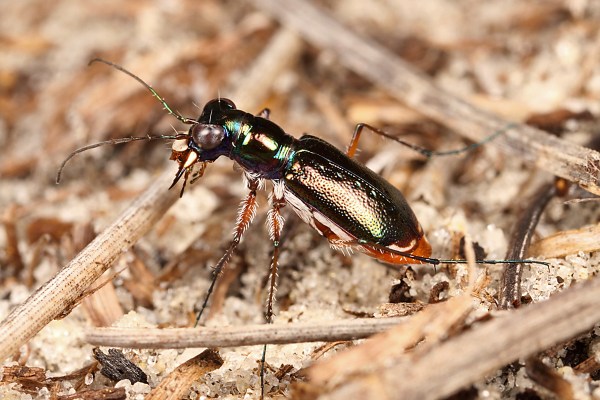
Now that I have seen and photographed in the field all four species of the Cicindelidia abdominalis species-group, I thought some might find it useful to have a summary of each species with comparisons, photographs and a key to distinguish the four species. The key presented below is based on that found in Brzoska et al. (2011), which itself is a modification of couplet 8 in the key to the species of Common Tiger Beetles (Cicindela) found in Pearson et al. (2006). Following the key are comparative notes for each species that discuss key characters and give specific information about their distribution, along with field photographs to illustrate the distinguishing characters.

Key to the Cicindelidia abdominalis species-group

1. Elytral surface covered with deep punctures, pronotum with dense decumbent setae (old specimens may have the setae rubbed off and the presence of setal punctures should be checked), usually with 6 labral setae . . . . . . . . . . . . . . . . . . . . . . . . . . . . . . . . . . . . . . . . . . . 2

— Elytral surface (excluding presutural foveae) relatively smooth, with shallow punctures, pronotum glabrous or with fine pronotal setae, usually with 4 pronotal setae . . . . . . . . . . . . . . . . . . . . . . . . . . . . . . . . . . . . . . . . . . . . . . . . . . . . . . . . . . . . . . . . . . . . . . . . . . . . . . . . . . . . . 3

2(1) Elytra black, with a post median marginal spot, usually with a vestige of a middle band, restricted to peninsular FL north of Miami-Dade County . . . . . . . . . . . . . . . . . . . . . . . . . . . . . . . . . . . . . . . . . . . . . . . . . . . . . . . . . . . . . . . . . . . . . . . . . . . C. scabrosa (Schaupp)

— Elytra green or bronze-green, rarely with a post median marginal spot, and without evidence of a middle band, restricted to Miami-Dade County, FL . . . . . . . . . . . . . . . . . . . . . . . . . . . . . . . . . . . . . . . . . . . . . . . . . . . . . . . . . . . . . . . . . . . . . . C. floridana (Cartwright)

3(1) Pronotum, and mes- and metepisternum glabrous, restricted to Polk and Highlands Counties, FL . . . . . . . . . . . . . . . . . . . . . . . . . . . . . . . . . . . . . . C. highlandensis (Choate)

— Pronotum with fine decumbent setae, and mes- and metepisternum with decumbent setae, widespread across southeastern U.S. Coastal Plain . . . . . . . . . . . . . . . . . . . . . . . . . . . . . . . . . . . . . . . . . . . . . . . . . . . . . . . . . . . . . . . . . . . . . . . . . . . C . abdominalis (Fabricius)

Cicindelidia scabrosa—Scabrous Tiger Beetle

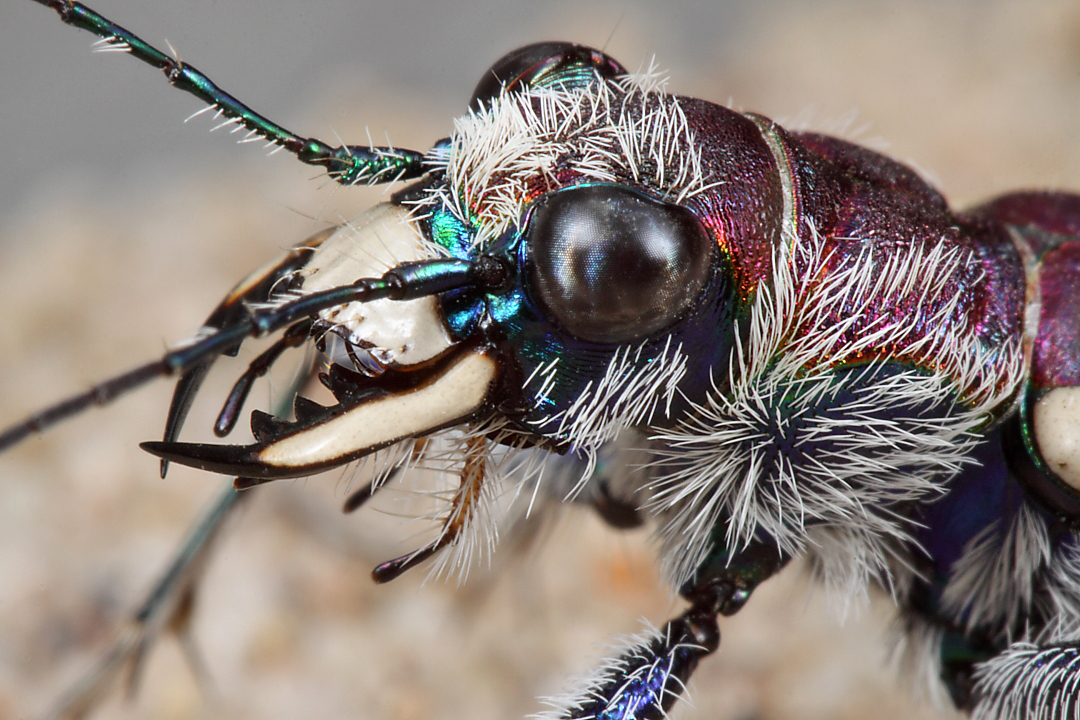
This species is largely limited to oak/pine scrub habitats in peninsular Florida north of Miami-Dade Co., although it does just sneak north of the border into souutheastern Georgia. From Cicindelidia abdominalis and C. highlandensis it can be distinguished by the distinctly punctured rather than smooth elytra and the presence of dense white setae along the lateral margins of the pronotum. From C. floridana it can be distinguished by the black rather than coppery-green coloration and the usual presence of a post-median spot along the lateral elytral margins. More information about this species can be found in my post, “The (almost) Florida-endemic Cicindelidia scabrosa.”

Cicindelidia scabrosa
Cicindelidia scabrosa | Levy Co., Florida

Cicindelidia floridana—Miami Tiger Beetle

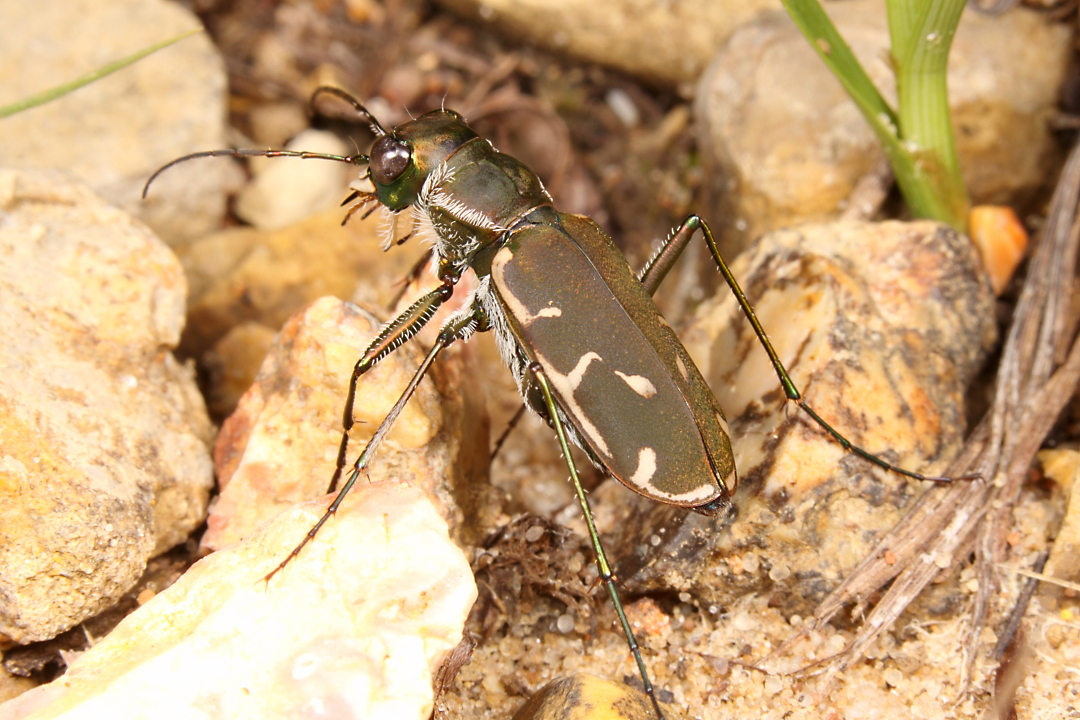
Only recently rediscovered after being thought extinct for nearly a century, this species is most similar to C. scabrosa but is restricted to pine rockland habitat in Miami-Dade Co. where C. scabrosa does not occur. Like that species it exhibits the distinctly punctured rather than smooth elytra and dense white setae along the lateral margins of the pronotum that distinguish both species from C. abdominalis and C. highlandensis; however, its coloration is brilliant coppery green rather than black like C. scabrosa, especially in living individuals seen in the wild. More information about this species can be found in my posts, “Rediscovery of Cicindela scabrosa floridana” and “Photographing the Newly Rediscovered Cicindelidia floridana.”

Cicindelidia floridana
Cicindelidia floridana | Miami-Dade Co., Florida

Cicindelidia highlandensis—Highlands Tiger Beetle

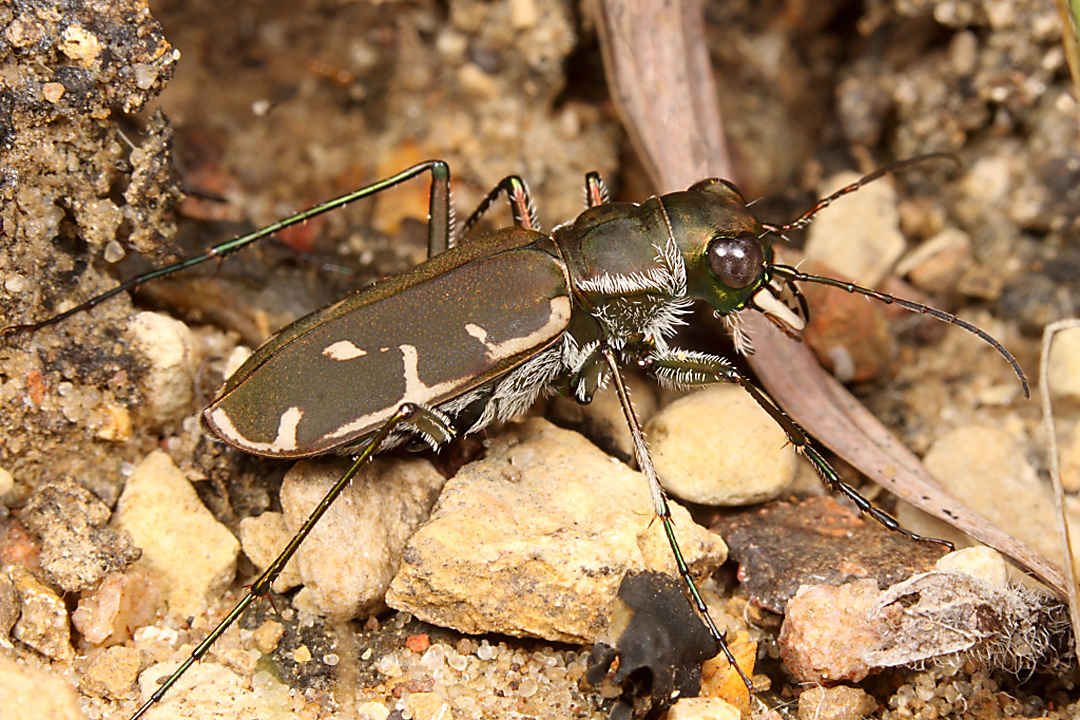
This species is most similar to C. abdominalis, sharing with it the smooth elytra and glabrous pronotum that distinguish both species from C. scabrosa and C. floridana. Unlike that more widespread species, however, C. highlandensis is found only along a narrow band of sand scrub habitats on the Lake Wales Ridge in Polk and Highland Cos., central Florida, and it can be distinguished from it by the lack of white setae on the pronotum and mes- and metepisterna (lateral portions of the thorax above the middle and hind legs). More information about this species can be found in my post, “Highlands Tiger Beetle.”

Cicindelidia highlandensis
Cicindelidia highlandensis | Polk Co., Florida

Cicindelidia abdominalis—Eastern Pine Barrens Tiger Beetle

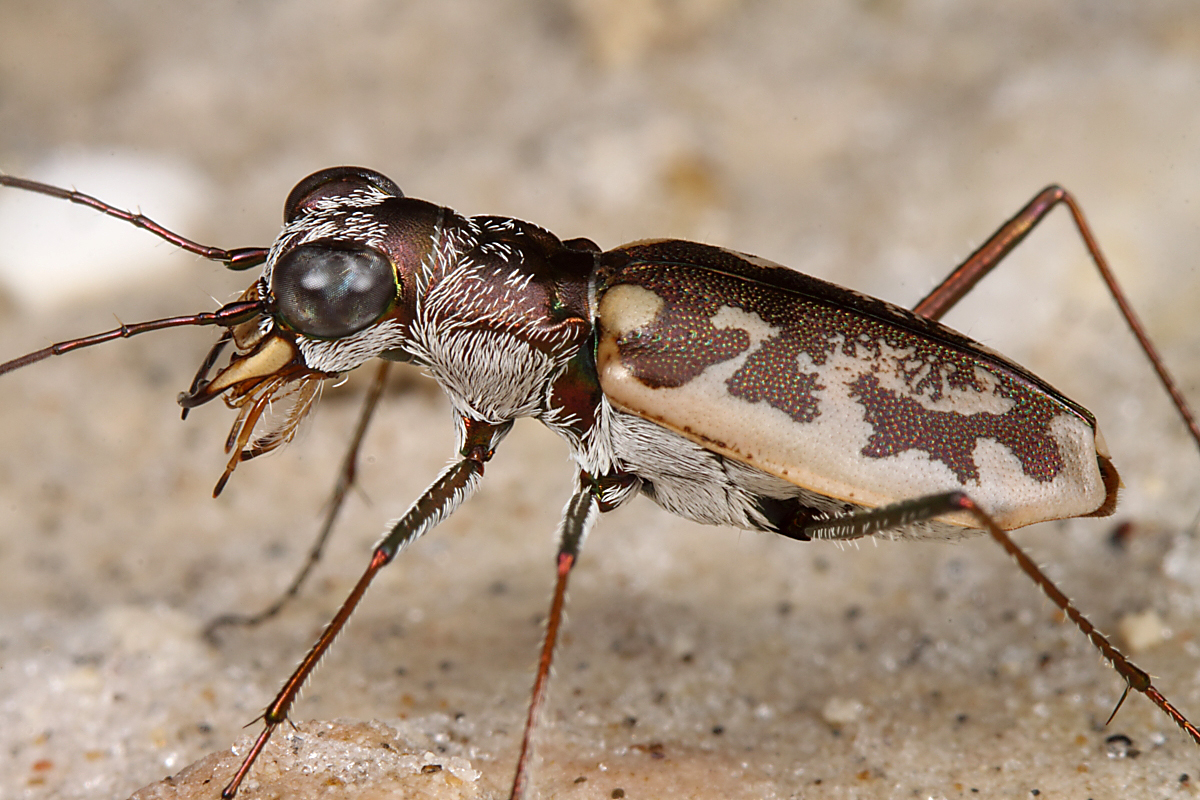
This is the only relatively broadly distributed species of the group, occurring in a variety of dry sand habitats along the southeastern U.S. Coastal Plain from New Jersey west to Louisiana and south into the northern half of Florida. Aside from its non-endemic distribution, this species can be distinguished from C. scabrosa and C. floridana by its smooth elytra and lack of dense white setae along the lateral pronotal margin, and from it’s most similar relative C. highlandensis by the presence of fine, decumbent (lying down) setae on the pronotum and on the mes- and metepisterna above the middle and hind legs. More information about this species can be found in my post, “Tiger Beetles Agree—It’s Hot in Florida!.”

Cicindelidia abdominalis
Cicindelidia abdominalis | Withlacoochee Co., Florida

REFERENCES:

Brzoska, D., C. B. Knisley, and J. Slotten. 2011. Rediscovery of Cicindela scabrosa floridana Cartwright (Coleoptera: Cicindelidae) and its elevation to species level. Insecta Mundi 0162:1–7.

Pearson, D. L., C. B. Knisley and C. J. Kazilek. 2006. A Field Guide to the Tiger Beetles of the United States and Canada. Oxford University Press, New York, 227 pp.

Copyright © Ted C. MacRae 2011

Charming Couple revisited

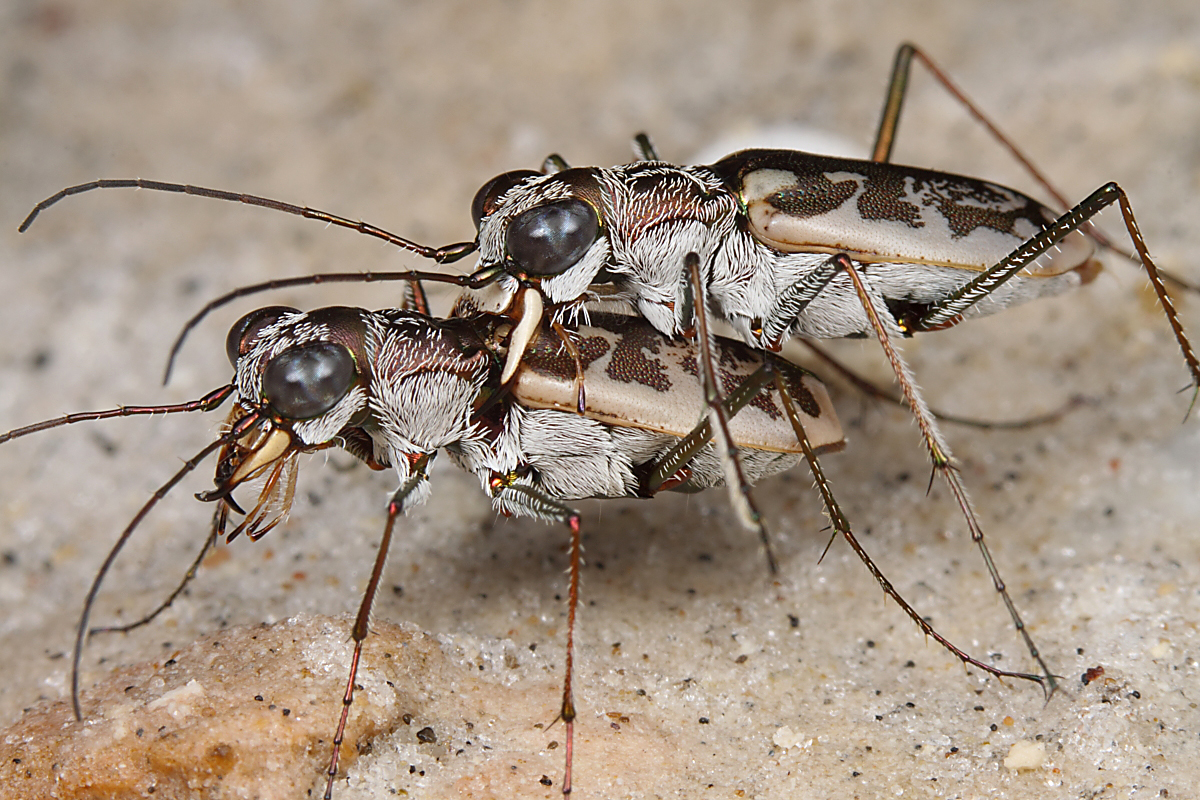
Another view of the of Ellipsoptera hamata lacerata (Gulf Coast Tiger Beetle) that I photographed in a small mangrove marsh in Seminole, Florida. These are actually among the first tiger beetles that I ever tried to photograph at night, and the major learnings involved: 1) figuring out how to turn on the flash lamp and then compose the shot quickly enough before the lamp shut off, and 2) making sure to use the histogram in the field to ensure I’d gotten the proper flash level. My first few attempts all tended to be underexposed because the brightness of the image on the playback screen in the darkness caused me to keep undersetting the flash exposure compensation. I’d not previously gotten in the habit of using the histogram in the field since I do a lot of flash level bracketing, but perhaps this is a tool that will allow me to cut down on that to some degree. Anyway, these are two additional photos that worked out pretty well—I like the first because of the contrast between the bright white mandibles of the male versus the off-white mandibles of the female, and the second (female only after the male bolted) for its nice view of the curiously bent elytral apices that distinguish it from the female of the very similar and (in this area) sympatric E. marginata (Margined Tiger Beetle). Also clearly seen in the second is one of the distinct basolateral grooves on the pronotum that serve to receive the male mandibles during mating (compare to same area on pronotum of male). I was amazed at how easy this mating pair and other individuals of this species were to photograph at night in view of their extreme wariness during the day.

Ellipsoptera hamata lacerata | Seminole, Pinellas Co., Florida

Note curiously bent elytral apices and basolateral pronotal groove for reception of male mandibles.

Copyright © Ted C. MacRae 2011
Speaking of Graphisurus

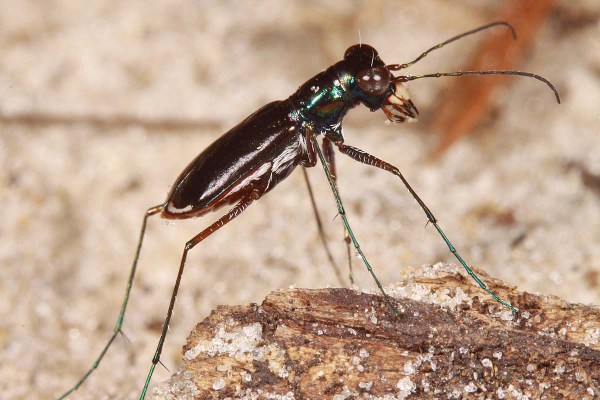
Graphisurus fasciatus | Sam A. Baker State Park, Missouri.

Graphisurus fasciatus is the commonest of the three species in this North American genus. It is easily distinguished from  by its smaller, narrower form, more mottled coloration, and lack of distinctive triangular-shaped black markings on the elytra. However, it can easily be confused with the third species in the genus G. despectus, which is nearly identical in size and coloration. From this latter species, G. fasciatus may be distinguished by the slightly darker ground color of the elytra (in G. despectus the elytra are more uniformly grayish) with the post-median dark marking of the elytra not very conspicuous (in G. despectus this marking and contrasts distinctly with the grayish elytra). Also, the tips of the elytra are distinctly emarginate (concave) in G. fasciatus but more subtruncate in G. despectus, and the scutellum in the former is pubescent (hairy) but glabrous (lacking hairs) in the latter.

Host plant is also a clue as to the identity of this individual (a male, as distinguished by its very long antennae and lack of distinctly elongate ovipositor extending from the tip of the abdomen), as it was found on the trunk of a very large, recently wind-thrown black oak (Quercus velutina)—its preferred host genus.  Graphisurus despectus, in contrast, appears to be associated almost exclusively with hickory (genus Carya).  Both species, despite their relatively modest size (generally 10–15mm in length, excluding the female ovipositor), seem to prefer dead wood from the trunk and main branches of larger trees for larval development, mining just beneath the bark rather than in the wood itself.

Copyright © Ted C. MacRae 2011
Rediscovery of Cicindela scabrosa floridana

ResearchBlogging.orgIn refreshing contrast to the more usually heard reports of declining and extinct species, a new paper by Dave Brzoska, Barry Knisley, and Jeffrey Slotten (Brzoska et al. 2011) announces the rediscovery of a tiger beetle previously regarded as probably extinct.  Cicindela scabrosa floridana was described from a series of unusually greenish specimens collected in Miami, Florida in 1934; however, no additional specimens turned up in the following 70+ years despite dedicated efforts in the late 1980s and early 1990s by Brzoska, Knisley, and Ron Huber to locate and search areas around the presumed type locality.  This paucity of specimens and occurrence of the type locality in highly urbanized Miami had caused most contemporary tiger beetle researchers to presume that the population had fallen victim to the ceaseless sprawl of urbanization and its attendant habitat destruction.  However, in September of 2007, co-author Jeff Slotten, working with David Fine, rediscovered a population of individuals matching the type series while surveying butterflies in pine rockland habitat in the Richmond Heights area of Miami.  Subsequent surveys of pine rockland habitat in surrounding areas revealed populations of the beetle at three sites – all in the Richmond Heights area. 

Source: Brzoska et al. (2011)

Cicindela scabrosa floridana was originally described by Cartwright (1939) as a variety of the broadly distributed southeastern U.S. species C. abdominalis.  In describing the closely related C. highlandensis (endemic to the Lake Wales Ridge of central Florida), Choate (1984) also elevated the peninsular Florida-endemic C. scabrosa (previously considered a subspecies of C. abdominalis) to full species status and treated floridana as a subspecies of scabrosa, apparently due to the similarity of their elytral sculpturing, occurrence in both of dense flattened setae on the pronotum, and their allopatric distributions.  The new availability of additional specimens of floridana, however, has allowed more detail comparisons of this form with scabrosa.   In addition to the markedly greener elytra, the great majority of floridana lack post-median marginal spots – found consistently in scabrosa, and the apical lunule is generally thinner in floridana than in scabrosa.  Moreover, no floridana were found to exhibit the vestigial middle band that scabrosa often exhibits, and the leg color of floridana also is lighter and more yellow than most scabrosa specimens.  Differences in habitat, distribution and seasonality were also noted – scabrosa occurs in sand pine scrub habitat throughout most of peninsular Florida north of Miami from late spring to mid-summer, while floridana occurs only in pine rockland habitats in southern Florida with adults active well into October.  These consistent differences in morphology, distribution, habitat, and seasonality led Brzoska et al. to elevate floridana to full species status.  According to the most recent classifications of North American and Western Hemisphere tiger beetles (Pearson et al. 2006, Erwin and Pearson 2008), the new name would be Cicindela (Cicindelidia) floridana.  However, Brzoska et al. follow the classification initially proposed by Rivalier (1954) and followed by Weisner (1992) in regarding Cicindelidia as a full genus, resulting in the new combination Cicindelidia floridana.  The character differences identified by Brzoska et al. are illustrated with detailed photographs and presented in a key to allow recognition of the now four species in the abdominalis group.

The rediscovery of a rare species thought to be extinct is always cause for celebration.  However, there is much work still to be done before prospects for the long-term survival of C. floridana can be considered secure.  Many potential scrub and pine rockland sites throughout Miami-Dade, Broward, and Palm Beach Counties were identified and surveyed after the initial discovery of C. floridana in the Richmond Heights area.  Unfortunately, to date the beetle has been found only at three sites in the Richmond Heights area.  This suggests that C. floridana populations are small, highly localized, and greatly restricted in distribution, making the species a likely candidate for listing as endangered by the U. S. Fish and Wildlife Service.   To their credit, the authors have not revealed the precise locations of these sites, which will hopefully reduce the temptation by those with more philatelic tendencies to undercut ongoing studies of the distribution, abundance, biology, and habitat of C. floridana.  These studies will be critical in the development of effective conservation strategies to ensure that this highly vulnerable representative of Florida’s natural heritage does not, once again, become regarded as extinct.

REFERENCES:

Brzoska, D., C. B. Knisley, and J. Slotten.  2011.  Rediscovery of Cicindela scabrosa floridana Cartwright (Coleoptera: Cicindelidae) and its elevation to species level. Insecta Mundi 0162:1–7.

Cartwright, O. L. 1939. Eleven new American Coleoptera (Scarabaeidae, Cicindelidae). Annals of the Entomological Society of America 32: 353–364.

Choate, P. M. 1984. A new species of Cicindela Linnaeus (Coleoptera: Cicindelidae) from Florida, and elevation of C. abdominalis scabrosa Schaupp to species level. Entomological News 95:73–82.

Erwin, T. L. and D. L. Pearson. 2008. A Treatise on the Western Hemisphere Caraboidea (Coleoptera). Their classification, distributions, and ways of life. Volume II (Carabidae-Nebriiformes 2-Cicindelitae). Pensoft Series Faunistica 84. Pensoft Publishers, Sofia, 400 pp.

Pearson, D. L., C. B. Knisley and C. J. Kazilek. 2006. A Field Guide to the Tiger Beetles of the United States and Canada. Oxford University Press, New York, 227 pp.

Rivalier, E. 1954. Démembrement du genre Cicindela Linne, II. Faune americaine. Revue Francaise d’Entomologie 21:249–268.

Wiesner, J. 1992. Checklist of the Tiger Beetles of the World. Verlag Erna Bauer; Keltern. 364 pp.

Copyright © Ted C. MacRae 2011