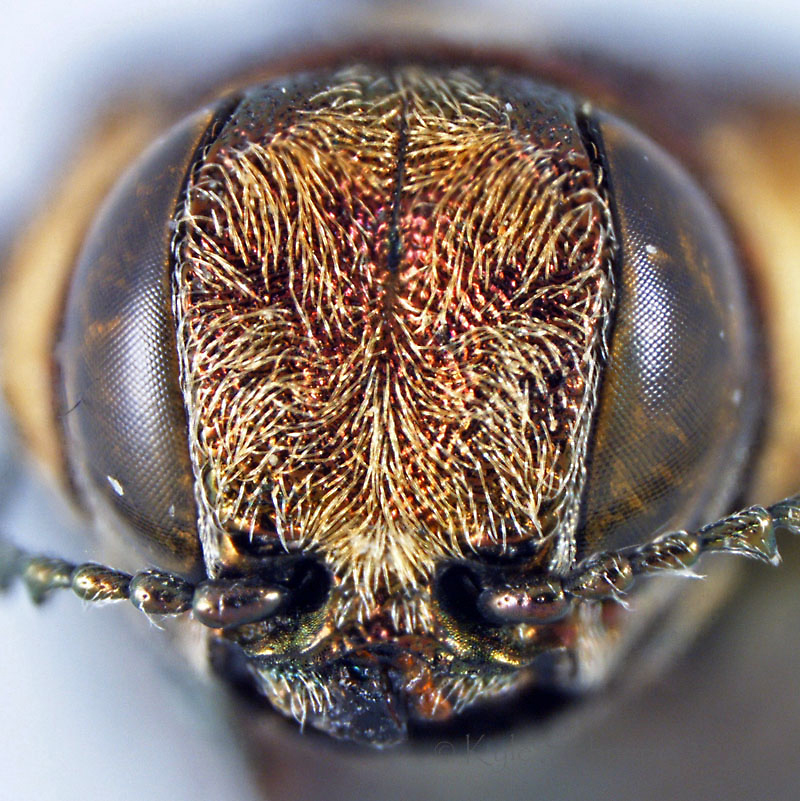
Typocerus lugubris

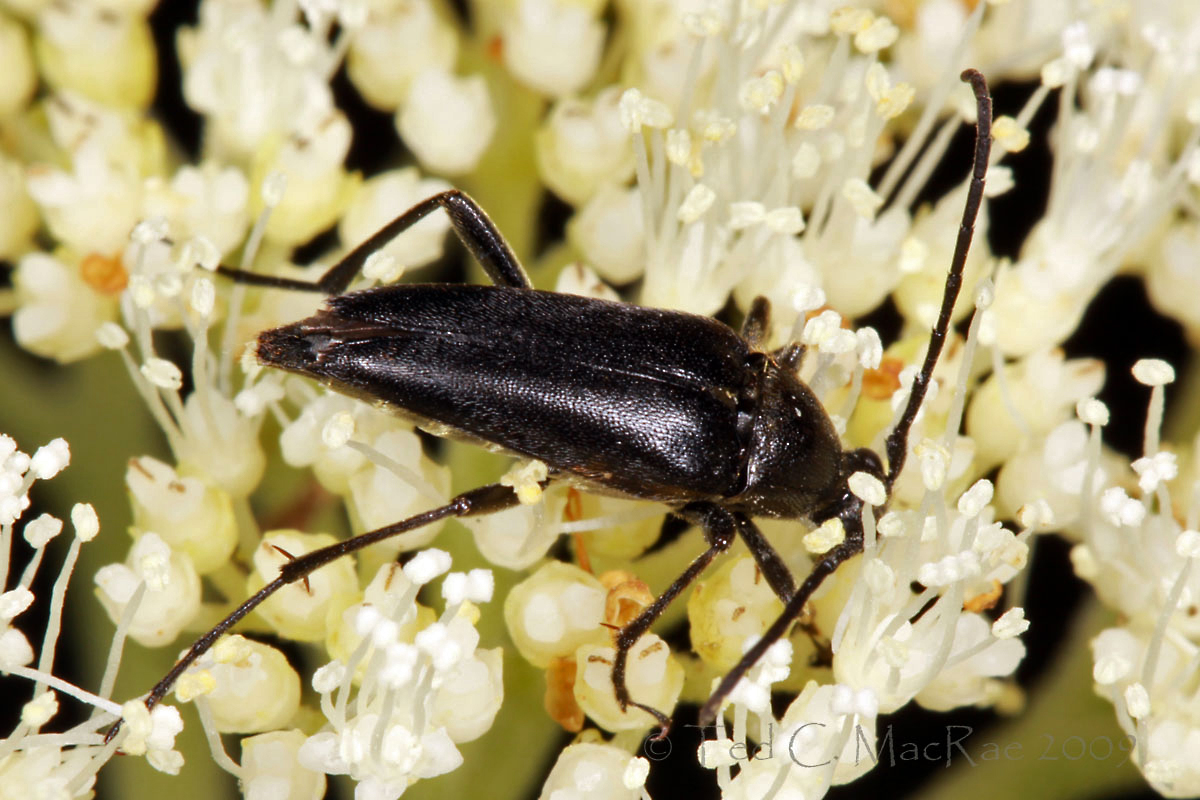
Typocerus lugubris on Hydrangea arborescens, Trail of Tears State Park, Missouri.

Members of the genus Typocerus are among the more commonly encountered species of the so-called “flower longhorns” (family Cerambycidae, subfamily Lepturinae) in eastern North America. In addition to the narrow-necked, broad-shouldered appearance characteristic for the subfamily, species in this genus are recognizable by their strongly tapering elytra, strongly basally depressed prothorax, and apically produced antennal segments with distinct poriferous areas (Linsley and Chemsak 1976).

Eight of the 15 species known from North America occur in Missouri, where they are commonly encountered on a variety of flowers during the months of June and July. Some of these species can be difficult to distinguish from each other – in fact, Missouri’s rarest species (Typocerus deceptus) is almost identical in appearance to one of Missouri’s commonest species (Typocerus velutinus), and several other species resemble them closely enough to require careful attention details of coloration when attempting identification.

Typocerus lugubris is not one of those species, its all-black coloration making it quite distinctive within the genus. Two other species in Missouri are mostly black, but unlike T. lugubris they always bear yellow blotches in the basal area of the elytra (T. lunulatus) or exhibit yellow transverse bands (T. zebra). Typocerus confluens also is a rather uncommon species in Missouri that varies from chestnut brown to nearly all black, but it is much more robust than T. lugubris (and also bears erect hairs on the pronotum and lacks poriferous areas on antennomere 6). The remaining species tend to be chestnut colored, at least in the basal area of the elytra, with more or less distinct transverse yellow banding.

Photo Details: Canon 50D (ISO 100, 1/250 sec, f/18), Canon 100mm macro lens, Canon MT-24EX flash (1/4 ratio) w/ Sto-Fen diffusers. Post-processing: levels, minimal crop, unsharp mask.

REFERENCES:

Linsley, E. G. and J. A. Chemsak.  1976. The Cerambycidae of North America.  Part VI, No. 2.  Taxonomy and classification of the subfamily Lepturinae. University of California Publications in Entomology 80:ix + 1–186.

Copyright © Ted C. MacRae 2010

Add to FacebookAdd to DiggAdd to Del.icio.usAdd to StumbleuponAdd to RedditAdd to BlinklistAdd to TwitterAdd to TechnoratiAdd to Yahoo BuzzAdd to Newsvine

Email to a friend

Nomenclatural changes in Phymatodes

ResearchBlogging.orgI’ve mentioned before the considerable taxonomic challenges facing students of the family Buprestidae (jewel beetles) in North America, owing largely to fact that more than half of its species are assigned to one of just three hyper-diverse genera (Acmaeodera, Agrilus, and Chrysobothris). New species continue to be described, but the most recent comprehensive treatments of these three genera were published more than 60 to 100 years ago (Fall 1899, Fisher 1928, Fisher 1945)! The situation is not as dire in the “other” major woodboring beetle family – the Cerambycidae (longhorned beetles), thanks in great part to the efforts of Gorton Linsley and John Chemsak and their monographic series of the family’s North American species (Linsley 1961-1964, Linsely and Chemsak 1972-1997). Although somewhat more speciose in North American than the Buprestidae, diversity in the Cerambycidae is more apparent at the generic level (1000+ species in 325 genera, compared to 787 species in only 54 buprestid genera). This does not mean, however, that the Cerambycidae lacks problematic, speciose genera, and in a recently published paper, Ian Swift and Ann Ray (2010) tackle one of these – the genus Phymatodes. While no new species are described, their treatment does propose numerous nomenclatural changes based on examination of type specimens that affect several North American species, including correcting misapplied names and recognizing multiple synonymies. These problems resulted from the practice of many earlier authors who did not examine type specimens when describing new species, relying instead only on written descriptions to compare taxa.

  • Phymatodes blandus is no longer divided into subspecies, with P. blandus concolor now being recognized as a full species.
  • The name Phymatodes decussatus has been used for the wrong species, which is actually P. obliquus. It is distinct from true P. decussatus, which has until now been called P. juglandis. The subspecies formerly placed under P. decussatus are also synonymized under P. obliquus.  Linsley (1964) confused things by applying the name decussatus to this common, oak-associated species and the name juglandis to the species associated with walnut. The type of decussatus, however, matches the walnut species and, since it is the older name, takes priority. The common oak species is thus left without a name, and obliquus is the oldest of the many synonyms created by Thomas Casey.
  • Phymatodes hirtellus is no longer divided into subspecies.
  • Phymatodes lecontei is synonymized under P. grandis.
  • Phymatodes mojavensis is synonymized under P. nitidus.
  • Phymatodes oregonensis is synonymized under P. nigrescens.
  • Phymatodes ursae is synonymized under P. hirtellus.

While this paper is not a full revision of the genus, it does include diagnostic and comparative notes, full color dorsal habitus photographs (example plate below), and an updated key to all of the species found in North America.

PLATE 1. 1) Phymatodes aeneus, male; 2) P. aereus, female; 3) P. amoenus, female; 4) P. amoenus, female ventral; 5) P. ater, female; 6) P. ater, female; 7) P. blandus, male; 8 ) P. concolor, male; 9) P. decussatus, male. © Swift & Ray 2010.

The genus Phymatodes is most diverse in the western states and provinces – I haven’t spent as much time out there as in other areas of North America, so representation of this genus in my collection is rather weak at only 10 of the 26 species currently recognized in North America. Missing from my cabinet are the following – if anyone is able to help me out with these I would be most grateful:

  • Phymatodes aeneus LeConte, 1854
  • Phymatodes ater LeConte, 1884
  • Phymatodes concolor Linsley, 1934
  • Phymatodes decussatus (LeConte, 1857)
  • Phymatodes fulgidus Hopping, 1928
  • Phymatodes infuscatus (LeConte, 1859)
  • Phymatodes lengi Joutel, 1911
  • Phymatodes lividus (Rossi, 1794) – introduced to eastern U.S.
  • Phymatodes maculicollis LeConte, 1878
  • Phymatodes nigerrimus Van Dyke, 1920
  • Phymatodes nigrescens Hardy & Preece, 1927
  • Phymatodes obliquus Casey, 1891
  • Phymatodes rainieri Van Dyke, 1937
  • Phymatodes shareeae Cope, 1984
  • Phymatodes tysoni Chemsak & Linsley, 1984
  • Phymatodes vulneratus LeConte, 1857

REFERENCES:

Fall, H. C.  1899. Synonpsis of the species of Acmaeodera of America, north of Mexico. Journal of the New York Entomological Society 7(1):1–37 [scroll to “Journal of the New York Entomological Society”, “v. 7 1899”, “Seq 12”].

Fisher, W. S.  1928. A revision of the North American species of buprestid beetles belonging to the genus AgrilusU. S. National Museum 145, 347 pp.

Fisher, W. S.  1942. A revision of North American species of buprestid beetles belonging to the tribe Chrysobothrini.  U. S. Department of Agriculture, Miscellaneous Publication 470, 275 pp.

Linsley, E. G.  1961. The Cerambycidae of North America.  Part I.  Introduction.  University of California Publications in Entomology 18:1–97.

Linsley, E. G.  1962. The Cerambycidae of North America.  Part II.  Taxonomy and classification of the Parandrinae, Prioninae, Spondylinae and Aseminae.  University of California Publications in Entomology 19:1–102.

Linsley, E. G.  1962. The Cerambycidae of North America.  Part III.  Taxonomy and classification of the subfamily Cerambycinae, tribes Opsimini through Megaderini.  University of California Publications in Entomology 20:1–188.

Linsley, E. G.  1963. The Cerambycidae of North America.  Part IV.  Taxonomy and classification of the subfamily Cerambycinae, tribes Elaphidionini through Rhinotragini.  University of California Publications in Entomology 21:1–165.

Linsley, E. G.  1964. The Cerambycidae of North America.  Part V.  Taxonomy and classification of the subfamily Cerambycinae, tribes Callichromini through Ancylocerini.  University of California Publications in Entomology 22:1–197.

Linsley, E. G. and J. A. Chemsak.  1972. The Cerambycidae of North America.  Part VI, No. 1.  Taxonomy and classification of the subfamily Lepturinae.  University of California Publications in Entomology 69:viii + 1–138.

Linsley, E. G. and J. A. Chemsak.  1976. The Cerambycidae of North America.  Part VI, No. 2.  Taxonomy and classification of the subfamily Lepturinae.  University of California Publications in Entomology 80:ix + 1–186.

Linsley, E. G. and J. A. Chemsak.  1984. The Cerambycidae of North America, Part VII, No. 1: taxonomy and classification of the subfamily Lamiinae, tribes Parmenini through Acanthoderini.  University of California Publications in Entomology 102:ix + 1–258.

Linsley, E. G. and J. A. Chemsak.  1995. The Cerambycidae of North America, Part VII, No. 2: taxonomy and classification of the subfamily Lamiinae, tribes Acanthocinini through Hemilophini.  University of California Publications in Entomology 114:xi + 1–292.

Linsley, E. G. and J. A. Chemsak.  1997. The Cerambycidae of North America, Part VIII: bibliography, index, and host plant index.  University of California Publications in Entomology 117:ix + 1–534..

Swift, I. P. & A. M. Ray. 2010. Nomenclatural changes in North American Phymatodes Mulsant (Coleoptera: Cerambycidae). Zootaxa 2448:35–52.

Copyright © Ted C. MacRae 2010

Add to FacebookAdd to DiggAdd to Del.icio.usAdd to StumbleuponAdd to RedditAdd to BlinklistAdd to TwitterAdd to TechnoratiAdd to Yahoo BuzzAdd to Newsvine

Email to a friend

North America’s largest tiger beetle (I think!)

The generous among us might call it serendipity, while the rest of us would just call it luck.  By whatever name, I had it in spades in June last year when I made my first visit to the Glass Mountains of northwestern Oklahoma.  My original plan was to go to Tallgrass Prairie Preserve in eastern Oklahoma at the end of what proved to be a resoundingly successful day at Alabaster Caverns State Park.  However, soaking rains moved into the area and continued rumbling eastward across the plains towards the preserve, forcing a quick change of itinerary.  I decided to wait it out in the state’s western reaches, a “hunch” telling me that the red clay/gypsum hills in nearby Major County might be a fruitful place for hunting tiger beetles.  Sunny skies the next morning were a good sign, and my hunch was rewarded later that day when I discovered a previously unknown (and fortunately robust) population of the rare Cylindera celeripes (swift tiger beetle), making not just the day but the entire trip more successful than I could have ever imagined.  Icing on the cake came when I found decent numbers of the more secure but nevertheless uncommon Dromochorus pruinina (frosted dromo tiger beetle) also in the area.

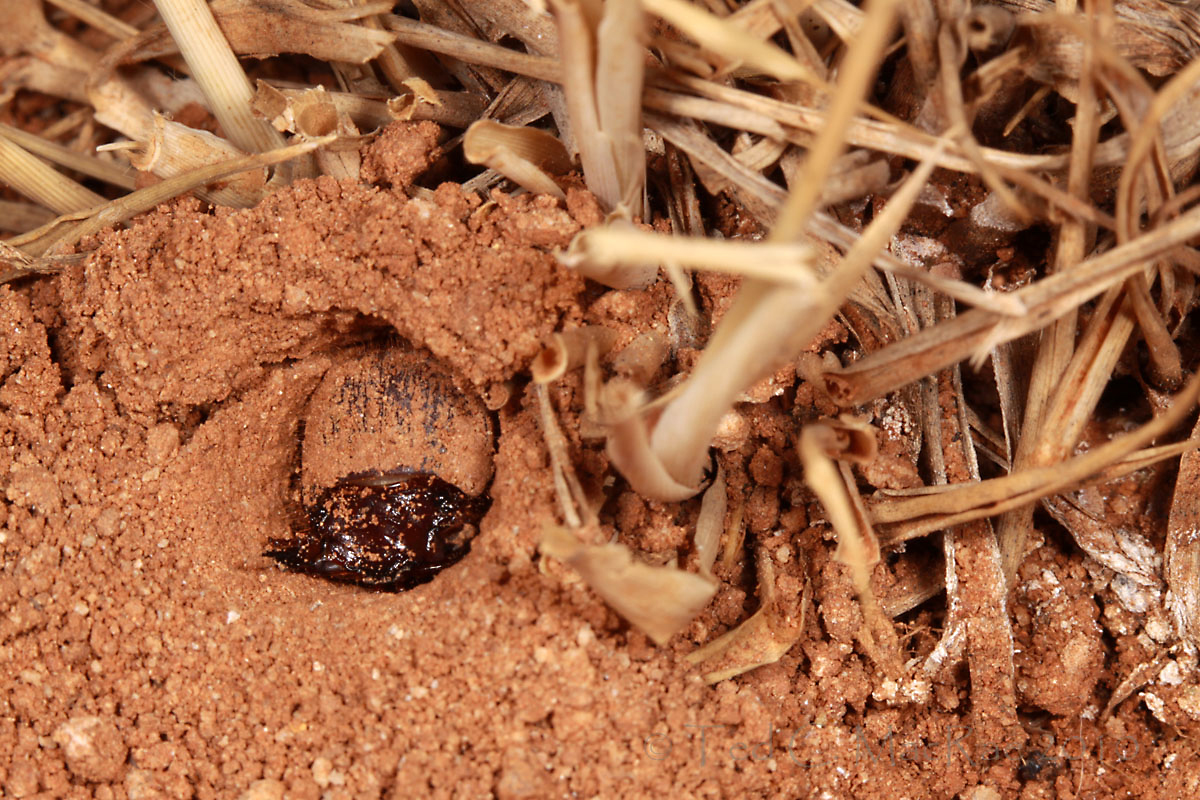
Another find I made that day that I’ve mentioned on occasion but not talked about at length was a single, rather large tiger beetle larva.  I found several burrows at the base of a talus slope at the edge of a small ravine where many adult C. celeripes were scurrying, and though I tried with many, out of only one did I manage to “fish” its occupant with a blade of grass.  I didn’t know which species it represented, but its large size and occurrence in clay soil brought to mind two species – Cicindela pulchra (beautiful tiger beetle) and C. obsoleta (large grassland tiger beetle).  Both of these Great Plains species reach their eastern limit of distribution in this part of Oklahoma (Pearson et al. 2006), and their status as the largest species of the genus (and its former subgenera) in North America seemed to make them the leading candidates for this enormous larva.  There was one other possibility – Amblycheila cylindriformis (Great Plains giant tiger beetle), another Great Plains species at its eastern limit in western Oklahoma and (as the common name implies) the largest tiger beetle in all of North America.  However, to consider that species seemed too much wishful thinking.  From my understanding, larvae of that elusive species reach an incredible 45 mm in length and dig burrows  on steep slopes or at the mouths of rodent burrows that extend vertically to depths of up to 1.5 m or more (Brust et al. 2005).  Surely I could not have so casually stumbled upon such a grand grub!

I placed the larva in a terrarium of native soil and brought it back with me, and for one year now I have waited – feeding it a regular diet of the fat noctuid caterpillars that we rear so abundantly in our lab.  For a full year, I’ve watched it nab caterpillar after caterpillar, disappearing mysteriously for days on end, and just as mysteriously reappearing at the top of its burrow.  I knew getting a closer look at it would help in my attempts to determine its identity, but every time I approached with a camera it dodged down into its burrow and beat my patience.  Sometimes I would see it sitting about a centimeter below the burrow entrance – just waiting for a caterpillar to crawl by but refusing to expose itself to the lens.  I gradually decided it was likely C. pulchra, as I had seen that species in similar habitat not too far north in Barber County, Kansas.  So strong was my suspicion that I even made another trip out to the Glass Mountains in October of last year, expecting to see the fall-active adults bejeweling the exposed flats below the red clay slopes, their wine-red elytra and purple-margined bodies all aglitter under the crisp, autumn sun.  No such sight was beheld, however – my hopes dashed by the season’s sudden cold and wet turn, and with the terrarium containing the larva by then tucked away in a cool incubator for a winter’s rest, it would be several months before I would see the larva once again sitting at the top of its burrow.

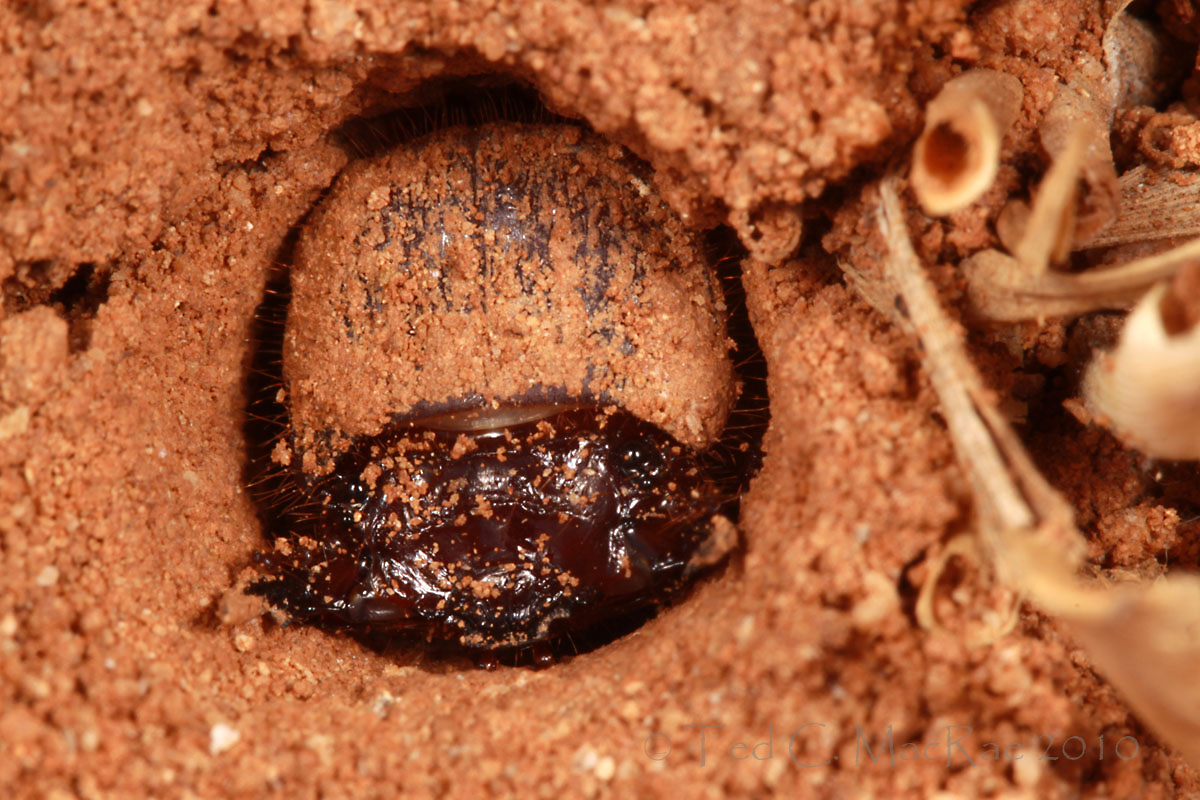
In late March I pulled the terrarium out of the incubator, and within a week the larva reopened its burrow.  I fed it a few times, and then one day I saw that it had dug a new, larger  burrow – measuring a full 10 mm in diameter!  This seemed extraordinarily large for any species of Cicindela, so I resolved once again to photograph it and determine its identity.  For days I stalked it, keeping the terrarium just outside my office door where I could keep an eye on it, yet every time I approached within two feet or so it would drop down out of sight.  I decided to stop feeding it – perhaps hunger would overwhelm its patience and prompt it to return to the top of its burrow more quickly after retreating.  That seemed to work, as one day the larva came back up after only a few minutes – and I was ready!  Already  in position, I flashed off multiple shots as soon as it reappeared, moving slowly and deliberately between shots to avoid spooking it again, and managed to get a nice series from varying distances.  As a testament to its enormous size, all of the photos shown here were taken with the standard 100mm macro lens (1X maximum) – not the 65mm 1-5X beast that I needed for these shots of the super-tiny C. celeripes.

Thinking that the larva likely represented C. pulchra, I compared the photos to this photo taken by Matt Brust of a 3rd-instar larva of C. pulchra and immediately noted the differently shaped pronotum of my larva and its distinctly projecting anterolateral angles.  Compare to C. pulchra, in which the angles are in line with the median part of the anterior margin – it is clearly not that species.  It isn’t C. obsoleta either, as that species has the anterolateral angles of the pronotum even less projecting than C. pulchra (Drew and Van Cleave 1962).  Apparently I needed to rethink my assumption that it belonged to Cicindela or its close relatives – none that occur in Oklahoma are simply large enough!  Tetracha virginica is large enough, but I knew it wasn’t that species since it lacked the white margined pronotum distinctive of species in that genus (as can be seen in this post on the larva of Tetracha florida).  That left only A. cylindriformis, distinguishable from all other tiger beetle genera occurring in Oklahoma by the second (lower) pair of eyes distinctly smaller than the first (Hamilton 1925, Drew and Van Cleave 1962, Pearson et al. 2006) – clearly seen in the third photo above.  Matt Brust has also photographed the larva of A. cylindriformis – it’s not a close shot of the head and pronotum, but in general aspect my larva seems to match it well enough.

All that is left is to actually succeed in rearing this larva to adulthood.  These beasts may require up to three to four years to develop (Brust et al. 2005), although this is likely influenced by latitude and prey abundance.  I suspect it was a second instar larva when I collected it, and that it dug its new burrow this spring after molting to the third (and final) instar.  Hopefully by keeping it in a nice, warm growth chamber and feeding it generously with fat caterpillars, I can minimize the time to pupation and perhaps see the adult sometime later this summer.  If/when that happens, you can be sure to see a follow up to this post.

Photo Details: Canon 50D (ISO 100, 1/250 sec, f/16-18), Canon 100mm macro lens, Canon MT-24EX flash (1/4 ratio) w/ Sto-Fen diffusers. Post-processing: contrast and unsharp mask (no cropping).

REFERENCES:

Brust, M. L., S. M. Spomer and W. W. Hoback.  2005. Tiger Beetles of Nebraska.  University of Nebraska at Kearney.  http://www.unk.edu (Version 5APR2005).

Drew, W. A. and H. W. Van Cleave.  1962. The tiger beetles of Oklahoma (Cicindelidae).  Proceedings of the Oklahoma Academy of Science 42:101–122.

Hamilton, C. C.  1925. Studies on the morphology, taxonomy, and ecology of the larvae of Holarctic tiger beetles (family Cicindelidae).  Proceedings of the U.S. National Museum 65 (Art. 17):1–87.

Pearson, D. L., C. B. Knisley and C. J. Kazilek. 2006. A Field Guide to the Tiger Beetles of the United States and Canada. Oxford University Press, New York, 227 pp.

Copyright © Ted C. MacRae 2010

Add to FacebookAdd to DiggAdd to Del.icio.usAdd to StumbleuponAdd to RedditAdd to BlinklistAdd to TwitterAdd to TechnoratiAdd to Yahoo BuzzAdd to Newsvine

Email to a friend

An irresistible sight!

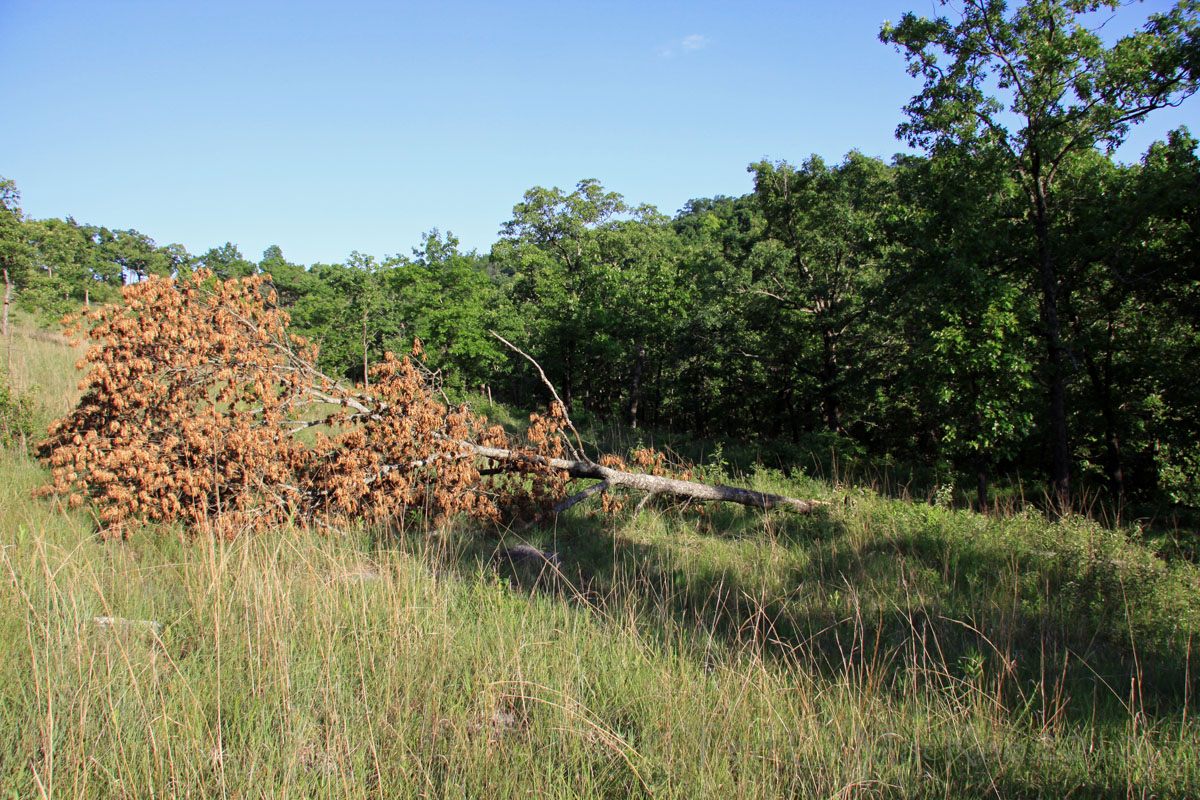
One of the few highlights of my Memorial Day weekend collecting trip came in the earliest moments of my visit to Ha Ha Tonka State Park.  My destination was Ha Ha Tonka Savanna Natural Area, and a short walk through fire-restored woodland led me to the open glade where just a few years earlier a UMC student had collected the rare and little-known Agrilus impexus.  Entering the glade, I was all set to begin sweeping the vegetation along the woodland/glade interface, paying special attention to any honey locust (Gleditsia triacanthos) that I might happen to find in the area as a potential host for the beetle.  What I saw instead as the glade opened up in front of me was a sight that any collector of wood-boring beetles will find almost irresistable – a recent wind-throw!  In this case, it was a black oak (Quercus velutina) laying in full sun – its bright brown leaves suggesting that it had fallen within the past few weeks (and would thus still be emitting the volatiles that wood-boring beetles find so attractive).  I wanted to begin looking for A. impexus, but I knew there would be beetles actively crawling on the trunk and branches of that tree.  I couldn’t resist it – I dropped my sweep net and beating sheet and made my way to the tree (in the end it didn’t matter, since no other beetles – including A. impexus – would be seen that day).

I already had an idea what I might find.  Recent wind-throws are the domain of Chrysobothris, and if the tree is a deciduous species then this means members of the Chrysobothris femorata species-group.  I recently featured one of six newly described members (C. caddo) of this taxonomically challenging group (Wellso and Manley 2007), providing a synopsis of the now twelve species in the group and their primarily host preferences.  Fully half of these are associated primarily or exclusively with oaks four occurring in Missouri (quadriimpressarugosiceps, shawnee, and viridiceps).  Of these, C. quadriimpressa is the most commonly encountered (although the others are by no means uncommon), and all of the nearly dozen or so beetles I found on this particular tree in fact represented that species. Confirmation of my ID would require microscopic examination of the female pygidium (which is shallowly impressed on each side of the middle) and male genitalia, but in general this species can be distinguished in the field by its smallish size (~10-12 mm in length – rugosiceps and shawnee tend to be larger) and the post-median pair of foveae (circular impressions) on the elytra being joined (they are distinctly separated in viridiceps).

As we’ve seen with other species of jewel beetles (e.g., C. caddo, Dicerca lurida, D. obscura), adults of C. quadriimpressa are incredibly cryptic and nearly impossible to see on the bark of their hosts – at least until they move.  They are notoriously difficult to approach – their large eyes and penchant for rapid escape flights suggesting excellent vision.  This is a useful capability for insects that must expose themselves to would-be predators (and beetle collectors) during daylight hours while actively searching dead trees for mates and oviposition sites.  One thing I can’t figure out, however, is the role of the intensely blue feet in this and other cryptically colored Chrysobothris species (see also C. caddo).  Any ideas?

Photo Details (insect): Canon 50D (ISO 100, 1/250 sec, f/16), Canon 100mm macro lens w/ Kenco extension tubes (68mm), Canon MT-24EX flash (1/4 ratio) w/ Sto-Fen diffusers.  Post-processing: levels, unsharp mask, minimal cropping.

REFERENCES:

Wellso, S. G. and G. V. Manley. 2007. A revision of the Chrysobothris femorata (Olivier, 1790) species group from North America, north of Mexico (Coleoptera: Buprestidae). Zootaxa 1652:1–26 (first page only).

Copyright © Ted C. MacRae 2010

Add to FacebookAdd to DiggAdd to Del.icio.usAdd to StumbleuponAdd to RedditAdd to BlinklistAdd to TwitterAdd to TechnoratiAdd to Yahoo BuzzAdd to Newsvine

Email to a friend

Introducing Chrysobothris caddo

This set of photographs comes from my June 2009 trip to northwestern Oklahoma, which I found at Boiling Springs State Park in Woodward County. They represent only the second buprestid species that I attempted to photograph with my (then) new camera and macro lens setup, the first being Chrysobothris ignicollis which I found at nearby Four Canyon Preserve. The latter species is commonly associated with Juniperus throughout much of western North America – indeed, the individuals I photographed were found on freshly cut J. virginiana (eastern redcedar), and I have reared the beetle from dead branches of this and other Juniperus species. The individual in these photographs represents another species in the same genus – Chrysobothris caddo. It was also found on cut redcedar; however, it is not normally associated with that plant. In fact, it is not very well-known at all, as it was only just described in 2007 (and these may well be the first ever identified photographs of the species).

Chrysobothris caddo is one of a number of new species that were described by Wellso and Manley (2007) in their revision of the Chrysobothris femorata species-group from North America. I’ve previously mentioned the taxonomic difficulties associated with this group, last revised by Fisher (1942), and it had been known for some time that several species – including some unnamed – were masquerading under the “catch-all” taxon of Chrysobothris femorata. Normally, the only people who care about such situations are taxonomists and those who enjoy placing ID labels on specimens (me on both counts – I just hated those “Chrysobothris femorata species-group” labels).  However, there was farther reaching impact in this case since C. femorata is a widespread and important economic pest of shade and fruit trees (eggs are laid on the trunks of the trees, which are then damaged by the boring actions of the larvae that hatch from them). The Wellso/Manley revision has brought some degree of clarity to species limits within the group (doubling its number of described species), but they remain difficult to identify since their recognition relies upon “suites” of characters rather than single “key” characters. For example, we know this individual (a female, based on the form of the pygidium, or upper surface of the tip of the abdomen) represents C. caddo because (see if you can find the characters in the photos as we go here):

  • the antennae are narrowed to the apex (eliminating C. rugosiceps, which has the last antennal segment strongly quadrate)
  • the post-median (back of middle) foveae (circular impressions) of the elytra (wing covers) are joined (eliminating C. viridiceps, which has the foveae distinctly separated)
  • the pygidium is deeply impressed on each side of the middle (eliminating C. quadriimpressa, which has the pygidium shallowly impressed)
  • the pygidium lacks a hyaline (membranous) lateral margin (eliminating C. adelpha, which is unique in possessing this character)
  • the elytra have the posteriolateral margins arcuate and the tips bronze (eliminating C. femorata, in which the margins are straight and the tips reddish)
  • the elytral costae (longitudinal ridges) are connected by cross-veins and interrupted by the foveae (eliminating C. comanche, which lacks cross veins and has indistinct foveae)
  • the frons (face) has the callosities (elevated patches) transverse and bronze (eliminating C. shawnee, which has larger, bronze-black callosities)

Are you cross-eyed yet?! If not, there are four additional species in the group that are distinguished by similarly subtle character suites but whose geographical occurrence outside of Oklahoma (see checklist below) automatically eliminates them from consideration.

Chrysobothris caddo is primarily associated with Celtis (hackberry), and my finding it on redcedar is simply an incidental association. There was a large tree dump in the back area of the park with freshly cut wood from a variety of plant species – such tree dumps are famous collecting grounds for woodboring beetles in the families Buprestidae and Cerambycidae. However, little importance can be given to beetle-plant associations observed in such situations, with multiple potential host plant species in such close proximity to each other. The third photograph shows another female probing cracks in the bark of cut Ulmus rubra (slippery elm) with her ovipositor – perhaps she will have laid an egg or perhaps not, and if she did it is unknown whether the larva that hatched would be able to feed and develop successfully to adulthood on this non-preferred host.

For those with an interest in this group, following is a checklist of the species with their geographical distribution and preferred hosts:

  1. Chrysobothris adelpha Harold – eastern US and southern Canada west to Texas.  Primarily associated with Carya, also reared from Amelanchier and Prosopis.
  2. Chrysobothris caddo Wellso and Manley – Florida west to Arizona and north to Missouri, abundant in Texas.  Primarily associated with Celtis, reared also from Cercis and Ebanopsis [= Pithecellobium].
  3. Chrysobothris comanche Wellso and Manley – New Mexico, Texas, and Utah.  Associated exclusively with Juglans.
  4. Chrysobothris femorata (Olivier) – all continental states and Canada.  Associated with a wide variety of woody plant species, especially those in landscape and orchard settings.
  5. Chrysobothris mescalero Wellso and Manley – New Mexico and Texas.  Associated exclusively with Quercus.
  6. Chrysobothris quadriimpressa Gory and Laporte – eastern US west to Continental Divide.  Primarily associated with Quercus, reared also from Juglans, Liquidamber, and Sapindus.
  7. Chrysobothris rugosiceps Melsheimer – eastern US and southern Canada west to Texas.  Primarily associated with Quercus, reared also from Castanea.
  8. Chrysobothris seminole Wellso and Manley – Georgia and Florida.  Associated exclusively with root crowns of Chrysoma, making it the only species associated with a non-woody host.
  9. Chrysobothris shawnee Wellso and Manley – eastern US west to Colorado.  Primarily associated with Quercus, reared also from Salix and Prunus.
  10. Chrysobothris sloicola Manley and Wellso – Known only from Michigan in association with Prunus.
  11. Chrysobothris viridiceps Melsheimer – eastern US and southern Canada west to Continental Divide.  Associated primarily with Quercus, reared also from Carya, Prosopis, and Ulmus.
  12. Chrysobothris wintu Wellso and Manley – Arizona and California.  Primarily associated with Quercus, reared also from Salix and Prunus.

I have, over the years, collected numerous specimens of most of the species in this group (lacking only mescalero, seminole, and sloicola in my collection), with specimens now assignable to caddo, comanche, shawnee, and wintu included in the original type series as paratypes.

Photo Details: Canon 50D (ISO 100, 1/250 sec, f/14-16), Canon 100mm macro lens, Canon MT-24EX flash (1/4 ratio) w/ Sto-Fen diffusers. Typical post-processing (levels, unsharp mask, minimal cropping).

REFERENCES:

Fisher, W. S.  1942. A revision of North American species of buprestid beetles belonging to the tribe Chrysobothrini.  U. S. Department of Agriculture, Miscellaneous Publication 470, 275 pp.

Wellso, S. G. and G. V. Manley. 2007. A revision of the Chrysobothris femorata (Olivier, 1790) species group from North America, north of Mexico (Coleoptera: Buprestidae). Zootaxa 1652:1–26 (first page only).

Copyright © Ted C. MacRae 2010

Add to FacebookAdd to DiggAdd to Del.icio.usAdd to StumbleuponAdd to RedditAdd to BlinklistAdd to TwitterAdd to TechnoratiAdd to Yahoo BuzzAdd to Newsvine

Email to a friend

Revision of the Formicidae of North America

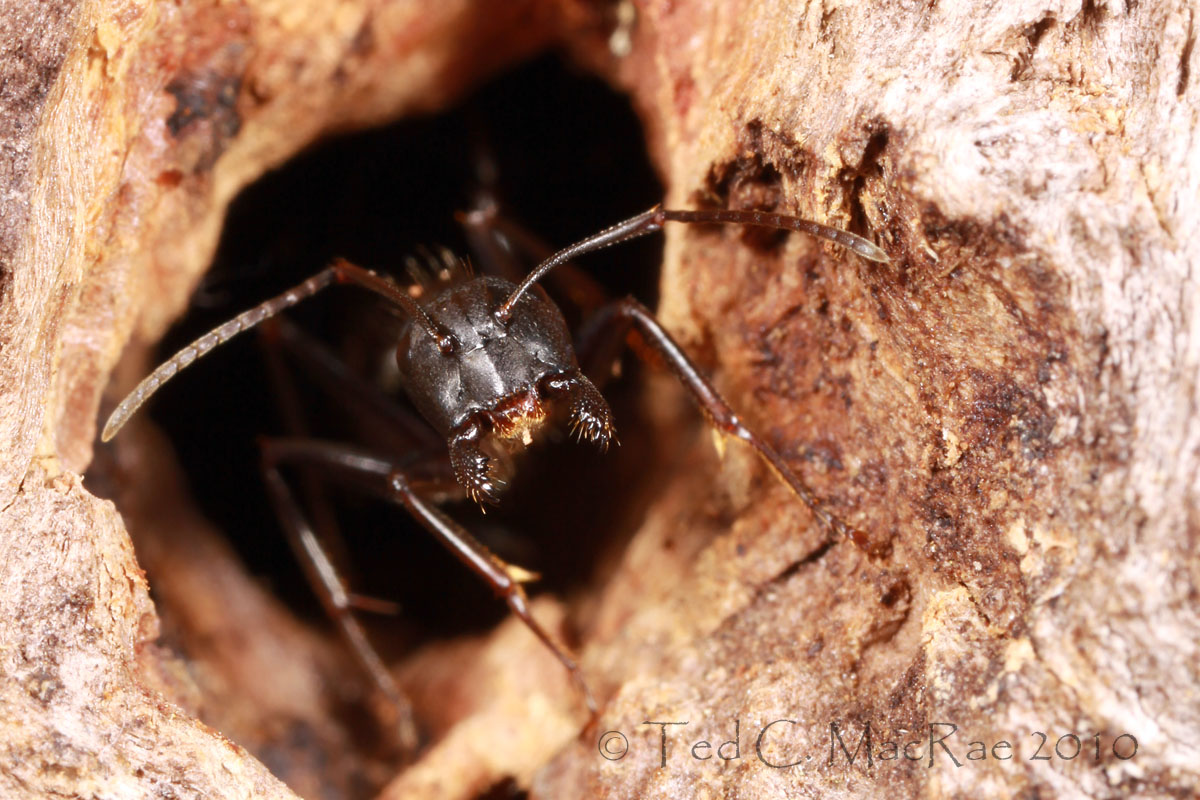
Formica meganigra guarding a nest entrance.

I recently came across this ant in the southeastern Missouri Ozarks sitting in a hole in the trunk of a standing dead black oak (Quercus velutinus) tree, apparently guarding the entrance to its nest. This big black ant is frequently associated with dead wood; however, this is the first time I’ve noticed one guarding the entrance to its nest. Other workers coming back to the nest were greeted by this individual by a quick rubbing of antennae and then allowed to pass. The close approach of my camera apparently was not very welcome by the ant, who responded by showing off his *her* impressive choppers.

In trying to determine the species name for this ant, it became clear to me that myrmecologists have made things far more complicated than they really need to be. When I was a kid, ant identification was easy – there were black ants and red ants, and within those two main guilds some were big, some were not so big, and some were really small.  Peter Yeeles alluded to this traditional classification in a recent comment at Fall to Climb, which the Geek herself later modified to recognize ants that were neither black nor red.  In that classification, this is clearly a big black ant; however, the myrmecologists have unnecessarily split this species up into multiple genera and species based on inconsequential characters such as punctures on the head, clypeal notches, hairy scapes, etc.  I propose to bring a measure of sanity back to ant identification in North America with a revised key to the family (below).  It is based on the traditional classification but also recognizes the introduction in recent years of an alien species that stings and has colonized a large part of the southern United States (we didn’t have those when I was a kid).  In offering this simplified classification, it is my hope that school children across the country – naturally curious about ants and other insects – will no longer have their budding interest squashed by the ponderous, complex ant identification system that has become so fashionable in recent years.

Photo Details: Canon MP-E 65mm 1-5X macro lens on Canon 50D, ISO 100, 1/250 sec, f/14, MT-24EX flash 1/8 power w/ Sto-Fen diffusers.

Revised Key to Formicidae of North America

.
1 Color black . . . . . . . . . . . . . . . . . . . . . . . . . . . . . . . . . . . . . . . . . . . . . . 2
1′ Color not black . . . . . . . . . . . . . . . . . . . . . . . . . . . . . . . . . . . . . . . . . . . 4
2 (1) Enormous. . . . . . . . . . . . . . . . . . . . . . Formica meganigra (big black ant)
2′ Not enormous. . . . . . . . . . . . . . . . . . . . . . . . . . . . . . . . . . . . . . . . . . . . 3
3 (2′) Regular size . . . . . . . . . . . . . . . . . . . . . . . . . . . Formica nigra (black ant)
3′ Tiny. . . . . . . . . . . . . . . . . . . . . . . . . . Formica micronigra (little black ant)
4 (1′) Color red. . . . . . . . . . . . . . . . . . . . . . . . . . . . . . . . . . . . . . . . . . . . . . . . 5
4′ Color yellow . . . . . . . . . . . . . . . . . . . . . . . . . . . . . . . . . . . . . . . . . . . . . 6
5 (4) Can sting. . . . . . . . . . . . . . . . . . . . . . . . . . . . Solenopsis invicta (fire ant)
5′ Can’t sting. . . . . . . . . . . . . . . . . . . . . . . . . . . . . . Formica rubra (red ant)
6 (4′) Regular size. . . . . . . . . . . . . . . . . . . . . . . . . . . Formica flava (yellow ant)
6′ Tiny . . . . . . . . . . . . . . . . . . . . . . . . . Formica microflava (little yellow ant)

Copyright © Ted C. MacRae 2010

Add to FacebookAdd to DiggAdd to Del.icio.usAdd to StumbleuponAdd to RedditAdd to BlinklistAdd to TwitterAdd to TechnoratiAdd to Yahoo BuzzAdd to Newsvine

Email to a friend

Josef Knull was wrong!

A few weeks ago I received an email from Kyle Schnepp, an entomology student at Purdue University.  Kyle has taken on the rather ambitious project of developing an illustrated key to the Buprestidae of eastern North America, for which he has been spending the past year acquiring material for photographs.

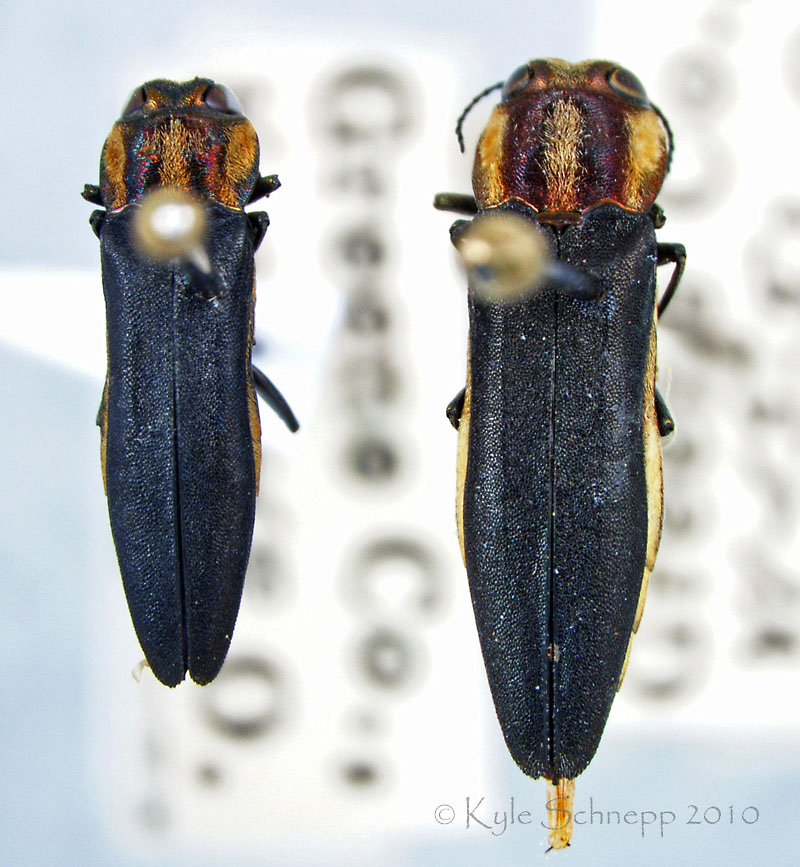
During his examination of specimens in the Field Museum of Natural History, Kyle came across two examples of an extraordinarily rare species of Buprestidae, Agrilus audax Horn.  Although described more than 100 years ago from specimens collected in Texas (Horn 1891), few records have been published in the years since.  Chamberlin (1926) reported the species also from Arizona and Illinois but without further details, causing Fisher (1928), in his revision of the genus (woefully out-of-date now, but still the only comprehensive resource for identifying the North American species), to regard at least the Illinois record as probably erroneous (common for many of Chamberlin’s records).  The first undisputed report of this species from outside of Texas was by Josef Knull (1934), who reported the species emerging from living, wind-thrown branches of slippery elm (Ulmus rubra) collected in western Missouri.  More than half a century would pass before the species would turn up again – first in Oklahoma (Nelson and MacRae 1990) and twice again in Missouri through the efforts of Gayle Nelson and myself (MacRae 1991, MacRae and Nelson 2003). All but one of these specimens were beaten from bur oak (Quercus macrocarpa).

Agrilus audax Horn, 1891 – male (L) and female (R)

While the rarity of this species makes Kyle’s find significant enough, there is an even more significant – and interesting – aspect to his discovery.  Both of the specimens, one male and one female, were collected in Ohio, which is a rather extraordinary geographical range extension. Additionally, the specimens were collected by none other than Josef Knull.  To students of North American Buprestidae, the name Josef Knull is as familiar as Carl Linnaeus, Charles Darwin, or Thomas Say. A Professor of Entomology at The Ohio State University from 1934-1962, Knull published nearly 200 papers on the taxonomy, biology, and distribution of these and other families of beetles (Davidson and Bellamy 2002).  Although he lacked a Ph.D., he was an indefatigable collector and describer of beetles – to his fellow colleagues and students, he was known as “Professor” or “Doctor” as a show of respect.  He spent many of his summers traveling through the southwestern U.S. with his wife Dorothy Knull (herself an entomologist specializing in leafhoppers), and by the time he died in 1975 he had described 233 species and subspecies of beetles (as well as one species of Fulgoridae).  He was, and is, an icon among North American beetle collectors.

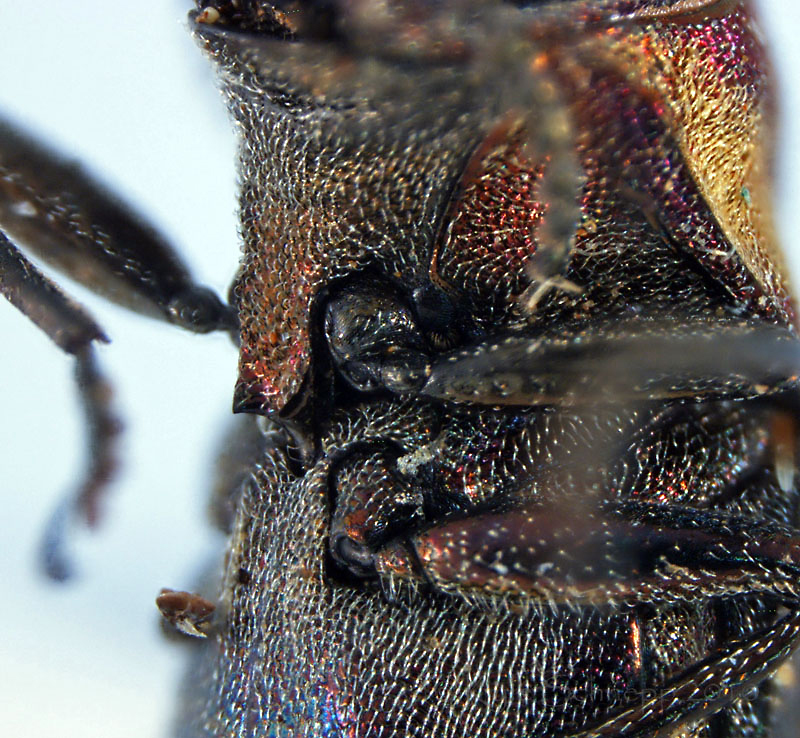
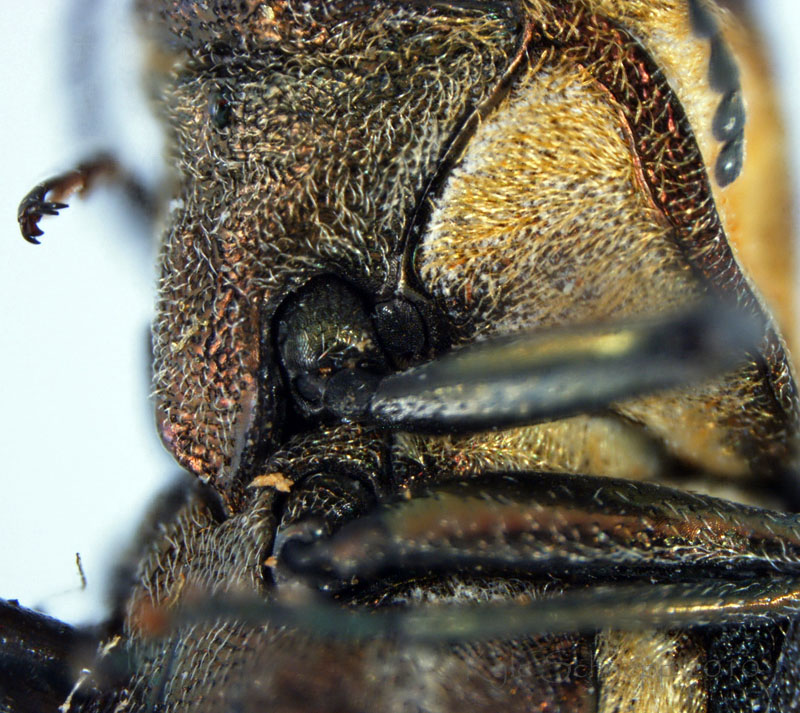
Curiously, Knull did not recognize these specimens for what they were, instead identifying them as the similar and much more widespread species, Agrilus vittaticollis.  Curious, because Knull collected these specimens in 1949 and 1953 – after first reporting the species in Missouri.  Agrilus audax belongs to a small group of species that look very similar to each other by way of their large size and striking coloration – black elytra and a red pronotum with a densely pubescent median channel.  Agrilus vittaticollis is the most common of these (though still not as commonly encountered as many other species in the genus), and the much less common A. benjamini also belongs to this group.  Kyle had sent me the above photo in an attempt to confirm their identity, but true confirmation would require examination of characters of the face and ventral surface.  Kyle quickly took additional photographs of these characters and sent them to me – they are shown below and leave no doubt as to the identity of these specimens.

Agrilus vittaticollis prosternum – note sides bent downward to sharp points.

Agrilus audax prosternum – sides normal, not bent downward to sharp points.


Agrilus audax frons is moderately depressed and uniformly pubescent (deeply depressed & pubescent only on lower half in A. benjamini).

Agrilus audax male sternite – the deep, smooth, elongate depression is diagnostic (A. benjamini males have only an obsolete depression).


Finding a new state record buprestid in Ohio – the land of Knull – based on specimens collected by Knull himself is nothing short of remarkable (almost like proving E. O. Wilson wrong¹). The occurrence of A. audax in Ohio also lends some credibility to Chamberlin’s record of the species in Illinois. Kyle is graciously allowing me to include these new records in a forthcoming publication; my thanks to him for this and also for allowing me to use his fine photographs in this post.  Kyle did also mention that these were the only misidentified specimens he saw in the Knull collection at the Field Museum of Natural History. For those interested in acquiring reprints of Knull’s papers, pdfs of the 50 papers he published in the Ohio Journal of Science may be found at this link.

¹ The title of this post is a play on the title of a recent post by Alex Wild at Myrmecos. No true disrespect is intended to Josef Knull, who’s legacy (with the possible exception of his frustratingly vague label data) is rightfully held in high regard by all who knew him or know of his work.

REFERENCES:

Chamberlin, W. J. 1926. The Buprestidae of North America, exclusive of Mexico, a catalogue including synonymy, bibliography, distribution, type locality and hosts of each species. W. J. Chamberlin, Corvallis.

Davidson, J. M., and C. L. Bellamy.  2002. The entomological contributions of Josef Nissley Knull (1891-1975).  Zootaxa 37:1-24.

Horn, G. H. 1891. The species of Agrilus of Boreal America. Transactions of the American Entomological Society 18:277-366.

Knull, J. N. 1934. Notes on Coleoptera, No. 4. Entomological News 45(10):207-212.

MacRae, T. C. 1991. The Buprestidae (Coleoptera) of Missouri. Insecta Mundi 5(2):101–126.

MacRae, T. C., and G. H. Nelson. 2003. Distributional and biological notes on Buprestidae (Coleoptera) in North and Central America and the West Indies, with validation of one species. The Coleopterists Bulletin 57(1):57–70.

Nelson, G. H., and T. C. MacRae. 1990. Additional notes on the biology and distribution of Buprestidae (Coleoptera) in North America, III. The Coleopterists Bulletin 44(3):349–354.

Copyright © Ted C. MacRae 2010

Add to FacebookAdd to DiggAdd to Del.icio.usAdd to StumbleuponAdd to RedditAdd to BlinklistAdd to TwitterAdd to TechnoratiAdd to Yahoo BuzzAdd to Newsvine

Email to a friend

Acmaeodera carlota in northern Arizona

Acmaeodera carlota Fall – Coconino Co., Arizona

This is another of the interesting species that I encountered during my examination of material submitted for identification this past winter.  Acmaeodera carlota is one of 149 species/subspecies in North America belonging to this very difficult genus (recall my recent post, Aaack!-maeodera), and as with so many of its congeners it wasn’t described until after the last revision of the genus more than a century ago (Fall 1899).  Obviously, the genus badly needs another revision – or at least a revised key – so that the known species can be identified with some degree of confidence without having to send specimens to a specialist. There have been a handful of buprestid workers in recent decades who may have been able to accomplish this daunting task, but to date none have been willing to embrace this considerable challenge.

As far as is known, A. carlota occurs only in Arizona.  Fall (1932) described this species from a few specimens collected from cactus blossoms near Globe, Arizona (~90 miles east of Phoenix).  Since then, the only specific information recorded about this species was by Westcott et al. (1979), who reported adults cut from wood of Quercus dumosa near Sunflower (~60 miles northwest of the type locality) and collected from flowers in west-central Arizona near Wikieup.  Fall’s original description leaves much to be desired (as is the case for nearly all original descriptions prior to the last 50 years or so), and to this point no images have been published in the literature or appeared on the web.  This particular specimen was found in a batch of material sent to me by cerambycid-enthusiast Jeff Huether (the same batch containing the previously discussed Acmaeodera robigo), and the only reason I was able to identify it was by comparing it to a specimen given to me by the late Gayle Nelson, who collected the species near Wikieup after its occurrence was reported there by Westcott and colleagues.  The interesting thing about this specimen is that it was collected near Page, Arizona – nearly 200 miles north of any of the previous known localities and just south of the Utah border.  In suspect this species occurs even more broadly and is not, as the limited records suggest, restricted to Arizona.

Acmaeodera carlota belongs to a group of species that I loosely refer to as the A. tubulus-species group.  It is not clear that all of the species are actually closely related, but they do all resemble each other in their small size (<8 mm), general appearance (i.e., black with confused yellow maculations on the elytra), and inclusion in the so-called ‘Truncatae’ group (a subdivision of the genus established by 19th Century coleopterist George Horn to include those species having the prosternal margin nearly straight and not retracted from the sides). Within the Truncatae, the species in the tubulus-species group are distinguished by lacking a subapical crest on the last ventral segment and general appearance.  Only three species were known at the time of Fall’s revision (conoidea, neglecta, and tubulus); however, an additional eight species have been described since (carlota, ligulata, neoneglecta, opuntiae, parkeri, sabinae, starrae, and thoracata).  I have collected many of these species in my travels across the southwestern U.S. and lack only starrae and thoracta in my collection (the latter is known only from the type).  In the case of A. carlota, note the rather flattened dorsal surface that is densely clothed with long, stiff, dark, suberect hairs; the coarsely, contiguously punctate pronotum; and the subrugose, slightly irregular elytral intervals, which serve to distinguish this species from others in the group.

The group’s namesake, Acmaeodera tubulus, is widespread and common across the eastern U.S., making it relatively easy to identify. However, the remaining species of the tubulus-species group are limited to the south-central and southwestern U.S., and the lack of available identification keys and suitable descriptions makes them nearly impossible to identify except by comparison with determined specimens. As a result, I have built a key to the species in the Acmaeodera tubulus-species group that I use to assist in my own identifications.  The key is based on distinguishing characters given in the original descriptions (if any) and augmented by my examination of the material at my disposal.  I invite users to test the key with their own material and let me how well it works.

My sincere appreciation to Jeff Huether for allowing me to retain this specimen in my collection as a voucher for the range extension that it represents.

REFERENCES:

Fall, H. C.  1899.  Synonpsis of the species of Acmaeodera of America, north of Mexico.  Journal of the New York Entomological Society 7(1):1–37 [scroll to “Journal of the New York Entomological Society”, “v. 7 1899”, “Seq 12”].

Fall, H. C.  1932.  Four new Buprestidae from Arizona.  The Pan-Pacific Entomologist, 8(2) (1931):81-84.

Westcott, R. L., W. F. Barr, G. H. Nelson, and D. S. Verity.  1979.  Distributional and biological notes notes on North and Central American species of Acmaeodera (Coleoptera: Buprestidae).  The Coleopterists Bulletin, 33(2):169-181.

Copyright © Ted C. MacRae 2010

Add to FacebookAdd to DiggAdd to Del.icio.usAdd to StumbleuponAdd to RedditAdd to BlinklistAdd to TwitterAdd to TechnoratiAdd to Yahoo BuzzAdd to Newsvine

Email to a friend