Trees of Lake Tahoe – The “Other” Conifers

The inviting openness of the Sierra woods is one of their most distinguishing characteristics. The trees of all the species stand more or less apart in groves, or in small, irregular groups, enabling one to find a way nearly everywhere, along sunny colonnades and through openings that have a smooth, parklike surface.–John Muir, The Mountains of California (1894)

p1020595_2

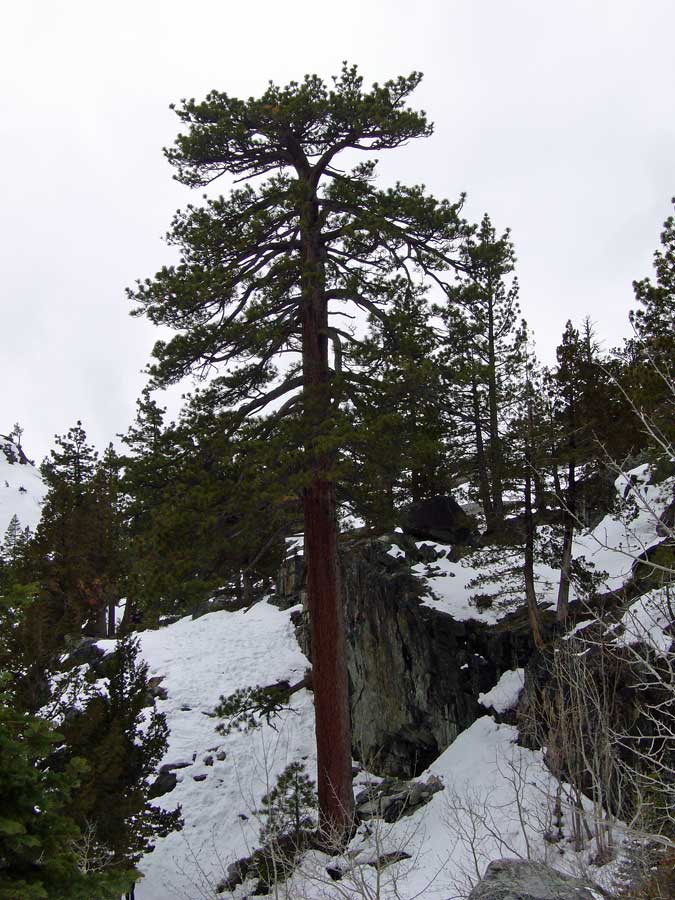
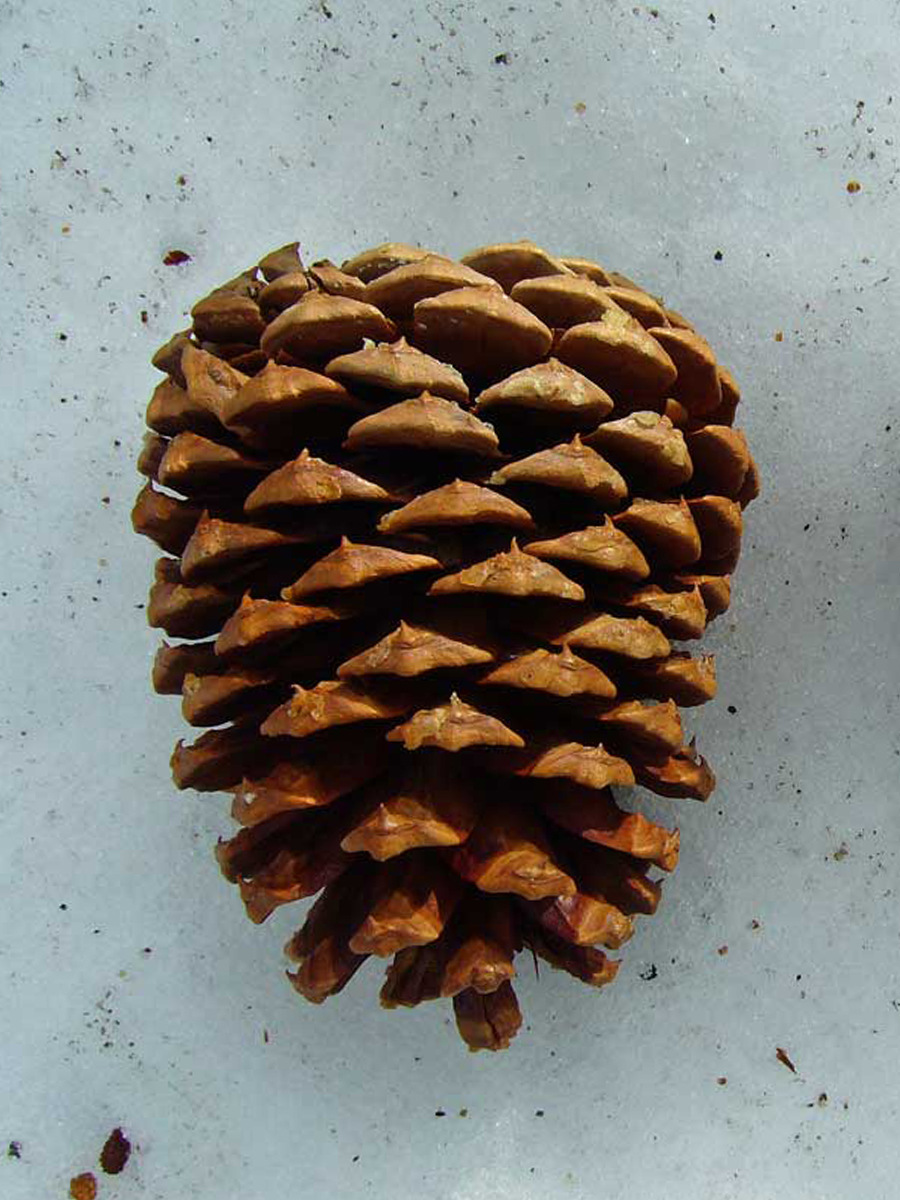
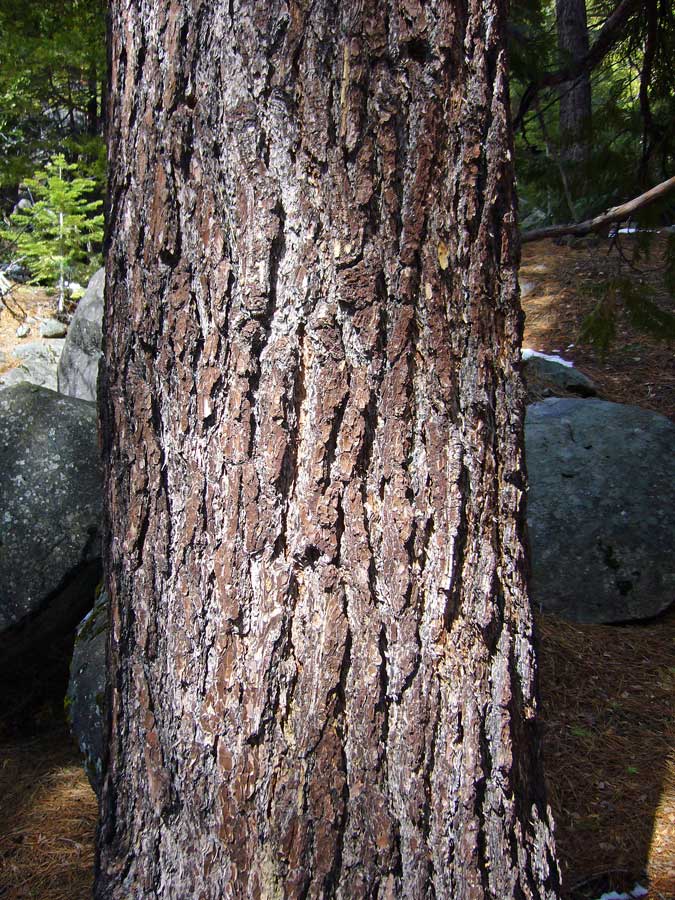
In a previous post (Trees of Lake Tahoe – The Pines), I discussed the six species of pine that can be found within the Tahoe Basin. These include Jeffrey pine (Pinus jeffreyi) – dominant around the lake at lower elevations, lodgepole pine (P. contorta ssp. murrayana) – common in meadows at lower elevations and replacing Jeffrey pine at higher elevations, ponderosa pine (P. ponderosa) – uncommon in the basin due to its preference for lower elevations, sugar pine (P. lambertiana) – the magnificent giant of high quality mesic sites along the western shore, western white pine (P. monticola) – co-occurring with lodgepole pine at higher elevations, and whitebark pine (P. albicaulis) – covering the highest peaks with its gnarled and twisted form.  In this post, I will cover the five “other” coniferous trees that can be found growing in the Tahoe Basin.  These other conifers belong to several different genera in two gymnospermous families – the Pinaceae and the Cuppressaceae.  Together with the pines, these trees comprise what John Muir described as one of the most diverse and appealing coniferous forests in the world. I am most inclined to agree with him.  The diversity of conifers found in the Tahoe Basin is reflective of the wide range of conditions occurring there as a result of differences in elevation (from 6,200 ft to more than 10,000 ft), exposure, and moisture.

Family-level identification of Tahoe Basin conifers is relatively straightforward – those with needle-shaped leaves belong to the Pinaceae (the pine family), while those with scale-like leaves belong to the Cuppressaceae (the cypress family).  There are other characters that distinguish members of these two families, but leaf shape is the most useful for purposes of field identification.  Nine of the eleven species of conifers found in the Tahoe Basin belong to the Pinaceae, while only two are members of the Cuppressaceae.  Within the families, the genera can be distinguished most readily by the following characters:

Pinaceae

  • Pines (Pinus) – needles linear, arranged in bundles or clusters of up to 5 needles held together at the base by sheath of papery bark (discussed in Trees of Lake Tahoe – The Pines).
  • Firs (Abies) – needles more or less flattened, growing directly and singly from the branch and with a plump base that leaves a round depression on the branch.  Cones upright, on upper branches.
  • Hemlocks (Tsuga) – needles more or less flattened and growing directly and singly from the branch like firs, but narrowly stalk-like at the base where they are joined to tiny wooden pegs.  Cones pendant, on outer branches.

Cuppressaceae

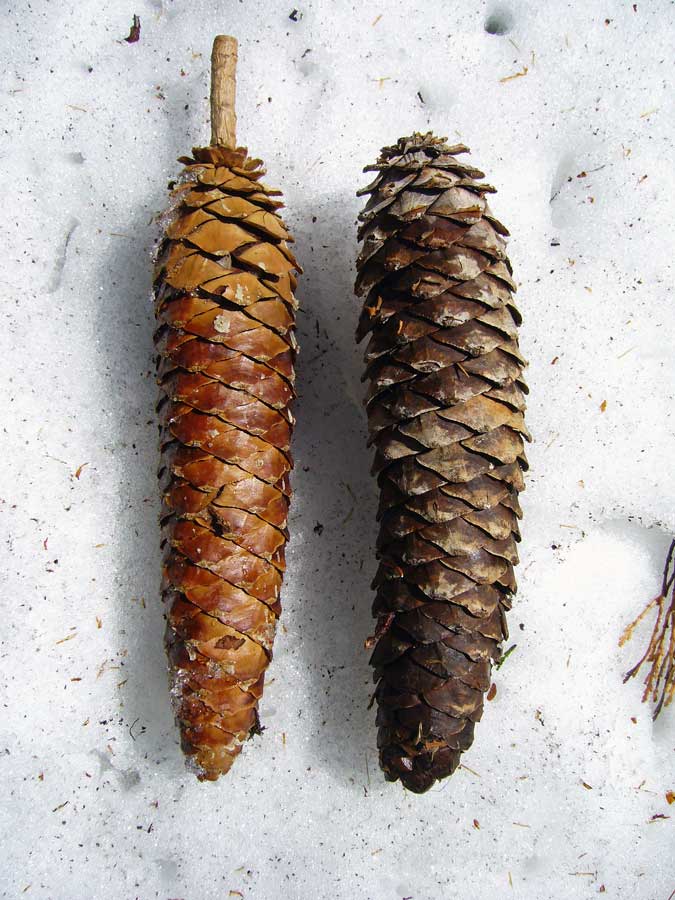
  • Incense-cedars (Calocedrus) – scale-like leaves 4-ranked, twigs branching in one plane to form flat sprays, cones > ½” in length, consisting of two large scales separated from a closed center.
  • Junipers (Juniperus) – scale-like leaves arranged in circles of 3, twigs not forming flat sprays, cones < ½” in length, berrylike.

There are three additional coniferous genera in the Sierra Nevada – each represented by a single species and found along the western slope – that do not occur in the Tahoe Basin.  These include: Douglas-fir (Pseudotsuga menziesii) – widespread at elevations from 2,500 ft to 6,000 ft (higher at the southern end of its range); giant sequoia (Sequoiadendron giganteum) – primarily in Giant Sequoia National Monument, and California nutmeg (Torreya californica) – of scattered occurrence.

White fir (Abies concolor)

As old age creeps on, the bark becomes rougher and grayer, the branches lose their exact regularity, many are snow-bent or broken off,…but throughout all the vicissitudes of its life on the mountains, come what may, the noble grandeur of the species is patent to every eye.
p1020574_2p1020575_2p1020587_2

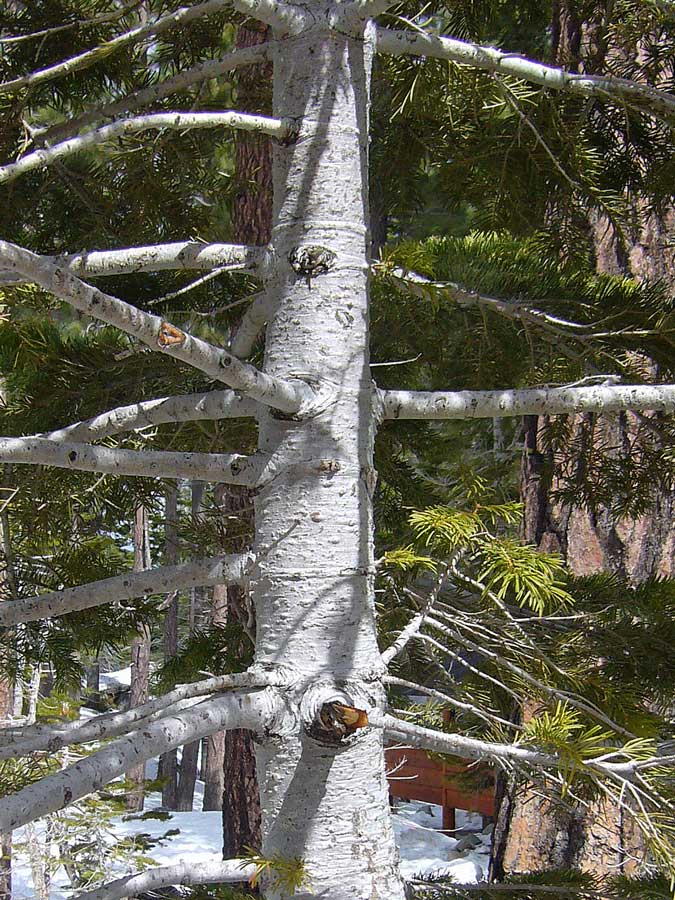
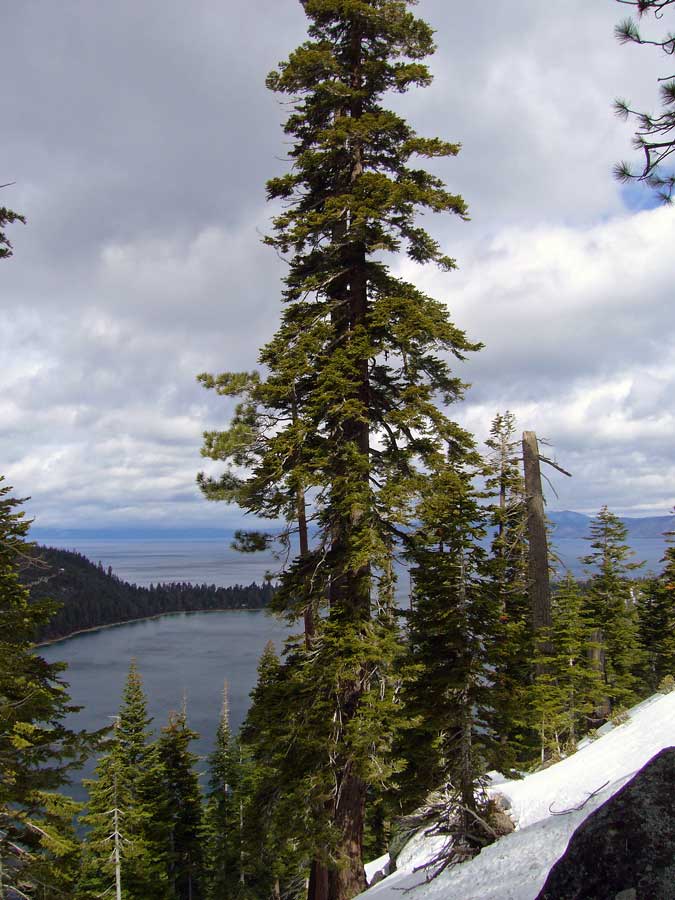
White fir is second only to Jeffrey pine as the dominant conifer at the lower elevations within the Tahoe Basin¹.  It is immediately recognizable as the only non-pine member of the Pinaceae to occur at these elevations – red fir and mountain hemlock are found only at higher elevations in the basin.  Young trees have a nearly perfect pyramidal shape, with silvery gray bark that is thin, smooth, and p1020588_2covered with resin-filled blisters that can be “popped” to shoot out the resin. Older trees develop a more cylindrical and slightly irregular crown, and the bark becomes thick and roughly furrowed, changing to a dark gray or brown color. The foliage has a gray frosted appearance from below, and crushing the needles releases a delightful citrus smell that I found myself partaking in repeatedly. In the narrow elevational zone where white fir and red fir co-exist, white fir may be recognized by its more flattened needles (cannot be “rolled” in the fingers) which are distinctly twisted near the base, causing them to appear 2-ranked. White fir was seen throughout the Tahoe Basin at elevations below around 7,500 ft, and especially along the western shore and southern shores where the greater moisture and protection of north and east facing slopes are to this species liking.

¹ This post by Watching The World Wake Up provides an excellent introduction to the characteristics and distribution of white fir and its relatives. It also contains what must be the best tangent to ever appear in a botanical blog – the connection made between white fir and the alluring Salma Hayek (annoyingly mispelled “Selma” Hayek), softly singing Siente Mi Amor, is pure brilliance!

Despite its “noble grandeur,” white fir may be regarded as somewhat of a pest species. The suppression of fires that have been the hallmark of 20th century forest management have encouraged the replacement of pines throughout the Sierra Nevada by this species. White fir does not tolerate fire as well as the pines with which it occurs, but unlike those species it does well in shadier conditions. The suppression of fires has resulted in dense stands of white firs growing up in the spaces between the pines. Since it tends to retain its lower branches as it grows, when fires do occur the white firs can act as “fire ladders” that allow the fires to reach the upper canopies of the pines. Pines are not as shade tolerant as firs and are thus unlikely to become established beneath the dense canopy of firs. The result of these fire suppression policies are mixed-conifer forests that are denser and contain a much higher proportion of white fir than in the past, making the forests more vulnerable to stand-replacing fires as well as stress-induced insect and disease outbreaks. These counterproductive management policies are beginning to change – and I saw two controlled burns taking place during the week while I was in Lake Tahoe – but there is still much progress yet to be done if we are to once again see large expanses of the “inviting openness” that so captivated John Muir.

Red fir (Abies magnifica)

This is the most charmingly symmetrical of all the giants of the Sierra woods, far surpassing its companion species [white fir] in this respect… Happy the man with the freedom and the love to climb one of these superb trees in full flower and fruit.

p1020785_2I suspected I had seen this magnificent relative of the white fir in the higher elevations at Heavenly Ski Resort on my first trip back to the area last year, but lacking any real knowledge or field guides at the time it remained only a suspicion. When I returned to Heavenly this year, I was ready for it, and I recognized it instantly when I reached elevations around 8,000 ft. The massive trees with deeply reddish bark were unmistakable, and my only disappointment in seeing this species was that I was unable to approach them closely enough to allow a more thorough examination of their needles and bark. Like the white firs I saw at lower elevations, these massive trees had developed a bit of irregularity in their long, cylindrical crowns.

Younger trees can appear more similar to white fir because of their thin, smooth gray bark with elliptical resin blisters. However, in trees both young and old, the foliage is a more boldly colored blue-green than the paler foliage of white fir. p1020784_2Both species develop thick, deeply furrowed bark as they age, but the bark of red fir is distinctly reddish-brown or reddish purple, compared to the dark gray or brown bark of white fir – almost ashen in appearance. In the hand, the needles are not so flattened as white fir – almost quadrangular in cross-section and able to be rolled in the fingers – nor are they distinctly twisted near the base. The photo at right shows a stately red fir on the left next to a Jeffrey pine on the right at Lakeview Lodge on the California side of Heavenly (elevation 8,250 ft – the highest at which I saw the latter species).  I found this species growing in the company of western white pine (Pinus monticola), lodgepole pine (P. contorta ssp. murrayana), and mountain hemlock (Tsuga mertensiana), as well as in groves of its own kind (unfortunately, seen only from my perch upon a ski lift).

Mountain hemlock (Tsuga mertensiana)

The Hemlock Spruce is the most singularly beautiful of all the California coniferæ. So slender is its axis at the top, that it bends over and droops like the stalk of a nodding lily. The branches droop also, and divide into innumerable slender, waving sprays, which are arranged in a varied, eloquent harmony that is wholly indescribable.

p1020804_2I hadn’t a clue whether I would succeed in finding mountain hemlock – I knew it was a denizon of the snowy high mountains, though less common than some of the other high country conifers, and I didn’t recall noticing anything that might be this species during last year’s visit to the slopes of Heavenly. Of course, being a long-time resident of the Midwest I have little experience with hemlocks in general – eastern hemlock (T. canadensis) is on occasion planted in urban landscapes here, but mountain hemlock is markedly different from that species, as well as its Pacific counterpart western hemlock (T. heterophylla), due to its needles growing out of the twigs in all directions rather than in two flat planar sprays. Additionally, the needles are square in cross-section like spruce (Picea), a genus that does not now occur in the Sierra Nevada. These features caused 19th century botanists to suspect that mountain hemlock might have originated from an intergeneric hybridization event, as evidence by John Muir’s reference to it as “Hemlock Spruce.” However, no crosses between genera in the Pinaceae have ever been substantiated, and no compelling evidence of the presumed crossing events proposed for mountain hemlock has been brought forth (Lanner 1999).

p1020803_2Perhaps being primed by the readings I had done beforehand, I knew instantly I had found this species while riding a ski lift and seeing what looked at first like small junipers, but with a Tolkienesque appearance due to the gracefully nodding leader and drooping branch tips.  My hurried attempts to snap photographs of the trees from the moving ski lift produced nothing but skewed views marred by lift cables and passing cars, but once at the summit I was able to ski down to a little grove next to the ski run for closer inspection.  I immediately noticed the many cones clustered at the branch tips and was struck by their pine cone-like appearance. They were quite large – nearly 2” long (massive by hemlock standards).  Sadly, the only examples I would see of this species would be these small trees that only hinted at the charms of the massive specimens with trunks up to six feet in diameter that so enamoured John Muir.  Like the rare Washoe pine (Pinus washoensis) that occurs just outside Tahoe Basin on the eastern slopes of Mt. Rose, attempts to find some of these graceful 100-footers will have to await my next year’s visit.

Incense-cedar (Calocedrus decurrens)

Casting your eye over the general forest from some ridge-top, the color alone of its spiry summits is sufficient to identify it in any company.

p1020687_2p1020688_2p1020693_2

The incense-cedar is my favorite of all the Tahoe Basin conifers. The bright, cinnamon-red bark of mature trees, deeply-furrowed, fibrous and peeling, is reminiscent of California’s two most iconic conifers – redwood (Sequoia sempervirens) and giant sequoia (Sequoiadendron giganteum), respectively the world’s tallest and most massive trees. Incense-cedar is neither as tall as redwood nor as massive as giant sequoia – p1020590_2indeed, it is not even very closely related (redwood and giant sequoia belong to yet another coniferous family, the Taxodiaceae, containing also the graceful but much smaller resident of southeastern U.S. swamps, baldcypress – Taxodium distichum). Nevertheless, old trees – veterans of centuries of fires and storm damage – are stunning specimens to behold, their massive, buttressed trunks often draped in yellow-green mosses and bearing deep basal fire scars, their spired crowns often broken and forked.  Their flattened sprays of foliage give the tree a delicate, lacy appearance in beautiful contrast to its grizzled, gnarled bark. Indeed, even in death these trees stand out for their stark beauty.

Incense-cedar is common at lower elevations in the Tahoe Basin, especially down close to the lake and in the communities ringing the shore. It rarely forms “stands” like white fir and the pines, p1020670_2but rather most often occurs singly – as if to emphasize their distinctiveness. I found it most common along the western shore, where it grows scattered amongst white fir and Jeffrey, sugar, and ponderosa pines. Some of the most massive incense-cedars I have ever seen were found down near the lakeshore along the Rubicon Trail in Emerald Bay State Park. Common on these trees were what I take to be incense-cedar mistletoe (Phoradendron libocedri) (family Santalaceae), which is apparently rare in the Tahoe Basin but known to occur in the mesic forests of the west shore.

Incense-cedar is another of the so-called “wrongly named” conifers – it is not a true cedar (thus, the hyphen in the name), a group of conifers belonging to the genus Cedrus in the family Pinaceae that is found across Eurasia². While somewhat resembling the true cedars, incense-cedar’s closest relatives are restricted to China and Taiwan. p1020640_2Early botanist-explorers, when they first encountered this tree, named it for what it most resembled to them – the old world cedars. This distinctiveness makes older trees the easiest Tahoe Basin conifer to identify. Even it’s cones that litter the ground under mature trees are unique – slender, spindle-shaped, and about an inch long, with the two longest scales bending back at maturity in a manner resembling a wide-open duck’s bill with the tongue sticking out. Young trees resemble Sierra juniper by their scale-like leaves and peeling bark, but the flattened, yellow-green sprays of incense-cedar and shiny reddish coloration of the bark of twigs and younger branches are immediately distinctive.
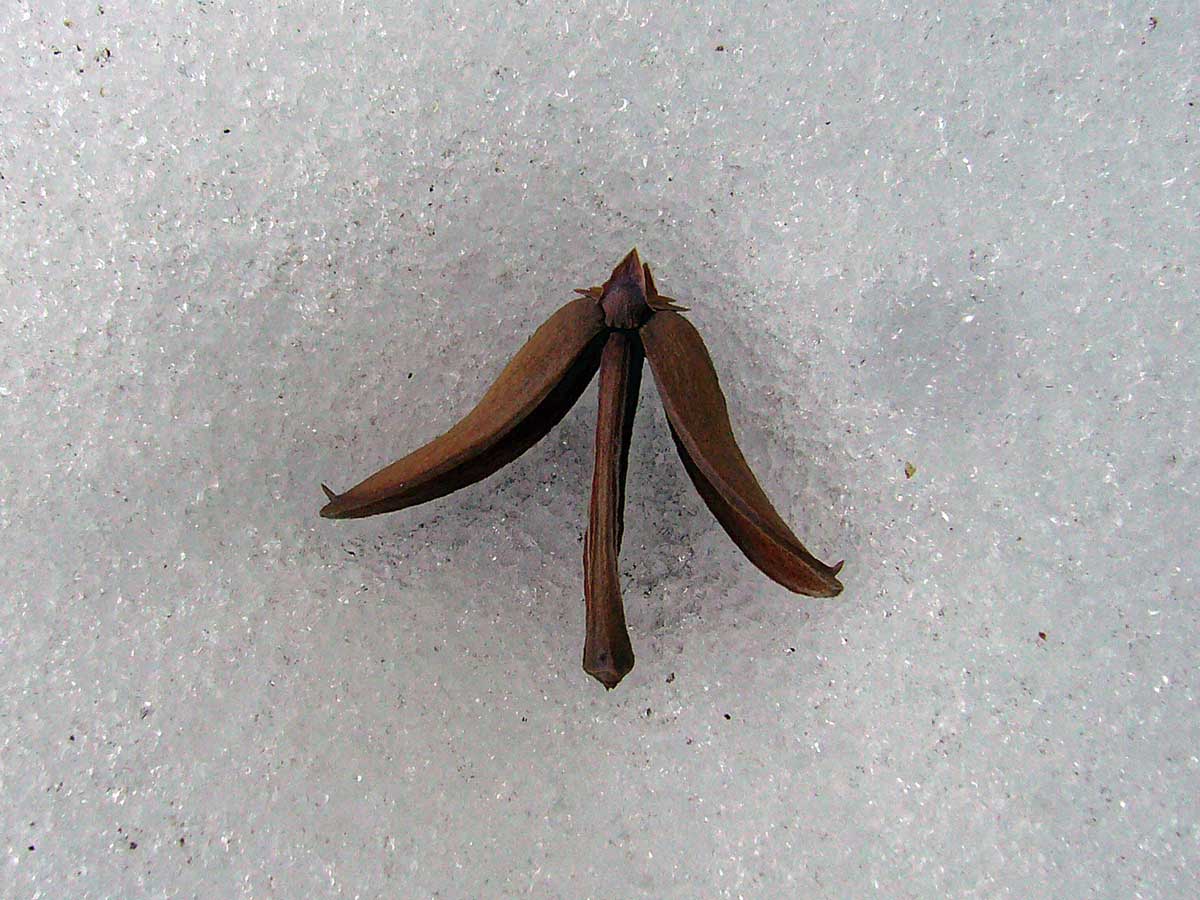
² There are actually numerous examples of such wrongly named conifers – Douglas-fir (Pseudotsuga menziesii) is not a true fir; eastern redcedar (Juniperus virginiana), western redcedar (Thuja plicata) and Alaska-cedar (Chamaecyparis nootkatensis) are not true cedars; and baldcypress (Taxodium distichum) is not a true cypress. Long live scientific names!

Like white fir, the Sierra Nevada has seen a bit of a population explosion of incense-cedar due to the fire-suppressive forest management practices of the past century. Despite the thick, fire-resistant bark of older trees, the thin-barked seedlings and saplings are intolerant of fire and grow more slowly than the fire-adapted pines. As a result, the frequent low-intensity fires of the past kept seedling establishment to a minimum, resulting in spot occurrences of mature, fire-resistant specimens. The suppression of these fires, combined with the ability of incense-cedar to germinate in shade and thick layers of duff, have allowed this species to increase in incidence throughout the Sierra Nevada. Along with white fir, it is gradually replacing the pines. This may seem like a good thing from the perspective of foresters and loggers, who value the wood of incense-cedar for its use in making pencils and cedar chests, but from an ecological perspective this has the same negative consequences discussed above for white fir.

Sierra juniper (Juniperus occidentalis ssp. australis)

Its fine color and odd picturesqueness always catch an artist’s eye, but to me the Juniper seems a singularly dull and taciturn tree, never speaking to one’s heart.

p1020766_2p1020600_2p1020603_2

This was another conifer that I didn’t recall seeing on my previous visits, but from what I had read I really hoped I did. Gnarly and burly, mature specimens have a weather-beaten, picturesque quality that is unmatched by any other Tahoe Basin conifer save whitebark pine (P. albicaulis). While I did not find this tree to be common in the Tahoe Basin, I did find it in the most surprising of places – Emerald Bay overlook, where I had gazed in admiration at Lake Tahoe on so many previous occassions. This enduring dweller of exposed granite crags grows where no other trees can, anchored to crevices with only the tracest amounts of soil, p1020613_2seemingly thriving on nothing more than rock, snow, and sunshine. Old trees, with their massively short trunks supporting wind-pruned crowns, cannot be mistaken for any other Tahoe Basin conifer. The wood, it seems, is almost as hard as the granite upon which the trees grow, accounting for John Muir’s impression of this tree as without expression – not even the strongest Sierra winds evoke the slightest of shudders or the quietest of whispers in its unyielding bows.

I did not find this species commonly in the areas of the Tahoe Basin that I visited (which were mostly lower elevation sites below 7,000 ft). In addition to the specimens seen at Emerald Bay State Park, I also found this species near Upper Truckee River before the climb to Echo Summit, and I found a number of fine mature specimens outside of the basin proper at Pyramid Creek Geological Area.  Where I did find it, Jeffrey pine was the most common associate, but in most cases the trees stood alone in their own starkness.  Among the Tahoe Basin conifers, the small scale-like leaves are recognizable to almost any easterner as those of juniper, immediately placing it in the family Cuppressaceae alongside incense-cedar.  Even the young trees can be distinguished from that species by their non-glossy foliage borne on twigs that radiate out from the branches in all directions.  p1020602_21The bark of young trees is shreddy and peeling like that of incense-cedar, but it is dull brown to reddish-brown rather than the shiny purple-red color of incense-cedars.

Sierra Nevada populations of Juniperus occidentalis are considered a separate subspecies due to differences in reproduction and elevational preference.  Trees in nominotypical populations, found in northeastern California and up through eastern Oregon and Washington, are found at somewhat lower elevations (4,000 ft to 5,000 ft) and have cones of both sexes on the same tree; while those of subspecies australis, limited to higher elevations (usually from 6,500 ft to over 10,000 ft) in the Sierra Nevada, have either all male cones or all female cones.

REFERENCES:

Arno, S. F. 1973. Discovering Sierra Trees. Yosemite Association, Yosemite National Park, California, 89 pp.

Graf, M. 1999. Plants of the Tahoe Basin. Flowering Plants, Trees, and Ferns. A Photographic Guide. California Native Plant Society Press, Berkeley, 308 pp.

Muir, J. 1894. The Mountains of California. The Century Co., New York, xiii+381 pp.

Lanner, R. M. 1999. Conifers of California. Cachuma Press, Los Olivos, California, 274 pp.

Peterson, P. V., and P. V. Peterson, Jr. 1975. Native Trees of the Sierra Nevada. University of California Press, Berkeley, 147 pp.

Copyright © Ted C. MacRae 2009

Add to FacebookAdd to NewsvineAdd to DiggAdd to Del.icio.usAdd to StumbleuponAdd to RedditAdd to BlinklistAdd to Ma.gnoliaAdd to TechnoratiAdd to Furl

Trees of Lake Tahoe – The Pines

The coniferous forest of the Sierra are the grandest and most beautiful in the world, and grow in a delightful climate on the most interesting and accessible of mountain-ranges…–John Muir, The Mountains of California (1894)

During the early 1990’s while I lived in Sacramento, I spent a lot of time exploring the nearby Sierra Nevada – my first true mountain experience after cutting my entomological teeth in my beloved Ozark Highlands.  The beauty of the Sierra is overwhelming (this should be obvious after my last several posts), and it didn’t take long for the deep, clear, blue waters of Lake Tahoe to capture my heart.  One year ago, I returned to Lake Tahoe for the first time since moving back to St. Louis in 1995.  That visit was much too short – only 3 days, but that was more than enough time to rekindle my love affair with Lake Tahoe.  My wife shared those feelings, and together we made a commitment to return to Lake Tahoe every year from then on.

And return we did.  Our primary goals last week were skiing (to invigorate the body) and relaxation (to rejuvenate the mind) – typical goals for working professionals who spend much of the year consumed by the demands of job and family.  In addition, I had another goal of my own – to learn as many of the trees and shrubs that occur in the Tahoe Basin as possible.  I hadn’t done a very good job of this during the time that I lived in California – in those earlier days of insect collecting, I was content to call a pine a pine and a fir a fir and leave it at that.  Over the years, however, I’ve become more and more interested in understanding host plant associations for the woodboring beetles that I study, and to do that I need to become a better botanist.  With a whole week to explore the Tahoe Basin during this year’s trip, I figured I should be able to gain a solid understanding of most of the trees and a good portion of the shrubs that occur in the area.  Maybe, if I was really lucky, I could actually succeed in finding and recognizing every species of conifer known from the Basin.

To make a long story short – yes, I did succeed in building a solid understanding of most of the trees that occur in Tahoe Basin, including all 11 coniferous tree species.  At this point, I have to acknowledge once again the considerable help given by a particularly knowledgeable associate at the U.S.D.A. Forest Service headquarters in South Lake Tahoe.  Without her focused insight on distinguishing characters and locations, I may not have enjoyed the same level of success.  From my discussions with her and what I had gleaned from my readings up to that point, I knew I would have to explore a range of habitats and elevations to find everything I was looking for, always with field guides and camera in pocket.  This post represents the first of a two-part treatment of the coniferous trees that occur naturally in the Tahoe Basin and covers the six species of pine¹ (family Pinaceae, genus Pinus). The second part in this series will cover the remaining conifers in other genera.

¹ Two additional species of pine – Washoe pine (Pinus washoensis) and single-leaf pinyon pine (P. monophylla) – are often treated as occurring in the Lake Tahoe area. However, they are of sporadic occurrence on the eastern slopes of Mount Rose, and thus do not occur within the Tahoe Basin proper.

In the treatments that follow, click on any of the photos to see enlarged versions for a better view of the characters discussed.

Jeffrey pine (Pinus jeffreyi)

p1020604_2p1020665_2p1020576_3This is the dominant conifer and pine species in the Tahoe Basin. It is very closely related to ponderosa pine – so much so that some authors have treated it as a variety or synonym of the latter. Here, I follow the opinion of Conifers of California by Ronald M. Lanner (1999), who notes important differences in the chemical composition of its oleoresin (containing an explosive hydrocarbon p1020586_2called normal heptane) in addition to the subtle phenotypic characteristics. At a distance, the species can be recognized by its tall, straight massive trunk and relatively long, symmetrical crown. The bark is generally reddish brown with narrow plates between deep fissures. Like other species in the hard pine subgenus, old trees cease adding height after their crown flattens out (as seen in the photo above, which at first caused me to think it might be sugar pine). This species and ponderosa pine are the only Tahoe Basin pines that bear needles in bundles of three, and their length (up to 10″) and blue-green color also help to distinguish at a distance these two species from the other Tahoe Basin pines. p1020784_2I found the beehive shaped cones of Jeffrey pine to be the most reliable character for distinguishing this species from ponderosa pine – they are more robust, more tightly constructed, and easy to handle because the prickles of open cones curve inward.

This species was the dominant pine at lake level around the entire perimeter of the lake.  It also dominated the forests I saw at Spooner Lake (elevation 7,200′), and I saw a few specimens as high as about 8,000′ elevation at Heavenly Ski Resort.  The photo at right shows this species (right) standing next to red fir, Abies magnifica (left) on the California side of Heavenly. I also found it outside Tahoe Basin on the western slope of the Sierra Nevada down to Pyramid Creek Geological Area at an elevation of about 6,200′.  At that point, ponderosa pine began to take over and dominated at lower elevations.

Ponderosa pine (Pinus ponderosa)

p1020690_2p1020643_2p1020644_2Despite the widespread occurrence of this species across the mountainous west, I knew this species was not common in the Tahoe Basin as it prefers somewhat lower elevations than Jeffrey pine. The U.S.D.A. Forest Service representative told me that I should be able to find this species in Emerald Bay State Park, and that proved to be the case. This species is so similar to Jeffrey pine that it is more useful to discuss the differences only. The photograph in Winter botany quiz #3 shows the more yellow, larger plates of the bark on mature trees that is usually cited as a distinguishing character, but I found this to be unreliable in deciding whether a large tree represented this species or Jeffrey pine.  On several occasions I made a judgment based on the bark and then had to change my mind after looking at the fallen cones underneath.  Furthermore, this character was useless for younger trees that have not yet developed the distinctive plating. Another character often cited is the shape of the crown, which in ponderosa pine is generally shorter and less symmetrical than that of Jeffrey pine and results in the branches starting higher up the trunk in mature trees. I didn’t develop any confidence in this character either. It was not until I started focusing on the fallen cones beneath each tree that I developed a consistent sense of which species was which. In contrast to the robust cones of Jeffrey pine, those of ponderosa pine were almost always slightly smaller, with a more open structure and – most obvious – were very prickly to hold due to the prickles of open cones curving outwards.  p1020663_2The photo at right shows the distinctly outward pointing prickles and more open structure of a ponderosa pine cone (left) versus the distinctly inward pointing prickles of a Jeffrey pine cone (right).

Within Tahoe Basin proper, I didn’t see any trees that I thought represented this species outside of Emerald Bay State Park, where it occurred together with Jeffrey pine in mixed stands.  At higher elevations, Jeffrey pine took over exclusively, while at lower elevations (outside Tahoe Basin, on the western slope of the Sierra Nevada), ponderosa pine eventually took over.  I saw both species in the area of Pyramid Creek Geological Area (about 6,200′ elevation – the same as lake surface within Tahoe Basin).

Sugar pine (Pinus lambertiana)

p1020715_2p1020647_2p1020632_2If there was any pine that I most looked forward to finding on this trip, it was this one². In contrast to the straight, narrow-crowned Jeffrey pines that dominate the Tahoe Basin, mature sugar pines have a ragged quality to them that makes each one unique.  Or at least that was the feeling that I got from my readings. p1020719_2I had seen the giant cones of this tree before up around Tahoe City, but I had never before made the effort to find and recognized the tree itself – to say unequivocally “Wow, that’s a sugar pine!” The wonderfully knowledgeable U.S.D.A. Forest Service associate had told me I might be able to find it along the Vikingsholm and Rubicon Trails at Emerald Bay State Park, but better stands could be found further north along the west shore at D. L. Bliss and Sugar Pine Point (of course) State Parks.

In addition to its distinct crown – tapering, frond-like branches that arch upwards in the upper crown and droop gracefully at the tips, while spreading horizontally below – sugar pine is immediately recognizable from a distance by the long, pendulous cones (usually a foot or more in length) hanging from the branch tips. It wasn’t long into my hike on the Vikingsholm Trail before I spotted the distinctive cones on a tree down by Vikingsholm Castle. Up close, the bark of mature trees is dark reddish and narrowly fissured, similar to Jeffrey pine but not so distinctly “plated.” p1020581_2Younger trees not yet bearing cones lack such distinctive characters, but they can still be recognized by their needles in bundles of five (about 4″ in length, much shorter than Jeffrey and ponderosa pine) – which places them in the soft pine subgenus – and smooth, gray bark. There are three soft pine species in the Tahoe Basin, but the other two – western white pine and whitebark pine – are found at higher altitudes than lake level. After hiking at Emerald Bay State Park, I drove up to D. L. Bliss State Park, and even from the road the towering asymmetrical crowns were immediately recognizable.  Rising like giant monuments, these largest of pines were full of character and stood in defiant contrast to the uniformly symmetrical crowns of the Jeffrey pines and white firs (Abies concolor) that surrounded them.  I would see this species along the entire western shore – just uncommonly enough to make each new sighting a delight.  This species appears to favor the greater moisture of the western shore, as I only saw a single tree of this species while driving the eastern shore in Nevada.

² I equally looked forward to seeing whitebark pine, but I knew I would find good stands of this hauntingly beautiful species on the high peaks at Heavenly Ski Resort, where I had seen and recognized it for what it was during last year’s trip.

Western white pine (Pinus monticola)

p1020797_2p1020796_2p1020787_2I wasn’t sure I would find this species at first – my readings suggested, and the U.S.D.A. Forest Service associate confirmed, that I would need to visit higher altitudes than around the lake to find this species. I held out hope that I might see it on my final day during the trip, when we went skiing at Heavenly Ski Resort. This species is another member of the soft pine subgenus, with its needles in bundles of five and looking very similar to those of the closely related sugar pine. I learned, were I to find it, that its crown of horizontal branches would appear more tightly and neatly layered, and that the upward arching branches of the upper crown would not droop at their tips. I also learned that the cones, smaller than those of sugar pine, would cluster erectly at the tips of the branches rather than hanging pendulously. My skepticism at being able to find and recognize this tree would prove to be unfounded. As soon as I reached the upper elevations of the ski resort, the robust, mature trees of this species were immediately recognizable – the crown shape and shape of the hanging cones were unmistakable. The foliage and young bark resembles that of sugar pine, but older trees quickly develop a thick, deeply-fissured, dark, purplish-brown bark that has a checkered appearance. They’re not as tall as sugar pine, but stouter and more robust. The trunks of some of the trees I saw were as massive as the largest ponderosa pines I had seen down near Vikingsholm Castle. I saw this species at elevations above about 8,000′ on both the California and the Nevada sides of Heavenly Ski Resort.

Lodgepole pine (Pinus contorta ssp. murrayana)

p1020733_2p1020582_21p1020635_2In the Jeffrey pine dominated zone around the Tahoe Basin, lodgepole pine is the second most common pine species. It is also one of the most easily recognized species due to its thin, flaky bark – light, brownish-gray in color and almost appearing orange from a distance, brown and gray mottled up close. I recognized this as something different right away when I started noticing nearly uniform stands in the wet meadow areas around the southern lake shore. It’s not as big as the Jeffrey and other pines I’ve discussed, and although the trunk is straight as in the others, the crown tends to be narrower. It has the shortest needles of any of the Tahoe Basin pines – only about 2″ – and is also the only pine in the area with its needles in bundles of two – all other Tahoe Basin pine species have needles in bundles of three (Jeffrey and ponderosa) or five (sugar, western white, and whitebark).  p1020731_2This gives the foliage a finer, more delicate appearance, as seen in the photo at right with lodgepole pine on the right and Jeffrey pine on the left.  Lodgepole pine cones are quite small, only about 2″ in length, with an open structure and distinctive dark tips that contrast strongly with the brown scale bases.

I found this species sporadically throughout the forests along the Vikingsholm and Rubicon Trails when I hiked Emerald State Park; however, the best stands were seen in the meadows along the Upper Truckee River near the city of South Lake Tahoe and while cross-country skiing around Spooner Meadow near Spooner Lake in Nevada (elevation about 7,000′). This species likes moisture and is the dominant pine in the many wet meadow areas that are found in the Tahoe Basin. The photo below was taken at Spooner Meadow and shows the stands of lodgepole pine in the meadow, with Jeffrey pine taking over on the elevated hillsides. p1020738_2I also saw this species commonly at much higher elevations (about 8,000-9,000′) at Heavenly Ski Resort, where it took on a more stunted, windswept growth form that at first made me think I was seeing whitebark pine.

The Sierra Nevada-Cascade populations of this species are assigned to subspecies murrayana, while populations in the Coastal Range and Rocky Mountains are assigned to the nominate subspecies and subspecies latifolia, respectively. The three populations lost contact with each other when their ranges shrank during the Pleistocene glaciations, resulting in subspecific divergence before expanding their ranges northward again as the ice sheets retreated. A fourth subspecies in Mendocino, bolanderi, is believed to have evolved from a soil race or ecotype of coastal lodgepole.

Whitebark pine (Pinus albicaulis)

p1020794_2Whitebark pine is without question the most grotesquely beautiful of the Tahoe Basin pines. Growing only at the highest elevations, it develops a spectacular windswept form through endless pounding by fierce alpine winds and heavy snowpacks. Nearly pure stands of this tree were seen near the summits at 9,000-10,000′ elevation on both the California and the Nevada sides of Heavenly Ski Resort. It is usually encountered as a multistemmed plant with upswept branches and twisted, crooked trunks, a result of its unique association with Clark’s nutcrackers, who live almost exclusively on a diet of pine nuts. These birds harvest the seeds, which do not exit the cone as in most other pines, and cache them in groups of usually 3-4, relying on their memory to find their caches at a later date. p1020793_2Lanner (1999) refers to a 1990 study at Tioga Pass in the Sierra Nevada, in which it was estimated that each adult nutcracker cached an average 89,000 seeds and each juvenile about 34,000 seeds. In years when abundant seed crops are produced, the nutcrackers cache many more seeds than they or their offspring can utilize. It is these unrecovered caches that allow regeneration of whitebark pine, and the majority of trees that grow from them are members of stem clumps. Whitebark pine has no other mechanism for dispersing its seeds and is thus completely dependent upon Clark’s nutcracker for its regeneration.

p1020792_2Up close, whitebark pine needles are relatively short (usually about 2″ in length) and stout, and their bundles of five immediately distinguish this species from lodgepole pines which may grow with them and mimic their windswept form. The yellow-green needles lack the bluish cast of western white pine needles. The bark on the branches is smooth like the other soft pines but had a slightly reddish cast rather than the silvery gray color of sugar and western white pine or the flaky, orange-gray appearance of lodgepole pine.

In part two of this series, I’ll treat the remaining conifers of the Tahoe Basin, which include Abies and Tsuga in the Pinaceae and Calocedrus and Juniperus in the Cupressaceae.

REFERENCES:

Arno, S. F. 1973. Discovering Sierra Trees. Yosemite Association, Yosemite National Park, California, 89 pp. (at only $5, this is an excellent, informative book with beautiful ink drawings).

Graf, M.  1999. Plants of the Tahoe Basin.  Flowering Plants, Trees, and Ferns.  A Photographic Guide. California Native Plant Society Press, Berkeley, 308 pp.  (another excellent resource for plants specific to the Tahoe Basin).

Lanner, R. M.  1999. Conifers of California.  Cachuma Press, Los Olivos, California, 274 pp. (the ultimate resource for conifers in California).

Peterson, P. V., and P. V. Peterson, Jr.  1975. Native Trees of the Sierra Nevada.  University of California Press, Berkeley, 147 pp. (this compact field guide was in my pocket at all times).

Copyright © Ted C. MacRae 2009

Add to FacebookAdd to NewsvineAdd to DiggAdd to Del.icio.usAdd to StumbleuponAdd to RedditAdd to BlinklistAdd to Ma.gnoliaAdd to TechnoratiAdd to Furl

Sanctuary for the Betulaceae

Nestled on the eastern side of the St. Francois Mountains, where the craggy exposures of the Ozarks most ancient rocks begin to subside underneath the Cambrian sandstones laid down over them, lies Hawn State Park – considered by many to be the loveliest of Missouri’s state parks. I have written previously about Hawn – in fact, it was the subject of my very first post on this blog. I have long treasured Hawn for its excellent insect collecting, diversity of plants and habitats, and unbridled beauty. I have hiked the incomparable Pickle Creek and Whispering Pine Trails many times – far more than any other trail in the state, and each time I fall more deeply in love with what, to me, represents the essence of the Missouri Ozarks in their most pristine state.

Lamotte sandstone cutThe charm of Hawn results from a unique combination of geological features. The Lamotte sandstone outcrops that dominate Hawn’s landscape are the oldest sedimentary rocks in the state, formed from coarse sand deposits that were laid down over the Precambrian rhyolites and granites that form the core of the St. Francois Mountains. These sand deposits were themselves buried under limestone and dolomite layers formed at the bottom of vast seas that later covered much of the interior of the continent. Subsequent periods of uplift and erosion once again exposed these sandstones, whose unique ability to hold groundwater has resulted in the formation of spring-fed streams that have cut deep into their soft layers to create canyon-rimmed valleys with tall vertical cliffs. rhyolite shut-ins One of these streams is Pickle Creek, which is fed throughout the year by Pickle Spring and has in some places cut all the way down to the underlying igneous rock to form “shut-ins.” In contrast to the slow, sandy bottomed stretches where Pickle Creek is still cutting through sandstones, the water in these igneous shut-ins rushes through narrow openings in the highly resistant rock. The igneous and sandstone exposures found in Hawn are spectacularly beautiful and support a unique flora due to the acid soils they produce. One group of plants that have taken sanctuary in these moist, acid soils is the Betulaceae, or birch family. Missouri is home to five native species of Betulaceae¹, and while none of them are extraordinarily uncommon they are limited in their occurrence to natural communities with sufficient moisture and exhibit a clear preference for acidic soils. This confluence of conditions occurs perfectly along Pickle Creek, allowing all five native species to grow here side-by-side – a betulaceous “hot spot” that represents not only the full diversity of the family in Missouri, but also the total generic diversity of the family in North America. In fact, only one other genus (Ostryopsis, shrubs related to Corylus and restricted to China) is assigned to the family on a global basis (Furlow 2004).

¹ Dr. George Yatskievych, in his recently published Steyermark’s Flora of Missouri (2006), regarded the presence of Corylus cornuta in Missouri as unlikely despite earlier reports of such. Dr. Yatskievych also recorded a single escape of the European species Alnus glutinosa from Springfield, Missouri.

The Betulaceae are deciduous trees and shrubs that occur primarily in the boreal and cool temperate zones of the Northern Hemisphere, although outposts are also known from high elevations in the Neotropics and, as mentioned above, China. Fossils of this ancient lineage of flowering plants are traceable to the late Mesozoic (upper Cretaceous), and the family appears to form a clade with hamamelidaceous plants. As would be expected from a group with boreal affinities, most species exhibit adaptations for survival in cold climates, such as small stature, shrubby growth habits, and small leaves. Several of Missouri’s species have performed well and gained acceptance as ornamental trees and shrubs, while others are important as sources of hazelnuts (genus Corylus) or ecologically for their ability to fix nitrogen (genus Alnus). My interest in these plants has nothing to do with their economic importance, but rather in their role as host plants for several rarely encountered species of woodboring beetles. Often, insects in this group may be collected on foliage of their hosts during the summer, making host identification fairly easy due to the presence of leaves. This is not always possible, however, due to limited periods of adult activity or low population densities. Rearing these insects from their hosts provides additional opportunity to document their occurrence, and winter is often the best time to collect the dead branches in which they breed, since by that time they have nearly completed their development and will be ready to emerge as soon as temperatures rise during spring. Identifying woody plants without foliage can be a challenge, but the ability to distinguish host plants by non-foliage characters such as bark, growth habit, bud shape, etc. greatly facilitates studies of wood boring beetles through rearing. In the past I have relied heavily on Cliburn and Klomps’ (1980), A Key to Missouri Trees in Winter, which utilizes mostly details of the twigs and buds to discriminate among Missouri’s 160+ species of trees. However, after a certain level of familiarity is gained, one eventually learns to recognize winter trees and even downed logs or fallen branches simply by their “look”.

Betula nigra - habit

Betula nigra - habit

Betula nigra - old bark

Betula nigra - old bark

Betula nigra - sapling

Betula nigra - sapling

Betula nigra (river birch) is the only member of this largely boreal genus found in the middle and southern latitudes of the U.S. and, thus, cannot be confused with any of Missouri’s other betulaceous species². It is the largest of the five and, along with the following species, is the most demanding in terms of keeping its “feet” wet. Trees are usually encountered right at the water’s edge, with tall, slender, often twisted or leaning trunks. Young trees and large branches on older trees exhibit gorgeous reddish brown bark peeling in thin, papery sheets, becoming thick and scaly on the main trunks of older trees. Small branches are dark, purplish brown in color with smooth bark and distinctly horizontal lenticels.  I have reared a small jewel beetle from fallen, dead branches of this tree collected at several locations in Missouri – this beetle turned out to be new to science, which I described and named Agrilus betulanigrae in reference to its (then) only known host (MacRae 2003).  I have also reared tremendous series of another jewel beetle, Anthaxia cyanella, which at the time was not known to utilize this host and was considered uncommon.  As it turns out, Betula nigra is its preferred host, and the rearing of large series from many locations resulted in improved knowledge about color forms and variability in this species (MacRae & Nelson 2003).

² The widely planted but dreadfully non-adapted Betula pendula (European white birch) and B. papyrifera (paper birch) can be recognized by their distinctly white bark. These species are limited to urban landscapes where they rarely achieve significant stature before declining and eventually succumbing to insect pests such as Agrilus anxius (bronze birch borer). River birch provides an equally attractive and much more durable choice!

Alnus serrulata - habit

Alnus serrulata - habit

Alnus serrulata - sapling

Alnus serrulata - sapling

Alnus serrulata - old cones

Alnus serrulata - old cones

Alnus serrulata (common alder, hazel alder, smooth alder, tag alder…) also demands to be next to (or even in) the water.  Unlike B. nigra, however, this species rarely reaches true tree status, instead usually forming shrubby thickets along the water’s edge.  Saplings can resemble those of B. nigra due to their smooth brownish bark, but the latter is usually more purplish, and the lenticels of A. serrulata are not distinctly horizontal as in B. nigra. The large purple-red buds also differ from the small brown buds of B. nigra, and during winter A. serrulata is adorned with numerous staminate catkins.  The persistent woody cones also cannot be mistaken for those of any other species of Betulaceae in Missouri. Associated with this plant is the longhorned beetle, Saperda obliqua, which reaches its southwesternmost distributional limit in Missouri on the basis of a single specimen collected some 25 years ago right here along Pickle Creek and given to me by lepidopterist George Balogh. Numerous attempts to find this species here since then have not (yet!) been successful.

Carpinus caroliniana - habit

Carpinus caroliniana - habit

Carpinus caroliniana (blue beech, hornbeam, musclewood) is one of my favorite betulaceous species. The beautifully fluted trunks and smooth, light gray bark are remniscent of the limbs of a sinewy, muscular person – every time I see this tree I cannot resist the temptation to grab and stroke the hard limbs (should I be admitting this?). This character begins to show even in very young trees, making its identification during winter quite easy. These trees also like to be near water, but they are not so demanding to be right at the water’s edge as are the previous two species. They usually form small trees, often in clumps with multiple trunks.  There are some notable insect associations that I’ve found with this plant.  One is a small jewel beetle, Agrilus ohioensis, which I reared from dead branches of this plant collected along Pickle Creek (Nelson & MacRae 1990), and which after more than 20 years still remain the only known Missouri specimens of this species.  Another is the longhorned beetle, Trachysida mutabilis, a single adult of which I reared from a dead (almost rotting) branch of this plant collected not too far from Pickle Creek in Iron Co.  This beetle also is the only representative of its species known from Missouri (MacRae & Rice 2007).

Ostrya virginiana - habit

Ostrya virginiana - habit

Ostrya virginiana - trunk

Ostrya virginiana - trunk

Ostrya virginiana (hop hornbean, American hornbeam) has a form and growth habit very similar to C. caroliniana, but its leaves that persist through the winter make it instantly recognizable from afar.  In Missouri, this habit is most often seen with the oaks (Quercus spp.).  This species can be found even further away from the water than the previous species, and its small stature combines with the orangish, persistent leaves to form a distinctive understory layer during winter.  Also, in contrast to the smooth gray bark of Carpinus, this species exhibits scaly, light reddish brown to brownish gray bark.  I have succeeded in rearing one of the two known Missouri specimens of another jewel beetle, Agrilus champlaini, from O. virginiana collected along Pickle Creek (the other specimen was reared from wood collected at Graham Cave State Park, another site where sandstone bedrocks favor an O. virginiana understory).  Unlike most other jewel beetles, A. champlaini forms galls in small living branches of its host.  I have collected the distinctive swellings during winter on many occasions but managed to rear only these two individuals (plus one ichneumonid parasitoid).  I have also noted similar swellings on Carpinus but have not yet managed to definitely associated them with this beetle.

Corylus americana (hazelnut, American hazelnut) is the smallest of Missouri’s five betulaceous species, always forming shrubs, sometimes in thickets, and never assuming the form of a tree. Its staminate catkins present during winter immediately identify plants of this species as Betulaceae, but the small, globe-shaped buds are unlike the more pointed buds of Ostrya and the elongated, reddish buds of Alnus. This species is the least demanding in terms of being near water and can be found even in upland prairies and glades. I haven’t yet associated any woodboring beetles with this plant in Missouri, but there are several jewel beetles known from the eastern U.S. that utilize Corylus (Agrilus corylicola, A. fulgens, and A. pseudocoryli) and could occur in Missouri.

pine savanna - fire managementThe upland habitats at Hawn are of interest as well. Lamotte sandstones are the dominant bedrock, creating acid soils that support a canopy dominated by Missouri’s only native species of pine, Pinus echinata (shortleaf pine), several species of oak, and a diversity of acid-loving shrubs primarily in the family Ericaceae (including the stunningly beautiful Rhododendron prinophyllum, or wild azalea). Historically, so-called “pine savanna” was prevalent in this area, a natural community in which periodic fires maintained an open structure amongst the fire-adapted pines and allowed a diverse herbaceous layer beneath the open canopy. Much of Hawn has closed up after decades of fire suppression; trail through pine savannahowever, the Department of Natural Resources has implemented a rotational burn management regime to recreate pine savanna habitat within Hawn’s Whispering Pines Wild Area. Evidence of what appeared to be very recent burns could be seen at several places as I hiked along the Whispering Pines Trail, and while many visitors might have been alarmed at the apparent “damage” they were observing, my heart sang with the prospect of seeing mature pine savanna communities taking hold throughout my beloved Hawn. As I stood atop this ridge and looked back down from where I had come, I could almost see Henry Schoolcraft and Levi Pettibone in the distance on horseback, perhaps pausing to gaze at an elk.

REFERENCES:

Cliburn, J. and G. Klomps. 1980. A Key to Missouri Trees in Winter, 2nd edition. Missouri Department of Conservation, Jefferson City, 43 pp. (subsequently revised)

Furlow, J. J.  2004. Betulaceae in Flora of North America @ efloras.org. http://www.efloras.org/florataxon.aspx?flora_id=1&taxon_id=10101.

MacRae, T. C. 2003. Agrilus (s. str.) betulanigrae MacRae (Coleoptera: Buprestidae: Agrilini), a new species from North America, with comments on subgeneric placement and a key to the otiosus species-group in North America. Zootaxa 380:1–9.

MacRae, T. C., and G. H. Nelson. 2003. Distributional and biological notes on Buprestidae (Coleoptera) in North and Central America and the West Indies, with validation of one species. The Coleopterists Bulletin 57(1):57–70.

MacRae, T. C. and M. E. Rice. 2007. Distributional and biological observations on North American Cerambycidae (Coleoptera). The Coleopterists Bulletin 61(2):227–263.

Nelson, G. H. and T. C. MacRae. 1990. Additional notes on the biology and distribution of Buprestidae (Coleoptera) in North America, III. The Coleopterists Bulletin 44(3):349–354.

Yatskievych, G. 2006. Steyermark’s Flora of Missouri, Volume 2. The Missouri Botanical Garden Press, St. Louis, 1181 pp.

Copyright © Ted C. MacRae 2009

Add to FacebookAdd to NewsvineAdd to DiggAdd to Del.icio.usAdd to StumbleuponAdd to RedditAdd to BlinklistAdd to Ma.gnoliaAdd to TechnoratiAdd to Furl

Bizarre, beautiful extremes

No niche, it seems goes unfilled. Specialization is likely to be pushed to bizarre, beautiful extremes.–E. O. Wilson, The Diversity of Life

Wilson didn’t mention treehoppers specifically when he made the above quote, referring to the exuberance of extreme behavioral and morphological adaptations seen in the biota of the tropics, but he could have just as easily led off with them.  Treehoppers (order Hemiptera, family Membracidae) are well-known for their variety of oddly grotesque shapes resulting from a curiously inflated pronotum – presumably having evolved to resemble thorns and buds on their host plants, or the ants that vigorously defend numerous treehopper species in exchange for their sweet honeydew, or perhaps to aid in the dispersal of volatile sex pheromones (an attractive hypothesis but lacking experimental support). Despite inordinate attention in relation to their low economic importance, it remains that the pronotal modifications of many treehoppers are so bizarre that they continue to defy any logical explanation.

I must admit that, despite my passion for beetles, treehoppers were my first love.  (Well, actually anything that I could bring home from my solo wanderings in the urban woodlands and vacant lots near my childhood home and keep alive in a terrarium was my first true love, but from an academic standpoint, treehoppers were the first group to arouse my taxonomic interest as I began my transformation from child collector to serious student.) I had just begun graduate school in the Enns Entomology Museum under the late hemipterist Tom Yonke to conduct leafhopper host preference and life history studies, and although far more Cornell drawers in the museum contained Cicadellidae, it was the treehopper drawers that I found myself rifling through each afternoon after completing the day’s thesis duties. Despite their lesser number, the treehopper drawers had recently benefited from the attentions of a previous student, Dennis Kopp, whose efforts during his time at the museum concentrated on collecting treehoppers from throughout Missouri and culminated in the four-part publication, The Treehoppers of Missouri (1973-1974). I was enamored by these little beasts – specifically by their exaggerated pronotum – and started collecting them whenever I could on my forays around the state surveying for leafhoppers. They were closely enough related to leafhoppers to make them relevant to my work, only cooler – like leafhoppers on steroids! With The Treehoppers of Missouri as my bible and my desk located a half dozen footsteps from the largest treehopper collection within a several hundred mile radius, I delved into their taxonomy and, for a time, considered a career as a professional membracid taxonomist.

Fast forward nearly 30 years, and my involvement as a taxonomist is neither professional nor deals with membracids. Beetles have taken over as my focal taxon, and I conduct these studies strictly as an avocation. Still, I continue to collect treehoppers as I encounter them, and although such efforts have been largely opportunistic, I’ve managed to assemble a fairly diverse little collection of these insects as a result of my broad travels. Much of this has occurred in the New World tropics, and it is this region that is the center of diversity for the family Membracidae (fossil evidence suggests that subfamily diversification and subsequent New World radiation began during Tertiary isolation about 65 million years ago after South America separated from Africa, since only the primitive subfamily Centrotinae occurs in both the Old and the New Worlds – all other subfamilies are restricted the New World (Wood 1993)).  Every now and then, as I accumulate enough material to fill a Schmidt box, I sit down and study what I’ve collected, comparing it to my meager literature to attempt identifications.  For material I collect in eastern North America, this works fairly well, as there have been a number of publications covering different parts of this area.  Outside of this area, however, my only hope is to entice one of the few existing membracid specialists into agreeing to look at what I’ve accumulated and ask for their help in providing names, in exchange for which they will be granted retention privileges to benefit their research.

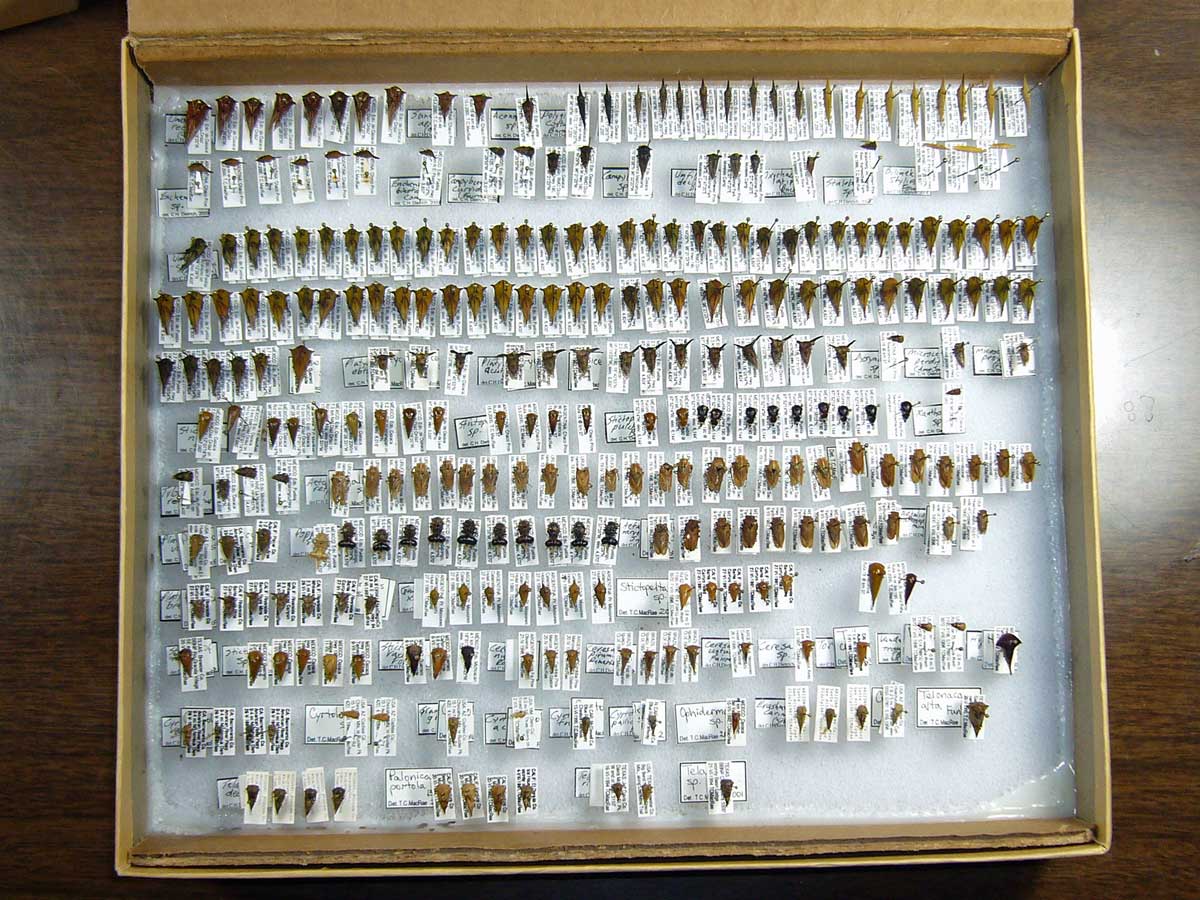
idd-treehoppersMost recently, I was able to convince Illinois Natural History Survey entomologist Chris Dietrich to take a look at the material I had accumulated during the past ten years or so, which included many specimens from Mexico and a smattering from other world areas, including South Africa. Chris did his doctoral work at North Carolina State University under “Mr. Membracid” himself, Lewis Deitz, and has since been conducting evolutionary and phylogenetic studies on Membracidae and the related Cicadomorpha. I recently received this material back from Chris (photo above), the majority of which he had been able to identify to species – only a few specimens in the more problematic genera were left with a generic ID.

Oaxaca)

Campylocentrus sp. (Mexico: Oaxaca)

Oaxaca)

Hyphinoe obliqua (Mexico: Oaxaca)

Puebla)

Poppea setosa (Mexico: Puebla)

Oaxaca)

Umbonia reclinata (Mexico: Oaxaca)

Puebla)

Umbonia crassicornis male (Mexico: Puebla)

umbonia_crassicornis_female

Umbonia crassicornis female (Mexico: Puebla)

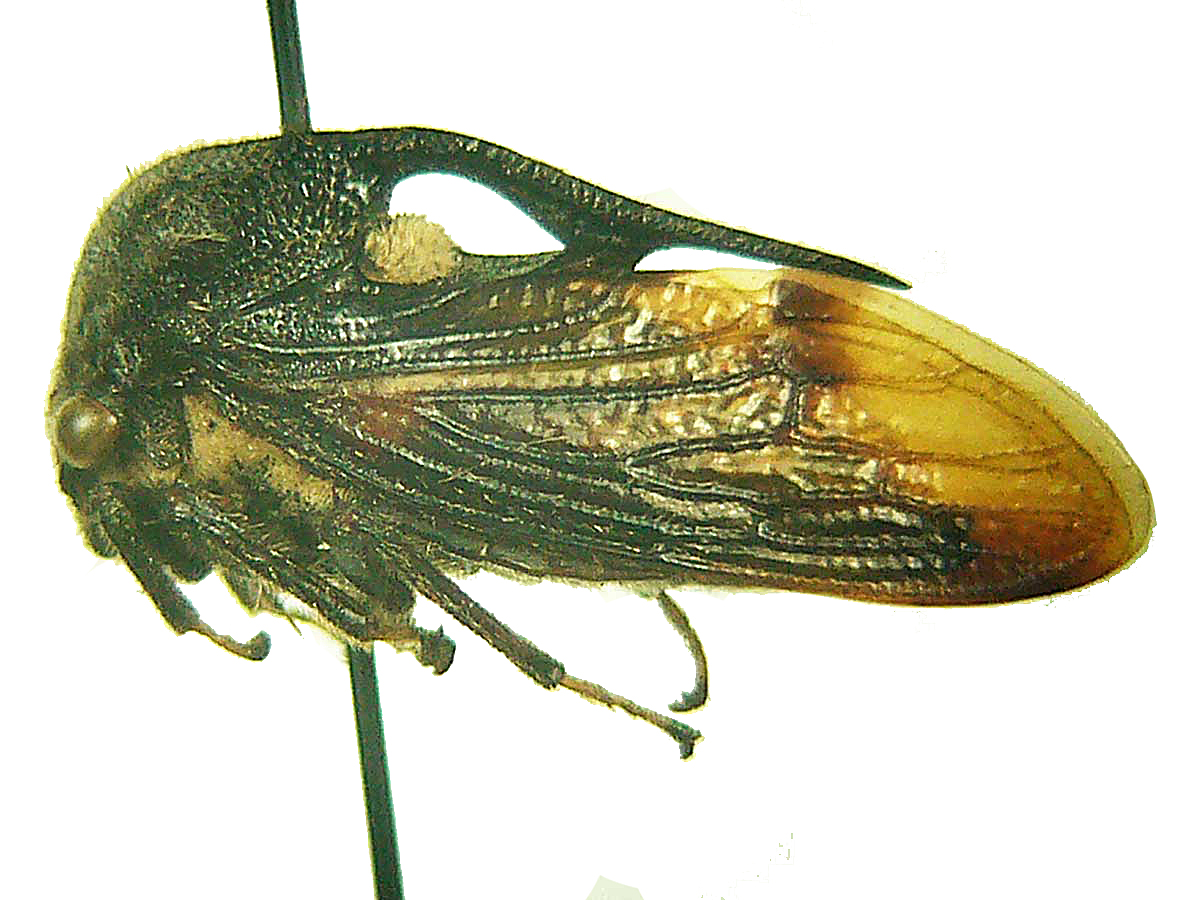
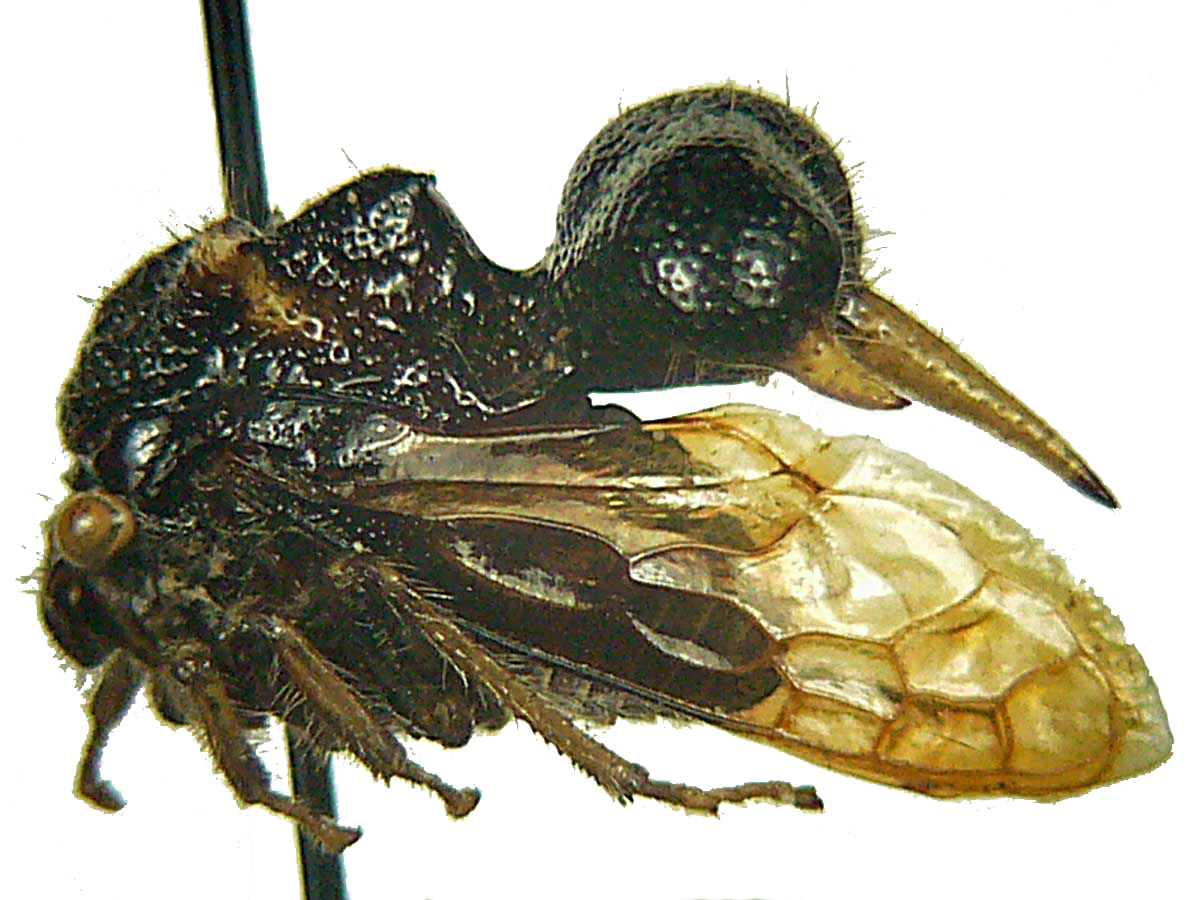
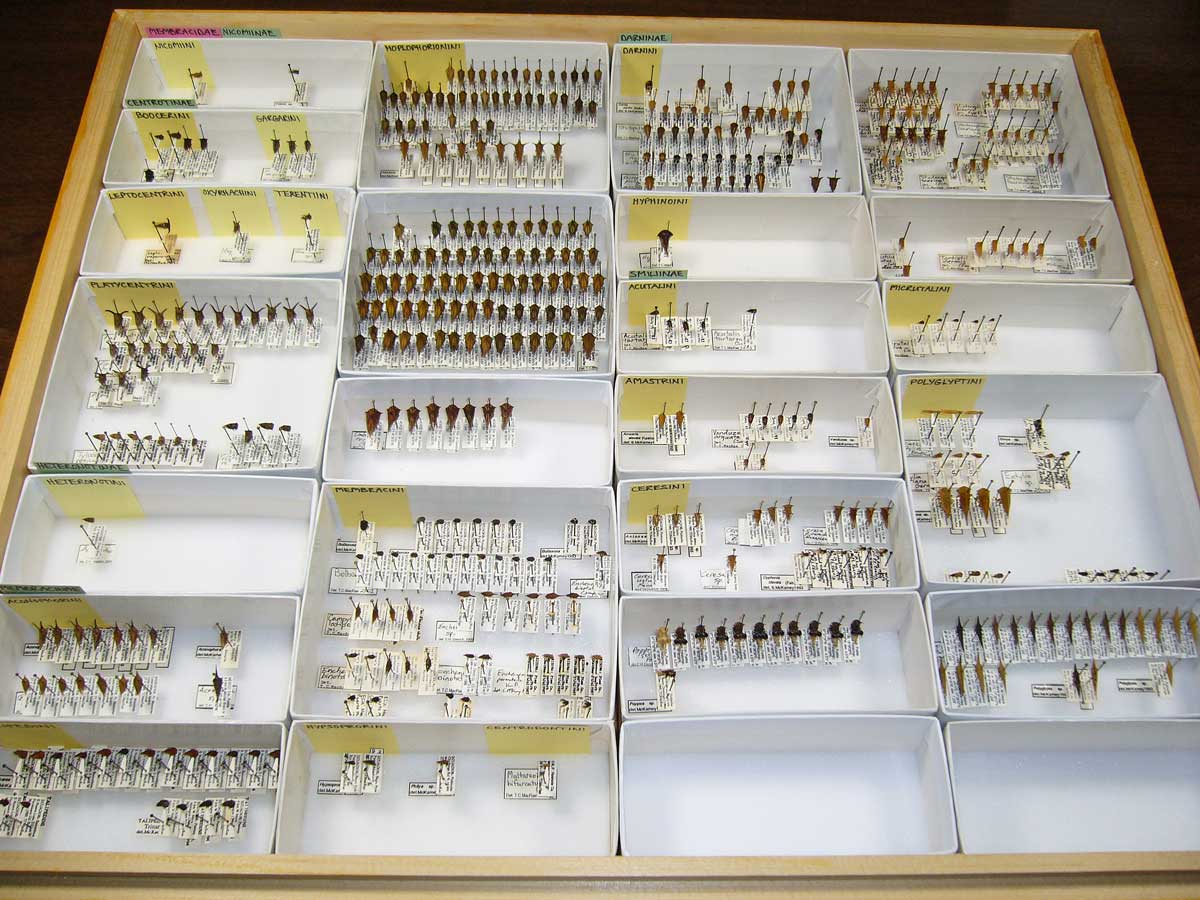
The selection of photos here show a sampling of some of the more interesting forms contained within this batch of newly identified material – all of which hail from southern Mexico. Campylocentrus sp. is an example of the primitive subfamily Centrotinae, distinguished among most membracid subfamilies by the exposed scutellum (not covered by the expanded pronotum).  Hyphinoe obliqua is an example of the largely Neotropical subfamily Darninae, while Poppea setosa represents one of the more bizarre ant-mimicking species of the subfamily Smiliinae.  Umbonia is a diverse genus in the subfamily Membracinae, occurring from the southern U.S. south into South America. Umbonia crassicornis is one of the most commonly encountered species in this genus, with the photos here showing the high degree of sexual dimorphism it exhibits.  As membracids go, these species are quite large (10 mm in length from frons to wing apex for Campylocentrus sp. and P. setosa, a slightly larger 11-13 mm for the others); however, the many smaller species in this family are no less extraordinarily ornamented.  I’ve also included a photo (below) of one of the drawers from the main collection after incorporating the newly identified material – this drawer represents about half of my treehopper collection, with the largely Nearctic tribe Smiliini and the primitive family Aetalionidae contained in another drawer. In all, the material contained one new subfamily, six new tribes, 13 new genera¹, and 30 new species for my collection. For those with an appetite for brutally technical text, a checklist of the species identified, arranged in my best attempt at their current higher classification, is appended below (any treehopper specialist who happens upon this should feel free to set the record straight on any errors). For each species, the country of origin (and state for U.S. specimens) is indicated along with the number of specimens, and higher taxa new to my collection are indicated with an asterisk(*). Don’t worry, I didn’t type this up just to post it here – it’s a cut/paste job from my newly updated collection inventory for Membracoidea. Happy reading!

¹Wildly off topic, and perhaps of interest only to me, but two of the genera represented in the material are homonyms of plant genera: Oxyrhachis is also a Madagascan genus of Poaceae, and Campylocentrus is a Neotropical genus of Orchidaceae. Scientific names of plants and animals are governed by separate ruling bodies (ICBN and ICZN, respectively), neither of which specifically prohibit (but do recommend against) creating inter-code homonyms. The number of such homonyms is surprisingly high – almost 9,000 generic names have been used in both zoology and botany (13% of the total in botany) (source).  Fortunately, there is only one known case of plant/animal homonymy fr BOTH genus- and species-level names – Pieris napi japonica for a subspecies of the gray-veined white butterfly (Pieridae) and Pieris japonica for the popular ornamental plant Japanese andromeda (Ericaceae).

treehopper_drawer
REFERENCES:

Kopp, D. D. and T. R. Yonke. 1973-1974. The treehoppers of Missouri: Parts 1-4. Journal of the Kansas Entomological Society 46(1):42-64; 46(3):375-421; 46(3):375-421; 47(1):80-130.

Wood, T. K. 1999. Diversity in the New World Membracidae. Annual Review of Entomology 38:409-435.
.


.
Superfamily MEMBRACOIDEA
Family MEMBRACIDAE
Subfamily CENTROTINAE

 *Tribe BOOCERINI
*Campylocentrus curvidens (Fairmaire) [Mexico] – 4
Campylocentrus sp. [Mexico] – 1

*Tribe GARGARINI
*Umfilianus declivus Distant [South Africa] – 3

*Tribe OXYRHACHINI
*Oxyrhachis latipes (Buckton) [South Africa] – 1

Tribe PLATYCENTRINI
Platycentrus acuticornis Stål [Mexico] – 11
Platycentrus obtusicornis Stål [Mexico] – 3
Platycentrus brevicornis Van Duzee [USA: California] – 7
Tylocentrus reticulatus Van Duzee [Mexico] – 4

*Tribe TERENTIINI
*Stalobelus sp. [South Africa] – 1

*Subfamily HETERONOTINAE

*Tribe HETERONOTINI
*Dysyncritus sp. [Argentina] – 1

Subfamily MEMBRACINAE

Tribe ACONOPHORINI
Aconophora sp. female [Mexico] – 1
*Guayaquila xiphias (Fabricius) [Argentina] – 7

Tribe HOPLOPHORIONINI
Platycotis vittata (Fabricius) [USA: Arizona, California] – 3
Umbonia crassicornis (Amyot & Serville) [Mexico] – 73
Umbonia reclinata (Germar) [Mexico] – 8

Tribe MEMBRACINI
Enchenopa binotata complex [Mexico] – 1
Enchenopa sp. [Argentina] – 6

Subfamily DARNINAE

Tribe DARNINI
Stictopelta nova Goding [Mexico] – 9
Stictopelta marmorata Goding [USA: Texas] – 1
Stictopelta pulchella Ball [Mexico] – 11
Stictopelta varians Fowler [Mexico] – 3
Stictopelta sp. [USA: Arizona, California] – 5
Stictopelta sp. [Mexico] – 5
Stictopelta spp. [Argentina] – 6
*Sundarion apicalis (Germar) [Argentina] – 2

*Tribe HYPHINOINI
*Hyphenoe obliqua (Walker) [Mexico] – 1

Subfamily SMILIINAE

Tribe AMASTRINI
Vanduzeea triguttata (Burmeister) [USA: Arizona] – 2

Tribe CERESINI
Ceresa nigripectus Remes-Lenicov [Argentina] – 3
Ceresa piramidatis Remes-Lenicov [Argentina] – 4
Ceresa ustulata Fairmaire [Argentina] – 1
Ceresa sp. female [Argentina] – 1
Poppea setosa Fowler [Mexico] – 11
Tortistilus sp. [USA: California] – 1

Tribe POLYGLYPTINI
*Bilimekia styliformis Fowler [Mexico] – 3
Polyglypta costata Burmeister [Mexico] – 18

Tribe SMILIINI
Cyrtolobus acutus Van Duzee [USA: New Mexico] – 1
Cyrtolobus fuscipennis Van Duzee [USA: North Carolina] – 1
Cyrtolobus pallidifrontis Emmons [USA: North Carolina] – 1
Cyrtolobus vanduzei Goding [USA: California] – 4
Cyrtolobus sp. [USA: Arizona] – 2
*Evashmeadea carinata Stål [USA: Arizona] – 4
*Grandolobus grandis (Van Duzee) [USA: Arizona] – 1
Ophiderma sp. [Mexico] – 1
Palonica portola Ball [USA: California] – 4
Telamona decora Ball [USA: Missouri] – 4
Telamona sp. [USA: Texas] – 1
*Telamonanthe rileyi Goding [USA: Texas] – 2
*Telonaca alta Funkhouser [USA: Texas] – 1
Xantholobus sp. [Mexico] – 1

Subfamily STEGASPINAE

Tribe MICROCENTRINI
Microcentrus perditus (Amyot & Serville) [USA: Texas] – 1
Microcentrus proximus (Fowler) [Mexico] – 1

Family AETALIONIDAE
Subfamily AETALIONINAE

Aetalion nervosopunctatum nervosopunctatum Signoret [Mexico] – 9
Aetalion nervosopunctatum minor Fowler [USA: Arizona] – 2
Aetalion reticulatum (Linnaeus) [Argentina, Uruguay] – 26

Copyright © Ted C. MacRae 2009

Add to FacebookAdd to NewsvineAdd to DiggAdd to Del.icio.usAdd to StumbleuponAdd to RedditAdd to BlinklistAdd to Ma.gnoliaAdd to TechnoratiAdd to Furl

“Armoured tank beetle”

anomalipus-elaphus1

Photo details: Panasonic DMC-FX3 (macro setting w/ auto exposure, aperature, and focus), illumination by two 23w compact fluorescent light bulbs. Post processing details: Adobe PhotoShop Elements 6.0 to crop, adjust brightness and contrast, remove pinhead, erase background, and sharpen.

In my last post, I briefly mentioned a beast of a beetle that we had given the nickname “armoured tank beetle.” Using (Picker et al. 2002), I determined this beetle to represent the species, Anomalipus elephas (family Tenebrionidae) – whose actual common name of “large armoured darkling beetle” was amazingly close to our made-up common name (not to mention the appropriateness of its specific epithet) – and linked to an online photograph of the species. As it turns out, the genus Anomalipus is quite large, with 51 species distributed throughout eastern and southern Africa – 34 of which have been recorded from South Africa proper (Iwan 2002). I’ve learned better than to ascribe species names to specimens in diverse groups of which I am not an expert based on a photograph of a common species, so for now this specimen will have to be called Anomalipus sp. Endrödy-Younga and Tschinkel (1993) report that all species in this genus are heavily built with strong legs, with most species being restricted within their geographical range to dense bush-covered patches of woody savanna.

After I wrote that post, I got to looking at the larger of my two specimens and thought, “Gee, I bet I could get a nice shot of that thing.” After all, it measures an impressive 32 mm in length (that’s 1¼ inches, folks!). Here is the result, and I have to admit I’m quite pleased given my equipment limitations (I only wish I’d thought to brush him off a little bit). This really has to be the most beautiful “big, black, ugly beetle” I’ve ever seen. I recall when I was pinning these two specimens that the exoskeleton was so hard I literally had to use my scissors to hammer the pin to get it going into the specimens. I like “armoured tank beetle” better.

In unrelated news, there are a couple of Carnivals everyone should be aware of – I’m doing my part to get the word out:

Circle of the Spineless – Ed Baker over at Invertebrate Diaries is set to host the next issue on March 2, 2009. There’s your deadline!

Linneaus Legacy – The January issue, hosted at Greg Laden’s Blog, was a good one.  Seeds Aside is hosting the February edition and is hoping to post it later this week if he gets enough submissions!  Go to this post for details on where to submit your post (or those from other blogs you enjoy).  EDIT: Too late – edition #16 is now posted.

REFERENCES:

Endrödy-Younga, S. and W. Tschinkel. 1993. Estimation of population size and dispersal in Anomalipus mastodon Fåhraeus, 1870 (Coleoptera: Tenebrionidae: Platynotini). Annals of the Transvaal Museum 36(4):21-30.

Iwan, D. 2002. Catalogue of the World Platynotini (Coleoptera: Tenebrionidae). Genus 13(2):219-323.

Picker, M., C. Griffiths and A. Weaving. 2002. Field Guide to Insects of South Africa. Struik Publishers, Cape Town, 444 pp.

Copyright © Ted C. MacRae 2009

Add to FacebookAdd to NewsvineAdd to DiggAdd to Del.icio.usAdd to StumbleuponAdd to RedditAdd to BlinklistAdd to Ma.gnoliaAdd to TechnoratiAdd to Furl

Tragidion confusion

Back in October, I discussed a recent review of the cerambycid genus Tragidion, authored by Ian Swift and Ann Ray and published in the online journal Zootaxa.  These gorgeous beetles mimic the so-called “tarantula hawks” (a group of large, predatory wasps in the family Pompilidae) and have been difficult to identify due to poorly-defined species limits, wide range of geographic variation, unusually high sexual dimorphism, and apparent potential for hybridization in areas of geographic overlap. Swift and Ray (2008) recognized seven North American and four Mexican species, including two newly described species and another raised from synonymy. It was an excellent work that provided much needed clarity based on examination of types and included detailed descriptions and dorsal habitus photographs of all species and separate keys to males and females to facilitate their identification. Unfortunately, my summary caused some confusion regarding species that occur in the deserts of southern Arizona, southern New Mexico and western Texas. In this post, I’ll clarify that confusion and provide details for distinguishing these species.

Formerly, it was thought that two species of Tragidion inhabited this region, with populations exhibiting smooth elytra and breeding in dead stalks of Agave and Yucca (Agavaceae) representing T. armatum and those exhibiting ribbed elytra and breeding in dead branches of a variety of woody plants representing T. annulatum. This concept dates back to the landmark monograph of the Cerambycidae of North America by Linsley (1962). Swift and Ray (2008) noted that Linsley’s concept of T. annulatum was based on an erroneously labeled type specimen, and that true T. annulatum referred to populations in California and Baja California (for which other names – now suppressed – were being used). This left the AZ/NM/TX populations attributed to T. annulatum without a name. The previously suppressed name T. densiventre was found to refer to populations inhabiting lowland habitats and breeding in Prosopis and Acacia (Fabaceae), but those occurring in montane habitats and breeding in Quercus (Fagaceae) represented an as yet undescribed species, for which the name T. deceptum was given. I included Swift and Ray’s figure of T. deceptum in my post – but mistakenly included the male of T. densiventre alongside the female of T. deceptum!

This error may never had been noticed, had it not been for the discriminating eyes of BugGuide contributor, Margarethe Brummermann. Margarethe is currently collecting photographs for a field guide to Arizona beetles and had photographed a male and female of a “ribbed” species in Montosa Canyon. Using the illustration of T. deceptum” in my post, Margarethe concluded her specimens represented T. deceptum and asked me to confirm her ID. When I told her the specimens represented T. densiventre, her confusion was understandable (given that her male appeared identical to the T. deceptum” male in my post). Further query on her part prompted me to do a little digging, and I discovered my error. The figure in my post has since been corrected – both that figure and a figure from Swift and Ray (2008) showing the male and female of T. densiventre are included below, along with additional information to allow their identification.

tragidion_densiventre

Tragidion densiventre Casey, 1912

Tragidion densiventre was formerly synonymized under T. auripenne (a rare species known from the four corners region of northern Arizona, southern Utah, southwestern Colorado, and northwestern New Mexico). Males of T. densiventre can be distinguished by their longer antennae, tawny-tan elytra and distinctly red-brown head, legs, and scape, while females have shorter antennae and the elytra red-orange. Both males and females of this species are distinguished from T. deceptum by their five elytral costae that curve inward toward the suture and extend to near the elytral apices, as well as their relatively narrower basal black band. Females of this species may be further distinguished from T. deceptum by their all black (or nearly so) antennae. Tragidion densiventre is found predominantly in xeric lowland desert habitats in Arizona, New Mexico, and west Texas (as well as northern Mexico). Larvae have been recorded developing in dead Prosopis glandulosa and Acacia greggii, and adults have been observed aggregating on sap oozing from stems of Baccharis sarothroides (Asteraceae) and flowers of larval host plants. Although the biology of this species has not been described in detail, it is likely that the observations of Cope (1984) for T. auripenne refer to this species. This is the classic T.annulatum” commonly observed in the desert southwest.

Tragidion deceptum

Tragidion deceptum Swift & Ray, 2008

Tragidion deceptum superficially resembles T. densiventre due to its ribbed elytra; however, it is actually more closely related to the Mexican species T. carinatum. Like T. densiventre, the males exhibit longer antennae and tawny-tan elytra, while females have shorter antennae and orange-red elytra. However, the head, legs and scape of males are black, as in females of the species, rather than red-brown as in males of T. densiventre. Females exhibit distinctly annulated antennae, in contrast to the all black antennae of T. densiventre. Both males and females are distinguished from T. densiventre by the elytral costae – only four rather than five, not incurved towards the suture and extending only to the apical one-third of the elytra. In addition, the basal black band is very broad – exceeding the scutellum by 2 × its length. This species is similarly distributed across the desert southwest as T. densiventre but occurs in more montane habitats, where it breeds in recently dead branches of several species of Quercus. Like T. densiventre, adults are often found feeding and aggregating on Baccharis sarothroides, and in a few lower canyons bordering desert habitats in the Huachuca Mountains of southeastern Arizona this species and T. densiventre have been collected feeding alongside each other on the same Baccharis plants. Tragidion deceptum is one of several species in the genus (along with T. coquus in eastern North America) that have been collected using fermenting molasses traps (more on this in a future post).

REFERENCES:

Cope, J. 1986. Notes on the ecology of western Cerambycidae. The Coleopterists Bulletin, 38:27–36.

Linsley, E. G. 1962. The Cerambycidae of North America. Part III. Taxonomy and classification of the subfamily Cerambycinae, tribes Opsimini through Megaderini. University of California Publicatons in Entomology, 20:1-188, 56 figs.

Swift, I. and A. M. Ray. 2008. A review of the genus Tragidion Audinet-Serville, 1834 (Coleoptera: Cerambycidae: Cerambycinae: Trachyderini). Zootaxa, 1892:1-25.

Copyright © Ted C. MacRae 2009

Add to FacebookAdd to NewsvineAdd to DiggAdd to Del.icio.usAdd to StumbleuponAdd to RedditAdd to BlinklistAdd to Ma.gnoliaAdd to TechnoratiAdd to Furl

Review of Calodema and Metaxymorpha

ResearchBlogging.orgNylander 2008Insects are not only the most diverse group of animals in the world, they are also among the most beautiful.  Beetles, of course (with apologies to any lepidopterists that may be reading this), are responsible for a hefty slice of this majestic diversity, with the most spectacular of these belonging primarily to a few select families.  Longhorned beetles, who combine vibrant colors with grossly elongated antennae and legs.  Scarabs, upping the anty by sporting a monstrously wonderful array of horns or just sheer size to go along with their bright colors.  Tiger beetles, whose elaborate designs and vivid colors are further augmented with toothy-jawed, behavioral charisma.  Yet, it is the Buprestidae upon which the moniker “jewel beetles” has been bestowed, despite their lack of obvious morphological gimmicks – a testament to their bright, sparkling, even gaudy colors and exquisite surface sculpture.

Calodema spp.Some of the most beautiful buprestids in the world are found in the rainforests of southeast Asia, Indonesia, New Guinea and northern Australia.  Genera such as Catoxantha, Chysochroa, Megaloxantha, and Chrysodema come to mind – big, beautiful beetles with screaming iridescence of green, red, yellow and blue.  Living jewels!  These and related genera comprise the great tribe Chrysochroini – the “classic” jewel beetles.  Not as well known but perhaps even more spectacular than the chrysochroines are two genera with strictly Australasian affinities – Calodema (left) and Metaxymorpha (below).  These two genera are the subject of a review authored by Swedish entomologist Ulf Nylander and published in the journal Folia Heyrovskyana by Kabourek.  This gorgeously printed, copiously illustrated, and handsomly bound volume is as much a work of art as it is a technical review.

Metaxymorpha spp.Calodema and Metaxymorpha are among several genera comprising the tribe Stigmoderini in the subfamily Buprestinae.  Six genera, including Calodema and Metaxymorpha, are strictly Australasian, while another five genera are of southern Neotropical occurrence.  This now-disjunct tribal distribution suggests an origin on Gondwana prior to its break up beginning about 167 million years ago during the mid-Jurassic.  Calodema and Metaxymorpha are restricted to New Guinea and its associated islands and the northern and northeastern coastal areas of Australia.  The two genera share certain features that distinguish them from other stigmoderines, notably elongated mouthparts adapted to feeding on nectar and a streamlined, aerodynamically-shaped body with the prosternum (ventral sclerite behind the head) curiously prolonged into a large conical process.  Nylander discusses the possible function of this process in serving as a ballast to help stabilize the flight of these large beetles as they fly through branches and other obstructions in the upper forest canopy searching for flowers on which to feed.  This thought is based on the observation that adult beetles dropped from any angle are able to quickly right themselves and fly away before hitting the ground, while stigmoderines in other Calodema ribbeigenera – lacking the prosternal process – more often drop to the ground and feign death (presumably an adaptation for predator avoidance in the more open environments where they occur).  Calodema and Metaxymorpha are clearly related to each other but are distinguished by the smaller scutellum and nonoverlapping elytra of Calodema versus larger scutellum and distinctly overlapping elytra (in the apical area, usually left over right) of Metaxymorpha.

Fifteen species of Calodema and 18 species of Metaxymorpha are recognized, with comparative tables, figures, and keys provided to differentiate the species and species groups within each genus.  Four species are described as new, including Calodema hanloni, C. longitarsis and Metaxymorpha alexanderiensis from Papua New Guinea, and M. hanloni from Australia.  Species treatments include synonymies, information on type specimens and type localities, label data for specimens examined, detailed descriptions, and comments on distribution and flight periods when known.  Metaxymorpha nigrofasciataHigh quality, full color photographs are provided for every species.  In many cases, multiple specimens are illustrated to show the degree of intraspecific variation encountered in the specimens studied, as shown in the examples included here for Calodema ribbei (above) and Metaxymorpha nigrofasciata (right).  These fabulous plates would almost be enough to justify ‘coffee table book’ status, were it not for the decidedly technical nature of the text itself.  Lest you think this makes for a strictly dry read, there are additional comments for several species regarding historical localities and collection circumstances.  One of the more fascinating is this passage for Calodema vicksoni from Papua New Guinea:

The holotype was captured by a native lady who found this specimen feeding on flowers near her house in the jungle in a very remote location in the Owen Stanley Range.  She caught the beetle and gave it to her husband.  Sadly enough, shortly afterwards she was bitten by a Papuan Blacksnake and died.

The morbid origins of this species become even more gruesome, as Nylander further explains that the species was named to honor the memory of the late Vickson Kotaseao – an associate at the Wei Institute in Papua New Guinea who was the first person to discover the larva of Calodema, and who was later brutally murdered in an ambush while on duty.  The book concludes with a summary of the meager biological information recorded for species of Calodema and Metaxymorpha, including observations of larvae presumed to be Calodema ribbei and their host tree.  As a special bonus, the book comes with a DVD that includes videosequences of adults of several species (Calodema regalis, C. blairi, C. ribbei, C. hudsoni, Metaxymorpha nigrosuturalis, and M. meeki) feeding on their flower hosts in the Australian and Guinean rain forests.  While the color photographs in the book are truly stunning, seeing these beetles on video emphasizes their true spectacularity as living, behavioral creatures and not just dead, pinned specimens.

This book is a beautiful assemblage of all that is currently known about some of the world’s most gorgeous beetles.  Sadly, it also emphasizes just how incomplete that knowlegde really is.  Of the 33 species now recognized in these two genera, 20 of them (60%) have been described in just the past 15 years, and virtually nothing is known of the biology of the vast majority of them.  Seven species are known from just a single specimen, and several more are known by only a very small handful.  In an age where advanced molecular genetic techniques offer great promise for unlocking stores of knowledge about evolutionary relationships among earth’s biota, Calodema and Metaxymorpha offer a sobering reminder that there is still much to do in the less glamorous world of alpha taxonomy.  As noted by Nylander, the center of diversity for these spectacular buprestids appears to be in the Papua New Guinea central highlands – primary rain forests that are increasingly threatened by both legal and illegal logging.  To destroy such a biodiversity “hotspot” would be a sad legacy to leave – but to destroy it without even knowing what was there to begin with would be simply shameful.

I thank Ulf Nylander for granting me permission to scan and post these gorgeous plates, representing but a few of the many beautiful illustrations that can be found in his book.

REFERENCE:

Nylander, U. (2008). Review of the genera Calodema and Metaxymorpha (Coleoptera: Buprestidae: Stigmoderini) Folia Heyrovskyana, Supplementum 13, 1-84.

Cicindela lengi vs. Cicindela formosa

Back to beetle blogging – I hope everyone enjoyed their holiday break as much as I. One of the tiger beetles that I most hoped to see on my trip to Nebraska and South Dakota last September was Cicindela lengi (blowout tiger beetle). This is another one of the several tiger beetle species confined to dry sand habitats in the central/northern Great Plains (Pearson et al. 2006). Its common name would suggest it prefers sand blowouts, the most barren of dry sand habitats and where the co-occurring C. limbata (sandy tiger beetle) can be found. In reality, it also can be found in slightly more vegetated habitats such as dune margins, sand flats, and sandy roadsides along with the much more common C. formosa (big sand tiger beetle) and C. scutellaris (festive tiger beetle). It can also be found occasionally on sand bars along rivers, where the aptly-named C. lepida (ghost tiger beetle) is likely to occur, and in the northern part of its range it even inhabits boreal coniferous forest along sandy roadsides.

Cicindela lengi lengiDespite its relatively loose habitat requirements, C. lengi is not a common species. In Nebraska it may be locally abundant (Spomer et al. 2008), and while planning my trip I was fortunate to get a specific locality from Steve Spomer and Matt Brust for one of these localized populations in far northwestern Nebraska. [Happily, that locality was very close to the locality where I would be looking for another priority species for the trip, C. nebraskana (prairie long-lipped tiger beetle)]. The site – a sandy roadside embankment – was characterized by a very fine-grained sand, which Matt Brust tells me the species appears to favor over the coarser-grained sands more typical of the Sandhills to the east. Success did not come easily – when no adults were seen at the site after two consecutive days of searching, I hedged my bets and extracted larvae that I hoped would represent this species for an attempt at rearing them out to adulthood in the laboratory. Persistence paid off, however – a hunch told me to make one more visit to the site after a couple days in the Black Hills, with two adults (and another C. nebraskana!) being my reward.

The individual shown in the above photo was an unexpected surprise. It was captured a day later in the Sandhills proper at a locality where I expected to see not this species, but C. limbata (which I did succeed in finding at a nearby locality – see “Cicindela limbata – epilogue“). When I first saw this individual, I thought it was the ever present C. formosa (pictured below), which it greatly resembles and which, along with C. scutellaris, occurs commonly in suitable sand habitats throughout the Sandhills. Cicindela formosa formosaSomething about the way it flew gave me pause, however, and after capturing and looking closely at it in my hand I realized what it was. Cicindela lengi is distinguished from C. formosa morphologically by its slightly narrower form and longer, narrower labrum, but the quickest field identifier is the obliquely straight humeral marking (“C”-shaped in C. formosa). There are subtle behavioral differences also – both species are alert and quick to fly, but C. lengi lands quickly after a short flight, whereas C. formosa flies further and tends to land with a comical bounce and tumble or two across the sand. Cicindela lengi and C. formosa are not closely related despite their similar appearance – the former is assigned to subgenus Cicindela (Tribonia), while the latter is assigned to the nominate subgenus. The individual pictured above represents the nominate C. lengi lengi – populations north of Nebraska and Colorado exhibit a distinct coppery underside to the thorax and are assigned to subspecies C. lengi versuta, while populations in the southwestern part of its range show broadly coalesced elytral maculations and are assigned to subspecies C. lengi jordai.

REFERENCES:

Pearson, D. L., C. B. Knisley and C. J. Kazilek. 2006. A Field Guide to the Tiger Beetles of the United States and Canada. Oxford University Press, New York, 227 pp.

Spomer, S. M., M. L. Brust, D. C. Backlund and S. Weins. 2008. Tiger beetles of South Dakota & Nebraska. University of Nebraska-Lincoln Special Publication, 60 pp.