Just published: Cicindela 44(1) March 2012

Issue 44(1) of the journal Cicindela is now hitting mailboxes. This one-paper issue features an article by Chandima D. Dangalle and Nirmalie Pallewatta (University of Colombo, Sri Lanka) and Alfred P. Vogler (The Natural History Museum, London) reporting the results of a survey of tiger beetles of Sri Lanka and analysis of their habitat specificity. The authors sampled 94 locations on the island representing six habitat types: coastal and beach habitat, river and stream banks, reservoir systems, urban man-made sites, agri-ecosystems and marshy areas, finding ten species in the genera Cylindera, Calomera, Hypaetha, Lophyra and Myriochile at 37 locations representing all habitat types except the last two. The study further revealed that the species of tiger beetles were restricted to different habitat types, with most displaying a high degree of habitat specificity. Statistical analysis revealed significant differences between two or more species in four factors: solar radiation (i.e., sun or shade), soil salinity, soil moisture and wind speed. This suggests that these are the key factors involved in habitat selectivity in Sri Lankan tiger beetle species. Other factors such as temperature, relative humidity, soil type and soil color did not differ significantly between habitats for the different species, suggesting that these criteria are essential for tiger beetle survival in any habitat type.

You may also notice that my photo of Cicindela arenicola, taken last fall in Idaho Falls, graces the cover of this latest issue. Contact Managing Editor Ron Huber to begin your subscription—membership is a very nominal $10 per year in the U.S., a little more elsewhere to cover additional postage.

REFERENCE:

Dangalle, C. D., N. Pallewatta & A. P. Vogler. 2012.  Habitat specificity of tiger beetle species (Coleoptera, Cicindelidae) of Sri Lanka. Cicindela 44(1):1–32.

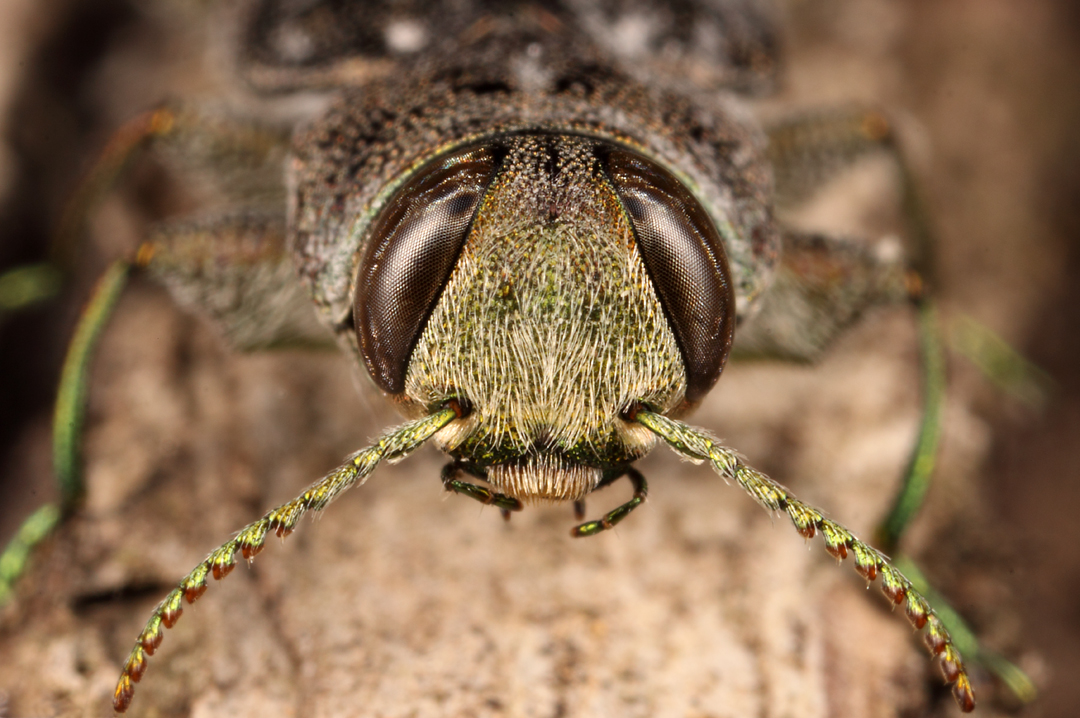
ID Challenge #18

It’s time for another identification challenge. Currently we are in Challenge Session #6, with two challenges down (SSC#12 and IDC#17) and probably four more to go (including this one). Can you identify the critter in this photo? I’ll give 2 pts each for class, order, family and genus.

I think it would be good to restate the ground rules that I use in these challenges, as they have evolved somewhat since I first began these challenges and don’t seem to be easily accessible in their entirety to those who have begun participating more recently. They are:

  1. Points will be awarded for correctly named taxa—usually 2 pts each for order, family, genus and species.
  2. Points will only be awarded for the taxa requested.
  3. Taxa must be correctly spelled to receive full credit (this includes italicization for genus and species—and yes, italicization is easy in HTML, just look it up). Misspelled or non-italicized names may receive partial credit.
  4. Taxa must be explicitly stated to receive full credit. For example, if I request order, family, genus and species for Buprestis rufipes, but only genus and species are given in the answer, then “Coleoptera” and “Buprestidae” are “implied” taxa. I can’t give full credit for implied taxa but may give partial credit.
  5. In the case of outdated nomenclature, I won’t judge too harshly if the taxon is obscure or there is still disagreement about rank. However, obvious or easily referenced obsolescences (e.g. “Homoptera”) will get dinged.
  6. Bonus points may be given (at my discretion) for providing additional relevant information (e.g., diagnostic characters, biological/ecological uniquities, clever jokes, etc.). I’m more inclined to give bonus points for unusual features of biology/morphology/ecology, etc. that are not readily found in easily-found, Wikipedia-type summaries of the subject.
  7. Be sure to examine each post carefully in its entirety for the possible presence of clues 🙂
  8. Comments will be moderated during the 1- to 2-day open challenge period to allow all a chance to participate (i.e., you don’t have to be first to win!).
  9. In the case of multiple correct answers, “early-bird” tie-breaker points will be awarded to those that answered correctly first. The more people you beat to the punch with the correct answer, the more early-bird points you get.
  10. Submitted answers will be revealed at the end of the challenge period along with the number of points earned. This is generally followed closely by a new post discussing the subject in greater detail. Also, because I’m such a big Survivor and Jeff Probst fan, I’ll also say that “once the points are read the decision is final!”
  11. Winners of individual challenges get nothing more than my accolades; however, session winners get real loot! Thus, it pays to play consistently and try even when you don’t think you know the answer. Top three points earners at the end of each session (usually 5 to 6 individual challenges) get to choose from selection of gifts that will be communicated to the winners by email.

Copyright © Ted C. MacRae 2012

My response to “Can you talk to 10-year-olds about science?”

The Bug Geek is becoming the champion of challenges! Last week she illustrated in clever graphical form the emotions she had encountered during the manuscript writing process, and this week she tops it with a challenge to see how well we can talk to 10-year-olds about science. I played along with the first one just for fun (see The Ups and Downs of Bug Collecting—I also earned the tag “easily-entertained professional research entomologist with too much time on his hands” for my efforts!), but the second challenge hit closer to home. You see, like the Geek I believe strongly that the responsibility for recruiting the next generation of scientists rests squarely on the shoulders of today’s scientists. Who else but us will excite them about science and show them not only the importance that science plays in our daily lives, but how cool and fun it is!

I’ve been a professional entomologist for three decades now, and for most of that time I’ve also been involved in giving presentations to children about insects and the science of entomology. I also happen to be an avocational entomologist—insects are not just my livelihood, but also my hobby! I live, breath, and eat insects (okay, maybe not so much the latter), and wherever I have lived my name has quickly made it to the local schools as someone who can keep the kids occupied for an hour or two. I have done dozens, perhaps even hundreds of “kid outreach” sessions during the past 30 years—how could I not take up the Geeks’s challenge?! The only question was which “entomologist” I should take the challenge as—the professional one who conducts insect research on biotech crops, or the avocational one who travels the country and beyond looking for new and rare beetles. Ultimately I decided to try both (you knew that was coming!), so here I present my 250-word (precisely) attempts to convince a 10-year-old in written form that science, and specifically entomology, is fun, cool, and incredibly important for the future of our planet.

Professional

I work for a company that helps farmers grow crops that don’t need to be sprayed with insecticides. These “insect-protected crops” are grown by farmers all across the world and help the environment by reducing the need for insecticides to grow our food. We create these plants by adding a small piece of DNA in the laboratory so that the plants produce a protein inside their leaves that only insects don’t like. Not all of the plants produce the protein, so we have to test the plants to make sure insects can’t feed on them. I do this by growing plants in the greenhouse, and when they are big enough I put insects that we grow in our laboratory on the plants to see if they can eat the leaves. If the plants don’t get eaten, I collect the seeds and grow them outside like a farmer would do. If the plants don’t get eaten by insects outside either, then other people in my company test the plants to make sure they grow normally and produce as much food as plants without the protein. Insects might become immune to the proteins, so I also test new proteins to find new ones we can use in case the old ones stop working. I mix the protein with a special insect diet to see how much protein is needed to make the insect stop eating. I love my job because I get to study bugs while helping to improve the environment.

Avocational

I have the best hobby in the world—I travel across the US and other countries looking for beetles! There are more kinds of beetles in the world than any other kind of animal, and most of them are unknown to science. When I find a new beetle, I get to give it whatever name I want. Even many of the ones that we know about we don’t know where they live or what they eat. The heaviest insect in the world is a beetle (the Goliath Beetle from Africa) – it weighs more than a mouse! Some of the tiniest insects of all are beetles also – it would take a quarter million feather-winged beetles to weigh as much as one Goliath Beetle! There are beetles in the Amazon rain forest that play “King of the Log.” Males find a rotten log and sit on it, and when another male comes along he knocks him off with his horns. He does this to save the log for a female beetle so she can lay her eggs in it. The baby beetles eat the rotten wood. I especially like tiger beetles – they have stripes and bright, metallic colors that glitter in the sun. They use their long legs, big eyes, and huge sickle-shaped jaws to run down and catch other insects and eat them. Many kinds of tiger beetles can live in only one place on earth – we must do everything we can to protect their habitats so they don’t go extinct.

Copyright © Ted C. MacRae 2012

Bicho palito, or “My longest post ever!”

The last day of my vacation week in Corrientes, Argentina got off to a bad start—heavy rain moved in during the morning, and I feared my last chance at looking for insects was about to be washed away. The weather radar, however, showed a curious, abrupt line between rain/no rain across the river in Chaco Province. At noon I decided it was do or die and played a hunch that one of my favorite spots ~50 km west might have been spared the downpour, and if not at least I tried. Yet another example of how it usually pays to play your hunches—while the skies were gray and the ground and foliage a little damp, there was plenty of insect activity afield (and perhaps even enhanced by the first significant moisture in almost two months).

Tetanorhynchus poss. n. sp. | Chaco Province, Argentina

No sooner than had I walked 20 feet from the car did I see an enormous stick insect in a low, spreading acacia tree. I don’t know why I saw it, as it’s camouflage was quite effective, but after so many years of doing this I think I’ve just developed an eye for seeing things often easily missed. This, of course, is not your normal, run-of-the-mill (at least to North Americans) walkingstick (order Phasmida), but rather a member of the curious and exclusively Neotropical grasshopper family Proscopiidae, referred to in English as “jumping sticks” and in Spanish as “bicho palito” (stick bug). I recognized the family instantly, as I had already seen one of these a number of years ago in Uruguay (though not so large as this one), and of course Alex Wild featured what has become one of his most famous photos of a species from Ecuador in one of his Monday Night Mystery posts.

The super elongate fastigium suggests this may be a new species.

Gleefully I set about taking photos, focusing almost exclusively on the head. One thing that immediately struck me was the super-elongate fastigium (frontal projection)—many proscopiids lack this elongate fastigium, and I had not recalled seeing any example as long as the one on this individual. When I saw the super-closeup I had taken of the eyes and antennal bases from the ventral view, I knew I had my own Super Crop Challenge. Of course, it was not until after I posted the challenge that I realized identifying this insect below the family level was more of a challenge than I had anticipated. How could I award points for genus when I wasn’t even sure of this myself? Eventually I enlisted the help of Alba Bentos-Pereira at São Paulo University—he and his doctoral student are perhaps the only two people in the world that are working on this family. I had suggested, based on its location in Chaco Province and consulting Orthoptera Species File Online, that it must be either Tetanorhynchus calamus or Cephalocoema daguerrei—both in the tribe Tetanorhynchini (Bentos-Pereira 2003). Alba kindly responded that it could be the former, it most definitely is not the latter, and perhaps most likely is that it represents an undescribed species (proscopiid taxonomy is still far from complete). He indicated that the presence of ventral spines on the metatibia would confirm membership in the tribe Tetanorhynchini (they are present), and provided several measurements from the male holotype of T. calamus that I could use to compare with my specimen. Although the absolute measurements might (and probably would) differ, their relative proportions should be the same as the type. Here are the results (measurements in mm):


Male type

Female

Ratio

Body

98

138

1.4

Head

18.5

32

1.7

Fastigium

9.5

19

2.0

Pronotum

20

25

1.3

Femur 1

14

17

1.2

Femur 3

28

38

1.4

Tibia 3

30

39

1.3

As can be seen, most of the measurements are consistently 1.2–1.4X that of the male type. The head, however, is proportionately longer (1.7X), primarily due to the much longer fastigium (2.0X). Is this difference significant, at least enough to consider it a different species? I am currently awaiting Alba’s opinion on that.

Like all proscopiids, the form of the face seems to be''smiling'.'

While only two species of Proscopiidae are described from Chaco Province, there are eleven species known from northeastern Argentina (which includes the provinces of Buenos Aires, Chaco, Córdoba, Corrientes, Entre Rios, Formosa, Missiones and Santa Fe)—these are shown in the following list with hyperlinks to their respective pages at Orthoptera Species File Online, along with notes on type localities for each (or synonyms) and the length of the fastigium relative to the body:  

Okay, in the title I indicated this was “My longest post ever!” Here’s why:


Congratulations to Sam Heads, whose work as a practicing orthopteran taxonomist and contributor to Orthoptera Species File Online set him up for the win with 17 points. Brady Richard takes 2nd place with 14 pts, while Chris Grinter and Dennis Haines share the final podium spot with 12 pts each. Congratulations to these folks, who jump out of the gate early in BitB Challenge Session #6.

REFERENCE:

Bentos-Pereira, A. 2003. The Tribe Tetanorhynchini, nov. (Orthoptera, Caelifera, Proscopiidae). Journal of Orthoptera Research 12(2):159–171.

Copyright © Ted C. MacRae 2012

The Ups and Downs of Bug Collecting

Recently The Geek In Question  posted an awesome graph to help visualize the stages of euphoria and despair she experiences while going through the manuscript process. Fellow grad students David Winter (The Atavism) and Morgan Jackson (Biodiversity in Focus) each took the bait and ran with their own version of the process. It has been far too many years since I was a grad student (moment of whimsy overtakes me), and I’ve gone through the manuscript process so many times now that I actually find the whole thing rather enjoyable. Presumably this results from my love of writing, combined with the sageness of having experienced most of the potential pitfalls and feeling confident in how to prevent or deal with them.

For my version of the Geek-Graph™, I thought I would take a broader look at the whole process of what it is to be a publishing Bug Collector. Here is my version:

I’ve been at this long enough to know what I like and what I don’t like, and it strikes me that I love the up front and the final product, but there are elements in between that I simply detest. I love time in the field—a bad day in the field is better than a good day of just about anything else. Some of my best field memories involved getting skunked on the collecting, just because the field experience itself was so weird, new, eventful, etc. I’ve spent days in the desert, it’s dry environs parched by drought, with nary a beetle to be had despite beating hundreds of tree branches. I hated it at the time, but I get euphoric recall of those days when I see something that reminds me of those trips. Even driving between localities, while not time “in the field,” is enjoyable for me as it’s a chance to see the landscapes. It’s only when I have to take time out to buy supplies mid-trip and, especially, hunt for hotels late in the day, that I stop enjoying my time completely.

After I’ve collected the specimens is where I hit the snag—pinning and labeling, ugh!!! It wasn’t always that way; in my younger days I rather enjoyed it. But in those days I was practicing my art and gaining skills. Now I’m as good at pinning/labeling as it gets, and my perfectionist tendencies don’t allow me to do anything less than perfect when I do do it. But it takes time—lots of time to do it perfectly, and especially when you collect the large numbers of specimens that I do. This is the point where I consistently question my decision not to pursue taxonomy as a career. I could have been enjoying the assistance of professional specimen preparators to take care of this for me, but nooo… I had to do it avocationally so I could “do my own thing”! Okay, a quick slap to the face and I’m back.

Once those specimens are pinned and labeled, it’s all fun from here on out.¹ Identifying specimens and adding my “Det. label” is enormously satisfying, even for routine, common species. Excitement mounts if the specimen turns out to be something rare, more so if it represents something I’ve not collected before. This is normal for all collectors, but for me there are additional chances for excitement if the specimens represent new information—e.g., a new state or host plant record, or (gulp!) a new species! Identified specimens also form the basis for manuscripts, and once I’m at that stage it’s pure happiness. I love writing the manuscripts. I even love revising them based on reviewers feedback (even when not very positive—hey, it makes for an improved paper). About the only negative is a little bit of post-publication depression when you realize that your paper is actually read by only a small number of specialists, and you haven’t really offered anything ground-breaking, but rather just an incremental increase in the vast, collective knowledge. But I usually don’t have time to let that get me down—by then I’m already out in the field collecting more bugs!

¹ I probably should make a confession here—sometimes I go ahead and include data in manuscripts from specimens that I haven’t even pinned and labeled yet. The siren call of the unwritten manuscript is far more irresistible than the grating nagging of the unprepared specimen!

Copyright Ted C. MacRae 2012

Chrysobothris viridiceps

Chrysobothris viridiceps on dead branch of Quercus alba | Baxter Co., Arkansas

Despite their general popularity among beetle collectors, jewel beetles (family Buprestidae) have an admittedly deserved reputation for difficult taxonomy. Part of the reason for this is the existence of several highly speciose genera. In North America, for example, nearly half of its described species belong to just three genera—Acmaeodera, Chrysobothris, and Agrilus (the latter, with nearly 3,000 described species and many more awaiting description, being possibly the most speciose animal genus in the world). Identification of species within these genera is difficult enough due to their sheer numbers and is further complicated by the existence a number of “species-groups”—i.e., groups of very closely related species that have only recently become reproductively isolated from each other (likely in response to host partitioning) but have not yet evolved obvious unique morphological characters. Perhaps the most famous of these is the “Chrysobothris femorata species-group.” A dominant component of hardwood forests throughout North America, members of this group have confounded taxonomists, collectors, and foresters alike for many years. Fortunately, the recent revision of the group and formal description of several species by Wellso and Manley (2007) have brought much needed clarity to the group. While problems still remain (C. femorata sensu novo probably still encompasses several undescribed species), most individuals can now be identified with some confidence.

Males and females both exhibit completely divided post-median fasciae

I have previously discussed three of the seven now recognized species occurring broadly in eastern North America—the nominate C. femorata, still regarded as an important pest of ornamental and fruit tree plantings, C. caddo, one of the new species described by Wellso and Manley (2007) and associated with dead hackberry (Celtis spp.), and C. quadriimpressa, mostly associated with dead branches of oak (Quercus spp.). The individuals shown here, photographed on branches of a dead white oak (Quercus alba) in north-central Arkansas this past June, represent a fourth species in the group, Chrysobothris viridiceps. Unlike most members of the C. femorata species-group, C. viridiceps can be readily recognized in the field  due to the uninterrupted costa (raised narrow ridge) that completely bisects the posterior fovea (rounded pit) on each elytron. In all other species this costa is interrupted by the fovea. Moreover, this species is the only one in the group in which the males (easily distinguished from females by the bright green frons, or face) exhibit bicolored antennal segments, with the outer portion of each segment yellow and the remainder bright metallic green. While the species name is Latin for “green face,” this character is useless for species identification, as males of all species in the group exhibit a more or less green face.

Males sport not only the green face for which the species is named, but also distinct yellow areas on the antennal segments

Females are a little more difficult to distinguish in the field because, like those of other species of the group the antennae are more uniformly reddish. Likewise, the face also lacks the green coloration of the male, and although still useful for species identification the differences among females between the different species are more subtle and require microscopic examination. However, as in the male the elytral foveae are completely divided, allowing even females to be recognized relatively easily.

Females tend to be more reddish on the legs, antennae and face

One thing I have noticed about the different members of the C. femorata species-group is the usefulness of host plant association in distinguishing the different species. Of the seven species occurring in my region, I’ve seen C. femorata associated mostly with stressed but still living trees in genera other than oak or hickory (e.g., maple, sycamore, apple, poplar, ash, etc.), C. adelpha associated exclusively with dead hickory (Carya spp.), and C. caddo associated almost exclusively with hackberry (Celtis spp.). The remaining four species are all associated primarily or exclusively with oaks, but even these species often segregate according to branch size, with C. viridiceps occurring mostly on the smallest branches, C. quadriimpressa on somewhat larger branches, C. rugosiceps on very large branches and the upper trunk, and C. shawnee on large trunks and even stumps. Not surprisingly, these size preferences reflect the relative size of the beetles, with C. viridiceps (7–13 mm in length) generally being the smallest of the four species and C. shawnee (9–18 mm in length) the largest.

Okay, now to get photos of C. adelpha, C. rugosiceps and C. shawnee!

REFERENCES:

Wellso, S. G. and G. V. Manley. 2007. A revision of the Chrysobothris femorata (Olivier, 1790) species group from North America, north of Mexico (Coleoptera: Buprestidae). Zootaxa 1652:1–26.

Copyright © Ted C. MacRae 2012

MacRae Entomology Museum Expansion

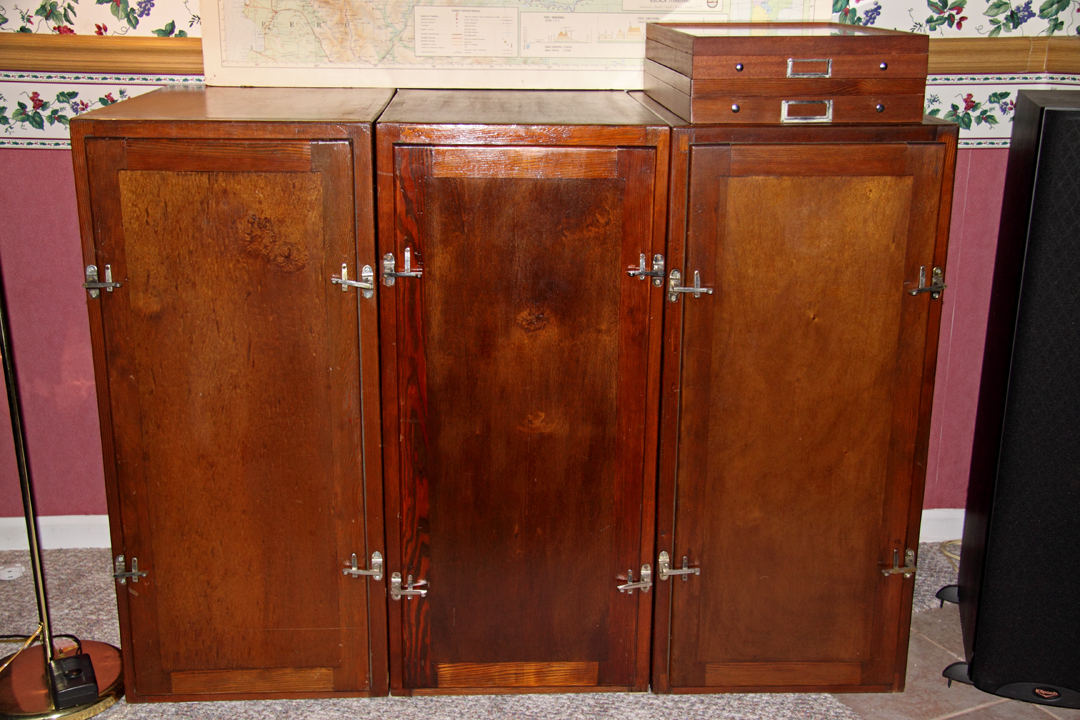
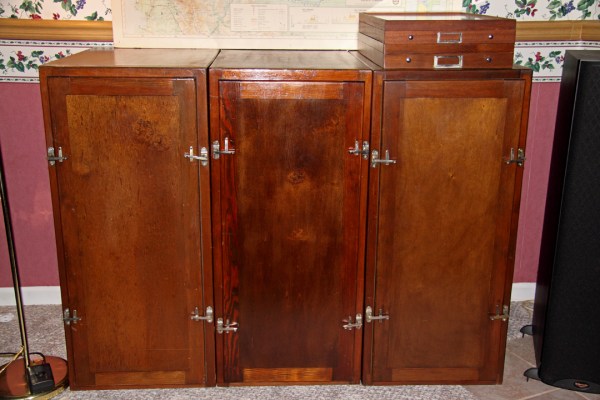
Badly needed drawer space is provided by these gorgeous, antique, hand-made, wooden insect cabinets.

Every five years or so I find myself facing the same dilemma—too many bugs and not enough space to keep them. Each time this occurs, I go through the same thought process trying to decide the best way to solve the problem. Do I create new space by buying new cabinets, or clear existing space by donating “excess” material? If money was no object it would be the former. However, money is an object—a new, premium 25-drawer cabinet costs more than $1,000, not to mention another $400 for the drawers to fill it (if I build them myself—3 times that amount if I buy them already made). In my younger, more care-free days I got away with plunking down this kind of money several times, eventually assembling my current battery of three half-size and three full-size cabinets holding a total of 111 Cornell drawers fully stocked with unit trays. These days, however, there are kids to feed and college costs looming on the horizon. I just can’t swing that kind of dough.

Each cabinet came complete with 10 hand-made, wooden, glass-topped drawers.

The alternative, however—donating away part of my collection, is equally unattractive. I’ve been collecting insects for most of my life, so it’s more than just a hobby—it’s a part of me. Nevertheless, I am able to draw a distinction between a working collection and a hobby collection, and for the most part mine is the former. I have a few “hobby” taxa like treehoppers and leaf beetles and such, and I’ve already made a number of donations from these groups over the years. However, the bulk of my collection—and hence drawer space—is taken up by just three taxa; jewel beetles, longhorned beetles, and tiger beetles. Not only are my research activities in these three groups ongoing, but a considerable amount of the material in these groups consists of voucher specimens for my publications. I just can’t think about divesting myself of material in these groups, at least not at this point in my life. Besides, pulling material for donation is, in itself, a long and very time-consuming process that I would not look forward to.

I’ve actually been debating my options for the past couple of years now, watching nervously as my inventory of specimens housed in temporary cardboard boxes started to balloon from the successes of the past several years of collecting. Temporary boxes are bad—not only is it impossible to integrate the specimens into the organization of the main collection, but they remain vulnerable to that dreaded pest of insect collectors around the world; DERMESTID BEETLES! (The one beetle I don’t like!) The likelihood of having specimens damaged by dermestids is directly proportional to the number of temporary boxes that must be checked periodically looking for any evidence of their presence. I’ve been hit by dermestids more than once, and with the number of temporary boxes that I currently have (more than 50) it has become almost impossible to monitor them frequently enough.

Unit trays designed for Cornell drawers fortuitously fit nicely inside the custom-sized drawers.

Of course, patience is a virtue, and my reward this time for not acting too rashly came in the form of an email sent to the members of our local entomology group by Mark Deering, Director of the Sophia M. Sachs Butterfly House just a few blocks from my office. Mark was an avid butterfly collector in the past but has divested much of his collection in recent years and, as a result, no longer needed the cabinets and drawers he was using to store his collection. The list of items he had for sale included a few Cornell cabinets with drawers, ostensibly perfect for my needs, but it was the last item in the list that caught my eye—several antique, hand-made, wooden, 10-drawer cabinets with drawers. Now, I love my Cornell cabinets—they provide state-of-the-art (albeit industrial-looking) protection for my collection. However, there is something appealing about hand-made, wooden insect cabinets. I can almost see John L. LeConte and George W. Horn themselves standing next to one and pulling a drawer to have a look at its contents. I quickly contacted Mark and made arrangements to look at the cabinets. Mark explained that they were part of a 40-cabinet set housing a collection of pierid butterflies that eventually found its way to the Smithsonian Institution… yes, the Smithsonian (such history!). He had gotten ahold of seven cabinets and was now selling them for a very reasonable price. The cabinets were gorgeous, and it didn’t take long for me to do the math; I could afford to buy three cabinets with drawers for a fraction of what a 25-drawer Cornell cabinet with drawers would cost. That’s 30 drawers total, each with almost as much space as a Cornell drawer.
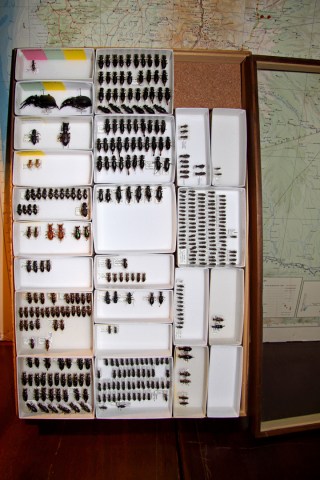
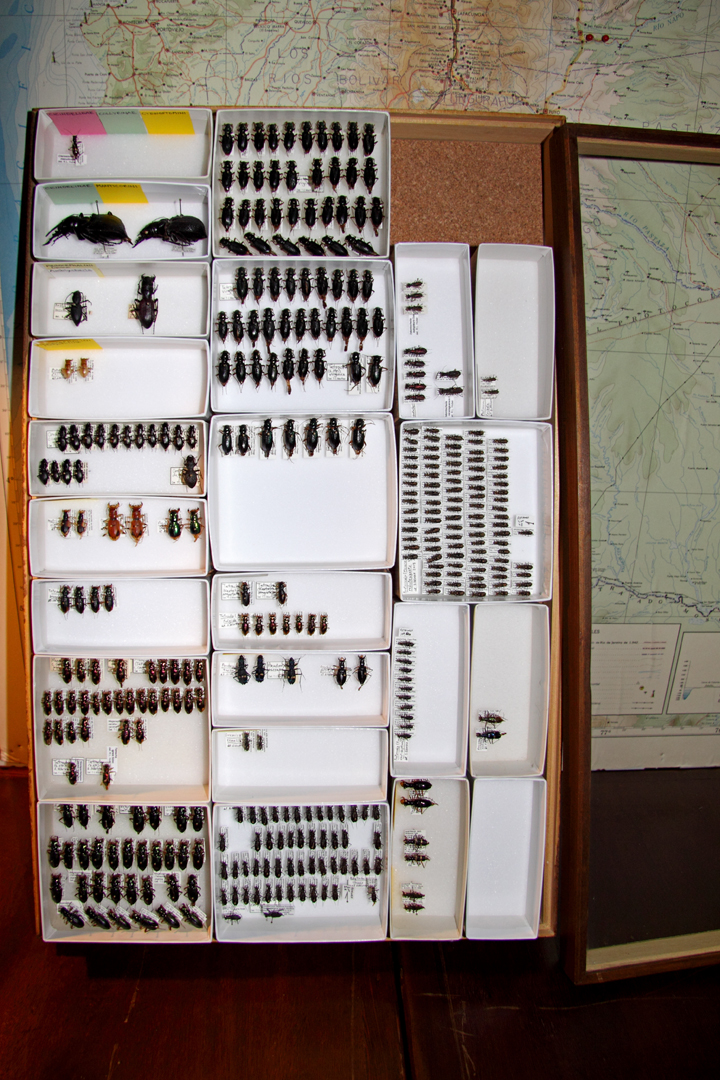
Drawer 1 of my tiger beetle collection.

I picked up the cabinets a few days later and spent the next two days rearranging furniture in my ‘museum’ to create the perfect showcase spot, cleaning the glass on each drawer (both sides), and transferring my tiger beetle collection into the first cabinet (drawer 1 of which is shown at right). Despite their age several transfers of ownership, the finish is still in very good shape with only minor nicks and scratches that add a sense of history yet don’t detract from their attractiveness. Especially pleasing was the discovery that the Cornell unit trays I use for my collection fit almost perfectly in the drawers (just an annoying empty spot in the upper right corner—this can probably be fitted with a California Academy-sized unit tray, perhaps for holding insect repellent blocks since the drawers and cabinets are not as air-tight as my modern Cornell cabinets). I’ll probably move the rest of my “hobby” taxa into the remaining drawers to free up the Cornell cabinets completely for exclusive use in housing my Buprestidae and Cerambycidae. That will take some time, but it’s a good problem to have. My only fear is that after I move things around and incorporate all of my backlogged material, I will have once again used up all of the newly available drawer space and find myself facing that same dilemma that I face every five years or so!

Perhaps a little teaser is in order—one of the species in the drawer shown at right will be the subject of an upcoming post—can you guess which one? Also, 2 BitB Challenge points to anyone who can correctly identify the country shown in the map behind the drawer.

Copyright © Ted C. MacRae 2012

A Living Jewel – Madecassia rothschildi

In North America, beetles in the family Buprestidae are commonly referred to as “metallic woodboring beetles.” This may be a perfectly adequate name—accurate and descriptive, but it’s also a bit dry and not terribly imaginative. Personally, I much prefer the moniker given to these beetles by the rest of the world—”jewel beetles!” No other name better captures the essence of these dazzling insects—brilliant, sparkling, even gaudy in coloration and with the most exquisite of surface sculptures, and no other group of buprestids better typifies jewel beetles at their most extreme than the great tribe Chrysochroini—the ‘‘classic’’ jewel beetles! Members of this tribe are found throughout the world (Chalcophora, Texania, Lampetis and Dicerca are the most familiar North American genera) but reach their zenith in the ancient rainforests of Africa and southeast Asia—big, beautiful beetles with screaming iridescence of green, red, yellow and blue. Living jewels!

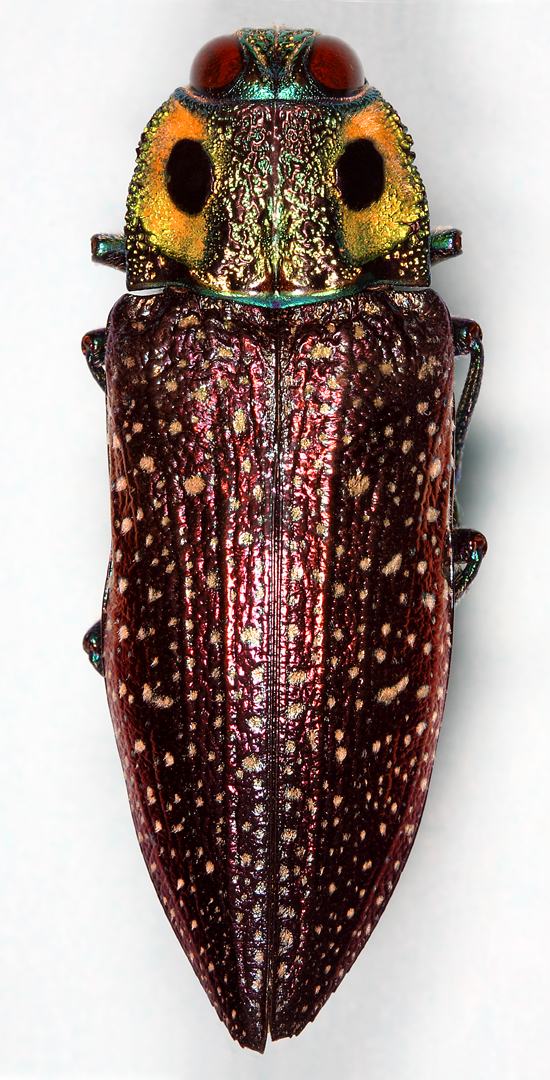
I have a fair number of chalcophorines in my collection, and among the more recent acquisitions is this fine specimen of the species Madecassia rothschildi. One of a pair of specimens given to me by friend and world buprestid-expert Chuck Bellamy, this larger of the two measures a whopping 45 mm in length (that’s almost 2 inches, folks!), surely near the top end of the range for this genus and paling only against such giants as Euchroma and Megaloxantha. The reddish-brown eyes on a brilliant green head, turquoise legs and white-flecked, wine-colored elytra are enough to make it stand out, but it is the distinctive yellow-lime “false eyes” that made me do a double-take when I first laid eyes on them after opening the box. A closer look at the eye spots reveals the yellow-lime area to be densely pulverescent.

Madecassia rothschildi and the two other species placed in the genus all hail from Madagascar (Bellamy 2008). This particular species must be rather common despite the well-chronicled disappearance of Madagascar’s native forests, as a quick Google search of the species name (or its older synonym, Lampropepla rothschildi) brings up a multitude of web sites for commercial insect dealers with this species in stock. The combination of its size, coloration, and availability must make it a popular item among philatelic collectors, and although I’m not a big fan of buying insects, I can understand the desire to purchase something as spectacular as this.

I’ll be the first to admit that these photos aren’t nearly as striking as Gianfranco Merati‘s photos of Polybothris sumptuosa, but they do well illustrate the iridescence that is common to these beetles. Iridescent coloration is due not to pigments in the exoskeleton, but rather the physical properties of different layers in the insect cuticle that reflect light of specific wavelengths in different directions (hence, resulting in apparent color shifts depending on the angle at which the subject is viewed).

Despite its commonness, it seems that virtually nothing known about the life history of this species or the host plants that it utilizes. Records in Madagascar are all from the south (Bellamy 2006), but all other references to this species consist exclusively of catalogue listings. A large, conspicuous, abundant species such as this almost begs for ecological studies—the “eye spots” can be presumed to function in predator avoidance, but how? What is the purpose of the dense brush of hairs inside the labrum (upper lip) and next to the mandibles, and why is the labrum itself so acutely emarginated? Adults are largely reproducers, not feeders—do these structures serve some other function not related to feeding? What about the dense covering of “pits” over most of the body surfaces—presumably they contain chemoreceptors for smell, but what? Host plant volatiles? Mates? Humidity? So many questions, so few answers. Imagine the even greater paucity of knowledge that exists for its smaller, less conspicuous relatives that also make their homes in the forests of Madagascar (most of them probably not adapting as well to the man-induced changes of the past century).


Congratulations to Tim Eisele, whose 13 pts not only nets him the win in Super Crop Challenge #11 but also moves him up to 2nd place in the overall standings for BitB Challenge Session #5 with 29 pts. Mr. Phidippus‘s 12 pts  just missed the win but keep him in well in command atop the overall standings at 43 pts. Strong showings by Dorian Patkus (11 pts) and Dennis Haines and Roy (10 pts each) also keep them in the overall hunt with 20, 25 and 28 pts, respectively. I suspect the top spot is now a lock, but it looks like we’ve got a real battle brewing for the remaining podium spots. There will be at least one more challenge in the current challenge session, and for the first time I am considering consolation prizes to the final 2nd and 3rd podium spots as well, so everybody will want to make sure they participate in the next challenge.

REFERENCES:

Bellamy, C. L. 2006. Insecta Coleoptera Buprestidae de Madagascar et des îles voisines. Catalogue annoté. Faune de Madagascar 92:1–267.

Bellamy, C. L.  2008. World catalogue and bibliography of the jewel beetles (Coleoptera: Buprestoidea),  Volume 1: Introduction: fossil taxa; Schizopodinae; Buprestidae: Julodinae—Chrysochroinae: Poecilonotini.  Pensoft Series Faunistica 76: 1-625.

Copyright © Ted C. MacRae 2012