Rearing the Prairie Tiger Beetle (Cicindela obsoleta vulturina)

A Prairie Tiger Beetle larva peers up from its burrow in rocky soil of a dolomite glade in the White River Hills of southwestern Missouri. The head of this 3rd-instar larvae is about the size of a pencil eraser.

I had so looked forward to the long Memorial Day weekend collecting trip – time of season and the weather were perfect, and it had been several years since I’d made a late spring swing through the woodlands, glades, and prairies of western Missouri. But after two fruitless days of searching for nearly non-existent beetles at Ha Ha Tonka State Park, Lichen Glade Natural Area, and Penn-Sylvania Prairie, I was faced with a choice: return home disappointed or try something completely different in an attempt to salvage the weekend.  I chose the latter.

A 3rd-instar Prairie Tiger Beetle larva extracted from its burrow. Total length is ~30mm.

What could be more different than the White River Hills of southwestern Missouri?  The deeply dissected dolomite bedrocks supporting xeric, calcareous glades, dry woodlands and riparian watercourses couldn’t be more different than the gentle, acidic sandstone terrain of those more northerly locations.  Its hilltop glades (“balds”) are the most extensive such system in Missouri, and I’ve already featured several charismatic insects from my travels last summer to this part of Missouri, including Megaphasma denticrus (North America’s longest insect), Microstylus morosum (North America’s largest robber fly), and Plinthocoelium suaveolens (North America’s most beautiful longhorned beetle).  One insect that I also wanted to feature from that area but that eluded me during last fall’s cold and wet collecting trip is the Prairie Tiger Beetle – Cicindela obsoleta vulturina.  This impressive species is highly localized in Missouri, occurring no further north and east than the White River Hills.  Moreover, the populations in this part of the state and across the border in Arkansas are highly disjunct from the species’ main population in the southern Great Plains.  Like a number of other plants and animals, the Missouri/Arkansas disjunct may represent a relict from the hypsithermal maximum of several thousand years ago, finding refuge in these rocky hills after cooling temperatures and increasing moisture caused the grasslands of today’s west to retreat from their former eastern extent.

The ''business end'' - four eyes and two enormous mandibles. The metallic purple pronotum is covered with soil.

Despite its restricted occurrence in Missouri, the species is apparently secure and occurs commonly on the many dolomite glades that are found in the area. I have records from a number of localities in the White River Hills, but the best populations I’ve seen occur at Blackjack Knob in Taney County.  Of course, I would have absolutely no chance of seeing the adults during this Memorial Day weekend – adults don’t come out until late summer rains trigger emergence in late August and early September.  It was not, however, the adults that I was after, for I had seen larvae of what I believed must be this species in their burrows during one of my visits to this location last summer.  Although I have collected several other species of tiger beetles in the area, I reasoned these larvae must represent C. obsoleta vulturina due to their rather large size (this species is one of the largest in the genus in North America) and because they lacked the white bordering of the pronotum typical of species in the genus Tetracha – the only other genus occurring in Missouri with species as large as this.  I had tried to extract some of the larvae for an attempt at rearing, but neither of the two techniques I tried (“fishing” and “jabbing”) had worked.  Fishing involves inserting a thin grass stem into the burrow and yanking out the larva when it bites the stem; however, I found the burrows of this species to angle and turn due to the rocky soil rather than go straight down for a clear shot.  Jabbing involves placing the tip of a knife at a 45° angle about 1″ from the edge of an active burrow, waiting for the larva to return to the top of the burrow, and jabbing the knife into the soil to block the larva’s retreat – a quick flip of the knife exposes the larvae, but in this case jabbing did not work because I always ended up hitting a rock and missing the larva before it ducked back down in the burrow.

Hooks on the abdominal hump of a 3rd-instar Prairie Tiger Beetle larva prevent it from being pulled out of its burrow by struggling prey.

I returned to the site where I had seen larval burrows last year and once again found them.  I tried fishing a few, though I knew this would be futile, then jabbing – again with no success, and then had an idea.  I went to the truck and retrieved a small trowel that I use to dig soil for filling rearing containers, then found an active burrow (larva sitting at the top, though dropping upon my approach) and got in position using the trowel as I would the knife.  I held the trowel firmly with both hands and placed my body behind it so I could use all my weight to force the trowel into the soil and past the rocks when the larva returned to the top of the burrow – worked like a charm!  After taking photographs of the first larva that I successfully extracted, I set to the business of collecting nearly a dozen more over the next couple of hours.  I then filled several containers with soil (using rocks in the larger one to create “compartments” to keep the larvae separated), poked “starter burrows” in the soil, and one at a time placed the extracted larvae in the burrows and sealed them in by pushing/sliding my finger over the hole.  I’ve found this is necessary to prevent the larvae from crawling right back out and digging a new burrow somewhere else – not a problem if there is only one larva in the container (although I prefer they use the starter burrows that I place at the edge of the container so that I can see them in their burrows to help keep track of what they are doing); however, in containers with more than one larva they will often encounter each other and fight, resulting in some mortality.  Larvae sealed in starter burrows eventually dig it open again but generally continue excavating it for their new burrow.  One larva was not placed in a rearing container – it was kept in a vial for the trip home, where it was dispatched and preserved in alcohol as a larval voucher specimen.
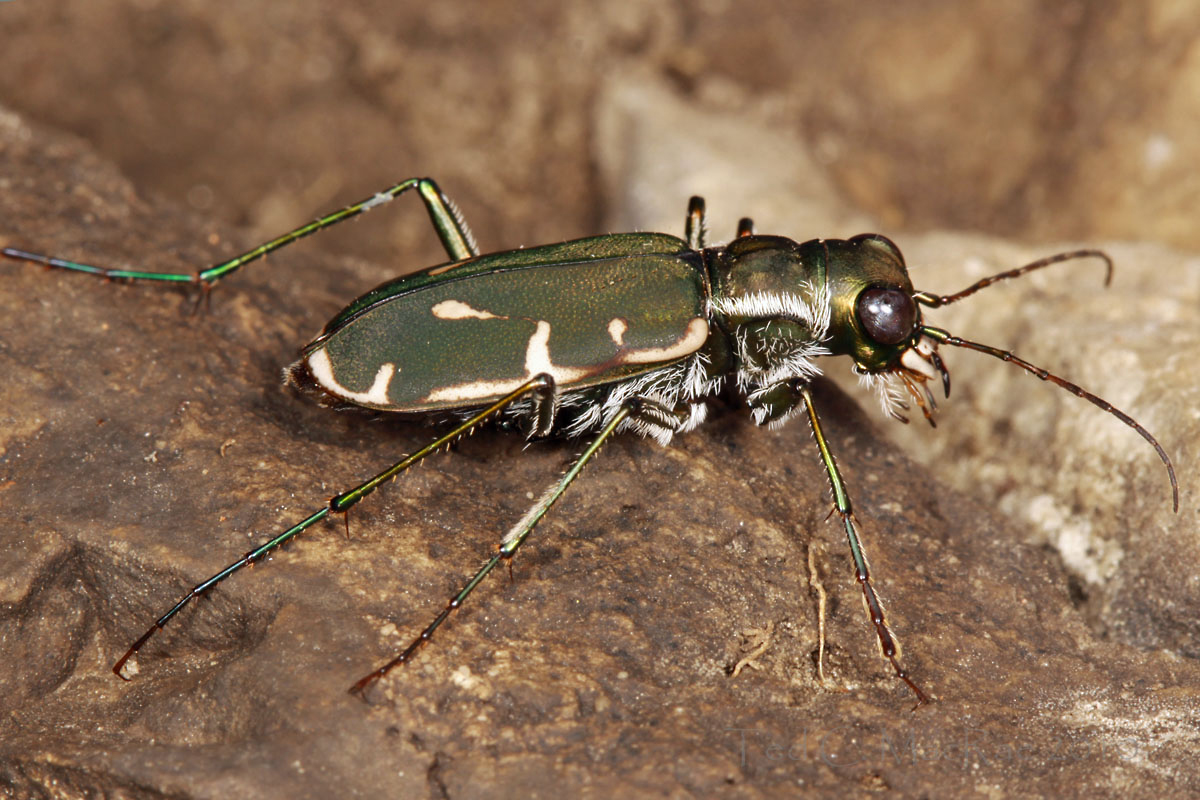
This male adult Prairie Tiger Beetle (emerged 10 weeks after collecting the larva) shows the dark olive-green coloration and semi-complete markings typical of the MO/AR disjunct population.

After returning to St. Louis, I placed the rearing containers in a growth chamber and monitored larval activity 2-3 times per week.  Whenever a burrow was opened, I would place a fall armyworm, corn earworm, or tobacco hornworm larva in the burrow and seal it shut.  Some burrows would be re-opened almost immediately and, thus, fed again, while others stayed sealed for longer periods of time.  Tap water was added to the container whenever the soil surface became quite dry – generally once per week, and by late July nearly all of the burrows were sealed and inactive. If these larvae did, indeed, represent C. obsoleta vulturina, then this would be the time they would be pupating.  On August 15 I had my answer, when I checked the containers to find the above male had emerged, and the next day two more adults emerged as well (including the female shown below).

This female adult Prairie Tiger Beetle emerged the same day as the male and shows slightly brighter green coloration.

I put the emerged adults together in the largest rearing container, and within minutes the male and one of the females were coupled. I’ve kept them fed with small caterpillars and rootworm larvae, and numerous oviposition holes were eventually observed on the surface of the soil in the container. In a few weeks, I’ll place this container in a cold incubator for the winter and then watch next spring to see if larvae hatch and begin forming burrows. If so, it will be a chance to see if I can rear the species completely from egg to adult and preserve examples of the younger larval instars.

Photo Details: Canon 50D (ISO 100, 1/250 sec) w/ Canon MT-24EX flash w/ Sto-Fen + GFPuffer diffusers. Typical post-processing (levels, minor cropping, unsharp mask).
Photos 1-2, 5-6: 100mm macro lens (f/14-f/16).
Photos 3-4: 65mm MP-E 1-5X macro lens (f/14).

Edit 9/10/10, 6:30 pm: I checked the terrarium today and discovered 24 brand new 1st-instar larval burrows dotting the soil surface.  They are quite large already, almost as big as 3rd-instar burrows of the diminutive Cylindera celeripes.  I guess I’m surprised to see larvae hatching already, as I expected they would overwinter as eggs and hatch in the spring.  Now that I think about it, however, hatching in the fall makes sense, as this gives them an opportunity to feed some before winter sets in and also allows them to burrow for more protection from freezing temperatures.  I’ve dumped a bunch of 2nd-3rd instar Lygus nymphs into the terrarium for their first meal.

Copyright © Ted C. MacRae 2010

“A good photographer is invisible…”

Yesterday I shot down to the southeastern lowlands of Missouri to spend some quality time in the field with friend and fellow cicindelophile Kent Fothergill. We were primarily looking for migrants of the Ascendent Tiger Beetle (Cicindela trifasciata ascendens), a Gulf Coast species that doesn’t normally occur in Missouri but is well known for its vagility and late-season northward migrations and which has been seen in the state once before (Brown and MacRae 2005).  No such individuals were found, but no matter – the day was really about just getting out and enjoying the camaraderie.  Nevertheless, there were some successes.  We located burrows of 1st- and  2nd-instar larvae of the Ant-like Tiger Beetle (Cylindera cursitans) at a site along the Mississippi River where Rich Thoma and I found adults last year.  Previous attempts to rear this species from larva to adult have not succeeded (Brust et al. 2005), but I collected a number of larvae and transferred them to a rearing container anyway in hopes that the techniques I’ve developed for rearing the closely-related Swift Tiger Beetle (Cylindera celeripes) might work also with this species.  We also found the beast that I am photographing above – I’ll leave it to your imagination for now to figure out what it is.

In between stops there was plenty of time for discussion on subjects entomological and non.  One thing Kent knows a thing or two about is insect photography, and during a discussion about such he made an interesting comment. Beyond focus, exposure, and composition, he noted that good insect photographers have the ability to become invisible – i.e., they combine patience and persistence with knowledge of the subject’s behavior to make it forget about the big glass eye staring at them from 6 inches away and return to going about their business.  It brought some clarity to my mind about the things I’ve tried in my own attempts to photograph insects that really did not want to be photographed (and there have been many).  The point was emphasized when I came into the office this morning and found the above photograph in my email inbox – Kent had taken it yesterday while I was photographing the bug-to-be-named-later, and I was completely unaware that I was being photographed!  Yes, a good photographer is invisible…

REFERENCES:

Brown, C. R. and T. C. MacRae. 2005. Occurrence of Cicindela (Cicindelidia) trifasciata ascendens (Coleoptera: Cicindelidae) in Missouri. Cicindela 37(1–2):17–19.

Brust, M. L., W. W. Hoback, and C. B. Knisley. 2005. Biology, habitat preference, and larval description of Cicindela cursitans LeConte (Coleoptera: Carabidae: Cicindelinae). The Coleopterists Bulletin 59(3):379–390.

Copyright © Ted C. MacRae 2010

Add to FacebookAdd to DiggAdd to Del.icio.usAdd to StumbleuponAdd to RedditAdd to BlinklistAdd to TwitterAdd to TechnoratiAdd to Yahoo BuzzAdd to Newsvine

Email to a friend

What’s so special about this beetle?

Regular readers of this blog might recognize this as the swift tiger beetle, Cylindera celeripes. This tiny, flightless beetle was once common in the central Great Plains; however, the species has experienced dramatic declines over the past century due to near complete destruction of its preferred prairie habitats.  By the time I first became interested in this species a few years ago, the Flint Hills of Kansas were its last known stronghold.

But that’s not what’s so special about this beetle.

My colleague Chris Brown and I began looking for this species as part of a survey of Missouri tiger beetles.  Although not previously known from the state, historical records from loess hilltop prairie habitats in southwestern Iowa suggested that it might be found in extreme northwestern Missouri at the southern terminus of the Loess Hills landform.  Earlier searches in this part of the state by us and others had turned up empty; however, it was easy to imagine that the beetles had eluded detection due to their small size, cryptic resemblance to ants, and limited temporal occurrence.  In an effort to understand more specifically its habitat preferences and gain a better search image for the species, we visited one of the historical Iowa localities in 2008 and succeeded in finding the species ourselves for the first time.

But that’s not what’s so special about this beetle.

Armed with this experience, Chris and I conducted another dedicated search for this species in Missouri during 2009, targeting the largest and highest quality loess hilltop prairie remnants remaining in the state.  At last, our efforts were rewarded when we found beetles in several loess hilltop prairie remnants in Atchison and Holt Counties.  Their numbers were not high at any of the sites, but the finds nevertheless represented a new state distribution for a species that has only seen contractions to its known range for many years now.

But that’s not what’s so special about this beetle.

A few weeks before finding the beetle in Missouri, I had an opportunity to visit Alabaster Caverns State Park in northwestern Oklahoma, where BugGuide contributor Charles Lewallen had photographed the species in 2003.  I not only succeeded in finding the species at the original locality but determined also that its population there was quite robust.  Indeed, on the same trip I discovered robust populations at several nearby localities, suggesting that the species occurrs commonly throughout the red clay/gypsum hills of northwestern Oklahoma.  Further observations of the species in northwestern Oklahoma last month seem to confirm this.  The beetle in these photographs comes from Alabaster Caverns, but that’s not what’s so special about it.

What is so special about it is that it’s the first ever reared individual of this species!  For those of you wondering why this is significant, until now the immature stages of this species have remained completely unknown.  A few contemporary students of the group have tried to rear the species, but the adults are delicate and do not travel well – indeed, my own first attempt to rear the species when I found it in Iowa was not successful.  However, when I found the Alabaster Caverns population, I placed ~12 adults in a small terrarium into which I had placed a chunk of native soil and moistened with water.  The adults survived well in this terrarium over several days of travel, and once back in the lab I kept them alive for several weeks by feeding them small caterpillars and fruit flies.  When larval burrows began to appear I fed them periodically with very small caterpillars and rootworm larvae, inserting them into individual burrows and sealing the burrow entrance to prevent their escape.  Additional prey larvae were inserted into burrow entrances as they were reopened, and the soil in the terrarium was moistened whenever its surface became quite dry.  By late October, all of the burrows had become inactive, and I wasn’t sure if the larvae had died or were just overwintering.  Nevertheless, I placed the terrarium in a cool (10°C) incubator, where it remained until this past March when I pulled it out of the incubator and returned it to warmer temperatures.  Within days, larval burrows reappeared, and I knew then that I had a decent chance of rearing the species to adulthood.  In early July, the beetle in these photographs emerged from its burrow – the first ever reared swift tiger beetle!  Several more adults emerged during the following 2-3 weeks.

While this rearing was in progress, I managed to find larvae of this species on a return trip to Alabaster Caverns last October.  Both 2nd- and 3rd-instar larvae were collected and preserved to go along with the preserved 1st-instar larva that I had extracted from the rearing container when larvae first began to appear.  While these preserved specimens are all that I need to complete a manuscript describing the larval instars, having reared the species completely from egg to adult as well will provide a most gratifying conclusion for that manuscript.

Copyright © Ted C. MacRae 2010

Add to FacebookAdd to DiggAdd to Del.icio.usAdd to StumbleuponAdd to RedditAdd to BlinklistAdd to TwitterAdd to TechnoratiAdd to Yahoo BuzzAdd to Newsvine

Email to a friend

Swift Tiger Beetle – good news, bad news

Sorry about the noisy video – it was shot in one of our walk-in growth chambers with fans going full-bore! Anyway, the video shows a couple of mating pairs of Cylindera celeripes (swift tiger beetle) that I brought back from the Loess Hills of extreme northwest Missouri this past weekend.  Watch carefully and you’ll see the first pair actively copulating before they break apart. After that I pan over to the second pair, which is not actively mating but have remained coupled as an example of behavior called “mate guarding” You might also notice a few very small green “bugs” in the container – these are 2nd-instar Lygus nymphs, which I placed in the container earlier in the day as prey – it was quite a sight to see the tiger beetles immediately begin chowing down on them! At the end of the video, I poke at the second mating pair with my forefinger to give an indication of their tiny size – this flightless species is one of the smallest in all of North America! Knowing how tiny the beetles are and how well they blend into their surroundings (you’ll have to imagine the 1-2 ft of plant growth that was surrounding them in the field), you can appreciate just how difficult these beetles are to detect in their native habitat.

There is a “good news, bad news” aspect to the story behind these beetles. This rare Great Plains species was unknown from Missouri until last year, when we (Chris Brown and I) discovered it in loess hilltop prairie remnants at Brickyard Hill, Star School Hill Prairie, and McCormack Loess Mounds Conservation Areas. Loess hilltop prairie is among Missouri’s most critically endangered natural community due to its restricted occurrence at the southern tip of the Loess Hills landform and more than a century of overgrazing and relentless encroachment by woody vegetation and invasive exotics. The sites where we found the beetle last year contain the highest quality loess hilltop prairie remnants in Missouri, so we are now taking a more thorough look at some of the smaller remnants that still exist in the area. The most promising of these are at Squaw Creek National Wildlife Refuge and on several privately owned lands near the known sites, and these were the sites that I searched this past weekend. Some of these sites looked promising (one in particular looked excellent), but thorough searching at each revealed no beetles. By the time I finished searching the last of them I had begun to wonder if: 1) my “search image” for the species had gotten rusty, or 2) my timing was a bit too early (last year’s populations were discovered in late June). To test this, we (daughter Madison and I) returned to one of the known sites (McCormack) where we had seen only two beetles last year (unable to capture either one). As we hiked along the ridge top leading to the spot where we saw them, I kept a close watch on the narrow trail in front of me. Nothing. However, as soon as I came upon “the spot” I saw one! I dropped to my knees and slapped my hands down on the ground, forming an “arena” between my two thumbs and forefingers, but the beetle ran over my hand too quickly and escaped. No matter – in less than a minute I saw another one and successfully trapped it under my fingers as it ran over my other hand. During the next 15-20 minutes I would see at least eight individuals along the narrow trail in this single spot. While it was gratifying to see more individuals at this site than we had seen last year, it also meant that the timing of my searches at the other sites was fine and that I was not suffering from a rusty search image. The beetle could still be at those sites where I had failed to find it, but if it is then it certainly does not occur in very high numbers. It also bothers me that at this site the beetle seems to be restricted to one isolated ridge, which appears not to have been burned in recent years (in contrast to the rest of the preserve, which seems to have been burned within the past year or so). I searched all the remaining ridge top again thoroughly after finding the beetles again this year, but no beetles were seen anywhere except this tiny spot where we have now seen beetles in successive years.

Missouri’s few existing loess hilltop prairie remnants are not only small but highly disjunct, and the flightless nature of the beetle makes re-colonization of a remnant unlikely in the event of a localized extirpation. There is obviously much we still do not know about the impact of burning on the beetle and how best to devise management plans that consider both the habitat and the beetle. However, one thing is clear – both the habitat and the beetle are critically imperiled in Missouri, and the fate of both are in our hands, right here and right now! We’d better get this figured out quick if we’re going to save both, and there seems to be little room for error. For my part, in addition to pinpointing where our populations occur and precisely what habitats are supporting them, I am trying to develop an effective rearing technique for this never-before-reared species in the event that captive rearing becomes necessary for reintroduction or augmentation of native populations. The adults seem very delicate and do not travel well, but I have found that if I prepare a terrarium in the field for transporting the adults then they survive well – even when traveling for several days. The container measures 6 1/4” H x 8” L, and I’ve placed a chunk of native soil cut from the site where I found the beetles and kept intact. The debris on the soil surface is intact as well, but the plants growing in the soil have (obviously) been trimmed. I’ll collect eggs from these individuals and experiment with different methods that I’ve been working on for rearing the larvae to see which are the most efficient and effective.

Copyright © Ted C. MacRae 2010

Add to FacebookAdd to DiggAdd to Del.icio.usAdd to StumbleuponAdd to RedditAdd to BlinklistAdd to TwitterAdd to TechnoratiAdd to Yahoo BuzzAdd to Newsvine

Email to a friend

“Trying” to photograph whirligig beetles

Nobody figured out exactly what I was doing in the photograph shown in the previous post (does anybody now see the whirligig beetles in the lower left corner of the photo?), but I sure enjoyed the guesses.  Several people alluded to dropping the camera or falling into the water, while others mentioned my heretofore unrevealed contortionist abilities.  However, Morgan Jackson‘s tale of trying to photograph Platypsyllus castoris has it all – rarely photographed species and the inordinate lengths we go through to get the shot.

Of course, whirligig beetles (family Gyrinidae) are much more commonly encountered than Platypsyllus castoris, but they can’t be any easier to photograph.  I spotted them as Rich and I balanced our way across a massive sycamore tree trunk while crossing the Black River during our early April hike of the lower Wappapello Section of the Ozark Trail.  I don’t know much more about whirligig beetles (or aquatic insects in general) than your average land-lubbin’ entomologist (in fact, I don’t think I’ve collected any since college systematics – yes, that long ago!), but for some reason I felt the need to try to photograph them.  Sure, the fallen tree provided a rare opportunity to get reasonably close to these very skittish insects without having to wade, but I think it was actually just the challenge of trying to photograph something in constant zigzagging motion that appealed to me.  Rich’s warnings that I would drop my camera were not enough to dissuade me, and after reaching the other side I ditched the backpack and tiptoed out with just my camera.

It seems like I’ve said this often in recent months, but these are my new hardest insect to photograph.  Not only are there the usual difficulties of framing and focusing a subject that is always in motion, but that motion is fast, erratic, and unpredictable, making tracking through the lens an extraordinary challenge.  Moreover, balancing precariously on a debris pile in the middle of the river strains the body and adds an element of danger (yes, I would be in deep doodoo if I dropped that camera).  I kept my eye on one particular individual that was swimming nearest to me, and after watching for a bit I saw that it was making a relatively predictable circuit that passed fairly close to me each time around.  I started trying to follow it through the lens and snap shots as it passed by – most of them turned out like this (actually, most of them turned out worse than this):

However, with each pass I got better, and I started getting shots with at least part of the beetle in focus.  So intent I was on what I was doing that I didn’t even know Rich had taken the photograph of me in the previous post until he showed it to me afterwards (he said he wanted to document the camera drop!).  Eventually I got this shot:

It’s far from a perfect photo – I had to adjust the levels because I hadn’t figured out the best lighting to use for something on the water’s surface, and the specular highlights from the flash on the forward elytron are rather extreme.  But the entire beetle is in focus, and we can make a reasonable guess as to its identity.  There are only two genera of whirligig beetles in Missouri – Dineutus and Gyrinus – and the large size (~12 mm in length) and hidden scutellum clearly identify this individual as something in the former genus.  Moreover, the rounded elytral apices (seen on other individuals as well) narrow it down even further to just a few possible species.  Unfortunately, they are distinguished primarily by ventral coloration; however, the bad first photo clearly does show dark legs, suggesting this may be D. ciliatus and not the orange-legged D. emarginatus.  I don’t even really care what species it is (did you ever think you’d hear me say that?), I’m just happy to have gotten a reasonably good photograph of an insect that surely few people have photographed well.

Copyright © Ted C. MacRae 2010

Add to FacebookAdd to DiggAdd to Del.icio.usAdd to StumbleuponAdd to RedditAdd to BlinklistAdd to TwitterAdd to TechnoratiAdd to Yahoo BuzzAdd to Newsvine

Email to a friend

Cylindera celeripes Larva Revealed

In a recent post, I provided the first ever glimpse of the previously unknown larva of Cylindera celeripes, or swift tiger beetle.  This little-known flightless species is among the tiniest in North America (adults measure only 8 or 9 mm in length), and so far nobody has succeeded in rearing the species in the lab, or even finding its larva.  As the photographs in that post showed, I am reasonably close to accomplishing that first goal, having successfully obtained a number of eggs from field-collected adults placed in a terrarium of native soil. I fed the subsequent larvae a diet of small rootworm larvae and Lygus nymphs before putting them to sleep for the winter in a cold incubator, and the larvae resumed activity when I pulled them out of the incubator 2 months ago. Since then, they have feasted heavily on small noctuid larvae that we rear in our lab, and now most of the dozen or so larvae have sealed their burrows – I presume for pupation before (hopefully) emerging as adults in the next few weeks.

Cylindera celeripes 3rd instar larva - USA: Oklahoma, Woodward Co.

There is more to the story, however.  I had brought the adults back home in June 2009 from a population I found at Alabaster Caverns State Park in northwestern Oklahoma.  This was a reasonably robust population – news enough for a species that has not been seen in good numbers for many years now, and my discovery of equally healthy populations at several other locations in the general area gives new hope for the long-term prospects of a species that some regard as a potential candidate for listing as an endangered species. It also gave me hope that I might be able to find the larva were I to return to the area in the fall.  I also had a hunch that Cicindela pulchra (beautiful tiger beetle) could be found in the area, based on some very large larvae I found during that June trip, so in early October I made a quick return to northwestern Oklahoma to search for these two species.  While it was too cold and wet to have any hope of finding Cicindela pulchra adults (I still think the species is there), it did not prevent me from realizing my other goal.  May I present one of the first ever field-collected larvae of Cylindera celeripes!

Cylindera celeripes 3rd instar larva - closeup of hump on 5th abdominal segment with hooks to aid in securing the larva in its burrow

I found the larvae at Alabaster Caverns where I had found the adults earlier in June, and although the larval burrows were very small (only 2 to 3 mm in diameter), I knew what they were immediately when I saw them.  As I had observed for the adults, burrows tended to be near the edges of barren patches of soil in proximity to vegetation and not out in the middle of the barren areas.  This makes sense, considering where it would be more likely for prey to be encountered.  Because the weather was cold and gray, I didn’t see (or expect to see) larvae actively sitting at the tops of their burrows, so I began “fishing” to see if I could yank a few from their burrows.  I fished quite a few burrows for the first half hour or so, but none of my attempts were successful.  I began wondering if the larvae were even active at all or if they had already entered hibernation for the upcoming winter.  While I was fishing, I noticed that the burrows all seemed rather shallow – only about 6” or so (most tiger beetles, having larger larvae, dig burrows that are much deeper). This gave me an idea.  I went back to the truck and retrieved a small spade that I carry in case… well, I’d never actually used it before.  Anyway, I inserted a grass stem into a burrow and sunk the spade into the ground right next to it, making sure I got the spade at least as deep as the grass blade.  I then removed the spade and sunk it into the ground on the other side of the burrow, then pried until the entire chunk of soil came up intact.  With the bottom of the soil chunk exposed, I used my knife to carefully remove slivers of soil until I found the end of the grass stem that I had inserted into the burrow.  Carefully removing the soil in this area revealed the larva in a side chamber at the bottom of the burrow.  Success!  I took many photos of that larva right then and there, and over the next hour or so collected several more larvae, all but one of which I presumed were 3rd instars.  I packed each larva in its own small vial of native soil for the trip home, and although I have been attempting to rear them out for confirmation of their identity, there is little doubt that they do indeed represent this species.

Cylindera celeripes 3rd instar larva - that grotesquely beautiful head!

The photographs I’m showing here are not those first field photographs that I took when I first discovered the larvae.  Looking at those photographs after I returned home, I was dissatisfied with the amount of soil and debris that covered the larvae – especially their grotesquely unique head and pronotum.  Instead, I removed one of the larvae from its rearing tube and gave it a “bath” – brushing it with a fine camel-hair brush in a shallow dish of water – to clean it up for the photographs shown here.  After the photo shoot, I sacrificed this larva for the collection – it will be the basis for a formal description of the larva of this species (along with examples of the 1st and 2nd instars that I had sacrificed from my rearing, not yet confident that I would succeed in getting any of the others to 3rd instar).  The only thing I am waiting on before preparing that description is to see whether I actually succeed in rearing this species from egg to adult – stay tuned!

Photo Details: Canon 50D (ISO 100, 1/250 sec, f/13-16). Canon MP-E 65mm 1-5X macro lens, MT-24EX flash (1/8 power) w/ Sto-Fen diffusers. Typical post-processing (levels, unsharp mask).

Copyright © Ted C. MacRae 2010

Add to FacebookAdd to DiggAdd to Del.icio.usAdd to StumbleuponAdd to RedditAdd to BlinklistAdd to TwitterAdd to TechnoratiAdd to Yahoo BuzzAdd to Newsvine

Email to a friend

A Horridus Birthday

For many years now, I’ve celebrated my birthday each year with the “season-opener-birthday-bug-collecting-trip.”  This happens regardless of what day of the week it falls (although two years ago I did get roped into a business trip – I made up for it by stumbling into a quick but thoroughly enjoyable tour of Pipestone National Monument before my flight back home).  Last year I made sure I got the day off and had a nice, festive (tiger beetle) birthday.  For this past April 23rd, a Friday, I celebrated my 29th birthday (for the 2-dozenth time!) by grabbing long-time field companion Rich and shooting down to Sam A. Baker State Park in the Ozark Highlands of southeastern Missouri.  My goal for the trip was to find the very uncommon Cladrastis kentukea (American yellowwood), a small tree that is known to occur in Missouri only in the White River Hills of the extreme southwest and in a few localities in and near Sam Baker State Park.  Actually, it wasn’t the tree so much that I was after, but a small jewel beetle – Agrilus cladrastis – that utilizes this plant exclusively for its larval host. To date, the only Missouri specimens of this species have been collected by the late, great Gayle Nelson on yellowwood in the White River Hills, and I wanted to see if I might be able to find it in southeastern Missouri as well.  April is still too early to encounter active adults, but my plan was to: 1) find examples of the tree, 2) collect dead wood from them, and 3) cut living branches to leave in situ for infestation this season and retrieval the next.  Long story short, I succeeded on all three counts (though I won’t know for a few weeks whether the wood I brought back actually harbors any as yet unemerged adults – finger crossed!).

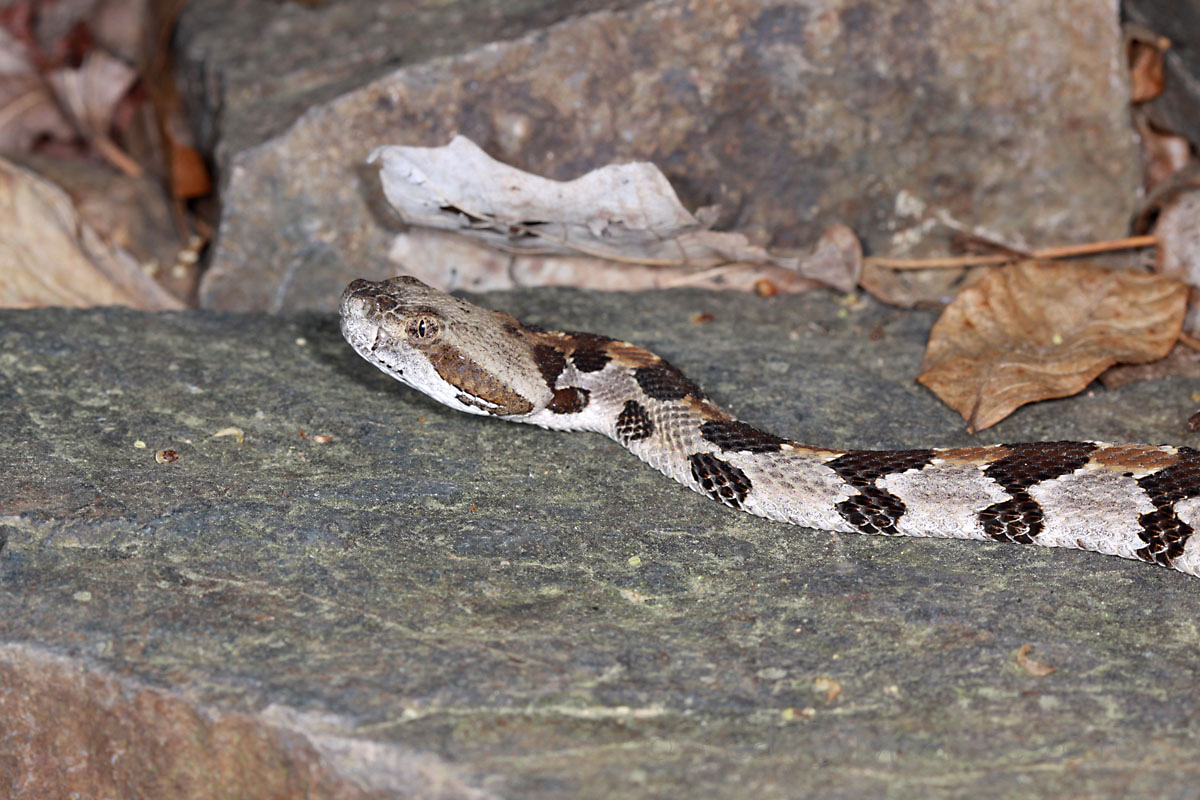
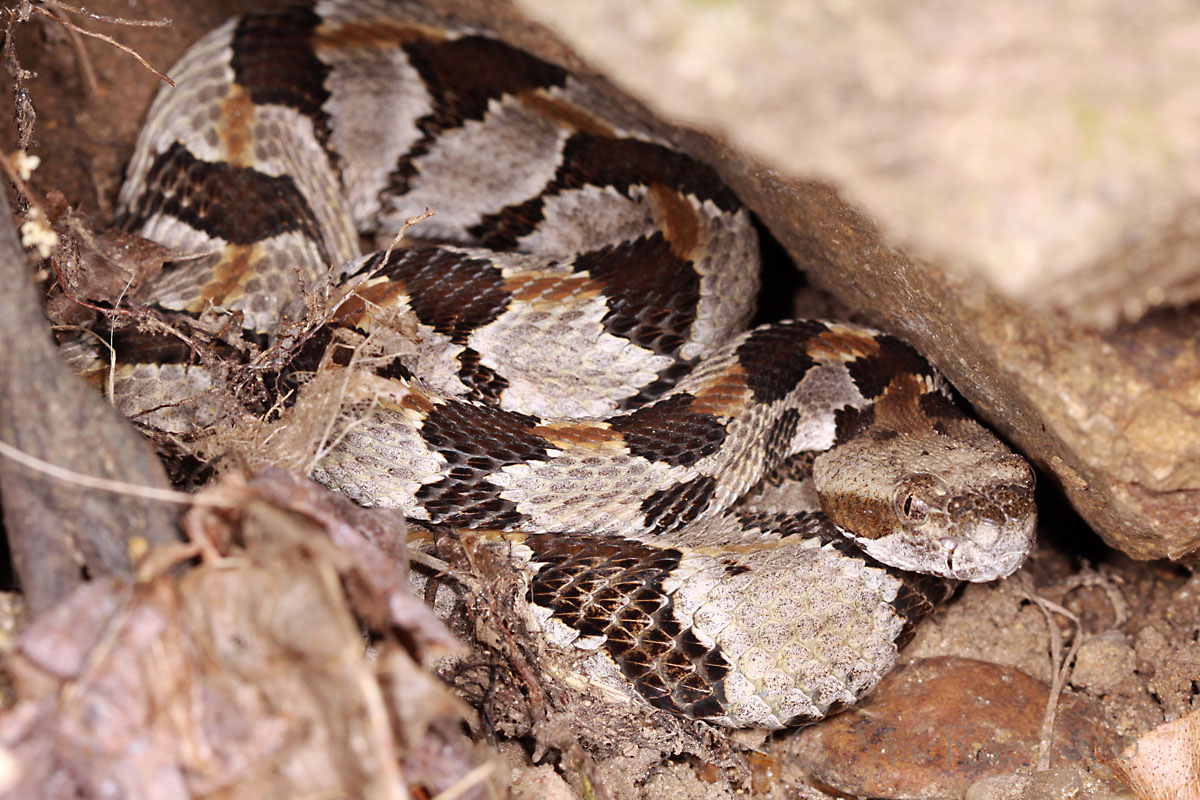
The area where we expected to find the tree was steep, rocky slopes overlooking Big Creek on the north side of the park.  Rich and I were hiking a trail below the slopes, and I had gotten a little bit ahead of him when I saw a 30″ long snake stretched straight out across the trail.  Recognizing it immediately as one of our venomous species, but not quite sure which one, I blurted out, “Wow, what a gorgeous snake!”  Rich, a better herpetologist than I, shouted from a distance back, “What kind?”  In the few seconds during which this exchange was taking place, it all registered – the dark stripe behind the eye, the bold markings (too dark for a copperhead, too big for a western pygmy rattlesnake, too widely spaced for a massasauga), the black tail (not yellow-green like a juvenile copperhead), and a tiny little one-chambered rattle!  I yelled back, “A young timber rattler!”  Rich got there promptly, and we decided that it must be a yearling based on the time of year, its length, and the size of the rattle.

I have seen a few timber rattlesnakes (Crotalus horridus) in Missouri over the years, but never like this.  My previous sightings have all been fleeting glimpses after hearing them shooting into the underbrush to escape my close approach – me oblivious to their presence until it was too late.  This young snake, by contrast, didn’t flinch as I approached (carefully), set down the backpack, and assembled the camera to begin taking photographs.  As I began taking a few photos of the head area (from a respectful distance – the vision of that terrifyingly aggressive prairie rattlesnake from two years ago still lingers), it became agitated and started moving for cover.  Rich wasn’t too anxious to head it off at the pass, but I wasn’t satisfied with the shots that I’d gotten so far, so I grabbed my net to block it from disappearing into the litter.  That caused it to pause just long enough for me to get back into position and frame a shot… that I couldn’t get off before it started moving again!  We did this a few times until it finally just crawled right into the net – now what?!  I carried the net over to some large rocks on the side of the trail and used them to flip the net and dump out the snake, which immediately headed for cover underneath the rocks.  I figured the photo shoot was over then, but the space under the rocks was not deep, and after a bit of probing for escape routes the snake eventually settled into a money pose and I was able to snap away with glee – what do you think?

Missouri has five venomous snake species, all of which are pit vipers with three being rattlesnakes.  I’ve featured two of these in previous posts – the Osage copperhead and the western pygmy rattlesnake.  Both of these species occur throughout the Ozark Highlands, although the latter is more common in the southwestern part of the state.  The third rattlesnake species in Missouri, eastern massasauga, is rare in wet habitats scattered across northern Missouri, while the cottonmouth (or water moccasin) is limited to stream, river, and swamp habitats in the southern Ozarks and southeastern lowlands.  Many internet references list the western massasauga also as occurring in Missouri, but this subspecies is not included in the most recent Snakes of Missouri (Biggler and Johnson 2004).  Within Missouri, timber rattlesnakes have a statewide distribution, but they have been extirpated by humans from many areas and now occur as small populations in scattered locations across the state.  The same is true in other parts of their range as well, particularly along the western and northern limits.  It is thus a rare and exciting treat to see one of these magnificent animals, although the reasons for its rarity are both sobering and maddening.

REFERENCE:

Briggler, J. and T. R. Johnson.  2004. Snakes of Missouri. Missouri Department of Conservation, Jefferson City, 16 pp.

Copyright © Ted C. MacRae 2010

Add to FacebookAdd to DiggAdd to Del.icio.usAdd to StumbleuponAdd to RedditAdd to BlinklistAdd to TwitterAdd to TechnoratiAdd to Yahoo BuzzAdd to Newsvine

Email to a friend