Photographing the Limestone Tiger Beetle

Seeing and photographing the beautifully black Prairie Tiger Beetles (Cicindelidia obsoleta vulturina) in southwestern Oklahoma was a lot of fun, but by Day 5 I was ready to look for one of my top goals for the trip—Cicindelidia politula (Limestone Tiger Beetle). Occurring primarily in Texas (but also sneaking up into Oklahoma), this would be my first attempt to search for the species. I had gotten a few localities in northern Texas from trusty colleagues, and I knew the beetles occurred on limestone outcroppings in dry to xeric upland habitats (Pearson et al. 2006)—usually starting in late September.  Nevertheless, I always get a little apprehensive when I drive long distances to look for tiger beetles I’ve never seen before. Will I recognize it? What if I find another, similar looking but more common species and assume I’ve found it? Will the season be right? Many species, especially those associated with xeric habitats, depend on timely rains to make their appearance. Will I find the proper microhabitat? There are sometimes seemingly minor details that can make a habitat suitable or not for a particular species.
Cicindelidia politula politula | Montague Co., Texas

As can be seen by the above photo, I did succeed in finding the species. However, it wasn’t easy, and for the better part of Day 5 I wondered if I would even be able to capture a specimen, much less succeed in photographing the species in its native habitat. I actually saw the first individual of this species in Oklahoma—sitting on the very first exposed limestone rock at the very first locality I went to. My rule for photographing tiger beetles that I’ve never seen before is to collect the first individual and keep it alive in a vial. In the event I never see another individual or fail in my attempts to photograph them in the field, the first individual becomes my voucher specimen and studio backup. Fortunately, I rarely have to resort to studio shots, but in this case I muffed my attempt to capture the specimen! I searched the locality for a good hour and never saw another one until I circled back to where I started, and there it was again (it just had to be the same one). Believe it or not, I muffed the capture attempt once again! That was my last chance at the Oklahoma site, so it was a rather dejected 2-hour drive south to Montague Co. in northern Texas—knowing that I’d seen it and had my shot at it (two shots, actually) but still found myself empty-handed.

A serviceable photo, but like most of confined individuals it suffers from lack of ”pizzazz.”

My luck improved in Montague Co., although not right away or that much when it did. I had just about given up at this second locality when I saw one. This time I used the stalk-and-slap technique followed by a quick pounce to seal down the net around its perimeter and prevent escape by the beetle (they are real good at quickly finding the tiniest gap between the net rim and the ground and then zipping away in a flash). This time I succeeded in capturing the beetle and thus had my voucher, but my pounce was a little too rough on the beetle, resulting in an extruded genital capsule. This made it completely unusable for photographs (imagine a big orange blob sticking out of the butt of the beetle—not good, photographically!). Of course, finding a beetle at the site caused me to spend more time searching, but I never saw another beetle there.

The shiny black to blue-black elytra with white markings absent or limited to the apices are characteristic for the species.

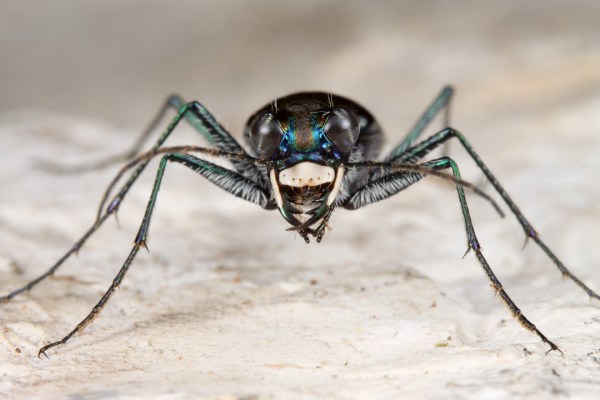
At this point I had a decision to make—if I drove to the next locality on my list (2-hour drive), I probably would not arrive with enough time before sunset to find beetles. I decided not to waste the remaining daylight and instead just bushwhack where I was to look for similar roadside habitats and drive on after sunset. I found another good habitat fairly quickly, and within minutes after starting the search I saw one—and missed it! But then I saw another one—and missed it, too! Now my confidence was shaken, as neither of the two techniques I use most commonly for capturing tiger beetles were working. When I used the “stalk-and-slap” method the beetles always found a gap on the rough, rocky ground and got away, and when I used the “tap-and-sweep” method the beetles would hunker down at first and then fly right after the net passed over them. I would miss a total of eight (eight!) beetles before I finally (finally!) caught one, and then I would miss three more beetles afterwards! That single beetle is shown in the above photographs, which were taken after placing the beetle on a large, flat limestone rock that I laid on the bed in my hotel room that night (carrying that huge limestone rock into the hotel room was an experience!).

I really dislike photographing confined insects. Even if one prepares a wholly natural looking set and manages to cajole the subject into standing still, they rarely look quite right. I do like the first photo in the series, just because it’s a well composed face shot, but I’m not so fond of the more ‘classic’ view of the beetle represented by the second photo. Technically it’s an adequate photo that shows the beetle and all of its salient characters; however, it lacks, well… oomph, because the beetle isn’t really doing anything—the photo tells no natural history story. Still, an adequate photo that lacks oomph is better than no photo at all, so I made the best of my opportunity to take studio shots of the one good beetle I had and hoped for better luck the next day.

Exposed limestone road bank in Johnson Co., Texas—perfect habitat for Cicindelidia politula

The next day brought the luck that I was looking for. I was close to the next locality on my list when I saw a road bank with exposed limestone that just seemed to call out, “Search me!” I stopped and began searching, and within a few minutes I saw the first beetle—and missed it! Arghhh, not again! I would actually miss a few more before I finally caught one, so by now my confidence was destroyed. It’s been a long since I’ve had this much trouble catching tiger beetles, and if I was having this much trouble catching them, how on earth could I even contemplate trying to photograph them. However, the nice thing about finding a spot where beetles are out in numbers is the opportunity to try again—practice makes perfect. I decided my previous attempts had all been a little too lackadaisical and started buckling down and really concentrating on my technique. Not surprisingly, I started having success in capturing the elusive beetles (tap-and-sweep worked best), and after a time I felt like I had a good enough feel for the beetle’s behavior to begin trying for field photographs.

Cicindelidia politula politula | Johnson Co., Texas

Not surprisingly, given how difficult they were to catch, this also proved to be one of the most difficult species of tiger beetle that I’ve ever tried to photograph. Like many other tiger beetles that live in hot, xeric, open habitats they were extremely wary and difficult to approach, a behavior that was exacerbated by the now midday sun. Their escape flights were not very far, but far enough that if I’d already gotten into a prone position I had to get up and start all over again. The task was made even more difficult by the hard, jagged, rough-edge rocks on which I had to lay and crawl—ouch! Several individuals are represented in the field photographs shown here, each of which I had to “work” for some amount of time before I was able to finally get close enough to start taking photos (and representing only a few of the many individuals that I actually spent time “working”). Usually, the first photos of an individual are never very good but start the process of getting the beetle accustomed to my presence and the periodic flash of light. Eventually, if I’m lucky, it settles down and resumes normal searching and thermoregulatory behaviors, and I can then get as close as I want and really work the angles for a variety of compositions. I no longer try to approach beetles from the ‘proper’ angle; they turn so much while moving about that it’s easier to just wait for them to assume desired angles as they move about and be ready to shoot when it happens. Field photography of unconfined tiger beetles in their native habitat is hard and time consuming, but the results are well worth the effort. Compare the staged photos of the Montague Co. individual with the field photos from Johnson Co. What marvelous displays of active beetles engaged in natural behaviors in their native habitat the latter represent!
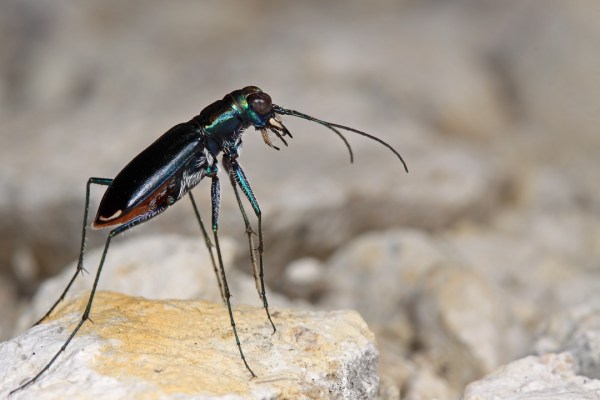
By midday the adults start ”sun-facing” to minimize thermal exposure in their hot, xeric habitats.

After getting several good photos of the beetle in its habitat, I decided it was time to try for some really close photos and added a full set of extension tubes to the camera. A set of tubes with a 100mm macro lens provides close to 2X magnification, but it also reduces the available working distance—a real challenge with wary tiger beetles under a midday sun! I spent quite a bit of time trying to get close enough to take advantage of the additional magnification, but I wasn’t successful until I encountered the individual in the photos below shade-seeking at the base of a yucca plant. Shade-seeking beetles tend to stay put and not move as much (although they still rarely just sit there).
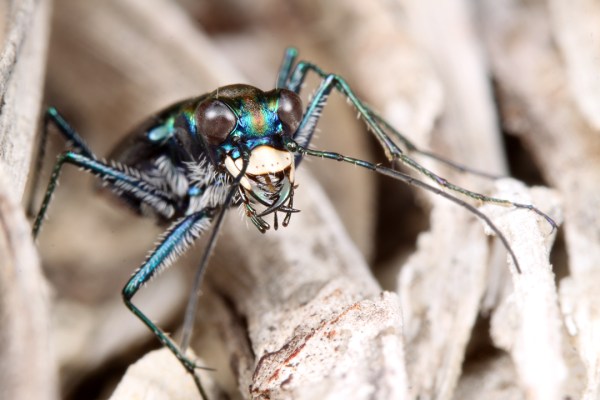
Shade-seeking is another strategy to avoid the midday heat.

I worked this beetle for several minutes and managed to get a number of shots, each closer than the previous and culminating in the nice portrait below.

The ”pièce de résistance”—Cicindelidia politula politula at 2X life size!

My photographic appetite now completely satiated, I spent the rest of the day searching for (and finding) additional localities for the species in the area. I found them more often associated with older, level exposures that had at least a small amount of vegetation. In contrast, newer or steeply sloped exposures or those completely devoid of vegetation rarely had beetles associated with them. I had now spent two days working on C. politula, but the results—both as a collector and as a photographer—made it time well spent. I felt like I “understood” the beetle. However, with only two days left in the trip, it was time to start working my way back towards Missouri and focusing on the few additional goals I still had for the trip.

REFERENCE:

Pearson, D. L., C. B. Knisley and C. J. Kazilek. 2006. A Field Guide to the Tiger Beetles of the United States and Canada. Oxford University Press, New York, 227 pp.

Copyright © Ted C. MacRae 2012

Extreme sexual dimorphism in Buprestidae: Xenorhipis hidalgoensis

Yesterday I received in the mail a package of specimens for identification from Dan Heffern in Houston, Texas. I first began corresponding with Dan about 25 years ago—not long after I myself became interested in Coleoptera, and as an avid collector of longhorned beetles (family Cerambycidae) Dan knows a thing or two about jewel beetles (family Buprestidae) as well. Over the years, Dan has come up with a number of great buprestid species from Texas, especially through rearing, many of which he has graciously sent to me examples for my cabinet.

Xenorhipis hidalgoensis (male, length 5.3 mm) | Hidalgo Co., Texas

The present package was no exception, as it contained a male/female pair of one of North America’s least frequently encountered buprestids, Xenorhipis hidalgoensis. Dan had reared them from dead branches of Condalia obovata collected in south Texas as part of a multi-year beetle survey in the Lower Rio Grande Valley. He had mentioned to me that he would be including them in the sending, but that did nothing to diminish my excitement upon seeing the specimens when I opened the box. The species was first described from Hidalgo Co., Texas (Knull 1952), and other than a single record from the neighboring Mexican state of Tamaulipas (Nelson et al. 1981) subsequent mentions of the species have been limited to catalogue listings and inclusion in keys to species. Thus, these specimens represent not only a nice addition to my collection, but also the first reported larval host for the species.

Xenorhipis hidalgoensis belongs to the tribe Xenorhipini, the males of which exhibit a distinctive specialization of their antennae in that the distal segments are highly modified into a very extended flabellate or lamellate condition. Females, in contrast, retain the serrate antennal condition that is more typical throughout the family.  Differences in antennal morphology aren’t the only sexual differences exhibited by members of the tribe, as males and females often exhibit differences in coloration as well. This is especially true in the genus Xenorhipis, and I’m not aware of a more striking example of this than X. hidalgoensis (compare these photos to those of male/female pairs of X. bajacalifornica, X. brendeli and X. osborni in A new species of Xenorhipus from Baja California).

Xenorhipis hidalgoensis (female, length 6.4 mm) | Hidalgo Co., Texas

The highly modified male antennae are interesting from both an evolutionary and functional standpoint. Similarly modified male antennae are found in a few other groups of Buprestidae, including the genus Knowltonia in western North America (four species), the monotypic genera Mendizabalia and Australorhipis in South America and Australia, respectively, and two species in the enormous Australian genus Castiarina (Bellamy and Nylander 2007). The Xenorhipini, however, with 20 species distributed throughout the Western Hemisphere, is by far the most diverse group exhibiting the condition. Despite the similarity of their antennae, the taxonomic distance between these groups and differences in the detailed structure of the numerous olfactory sensillae that cover the modified segments (Volkovitsh 2001) suggest that the modifications have arisen and evolved independently in these several disparate taxa.

All Buprestidae exhibit sensory structures on their antennae, presumably with olfactory and/or thermosensory functions; however, Wellso (1966) provided strong evidence that females of X. brendeli release pheromones that are highly attractive to males and detected by their elaborate antennae. Caging studies with virgin and mated females revealed that males were highly attracted to virgin but not mated females, and that mated males were not attracted to either virgin or mated females and died shortly thereafter.  Further, more than 80% of males were attracted within a 1-hour period just past midday. It is assumed that chemoreceptors for detecting female pheromones are located on the male antennae, as males with their antennae removed were not attracted to caged virgin females but were able to mate when caged with them. This suggests that the male antennae evolved in response to selection for greater surface area, which allows placement of more sensillae to detect female pheromone. Wellso observed also that adults are very short-lived, with no individuals living longer than 48 hours (perhaps due to reliance on pheromone attraction rather than longevity for mate location). This, along with their very short daily activity period, may explain  why adults of species in this tribe are so seldom encountered in the field.

Male with highly flabellate antennae

Female with unmodified serrate antennae


REFERENCES:

Bellamy, C. L. and U. Nylander. 2007. New genus-group synonymy in Stigmoderini (Coleoptera: Buprestidae). The Coleopterists Bulletin 61(3):423–427.

Knull, J. N. 1952. A new species of Xenorhipis from Texas (Coleoptera: Buprestidae). Entomological News 63(7):177–178.

Nelson, G. H., D. S. Verity, and R. L. Westcott. 1981. Additional notes on the biology and distribution of Buprestidae (Coleoptera) of North America. The Coleopterists Bulletin 35(2):129–152.

Volkovitsh, M. G. 2001. The comparative morphology of antennal structures in Buprestidae (Coleoptera): evolutionary trends, taxonomic and phylogenetic implications. Part 1. Acta Musei Moraviae, Scientiae biologicae (Brno) 86:43-169.

Wellso, S. G. 1966. Sexual attraction and biology of Xenorhipis brendeli (Coleoptera: LeConte). Journal of the Kansas Entomological Society 39(2):242–245.

Copyright © Ted C. MacRae 2012

Red-eyed Devil

In June 1994, I made my first insect collecting trip to Big Bend National Park.  Both of my previous visits to Texas had been to the Lower Rio Grande Valley, so I was anxious to see what beetle treasures awaited me in this huge chunk of western Texas.  For three days I sampled the astounding diversity of beetles found in the park’s low desert scrub, oak/juniper woodlands, and high pine forests, and on the final day I decided to visit the sotol grasslands – a transitional habitat between the desert and woodlands in the Chisos Mountains foothills.  Sotol (Dasylirion wheeleri) is the host plant of jewel beetles in the genus Thrincopyge – exquisitely beautiful beetles of metallic blue or green and vivid yellow.  Larvae bore through the plant’s dried flower stalks, while adults wedge themselves in the base of this agave-like plant, hidden from view by the plant’s long, strap-like, saw-toothed leaves.  I had not yet seen these beetles for myself, so I began searching the through the plants – carefully prying apart the wicked leaves in hopes of seeing adults peering up from the base, and then using my foot-long forceps to extract them.  It’s a painful process, as no amount of care completely prevents the plant’s stout, recurved spines from impaling and ripping forearm flesh while trying to grab and pull out the beetles! 

While prying apart the leaves of one particular plant, I was startled by one of the most imposing-looking insects that I have ever seen as it jumped up on top of the foliage and assumed this decidedly aggressive posture.  Although I recognized it as some type of katydid, it was unlike any I’d seen before – large and robust, vivid green and yellow with flashing red eyes, its short spotted hind wings outstretched, spiny forelegs held high, and huge jaws spread wide open.  Her long dagger-like ovipositor only added to her impressiveness.  So spectacularly terrifying was its threat display that I couldn’t resist the opportunity to collect it for eventual mounting in life-like position.  I felt a little silly being scared of a katydid but nevertheless took great care to avoid getting my fingers anywhere near those jaws as I gingerly corraled it into a jar. 

Neobarrettia spinosa is also known as the greater arid-land katydid or spiny bush katydid, but I prefer the name that has been coined by some – “red-eyed devil”!  This species belongs to a small genus of primitive katydids largely restricted to northern Mexico, with only two species extending north into the south-central and southwestern U.S.  The black front edge of the pronotum and (in life) red eyes identify this individual as N. spinosa (N. victoria, also occurring in Texas, has the pronotal front edge green and the eyes pale).  Unlike most katydids, which have adopted omnivorous or hervivorous feeding habits, species of Neobarrettia and their subfamilial relatives are pure carnivores capable of capturing and consuming prey as large as themselves.  Its bulging eyes, elongate and heavily spined forelegs, and massively robust mandibles on a large head (presumably for enlarged mandibular musculature) clearly represent adaptations for predation (Cohn 1965).

The painting above from Cohn’s revision of the genus shows the true colors of a living female and its threat display.  I collected this specimen before the days of the internet or my own interest in photography, so I had nothing but my memory to guide me as I tried to recreate the threat display during mounting.  I got it mostly right but missed on a few details – the wings should have been placed more vertically, and the insect also rears back more on its hind legs to display the brightly colored cephalic portion of its abdominal venter.  I could try to relax and remount the specimen, but given its fragility and the fact that doing so would do little to make it any more imposing, I think the pose I have it in now is just fine.

This turned out to be a more difficult ID Challenge than I anticipated, but a record number of participants played along anyway.  Dave wins this challenge with 11 pts on the basis of a correct identification and entertaining logic to accompany it.  Ben Coulter was the only other person to correctly identify the genus and species, earning 9 pts for 2nd place, while BitB’s own James Trager and TGIQ share the final podium spot with 5 pts each.  Ben continues to dominate the overall competition with 32 pts now, but the battle for 2nd place has really heated up – Janet Creamer (14 pts) and TGIQ (13 pts) have the edge, but Dave (11 pts), James Trager (11 pts), and Christopher Taylor (10 pts) are all within easy striking distance.

REFERENCE:

Cohn, T. J. 1965. The arid-land katydids of the North American genus Neobarrettia (Orthoptera: Tettigoniidae): their systematics and a reconstruction of their history.  Miscellaneous Publications of the University of Michigan Museum of Zoology 126:1-179.

Copyright © Ted C. MacRae 2011

Lampetis drummondi larva?

Back in February, I learned that Mark Volkovitsh (Zoological Institute, Russian Academy of Science, St. Petersburg) would be visiting Chuck Bellamy (California Department of Food and Agriculture) in Sacramento the very week that I was planning to be in Lake Tahoe. Chuck and Mark are two of the worlds leading specialists in Buprestidae, or jewel beetles, and have worked together on a number of projects dealing with the taxonomy and systematics of buprestid beetles. Mark, in particular, has focused on describing the larval forms of buprestids (“white wormy things,” as my wife calls them) and using larval morphology to supplement adult morphology in phylogenetic analyses. I’m not anywhere near being in their league in terms of authority in the family – a comparative dabbler, really – but for some reason they’ve both seen fit to accept me into the fraternity. I’ve been fortunate to spend time in the field with each of them, as well as visit them at their respective institutions.  When I learned of Mark’s coincident visit, I couldn’t resist the chance to make the 2-hour drive from Lake Tahoe to Sacramento and spend the day with Mark and Chuck at the CDFA and discuss things buprestological.  The wife and kids were fine with that, since her brother also lives in Sacramento, and it would be a chance for them to do some sight-seeing before we all got together for dinner.  Upon arriving at CDFA, I also met Andy Cline, a nitidulid specialist at the CDFA (re-met actually, turns out we’d met some years back), and the four of us went out for an animated lunch at a nearby restaurant over some of the most delicious barbeque that I’ve ever tasted.

L-R: Mark Volkovitsh (Russia), Chuck Bellamy (CDFA), me, Andy Cline (CDFA)

After lunch, I was most interested in discussing with Mark some buprestid larvae that I had collected in Big Bend, Texas in 2004. My colleague Chris Brown and I were hiking a low desert trail west of Rio Grande Village when we encountered a large, uprooted Goodding willow (Salix gooddingii) tree laying on the river bank. Wilting leaves were present on some of its branches, suggesting that the half-dead had been washed to its current location by the river during a recent flood. At the base of the trunk where the main roots projected, I noticed what appeared to be frass (the sawdust that wood boring beetle larvae eject after eating it – that’s right, grub poop!) under the edge of the bark at the live/dead wood interface. I used my knife to cut away some of the bark and immediately encountered a huge buprestid larvae. Its enormous size is matched only by a few desert southwest species: Polycesta deserticola, which breeds commonly in oak and is known from willow, but breeds only in dead, dry branches; and Gyascutus planicosta, whose larvae are restricted to the living roots of Atriplex and a few other asteraceous shrubs.  Clearly, it could not be either of these species.  The only other desert southwest buprestids large enough to produce a larva this large (~50 mm) are Lampetis drummondii and L. webbii. However, the larvae of both of these species are unknown, as is basic information regarding what hosts they utilize for larval development. Lampetis webbii is quite rare, but L. drummondii is, in fact, one of the most conspicuous and commonly encountered buprestid species in the desert southwest – that fact that its larva has remained unknown suggests that it utilizes living wood, probably feeding below the soil line.  Thus, I immediately began to suspect that the larva might represent this species – a truly exciting development. 

As I continued digging into the wood, I encountered a second, somewhat smaller larva in a neaby gallery, and further digging revealed another clue about its identity in the form of fragments of a dead adult beetle – all brilliant blue/green in color (identical to the color of L. drummondi), and the largest (the base of an elytron, or wing cover) showing the same pattern of punctation exhibited by L. drummondi adults. I placed the two larvae individually in vials with pieces of the host wood; however, I knew there was little chance that either larva, requiring living tissue upon which to feed, would complete its development once removed from its host gallery.  They did survive for a time after my return to St. Louis, but when the largest larva became lethargic, I decided to go ahead and preserve them.  I sent the photograph below (taken by Chris) of the living larvae to Mark, who confirmed that it did indeed appear to be a species of Lampetis, based on its large size and the narrowly V-shaped furcus on the pronotal shield (typical for members of the tribe to which Lampetis belongs). 

Buprestid larva (prob. Lampetis drummondi) under bark of Salix gooddingii at trunk base - Big Bend National Park, Texas. Photo by Christopher R. Brown.

Considering the complete lack of published information on the larval biology of Lampetis drummondi and the several lines of evidence that these larvae, in fact, represent that species, it would be worthwhile to publish a description of the larva.  However, formal description requires dissection, and I did not know how to do this.  Mark, on the other hand, has dissected literally hundreds of buprestid larvae, including representatives of nearly every genus for which larvae are known.  He is the buprestid larva expert, and what a thrill it was for me to learn how to do this from the Master himself, using the larger of these two probable Lampetis larvae as the subject.  While we were dissecting the larva, we compared its features to those published for the European species Lampetis argentata (Danilevsky 1980) – the only member of the genus for which the larva is known – and confirmed their similarity and the larva’s likely close relationship to that species.  Coincidentally, the larva of L. argentata develops in living roots of saxaul (Haloxylon) – a genus of large shrubs/small trees (family Amaranthaceae) that grows in the deserts of Central Asia.  It thus appears that Lampetis species may, as a general rule, utilize living wood below the soil line for larval development, explaining why the larva of only one (now two) of the nearly 300 species in the genus worldwide has been found.

REFERENCES:

Danilevsky, M. L. 1980. Opisanie zlatki Lapmetis [sic] argentata (Coleoptera, Buprestidae) – vreditelya saksaula [Description of the larva of Lapmetis [sic] argentata (Coleoptera, Buprestidae) – the pest of HaloxylonZoologicheskii Zhurnal 59:791–793.

Copyright © Ted C. MacRae 2010

Add to FacebookAdd to DiggAdd to Del.icio.usAdd to StumbleuponAdd to RedditAdd to BlinklistAdd to TwitterAdd to TechnoratiAdd to Yahoo BuzzAdd to Newsvine

Email to a friend

Aaack!-maeodera

Warning: post contains hardcore, taxonomic, sciencey geekiness!

Just as there is seasonality in the lives of insects, there is seasonality in the work of those who study them.  For the collector/taxonomist, everything revolves around the collecting season — time spent on anything else is time not available for collecting. As a result, I spend a good deal of my time during the summer in the field and on its associated planning and organizing activities, leaving the winter months for processing and identifying collected specimens, incorporating them into the permanent collection, generating reports to fulfill permit requirements, and ultimately preparing manuscripts for publication — the raison d’être.  Winter is also the time when I identify specimens sent to me by other collectors.  I do this not only because I’m such a nice guy (at least I hope I am), but also because such material often contains species I haven’t seen before or that represent new distributions and host plant associations that I can use to augment the results of my own studies.  Such work has occupied much of my time during the past several weeks, and I now find myself close to finishing the last of the nearly dozen batches of beetles sent to me since the end of last winter.

Of the three groups of beetles that I actively study — jewel beetles, longhorned beetles, and tiger beetles — it is the jewel beetles that are taxonomically the most challenging.  Tiger beetles can often be indentified in the field (especially with the publication of Pearson et al. (2006), or “the Bible” among cicindelophiles), and North American longhorned beetles have been reasonably well worked by a strong contingent of both professional and amateur taxonomists over the past several decades.  Jewel beetles on the other hand, despite their dazzling colors and popularity with collectors, continue to befuddle even the most dedicated collectors due to their extreme variability and poorly-defined species limits.  Of the 822 species and subspecies known from North America, fully three-fifths of them belong to one of just three hyperdiverse genera — Acmaeodera, Agrilus, and Chrysobothris.  No recent taxonomic treatments are available for any of these genera, thus, identifying species belonging to them requires access to primary literature, a well-represented and authoritatively-identified reference collection, and extraordinary patience!  This is particularly true of the genus Acmaeodera, the North American members of which were last treated collectively more than a century ago (Fall 1899) (at which time less than half of the current 149 species/subspecies were known to science).  The recent explosion of web-based images has helped matters (a particularly useful site for those interested in North American Acmaeodera is Acmaeoderini Orbis, with its galleries of Harvard type specimens and BugGuide photos); however, images are still lacking for many species, and others are not easily distinguished from the images that do exist.

Acmaeodera robigo Knull (Val Verde Co., Texas)

It is precisely this taxonomic challenge, however, that makes the group so interesting to me.  Opportunities for discovery abound, as basic information is incomplete or totally lacking for many species regarding their geographical ranges and life histories.  One of the species I encountered in a batch of material sent to me by cerambycid-specialist Jeff Huether contained three specimens that I eventually determined to represent Acmaeodera robigo.  Josef Knull (1954) first described this species from specimens collected at Lake Corpus Christi in south Texas, and nothing more was recorded about the species until Nelson et al. (1996) reported a single specimen cut from its pupal cell in the base of Dalea formosa (Fabaceae) at White River Lake in far northern Texas — a range extension of almost 500 miles!  Obviously, I didn’t have this species in my collection, and it was only after a series of eliminations that led me to the original description (and confirmation of my ID by Nearctic Acmaeodera-guru Rick Westcott based on the photos shown here) did I know for sure what it was.  These specimens were collected at Seminole Canyon State Historic Park, thus, extending into west Texas the species’ known range, and they exhibit variability in the elytral markings and punctation that was not noted in the original description.  While only an incremental increase in our knowledge of this species, collectively such increases lead to greater understanding of the genus as a whole, and Jeff’s generosity in allowing me to retain examples of the species increases my U.S. representation of the genus to 130 species/subspecies (87%).

Acmaeodera n. sp. (Santa Cruz Co., Arizona)

The opportunity for discovery is not limited to range extensions and new host records, but includes new species as well.  A few years ago I received a small lot of specimens collected in Arizona by my hymenopterist-friend Mike Arduser (hymenopterists, especially those interested in apoid bees, are excellent “sources” of Acmaeodera, which they encounter frequently on blossoms while collecting bees).  Among the material he gave to me was the single specimen shown here that immediately brought to my mind Acmaeodera rubrovittata, recently described from Mexico (Nelson 1994) and for which I had collected part of the type series.  Comparison of the specimen with my paratypes, however, showed that it was not that species, and after much combing through the literature I decided that the specimen best fit Acmaeodera robigo (despite being collected in Arizona rather than Texas and not matching the original description exactly).  This was before I had true A. robigo with which to compare, so I sent the specimen to Rick Westcott for his opinion.  His reply was “good news, bad news” — the specimen did not represent A. robigo, but it didn’t represent any known species either!  While the prospect of adding a new species to the U.S. fauna is exciting, basing a description on this single specimen would be ill-advised.  Only through study of series of individuals can conclusions be made regarding the extent of the species’ intraspecific variability and its relation to known species.  Until such specimens are forthcoming, the specimen will have to sit in my cabinet bearing the label “Acmaeodera n. sp.”  For all of you collector-types who live in or plan to visit southeastern Arizona, consider this a general call for potential paratypes!  The specimen was collected in early August on flowers of Aloysia sp. near the Atascosa Lookout Trailhead on Ruby Road in Santa Cruz Co.

REFERENCES:

Fall, H. C.  1899.  Synonpsis of the species of Acmaeodera of America, north of Mexico.  Journal of the New York Entomological Society 7(1):1–37.
[scroll to “Journal of the New York Entomological Society”, “v. 7 1899”, “Seq 12”]

Knull, J. N. 1954. Five new North American species of Buprestidae (Coleoptera). Ohio Journal of Science 54:27–30.

Nelson, G. H. 1994. Six new species of Acmaeodera Eschscholtz from Mexico (Coleoptera: Buprestidae). The Coleopterists Bulletin 48:272–282.

Nelson, G. H., R. L. Westcott and T. C. MacRae. 1996. Miscellaneous notes on Buprestidae and Schizopodidae occurring in the United States and Canada, including descriptions of previously unknown sexes of six Agrilus Curtis (Coleoptera). The Coleopterists Bulletin 50(2):183–191.

Pearson, D. L., C. B. Knisley and C. J. Kazilek. 2006. A Field Guide to the Tiger Beetles of the United States and Canada. Oxford University Press, New York, 227 pp.

Copyright © Ted C. MacRae 2010

Add to FacebookAdd to DiggAdd to Del.icio.usAdd to StumbleuponAdd to RedditAdd to BlinklistAdd to TwitterAdd to TechnoratiAdd to Yahoo BuzzAdd to Newsvine

Email to a friend