Is Missouri’s disjunct population of Johnson’s tiger beetle extirpated?

ResearchBlogging.orgThe December 2010 issue of the journal CICINDELA came out a little over a week ago. Leading off inside is the first in a series of papers that I, along with colleagues Chris Brown and Kent Fothergill, have prepared detailing our work with several species of tiger beetles in Missouri of potential conservation interest. At the start of our surveys, Missouri’s tiger beetle fauna was already fairly well characterized, at least qualitatively, due to the efforts of heavy hitters Ron Huber and Dave Brzoska, who for many years lived in nearby eastern Kansas. Despite their attentions, however, questions lingered regarding the precise distribution and status of several species of restricted geographical occurrence within the state, and our surveys over the past 10 years have sought to resolve these questions and, if necessary, recommend conservation efforts to secure the long-term survival of these species within the state.
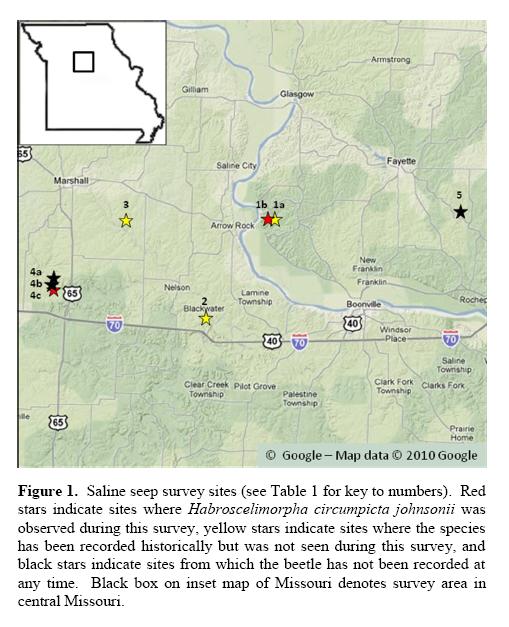
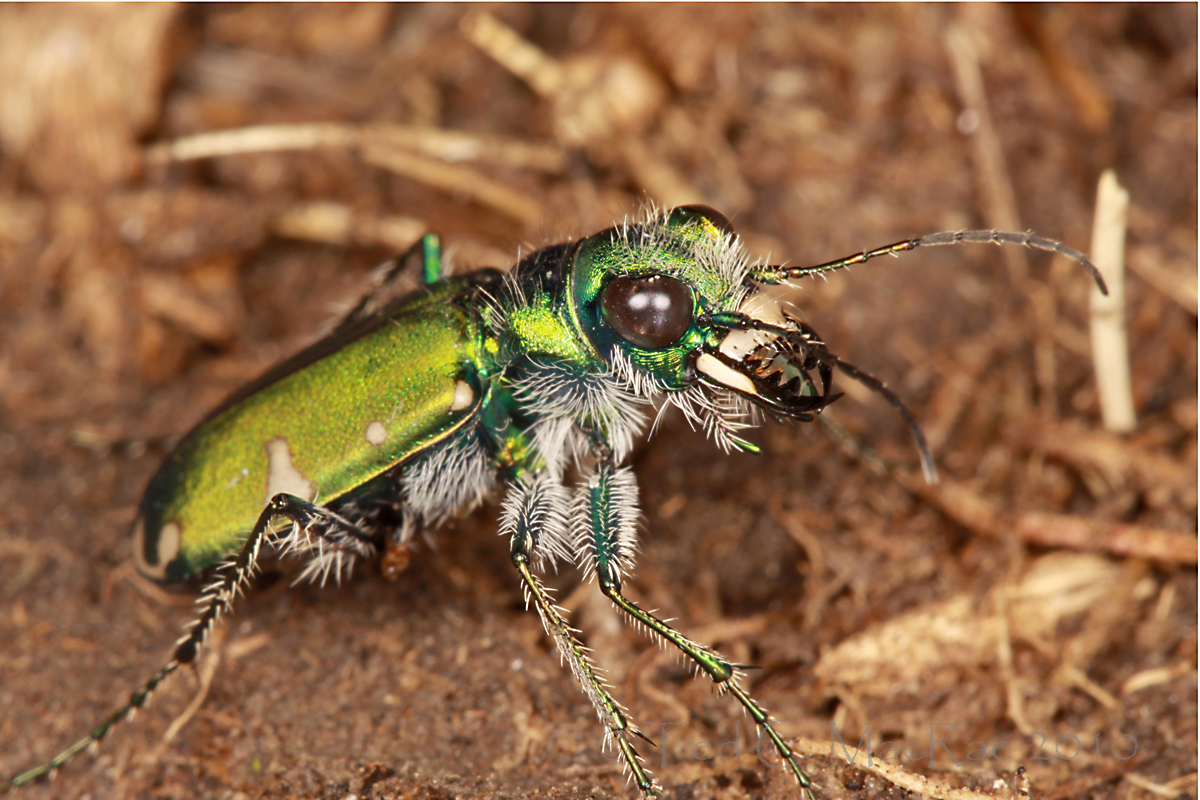
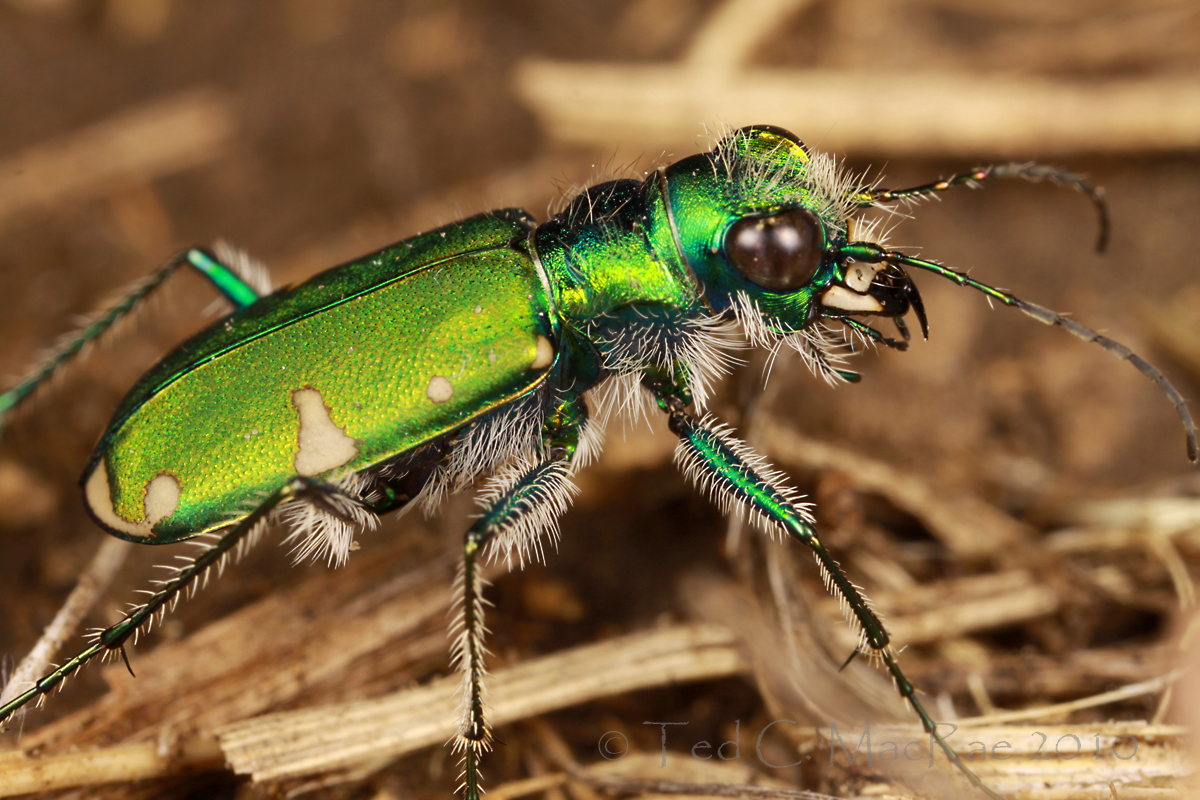
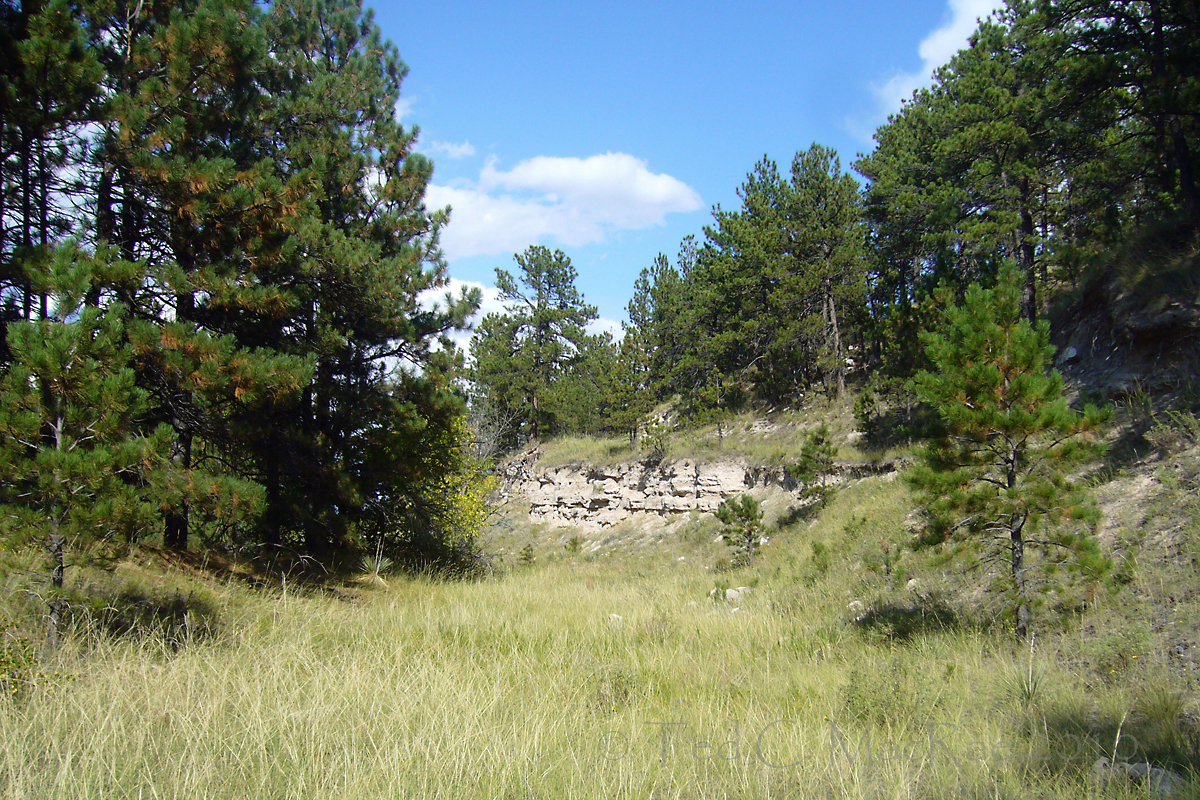
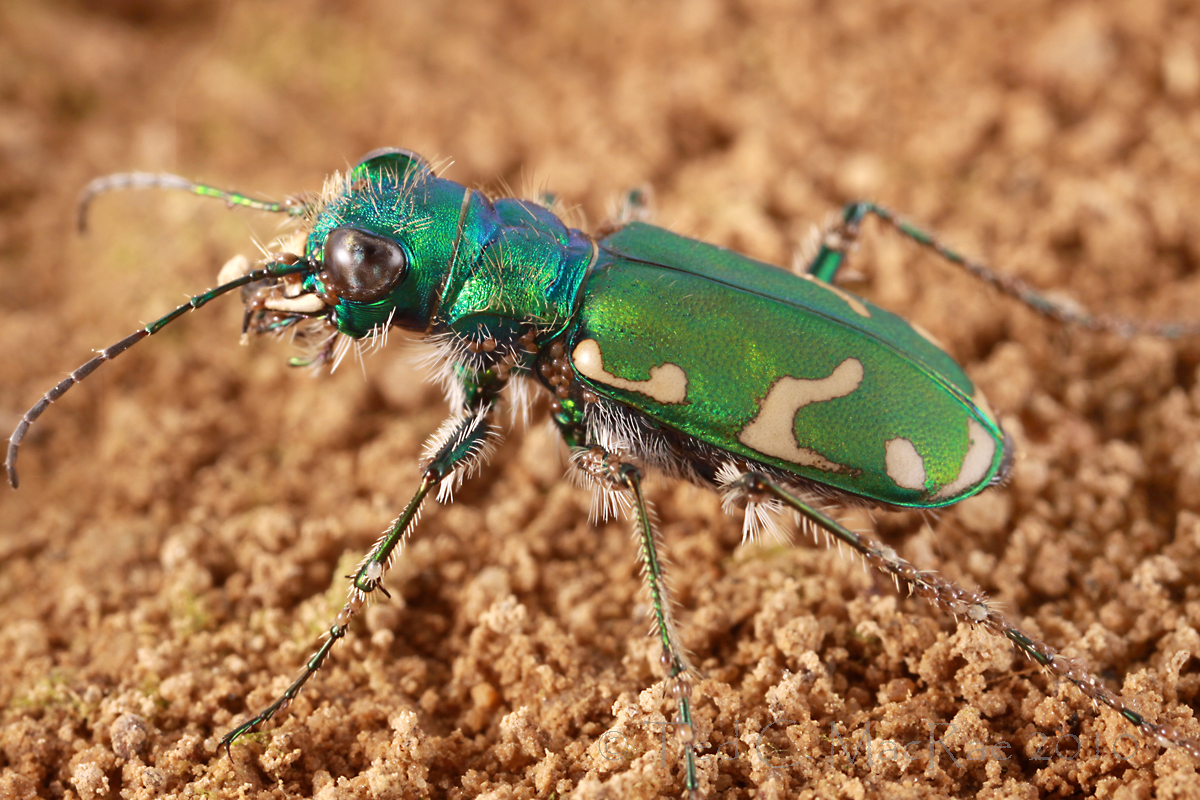
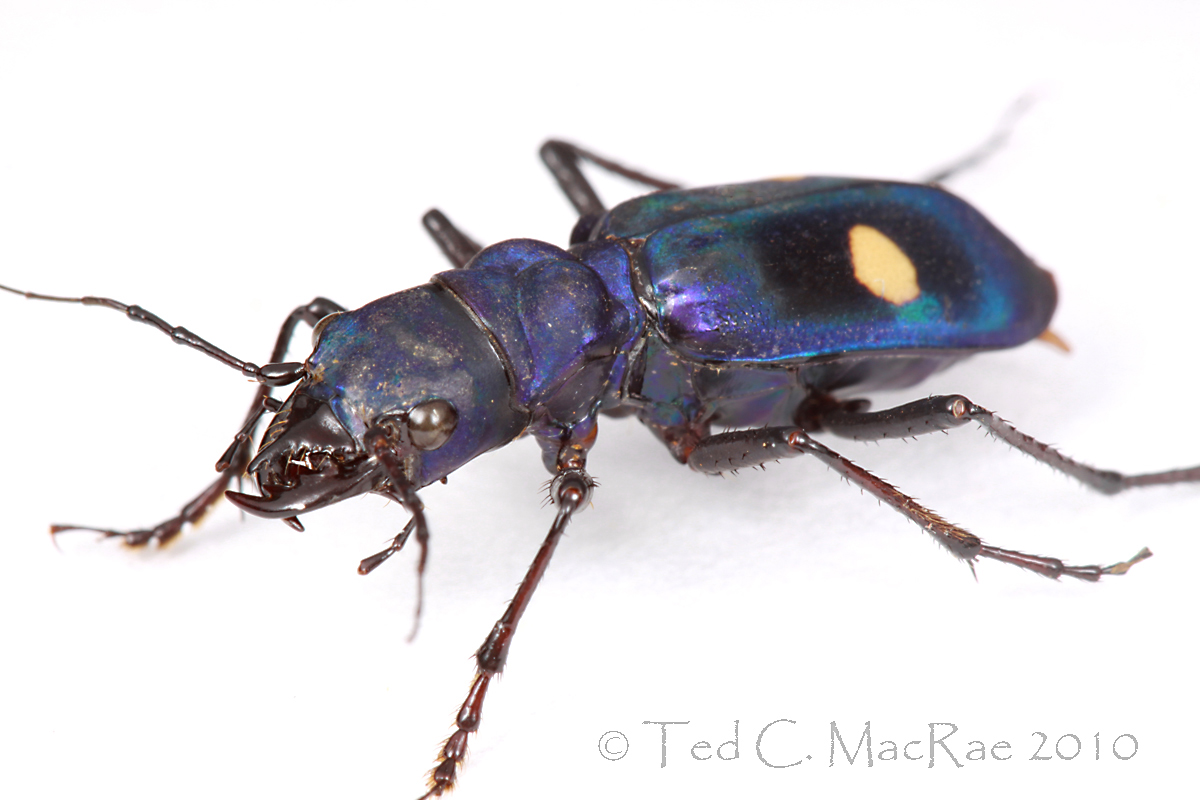
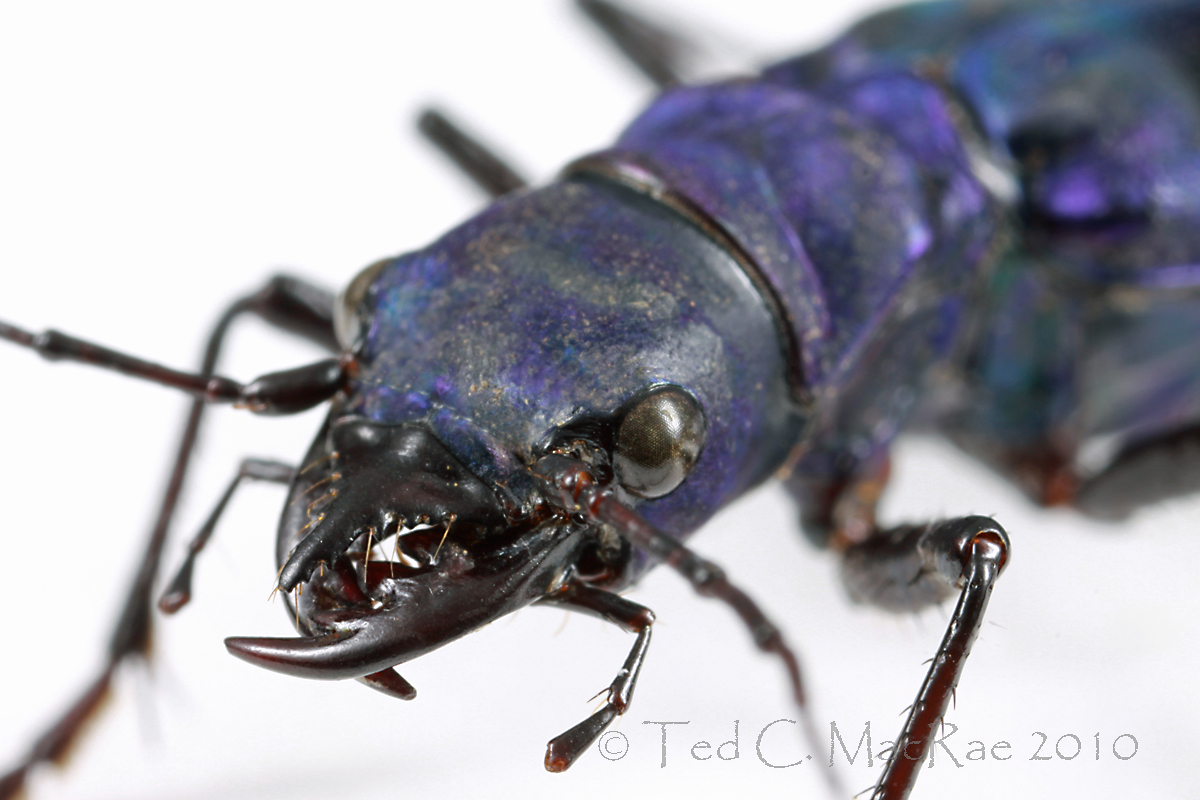
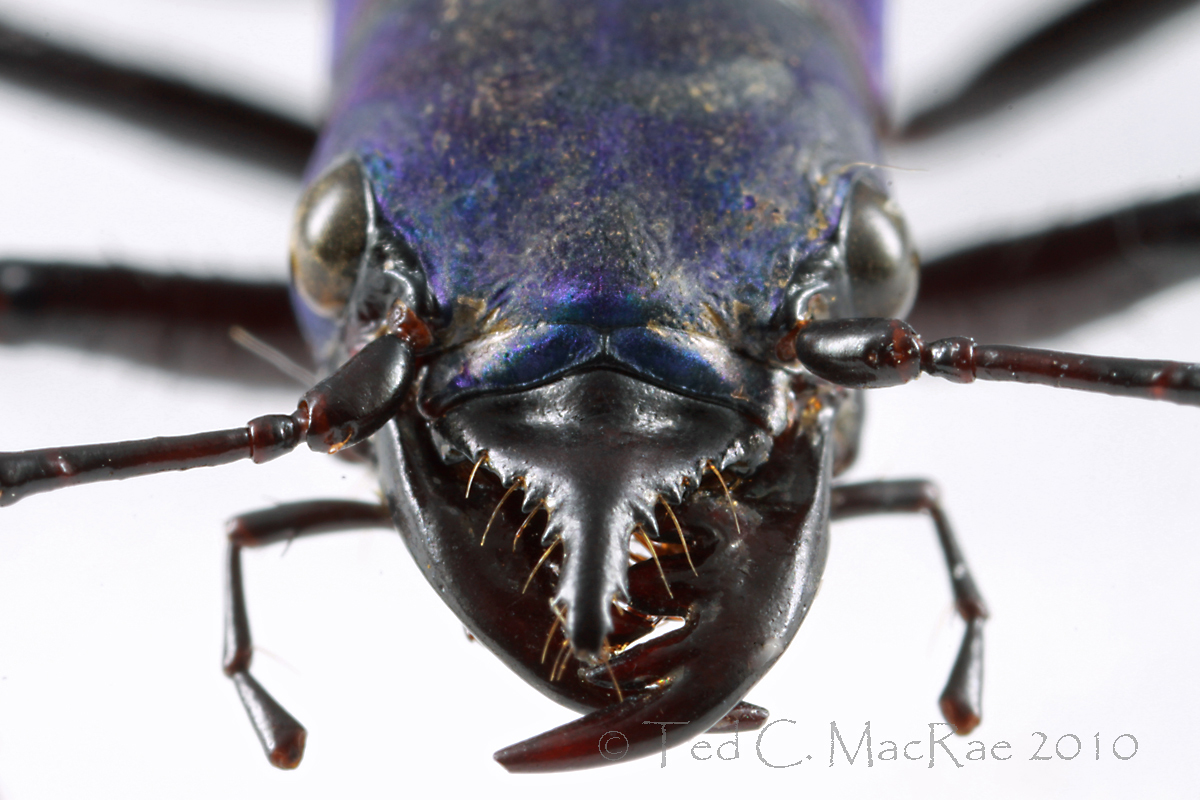
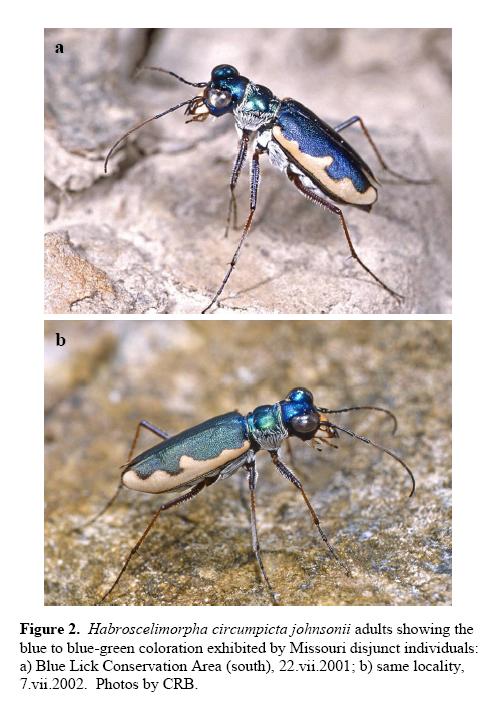
One of these species of interest is Habroscelimorpha circumpicta johnsonii (Johnson’s tiger beetle). This subspecies is widely distributed in inland areas of the central and south-central United States, where it is associated exclusively with barren areas surrounding saline seeps. Despite the broad occurrence of the main population, the Missouri population of this subspecies has long been of particular interest for several reasons: 1) its widely disjunct isolation, occurring several hundred miles east of the nearest populations in central Kansas, 2) its strict association with the highly restricted saline seeps of central Missouri (Fig. 1), and 3) the exclusive blue-green coloration of the adults (Fig. 2) that contrasts with the varying proportions of reddish and/or dark morphs, in addition to blue-green morphs, found in other populations. The highly disjunct and isolated occurrence of this population and its unique coloration have been considered by some workers as grounds for separate subspecific status. Another restricted, disjunct population of this species in North Dakota has already been accorded subspecific status – H. circumpicta pembina.
Despite its restricted occurrence in Missouri, a long history of collection records exist for the subspecies. Numerous specimens are housed in the Enns Entomology Museum in Columbia, Missouri, with a majority of these coming from a single location (Boone’s Lick Historic Site) and dating back as early as 1954. In more recent years (1985-1992), Ron Huber and Dave Brzoska found significant numbers of beetles at two additional locations near Boone’s Lick. Despite these numerous records, the subspecies was listed as a “Species of Conservation Concern” by the Missouri Natural Heritage Program with a status of “S2S3” (vulnerable or imperiled) due to the rarity of its required saline seep habitats in Missouri. Unfortunately, this alone did not appear to be sufficient protection for the species, as my own observations beginning in the mid-1990s suggested that populations of the beetle had declined significantly from their historical levels. Concomitant with these apparent declines was the observation that the sites supporting these beetles had themselves suffered severe degradation that reduced their apparent suitability as habitat for the beetle. As a result of these observations, Chris and I initiated comprehensive surveys during the 2001 field season to assess the conservation status of the Missouri population and identify potential new sites. Our first order of business was to petition a status change to “S1” (critically imperiled), and for the next three years we regularly visited the historical sites throughout the presumed adult activity period, noting occurrence of adults and recording their numbers and the circumstances of their habitat associations. Included in these surveys also were two new sites identified using the Missouri Natural Heritage Database.

The results were not good – during the 3-year survey, only a single beetle was observed at the historical location of Boone’s Lick, and none were observed at the two other locations discovered by Ron Huber and Dave Brzoska. More significantly, all three sites had suffered severe degradation due to vegetational encroachment, cattle trampling, or other anthropogenic disturbance. Moreover, of the two potential new sites identified, only one of these (Blue Lick Conservation Area) was found to support a small population of the beetle. Three apparently suitable saline seeps exist at this latter site; however, beetles were observed at only one of them. During the final year of the survey, prolonged flooding occurred at this site (frustratingly, a result of earth-moving operations by site personnel), which was followed in subsequent years by significant vegetational encroachment (Fig. 3). No beetles were observed at this site during the final year of the survey, nor has the species been seen there in multiple visits to the site in the years since.

Is the Missouri disjunct population of Johnson’s tiger beetle extirpated? There is little reason to be optimistic. What is clear is that the beetle is now below detectable limits, and with the loss of suitable habitat at all sites known to have supported the beetle in the past and little chance that new, high-quality sites will be identified, prospects for an unaided comeback are dim. The saline seep habitats at the three historic sites appear to have suffered irreparable degradation and offer little restoration potential to the degree required to support viable beetle populations; however, there are still two saline seeps at Blue Lick that do offer at least a semblance of suitable habitat. It is imperative that these last remaining examples of Missouri’s critically imperiled saline seeps habitats receive the highest priority for protection if the beetle (should it still exist) is to have any chance of surviving in Missouri. Johnson’s tiger beetle is only one of several tiger beetle species whose presence in Missouri appears to be in jeopardy (others being Dromochorus pruinina – loamy ground tiger beetle, and Cylindera celeripes – swift tiger beetle). I end this post with our closing admonition in the paper:

The loss of this beautiful and distinctive beetle from Missouri’s native fauna would represent a significant and tragic loss to this state’s natural heritage. We urge the Missouri Department of Conservation, the Missouri Department of Natural Resources, and other conservation organizations within the state to identify and allocate the resources needed to develop and implement a recovery plan for the species in Missouri.

REFERENCE:

Brown, C. R. and T. C. MacRae. 2011. Assessment of the conservation status of Habroscelimorpha circumpicta johnsonii (Fitch) in Missouri CICINDELA 42(4) (2010):77-90.

Postscript. On a happier note, I am pleased to be joining the editorial staff for CICINDELA. While my role as layout editor is more functional than academic, I am nevertheless thrilled with the chance to “rub shoulders” with the likes of Managing Editor Ron Huber and long-time cicindelid experts Robert Graves and Richard Freitag. I hope my contributions to the journal’s production on the computer end of things will be favorably received by its readership.

Copyright © Ted C. MacRae 2011
Featured Guest Photo – Dromica kolbei

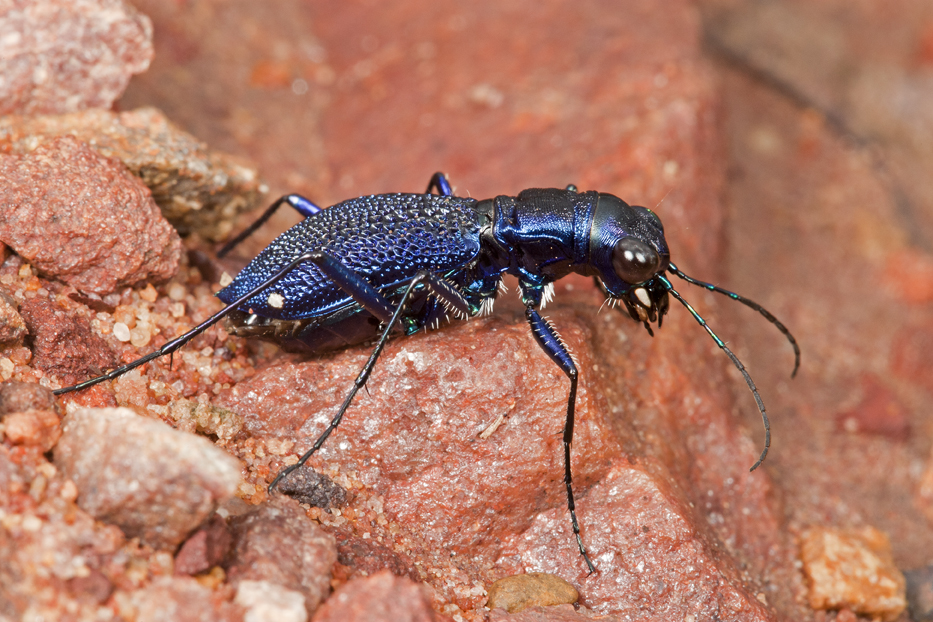
Dromica kolbei? - Kruger National Park, South Africa. Copyright © Joe Warfel 2011.

Shortly after I returned from Brazil, this stunning photo was sent to me by Joe Warfel, who himself had just returned from a trip to South Africa.  Joe had seen the beetle at Punda Maria camp in the northern part of Kruger National Park, had deduced that it represented a species in the genus Dromica, and included the following notes about its behavior:

It did not fly, only ran, ran, ran, ran…. you get the picture.  But stopped briefly now and then to deposit eggs in the  soil.  My best guess from my limited tiger beetle references is Dromica sp.  Any help for identification you may give would be appreciated.

Although I have not collected this genus myself, I recognized it instantly as a member of such based on specimens and images I have seen.  Carabidae of the World contains fine images of a number of species in this genus, of which Dromica kolbei (W. Horn, 1897) seems to be a pretty good match.  However, more than 170 species are currently included in the genus, and while a modern revision is in progress (Schüle and Werner 2001; Schüle 2004, 2007), the bulk of the genus still remains to be treated.  As a result, this really should be considered as just a provisional ID.

Dromica is a strictly sub-Saharan African genus of tiger beetles whose included species are denizens of dry lands – savannahs, grasslands, open woodlands, and semideserts, and are generally absent in the moister, more heavily forested areas of western Africa.  Like a number of other tiger beetle genera, they have given up the power of flight to capitalize on their fast running capabilities.  This flightlessness and the strict association of adults with often short rainy seasons has led to both spatial and temporal isolation of numerous, localized populations of restricted geographical range.  This has no doubt contributed to the diversification of the genus across the mosaic of suitable habitats covering central, eastern, and southern Africa.  Schüle and Werner (2001) suggest that a good number of new species may still await discovery in the more remote or yet inaccessible areas of the countries of occurrence.  I had hoped to encounter these beetles (and also Manticora, or the giant African tiger beetles) during my visit to South Africa in 1999, but luck was not with me in this regard (although I did collect several fine specimens of the handsome Ophryodera rufomarginata (Boheman) and also a few species in the genera Cicindina and Lophyra).

My sincere thanks to Joe Warfel for allowing me to post his excellent photograph.  I featured photographs by Joe in an earlier post (A Tiger Beetle Aggregation), and his other photos can be seen at EighthEyePhotography (you must see this striking harvestman from Trinidad!).

REFERENCES:

Schüle, P. 2004. Revision of the genus Dromica. Part II.  The “elegantula-group” (Coleoptera: Cicindelidae). Folia Heyrovskana 12(1):1–60.

Schüle, P. 2007. Revision of the genus Dromica. Part IV.  Species closely related to Dromica albivittis (Coleoptera: Cicindelidae). African Invertebrates 48(2):233–244.

Schüle, P. and K. Werner. 2001. Revision of the genus Dromica Dejean, 1826. Part I: the stutzeri-group (Coleoptera: Cicindelidae). Entomologia Africana 6(2):21–45.

Copyright © Ted C. MacRae 2011 (text)

Recent literature – The Coleopterists Bulletin

Volume 64, No. 4 - December 2010

I returned to the office this week after spending two weeks in Brazil to find the December 2010 of The Coleopterists Bulletin in my inbox.  I don’t think there is another journal that I look forward to more eagerly than this one (with the possible exception of CICINDELA) – with each issue, I know that regardless of whether it contains any papers in my priority groups of interest (jewel beetles, longhorned beetles, and tiger beetles), it will nevertheless contain well-written articles presenting results of high-quality research on nothing but beetles – pure elytral ecstasy!  This latest issue, however, is a real keeper.  Gracing the cover is a stunning image of the South African jewel beetle species Julodis viridipes, photographed by my good friend and world jewel beetle expert Chuck Bellamy, and inside are three tiger beetle papers and two longhorned beetle papers – it’s almost as if the issue were produced just for me.

Friend and colleague Mathew Brust takes credit for two of the three tiger beetle papers.  In the first (Brust et al. 2010), he compares the efficiency of the three main methods for collecting tiger beetle larvae: fishing, stab-and-grab, and excavation. They found fishing to be the most efficient and least damaging of the three methods, an important finding for tiger beetle conservation where the availability of efficient, non-lethal survey methods is critical.  (What are “fishing” and “stab-and-grab” you ask?  Read the paper.)  In the second paper (Brust and Hoback 2010), Matt teams up with University of Nebraska entomologist Wyatt Hoback to provide new distributional records and larval descriptions of Nebraska’s tiger beetle, Cicindela nebraskana.  Ironically, this species is quite rare in it’s namesake state, and their findings give clues about the habitats in which it is most likely to occur (I had the good fortune to contribute a small amount of data).  In the third tiger beetle paper, Robert Richardson (2010) notes an overwhelming preponderance of left-superior mandibles in two species of Omus and speculates on the selective pressures that might operate on different tiger beetle clades to produce such a finding – a truly interesting read.

As for longhorned beetles, Sánchez-Martínez et al. (2010) report the utilization of living oaks by an apparently disjunct population of the marvelously beautiful Crioprosopus magnificus in central Mexico, complete with photographs of the larval workings and detailed emergence data.  (I am also reminded that I have a post on this very species that I need to put up).  Closer to home, Terence Schiefer and Patricia Newell (2010) independently recognized the existence of an undescribed subspecies of the red-edged saperda, Saperda lateralis, in the lower Mississippi Delta Region of the southeastern U.S., which together they describe as S. lateralis rileyi (named for Edward Riley, indefatigable collector of beetles, and collector of much of the type material).  Okay, I know what you’re thinking – “A new subspecies of S. lateralis? No way!”  Well, I was skeptical also when I first saw the title – several untenable and no longer recognized subspecies have already been described for this broadly distributed and variable species.  However, after noting the nature of the diagnostic characters, seeing the photographs, and studying their partially allopatric distributions, I was convinced.

In addition to the above papers, there were also a number of interesting book reviews in the issue, including The Chiasognathinae of the Andes, reviewed by M. J. Paulsen, A Field Guide of the Dynastidae Family of the South of South Americano access, reviewed by Ronald M. Young, and three book reviews by our beloved Art Evans: Illustrated Identification Guide to Adults and Larvae of Northeastern North American Ground Beetles (Coleoptera: Carabidae) [including tiger beetles]; The African Dung Beetle Genera; and Weevils of South Carolina (Coleoptera: Nemonychidae, Attelabidae, Brentidae, Ithyceridae, Curculionidae)no access.

REFERENCES:

Brust, M. L. and W. W. Hoback. 2010. Larval description and new Nebraska distribution records for Nebraska’s tiger beetle, Cicindela nebraskana Casey (Coleoptera: Carabidae). The Coleopterists Bulletin 64(4):341-346.

Brust, M. L., W. W. Hoback, and J. J. Johnson. 2010. Fishing for tigers: A method for collecting tiger beetle larvae holds useful applications for biology and conservation. The Coleopterists Bulletin 64(4):313-318.

Richardson, R. K. 2010. Mandibular chirality in tiger beetles (Carabidae: Cicindelinae). The Coleopterists Bulletin 64(4):386-387.

Sánchez-Martínez, G., O. Moreno-Rico, and M. E. Siqueiros-Delgado. 2010. Crioprosopus magnificus Leconte (Coleoptera: Cerambycidae) in Aguascalientes, Mexico: Biological observations and geographical distribution. The Coleopterists Bulletin 64(4):319-328.

Schiefer, T. L. and P. Newell. 2010. A distinctive new subspecies of Saperda lateralis F. (Coleoptera: Cerambycidae) from the southeastern United States. The Coleopterists Bulletin 64(4):329-336.

Copyright © Ted C. MacRae 2011

Diversity in Tiger Beetle Larval Burrows

One of the fascinating aspects of tiger beetle study is their often high degree of fidelity for specific habitats.  Some species prefer wet habitats, while others frequent the drier uplands.  Some like sand while others need clay.  Differences in salinity, vegetational cover, and even slope dictate what species might be expected to occur in a given habitat, thus, the diversity of tiger beetle species one encounters is directly proportional to the diversity of habitats explored.  Unfortunately, tiger beetles can be rather ephemeral in their occurrence as adults.  Despite a life cycle that requires at least one year (and may take 2-3 years or even more), adults are often present for only for a few short weeks.  Even during the time that adults are present, they often hide if conditions aren’t right (too cold, too hot, too wet, too early, too late, etc., etc.  Add to that their marvelous evasive capabilities, and it’s a wonder I ever see or catch any at all!).  The study of tiger beetles is not, however, entirely dependent upon the adults.  The presence of larval burrows in an area is also useful information, and through understanding of the species that might occur in an area and their habitat preferences, it is possible to identify – at least tentatively – the species that might be living in them.

Cicindela lengi? (sandy tiger beetle) - Sioux Co., Nebraska

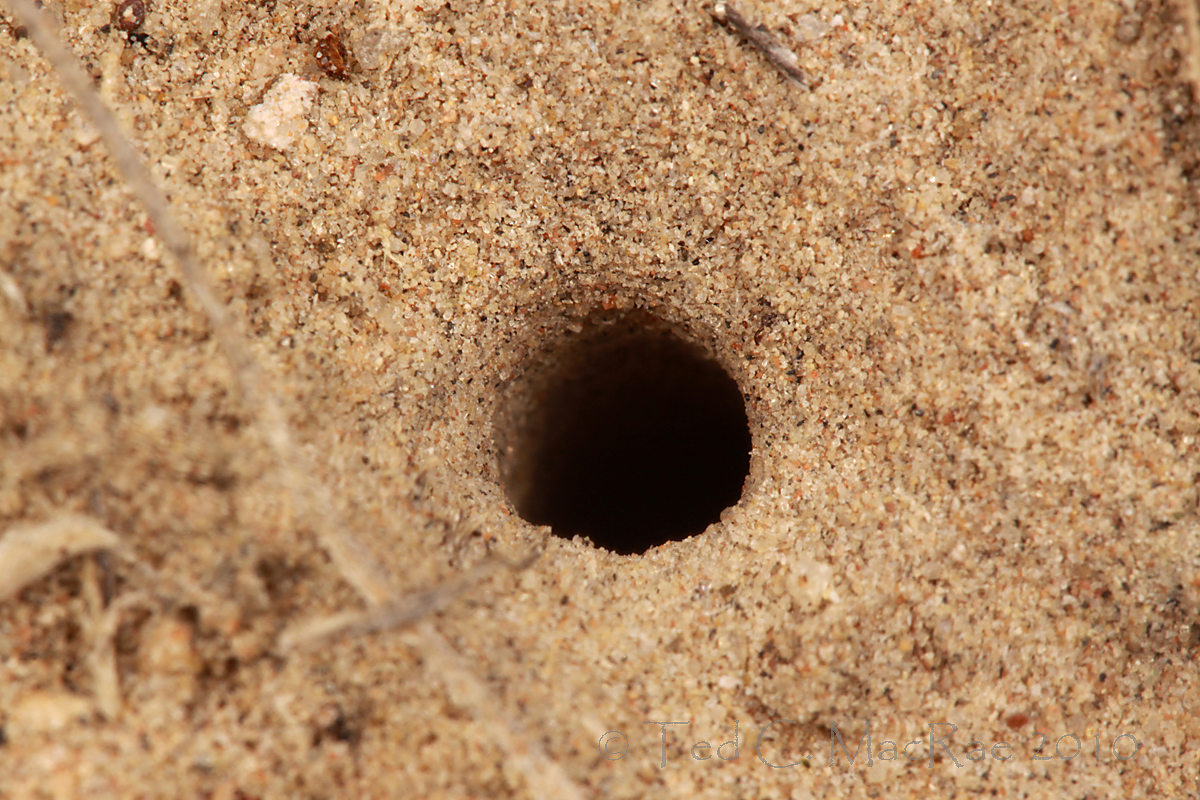
To the uninitiated, tiger beetle burrows might seem nothing more than a simple hole in the ground – anything could have made it.  However, with experience one becomes able to distinguish tiger beetle larval burrows almost instantly from burrows made by other ground-burrowing organisms.  The most common type of burrow is recognized by a combination of characters – almost perfectly circular except for a slight flattening on one side that gives the burrow a faint D-shape, and with the edge smoothly beveled.  This is your classic tiger beetle burrow and, for most U.S. species of Cicindela and related genera, averages ~5-6mm in diameter for 3rd instar larvae (tiger beetle burrows are most often observed at 3rd instar, since it is this final instar in which the larva spends the majority of its time and the burrow becomes most noticable).  The above burrow is one such burrow, found at Monroe Canyon in northwestern Nebraska last September.  While a number of species are known from the area, there are only a few that make their burrows in deep dry sands such as those that occur at this site.  We can eliminate Cicindela formosa (big sand tiger beetle) for reasons discussed below, and we can also dismiss Cicindela limbata (sand blow tiger beetle) because the habitat is not the barren, wind-shaped sand blow habitat that the species prefers.  This leaves two possibilities – Cicindela scutellaris (festive tiger beetle), a common and widespread inhabitant of sand habitats throughout the Great Plains, and Cicindela lengi (sandy tiger beetle), a much more localized resident of sand habitats with more western distribution.  The burrow likely represents the latter, since adults of this species have been found with greater frequency than C. scutellaris on the very fine-grained sands that occur in this part of Nebraska.  My confidence in this ID is bolstered by the fact that a larva I collected in the area from just such a burrow successfully finished its development and emerged a few months later as an adult C. lengi.

Cicindela pulchra pulchra (beautiful tiger beetle) - Fall River Co., South Dakota

Sometimes size alone is enough to indicate the species responsible for a burrow.  The above burrow was encountered last September in southwestern South Dakota on a clay/shale embankment in sage/shortgrass prairie.  A number of tiger beetle species fond of clay were observed at the site, including the two generalist species Cicindela tranquebarica (oblique-lined tiger beetle) and Cicindela purpurea audubonii (Audubon’s tiger beetle).  However, at ~8 mm in diameter the burrow is too large to have been made by either of these species.  The only tiger beetle in the area capable of making a burrow this size is Cicindela pulchra (beautiful tiger beetle), and in fact this burrow was found at one of several sites recently discovered by Matt Brust for this species in South Dakota.  Note again the classic shape – slightly flattened along the bottom side (the flattening accommodates the mandibles of the larval head – tiger beetle larvae always orient themselves in one position when sitting at the burrow entrance).

Cylindera celeripes (swift tiger beetle) - Woodward Co., Oklahoma

Just as large size was diagnostic for the previous burrow, the small size of the above burrow was also diagnostic.  This burrow, found at Alabaster Caverns in northwestern Oklahoma in October, 2009, measured only 3-4mm in diameter and can only have been made by Cylindera celeripes (swift tiger beetle).  This provisional ID was suggested by the fact that adults of the species had been observed abundantly in the lichen-encrusted clay exposures of this shortgrass prairie the previous June.  This photo, in fact, represents the first-ever discovery of the larval burrow of this species, and the identity of the species was confirmed when the larva collected from this and neighboring burrows and placed in rearing containers in the lab later emerged as adults.  I have found very similar-sized burrows in bottomland forest habitats in southeastern Missouri where the closely related species Cylindera cursitans has been seen.  The burrows are identical in size and shape, but the drastic difference in habitat is enough to distinguish the species that made them.

Cicindela formosa formosa (big sand tiger beetle) - Sioux Co., Nebraska

Not all tiger beetles utilize the simple hole-in-the-ground style of burrow, but rather incorporate some rather unique engineering features that make specific identification much easier.  This burrow can only be made by Cicindela formosa (big sand tiger beetle), a common resident of a variety of dry sand habitats throughout the Great Plains and eastern U.S.  The burrow entrance is on the large size for U.S. Cicindela (~6mm in diameter), and rather than opening flush on the ground it is directed horizontally and opens into a pit that is excavated to one side and underneath the burrow entrance.  No other U.S. tiger beetle makes a burrow quite like this (although I have noted Cicindela limbalis (common claybank tiger beetle) burrows on steep clay banks with a similar but much less distinct excavation on their lower side).  The pit apparently functions as a trap for potential prey, and since I have most often encountered burrows of this species in areas with some slope, I suspect the pit may help the larva capture its prey by preventing the prey from tumbling down the slope at the first sign of trouble.

Cicindela formosa 3rd instar larvae - Sioux Co., Nebraska

This is a different burrow by the same species, also at Monroe Canyon last September, that shows a 3rd instar larva sitting at the burrow entrance.  The sickle-shaped mandibles are resting against the slightly flattened lower edge of the burrow entrance, while the round pronotum fills the rest of the entrance profile.  The upper pair of eyes can be seen above the mandibles, but the lower pair (between the upper pair and the mandibles) are not visible in this photo due to the downward-facing angle of the burrow entrance.  I waited for quite some time with camera in position in hopes that I could photograph the larva, and when it did return to the burrow entrance I had time enough to fire off just a couple of shots before it retreated once again to safety in the depths of its burrow.

Cicindela fulgida fulgida (crimson salt flat tiger beetle) - Sioux Co., Nebraska

This unusual-looking burrow was found in a dry clay saline creek bed in the Badlands of northwestern Nebraska last September.  The turret structure is unique, but the nearly perfectly round and smoothly beveled burrow entrance identify it, nevertheless, as that of a tiger beetle larva.  These burrows can only be made by Cicindela fulgida (crimson salt flat tiger beetle).  There are several other saline-tolerant tiger beetles species in Nebraska, but most such as Ellipsoptera nevadica knausii (Knaus’ tiger beetle), Eunota togata (cloaked tiger beetle), and Habroscelimorpha circumpicta johnsonii (Johnson’s tiger beetle) require much more moisture than was found in this bone-dry creek bad.  I’ve found two other much more widely distributed clay-associated species – Cicindela tranquebarica and Cicindela purpurea audubonii – at this and other sites where I’ve seen C. fulgida; however, the larvae of those species do not utilize this unique turret-shaped structure for their burrows.  The turret is thought to have a cooling function for the larva during the heat of summer by raising it above the hottest layer of air against the white salt-encrusted ground and by aiding in the dissipation of heat from the larval burrow.  I wanted to photograph the larva sitting at the burrow entrance and spent quite a bit of time stalking out this and nearby burrows for a chance to do so.  Alas, however, on this day the larvae had greater patience than I!

Cicindela tranquebarica kirbyi (Kirby's tiger beetle) adult & larval burrows - Sioux Co., Nebraska

The above burrow entrances were photographed in September 2008 at the same dry saline creek bed in Sioux Co., Nebraska.  I mentioned above that Cicindela tranquebarica kirbyi and Cicindela purpurea audubonii both occurred commonly at this site along with Cicindela fulgida; however, these burrows likely represent the former.  That species seems to be found more consistently in high saline environments than the latter, which in this case probably have their larval burrows in the more normal clay soil further away from the creek bed.  During that 2008 trip, I did collect larvae from burrows like these in several similar, high saline habitats in Nebraska, South Dakota, and Oklahoma, and in each case adults of C. tranquebarica kirbyi were what emerged.  I have also reared this species from larvae collected on clay banks and wet sand habitats – in all cases, the burrows are a tad larger than those I have seen for other species in the genus that I have reared, such as Cicindela limbalis and Cicindela repanda (common shore tiger beetle) – logical since adults of C. tranquebarica tend to be a little more robust than these other species (but smaller than Cicindela pulchra and Cicindela obsoleta vulturina (prairie tiger beetle)).  In the above photo, I believe the the upper-right burrow is that of a larva, while the the lower-left one is that of an emerged adult – note the not-perfectly-circular opening and more ragged edge to the burrow.  In fact, the latter burrow looks very much like the adult emergence burrow that I saw at this very location last September, in which the still unemerged adult was seen sitting!  Granular chunks of soil can be seen scattered about the latter burrow, but I believe these were actually tossed by the larva rather than the adult as a result of burrow excavation – the amount of soil an adult would need to remove to re-open its burrow for emergence would probably be far less than what can be seen in this photo.  I did not search the surrounding grasslands for larval burrows, but if I had done so, it is likely that I would have found similar burrows that belonged to the larvae of Cicindela purpurea audubonii – the only other tiger beetle that we have seen in this inhospitable place!

Copyright © Ted C. MacRae 2011

Monroe Canyon epilogue – Audubon’s tiger beetle

Cicindela purpurea audubonii (Audubon's tiger beetle) - green morph

In my first post about Monroe Canyon in the Pine Ridge of northwestern Nebraska, I featured the sumptuous Cicindela lengi (blowout tiger beetle) – a target species for the trip and one of six tiger beetle species that Chris Brown and I would find at this quarter-mile long sandy roadside embankment.  Another species we found there was C. denverensis (green claybank tiger beetle), unexpected given its preference for clay soils, but like C. lengi also a target species and thus a welcome find.  We also saw some more common species – the nominotypical forms of C. formosa (big sand tiger beetle) and C. scutellaris (festive tiger beetle), both reliable residents of sand habitats throughout the Great Plains, as well as a few individuals of the often ubiquitous C. punctulata (punctured tiger beetle).  The most numerous of all, however, was C. purpurea audubonii (Audubon’s tiger beetle).  Despite being uncommon in other parts of its range (in fact, nominotypical populations are feared extirpated in some parts of the eastern U.S.), C. purpurea audubonii is one of the most commonly encountered tiger beetles in grassland habitats throughout the central Great Plains and Rocky Mountains.  This species belongs to a complex of several that are generally green in color and fond of clay soil habitats, such as C. denverensis, C. decemnotata (badlands tiger beetle), C. limbalis (common claybank tiger beetle), and C. splendida (splendid tiger beetle).  All of these species can co-occur with C. purpurea audubonii in the Great Plains, but the latter is distinguished by its faint purple tinge and distinct metallic purple border around the edge of the elytra and its reduced elytral markings consisting of a short, oblique middle line and a white rear tip at the edge of the elytra (Pearson et al. 2006).  All of these characters can be seen easily in classic pose in the above photograph.

Cicindela purpurea audubonii (Audubon's tiger beetle) - black morph

Despite its commonness, however, I actually did look forward to seeing this species – the reason being the occurrence of occasional all-black individuals in the population.  Tiger beetles as a whole are a variable lot – polytopism (geographically based variability) is the rule!  Despite this, for the most part individuals within a given population usually exhibit a fairly uniform appearance.  Occasionally, populations of some species – generally those at intergrade zones where different subspecies meet – will show variation on a continuum between two extremes.  The occurrence of two distinct morphs within a population, however, is rather unusual.  I lacked good field photographs of the all-black morph of C. purpurea audubonii (and also the green morph, for that matter), so I was pleased to encounter several individuals of the black morph while we were at Monroe Canyon.  As can be seen in the above photograph, black morph individuals are truly all-black, perhaps with a purple reflection but without a trace of green anywhere on the body.  They do retain the same pattern of reduced white markings exhibited by the green morphs.  As a result, these individuals can be confused with some other black species that also occur in the Great Plains, such as C. nebraskana (prairie long-lipped tiger beetle) and, at higher elevations, C. longilabris (boreal long-lipped tiger beetle).  These latter species were also targets for our trip, so we had to pay close attention to any black morphs that we saw to confirm their identity (C. purpurea audubonii black morphs are distinguished by their distinctly hairy frons).

Chris Brown waits patiently to photograph a burrowing wolf spider at the entrance of its burrow.

I’ve not been able to find any additional information about these black morph individuals and the possible causes for their occurrence.  Cicindela purpurea is a so-called “spring-fall” species, emerging in the fall as sexually immature adults and then spending the winter in burrows before re-emerging in the spring to mate and lay eggs.  As spring-fall species go, it is one of the earliest to appear in the spring and last to disappear in the fall.¹  This immediately brings to my mind a possible thermoregulatory function.  Low temperatures may be a challenge for the adults during early spring and late fall, and the black coloration could be an adaptation to maximize absorption of solar radiation for heat gain. This idea seems to be supported by the fact that the incidence of black morphs is greater at more northern latitudes and in the higher elevations of the western part of the subspecies’ range (as much as 20-40%), where overall lower temperatures would be expected to occur.

¹ Karl Werner even amusingly stated that this species “rather delights in chilly weather” (Acorn 2001).

REFERENCES:

Acorn, J.  2001. Tiger Beetles of Alberta: Killers on the Clay, Stalkers on the Sand. The University of Alberta Press, Edmonton, xix + 120 pp.

Pearson, D. L., C. B. Knisley and C. J. Kazilek. 2006. A Field Guide to the Tiger Beetles of the United States and Canada. Oxford University Press, New York, 227 pp.

Copyright © Ted C. MacRae 2011

BitB Top 10 of 2010

Welcome to the 3rd Annual BitB Top 10, where I pick my 10 (more or less) favorite photographs of the year.  My goal for 2010 was to continue the progress that I began the previous year in my quest to become a bona fide insect macrophotographer.  I’m not in the big leagues yet, but I have gotten more comfortable with using my equipment for in situ field photographs and am gaining a better understanding of lighting and the use of flash.  I also began experimenting with different lighting techniques (e.g. white box) and diffusers and am putting more effort into post-processing techniques to enhance the final appearance of my photographs.  I invite you to judge for yourself how successful I’ve been toward those goals by comparing the following selections with those from 2009 and 2008 – constructive feedback is always welcome:


Best Tiger Beetle

Cicindela denverensis - green claybank tiger beetle

From ID Challenge #1 (posted December 23).  With numerous species photographed during the year and several of these dramatic “face on” shots, this was a hard choice.  I chose this one because of the metallic colors, good focus throughout the face, and evenly blurred “halo” of hair in a relatively uncluttered background.


Best Jewel Beetle

Buprestis rufipes - red-legged buprestis

From Special Delivery (posted July 13).  I didn’t have that many jewel beetles photos to choose from, but this one would have risen to the top no matter how many others I had.  The use of a white box shows off the brilliant (and difficult-to-photograph) metallic colors well, and I like the animated look of the slightly cocked head.


Best Longhorned Beetle

Desmocerus palliatus - elderberry borer

From Desmocerus palliatus – elderberry borer (posted November 18).  I like the mix of colors in this photograph, and even though it’s a straight dorsal view from the top, the partial dark background adds depth to the photo to prevent it from looking “flat.”


Best “Other” Beetle

Enoclerus ichneumoneus - orange-banded checkered beetle

From Orange-banded checkered beetle (posted April 22).  The even gray background compliments the colors of the beetle and highlights its fuzziness.  It was achieved entirely by accident – the trunk of the large, downed hickory tree on which I found this beetle happened to be a couple of feet behind the twig on which it was resting.


Best Non-Beetle Insect

Euhagenia nebraskae - a clearwing moth

From Euhagena nebraskae… again (posted October 21).  I photographed this species once before, but those photos failed to capture the boldness of color and detail of the scales that can be seen in this photo.


Best “Posed” Insect

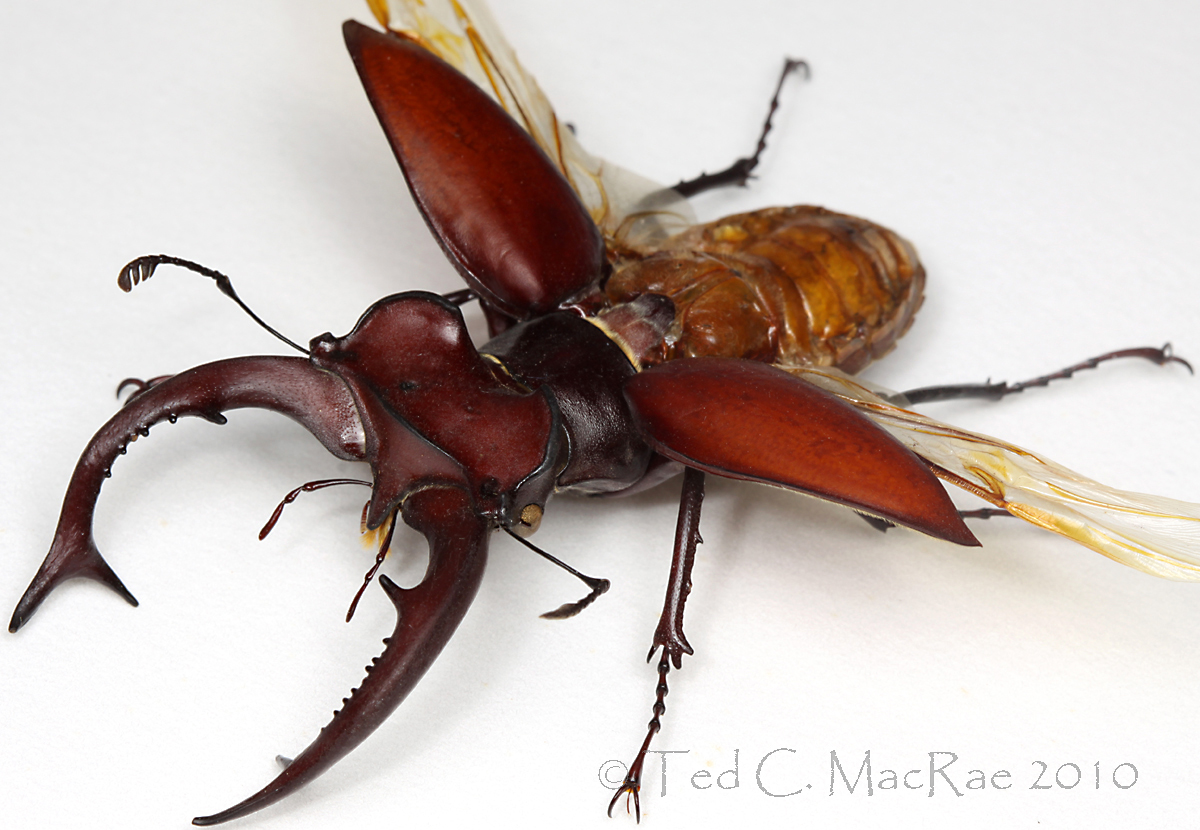
Lucanus elaphus - giant stag beetle

From North America’s largest stag beetle (posted December 30).  I’ve just started experimenting with photographing posed, preserved specimens, and in fact this male giant stag beetle represents only my second attempt.  It’s hard to imagine, however, a more perfect subject than this impressively stunning species.


Best Non-Insect Arthropod

Scolopendra heros - giant desert centipede

From North America’s largest centipede (posted September 7).  Centipedes are notoriously difficult to photograph due to their elongate, narrow form and highly active manner.  The use of a glass bowl and white box allowed me to capture this nicely composed image of North America’s most spectacular centipede species.


Best Wildflower

Hamamelis vernalis - Ozark witch hazel

From Friday Flower – Ozark Witch Hazel (posted March 26).  The bizarre form and striking contrast of colors with the dark background make this my favorite wildflower photograph for the year.


Best Non-Arthropod

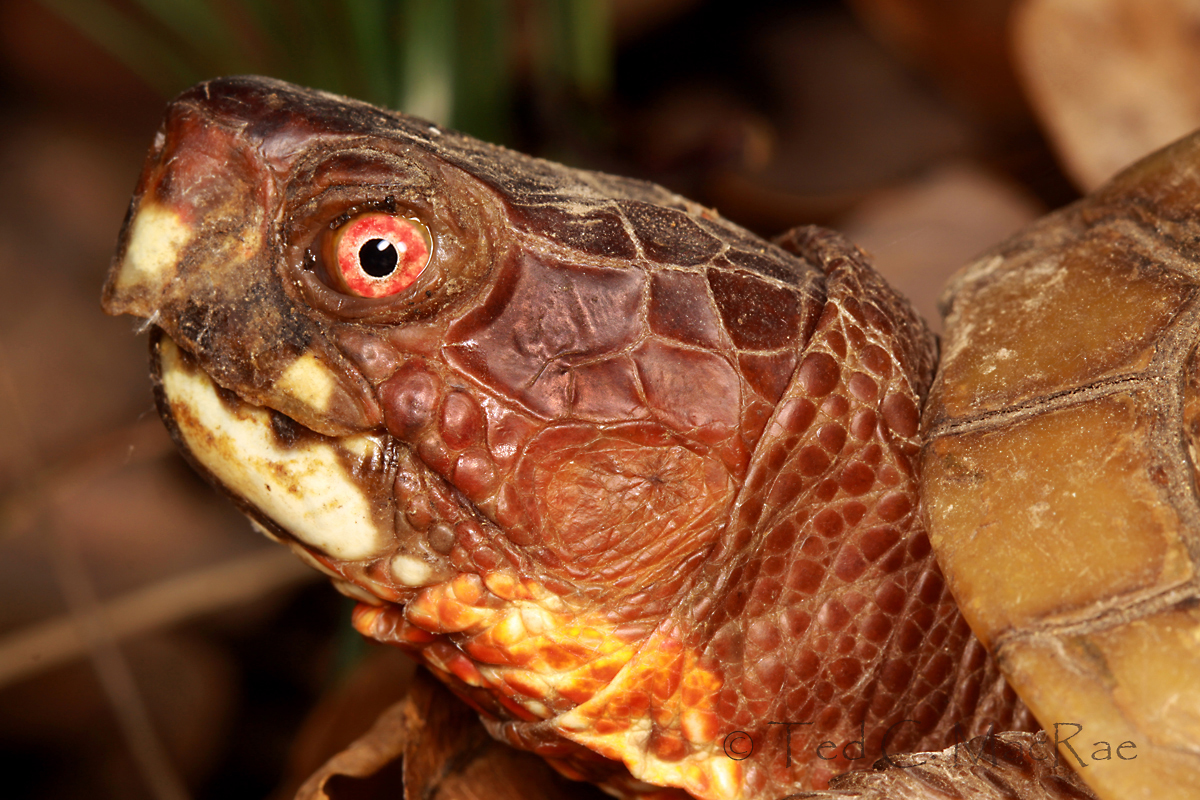
Terrapene carolina triunguis - three-toed box turtle

From Eye of the Turtle (posted December 10).  I had a hard time deciding on this category, but the striking red eye in an otherwise elegantly simple photograph won me over.  It was also one of two BitB posts featured this past year on Freshly Pressed.


Best “Super Macro”

Phidippus apacheanus - a jumping spider

From Jeepers Creepers, where’d ya get those multilayered retinae? (posted October 5).  I’m not anywhere close to Thomas Shahan (yet!), but this super close-up of the diminutive and delightfully colored Phidippus apacheanus is my best jumping spider attempt to date.  A new diffuser system and increasing comfort with using the MP-E lens in the field at higher magnification levels should allow even better photos this coming season.


Copyright © Ted C. MacRae 2011

Cicindela denverensis – green claybank tiger beetle

Cicindela denverensis (green claybank tiger beetle) | Sioux Co., Nebraska.

Here are a few more photographs of the insect featured in ID Challenge #1, which is, in fact, Cicindela denverensis (green claybank tiger beetle).  Nearly every commentor got the first 6 points easy enough (2 pts each for order, family, and genus), but only Ben Coulter correctly identified the species.  A bonus point for proper italicization of the binomen (and a favorable ruling on a technicality) gave him 9 points and the win.  Second place goes to TGIQ, who smartly picked up bonuses to earn 8 points and edge the pack.  Charley Eiseman, Christopher Taylor, Delbert La Rue, jason, and Techuser crowd the final podium spot with 7 points each.

Distinguished by its green color, hairy frons, reduced maculations, and grassland occurrence.

Cicindela denverensis occurs in short- and mixed-grass prairie habitats in the central and western Great Plains, especially sites with clay soils.  It can be distinguished from a number of similar-looking species by its uniformly green color, hairy frons, often reduced maculations, and occurrence in grassland habitats.  Cicindela sexguttata is also uniformly green, but the frons in that species is glabrous, and it occurs further east in woodland habitats.  Cicindela decemnotata is also similar, but it usually has broad maculations and a shinier, oily appearance – often with some degree of red tinting.  Some subspecies of C. scutellaris are also green, but only rugifrons bears maculations and can be distinguished by it’s stockier form and Atlantic Coastal Plain distribution. Cicindela denverensis is actually most closely related to C. purpurea (cowpath tiger beetle), C. limbalis (common claybank tiger beetle), and C. splendida (splendid tiger beetle) – especially the latter two.  All three of these species exhibit some degree of purple or red on the pronotum, elytra, and/or legs that distinguish them from C. denverensis in most parts of their range.   There is, in fact, some disagreement about whether C. denverensis, C. limbalis, and C. splendida even represent distinct species, all of which demonstrate a similar preference for clay substrates but segregate into three partially allopatric populations – northern C. limbalis, southern C. splendida, and western C. denverensis.  Hybrid individuals can be encountered in areas where their distributions overlap, and this is especially so in central Nebraska – one of just a few spots where all three species occur together.  Schincariol & Freytag (1991) conceded a close relationship between the three based on morphometric analysis but still considered them distinct based on differences in elytral color, pattern, and percentage maculation and the number of non-sensory setae.  However, a recent phylogenetic analysis based on mitochrondrial DNA sequences strongly supports a single species hypothesis (Woodcock & Knisley 2009).  From an academic perspective, more thorough systematic analyses of the claybank group of tiger beetles would be of great interest (although I suspect many cicindelophiles with strictly philatelic interests will not be happy to see three species sunk into one).

Ponderosa pine mingles with prairie grasses on the Nebraska Pine Ridge escarpment.

The individual in the above photos was found at Monroe Canyon in the Pine Ridge escarpment of western Nebraska (Sioux Co.).  It was the only individual of this species that we saw there and was a bit of a surprise finding because of the generally sandy soils that characterize the spot – perhaps it was a vagrant individual that had found its way into the canyon from the more clay-based shortgrass prairie above.  We’ve seen greater numbers of this species further east in central Nebraska (Sherman Co.) along vertical roadside clay banks. The photograph below is one of those individuals and exhibits somewhat more complete maculations.  Note the sharp bend, or “knee,” on the median maculation that allows the species to be differentiated from C. limbalis (all-green forms of this species can be found at the northern limit of distribution for C. denverensis in North Dakota).  This individual also displays something else of interest – anybody?

Individual with more complete maculations | Sherman Co., Nebraska.

REFERENCES:

Schincariol, L. A. and R. Freitag. 1991. Biological character analysis, classification, and history of the North American Cicindela splendida Hentz group taxa (Coleoptera: Cicindelidae). The Canadian Entomologist 123(6):1327-1353.

Woodcock, R. M. and C. B. Knisley. 2009. Genetic analysis of an unusual population of the problematic tiger beetle group, Cicindela spendida/C. limbalis, from Virginia, USA (Coleoptera: Cicindelidae) using mtDNA. Entomological News 120(4):341-348.

Copyright © Ted C. MacRae 2010

Pseudoxycheila tarsalis – remounted

Pseudoxycheila tarsalis (Central American montane tiger beetle) | specimen ex. Costa Rica.

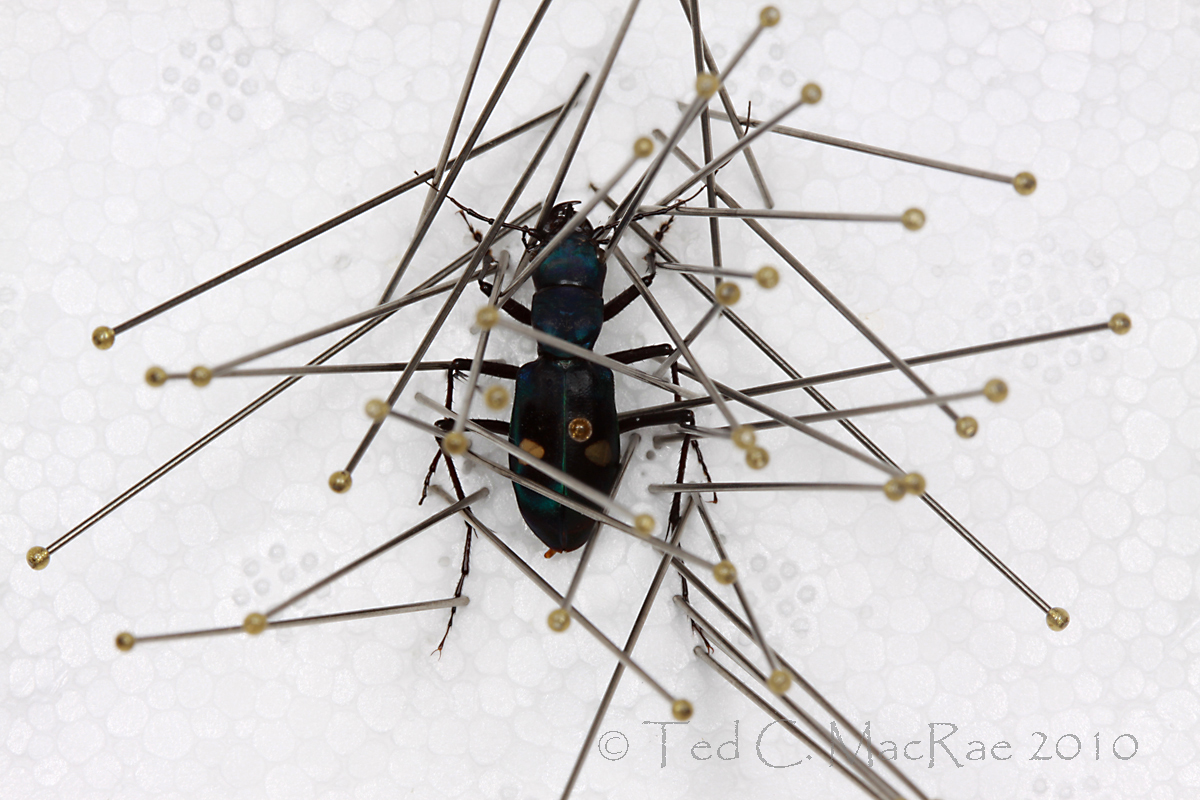
I tend to be a minimalist when it comes to mounting beetles. That is, I mount them so that they take up minimal space – legs tucked neatly and symmetrically against each side of the body and antennae laid straight alongside each elytron. This is important not only for space considerations (always a premium, but especially so in a private collection), but also to minimize the chances of accidental breakage when handling specimens. I must admit that beetles mounted in such manner don’t have quite the visual appeal of beetles mounted in a more relaxed, life-like position, but the ability to pack them tightly in my limited drawer space generally overrides whatever aesthetic desires I may have. Every now and then, however, I come across a specimen that just begs to be mounted life-like due to its striking appearance or impressive structures. Pseudoxycheila tarsalis (Central American montane tiger beetle), which I recently received as a gift from Henry Hespenheide, is one such species.

Remounting a dry, already-mounted beetle is a little trickier than mounting a fresh specimen. The beetle must first be relaxed, and even when relaxed well the beetle is never as pliable as when fresh. This makes it more difficult to get the legs and antennae into the desired position, and there is always a higher risk of breakage while trying to do so. Many different methods for relaxing beetles are available – some better than others, but for a one-off specimen I usually just soak it in very warm tap water. Generally 15-20 minutes will suffice, although large specimens may require more than this. Soaking has the added benefit of softening whatever debris might be caked onto the beetle so that it can be removed more easily. In this case, once the beetle was relaxed I used forceps to hold the specimen by the pin to keep it submerged in the water while “scrubbing” its upper surface with a camel-hair brush. Younger eyes might be able to do this unaided, but I find a binocular dissecting scope at low power to be quite helpful.

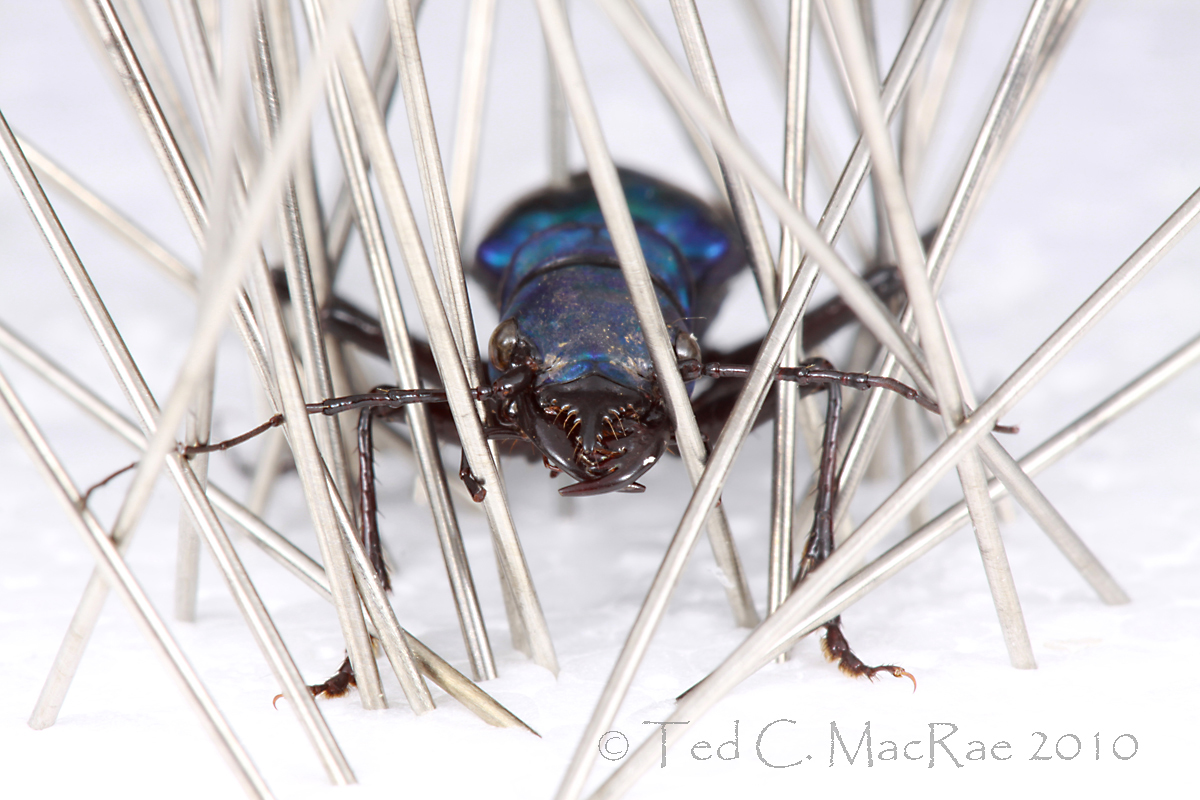
Once clean, I inserted the pin into a styrofoam block for positioning of the body parts. Since this specimen was to be posed in a life-like position, I didn’t insert the pin all the way, but rather left the body up off the styrofoam as it would be in life. Also, my favorite tiger beetle pose is slightly elevated on the front legs, so I inserted the pin at an angle to leave more space under the head than the abdomen. Then it was a matter of using brace pins to hold each body part in the desired position. I work from “sturdy” to “delicate” – i.e., the sturdiest body parts are placed in position first and the most delicate are done last, since positioning the sturdier parts causes tugging and pulling that could break the more delicate parts if they are already braced in position. This usually means bracing the body itself first, then then the legs, and lastly the antennae. Again, my eyes prefer to do this under a scope. While the antennae and tarsi can usually be positioned directly with the brace pins, sturdier body parts may need to be positioned and held in place with fine-tipped forceps in one hand while placing brace pins around them with the other hand. I also work “proximal to distal” with each part – i.e., positioning the part closest to the body first, followed by the more distal portions. There’s no way around it – this kind of work takes practice and patience, and even with all my years of experience I still managed to break off the distal four antennomeres from the left antenna (and failed in my attempt to glue them back on after drying). For this specimen, a total of 42 brace pins were used.

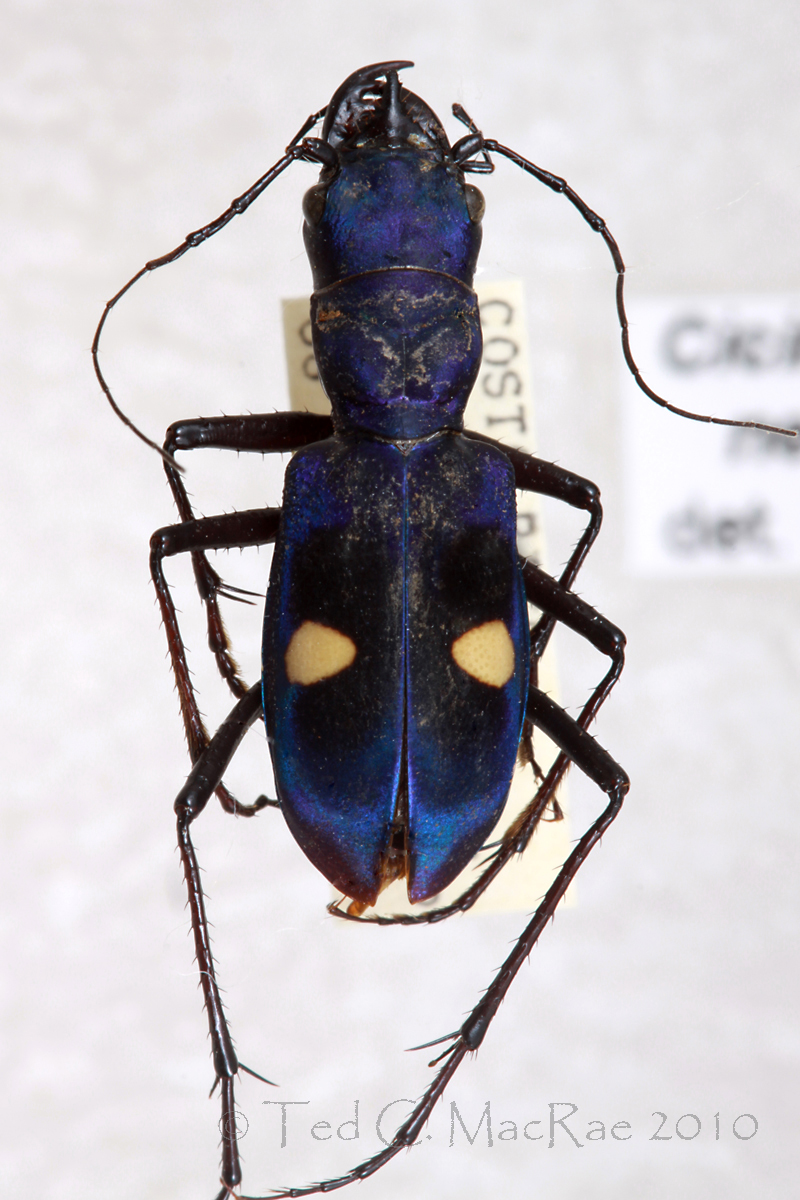
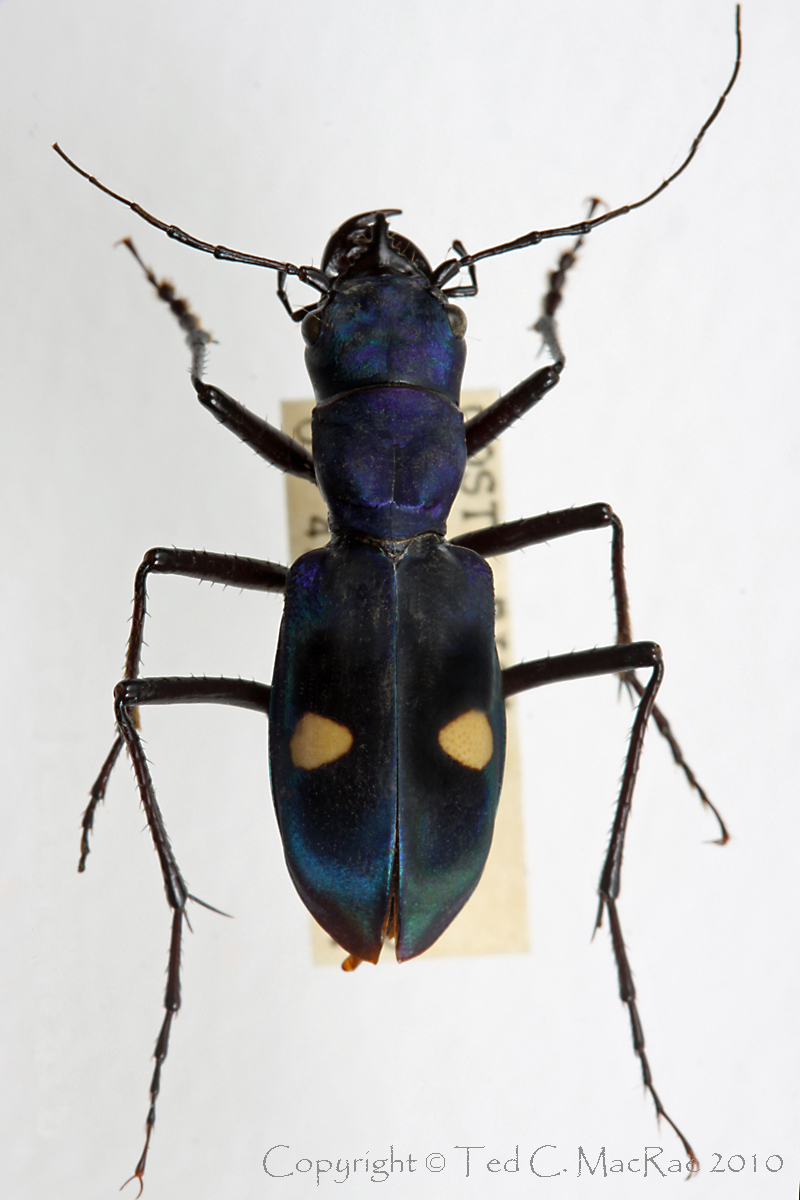
While fresh specimens may take several days (to a week or more for large specimens) to dry, relaxed specimens usually dry much more quickly – overnight was more than adequate for this specimen. Be careful when removing the brace pins! If you grab them too tightly as you pull them out of the styrofoam, you can end up “flicking” a leg or antenna and breaking it – better to grab the pin head loosely and lightly spin it back and forth as you pull up gently until the pin is free. Once all the brace pins are removed, pull up carefully on the main pin as well until you’re sure the tarsal claws aren’t grabbing the styrofoam – if they are, slide a pin or forceps underneath and gently unhook the claws before pulling the pin out any further. Replace the labels and voila – a much more aesthetically pleasing specimen! Is all this effort worth it? You be the judge. Below on the left is the photograph I showed previously for the specimen prior to cleaning and remounting, while on the right is the now clean and nicely mounted specimen.

Before

After

With the beetle in its new life-like position (and scrambling for any chance to get some more practice with my new diffuser setup [photos coming soon, I promise!] as I slide into the depths of this Midwestern winter), I couldn’t resist the urge to take a few studio shots of the remounted beetle “on white.” While photographs of posed, dead beetles may not be to everyone’s liking, they do provide a chance to see detailed views of species that may not be otherwise available. The first photo above and the three below are some of my favorites from the session:

Photo Details: Canon 50D, Canon MT-24EX flash w/ DIY diffuser (photos 1, 7-8: Canon MP-E 65mm 1-5X macro lens, ISO 100, 1/250 sec, f/13; photos 2-6: Canon 100mm macro lens, ISO 100, 1/250 sec, f/16). Typical post-processing (levels, minor cropping, unsharp mask) with digital removal of pin heads and minor debris.

Copyright © Ted C. MacRae 2010