Tiger beetles in Argentina’s Chaco forest

The day after I photographed Brasiella argentata on the mud/san banks of the Rio Paraná in Corrientes, Argentina, I decided to drive westward into the heart of Chaco Province. The destination: Chaco National Park, where some of the best remaining examples of the original “Gran Chaco” remain. Once covering nearly a million square kilometers in northern Argentina, Paraguay and Bolivia, this distinctive ecoregion has been largely converted to a vast, hot sea of cotton fields and mesquite fence-rows. A unique plant community in the Gran Chaco is the quebracho forest that takes its name from quebracho colorado chaqueño (Schinopsis balansae)—a tall, massively-trunked tree (related to, of all things, poison ivy!) with beautiful red wood that has been logged relentlessly wherever it occurs. Chaco National Forest is unique for the largely intact example of this forest it preserves and the mature quebracho trees that it contains.

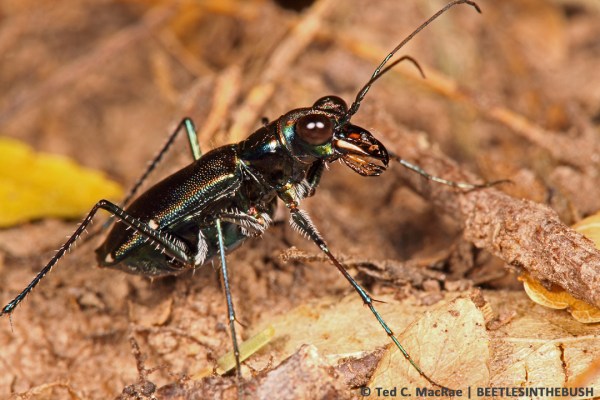
Odontocheila chrysis | Chaco National Park, Argentina

Odontocheila chrysis (Fabricius, 1801) | Chaco National Park, Argentina

Insect life was not abundant as I walked the dark forest path. The lateness of the season (early April) and long-enduring drought occurring in the region had taken their toll, and I was content to see just about anything. At one point, a flash of movement caught my eye, and as I scanned the forest floor in the area where I had seen it, the familiar silhouette of a Golden Forest Tiger Beetle—Odontocheila chrysis (Fabricius, 1801)—became visible. I was already familiar with this species, having seen fairly good numbers of them at another location further east during my first visit to the area 12 years earlier. Long-legged and fast-flying, this tiger beetle occurs throughout much of South America, where it lives in more shaded areas of forest clear-cuts, secondary forests, savannas, and open scrublands (Erwin & Pearson 2008). The ground-dwelling adults are known to congregate along paths and at large openings on the forest floor, and indeed I had seen them in their greatest numbers on a shaded dirt road around the margins of a temporary mud puddle. When disturbed, the wary adults fly up from the forest floor to land in adjacent bare area of substrate or on the leaves of understory plants.

Superposition eyes are adapted to the dark forest environment in which this species lives.

Superposition eyes are an adaptation to the dark forest environment where this species lives.

I faced a bit of a quandary when I saw this individual—do I collect it as a voucher and studio photograph backup, or do I go ahead and try to get the much more desirable in situ photograph of an unconfined adult in its native habitat. Considering that I had already collected a sufficient number during my earlier trip, I opted for the latter. I am fortunate that I got these two quite acceptable photographs before the adult flashed away in the blink of an eye right after I took the second shot, because I never saw another one the rest of the day or even the trip.  

An interesting feature of O. chrysis is its superposition eyes. In such eyes, each rhabdom (light sensitive unit) in the compound eye receives light through many ommatidial facets. This is in contrast to apposition compound eyes, where each rhabdom receives light from only a single facet. Superposition eyes are designed to increase photon capture, which is an advantage in the dark forest habitats where this beetle prefers to live (Brännström 1999).

Brasiella argentata | Chaco National Park, Argentina

Brasiella argentata (Fabricius, 1801) | Chaco National Park, Argentina

Shortly after photographing O. chrysis, I came upon a small opening where the path was a little wider and sunnier and the soil a little sandier and drier. Immediately I saw the small, zippy flits of the same tiger beetle species I had photographed the previous day on the banks of the Rio Paraná—Brasiella argentata. I could not find in the literature whether this species has superposition or apposition compound eyes, but considering that the species occur in great numbers on sunny river banks and that the few individuals I saw in the forest were in a sunny opening, I’m betting it’s the latter.

I couldn’t help but make another attempt to photograph this species, considering the difficulty I’d had the previous day (and that I wasn’t completely satisfied with any of the photos that I had obtained). More good fortune, despite there being only a few individuals to work with, as I managed to get the above photograph, which I consider far better than any that I already had. These beetles, too, quickly disappeared, and I never saw them again, but knowing I had the photos that I wanted made that okay.

Habitat for Odontocheila chrysis and Brasiella argentata

Quebracho forest habitat for Odontocheila chrysis and Brasiella argentata.

REFERENCES:

Brännström, P. A. 1999. Visual ecology of insect superposition eyes. Unpublished Ph.D. Dissertation, Lund University, 142 pp. [abstract].

Erwin, T. L. & D. L. Pearson. 2008. A Treatise on the Western Hemisphere Caraboidea (Coleoptera). Their classification, distributions, and ways of life. Volume II (Carabidae-Nebriiformes 2-Cicindelitae). Pensoft Series Faunistica 84. Pensoft Publishers, Sofia, 400 pp. [Amazon descriptionbook review].

© Ted C. MacRae 2014

Best of BitB 2013

Welcome to the 6th Annual “Best of BitB”, where I pick my favorite photographs from the past year. Like last year, 2013 was another year of heavy travel. For work I did my annual tour of soybean field sites throughout Argentina during late February and early March, then cranked it up for my own field season with frequent travel to sites in Illinois and Tennessee from May to October. In the meantime I spent a week at company meetings in Las Vegas in August, toured field sites across the southeastern U.S. for two weeks in September, visited Argentina again in October to finalize research plans for their upcoming season, and finished off the travel year by attending the Entomological Society of America (ESA) Meetings in Austin, Texas during November. On top of all this, I managed to slip in two of the best insect collecting trips I’ve had in years, with 10 days in northwestern Oklahoma in early June and another 10 days in California, Nevada, Utah, and Colorado during late August, and I got to play “visiting scientist” during short trips to Montana State University in late July and the Illinois Natural History Survey in late October! Of course, during my brief interludes at home I wasn’t sitting still, giving entomology seminars to several local nature societies and hosting two ESA webinars on insect photography. Needless to say, come December I was more than ready to spend some quite time at home (well, except for hiking most weekends) and am happy to report that I’ve successfully become reacquainted with my family and office mates. It’s a peripatetic life—and I wouldn’t have it any other way!

Okay, let’s get down to business. Here are my favorite BitB photographs from 2013. This year was less about learning new techniques as it was about refining the techniques I’ve found most useful for the style I’ve chosen as a photographer, i.e., hand-held, in situ field shots that (hopefully) excel at both natural history and aesthetic beauty. Links to original posts are provided for each photo selection, and I welcome any comments you may have regarding which (if any) is your favorite and why—such feedback will be helpful for me as I continue to hone my craft. If you’re interested, here are my previous years’ picks for 2008, 2009, 2010, 2011, and 2012. Once again, thank you for your readership, and I hope to see you in 2014!


Tremex columba, female ovipositing | Sam A. Baker State Park, Missouri

Tremex columba female drilling for oviposition into hardwood trunk | Sam A. Baker State Park, Missouri

From Ovipositing Pigeon Horntail (posted 6 Jan). I like this photo for the combination of vibrant, contrasting colors between the wasp and moss-covered wood and the visualization it provides of the remarkable depth to which this wasp will insert its ovipositor into solid wood!


Eurhinus cf. adonis on Solidago chilensis | Chaco Province, Argentina

Eurhinus cf. adonis on Solidago chilensis flowers | Chaco Province, Argentina

From Giving me the weevil eye! (posted 28 Apr). While a little soft, the color combination is pleasing and the pose taken by the beetle almost comically inquisitive.


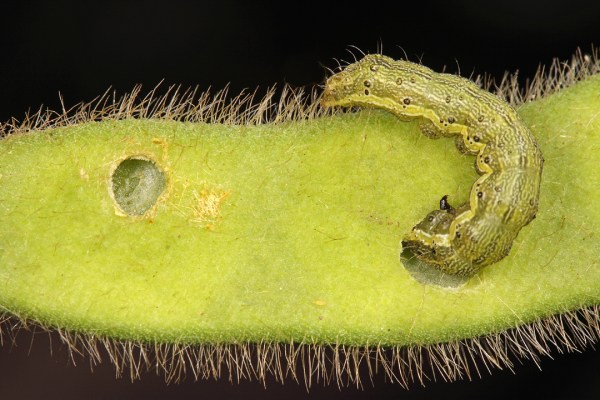
Helicoverpa gelotopeon feeding on soybean pod | Buenos Aires Prov., Argentina

Helicoverpa gelotopeon feeding on soybean pod | Buenos Aires Prov., Argentina

From Bollworms rising! (posted 30 Mar). This is the first photo of an economic pest that has made one of my “Best of BitB” lists. The two holes in the soybean pod, one with the caterpillar and its head still completely inserted, visualizes how the feeding habits of these insects can so dramatically affect yield of the crop.


cf. Eremochrysa punctinervis | Gloss Mountains, Major Co., Oklahoma

cf. Eremochrysa punctinervis | Gloss Mountains, Major Co., Oklahoma

From “Blue-sky” tips and tricks (posted 1 July). Insects with a lot of delicate detail and long, thin appendages are especially difficult to photograph against the sky due to wind movement. See how I dealt with the antennae of this delicate lacewing without resorting to the standard black background typical of full-flash macrophotography.


Cicindela scutellaris lecontei x s. unicolor

Cicindela scutellaris lecontei x s. unicolor intergrade | Holly Ridge Natural Area, Stoddard Co., Missouri

From The Festive Tiger Beetle in Southeast Missouri (posted 25 Oct). I like this photo a lot more now than I did when I first took it. Its shadowy feel and the beetle “peering” from behind a leaf edge give a sense of this beetle’s attempts to hide and then checking to see if the “coast is clear”


Batyle suturalis on paperflower (Psilostrophe villosa) | Alabaster Caverns State Park, Woodward Co., Oklahoma

Batyle suturalis on Psilostrophe villosa flowers | Alabaster Caverns State Park, Woodward Co., Oklahoma

From Tips for photographing shiny beetles on yellow flowers (posted 10 Aug). “Bug on a flower” photos are a dime a dozen, but shiny beetles on yellow flowers with natural sky background can be quite difficult to take. All of the techniques for dealing with the problems posed by such a photo came together nicely in this photo.


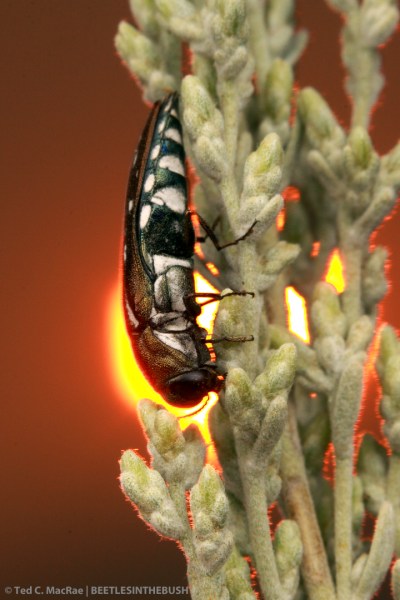
Agrilus walsinghami | Davis Creek Regional Park, Washoe Co., Nevada

Agrilus walsinghami | Davis Creek Regional Park, Washoe Co., Nevada

From Sunset for another great collecting trip (posted 1 Sep). This photo is not without its problems, with a little blurring of the backlit fuzz on the plant, but the placement of the sun behind the subject’s head and resulting color combination make it my favorite in my first attempts at achieving a “sun-in-the-sky” background with a true insect macrophotograph.


A tiny male mates with the ginormous female.

Pyrota bilineata on Chrysothamnus viscidflorus | San Juan Co., Utah

From Midget male meloid mates with mega mama (posted 8 Nov). Another blue-sky-background photograph with good color contrast, its real selling point is the natural history depicted. with some of the most extreme size dimorphism among mating insects that I’ve ever seen.


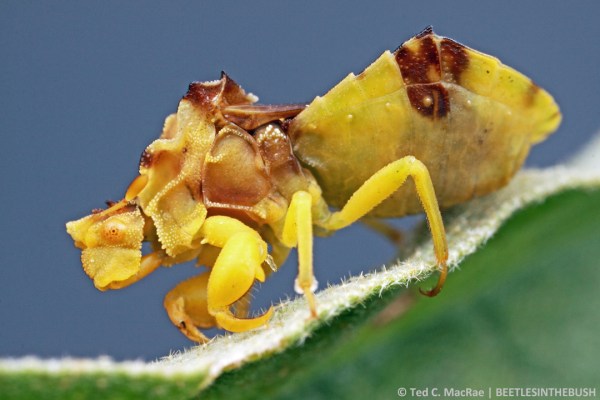
Phymata sp.

Phymata sp. on Croton eleagnifolium foliage | Austin, Texas

From ESA Insect Macrophotography Workshop (posted 13 Nov). The oddly sculpted and chiseled body parts of ambush bugs makes them look like they were assembled from robots. Contrasting the body against a blue sky gives a more unconventional view of these odd beasts than the typical top-down-while-sitting-on-a-flower view.


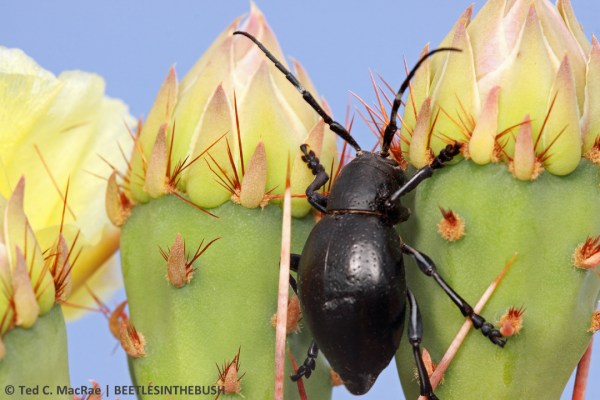
Fourth attempt - holding detached pad up against sky for cleaner background.

Moneilema armata on Opuntia macrorhiza | Alabaster Caverns State Park, Woodward Co., Oklahoma

From Q: How do you photograph cactus beetles? (posted 24 Nov). Photographing cactus beetles requires patience, persistence, long forceps, and strong forearms. Natural sky provides a much more pleasing background than a clutter of cactus pads and jutting spines.


I hope you’ve enjoyed this 2013 version of “Best of BitB” and look forward to seeing everyone in 2014.

Copyright © Ted C. MacRae 2013

A polypipin’ we will go!

A polypipin’ we will go, a polypipin’ we will go
Heigh ho, the dairy-o, a polypipin’ we will go
A polypipin’ we will go, a polypipin’ we will go
We’ll catch a tiger beetle and put him in a vial
And then we’ll let him go (not!)

Okay, maybe my adaptation of the popular children’s song A Hunting We Will Go isn’t the best, but if you want to collect tiger beetles in the genus Tetracha then you’ve got to try the method that my friend Kent Fothergill has dubbed “polypipin’.”

The author polypipin’ in a soybean field in Starkville, Mississippi, September 2013. Photo by Lisa G. Ruschke.

What exactly is polypipin’? Well, it’s when you look for stuff under polypipe—a big plastic tube with holes in it that some farmers use to irrigate their crops. The tube is laid across one end of their field, and when water is pumped into it the water leaks out of the holes along the length of the tube and runs down the furrows between the rows. This is a popular method of irrigation in the Mississippi Delta because the terrain is flat and the equipment costs are much lower than center pivot irrigation systems. Of course, the tube also provides excellent cover for insects and other small critters that live in and around agricultural fields, and these include tiger beetles in the genus Tetracha.

Tetracha carolina under polypipe in a soybean field in Starkville, Mississippi

Tetracha carolina under polypipe in a soybean field in Starkville, Mississippi

I wish I could take the credit, but it was Kent who had the great idea to use polypipin’ as a way to survey for T. carolina (Carolina metallic tiger beetle) in the Mississippi Lowlands (“bootheel”) in southeast Missouri. This is a common species across the southern tier of the United States, but prior to this survey the occurrence of this species in Missouri was not well understood. While a number of specimens had been collected in the bootheel over the years prior to the survey, some regarded Missouri records of the species to be a result of vagrants migrating into the state rather than residents (Pearson et al. 2006). Tiger beetles in the genus Tetracha are nocturnal and take refuge during the day, so they are not often encountered unless one goes at at night with a flashlight. Kent was interested in determining the status of this species in Missouri and had noticed their tendency to take refuge under polypipe—where they could be easily found during the day by simply lifting up the pipe. Rather than give up on sleep, Kent and colleagues surveyed agricultural fields throughout the bootheel by looking under polypipe and demonstrated not only that T. carolina is well established in and a resident of the bootheel, but that it is actually quite abundant and may reside even further north in Missouri than just the bootheel (Fothergill et al. 2011).

Adults are amazingly calm if the polypipe is lifted carefully so as not to disturb them.

Adults are amazingly calm if the polypipe is lifted carefully so as not to disturb them.

I don’t know what it is, but there is just something really fun about polypipin’. Being an agricultural entomologist by day, I have ample opportunity to do a little polypipin’ of my own as I travel across the southern U.S. looking at soybean fields, including this past September when I found myself in fields with polypipe in Arkansas and Mississippi. These photos were taken in Starkville, Mississippi near the Mississippi State University campus, and as has happened in every other case where I’ve looked, I found adults of T. carolina quite abundant underneath the polypipe. Some were found simply resting on the soil surface beneath the pipe, but a great many were observed to have dug burrows under the pipe for added shelter.

Adults often construct burrows underneath the polypipe for additional refuge.

Adults often construct burrows underneath the polypipe for additional refuge.

Polypipin’ works as a survey tool for T. carolina because of that species’ propensity for agricultural fields and other moist, treeless habitats. I’ve not yet found T. virginica (Virginia metallic tiger beetle) under polypipe, but that species is more fond of forested rather than treeless habitats. Perhaps an agricultural field next to forest with polypipe laid on the side adjacent to the forest might produce this species. At any rate, polypipin’ might offer a tool to better define the entire northern distributional limit of T. carolina—all one has to do is look.

REFERENCE:

Fothergill, K., C. B. Cross, K. V. Tindall, T. C. MacRae and C. R. Brown. 2011.Tetracha carolina L. (Coleoptera: Cicindelidae) associated with polypipe irrigation systems in southeastern Missouri agricultural lands. CICINDELA 43(3):45–58 [pdf].

Pearson, D. L., C. B. Knisley & C. J. Kazilek. 2006. A Field Guide to the Tiger Beetles of the United States and Canada. Oxford University Press, New York, 227 pp. [Oxford description].

Copyright © Ted C. MacRae 2013

Stalking tigers in Argentina

Brasiella argentata

Brasiella argentata | banks of Rio Paraná, Corrrientes, Argentina

Most of you know that I have spent a lot of time in Argentina over the years, and while most of my time there has been for work I have had a fair bit of opportunity to collect insects as well. This includes tiger beetles, and in fact I recall one trip some years ago during which I spent the better part of a week chasing tigers in northeastern Argentina around Corrientes and west into Chaco Province. I think I collected maybe a dozen species or so—some in great numbers and others not, and with the help of tiger beetle expert David Brzoska I’ve managed to put names on most of the material. Despite this, however, I’ve never actually posted any photos of tiger beetles from Argentina here on BitB. I guess the main reason for this is that my efforts to photograph tiger beetles is still a relatively new pursuit (compared to the time that I’ve been going to Argentina), and most of my luck with tiger beetles in Argentina has preceded my time with a camera. The other reason for the delay is that, while I have managed to photograph a few tiger beetles in Argentina, I’ve only recently been able to determine their identity (and you all know how I dislike posting photos of unidentified insects). Well, time to change that, and for this post I am featuring the very first tiger beetle that I was able to photograph in Argentina—the aptly named Brasiella argentata.

Banks of Rio Paraná, habitat for Brasiella argentata.

Banks of Rio Paraná, habitat for Brasiella argentata.

The individuals in this post were photographed on 1 April 2011 during the early part of a week-long visit to Corrientes and neighboring Chaco Province in northern Argentina. Remember, this is the southern hemisphere, so early April is way late in the season and, in this part of Argentina, typically on the back end of a very long dry period. Still, it is far enough north to be borderline subtropical climate, and with the stifling heat it could, for all intents and purposes, have been the middle of summer. I knew tiger beetles could be found along the banks of the Rio Paraná, as I had collected them there during my trip some 10 years previous, so in late morning of my first day after arrival in the city I kitted up and walked down to the river. Sand and mud beaches are not plentiful along the mostly rocky shoreline, and I was perturbed to see the area where I had collected during my last visit had since been “developed.” Nevertheless, I found promising-looking habitat a short distance further north and walked to its moister edges (photo above). I saw nothing at first, but eventually I came to a small, moist drainage where the sand was mixed with more mud, and there they were! It took a little bit of looking, as this species is quite small—adults average only ~7 mm in length, and despite the impression you may get from these photos they are well camouflaged to match the color of the wet, muddy sand and, thus, difficult to see before they take flight and again after they land.

An individual sits long enough to allow a few close, lateral profile shots.

Brasiella argentata is one of the most widely distributed Neotropical species of tiger beetles, occurring from Panama and the West Indies south to Peru and Argentina (Cassola & Pearson 2001). Numerous subspecies have been described from throughout its range, but in truth it seems to actually be a “species swarm” comprised of multiple species, many of which can only be determined by examination of characters contained within the male aedeagus (Sumlin 1979). The genus Brasiella itself, like many others, was until recently considered to be a subgenus of Cicindela, but the distinctiveness of these mostly small (Pearson et al. 2007 refer to them as “Little Tiger Beetles”), cursorial (running) beetles has been recognized in most of the more recent comprehensive treatises (e.g., Cassola & Pearson 2001, Erwin & Pearson 2008). Unlike most of its related genera (subtribe Cicindelina), Brasiella is almost exclusively Neotropical in distribution—only one of its 45 species, B. wickhami, reaches the U.S. in southern Arizona (Pearson et al. 2007).

Brasiella argentata

The only photo I managed looking towards the front of an individual.

If their smallness must be recognized, so must their running abilities. This was one of the most difficult species I’ve ever attempted to photograph, and with those difficulties added to the heat of the day and its “perfect storm” habitat it’s a wonder I got any photographs at all. It was a good half hour before I even got the first photo (top), and another hour and a half of effort was required before I managed to get a selection of photos that included a good, close lateral profile shot (middle). As is often the case with very wary tiger beetles, frontal portraits were almost impossible due to their persistent efforts to flee, so I feel fortunate to have managed the last photo. It’s not as close as I typically like to get, but I am pleased with the composition and also the fact that it shows the species’ truncate labrum—a key character.

REFERENCES:

Cassola, F. & D. L. Pearson. 2001. Neotropical tiger beetles (Coleoptera: Cicindelidae): Checklist and biogeography. Biota Colombiana 2:3–24 [pdf].

Erwin, T. L. & D. L. Pearson. 2008. A Treatise on the Western Hemisphere Caraboidea (Coleoptera). Their classification, distributions, and ways of life. Volume II (Carabidae-Nebriiformes 2-Cicindelitae). Pensoft Series Faunistica 84. Pensoft Publishers, Sofia, 400 pp [Amazon description, book review].

Pearson, D. L., C. B. Knisley & C. J. Kazilek. 2006. A Field Guide to the Tiger Beetles of the United States and Canada. Oxford University Press, New York, 227 pp. [Oxford description].

Sumlin, W. D., III 1979. A brief review of the genus Cicindela of Argentina (Coleoptera: Cicindelidae). Journal of the New York Entomological Society 87(2):98–117 [JSTOR].

Copyright Ted C. MacRae 2013

The Festive Tiger Beetle in Southeast Missouri

Cicindela scutellaris lecontei x s. unicolor

Cicindela scutellaris lecontei x scutellaris unicolor (male) | Holly Ridge Conservation Area, Missouri

This past spring I returned to the lowlands of southeastern Missouri in an effort to find and photograph a population of tiger beetles that seems to be unique to the area. The beetles represent Cicindela scutellaris (Festive Tiger Beetle), a widespread species that is common in dry sand habitats across the central and eastern U.S. It is also one of North America’s most polytopic species, with populations in the Great Plains, eastern U.S., Atlantic Coast, southeastern Coastal Plain, and several isolated populations on the western and southwestern peripheries of the species’ range of distribution recognized as distinct subspecies. In Missouri the species is known only from the extreme northwestern, northeastern, and southeastern corners of the state. In all of these areas the populations are found on alluvial sand deposits associated with the Missouri and Mississippi Rivers. Additional sand deposits are found in the areas between these three widely disjunct areas, but curiously the species has not yet been found in them, despite the presence of other species that occupy these same habitats such as Cicindela formosa (Big Sand Tiger Beetle).

Cicindela scutellaris lecontei x s. unicolor

Cicindela scutellaris lecontei x scutellaris unicolor (male) | Holly Ridge Conservation Area, Missouri

The populations in northern Missouri fall well within the distributional range of subspecies C. s. lecontei and are readily assignable to that taxon based on their wine-red coloration and well developed elytral markings. The population in southeastern Missouri, however, cannot be assigned either to that subspecies or to the more southern subspecies C. s. unicolor, which occurs along the southeastern U.S. Coastal Plain and is characterized by solid green coloration and no elytral markings. Individuals from southeastern Missouri are typically green, as in C. s. unicolor, but usually exhibit a distinct wine overtone from C. s. lecontei that varies greatly in its degree of development. Like C. s. lecontei, the elytra are usually marked, but never as strongly as in C. s. lecontei and sometimes not at all (as in C. s. unicolor). The two individuals shown in these photos represent the typical condition—wine blushing and elytral markings only moderately developed; however, more extreme examples can be seen in photos from fall 2008 and spring 2009 (taken during my “point-and-shoot” days, which explains my desire to photograph these beetles again). The intergradation of characters, their variable development, and the apparent presence of a wide disjunction zone between this population and C. s. lecontei to the north suggest to me that it originated from a relatively recent hybridization event between C. s. lecontei and C. s. unicolor—perhaps during the post-glacial hypsithermal that ended some 5,000 years ago.

Cicindela scutellaris lecontei x s. unicolor

Cicindela scutellaris lecontei x scutellaris unicolor (female) | Sand Prairie Conservation Area, Missouri

While I am happier with these photos than I am with those taken earlier, they don’t represent either the full range of variability seen in the population or the most aesthetically pleasing tiger beetle photographs I’ve ever taken. I made two trips to the southeast this past spring, and on each trip I was successful in finding and photographing only a single, very skittish individual—one on a sandy trail through upland forest (Holly Ridge Conservation Area) and the other along the margin of a sand blowout in a native sand prairie remnant (Sand Prairie Conservation Area). I’ll try again this coming spring and hopefully will be able to show some better photographs.

p.s. Can you tell the difference in the type of flash diffuser I used between these two trips? If so, which one do you like better?

Copyright © Ted C. MacRae 2013

INHS Seminar: Tiger Beetles of Missouri

If you are in the Champaign, Illinois area on Tuesday, 29 October 2013, I will be giving a seminar as part of the Illinois Natural History Survey Fall 2013 Seminar Series. I hope to see you there!

My thanks to Dr. Sam Heads for extending to me the invitation and to Jennifer Mui for preparing the very nice poster and attending to travel details.

INHS-Seminar-MacRae_2013-10-29
Copyright © Ted C. MacRae 2013

Just another ‘bug on white’

“White box” photography seems to have become quite popular for insects during the past couple of years, and what used to be a rarely used technique for photographing insects has become rather commonplace. It’s really not that hard to do—all you need is a camera, a flash, an insect, and… um, a white box. Put the insect in the box (maybe cover it with a petri dish and turn the lights off for a bit of time until it settles down), direct the flash towards the interior of the box, and start shooting. It takes only a little bit of trial and error to dial in the proper flash direction and duration (or flash exposure compensation if you use ETTL), and the results can be dramatic, especially if you post-process to enhance levels, contrast, brightness, etc. You can even cheat a little and skip the white box if you have a good flash diffuser and don’t care that there might be a little bit of gray in the furthest reaches of the background (pleading guilty here)—just place the bug on white paper and shoot away.

Cicindela oregona oregona | Topaz Lake, California

Cicindela oregona oregona | Topaz Lake, California

I guess I can’t complain about the new-found popularity of “bug-on-white” photography—anything that makes insects more appealing to the general public is a good thing, and the purity of the photos seems not only to enhance the appearance of the insects but actually makes them seem… well, “cleaner.” Nevertheless, I’ve only dabbled in bug-on-white photos and not gotten into the technique in a big way. The reason for this is that I still, all things being equal, prefer to photograph insects in the field in their native habitats—hopefully also exhibiting interesting natural behaviors. That is the goal, of course, but it is not always a possibility, especially when it comes to one of my favorite subject groups—tiger beetles. Photographing tiger beetles in the field is a challenge due to their extremely wary habits, swift running and rapid flight capabilities, and penchant for extreme, often hostile habitats. Many times I am up for the challenge and will spend whatever time it takes and suffer all manner of indignance to get the shot. However, there are times when there are other tasks at hand or a perfect storm of conditions makes the beetles simply impossible to approach. This was one of those times.

Cicindela oregona oregona | Topaz Lake, California


We encountered the beetle shown in these photos on the California side of Lake Topaz along its muddy southwestern banks. The beetles were not numerous—unusual for the species Cicindela oregona which can oftentimes be quite abundant along shoreline habitats throughout the western U.S. Time was at a premium, as it was supposed to be just a quick stop to see what might be found as we headed further south into Mono Co. to look for some rather spectacular longhorned beetles in the genus Crossidius unique to the area. An added difficulty was the habitat—the beetles were at the edge of a very shallowly pitched mudflat, preventing us from reaching the water’s edge without sinking deeply into the rancid mud. Between this and their scarce numbers, field photographs would have required more of an investment in time and cleanup than I was prepared to spend, so I netted a few individuals for the record and kept one alive for photographs later that night in the comfort of my hotel room.

xxx

One of the nice things about bug-on-white photographs is the ability to get a variety of carefully executed compositions from the most optimum vantage point. Lateral profile shots are almost a requirement, as are shots with the head of the insect slightly turned towards the lens. Of course, I cannot photograph a tiger beetle and not take the perfectly centered, full-on face shot. In all of these cases, the ability to get the camera truly “down” on the subject’s level means that I can maximize the use of low perspective, and nowadays I don’t even bother with dorsal shots that might be good for some future field guide but that I find really quite boring in their aesthetics.

xxx

In fact, you can even take the low perspective to the extreme by actually elevating the subject and coaxing it towards the edge of its platform to allow photography from below. Compare the above frontal portrait of the beetle, taken from a particularly extreme low perspective, with the photo above it, taken at the same level as the subject. Both photographs provide an interesting and aesthetically pleasing perspective, but in very different ways despite the small change in the angle of the camera—the upper photo is pleasing due more to the symmetry of the composition, while the lower photo derives its interest in the unusual perspective that highlights the setose mouthparts and bulging eyes.

xxx

I have long wanted to photograph a tiger beetle with blue sky background (hat tip to Thomas Shahan for giving me that idea during the inaugural BugShot). Sadly, I have not succeeded in doing this. The main problem is in trying to get an extremely wary subject in just the right place at the right time. Since these beetles occur on the ground rather than being elevated on foliage (at least under normal circumstances in the U.S.), one must find a spot where the ground drops sharply enough to allow the photographer to get below the subject, and then somehow get the tiger beetle to pose right at the edge of the precipice. The above photograph is sort of a simulation of the kind of photo I am striving for, achieved in this case by (are you ready for this?) hanging a pair of blue underwear behind the subject, which is sitting on a piece of white paper placed at the edge of the table. The combination of “blue-sky” and bug-on-white techniques is interesting, but don’t think I’ll be able to rest until I have succeeded in a true field version of this photograph. If anyone manages to achieve this before I do, please let me know how you did it (in exchange for me having given you the idea :)).

Copyright © Ted C. MacRae 2013