Photographing the Limestone Tiger Beetle

Seeing and photographing the beautifully black Prairie Tiger Beetles (Cicindelidia obsoleta vulturina) in southwestern Oklahoma was a lot of fun, but by Day 5 I was ready to look for one of my top goals for the trip—Cicindelidia politula (Limestone Tiger Beetle). Occurring primarily in Texas (but also sneaking up into Oklahoma), this would be my first attempt to search for the species. I had gotten a few localities in northern Texas from trusty colleagues, and I knew the beetles occurred on limestone outcroppings in dry to xeric upland habitats (Pearson et al. 2006)—usually starting in late September.  Nevertheless, I always get a little apprehensive when I drive long distances to look for tiger beetles I’ve never seen before. Will I recognize it? What if I find another, similar looking but more common species and assume I’ve found it? Will the season be right? Many species, especially those associated with xeric habitats, depend on timely rains to make their appearance. Will I find the proper microhabitat? There are sometimes seemingly minor details that can make a habitat suitable or not for a particular species.
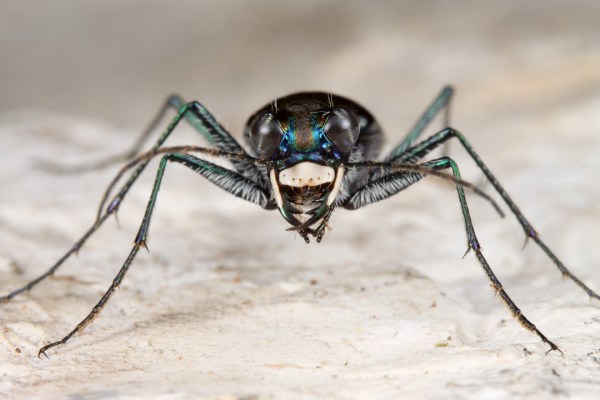
Cicindelidia politula politula | Montague Co., Texas

As can be seen by the above photo, I did succeed in finding the species. However, it wasn’t easy, and for the better part of Day 5 I wondered if I would even be able to capture a specimen, much less succeed in photographing the species in its native habitat. I actually saw the first individual of this species in Oklahoma—sitting on the very first exposed limestone rock at the very first locality I went to. My rule for photographing tiger beetles that I’ve never seen before is to collect the first individual and keep it alive in a vial. In the event I never see another individual or fail in my attempts to photograph them in the field, the first individual becomes my voucher specimen and studio backup. Fortunately, I rarely have to resort to studio shots, but in this case I muffed my attempt to capture the specimen! I searched the locality for a good hour and never saw another one until I circled back to where I started, and there it was again (it just had to be the same one). Believe it or not, I muffed the capture attempt once again! That was my last chance at the Oklahoma site, so it was a rather dejected 2-hour drive south to Montague Co. in northern Texas—knowing that I’d seen it and had my shot at it (two shots, actually) but still found myself empty-handed.

A serviceable photo, but like most of confined individuals it suffers from lack of ”pizzazz.”

My luck improved in Montague Co., although not right away or that much when it did. I had just about given up at this second locality when I saw one. This time I used the stalk-and-slap technique followed by a quick pounce to seal down the net around its perimeter and prevent escape by the beetle (they are real good at quickly finding the tiniest gap between the net rim and the ground and then zipping away in a flash). This time I succeeded in capturing the beetle and thus had my voucher, but my pounce was a little too rough on the beetle, resulting in an extruded genital capsule. This made it completely unusable for photographs (imagine a big orange blob sticking out of the butt of the beetle—not good, photographically!). Of course, finding a beetle at the site caused me to spend more time searching, but I never saw another beetle there.

The shiny black to blue-black elytra with white markings absent or limited to the apices are characteristic for the species.

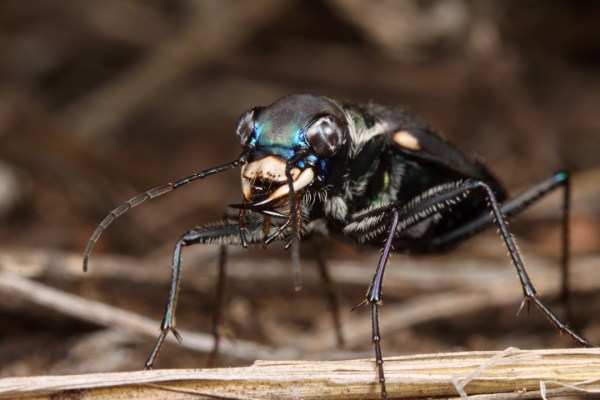
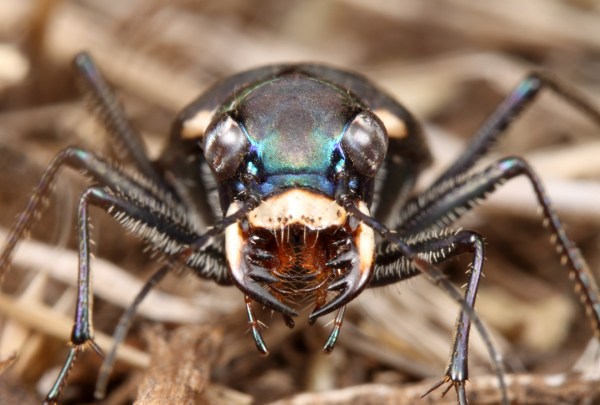
At this point I had a decision to make—if I drove to the next locality on my list (2-hour drive), I probably would not arrive with enough time before sunset to find beetles. I decided not to waste the remaining daylight and instead just bushwhack where I was to look for similar roadside habitats and drive on after sunset. I found another good habitat fairly quickly, and within minutes after starting the search I saw one—and missed it! But then I saw another one—and missed it, too! Now my confidence was shaken, as neither of the two techniques I use most commonly for capturing tiger beetles were working. When I used the “stalk-and-slap” method the beetles always found a gap on the rough, rocky ground and got away, and when I used the “tap-and-sweep” method the beetles would hunker down at first and then fly right after the net passed over them. I would miss a total of eight (eight!) beetles before I finally (finally!) caught one, and then I would miss three more beetles afterwards! That single beetle is shown in the above photographs, which were taken after placing the beetle on a large, flat limestone rock that I laid on the bed in my hotel room that night (carrying that huge limestone rock into the hotel room was an experience!).

I really dislike photographing confined insects. Even if one prepares a wholly natural looking set and manages to cajole the subject into standing still, they rarely look quite right. I do like the first photo in the series, just because it’s a well composed face shot, but I’m not so fond of the more ‘classic’ view of the beetle represented by the second photo. Technically it’s an adequate photo that shows the beetle and all of its salient characters; however, it lacks, well… oomph, because the beetle isn’t really doing anything—the photo tells no natural history story. Still, an adequate photo that lacks oomph is better than no photo at all, so I made the best of my opportunity to take studio shots of the one good beetle I had and hoped for better luck the next day.

Exposed limestone road bank in Johnson Co., Texas—perfect habitat for Cicindelidia politula

The next day brought the luck that I was looking for. I was close to the next locality on my list when I saw a road bank with exposed limestone that just seemed to call out, “Search me!” I stopped and began searching, and within a few minutes I saw the first beetle—and missed it! Arghhh, not again! I would actually miss a few more before I finally caught one, so by now my confidence was destroyed. It’s been a long since I’ve had this much trouble catching tiger beetles, and if I was having this much trouble catching them, how on earth could I even contemplate trying to photograph them. However, the nice thing about finding a spot where beetles are out in numbers is the opportunity to try again—practice makes perfect. I decided my previous attempts had all been a little too lackadaisical and started buckling down and really concentrating on my technique. Not surprisingly, I started having success in capturing the elusive beetles (tap-and-sweep worked best), and after a time I felt like I had a good enough feel for the beetle’s behavior to begin trying for field photographs.

Cicindelidia politula politula | Johnson Co., Texas

Not surprisingly, given how difficult they were to catch, this also proved to be one of the most difficult species of tiger beetle that I’ve ever tried to photograph. Like many other tiger beetles that live in hot, xeric, open habitats they were extremely wary and difficult to approach, a behavior that was exacerbated by the now midday sun. Their escape flights were not very far, but far enough that if I’d already gotten into a prone position I had to get up and start all over again. The task was made even more difficult by the hard, jagged, rough-edge rocks on which I had to lay and crawl—ouch! Several individuals are represented in the field photographs shown here, each of which I had to “work” for some amount of time before I was able to finally get close enough to start taking photos (and representing only a few of the many individuals that I actually spent time “working”). Usually, the first photos of an individual are never very good but start the process of getting the beetle accustomed to my presence and the periodic flash of light. Eventually, if I’m lucky, it settles down and resumes normal searching and thermoregulatory behaviors, and I can then get as close as I want and really work the angles for a variety of compositions. I no longer try to approach beetles from the ‘proper’ angle; they turn so much while moving about that it’s easier to just wait for them to assume desired angles as they move about and be ready to shoot when it happens. Field photography of unconfined tiger beetles in their native habitat is hard and time consuming, but the results are well worth the effort. Compare the staged photos of the Montague Co. individual with the field photos from Johnson Co. What marvelous displays of active beetles engaged in natural behaviors in their native habitat the latter represent!
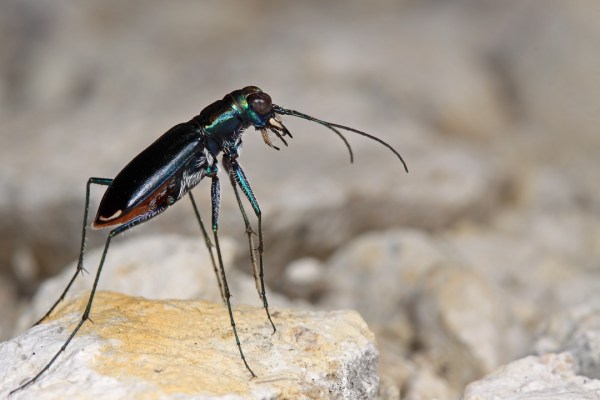
By midday the adults start ”sun-facing” to minimize thermal exposure in their hot, xeric habitats.

After getting several good photos of the beetle in its habitat, I decided it was time to try for some really close photos and added a full set of extension tubes to the camera. A set of tubes with a 100mm macro lens provides close to 2X magnification, but it also reduces the available working distance—a real challenge with wary tiger beetles under a midday sun! I spent quite a bit of time trying to get close enough to take advantage of the additional magnification, but I wasn’t successful until I encountered the individual in the photos below shade-seeking at the base of a yucca plant. Shade-seeking beetles tend to stay put and not move as much (although they still rarely just sit there).
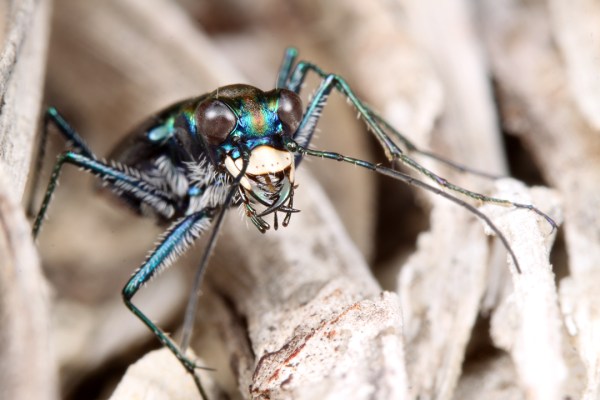
Shade-seeking is another strategy to avoid the midday heat.

I worked this beetle for several minutes and managed to get a number of shots, each closer than the previous and culminating in the nice portrait below.

The ”pièce de résistance”—Cicindelidia politula politula at 2X life size!

My photographic appetite now completely satiated, I spent the rest of the day searching for (and finding) additional localities for the species in the area. I found them more often associated with older, level exposures that had at least a small amount of vegetation. In contrast, newer or steeply sloped exposures or those completely devoid of vegetation rarely had beetles associated with them. I had now spent two days working on C. politula, but the results—both as a collector and as a photographer—made it time well spent. I felt like I “understood” the beetle. However, with only two days left in the trip, it was time to start working my way back towards Missouri and focusing on the few additional goals I still had for the trip.

REFERENCE:

Pearson, D. L., C. B. Knisley and C. J. Kazilek. 2006. A Field Guide to the Tiger Beetles of the United States and Canada. Oxford University Press, New York, 227 pp.

Copyright © Ted C. MacRae 2012

Dressed in black

The first three days of this year’s Fall Tiger Beetle Trip had been fun, and finding a new state record jewel beetle and an unusual seasonal activity record for another were definitely icing on the cake. Still, tiger beetles (at least adults) had been notably absent, with my hunch that Cicindela pulchra (Beautiful Tiger Beetle) might occur in the Red Hills of northwestern Oklahoma not playing out. My next goal was to go down to northern Texas and look for Cicindelidia politula (Limestone Tiger Beetle)—a species I have not yet encountered in the field. When I saw that the route south took me through the Wichita Mountains of southwestern Oklahoma, I recalled seeing this photo of Cicindelidia obsoleta vulturina (Prairie Tiger Beetle) on BugGuide taken in these very mountains during the fall. I have seen on many occasions the greenish Missouri / Arkansas disjunct population of this subspecies, but I had not yet seen the main population and its decidedly black individuals, so this became my quarry for Day 4 of the trip. I had nothing more to go on for a locality than “Wichita Mountains NWR” and a sense of its habitat preferences based on my own experience with the MO/AR disjuncts, so after arriving at the refuge I began to look for access to a 2-track leading to higher, unforested ground (reminiscent of the dolomite glades of southwestern Missouri). I quickly found a parking lot with a 2-track leading from it, so I pulled off, geared up, and set out on what I figured was surely a wild goose chase. The track looked good, but no beetles were seen, and after walking about a half-mile I happened to look up and see this not too far ahead:

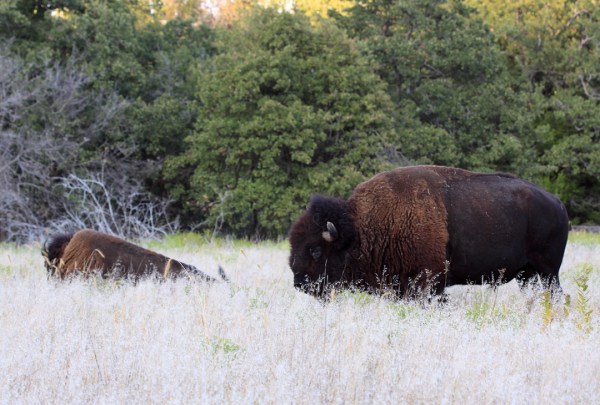
American bison | Wichita Mountains National Wildlife Refuge, Oklahoma

Call me chicken, but bison can and will charge without warning. Even though they seemed unconcerned by my presence, I wasn’t with anybody that I knew I could outrun 🙂 and decided that a cautious, tip-toeing retreat would the best course of action (even taking the above photo—uncropped, I might add—made me nervous). What now? I was quickly back at the car and not sure what to do next when I saw a foot path leading into a cedar woods, behind which the land rose up to treeless heights. I decided that might be a good place to explore—as long as I didn’t run into any bison along the way! As I was hiking through the woodland—an open, obviously long ago planted grove of eastern red cedar (Juniperus virginiana)—I passed by a small opening and almost by instinct veered into the opening to have a look. As soon as I stepped into the opening I saw the unmistakable escape flight of two large tiger beetles—what the…?! No doubt about it, they were C. o. vulturina, and they had been hanging out by a fairly fresh bovid chip (bison or cow, I don’t know). (I have seen this behavior also with the MO/AR disjuncts.) I watched them land and decided which one I would try to photograph. I guess I picked right, because the following photo was among the first few that I got:

Cicindelidia obsoleta vulturina (prairie tiger beetle) | Wichita Mountains National Wildlife Refuge, Oklahoma

Despite the jet-black dorsal surface (which contrasts with the green to greenish-black to bronzy dorsal surface of the MO/AR disjuncts), these were colorful beetles with gorgeous metallic blue genae (cheeks) and intense violaceous tibia (lower legs). This first individual was quite cooperative (usually it’s the tenth or more beetle that I try to photograph that actually allows me to do so), so I spent a bit of time trying to coax it back to the bovid chip from which it flew. Eventually I succeeded in this and took a few more photos, the following of which I liked the best:

Shade seeking next to a bovid chip.

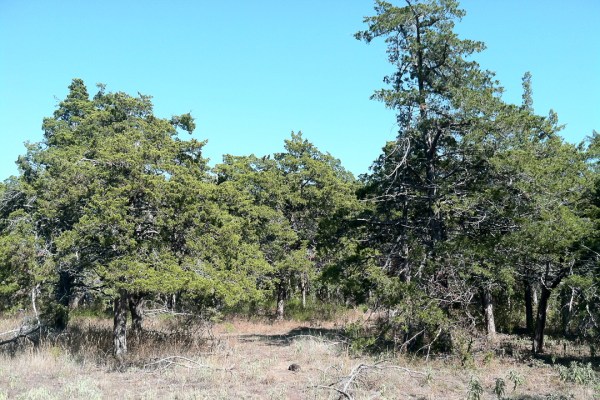
I’m still a bit puzzled about the habitat in which I found these beetles. I would have considered it an anomaly had I not seen two beetles at the same time and then subsequently seen a mating pair in almost the exact same spot. Prairie tiger beetles are known for their preference of open grassland habitats rather than woodlands, and indeed I saw more individuals back along the 2-track that I had abandoned earlier (once I got the courage to stray down it again later in the day). The photo below shows almost the entirety of the opening where I found the beetles, with the bovid chip located on the ground in the lower center of the photo:

An unusually wooded habitat for Cicindelidia obsoleta vulturina.

Seeing these two individuals in the small woodland opening gave me greater optimism that I would be able to find more on the grassy higher slopes above the cedar grove. I crossed the creek and climbed to the top of the first ridge, passing through what seemed to be ideal habitat for the beetle but seeing none. Although igneous in origin, the rocky landscape reminded me very much of the dolomite glades that lace through the White River Hills of southwestern Missouri and that harbour robust populations of this beetle (but occurring nowhere else in the state).

Rocky grasslands extend towards Mt. Scott.

After posting one of these landscape photos on my Facebook page, I got a comment from Thomas Shahan saying he had been to the area recently and seen a “dark Cicindela” atop nearby Elk Mountain. Low and behold, the beetle in the photo that he included was none other than this subspecies, so at least now I know they do occur in this more expected habitat despite my not having seen them on this day.

Failing to find the beetle on higher ground, and wanting to try for even closer photographs, I returned to “the opening” and immediately found another individual to photograph. A female, she may (or may not) have been the partner to the male I photographed earlier, but at any rate she was not nearly as cooperative. I chased her back and forth through the opening for about a half-hour before I finally got close enough to get a shot (my use of tube extensions required that I get even closer than before). As typically happens, however, she gradually became more and more accustomed to my presence, and eventually I was able to get a few photos with the beetle in fairly relaxed, candid poses. The following are my favorites:

A less trusting individual relunctantly allows herself to be photographed.

She looks angry, but in reality I caught her mandibles half open in the midst of chewing movements.

After photographing these individuals, I returned to the car and decided to wander (tentatively) down the 2-track that I had to abandon earlier in the day. This time I fouund the beetles easily, seeing perhaps half a dozen individuals in just the first quarter-mile. My wanderings, however, were once again cut short when I came around a tree bank and saw those same two bison, much closer to the road this time. I really wanted to get a better photograph than the one above, but common sense at first prevented me from getting any closer. I studied the two magnificent behemoths looking for any sign of annoyance, and seeing none I began to creep ever so tiny a bit closer. Eventually my heart rose too high in my throat to approach any closer, and I snapped the following photo and began a hasty, horse-eyed retreat—not even knowing for sure if the shot was good but feeling a little too proud of myself and my stupidity courage!

A little too close for comfort!

Copyright © Ted C. MacRae 2012

The very dirty tiger

Ellipsoptera cuprascens (Coppery Tiger Beetle) | Mississippi Co., Missouri

In my post Very wary tigers!, I lamented my inability to photograph one of our state’s less commonly encountered tiger beetles, Ellipsoptera cuprascens (Coppery Tiger Beetle), on an open Mississippi River beach under a blazing sun. There are solutions to such problems, however, one of which is the use of blacklights to attract the beetles at night when cooler temperatures and readily available prey make the beetles much more approachable. Of course, this only works for those certain species that are attracted to blacklights, of which fortunately E. cuprascens is one, and not long afterwards I was able to photograph individuals of this species that came to a blacklight placed further south along the Mississippi River in New Madrid Co., Missouri. The photos were adequate, but none were what I would consider a true winner, so when I found the species again while blacklighting at another Mississippi River beach in southeast Missouri I continued with my attempts to photograph them.

Heavy lime coating the antennae must feel to this fellow like like breathing in concrete does to us!

The species was much less abundant this time, and none of the few individuals that showed up at the light actually spent any time on the ground where I could take reasonably natural looking photographs. This time I decided to look for them along the beach away from the light and succeeded in finding a few. As is typical, the first several that I tried to photograph were too wary to approach, but I’ve learned to keep trying until I find that one (slightly) more cooperative individual. As I crossed over the concrete boat ramp I saw one that seemed not at all flighty. I’ve seen the ubiquitous Cicindela repanda commonly on concrete boat ramps, so I checked carefully to be sure it wasn’t that species, and after confirming its E. cuprascens identity I began the slow, cautious approach that ended with me flat on my belly and the camera lens inches from the beetle. Nighttime photography is tricky because… uhm… it’s dark, and I don’t find my flash unit’s focusing lamps all that helpful (they tend to time out right before I’ve composed the shot to my satisfaction). Instead, I place my headlamp on the ground and position it so that it continuously illuminates the subject so I can concentrate on getting multiple shots without having to constantly divert my attention to the focusing lamp button. The concrete was hard, and my elbows were mad at me for a time afterwards, but the beetle was generously cooperative and took on some very nice poses during the session, leaving me with the impression that I’d gotten that “perfect” shot as I walked back to the blacklight.

The obligatory face-shot—especially stark in its white lime surroundings!

Sadly, these photos are far from perfect. Their composition is good, as is their focus and lighting and the natural-looking poses that I captured. But the beetle is absolutely filthy! I didn’t realize it at the time, but apparently its wanderings across the decaying lower reaches of the concrete boat ramp resulted in a thick coating of lime on just about every part of its body. Now, few tiger beetles that I photograph are perfectly clean and spotless, and although a few grains of sand around the mouth or on the legs are tolerable, I am not above cloning out debris that detracts from the beauty of the beetle—especially when it is on the eyes or its shiny, glabrous dorsal surface. This beetle, however, is simply beyond repair. I’m by no means a Photoshop expert, but I’m not sure even the most fluent PS whiz could fix this beetle. So, my quest for the “perfect” E. cuprascens photo will continue…

Copyright © Ted C. MacRae 2012

Unexpected visitors

Cicindela repanda (Bronzed Tiger Beetle) | Lewis Co., Missouri

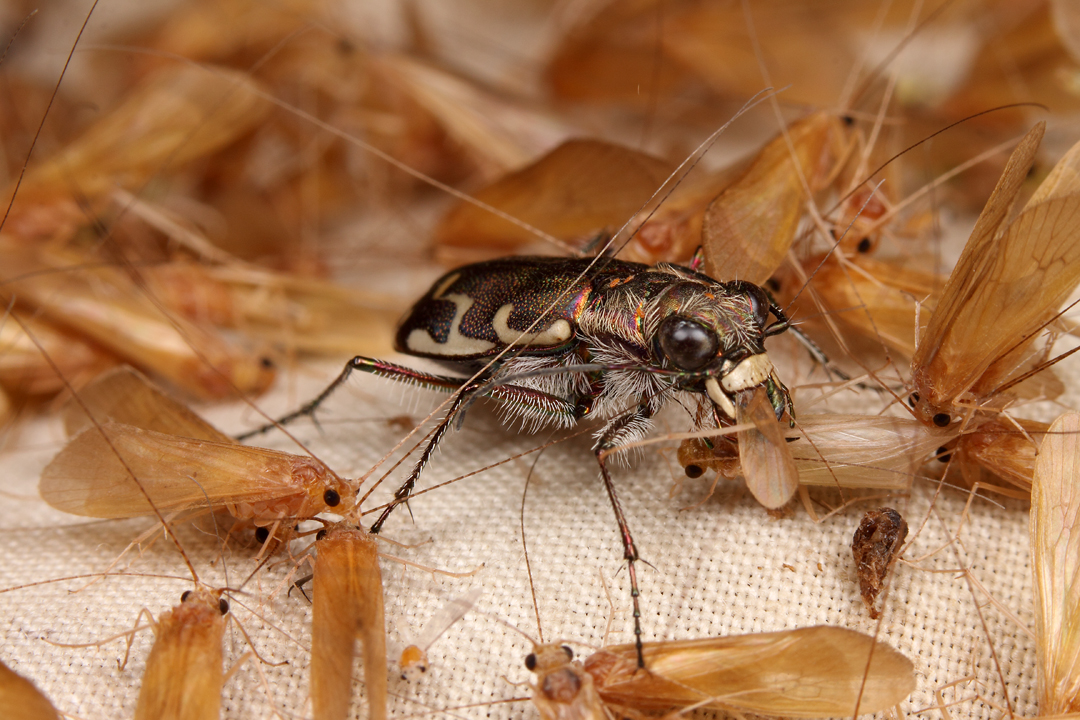
In late July I began blacklighting on a weekly basis at different locations along the Mississippi River in an effort to gain more detailed information on the distribution of certain tiger beetles along that great watercourse. While attraction of tiger beetles to ultraviolet lights is well documented, it seems to me to be an underutilized method for collecting tiger beetles and recording distributions. Perhaps this is because only certain species are attracted to lights—principally members of the genera Ellipsoptera and Habroscelimorpha [and even one species, Habroscelimorpha striga (Elusive Tiger Beetle), that is seen almost exclusively at blacklights], while others, including the more commonly encountered and speciose genus Cicindela, are rarely attracted to lights. As a result, when I setup a blacklight on a sandy beach along the Mississippi River in La Grange in far northeastern Missouri, I expected to see Ellipsoptera cuprascens (Coppery Tiger Beetle), which I had seen there during the day many years ago, and hoped to see Ellipsoptera macra (Sandy Stream Tiger Beetle), which I have so far seen only in northwestern Missouri. I did not see either of these species, but what I did see was even more unexpected—Cicindela repanda (Bronzed Tiger Beetle).

Feasting on the bounty!

It is ironic that I should be so excited to see this species—it is only the most common species of tiger beetle in Missouri (and probably across much of eastern North America), where chokingly thick populations develop each summer along every waterway in the state. As a species, it is remarkable infidel when it comes to habitat selection, proximity to water appearing to be its only real requirement. I have seen them on virtually every type of stream/river/pondbank regardless of soil type—sand, mud, or any mixture of the two—and note them to be common even on concrete boat ramps (although I have yet to find larval burrows in the latter habitat!). Yet, I have never seen them at a blacklight! Perhaps it was just a matter of time, as until this year I myself hadn’t done much blacklighting for tiger beetles. Populations of this species build as the summer progresses, and it could be that once numbers reach their peak in mid- to late August, a few will find their way to a light that happens to be placed in their midst while the majority of individuals bed down in their overnight burrows.

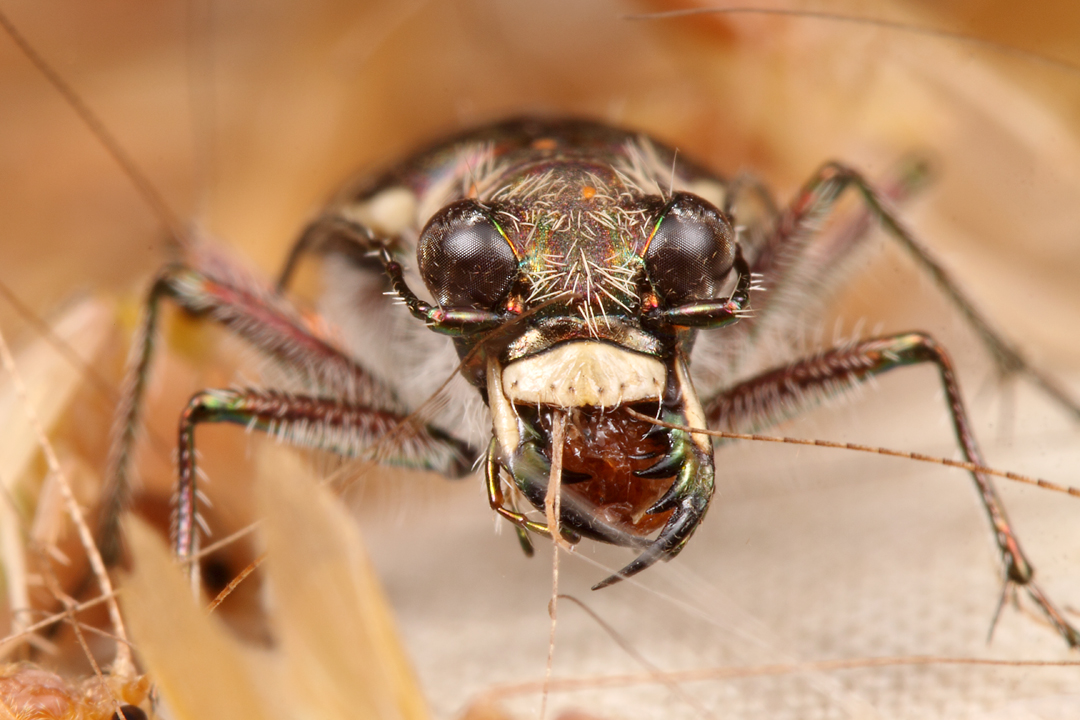
A macerated bolus is all that remains of the caddisfly meal.

It’s easy to see what might attract them to the light other than the light itself—prey! At every location along the Mississippi River that I’ve blacklighted this summer, choking throngs of caddisflies inundate the sheet within the first half-hour after sunset. Piling up in layers beneath the stupefying light, the caddisflies are a limitless bounty of easy pickings for the tiger beetles, who greedily grab the hapless trichopterans in their toothy, sickle-shaped mandibles and then use their maxillae and digestive juices to macerate them to a juicy pulp that can be sucked dry. I have watched tiger beetle adults feeding on many occasions, but I never noticed until examining these photographs that the feeding beetles hold their antennae back and out of the way against their head and pronotum. Contrast the antennal position of the feeding beetles in the above photographs with the forward position of the antennae in the non-feeding beetles in the remaining photographs. Perhaps this is an adaptation to prevent the antennae from being grabbed and damaged by struggling prey.

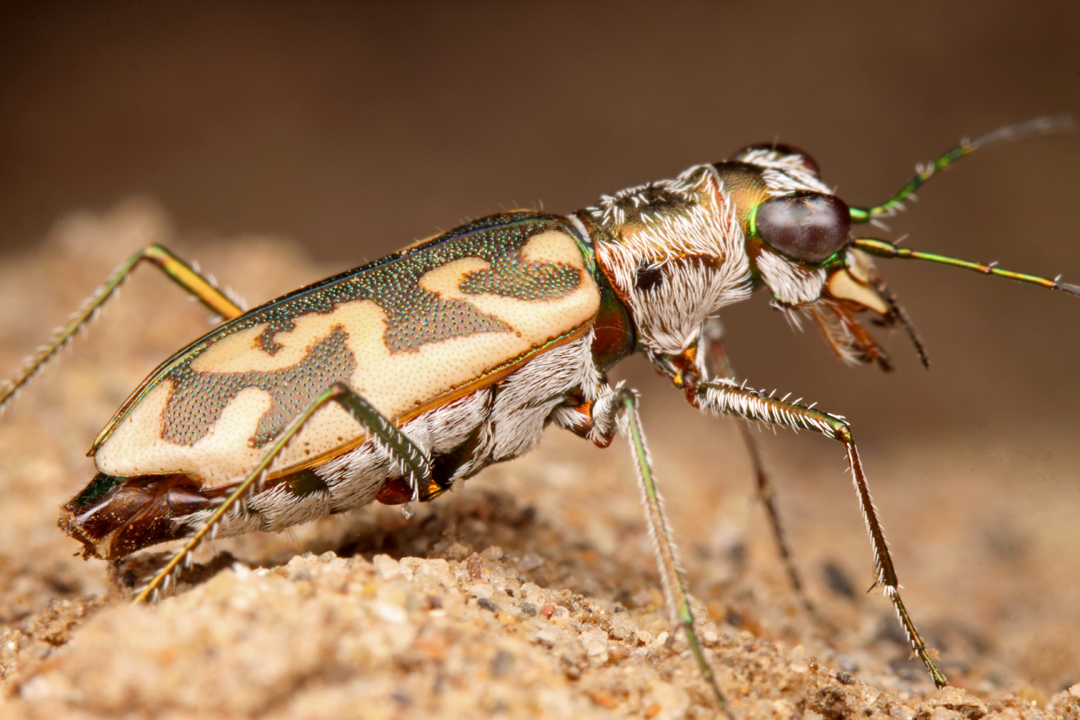
A male in more natural-looking surroundings.

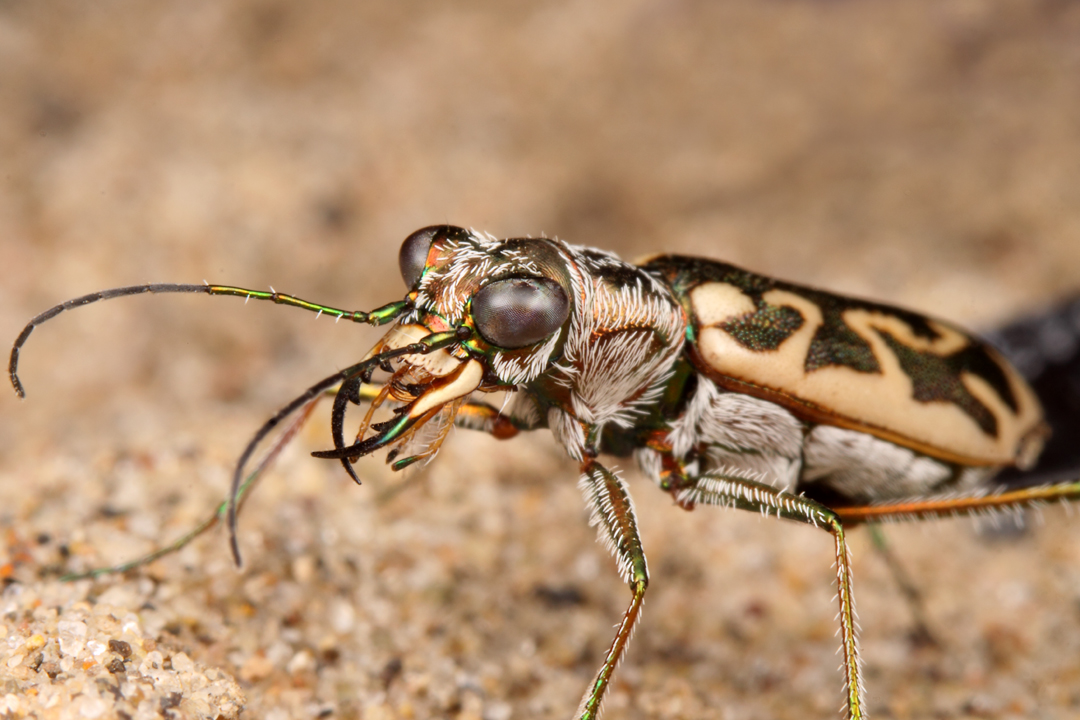
Recall also my recent lamentations about lacking good photographs of this species, due initially to lack of effort and later to a rare failure when I did try to photograph them. A half dozen individuals made their way to the light this night, and I was able to coax a few of them off the sheet and onto the surrounding sand for a few photographs in more realistic and natural surroundings. I still don’t consider these to be the photographs that I want for this species, as they do not show any of the thermoregulatory behaviors exhibited during the day such as stilting, sun-facing, or shade-seeking that make for such marvelously iconic tiger beetle poses. For that, I will need to give them another shot on a hot day while summoning every ounce of tiger beetle stalking skill that I can possibly muster. Still, these last two photos (and a few others not shown) are several steps above the single, frustratingly distant lateral profile shot that I had for this species before this night.

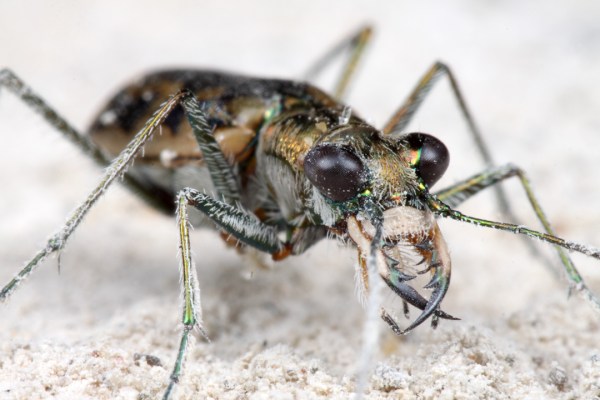
All jaws, eyes, legs, and hair!

Copyright © Ted C. MacRae 2012

Program Announcment: 2012 ESA Annual Meeting

The Entomological Society of America recently posted the 2012 Program for their Annual Meeting this November in Knoxville, Tennessee, and I’m honored to announce that I’ll be giving a presentation in the Section A Symposium “Entomologists Beyond Borders: Hands on Macrophotography to Help Think Globally.” Let me say this straight out: this looks like a fabulous symposium, but I’m a bit intimidated at the prospect of sharing the stage with such renowned insect macrophotographers as Alex Wild, Thomas Shahan, Marlin Rice, etc. Nevertheless, I hope that the techniques I plan to share on locating and photographing live, often wary insects in their native habitats will be considered useful by at least some members of the audience. At this point, my talk is still an amorphous collection of ideas swirling around in my head (although, as you might predict, there will be many photos of tiger beetles!), thus, if there are any particular points you would like to see addressed now is the time to let me know.

I have been to a number of ESA meeting in the past, but the last was many years ago. I look forward to attending once again, reconnecting with old acquaintances and (hopefully) meeting many new ones. I hope to see you at the Entomologists Beyond Borders Symposium, and please don’t hesitate to come up and say hello.

When: Tuesday, November 13, 2012: 8:00 AM-12:45 PM
Where: Ballroom A, Floor Three (Knoxville Convention Center)
Organizers: Cheri M. Abraham and Ric Bessin
 
8:00 AM Welcoming Remarks
8:05 AM Introduction to insect macrophotography
Robert K. D. Peterson
, Montana State University
8:35 AM This is not that difficult: Techniques for shooting digital macro-photography images of insects
Marlin E. Rice
, Pioneer Hi-Bred International, Inc.
9:05 AM Approaching the unapproachable: Tips and tricks for photographing live insects in their native habitats
Ted C. MacRae
, Monsanto Company
9:25 AM Digital Imagery: Tips, tricks and tools to make impressive insect images
Jocelyn Gill
, Agriculture and Agri-Food Canada
9:45 AM Methods of magnification
Thomas Shahan
, N/a
10:15 AM Photographing insects on a budget
Alexander L. Wild
, University of Illinois
10:45 AM Digital image processing: One perspective on organization, correction and retrieval of images
Eugene D. White
, Rose Pest Solutions
11:15 AM Concluding Remarks
11:20 AM Hands on workshop

Copyright © Ted C. MacRae 2012

Very cozy tigers!

In my post Very wary tigers!, I spoke of the frustrations of trying to photograph tiger beetles when conditions of temperature and terrain conspire to make them too wary to approach. This is a common feature of tiger beetle photography in general, but the problem seems to reach its zenith with the “wet sand beach” species—most species inhabiting these habitats tend to be “summer species” active during the hottest part of the season, and their habitats tend to be virtually devoid of any vegetative cover that can be used to the photographer’s advantage. A blazing sun on hot, open sand is not conducive to photographing anything! Still I try, and on that particular day I did manage a few relatively distant photographs of two species, Cicindela repanda (Bronzed Tiger Beetle) and C. hirticollis shelfordi (Shelford’s Hairy-necked Tiger Beetle) but none at all of a third species that was present on the beach, Ellipsoptera cuprascens (Coppery Tiger Beetle).

Ellipsoptera cuprascens (Coppery Tiger Beetle) | New Madrid Co., Missouri

Well, there is always more than one way to skin a cat (or a tiger), and as can be seen in these photographs I took a different approach to that latter species that allowed me to obtain several quite decent photographs of both males and females. Not long after that frustrating day at Cape Rock Park, I found myself again in southeastern Missouri with an opportunity to do some night collecting. It may not be widely known, but certain species of tiger beetles are also active at night and can actually be attracted to ultraviolet (UV) lights. This is particularly true of species in the genus Ellipsoptera, which as a group seem to depend almost exclusively on coastal and fluviatile sand habitats. I have used UV lights in the past to attract nocturnally active species of tiger beetles for photography (see Return to Nowhere), and since I had seen E. cuprascens a few years ago at Steward Towhead in New Madrid County I thought this might be a good spot to try again for photographs of that species.

The relatively coarsely and densely punctate elytra distinguish E. cuprascens from E. macra.

“Might be a good spot” turns out to be quite the understatement, as I have never seen E. cuprascens in such numbers as I did that night! Seeing the species common at the sheet guarantees that individuals will also be found milling around on the ground in the immediate vicinity of the sheet, and unlike during the heat of the day when their bodies shift to thermal overdrive, adults at night are much easier to approach due to the cooler temperatures and the distraction of abundant, easily captured prey sitting transfixed in their UV light-induced stupor. Of course, night photography brings its own set of challenges, primarily (for me) the need to use the camera flash head lamps for focusing—I often find myself repeatedly aborting a shot because the lamps turned off automatically before I had a chance to find the subject and compose the shot to my satisfaction. Still, this is a minor inconvenience compared to the exasperation of subjects blasting across the hot sand when your approach comes within 12 feet!

Males mandibles are modified for grasping the female pronotum during mating.

Ellipsoptera cuprascens is very closely related to E. macra (Sandy Stream Tiger Beetle—see The last tiger beetle), which it resembles greatly and whose ranges overlap here in Missouri (although the latter is far less commonly encountered than the former). The photos in this post show the relatively coarser and denser punctures on the elytra that distinguish E. cuprascens from E. macra, as well as their somewhat shinier surface and distinctly more coppery color. The rounded elytral apices of the female (middle photo) also serve to distinguish the species from E. macra, in which species the elytra of the females come to a point at the suture (Pearson et al. 2006). Note also the sexual dimorphism in the labrum and mandibles of the female (first photo) and male (last photo), with the mandibles relatively longer and slightly curved and the labrum shorter in the latter. Presumably this is related to the use of the mandibles by the males in grasping the female pronotum during mating—the longer, curved mandibles are shaped to precisely fit the contour of the female’s pronotum, while the shorter labrum allows the mandibles to gain better purchase farther down on the side of the female’s pronotum (Pearson and Vogler 2001).

REFERENCE:

Pearson, D. L., C. B. Knisley and C. J. Kazilek. 2006. A Field Guide to the Tiger Beetles of the United States and Canada. Oxford University Press, New York, 227 pp.

Pearson, D. L. and A. P. Vogler.  2001. Tiger Beetles: The Evolution, Ecology, and Diversity of the Cicindelids.  Cornell University Press, Ithaca, New York, 333 pp.

Copyright © Ted C. MacRae 2012
Very wary tigers!

In late July I found a new tiger beetle site in southeastern Missouri—a small sandbar along the Mississippi River near Cape Rock Park on the north side of Cape Girardeau. I originally went to the park to look for Cylindera cursitans (Antlike Tiger Beetle), two specimens of which my friend and colleague Kent Fothergill had found in the collection of a local lepidopterist (MacRae et al. 2012). I thoroughly searched the areas that looked suitable for that species, but to no avail. I did, however, spot the sandbar down by the river and knew immediately that it had good potential for several species typically found in such habitats. Even before hiking down the rocky embankment I figured I would see Cicindela repanda (Bronze Tiger Beetle)—dreadfully common along almost every waterway in the state. What I was really hoping to see, however, were some of the more specialty species found only in wet sand habitats along the big rivers of the state—the Missouri and mighty Mississippi.

”Stilting” and ”sun-facing” by Cicindela hirticollis shelfordi | Cape Girardeau Co., Missouri

Predictably, C. repanda was present and abundant, but it wasn’t long before I spotted some individuals that looked just a little bit different—stockier and with the white markings a little more distinct. A closer look confirmed that these were C. hirticollis shelfordi (Shelford’s Hairy-necked Tiger Beetle). It had been a while since I’d seen this species, and it occurred to me that the only photos I had of it were taken with my point-and-shoot prior to getting my dSLR setup. I then realized also that I didn’t even have good photographs of C. repanda—I’ve been so focused on photographing rare and unusual species over the past few years that I’ve completely neglected photographing our state’s most common resident.

Sand bar habitat along the Mississippi River | Cape Girardeau Co., Missouri.

Over the years, I’ve learned a number of tricks that have allowed me to be fairly successful at approaching tiger beetles closely for photography—working a population to find that one slightly more cooperative individual, and then working that one individual until it becomes accustomed to my presence, perhaps allowing it to “hide” under debris before carefully removing its cover or even “trapping” it in a relatively confined area until it settles down enough to allow photographs. But nothing, not a single thing I tried, worked on this day. As it was through much of July and early August, temperatures were extreme—already well into the 90s despite my mid-morning arrival. Combined with the wide open spaces and a blazing hot sun, the beetles were already extremely active and very wary. The sandbar itself offered little help in corralling the beetles—stark, barren, devoid of any debris or other potential shelters that could be used to my advantage. Stubbornness prevented me from accepting this fact, so I spent the good part of two hours slowly stalking each beetle that looked like it might cooperate, only to have it fly before I could even get down on all fours or, once I did, run incessantly to the point that it was almost impossible to settle it in the frame—much less compose a decent closeup shot. Eventually I decided that the only way I was going to get a beetle standing still in the frame with any degree of closeness was to approach it from the front and try to catch it in one of its intermittent “stilting/sun facing” poses—a thermoregulatory behavior that tiger beetles employ when the sun heats the soil surface to temperatures that would be lethal for many other insects. The first shot in this post is the best of that type that I could manage (although I like its composition very much—I just wish I’d been able to get some closer shots as well).

The ”C”-shaped humeral lunule identifies this individual as Cicindela repanda.

As suggested above, C. repanda and C. hirticollis are quite similar in appearance, and at least in Missouri the latter is always found in association with the former, though only in wet sand habitats along the big rivers and not nearly in the same numbers as C. repanda. Until one develops a feeling based on “gestalt” it can be difficult to pick out individuals of C. hirticollis amongst the commoner C. repanda. I’ve already mentioned their slightly huskier build and somewhat bolder white markings, and C. hirticollis also tends to exhibit a slightly more coppery cast to the body. The surest character to use, however, is the “G”-shaped humeral lunule, which is the white marking on the “shoulders” of the elytra just behind the pronotum. The posterior portion of this marking is nearly transverse and usually angles sharply anteriorly on its inner edge. By contrast, in C. repanda this marking is always “C”-shaped and never curls forward on its inner edge. These characters can be compared in the lateral profile photos of the two species above and below (though not as closely as I would like).

The ”G”-shaped humeral lunule identifies this individual as Cicindela hirticollis.

I should mention that there was one other big river specialty species present on the sandbar—Ellipsoptera cuprascens (Coppery Tiger Beetle). I saw only a few individuals of this species and couldn’t get close enough to one of them to even fire off a single shot. For this species, however, I still had one more trick up my sleeve that allowed me to photograph it to my heart’s content (no, not capturing one and confining it in a terrarium!)…

REFERENCE:

MacRae, T. C., C. R. Brown and K. Fothergill. 2011. Distribution, seasonal occurrence and conservation status of Cylindera (s. str.) cursitans (LeConte) (Coleoptera: Cicindelidae) in Missouri.  CICINDELA 43(3):59–74.

Copyright © Ted C. MacRae 2012