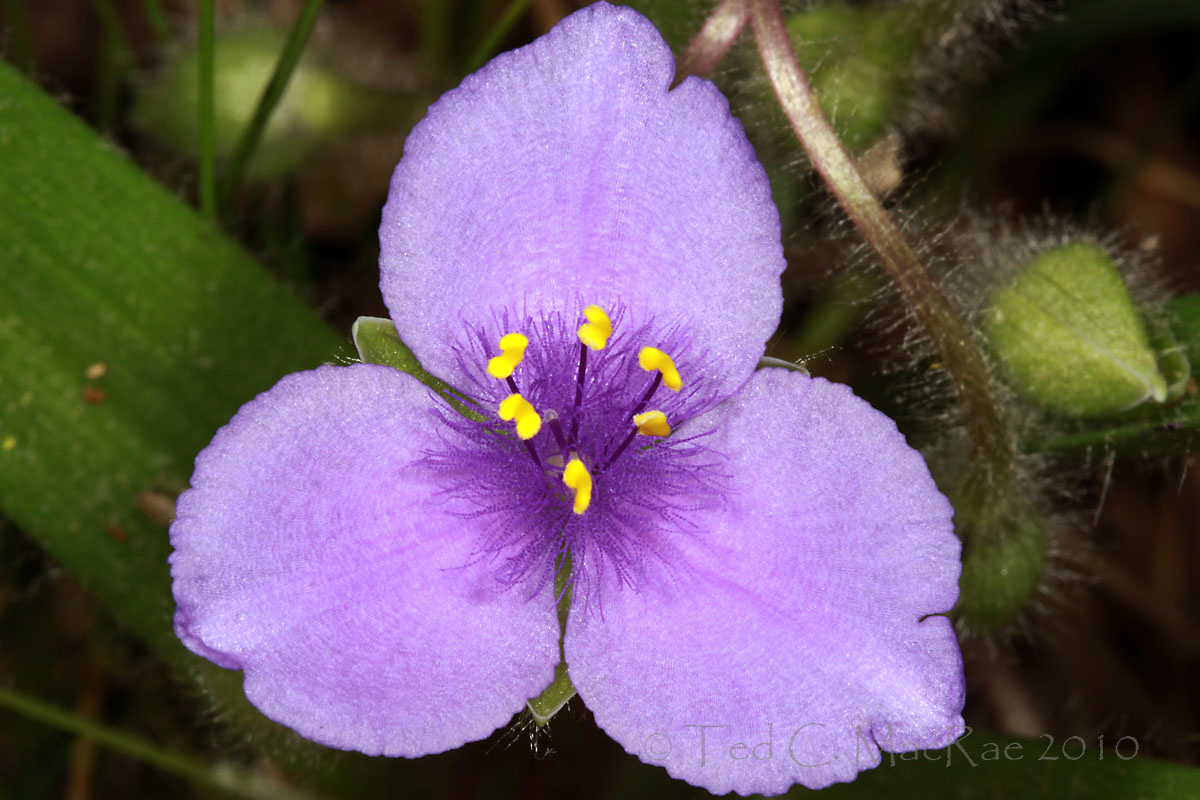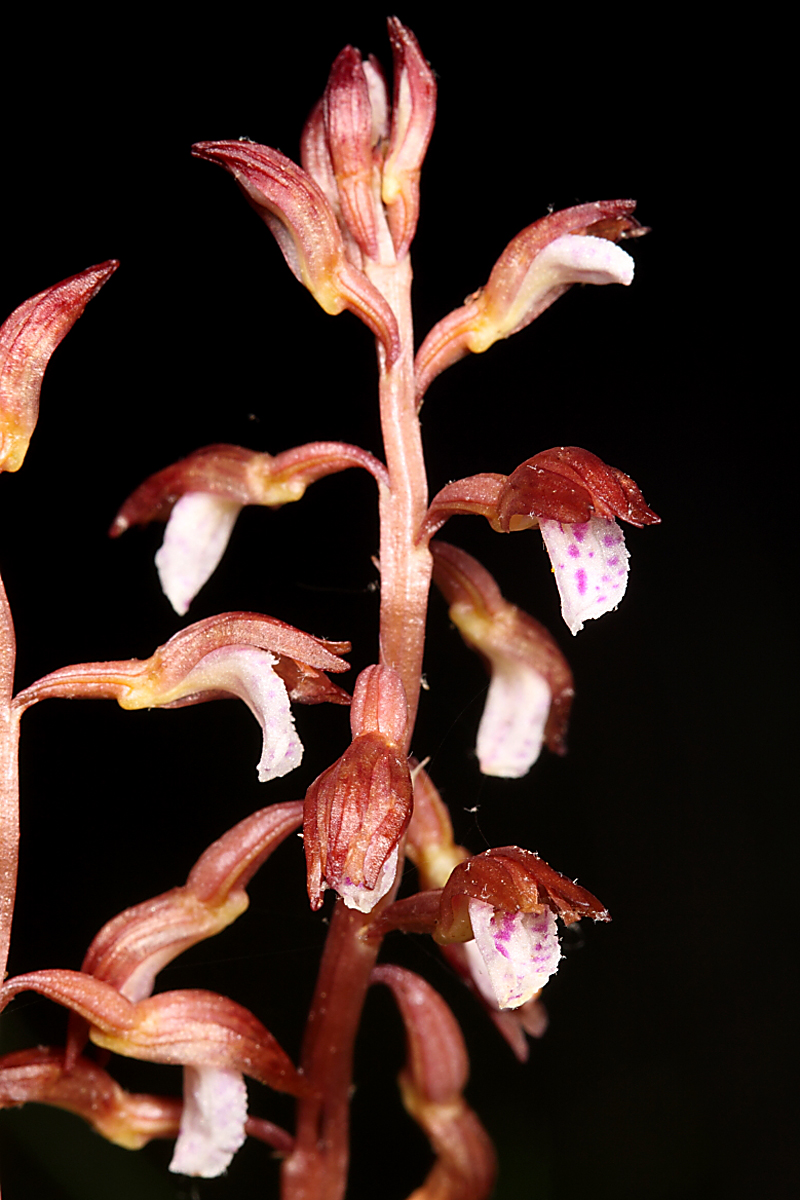
Friday Flower – Spring Coralroot Orchid

As flowers go, I have a passion for orchids.  Despite comprising perhaps the largest family of flowering plants on earth, most people think of orchids as rare, epiphytic plants restricted to the lush, hyper-diverse, tropical rain forests of South America and southeast Asia.  In reality, terrestrial orchids abound in the temperate regions of the Northern Hemisphere, with more than 200 species occurring in the United States and Canada.  Some, such as the lady slippers (genus Cypripedium),  have blossoms as magnificent as their tropical counterparts, while others are less conspicuous and easy to overlook; however, all share the hallmark that unites the family—a modified petal forming a conspicuous lower lip¹

¹ Interestingly, the lip is actually derived from the uppermost petal, but in most species the flower twists during development so that the lip is oriented at the bottom.

Missouri is home to 34 species of orchids (one introduced, and another discovered in Missouri for the first time just a couple years ago).  None of them are truly common like Rudbeckia or Coreopsis, although some are far more common than is realized.  I’ve featured a few of these previously, including Spiranthes magnicamporum (Great Plains Ladies’-tresses), Platanthera lacera (green fringed orchid), Aplectrum hymenale (Adam and Eve orchid), and Goodyera pubescens (rattlesnake plantain orchid).  I’ve traveled to the far corners of the state to see them, but for today’s featured species—Corallorhiza wisteriana (spring coralroot)—I had to travel no further than my front yard.

I’m sure my neighbors hate my front yard. I don’t use fertilizers or herbicides, and I’m unconcerned about the moss that grows amongst the thin stands of mixed grasses under the tall native oaks that shade much of the yard. My neighbor down the street especially probably shakes his head as he walks his dog past my yard every day, frustrated that I don’t share his passion for the lush, thick, über-green bluegrass monoculture that he has achieved (and must pay somebody to cut at least once a week). Spring must be especially frustrating for him, as I don’t even cut the grass until late May, giving the lawn an especially ragged, unkempt appearance. However, whatever my yard lacks in graminaceous greatness, it more than makes up for in its diversity of woodland natives—spring beauty, toothwort, trout lily, violets, coral bells… and spring coralroot. I have several colonies growing at different spots in the yard, all marked with surveyor’s flags to prevent accidental trampling until their bloom period ends and I can (begrudgingly) begin mowing the grass (no more than once a month, if I can get away with it). I’ve enjoyed these coralroot colonies every spring since I’ve lived here, but this spring was the first that I took the opportunity to photograph their blooms.
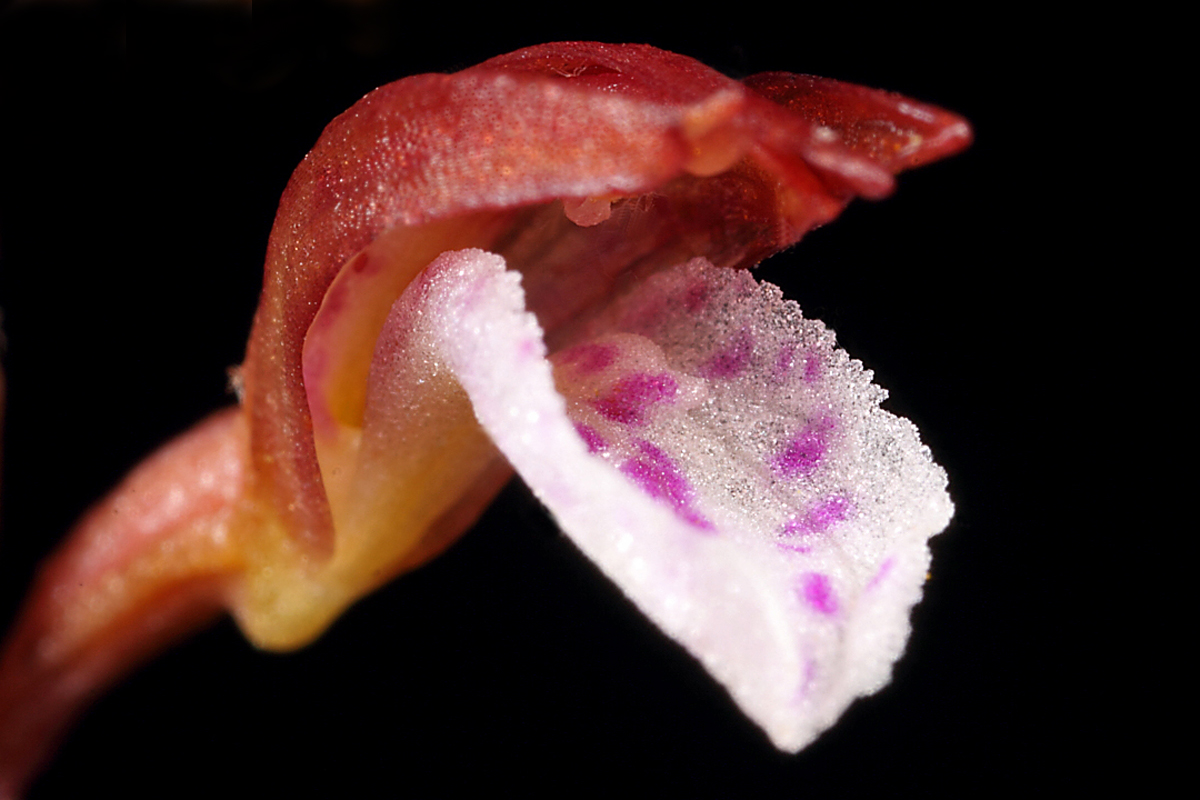
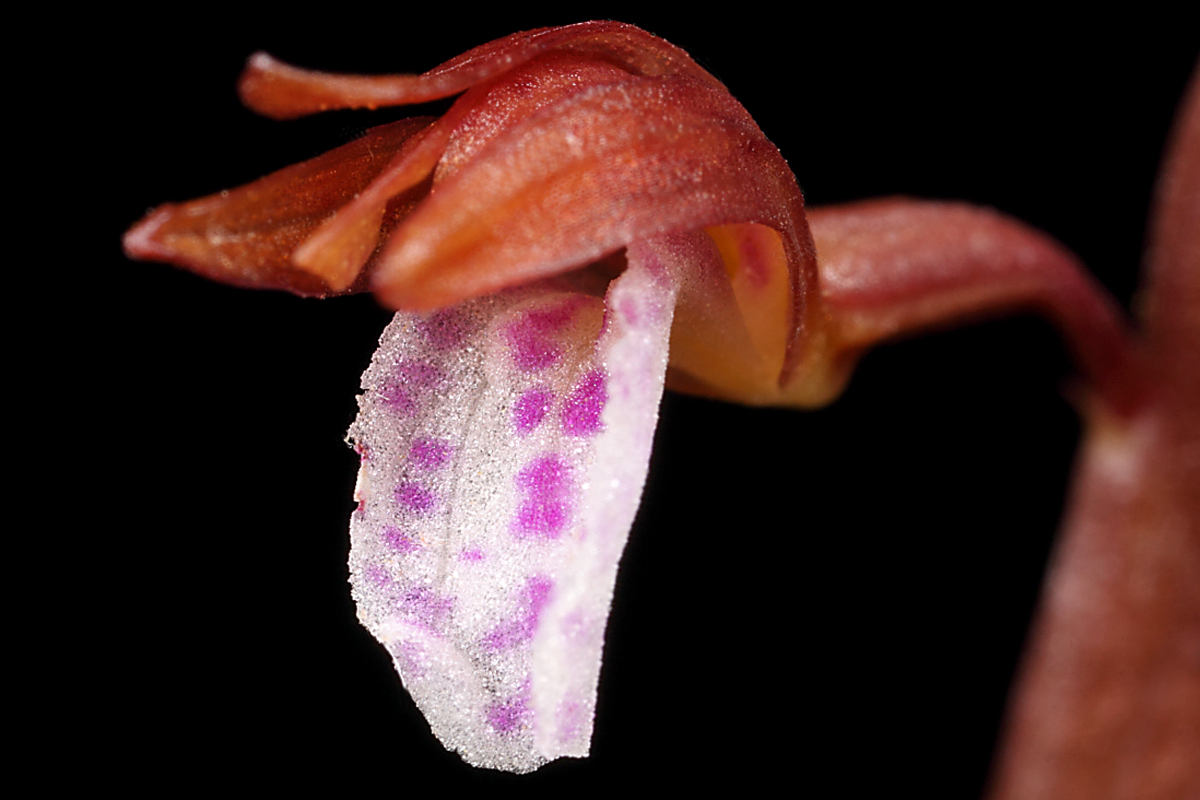
Of the three Corallorhiza species that can be found in Missouri, C. wisteriana is the most common, occurring in rich or rocky acidic soils of low wooded valleys, ravine bottoms, along streams and on ridges and slopes of open woods (Summers 1981).  My yard qualifies as the latter, occurring on a limestone ridge in mesic upland forest made only slightly more open by the late 1980s construction of the neighborhood and its minimal disturbance limited to the roads, driveways, home footprints and a small amount of associated lawn.  It is distinguished in Missouri from C. odontorhiza (Autumn coralroot) by its spring flowering period and larger flowers with notched or lobed lip, and from the rare C. trifida (known from only a few Missouri counties) by the purple or brownish stems and spotted lip.
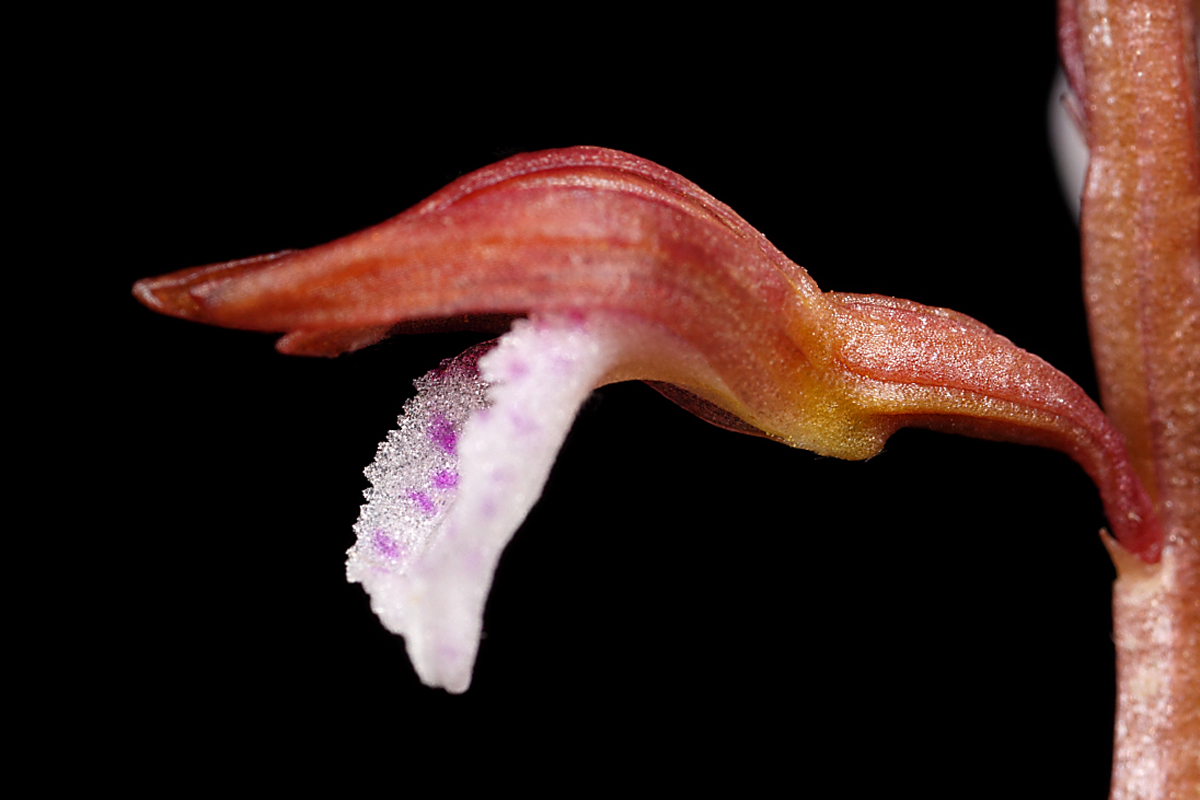

As suggested by the unusual coloration, Corallorhiza species are largely (though not completely) lacking in chlorophyll, and as a result are mostly unable to photosynthesize their own food. Instead, the bulbous rhizomes remain hidden within the soil for much of the year, forming symbiotic relationships with soil fungi and flowering only when conditions are favorable (Luer 1975). The past several springs have been wet here, and accordingly I’ve been rewarded with the wonderful sight of these exquisite tiny blossoms.

I can’t say that I’m entirely happy with these photographs, as I found it difficult to get the entire blossom in focus—when the petals were in focus the lip was not, and vice versa, even in straight lateral profile.  Nevertheless, they still show the delicate structure of the lip, with its scalloped edge and crystalline-appearing surface.  The blooms are fading now—soon there will be no above-ground evidence of their existence, and my neighbor and wife will likely gang up on me to finally power up the lawn mower.

REFERENCES:

Luer, C. A.  1975.The Native Orchids of the United States and Canada Excluding Florida.  The New York Botanical Garden, 361 pp. + 96 color plates.

Summers, B.  1981. Missouri Orchids.  Missouri Department of Conservation, Natural History Series No. 1, 92 pp.

Copyright © Ted C. MacRae 2011

Friday Flower – Hedychium coccineum

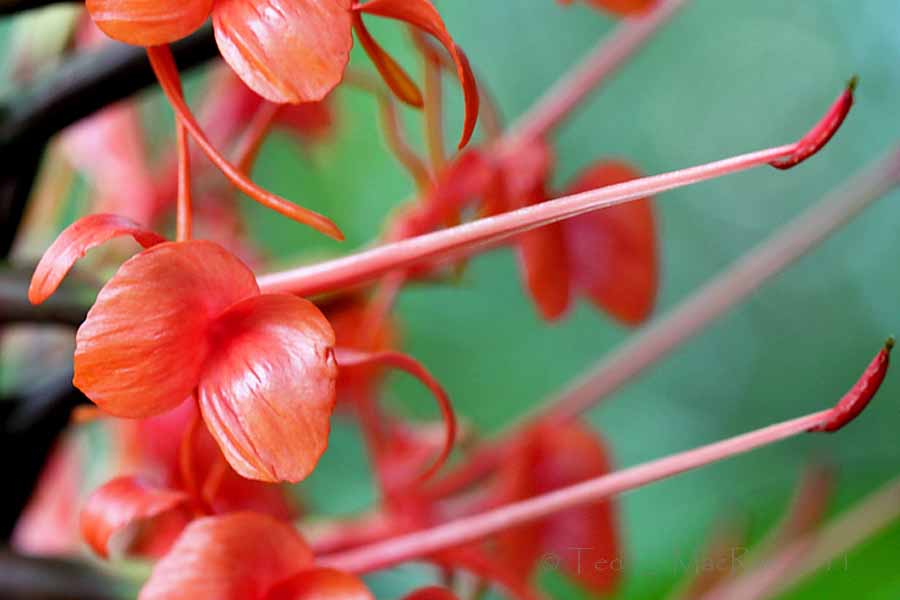
Distrito Joaquim Igidio is one of four “districts” surrounding Campinas, Brazil.  It is the most remote of the four, with farmsteads dating back more than a century interspersed amongst some of the most significant tracts of Atlantic forest still remaining in the area.  Many of the farmsteads have recently been converted to bars and restaurants featuring live music, making the area a popular weekend getaway for Campineros.  I joined my colleague and some of his friends on a visit to one of these—Bar do Cachoeira—over the weekend during my visit this past January.  After a sumputuous lunch of Brazilian cuisine (including tohesmo torresmo—my new favorite dish) and cerveja, I walked the grounds to look for insects to photograph.  Despite only having an hour or so to look around, the two species of treehoppers I found and photographed made it a successful little venture.  Coming back to rejoin my friends, I saw a few plants with these marvelously bizarre inflorescenses growing alongside a forested stream running through the grounds.  I could tell they were some type of monocot, but beyond that I had no idea.  Something inside me suspected, however, that this was likely not a native species—it just had that introduced, tropical ornamental look to it.  My suspicions were confirmed when I showed the photos to Dr. George Yatskievych, Curator at the Missouri Botanical Garden and Director of the Flora of Missouri Project.  George identified the plant as Hedychium in the Zingiberaceae (ginger family), likely one of the cultivars of Hedychium coccineum.  He added:

This species is native to tropical Asia, but is commonly cultivated in warm regions of the world. A number of cultivars and hybrids involving related species are sold, so it’s hard to be sure which one you photographed.  The most common cultivar seems to be cv. ‘Tara’ and that’s a possibility for your plant.

Known by a number of common names (red gingerlilly, orange gingerlily, scarlet gingerlily, orange bottlebrush ginger, etc.), H. coccineum hails from the eastern Himalyas, where it grows along forest edges and in mountain grasslands.  This herbaceous perennial can reach one to two metres in height and, in some places, has become somewhat invasive.  The existence of rhizomes and bulbs can make control particularly difficult.

An interesting feature of the plant is the long, exserted stamens and stigmas of the flowers.  This feature is suggestive of an interesting pollination mechanism that relies on pollen attachment to the wings rather than the main body of its moth and butterfly pollinators. Pollen transfer is effected as the lepidopterans move from flower to flower seeking nectar, brushing their wings against the floral parts in the process and thus pollinating the flowers (Zomlefer 1994).

REFERENCE:

Zomlefer, W. B. 1994. Guide to flowering plant families. University of North Carolina Press, Chapel Hill, 430 pp.

Copyright © Ted C. MacRae 2011

BitB Top 10 of 2010

Welcome to the 3rd Annual BitB Top 10, where I pick my 10 (more or less) favorite photographs of the year.  My goal for 2010 was to continue the progress that I began the previous year in my quest to become a bona fide insect macrophotographer.  I’m not in the big leagues yet, but I have gotten more comfortable with using my equipment for in situ field photographs and am gaining a better understanding of lighting and the use of flash.  I also began experimenting with different lighting techniques (e.g. white box) and diffusers and am putting more effort into post-processing techniques to enhance the final appearance of my photographs.  I invite you to judge for yourself how successful I’ve been toward those goals by comparing the following selections with those from 2009 and 2008 – constructive feedback is always welcome:


Best Tiger Beetle

Cicindela denverensis - green claybank tiger beetle

From ID Challenge #1 (posted December 23).  With numerous species photographed during the year and several of these dramatic “face on” shots, this was a hard choice.  I chose this one because of the metallic colors, good focus throughout the face, and evenly blurred “halo” of hair in a relatively uncluttered background.


Best Jewel Beetle

Buprestis rufipes - red-legged buprestis

From Special Delivery (posted July 13).  I didn’t have that many jewel beetles photos to choose from, but this one would have risen to the top no matter how many others I had.  The use of a white box shows off the brilliant (and difficult-to-photograph) metallic colors well, and I like the animated look of the slightly cocked head.


Best Longhorned Beetle

Desmocerus palliatus - elderberry borer

From Desmocerus palliatus – elderberry borer (posted November 18).  I like the mix of colors in this photograph, and even though it’s a straight dorsal view from the top, the partial dark background adds depth to the photo to prevent it from looking “flat.”


Best “Other” Beetle

Enoclerus ichneumoneus - orange-banded checkered beetle

From Orange-banded checkered beetle (posted April 22).  The even gray background compliments the colors of the beetle and highlights its fuzziness.  It was achieved entirely by accident – the trunk of the large, downed hickory tree on which I found this beetle happened to be a couple of feet behind the twig on which it was resting.


Best Non-Beetle Insect

Euhagenia nebraskae - a clearwing moth

From Euhagena nebraskae… again (posted October 21).  I photographed this species once before, but those photos failed to capture the boldness of color and detail of the scales that can be seen in this photo.


Best “Posed” Insect

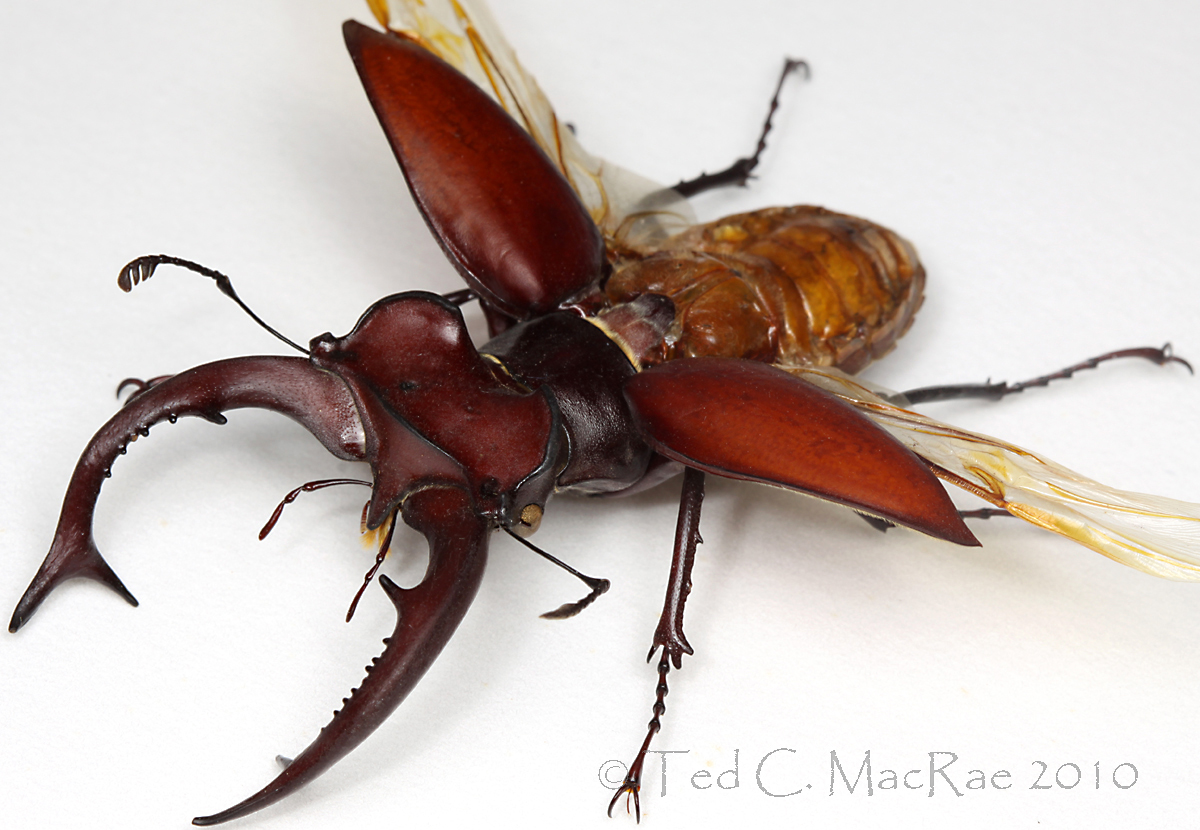
Lucanus elaphus - giant stag beetle

From North America’s largest stag beetle (posted December 30).  I’ve just started experimenting with photographing posed, preserved specimens, and in fact this male giant stag beetle represents only my second attempt.  It’s hard to imagine, however, a more perfect subject than this impressively stunning species.


Best Non-Insect Arthropod

Scolopendra heros - giant desert centipede

From North America’s largest centipede (posted September 7).  Centipedes are notoriously difficult to photograph due to their elongate, narrow form and highly active manner.  The use of a glass bowl and white box allowed me to capture this nicely composed image of North America’s most spectacular centipede species.


Best Wildflower

Hamamelis vernalis - Ozark witch hazel

From Friday Flower – Ozark Witch Hazel (posted March 26).  The bizarre form and striking contrast of colors with the dark background make this my favorite wildflower photograph for the year.


Best Non-Arthropod

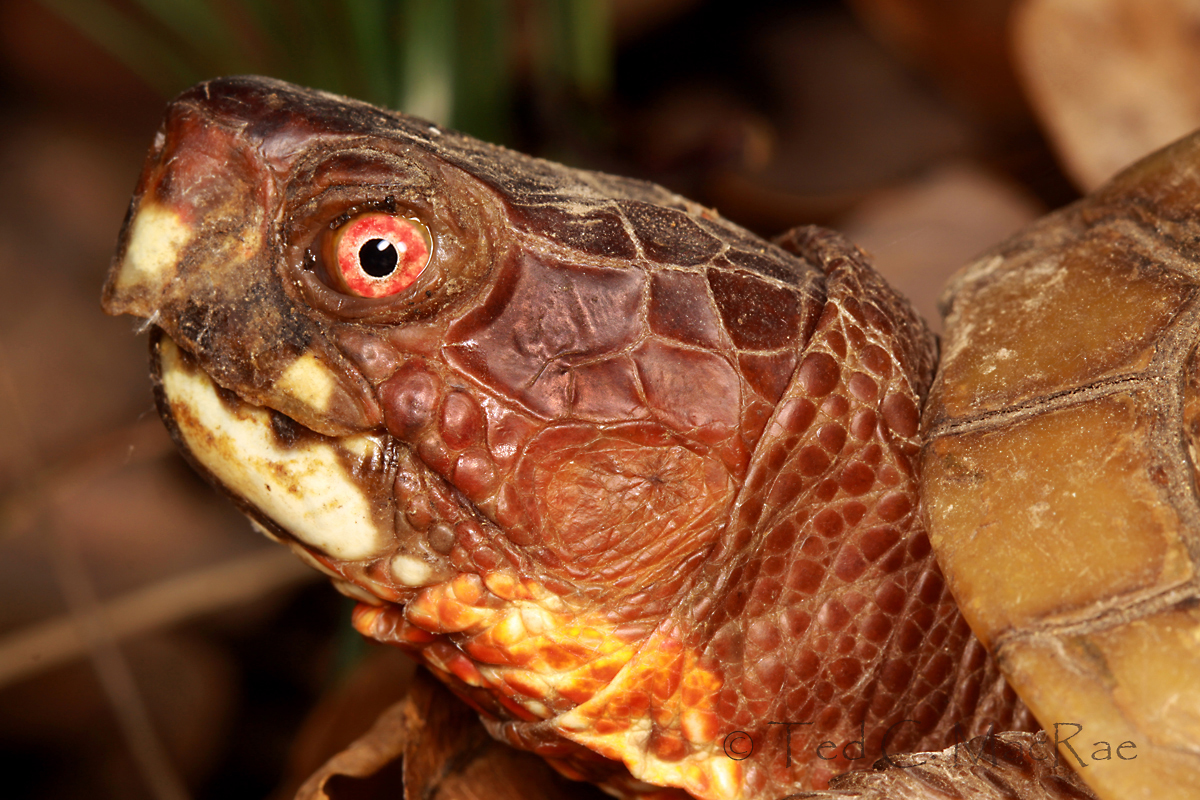
Terrapene carolina triunguis - three-toed box turtle

From Eye of the Turtle (posted December 10).  I had a hard time deciding on this category, but the striking red eye in an otherwise elegantly simple photograph won me over.  It was also one of two BitB posts featured this past year on Freshly Pressed.


Best “Super Macro”

Phidippus apacheanus - a jumping spider

From Jeepers Creepers, where’d ya get those multilayered retinae? (posted October 5).  I’m not anywhere close to Thomas Shahan (yet!), but this super close-up of the diminutive and delightfully colored Phidippus apacheanus is my best jumping spider attempt to date.  A new diffuser system and increasing comfort with using the MP-E lens in the field at higher magnification levels should allow even better photos this coming season.


Copyright © Ted C. MacRae 2011
Friday Flower – green fringed orchid

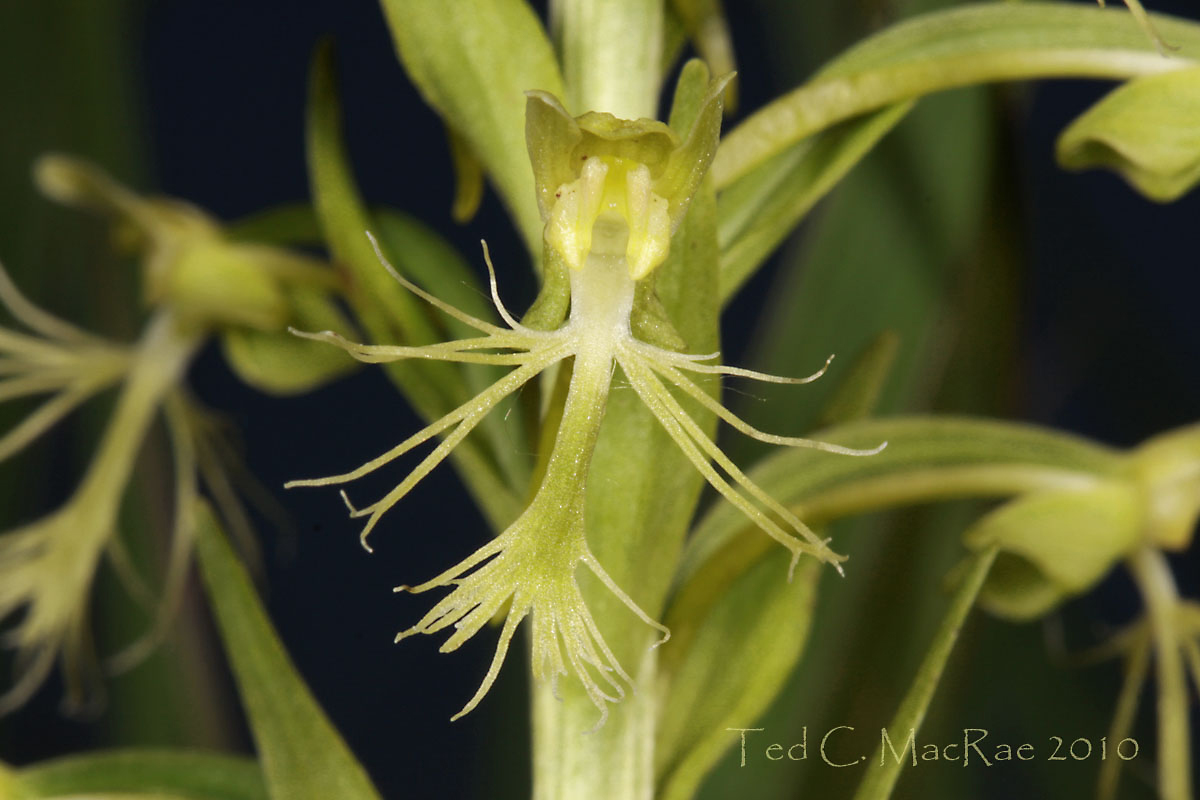
I may have been the “Beetle Group” leader for last May’s BioBlitz at Penn-Sylvania Prairie, a 160-acre tract of native tallgrass prairie in southwestern Missouri owned by the Missouri Prairie Foundation.  However, it was a plant – specifically the green fringed orchid  (Platanthera lacera) – that would prove be the highlight of my visit.  I’ve already lamented the paucity of beetles that I found at the prairie and the possible reasons for such.  It’s a shame, because to my knowledge the BioBlitz was the first real attempt to begin documenting the diversity of beetles and other insects that inhabit the prairie.  This is in great contrast to the vascular plants, of which about 300 mostly native prairie species have already been recorded from the site in active survey efforts that began even before its acquisition.   It’s no coincidence that prairie plant diversity would be so high in this frequently burned prairie remnant while beetles and other insects would be rather hard to find, since vascular plant diversity is the primary – and often the only – metric used to assess the success of and optimal timing for prescribed burning in native prairie remnants.  Unfortunately, the response of invertebrates to fire-centric management techniques such as those used here have not been so well considered, with the apparent declines in their populations now fueling an increasingly acrimonious debate on the subject.  But I digress…

Also called ragged fringed orchid, this species typifies the rather striking appearance of the genus as a whole.  I’ve always been quite enamored with orchids (even possessing a small collection during my young adult days that I grew outside under shadecloth during summer and indoors under artificial light during winter) but have encountered only a small fraction of Missouri’s 33 native orchid species – mostly in the genus Spiranthes (e.g., Great Plains Ladies’-tresses).  Despite not having seen this genus prior to this day, I knew immediately what I had stumbled upon (at least at the generic level) as we scoured the prairie in our search for its meager scraps of beetle life.  While not listed as threatened or endangered in Missouri, it is still quite uncommon, with populations scattered across the Ozark and Ozark Border counties and occurring with greater frequency in these Osage Plains in a variety of open, acidic-soiled habitats (Summers 1981).  As is typical for species with green-white colored flowers, the blossoms emit fragrance at night and thus attract sphinx moths (family Sphingidae) and owlet moths (family Noctuidae) for pollination, including the hummingbird clearwing hawkmoth (Hemaris thysbe) (Luer 1975).  While our Midwestern populations are considered “spindly and unattractive” compared to the more luxuriantly-blossomed plants of New England and maritime Canada (Luer 1975), I consider this to be the most strikingly handsome orchid I’ve encountered to date.

Photo Details: Canon 50D (ISO 100, 1/250 sec) w/ 100mm macro lens @ f/10 (whole plant) or f/18 (flower close-up), Canon MT-24EX flash (manual, 1/4 ratio) w/ Sto-Fen diffusers. Typical post-processing includes levels adjustment, minor cropping, and/or unsharp mask.

REFERENCES:

Luer, C. A.  1975. The Native Orchids of the United States and Canada Excluding Florida.  The New York Botanical Garden, 361 pp. + 96 color plates.

Summers, B.  1981. Missouri Orchids.  Missouri Department of Conservation, Natural History Series No. 1, 92 pp.

Copyright © Ted C. MacRae 2010

The joys of ecological restoration

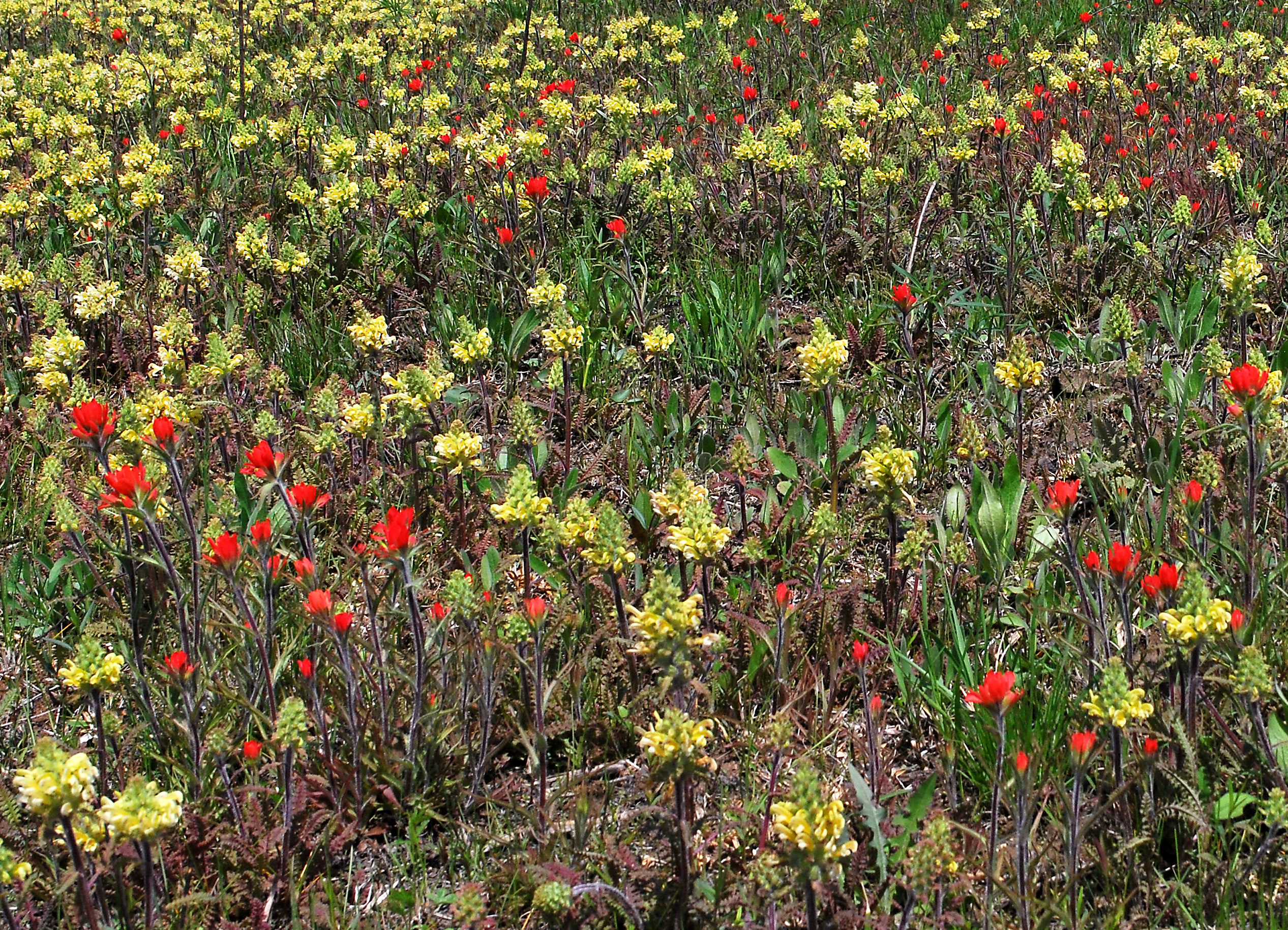
Indian paintbrush and lousewort now dominate patches of SNR

I moved to Missouri in the summer of 1988, having experienced 8 years of generous support of my family’s livelihood by my research on the infamous imported fire ants of the US Southeast, and their relatives in South America. When I arrived in the Midwest, I  hoped to land a job as an insect taxonomist in a university or museum, a goal of mine since before entering college. But this dream was one that even before moving to Missouri was dimming, and then receded ever further from the realm of possibility for me (and for traditionally trained taxonomists, generally), once here. So, I began to re-think what I might do with my work life. It would be something, I hoped, that would make some use of all the course work (mostly in entomology and botany) and research (on ant systematics) I had done during my 24 years (!) of getting educated and four additional years as a post-doc. As or more important, whatever job I ended up in would somehow have to allow me to share my life-long love of nature with others.

A museum drawer of ant specimens mounted for taxonomic study, the ants no doubt frustrated by the years of inattention they have received as I have tended to the duties of my day job.

Early in my residence in eastern Missouri, I made the acquaintance of the naturalist at a 2500-acre (1000-hectare) nature reserve outside of St. Louis. Shaw Arboretum, as it was then known, is country cousin to the world-renowned Missouri Botanical Garden, and is named after the Garden’s founder Henry Shaw. Long story short, in the summer of 1990 the naturalist mentioned to me that he would soon retire, the position would become available, and that I ought to apply. So I applied, and was hired as the arboretum’s naturalist in January 1991.

A dolomite glade plant endemic to a few counties in eastern Missouri, this leatherflower was established at SNR in the 1930s, but expanded exponentially after prescribed fire was introduced in the 1990s. Here, an ant characteristic of glades and dry prairies forages on the flower.

When I came on board, the “Arboretum” had mostly ceased to be an arboretum (a formal collection of trees for display, breeding and research), and most folks seemed unable to either pronounce or define the word. Indeed we learned, through a public survey, that the strange name and the stone wall in the front actually dissuaded people unfamiliar with it from entering! Yes, there were a few patches of exotic trees scattered around the property, especially in the conifer collection near the front entrance know as the “Pinetum”, but ever since the Garden had decided around 1930 that it would not, afterall move all of its horticultural operations to this then very rural site (the original intent of its purchase), formal arboretum and botanical garden type activities had been few and far between, and the site began gradually reverting from abandoned farmland to a wilder sort of place, as well as a haven for native biota. Thus, on its 75th anniversary in the year 2000, Shaw Arboretum was renamed Shaw Nature Reserve.

Colony-founding queen bumblebees are the primary actors in loosening pollen with ultrasound from shootingstar anthers, and distributing it about the plant population.

Around that time, my title changed too, to “Restoration Biologist”. The job is multifaceted; presenting public programs and classes on various aspects of the site’s natural history, writing and reviewing articles, acting as liaison to the vigorous regional group of academic ecologists who use the site for research and teaching, a very intermittent personal research program on ants resulting in sporadic publications, and last but certainly not least, ecological restoration.

Ecological restoration, in the broad sense, consists of  two primary practices:

  • Restoration of a natural community to structure and species composition presumed characteristic of an  ;;earlier condition (however arbitrary or ill-defined).
  • Reconstruction of regional, native-like habitats, de novo, using locally acquired native plant propagules in the appropriate settings of soil, hydrology,  slope aspect and climate.

Both  require essentially perpetual, follow-up maintenance, including invasive species control, mowing, haying, grazing, selective timber removal, species richness enhancements, and prescribed burning. All of these have many variations and nuances in application, and there can be impassioned arguments about their implementation in the literature, at conferences, and in forums and blogs on ecological restoration, native plants, butterflies, beetles, etc..

An ecologically conservative lily ally of undisturbed moist soil habitats now thrives in prairie plantings at the Reserve.

Attitudes about ecological restoration vary, among practitioners, among sociologists and philosophers, and in the general public. One broad attitudinal schism lies along the lines of  whether ecological restoration activities are some sort of primitivist, grand-scale gardening, or do they represent ecologically valid landscape conservation? Another question some pose is to what extent we should interfere with “natural successsion”? Be this as it may be, most people with functioning sensory perception agree the results can be very beautiful. The loveliness of the mosaic of colors in the herb layer of a spring woodland is inarguable, especially so after it has had its woody stem density reduced, and had the leaf litter burned off, to allow more light, rain and seeds to the soil surface — even where there is genuine concern about damage to invertebrate assemblages residing in forest duff. A waving meadow of grasses and flowers in a tallgrass prairie planting, intended to replace just a few of the tens of millions of acres of this ecosystem that have succumbed to the plow, has its own grand beauty, though its per-square-meter species density of plant species remains less than half that of a native prairie remnant and it is dominated mainly by habitat-generalist insect species rather than prairie specialists, even after 30 or more years.

A self-introduced grassland ant forages among a thriving, human-introduced population of this wet prairie gentian.

The smaller, daily rewards of restoration, to the practicing ecological restorationist and to those who visit his or her work, are many. Over 20 years, in the opened-up woods, restored glades and prairie and wetland plantings at SNR, I repeatedly have enjoyed the “sudden appearance” and increase in populations of ant species (of course) that I never observed during my early years of working at SNR (then scouring it for purposes of preparing an annotated ant list). The feeling I get upon discovering that a grouping of shooting star, royal catchfly, bunch flower or bottle gentian plants, are in bloom at a site where I spread their seeds five, seven, or even ten years earlier is a bit like that one feels when a child is born. The spontaneous colonization of SNR grassland plantings by prairie ragged orchid never fails to amaze me. Bird, or frog, or katydid and cricket songs in a former crop field or pasture, as the “restored” vegetation fills in and matures, is as pleasing to my ear as it is to my soul.

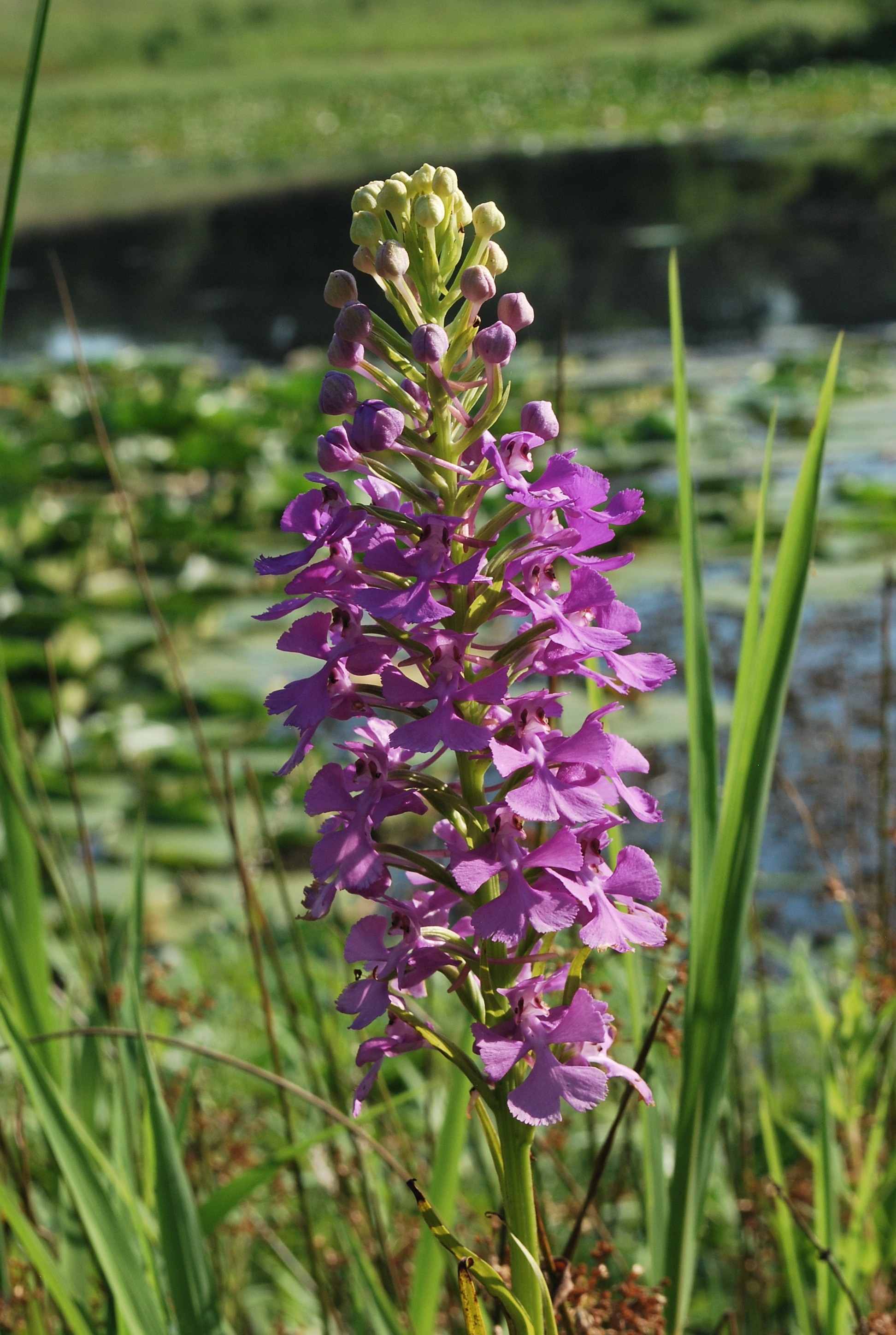
A few days ago (in early July), the director of the Reserve came to my office asking if I had noticed a purply pink, “possibly orchid” flower growing on a section of a berm (planted with native vegetation) in our 32-acre wetland complex. I had not been in the area recently, but headed right out to see what it was. Joyously, and not a little surprised, I learned that seeds of the purple fringeless orchid, sowed at a location nearby 17 years previously, had washed to this site, taken root, and as terrestrial orchids are wont to do, flowered after so many years!

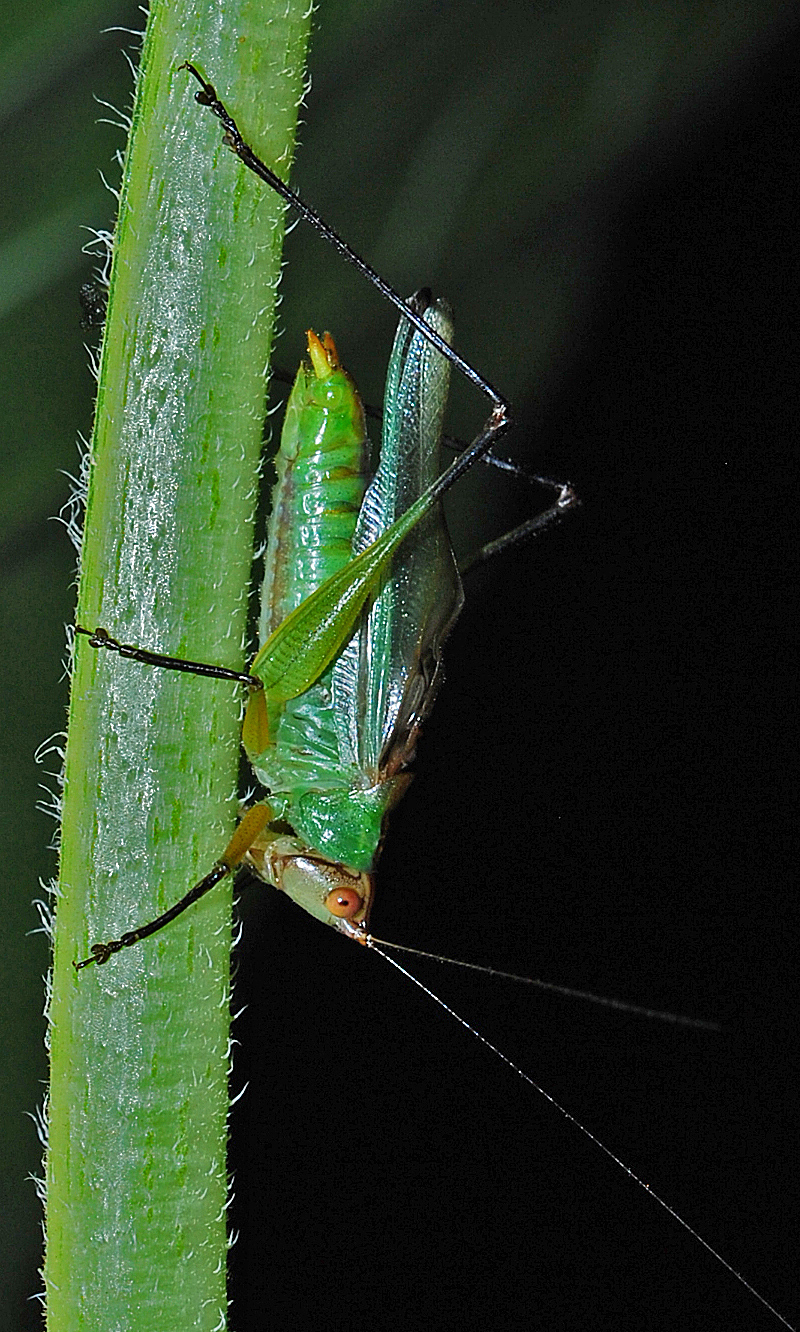
The black-legged greater meadow katydid thrives in low areas and near bodies of water in SNR

The prairie ragged orchid began to appear in old fields and prairie plantings where prescribed burning occurs at SNR. It has not been seen in fields maintained exclusively by mowing or haying.

The purple fringeless orchid surprised the restorationist and St. Louis area botanists by flowering in the SNR wetland area 17 years after the original sowing.

Copyright © James Trager 2010

Add to FacebookAdd to DiggAdd to Del.icio.usAdd to StumbleuponAdd to RedditAdd to BlinklistAdd to TwitterAdd to TechnoratiAdd to Yahoo BuzzAdd to Newsvine

Email to a friend

Friday Flower – Cleft Phlox

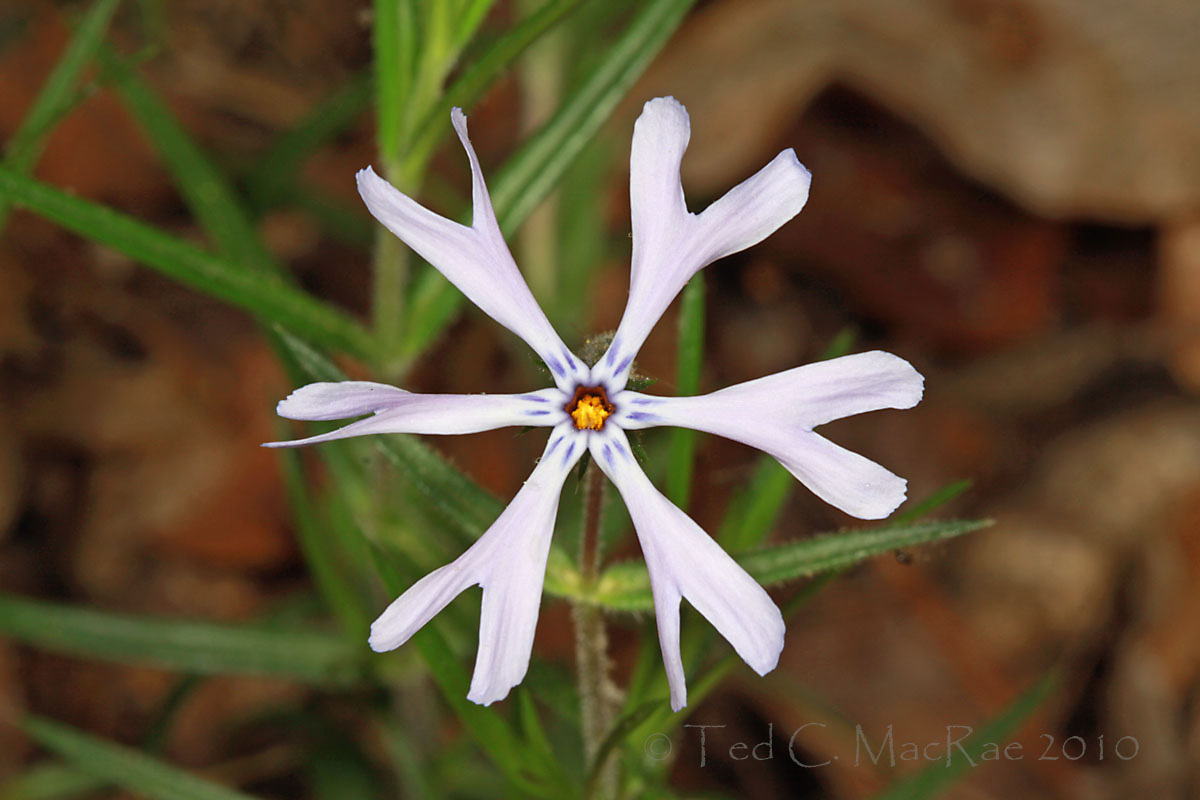
In a recent edition of my Friday Flower series I featured Tradescantia longipes (dwarf spiderwort or wild crocus), an exquisite Ozark endemic found scattered in dry igneous woodlands of the Missouri’s St. Francois Mountains and Arkansas’ Ouachita Mountains and that I had seen this past April at Sam Baker State Park. Growing alongside these beautiful plants was this equally exquisite plant bearing strikingly cleft petals on its blossoms.  I recognized it clearly as some type of phlox, but not one that I recalled having seen before.  There is good reason for this, as a quick check of Steyermark (1963) revealed this to be Phlox bifida, which, though not a true Ozark endemic, is known from just a handful of Missouri counties where it grows typically in dry, rocky soils of upland woods, ravine slopes and bluff ledges.  Commonly called cleft phlox or sand phlox, the strongly cleft (bifid) petals distinguish it from other species in the genus and, not surprisingly, are the basis for its species name.  This is another plant that would seem to make a good choice for a native wildflower garden, as it can perform very well in cultivation.

Photo Details: Canon 50D (ISO 100, 1/250 sec, f/18), Canon 100mm macro lens, Canon MT-24EX flash (diffused 1/4 power), typical post-processing (levels, unsharp mask).

REFERENCE:

Steyermark, J. A. 1963. Flora of Missouri. Iowa State University Press, Ames. 1728 pp.

Copyright © Ted C. MacRae

Add to FacebookAdd to DiggAdd to Del.icio.usAdd to StumbleuponAdd to RedditAdd to BlinklistAdd to TwitterAdd to TechnoratiAdd to Yahoo BuzzAdd to Newsvine

Email to a friend

Friday Flower – Sedum pulchellum

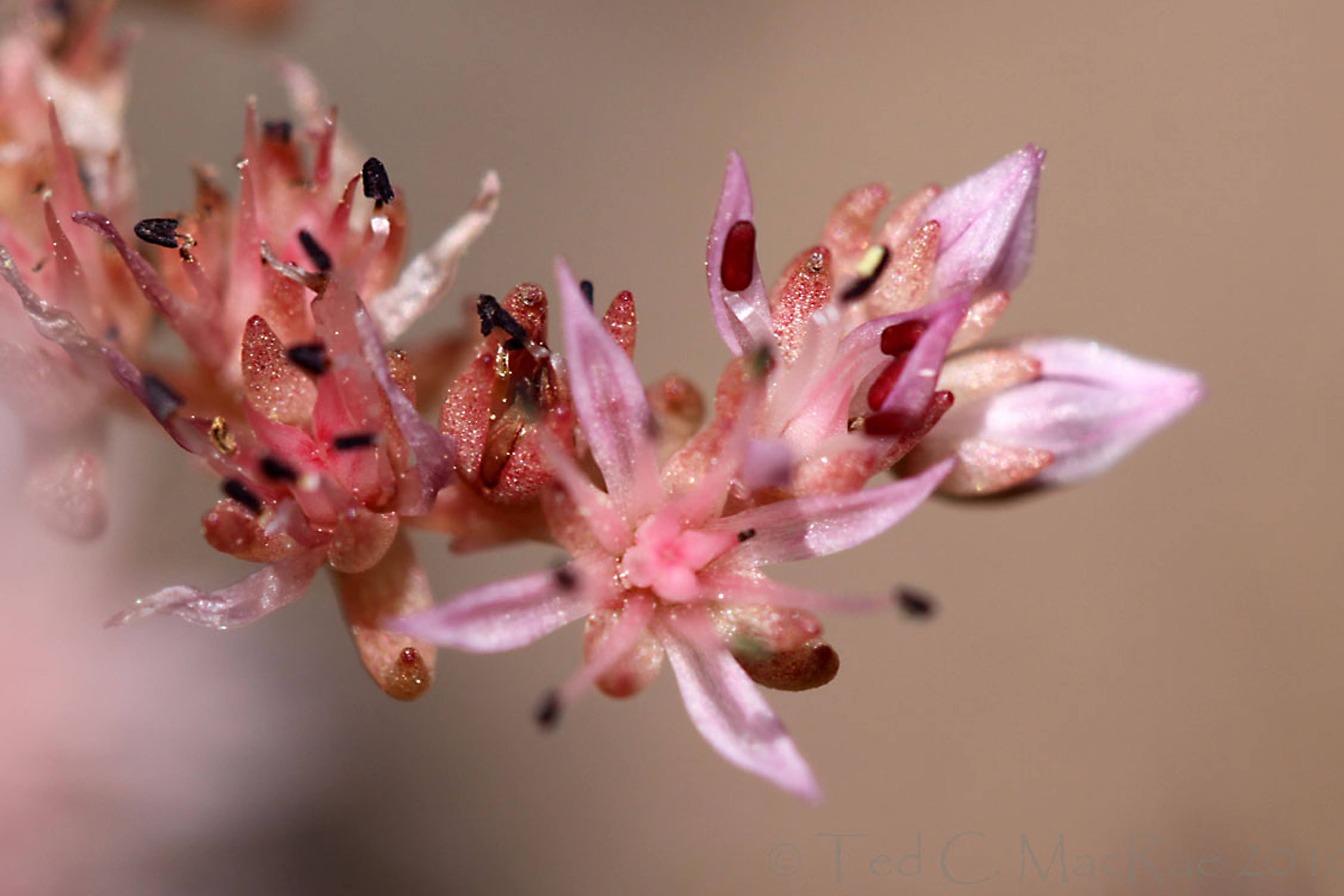
I’m particularly enamored with glades, and after nearly 30 years of exploring Missouri’s Ozark Highlands, there aren’t many glades of any significance that I haven’t visited at some time or another.  However, during my mostly unproductive Memorial Day weekend collecting trip, I had a chance to visit Bona Glade Natural Area in Dade County for the first time.  Located in southwestern Missouri where the Ozark woodlands of the Springfield Plateau begin transitioning to the grasslands of the Great Plains, this small (20 acres) sandstone glade is noted as a station for the federally threatened and state endangered Geocarpon minimum.  I did not see this diminutive plant (sometimes called tinytim) during my visit, but I did see another pretty little succulent – Sedum pulchellum.  Also called widowscross, this plant belongs to the Crassulaceae – the same family as the familiar jade houseplant.

Although not nearly as rare as Geocarpon, widowscross is nevertheless somewhat restricted in Missouri, occurring primarily in the southwestern quarter of the state.  Throughout much of its range it is primarily associated with calcareous limestone glades, ledges, and outcrops (Baskin and Baskin 1977), but in Missouri it grows also on acidic chert and sandstone glades (Yatskievych 2006) – as is the case at Bone Glade.  I’ve not encountered this plant before, thus when I spotted this little stand with its profusion of brilliant pink blossoms, it immediately caught my attention.  A winter annual, this species prefers full sun and well drained, disturbed soils and apparently produces seeds quite prolifically when grown under the right conditions.  These features, along with its petite attractiveness, would seem to make it an ideal native alternative for succulent gardens.

Another, much less common sedum also occurs at Bona Glade, Sedum nuttallianum (Nuttall’s sedum).  This species is similar to S. pulchellum but can be distinguished by its smaller leaves and yellow blossoms.  It’s range is similar to that of Geocarpon, growing almost exclusively on chert and sandstone glades from southwestern Missouri and southeastern Kansas south to Louisiana and Texas.  I did not see this plant either – in fact, after finding this small stand of S. pulchellum I searched the entire glade rather thoroughly and did not see any other plants of that species either.

Photo Details: Canon 50D (ISO 100-200, 1/400-500 sec, f/5.6), Canon 100mm macro lens, ambient light. Post-processing: minor cropping, levels, unsharp mask.

REFERENCES:

Baskin, J. M. and C. M. Baskin. 1977. Germination ecology of Sedum pulchellum Michx. (Crassulaceae). American Journal of Botany 64(10):1242-1247.

Yatskievych, G. 2006. Steyermark’s Flora of Missouri, Volume 2. The Missouri Botanical Garden Press, St. Louis, 1181 pp.

Copyright © Ted C. MacRae 2010

Add to FacebookAdd to DiggAdd to Del.icio.usAdd to StumbleuponAdd to RedditAdd to BlinklistAdd to TwitterAdd to TechnoratiAdd to Yahoo BuzzAdd to Newsvine

Email to a friend

Friday Flower – Dwarf Spiderwort

Living at the foothills of the Ozark Highlands, I sometimes forget how unique the biota of this ancient landscape truly is. More than 200 species of plants and animals are largely restricted to the region, with around 160 of these being true Ozark endemics found nowhere else on earth. The biodiversity of the region stems from the landform’s unusual geology, topography and hydrology, it’s ectotonal position within the North American continent, and its distinction as the only significantly elevated landform between the Appalachian and Rocky Mountains. Many Ozark endemics are found in the region’s abundant caves and sinkholes, formed by underground dissolution of its massive limestone/dolomite bedrocks. Others represent isolated populations of more typically northern plants and animals that found refuge here during the Pleistocene glacial advances. Still others evolved during periods of isolation when vast inland seas covered much of the continent’s interior.

Tradescantia longipes, known locally as dwarf spiderwort or wild crocus, is a particularly exquisite Ozark endemic found scattered in dry igneous woodlands of the Missouri’s St. Francois Mountains and Arkansas’ Ouachita Mountains. I first saw this species two years ago in May at Crane Lake in the heart of the St. Francois Mountains, and the plants shown here were seen this past April in the igneous woodlands of Sam Baker State Park at the southernmost extent of the St. Francois Mountains’ igneous exposures. The genus to which this plant belongs contains some much more widely distributed (though no less striking) members (e.g. T. ohioensis, which I featured in my first “Friday Flower” post). Tradescantia longipes flowers are similar to those of T. ohioensis, but the plant differs from most others in the genus by its short, squat habit of growth and strictly basal leaves.

One feature shared by T. longipes with all other members of the genus is the dense fringe of hairs arising from the stamen filaments.  I discussed these in my first Friday Flower post, noting that each of the 70-100 hairs per filament is composed of a chain of about 20 large, single cells – easily seen with low magnification. While their sensitivity to radiation and chemical mutagens has been recognized for many years (the hairs turn pink when exposed to radiation), less seems to be known about their natural function for the plant.  It is interesting to note, however, that the flowers of Tradescantia and related genera rely heavily on insects for pollination (primarily bees and bee flies), yet they do not produce nectar.  Faden (1992) has speculated that the stamen hairs might combine with floral scents and the nearly pollenless anthers to deceptively attract insects, provide footholds, retain pollen fall, and influence the pollen-collecting behavior of the insects.

Photo Details: Canon 50D (ISO 100, 1/250 sec, f/14-18), Canon 100mm macro lens, Canon MT-24EX flash (1/4 ratio) w/ Sto-Fen diffusers. Post-processing: levels, unsharp mask, minimal cropping.

REFERENCE:

Faden, R. B.  1992. Floral attraction and floral hairs in the Commelinaceae.  Annals of the Missouri Botanical Garden 79(1):46–52.

Copyright © Ted C. MacRae

Add to FacebookAdd to DiggAdd to Del.icio.usAdd to StumbleuponAdd to RedditAdd to BlinklistAdd to TwitterAdd to TechnoratiAdd to Yahoo BuzzAdd to Newsvine

Email to a friend