Oedipodine Rex

Sandstone glade habitat for Trimerotropis saxatilis | vic. Calico Rock, Arkansas

Ever since my current fascination with band-winged grasshoppers (family Acrididae, subfamily Oedipodinae) began, I have been obsessed with photographing one species above all others—Trimerotropis saxatilis, the lichen grasshopper. Like most species in the group, lichen grasshoppers utilize an interesting survival strategy that I call “conspicuous crypsis”—the use of stunning colors and contrasting markings to help them blend into the mottled and variably-colored environments that they inhabit.  Lichen grasshoppers take this strategy to the extreme, culminating in some individuals with the most gorgeous shade of blue-green in perfect match to the crustose lichens that cover the rock outcroppings of their preferred glade habitats.  In my opinion, they are the kings of the oedipodines!  I have seen them before in past years in the igneous and sandstone glades that dot the Ozark Highlands of southern Missouri.  Crustose lichens abound in these acid environments, providing the perfect backdrop to make invisible these otherwise conspicuous grasshoppers. This past June during a couple of visits to a marvelous sandstone glade complex near Calico Rock in north-central Arkansas I got my wish, and shown here are some of my favorites from the many, many photographs I took during those sessions.
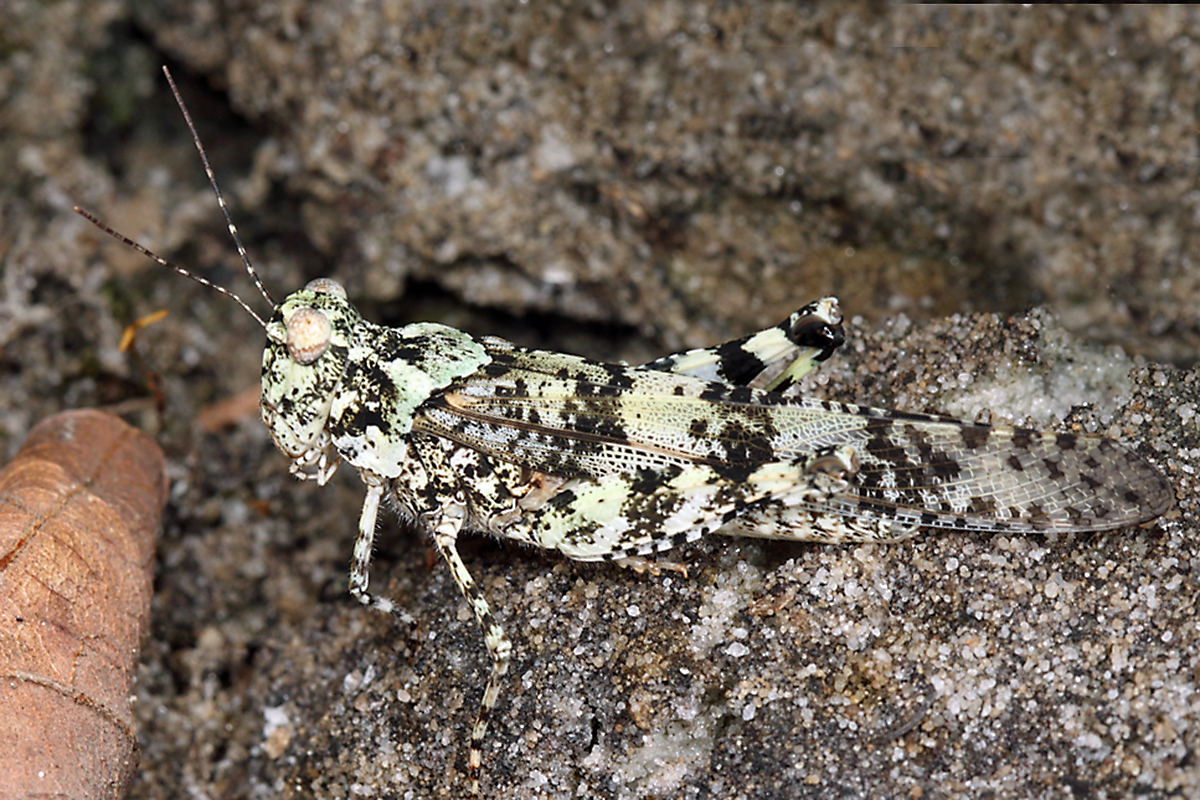
Trimerotropis saxatilis with classic lichen-green coloration.

Lichen grasshoppers are actually quite variably colored—not all individuals exhibit the green coloration for which they are so famous.  Despite this, they are the only member of the genus occurring in the eastern U.S. and, thus, are immediately recognizable.  While they are beautiful in all of their color variations, I cannot lie—it is the green individuals that I constantly find myself admiring the most.  While many other grasshoppers are green, only a handful (themselves members of the same subfamily) exhibit the same stunning shade of blue-green that this one does.  Add to that an abundance of black speckling and contrasting bands, and you’ve got one gorgeous grasshopper.  Yet, for all their overt beauty, they are absolutely impossible to see in their native habitat until they take flight when approached.  Fortunately, their escape flights are short and not terribly erratic—with a little practice it becomes rather easy to track them in flight (aided by their interrupted buzzing crepitation) and watch where they land.  They may not be immediately visible after landing, but with careful study of the landing area they are usually quickly relocated.  Once detected, slow deliberate movements are all that are needed to allow a close approach and a good look (and photographs if desired).

The stunning green contrasts starkly against a dark moss backdrop.

Of course, the problem with ‘conspicuous crypsis’ (or any form of crypsis, for that matter) is that it only works when in the right environment.  I chased the above lichen-colored individual onto this patch of dark moss while trying to photograph it, at which point it became overtly visible.
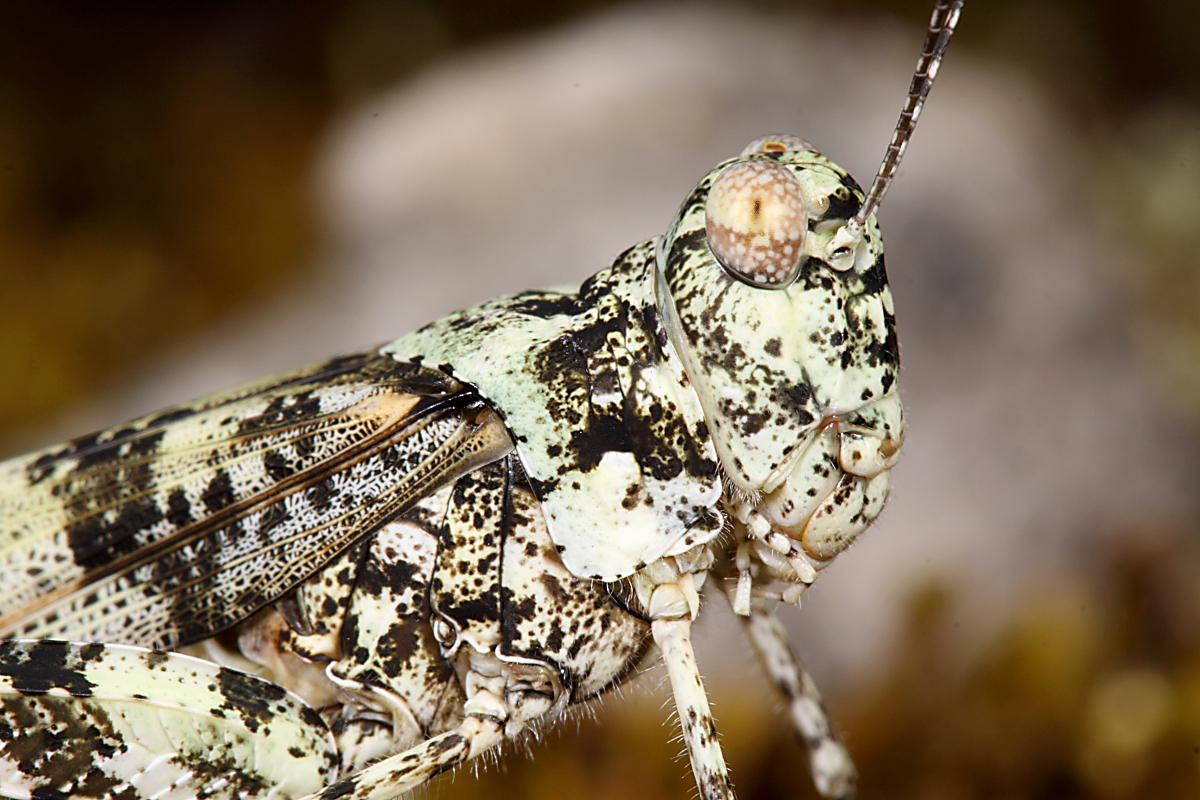
The mottling of the colors is almost as fascinating as the colors themselves.

As previously mentioned, lichen grasshoppers come in a variety of colors and shades.  While the green individuals may be the most stunning, I was captivated also by the below individual, darker brown and black, with the most beautiful, contrastingly colored orange eyes.  This individual may not blend in as well as the green individuals when sitting on lichen-encrusted rocks; however, its coloration and patterning seem perfectly adapted to the more barren, darkly colored rock exposures.  This helps explain why not all lichen grasshoppers are green—the rock exposures in the glades that they inhabit are not uniformly lichen-encrusted, but rather consist of both encrusted and barren expanses of rock, with diverse coloration being a result of multiple and sometimes conflicting selective pressures.

A darker brownish individual with spectacular orange eyes.

A third individual, shown in the photograph below, resembles the second in that it is more brown than green.  However, the base coloration is lighter with greater contrast to the dark bands.  Like the second individual the eyes are spectacular orange, but it also exhibits a green shading on the back of the head behind the eyes not seen in the second individual.

Another brownish individual, this one more contrastingly marked.

Not only did I find the adults, but I also found a rather young nymph that certainly represents this species (I’m guessing maybe 3rd instar based on the degree of wing pad development).  This nymph exhibits the same stunning green coloration that the first individual above shows, and its fortuitous occurrence on both lichen-encrusted and (relatively) barren rocks provide an excellent demonstration of the effectiveness of its coloration in achieving crypsis—now you see me…
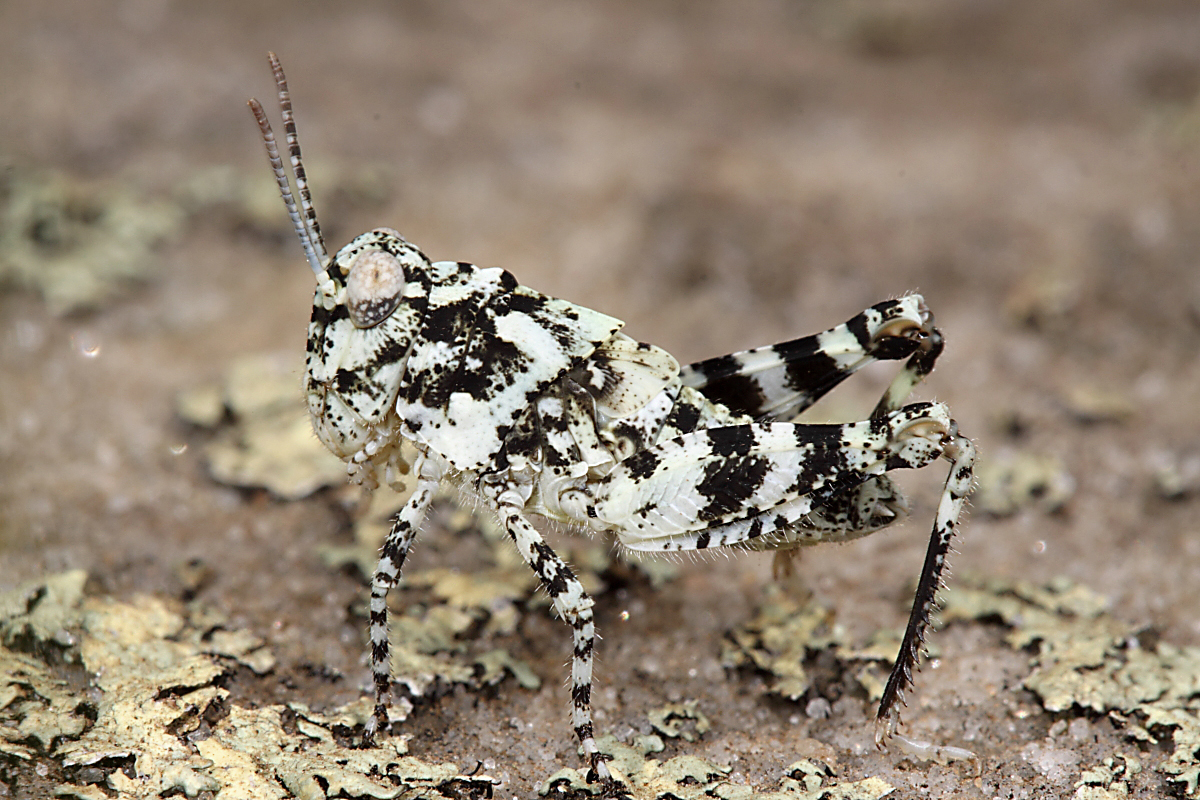
The lichen-colored nymph is easily seen against barren rock...

…now you don’t!

...but blends in marvelously amongst the lichens.

Copyright © Ted C. MacRae 2011

Vinerunt, futuerunt, ierunt

Very rough translation: They loved us, then left us. (the cicadas, that is.)¹ 

¹ Guest blogger’s subtext — Maybe if I dazzle the readers with a title in the colorful language of Pompeiian graffiti, they’ll forgive me for not posting pictures as beautiful as Ted’s. Well, anyway…

On this year’s US Independence Day, we in the St. Louis area were able to proclaim our freedom from the 5-week-long din of cicadas, or so the TV “news” reporters would have us believe. For me, it was more of a return to the dominance of human-made noise; the faint drone of a distant highway, the monotone roar of a neighbor’s lawn mower, the repetitively plosive engine of one of the many diesel pickups that float by, with the CD player’s bass thumping at an almost certainly hearing-damaging decibel level.

Magicicada burrows

I started my celebration early in the day, by doing some gardening and rearranging in the yard. Moving a pile of concrete paving stones, I reached the bottom one and lifted it, and was greeted with a view of abandoned nymphal emergence burrows made by just a few of the many thousands of periodical cicadas that graced my yard with their presence this year. The burrows were already showing wear at the edges in their disuse. A little later later in the morning, I heard the whoooooooa-ooh of a last, lone Magicicada tredecim male from the hackberry tree—first one call, then another, then no more. But nature’s course proceeds, and as afternoon drifted into evening, I was pleased to hear the first of the dogday, or annual, cicadas of the genus Tibicen. These are not truly annual; They emerge every year, but actually take several years—4 or 5, it is said—to develop from egg to adult. 

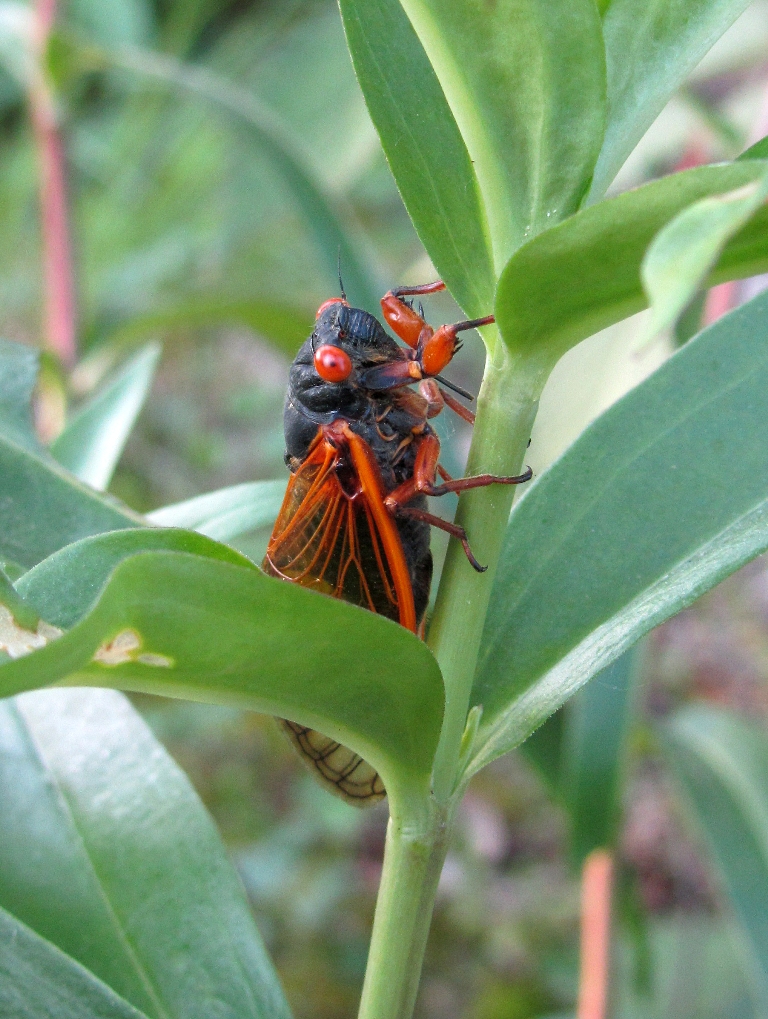
The four Magicicada species that can be found in the St. Louis area, near the western edge of Periodical Cicada Brood XIX (a.k.a. the Great Southern Brood), are famous for their intermittent emergence as adults, every 13 years. (Life spans of 17 years occur in three, more northern species that do not occur in the St. Louis area). In fact, during years to either side of the two emergences of Brood XIX that I’ve experienced since moving to this area 24 years ago, I have always heard, and if really lucky, seen a few, one or two years before and after the “scheduled” emergence. But, the vast majority stick to the plan of feeding on the xylem sap of tree roots as subterranean, tan-colored nymphs for 13 seasons before coming out of the ground, then molting to the ever-so-buggy-looking, winged, black insects with red eyes and wing veins, that “freak everyone out” during their mass emergences. 

The mass emergence is all about reproduction, the successful transmission of genes to the next generation—you know, Darwinian fitness. When a female happens to “like” the song of a particular male, she flies to him, then is courted a for a bit with a different song, before “succumbing to his charms”. Mating typically takes place up in trees. But, being amoral creatures of little brain or scruples, they may choose indelicately to copulate on a porch rail or other such public place. 

Magicicada mating

Magicicada sipping Gentiana andrewsii

Consumed with sex, the adults don’t eat much, but occasionally one sees a cicada poking its proboscis into some soft plant tissue for a drink of sap (clearly exhibiting the relationship of these large insects to those smaller sap-feeders, the aphids and such). A little sap-drinking does little damage to plants, but the insertion of eggs by the mated females into small twigs of woody plants can do quite a bit of “natural pruning”. This would be more of a concern if it happened every year, I suppose, but it really also does little damage in the long run, especially on a mature tree. Still, I would have appreciated it they hadn’t found my recently planted black gum tree such an attractive oviposition site. 

Magicicada damage on Acer saccharum

Magicicada meets Nyssa sapling

But I don’t begrudge them this. I miss their mass serenade. I treasure the remembered sight of a corpulent hairy woodpecker muddying itself to pull one nymph after another from rain saturated ground. I delighted in seeing a surprisingly chubby chipmunk perched fearlessly on an exposed root as it munched a cicada whose wings never properly expanded. Perhaps best of all was watching a red-shouldered hawk clumsily hop about on the lawn to snarf up cicadas that weakly fluttered to the ground. But now, the periodical cicadas are, till May of 2024, mere shells of their former selves. 

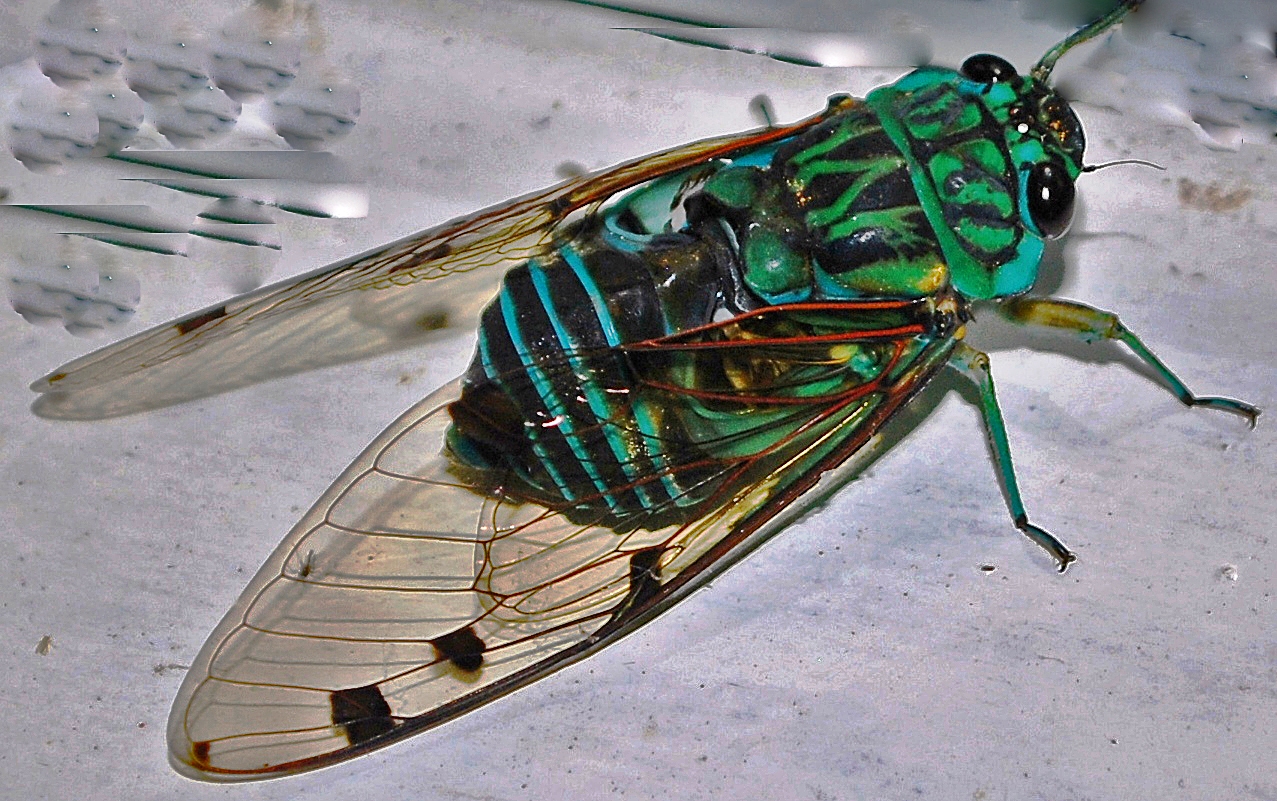
To end on a pretty note, here’s a gaudy cicada that was attracted to lights of the scientific station’s laboratory building in Yasuní National Park, Ecuador, and obligingly posed for a photo on the windowsill.

Ecuadorian cicada

Copyright © James Trager 2011

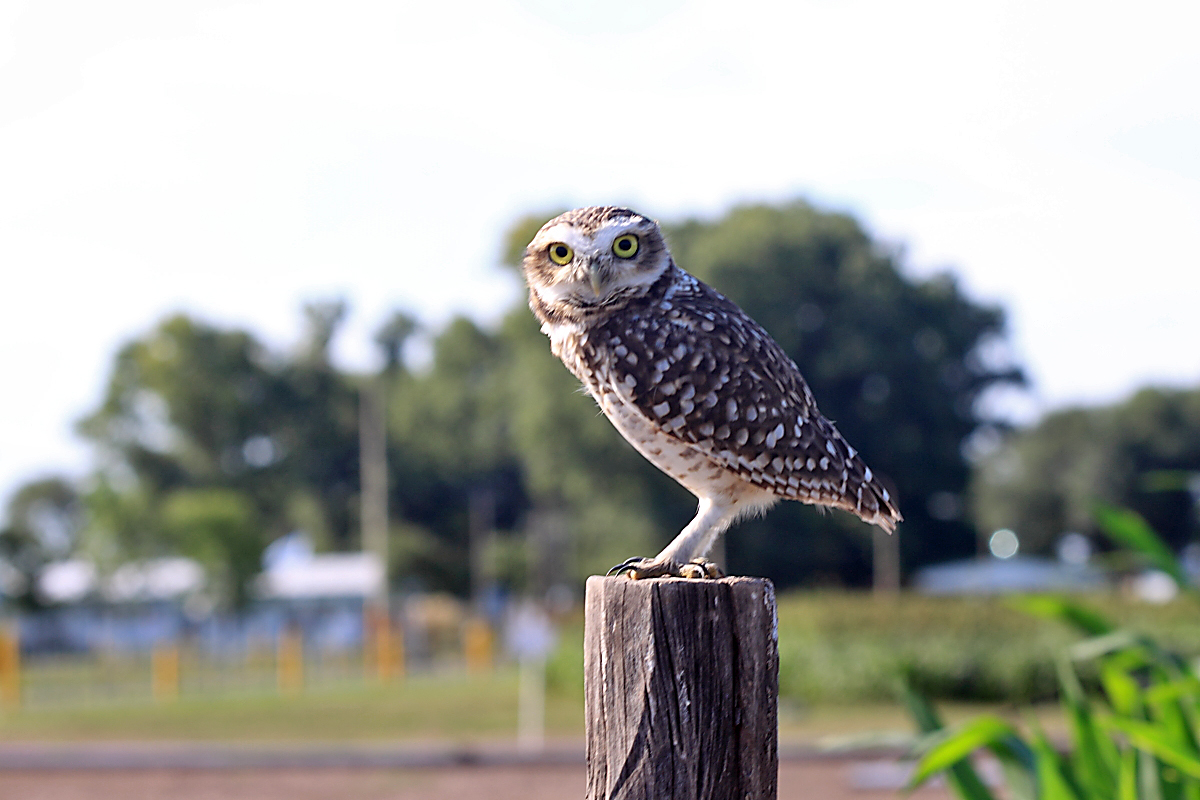
Burrowing Owl in Argentina

I’m not normally one to try to photograph birds—I have neither the expertise nor the long lenses that are generally required for good bird photographs.  However, during my March trip to Argentina I scared up this burrowing owl (Athene cunicularia), who flew a short distance, landed on a nearby fence post, and then just sat there staring at me—almost as if it was daring me to try.  Never one to turn down a challenge (real or perceived), I took the bait.  My longest lens is a 100mm macro, so I set the camera to automatic mode, pointed it at the bird, and started walking.  After each slow, deliberate step I clicked the shutter, racking up about a dozen shots by the time I took the photos below.  They are minimally cropped only for composition and, thus, attest to how amazingly close the owl allowed me to get before it finally found the situation just too unsettling and flew much farther away.  My colleagues commented afterwards that they wished they’d taken a video of me stalking the owl (which they found almost as amusing as the bird’s incredulous stare).  Perhaps all the tiger beetle stalking I’ve done helped.

Copyright © Ted C. MacRae 2011

Diminishing Stag Beetle

This past June I made a couple of trips to north-central Arkansas. They were my first real efforts to collect insects in Arkansas, despite hundreds (literally) of trips to various localities throughout the Ozark Highlands in adjacent southern Missouri. The similarities between the two areas were obvious, yet there was also the feeling of a brand new area just waiting for exploration. On the second trip, I found a campground that looked good for blacklighting to see what wood-boring beetles I might be able to attract amongst the surrounding pine/oak-hickory forest. The evening was warm (very warm!) and humid with no moon—typically ideal for blacklighting, but beetles were sparse at the sheets for some reason (perhaps deterred by the obnoxiously unrelenting yells of drunk Arkansans and their out-of-control offspring?!). The evening, however, was not a total loss—at one point an enormous stag beetle landed on the top of the sheet.  It was so big that I couldn’t even fit it into the viewfinder of my camera:

I fiddled with the camera and changed some settings.  I got a little more of the beetle in the viewfinder this time, but it was still just too big:

Additional fiddling with the camera allowed even more of the beetle to be seen:

As I took the photographs, I even began wondering if the beetle itself was actually shrinking:

Eventually, it turned out to be a normal-sized beetle after all:

This is a female of the common eastern North American species Lucanus capreolus.¹  I don’t seem to encounter female stag beetles as often as the males, so this was still a nice find on an otherwise frustrating night.

¹ Two bonus point in the current BitB Challenge session to the first person who correctly explains how I know this.  Overall contenders: here’s your chance to score an advantage as we enter the final stretch in the current Challenge session.

Copyright © Ted C. MacRae 2011
Four-humped Longhorned Beetle

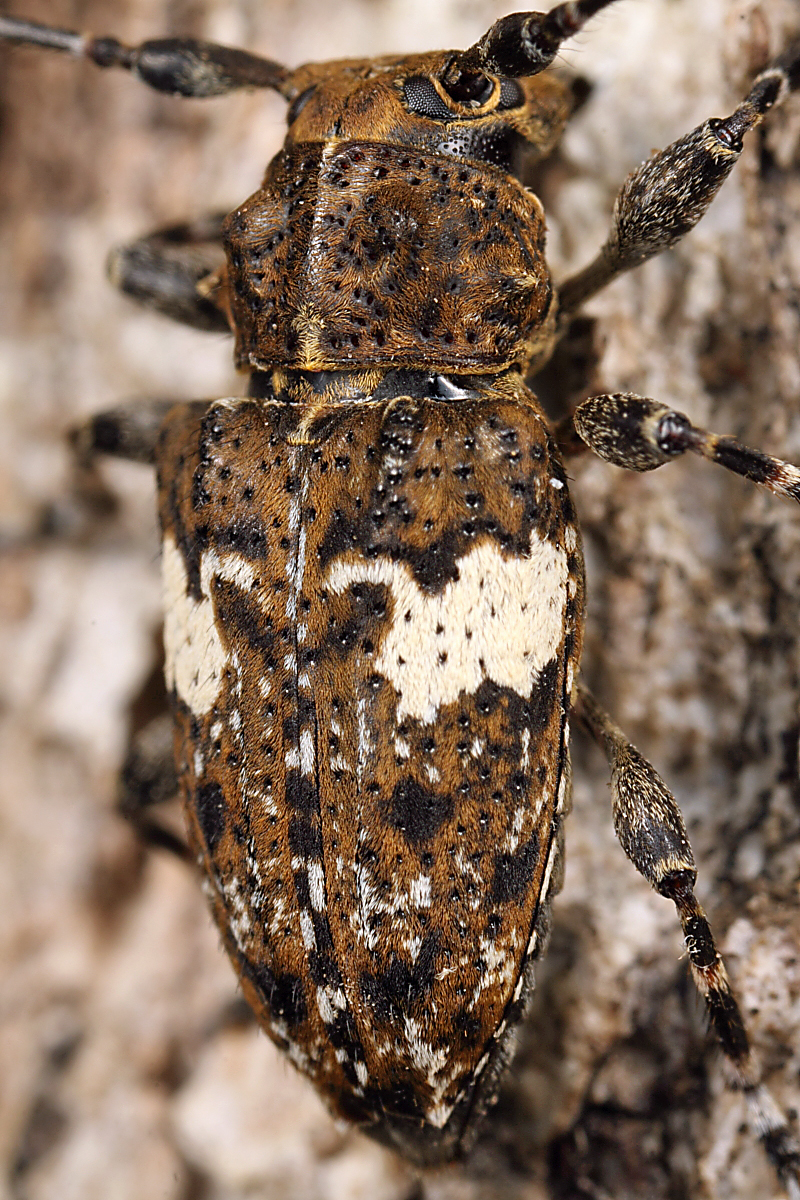
Acanthoderes quadrigibba | Chalk Bluff Natural Area, Arkansas.

On a recent collecting trip, I went over to Chalk Bluffs Natural Area in the Mississippi Alluvial Plain of northeastern Arkansas.  My quarry was a population of Cylindera cursitans (ant-like tiger beetle) that has been reported from the site—one of the only known sites for the species in Arkansas.  While I was there, I noticed some movement on the trunk of a tree, and a closer look revealed that what appeared to be a piece of bark was actually a beetle—a longhorned beetle to be precise.  The elevated gibbosities of the pronotum and white, transverse fasciae of the elytra immediately identify it as Acanthoderes quadrigibba, a not uncommon species in the eastern U.S., but one that I still get excited about whenever I encounter it.

Note the four pronotal ''humps'' in this dorsolateral profile view.

Judging by the number and diversity of plant genera that have been recorded as larval hosts for this species—Linsley and Chemsak (1984) recorded Acer, Betula, Carya, Castanea, Celtis, Cercis, Fagus, Ficus, Quercus, Salix, Tilia, and Ulmus—you could be forgiven for thinking that this is one of the most common and abundant species of longhorned beetle in North America.  I have not found this to be the case, and I don’t think it is because I’m simply missing it due to its cryptic appearance.  Longhorned beetles in the tribe Acanthoderini are, like many species in the family, quite attracted to lights at night, and I’ve done plenty of lighting over the years.  What I have noticed is that nearly all of my encounters with this species have been in the Mississippi Alluvial Plain—an area rich with wet, bottomland forests that contrast markedly from the dry to dry-mesic upland forests that cover much of the southern two-thirds of Missouri.  I’ve also reared the species a few times from Salix, one of the host genera recorded by Linsley and Chemsak (1984).  In both cases, the wood was not freshly dead (as is commonly preferred by many other longhorned beetles), but a little past its prime and starting to get somewhat moist and punky.  In the case of this beetle, I suspect that the nature of the host wood may be more important than the species, the preference being for longer dead wood in moister environments.  Of course, observations by another collector in another state may completely obliterate my idea, but for now it sounds good.

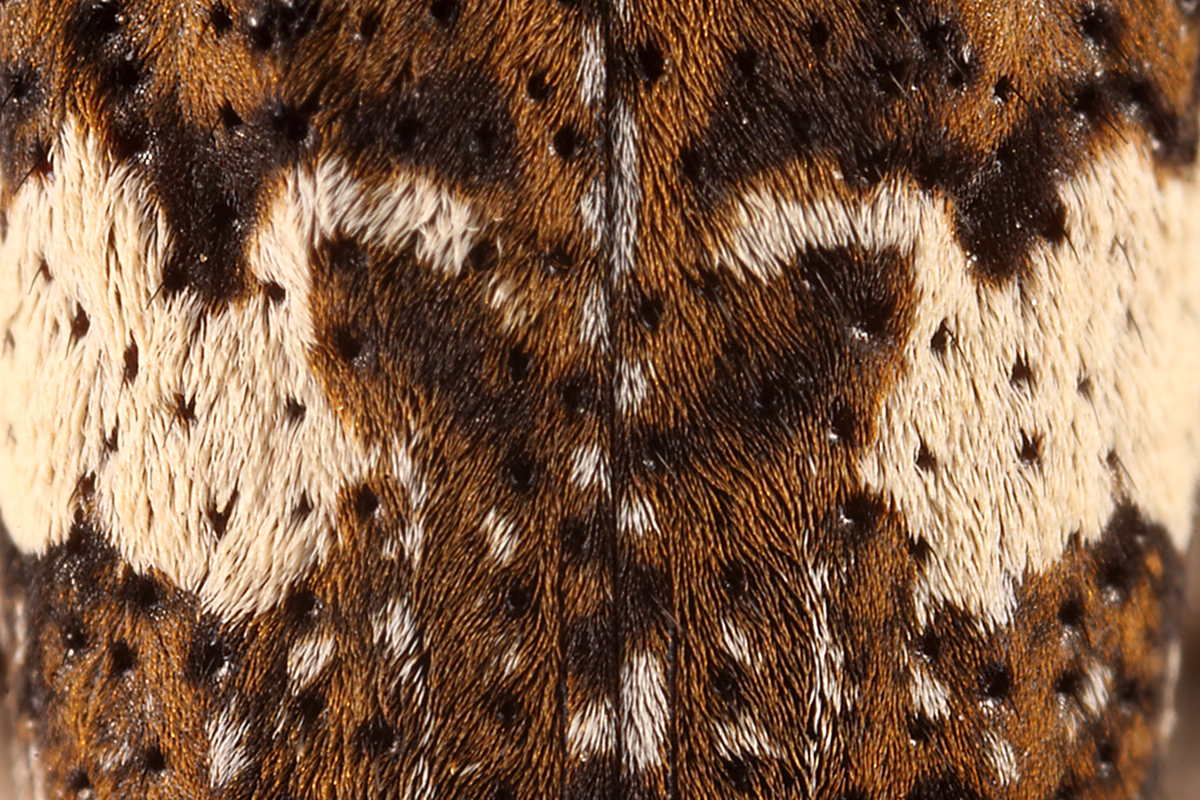
A closeup photograph of the elytral markings of this beetle was the subject of ID Challenge #9, to which a record 18 participants responded (thanks to all who played!).  Troy Bartlett takes the win with 12 points (and attention to detail), while Dennis Haines, Max Barclay, Mr. Phidippus, and Josh Basham all score double-digit points.  Troy’s win moves him into the top spot in the overall standings of the current BitB Challenge Session with 23 pts, but Dave is breathing down his neck with a deficit of just a single point.  Tim Eisele and Max Barclay have also moved to within easy striking distance with 19 and 18 points, respectively, and several others could make a surprise move if the leaders falter.  I think I’ll have one more challenge in the current session before deciding the overall winner—look for it in the near future. 

REFERENCE:

Linsley, E. G. and J. A. Chemsak. 1984. The Cerambycidae of North America, Part VII, No. 1: Taxonomy and classification of the subfamily Lamiinae, tribes Parmenini through Acanthoderini. University of California Publications in Entomology 102:1–258.

Copyright © Ted C. MacRae 2011

ID Challenge #9

Despite the super close-up nature of the photograph in today’s challenge, this is not a crop and is thus a straight up ID Challenge (making this either a very giant insect or maximum magnification of my 65mm lens).  I’ll award 2 pts each for order, family, genus, and species.  Standard challenge rules apply, including moderated comments (to give everyone a chance to take part) and possible bonus points for being the first to guess correctly (in the off chance multiple people offer the same correct answers), offering suitable relevant information, or just making me chuckle.  Reminder: nobody walks away with no points, so it pays to try even if you haven’t a clue!¹

¹ If you question the importance of this, just ask Dave, whose pity points in the last challenge helped him retain sole possession of 2nd place in the overall standings.

Who am I?

Copyright © Ted C. MacRae 2011

A “Giant” Pygmy

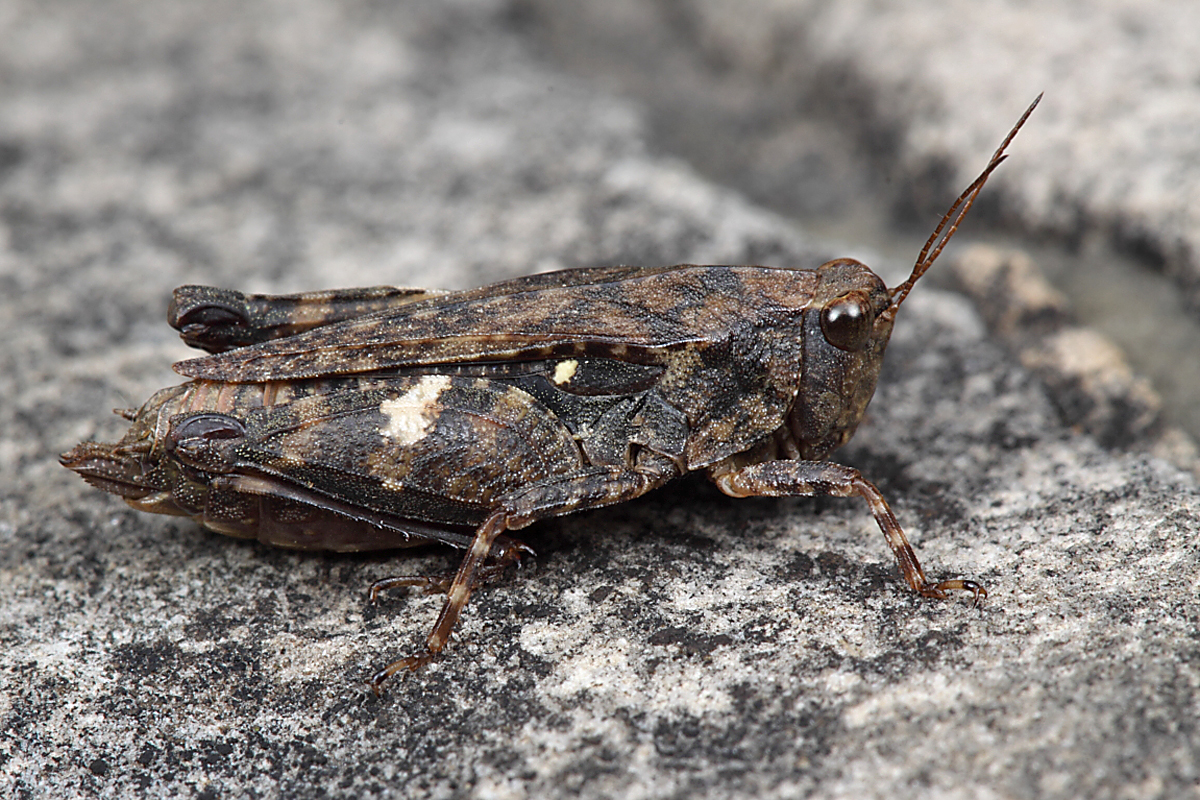
Not long ago, I got an email from grasshopper expert David J. Ferguson confirming my identification of  (and also encouraging my recent fascination with band-winged grasshoppers (family Acrididae, subfamily Oedepodinae) and their marvelously cryptic nymphs).  He suggested that I might also find the “toad lubbers” (family Romaleidae) and pygmy grasshoppers (family Tetrigidae) interesting, since they too have many of those qualities I was finding attractive in band-winged nymphs, only on a very small scale.  It was a prescient comment, as I’d already started taking notice of the pygmies and even photographed one before ever getting his email.

Tettigidea lateralis | Shaw Nature Reserve, Missouri.

I take this individual to represent Tettigidea lateralis (black-sided pygmy grasshopper), which I saw at Shaw Nature Reserve during my May search for .  Actually, I’m not sure I would have even noticed this individual, as I walked along the trail going from open woodland through dry dolomite glade, had it not actually been sitting on my net rim.  I haven’t studied pygmies all that much, other than to note that they seem common around streams and other wet areas and are usually quite small.  This one, however, at close to 15mm in length seemed positively gigantic!  I placed it on the barren dolomite along the trail, expecting it to flee immediately.  Instead it just sat there—begging me to photograph it, so I did.

Bold, white femoral markings contrast nicely with its otherwise marvelously cryptic coloration.

This one appears to be a female with a short pronotum, but I can’t tell if it is an adult with short wings or still a nymph (it was certainly large enough to be an adult!).  Either way, I’m interested in the function of the bright white femoral marking on what is otherwise a very cryptically colored individual.

Copyright © Ted C. MacRae 2011

T.G.I.Flyday – Andrenosoma fulvicaudum

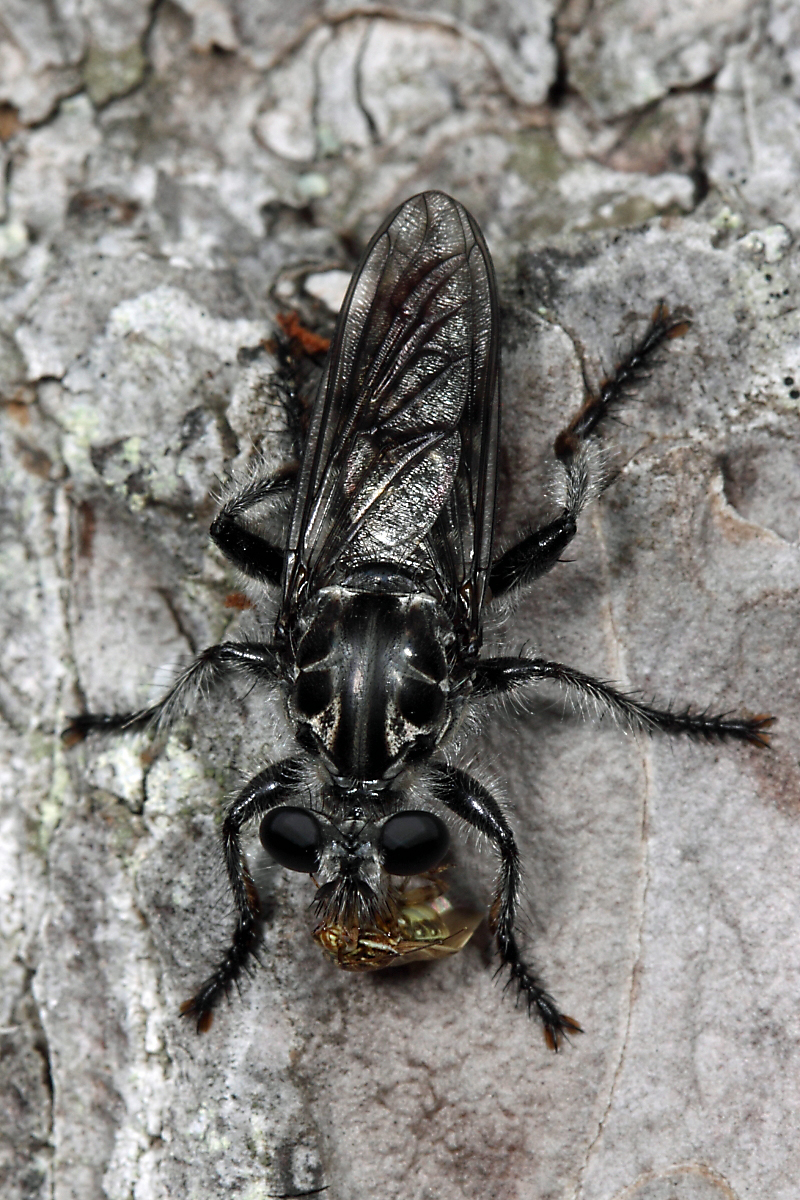
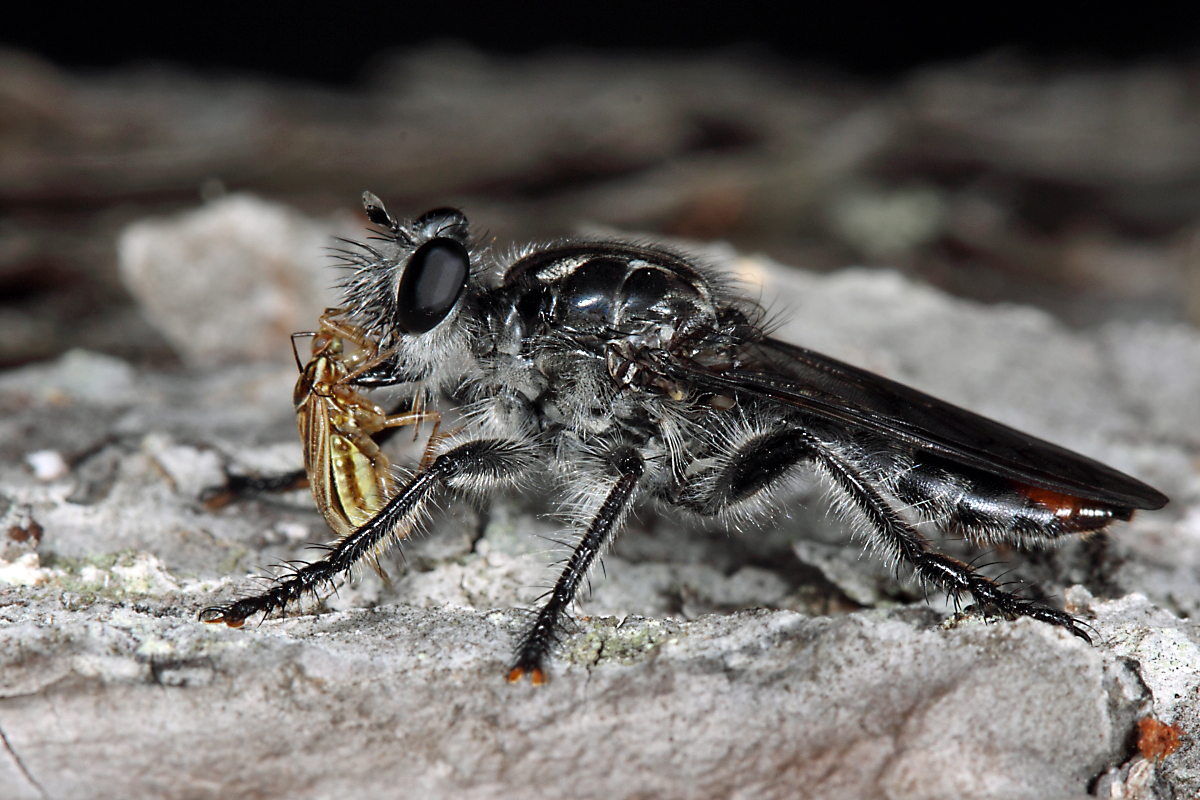
Andrenosoma fulvicaudum | Stone Co., Arkansas

First, about the name. T.G.I.Flyday is my contribution to a collusional triad between dipterist Morgan Jackson, myrmecologist Alex Wild, and myself (uhm, beetles).  Although Alex blogs primarily about ants, he has long featured a “Friday Beetle Blogging” series.  I’ve also occasionally stepped on their toes with an ant or fly post, so Morgan and I thought it would be fun to complete the Friday switcheroo with a post about ants on his blog and one about flies on mine. Get it?… Oh well, it made me chuckle when we thought it up.  Anyway, here is my first T.G.I.Flyday contribution.

Among the flies (order Diptera), it is hard to pick anything but robber flies (family Asilidae) as the most charismatic group.  Several subfamilies of robber flies have candidates that vie for the most impressive species, mostly due to their enormous size combined with striking green eyes (e.g., Microstylum morosum, Diogmites neoternatus) or vivid, aposematic / mimetic coloration (e.g., Archilestris magnificus, Eccritosia zamon, Wyliea mydas).  However, my favorite subfamily is the Laphriinae—not because of the amazing bumble bee-like appearance of the nominate genus, but rather the larval food of all species in the subfamily; wood-boring beetle larvae.  Over the years, I have put up hundreds of batches of dead wood for rearing wood-boring beetles in the families Buprestidae and Cerambycidae, and not uncommonly do I find in one of the emergence containers—especially those containing dead pine—an adult of one of these impressive flies. Oftentimes their characteristic pupal cases will be found protruding from the emergence hole, in which case I pin it underneath the fly (just in case some ambitious dipterist examines my collection after I’m gone and finds that the pupal case of xx species is not yet described).  I’ve by now accumulated a rather decent little robber fly collection (especially considering that I’m really a coleopterist), graciously identified for the most part by world robber fly expert Dr. Eric Fisher (California Department of Food and Agriculture).

Last weekend I made the second in a series of trips I’ll be taking to the White River Hills region of north-central Arkansas in an effort to confirm the occurrence there of Cylindera celeripes (swift tiger beetle).  My efforts are focused on the area around Calico Rock, a marvelous system of acidic sandstone barrens interspersed amongst shortleaf pine and oak forests.  The occasional dead pines found in such areas are highly attractive to a variety of pine-associated buprestids and cerambycids (my first loves), and whenever I see a standing dead tree I make a beeline straight for it (the tiger beetles can wait).

This individual was sitting on the trunk of a dead shortleaf pine with a mirid bug for prey.

On this day, sitting on the trunk of the first dead pine that I approached was not a buprestid or cerambycid, but rather this laphriine robber fly.  Based on the reddish posteriodorsal markings of the abdomen and general gestalt, I take this to be Andrenosoma fulvicaudum, a widespread though never very abundant species that occurs across most of North America.  According to Bromley (1934), the species frequents dry, sandy locations where it rests on logs, stumps, or tree trunks exposed to the bright sunlight and is commonly observed preying on small hymenopterans.  These observations are quite consistent with mine, except this one was feeding on a true bug in the family Miridae (perhaps distracting it just enough to allow me these photographs).  Cannings (1998) notes that A. fulvicaudum is attracted to recently burned forests, which will provide a fresh supply of wood-boring beetle larvae on which its larvae can prey.  This is the only species of Andrenosoma occurring in eastern North America; four additional species are restricted to Texas and a fifth occurs only in the western U.S., but the genus reaches its greatest diversity in the Neotropics.

REFERENCES:

Bromley, S. W. 1934. The Laphriine Robber Flies of North America.  Ph.D. dissertation, Ohio State University, 358 pp.

Cannings, R. A. 1998. Robber flies (Insecta: Diptera: Asilidae), In I. M. Smith and G. G. E. Scudder [Eds.], Assessment of Species Diversity in the Montane Cordillera Ecozone, Burlington: Ecological Monitoring and Assessment Network.

Copyright © Ted C. MacRae 2011