Lampetis drummondi larva?

Back in February, I learned that Mark Volkovitsh (Zoological Institute, Russian Academy of Science, St. Petersburg) would be visiting Chuck Bellamy (California Department of Food and Agriculture) in Sacramento the very week that I was planning to be in Lake Tahoe. Chuck and Mark are two of the worlds leading specialists in Buprestidae, or jewel beetles, and have worked together on a number of projects dealing with the taxonomy and systematics of buprestid beetles. Mark, in particular, has focused on describing the larval forms of buprestids (“white wormy things,” as my wife calls them) and using larval morphology to supplement adult morphology in phylogenetic analyses. I’m not anywhere near being in their league in terms of authority in the family – a comparative dabbler, really – but for some reason they’ve both seen fit to accept me into the fraternity. I’ve been fortunate to spend time in the field with each of them, as well as visit them at their respective institutions.  When I learned of Mark’s coincident visit, I couldn’t resist the chance to make the 2-hour drive from Lake Tahoe to Sacramento and spend the day with Mark and Chuck at the CDFA and discuss things buprestological.  The wife and kids were fine with that, since her brother also lives in Sacramento, and it would be a chance for them to do some sight-seeing before we all got together for dinner.  Upon arriving at CDFA, I also met Andy Cline, a nitidulid specialist at the CDFA (re-met actually, turns out we’d met some years back), and the four of us went out for an animated lunch at a nearby restaurant over some of the most delicious barbeque that I’ve ever tasted.

L-R: Mark Volkovitsh (Russia), Chuck Bellamy (CDFA), me, Andy Cline (CDFA)

After lunch, I was most interested in discussing with Mark some buprestid larvae that I had collected in Big Bend, Texas in 2004. My colleague Chris Brown and I were hiking a low desert trail west of Rio Grande Village when we encountered a large, uprooted Goodding willow (Salix gooddingii) tree laying on the river bank. Wilting leaves were present on some of its branches, suggesting that the half-dead had been washed to its current location by the river during a recent flood. At the base of the trunk where the main roots projected, I noticed what appeared to be frass (the sawdust that wood boring beetle larvae eject after eating it – that’s right, grub poop!) under the edge of the bark at the live/dead wood interface. I used my knife to cut away some of the bark and immediately encountered a huge buprestid larvae. Its enormous size is matched only by a few desert southwest species: Polycesta deserticola, which breeds commonly in oak and is known from willow, but breeds only in dead, dry branches; and Gyascutus planicosta, whose larvae are restricted to the living roots of Atriplex and a few other asteraceous shrubs.  Clearly, it could not be either of these species.  The only other desert southwest buprestids large enough to produce a larva this large (~50 mm) are Lampetis drummondii and L. webbii. However, the larvae of both of these species are unknown, as is basic information regarding what hosts they utilize for larval development. Lampetis webbii is quite rare, but L. drummondii is, in fact, one of the most conspicuous and commonly encountered buprestid species in the desert southwest – that fact that its larva has remained unknown suggests that it utilizes living wood, probably feeding below the soil line.  Thus, I immediately began to suspect that the larva might represent this species – a truly exciting development. 

As I continued digging into the wood, I encountered a second, somewhat smaller larva in a neaby gallery, and further digging revealed another clue about its identity in the form of fragments of a dead adult beetle – all brilliant blue/green in color (identical to the color of L. drummondi), and the largest (the base of an elytron, or wing cover) showing the same pattern of punctation exhibited by L. drummondi adults. I placed the two larvae individually in vials with pieces of the host wood; however, I knew there was little chance that either larva, requiring living tissue upon which to feed, would complete its development once removed from its host gallery.  They did survive for a time after my return to St. Louis, but when the largest larva became lethargic, I decided to go ahead and preserve them.  I sent the photograph below (taken by Chris) of the living larvae to Mark, who confirmed that it did indeed appear to be a species of Lampetis, based on its large size and the narrowly V-shaped furcus on the pronotal shield (typical for members of the tribe to which Lampetis belongs). 

Buprestid larva (prob. Lampetis drummondi) under bark of Salix gooddingii at trunk base - Big Bend National Park, Texas. Photo by Christopher R. Brown.

Considering the complete lack of published information on the larval biology of Lampetis drummondi and the several lines of evidence that these larvae, in fact, represent that species, it would be worthwhile to publish a description of the larva.  However, formal description requires dissection, and I did not know how to do this.  Mark, on the other hand, has dissected literally hundreds of buprestid larvae, including representatives of nearly every genus for which larvae are known.  He is the buprestid larva expert, and what a thrill it was for me to learn how to do this from the Master himself, using the larger of these two probable Lampetis larvae as the subject.  While we were dissecting the larva, we compared its features to those published for the European species Lampetis argentata (Danilevsky 1980) – the only member of the genus for which the larva is known – and confirmed their similarity and the larva’s likely close relationship to that species.  Coincidentally, the larva of L. argentata develops in living roots of saxaul (Haloxylon) – a genus of large shrubs/small trees (family Amaranthaceae) that grows in the deserts of Central Asia.  It thus appears that Lampetis species may, as a general rule, utilize living wood below the soil line for larval development, explaining why the larva of only one (now two) of the nearly 300 species in the genus worldwide has been found.

REFERENCES:

Danilevsky, M. L. 1980. Opisanie zlatki Lapmetis [sic] argentata (Coleoptera, Buprestidae) – vreditelya saksaula [Description of the larva of Lapmetis [sic] argentata (Coleoptera, Buprestidae) – the pest of HaloxylonZoologicheskii Zhurnal 59:791–793.

Copyright © Ted C. MacRae 2010

Add to FacebookAdd to DiggAdd to Del.icio.usAdd to StumbleuponAdd to RedditAdd to BlinklistAdd to TwitterAdd to TechnoratiAdd to Yahoo BuzzAdd to Newsvine

Email to a friend

Friday Flower – Ozark Witch Hazel

Spring is beginning its “march” across the nation, and in typical fashion the month started out with the promise of pleasant weather but is throwing a few tantrums before giving way to April. For most folks in the lower Midwest, spring began a week or so ago when daffodils began popping up from nowhere and dotting the suburban and semirural landscapes with their yellow smiles. Forsythia are also set to burst forth, their appearance temporarily put on hold by this latest cold/wet snap, but when they do most people here will be satisfied that spring has finally come. For me, spring comes much earlier, and it’s not planted ornamentals that mark its beginning, but native trees.  Silver maples (Acer saccharinum) and American elms (Ulmus americana) are first, bursting open in the very first warm days of early March.  These are followed by the sugar maples (A. saccharum) and red maples (A. rubrum) that are in full bloom now, which will themselves give way to the redbuds (Cercis canadensis) and serviceberrys (Amelanchier arborea) that will close out the month before flowering dogwood (Cornus florida) dominates the area’s understories in April.

There is one tree in this part of the country, however, that shows its amazing blooms in January and February while winter’s grip is still strong.  Ozark witch hazel (Hamamelis vernalis) is restricted to the Ozark Highlands of Missouri and Arkansas, where it grows along the rocky creeks and streams that dissect this ancient landscape.  I have long wanted to see its striking blooms, but despite my many wintertime hikes throughout the Ozarks, I have never found myself in the right place at the right time – until a few weeks ago when I hiked the Mina Sauk Trail at Taum Sauk Mountain State Park.  I found these plants growing below Mina Sauk Falls and along Taum Sauk Creek below, and even though it was the first weekend of March (and the very first warm day of the season), many of the plants had already passed their peak bloom.  Fortunately, I was able to find these several plants with flowers still in good shape.

There is only one other species in the genus – eastern witch hazel (Hamamelis virginiana).  Although distributed widely across eastern North America, it is restricted in Missouri to these same St. Francois Mountains where I saw H. vernalis.  The two species are very similar by the characteristics of their foliage but can be easily distinguished by floral characters.  Hamamelis virginiana blooms in fall rather than winter, and its flowers, while nearly twice the size, rarely show the amount of red on the inner calyx that is seen in this species.  Hamamelis vernalis flowers are also quite fragrant, having what has been described as a “vanilla” scent.  The photographs here show the rather unusual color range of the flowers of this species, which can vary from orange to deep red to deep yellow.  I suspect that flower color also changes with age, in that petals are initially deep red and later fade to yellow, as in the photo below.  It’s difficult to explain why H . vernalis is restricted to the Ozark Highlands while H. virginiana occurs so broadly, but the Ozarks are a well-known refugium for a number of other plants and animals, especially Ice Age relicts.

Sitting on a rhyolite ledge overlooking Taum Sauk Creek as I ate lunch, I wondered about the pollination biology of a plant that flowers during winter.  It was a warm day – certainly an unusual occurrence during the period in which this plant flowers – and even still it was too early in the season for a lot of insect activity.  I watched one of the nearby plants as I ate to see what insects came to the flowers, and for a time all I saw were a couple of European honey bees.  Clearly, the plant did not evolve in association with this now ubiquitous insect.  I continued watching, and at last I saw a native insect visiting the flowers – a large species of hover fly (family Syrphidae), perhaps something in the genus Helophilus.  After taking a few more photographs (unfortunately, none of the fly), another of the same species visited the plant.  Flies in general are famous for appearing during warm days in winter, and I wonder if the unusually extended bloom period of this species is intended to take advantage of those few, unpredictable days during winter when temperatures are sufficient for flies to become active.

Photo Details: Canon 100mm macro lens on Canon EOS 50D
Photo 1: ISO 100, 1/200 sec, f/11, MT-24EX flash w/ Sto-Fen-Puffer diffusers.
Photo 2: ISO 200, 1/200 sec, f/5.6, ambient light.
Photo 3: ISO 100, 1/60 sec, f/9, flash w/o diffusers.
Photo 4: ISO 200, 1/250 sec, f/5.6, ambient light.

Copyright © Ted C. MacRae 2010

Add to FacebookAdd to DiggAdd to Del.icio.usAdd to StumbleuponAdd to RedditAdd to BlinklistAdd to TwitterAdd to TechnoratiAdd to Yahoo BuzzAdd to Newsvine

Email to a friend

Lake Tahoe – 2010 Preview

How does an entomologist/wannabe botanist-ecologist-geologist-cyclist-nature photographer spend his time on a family vacation?

  • Thursday evening to Saturday late afternoon:
    – Drive from St. Louis to Lake Tahoe.  In between driving shifts:
    – Complete manuscript on Cylindera cursitans surveys
    – Complete manuscript on Dromochorus pruinina surveys.
    – Arrive late afternoon, quick 1-hr bike ride before dark.
  • Sunday:
    – Cross-country skiing with the family: Spooner Lake (~6 miles).
    – Sight-seeing: Sand Harbor Overlook on the east shore.
    – Hang out at the hot tub with the family and a glass of wine.
  • Monday:
    – Drive to Sacramento with the family.
    – Visit buprestid-colleagues Chuck Bellamy (CDFA) and Mark Volkovitsh (Russian Academy of Science).
    – Private lesson from Mark on how to dissect buprestid larvae for taxonomic description.
    – Dinner with my favorite brothers-in-law.
    – Drive back to Lake Tahoe.
  • Tuesday:
    – Snowshoe hike with the family: Emerald Bay to Eagle Lake and back (2 miles, 1,900′ of climbing).
    – Bike ride: South Lake Tahoe to Bliss State Park and back (33 miles, 1,100′ of climbing).
  • Wednesday:
    – Bike ride: all the way around Lake Tahoe (72 miles, 3,500′ of climbing).
    – Hang out at the hot tub with the family and a glass of wine.
  • Thursday:
    – Botanizing and hiking with daughter Madison at Mt. Rose (4 miles, 1,300′ feet of climbing).
    – Hang out at the hot tub with the family and a glass of wine.
  • Friday:
    – Alpine skiing with the family at Heavenly Ski Resort.
    – Join a 2-hour ski tour with US Forest Service rangers discussing natural and cultural history of Lake Tahoe.
    – Hang out at the hot tub with the family and a glass of wine.
  • Saturday morning to Sunday night:
    – Drive from Lake Tahoe back to St. Louis.  In between driving shifts:
    – Process/file photographs from trip (~250).
    – Complete reports for 2009 collecting permits.
    – Complete new applications for 2010 permits.
    – Begin manuscript on Cylindera celeripes conservation status.
  • Monday:
    – Return to work mentally refreshed!

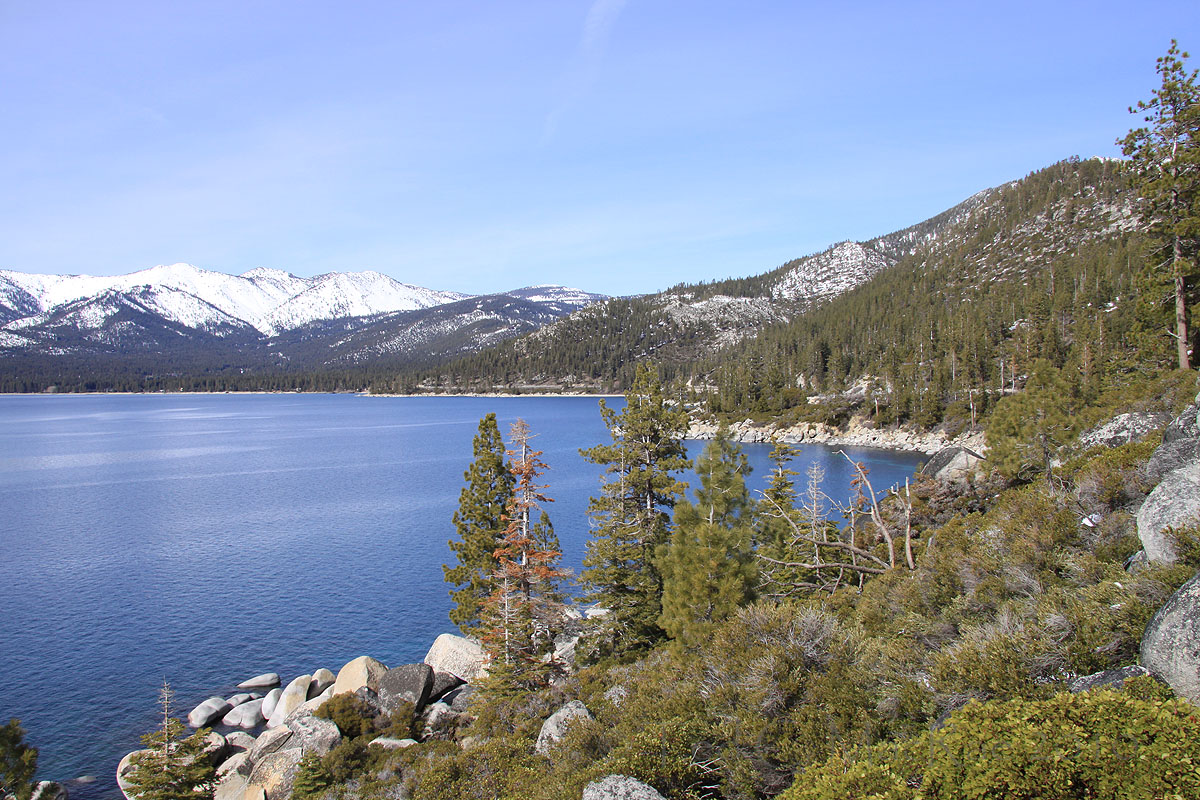
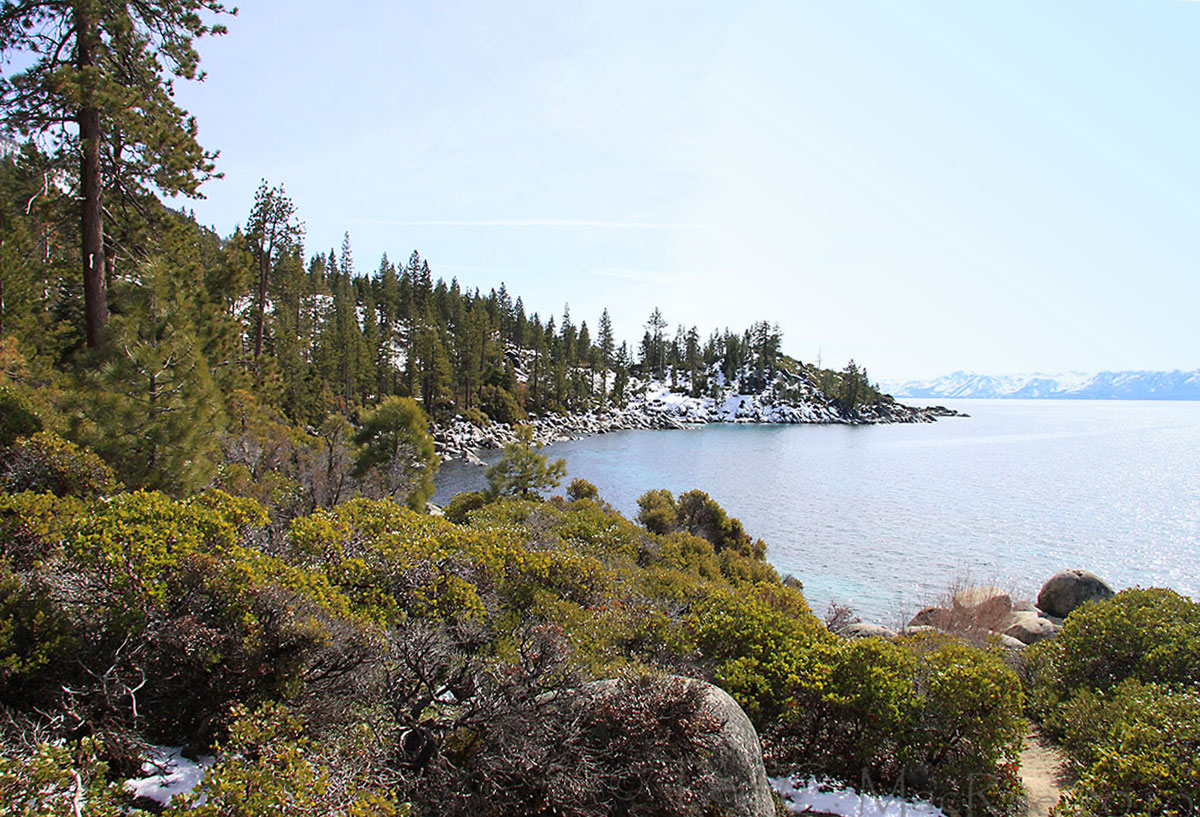
I’ve already shared a bit of the trip with a view of Mt. Rose from 7,000′ and ensuing pismire quagmire.  Today I share some views of one of the most scenic of lakeside spots on the east shore – Sand Harbor Overlook.  I featured this spot in this post from last year’s trip due to its stunning beauty, and this year I was no less impressed.  I still had that same, annoying, afternoon sun to deal with (next year I’ve resolved to get here during the morning) but managed to get some passable photographs.  The one above is my favorite, and I hope you enjoy the following as well. (p.s. if someone knows how to fix a sun-blown sky in Photoshop Elements, please let me know).

Copyright © Ted C. MacRae 2010

Add to FacebookAdd to DiggAdd to Del.icio.usAdd to StumbleuponAdd to RedditAdd to BlinklistAdd to TwitterAdd to TechnoratiAdd to Yahoo BuzzAdd to Newsvine

Email to a friend

Pismire Puzzle

I returned home from a much-needed vacation late last night, and even though it was a family trip I have much to share from the past 10 days. However, I must remain coy about where I was for the time being so that I may present this little quiz:

Who am I?

I had planned to post this yesterday, but the best title I could come up with – “Monday Myrmecine Mystery” – was just too similar to a Monday tradition on another blog that we’ve all grown to love.  (Also, I just couldn’t get to it.)  No longer constrained by an M-themed title, I came up with this alternative¹ that I hope will make the 12-year old boy in each of us giggle aloud.

¹ Pismire (from pissemire) is an archaic name of Scandinavian origin for ant. Derived from pisse urine (referring to the smell of formic acid) + mire ant.

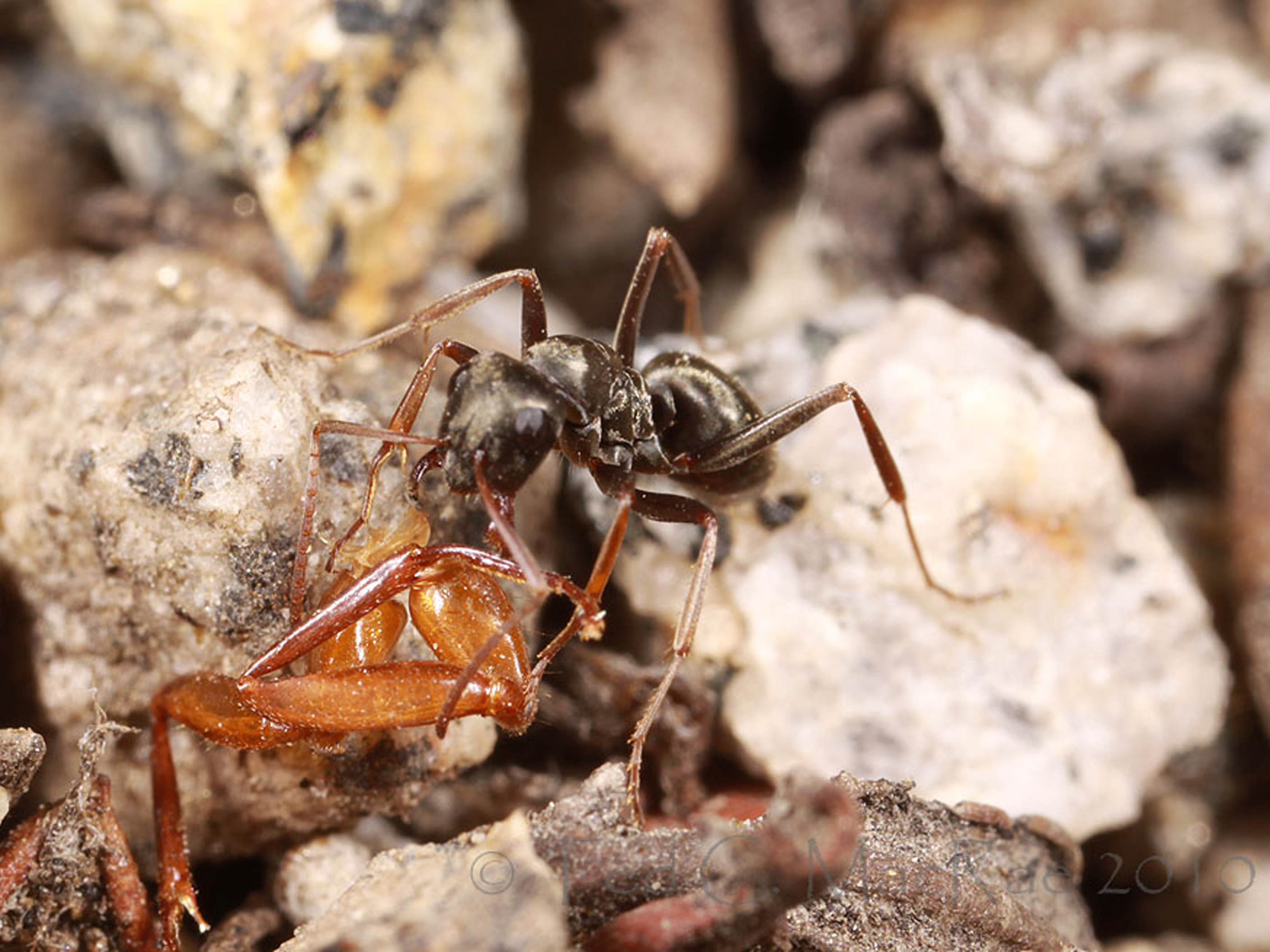
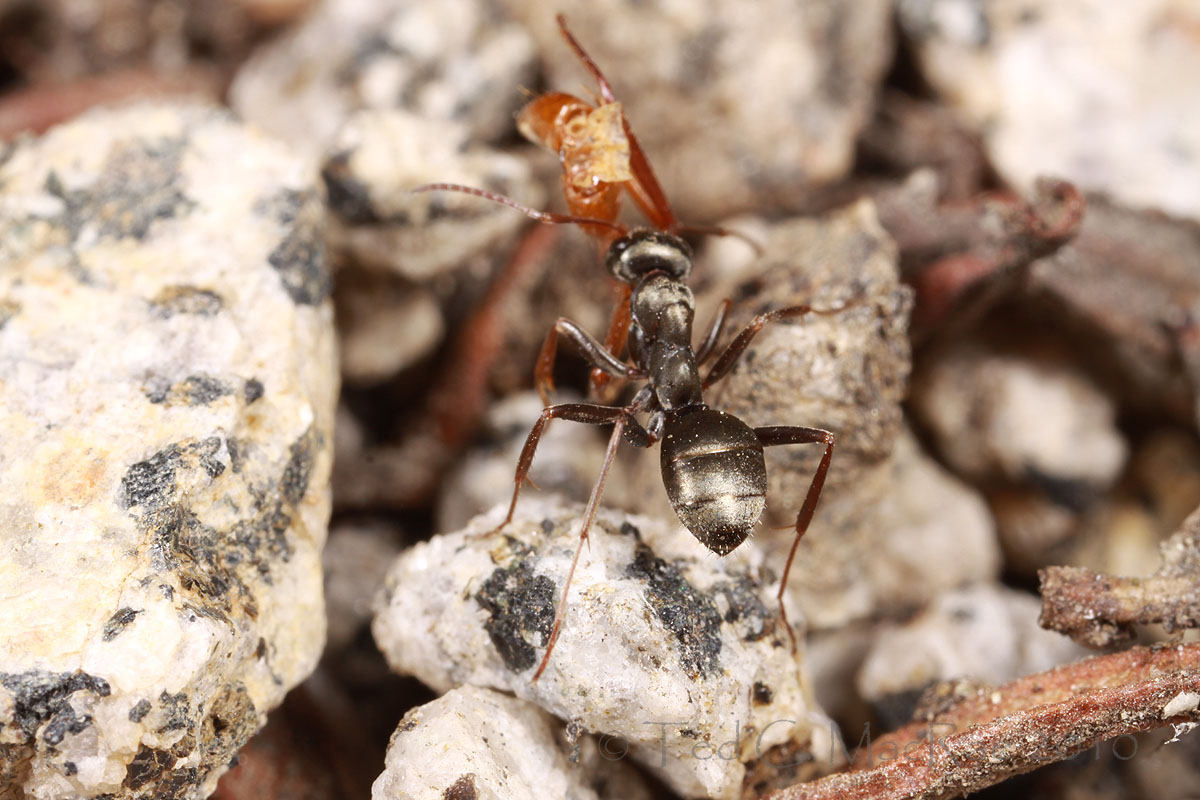
What am I doing?

I expect members of the Formicine Guild will jump all over this, so I should probably make this quiz about more than just the name of the ant (which I don’t know, so does that make this an illegal quiz?).  Maybe I should offer double points to non-myrmecologists for a proper ID (but then, I would need the consensus of the myrmecologists – perhaps a conflict of interest?).

Why do I do this?

I could also offer points for correctly guessing what the ant is carrying – which again I wasn’t able to figure out, so I guess points will have to be awarded for the most plausible explanation.  What I do know is the ant carried this carcass while meandering aimlessly over the same patch of ground – occasionally stopping very briefly to dig its jaws into it before resuming its wanderings.  I followed the ant for about 10 minutes, and it never left an area of about 1 square foot – no nest nearby that I could see, no direction to its travels, no apparent purpose to its labors.

This is where I live.

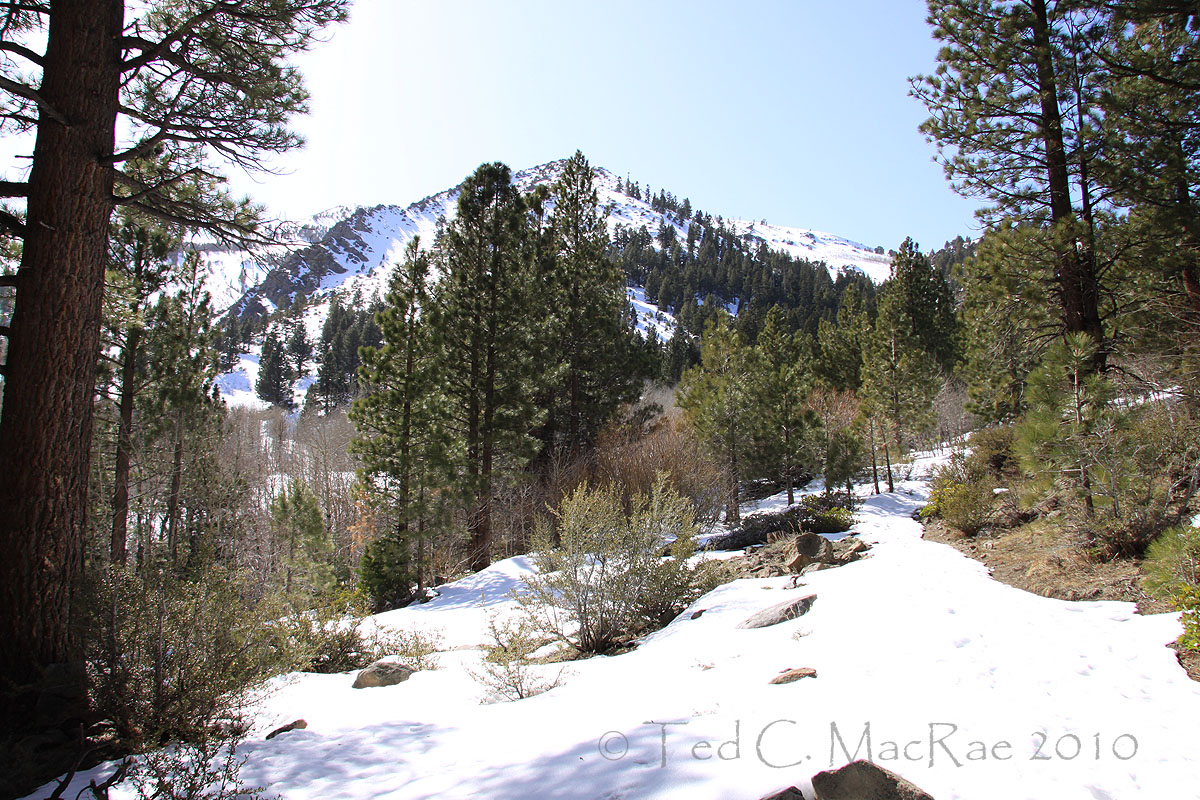
I most definitely know where I was, so firm points are on offer for correctly guessing the answer to that question – either on the basis of the ant ID or the above photograph of its habitat.  Yes, that is snow on the ground – lots of it!

Copyright © Ted C. MacRae 2010

Add to FacebookAdd to DiggAdd to Del.icio.usAdd to StumbleuponAdd to RedditAdd to BlinklistAdd to TwitterAdd to TechnoratiAdd to Yahoo BuzzAdd to Newsvine

Email to a friend

March moths, herps, and beetles

Nature blog carnival time used to be restricted to the beginning of each month – a mensual fix of inverts, birds, berrys, and trees.  Those stalwarts still greet each new month in rough synchrony, but lately a new crop of upstart nature blog carnivals has appeared, all vying to fill that former mid-month lull.  Covering mothsherps, and beetles, they cater to a more specialized audience (despite their subject matter being as diverse as any of the original carnivals).   New editions of these mid-month carnivals are hot off the press, just in time to stock up on fresh reading material for the weekend.

Jason Hogle is my hero!  Intellect, perspective, and artistic talent combine at xenogere to produce some of the most visually and spiritually compelling nature writing available.  In The Moth and Me #9 – the wingless one, Jason unleashes his considerable talents on 15 contributions, weaving them seamlessly into a beautiful story about a wingless moth and its place in The Creation.  Read it and be spellbound, then (after getting over your jealousy of his writing talents) visit the posts for more lepidopterous prose.

John from Kind Of Curious got the lucky draw by hosting House of Herps #4 – St. Patrick’s Edition on St. Patrick’s Day. John notes the ophiological connection to St. Patrick – famed for driving the snakes out Ireland (today seen as an allegory for his conversion of many of the Irish to Christianity) – and then provides scientific reasons for the lack of snakes in Ireland. Nine other contributions round out a menagerie of posts covering snakes, turtles, salamaders, frogs, and toads.

For An Inordinate Fondness (AIF) #2, Amber and AJ at Birder’s Lounge have cleverly adopted a musical theme to honor the coleopterological origin behind the name of the music group, “The Beatles” – complete with song snippets and the irreverent perspective that we have come to expect and adore in their writings. Buzz on over, listen to the music, and let their prose whet your appetites before visiting this month’s eleven contributions.

Copyright © Ted C. MacRae 2010

Add to FacebookAdd to DiggAdd to Del.icio.usAdd to StumbleuponAdd to RedditAdd to BlinklistAdd to TwitterAdd to TechnoratiAdd to Yahoo BuzzAdd to Newsvine

Email to a friend

Clubmoss along the Ozark Trail

It has been a long, hard winter – one of the toughest I can remember during my years here in Missouri in terms of amount and frequency of precipitation and persistent cold temperatures. Tough winters, however, are no deterrent to my favorite wintertime activity – hiking. I’ve mentioned several times the goal of my friend Rich and I to hike all 350 miles of the Ozark Trail.  We’re at ~250 miles now (more than 2/3 done), thanks to the two 10-mile stretches of the Wappapello Section that we did on the days after Thanksgiving and New Year’s. 

Hiking these trails is an opportunity to imagine the Ozark Highlands in their wild, pre-settlement state – expansive hardwood forests covering miles and miles of rugged up-and-down terrain.  Of course, try as I might to pretend otherwise, the Ozarks have changed, and evidence of man’s pervasive presence are everywhere.  Some are overt, such as this mass grave of domestic cattle, dumped by their former owner for others to worry about when disease prevented them from realizing their economic potential.  Others are much more subtle, but to the discriminating naturalist they are everywhere – even in the most pristine-looking of areas.  A cedar-choked glade here, it’s rich, tawny, native warm-season grasses pushed the margins and interspaces; a monotonous, stunted black oak forest there, sprigs of herbaceous plants giving a hint of the diverse understory just waiting for a fire to bring back the more open woodland it needs to thrive.  Settlement has brought with it not only direct impacts to the land, but also changes in its ecology and vegetational character.  Once a fire-mediated landscape with shifting mosaics of bald ridges, grassy woodlands, and riparian forests, a century of logging, grazing, and fire suppression have turned much of the Ozark Highlands into homogenous stands of oak with depauperate mid- and understories.

While loss of diversity has been the overwhelming trend in response to settlement, additions to the state’s flora are also being seen.  The Wappapello Section is the southeasternmost of all the Ozark Trail sections, lying almost entirely in Wayne County, and as we traversed the rugged terrain north to Sam A. Baker State Park, we encountered this most unusual of plants – a clubmoss.  Since they are vascular plants, clubmosses are not really moss (which are non-vascular).  Clubmosses are not flowering plants either, nor do they even produce seeds, reproducing instead by spores – just like ferns, horsetails, and other ‘primitive’ (sorry, Alex!) vascular plants.  Practicing botanists include them in a group known as “fern allies”, meaning that they are not ferns (ferns have multiple branching veins in their delicate fronds, while clubmosses have a single vein in their small, scale-like leaves), but they are somewhat like them.

This particular clubmoss belongs to the genus Lycopodium, or ground cedars – the name obviously derived from the resemblance of their foliage to various gymnospermous plants known as cedars (though completely unrelated) but growing very low to the ground. There are three species of Lycopodium in Missouri (Yatskievych 1999), all confined to the Ozark Highlands and all considered species of conservation concern due to their rarity in the state (Missouri Natural Heritage Program 2010).  Two of these species are highly restricted (designated S1 for “critically imperiled”), boreal species occurring only on moist sandstone bluffs in Ste. Genevieve County as Pleistocene relicts – holdovers from a time when glaciers advanced to within about 50 miles to the north and cool, wet conditions prevailed throughout the rest of the state.  The third species, shown here, is Lycopodium digitatum.  Although more widespread in the cool forests of the northeastern U.S. and Canada, it is apparently expanding its range and was first found in Missouri in 1993.  While still considered uncommon (and accordingly designated S2, or “imperiled”), its range has since expanded to a core of several southeastern Missouri Ozark counties that include Carter, Iron, Madison, Reynolds, and Wayne Counties (Doolen and Doolen 2008).  We found this colony at the base of a moist wooded slope amongst an invading stand of Juniperus virginiana (ironically, called “cedars” by local residents).

“Running ground cedar” has been used as a common name for L. digitatum, most likely due to its habit of spreading by rhizomes – or “runners” – along the soil surface.  From a distance, the spore-producing strobili stood out in bright yellow contrast to the dark glossy green foliage that carpeted the ground – itself in stark contrast with the surrounding brown leaf litter.  It is these club-like strobili from which the common name “clubmoss” is derived, and from a distance of 20 m away I knew instantly that this was something unusual and worthy of investigation.  Despite the gray November skies and cool temperatures, the strobili were actively shedding spores – clouds of yellow dust swirling briefly with each knock of the finger before dissapating into the air.

Hundreds of millions of years ago, the Carboniferous earth was covered with vast forests of giant clubmosses – extinct relatives of this species that soared to heights of one hundred feet. These giants eventually gave way to new kinds of plants – first the seed-bearing conifers, and later the flowering angiosperms. The giant clubmosses are gone, but their descendents have survived the vastness of time, represented today by these humble, diminutive forms – extant members of an ancient group hiding in the nooks and crannies of the modern flora. I don’t know whether the recent appearance of L. digitatum in the Ozark Highlands is a result of the anthropogenic changes brought upon the area in recent years, but given its ancient, relictual qualities, it is one change in the flora of Missouri that I do not mind.

REFERENCES:

Doolen, W. and C. Doolen.  2008.  Clubmoss wonders in southeast Missouri.  Perennis, Newsletter of the S.E. Missouri Native Plant Society 1(4):1–2.

Missouri Natural Heritage Program.  2010.  Missouri Species and Communities of Conservation Concern Checklist.  Missouri Department of Conservation, Jefferson City, Missouri, 53 pp.

Yatskievych, G. 1999. Steyermark’s Flora of Missouri, Volume 1. Missouri Department of Conservation, Jefferson City, 991 pp.

Copyright © Ted C. MacRae 2010

Add to FacebookAdd to DiggAdd to Del.icio.usAdd to StumbleuponAdd to RedditAdd to BlinklistAdd to TwitterAdd to TechnoratiAdd to Yahoo BuzzAdd to Newsvine

Email to a friend

BitB on NBN

Nature Blog NetworkI’m sure all of you have by now heard of Nature Blog Network. At more than 1,000 member blogs, it is THE nexus for the nature blog community. Consisting of a toplist that ranks websites based on pageviews (including separate toplists for each subject, like invertebrates) and a blog that keeps members up-to-date on the art and science of nature blogging, Nature Blog Network is a portal through which bloggers and readers alike can find what they’re looking for.

One of their regular blog items is the Featured Blog – an in-depth look at one of their member blog sites, and I’m thrilled that BitB has been chosen for this week’s edition.  Check it out for a peek inside the brain behind the beetles at BitB (and don’t forget to tip the waiter).

Copyright © Ted C. MacRae 2010

Add to FacebookAdd to DiggAdd to Del.icio.usAdd to StumbleuponAdd to RedditAdd to BlinklistAdd to TwitterAdd to TechnoratiAdd to Yahoo BuzzAdd to Newsvine

Email to a friend

North America’s largest jewel beetle

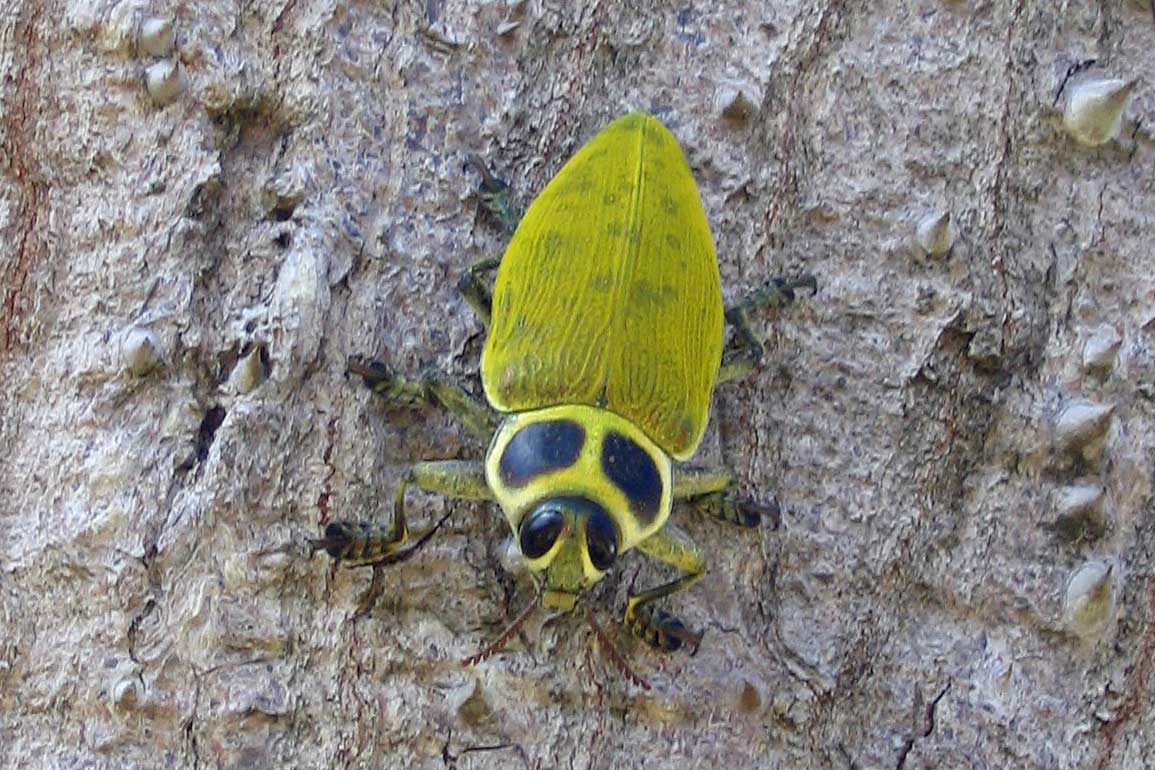
Euchroma gigantea in Jamaica. Photo © Steve Meyer


In recent weeks I’ve featured a few jewel beetles that I have encountered amongst specimens sent to me for identification (see “Aaack!-maeodera” and “Acmaeodera carlota in northern Arizona“).  While the new distributions and even unknown species that they represent are fascinating from a scientific perspective, their diminutive size (~6 mm in length) probably makes them less than spectacular to the non-specialist.  The family Buprestidae does, however, contain some very large species, including a few that qualify as bona fide giants.  One such species, Euchroma gigantea (Giant Metallic Ceiba Borer Beetle), occurs from Mexico through Central America, the West Indies, and most of South America.  At a maximum of 65mm in length, it is not only North America’s largest jewel beetle, but also the largest jewel beetle in the entire Western Hemisphere.

My colleague Steve Meyer encountered and photographed this individual in Negril, Jamaica.  Although its scientific name translates to “colorful giant”, the beetle in the photo is especially so due to the delicate, waxy bloom covering its elytra. This bloom is secreted by the adult after transforming from the pupa and prior to emerging from its larval host, giving it a bright yellow-green appearance.  After the beetle emerges and becomes active, the bloom is quickly rubbed off and the beetle takes on the shiny, iridescent purple-green color by which it is more familiar.  The presence of bloom on this individual suggests that it had just emerged from the trunk of the kapok tree (Ceiba pentandra) on which it was sitting.  Kapok and other large trees in the family Bombacaceae serve as hosts for larval development for this species (Hespenheide 1983).

Indigenous peoples in Central and South America have long utilized the dazzlingly colored elytra of these beetles to create beautiful natural jewelry and adorn their clothes and textiles.  The species is also eaten in both the larval and adult stages – Tzeltal-Mayans in southern Mexico (Chiapas) roast the adults when available, and the Tukanoans (northwestern Amazon) also eat the larvae (Dufour 1987). I have eaten a few insects in my day, but none as thick and massively juicy as the grub of this species must be. Holometabolous larvae typically contain a rather high percentage of fat (up to 66% dry weight) to meet the demands of pupal development and adult reproduction, and I suspect this makes the larvae quite tasty (especially when roasted). If there is any insect in the world that I really, really, really want to eat – it is the larva of this one!

REFERENCES:

Dufour, D. L.  1987.  Insects as food:  A case study from the northwest Amazon.  American Anthropologist 89(2):383–397.

Hespenheide, H. A.  1983.  Euchroma gigantea (Eucroma, giant metallic ceiba borer), p. 719.  In: D. H. Janzen [ed.], Costa Rican Natural History, University of Chicago Press, Chicago.

Copyright © Ted C. MacRae 2010