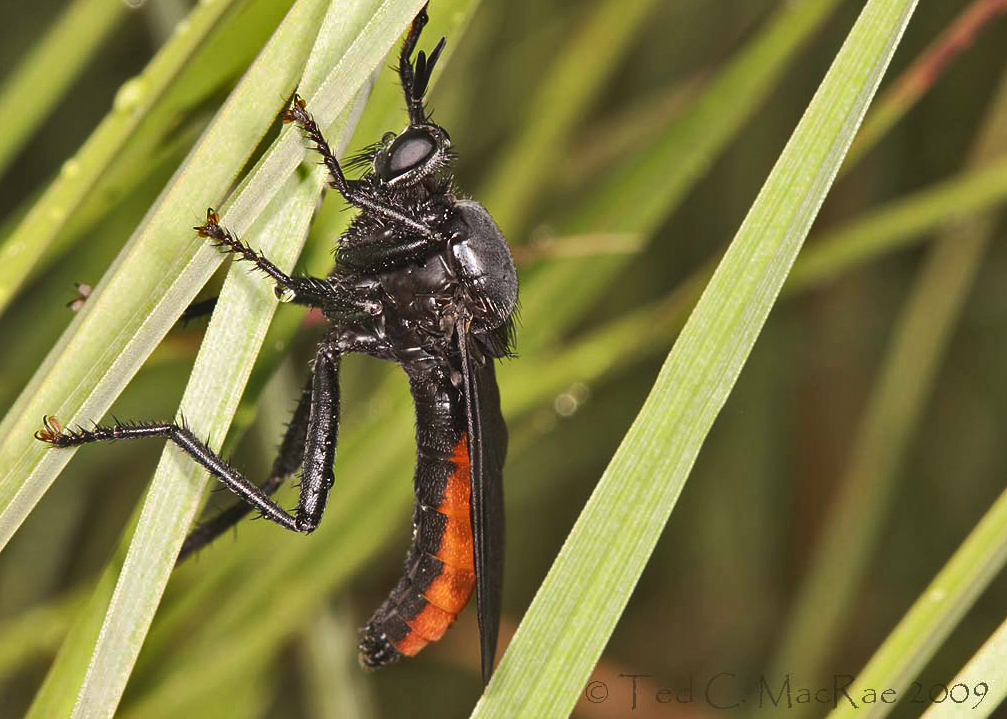
Ospriocerus abdominalis

Photo details: Canon 100mm macro lens on Canon EOS 50D, ISO 100, 1/250 sec, f/14, MT-24EX flash 1/4 power w/ diffuser caps.

Photo details: Canon 100mm macro lens on Canon EOS 50D, ISO 100, 1/250 sec, f/14, MT-24EX flash 1/4 power w/ diffuser caps.

My dipteran digression continues with this photograph of the robber fly, Ospriocerus abdominalis (Diptera: Asilidae).  More than just a pretty picture, this represents yet another apparently new state record that I and my colleague Chris Brown discovered a few weeks ago during our 2-day survey of Missouri’s critically imperiled hilltop prairies in the extreme northwest corner of the state.  Like the previously discussed Cylindera celeripes (swift tiger beetle) and Beameria venosa (a prairie-obligate species of cicada), O. abdominalis has not previously been recorded further east than Nebraska, Kansas, Oklahoma and Texas. This large fly is a grassland denizen that ranges over western North America and into Mexico (Cannings 1998, as Ospriocerus aeacus). It is somewhat suggestive of a mydas fly, although its short antennae immediately identify it as a robber fly (mydas flies have elongate clubbed antennae).  It also reminds me of the magnificent western robber fly Wyliea mydas by its mimetic, wasp-like coloration – presumably modeled after spider wasps of the genus Pepsis and Hemipepsis (Hymenoptera: Pompilidae) – but is distinguished by its black body and wings with red dorsal coloration on the abdomen (W. mydas has the abdomen wholly black and the wings red).  While not quite as handsome as W. mydas, it is impressive nonetheless.

The dry hilltop prairie remnants in which O. abdominalis, B. venosa, and C. celeripes were found are associated with the Loess Hills, a unique landform along the western edge of Iowa that reaches its southern terminus in extreme northwest Missouri.  Due to their extreme rarity and vulnerability to woody encroachment and anthropogenic degradation, these remnant habitats are considered one of Missouri’s most critically imperiled natural communities. Only about 50 acres of original habitat remain, and of this only half is in public conservation ownership.  Many of the plants and animals found in these habitats represent hypsithermal relicts that migrated eastward during a dry and warm period after the last ice age and were then “left behind” in pockets of relictual habitat as a return to cooler, wetter conditions forced the main populations back to the west.  More than a dozen plants and two vertebrates occurring in these prairies are listed as species of conservation concern.  As is typically the case, the flora and vertebrate fauna of these remnant habitats have been fairly well characterized, while precious little attention has been given to the vastly more diverse invertebrate fauna.  As we begin to study the insects of these habitats more carefully, we are almost sure to find a great many species that are more typically found further to the west and that live nowhere else in Missouri.  Their continued presence in the state will be wholly dependent upon the critically imperiled habitats in which they live, making conservation and restoration of the remaining loess hilltop prairie remnants in Missouri all the more important.

My thanks to Eric Fisher and Herschel Raney for confirming the identity of O. abdominalis.

REFERENCES:

Cannings, R. A. 1998. Robber Flies (Insecta: Diptera: Asilidae), in Smith, I. M., and G. G. E. Scudder, eds. Assessment of species diversity in the Montane Cordillera Ecozone. Burlington: Ecological Monitoring and Assessment Network.

Copyright © Ted C. MacRae 2009

Add to FacebookAdd to NewsvineAdd to DiggAdd to Del.icio.usAdd to StumbleuponAdd to RedditAdd to BlinklistAdd to Ma.gnoliaAdd to TechnoratiAdd to Furl

Overlooked, needle-tailed, thick-headed fly

Photo details: Canon 100mm macro lens on Canon EOS 50D, ISO 100, 1/250 sec, f/16, MT-24EX flash 1/4 power w/ diffuser caps.

Photo details: Canon 100mm macro lens on Canon EOS 50D, ISO 100, 1/250 sec, f/16, MT-24EX flash 1/4 power w/ diffuser caps.

While photographing the rare Typocerus deceptus on flowers of wild hydrangea (Hydrangea arborescens) at Trail of Tears State Park in southeast Missouri last June, I encountered this strange fly also visiting the hydrangea blossoms.  At first I thought it was some weird type of syrphid fly, but it turns out to be a member of an even more unusual group of flies in the appropriately-named genus Stylogaster¹.  Although classified in the family Conopidae (thick-headed flies), members of this genus are placed in their own subfamily (Stylogastrinae) due to their unusual morphology and biology (obligate parasites of crickets, cockroaches and calyptrate flies).  Ninty-two described species are currently placed in the genus, only two of which occur in North America (the remainder are found chiefly in the Neotropics and in sub-Saharan Africa and southeast Asia).  This individual appears to be a female S. neglecta because of its short 2nd antennomere (antennal segment) and highly elongate 3rd antennomere (in S. biannulata, the 2nd antennomere is almost as long as the 3rd). Thus, the “overlooked, needle-tailed, thick-headed fly” – and who said common names are easier?

¹ Derived from the Latin stilus (needle) and the Greek γαστηρ (belly, stomach), a reference to the highly elongated female abdomen, or “tail.”

Morphologically, stylogastrines are distinguished from other conopids by their eggs, which feature a rigid barbed tip.  This, along with some behavioral observations, seems to imply a shooting oviposition technique; however, morphological evidence suggests that the eggs are forcibly jabbed into their hosts (Kotrba 1997).  The larvae hatch and develop inside their host as internal parasites, but other than the egg very little is known about the life histories of species in this genus (Couri and Pont 2006).  Adults are further distinguished by their long proboscis, which exceeds the length of the body when fully extended and is used to access nectar within a variety of flowers.  Adult females aggressively intercept hosts in-flight for oviposition, and speculation has been made that they are obligate associates of army ants (New World subfamily Ecitoninae and Old World subfamily Dorylinae), relying upon the ants’ raiding columns to flush out their prey.  However, since the genus also occurs in Madagascar and parts of Africa where army ants are completely absent, it is clear that at least some species of Stylogaster have no obligatory association with these ants (Stuckenberg 1963, Couri and Pont 2006).

REFERENCES:

Couri, M. S. and A. C. Pont. 2006. Eggs of Stylogaster Macquart (Diptera: Conopidae) on Madagascan Muscids (Diptera: Muscidae). Proceedings of the California Academy of Science 57(16):473-478.

Kotrba, M. 1997. Shoot or stab? Morphological evidence on the unresolved oviposition techique in Stylogaster Macquart (Diptera: Conopidae), including discussion of behavioral observations. Proceedings of the Entomological Society of Washington 99:613-621.

Stuckenberg, B. R.  1963.  A study on the biology of the genus Stylogaster, with the description of a new species from Madagascar.  Revue de Zoologie et Botaniques Africaines 68:251-275.

Copyright © Ted C. MacRae 2009

Add to FacebookAdd to NewsvineAdd to DiggAdd to Del.icio.usAdd to StumbleuponAdd to RedditAdd to BlinklistAdd to TwitterAdd to TechnoratiAdd to Furl

The last tiger beetle

Our recent discovery of Cylindera celeripes (swift tiger beetle) in Missouri was arguably the most exciting moment that I and colleague/fieldmate Chris Brown have experienced since we first began surveying the tiger beetles of Missouri back in the year 2000.  It was the 24th species that we had recorded for the state and the latest of several for which we had searched through targeted surveys during the past few seasons.  Earlier surveys have already produced a new record for Cicindela trifasciata ascendens (ascendant tiger beetle), “rediscovered” Cylindera cursitans (ant-like tiger beetle) and Dromochorus pruinina (frosted dromo tiger beetle), precisely characterized the limited in-state distributions of Habroscelimorpha circumpicta johnsonii (Johnson’s tiger beetle) and Cicindela obsoleta vulturina (prairie tiger beetle), and generated copious distributional data for the remaining more generally distributed species.

Yet, there still remained one species that we had not managed to find ourselves – Ellipsoptera macra (sandy stream tiger beetle).  This species was recorded from a few localities along the Missouri River in northwestern Missouri by Willis (1967), and we have examined a small number of additional specimens in the Enns Entomology Museum.  According to the literature, this species occurs near the water’s edge on sandy habitats along large rivers – precisely the type of habitats in which we have encountered the closely related E. cuprascens (coppery tiger beetle), which we have found at several locations along the Missouri and Mississippi Rivers.  Each time we found E. cuprascens we expected/hoped to see E. macra as well but never did.  The reasons for this remained a mystery to us until I noted a comment on the Tiger Beetles of Nebraska website stating that blacklighting is usually more productive for this species than daytime collecting.  With its known occurrence in northwestern Missouri, our planned survey for C. celeripes in that part of the state this season offered a perfect opportunity to try to find this, the last tiger beetle species in Missouri that we had not yet collected ourselves.  Our plan was to search loess hilltop prairie habitats during the day for C. celeripes, then blacklight along the Missouri River at night to look for E. macra.  Both species seemed like longshots – we’d searched for each many times, and we were willing to spend several consecutive weekends from late June to mid-July on our survey so that we could claim that we had given it our best shot.  Of course, as you know, we succeeded in finding C. celeripes on the first day of our first weekend, and we would also enjoy the same success with E. macra later that evening.

Chris Brown looks for Ellipsoptera macra amongst the swarm.

Chris Brown braves the swarm to look for individuals of Ellipsoptera macra.

We setup two blacklights at a public fishing access along the Missouri River (explaining to some puzzled locals exactly what we were doing and why), turned the lights on, and sat back with pizza and merlot as we waited for things to start coming to the sheets.  We had been to this site before in previous years and found E. cuprascens here, suggesting that suitable habitat was present in the area.  Almost immediately a growing cloud of all manner of aquatic insects began swarming around the lights, landing on the sheets – and flying down our shirts and in our hair whenever we tried to approach!  I don’t blacklight as much as I did in my younger days, but even then I wasn’t much of a fan of blacklighting near water for precisely these reasons.  We hadn’t had the lights going for more than 15 minutes or so before we saw the first tiger beetle crawling on the bottom of the sheet below the light.  It looked like cuprascens, but I placed it live in a vial anyway for photographs the next morning.  Then there was another… and another…  Soon, they were coming in with regularity, and I quickly ran out of vials in which to keep live individuals separately.  I’ve never seen tiger beetles come to blacklights like this, but we still weren’t convinced they were E. macra until later that night when we got back to the hotel and had a chance to take a close look at them with good light.  There was no doubt about it – we had finally found E. macra in Missouri!

This species is very similar to E. cuprascens, but the elytra are not as shiny and with smaller, shallower punctures than the latter.  Some references mention a more recurved lower portion of the humeral lunule and a generally more green than bronze coloration (Pearson et al. 2006), but these characters were tenous at best with the specimens we had in hand (see photo below).  The best character we have found to separate the two species is by examining the female elytra – in E. macra the sutural apex is acute, while in E. cuprascens it is rounded (Willis 1967).  We returned to the site the next morning to see if we could find them during the day, and although we did manage to find a few, they were nowhere near as numerous as we had seen them at the blacklights the night before.  The following photograph is of an individual captured that evening and then “released” back into the field the following morning – they were quick to fly once released, and only after several individuals and trying the “lens cap” technique did we succeed in getting some good shots.

Ellipsoptera macra

Ellipsoptera macra

We didn’t get a chance to use blacklights in subsequent weekends to see if we could find E. macra in other localities along the Missouri and Mississippi Rivers – with E. macra and C. celeripes success already in hand, I quickly turned my attention to the White River Hills of southwestern Missouri and their gorgeous glade habitats to look for one of North America’s most beautiful cerambycid beetles, Plinthocoelium suaveolens (more on that in a future post).  However, I am confident that E. macra will be found at other spots in Missouri should we decide to look for them with blacklights.  Having encountered all 24 species of tiger beetles known from Missouri, I present here a checklist of those species.

CHECKLIST OF TIGER BEETLES IN MISSOURI
(classification and common names by Erwin and Pearson 2008)

Tribe CICINDELINI
Subtribe MEGACEPHALINA
Tetracha (s. str.) carolina carolina – Carolina Metallic Tiger Beetle
Tetracha (s. str.) virginica – Virginia Metallic Tiger Beetle

Subtribe CICINDELINA
Cicindela (s. str.) duodecimguttata – 12-spotted Tiger Beetle
Cicindela (s. str.) formosa generosa – Eastern Sand Tiger Beetle
Cicindela (s. str.) hirticollis shelfordi – Shelford’s Tiger Beetle
Cicindela (s. str.) limbalis – Common Claybank Tiger Beetle
Cicindela (s. str.) purpurea purpurea – Cowpath Tiger Beetle
Cicindela (s. str.) repanda – Bronzed Tiger Beetle
Cicindela (s. str.) scutellaris lecontei – LeConte’s Tiger Beetle
Cicindela (s. str.) sexguttata – Six-spotted Tiger Beetle
Cicindela (s. str.) splendida – Spendid Tiger Beetle
Cicindela (s. str.) tranquebarica tranquebarica – Oblique-lined Tiger Beetle
Cicindela (Cicindelidia) obsoleta vulturina – Prairie Tiger Beetle
Cicindela (Cicindelidia) punctulata punctulata – Punctured Tiger Beetle
Cicindela (Cicindelidia) rufiventris rufiventris – Eastern Red-bellied Tiger Beetle
Cicindela (Cicindelidia) trifasciata ascendens – Ascendant Tiger Beetle
Cylindera (s. str.) celeripes – Swift Tiger Beetle
Cylindera (s. str.) cursitans – Ant-like Tiger Beetle
Cylindera (s. str.) unipunctata – One-spotted Tiger Beetle
Dromochorus pruinina – Frosted Dromo Tiger Beetle
Ellipsoptera cuprascens – Coppery Tiger Beetle
Ellipsoptera lepida – Ghost Tiger Beetle
Ellipsoptera macra macra – Sandy Stream Tiger Beetle
Habroscelimorpha circumpicta johnsonii – Johnson’s Tiger Beetle

Photo details:
Blacklighting: Canon 17-85mm zoom lens on Canon EOS 50D (manual mode), ISO 100, 1/30 sec, f/11, on-camera flash.
Ellipsoptera macra: Canon 100mm macro lens on Canon EOS 50D (manual mode), ISO 100, 1/250 sec, f/14, MT-24EX flash 1/4 power w/ diffuser caps.

REFERENCES:

Erwin, T. L. and D. L. Pearson. 2008. A Treatise on the Western Hemisphere Caraboidea (Coleoptera). Their classification, distributions, and ways of life. Volume II (Carabidae-Nebriiformes 2-Cicindelitae). Pensoft Series Faunistica 84. Pensoft Publishers, Sofia, 400 pp.

Pearson, D. L., C. B. Knisley and C. J. Kazilek. 2006. A Field Guide to the Tiger Beetles of the United States and Canada. Oxford University Press, New York, 227 pp.

Willis, H. L.  1967. Bionomics and zoogeography of tiger beetles of saline habitats in the central United States (Coleoptera: Cicindelidae).  The University of Kansas Science Bulletin 47(5):145-313.

Copyright © Ted C. MacRae 2009

Add to FacebookAdd to NewsvineAdd to DiggAdd to Del.icio.usAdd to StumbleuponAdd to RedditAdd to BlinklistAdd to Ma.gnoliaAdd to TechnoratiAdd to Furl

Friday flower – Krameria lanceolata

Photo details: Canon 100mm macro lens on Canon EOS 50D, ISO 100, 1/250 sec, f/9, MT-24EX flash 1/4 power w/ diffuser caps.

Photo details: Canon 100mm macro lens on Canon EOS 50D, ISO 100, 1/250 sec, f/9, MT-24EX flash 1/4 power w/ diffuser caps.

I encountered few insects this past June on the dry slopes of sand shinnery oak shrubland that just makes it into the northwestern corner of Oklahoma’s Four Canyon Preserve – insect population levels were still depressed from the wildfire that swept through the area in April of last year.  Plant life, however, was diverse and abundant, including this most unusual plant – Krameria lanceolata (many common names, including trailing krameria, trailing ratany [sometimes spelled “rhatany”], Texan ratany, prairie sandbur, sandspur, etc.).  A dicot in the monogeneric family Krameraceae, plants in this genus share several unusual traits, the most obvious being their distinctly orchid-like, zygomorphic flowers (i.e., capable of division into symmetrical halves by only one longitudinal plane passing through the axis).  The resemblance to orchids is strictly superficial – they are most closely related to plants in the family Zygophyllaceae.

Orchids, of course, are monocots with trimerous flowers that only appear to be five-petaled because of the three petal-like sepals and the third true petal being modified into a “lip” onto which pollinating bees land.  Krameria flowers also appear five-petaled with a lip, but in this case it is the five sepals that form the “petals,” while the five true petals are modified into a lip (three fused petals) and two lateral upright “flags” called elaiphores.  These eliaphores play a central role in Krameria‘s unusual pollination biology, whose flowers produce not nectar, but fatty oils as rewards for their visitors – female bees of the genus Centris (Anthophoridae) (Simpson and Neff 1977).  The bees collect the oils from the modified external surfaces of the eliaphores, pollinating the flower in the process, and mix the oils with pollen to feed their larvae.  Although the Krameria plants are wholly dependent upon Centris bees to effect their pollination, the relationship is not mutually exclusive – Centris bees utilize other oil-producing plants as well.

All species of Krameria examined to date are obligate semiparasites, forming haustoria on the roots of a broad range of host plants.  Of the 18 species currently known in the genus, five occur in the U.S., with K. lanceolata the most widespread (Kansas and Colorado south to Arizona, New Mexico, and Texas and east to Georgia and Florida) (Austin and Honeychurch 2004). It is distinguished from the other U.S. species by its herbaceous, prostrate form.

Update 8/10/09: Mike Arduser, my hymenopterist friend who visited Four Canyon Preserve with me, wrote the following in response to my query about collecting bees from these flowers:

Yes, collected several off Krameria at Four Canyons and at Packsaddle – all were the same species, and I’m trying to remember the name as I’m writing this (all notes and material are at home) –  it was Centris lanosa. They are best found by listening, as they have a distinctive buzz as they move from flower to flower at ground level (difficult to see there).

REFERENCES:

Austin, D. F. and P. N. Honychurch.  2004.  Florida ethnobotany. CRC Press, Boca Raton, Florida. 909 pp.

Simpson, B. B. and J. L. Neff. 1977. Krameria, free-fatty acids and oil-collecting bees. Nature 267: 150-151.

Copyright © Ted C. MacRae

Add to FacebookAdd to NewsvineAdd to DiggAdd to Del.icio.usAdd to StumbleuponAdd to RedditAdd to BlinklistAdd to Ma.gnoliaAdd to TechnoratiAdd to Furl

North America’s smallest cicada

Photo details: Canon 100mm macro lens on Canon EOS 50D, ISO 100, 1/250 sec, f/18, MT-24EX flash 1/2 power w/ diffuser caps.

Photo details: Canon 100mm macro lens on Canon EOS 50D, ISO 100, 1/250 sec, f/18, MT-24EX flash 1/2 power w/ diffuser caps.

While searching the hilltop prairies for Cylindera celeripes (swift tiger beetle) at McCormack Loess Mounds Natural Area in northwestern Missouri, I ran across a species of cicada that I’d not yet encountered in the state – Beameria venosa.  Cicadas as a rule are quite large insects, but with a body measuring only 16 mm (well under an inch) in length, B. venosa is one of – if not the – smallest species of this group in all of North America.  Had it not been for its distinctly cicada-esque call I might have thought it was some sort of fulgoroid planthopper (albeit a rather large one).  But a cicada it is, and a beautiful one at that despite its small size.

Beameria venosa is a prairie obligate species occurring from Nebraska and Colorado south to Texas and New Mexico.  To my knowledge, it has not been formally recorded from Missouri, although it is certainly already known from the state (it is listed in the 2009 issue of Missouri Species and Communities of Conservation Concern Checklist as “vulnerable” due to the restricted occurrence in Missouri of the prairie habitats in which it lives).  Froeschner (1952) listed 14 species of cicadas from Missouri but did not include this species even among those of possible occurrence in the state.  In my younger days, I managed not only to find all 14 of those species, but also a fifteenth species – the magnificent Tibicen superbus – in the southwestern corner of the state (formally recorded from the state some years later by Sanborn and Phillips 2004).  The occurrence of B. venosa in Missouri now brings to 16 the number of cicada species known from Missouri.

Despite its small size, the calling song of B. venosa is quite audible.  In fact, it was only due to its call that I noticed and began looking for this individual.  This brings up an interesting point regarding conspicuous insect songs and their role in enhancing predation risk.  Many predators are known to orient to the calls of cicadas (Soper et al. 1976), which in turn exhibit a variety of predator avoidance behaviors such as high perching, hiding, fleeing, and perhaps even mass emergence in the periodical cicadas.  Beameria venosa appears to avoid predators by producing its continuous train of sound pulses at a very high frequency.  Although audible to humans, the high frequency call apparently is not audible to birds and lizards – their chief predators (Sanborn et al. 2009).  In the open, treeless prairies where B. venosa lives, high frequency calling appears to provide the selective advantage for predator avoidance that fleeing, hiding, and high perching cannot.

REFERENCES:

Froeschner, R. C.  1952. A synopsis of the Cicadidae of Missouri. Journal of the New York Entomological Society 60:1–14.

Sanborn, A. F., J. E. Heath and M. S. Heath.  2009.  Long-range sound distribution and the calling song of the cicada Beameria venosa (Uhler) (Hemiptera: Cicadidae).  The Southwestern Naturalist 54(1):24-30.

Sanborn, A. F. and P. K. Phillips.  2004.  Neotype and allotype description of Tibicen superbus (Hemiptera: Cicadomorpha: Cicadidae) with description of its biogeography and calling song.  Annals of the Entomological Society of America 97(4):647-652.

Soper, R. S., G. E. Shewell and D. Tyrrell. 1976. Colcondamyia auditrix nov. sp. (Diptera; Sarcophagidae), a parasite which is attracted by the mating song of its host, Okanagana rimosa (Homoptera: Cicadidae).  The Canadian Entomologist 108:61-68.

Copyright © Ted C. MacRae 2009

Add to FacebookAdd to NewsvineAdd to DiggAdd to Del.icio.usAdd to StumbleuponAdd to RedditAdd to BlinklistAdd to Ma.gnoliaAdd to TechnoratiAdd to Furl

Western hognose snake

Another herp interlude…

IMG_0655_1200x800
Photo details: Canon 100mm macro lens on Canon EOS 50D, ISO 100, 1/250 sec, f/14, MT-24EX flash 1/4 power w/ diffuser caps.

During my visit to Salt Plains National Wildlife Refuge in northwestern Oklahoma this past June, tiger beetles were not the only wildlife subjects I encountered.  Near the edge of one of the alkaline flats along Sandpiper Trail was this hognose snake.  This is the second hognose snake that I’ve encountered in as many years, the first being a member of a rare, disjunct population of the dusty hognose snake (Heterodon nasicus gloydi) in one of southeastern Missouri’s critically imperiled sand prairie habitats.  There are two species of hognose snake in Oklahoma – eastern (H. platirhinos) and western (H. nasicus).  I presume this individual to be the western due to its strongly upturned rostral (snout), which is only moderately upturned in the eastern species, and black-checkered ventral coloration.  Surprisingly, in checking the Salt Plains reptile species list for confirmation on its identity, I noted that no confirmed sightings of either the eastern or western hognose snake have been recorded at the refuge.  I have since done my good deed to reptile science by submitting this and another photograph I took of the individual to the refuge biologist.  Ted MacRae – entomologist and discoverer of new reptile records!  Western hognose snakes are further classified into three subspecies, two of which – dusty and nominotypical – occur in Oklahoma (the third occurs in Mexico). However, the distinctions between the two U.S. subspecies are subtle¹ and not apparent in this photograph, preventing further classification.

¹ Some authors consider the dusty and western hognose snakes to be separate species, while others have regarded their differences too subtle to warrant even subspecific distinction.

Hognose snakes are famous for their well-choreographed sequence of defensive displays. Their first act is to rear up cobra-like and strike out with their mouth open while hissing (unfortunately, neither of the hognoses I’ve encountered entertained me in this manner).  If the threat continues, they then turn over and writh violently in mock agony before finally rolling over on their backs and playing dead (thanatosis).  Last year’s hognose snake didn’t do this either, insisting instead on continually trying to burrow into the loose sand.  As can be seen from the photograph above, however, playing dead is exactly what this individual did.  With the mouth agape and the tongue protruding, it’s a convincing display of lifelessness.  Amusingly though, whenever the snake was righted it immediately turned over on its back again – not such a good imitation of being dead!  Presumably the snakes predators are as bad at noticing that detail as are the snakes themselves.  As I continued to pester this individual, trying to get him to stick out his tongue further for a better photograph, he eventually started ejecting blood from the lacrymal glands and emitting musk from the cloaca – what better to emphasize a death display than blood and an offensive smell!

Western hognose snakes are classified as a species of ”least concern” on the IUCN Red List of Threatened Species and aren’t listed as a species of concern on the Oklahoma Natural Heritage Inventory database.  Nevertheless, as with many other reptiles and amphibians, populations are declining throughout much of their former range.  This is likely due to the combined effects of urbanization, reduction of habitat, predation by feral dogs and cats, and overcollection for sale to the pet trade.

Copyright © Ted C. MacRae 2009

Add to FacebookAdd to NewsvineAdd to DiggAdd to Del.icio.usAdd to StumbleuponAdd to RedditAdd to BlinklistAdd to Ma.gnoliaAdd to TechnoratiAdd to Furl

Salt Plains National Wildlife Refuge

IMG_0687_1200x800

I’ve written quite a few posts about my June trip to northwestern Oklahoma. Four days at the ruggedly scenic Four Canyon Preserve and nearby Packsaddle Wildlife Management Area yielded a few interesting jewel beetles (though not many tiger beetles), but the followed two days in the red clay/gypsum hills just north of there were as successful a two-day period as I’ve ever had, with new localities for Cylindera celeripes (swift tiger beetle) and true field photographs of Dromochorus pruinina (frosted dromo tiger beetle¹). The next day was spent at nearby Salt Plains National Wildlife Refuge, just east of the red clay hills in Alfalfa Co. Salt Plains is best known for its Selenite Crystal Dig Area, where an estimated 30,000 annual visitors dig for Oklahoma’s State Crystal with its unique hour glass-shaped inclusion (the only known site where these crystals are found). A dominant feature of the refuge, however, is its 10,000 acre saline flat – left behind by the vast Permian seas that once covered the interior of the continent and the largest such salt flat in the Great Plains.  It was this feature that drew my interest.

¹ Common names according to Erwin and Pearson (2008).

IMG_0689_1200x800

I first visited Salt Plains a few years ago when fieldmate Chris Brown and I were near the end of a rather unproductive (yet still enjoyable) fall tiger beetle trip to the nearby Gypsum Hills of south-central Kansas (Cicindela pulchra had eluded us – for the time being!).  We noted the refuge on the map and decided to take a look – becoming instantly enamoured with the diversity of tiger beetles seen running on its barren, salt-encrusted mud flats.  I returned the following fall with long-time fieldmate Rich Thoma and Hardtner, KS resident “Beetle Bill” Smith, who introduced us to the refuge biologist so we could get permits to do some proper collecting.  Most of the tiger beetles we saw were widespread and familiar to me – Cicindela species proper such as C. formosa formosa (big sand tiger beetle), C. tranquebarica (oblique-lined tiger beetle), C. punctulata (punctured tiger beetle), and C. repanda (bronzed tiger beetle), but it was the creamy white Eunota togata globicollis (alkali tiger beetle) that had me swiping my net for the next hour or two.  Sadly, those were in my pre-photographer days, so I have no visual record of that species other than the pinned specimens in my collection.

My visit during this trip was completely unplanned.  After the mid-week’s thunderstorms chased me back to this part of the state, I thought this would be a nice contrast to the red clay/gypsum hills where I saw C. celeripes and D. pruinina.  In addition, the selection of tiger beetles active on the saline flats during this summer trip would likely be quite different from the fall/spring species I had seen on my previous two visits.  Trouble was, the unplanned nature of the visit also meant that I didn’t have a permit, but I was prepared to limit my activities to only photography in case I was unable to convince the refuge staff to renew my prior permit.  That eventuality was unnecessary, however, as the refuge biologist located my permit in a gray, dusty file cabinet and graciously typed up a new permit for me – good until next summer!  With that, I was off to SandPiper Trail and seven hours of stalking, netting, and photographing.  Some familiar faces were there again – C. formosa, C. repanda, C. punctulata, and C. tranquebarica (as they are almost everywhere), but I also encountered three beautiful species that I had not seen there before (one of which I had never seen previously).  Like E. togata, each of these species is an alkaline habitat specialist that makes its living only in these harsh, saline environments. They were not the easiest species to photograph, easily alarmed in the heat of the day, but the vast open spaces allowed me to follow their escape flights with relative ease, and one-by-one they gradually became accustomed to my presence and eventually allowed me to get at least one or two good shots.

Ellipsoptera nevadica knausii - Knaus' tiger beetle

Ellipsoptera nevadica knausii - Knaus' tiger beetle

Habroscelimorpha circumpicta johnsonii - Johnson's tiger beetle

Habroscelimorpha circumpicta johnsonii - Johnson's tiger beetle

Cicindela fulgida fulgida - crimson saltflat tiger beetle

Cicindela fulgida fulgida - crimson saltflat tiger beetle

Along with E. togata globicollis, these species bring the total number of species that I’ve observed at Salt Plains to eight – quite a hyperdiversity given the very small portion of the refuge that I’ve explored during my three visits.  Willis (1967) has observed as many as 11 species in a single habitat, and while this may seem to violate the principle of competitive exclusion (limiting the number of species that can occupy a given niche), careful observation reveals small but distinct partitionings of this harsh environment by the different species.  For example, C. fulgida was seen in the drier, more vegetated fringes around the flats, E. nevadica knausii was observed in moist, open areas near the water’s edge, and H. circumpicta johnsonii was more generally free ranging across the open salt surfaces.  Temporal separation combines with spatial separation to further subdivide the habitat – the latter two species occur as adults during summer, while E. togata globicollis and C. fulgida adult occurrence is primarily during spring and fall (the individual I saw was likely a stragler).  I have noted the same phenomenon with species occurring in clay habitats here in Missouri, with as many as six species seen at a single highway intersection in the White River Hills a few years ago.

Photo details:
Landscapes: Canon 17-85mm zoom lens on Canon EOS 50D (landscape mode), ISO 100, 1/50-60 sec, f/7.1-6.3, natural light.
Beetles: Canon 100mm macro lens on Canon EOS 50D (manual mode), ISO 100, 1/250 sec, f/14, MT-24EX flash 1/4 power w/ diffuser caps.

REFERENCES:

Erwin, T. L. and D. L. Pearson. 2008. A Treatise on the Western Hemisphere Caraboidea (Coleoptera). Their classification, distributions, and ways of life. Volume II (Carabidae-Nebriiformes 2-Cicindelitae). Pensoft Series Faunistica 84. Pensoft Publishers, Sofia, 400 pp.

Willis, H. L.  1967.  Bionomics and zoogeography of tiger beetles of saline habitats in the central United States (Coleoptera: Cicindelidae).  The University of Kansas Science Bulletin 47(5):145-313.

Copyright © Ted C. MacRae 2009

Add to FacebookAdd to NewsvineAdd to DiggAdd to Del.icio.usAdd to StumbleuponAdd to RedditAdd to BlinklistAdd to Ma.gnoliaAdd to TechnoratiAdd to Furl

Oklahoma is for lovers

A few rather risqué photos from my June trip to northwestern Oklahoma.

Eleodes suturalis (family Tenebrionidae) - June 6, 2009 at Four Canyon Preserve, Ellis Co., Oklahoma

Eleodes suturalis (family Tenebrionidae) - June 6, 2009 at Four Canyon Preserve, Ellis Co., Oklahoma

Chrysobothris ignicollis (family Buprestidae) - June 6, 2009 at Four Canyon Preserve, Ellis Co., Oklahoma

Chrysobothris ignicollis (family Buprestidae) - June 6, 2009 at Four Canyon Preserve, Ellis Co., Oklahoma

Ellipsoptera nevadica knausii ("family" Cicindelidae) - June 12, 2009 at Salt Plain National Wildlife Refuge, Alfalfa Co., Oklahoma

Ellipsoptera nevadica knausii ("family" Cicindelidae) - June 12, 2009 at Salt Plain National Wildlife Refuge, Alfalfa Co., Oklahoma

Photo details:
Eleodes suturalis: Canon 100mm macro lens on Canon EOS 50D, ISO 100, 1/250 sec, f/13, MT-24EX flash 1/4 power through diffuser caps.
Chrysobothris ignicollis: Canon 65mm 1-5x macro lens on Canon EOS 50D, ISO 100, 1/250 sec, f/13, MT-24EX flash 1/8 power through diffuser caps.
Ellipsoptera nevadica knausii: Canon 100mm macro lens on Canon EOS 50D, ISO 100, 1/250 sec, f/14, MT-24EX flash 1/4 power through diffuser caps.

Copyright © Ted C. MacRae 2009

Add to FacebookAdd to NewsvineAdd to DiggAdd to Del.icio.usAdd to StumbleuponAdd to RedditAdd to BlinklistAdd to Ma.gnoliaAdd to TechnoratiAdd to Furl