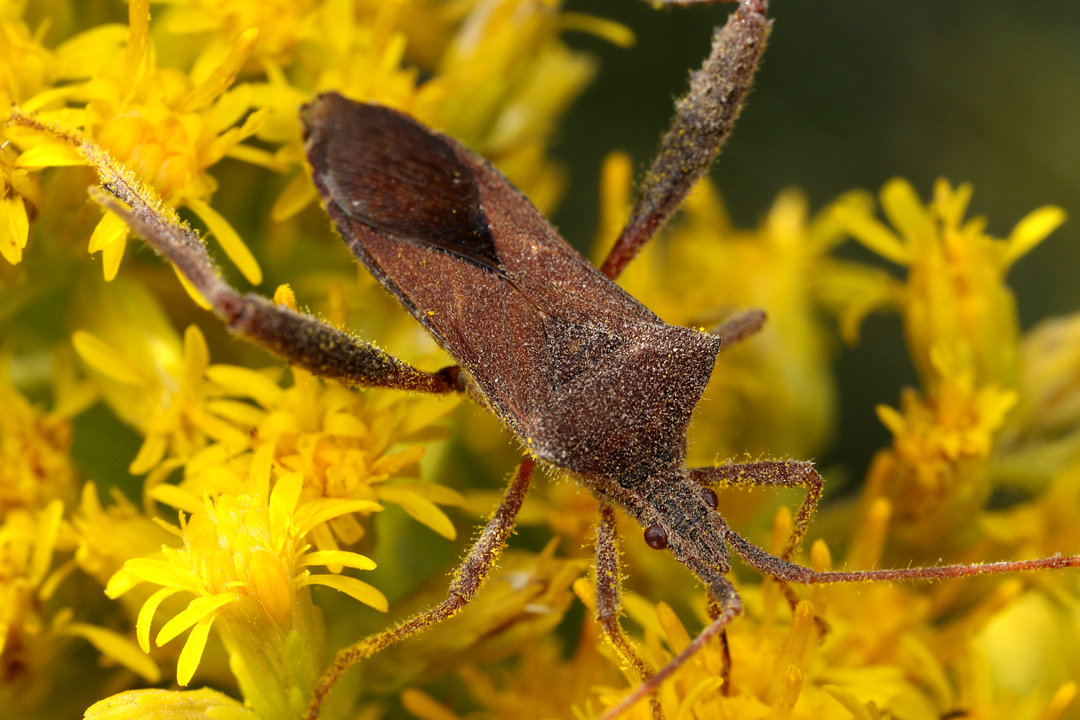
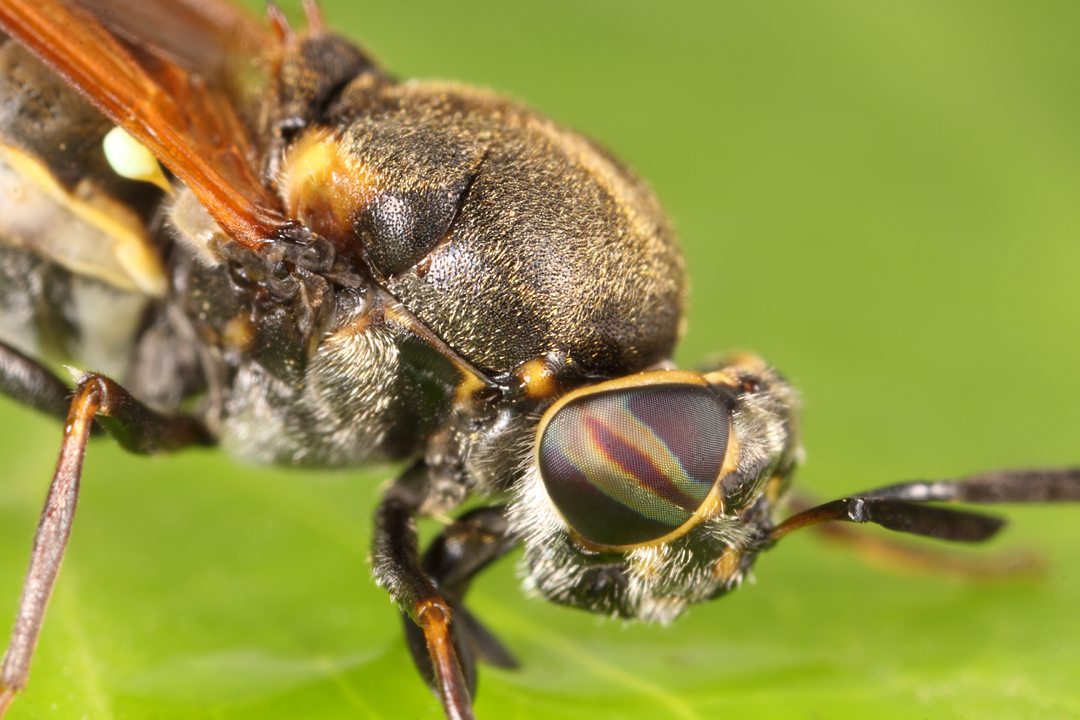
Sometimes photo opportunities come at the unlikeliest of times. A few weeks ago while traveling back to Corrientes, Argentina from neighboring Chaco Province, I came upon traffic at a standstill just a few kilometers from the towering Gral. Belgrano bridge that spans the massive Rio Paraná to link Chaco and Corrientes Provinces. People were already getting out of their cars and walking around, suggesting a wreck closer to (or on) the bridge had completely shut down the highway for the time being. Somebody said they heard it might be another 45 minutes before it could be opened. What to do now? It was the end of my last day after a week of insect collecting/photographing in the area, and the last thing I wanted to do was spend the evening sitting on a divided highway with nowhere to go and nothing remotely interesting to look at…
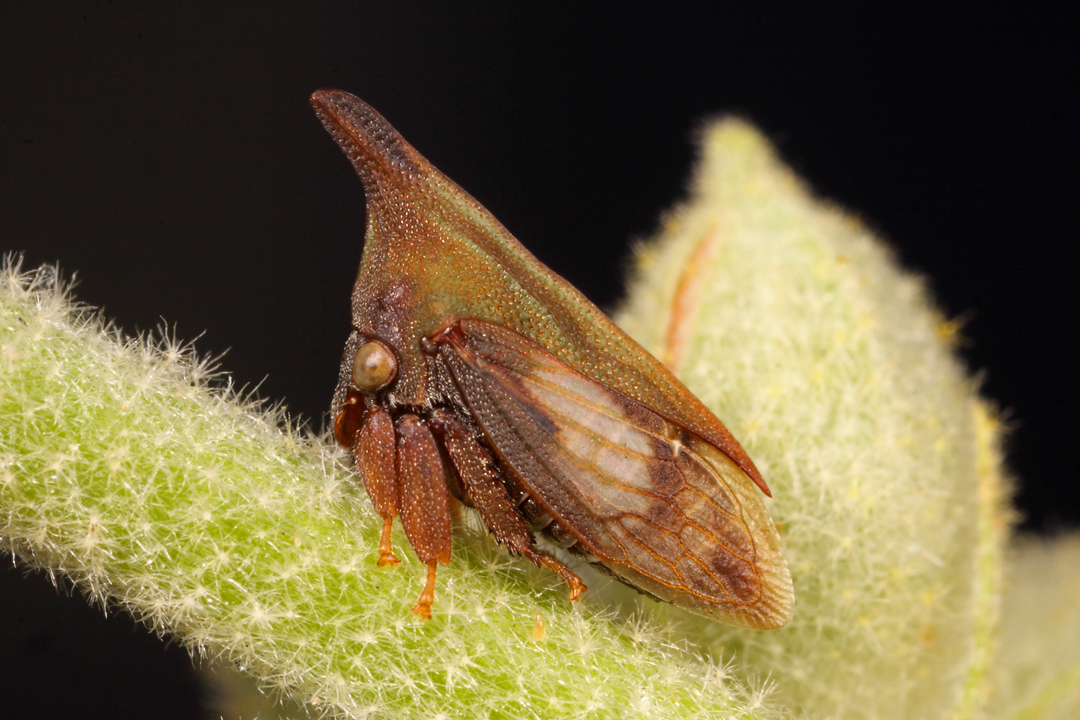
Enchenopa gracilis (Germar, 1821) | Chaco Province, Argentina
…or so I thought. While scanning the highway right-of-way to see if there might be anything possibly interesting to look at, I spotted a small clump of woody shrubs down the embankment and across the erosion gully before the fenceline. I looked around—everybody was out of their cars with the engines shut off, so I grabbed my camera (not really sure why) and started walking towards the shrubs while looking ahead every now and then for any sign that people were getting back in their cars and moving again. I reached the shrubs and saw they represented something in the mallow family (Malvaceae) due to their small, orange, über-staminate flowers. Immediately I spotted the familiar thorn-like shape of treehoppers in the tribe Membracini, probably a species of Enchenopa or related genus. I had been hoping to see more of these after photographing another species further south in Buenos Aires last year, but I hadn’t seen a single treehopper during the entire week. Fortunately I had my 65mm lens already on the camera, so I quickly snapped a few shots and collected a couple of specimens. Just as quickly as I had done that, I heard somebody yelling to me from the road above that people were getting back into their cars ahead. These few shots and specimens would have to do. (And, disappointingly, after spending the next hour creeping towards the bridge there wasn’t even a wreck to look at!)
As I did with those previous photos, I sent these to Andy Hamilton (Canadian National Collection, Ottawa), who forwarded them on to Dr. Albino Sakakibara (Universidad Federal de Parana, Brazil) and then reported back to me that:
My Brazilian colleagues…have been able to identify your “beautiful photos” as representing Enchenopa gracilis, a species that has been illustrated only once (in 1904), and certainly not by a photograph!
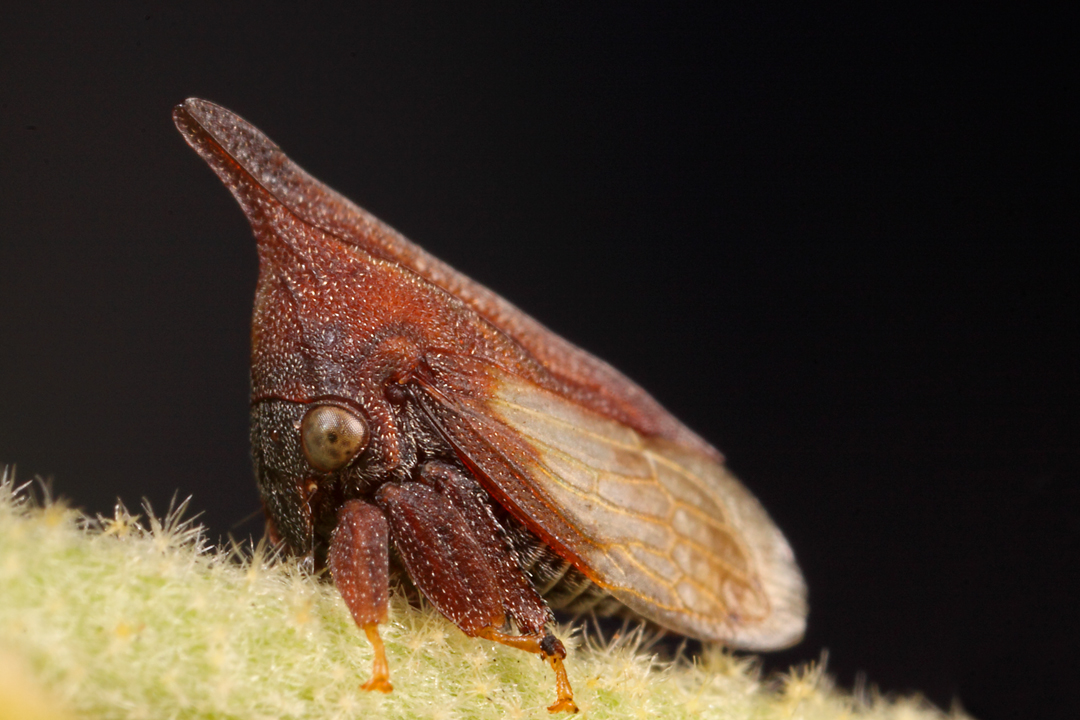
Another individual, this one with no trace of green colorationi and less distinctly marked wings.
The illustration referenced by Andy comes from Kellogg (1905—p. 169, fig. 239), and as he notes at BugGuide the problem with old illustrations is that many of them are either inaccurate or use obsolete names. Enchenopa gracilis does not occur in North America, thus the drawing in Kellogg (1905) probably does not actually represent this species. Nevertheless, a recent dissertation on the insect fauna associated with pigeon pea in Brazil (Azevedo 2006) shows several photographs of adults that agree nicely with these photos. Enchenopa gracilis actually seems to be a bit of a pest on that crop, and it has also been reported in association with a variety of other plants across several different families (Lopes 1995, Alves de Albuquerque et al. 2002). Interestingly, I could not find any species of the family Malvaceae recorded as a host for E. gracilis.
REFERENCES:
Azevedo, R. L. 2006. Entomofauna associada ao feijão guandu [Canjanus cajan (L.) Millspaugh] no recôncavo baiano. Ph.D. dissertation, Centro de Ciências Agrarias e Ambientais, Universidade Federal da Bahia, Cruz das Almas, 54 pp.
Alves de Albuquerque, F., F. C. Pattaro, L. M. Borges, R. S. Lima & A. V. Zabini. 2002. Insetos associados à cultura da aceroleira (Malpighia glabra L.) na região de Maringá, Estado do Paraná. Maringá 24(5):1245-1249.
Kellogg, V. L. 1905. American Insects. Henry Holt & Co., New York, 674 pp.
Lopes, B. C. 1995. Treehoppers (Homoptera, Membracidae) in southeastern Brazil: use of host plants. Revista Brasileira de Zoologia 1213:595-608.
Copyright © Ted C. MacRae 2012