Tucuras, langostas, y saltamontes

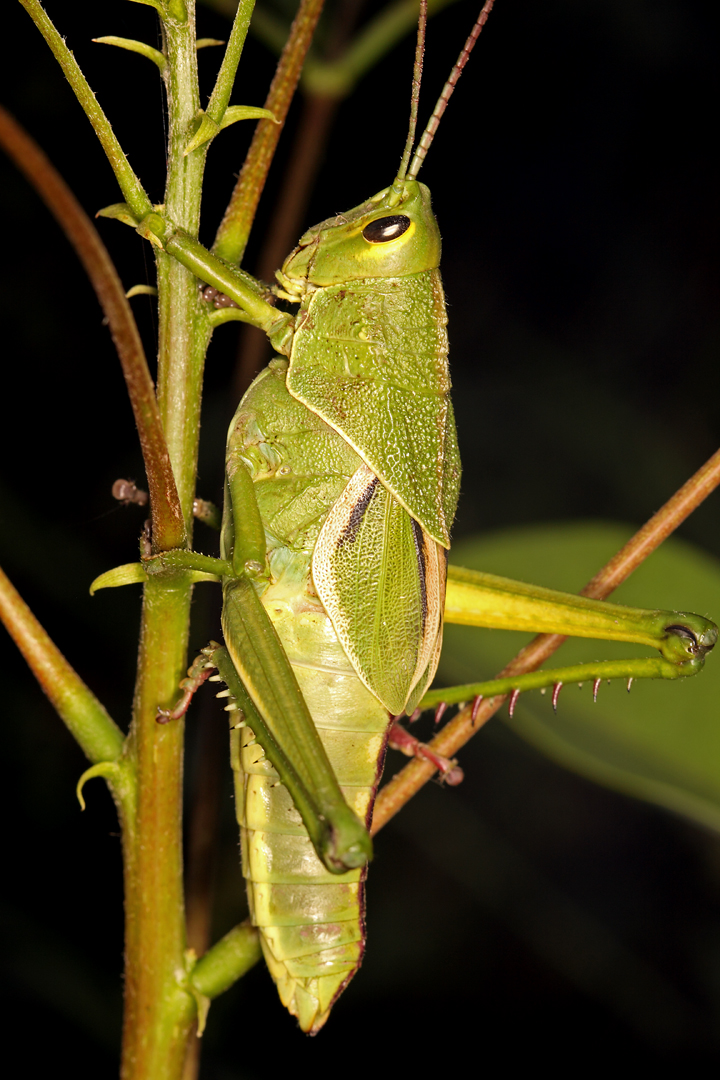
Staleochlora viridicata | Cordoba Province, Argentina (March 2011)

Tucuras, langostas, and saltamontes are names in Argentina for what we in North America call grasshoppers (order Orthoptera, superfamily Acridoidea). Argentina certainly has its share of species, some of which can only be described as “gigantes”! During my first week out in the field at my home base here in western Buenos Aires Province, I encountered the hefty-bodied female in the photo below and was immediately reminded of a similar-looking individual I had photographed in neighboring Córodoba Province during my March 2011 visit. Both had short but well-developed wing pads that at first suggested they might be mature nymphs of an incredibly large species. However, when I noted both were females I decided they likely represented adults of some type of lubber grasshopper (family Romaleidae), many of which—especially the females—are brachypterous (short-winged) and heavy-bodied as adults. A little searching revealed that both belong to the genus Elaeochlora, each looking very much like the species pictured on an Argentine postal stamp and identified as E. viridis (update 9 Mar 2012 – Sam Heads has identified these as Staleochlora viridicata).

Staleochlora viridicata| Buenos Aires Province, Argentina (March 2012)

Getting at least a genus name for these individuals then prompted me to go back to photographs I had taken last year of other types of grasshoppers. One of these, Eutropidacris cristata, is truly one of the largest grasshoppers I have ever seen (update 9 Mar 12 – Sam Heads notes that Eutropidacris is now a synonym of Tropidacris). This individual was seen in a soybean field in the northern Argentina province of Chaco. These insects, known in Argentina as “La tucura quebrachera,” apparently occur in outbreak numbers periodically and, understandably owing to their monstrous size, generate a lot of attention. In Brazil the sepcies is known as “gafanhoto-do-coqueiro” (coconut tree grasshopper),

Tropidacris cristata | Chaco Province, Argentina (March 2011)

One of the more colorful grasshoppers I have seen in Argentina is Chromacris speciosa. The individual below was photographed last March in eastern Córdoba Province, also on soybean. It’s tempting to presume that the green and yellow coloration has a cryptic function, but apparently the nymphs of this species are brightly colored red and black and have the habit of aggregating on foliage. This is classic aposematism (warning coloration) to indicate chemical protection from predation, so perhaps there is a similar function to the adult coloration as well.
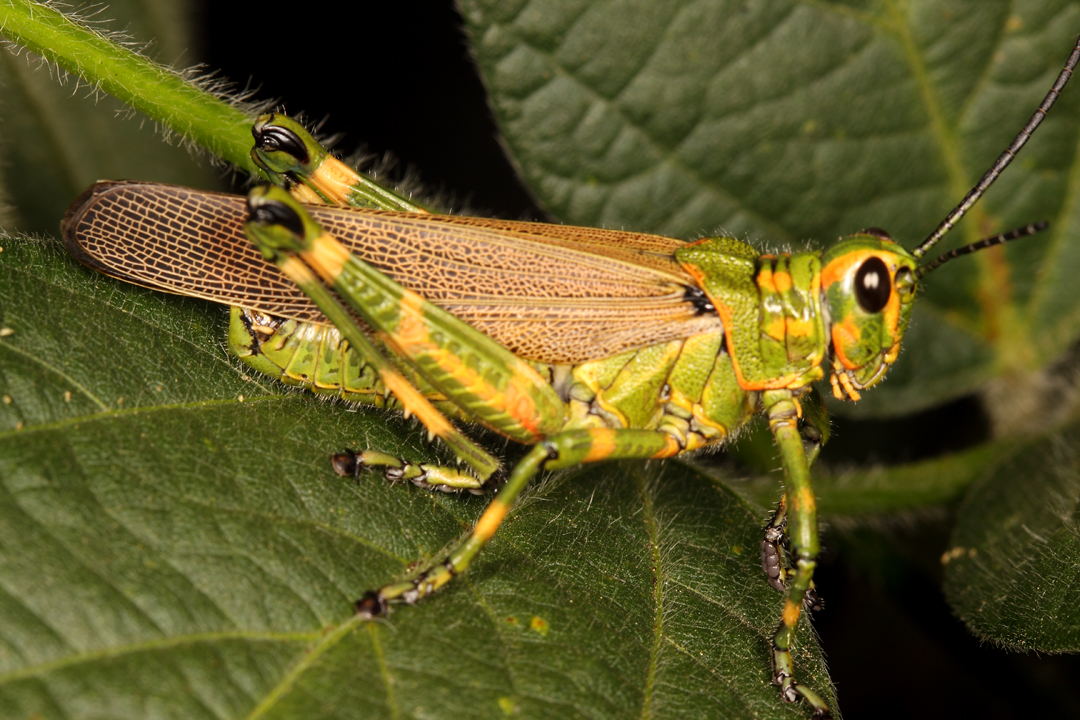
Chromacris speciosa | Cordoba Province, Argentina (March 2011)

Copyright © Ted C. MacRae 2012

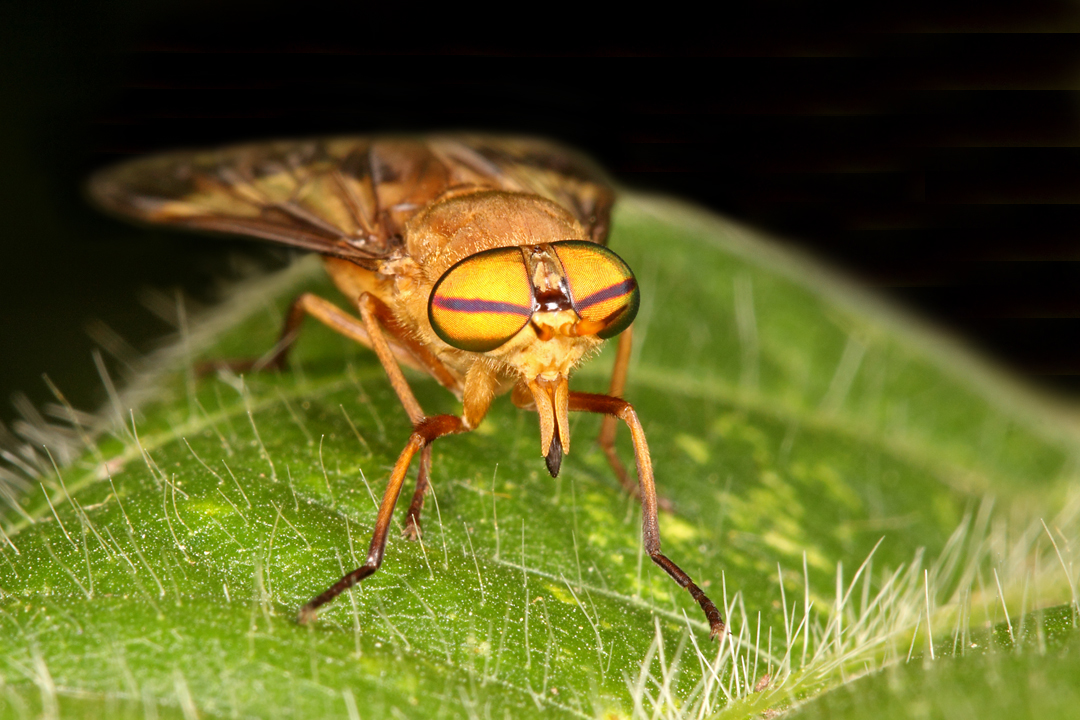
Crazy Eyes 2

Buenos Aires Province, Argentina | March 2012

While the eyes of this female horse fly (family Tabanidae) aren’t quite as striking as those of Tabanus lineolus (the wonderfully dimorphic males and females of which were made famous by Thomas Shahan and Ralph Holzehthal), they still managed to catch my eye as I was scouting for more pedestrian types of insect in a soybean field in central Argentina this past week. We know this is a female due to the separated eyes (males have larger eyes that meet at the middle of the head—supposedly the better to see females with); and by the obvious, blade-like mouthparts, which the females use to slice mammal skin so they can lap the blood that their eggs need for development prior to being laid while males forego specialized mouthparts and concentrate on using their huge eyes to look for females.

Female horse flies have well-separated eyes and distinct, blade-like mouthparts.


I suspect this individual had recently emerged from the soil (where many horse flies pupate) and was still hardening off, as she was very calm sitting on the leaf and allowed me to steady the leaf with one hand as I snapped a few photos with the other. I would have loved to have switched out the 100mm lens I was using and put on my 65mm 1-5X lens to really zoom in on those striking eyes. Unfortunately, I don’t think my field companions shared or understood my fascination with this little insect. If anybody has a clue about the identity of this species please let me know.

Copyright © Ted C. MacRae 2012

The “Big 3” of corn in Argentina

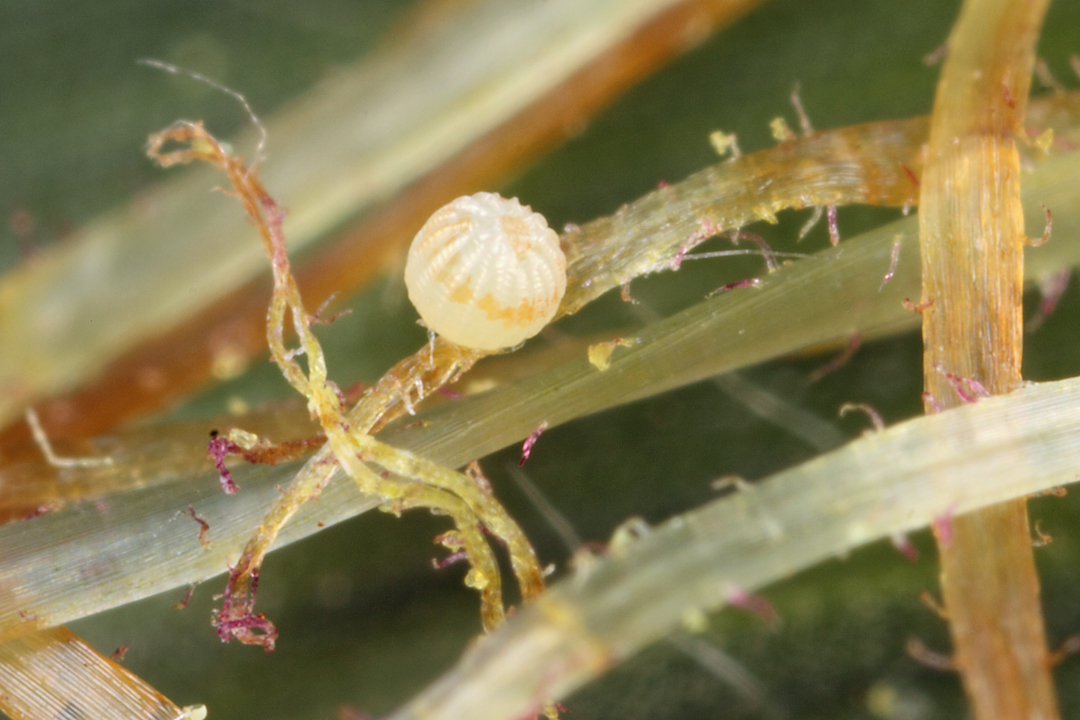
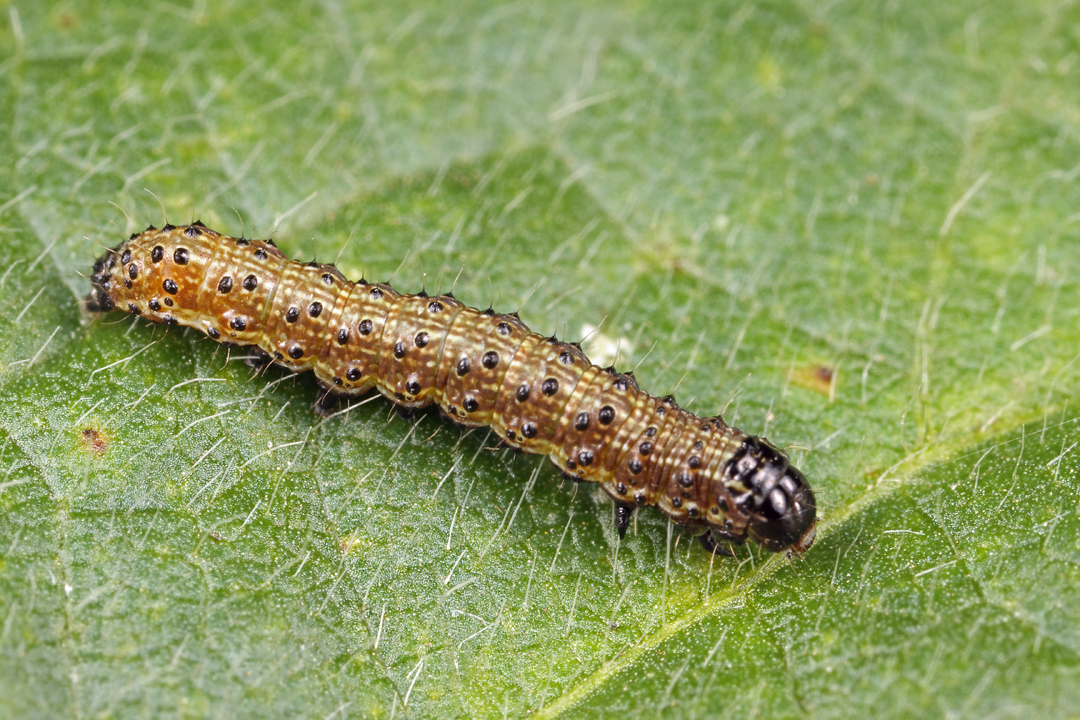
While leafcutter ants are one of the more unusual pests that Argentina corn farmers must deal with, the three most important confront farmers throughout the Western Hemisphere: stalk borers, earworms, and armyworms. In the U.S. the primary stalk boring pest of corn is the European corn borer (Ostrinia nubilalis), while in Argentina it is the sugarcane borer (Diatraea saccharalis). Corn earworm (Helicoverpa zea) and fall armyworm (Spodoptera frugiperda), on the other hand, are common to both countries. Here are some recent photos of the three species in Argentina – the first two on corn and the latter on soybean.

After you look at the photos, I have a funny story…

Diatraea saccharalis eggs ready to hatch | Buenos Aires Prov., Argentina

Helicoverpa zea egg on corn silk | Buenos Aires Prov., Argentina

Spodoptera frugiperda mid-instar larva on soybean | Buenos Aires Prov., Argentina

Learning to speak a foreign language via immersion can result in some embarrassingly funny moments. This afternoon I made an unplanned visit to the field with some colleagues. There has been much rain recently so the ground was rather muddy. Not having my boots with me, I picked my way through as best I could, and afterwards as I was cleaning the mud off my shoes, I commented (in Spanish) to one of my Argentine colleagues (a young female) that this was my only pair of clean shoes. I said everything okay but messed up the word for shoes—instead of saying “calzados” I said “calzones.”

In Argentina, calzones means “underwear.”

I’m really glad the shocked look on her face quickly gave way to hysterical laughter once she figured out what I was trying to say.

Copyright © Ted C. MacRae 2012

Leafcutter ants on corn

Leafcutter ants attacking corn | western Buenos Aires Prov., Argentina

North American corn farmers certainly have their share of insect pests to worry about. Between corn borer, earworm, armyworm, and rootworm, there isn’t much of the plant that isn’t vulnerable to attack by at least one of these insects. Argentina corn farmers have all this and more—have you ever seen ants attacking corn? I took these photographs yesterday in a corn field in western Buenos Aires Province showing leafcutter ants dining on the developing kernels of late-planted corn. Okay, “dining” may not be the proper word, as they are not actually eating the kernels, but rather harvesting them to bring them back to their “hormiguera” (ant nest) for cultivation of the fungi on which they feed. The four pairs of spines on the pro-mesonotum and narrow distal antennal segments suggest this is a species of Acromyrmex, three species of which are mentioned as pests of corn in Argentina (A. lundii, A. striatus, and A. lobicornis). Of these, the individuals in these photos seem to best match AntWeb’s photos of Acromyrmex lundii, but that is just my guess.

Acromyrmex sp. poss. lundii?

Copyright © Ted C. MacRae 2012
To the land of Gauchos

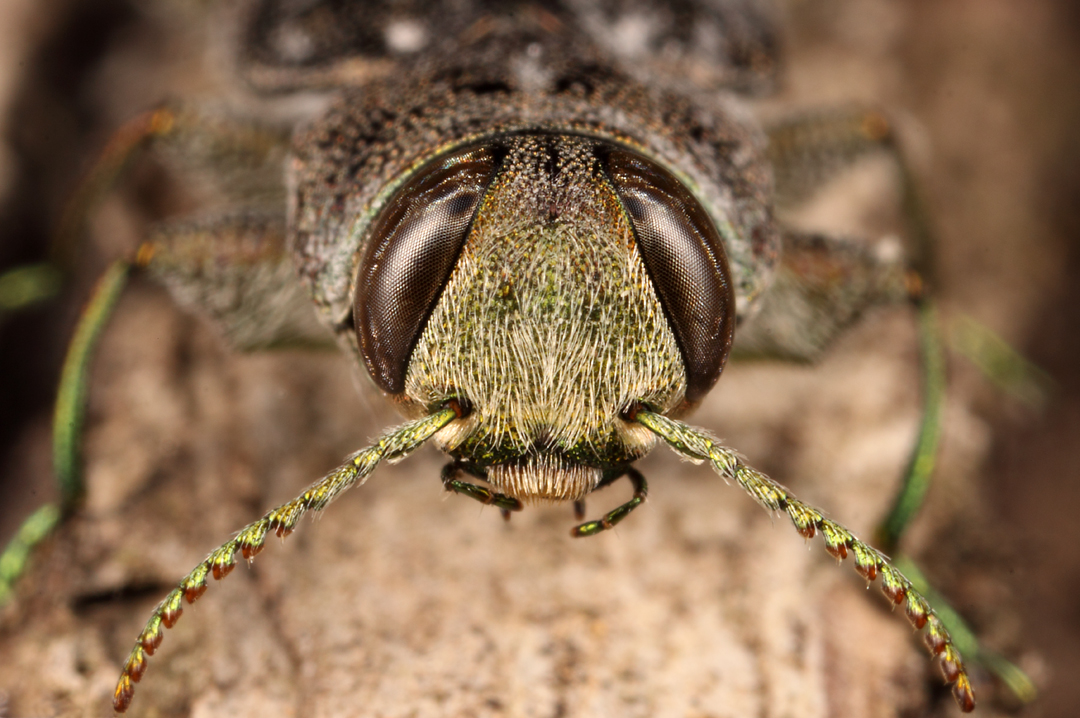
Today I leave for an extended stay in Argentina. Many have asked me if my trip is for work or fun, and my standard response has been, “It’s for work, and it will be fun!” For the next eight weeks, I’ll be helping out with field trials and speaking to farmers (while sampling a few Malbecs as well). Of course I would rather it be an 8-week collecting trip, but I consider myself fortunate even to have an opportunity such as this. I’ll pick up a few insects along the way, but what I really hope to bring back in large quantity is photographs.

It’s a little difficult to predict how reliable and consistent I’ll have internet access or the time to take advantage of it, so postings over the next few weeks may be a little less regular than what has become my usual custom. The trip is also heavily front-loaded with work activities as I get my bearings and spend time getting to know my new colleagues, so I’m not sure when I might have new photos to show here. Not to worry, I have plenty of material that I haven’t yet shown. Until then, I leave you with this photograph I took last November at  in Buenos Aires. These tiny bugs seem to be early-instar leaf-footed bug (family Coreidae) nymphs, their bright red and black coloration and aggregating behavior indicating ample chemical protection against predation.

Early-instar coreid nymphs | Buenos Aires, Argentina

Copyright © Ted C. MacRae 2012

Chrysobothris viridiceps

Chrysobothris viridiceps on dead branch of Quercus alba | Baxter Co., Arkansas

Despite their general popularity among beetle collectors, jewel beetles (family Buprestidae) have an admittedly deserved reputation for difficult taxonomy. Part of the reason for this is the existence of several highly speciose genera. In North America, for example, nearly half of its described species belong to just three genera—Acmaeodera, Chrysobothris, and Agrilus (the latter, with nearly 3,000 described species and many more awaiting description, being possibly the most speciose animal genus in the world). Identification of species within these genera is difficult enough due to their sheer numbers and is further complicated by the existence a number of “species-groups”—i.e., groups of very closely related species that have only recently become reproductively isolated from each other (likely in response to host partitioning) but have not yet evolved obvious unique morphological characters. Perhaps the most famous of these is the “Chrysobothris femorata species-group.” A dominant component of hardwood forests throughout North America, members of this group have confounded taxonomists, collectors, and foresters alike for many years. Fortunately, the recent revision of the group and formal description of several species by Wellso and Manley (2007) have brought much needed clarity to the group. While problems still remain (C. femorata sensu novo probably still encompasses several undescribed species), most individuals can now be identified with some confidence.

Males and females both exhibit completely divided post-median fasciae

I have previously discussed three of the seven now recognized species occurring broadly in eastern North America—the nominate C. femorata, still regarded as an important pest of ornamental and fruit tree plantings, C. caddo, one of the new species described by Wellso and Manley (2007) and associated with dead hackberry (Celtis spp.), and C. quadriimpressa, mostly associated with dead branches of oak (Quercus spp.). The individuals shown here, photographed on branches of a dead white oak (Quercus alba) in north-central Arkansas this past June, represent a fourth species in the group, Chrysobothris viridiceps. Unlike most members of the C. femorata species-group, C. viridiceps can be readily recognized in the field  due to the uninterrupted costa (raised narrow ridge) that completely bisects the posterior fovea (rounded pit) on each elytron. In all other species this costa is interrupted by the fovea. Moreover, this species is the only one in the group in which the males (easily distinguished from females by the bright green frons, or face) exhibit bicolored antennal segments, with the outer portion of each segment yellow and the remainder bright metallic green. While the species name is Latin for “green face,” this character is useless for species identification, as males of all species in the group exhibit a more or less green face.

Males sport not only the green face for which the species is named, but also distinct yellow areas on the antennal segments

Females are a little more difficult to distinguish in the field because, like those of other species of the group the antennae are more uniformly reddish. Likewise, the face also lacks the green coloration of the male, and although still useful for species identification the differences among females between the different species are more subtle and require microscopic examination. However, as in the male the elytral foveae are completely divided, allowing even females to be recognized relatively easily.

Females tend to be more reddish on the legs, antennae and face

One thing I have noticed about the different members of the C. femorata species-group is the usefulness of host plant association in distinguishing the different species. Of the seven species occurring in my region, I’ve seen C. femorata associated mostly with stressed but still living trees in genera other than oak or hickory (e.g., maple, sycamore, apple, poplar, ash, etc.), C. adelpha associated exclusively with dead hickory (Carya spp.), and C. caddo associated almost exclusively with hackberry (Celtis spp.). The remaining four species are all associated primarily or exclusively with oaks, but even these species often segregate according to branch size, with C. viridiceps occurring mostly on the smallest branches, C. quadriimpressa on somewhat larger branches, C. rugosiceps on very large branches and the upper trunk, and C. shawnee on large trunks and even stumps. Not surprisingly, these size preferences reflect the relative size of the beetles, with C. viridiceps (7–13 mm in length) generally being the smallest of the four species and C. shawnee (9–18 mm in length) the largest.

Okay, now to get photos of C. adelpha, C. rugosiceps and C. shawnee!

REFERENCES:

Wellso, S. G. and G. V. Manley. 2007. A revision of the Chrysobothris femorata (Olivier, 1790) species group from North America, north of Mexico (Coleoptera: Buprestidae). Zootaxa 1652:1–26.

Copyright © Ted C. MacRae 2012

Grampus and go-devil

Corydalus cornutus | Wayne Co. Missouri


Ever taken a close look at a female dobsonfly’s head? Female dobsonflys don’t get nearly as much attention as the males due to the latter’s ridiculously elongated mandibles. While female mandibles are more modestly proportioned, don’t think they’re ineffectual—females are quite capable of inflicting a blood-letting nip if one is not careful. Certainly the female head is no less dinosaurian in appearance than the male’s, and while I know that Corydalus cornutus is the product of the same amount of evolutionary time as any other species on earth today, I can’t help but think they look so “primitive.”

While dobsonfly is the commonest name applied to these insects, I much prefer “go-devil” (not sure of the origin) and “grampus” (from “Krampus”—a mythical horned, creature in Alpine countries). The latter name in particular pays more appropriate homage to the monstrous appearance of these insects.

Photographed July 2011 at a blacklight sheet in Sam A. Baker State Park, Wayne Co., Missouri.

Copyright © Ted C. MacRae 2012
Tiger beetles in southeast Missouri

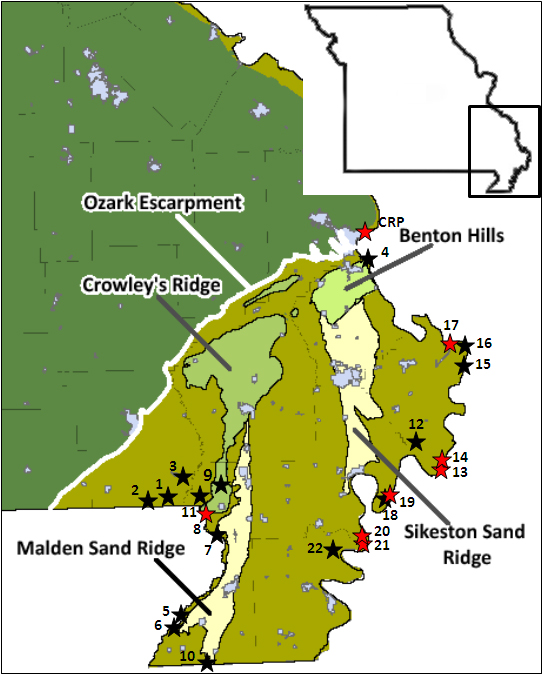
Figure 1. Sites surveyed in southeastern Missouri for Cylindera cursitans during 2007–2010. Site numbers are referenced in Table 1 (CRP = Cape Rock Park), with red stars indicating sites where C. cursitans was observed. Black box on inset map of Missouri denotes main map area (bordering states include AR to the south and TN, KY, and IL to the east).

ResearchBlogging.orgVolume 43(3) of the journal CICINDELA was published a few weeks ago, and I can truly lay more claim to the issue than anybody else (except perhaps Managing Editor Ron Huber). In addition to having one of my photos (a face-on shot of Tetracha carolina) featured on the cover, I was coauthor on the first of two papers included in the issue and lead author on the second. (And to complete my stamp of ownership, I did the final assembly of the issue as the journal’s Layout Editor.) The two included papers each report the results of surveys conducted in the Mississippi Alluvial Plain of southeastern Missouri (also called the “bootheel” in reference to its shape—see Fig. 1) for tiger beetles whose occurrence in that part of the state was previously not well known. In the first, Fothergill et al. (2011) used a novel survey technique that involved searching beneath irrigation polypipe in agricultural fields to find Tetracha carolina (Carolina Metallic Tiger Beetle); while the second paper (MacRae et al. 2011) reports the results of a multi-year survey to characterize the distribution, habitat associations and conservation status of Cylindera cursitans (Ant-like Tiger Beetle). Together with our three papers on Habroscelimorpha circumpicta johnsonii (Saline Spring Tiger Beetle), Dromochorus pruinina (Loamy Ground Tiger Beetle) and Cylindera celeripes (Swift Tiger Beetle)—all published in the past year—these two papers officially complete the battery of publications that describe our survey efforts for the five tiger beetle species considered of potential conservation concern in Missouri when Chris Brown and I began our faunal studies of the group more than ten years ago.

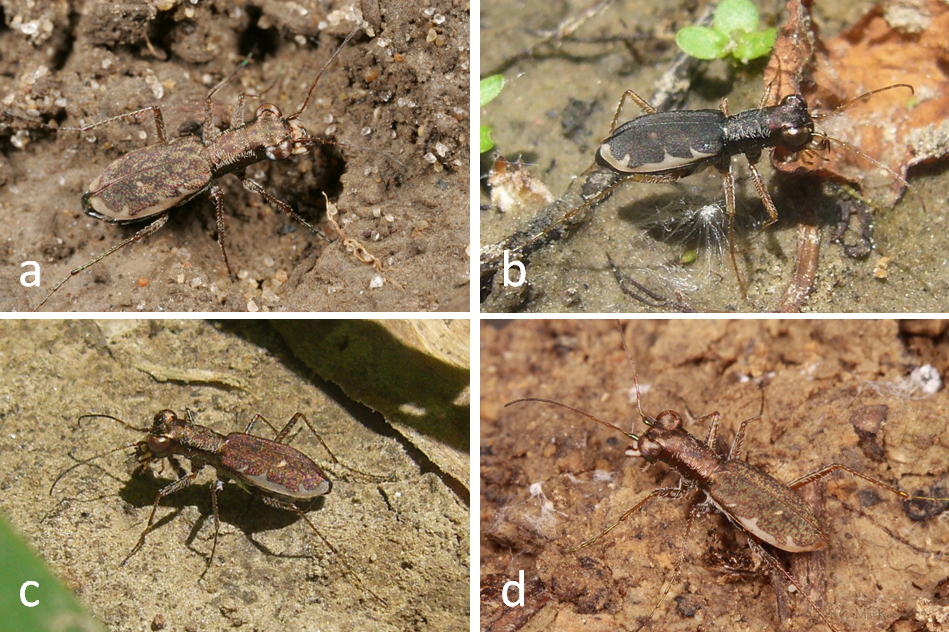
The first three papers clearly painted a rather gloomy picture—H. circumpicta johnsonii is possibly extirpated from saline spring habitats in central Missouri, D. pruinina is limited to a 2.5 mile stretch of roadside habitat in western Missouri, and C. celeripes is restricted to a few patches of critically imperiled loess hill prairie habitat in extreme northwestern Missouri. Happily, prospects for T. carolina and C. cursitans in Missouri are much better. While both are limited in the state to the southeastern lowlands, our surveys indicated that populations are sufficiently robust and widespread in the area to alleviate any concerns about the potential for extirpation. Tetracha carolina in particular was found abundantly in agricultural habitats and appears to have adapted well to the extensive modifications caused by conversion of the cypress-tupelo swamps that formerly covered the region. Cylindera cursitans (Fig. 2) hasn’t shown nearly the same adaptive capability as T. carolina; however, it has nevertheless found suitable refuge in the ribbons of wet, bottomland forest that persist between the Mississippi River and the levee systems that protect the region’s farmland. For a time it seemed that the same habitats along the St. Francois River that bound the western side of the region weren’t suitable for the species, but after much searching (in often tough conditions!) Kent finally managed to locate a population on the Missouri side of the river opposite a known population in Arkansas.

Figure 2. Cylindera cursitans in southeast Missouri: a) New Madrid Co., Girvin Memorial Conservation Area, 6.vii.2007; b-c) Mississippi Co., Dorena Ferry Landing, 6.vii.2008; d) Mississippi Co., Hwy 60 at Mississippi River bridge, 20.vi.2009. Photos by CRB (a) and TCM (b-d).

Both of these species illustrate how healthy populations of insects are able to hide right beneath our noses. Previous to our surveys, records of T. carolina and C. cursitans in southeastern Missouri were scarce (the latter consisting of a single specimen in the Enns Entomology Museum at the University of Missouri in Columbia, and with considerable searching required before the first field population was finally located). In both cases, perceived rarity was a result not of actual rarity, but rather specific habitat requirement or unusual behavior. While I get great satisfaction out of finding populations of “rare” species and increasing our understanding of their habitat requirements, I also can’t help but wonder if they truly are rare and how many populations I might still have missed—populations that I would have found had I searched in a slightly different manner or at a slightly different time.

REFERENCES:

Fothergill, K., C. B. Cross, K. V. Tindall, T. C. MacRae and C. R. Brown. 2011. Tetracha carolina L. (Coleoptera: Cicindelidae) associated with polypipe irrigation systems in southeastern Missouri agricultural lands. CICINDELA 43(3):45–58.

MacRae, T. C., C. R. Brown and K. Fothergill. 2011. Distribution, seasonal occurrence and conservation status of Cylindera (s. str.) cursitans (LeConte) (Coleoptera: Cicindelidae) in Missouri. CICINDELA 43(3):59-74

Copyright © Ted C. MacRae 2012