Recent literature – The Coleopterists Bulletin

Volume 64, No. 4 - December 2010

I returned to the office this week after spending two weeks in Brazil to find the December 2010 of The Coleopterists Bulletin in my inbox.  I don’t think there is another journal that I look forward to more eagerly than this one (with the possible exception of CICINDELA) – with each issue, I know that regardless of whether it contains any papers in my priority groups of interest (jewel beetles, longhorned beetles, and tiger beetles), it will nevertheless contain well-written articles presenting results of high-quality research on nothing but beetles – pure elytral ecstasy!  This latest issue, however, is a real keeper.  Gracing the cover is a stunning image of the South African jewel beetle species Julodis viridipes, photographed by my good friend and world jewel beetle expert Chuck Bellamy, and inside are three tiger beetle papers and two longhorned beetle papers – it’s almost as if the issue were produced just for me.

Friend and colleague Mathew Brust takes credit for two of the three tiger beetle papers.  In the first (Brust et al. 2010), he compares the efficiency of the three main methods for collecting tiger beetle larvae: fishing, stab-and-grab, and excavation. They found fishing to be the most efficient and least damaging of the three methods, an important finding for tiger beetle conservation where the availability of efficient, non-lethal survey methods is critical.  (What are “fishing” and “stab-and-grab” you ask?  Read the paper.)  In the second paper (Brust and Hoback 2010), Matt teams up with University of Nebraska entomologist Wyatt Hoback to provide new distributional records and larval descriptions of Nebraska’s tiger beetle, Cicindela nebraskana.  Ironically, this species is quite rare in it’s namesake state, and their findings give clues about the habitats in which it is most likely to occur (I had the good fortune to contribute a small amount of data).  In the third tiger beetle paper, Robert Richardson (2010) notes an overwhelming preponderance of left-superior mandibles in two species of Omus and speculates on the selective pressures that might operate on different tiger beetle clades to produce such a finding – a truly interesting read.

As for longhorned beetles, Sánchez-Martínez et al. (2010) report the utilization of living oaks by an apparently disjunct population of the marvelously beautiful Crioprosopus magnificus in central Mexico, complete with photographs of the larval workings and detailed emergence data.  (I am also reminded that I have a post on this very species that I need to put up).  Closer to home, Terence Schiefer and Patricia Newell (2010) independently recognized the existence of an undescribed subspecies of the red-edged saperda, Saperda lateralis, in the lower Mississippi Delta Region of the southeastern U.S., which together they describe as S. lateralis rileyi (named for Edward Riley, indefatigable collector of beetles, and collector of much of the type material).  Okay, I know what you’re thinking – “A new subspecies of S. lateralis? No way!”  Well, I was skeptical also when I first saw the title – several untenable and no longer recognized subspecies have already been described for this broadly distributed and variable species.  However, after noting the nature of the diagnostic characters, seeing the photographs, and studying their partially allopatric distributions, I was convinced.

In addition to the above papers, there were also a number of interesting book reviews in the issue, including The Chiasognathinae of the Andes, reviewed by M. J. Paulsen, A Field Guide of the Dynastidae Family of the South of South Americano access, reviewed by Ronald M. Young, and three book reviews by our beloved Art Evans: Illustrated Identification Guide to Adults and Larvae of Northeastern North American Ground Beetles (Coleoptera: Carabidae) [including tiger beetles]; The African Dung Beetle Genera; and Weevils of South Carolina (Coleoptera: Nemonychidae, Attelabidae, Brentidae, Ithyceridae, Curculionidae)no access.

REFERENCES:

Brust, M. L. and W. W. Hoback. 2010. Larval description and new Nebraska distribution records for Nebraska’s tiger beetle, Cicindela nebraskana Casey (Coleoptera: Carabidae). The Coleopterists Bulletin 64(4):341-346.

Brust, M. L., W. W. Hoback, and J. J. Johnson. 2010. Fishing for tigers: A method for collecting tiger beetle larvae holds useful applications for biology and conservation. The Coleopterists Bulletin 64(4):313-318.

Richardson, R. K. 2010. Mandibular chirality in tiger beetles (Carabidae: Cicindelinae). The Coleopterists Bulletin 64(4):386-387.

Sánchez-Martínez, G., O. Moreno-Rico, and M. E. Siqueiros-Delgado. 2010. Crioprosopus magnificus Leconte (Coleoptera: Cerambycidae) in Aguascalientes, Mexico: Biological observations and geographical distribution. The Coleopterists Bulletin 64(4):319-328.

Schiefer, T. L. and P. Newell. 2010. A distinctive new subspecies of Saperda lateralis F. (Coleoptera: Cerambycidae) from the southeastern United States. The Coleopterists Bulletin 64(4):329-336.

Copyright © Ted C. MacRae 2011

Answer to ID Challenge #4 – Aetalion reticulatum

Aetalion reticulatum female guarding her egg mass - São Paulo state, Brazil.

ID Challenge #4 seems to have been a little more difficult than I anticipated – only a few people mustered the courage to even hazard a guess, of whom TGIQ emerged with maximum points to take the win.  Looking sort of like a cross between a leafhopper (family Cicadellidae) and a treehopper (family Membracidae), Aetalion reticulatum is one of a few species and the only genus comprising the family Aetalionidae.  While lacking the pronotal processes that characterize species in the much more diverse and better known Membracidae, aetalionids are nevertheless considered treehoppers as well, along with another little-known family Melizoderidae.  As a whole, the Aetalionidae + Melizoderidae + Membracidae form a sister group to the Cicadellidae (Deitz and Dietrich 1993), which combine to form the most diverse and successful lineage of sap-sucking phytophagous insects. 

Like many treehoppers, A. reticulatum exhibits ant-mutualistic and presocial behaviors; however, it remains unclear whether these behaviors were acquired separately by each treehopper lineage or if they represent retention of a more primitive condition (sorry, Alex – it’s just easier to say it that way than deal with terms such as ‘retained plesiomorphy’ and ‘phylogenetic conservatism’).  Aetalion reticulatum occurs broadly in the New World tropics, where females can often be found perched on top of their egg masses.  Some (but not all) guarding females make periodic sweeps of the hing legs down the sides of the egg mass, apparently to dislodge egg parasitoids and discourage further attack (Preston-Mafham & Preston-Mafham 1993).  Ant-mutualistic relationships and the tendency to form colonies provide additional protection from predators.

Now is a good opportunity to summarize the ‘1st BitB Challenge Series’ overall standings – Ben Coulter maintains his overall lead by gaining points in every challenge.  TGIQ climbs into 2nd place with this week’s win, and tceisele leap frogs over several contestants to tie Janet Creamer for the 3rd podium spot (and gets the nod for more frequent participation).  It’s no real surprise that the most frequent players took the top spots.  At this point, I’m going to call a close to the 1st series and declare Ben Coulter the overall series winner – contact me for your loot!  To the rest, thanks for playing, and now that you know how this game works maybe you’ll think about making a move for the 2nd series win!

Place Commenter IDC #1 SSC #3 IDC #2 IDC #3 IDC #4 Total
1 Ben Coulter 9 14 9 4 4 40
2 TGIQ 8 5 10 23
3 tceisele 3 8 3 14
4 Janet Creamer 14 14
5 James Trager  6 5 11
6 Dave 11 11
7 Christopher Taylor 7 3 10
8 Dave Hubble 6 2 8
  JasonC 5 3 8
10 Charley Eiseman 7 7
  Delbert La Rue 7 7
  jason 7 7
  Techuser 7 7
14 Richard Waldrep  6 6
15 Alex/Watcher 2 2
  dragonflywoman 2 2
  nellie 2 2
16 Brady Richards  1 1
  Francis 1 1
  macroinstantes 1 1
  Margarethe 1 1
  Mark Deering  1 1
  Andrew 1 1

REFERENCES:

Deitz, L. L. and C. H. Dietrich.  1993.  Superfamily Membracoidea (Homoptera: Auchenorrhyncha). I. Introduction and revised classification with new family-group taxa.  Systematic Entomology 18(4):287–296.

Preston-Mafham, R. and K. Preston-Mafham.  1993.  The Encyclopedia of Land Invertebrate Behaviour.  The MIT Press, 320 pp.

Copyright © Ted C. MacRae 2011

Brazil Bugs #8 – Desafio de identificação #4

It’s time for a new ID Challenge, this one from my recent trip to Brazil.  I don’t expect this to be a terribly difficult challenge, so whoever wins is going to do so by gaining bonus points for providing detail about what is shown here in addition to correct taxonomic assignments.

See ID Challenge #2 for a detailed explanation of the rules

Copyright © Ted C. MacRae

Brazil Bugs #7 – Cigarrinhas

It seems that North American entomologists have returned en masse from their various tropical winter travels – Alex and Brigette have returned from their respective trips to Ecuador, Troy has come back from Costa Rica, and I am now back home after my recent business trip to São Paulo, Brazil.  I’m anxious to see the photos and read the tales that the others will no doubt be posting in the coming weeks regarding their visits to cloud forests, research stations, and nature preserves.  My insect hunting activities were limited to municipal parks and hotel grounds, but I still have a decent variety of insect encounters to share (along with many pleasant memories of churrasco, cerveja, e novos amigos).

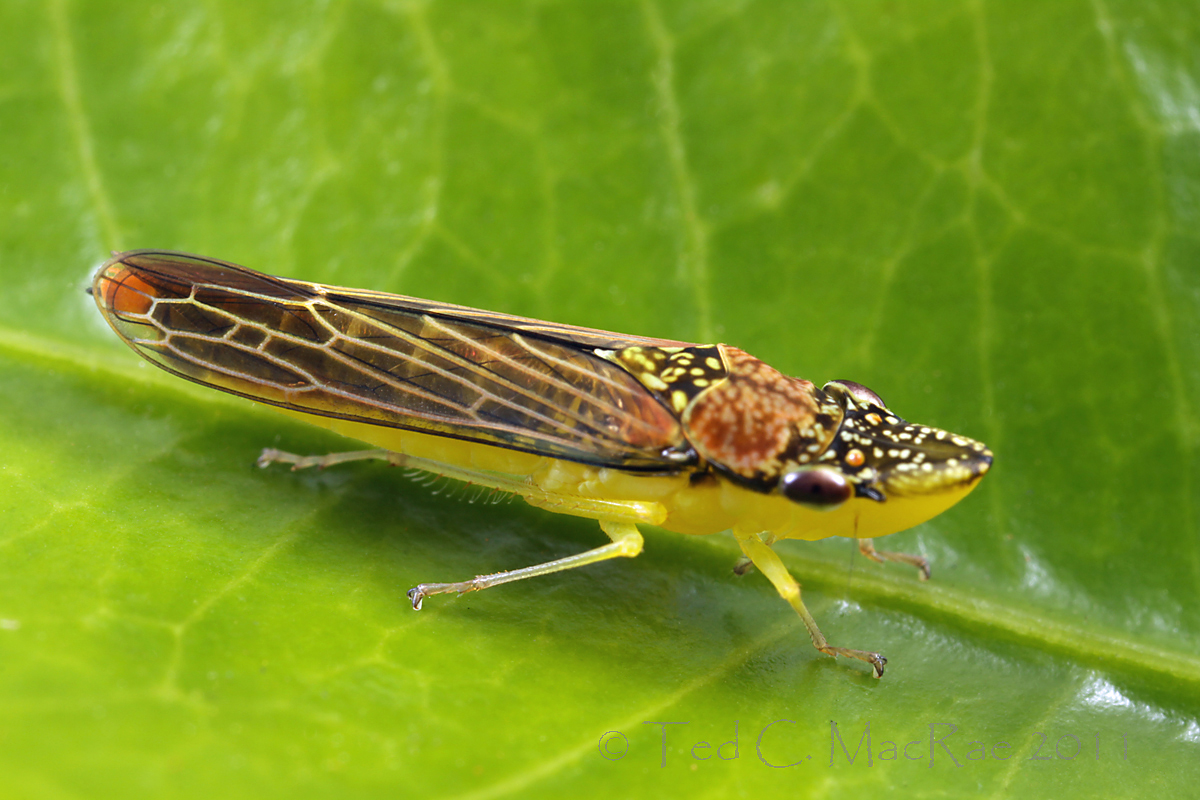
Acrogonia citrina

Thanks to Ani, I think we now agree that the pink-flowered shrub on the grounds of my hotel in Campinas that attracted such a nice diversity of insects belongs to the genus Ixora (family Rubiaceae).  Included in this post are a few leafhoppers (order Hemiptera, family Cicadellidae) in a group known as ‘sharpshooters’ (subfamily Cicadellinae) that I found also attracted to this shrub.  Leafhoppers are, of course, a hugely diverse family, but because of the generally small size and cryptic coloration of most North American species, it is a group that often goes unnoticed.  In the tropics, however, it’s a different story, with not only a number of larger forms but also a multitude of brightly colored species.

Acrogonia citrina at 5X life size

The diversity of species present in a place like southern Brazil might seem to preclude any possibility of identification without consulting a specialist, but the individual in these first two photos looks very much like Acrogonia citrina.  This species has become a major pest of citrus in São Paulo state during the past two decades, its importance driven not so much by direct damage, but rather by vectoring a bacterial disease of citrus called Citrus Variegated Chlorosis (Xylella fastidiosa) – or CVC (Lopes 2007).  Of the 12 sharpshooter species identified as vectors of CVC, A. citrina is among the most important due to its abundance in citrus groves (an important agricultural crop in São Paulo state) and high degree of polyphagy.  The disease affects mainly fruit quality, reducing their size and making them unsuitable to be sold fresh, and by decreasing yield when processed for juice.

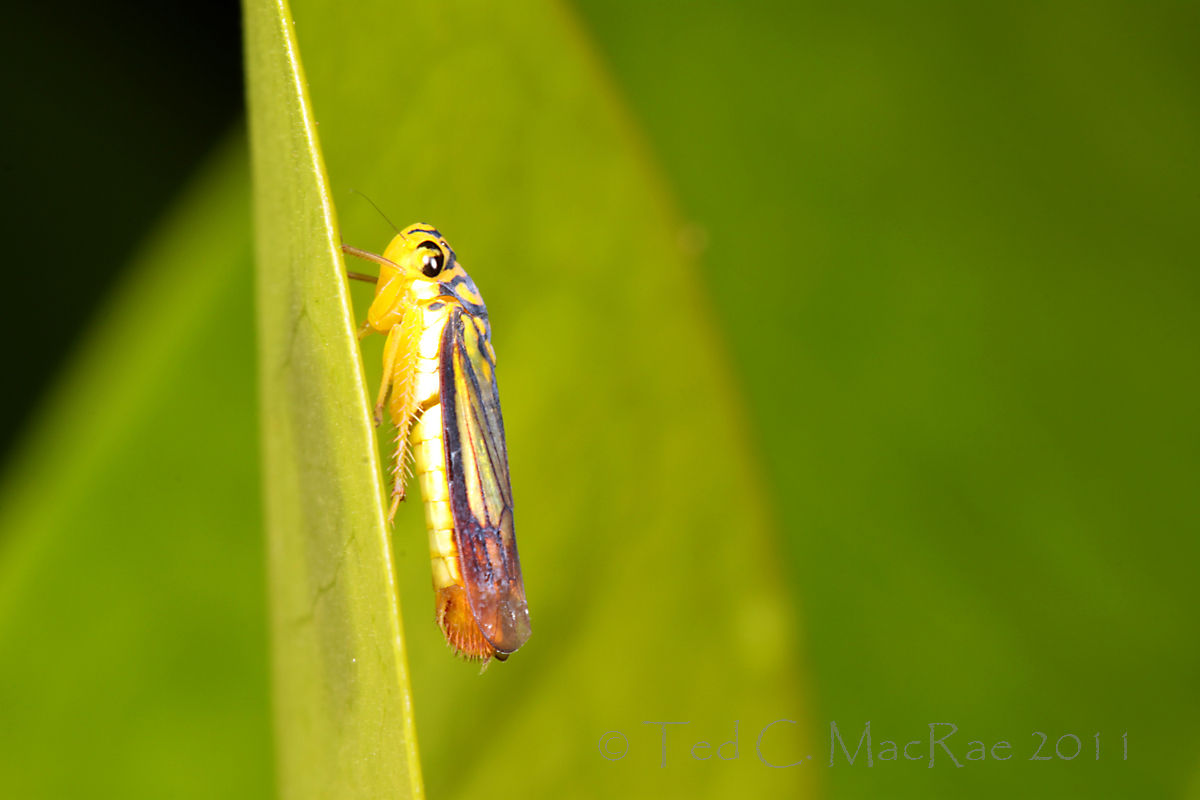
Dilobopterus costalimai

Dilobopterus costalimai is another important vector of CVC, again primarily as a result of its abundance on citrus in São Paulo state and polyphagous nature.¹  At this point, CVC has not been found outside of South America; however, California and Florida citrus growers are understandably nervous about the potential for its eventual occurrence in the U.S. due to the presence here of leafhopper species that are confirmed vectors of the disease and the ease with which the disease can be transported in infected nursery stock.  There is no cure for CVC, and chemical control of vectors is both costly and difficult, leaving nursery certification, protection of nursery stock from infection, pruning of symptomatic parts of trees to remove inoculum sources, and other such labor intensive methods as the only options for managing CVC (Chung and Brlansky 2009).

¹ I originally attempted to photograph this individual because it appeared to have been parasitized by what I suspect is a dryinid (order Hymenoptera, family Dryinidae).  Unfortunately the parasitoid is on the right side of the abdomen of this individual and can’t really be seen in this view, and I didn’t get any other shots besides this one.

REFERENCE:

Chung, K.-R. and R. H. Brlansky.  2009.  Citrus Diseases Exotic to Florida: Citrus Variegated Chlorosis (CVC).  University of Florida, Institute of Food and Agricultural Sciences Fact Sheet PP-223, 4 pp.

Lopes, J. S.  2007.  Vector ecology and implications on epidemiology of citrus variegated chlorosis.  Proceedings of the 2007 Pierce’s Disease Research Symposium, California Department of Food and Agriculture.

Copyright © Ted C. MacRae 2011

Brazil Bugs #6 – A mosca

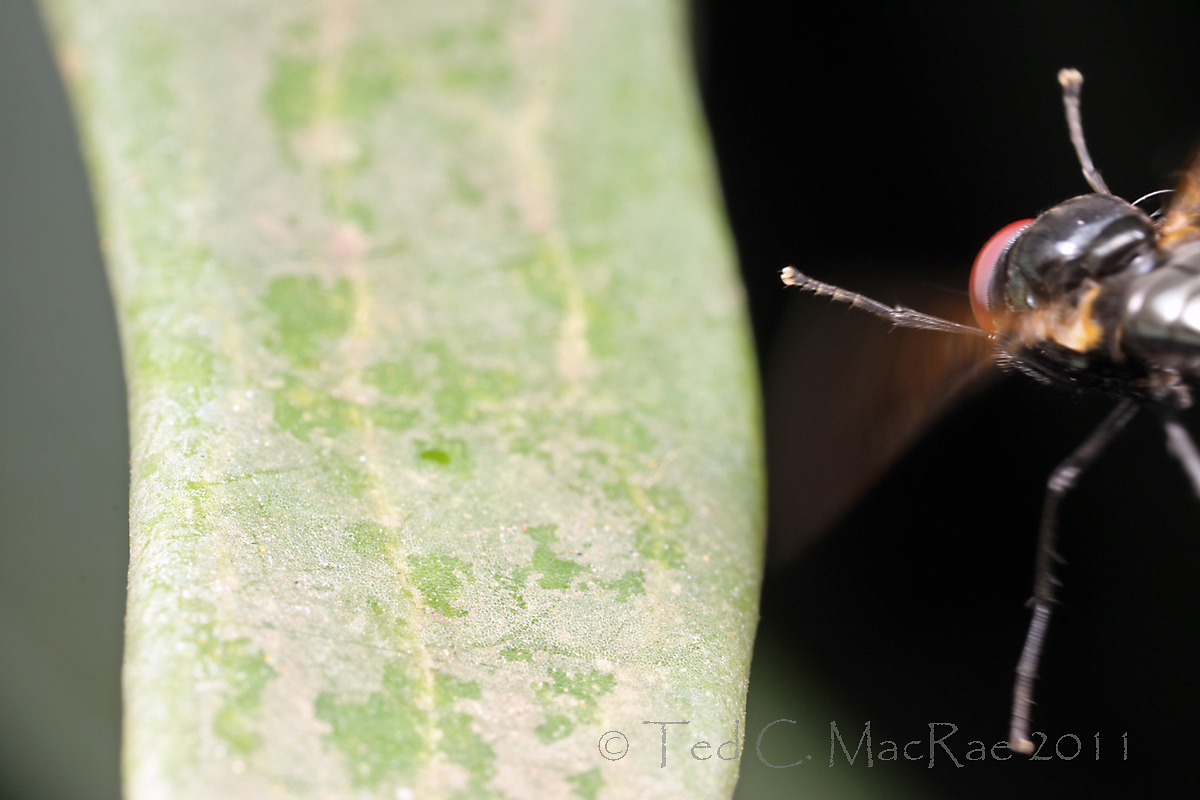
As I strolled the hotel grounds here in Campinas after work one day last week, I came upon a tree with several epiphytic orchids and a large staghorn fern (Platycerium sp.) mounted to its trunk.  On the tips of several of the fern’s leaves sat these peculiar looking flies – shining dark blue-black in color with a prominent red head.  I’m just guessing that they were some sort of blow fly (family Calliphoridae), although something about the look doesn’t seem quite right for the family (maybe because I’ve never seen Brazilian calliphorids before).  I found it interesting that they all oriented themselves head downward at the tip of the leaf on which they were sitting.  When I get intrigued by something, I want to photograph it, but in this case it was easier said than done.  They were small enough to require the 65mm lens, which means getting quite close, and every time I approached one it would fly away.  There were enough of them, however, that when one flew away I would just try another, and each fly would eventually return to the same leaf on which it had previously been sitting.  I spent some minutes scaring away fly after fly before I finally figured out the approach.  That, however, was only half the battle! 

When I finally started trying to take some shots, the pre-flash on the ETTL flash setting would scare the fly before I could complete the shutter snap, and I was getting only an empty frame where the fly had been sitting.  I thought about switching to manual flash but decided to keep working the fly and just see if I could get it accustomed to the flash.  The first photo in the series posted here is the first one in which I actually got part of the fly in the frame (I think he did a quick loop out and was actually returning to his spot when the shutter snapped).

I got closer in this one – the fly was just starting to take off as the shutter snapped (too bad I didn’t have better focus, or this could’ve been an interesting view).

Finally, I got the fly sitting still at the tip of the leaf.  This is when I started to get picky – I wasn’t too satisfied with the composition in this photo, and since he seemed to have become accustomed to the flash, I decided to take a few more shots to try to make sure I get one with good composition and focus.

Better composition this time, but the focus is still a bit off.  Unfortunately, this was my last shot at this guy, as he took off right afterward.  The thought taking the time to work another fly and get him accustomed first to me and then the flash didn’t appeal to me by this point – I was in Brazil, and there are so many other insects to photograph.  I decided good enough was good enough and continued my searches…

Copyright © Ted C. MacRae 2011
Brazil Bugs #5 – Lagartixa

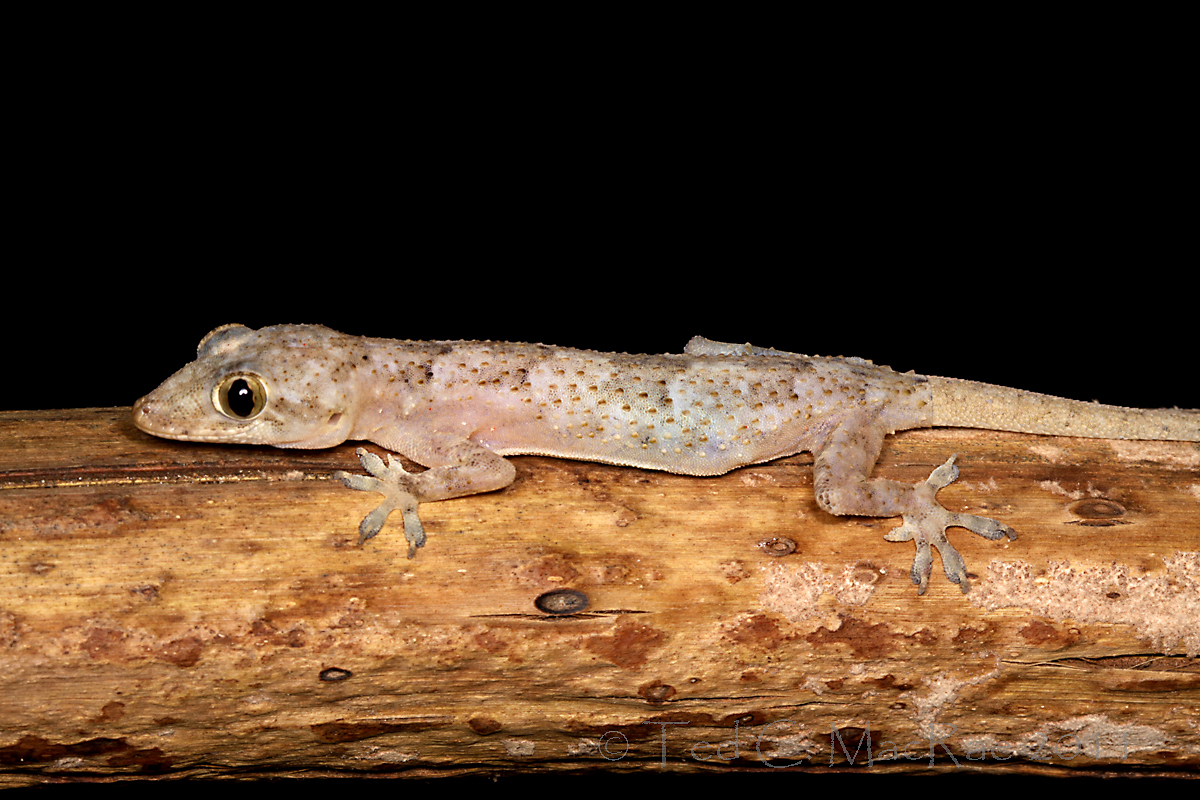
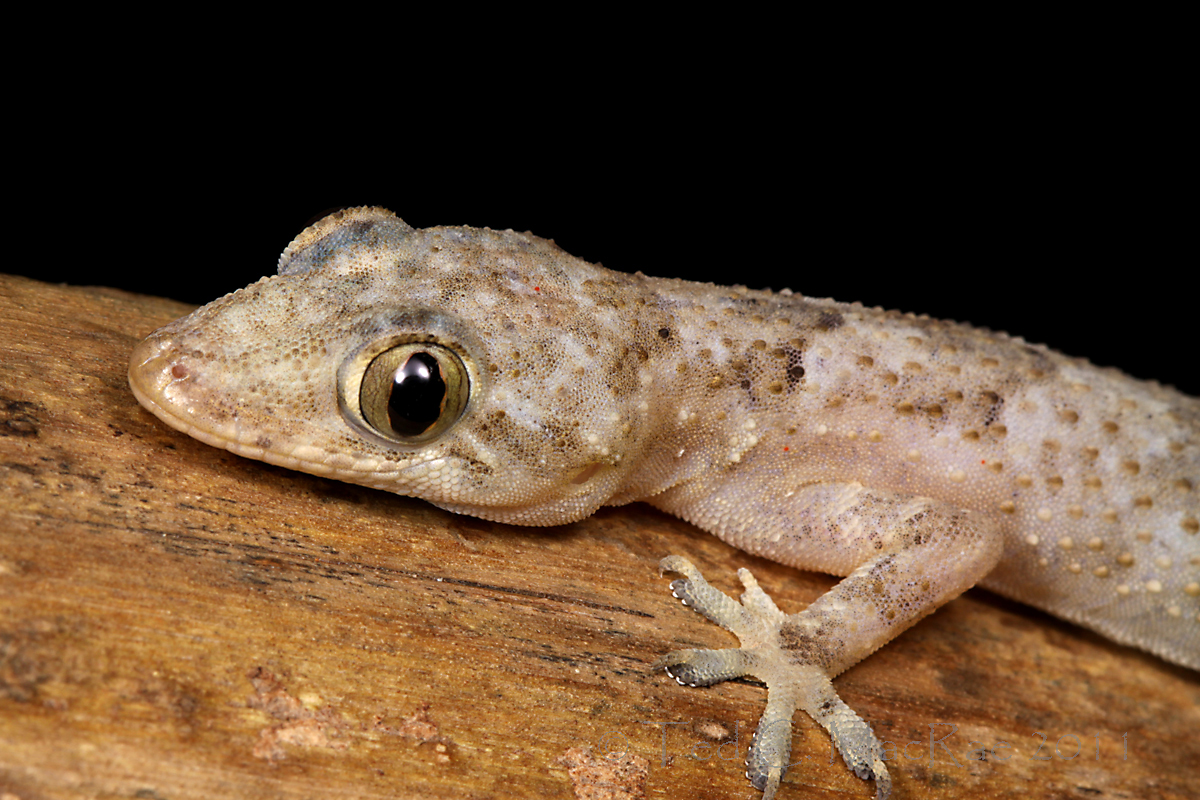
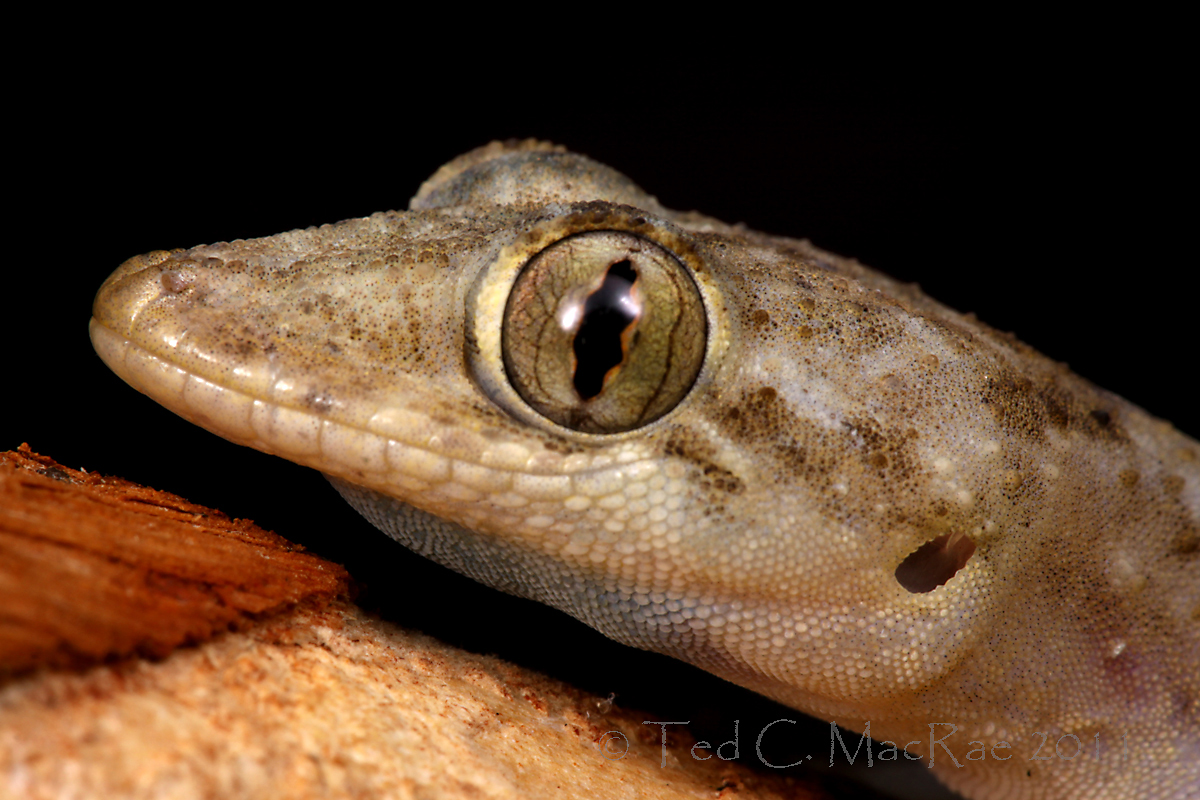
On my third night here in Campinas last week, I went out to check the building lights around the hotel grounds.  Surely a fantastical assortment of gaudy, tropical insects would be awaiting me on this hot, humid, summer night in southern Brazil.  Alas, virtually no insects were to be found anywhere – on the walls, in the window sills, under the street lights, or crawling on the sidewalks.  A disappointment, although I’m loathe to complain too much considering the number of insects I’ve encountered during the daylight hours.  I did find a gecko on the hotel wall, however, and although it is not a “bug” the lack of insects at the lights made a photography subject by default.

I’m not at all an expert on reptiles, and certainly those in South America, but I can’t help wondering if this is Hemidactylus mabouia – the tropical house gecko, or lagartixa-doméstica-tropical – an African species introduced to the New World and now widespread from the southern U.S. through much of South America and the Caribbean.

Copyright © Ted C. MacRae 2011
Brazil Bugs #4 – Mais dos percevejos

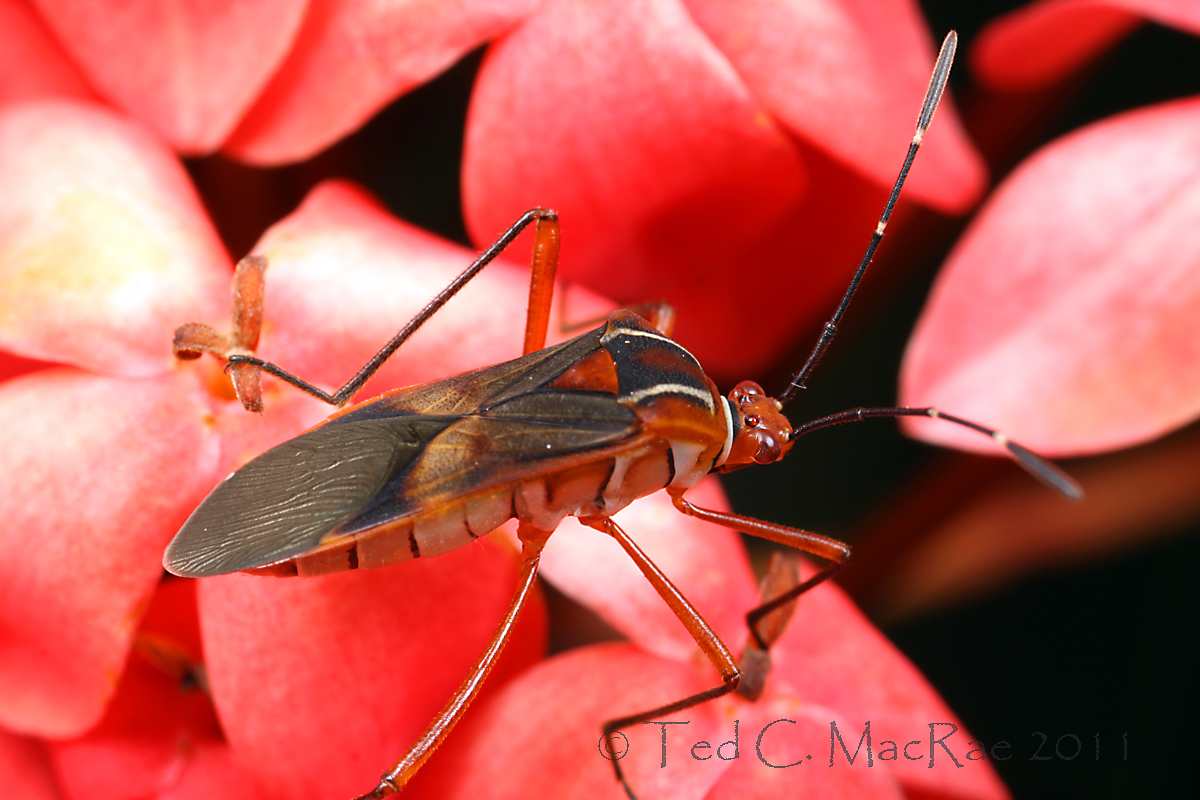
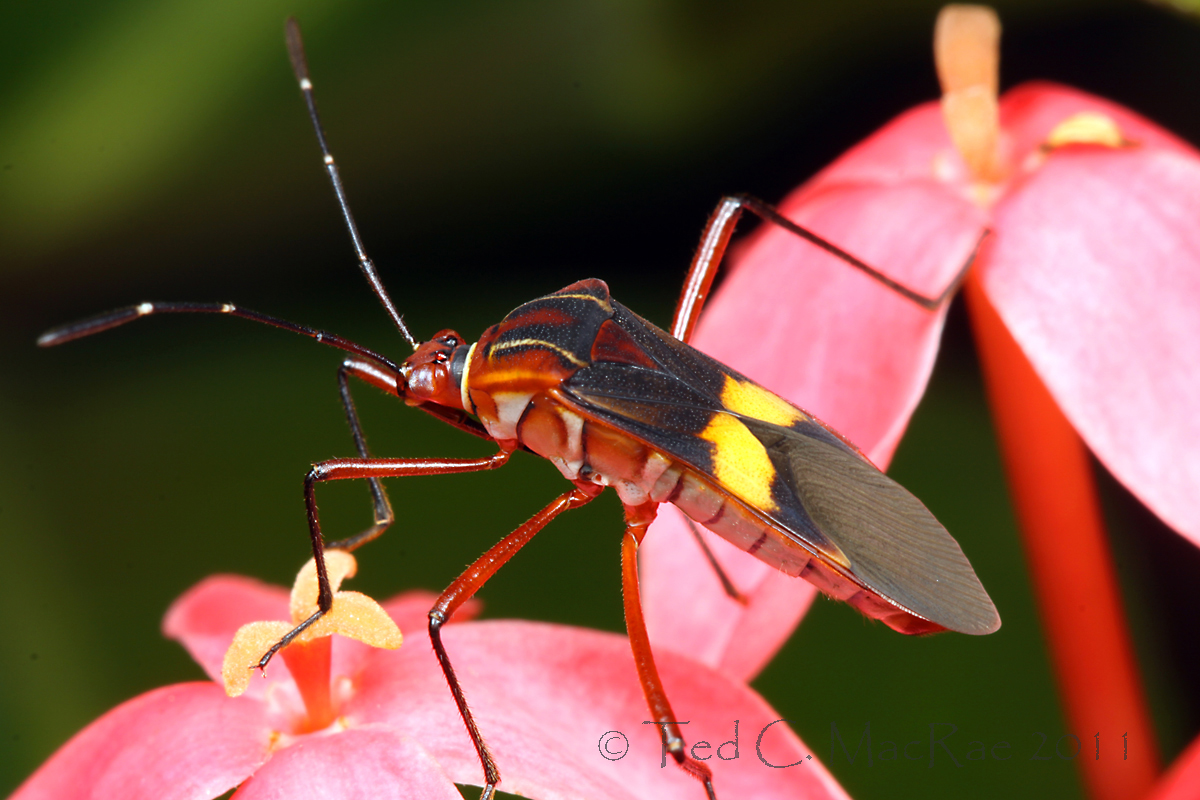
I found mais dos percevejos (more of the leaf-footed bugs) on the still-unnamed pink flowering shrub in back of the hotel in Campinas, Brazil.  Not only am I convinced that they truly do belong to the family Coreidae (for the reasons mentioned in the earlier post and below), but also that despite the different color patterns shown by the two individuals in that post that they are indeed a single species.  I also found the above individual, representing an even more heavily melanized version than the two shown previously.  In looking at a large number of individuals on the shrubs (and subsequently encountering them in a different part of Campinas over the weekend), it became clear that there were not just two distinct color forms but a broad range of variability.  I could believe maybe two species occurring together on a common resource, but it seems unlikely that each color variation represents a different species.  Thus, it now seems that there is one highly variable species visiting these flowers.

I had an idea on how to find the name of this species that almost worked.  Rather than Googling “leaf-footed bug” or “Coreidae,” I tried “percevejo” instead, along with Brazil or Brasil.  There were 3 or 4 photographs that showed up in the images search that I recognized instantly as belonging to the same species.  Unfortunately, none of the links where the photos were found gave any information more specific than family (all, however, agreeing with family Coreidae).  I think it’s time to send an email to Harry Brailovsky, a coreid specialist at the Instituto de Biologia (UNAM) in Mexico City.

Photo 1: Canon MP-E 65mm 1-5X macro lens (ISO 100, 1/200 sec, f/13).
Photo 2: Canon 100mm macro lens (ISO 100, 1/200 sec, f/16).
Both photos: Canon 50D, Canon MT-24EX flash w/ oversized DIY concave diffuser. Typical post-processing (levels, color, unsharp mask).

Last minute edit: I just heard back from Harry Brailovsky as I was ready to post (thank you Harry!).  The insect is, indeed, a species of Coreidae, which he identified as a member of the genus Hypselonotus.  I did some searching online to see if I could find any additional clues as the species identity – I found no images that looked right but did find this key to the Hypselonotus of Costa Rica.  The key relies on some ventral characters, and I’m a little uneasy about using it for something from southern Brazil, so I think I’ll just wait until Harry has a chance to look it up when he returns to the museum.

Second update 1/26/11:  Harry has confirmed the species as Hypselonotus interruptus, which was mentioned but not included in the key that I linked to above.  The only online images I have found of this species are at this link. Either Harry is wrong (unlikely), the photos in the link are misidentified (maybe), or the species is enormously variable (perhaps quite likely).

Copyright © Ted C. MacRae 2011
Brazil Bugs #3 – Gorgulho Enorme!

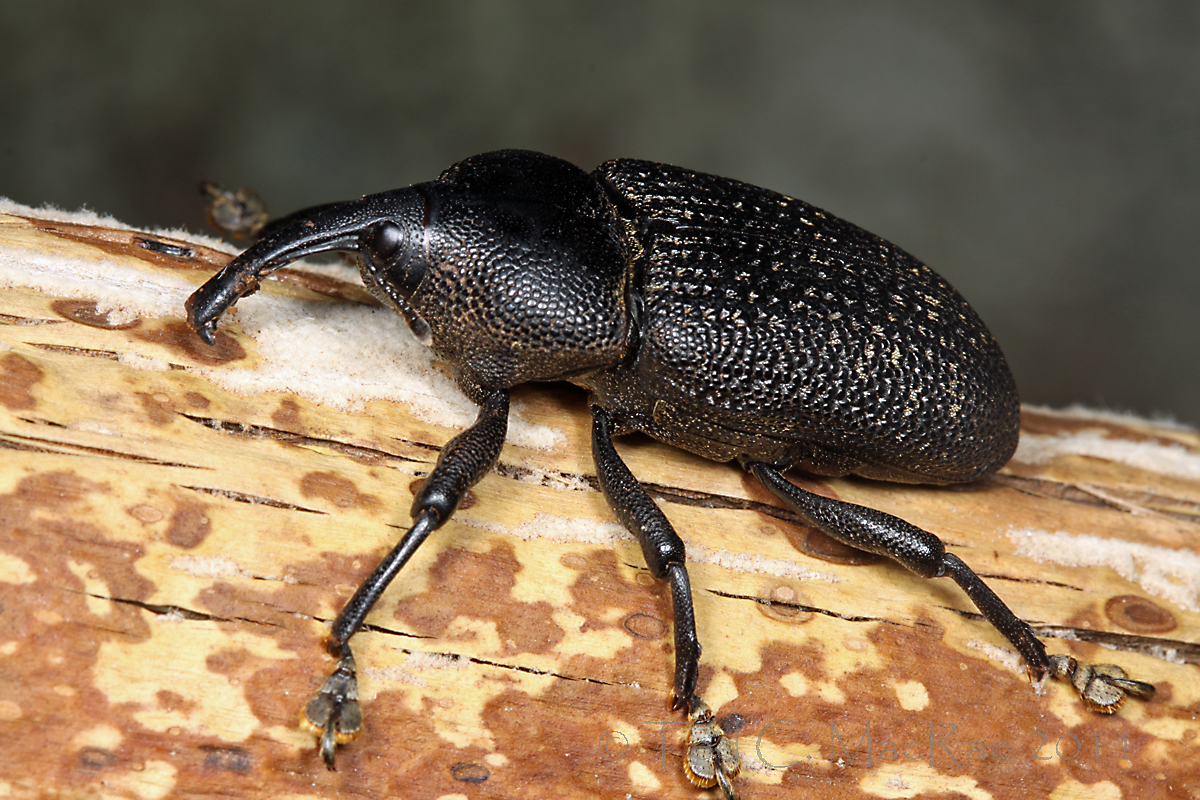
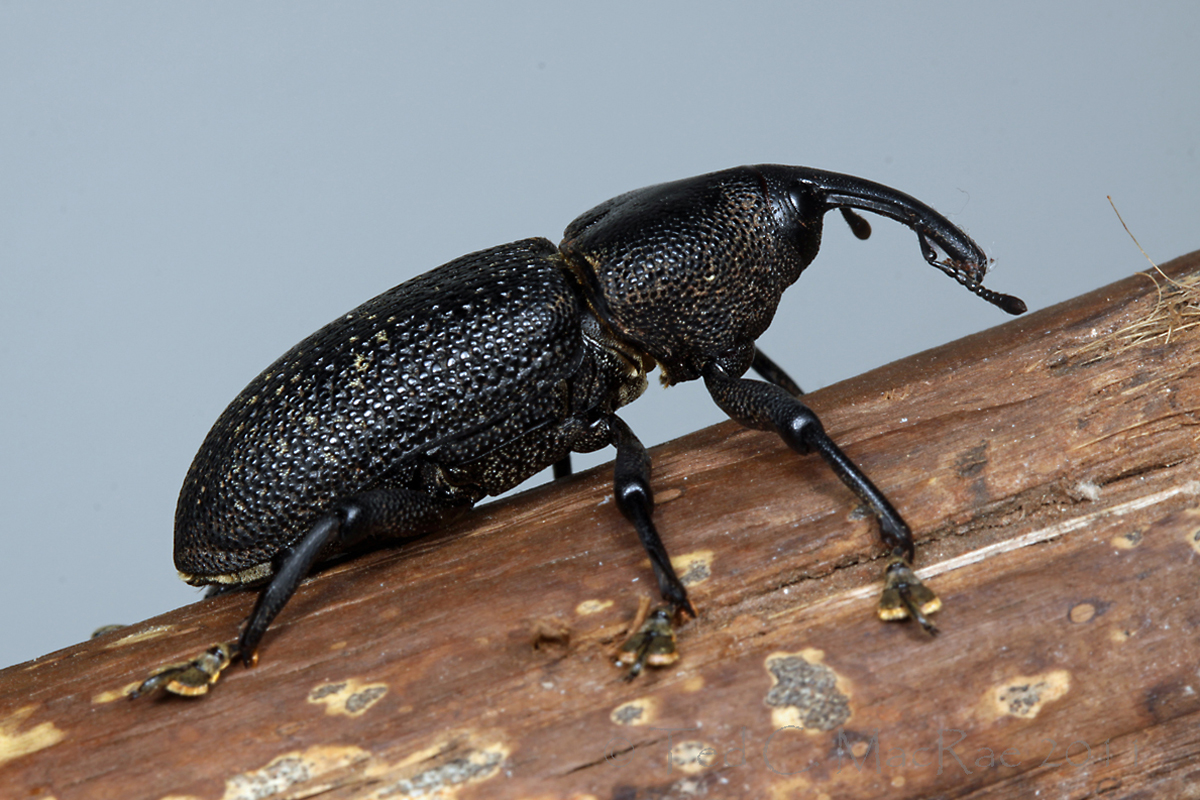
The second night at the hotel on the outskirts of Campinas (São Paulo, Brazil), I found this enormous weevil laying on the ground underneath some windows.  It was dead but completely relaxed and in perfect shape.  I wondered if it had been attracted to lights in the window the previous evening and flown there as its “last hurrah.”  This beast of a weevil – measuring a good 30mm from the tip of the snout to the apex of the elytra – immediately brought to my mind giant palm weevils of the genus Rhynchophorus (Coleoptera: Curculionidae).  I looked around and saw palm trees everywhere, so I figured that must be what it was.  I picked up one of the dead fronds from under a nearby palm tree and placed the weevil on the stem for a few photographs.  Given it’s freshness, it was quite easy to place in a lifelike pose, and I placed the stick in various positions to get a few different backgrounds.  As I was shooting, I noticed another, smaller, weevil on the ground near where I had found the first one – also dead and fresh.  Considering that Rhynchophorus often reaches pest status on palms, this further confirmed the ID in my mind.

Once back in the hotel room I smugly entered “giant palm weevil” into Google to bring up some images and confirm my ID (and also make sure my photos were at least on par with published images).  When the images came up, I saw immediately that my weevil was not a giant palm weevil at all.  While the South American species (R. palmarum) is black, the pronotum and elytra are much smoother and distinctly striate.  I don’t know if this weevil is a member of the same subfamily (Rhychophorinae) as the giant palm weevils, but it certainly not a member of that genus.  Still, considering its large size and distinctive appearance, I remained confident that an ID would come quickly.  Sadly, this has not proven to be the case – no search term I’ve tried involving the term “giant black weevil Brazil” or its many variations brings up anything remotely similar.  So, after spending much more time trying to identify this beetle than I should have, I leave it in the hands of my readers in the hopes that one of you will recognize it and provide a name.  Only when we have a name will it be possible to know something more about how this beetle lives (and if my placing it on a dead palm frond was a truly artificial setup).

Photo Details: Canon 50D w/ 100mm macro lens (ISO 100, 1/200 sec, f/16-18), Canon MT-24EX flash w/ oversized DIY concave diffuser. Typical post-processing (levels, minor cropping, unsharp mask).

Update 01/24/11: Thanks to Henry Hespenheide (via Facebook) and Art Evans, who clued me in to the genus Homalinotus (subfamily Cholinae).  I found a key to the 21 known species of this exclusively Neotropical genus (Vaurie 1973) and consider this individual to represent H. coriaceus – broca do cacho do coqueiro (black coconut bunch weevil).  This species breeds in the stems of old leaves of several native palms; however, it has adapted to the introduced coconut palm and apparently become a limiting factor in the commercial production of coconuts.  Thus, I can breathe easy now knowing that my photographs of this individual on the stem of a dead palm frond represent an entirely natural setting.

REFERENCE:

Vaurie, P.  1973.  The weevil genera Homalinotus and Ozopherus of the Neotropical Cholinae (Coleoptera, Curculionidae).  Bulletin of the American Museum of Natural History 152(1):1–49.

Copyright © Ted C. MacRae 2011