Sunday Spider: Backlit Araneus

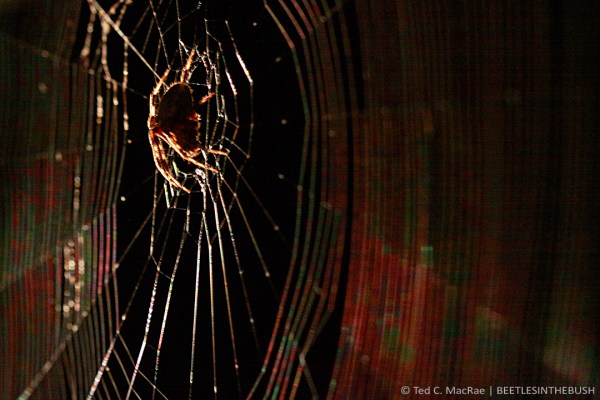
Araneus sp. | Wildwood, St. Louis Co., Missouri

Araneus sp. | Wildwood, St. Louis Co., Missouri

Letting the dog out tonight, I encountered this spider—presumably in the genus Araneus—who had strung up her web in the corner of the doorway and was eerily backlit when I turned on the porch light. Without a tripod that would allow me to position the camera about 7′ above the floor and make use of a super long exposure, my only option for capturing the scene hand-held was to crank the ISO all the way up to 3200, ratchet down the shutter speed to 1/20th sec, and open up the aperture to f/5.6 (any lower and the shallow depth of field would have been unacceptable). Heavy-handed processing to reduce noise and increase sharpness yielded a serviceable photo; however, I’ve been thinking about getting a tripod lately, and the chance to produce much better versions of scenes like this only strengthen those thoughts.

Copyright © Ted C. MacRae 2013
And the results are in…

I recently entered my first photo contest, a local competition sponsored by the Webster Groves Nature Study Society (of which I have been a member for ~30 years), and although the competition was limited to its few hundred members there were some serious cash prizes on offer. Being a noob at photo contests and a still relative newcomer to photography in general, I wasn’t sure what to expect. I thought my photos might be good enough to compete, but I also knew I would be going up against some long-time and very skilled nature photographers. The basic rules were a maximum of two submissions in no more than three of the following categories:

  • Botany
  • Entomology
  • Ornithology
  • Landscapes/habitats

Since I’ve only photographed two birds ever, I decided to submit entries to each of the other three categories. It was an interesting competition—the judges (each category had a panel of three consisting of a WNGSS board member, a natural history expert, and a photography expert) had a chance to see all of the photographs prior to the event (held last night) and select the top ten from each category, but the rest of the judging was done live at the event. Eventually, from each category a 1st place, 2nd place, and 3rd place photo was selected. The 12 winning photographs were then displayed in a continuous loop, and everybody attending the event was allowed to vote for one grand prize winner. The grand prize winner had to receive more than 50% of the vote, so a few runoff rounds were required to decide the final winner.

How did it go for me? I had a pretty good night, with three winning photographs:

Entomology—3rd place

Cicindela repanda (Bronze Tiger Beetle) | St. Louis Co., Missouri

Cicindela repanda (Bronze Tiger Beetle) | St. Louis Co., Missouri

Botany—2nd place

Hamammelis vernalis (Ozark witch hazel) | Iron Co., Missouri

Hamammelis vernalis (Ozark witch hazel) | Iron Co., Missouri

Entomology—1st place

Arctosa littoralis (beach wolf spider) | Lewis Co., Missouri

It was a thrill for me to learn that, out of the six photographs I submitted (and I really didn’t think my two landscape submissions were competitive to begin with), three were among the 12 final prize winners. That also made them eligible for the grand prize, but in this case I didn’t really expect the larger membership (which has a lot of birders) would really take to my closeup insect photographs. To my surprise, the first round of voting produced four finalists—two of which were my insect photos! The first runoff vote eliminated one photo—but not either of mine, and the second runoff eliminated one more photo—but again neither of mine. I had won the grand prize without yet knowing which photo would be the winner! In the end, the tiger beetle took the top prize. Personally, I was happy about that, because even though the photo took only 3rd place in the entomology competition, I thought it was the stronger of the two photos based on composition, the time and effort it took to work the beetle to finally “get the shot” (not that the wolf spider photo didn’t also take a lot of effort to get that close), and the natural history behavior that it captured (stilting and sun-facing for thermoregulation). I know blog commenting is becoming passé, but if you have any particular thoughts about these photos, good or bad, I would love to hear from you.

Overall I would have to say that, winner or not, participating in a photo competition was an extraordinary learning opportunity for me as I try to hone my craft. Listening to the comments of the judges in all of the categories, both on the natural history and the technical aspects of the photographs, gave me a lot of insight into how I might further improve my technique and take photographs that can be appreciated on both technical and artistic grounds. More importantly, the cash was nice, but the motivation to keep trying that I got out of the experience was priceless!

Copyright © Ted C. MacRae 2013

Mother and daughter (perhaps)

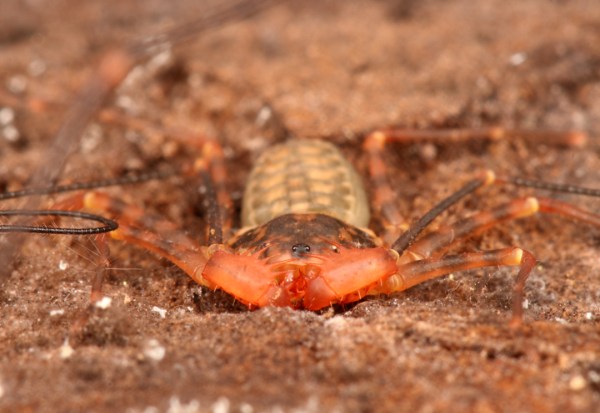
Phrynus marginenotata (Florida tailless whip scorpion)

Back in May I visited the California Department of Food and Agriculture’s Plant Pest Diagnostics Laboratory in Sacramento. While I was there to visit my friend and colleague Chuck Bellamy and see him receive Honorary Membership in The Coleopterists Society, I was also anxious for the opportunity to spend time with the lab’s other entomologists—most of whom I interact with as members of the Editorial Board of The Pan-Pacific Entomologist. Among the more ‘colorful’ of these is Martin Hauser, a dipterist (although I don’t hold that against him!) who also has a passion for maintaining live, captive arthropods. For me, there is nothing finer than visiting the lab/office of a taxonomic entomologist—one wall lined with steel cabinets full of insect specimens, another wall crammed-full of books and literature (the older the better), a workbench with microscope at the center of a jumble of specimen containers and open reprints, and shipping boxes piled everywhere. I take that back—there is nothing finer than visiting the lab/office of a taxonomic entomologist that also keeps livestock! Martin’s collection of live arthropods, however, goes well beyond the requisite 10-gallon aquarium with Madagascan hissing cockroaches. I already featured one of his more unusual tenants, Damon diadema (Tanzanian giant tailless whip scorpion), and here I feature its North American relative, Phrynus marginenotata (Florida tailless whip scorpion).

The genus is characterized by five spines on the pedipalp tibia—the 3rd shorter than the 2nd and 4th.

According to Weygoldt (2000), this is the northernmost and only U.S. representative of a mostly northern Neotropical genus of eleven species, recognized by the pedipalp tibia (the thickened segment of their “claws”) with five spines—the middle one shorter than the 2nd and 4th (refer to Photo 2). This species occurs in southern Florida and some Antillean islands, where it lives under coral stones and rocks close to the beach—a habitat that presumably subjects them to periodic flooding. While most tailless whip scorpions prefer humid/moist environments, they nevertheless studiously avoid standing water itself. This species, however, has been observed to voluntarily enter the water when placed on a stone surrounded by water and remain submerged for as many as eight hours. Remarkably, submerged individuals remain active and do not drown, apparently the result of a “plastron”—an area of the cuticle surrounding the lung openings that is packed with stiff, branched structures and, thus, capable of holding a volume of air against the body while the animal is submerged. The plastron seems to function much like a gill—oxygen continuously diffuses into the plastron from the surrounding water as it is used for respiration.

The bright orange pedipalps of 2nd-instar nymphs contrast with the somber coloration of the adults.

Like the D. diadema individuals that I also photographed, these P. marginenotata individuals had also produced viable eggs which had hatched a few weeks before my visit. Two nymphs can be seen with the adult in the top photo (although I can’t say for sure whether the adult is actually the mother), and Photos 3 and 4 show one of these nymphs up close and personal. I would have liked to have seen these nymphs when they first hatched, as the 1st-instars are a soft sea-green color and remain clustered on their mother’s abdomen until they are able to start fending for themselves (for a beautiful photo showing this, see Piotr Naskrecki’s The scariest animal that will never hurt you). The 2nd-instars that I photographed had already left their mother, and while they had lost their sea-green coloration, their pale yellow/gray bodies and bright orange pedipalps were no less striking compared to the more somber coloration of the full-sized adults.

…and, of course, the signature BitB face shot!

REFERENCE:

Weygoldt, P. 2000. Whip Spiders (Chelicerata: Amblypygi): Their Biology, Morphology and Systematics. Apollo Books, Stenstrup, Denmark, 163 pp.

Copyright © Ted C. MacRae 2012

Araneus marmoreus encore

Araneus marmoreus adult female—ventral view showing epigyne.

Here is the full-sized photo from which the crop shown in Super Crop Challenge #14 was taken. The small finger-like structure in the upper right of the photo—the object of the challenge—is the epigyne (or epigynum) of Araneus marmoreus (marbled orb weaver spider). Spiders have a rather unusual mating strategy—rather than possessing genitalia that couple for insemination, male spiders first form a packet of sperm (spermatophore) and transfer the packet to an enlarged segment (tarsus) at the end of their pedipalps. During mating, the male inserts the tarsus into the female genital opening, thereby effecting sperm transfer. The female genital opening and associated structures, located on the underside near the front of the abdomen, are called the epigyne and function to direct the male pedipalps during sperm transfer. The shape of the epigyne varies greatly and uniquely among species—probably serving as an isolating mechanism that prevents interspecific mating and also providing a good diagnostic character for species recognition among even very closely related species (similarly to the hardened male genitalia of many insect groups). An even closer view of the epigyne of A. marmoreus can be seen in this BugGuide photo.

Araneus marmoreus (marbled orb weaver) | Washington Co., Missouri

This is actually the second time I’ve featured A. marmoreus in a quiz—the intricate pattern of the dorsal abdomen being the subject of Super Crop Challenge #2. Folks had an easier time identifying the critter in that challenge than this one, which I guess is not surprising since people tend to know animals more by their color patterns than the structures of their genitalic openings. As in that first challenge, I encountered this adult female during a hike along the Ozark Trail, this time in Washington County in east-central Missouri. Unlike before, however, I found this spider crawling on a fallen log in the dark forest floor rather than resting in her web. The colors of this species are diverse and spectacular—a recipe that makes them almost irresistible to insect macrophotographers. That this is true is demonstrated by the 360! photos of this species posted to BugGuide.

Hot orange and yellows glow against the dark, moist wood of a fallen tree trunk.

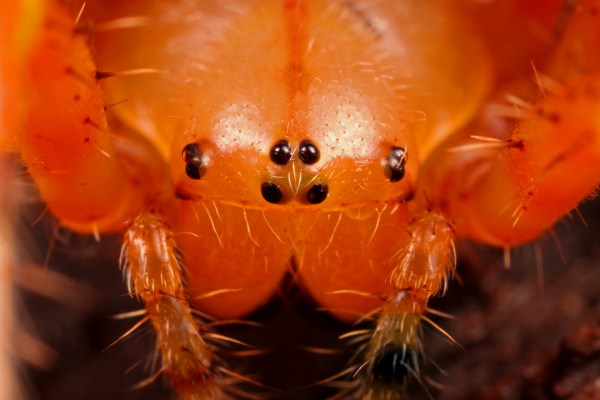
While my previous photos of this species were colorful, these simply glow due to the more orange coloration of this individual and its contrast with the darkened color of the moist wood. It’s a November color scheme if there ever was one—appropriate since I took them exactly one year ago today on November 23, 2011. She was a lot more cooperative than the first subject, and because of this and the stable substrate on which she was sitting I was able to get my favorite shot of all—the face portrait! Not quite as endearing as a jumping spider face (with its large, anthropomorphic median eyes), but striking nevertheless.

The obligatory BitB face shot!

A word about the challenges—I’m not sure if the lack of response to this one is an indication of difficulty or further evidence of declining relevance of blogs as an interactive social medium. I can’t help but notice that blog commenting in general has dropped with the rise of more functionally interactive media such as Twitter and Google+. What do you think—was this challenge too hard, or has the concept of challenge posts lost its appeal?

Copyright © Ted C. MacRae 2012

9th Annual Fall Tiger Beetle Trip: Day 1

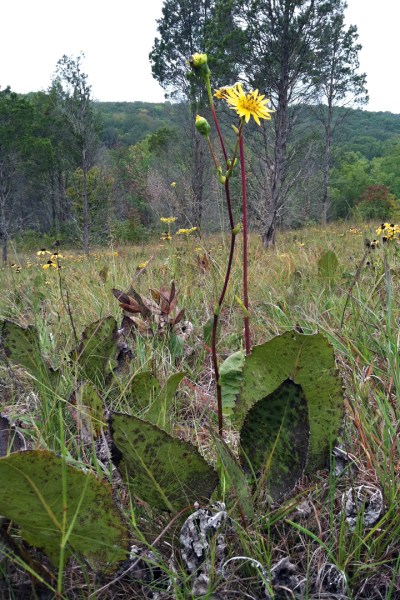
Once again, I have embarked upon my Annual Fall Tiger Beetle Trip, this being the ninth consecutive year that I have done such a trip. Unlike previous editions, however, the quarry on Day 1 (Sept. 15) was not a tiger beetle but a longhorned beetle. Ataxia hubbardi is not uncommon in the eastern and central U.S. and breeds in the living tissues of a variety of herbaceous plants, but especially certain species of Helianthus, Ambrosia, and Silphium in the family Asteraceae. I was hoping to see a distinctive population of this beetle that is associated with prairie dock (Silphium terebinthinaceum) in the dolomite glades just south of St. Louis. This population is interesting because individuals are smaller, darker, and narrower in form than is typical for the species, and I would like very much to get some photographs of the adults, which seem most abundant in the fall, on the tall flower stalks of their host plant.

Victoria Glades Natural Area | Jefferson Co., Missouri

I first discovered the population many years ago—back in the 1980s when I visited one particular glade, Victoria Glades Natural Area, almost weekly over a period of several years. I left Missouri for a few years in the early 1990s but returned in 1995, and during my absence fire was implemented in Victoria Glades and other glades in the area as a management practice for controlling invasion by woody plants (primarily eastern red-cedar, Juniperus virginiana). While the use of fire has certainly done much to restore the glades and improve its floral diversity, it seems more than coincidental that insect abundance and diversity on the glades is only a fraction of what I observed during my pre-burn collecting in the 1980s. There are a number of beetle species that I found at the glade historically that I have not seen now for more than 20 years; one of which is this distinctive population of A. hubbardi.

Prairie dock (Silphium terebinthinaceum) – host for Ataxia hubbardi

The prairie dock plants were at the height of bloom, but the flower stems seemed shorter and the normally large, spatulate basal leaves of the plants generally smaller than typical—perhaps a result of this summer’s severe drought. How such conditions affect the beetles is unknown. The day was also rather cool due to unbroken cloud cover and light drizzle, with temperatures in the low 70s during my visit. I spent the better part of two hours inspecting the stems of every prairie dock plant that I encountered and did not see a single beetle, so it has now been 23 years—almost a quarter century—since I’ve seen this once fairly common species at the glade. Can I prove that fire management has extirpated the beetle? No—populations might have been knocked down by the drought, or maybe the adults hide on cool, cloudy, drizzly days. Still, the pattern is too consistent to ignore, and I become increasingly worried that a special feature of these glades has now been lost.

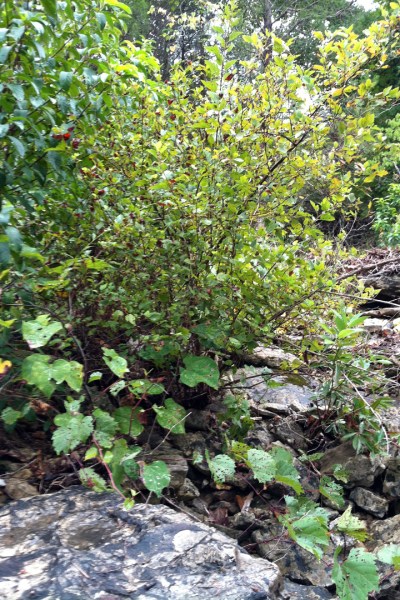
Ninebark (Physocarpus opulifolius intermedius) – host for Dicerca pugionata

On the other hand, another quite rare beetle that I encountered abundantly at Victoria Glades in the past seems to have rebounded from its long absence—the jewel beetle Dicerca pugionata. This beautiful beetle is associated with the scraggly clumps of ninebark (Physocarpus opulifolius intermedius) that hang on in the moist toe slopes of the glades. I wrote about this species earlier this year after re-discovering it in the glades; however, I couldn’t resist taking a few more photographs of this stunningly gorgeous species. This species also makes its appearance in the fall as well as spring, and in the two hours I spent searching I counted 13 beetles—more than I’ve ever seen on any one day. Interestingly, most of these were associated with a stand of plants in an area at the south end of the glade that I had never searched before and that appears not to have been subjected to fire management (cedar removal has been effected instead with a chain saw). Only a few of the beetles were found in the much more abundant plants growing in the area of the glade I am more familiar with and that has obviously been subjected to repeated burning. It’s not proof, but I’m just saying…

Dicerca pugionata on ninebark branch.

Adult beetles are colored almost precisely the same as the bark of their host plant.

More even lighting in this face shot compared to my previous attempts.

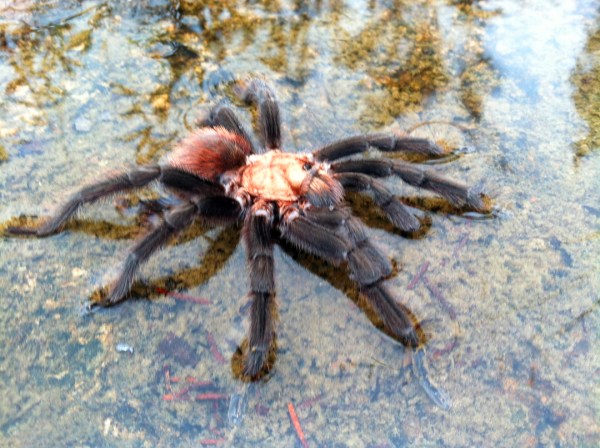
The cool temperatures and light drizzle were not conducive to much other insect activity, but while crossing the small, shallow creek that separates the south end of the glade from the main glade, the biggest male tarantula (Aphonopelma hentzi) that I have ever seen caught my attention as it crossed the creek. Situated only 30 miles south of St. Louis, Victoria Glades must represent the northeastern limit of distribution for the species, and although I once saw a tarantula crossing the road very near to this location, this is the first tarantula that I have actually seen in the glades that lie so close to St. Louis. Males are famous for their fall wanderings, presumably in search of the females that tend to stay within their burrows. This male was missing part of one of its hind legs but otherwise appeared quite healthy and robust. I hope he succeeds in finding a mate and sires many offspring and is not discovered by any of the poachers who regularly scour the glades and steal its more unusual inhabitants—the glades have already lost enough of their unique residents…

Can you find the tarantula crossing the creek? (Hint: 0.60X, 0.37Y)

Male Aphonopelma hentzi | Jefferson Co., Missouri

Copyright © Ted C. MacRae 2012

Not quite a one-shot

This little jumping spider (~8 mm in length) was in one of my soybean fields in west-central Illinois last week. She(?) was quite fidgety and kept jumping from the leaf on which I found her as I tried to carry the leaf out of the field to a more open and convenient place  to take photographs. Once I got out to the grassy field border, I managed to get one photograph (not shown but similar to this one) right before she jumped off the leaf yet again. However, I was able to find her and coax her back onto the leaf for this last shot before she jumped off again—never to be found again! I presume this spider belongs to the genus Phidippus based on the cephalic tufts, and within that genus maybe a species in the P. clarus group (corrections welcome!).

When I look at insect macrophotographs, I like to do reverse engineering on the lighting to figure out what was the flash/diffuser setup. I have a few different diffusers that I use depending on which lens I’m using and how important the photographs are. In this case, I was taking photographs of soybean insects for work purposes and didn’t bother putting on the larger concave diffuser that I use when I’m really concerned about getting more even lighting. Instead, I was just using my snap-on Sto-Fens+Gary Fong Puffers. The difference between these two diffuser setups and their effect on lighting is minor in many cases, but when photographing very shiny surfaces (such as the eyes of this spider) the differences are much more apparent, and it is obvious from this photo that I was using a twin flash unit with separate diffusers on each flash head.

There is one more feature apparent about the lighting in this photograph—note that the “left” flash head appears much more diffuse than the “right” flash head. This is because the right diffuser had actually fallen off of the flash head without me noticing (also never to be found again!). As a result, the light from only one of the flash heads was diffused, while that from the other hit the subject in all its harsh glory. I don’t really like the twin highlights that are the hallmark of twin macro flash units, and if I had known I was going to be photographing jumping spiders when I was in the soybean field I would have gone ahead and used my concave diffuser. I’ve also learned, however, that great photographs are not something that I can expect to pop off while concentrating on other activities—I need to concentrate fully on the photographs and spend a good amount of time doing it until I feel like I’ve gotten the shots that I want. I never really liked the Sto-Fen+Puffer diffusers, as they were only marginally better than no diffuser (and this photograph shows it), so losing one of them might be a blessing in disguise as now I’ll be motivated to try out some of the many other diffuser ideas I’ve been toying around with but never really taken the time to sit down and try them out.

Copyright © Ted C. MacRae 2012

Ghosts in the night

This summer I’ve spent quite a few nights hanging out along the Mississippi River—lamp on my head, vials in my pocket, and an ultraviolet (UV) light setup on the sandy banks. UV light collecting for insects (also called “blacklighting”) is a popular method among us beetlers, but for a number of reasons it’s been a while since I’ve done a lot of heavy blacklighting myself. That all changed this year when I decided I needed to get a better handle on the Missouri distribution of two species of tiger beetles, Ellipsoptera cuprascens and E. macra, found only in sandy habitats along the shores of the state’s two big rivers—the Missouri and Mississippi—and, fortuitously, attracted to blacklights at night. Blacklighting alongside these big rivers is a relatively new experience for me, as my previous experiences have been mostly in forests—either here in the Midwest or out in the desert southwest. Along the big rivers, as soon as the sun dips below the horizon hordes of hungry mosquitos descend upon me and choking swarms of caddisflies quickly envelop the blacklight. Liberal application of Deet keeps the mosquitoes at bay, but checking the sheet behind the blacklight to see if anything of interest has landed requires a bit of a mad dash and a quick retreat, all the while holding my breath and clamping the shirt cuff around my neck to prevent the swarming bugs from flying into spaces where I don’t want them.

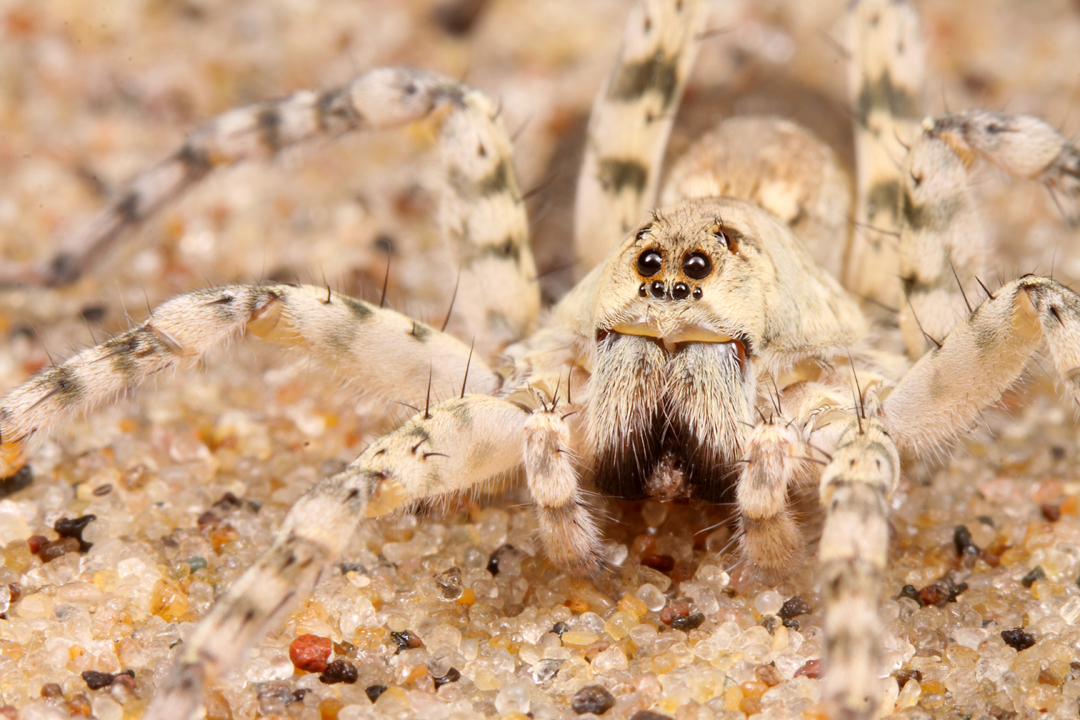
Arctosa littoralis (beach wolf spider) | Lewis Co., Missouri

Wandering away from the blacklight and exploring along the beach in the black of night is also a relatively new experience. While I’ve done a fair bit of night collecting away from the light, again this has tended to be in forests and woodlands with a beating sheet in hand looking for jewel beetles, which still hang out on the same host plants they can be found on during the day but are far less inclined to zip away as soon as they hit the sheet like they do when the sun is high overhead. I haven’t spent much time shining a lamp on the sand of a big river beach, so I wasn’t quite sure what to expect (other than hopefully a tiger beetle!). As I walked along the beach, I occasionally saw blue-green glowing dots on the sand—I recognized these fairly quickly as the eyes of spiders reflecting the light from my headlamp. However, at first when looked closer at the spot where I thought a spider should be sitting I didn’t see anything. It took a few tries before finally I saw ghost-like movement on the sand, and when I moved cautiously and got down close to the sand I finally saw a magnificent, white wolf spider sitting motionless—perfectly colored to blend into the sand on which it was sitting.

The mottled, white coloration is conspicuous on wet sand…

I quickly hurried back to the car and got my camera, set it up with a 100mm macro lens and extension tubes (hoping I could get real close), and went back to the spot where I’d seen the spider to see if I could find it again. I didn’t, but not too much searching was required before I found another one. Unfortunately, I didn’t succeed in photographing that one either. It was apparent to me that I was going to have to use the same ultra-cautious and slow movements that I use with tiger beetles if I was going to succeed in photographing one or more of these spiders. I quickly figured out that they were easier to see if I looked right along the water’s edge, as in that situation the white coloration of the spider actually stood out against the darkened, wet sand. (Of course, photographing them on the wet sand was a tad dirtier for me, but I’m not afraid to get filthy dirty when it comes to photographing arthropods.) I also figured out that I could more easily find the spiders on the wet sand and then follow them up to the drier sand for photos that better showed just how marvelously cryptic their coloration was.

…but provides perfect camouflage on the dry sand further away from the water’s edge.

Those of you familiar with my work know that I love frontal portraits, but I found this to be almost impossible during my first attempts. It was hard enough approaching the spider from the front without it bolting before I could get set behind the camera, but in the few cases where I did actually manage this then it would bolt as soon as I made any microadjustment in the position of the camera to compose the shot. It occurred to me that the spider was sensing vibration from moving the camera on the ground (ground-resting the camera is a technique that I use commonly to get the lowest possible angle on my subjects)—makes sense, as spiders are intensely tuned into vibrations for  prey capture. Once I began keeping my hand flat under the camera as sort of a makeshift “beanbag” I was able to make the final adjustments necessary to get shots like the one shown below and in ID Challenge #20.

Active primarily at night, the spider’s eyes glow blue-green when hit by light.

According to Dondale & Redner (1983) this should be Arctosa littoralis—widespread in littoral habitats across North America but, at least at the time of their revision, not recorded from Missouri [in fact, it seems no species of Arctosa was known from Missouri until A. virgo was recorded from oak-hickory forests in the southern part of the state by Bultman (1992)]. I’ll leave it to the spiderphiles to determine if this actually represents a new state record or (more likely) if I just haven’t dug deep enough into the literature.

Congratulations to 3-time champ Ben Coulter, who swooped in from his hiding place with 30 pts to win ID Challenge #20—the final challenge of BitB Challenge Session #6. It wasn’t enough, however, to disturb the overall standings, and Brady Richards maintained his overall lead with 28 pts to win Session #6. Sam Heads was just one point away from the win in this challenge, but his 29 pts were enough to earn a tie for 2nd place in the overall standings with Mr. Phidippus, who finished a respectable 4th place in this challenge. Nobody else came close to these three gentlemen in the overalls, so they deserve their accolades and loot (please contact me for details on the available choices). In case you haven’t been following along, here is a summary of the BitB Challenge champions to this point, listed by session:

  1. Ben Coulter
  2. Ben Coulter
  3. Max Barclay
  4. Ben Coulter
  5. Mr. Phidippus
  6. Brady Richards

REFERENCES:

Bultman, T. L. 1992. Abundance and association of cursorial spiders from calcareous fens in southern Missouri. Journal of Arachnology 20:165–172.

Dondale, C. D. & J. H. Redner. 1983. Revision of the wolf spiders of the genus Arctosa C . L. Koch in North and Central America (Araneae: Lycosidae). Journal of Arachnology 11:1–30.

Copyright © Ted C. MacRae 2012

ID Challenge #20

Has it really been seven weeks since the last ID Challenge? BitB Challenge session #6 overall leaders Brady Richards (66 pts), Mr. Phidippus (58 pts), and Sam Heads (54 pts) must think I’m trying to duck the final standings so I don’t have to doll out any loot. Let’s finish this session with a straight up ID Challenge—3 pts for order (der!), 4 pts for family, 5 pts for genus, and (to separate the imagos from the neonates) 6 pts for species. Bonus question worth 5 pts—what is the best way to search for this species? That’s a whopping total of 23 pts up for grabs in this one challenge (not including any discretionary bonus pts that might be awarded), so not only are the leaders not safe from each other, but from any number of other participants lurking just below them in the standings.  Please read the full rules if you are not already familiar with them—good luck!

Copyright © Ted C. MacRae 2012