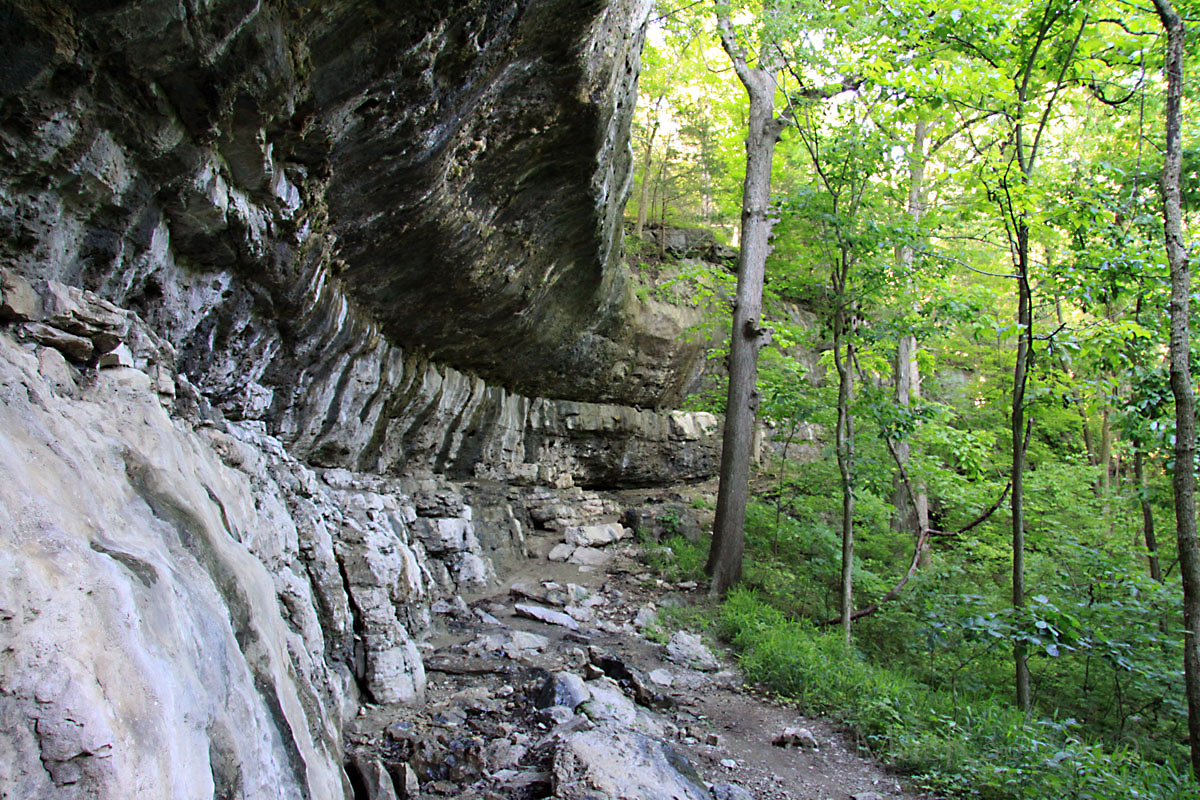
A First Class Box of Beetles

Warning: post contains lots of hardcore, beetle-collector geekery!

A nice selection of tiger beetles and buprestid beetles.

A few weeks ago I got an email from fellow buprestophile Henry Hespenheide (Professor Emeritus, UCLA) asking if I needed any specimens of Agrilus coxalis auroguttatus – recently dubbed the “goldspotted oak borer” after it was discovered damaging oaks in southern California (Coleman & Seybold 2008).  I replied that I did not have this species in my collection and that I would be grateful for any examples he could provide.  Shortly afterwards, I received another message from him saying that he had just placed in the mail a small box with a male/female pair of that species – along with about two dozen tiger beetles for my enjoyment!  Later that week I received the shipment at my office – I couldn’t wait to open it up and see what goodies were inside!
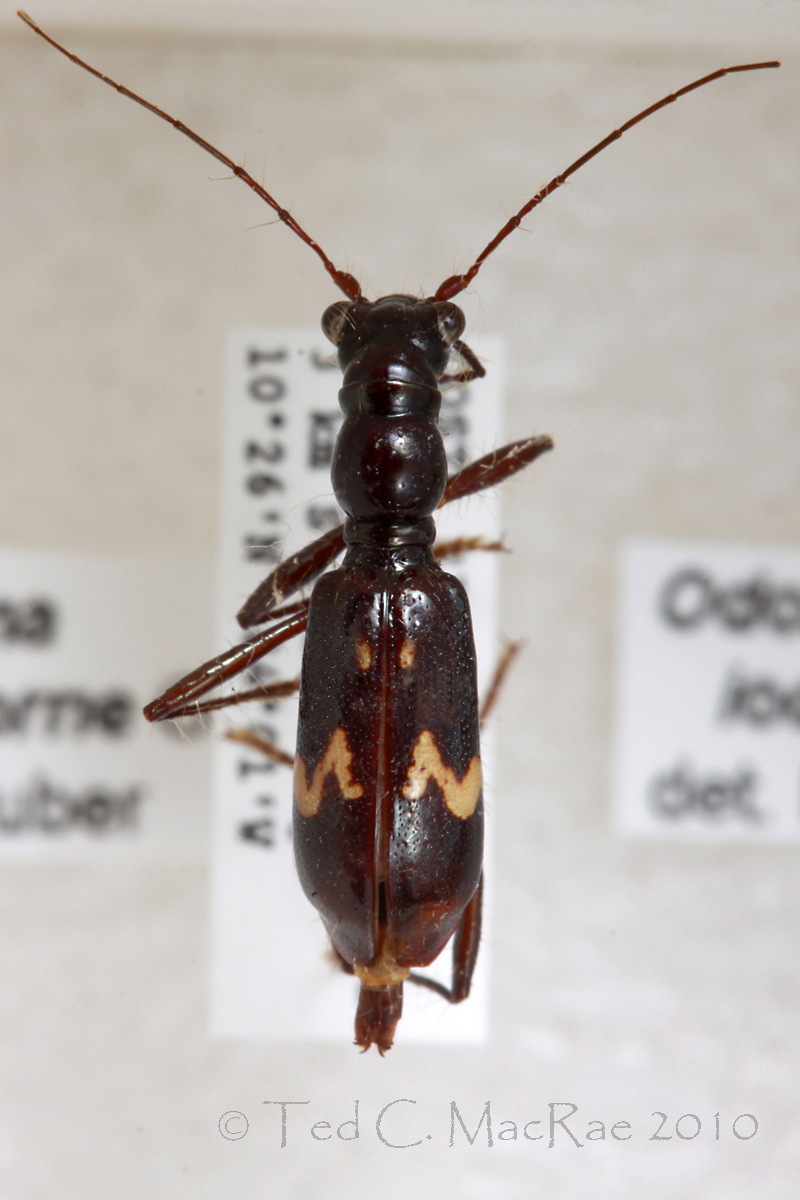
Ctenostoma maculicorne (Chevrolat, 1856)

Opening a box of just received specimens is a little like opening presents on Christmas – you don’t know for sure what’s inside, but you know you’re gonna like it!  This time was no exception, and I delighted as I realized the sending contained a dozen or so tiger beetles from Costa Rica and Nicaragua (a region in which Henry has spent many of his years studying the leaf-mining and twig boring buprestid beetles).  My eyes were immediately drawn to two tiger beetles in particular – specimen in the first row, and specimen #4 in the second row.  Why these particular tiger beetles?  Obviously they are among the more showy specimens in the sending, but more significantly both of them belong to genera not represented in my collection.  The first of these is Ctenostoma maculicorne, representing also a new tribe for my collection (Collyridini, subtribe Ctenostomina).  I’m glad Ron Huber had already identified this specimen, as I probably would’ve only been able to determine the genus.  Beetles in this group are ant mimics, but in a much different manner than our U.S. ant-mimics (Cylindera cursitans and Cylindera celeripes).  Those latter species are found strictly on the ground (as are all U.S. tiger beetle species), while species of Ctenostoma are largely arboreal.  Troy Bartlett at Nature Closeups has some great photographs of another species in this genus seen last January in Brazil (Caraça Natural Park, Minas Gerais) that show just how ant-like these beetles can appear as they crawl about on twigs and branches.
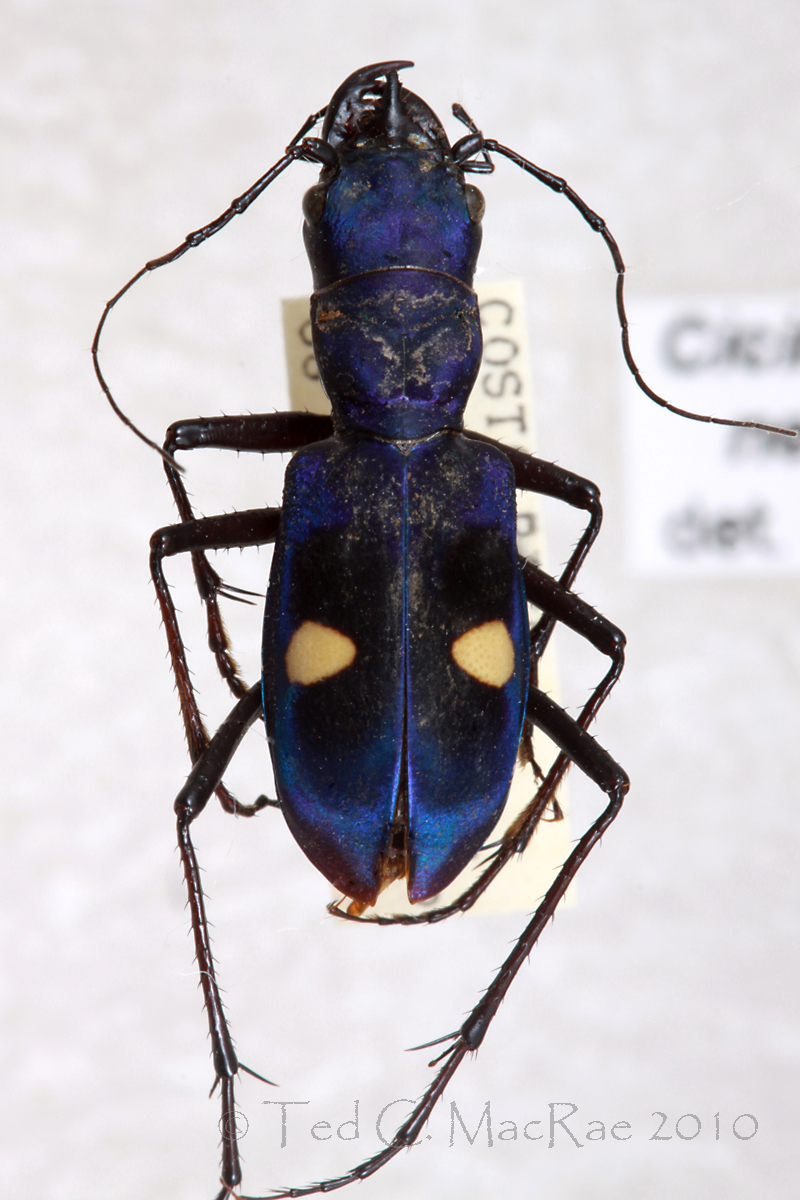
Pseudoxycheila tarsalis Bates, 1869

Despite lacking an identification label, I recognized the second specimen instantly as Pseudoxycheila tarsalis, dubbed by Erwin & Pearson (2008) as the “Central American montane tiger beetle.”  Pseudoxycheila is a rather large Neotropical genus (21 known species), but only P. tarsalis occurs north of South America.  Morgan Jackson at Biodiversity in Focus photographed an individual of this species during his visit to Costa Rica this past summer.  Its brilliant coloration is not only delightful to look at but also apparently aposematic in nature – Schultz and Puchalski (2001) found that benzene-like compounds isolated from the beetle’s pygidial glands are distasteful to humans, adding support to the potential of a Müllerian mimicry association with stinging mutillid wasps in the genus Hoplomutilla, which they resemble.  Note also the curious spine on the frons extending out over the mandibles – maybe it not only grabs its prey with its toothy jaws but also “stabs” it for extra measure (just kidding – though I do wonder about the function of that spine.  I’m not aware of its presence in any other genus of tiger beetles).

I also noted an interesting pair of tiger beetles that looked very different from each other, yet were both identified by Ron Huber as Tetracha ignea.  This species was recently synonymized under the nominotypical form of T. sobrina (Naviaux 2007) – the “ascendent metallic tiger beetle” (Erwin & Pearson 2008), a highly variable species with numerous described subspecies occurring in southern Mexico, Central America, northern South America, and the West Indies.  The specimen on the left has the normal appearance of T. sobrina sobrina, but the specimen on the right looks like it might have suffered some chemical discoloration (a common occurrence among collected tiger beetle specimens).

Update 16 Dec 2010, 12:00pm – I just learned from Henry that the Tetracha specimen on the right (from Nicaragua) was not seen by Ron Huber and, thus, is likely not conspecific with the specimen on the left (T. sobrina from Costa Rica).  That’ll teach me to blindly accept what I see but does not seem right.  Now, time to pull out my copy of Naviaux (2007) and test my abilities to work through a key written in French!

Tetracha sobrina sobrina Dejean, 1831 (L); Tetrach sp. undet. from Guatemala (R).

There are several other interesting species in the sending – some determined (two species each of Oxycheila and Brasiella) and others that I need to look at more closely.  You may note on the bottom row a few specimens of a species of Elaphrus – a genus of true ground beetles that often fool collectors by their strong resemblance to tiger beetles (looks like they fooled Henry, too).  As for the beetles that were the reason for this shipment in the first place, these are shown in the image below.  Agrilus coxalis auroguttatus was recently discovered as the cause of significant mortality in several species of oak trees in San Diego County (Coleman & Seybold 2008), thus joining the introduced Agrilus planipennis (emerald ash borer) and several native Agrilus spp. on the ever-growing list of buprestid beetles achieving economic pest status in North America.  This subspecies, known for many years from southern Arizona (where it is not a pest), is curiously widely disjunct from nominotypical populations in southern Mexico.  Its sudden appearance in southern California has all the hallmarks of being a human-aided introduction, although natural range expansion remains a possibility.
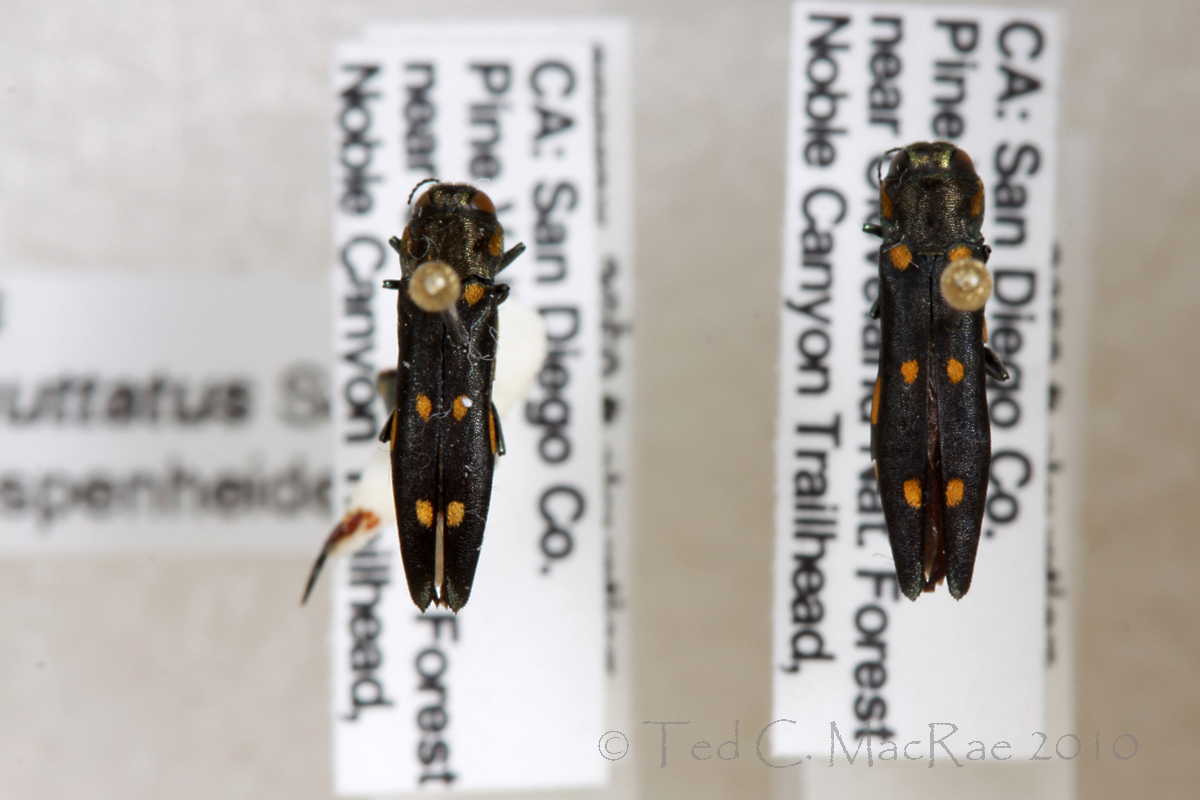
Agrilus coxalis auroguttatus Schaeffer, 1905

My deep appreciation to Henry Hespenheide for gifting me these specimens and for his always enlightening and often entertaining correspondence over the years.

REFERENCES:

Coleman, T. W. and S. J. Seybold.  2008.  Previously unrecorded damage to oak, Quercus spp., in southern California by the goldspotted oak borer, Agrilus coxalis Waterhouse (Coleoptera: Buprestidae).  The Pan-Pacific Entomologist 84:288–300.

Erwin, T. L. and D. L. Pearson. 2008. A Treatise on the Western Hemisphere Caraboidea (Coleoptera). Their classification, distributions, and ways of life. Volume II (Carabidae-Nebriiformes 2-Cicindelitae). Pensoft Series Faunistica 84. Pensoft Publishers, Sofia, 400 pp.

Naviaux R. 2007. Tetracha (Coleoptera, Cicindelidae, Megacephalina): Revision du genre et descriptions de nouveaus taxons. Mémoires de la Société entomologique de France 7:1–197.

Schultz, T. D. and J. Puchalski.  2001.  Chemical defenses in the tiger beetle Pseudoxycheila tarsalis Bates (Carabidae: Cicindelinae).  The Coleopterists Bulletin 55(2):164–166.

Copyright © Ted C. MacRae 2010


“Colorfull Cockroach” discovered in Panama

I won’t call this a taxonomy fail, since Patrick is clearly not a taxonomist, or even the first person to confuse a beetle with a cockroach.  Nevertheless, I was amused at Patrick’s amazement with the “colorfull cockroach” that he found and his palpable excitement that it might be a new discovery.

Well, I was amazed about this type of cockroach so, I would like to know if it is a cockroach or what because I know you guys will be also interested about checking out this type of bug.
Thanks please answer fast 🙂
Maybe is a new kind of cockroach not discovered yet.

Fortunately, the folks at What’s That Bug were able to correctly identify this as Euchroma gigantea (giant metallic ceiba borer), a beetle in the family Buprestidae (and the largest such species in the Western Hemisphere).  An interesting note about this photo is that it shows the beetle with some – but not all – of the green pulverulence (dusty coating) that these beetles exhibit over the elytra upon emergence from their host tree.  This coating is quickly worn off as the beetle goes about its activities, and most museum specimens of the species lack it completely – giving the beetle a purplish appearance as seen on the left elytron of the beetle in this photo.  Even handling a freshly-emerged specimen to mount it on an insect pin would likely result in loss of much of the coating, so it is quite difficult to preserve specimens in their lime-green dusty state.

Copyright © Ted C. MacRae 2010

Special Delivery

Entomology is, of course, a wide and varied discipline that touches any number of human endeavors – from the practical (agriculture, food production, public health) to the esoteric (genetics, ecology, cultural symbolism).  Despite this far-reach, however, entomologists themselves are not all that common, and the number of people who know a fair amount about insects without actually being an entomologist is rather small.  Compare this to ornithology, where the number of people who know a good deal about birds exceeds by great measure the number of actual ornithologists.  This is merely an observation and not a criticism – insects are just simply too small and too diverse for most lay people to even attempt identification.  That’s good for me, as those who have an interest in insects but not the expertise to identify them often turn to me for help.  For most of my adult life, I’ve been “the bug guy” at social gatherings, often leading to questions such as, “I’ve got this green bug on my bushes – what is it?”  Sometimes the insect or its situation are described well enough that I can offer a guess (just a guess!), more often I can only say, “I’d have to see it to know for sure.”  Despite not always being able to answer the question, I really do enjoy serving as this very direct link between the science of entomology and the general public, as it gives me a chance to present insects and their study in a favorable light and with a sense of passion.

The level of this interaction has increased greatly during the past two years since launching Beetles in the Bush.  Now, my “clients” include not just family, friends, their friends, etc., but an unrestricted internet audience.  I am regularly contacted by those who stumble upon this blog during a Google search in their attempt to identify some insect they’ve encountered.  Again, I’m not always able to answer their queries, but I do try to offer my best guess.  Such was the case recently when I was contacted by a resident of southwestern Missouri, who had this to say:

While messing around here in the yard this morning I came upon a beetle I thought interesting. First time I have seen one like this. I Have a Simon and Schusters Guide to insects guide and attempted to look up the beetle. Closest thing I could find was a flat-headed borer (BUPRESTIS GIBBSI) from the Pacific Northwest. Emerald green with yellow slash or stripe along the side of the head. four matching yellow spots on the wing covers, first pair closest to the front of the covers elongated. Second set smaller, third set smaller yet and then tiny sopts on the wing cover tips. Yellow center pattern along the bottom from head to tail. Bettle length almost 2.5 cm. I am not much of a insect man but when I get something stuck in my head I need to know what I have. Can you help me and if you do not have one in your collection do you want this one?

This is perhaps the best, most detailed description of an insect I’ve ever received from a non-specialist wanting an identification, but the reference to it resembling Buprestis gibbsii was enough to immediately bring to mind an eastern U.S. relative – B. rufipes.  I responded that it was likely the latter, and since they had offered to send it to me I would be happy to receive it and confirm its identity.  I instructed them to wrap the beetle loosely in a square of toilet paper, put that in a film canister or other small, sturdy box, and slip that inside a padded envelope and mail it to me.  A few days later a small padded envelope arrived at my office, and inside was a film canister.  I popped the lid to find it stuffed full with tissue paper, but I noted that the tissue seemed all chewed up.  I pulled out the tissue and unfolded it, and there was no beetle – oh no, was it alive, and did it chew it’s way out?  I looked inside the canister, almost expecting to see a hole chewed though it, and there at the bottom sat a most stunning example of B. rufipes (literally meaning red-legged buprestis).  I hadn’t expected the specimen to be sent alive when I gave my mailing instructions (but I did not, after all, specify that it should be otherwise), and I felt a little sorry for the beast when I saw it drinking eagerly after I put it in a terrarium with wood chips and a stick and misted it with water.  Once it was rehydrated, I was glad to have this unexpected opportunity to photograph a living individual of this beautiful species.

Buprestis rufipes is not a rare species, but it is certainly not very commonly encountered either.  For many years the only specimens in my collectioni were two dead adults that I found in Japanese beetle traps that I monitored during my early days with the Department of Agriculture.  I finally cued into this species when I chopped some big buprestid larvae out of the trunk sapwood of a very large, standing dead slippery elm (Ulmus rubra).  They resembled the larvae of Chrysobothris but were larger and not so flattened, so I retrieved my chain saw from the truck and extricated the lower 6ft of the 6-8″ diameter trunk from the swamp in which it was growing.  My efforts were rewarded with a nice series of this species, and I have since reared it from even larger trunk sections of Acer saccharum and Quercus palustris. In each case, the wood was in early stages of decay with the bark partly sloughed and the outer wood layer slightly softened (MacRae and Nelson 2003, MacRae 2006). Knull (1925) recorded this species breeding in a variety of other hardwoods, thus, it would seem that the size and condition of the wood are more important than the species.

Photo Details: Canon 50D (ISO 100, 1/250 sec), Canon 100mm macro lens, Canon MT-24EX flash (1/4 power).
Photos 1-2: f/13, indirect flash in white box.
Photo 3: f/16, double diffused flash.
Typical post-processing (minor cropping, levels and unsharp mask).

REFERENCES:

Knull, J. N. 1925. The Buprestidae of Pennsylvania (Coleoptera). Ohio State University Studies 2(2):1–71.

MacRae, T. C., and G. H. Nelson. 2003. Distributional and biological notes on Buprestidae (Coleoptera) in North and Central America and the West Indies, with validation of one species. The Coleopterists Bulletin57(1):57–70.

MacRae, T. C. 2006. Distributional and biological notes on North American Buprestidae (Coleoptera), with comments on variation in Anthaxia (Haplanthaxiaviridicornis (Say) and A. (H.) viridfrons Gory. The Pan-Pacific Entomologist 82(2):166–199.

Copyright © Ted C. MacRae 2010

Add to FacebookAdd to DiggAdd to Del.icio.usAdd to StumbleuponAdd to RedditAdd to BlinklistAdd to TwitterAdd to TechnoratiAdd to Yahoo BuzzAdd to Newsvine

Email to a friend

Call for paratypes!

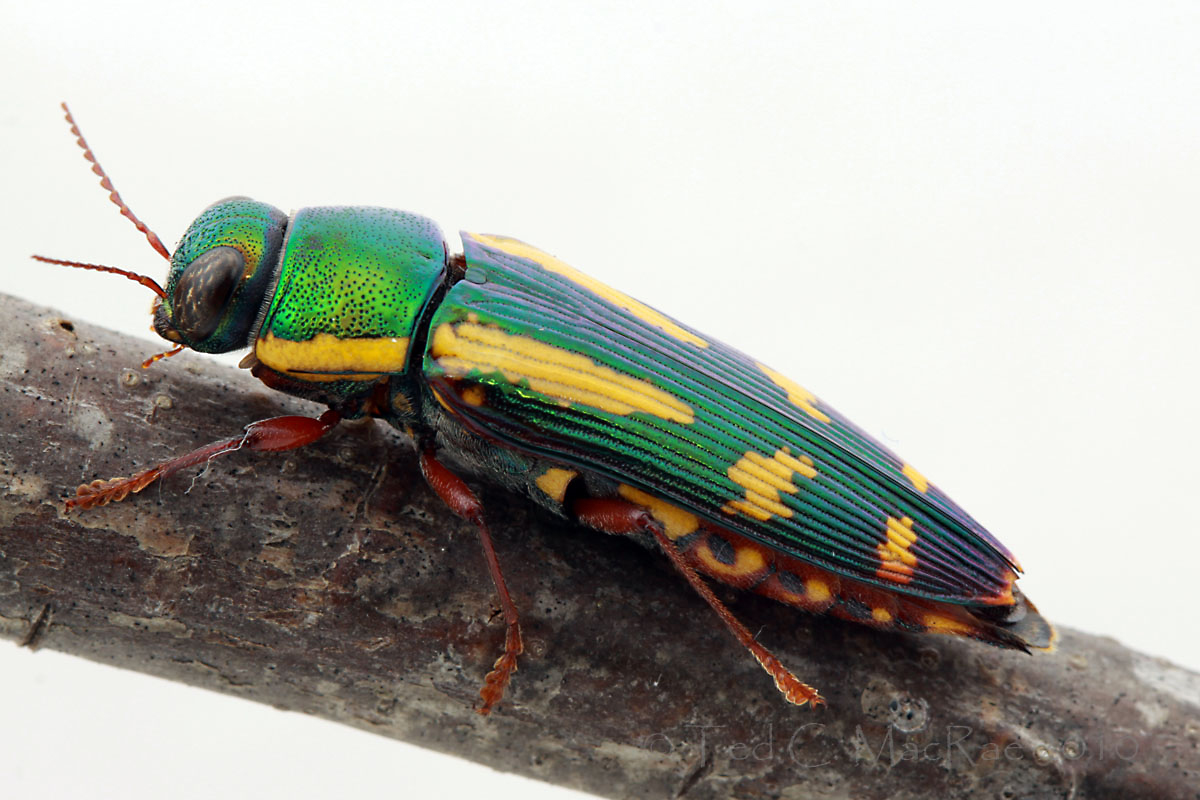
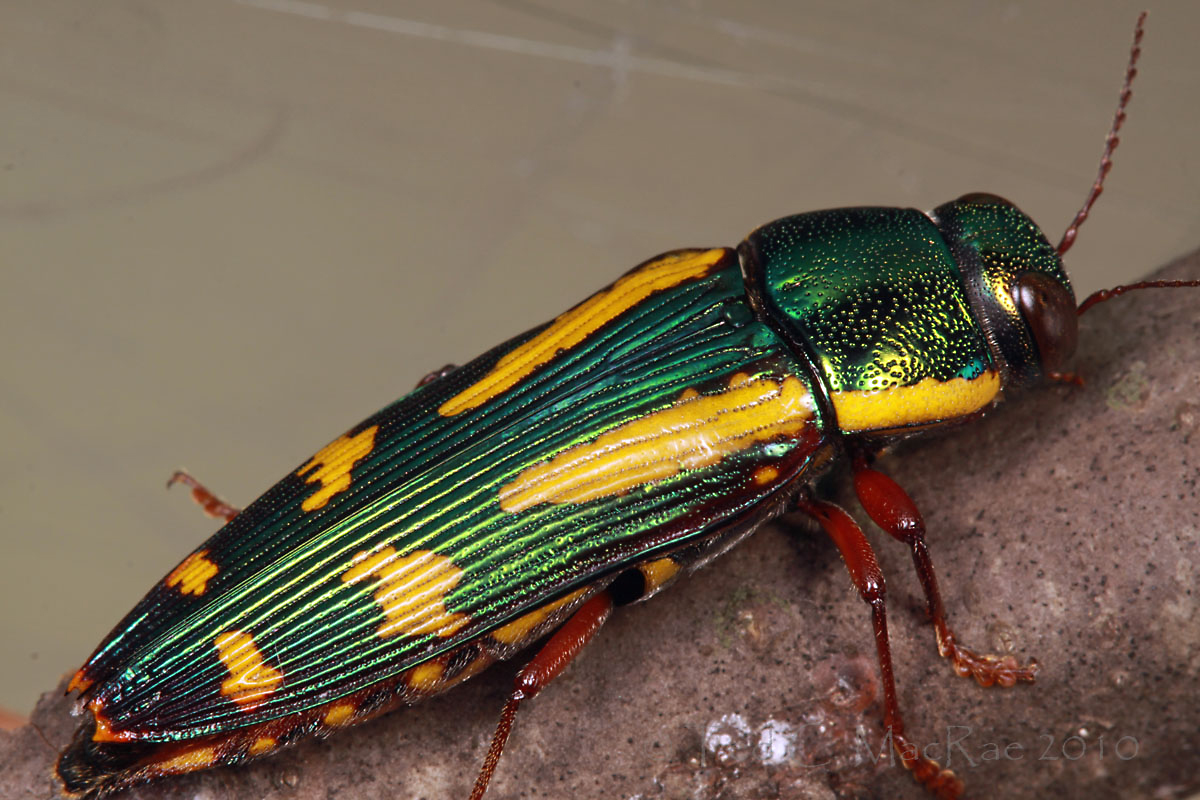
Acmaeodera n. sp. (Santa Cruz Co., Arizona)

Earlier this year, I featured this small jewel beetle in the genus Acmaeodera (family Buprestidae).  It was collected a few years ago in southeastern Arizona by my hymenopterist friend Mike Arduser, who over the years has given me a great variety of buprestid and cerambycid beetles that he has encountered on flowers while collecting representatives of his chosen specialty – apoid bees (bee specialists are often great collectors of flower visiting insects across many taxa!).  This particular specimen is perhaps the most exciting of all of those, as it appears to represent an undescribed species.  Unfortunately, it is the only specimen known, and describing new species based on a single specimen in a genus such as Acmaeodera – diverse, variable, and with ill-defined species limits – is not advisable.  I have enlisted the help of a few insect collectors to try to find more specimens of this species to allow proper description; however, so far no additional specimens have turned up.  The summer monsoons have begun this season in southeast Arizona, thus the next few weeks will once again provide the opportunity to encounter this beetle.  I am hoping that this post, with precise locality data, information on the circumstances of its collection, and photographs of the beetle and its habitat, will prompt any entomologists reading this to scour the mountains of Arizona during the next month (or the accumulation of undetermined material in their collections) in the hopes of encountering additional specimens to allow formal description of this species.

Label data for the specimen are as follows: “ARIZONA Santa Cruz Co. | Atacosa Mountains | along Ruby Road [E of #100 Trailhead], 6,000 ft. | August 2, 2003 10-1200 [hrs] | Aloysia flwrs – Arduser”.  The first person to search for additional specimens was my friend Paul Kaufman, who searched for the beetle in August 2007.  Here is what he had to say afterwards:

Well, we found the site based on the GPS readings you gave me.  We could not find any of the Aloysia in that location, but there were some other leguminous plants with white flowers a-buzz with bees.  No beetles however.  The area has had a fire burn through it in fairly recent history – several years maybe?  It’s hard to tell, but that could have changed things a bit.  Anyway, we drove west on Ruby Rd a few tenths of a mile and did find a drainage full of Aloysia!  This was the only location along Ruby Rd where we found any growing.  Three of us checked it very carefully uphill and downhill from the road (rough scrambling).  There were lots of bees, flies and leps, but no beetles!

The following year, North American Acmaeodera guru Rick Westcott himself went to search for this species – also without success.  He wrote:

If you remain in touch with the collector of the latter, please ask him if he got it up on the pinyon-juniper zone, or were there just oaks and junipers?  If he was at 6000′, I am quite certain there had to be pinyon.  The trail (#100) starts on the Ruby Road at 4700′ and goes to the lookout that is at 6200′.  I decided not to go to the latter, but I was close.  I did not see any flowers that were suitable for Acmaeodera, let alone did I see an Aloysia bush.  Much of the area had been burnt, though some years ago.

I sent this information to Mike Arduser, who replied as follows:

It appears now that I  must have  misinterpreted the elevation on my topo map and carried that error onto the label, because though I walked up almost to the lookout I did not do any collecting up that high. My collecting (hand net and malaise traps) was done adjacent to Ruby Rd., then upslope approximately 100 meters or so, all of it east of the #100 trailhead (which is where I parked). The only woody plants in the immediate vicinity I noted were Aloysia (in narrow rocky drainages) and a legume (forget the genus at the moment). However, I think there were a few oaks scattered around (I believe there was one where I parked). There was no evidence of fire at the time I was there.

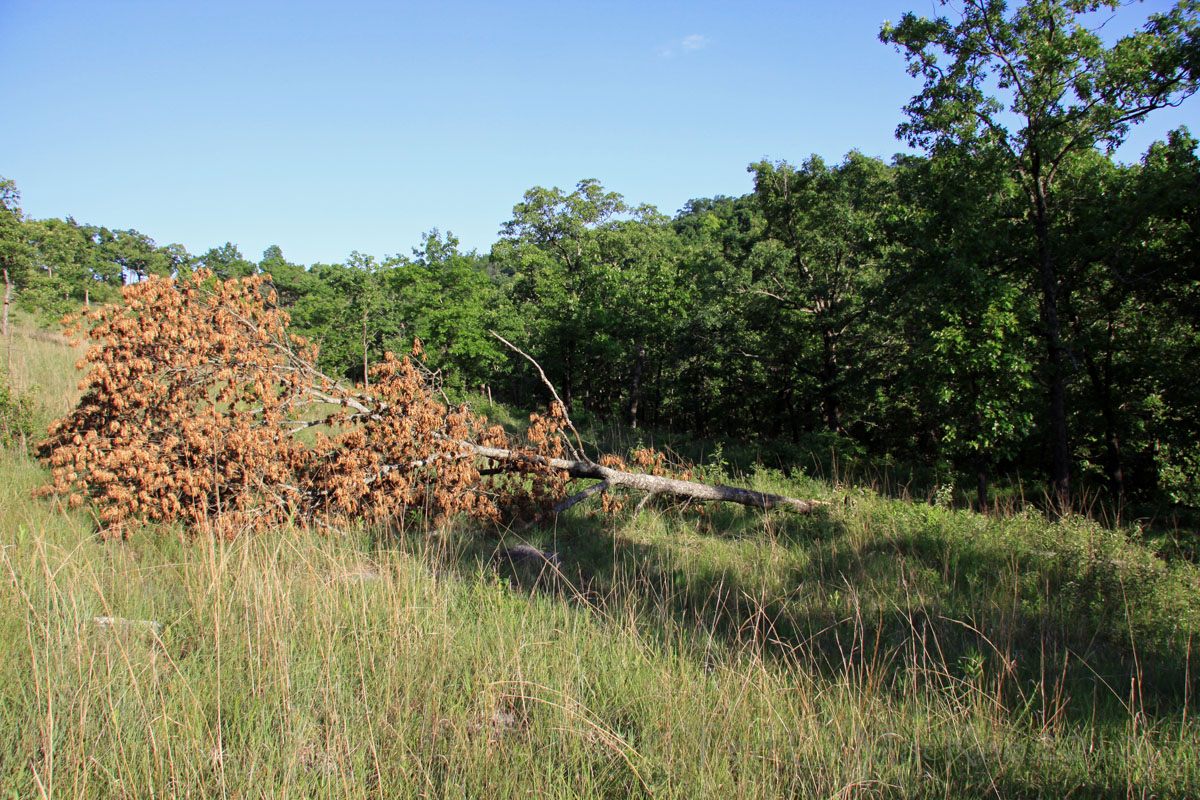
Mike also sent me the photo shown here taken near the collection site (if nothing else, the spectacular scenery makes a visit to this place seem like a good idea), noting:

Attached is a photo from the Atacosa Mtns. Area where the new buprestid was found – the photo was taken about 100ft. elev.  above the collection site and about a ¼ mile to the west.

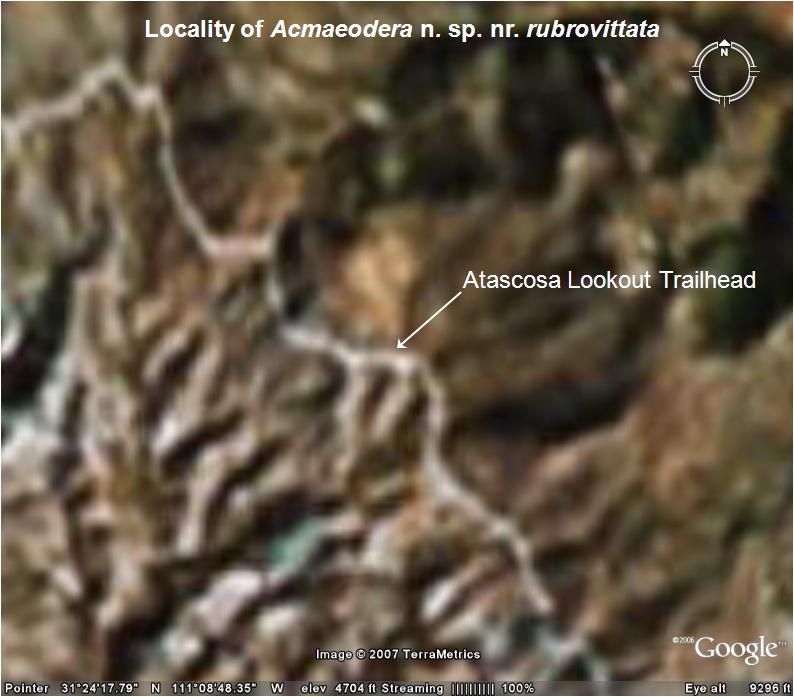
I’ve included a Google Map at left that shows the location of the Atascosa Lookout (#100) Trailhead.  It’s not the best overhead photo, but it does give an idea of the landscape relief and rather precisely pinpoints its location via GPS coordinates in the lower lefthand corner.  If the beetle truly does occur at lower elevations (~4,700′), then it is probably not terribly specific about this particular locality.  Perhaps it is a Mexican species that only occasionally makes it into the U.S. depending on the season. The repeated comments about apparent fire in the area by Paul and Rick suggest potential vegetational differences in the area from the time the beetle was collected compared to their subsequent visits. Although the single specimen was collected on Aloysia flowers, it is also possible that the species does not actually show a particular preference for this plant – although it does seem likely that it visits flowers of some type.  The only way to answer these questions is by finding more specimens!

Copyright © Ted C. MacRae 2010

Add to FacebookAdd to DiggAdd to Del.icio.usAdd to StumbleuponAdd to RedditAdd to BlinklistAdd to TwitterAdd to TechnoratiAdd to Yahoo BuzzAdd to Newsvine

Email to a friend

An irresistible sight!

One of the few highlights of my Memorial Day weekend collecting trip came in the earliest moments of my visit to Ha Ha Tonka State Park.  My destination was Ha Ha Tonka Savanna Natural Area, and a short walk through fire-restored woodland led me to the open glade where just a few years earlier a UMC student had collected the rare and little-known Agrilus impexus.  Entering the glade, I was all set to begin sweeping the vegetation along the woodland/glade interface, paying special attention to any honey locust (Gleditsia triacanthos) that I might happen to find in the area as a potential host for the beetle.  What I saw instead as the glade opened up in front of me was a sight that any collector of wood-boring beetles will find almost irresistable – a recent wind-throw!  In this case, it was a black oak (Quercus velutina) laying in full sun – its bright brown leaves suggesting that it had fallen within the past few weeks (and would thus still be emitting the volatiles that wood-boring beetles find so attractive).  I wanted to begin looking for A. impexus, but I knew there would be beetles actively crawling on the trunk and branches of that tree.  I couldn’t resist it – I dropped my sweep net and beating sheet and made my way to the tree (in the end it didn’t matter, since no other beetles – including A. impexus – would be seen that day).

I already had an idea what I might find.  Recent wind-throws are the domain of Chrysobothris, and if the tree is a deciduous species then this means members of the Chrysobothris femorata species-group.  I recently featured one of six newly described members (C. caddo) of this taxonomically challenging group (Wellso and Manley 2007), providing a synopsis of the now twelve species in the group and their primarily host preferences.  Fully half of these are associated primarily or exclusively with oaks four occurring in Missouri (quadriimpressarugosiceps, shawnee, and viridiceps).  Of these, C. quadriimpressa is the most commonly encountered (although the others are by no means uncommon), and all of the nearly dozen or so beetles I found on this particular tree in fact represented that species. Confirmation of my ID would require microscopic examination of the female pygidium (which is shallowly impressed on each side of the middle) and male genitalia, but in general this species can be distinguished in the field by its smallish size (~10-12 mm in length – rugosiceps and shawnee tend to be larger) and the post-median pair of foveae (circular impressions) on the elytra being joined (they are distinctly separated in viridiceps).

As we’ve seen with other species of jewel beetles (e.g., C. caddo, Dicerca lurida, D. obscura), adults of C. quadriimpressa are incredibly cryptic and nearly impossible to see on the bark of their hosts – at least until they move.  They are notoriously difficult to approach – their large eyes and penchant for rapid escape flights suggesting excellent vision.  This is a useful capability for insects that must expose themselves to would-be predators (and beetle collectors) during daylight hours while actively searching dead trees for mates and oviposition sites.  One thing I can’t figure out, however, is the role of the intensely blue feet in this and other cryptically colored Chrysobothris species (see also C. caddo).  Any ideas?

Photo Details (insect): Canon 50D (ISO 100, 1/250 sec, f/16), Canon 100mm macro lens w/ Kenco extension tubes (68mm), Canon MT-24EX flash (1/4 ratio) w/ Sto-Fen diffusers.  Post-processing: levels, unsharp mask, minimal cropping.

REFERENCES:

Wellso, S. G. and G. V. Manley. 2007. A revision of the Chrysobothris femorata (Olivier, 1790) species group from North America, north of Mexico (Coleoptera: Buprestidae). Zootaxa 1652:1–26 (first page only).

Copyright © Ted C. MacRae 2010

Add to FacebookAdd to DiggAdd to Del.icio.usAdd to StumbleuponAdd to RedditAdd to BlinklistAdd to TwitterAdd to TechnoratiAdd to Yahoo BuzzAdd to Newsvine

Email to a friend

Are we loving our prairies/glades/woodlands to death?

I had such high hopes for last weekend’s collecting trip – late May is boom time for insects across Missouri, we have had good moisture this spring, and I would be visiting some high-quality natural communities that I had not visited for a long time.  My stated goals (the jewel beetles, Agrilus impexus and A. frosti) were long shots – I knew that and would have been fine coming home without those species (which I did) had the the collecting been otherwise productive (which it was not).  Still, I’ve been doing this for a long time now, and I’ve learned to draw on my accumulated experience when things don’t go as planned to give myself the best shot at turning a bad collecting trip into a decent one when things don’t go as planned.  The itinerary with which I start is rarely the one that I actually follow, and this past weekend was a good example of such.

My first stop was Ha Ha Tonka State Park, one of Missouri’s premier parks, boasting high-quality chert, dolomite, and sandstone savanna interspersed with dolomite glades.  It is on these glades and savannas that I hoped to find Agrilus impexus, or failing that at least collect a nice diversity of other jewel beetles on the oaks and hickories of the savannas and surrounding woodlands.  However, it was with some reservation that I even came here after being told by my colleague at the Department of Natural Resources just 2 days before my trip that 75% of the park’s grasslands and woodlands had been burned within the past two years.  For an insect collector, this is never good news – in all my years of collecting insects, my experience in relatively recently-burned habitats has been consistent: collecting sucks!  I decided, however, to visit Ha Ha Tonka anyway because of the quality of the natural communities it contains, thinking perhaps I might be able to find pockets of unburned habitat supporting good insect populations.  This was not to be. I beat oak after oak in the savannas and woodlands – nothing!  I swept little bluestem and Indian grass in the glades – nothing!  The foliage was lush and green and the savanna and glade landscapes highly diverse – given the time of season the place should have been teeming with insect life, yet it almost seemed sterile. Were it not for a few Chrysobothris quadriimpressa jewel beetle adults that I found attracted to a recently wind-thrown black oak tree, I would not have seen any insects here at all.  It appeared my fears about park-wide depression of insect populations had been realized.  However, not one to waste a visit I decided to explore some of Ha Ha Tonka’s fascinating geological features.  Ha Ha Tonka contains one of Missouri’s best examples of karst geology, with complex structures formed from the collapse of a major cave system.  The Devil’s Promenade is one of the more spectacular examples of such, its horseshoe-shaped cliff representing the former interior walls of a now-collapsed cave.  As dusk approached, the day’s poor insect collecting caused me to abandon my plans to stay here and blacklight for nocturnal beetles.  Instead, I decided to break from the itinerary, drive further west and explore Lichen Glade Natural Area in the morning before heading to the Penn-Sylvania Prairie BioBlitz later that afternoon.

Devils Promenade, Ha Ha Tonka State Park

Lichen Glade Natural Area is a small area owned by The Nature Conservancy that boasts a high-quality sandstone glade surrounded by post oak/black jack oak forest.  My first visit to the area more than 20 years ago was during May, and it was one of the most productive collecting trips I’ve had with a number of Agrilus spp. (including A. frosti) beaten from post oak (Quercus stellata) along the woodland edge.  I didn’t visit again until fall of 2002, when Chris Brown, Rich Thoma and I found claybank tiger beetles (Cicindela limbalis) sunning on the exposed sandstone outcrops, and I made one more visit the following May to beat more insects off of post oak.  The Lichen Glade that I returned to this past weekend was a very different place from when I last visited – the surrounding woodlands had been extensively opened (I would guess within the past few years based on the size of the post oak resprouts), and fire had been used throughout the area.  Anticipation turned to frustration when no amount of beating of the woodland vegetation and sweeping of the glade vegetation turned up beetles in any appreciable numbers (or any insects for that matter) and two hours worth of effort yielded not a single buprestid beetle!

Sandstone glade community, Lichen Glade Natural Area

With resignation, I headed on over to Penn-Sylvania Prairie, where during the introduction to the BioBlitz I learned that nearly half of the 160-acre prairie was burned last December and all of it had been burned within the past few years.  I knew what I was going to find – nothing!  Okay, I shouldn’t say nothing, as there actually were some beetles present.  However, the numbers and diversity were low, with all of the species encountered representing common, widespread species.  Moreover, it was not just beetles – all of the invertebrate group leaders (which included experts on snails, ants, butterflies, and bees) reported low overall abundance and diversity in their groups of interest.  Only the vascular plants – the metric by which the value of prescribed burning is always assessed – showed high diversity, with 300 species of mostly native prairie plants recorded for the site.  It was a fun event, with probably ~75 attendees and a delicious pot luck dinner that evening; however, it would have been more enjoyable had there actually been a nice diversity of insects present to document for the preserve.

My comments may make it seem that I am against the use of prescribed burning.  This is not true – I understand the critical role that fire as a management technique plays in restoring and maintaining examples of Missouri’s historically fire-mediated landscape. Without fire and other processes to mimic natural disturbance factors, most of Missouri’s historical grasslands and woodlands suffer relentless encroachment by woody vegetation. However, the modern landscape is very different from the historical landscape, where fires of unpredictable scale, intensity, and frequency operated within a vastly larger scale to create a shifting mosaic of natural communities in various stages of ecological succession. Such processes cannot be recreated on today’s severely fragmented landscape, where the precious few remaining tracts of native habitat are relatively to extremely small and more often than not separated from each other by vast expanses of homogeneous and “inhospitable” habitat (e.g., agricultural, urbanized, or severely degraded lands).  It is in that context that I have great concerns about how aggressively fire has been used in recent years on our state’s natural areas and the impact this is having on insect populations – specialist and generalist alike.  Fire proponents will point to published studies that show little to no effect by the use of fire for managing small, isolated remnants on specialist insects (see review in Henderson 2010).  However, there are an equal number of studies that suggest such concerns are well-founded (see review in Panzer 2002). A consistent limitation in all of the studies that have been conducted is the lack of very large and long un-burned remnants.  Prescribed burning has been adopted so rapidly and pervasively that there just aren’t any significant un-burned remnants left to properly include as controls in such studies.  As a result, the insect fauna present at a given site at the start of such a study is already skewed towards those species that successfully recolonized the area post-burn.  At a minimum, the data to this point are inconclusive, and certainly the potential for impacts has not been given the consideration it warrants in designing fire-management plans for our own state’s prairies and glades. Furthermore, as rapidly and aggressively as fire has been adopted on our few, small, widely disjuct remnants, the opportunity for proper investigation of those potential effects may be gone.  A particularly egregious example of the lack of consideration being given to prairie invertebrates in designing fire management plans is shown in these photos of Iowa’s Sylvan Runkel State Preserve before and after a late May burn and the impact of that burn on a resident population of Nevada buck moths (Hemileuca nevadensis).

Here in Missouri, as in Iowa, it’s a problem of scale – the landscape is too fragmented and remnants too disjunct to manage based strictly on floristic response.   Populations of generalist insect species will recover, and even specialist species may be able to overcome such management practices if they are widely distributed and sufficiently mobile. But what about conservative species with low vagility, such as the swift tiger beetle (Cylindera celeripes) and our disjunct population of the frosted dromo tiger beetle (Dromochorus pruinina), flightless species restricted in Missouri to the few tiny remnants of loess hilltop prairie in northwestern Missouri and a single 2.5-mile stretch of roadside habitat in west-central Missouri?  Until directly relevant data, gathered here in Missouri, are forthcoming to suggest otherwise, I believe the most judicious use of fire possible should be practiced in restoring and maintaining our grasslands and woodlands.  In-season burns may have been a part of the historical landscape, but their use today has great potential to result in local extirpations and should be used only after the most careful consideration.  Leaving un-burned refugia within remnant habitats to accelerate recovery would also be prudent – yet many land managers disregard this practice because of its logistical difficulties. This is especially true in small parcels, yet it is precisely these remnants that have the most to gain from their use (or lose from not doing so!).  In the historical landscape, every burn was a patch burn – no matter what its size, there were always adjacent or proximal unburned habitat from which recolonization could occur.  Elk and bison, too, were integral components of the presettlement prairie landscape – their roamings caused intermittent, localized disturbances that were likely not only crucial to the tiger beetles that I study but may also have contributed to vegetational diversity through patch succession.  Techniques that mimic these natural disturbance factors include mowing, haying, and managed grazing.  They can be utilized to mimic those disturbances as well as delay woody encroachment, and their use in land management should be considered for their ecological value rather than deprioritized because of their relatively greater complexity and cost to implement. Mechanical removal and selective use of herbicides offer additional tools for addressing woody encroachment while minimizing potential impacts to insect populations. An effective management program that considers all of the flora and fauna of a remnant may not be possible unless all of these management tools are utilized, or at least properly considered. As my good friend James Trager said in a recent email (quoting Andrew Williams), habitat restoration “cannot rest on any single management practice, nor practicing it too extensively.”

REFERENCES:

Henderson, R. A.  2010. Influence of Patch Size, Isolation, and Fire History on Hopper (Homoptera: Auchenorrhyncha) Communities of Eight Wisconsin Prairie Remnants.  Wisconsin Department of Natural Resources, Research Report 189, 22 pp.

Panzer, R. 2002. Compatibility of prescribed burning with the conservation of insects in small, isolated prairie reserves. Conservation Biology, 16(5):1296-1307.

Copyright © Ted C. MacRae 2010

Add to FacebookAdd to DiggAdd to Del.icio.usAdd to StumbleuponAdd to RedditAdd to BlinklistAdd to TwitterAdd to TechnoratiAdd to Yahoo BuzzAdd to Newsvine

Email to a friend

Long Weekend Bug Collecting Trip!

On Saturday, I’ll be joining a number of other Missouri biologists as a Group Leader for a BioBlitz at Penn-Sylvania Prairie (“C” on the map above).  Penn-Sylvania Prairie is a 160-acre tract of native tallgrass prairie in southwestern Missouri owned by the Missouri Prairie Foundation. I’ll be leading the “Beetles” group (of course), and as far as I can tell there has been little to no work done to survey beetles in this prairie.  Late May is an awesome time to look for beetles in southwestern Missouri, and with the forecast calling for sunny skies with highs in the mid-80’s, what better opportunity to add an extra day to an already long holiday weekend and do a…

Long Weekend Bug Collecting Trip!

The BioBlitz is not until Saturday afternoon, so I’ve padded the itinerary with a few nearby southwestern Missouri spots that I’ve wanted to visit for some time now.  The first stop will be Ha Ha Tonka State Park (“B”) and its mosaic of dolomite glades and post oak savanna.  My interest in this area stems from two jewel beetle specimens collected there by a student at the University of Missouri, who gave them to me for identification.  These two specimens caused a stir when I first saw them, as I could not definitely ID them – they resembled Agrilus impexus, a common inhabitant of the desert southwest and Mexico, but they were much larger and, of course, were found in Missouri.  These specimens played a key role in clearing up a case of taxonomic confusion on the identity of Agrilus impexus when I sent them to U.S. Agrilus-guru Henry Hespenheide.  Through comparison with type specimens, he determined that these were among a smattering of specimens collected across the Great Plains that represent the true A. impexus, while the common southwestern U.S. species to which the name had long been applied was actually an undescribed species.  He described the latter as Agrilus paraimpexus (Hespenheide 2007), and the true A. impexus remains rare and little known.  Obviously, my two specimens are the only ones known from Missouri, and indeed only one other specimen of this species has been collected in the past 60 years!  I know that makes finding it a long shot, but the student who collected them told me he swept them from woody vegetation along the edge of a glade at Ha Ha Tonka Savanna Natural Area.  I suspect they may be associated with honey locust (Gleditsia triacanthos), thus, I will have my beating sheet and will be beating lots of honey locust on Friday – wish me luck!

On Sunday, I’ll work my way slightly northeast to some of the sandstone glades that are found in St. Clair Co. where the Osage Plains to the west transition into the Ozark Highlands to the east.  The two most interesting of these are Lichen Glade Natural Area (“D”) and Dave Rock Natural Area (“E”).  Here, sandstone glades and bluffs are surrounded by dry and dry mesic sandstone woodlands dominated by post oak (Quercus stellata) and blackjack oak (Quercus marilandica).  Many years ago, I beat a single specimen of Agrilus frosti off of post oak at Lichen Glade.  I have not collected the species since, and I know of only one other Missouri specimen collected by state agriculture personnel in a malaise trap in central Missouri.  I also hope to photograph the lichen grasshopper (Trimerotropis saxatilis), which I have seen commonly at both of these sites.  This Great Plains species is at its eastern limit of distribution in Missouri, occurring exclusively on sandstone and igneous glades where its cryptic coloration makes it nearly invisible against the acidic, lichen-covered rocks that dominate these habitats.

Otherwise, I have no specific goals for the trip, but as late May is prime time in this area for jewel beetles, I’ll be doing lots of general beating on the oaks and hickories that many species in this family favor as hosts for larval development.

REFERENCE:

Hespenheide, H. A.  2007. The identity of Agrilus impexus Horn, a new species, and taxonomic notes and records for other Agrilus Curtis species (Coleoptera: Buprestidae).  Zootaxa 1617:57–66.

Add to FacebookAdd to DiggAdd to Del.icio.usAdd to StumbleuponAdd to RedditAdd to BlinklistAdd to TwitterAdd to TechnoratiAdd to Yahoo BuzzAdd to Newsvine

Email to a friend

Introducing Chrysobothris caddo

This set of photographs comes from my June 2009 trip to northwestern Oklahoma, which I found at Boiling Springs State Park in Woodward County. They represent only the second buprestid species that I attempted to photograph with my (then) new camera and macro lens setup, the first being Chrysobothris ignicollis which I found at nearby Four Canyon Preserve. The latter species is commonly associated with Juniperus throughout much of western North America – indeed, the individuals I photographed were found on freshly cut J. virginiana (eastern redcedar), and I have reared the beetle from dead branches of this and other Juniperus species. The individual in these photographs represents another species in the same genus – Chrysobothris caddo. It was also found on cut redcedar; however, it is not normally associated with that plant. In fact, it is not very well-known at all, as it was only just described in 2007 (and these may well be the first ever identified photographs of the species).

Chrysobothris caddo is one of a number of new species that were described by Wellso and Manley (2007) in their revision of the Chrysobothris femorata species-group from North America. I’ve previously mentioned the taxonomic difficulties associated with this group, last revised by Fisher (1942), and it had been known for some time that several species – including some unnamed – were masquerading under the “catch-all” taxon of Chrysobothris femorata. Normally, the only people who care about such situations are taxonomists and those who enjoy placing ID labels on specimens (me on both counts – I just hated those “Chrysobothris femorata species-group” labels).  However, there was farther reaching impact in this case since C. femorata is a widespread and important economic pest of shade and fruit trees (eggs are laid on the trunks of the trees, which are then damaged by the boring actions of the larvae that hatch from them). The Wellso/Manley revision has brought some degree of clarity to species limits within the group (doubling its number of described species), but they remain difficult to identify since their recognition relies upon “suites” of characters rather than single “key” characters. For example, we know this individual (a female, based on the form of the pygidium, or upper surface of the tip of the abdomen) represents C. caddo because (see if you can find the characters in the photos as we go here):

  • the antennae are narrowed to the apex (eliminating C. rugosiceps, which has the last antennal segment strongly quadrate)
  • the post-median (back of middle) foveae (circular impressions) of the elytra (wing covers) are joined (eliminating C. viridiceps, which has the foveae distinctly separated)
  • the pygidium is deeply impressed on each side of the middle (eliminating C. quadriimpressa, which has the pygidium shallowly impressed)
  • the pygidium lacks a hyaline (membranous) lateral margin (eliminating C. adelpha, which is unique in possessing this character)
  • the elytra have the posteriolateral margins arcuate and the tips bronze (eliminating C. femorata, in which the margins are straight and the tips reddish)
  • the elytral costae (longitudinal ridges) are connected by cross-veins and interrupted by the foveae (eliminating C. comanche, which lacks cross veins and has indistinct foveae)
  • the frons (face) has the callosities (elevated patches) transverse and bronze (eliminating C. shawnee, which has larger, bronze-black callosities)

Are you cross-eyed yet?! If not, there are four additional species in the group that are distinguished by similarly subtle character suites but whose geographical occurrence outside of Oklahoma (see checklist below) automatically eliminates them from consideration.

Chrysobothris caddo is primarily associated with Celtis (hackberry), and my finding it on redcedar is simply an incidental association. There was a large tree dump in the back area of the park with freshly cut wood from a variety of plant species – such tree dumps are famous collecting grounds for woodboring beetles in the families Buprestidae and Cerambycidae. However, little importance can be given to beetle-plant associations observed in such situations, with multiple potential host plant species in such close proximity to each other. The third photograph shows another female probing cracks in the bark of cut Ulmus rubra (slippery elm) with her ovipositor – perhaps she will have laid an egg or perhaps not, and if she did it is unknown whether the larva that hatched would be able to feed and develop successfully to adulthood on this non-preferred host.

For those with an interest in this group, following is a checklist of the species with their geographical distribution and preferred hosts:

  1. Chrysobothris adelpha Harold – eastern US and southern Canada west to Texas.  Primarily associated with Carya, also reared from Amelanchier and Prosopis.
  2. Chrysobothris caddo Wellso and Manley – Florida west to Arizona and north to Missouri, abundant in Texas.  Primarily associated with Celtis, reared also from Cercis and Ebanopsis [= Pithecellobium].
  3. Chrysobothris comanche Wellso and Manley – New Mexico, Texas, and Utah.  Associated exclusively with Juglans.
  4. Chrysobothris femorata (Olivier) – all continental states and Canada.  Associated with a wide variety of woody plant species, especially those in landscape and orchard settings.
  5. Chrysobothris mescalero Wellso and Manley – New Mexico and Texas.  Associated exclusively with Quercus.
  6. Chrysobothris quadriimpressa Gory and Laporte – eastern US west to Continental Divide.  Primarily associated with Quercus, reared also from Juglans, Liquidamber, and Sapindus.
  7. Chrysobothris rugosiceps Melsheimer – eastern US and southern Canada west to Texas.  Primarily associated with Quercus, reared also from Castanea.
  8. Chrysobothris seminole Wellso and Manley – Georgia and Florida.  Associated exclusively with root crowns of Chrysoma, making it the only species associated with a non-woody host.
  9. Chrysobothris shawnee Wellso and Manley – eastern US west to Colorado.  Primarily associated with Quercus, reared also from Salix and Prunus.
  10. Chrysobothris sloicola Manley and Wellso – Known only from Michigan in association with Prunus.
  11. Chrysobothris viridiceps Melsheimer – eastern US and southern Canada west to Continental Divide.  Associated primarily with Quercus, reared also from Carya, Prosopis, and Ulmus.
  12. Chrysobothris wintu Wellso and Manley – Arizona and California.  Primarily associated with Quercus, reared also from Salix and Prunus.

I have, over the years, collected numerous specimens of most of the species in this group (lacking only mescalero, seminole, and sloicola in my collection), with specimens now assignable to caddo, comanche, shawnee, and wintu included in the original type series as paratypes.

Photo Details: Canon 50D (ISO 100, 1/250 sec, f/14-16), Canon 100mm macro lens, Canon MT-24EX flash (1/4 ratio) w/ Sto-Fen diffusers. Typical post-processing (levels, unsharp mask, minimal cropping).

REFERENCES:

Fisher, W. S.  1942. A revision of North American species of buprestid beetles belonging to the tribe Chrysobothrini.  U. S. Department of Agriculture, Miscellaneous Publication 470, 275 pp.

Wellso, S. G. and G. V. Manley. 2007. A revision of the Chrysobothris femorata (Olivier, 1790) species group from North America, north of Mexico (Coleoptera: Buprestidae). Zootaxa 1652:1–26 (first page only).

Copyright © Ted C. MacRae 2010

Add to FacebookAdd to DiggAdd to Del.icio.usAdd to StumbleuponAdd to RedditAdd to BlinklistAdd to TwitterAdd to TechnoratiAdd to Yahoo BuzzAdd to Newsvine

Email to a friend