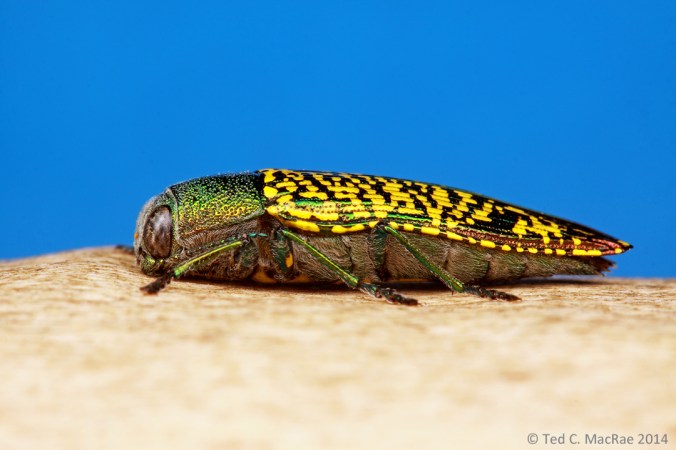
Buprestidae type specimens at Fundación Miguel Lillo, Argentina

During my most recent visit to Argentina this past February and March, I had the chance to go behind the scenes and visit the entomology collection at Fundación Miguel Lillo, Instituto de Entomología, Tucumán. It’s always a treat to visit any entomology collection—public or private—at any location. When the collection has holdings of Buprestidae, so much the better. Much to my delight, however, this collection not only had holdings of Buprestidae (not surprisingly representing primarily Argentine species), but also a small collection of type specimens designated by Antonio Cobos Sanchez (1922–1998). Cobos was one of the 20th century’s most prolific students of Buprestidae, with publications in the family spanning the period from 1949–1990 (coincidentally, 1990 being the year of my very first buprestid publication!). I was graciously allowed to photograph these specimens, some of which present interesting nomenclatural situations that are worthy of comment. These are presented below with my notes.

Jose xx & Ted MacRae

Looking at the insect collection at Fundación Miguel Lillo, Argentina.


Sufamily POLYCESTINAE

Tribe TYNDARINI

Tylauchenia golbachi Cobos, 1993 (currently placed in Oocypetes)

Tylauchenia golbachi Cobos, 1993. The species was moved to the genus Ocypetes.

Lapsus calami or mislabeled type specimen? Cobos (1973) described Tylauchenia golbachi from Argentina (now placed in the genus Ocypetes), stating the type locality as “6 kms. N. de Belén, 1.240 m. alt., Catamarca, Argentina (Willink, Terán y Stange coll., con trampa de Malaise, 1-15-I-1970…)”. The specimen above bears the holotype label, but the locality label clearly shows that it was collected in Tucumán rather than Catamarca and that the collector’s name is Guanuco rather than the above stated names. Interestingly, in the same publication Cobos gives the allotype female collection data as “San Pedro de Colalao, Tucumán, Argentina (Coll. Guanuco, 9-III-1949)”. At first I thought this might actually be the allotype rather than the holotype; however, 1) the specimen clearly bears a holotype label, and 2) it is also clearly a male based on the dissected genitalia preserved on the label below the specimen. There are two possible explanations, both of which make it difficult to determine what is the true type locality: 1) the holotype and allotype specimens are correctly labeled, but Cobos simply transposed their label data in his publication describing the species, making Tucumán the true type locality, or 2) the holotype and allotype locality labels were switched at some point and the true type locality is Catamarca, as stated in the publication in which the species is described. This latter possibility is more serious, as in addition to the doubts it generates regarding the type locality it also raises concern about the integrity of the holotype specimen. The latter explanation, however, seems less likely, as it is more difficult to imagine a scenario where only the locality label but not the others was switched than to imagine a transposition of label data in the publication. Sadly, at this point, there seems no easy way to determine which of the two explanations is correct.

Subfamily CHRYSOCHROINAE

Tribe DICERCINI

Lampetis tucumana monrosi Cobos (nomen nudum?)

Lampetis tucumana “monrosi” Cobos (ms name?)

A manuscript name? Cobos never actually proposed a subspecies “monrosi” for Lampetis tucumana (Guérin-Méneville & Percheron, 1835) (the name on the separate box label is misspelled). He did use the name for two other buprestid taxa: Tetragonoschema monrosi Cobos, 1949—now regarded as a synonym of T. argentiniense (Obenberger, 1915), and Anthaxia monrosi Cobos, 1972—now placed in the genus Agrilaxia. The holotype label on the specimen clearly states “Lampetis tucumana monrosi” in Cobos’ handwriting, so one can only presume that Cobos had identified this specimen as representing a distinct subspecies but never followed through and actually described it.

Ectinogonia (Pseudolampetis) fasciata metallica Cobos, 1969

Psiloptera (Pseudolampetis) fasciata metallica Cobos, 1969. Pseudolampetis was later considered a subgenus of Ectinogonia but is now regarded as a full genus.

Oh, what a tangled web we weave! Cobos (1969) originally described this taxon as a subspecies of Psiloptera (Pseudolampetisfasciata Kerremans, 1919. Moore (1986) moved Pseudolampetis to a subgenus of Ectinogonia, which resulted in two taxa in the latter genus bearing the name “metallica“—Ectinogonia (Pseudolampetisfasciata metallica (Cobos, 1969) and Ectinogonia metallica Fairmaire, 1856—the latter now considered a synonym of E. speciosa (Germain, 1856). In taxonomic nomenclature, two taxa in the same genus cannot bear the same name—a situation known as homonymy. In such cases, the older name has priority and the younger name, in this case Cobos’, must be replaced. This was done by Bellamy (2006), who proposed the new name moorei for this subspecies, resulting in the name Ectinogonia (Pseudolampetis) fasciata moorei Bellamy, 2006. To bring some level of absurdity to the situation, the subgenus Pseudolampetis was subsequently raised to full genus rank, being listed as such in the recent world catalogue (Bellamy 2008), and since Cobos’ name was not originally proposed within the genus Ectinogonia it no longer competes with Germain’s name in that genus. As a result, there is no homonymy and Cobos’ original name must once again stand as Pseudolampetis fasciata metallica (Cobos, 1969), while Bellamy’s replacement name must be regarded as unnecessary. This fact seems to have been overlooked when Pseudolampetis was raised to genus rank, as Cobos’ taxon is still listed in the world catalogue as “Pseudolampetis fasciata moorei (Bellamy, 2006)”! This situation is a perfect example of just how complicated these situations can be to identify, track, and update. The type locality for the unique female is given as “Chagual, 1.200 metros de altitud, Rio Marañón, en el Perú, VIII-1953 (B. Fernández leg.)”.

Subfamily BUPRESTINAE

Tribe STIGMODERINI

Conognatha rufiventris weyrauchi Cobos, 1969

Conognatha rufiventris weyrauchi Cobos, 1969. The taxon is now considered a synonym of Conognatha abdominalis Waterhouse, 1912.

Insufficient grounds. Cobos (1969) regarded this specimen from Peru as subspecifically distinct from Conognatha rufiventris Waterhouse, 1912 from Brazil based on a suite of subtle character differences and named the taxon Conognatha rufiventris weyrauchi in honor of Prof. W. Weyrauch, who made made the holotype specimen available to him for study. Moore & Lander (2010) considered that the taxon did not represent C. rufiventris, but rather was a uniquely colored specimen of Conognatha abdominalis Waterhouse, 1912. The holotype is a male with the type locality given as “del Valle de Chatichamayo, a 1.200 m., en Peru (J. Schuiike leg.)”.
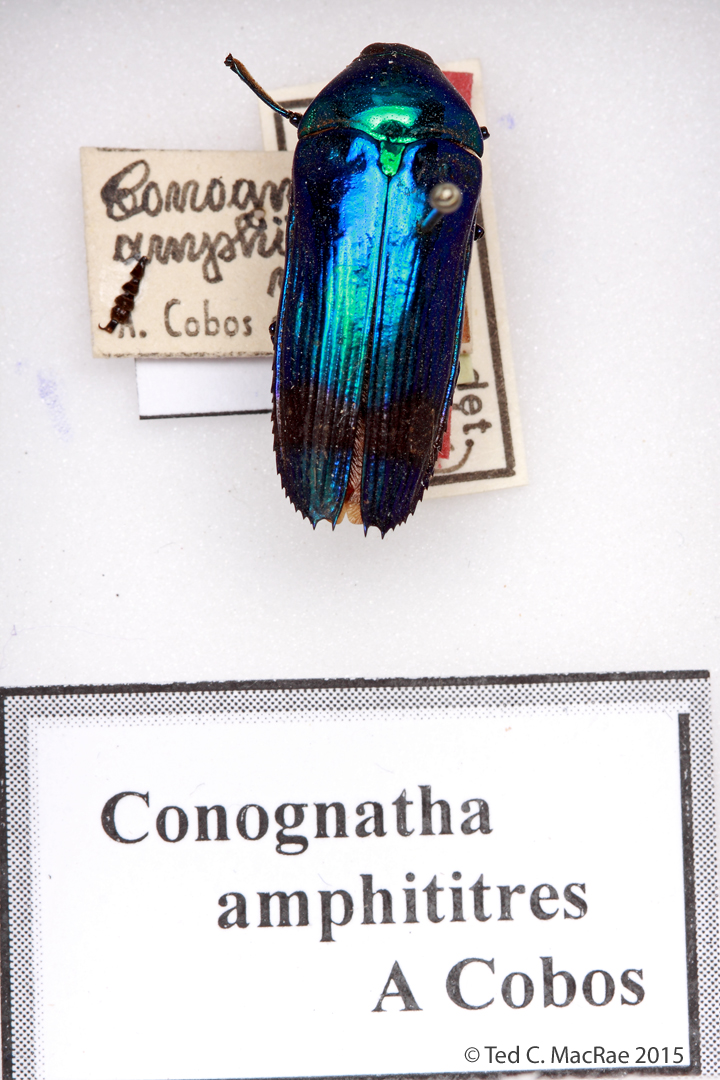
Conognatha amphititres Cobos, 1958 (syn. of Buprestis amoena Kirby, 1818; currently placed in Conognatha)

Conognatha amoena amphititres Cobos, 1958. The taxon is now considered a synonym of C. amoena (Kirby, 1818).

Insufficient grounds—part II. Cobos (1958) regarded this specimen from Brazil as subspecifically distinct from C. amoena (Kirby, 1818—originally described in the genus Buprestis) based on subtle characters and gave it the name Conognatha amoena amphititres (no etymology was given for the subspecies name). Moore & Lander (2006) regarded these differences as insufficient for subspecies status and placed the taxon as a synonym of the parent species. The holotype is thought to be a female with the type locality given as “Rio de Janeiro (Brasil)”.

Tribe CHRYSOBOTHRINI

Colobogaster weyrauchi Cobos, 1966

Colobogaster weyrauchi Cobos, 1966

Cobos (1966) described Colobogaster weyrauchi from Peru and named it after the collector, relating it to the widespread Colobogaster cyanitarsis Gory & Laporte, 1837. The type locality was given as “Pucallpá, 200 m. alt., Perú (W. Weyrauch coll. I-1948)”.

Subfamily AGRILINAE

Tribe CORAEBINI
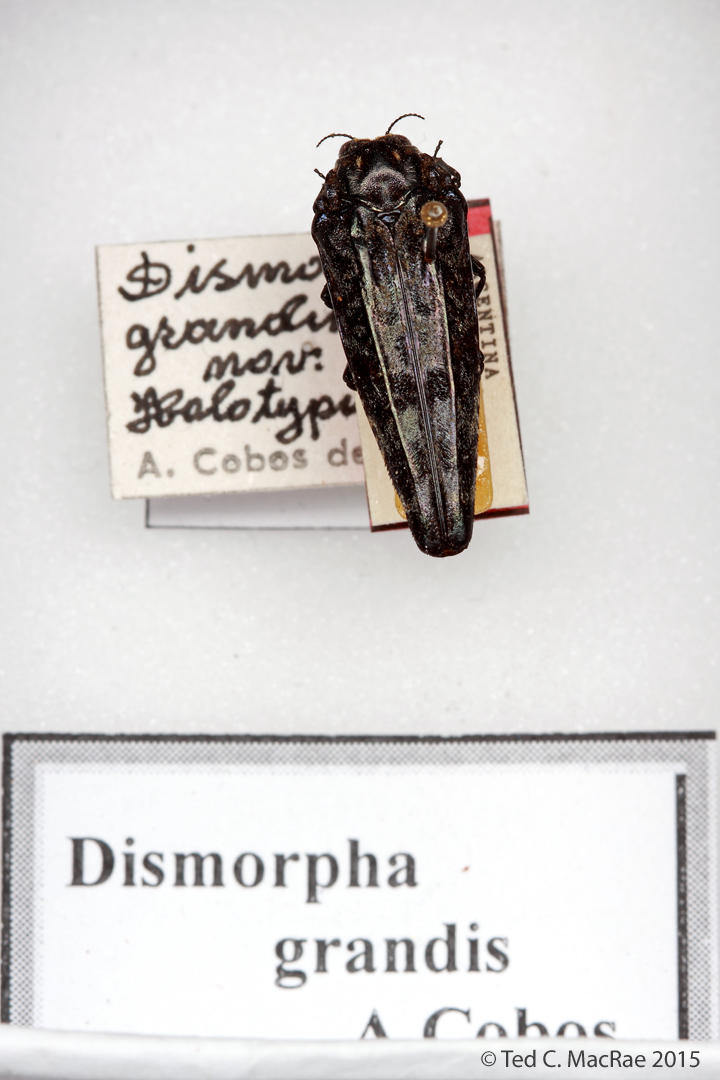
Dismorpha grandis Cobos, 1990

Dismorpha grandis Cobos, 1990

Cobos (1990) described Dismorpha grandis from Argentina in his very last buprestid publication, stating that the species had the appearance of an enormous D. irrorata (Gory & Laporte, 1839) (thus, the name “grandis“). The holotype is a male with the type locality given as “Bemberg, Misiones, Argentina (Exp. Hayward-Willink-Golbach: 12-29-I-1945)”.

Tribe AGRILINI
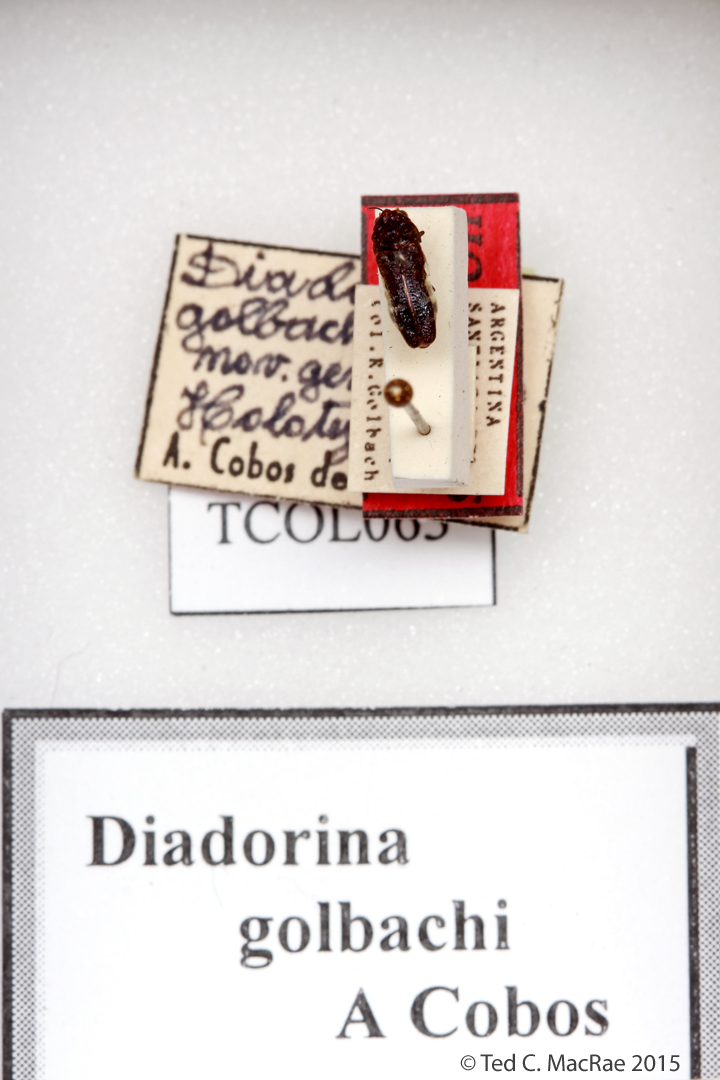
Diadorina golbachi Cobos, 1974 (monotypic)

Diadorina golbachi Cobos, 1974 (monotypic)

Cobos (1974) described Diadorina golbachi from Argentina as the only member (and thus the type species) of the new genus Diadorina (the genus is still regarded as monotypic), naming it in honor of the collector. The holotype specimen is a female with the type locality given as “La Tigres, Santiago del Estero, Argentina (R. Golbaeh coll. 11-16-1-1970)”.

Tribe TRACHEINI
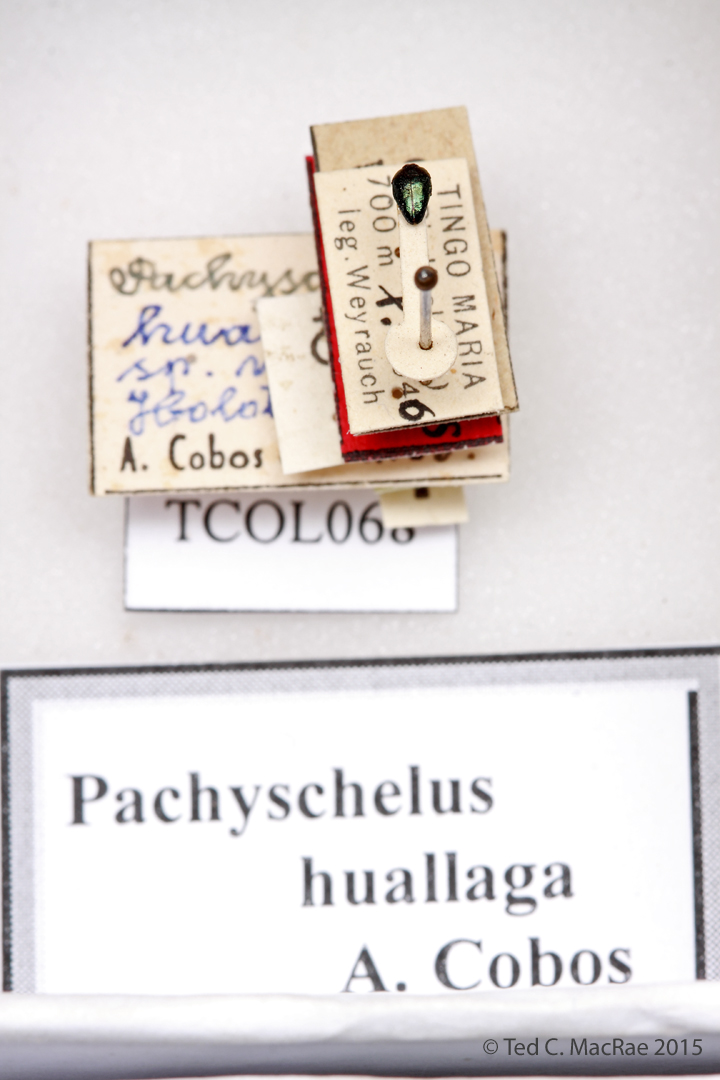
Pachyshelus huallaga Cobos 1969 (correct spelling is huallagus)

Pachyshelus huallaga Cobos, 1969

Cobos (1969) described and named this species after the river at the type locality in Peru. He related it to Pachyschelus atratus Kerremans, 1896 from Brazil and northern Argentina, stating that it differed by its distinct and less brilliant coloration and other features. Since the genus name is considered masculine, the correct species name is “Pachyschelus huallagus Cobos, 1969″. The unique holotype is a female with the type locality given as “Tingo María, Rio Huallaga, 700 metros de altitud, Peru, X-1946 (W. Weyrauch leg.)”.
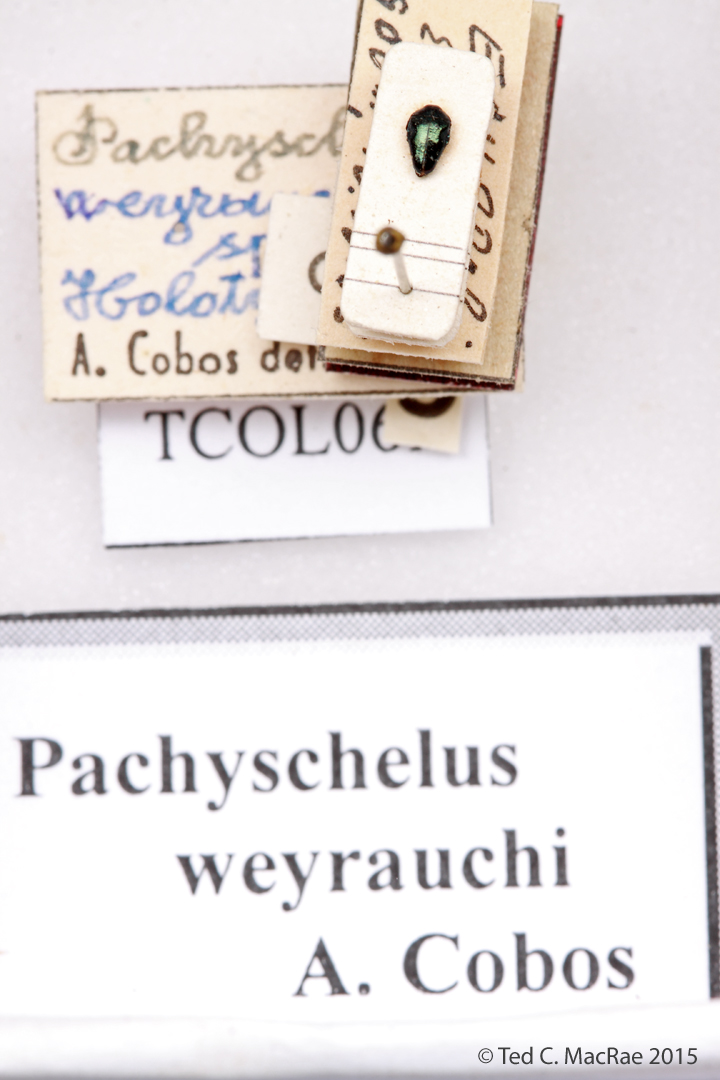
Pachyschelus weyrauchi Cobos, 1959

Pachyschelus weyrauchi Cobos, 1969

Cobos (1969) described Pachyschelus weyrauchi from Ecuador and named it in honor of its collector. He related the unique male to Pachyschelus aeneicollis (Kirsch, 1873) from Peru and Bolivia, citing differences in coloration, body shape, and surface sculpture. The type locality was given as “El Puyo, 900 metros de altitud, Ecuador, 10-IV-1958 (W. Weyrauch leg.)”.

There are two additional Buprestidae type specimens in the collection (Colobogaster pizarroi Cobos, 1966 and Hylaeogena cognathoides Cobos, 1969), but they are in another drawer that we did not find immediately and, thus, I did not have a chance to photograph them. My apologies!

REFERENCES:

Bellamy, C. L. 2006. Nomenclatural notes and corrections in Buprestidae (Coleoptera). The Pan-Pacific Entomologist 81(3/4):145–158 [pdf].

Bellamy, C. L. 2008. A World Catalogue and Bibliography of the Jewel Beetles (Coleoptera: Buprestoidea). Volume 2: Chrysochroinae: Sphenopterini through Buprestinae: Stigmoderini. Pensoft Series Faunistica No. 77, pp. 626–1260, Pensoft Publishers, Sofia-Moscow [details & links].

Cobos, A. 1966. Notas sobre Bupréstidos neotropicales. XV: Tres especies nuevas de Colobogaster Sol. (Coleoptera). EOS, Revista Española de Entomología 41(2-3):205–214 [pdf].

Cobos, A. 1969. Notas sobre Bupréstidos neotropicales XVII. Especies y subespecies nuevas (Coleoptera). EOS, Revista Española de Entomología 44(1968):19–43 [pdf].

Cobos, A. 1958. Tercera nota sobre Bupréstidos (Ins. Coleoptera) neotropicales descripciónes y rectificaciónes diversas. Acta Zoologica Lilloana 15:83–102 [pdf].

Cobos, A. 1973. Revisión del género Tylauchenia Burm., y afines (Coleoptera, Buprestidae). Archivos del Instituto de Aclimatacion 18:147–173 [pdf].

Cobos, A. 1974. Notas sobre Bupréstidos neotropicales, XIX. El género Amorphosternus H. Deyrolle y afines. Archivos de Instituto de Aclimatación 19:65–81 [pdf].

Cobos, A. 1990. Revisión del género Dismorpha Gistel (Coleoptera, Buprestidae). Revista Brasileira de Entomología 34(3):539–559 [pdf].

Moore Rodriguez, T. 1986. Contribución al conocimiento de los Buprestidos neotropicales (Coleoptera: Buprestidae). Revista Chilena de Entomología 13:21–29 [BioStor].

Moore Rodriguez, T. & T. Lander. 2010. Revision du genre Conognatha. Edition Magellanes 24:1–172 [introduction and generic discussion in French and Spanish; keys to species in English, French and Spanish] [order information].

© Ted C. MacRae 2015

Mexican Siesta

Summertime is go time for most entomologists, especially those who conduct field work both as a profession and as a hobby. Far flung field sites and the need to travel between them eats up most of each week, while on weekends clipboard and spreadsheets are exchanged for beating sheet and hatchet before traveling to other sites with the promise of some cool species of beetles. Even the most peripatetic entomologist, however, needs a break, and in late July I packed up my swim trunks, rounded up the girls, and headed off for a week of rest and relaxation on the beaches of Cabo San Lucas, Mexico.

Of course, you’re not a real entomologist if you don’t sneak off once or twice for a peak at the local flora and fauna with a vial that just happens to be in your pocket. Despite the rampant development in the area, reasonably extensive parcels of the original San Lucan xeric scrub habitat are accessible to those willing to hike a few miles up the beach. This unique, dry shrubland occurs only at the southern tip of the peninsula, extending from the coast up to about 250 meters in elevation. About ten percent of San Lucan scrub biota is endemic as a result of separation from more northern parts of the peninsula until the Miocene (23–5 mya). Xeric scrub is normally dry, brown, and dusty, but rains prior to my visit had created a verdant landscape with (relatively) lush foliage and an abundance of flowers. Insects were strangely scarce, however, save for a nice diversity of heavily sculptured darkling beetles (family Tenebrionidae), which I encountered along 2-tracks running through the habitat, and a few wood-boring beetles that were found on recently wind-thrown branches of palo verde (Cercidium floridum).

Chrysobothris octocola | Cabo San Lucas, Baja California Sur, Mexico

Chrysobothris octocola on Cercidium floridum ssp. peninsulare | Cabo San Lucas, Baja California Sur, Mexico

Adults were numerous on fresh wind-thrown branches of Cercidium floridum ssp. peninuslare

Adults ran rapidly on the fresh wind-thrown branches

Given the level of endemism in the area, I was hoping the beetles would prove to be examples of such, or at least species restricted to Baja California that I had not encountered before. Alas, both proved to be not only more widespread in Mexico but species occurring commonly in the southwestern U.S. as well. I suppose finding endemic species right off the bat after a quick jaunt up the beach while on a family vacation is a bit much to expect, although I suspect the palo verde trees on which I found the beetles represents the endemic subspecies Cercidium floridum ssp. peninsulare. And I got some nice photos.

Stenosphenus sobrius | Cabo San Lucas, Baja California Sur, Mexico

Stenosphenus sobrius on Cercidium floridum ssp. peninsulare | Cabo San Lucas, Baja California Sur, Mexico

This species was not as abundant on Cercidium branches as Chrysobothris octocola

Adults were found resting on the undersides of fresh wind-thrown branches

© Ted C. MacRae 2015
Best of BitB 2014

Welcome to the 7th Annual “Best of BitB”, where I pick my favorite photographs from the past year. Before I do this, however, let me briefly recap the year 2014. The trend of increasing travel each year continued, with more days spent on the road than in any prior year. Travel for work over the past few years has settled into a familiar routine—touring soybean fields in Argentina in late February and early March, working in my own field trials at (previously three, now four) sites in Illinois and Tennessee from late May through late September, touring more soybean fields at sites across the southeastern U.S. during mid-September, returning to Argentina in October to finalize plans for field trials in the upcoming season, and—finally—attending/presenting at the Entomological Society of America (ESA) Meetings (this year in Portland, Oregon). This heavy travel load makes scheduling my own insect collecting trips a bit tricky, but I’m a persistent sort! In late May I traveled to Tennessee and Georgia with fellow buprestophile Joshua Basham and lab mate Nadeer Youseff to collect several rare jewel beetles, then in late June I collected prionids and jewel beetles in Colorado, New Mexico, and Oklahoma with Jeff Huether. In addition to these longer trips, I also managed to take advantage of my work travel to check out interesting natural habitats along the way to and from my field sites. I continue to give the occasional entomology seminar as well, speaking in March at “Day of Insects” in Ames, Iowa and here in St. Louis to the Entomology Natural History Group of the Webster Groves Nature Study Society in April and the Missouri Master Naturalists Confluence Chapter in December. On top of all this, I still managed to vacation with my family in Lake Tahoe during March and in Cabo San Lucas, Mexico during late July.

I say all this to highlight the fact that after all these years I still consider myself an entomologist with a camera rather than a bona fide insect photographer. The reason for this is that the science of entomology itself remains my primary focus—photography is simply one of the tools that I have come to use in my pursuit of the discipline. I don’t mean to imply that I don’t continue to work on my photography style and technique—because I do. But my style and technique are not goals in of themselves; rather, they are means to an end—that end being my entomological studies. With that said, I present my favorite BitB photographs from 2014. As in previous years, my photos are largely hand-held, in situ field shots that are intended to tell a natural history story in a (hopefully) aesthetic manner. Links to original posts are provided for each photo selection, and I welcome any comments you may have regarding which (if any) is your favorite and why—such feedback will be helpful for me as I continue to hone my craft. If you’re interested, here are my previous years’ picks for 2008, 2009, 2010, 2011, 2012 and 2013. Once again, thank you for your readership, and I hope to see you in 2015!


Paraselenis tersa? female guarding her eggs | Cordoba Prov., Argentina

Paraselenis tersa (Boheman, 1854) | Cordoba Prov., Argentina

From Tortoise beetles on the job (posted April 20). This photograph of a tortoise beetle female over her egg mass illustrates maternal guarding behavior—rare in insects. The perfect lateral profile shot and clean, blue sky background also give the photo a pleasing aesthetic quality.


Who likes mole crickets?

Scapteriscus borellii Giglio-Tos, 1894 | Emanuel Co., Georgia

From Who likes mole crickets? (posted June 6). This has to be the most comical expression ever on the face of an insect!


Chrysobothris orono Frost, 1920 | South Cumberland State Park, Tennessee

Chrysobothris orono Frost, 1920 | South Cumberland State Park, Grundy Co., Tennessee

From Chrysobothris orono in Tennessee (posted July 29). I found this rare jewel beetle for the first time this year with the help of Josh Basham and Nadeer Youseff. The beetle itself is beautiful enough, but photographing it on a pine root with a presumed adult emergence hole adds considerable natural history interest to the photo. Rock substrate behind the root adds a pleasingly blurred background.


Buprestis (Stereosa) salisburyensis Herbst, 1801 | South Cumberland State Park, Tennessee.

Buprestis (Stereosa) salisburyensis Herbst, 1801 | South Cumberland State Park, Tennessee.

From The Buprestis tree (posted August 10). This was another of several jewel beetles that I found for the first time after more than three decades of collecting this group. I like the value contrast in this photo from the striking, metallic colors of the beetle against the nicely blurred cinnamon-colored pine bark of the tree on which it is sitting.


A "super moon" watches over a parasitized hornworm caterpillar.

A “super moon” watches over a parasitized hornworm caterpillar.

From A time of reckoning (posted August 13). I fully admit this is a composite photograph. Nevertheless, it is a faithful recreation of a true sight, and I don’t consider the use of composite techniques to overcome equipment shortcomings to be unethical. There is a haunting symmetry between the blood red moon—considered by some as a sign of the second coming—and the sad, parasitized caterpillar waiting for its inevitable demise.


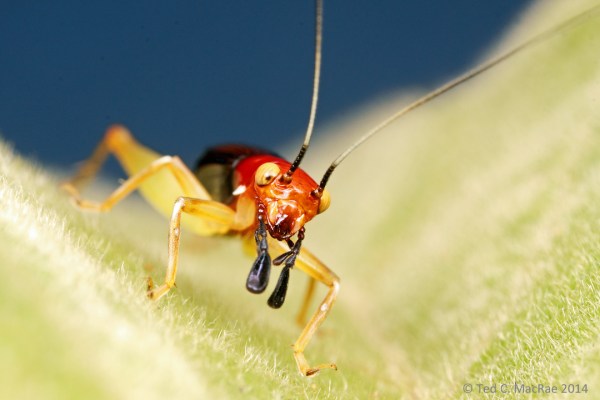
The greatly expanded palps are thought to mimic beetle mandibles or spider pedipalps.

Phyllopalpus pulchellus Uhler, 1864 | Hickman Co., Kentucky

From My, what busy palps you have! (posted September 2). I’ve become quite fond of insect photos with the subject “peering” at me, the photographer”, from some unusual vantage point. The “pupils” in the eyes of this red-headed bush cricket give the insect an almost quizzical look.


Acmaeodera immaculata Horn, 1881 | vic. Vogel Canyon, Otero Co., Colorado.

Acmaeodera immaculata Horn, 1878 | vic. Vogel Canyon, Otero Co., Colorado.

From Sunset beetles (posted September 30). Taking photos of insects at sunset is a challenging and ephemeral experience—one has only a few minutes to take advantage of the unusual and serene colors it offers, while at the same time trying to determine the best camera and flash settings to use in the rapidly fading light. Of the several that I’ve tried, this one is my favorite because of the softly complimentary colors of the beetle, the flower upon which it is sitting, and the dying orange sky behind it. If I had to choose, I would probably pick this one as my favorite of the year because of the unusual and serene colors.


Megacyllene decora (Olivier, 1795) | Stoddard Co., Missouri

Megacyllene decora (Olivier, 1795) | Stoddard Co., Missouri

From Amorpha borer on goldenrod (posted October 5). I featured this very same species in Best of BitB 2012 but can’t resist choosing this second attempt at photographing the spectacularly beautiful adult—this time on goldenrod. As with the previous version this is a true in situ field photograph, hand held and using the left-hand technique to achieve precise composition against a clear blue sky—difficult to do with an insect of this size and using a 100-mm lens, but well worth the effort.


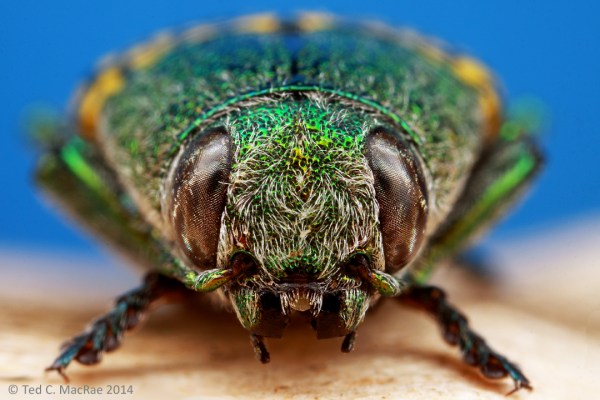
Buprestis (Knulliobuprestis) confluenta Say, 1823 | Woods Co., Oklahoma

Buprestis (Knulliobuprestis) confluenta Say, 1823 | Woods Co., Oklahoma

From A Buprestis hat-trick! (posted October 14). I didn’t take near as many of the classic “frontal portraits” this year, but this one of a jewel beetle that had eluded me for more than 30 years until this past June is perhaps my favorite of them all.


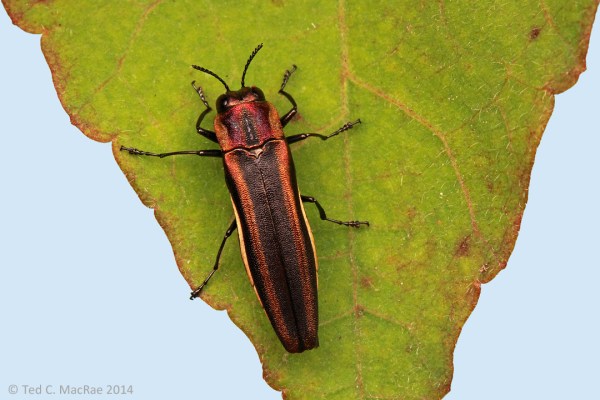
Agrilus concinnus  Horn, 1891 | Stoddard Co., Missouri

Agrilus concinnus Horn, 1891 | Stoddard Co., Missouri

From North America’s Most Beautiful Agrilus Jewel Beetle (posted October 19). There was a time when this beetle was considered one of North America’s rarest species of jewel beetle. Several years worth of hunting by me and others revealed this beetle’s association with mallow and its unusually late adult activity period—the two combining to make this beetle “seem” rare. This year I succeeded in photographing the spectacular adult beetle.


Cacama valvata female ovipositing

Cacama valvata (Uhler, 1888) | Vogel Canyon, Otero Co., Colorado

From Scorching plains, screaming cactus (posted December 5). Insect photos are always better when they also show some aspect of the subject’s natural history. I was lucky to find this female cactus dodger cicada in the act of ovipositing into the dry stem of cholla cactus—in a position where I could get a perfect lateral profile with a clean, blue sky background.


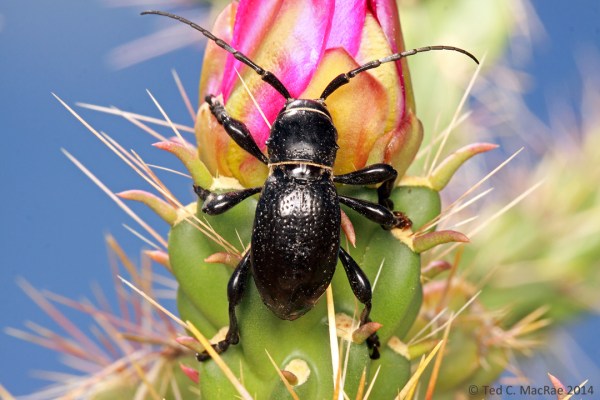
Moneilema armatum LeConte, 1853 | Vogel Canyon, Otero Co., Colorado

Moneilema armatum LeConte, 1853 | Vogel Canyon, Otero Co., Colorado

From Cactus beetle redux (posted December 20). Cactus beetles can be difficult to photograph, but sometimes they cooperate by nicely posing on a pleasing pink flower bud with a blue sky in the background and the cactus spines forming a nice, fuzzy “halo” around the jet black beetle. There were surprisingly few cactus spines impaled in the control unit of my flash after this photo session.


I hope you’ve enjoyed this 2014 version of “Best of BitB” and look forward to seeing everyone in 2015.

Copyright © Ted C. MacRae 2015

Two endemic Jamaican jewel beetles: one known, one not?

I recently received a batch of jewel beetles from Enrico Ruzzier of Italy. It was an impressive sending (as is any sending of jewel beetles!) collected from diverse parts of the world, but what really caught my eye were two specimens he had collected earlier this year in Jamaica—both representing species in the genus Chrysobothris. Most members of this genus are moderate-sized in relation to other species in the family, but at only 5 and 6 mm in length the two specimens I received are downright tiny. They also are extraordinarily pretty compared to most species in the genus by virtue of their striking patterns of metallic green, red, and blue to violaceous colors! Even more interesting, however, was their West Indian provenance. This “biodiversity hotspot” enjoys not only high species diversity but also high species endemism as a result of the 7,000+ islands that comprise it. This is especially true for Jamaica, where my records indicate that 64% of the known jewel beetle fauna (16 of 25 species) occurs nowhere else.

One of the specimens was easily identifiable as Chrysobothris quadrimaculata (Fabricius, 1776) because of the transverse green, violaceous, and reddish-cupreous bands on the pronotum and metallic green “cross” on the elytra separating four large violaceous spots, each with a reddish-cupreous central area (Fisher 1925). This species has so far been found only in Jamaica and appears to be uncommon in collections. As far as I can tell, the only illustration of the species is a 224-year old drawing appearing in Olivier (1790)¹. Considering this and the extraordinary beauty of this little beetle, it seems appropriate to post a photo here (sent to me by Enrico in his initial query regarding its identity).

¹ This early landmark taxonomic publication is occasionally offered for sale by rare book dealers at asking prices that run in the thousands of dollars! Fortunately, the National Library of France has made a pdf of the book available for free download.

Chrysobothris quadrimaculata (Fabricius, 1776)

Chrysobothris quadrimaculata (Fabricius, 1776). Photo by Enrico Ruzzier.

The second specimen, even smaller but no less pretty than the first, has defied all attempts at identification. It does not key out in Fisher (1925) and clearly differs from the four species and one subspecies known to occur in Jamaica (all of which are endemic). Further comparison with descriptions of all known West Indian species also fails to turn up a match. Considering this and the fact that many West Indian Chrysobothris seem to be quite rare in general (Maier & Ivie 2012), I would not be surprised if this specimen turns out to represent yet another (and as yet undescribed) endemic species for Jamaica. I am hopeful (although not optimistic) that posting a photo here (also provided by Enrico Ruzzier) will prompt those with West Indian material in their collections to examine their holdings and see if any additional specimens can be located.

Chrysobothris n. sp. ex Jamaica

Chrysobothris n. sp.? Photo by Enrico Ruzzier.

REFERENCES:

Fisher, W. S. 1925. A revision of the West Indian Coleoptera of the family Buprestidae. Proceedings of The United States National Museum 65:1–207 [BioDiversity Heritage Library, BioStor].

Maier, C. A. & M. A. Ivie. 2013. New species and records of Chrysobothris Eschscholtz (Coleoptera: Buprestidae) from Montserrat, Saba, and Anguilla, with a key to the Chrysobothris thoracica species-group in the West Indies. The Coleopterists Bulletin 67(2):81–88 [BioOne].

Olivier, A. G. 1790. Entomologie, ou histoire naturelle des insectes, avec leurs caractères génériques et spécifiques, leur description, leur synonymie, et leur figure enluminée. Coléoptères. Tome 2, genera 9–34 (32. Bupreste), pp. 1–485, 63 plates, Baudouin, Paris [Bibliothèque nationale de France].

© Ted C. MacRae 2014

First internet image of Phaenops piniedulis

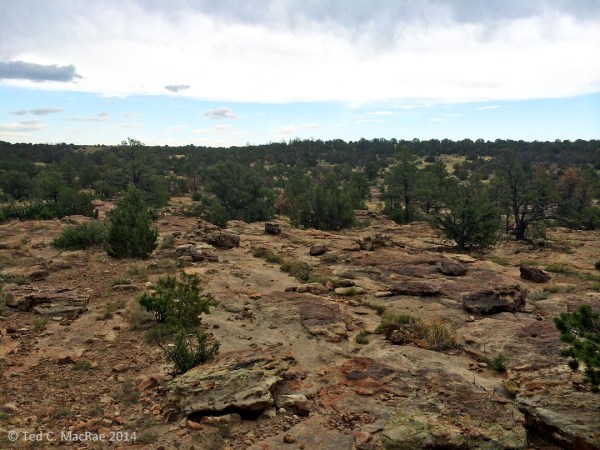
During last June’s collecting trip through the western Great Plains, we stopped at an interesting spot in northeastern New Mexico near the small town of Mills (Harding Co.). Mills itself sits smack dab in the middle of expansive shortgrass prairie; however, a few miles to the west the flat terrain gives way to a rugged, boulder-strewn sandstone canyon harboring oak-pine-juniper woodland. Welcome to Mills Canyon, which descends almost 1,000 feet to the Canadian River below.

Oak/juniper woodland at Mills Canyon, habitat for Prionus heroicus.

Oak-pine-juniper woodland near Mills Rim Campground, Harding Co., New Mexico.

Our quarry for the trip was longhorned beetles in the genus Prionus, especially those associated with grasslands in the central U.S., and while searching the area for suitable grassland-Prionus habitat we chanced upon this spot. Though not the grasslands we were searching for, the area looked interesting enough that we decided to stop and do a little beating. We were immediately rewarded with several interesting finds and decided to come back the next day when we had more time to spend. That was a good decision, as apparently the timing was perfect and we collected perhaps a dozen or more species of jewel and longhorned beetles.

Phaenops piniedulis on Pinus sp. | Mills Rim Campground, Harding Co., New Mexico.

Phaenops piniedulis on Pinus edulis  | Mills Rim Campground, Harding Co., New Mexico.

Perhaps the most interesting of the day’s catch was a single individual representing the jewel beetle Phaenops piniedulis. Though widespread across the southwestern U.S. (records exist from Arizona, California, Colorado, Nevada, New Mexico, Oregon, Utah, and Texas), it is nevertheless only rarely encountered, often no more than a few individuals at a time. As the name suggests, the species was originally associated with pinyon pine (Pinus edulis) (Burke 1908), although it has also been reared from California foothills pine (P. sabiniana), Jeffrey pine (P. jeffreyi), and single-leaf pinyon (P. monophylla) (MacRae & Nelson 2003). The species is distinguished from other several other North American species in the genus by the large yellow maculations that cover more than 50% of the elytral surface (Sloop 1937). These beetles are closely related to the so-called “fire beetles” of the genus Melanophila, the latter famous for their attraction to the smoldering and even still-burning wood of forest fires. However, Phaenops lack the large heat-sensing pores found on the metathorax of Melanophila and, thus, do not exhibit such behavior.

The photo above is not a true field photo, as I encountered the beetle on my beating sheet after whacking a dead pinyon pine branch. Rather than risking escape, I popped it into a vial for safekeeping and later that evening (when it was cooler) placed it on a pinyon twig for photographs. Even then it was still rather active, and the photo shown here is really the only decent photograph I obtained of the beetle. This turns out to be a rather significant photo, for as far as I can tell it is the only photograph of the species—live or dead—to be found on the internet!

REFERENCES:

Burke, H. 1908. A new buprestid enemy of Pinus edulisProceedings of the Entomological Society of Washington 9(1–4):117–118 [Google Books].

MacRae, T. C. & G. H. Nelson. 2003. Distributional and biological notes on Buprestidae (Coleoptera) in North and Central America and the West Indies, with validation of one species. The Coleopterists Bulletin 57(1):57–70 [pdf].

Sloop, K. D. 1937. A revision of the North American buprestid beetles belonging to the genus Melanophila (Coleoptera, Buprestidae). University of California Publications in Entomology 7(1):1–19.

© Ted C. MacRae 2014

I got Thomas Shahan to image my Chrysochroa corbetti!

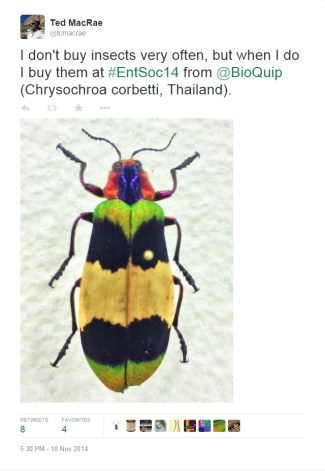
Chrysochroa-corbetti-TwitterThose who follow me on Twitter know that I attended Entomology 2014 last month in Portland, Oregon. As with other scientific conferences, live tweeting of the talks and associated events was all the rage. I may not have been the most prolific “tweeter”, but I did do my share, and one of my tweets involved a rather spectacular preserved specimen of the jewel beetle, Chrysochroa corbetti. The quick iPhone snapshot attached to the tweet was sufficient to prove that the beetle is pure eye candy, but still it did not do full justice to its stunning beauty:

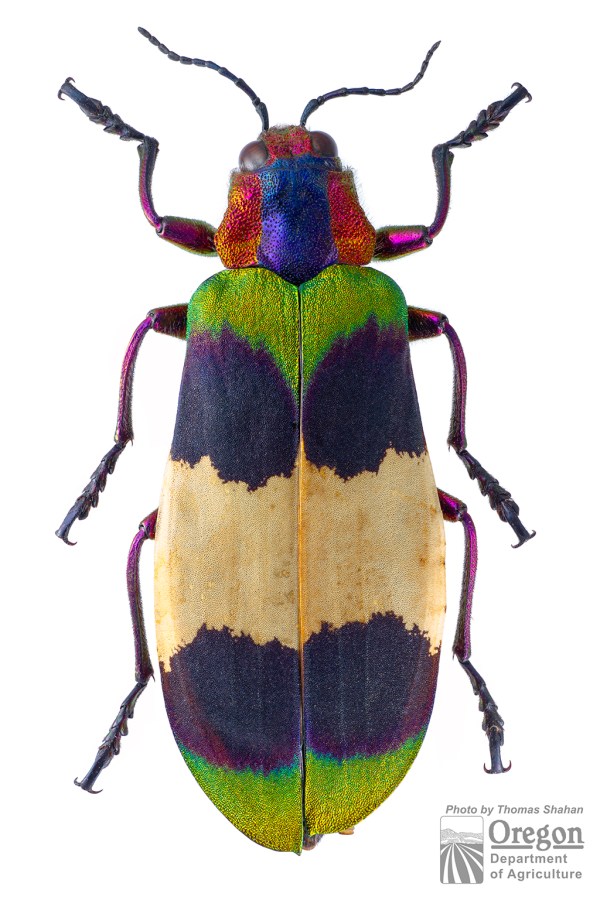
Fortunately, while I was at the meetings I ran into Thomas Shahan—already an icon among insect macrophotographers for his seemingly impossible portraits of jumping spiders, tiger beetles, and other insects. I had planned to spend a couple of days in Salem after the meetings to visit my friend and longtime buprestophile Rick Westcott. As it happens, Thomas is currently a Digital Imaging Specialist at the Oregon Department of Agriculture where Rick spent his entire career as an entomologist. When I showed my specimen to Thomas, he kindly agreed to make some focus-stacked images of the specimen using his lab’s photographic setup. I think you can now agree that this is one of the most spectacular jewel beetles around, and I think you’ll also agree that these images by Thomas are perhaps the most stunning of this oft-photographed species. Be sure to check out the last photo—a 10× close-up of the dorsal elytral detail at the interface between the green and blue areas. Simply stunning!

Chrysochroa (Chroodema) corbetti (Kerremans, 1893) | Thailand

Chrysochroa (Chroodema) corbetti (Kerremans, 1893) | Thailand

Chrysochroa corbetti lateral view

Chrysochroa corbetti lateral view

Chrysochroa corbetti ventral view

Chrysochroa corbetti ventral v

Chrysochroa corbetti dorsal elytral detail (10X)

Chrysochroa corbetti dorsal elytral detail (10X)

© Ted C. MacRae 2014

North America’s Most Beautiful Agrilus Jewel Beetle

For the past few years I’ve spent the summers traveling once a month or so from my home near St. Louis to research plots in western Tennessee. I enjoy these trips immensely—not only are my research and the colleagues that I spend time with fun, but I also get to keep an eye on the progression of the season in one of Missouri’s most interesting (and threatened) natural communities: the southeastern lowlands. Spring sees the emergence of an unusual population of the Festive Tiger Beetle (Cicindela scutellaris) in the area’s critically imperiled sand prairies; summer harks the appearance of the diminutive and almost-impossible-to-see Ant-like Tiger Beetle (Cylindera cursitans) in the ribbons of wet bottomland forest that line the Mississippi River; autumn is graced by the sight of stunningly beautiful amorpha borers (Megacyllene decora) in wet areas hosting mixed stands of false indigo (Amorpha fruticosa) and goldenrod (Solidago spp.); and all season long a variety of seldom-seen insects (e.g., longhorned beetles that look like stag beetles) are attracted to ultraviolet lights set up in the area’s increasingly scarce natural habitats.

Hairy mallow (Hibiscus lasiocarpus), host for Agrilus concinnus

Hairy mallow (Hibiscus lasiocarpus), host for Agrilus concinnus

Another phenological event that I look forward to in the southeastern lowlands is the blooming period of hairy mallow (Hibiscus lasiocarpus). Starting in July and reaching its peak in early to mid-August, the enormous white (and sometimes pink) flowers explode across the landscape at a time when precious few other flowers can be found, conspicuously flagging any ground where water tends to stand. It is not the flowers themselves, however, that pique my interest, but rather a beautiful (and, until recently, rare) jewel beetle (family Buprestidae)—Agrilus concinnus—that becomes active on the plants while they are in flower. In fact, of the nearly 200 species belonging to the genus in North America, I consider A. concinnus to be perhaps the most beautiful!

Agrilus concinnus | Stoddard Co., Missouri

Agrilus concinnus | Stoddard Co., Missouri

I first saw this species in Missouri’s southeastern lowlands nearly 30 years ago. At that time, I didn’t know that the mating pair that I had found on low vegetation represented a species considered to be one of the rarest of the genus in North America (having been recorded only from Florida, Georgia, Illinois, and Texas and not yet known from Missouri) and whose host plant and biology were completely unknown. Over the course of several years following this first find, fellow buprestophile Gayle Nelson (now deceased) and I were able to document the occurrence of this species also in Kansas (MacRae & Nelson 2003) and confirm its association with plants in the genus Hibiscus (MacRae 2006). We also determined that adults of this species exhibited an unusually late seasonal occurrence, peaking in late July and early August, compared to the spring adult activity period of most other eastern North American species in the genus. As a result of these efforts, one of North America’s rarest and least known jewel beetles was no longer regarded as either. A more detailed summary of my experiences with this beetle can be found in a newsletter article that I wrote a while back (MacRae 2004).

Hibiscus lasiocarpus

Plants in peak bloom signals the adult activity period of the beetle.

Of course, those were the days before I began photographing insects, so despite the abundance with which I have seen this species in past years, I still lacked photographs of it. I first made an effort to photograph adults two years ago while on one of my research plot trips, but 2012 was characterized by a severe drought in the central U.S.—precious few potential host plants were found at the locality where I first collected these beetles, and those that were present were severely stunted and in poor shape due to the drought. Conditions were much more favorable last year (2013), but again no beetles were seen during an early August visit. This past season was again favorable for growth of the host plants, and though my visit during early August again looked like it was not going to pay off, I eventually scared up an adult and watched it as it flew to another plant. I would see four adults on the day—not a lot, but enough to make sure that I got photographs showing how spectacularly beautiful they are!

Agrilus concinnus

Adults perch, mate, and feed on the upper leaf surfaces.

REFERENCES:

MacRae, T. C. 2004. Beetle bits: Hunting the elusive “hibiscus jewel beetle”. Nature Notes, Journal of the Webster Groves Nature Study Society 76(5):4–5 [pdf].

MacRae, T. C. 2006. Distributional and biological notes on North American Buprestidae (Coleoptera), with comments on variation in Anthaxia (Haplanthaxia)viridicornis (Say) and A. (H.) viridfrons Gory. The Pan-Pacific Entomologist 82(2):166–199 [pdf].

MacRae, T. C. & G. H. Nelson. 2003. Distributional and biological notes on Buprestidae (Coleoptera) in North and Central America and the West Indies, with validation of one species. The Coleopterists Bulletin 57(1):57–70 [pdf].

© Ted C. MacRae 2014

A Buprestis hat-trick!

In North America, few beetles can rival jewel beetles in the family Buprestidae for sheer beauty, and within the family this beauty is perhaps best exemplified by species in the family’s namesake genus Buprestis. Often flashing yellow, green, coppery, or red, species in this genus combine brilliant colors, moderately large size, and relative rarity to make them desirable additions to the collections of casual and serious collectors alike.

Buprestis (Knulliobuprestis) confluenta | Woods Co., Oklahoma

Buprestis (Knulliobuprestis) confluenta | Woods Co., Oklahoma

Over the years I’ve had some success collecting certain species in this genus, but even after 30 years of collecting there still remain several species that have eluded my net. A few weeks ago I posted photos of and wrote about my experience collecting not one, but two of these species that had so far eluded me—B. striata and B. salisburyensis—both as single specimens from a single tree in the mountains of Tennessee. Three weeks after collecting these species, I began a collecting trip west into the heart of the Great Plains with the primary purpose of using recently developed lures to collect some uncommonly encountered prionid longhorned beetles. Before reaching the first locality, however, field mate Jeff Huether and I stopped off in Hardtner, Kansas to visit with fellow beetle enthusiast “Beetle Bill” Smith and do a little collecting with him before continuing on. Bill took us to a spot just south of the nearby state line into Oklahoma to a spot where he had collected, among other things, yet another of the Buprestis spp. that had so far eluded me—B. confluenta.

Buprestis (Knulliobuprestis) confluenta

If B. striata and B. salisburyensis are beautiful, then B. confluenta is downright stunning! Brilliant green, perhaps with a slight coppery brown to purplish blue hue and with more or less confluent (thus the species name) fine yellow flecks densely scattered over the elytra, it is one of the easiest to identify of any species in the genus. Moreover, unlike the previous two species, I had already made several attempts to collect B. confluenta during several previous trips to the Great Plains, stopping wherever I saw a nice stand of the large eastern cottonwood trees (Populus deltoides) in which larvae of the species are known to develop. Frustratingly, as if to taunt me, I have even seen specimens on more than one occasion in one of the many 4H and student collections that I have examined over the years in Missouri and Kansas.

Buprestis (Knulliobuprestis) confluenta
Today was different, however—I could just feel it. Pulling up to the spot, my attention was immediately drawn to a grove of large cottonwood trees, some dead with bark-less trunks still standing. I thought to myself, “Those look like Buprestis trees!” While Bill and Jeff swept nearby herbaceous plants looking for a blister beetle that Jeff was interested in, I picked my way through the cottonwood grove, carefully approaching each tree—especially the dead ones—and scanning the trunk for any sign of movement or flash of color. It took a long time—well over an hour, by which time I had almost given up hope and begun thinking that this would be yet another unsuccessful attempt to collect the species. Suddenly, there it was sitting on the trunk of a recently fallen tree in all of its unmistakable glory! I froze at first, afraid of spooking it by too excited an approach, then remembered that species of Buprestis in general are not very skittish or as quick to take flight as many other members of the family (e.g., species in the genus Chrysobothris). I resumed my approach, albeit still cautiously just in case, and easily secured the specimen in a vial. My season now included a Buprestis hat-trick! The beetle was not only calm but actually seemed disinclined to flee, prompting me to release it back onto the tree trunk for a few quick field photos before placing it back in the vial for better photos later in the security of my hotel room that evening.

Buprestis spp. love large, dead, barkless cottonwood trunks.

Buprestis spp. love large, dead, bark-less cottonwood trunks.

Among North American jewel beetles, B. confluenta has one of the stranger geographic distributions, having been recorded from most of the central and western states and provinces as far east as Quebec and Indiana (Nelson et al. 2008). This is no doubt a consequence of the distribution of its primary larval hosts—cottonwood and quaking aspen (Populus tremuloides) (Burke 1917, Nicolay & Weiss 1918). In my Missouri checklist (MacRae 1991) I saw only two specimens from the state, both in counties along its western edge near Iowa and Kansas. Considering how abundant cottonwood is in Missouri, it is a mystery to me why this species should be so rare in the state. But then, I’ve not found it easy to come by in Kansas or Oklahoma either, where more records seem to exist than in any other state. Even on this occasion, when I would finally find the species after 30 years of searching, only this one, single specimen was seen. Interestingly, I would also collect about a half dozen specimens of the closely related species, B. rufipes (more commonly associated with oaks), off of the same trees that I searched so intensively for B. confluenta.

The requisite frontal portrait!

The requisite frontal portrait!

REFERENCES:

Burke, H. E. 1917. Flat-headed borers affecting forest trees in the United States. U.S. Department of Agriculture Bulletin 437, 9 pp. [Biodiversity Heritage Library].

MacRae, T. C. 1991. The Buprestidae (Coleoptera) of Missouri. Insecta Mundi 5(2):101–126 [pdf].

Nelson, G. H., G. C. Walters, Jr., R. D. Haines & C. L. Bellamy.  2008.  A Catalogue and Bibliography of the Buprestoidea of American North of Mexico.  Coleopterists Society Special Publication No. 4, The Coleopterists Society, North Potomac, Maryland, 274 pp. [description].

Nicolay, A. S. & H. B. Weiss. 1918. A review of the genus Buprestis in North America. Journal of the New York Entomological Society 26(2):75–109 [pdf].

© Ted C. MacRae 2014