North America’s most beautiful tiger beetle

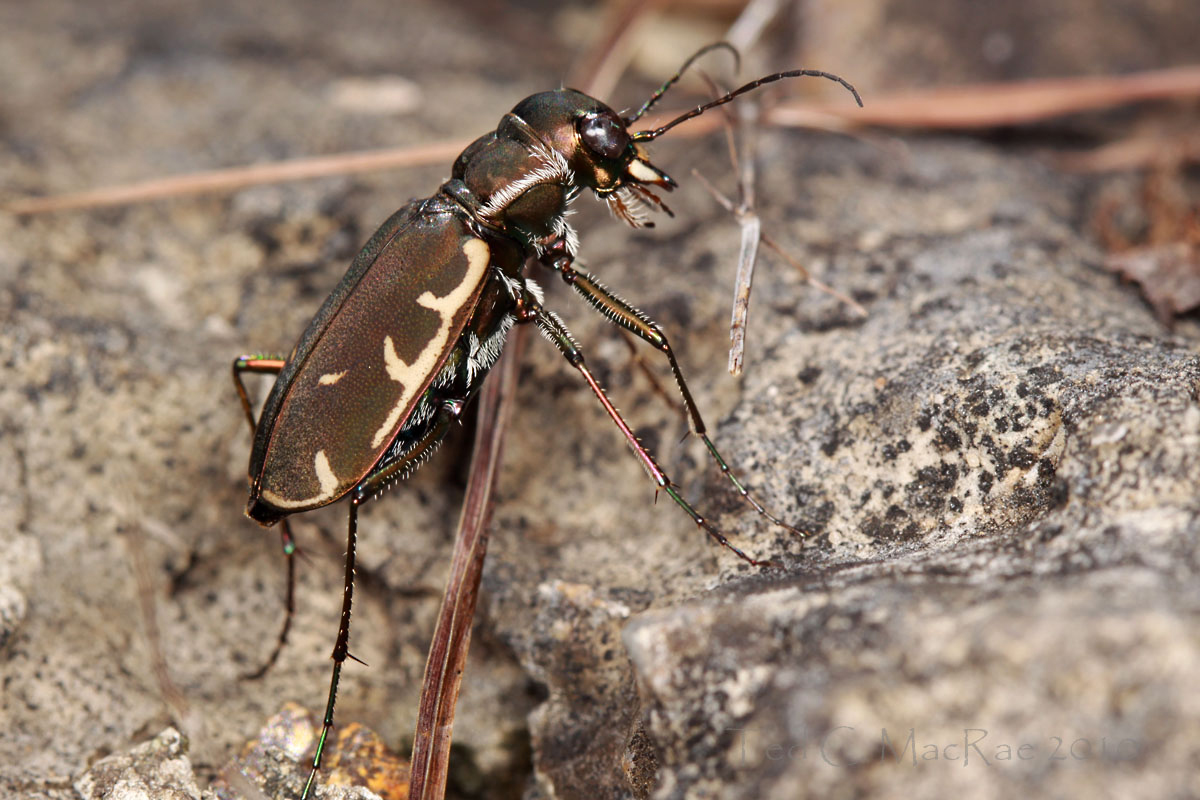
Cicindela pulchra pulchra (beautiful tiger beetle) - Fall River Co., South Dakota.

Five years ago this month, I got my first glimpse of North America’s most beautiful tiger – Cicindela pulchra.  This is not just my opinion – its name, given to it by Father-of-North-American-entomology Thomas Say, literally translates to “beautiful tiger beetle.”  Like Amblycheila cylindriformis, it was a species that I longed to see in the field ever since receiving a single specimen from tiger beetle guru Ron Huber.  That specimen came from the Gypsum Hills of Barber Co. in south-central Kansas – a known “hot spot” for the species.  For years I stared at that spectacular specimen as it sat in my cabinet, and in September 2004 Chris Brown and I finally made our first attempt to see it in the field for ourselves.  Unfortunately, we arrived ahead of the fall rains that seem to trigger emergence of this species, and C. pulchra would not be among the few species that we saw on that trip.  I don’t handle defeat very well, so the very next fall I resolved to try again – this time waiting until early October and also enlisting the assistance of local entomologist “Beetle Bill” Smith for access to better sites than what are available along the roadsides.  That trip was a tremendous success and was detailed in one of my Nature Notes articles (MacRae 2006), but Chris, unfortunately, was unable to join me on that second attempt.  He couldn’t join me last year, either, for my search of the species in the nearby Cimarron Gypsum Hills of northwestern Oklahoma.  Good thing, however, as a turn of the weather left me just cold and wet (although I do remain convinced that the species will eventually be found on those red clay slopes that have so far produced such prizes as Cylindera celeripes, Dromochorus pruinina, and Amblycheila cylindriformis).

Matt Brust (L) and Chris Brown (R). Matt discovered this site for Cicindela pulchra in 2009.

Fortunately, while I was getting skunked in Oklahoma, Matt Brust was discovering new populations of the species further north in the southwestern corner of South Dakota.  These discoveries were prompted by the initial discovery of the species on Pierre Shale exposures at a single site near the Black Hills (Larsen and Willis 2008).  The soft, dark gray soils of the Pierre Shales are in distinct contrast to red clay exposures with which the species has been typically associated further south, and by scouting a broader area for similar exposures Matt was able to find the species at six new sites during late summer 2009 (Brust 2010).  He found them associated not only with the Pierre Shale but also the Mowry Shale formation (and suspects they may eventually be found on Belle Fourche Shale formations as well).  When I learned of these discoveries, I decided I just had to see them for myself.  I had enjoyed my Fall 2008 trip to northwestern Nebraska and southwestern South Dakota, and the thought of seeing these beetles while spending time in the field with Matt once again seemed the perfect basis for another trip to the area.  It didn’t take much convincing for Chris to agree, thus, C. pulchra became goal #1 of the 2010 Fall Tiger Beetle Trip™.
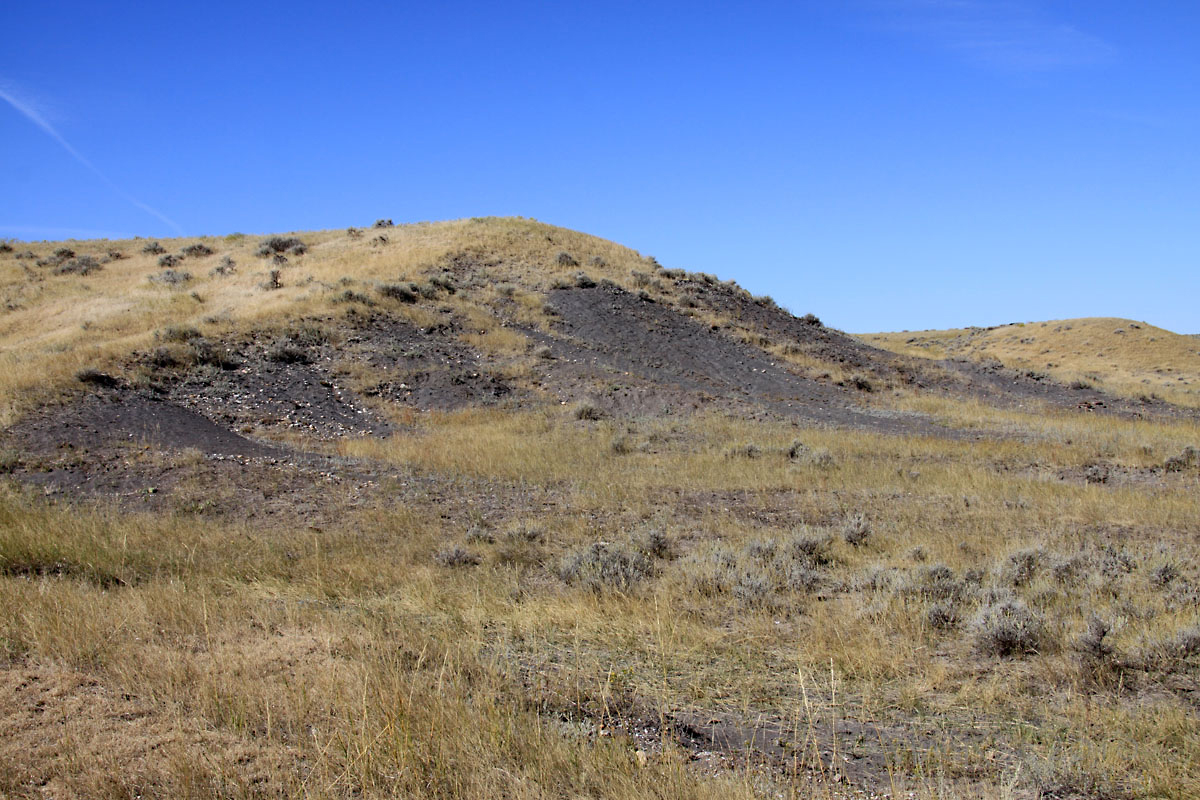
Habitat for Cicindela pulchra in Fall River Co., South Dakota. Adults and larval burrows are found in sparsely vegetated gray shale slopes and open flats beneath.

As we drove to the site that Matt had selected for us to explore, I felt nothing but optimism.  The skies were clear and the temperature was already nearing 70°F.  Matt, however, was hedging his bets – “I hope they’re still out, I’ve never seen them this late!”  Still, I wasn’t worried.  We were two weeks earlier in the season than the 2005 Kansas trip, and the weather was simply spectacular – it just had to be a good tiger beetle day!  My optimism was justified, as within minutes of arriving at the site we saw the first individual.  I collected this one alive as a backup for photographs in the studio should that be the last one we saw, but no such contingencies were necessary – we began seeing individual after individual as we trolled across the barren gray slopes.

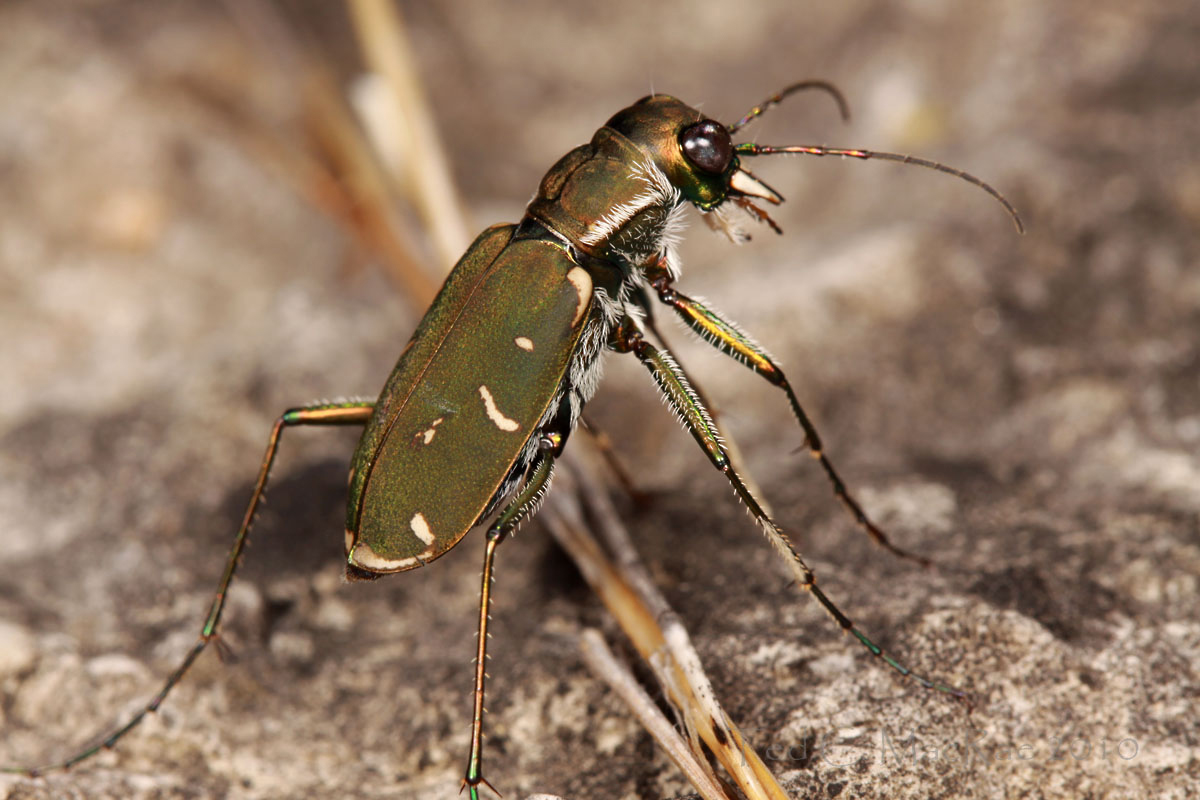
Adult male Cicindela pulchra taking in the morning sun.

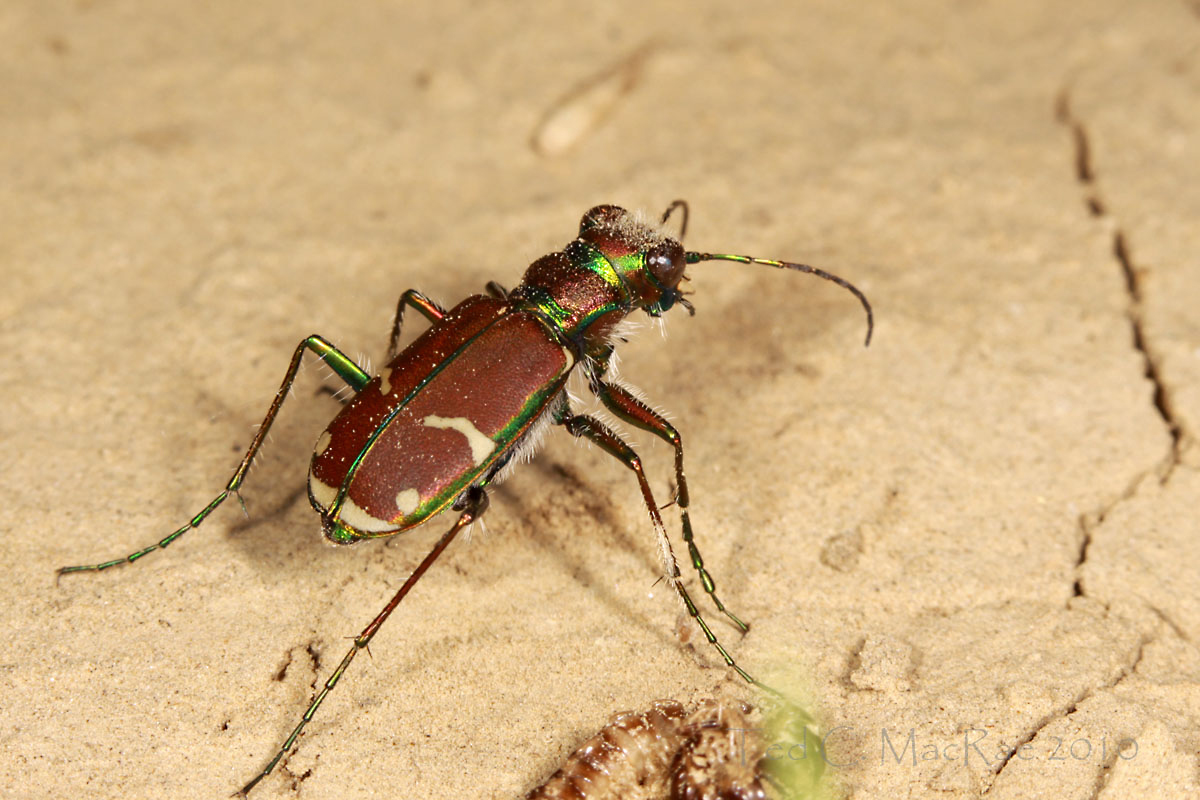
These beetles are simply a marvel to see in the field.  Brilliant dark red with metallic green, blue, and purple borders on the head, thorax, and elytra, this relatively large tiger beetle (certainly among the largest in the genus) can be confused with no other tiger beetle in North America.  Unlike adults of most other species, which exhibit color patterns resembling the texture and hue of the soil substrate on which they occur, C. pulchra adults are obvious and non-cryptic.  It apparently mimics the large, similarly colored velvet ants of the genus Dasymutilla with which they are sympatric – even exhibiting similar behavior when alarmed such as stridulating (creating vibrations by scraping body parts across one another) and giving off defense chemicals (Pearson 1988).  Adults are powerful fliers that can fly long distances when alarmed (Spomer et al. 2008), but in the still relatively cool morning air Chris and I had relatively (emphasis on relatively!) little trouble getting close enough to attempt those coveted field photographs.  This, however, was a double-edged sword – the same cool temperatures that allowed us to get close enough for photographs also caused to the beetles to assume the most non-photogenic poses as they sprawled torpidly on the ground, sometimes hugging it closely in an attempt to conserve heat until incident radiation from the sun warmed them sufficiently to go about the day’s activities.  Once this did happen, we found getting close enough for photographs nearly impossible.  In the 2+ hours that we chased after them, we took many shots but failed to get that “perfect” shot of a brilliant beetle standing tall and alert.

Adult male Cicindela pulchra hugs the ground during the cool morning hours.

Cicindela pulchra is a “spring/fall” species – i.e., sexually immature adults emerge during fall to feed, then return to their burrows to overwinter before emerging again in spring to mate and lay eggs.   Pearson et al. (2006) state the fall period lasts from July to September; however, as I observed in Kansas in 2005 adults can remain active well into October as long as suitable weather prevails.  Larvae hatch shortly after eggs are laid in the spring, but larval burrows can be seen during the entire season since they require 2-3 to complete development.  It was actually the presence of the large larval burrows (see photo below) that alerted Matt to the occurrence of the species at this site.  Several other tiger beetle species are also found here, e.g. C. purpurea (cow path tiger beetle) and C. tranquebarica (oblique-lined tiger beetle); however, these species – and hence their larval burrows – are considerably smaller than C. pulchra.  The only other species of Cicindela in North America that matches C. pulchra in size is C. obsoleta (large grassland tiger beetle), a southwestern species that is not known to range as far north as Nebraska and South Dakota, and the slightly smaller C. formosa (big sand tiger beetle) larval burrow has a distinctive “pitfall trap” with the burrow opening situated horizontally above it (it is also restricted to dry sand rather than clay habitats).  We saw several C. pulchra larval burrows during our visit but no active larvae, and none of my attempts to “fish” them out of their relatively shallow burrows met with success.  I could have tried digging them out, but that is a time-intensive activity, and I decided instead to bring a few live adults back in a terrarium of native soil and see if I could rear the species from egg.

Despite the presence of at least two other tiger beetle species at the site, this can only be that of a 3rd-instar Cicindela pulchra due to its large size.

I had tried persistently during the last hour we were there to get a good field photograph of an active adult beetle standing tall and alert, but the following is the closest I was able to achieve.  Leaving the site without that “perfect” shot was difficult – as Matt put it, we had “pulchra fever”!  Still, there were other tiger beetles – e.g. C. nebraskana (prairie long-lipped tiger beetle) and C. decemnotata (badlands tiger beetle) – that we wanted to find in the limited time we had to explore the region, so I prepared a terrarium for the live adults I was bringing back with me and chalked up our first big success of the trip as we headed towards the shortgrass prairie sitting atop the nearby Nebraska Pine Ridge.

I chased this adult female for some time trying to get a closer photograph, but warming temperatures made this impossible.

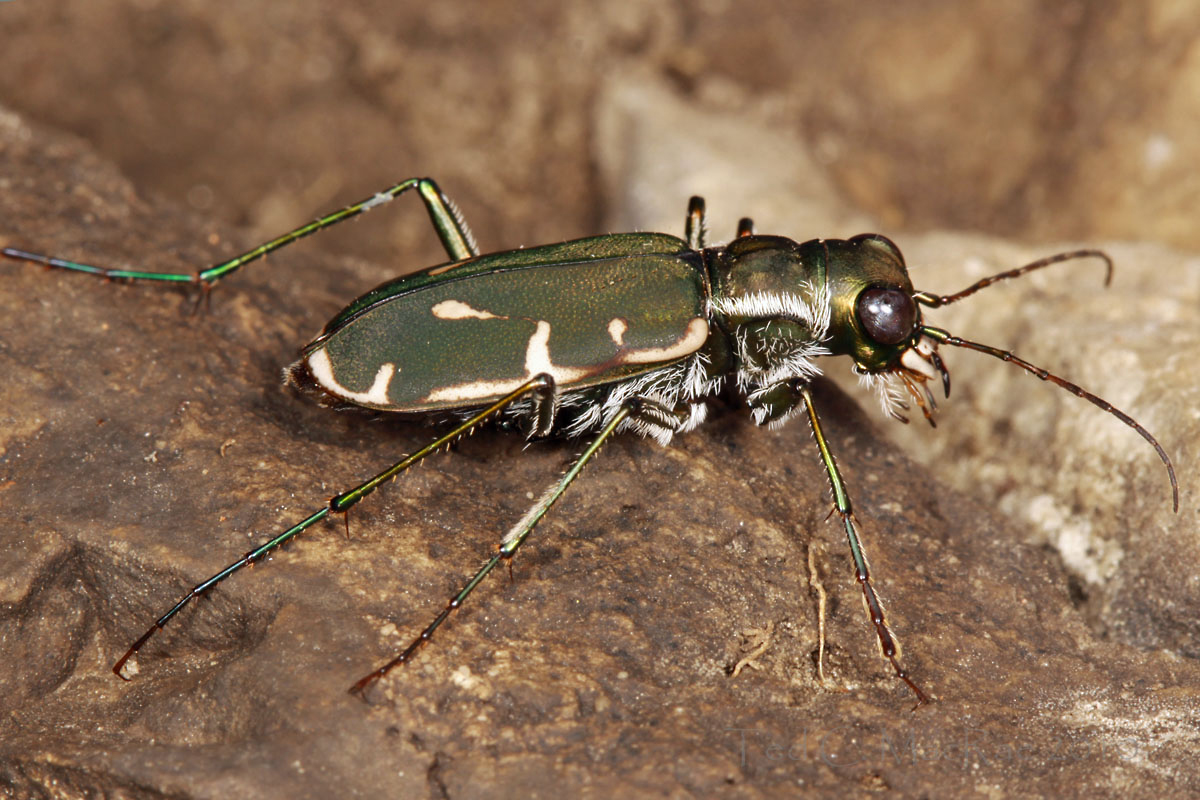
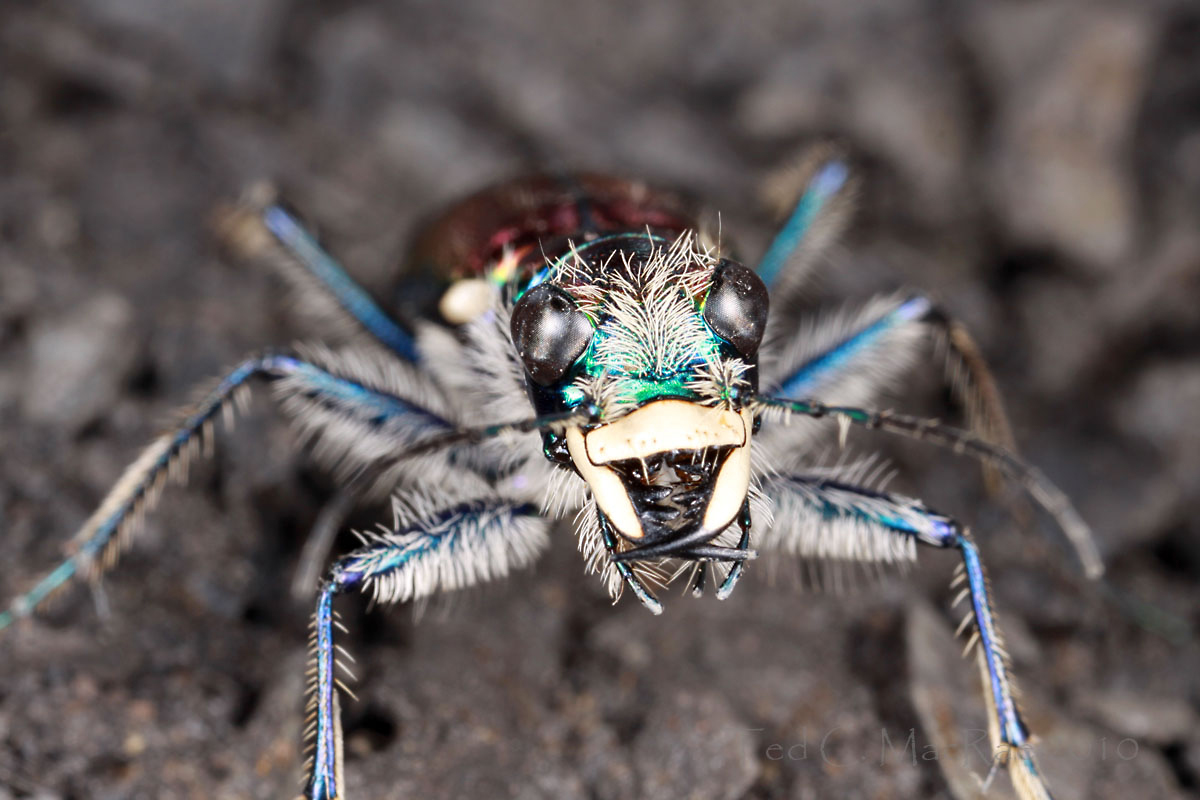
In addition to attempting to rear the species,  bringing live adults back with me also gave me more opportunity to photograph them.  In addition to the native crumbly shale soil that I used to fill the terrarium, I placed in it one of the nicely colored, presumably volcanic, rocks that littered the slopes on which the beetles occurred.  The dark color of the rock makes a nice backdrop to really show off the extraordinary colors of this species – especially the bright white labrum and mandibles of the particularly impressive male in the following photograph.  The beetles are all now sound asleep for the winter in a 10°C incubator.  Hopefully, when I move the terrarium back into warm temperatures next spring they will re-emerge, mate, and lay eggs (hmm, photographs of a mating pair would be really nice!).

The all-white labrum and mandibles of this male Cicindela pulchra are displayed nicely in this terrarium photograph.

Photo Details:
Insects: Canon 50D w/ 100mm macro lens (ISO 100, 1/250 sec, f/16), Canon MT-24EX flash w/ Sto-Fen + GFPuffer diffusers.
Habitat: Canon 50D w/ 17-85mm wide-angle lens (ISO 100, 1/160 sec, f/11), natural light.
Matt and Chris: Canon 50D w/ 17-85mm wide-angle lens (ISO 100, 1/250 sec, f/11), natural light.
All photos w/ typical post-processing (levels, minor cropping, unsharp mask).

REFERENCES:

Brust, M. L.  2010. New distribution records for Cicindela pulchra pulchra Say in South Dakota and notes on habitat use and natural history.  Cicindela 42:1–10.

Larsen, K. J. and H. L. Willis.  2008. Range extension into South Dakota for Cicindela pulchra (Coleoptera: Carabidae).  The Coleopterists Bulletin 62(4):480.

MacRae, T. C. 2006. Beetle bits: The “beautiful tiger beetle”. Nature Notes, Journal of the Webster Groves Nature Study Society 78(4):9–12.

Pearson, D. L.  1988. Biology of tiger beetles.  Annual Review of Entomology 33:123–147.

Pearson, D. L., C. B. Knisley and C. J. Kazilek. 2006. A Field Guide to the Tiger Beetles of the United States and Canada. Oxford University Press, New York, 227 pp.

Spomer, S. M., M. L. Brust, D. C. Backlund and S. Weins.  2008. Tiger Beetles of South Dakota & Nebraska.University of Nebraska, Department of Entomology, Lincoln, 60 pp.

Copyright © Ted C. MacRae 2010

Missouri’s disjunct population of Cicindela obsoleta vulturina

Although I’ve been collecting insects since I was a kid (and seriously for nearly three decades), it has only been in more recent years that fall has become an important part of the collecting season for me. With the notable exception of Fall 1978, when the Systematic Entomology course I was enrolled in sent me on a frantic quest to become one of the few undergraduate members of the exclusive “200 family” club (I got 205!), I long viewed fall as a time to hang up the net and begin the winter-long process of mounting, labeling, and curating the hundreds – sometimes thousands – of specimens I had collected earlier in the year during spring and summer.  This has primarily been a reflection of my taxonomic interest – woodboring beetles in the families Buprestidae and Cerambycidae, which occur at their overwhelmingly greatest abundance and diversity throughout most of North America during spring and summer but are found only sparingly later in the season.  Tiger beetles (family Cicindelidae) changed all that, and when I first began serious study of the group around 10 years ago, I found the combination of gorgeous weather and multitude of “spring/fall” species that emerge briefly during fall an irresistible siren call to the field. I’ve not looked back, and the Annual Fall Tiger Beetle Collecting Trip™ is now an established and eagerly anticipated event.

Cicindela obsoleta vulturina - the prairie tiger beetle (Blackjack Knob, Taney Co., Missouri).

No species embodies all that I love about fall tiger beetle collecting more than Cicindela obsoleta vulturina, the prairie tiger beetle. I first learned of the occurrence in Missouri of this large, dark green species back in 2000, when I saw a single specimen in the Enns Entomology Museum collected in Protem, Taney Co.  I was just beginning my tiger beetle studies and would later learn what the Tiger Beetle Guild already knew – that the occurrence of this species in Missouri was restricted to cedar glade habitats in the White River Hills region in the extreme southwestern part of the state, and that the population occurring there and in adjacent northern Arkansas was disjunct by 300+ miles from the main population in Texas and Oklahoma.  I couldn’t wait to see it for myself and eventually enlisted the help of Eric Eaton, living in the area at the time, and asked him to let me know if he saw a large green tiger beetle after the late summer rains began.  That September, I got a message from Eric saying that he had seen just such a beast not far from his home, and the following weekend he and I would enjoy the chance to meet each other in person and the splendor of the season while finding this marvelous species at several locations in the area.  Thus began my love affair with this species, and for several years I returned to the area each fall to document additional localities for this and other tiger beetle species occurring in the area.

Blackjack Knob is part of an extensive xeric dolomite prairie complex (commonly referred to as cedar glades, though the term is not precisely accurate) in the White River Hills subsection of the Ozark Highlands, providing habitat for prairie tiger beetles and other typically southwestern plants and animals.

In fact, until a few weeks ago it had been several years since I had last seen this species in the field.  I did make an attempt to see it again last year but returned home from that early October trip unsuccessful, cold and wet.  Thus, when tiger beetle enthusiast Steve Spomer mentioned to me earlier this summer that he wanted to see our Missouri population, I jumped at the chance to coordinate our visits this fall and show him some of my favorite sites.  The Patron Saint of Cicindela was smiling down upon us that day, as perfect timing and sunny skies combined to bring adults out in an abundance that I’d not seen in any of my previous visits.  I would take advantage of this rare opportunity and spend the next day in the area as well, documenting a number of new localities along the northern and eastern edge of its known distribution, including a far eastern extension of its range to Caney Mountain Conservation Area in Ozark Co. where we had long suspected the beetle to occur but failed in all previous attempts to find it.

Steve Spomer and yours truly at Cane Creek Rd. site.

The prairie tiger beetle is the easternmost subspecies of the large grassland tiger beetle, which along with its other included subspecies covers a geographic range covering most of Texas, New Mexico, and eastern Arizona and extending up through western Oklahoma and Kansas into eastern Colorado.  Individuals of subspecies vulturina, occurring primarily in eastern/central Texas, are distinguished from the other subspecies (nominate in western Texas and eastern New Mexico north into Colorado, santaclarae in New Mexico and Arizona, and neojuvenilis in south Texas) by their generally black to olive-green coloration and reduced, narrow elytral markings, typically with an inverted “V” at mid-elytron.  The Missouri/Arkansas disjunct population is interesting from several standpoints:

  • Individuals mostly dark olive-green – no black individuals.
  • Elytral maculations more completely developed.
  • Adults active in late summer/early fall rather than summer.

These features, in particular coloration and maculation, have fueled speculation that this isolated population might be subspecifically distinct (Pearson et al. 2006).  A recent review of material from throughout its range found these color characters of limited use in unequivocally diagnosing individuals from the Missouri and Arkansas population as a separate subspecific taxon (Mawdsley 2009); however, a molecular systematics approach ultimately may be needed to resolve the status of this population.  Presumably, the Missouri/Arkansas disjunct population represents a hypsithermal relict, left behind when the return of cooler, moister conditions caused a retreat of the formerly more expansive grasslands to their current position.  If true, then the Missouri/Arkansas population has been isolated from the parent population for ~6,000 years.  I suspect that the late summer/early fall adult phenology is an adaptation to local precipitation patterns, relying on more predictable late summer rains to trigger adult emergence after the generally droughty months of July and August.  In this regard it differs fundamentally from the true “fall” species, which emerge briefly in the fall as sexually immature adults before overwintering and re-emerging in the spring for mating and oviposition.  These Missouri/Arkansas disjuncts do not re-emerge in spring, but instead mate and lay eggs in the fall before the onset of cold weather.  The eggs hatch as well (based on my growth chamber observations of this species), so winter also is passed as a larva – either as newly-hatched 1st instars, or as later instars that hatched during the previous year(s) – rather than as adults.

I have noted considerable variation in the coloration and maculations of individuals in this population.  The individual in the first photograph above is typical of the population – dark olive-green with thin but nearly complete maculations.  That individual comes from Blackjack Knob (Taney Co.), which is near the heart of the White River Hills region.  However, the degree to which the maculations are developed is variable, ranging from rather incomplete to even more fully developed due to the presence of a marginal connection.  Additionally, a few individuals can be found that show greater or lesser suffusion of brown on the head, pronotum, and elytra.  At another location in the county closer to the northern distributional limit (Hwy 160/Cane Creek Rd.), this brown suffusion is more common and variably expressed from minimal to nearly complete.  The photographs below show five individuals from this site expressing differing degrees of brown as well as the variable macular development seen throughout the population:

Male (Hwy 160/Cane Creek Rd.) - green w/ trace brown, marginal band incomplete, median band complete.


Female (Hwy 160/Cane Creek Rd.) - green w/ slight brown, marginal band complete, median band incomplete.


Male (Hwy 160/Cane Creek Rd.) - green w/ moderate brown, marginal band incomplete, median band incomplete.


Male (Hwy 160/Cane Creek Rd.) - green w/ heavy brown, marginal band complete, median band complete.


Female (Hwy 160/Cane Creek Rd.) - completely brown, marginal band complete, median band incomplete.

There is another site even further north in the county (Merriam Woods), which I found for the first time on this trip and, to my knowledge, represents the northernmost extent of the population in Missouri.  At this site, nearly all of the individuals show coppery-brown coloration with almost no hint of green.  These fully brown individuals seem to represent an appearance that is completely unlike that seen in any other part of the range of the species.  The individual in the photo below typifies the appearance of the beetles seen at this site:

Male (Merriam Woods) - brown, marginal band incomplete, median band complete.

I’m less familiar with coloration of the population further south in Arkansas, although in my limited collecting in that area I recall that most individuals I encountered exhibited the dark olive-green coloration typical of individuals at Blackjack Knob and other more southern sites in Missouri.  Thus, there seems to a clinal element to variability in coloration in the Missouri/Arkansas disjunct population.  I suspect that the unique coloration of the beetles in this population is related to the soils with which they are associated.  Light gray Jefferson City-Cotter dolomite bedrock forms the core of the White River Hills landscape and is exposed extensively in the glades that dominate its knobs and slopes.  These exposures are weather-stained black and overlain by thin, black soils that support dark, green-black lichens amongst the sparse vegetation, as seen in the following photographs taken at the newly identified northeasternmost site at Caney Mountain Conservation Area:

Thinly soiled dolomite exposures punctuate the glades in the White River Hills. Prairie tiger beetles are found in these exposures.


Dark green-black lichens encrust the thin black soils overlaying the dolomite exposures. Prairie tiger beetle adult coloration closely matches the coloration of the lichens and soil.

The glades and dolomite exposures where these beetles are found in the White River Hills and the dry oak woodlands that surround them have a characteristic look that is not seen once one leaves the area, and I have found many new sites for the beetle in the northern and eastern fringes of the region by stopping at locations where the roadside exposures had the right “look.”  The variation in maculation and coloration seen in this population may be an indication that the population is still adapting to local conditions since becoming isolated from main population.

Currently, I have 3rd-instar larvae that I collected from their burrows at Blackjack Knob (adults mostly green) and Merriam Woods (adults mostly brown) and hope the rear them to adulthood next year.  If I succeed in getting virgin adults from the two sites, I think it would be interesting to do some single-pair crossings and rear the progeny to see how coloration is expressed.  A long term project, for sure, as these beetles probably require at least two seasons to reach adulthood, but rearing them is fun!  A more difficult, yet far more interesting, project would be to secure virgin adults from the mostly black main population in Texas – or even the bright green, thickly-maculated santaclarae subspecies from Arizona – to see how interbreeding them with these Missouri disjuncts would affect coloration and maculation in their progeny – they could be some of the most unusual appearing large grassland tiger beetles ever seen (not to mention their tongue-twisting taxonomic moniker of Cicindela (Cicindelidia) obsoleta vulturina [Missouri disjunct] x obsoleta santaclarae!).  Timing would be a difficulty, since the Texas and Arizona populations exhibit a more normal summer adult phenology, but it would be worth a try if I could secure a source of larvae for rearing.  Anybody?

A male sports his impressive pair of choppers.

Photo Details (insects): Canon 50D w/ 100mm macro lens (ISO 100, 1/250 sec, f/13-22), Canon MT-24EX flash (1/4-1/2 ratio) w/ Sto-Fen + GFPuffer diffusers. Typical post-processing (levels, minor cropping, unsharp mask).

REFERENCES:

Mawdsley, J. R.  2009. Geographic variation in U. S. populations of the tiger beetle Cicindela obsoleta Say (Coleoptera: Cicindelidae).  Insecta Mundi 0094:1–10.

Pearson, D. L., C. B. Knisley and C. J. Kazilek. 2006. A Field Guide to the Tiger Beetles of the United States and Canada. Oxford University Press, New York, 227 pp.

Copyright © Ted C. MacRae 2010

Quick Business…

I’ll have a “real” post ready shortly, but I wanted to make a quick note of a few items that have popped up recently:

  • Cylindera celeripes – this, of course, is the swift tiger beetle, a quite rare species of tiger beetle that I’ve been studying for the past two years.  I am preparing a manuscript (now in its final stages) that will review the species’ historical occurrence, document the new records I’ve accumulated for it, and discuss its potential conservation status.  I’ve gotten specimen label data from university collections in IA, KS, NE, OK, and TX (known range of the beetle) and from a number of private tiger beetle collectors.  However, I would like to make the story as complete as possible and am looking for any other repositories that might contain additional specimens.  If you know of such in your local university museum (other than those in the states listed above), I would appreciate knowing about them and getting ahold of their label data.
  • The Southern Fried Science Network has just launched a new group blog called Journeys, which they hope will serve as a central hub for writing about scientific field work and expeditions.  It’s a unique concept where contributors will post updates, stories, discoveries, and observations in the course of conducting their fieldwork.  The site has already been populated with a number of expedition logs (including a couple of my own).  I’m anxious to see if this takes off, as its field-work focus is right up my alley.  A link has been added to my sidebar under the heading “Field Work”.
  • Every now and then, someone asks me why I collect insects.  More specifically, they want to know why I must collect the insects that I find, rather than simply observing them in the field, making notes, and then letting them go on their merry ways.  Some are truly curious, while others adopt the more judgmental stance that collecting insects now is akin to the days of ornithology when birds were observed not through binoculars, but through rifle scopes before being shot!  I have a standard set of responses to this question, mostly dealing with difficulty of field identification, incomplete taxonomy, vouchering of scientific data, etc.  However, next time I am asked the question, I am going to provide a link to this post, a guest contribution by myrmecologist Benoit Guenard on Alex Wild’s Myrmecos.  I can only imagine what Benoit is going through, now realizing that he had found and photographed just the second and third known specimens of a truly rare North American ant, only to let them go because he didn’t realize what they were at the time.

Copyright © Ted C. MacRae 2010
Sweet Sixteen!

The 7th Annual Fall Tiger Beetle Trip™ is officially over – Chris and I rolled back into town a little after midnight last night. It was an amazing trip – perfect weather, unparalleled scenery, and a record-breaking 16 species of tiger beetles seen in 13 localities across four states. Not only does this beat my previous trip record of 13 species, but we did it with only five days in the field. At the time of my previous update, we had visited several locations in the South Dakota Badlands and Nebraska Pine Ridge and found ten different tiger beetle species, including Cicindela pulchra (beautiful tiger beetle) – our top priority for the trip – C. nebraskana (prairie long-lipped tiger beetle), and C. lengi (blowout tiger beetle). Our plan for the next day was to visit the Badlands of Wyoming to look for C. decemnotata (Badlands tiger beetle – appropriately) and the Yampa River Valley of northwestern Colorado to look for C. scutellaris yampae and C. formosa gibsoni, all three of which we managed to find (though with caveats – stay tuned). Our originally planned final field day was to take us back into Wyoming to look for C. longilabris (boreal long-lipped tiger beetle) in the mountains east of Laramie and the Nebraska Sand Hills to look for the delicate little C. limbata before heading back home. However, we were finally paid a visit by “the skunk” and did not see any of these species (although our sighting of C. limbata (common claybank tiger beetle) in Wyoming did officially break the old trip record). Not wanting to end the trip on a disappointing day, we delayed our departure for home yesterday and visited two more sites at the eastern edge of the Nebraska Sand Hills (sites M and N in the above map) – a clay bank site where we saw a robust population of C. denverensis (to augment the single individual we had seen earlier in the trip) and several C. splendida (splendid tiger beetle), and another sand dune/blowout system where we at last succeeded in finding C. limbata.

The day after the end of the Annual Fall Tiger Beetle Trip™ is usually a somewhat depressing day for me. Not only is the trip over, but likely so is the entire insect collecting season. I know I need the down time to process the specimens and knowledge acquired during the season, but the field work itself remains my favorite aspect of this pursuit. Nevertheless, the experiences from this trip will fuel my memories for years to come, and in the next weeks I’ll share some of the stories that unfolded. Until then, I leave you with this portrait of C. pulchra – looking rather annoyed with me for my persistent efforts to take his photograph.

Cicindela pulchra - the ''beautiful'' tiger beetle

Copyright © Ted C. MacRae 2010

The last survivor

This past June I made two trips to the Loess Hills of extreme northwestern Missouri as part of a follow-up survey for Cylindera celeripes (swift tiger beetle).¹ I was hoping to identify additional populations, however small, of this tiny, flightless, enigmatic species to go along with the three that colleague Chris Brown and I discovered last year.  The results were good news, bad news – no new populations were found, but I was able to re-confirm the beetle’s occurrence at two of the sites where we found the beetle last year.

¹ Some of you may recall my excitement at finally finding this long-sought after species in Missouri – apparently limited to the state’s few remaining high quality loess hilltop prairie remnants.

One of the sites that I had hoped might harbor the beetle is Squaw Creek National Wildlife Refuge in Holt Co. – located very near McCormack Loess Mounds Natural Area where the beetle was seen both this year and last.  Squaw Creek features several thousand acres of restored wetland habitat in the Missouri River valley that serve as resting, feeding, and breeding grounds for migratory birds and other wildlife.  Located within the Mississippi Flyway, the refuge is best known for its large concentrations of snow geese and bald eagles.  Wetlands are not good habitat for C. celeripes, but it was not the wetlands I was interested in visiting (well, I am really interested in visiting the wetlands someday – but on these visits I had other goals).  Rather, it was the tiny slivers of loess hilltop prairie that still remain on the fingers of loess bluffs along the eastern boundary of the refuge.  Twice scouring these prairie remnants over a two-week period failed to reveal the presence of the beetle, but on the first visit I did see this lone, rather ragged-looking adult male Cicindela limbalis (common claybank tiger beetle).  Unlike the aforementioned species, C. limbalis is rather common throughout most parts of the state on upland clay exposures. A spring-fall species, adults first emerge in September, have a little fun (which includes feeding but not mating), and then dig back into the ground for the winter before emerging once again in the spring. It is one of the first insects to greet the new season (I’ve seen them as early as late March) – mating and oviposition occur over the next month or two, and by end of May these guys are pretty well spent.  An interesting feature of the populations found in extreme northern Missouri is their higher degree of elytral maculation.  Compare this relatively fully-marked individual with this female that I reared from a larva collected at Knob Noster State Park in west-central Missouri (incidentally, my first ever reared tiger beetle!).

This male is clearly among the last of his generation in this area – not only did I not see any other individuals on the entire trip, but he clearly exhibits signs of wear and tear.  I found him nibbling on this dead millipede (which larger tiger beetles are known to prey upon); however, I don’t think this guy actually killed the millipede.  Rather, I think he found it already dead and was scavenging one of the only meals still available to him.  Closer examination of the face reveals that his left mandible is broken off near the base (best seen in the enlarged photo) – whether a result of battle with over-sized prey or a narrow escape from predation himself is hard to say.  Regardless, with only one “tooth” his ability to capture prey on his own has been severely compromised, and about all he can do is look for already dead prey items on which he can scavenge.  As one of the last survivors of his class, one can only hope that he lived a long and fruitful life, killed much prey, and inseminated many females.

Photo Details: Canon 50D w/ 100mm macro lens (ISO 100, 1/250 sec, f/14-16), Canon MT-24EX flash (1/4 ratio) w/ Sto-Fen diffusers. Typical post-processing (levels, minor cropping, unsharp mask).

Copyright © Ted C. MacRae 2010

Rearing the Prairie Tiger Beetle (Cicindela obsoleta vulturina)

A Prairie Tiger Beetle larva peers up from its burrow in rocky soil of a dolomite glade in the White River Hills of southwestern Missouri. The head of this 3rd-instar larvae is about the size of a pencil eraser.

I had so looked forward to the long Memorial Day weekend collecting trip – time of season and the weather were perfect, and it had been several years since I’d made a late spring swing through the woodlands, glades, and prairies of western Missouri. But after two fruitless days of searching for nearly non-existent beetles at Ha Ha Tonka State Park, Lichen Glade Natural Area, and Penn-Sylvania Prairie, I was faced with a choice: return home disappointed or try something completely different in an attempt to salvage the weekend.  I chose the latter.

A 3rd-instar Prairie Tiger Beetle larva extracted from its burrow. Total length is ~30mm.

What could be more different than the White River Hills of southwestern Missouri?  The deeply dissected dolomite bedrocks supporting xeric, calcareous glades, dry woodlands and riparian watercourses couldn’t be more different than the gentle, acidic sandstone terrain of those more northerly locations.  Its hilltop glades (“balds”) are the most extensive such system in Missouri, and I’ve already featured several charismatic insects from my travels last summer to this part of Missouri, including Megaphasma denticrus (North America’s longest insect), Microstylus morosum (North America’s largest robber fly), and Plinthocoelium suaveolens (North America’s most beautiful longhorned beetle).  One insect that I also wanted to feature from that area but that eluded me during last fall’s cold and wet collecting trip is the Prairie Tiger Beetle – Cicindela obsoleta vulturina.  This impressive species is highly localized in Missouri, occurring no further north and east than the White River Hills.  Moreover, the populations in this part of the state and across the border in Arkansas are highly disjunct from the species’ main population in the southern Great Plains.  Like a number of other plants and animals, the Missouri/Arkansas disjunct may represent a relict from the hypsithermal maximum of several thousand years ago, finding refuge in these rocky hills after cooling temperatures and increasing moisture caused the grasslands of today’s west to retreat from their former eastern extent.

The ''business end'' - four eyes and two enormous mandibles. The metallic purple pronotum is covered with soil.

Despite its restricted occurrence in Missouri, the species is apparently secure and occurs commonly on the many dolomite glades that are found in the area. I have records from a number of localities in the White River Hills, but the best populations I’ve seen occur at Blackjack Knob in Taney County.  Of course, I would have absolutely no chance of seeing the adults during this Memorial Day weekend – adults don’t come out until late summer rains trigger emergence in late August and early September.  It was not, however, the adults that I was after, for I had seen larvae of what I believed must be this species in their burrows during one of my visits to this location last summer.  Although I have collected several other species of tiger beetles in the area, I reasoned these larvae must represent C. obsoleta vulturina due to their rather large size (this species is one of the largest in the genus in North America) and because they lacked the white bordering of the pronotum typical of species in the genus Tetracha – the only other genus occurring in Missouri with species as large as this.  I had tried to extract some of the larvae for an attempt at rearing, but neither of the two techniques I tried (“fishing” and “jabbing”) had worked.  Fishing involves inserting a thin grass stem into the burrow and yanking out the larva when it bites the stem; however, I found the burrows of this species to angle and turn due to the rocky soil rather than go straight down for a clear shot.  Jabbing involves placing the tip of a knife at a 45° angle about 1″ from the edge of an active burrow, waiting for the larva to return to the top of the burrow, and jabbing the knife into the soil to block the larva’s retreat – a quick flip of the knife exposes the larvae, but in this case jabbing did not work because I always ended up hitting a rock and missing the larva before it ducked back down in the burrow.

Hooks on the abdominal hump of a 3rd-instar Prairie Tiger Beetle larva prevent it from being pulled out of its burrow by struggling prey.

I returned to the site where I had seen larval burrows last year and once again found them.  I tried fishing a few, though I knew this would be futile, then jabbing – again with no success, and then had an idea.  I went to the truck and retrieved a small trowel that I use to dig soil for filling rearing containers, then found an active burrow (larva sitting at the top, though dropping upon my approach) and got in position using the trowel as I would the knife.  I held the trowel firmly with both hands and placed my body behind it so I could use all my weight to force the trowel into the soil and past the rocks when the larva returned to the top of the burrow – worked like a charm!  After taking photographs of the first larva that I successfully extracted, I set to the business of collecting nearly a dozen more over the next couple of hours.  I then filled several containers with soil (using rocks in the larger one to create “compartments” to keep the larvae separated), poked “starter burrows” in the soil, and one at a time placed the extracted larvae in the burrows and sealed them in by pushing/sliding my finger over the hole.  I’ve found this is necessary to prevent the larvae from crawling right back out and digging a new burrow somewhere else – not a problem if there is only one larva in the container (although I prefer they use the starter burrows that I place at the edge of the container so that I can see them in their burrows to help keep track of what they are doing); however, in containers with more than one larva they will often encounter each other and fight, resulting in some mortality.  Larvae sealed in starter burrows eventually dig it open again but generally continue excavating it for their new burrow.  One larva was not placed in a rearing container – it was kept in a vial for the trip home, where it was dispatched and preserved in alcohol as a larval voucher specimen.

This male adult Prairie Tiger Beetle (emerged 10 weeks after collecting the larva) shows the dark olive-green coloration and semi-complete markings typical of the MO/AR disjunct population.

After returning to St. Louis, I placed the rearing containers in a growth chamber and monitored larval activity 2-3 times per week.  Whenever a burrow was opened, I would place a fall armyworm, corn earworm, or tobacco hornworm larva in the burrow and seal it shut.  Some burrows would be re-opened almost immediately and, thus, fed again, while others stayed sealed for longer periods of time.  Tap water was added to the container whenever the soil surface became quite dry – generally once per week, and by late July nearly all of the burrows were sealed and inactive. If these larvae did, indeed, represent C. obsoleta vulturina, then this would be the time they would be pupating.  On August 15 I had my answer, when I checked the containers to find the above male had emerged, and the next day two more adults emerged as well (including the female shown below).

This female adult Prairie Tiger Beetle emerged the same day as the male and shows slightly brighter green coloration.

I put the emerged adults together in the largest rearing container, and within minutes the male and one of the females were coupled. I’ve kept them fed with small caterpillars and rootworm larvae, and numerous oviposition holes were eventually observed on the surface of the soil in the container. In a few weeks, I’ll place this container in a cold incubator for the winter and then watch next spring to see if larvae hatch and begin forming burrows. If so, it will be a chance to see if I can rear the species completely from egg to adult and preserve examples of the younger larval instars.

Photo Details: Canon 50D (ISO 100, 1/250 sec) w/ Canon MT-24EX flash w/ Sto-Fen + GFPuffer diffusers. Typical post-processing (levels, minor cropping, unsharp mask).
Photos 1-2, 5-6: 100mm macro lens (f/14-f/16).
Photos 3-4: 65mm MP-E 1-5X macro lens (f/14).

Edit 9/10/10, 6:30 pm: I checked the terrarium today and discovered 24 brand new 1st-instar larval burrows dotting the soil surface.  They are quite large already, almost as big as 3rd-instar burrows of the diminutive Cylindera celeripes.  I guess I’m surprised to see larvae hatching already, as I expected they would overwinter as eggs and hatch in the spring.  Now that I think about it, however, hatching in the fall makes sense, as this gives them an opportunity to feed some before winter sets in and also allows them to burrow for more protection from freezing temperatures.  I’ve dumped a bunch of 2nd-3rd instar Lygus nymphs into the terrarium for their first meal.

Copyright © Ted C. MacRae 2010

“A good photographer is invisible…”

Yesterday I shot down to the southeastern lowlands of Missouri to spend some quality time in the field with friend and fellow cicindelophile Kent Fothergill. We were primarily looking for migrants of the Ascendent Tiger Beetle (Cicindela trifasciata ascendens), a Gulf Coast species that doesn’t normally occur in Missouri but is well known for its vagility and late-season northward migrations and which has been seen in the state once before (Brown and MacRae 2005).  No such individuals were found, but no matter – the day was really about just getting out and enjoying the camaraderie.  Nevertheless, there were some successes.  We located burrows of 1st- and  2nd-instar larvae of the Ant-like Tiger Beetle (Cylindera cursitans) at a site along the Mississippi River where Rich Thoma and I found adults last year.  Previous attempts to rear this species from larva to adult have not succeeded (Brust et al. 2005), but I collected a number of larvae and transferred them to a rearing container anyway in hopes that the techniques I’ve developed for rearing the closely-related Swift Tiger Beetle (Cylindera celeripes) might work also with this species.  We also found the beast that I am photographing above – I’ll leave it to your imagination for now to figure out what it is.

In between stops there was plenty of time for discussion on subjects entomological and non.  One thing Kent knows a thing or two about is insect photography, and during a discussion about such he made an interesting comment. Beyond focus, exposure, and composition, he noted that good insect photographers have the ability to become invisible – i.e., they combine patience and persistence with knowledge of the subject’s behavior to make it forget about the big glass eye staring at them from 6 inches away and return to going about their business.  It brought some clarity to my mind about the things I’ve tried in my own attempts to photograph insects that really did not want to be photographed (and there have been many).  The point was emphasized when I came into the office this morning and found the above photograph in my email inbox – Kent had taken it yesterday while I was photographing the bug-to-be-named-later, and I was completely unaware that I was being photographed!  Yes, a good photographer is invisible…

REFERENCES:

Brown, C. R. and T. C. MacRae. 2005. Occurrence of Cicindela (Cicindelidia) trifasciata ascendens (Coleoptera: Cicindelidae) in Missouri. Cicindela 37(1–2):17–19.

Brust, M. L., W. W. Hoback, and C. B. Knisley. 2005. Biology, habitat preference, and larval description of Cicindela cursitans LeConte (Coleoptera: Carabidae: Cicindelinae). The Coleopterists Bulletin 59(3):379–390.

Copyright © Ted C. MacRae 2010

Add to FacebookAdd to DiggAdd to Del.icio.usAdd to StumbleuponAdd to RedditAdd to BlinklistAdd to TwitterAdd to TechnoratiAdd to Yahoo BuzzAdd to Newsvine

Email to a friend

Cicindela – A quarterly journal devoted to Cicindelidae

Being a cicindelophile (i.e., a tiger beetle enthusiast), I have on occasion highlighted articles published in the journal Cicindela (“A quarterly journal devoted to Cicindelidae”) (see previous post – also here, here and here).  This delightful little journal is the now 42-year old brainchild of Ronald L. Huber, among North America’s foremost experts of the group (and still serving as Managing Editor for the journal).  With Robert C. Graves and Richard Freitag also serving as Editors, the journal publishes four issues per year – each containing a variety of articles dealing with the taxonomy, biology, faunistics, and conservation of this captivating group.  More recent years have also seen the inclusion of color photographs.  For serious students of the group, the journal is an indispensable resource – its issues containing a significant portion of the recent tiger beetle taxonomic literature (indeed, I am fortunate to possess in my own library a complete and nicely bound set of this journal).  However, even those with only casual interest in the group can appreciate the journal’s informal, enthusiast-centric tone.  A remarkably longstanding labor-of-love, Ron himself lays out and delivers each issue to the printer, then mails copies to the journal’s few hundred subscribers.

One thing that the journal has lacked is a web presence.  This has becomes all too clear with each article that I’ve featured, each prompting requests for subscription information by readers whose interest in the journal was piqued but were then unable to find such information on the web.  All of that is about to change – with Ron’s permission, the journal’s editorial policy and subscription information are being reproduced here to make them more widely available to those who might wish to contribute or subscribe.  The cost of the journal is nominal (only $10 in the U.S.), so even the most casually interested person should be able to justify a subscription.

Editorial Policy

Manuscripts dealing with any aspect of the study of Cicindelidae will be considered from any author.  All manuscripts should be submitted to the Managing Editor via email or on diskette [see inside back cover for conventions and format].  Papers dealing with areas other than the Nearctic are especially solicited but should be in English.  Translations are also very welcome.  All manuscripts will be acknowledged upon receipt.  Proofs-for-correction will be emailed to authors for quality control.  Illustrations, charts, graphs, etc., are encouraged.  Authors that have institutional support or other funds available for publication purposes are importuned to arrange for at least partial payment of publication costs.  Current page charges are shown inside the back cover.

Subscriptions

The subscription price for each annual volume of four numbers is currently $10.00 (domestic) and $13.00 outside the U.S.  All subscriptions begin with the first issue of the year.  Back issues of prior volumes, if still available, are priced according to age.  Inquire for prices.  All requests for subscriptions and back issue availability should be addressed to the Managing Editor: Ronald L. Huber, 2521 Jones Place West, Bloomington, Minnesota 55431-2837, U.S.A.

My appreciation to Ron for allowing me to post this information, and also to Ken Allen, for permitting me to reproduce the cover of the latest issue of Cicindela, graced with a gorgeous variant of Cicindela longilabris that he photographed in Glacer National Park.

Copyright © Ted C. MacRae 2010
Add to FacebookAdd to DiggAdd to Del.icio.usAdd to StumbleuponAdd to RedditAdd to BlinklistAdd to TwitterAdd to TechnoratiAdd to Yahoo BuzzAdd to Newsvine

Email to a friend