Big, black (and red), and beautiful!

While I may have already declared Plinthocoelium suaveolens (bumelia borer) as North America’s most beautiful longhorned beetle, any short list of top candidates for this title must also include the species Crossidius coralinus. Like most other members of this strictly North American genus, these gorgeous beetles emerge as adults during late August and September to feed on the profusion of yellow blooms put forth by their larval host plants, Ericameria nauseosa (gray rabbitbrush). Across the Great Basin and adjacent areas, the relatively large size, spectacularly long antennae, and stunning value contrast between red/black or orange/black beetles, yellow flowers, and blue skies combine to make the sight of C. coralinus a highlight on any fall insect collecting trip. If beauty alone isn’t enough, the species also exhibits an unusual level of polytopism across its range. Red in some areas (e.g., C. c. temprans), orange in others (e.g., C. c. monoensis), bigger or smaller, and varying degrees of development of the black areas that cover the basal edge and apical portion of the elytra, the species segregates into several described subspecies and many more unnamed but locally distinct populations. This post features photos of individuals from several populations that field-mate Jeff Huether and I encountered during last August’s Great Basin collecting trip.

Crossidius coralinus coralinus

Crossidius coralinus ssp. coralinus (male) | Montezuma Co., Colorado

Crossidius coralinus coralinus

Crossidius coralinus ssp. coralinus (female) | Montezuma Co., Colorado

One of the most impressive populations I’ve encountered is illustrated by the male and female individuals shown in the above photos, which were seen near the city of Cortez in southwestern Colorado. Linsley & Chemsak (1961) assigned specimens from this area to the nominate subspecies, characterizing them as “moderate-sized”; however, some of the individuals that we encountered at this site were truly gargantuan (exceeding 20 mm in length). Note how extensive the black areas are in these individuals, especially the female.
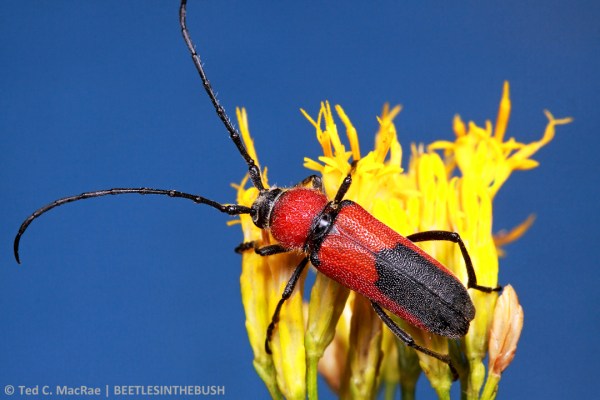
Crossidius coralinus jocosus (male) | Costilla Co., Colorado

Crossidius coralinus ssp. jocosus (female?) | Costilla Co., Colorado
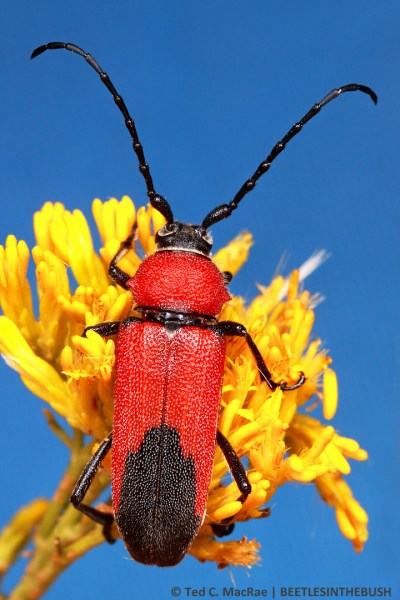
Crossidius coralinus jocosus (female) | Costilla Co., Colorado

Crossidius coralinus ssp. jocosus (female) | Costilla Co., Colorado

On the other side of the state near Fort Garland (southeastern Colorado) we encountered a population that Linsley & Chemsak (1961) considered representative of the subspecies C. c. jocosus. In contrast to the larger size and extensive black markings of the nominotypical population we found near Cortez, individuals in this population were considerably smaller in size and exhibited less extensively developed black areas of the elytra. Their small size also made them a little harder to notice—perhaps that is the reason we found so few individuals (~7 total at several sites along Hwy 160). We did note also, however, that the gray rabbitbrush flowers seemed to be well past their prime, so perhaps an earlier appearance of the rains upon which plant flowering and beetle emergence rely had us on the tail end of their activity period.

Crossidius coralinus coralinus

Crossidius coralinus ssp.? (male) | San Juan Co., Utah

Crossidius coralinus coralinus

Crossidius coralinus ssp.? (female) | San Juan Co., Utah

Linsley & Chemsak (1961) noted several populations across middle and southern Utah, but the only one to which they assigned a name was C. c. coccineus in Washington Co. (southwestern Utah). While we didn’t visit Washington Co. on this trip, we did look for these beetles at several sites north of Monticello in San Juan Co. (southeastern part of the state). Geography would place this population close to nominotypical populations, and while the beetles in this population resembled them in size they clearly differed in the greatly reduced black areas of the elytra. Note the male especially, with the black area reduced to little more than a sutural stripe in the apical half of the elytra. Linsley & Chemsak (1961) related specimens collected just a few miles further south from ours to an unnamed population in adjacent Wayne Co. (near Hanksville), both of which seem to be close to C. c. coccineus due to their robust size and the reduced black elytral markings of the male.

Crossidius coralinus ssp. (female) | Nye Co., Nevada

Crossidius coralinus ssp.? (female) | Nye Co., Nevada

Crossidius coralinus is found commonly along the western edge of the Great Basin in the form of C. c. temprans. However, Linsley & Chemsak (1961) presented very few records of the species further east in Nevada. We stopped at several spots in central Nevada while traveling along Hwy 6, but despite an abundance of gray rabbitbrush stands in peak bloom we found but a single male and a single female, the latter shown in the above photograph. Geographically this female should be assignable to C. c. temprans, but the black area of the elytra is not nearly so expanded as is typical for that subspecies. The only record from central Nevada in Linsley & Chemsak (1961) is a single male from White Pine Co. (a little further to the east), but they related that specimen to an unnamed population near Marysvale in Piute Co., Utah of smaller size and with the black area of the elytra distinctly expanded in both sexes.

The author photographing insects on flower head of Ericameria nauseosus.

The author photographs insects on gray rabbitbrush in San Juan Co., Utah.

There are those who say “Subspecies, schmubspecies!” I concede they may be right for a large number of named subspecies, possibly including C. coralinus, and while the basin and range topology of the Great Basin and discontinuous distribution of host plants within that geography provide ideal conditions for the development of distinctive, geographically based populations, I suspect C. coralinus has sufficient mobility to allow gene flow across its range (with the possible exception of populations in California’s Central and Owens Valleys). Moreover, the inability of Linsley & Chemsak (1961) to segregate the central Great Basin populations into discrete taxonomic units suggests that the subspecies concept may not be applicable. Nevertheless, it cannot be denied that distinctive, localized populations of this species do exist. Moreover, I hesitate to dismiss subspecies in problematic taxa such as C. coralinus, because doing so makes it easier to ignore variability and presume (possibly incorrectly) no geographic component. Variability is interesting and should be thoroughly evaluated to determine its basis regardless of its basis. Geographically based variability is especially interesting because it suggests the existence of distinct genetic traits that contribute to the genetic diversity of species. Such traits are valuable to protect, and the use of subspecies provides a convenient shorthand for referring to the populations that contain them in both taxonomic and conservation contexts.

REFERENCE:

Linsley, E. G. & J. A. Chemsak. 1961. A distributional and taxonomic study of the genus Crossidius (Coleoptera, Cerambycidae). Miscellaneous Publications of the Entomological Society of America 3(2):25–64 + 3 color plates.

© Ted C. MacRae 2014

When is a stag beetle not a stag beetle?

A: When it’s a longhorned beetle!

Parandra (Tavandra) polita

Parandra (Tavandra) polita | Alexander Co., Illinois

Last week I traveled to northwestern Tennessee to visit research plots, and on the way back I took the opportunity to stop by Fort Defiance Park near Cairo, Illinois. Fort Defiance represents the southernmost tip of Illinois, lying at the confluence of the Ohio and Mississippi Rivers, and on previous visits I had thought that the wet bottomland forest remnants present there looked like promising habitat for the ant-like tiger beetle (Cylindera cursitans). The type locality of a synonym (Cicindela alata) is in northern Illinois, but the type specimens are considered to have been introduced and, to my knowledge, no bona fide records of the species are known from the southern part of the state. I have taken the species nearby on the Missouri side of the Mississippi River (MacRae et al. 2011), so I thought the chances were good of finding it here as well. And find it I did—in good numbers! Success already in hand, I decided to stick around for nightfall and set up some blacklights to see what other beetles might be attracted from the surrounding forests.

Parandra (Tavandra) polita

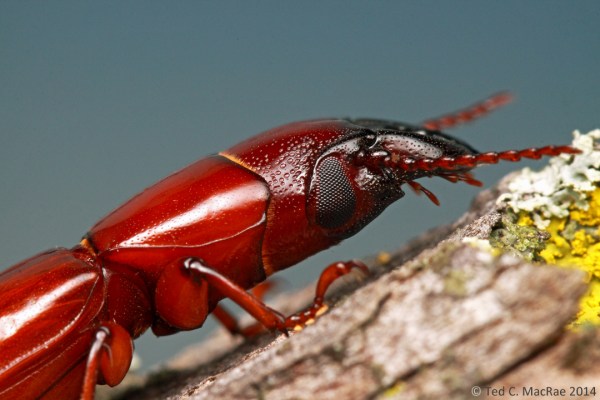
The color and shape of the body and prominent jaws give the appearance of a small stag beetle.

Sadly, not much of interest was coming to the lights. Temperatures and humidity were good, but a waxing moon with clear skies didn’t help. Worse, the sheets were inundated with caddisflies—always a predictable consequence when blacklighting near large rivers but especially annoying because of their habit of flying into your face (and up nostrils, down shirts, in ears…) when checking the sheet for other insects. A few longhorned beetles did show up, as did some male and female reddish-brown stag beetles (Lucanus capreolus), and later a single coppery tiger beetle (Ellipsoptera cuprascens) also made an appearance. By 10 pm, however, I had decided enough was enough and went to one of the sheets to begin taking it down. As I did, I noticed a reddish-brown, large-mandibled beetle sitting on the sheet that, for all intents and purposes, looked like a small stag beetle. I wasn’t fooled, however, as I knew exactly what this beetle was—I had previously seen this species in the form of two individuals at a blacklight in southern Missouri very near to my current location (although it was 28 years ago!). It was Parandra polita, an usual longhorned beetle belonging to the archaic subfamily Parandrinae, and those specimens (MacRae 1994) plus another collected more recently a few miles north—also at a blacklight in wet bottomland forest along the Mississippi River (McDowell & MacRae 2009)—to date represent the only known occurrences of this uncommon species in Missouri.

Parandra (Tavandra) polita

The entire rather than emarginate eyes distinguish this species from Neandra brunnea,

Linsley (1962) noted the tenebrionid (darkling beetle)-like appearance of beetles in this genus. Perhaps the glabrous, parallel-sided body recalls the appearance of some darkling beetles, but I have always thought these beetles looked more like stag beetles because of the reddish-brown coloration and, notably, fairly large, forward-projecting mandibles that even show the same type of size dimorphism as stag beetles—larger in “major” males, smaller in females and “minor” males. Parandrines differ from most other subfamilies of longhorned beetles by having the antennae short and equal-segmented and the tarsi distinctly pentamerous with slender, padless segments. Another small subfamily of longhorned beetles, the Spondylidinae, shares these characters, but parandrines are easily distinguished from them by several characters including the margined pronotum—also a most lucanid-like character.

Parandra (Tavandra) polita

Parandra polita also has the mandibles contiguous at the base and a narrower, more flattened body.

Although Parandrines are reasonably diverse in South America and Africa, North America boasts only four taxa, with P. polita and Neandra brunnea being the only two occurring in the eastern part of the continent. Annoyingly, I have collected just as few specimens of the latter as the former, despite the fact that N. brunnea is considered to be the most commonly encountered of all four North American taxa. The specimens were all taken in Japanese beetle traps that I ran while working for the Missouri Department of Agriculture in the 1980s, so I have never actually seen a live individual of that species. Parandra polita and N. brunnea are, however, fairly easy to distinguish, as the former has the mandibles triangular and contiguous at the base while in the latter they are sickle-shaped and well separated at the base. The former also has the eyes entire on the inner margin while the latter has them distinctly emarginate, and in basic gestalt P. polita has a narrower, more flattened body than N. brunnea.

A frontal portrait of this beetle was featured a few days ago in ID Challenge #23. A few people were fooled by its lucanid- and even cucujid-like appearance, but Stephen, Harry Zirlin, Nikola Rahme, Jon Quist, and Ben Coulter all correctly guessed this species. By virtue of being first, Stephen rises above the 5-way tie to get the win. However, I should note that Harry was the first to actually provide names for each of the four requested taxa (as did Jon and Ben subsequently), so he could make a valid claim for the win. Also, nfldkings and froglady made really nice comments about my blog and the featured photo, so I award them with honorable mentions!

REFERENCES:

Linsley, E. G. 1962. The Cerambycidae of North America. Part II. Taxonomy and classification of the Parandrinae, Prioninae, Spndylinae, and Aseminae. University of California Publications in Entomology 19:1–102, 1 plate [OCLC WorldCat].

MacRae, T. C. 1994. Annotated checklist of the longhorned beetles (Coleoptera: Cerambycidae and Disteniidae) known to occur in Missouri. Insecta Mundi 7(4) (1993):223–252 [pdf].

MacRae, T. C., C. R. Brown & K. Fothergill. 2011. Distribution, seasonal occurrence and conservation status of Cylindera (s. str.) cursitans (LeConte) (Coleoptera: Cicindelidae) in Missouri.  CICINDELA 43(3):59–74 [pdf].

McDowell, W. T. & T. C. MacRae. 2009. First record of Typocerus deceptus Knull, 1929 (Coleoptera: Cerambycidae) in Missouri, with notes on additional species from the state. The Pan-Pacific Entomologist 84(4) (2008):341-343 [pdf].

© Ted C. MacRae 2014

One-shot Wednesday: Mallodon dasystomus

Mallodon dasystomus | southeast Missouri (Mississippi Co.)

Mallodon dasystomus | southeast Missouri (Mississippi Co.)

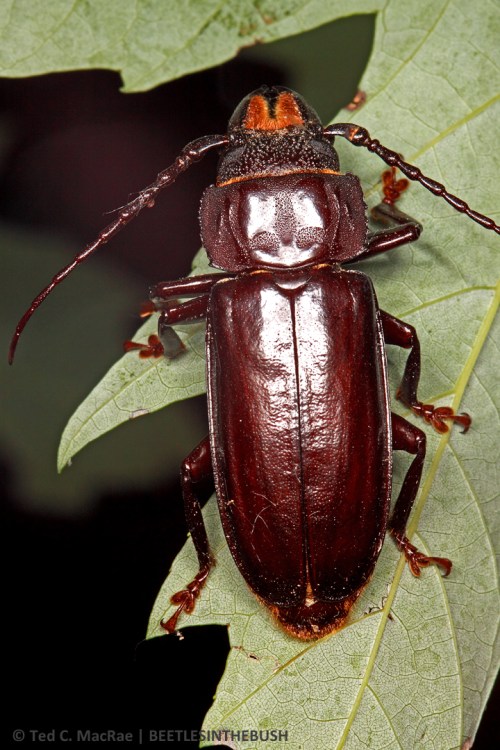
Today’s (slightly belated) edition of “One-shot Wednesday” features a beetle that I saw just about this time last year while blacklighting along the Mississippi River in the southeastern lowlands of Missouri. Mallodon dasystomus¹ is a prionid longhorned beetle (family Cerambycidae, subfamily Prioninae) that is sometimes called the “hardwood stump borer”. It is perhaps one of the most widely distributed members of its group, occurring across the southern tier of the U.S. down through Mexico and Central America as far as northern South America.

¹ Until recently the specific epithet was consistently misspelled in most of the literature as “dasytomus“. A closer look at the Greek root words dasus (δασύς), meaning “hairy”, and stoma (στόμα), meaning “mouth”, shows the misspelling to be nonsensical. I, myself, am guilty of using the wrong spelling in my checklist of Missouri longhorned beetles (MacRae 1994), although I can claim to have been “going with the flow”.

Despite the beetle’s wide geographical range, I searched for it both eagerly and unsuccessfully during the 1980s as I was gathering data for my checklist of Missouri longhorned beetles (MacRae 1994). I eventually published that checklist and included the species on the basis of a few specimens seen in other collections, but I never encountered it for myself until some years later during a visit to Cave Creek Canyon in southeast Arizona. As noted by Linsley et al. (1961), this species is common there and is associated with large, partially dead Arizona sycamores (Platanus wrightii). Although nearly 20 years ago, I still recall seeing the large beetles crawling high up on the trunks and sitting in their emergence holes with only their massively-mandibled heads protruding as they tantalizingly waved their antennae about.

That experience would directly lead to my eventually finding this species for myself in Missouri. Shortly after returning to the state in the mid-90s, I was driving along a road in the state’s southeastern lowlands when I passed a very large, half-dead American sycamore (Platanus occidentalis). Even at a speed of 40 mph I could see the large emergence holes that immediately reminded me of what I had seen in Arizona, so I hit the brakes, made a quick U-turn, and came back to look at the tree a little more closely. I was convinced the holes were made by this species, and my hunch was proven when I eventually found several beetle carcasses on the ground around the base of the tree. I returned the following weekend with a chainsaw, cut several one-cubic-foot sections of wood from the dead portion of the massive tree’s trunk (with landowner permission), and eventually reared a nice series of adults from the wood. Having uncovered the association of this species with sycamore in the state, I was able to find the species also in several other locations in southeastern Missouri, but I have not managed to find the species in any areas north of the southeastern lowlands in Missouri despite the common occurrence of the host tree.

The beetle in the above photograph landed on the foliage of a large silver maple (Acer saccharinum) next to the ultraviolet light I had setup in wet bottomland forest along the Mississippi River, and wanting to ensure that I got at least one in situ photo of the beetle that is where I shot it. I did try to move it to the trunk of a large, dead sycamore nearby for a more realistically representative photo of how these beetles are usually encountered, but the beetle became quite agitated when I moved it and my considerable patience was never rewarded. I popped it into a vial in hopes of photographs the next morning, but conditions were not to the beetle’s liking and it expired before I had another chance to photograph it. Just the other night I setup a blacklight in a spot not too far from where I saw this beetle in hopes of getting another chance to photograph it. That effort was not successful, but I did find a longhorned beetle species that I had not seen in nearly 30 years! I was successful in photographing that species but (please excuse the teaser) will save those photos for a future post.

REFERENCES:

Linsley, E. G., J. N. Knull & M. Statham. 1961. A List of Cerambycidae from the Chiricahua Mountain Area, Cochise County, Arizona (Coleoptera). American Museum Novitates 2050:1–34 [full text, pdf].

MacRae, T. C. 1994. Annotated checklist of the longhorned beetles (Coleoptera: Cerambycidae and Disteniidae) known to occur in Missouri. Insecta Mundi 7(4) (1993):223–252 [pdf].

© Ted C. MacRae 2014

Black is beautiful!

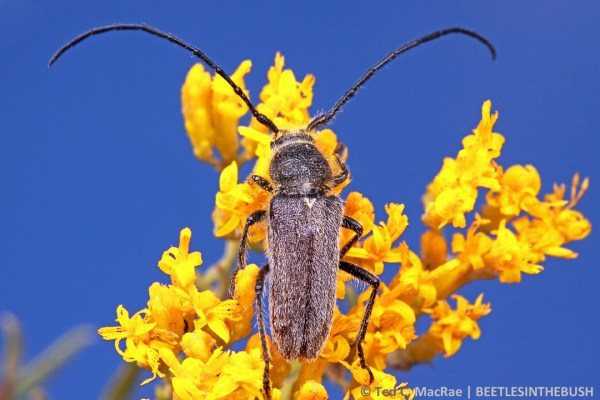
Most species in the genus Crossidius exhibit varying amounts of yellow/red/orange coloration on the body. However, one species—Crossidius ater—dispenses with such adornments and remains all-black throughout its expansive range across the Great Basin and surrounding areas. Despite this, they are no less pretty than their more gaudily colored relatives. The adults in these photos were seen on flowers of yellow rabbitbrush (Chrysothamnus viscidiflorus) at two locations in White Pine County, Nevada on 30 August 2013 (all photos w/ natural sky background).

Crossidius ater | 7.2 mi SW NV318 on US6, White Pine Co., Nevada.

Crossidius ater | 7.2 mi SW NV318 on US6, White Pine Co., Nevada.

Crossidius ater | Ely,  1.2 mi S Jct US6/50/93, White Pine Co., Nevada.

Crossidius ater | Ely, 1.2 mi S Jct US6/50/93, White Pine Co., Nevada.

Crossidius ater | Ely,  1.2 mi S Jct US6/50/93, White Pine Co., Nevada.

Crossidius ater | Ely, 1.2 mi S Jct US6/50/93, White Pine Co., Nevada.

© Ted C. MacRae 2014

Why I went to Georgia

Call me biased, but for my money few groups of beetles can match the maddening combination of beauty and difficult taxonomy of jewel beetles (family Buprestidae) (I can already hear the protestations of weevil and scarab workers). In the case of jewel beetles, much of the difficulty is due to a propensity for hyperdiverse genera. For example, in North and Central America more than half of the nearly 2,000 described species belong to just three genera—AcmaeoderaChrysobothris, and Agrilus. It’s enough to make many a casual coleopterist throw their hands in the air and ship their specimens off to “specialists” for identification. This is, strangely, for me part of their attraction. Any reasonably serious effort to study jewel beetles over a period of time is sure to uncover a wealth of new data, from previously unknown hosts associations and distributions to the alpha taxonomist’s raison d’être—new species!

Chrysobothris seminole

Chrysobothris seminole on its host, Chrysoma pauciflosculosa.

One of the more problematic jewel beetle groups is the “Chrysobothris femorata species-group”. For many years, these abundant and conspicuous members of forest and landscape ecosystems have confounded collectors, foresters, and extension entomologists alike. A recent revision of the group by Stan Wellso and Gary Manley (Wellso & Manley 2007) has done much to improve the situation through the description of several new species and clarification of the hosts, distributions, and identifying characters of previously known species. I have benefited more than many from their work, since during the 25 years leading up to that work I had collected large numbers of specimens assignable to this group and was fortunate to have this material examined by Stan and Gary and included in the type series of most of the new species they described. Having in my collection series of nearly all of the known species in this group greatly facilitates identification of specimens received for identification and the recognition of any new species that might come my way. Notice, however, that I said “nearly” all of the known species—there were two species described in that work that I did not have examples of; C. seminole from Georgia and Florida and C. mescalero from New Mexico and west Texas. Happily, I can now say that only C. mescalero is still missing from my collection.

Chrysomoa pausiflosculosa

Chrysomoa pausiflosculosa (woody goldenrod) | Emanuel Co., Georgia.

Chrysobothris seminole is unique in the group by its association not with deciduous hardwood trees, but rather the stems and root crowns of living woody goldenrod (Chrysomoa pauciflosculosa), a member of the aster family (Asteraceae). This plant is not a true goldenrod (genus Solidago), although they are in the same family, but is named such for the profusion of yellow inflorescences that appear during fall and resemble those of goldenrod. However, unlike goldenrod, woody goldenrod is a perennial plant with a woody root crown and stems from which new growth emerges each year. Woody goldenrod is restricted to coastal dunes and sand scrub habitats in the U.S. southeastern coastal plain, although the beetle itself has only been found in a few locations in Florida and southeastern Georgia. The beetle was first collected in numbers by Roy Morris and Edwin Donaldson, who reared adults from woody goldenrod root crowns they had collected in an effort to rear adults of another wood-boring beetle; this one in the family Cerambycidae and also undescribed and restricted to woody goldenrod. That beetle was recently described as Crossidius grahami Morris & Wappes, 2013.

Chrysobothris seminole

Adults are found primarily on lower stems of living plants.

In late May of this year, I made the 13½-hour drive from St. Louis to Emanuel Co., Georgia to visit the type locality of C. seminole and try my hand at finding this species. Along the way I met up with two excellent beetle collectors in Tennessee; Joshua Basham and Nadeer Youssef. Josh and Nadeer are among the few people who have succeeded in collecting this species, having visited the type locality during the previous two years and managing to collect a small series of adults. Their experience proved to be invaluable, as we saw only three individuals during our two days in the area. Josh saw the first soon after we arrived at the type locality and was kind enough to let me see it in situ on its host plant and make the collection, and Nadeer was equally kind to give me the third individual we saw. Our consensus was that a combination of early timing and lack of rain was the reason for their scarcity, and to hedge our bets we collected a number of plants that showed evidence of buprestid (as well as cerambycid) larval workings in the lower stems and root crowns to attempt rearing additional specimens. Because of their scarcity, I kept the adults alive and photographed them later that night in a more secure “studio” setting, and while this species has been photographed before I do believe that the photographs presented here are the only photos of live individuals.

Sand scrub habitat | Emanuel Co., Georgia.

Sand scrub habitat | Emanuel Co., Georgia.

In addition to its unique host plant association and restricted distribution, C. seminole can be distinguished from other members of the C. femorata species-group by both sexes having the frons and clypeus uniformly brown (in most other species of the group the frons and clypeus are variously colored, often brightly so in males of the species). The one other species with both males and females also exhbiting a uniformly brown frons and clypeus is C. mescalero (now the only species still lacking in my collection), which Wellso & Manley (2007) distinguished from C. seminole by having three distinct elytral costae (C. seminole has two indistinct costae), its indistinct elytral foveae (in C. seminole the foveae are distinct), and its southwestern distribution and association with oaks. I suppose now I’ll have to start making plans for a June/July visit to sand dune habitats in New Mexico and west Texas sometime in the near future.

REFERENCES:

Morris, R. F., II & J. E. Wappes. 2013. Description of a new Crossidius LeConte (Coleoptera: Cerambycidae: Cerambycinae: Trachyderini) from southern Georgia with comments on its biology and unusual distribution. Insecta Mundi 0304:1–7 [pdf].

Wellso, S. G. & G. V. Manley. 2007. A revision of the Chrysobothris femorata (Olivier, 1790) species group from North America, north of Mexico (Coleoptera: Buprestidae). Zootaxa 1652:1–26 [abstract].

© Ted C. MacRae 2014

“Picudo negro” (black weevil) on soybean in Argentina

During my recent tour of soybean fields in Argentina, I traveled north to Tucumán Province and met with entomologists at the Estación Experimental Agroindustrial Obispo Columbre (“Obispo Columbre Agricultural Experiment Station”). This provincial station, established more than 100 years ago (1909), conducts research on agricultural and production technology for the Tucumán agricultural region. Focus crops include sugarcane, citrus, and grain—primarily soybean, corn, wheat, and dry beans, with research activities ranging from basic biological studies on emerging pests (such as Rhyssomatus subtilis, featured here) and Helicoverpa armigera (recently discovered in Brazil and now in northern Argentina) to resistance monitoring for transgenic crop target pests such as Spodoptera frugiperda, Helicoverpa zea, and Diatraea saccharalis.

Rhysommatus subtilis is a significant regional pest of soybean in Tucumán Province.

Figure 1. Rhysommatus subtilis is a significant regional pest of soybean in Tucumán Province.

In recent years the laboratory has had a dedicated effort to characterize the biology and economic impact of R. subtilis on soybean (Fig. 1). Although practically limited to soybean growing regions in Tucumán Province, this insect has increased greatly in importance within that area in recent years along with two other weevils: Sternechus subsignatus (picudo grande, or “big weevil”) and Promecops carinicollis (picudo chico, or “little weevil”) (Casmús et al. 2010). Of the three species, S. subsignatus is perhaps the most serious because of its stem boring habit that can result in stand loss, while P. carinicollis is the least because its feeding is largely limited to leaves. Rhyssomatus subtilis is intermediate in importance, primarily due to larval feeding within developing pods.

Adults feed by clipping leaf petioles. The impact is minor, but it is a characteristic sign of adult presence.

Figure 2. Adults feed by clipping leaf petioles. The impact is minor but signals adult presence.

I have not yet seen S. subsignatus in soybean fields in the area, but I saw P. carinicollis during last year’s tour (see this post) and encountered R. subtilis at several locations during this year’s tour. Rhyssomatus subtilis presence in soybean can be detected even before the adults are noticed by the occurrence of clipped leaflets (Fig. 2), which is caused by adults feeding on leaf petioles.

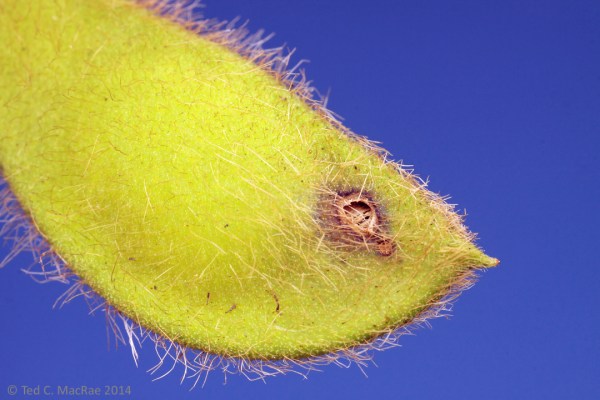
Adult females chew a small hole into the wall of the developing pod, not to feed but for oviposition

Figure 3. Adult females chew small holes into developing pods, not to feed but for oviposition.

Leaf feeding has little if any impact on the crop; however, as the crop enters pod development stages of growth adult females begin chewing small holes in the pod walls (Fig. 3), not for feeding but for oviposition. Eggs are laid singly in the pod (Fig. 4), with larvae (Fig. 5) feeding on the developing seeds within.

Eggs are laid singly inside the pod.

Figure 4. Eggs are laid singly inside the pod.

This manner of feeding by the larva not only directly impacts yield but also hampers efforts to control active infestations by preventing contact with foliar-applied insecticides. Eventually the larvae mature, exit the pod, and drop to the soil where they burrow, pupate, and emerge as adults during the next cropping season while plants are still in early to mid-vegetative stages of growth.

This neonate larva has just hatched and will feed within the pod on developing seeds.

Figure 5. This neonate larva has just hatched and will feed within the pod on developing seeds.

Management techniques include rotation with grass crops to reduce populations (the weevil is oligophagous on soybean and dry beans), use of insecticide seed treatments to control adults during early vegetative stages of growth, and subsequent use of foliar insecticide applications if adults remain after the effect of seed treatments begins to diminish.

REFERENCE:

Casmús, A., M. G. Socías, L. Cazado, G. Gastaminza, C. Prado, E. Escobar, A. Rovati, E. Willink, M. Devani & R. Avila. 2010. El picudo negro de la vaina de soja en el NOA. Estación Experimental Agroindustrial Obispo Columbre, Tucumán, Argentina, 8 pp.

Copyright © Ted C. MacRae 2014

Tortoise beetles on the job

Back in late February and early March I did my annual tour through the soybean growing regions of central and northern Argentina to look at insect efficacy trials (pretty amazing to me still when I think about it—I actually get paid to spend time in Argentina looking for insects!). Normally on such trips there is no shortage of soybean insects to occupy my attentions—of all the large-acre row crops, soybean probably has the greatest diversity of insect associates, and in South America it is rare for any soybean field to not experience pressure from at least one of them. Soybeans, however, are not the only plants that occur in soybean fields—there are also weeds, many of which also have their own suite of insect associates. Sometimes these weed-associated insects can be even more interesting than the soybean insects I’m look for.

Botanochara angulata?

Botanochara angulata? mating pair | Córdoba Prov., Argentina

On this particular day, as I walked through a soybean field in central Córdoba Province I noticed distinctive red and black tortoise beetles (family Chrysomelidae, subfamily Cassidinae) on some of the plants. I thought it odd that tortoise beetles would be on soybean, as I’m not aware of any soybean associates in the group. A closer look, however, quickly revealed that the beetles were not on the soybean plants themselves, but rather on vines that were weaving their way through the plants. The plant was akin to bindweed and obviously a member of the same plant family (Convolvulaceae), but none of my field mates knew which of the many weedy species of the family that occur in Argentina that this particular plant represented. Species of Convolvulaceae are, of course, fed upon by a great diversity of tortoise beetles—always a treat for this coleopterist to see, and it was all I could do to concentrate on the task at hand and finish doing what I needed to do so I could turn my attention to finding and photographing some of these beetles. Once I began photographing them I found them surprisingly uncooperative (not my normal experience with tortoise beetles), but I soon found a mating pair that was a little more cooperative (probably because they were mating), with the above photo being my favorite of the bunch.

Paraselenis tersa?

Paraselenis tersa? female guarding her eggs | Córdoba Prov., Argentina

As I was searching for beetles to photograph, I encountered some yellow tortoise beetles associated with the same plant but that I had not noticed earlier. Unlike the conspicuously red and black colored species (which seems to best match Botanochara angulata according to Cassidinae of the World), the yellow species (which I presume represents Paraselenis tersa, also ID’d using the same site) seemed almost cryptically colored. When I finished taking photographs of B. angulata, I began searching for a P. tersa to photograph and encountered the female in the above photograph guarding her eggs—score!

Undetermined cassidine larvae.

A single tortoise beetle larva was encountered.

Tortoise beetle larvae are always a delight to see as well—their dinosaurian armature and fecal adornments, both obviously designed to dissuade potential predators, form one of the most ironic defensive combinations one can find. If additional tactics become necessary, they are among the few insects that are known to actually “circle the wagons” (the technical term for this being “cycloalexy“). While I only found a single larvae (of which species I don’t know), its presence seems to further suggest that at least one of the species represented an actively developing population and that the adults I found were not just hangers-on putzing around until winter (such as it is in central Argentina) forced them to shut down for the season.

Undetermined cassidine larva.

Spiky spines and a pile of poop make formidable defenses.

My impression is that tortoise beetles are by-and-large noxious to predators, thus explaining why so many species in the group exhibit aposematic coloration. However, the apparent cryptic coloration of Paraselenis makes me wonder if this is not universally true. It seems especially odd for two species to feed on the exact same species of plant but only one of the species to be noxious, which leads me to even more questions about how two species feeding on the same plant at the same time avoid direct competition with each other. I wondered if perhaps one species was on the wax while the other was on the wane (late February is well along into the latter part of the season in central Argentina), but the fact that both species were involved in reproductive activities (mating in Botanochara and egg guarding in Paraselenis) suggests this was not the case.

Ted MacRae photographing tortoise beetles.

A candid photo of me photographing tortoise beetles (and revealing my technique for getting “blue sky” background photographs).

© Ted C. MacRae 2014

A Crossidius hirtipes subspecies blend zone…

…or, “There’s something fishy going on here!”

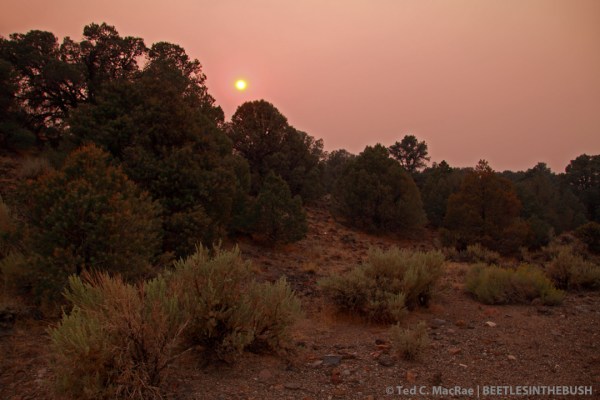
After a day in the vicinity of Yearington, Nevada  looking for (and eventually finding) a population of Crossidius hirtipes longhorned beetles assignable to subspecies “rubrescens“, field mate Jeff Huether and I dropped a little further south to look for two additional subspecies—C. h. immaculipennis and C. h. macswaini. Like C. h. rubrescens, populations assignable to these two subspecies are also restricted to a small area in west-central Nevada. Chemsak & Linsley (1959) described C. h. immaculipennis from specimens collected 10 miles north of Smith (Lyon Co.) and two years later (Linsley & Chemsak 1961) described C. h. macswaini from 19 miles SE of Wellington (Douglas Co.). We were still under the smoke plum from the now 9-day old Rim Fire in the nearby Sierra Nevada, which came and went during much of the day (top photo) and eventually settled in to create some amazing sunset landscapes (bottom photo).

19 mi S of Wellington, Toiyabe National Forest, Nevada.

Rim Fire smoke moves in and out of the area | 19 mi S of Wellington, Toiyabe National Forest, Nevada.

As had happened the day before with C. h. rubrescens, success did not come quickly or easily. We first searched for the type locality of C. h. immaculipennis, but many parts of the area have been converted to agriculture, and in the precise area 10 miles north of Smith we found only vast fields of dark green, irrigated alfalfa and not the rabbitbrush chaparral habitat required by these beetles. We did a little searching in surrounding areas and eventually found one rather nice-looking patch of ground with healthy stands of Chrysothamnus viscidiflorus in full bloom. Mindful of the previous day’s experience with finding the beetles often ensconced down within the inflorescences—especially as cooler temperatures set in, we took care to carefully inspect the blossoms in case the cool morning temperatures were inhibiting the beetles from coming back up for the day. Alas, we saw no beetles despite spending a considerable amount of time searching.

Crossidius hirtipes immaculipennis (male) | 6.3 mi W of Wellington, Nevada.

Crossidius hirtipes immaculipennis (male) | 6.3 mi W of Wellington, Nevada.

Rather than beat a dead horse, we decided to drive a short distance south and west to the town of Wellington, where a fellow cerambycid collector had found the subspecies a few years earlier. He had provided us with some detailed notes on the specific localities where he found the beetles, and these proved to be of great help as we passed through endless, seemingly acceptable chaparral habitat trying to decide exactly where we should stop and invest more time to look for the beetle. We stopped at one of the sites indicated in the notes and immediately found a beetle on one of the first plants we checked, and eventually after a gap in finding any more we found an area where good numbers of the plants were supporting decent numbers of the beetles. Chemsak & Linsley (1959) distinguished C. h. immaculipennis by its reddish legs, pale color, and complete lack of elytral markings in the male, exemplified by the male shown in the photo above.

Crossidius hirtipes macswainei? (female) | 6.3 mi W of Wellington, Nevada.

Crossidius hirtipes macswainei? (female) | 6.3 mi W of Wellington, Nevada.

As we searched the plants and found more and more individuals, I noticed an occasional adult that seemed to be a little more yellowish than reddish and with distinct sutural maculae. I didn’t think much about it then, chalking it up to individual variability, but after returning home and having a chance to look at the specimens more closely I was surprised to determine that these few beetles actually are a better fit for the second subspecies we planned to search for that day—C. h. macswainei. We had found both subspecies at the same site and didn’t even realize it. Okay, I know what you’re thinking… subspecies must exhibit allopatric geographic distributions (cannot occur together at the same place and time). It is, thus, tempting to declare that the two “subspecies” are actually not distinct, but rather represent distinctive extremes of individual variation in a single interbreeding population. However, one must also consider the possibility that the two subspecies represent reproductively isolated populations and, thus, qualify as distinct species. I’m not qualified to make that judgement, but I will note that most of the individuals encountered were assignable to C. h. immaculipennis  and the rest to C. h. macswainei, but that no “intergrades” were found.

Crossidius hirtipes macswainei (male) | 19 mi S of Wellington, Nevada.

Crossidius hirtipes rhodopus? (male) | 19 mi S of Wellington, Nevada.

After collecting adequate series from W of Wellington, we traveled further south of town to the type locality of C. h. macswainei (not knowing we already had it!). The holotype and most of the paratypes were collected 19 miles S of Wellington (Linsley & Chemsak 1961), but a number of paratypes had also been collected 14 miles south of town, so we stopped there first in an unsuccessful bid to find the subspecies before moving on to the type locality a few miles further south. Within a few minutes of arriving, I found the individual shown in the photo immediately above, presumed that I had found the subspecies we were looking for, and popped it into a vial alive as a photo backup if we did not find any other individuals with which I could attempt field photographs. Ironically, that is exactly what happened—despite Jeff and I scouring every plant we could find in about a 1-mile stretch along each side of the road, we never found another beetle. Later that evening I took the above individual out of its vial for photographs, but it never really “perked up” to look fully natural, resulting in “bum” antennae that give away the staged nature of the photograph. Again, it was not until I got back home and could look at the specimen closely before I realized that it did not at all fit the description of C. h. macswainei, but instead seemed to be a good match for the subspecies C. h. rhodopus, known from only a short distance further south but—until now, at least—apparently restricted to the Mono Basin in east-central California (see this post for more details about this subspecies). Jeff has since reported to me that some of the beetles he collected at the “C. h. rubrescens” locality (see this post) also are a match for C. h. macswainei, adding yet another wrinkle to those that resulted from this day’s collecting. Such inconsistencies with the published literature may tempt some to scrap all of Linsley & Chemsak’s subspecies, but considering that those two authors examined more than 12,000 specimens during the course of their studies such a reaction would be both premature and presumptuous. What is needed is more study—more specimens from more localities, hopefully augmented with DNA sequence analysis. For the latter goal we did our part, dropping a specimen or two from every locality in which we found beetles into ethanol for just such purpose. Until such studies are done, I prefer to withhold judgement about whether C. hirtipes is comprised of one highly polytopic population, several subspecifically distinct populations, or perhaps even multiple distinct species.

14 mi SE of Wellington, Toiyabe National Forest, Nevada.

Evening haze creates a spectacular sunset | 14 mi SE of Wellington, Toiyabe National Forest, Nevada.

Even though we found only a single beetle at the second locality, our persistence in searching until the day ran out was rewarded by a most spectacular sunset caused by thick haze from the nearby Rim Fire in California. It would also be our last day in Nevada before dropping south into California and spending the next several days in successful bids for C. coralinus monoensisC. c. caeruleipennisC. h. nubilus, and C. h. rhodopus.

REFERENCE:

Chemsak, J. A. & E. G. Linsley. 1959. Some new species and subspecies of Crossidius from western North America. Journal of the Kansas Entomological Society 32(4):176–183.

Linsley, E. G. & J. A. Chemsak. 1961. A distributional and taxonomic study of the genus Crossidius (Coleoptera, Cerambycidae). Miscellaneous Publications of the Entomological Society of America 3(2):25–64 + 3 color plates.

Copyright © Ted C. MacRae 2014