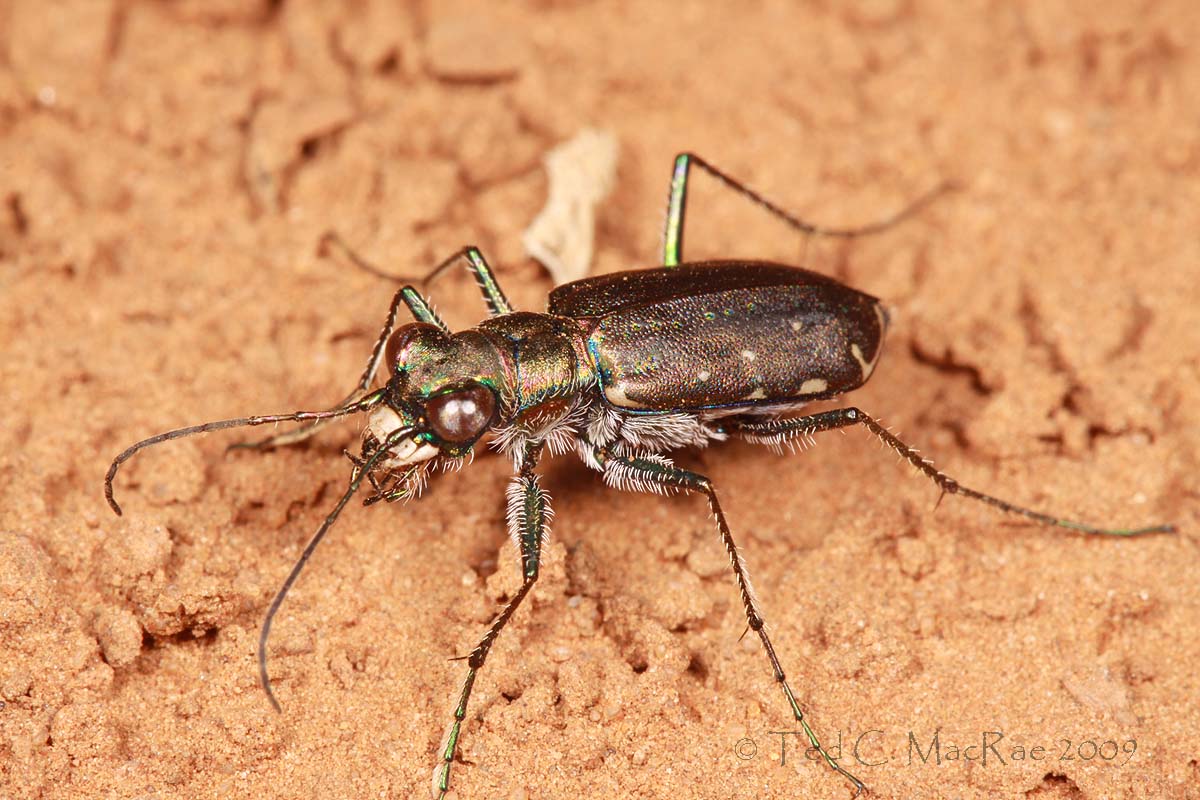
(My) Introduction to Florida Tiger Beetles

On the last day of July, I hopped into my stuffed-to-the-brim SUV and began the +1000-mile drive to St. Petersburg, Florida.  I had with me my camera and my collecting gear, but also my bike, some beach wear… and my family!  No, this was not a collecting trip, but a family vacation.  We would be staying at my sister-in-law’s condo with my niece and enjoying typical Florida vacation fare – beaches, Disney World, sightseeing.  I even brought my road bike along to enjoy some pancake-flat terrain (a rarity around St. Louis) for a nice change of pace.  Still, I can be rather single-minded when it comes to opportunities for bug collecting, and summer in Florida presents opportunities galore!  Virtually everything there is different, and while I have been to Florida a number of times, my visits have all been during spring and prior to my more recent interest in tiger beetles.  It would be a family vacation, but still I would find a way to sneak off a couple times and satisfy my compulsions, and while the girls talked about Disney World and the beach, visions of Cicindela abdominalis, C. highlandensis, C. scabrosa, Ellipsoptera gratiosa, E. hamata lacerata, E. hirtilabris, E. marginata, Habroscelimorpha dorsalis, H. severa, and H. striga danced through my head!

I wouldn’t have to go far to find my first Florida tiger beetles.  My sister-in-law’s condo is in Seminole (west side of St. Petersburg peninsula), and as my niece and her husband showed us around after our arrival, they pointed out the “wild area” off their back patio next to the intertidal waterway and suggested, innocently, that I could go bug collecting back there.  In such a developed urban/tourist area, I figured it must be highly disturbed, dominated by exotics, and offering little in the way of quality habitat for the serious bug collector.  However, that night, as a cacophony of nasal queenks from the area made it clear that a healthy population of what I presume to be green treefrogs were thriving in the area, I reconsidered my skepticism and decided to take a quick look a day later.  What I found was a small but high-quality strip of coastal scrub and saltwater marsh bordering the intracoastal waterway, with thickets of red mangrove (Rhizophora mangle) along the water’s edge, black mangrove (Avicennia germinans) “woodlands” in the high scrub areas, and moist, briney, barren ground in between (Photo 1).  The whole area couldn’t have been more than a hundred yards wide but extended along the length of the waterway, and a wooden sign as I entered the area indicated it was a bona fide, albeit private, nature preserve established as part of the condominium development.

Intertidal salt marsh, Tara Cay Sound Nature Preserve, Seminole, Florida

Intertidal salt marsh, Tara Cay Sound Nature Preserve, Seminole, Florida

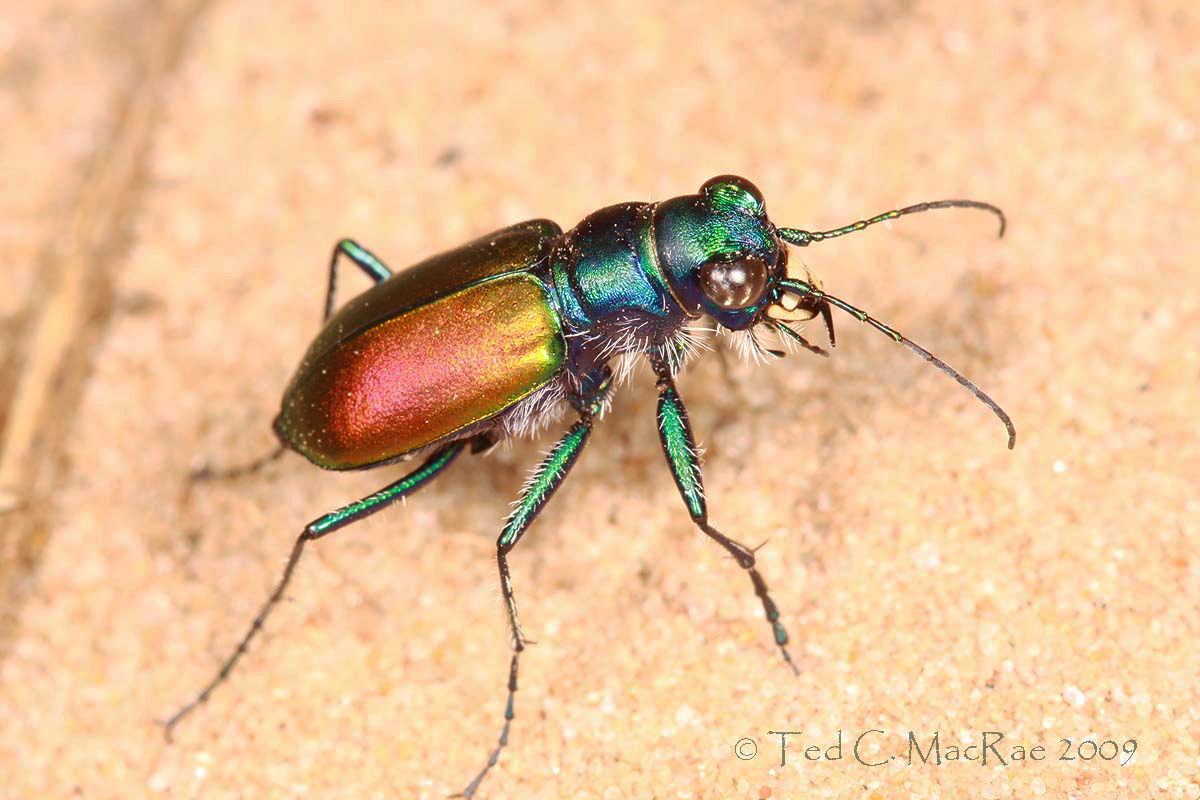
Within minutes after entering the preserve I saw the first tiger beetle.  I didn’t know what it was, and my first stalking efforts were woefully inadequate.  I saw another one a few minutes later and got within net handle distance but muffed the swing.  A few feet further along the path and onto an exposure by the water revealed several individuals, one of which I was finally able to capture after several clumsy misses.  I hadn’t yet memorized key characters for all of the species I had the potential to encounter, but I could see in the hand that this individual almost certainly belonged to the genus Ellipsoptera (Ellipsed-winged Tiger Beetles) because of its resemblance to E. macra (Sandy Stream Tiger Beetle) and E. nevadica knausii (Knaus’ Tiger Beetle), which I had photographed earlier this year in Missouri and Oklahoma, respectively.  With one now in the hand as a studio backup, I began my efforts to obtain field photographs.  The beetles were extremely wary, with fast running and strong flight capabilities that made them very difficult to approach.  It was only their abundance and my dogged persistance that allowed me to finally get close enough to one (Photo 2) to fire off a sequence of frames.  I then spent some time collecting a voucher series – finally getting a beat on their behavior and able to capture them with a little more efficiency despite their ultra-wariness before concentrating on getting more photographs of different individuals (including those shown in Photos 3 and 4).

Ellipsoptera marginata - Margined Tiger Beetle

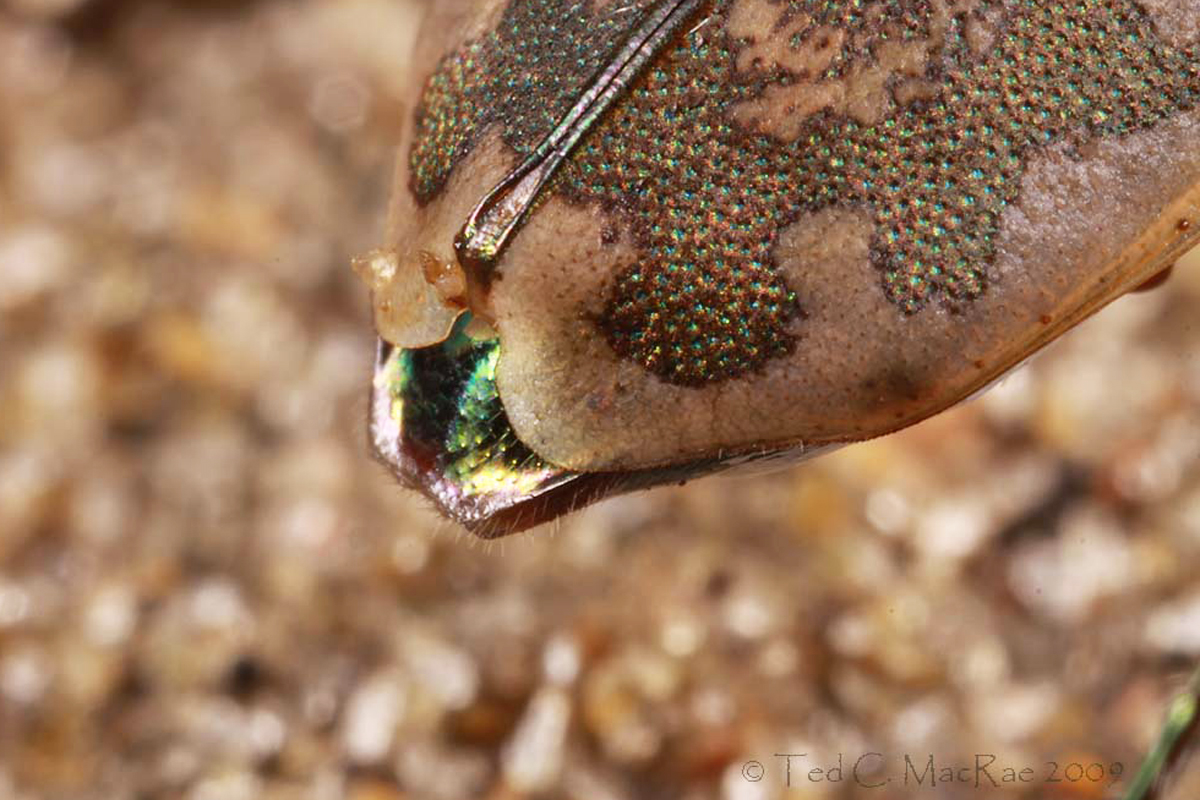
Ellipsoptera marginata - note "tooth" under right mandible of this male

Ellipsoptera marginata - Margined Tiger Beetle

Ellipsoptera marginata - another male, with a distinctly bronzed pronotum

IMG_1061_1200x800

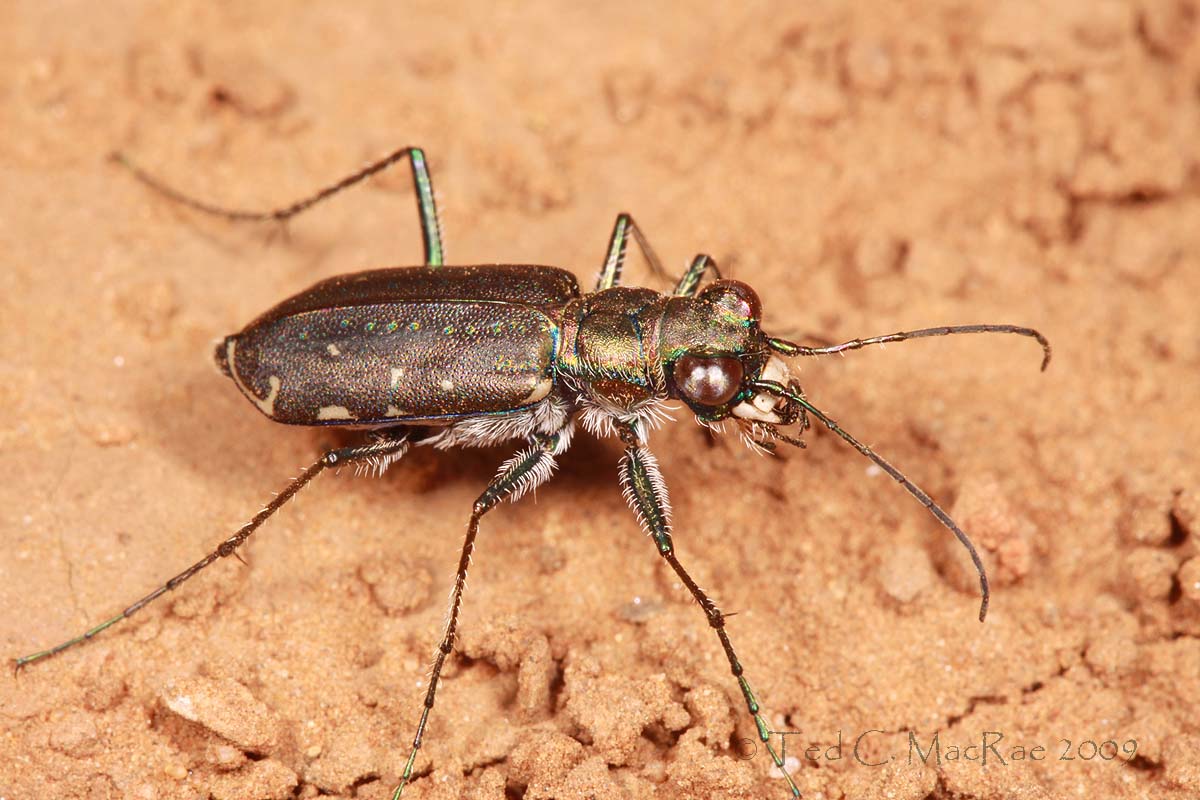
Ellipsoptera hamata lacerata - Gulf Beach Tiger Beetle (mate guarding)

I returned to the condo after a couple of hours – completely drenched (remember, it was August in Florida!). When I had the chance to consult my “bible” (Pearson et al. 2006), I learned there there were two possibilities: Ellipsoptera marginata (Margined Tiger Beetle), occurring along the Atlantic seaboard from Maine to the Gulf coast of Florida; and Ellipsoptera hamata lacerata (Gulf Beach Tiger Beetle), resembling and closely related to E. marginata and occurring along the Gulf Coast from Florida to Texas.  Both species inhabit coastal beaches, mud flats and salt marshes, and their distributions overlap along Florida’s Gulf Coast. While they are easily distinguished from other species in the genus by the distinctively diffuse middle band of the elytra, distinguishing between the two requires examination of the male right mandible (marginata bears a distinct tooth on the underside, hamata does not) or female elytral apices (marginata curiously bent down at a 90º angle, hamata not).  At this point, I didn’t know if I had one species or two – and if I did have two, did I have photographs of both (and would I be able to identify them)?

Fortunately, closer examination of the voucher series I collected revealed both species present, and even more fortunately I had managed to get photographs of both.  The individual in Photo 2 is a male, and the angle of the photograph clearly reveals a distinct tooth on the underside of the right mandible, identifying it as E. marginata.  Photo 3 is another male, and although the angle doesn’t afford a view of the mandibles, what can be seen is a bronze cast to the pronotum – in my voucher series, all of the E. marginata specimens have a bronze cast to the pronotum, while the E. hamata lacerata specimens exhibit an olive cast. This suggests that this individual also represents E. marginata. In Photo 4, no tooth can be seen on the male mandible, but the angle of the photo doesn’t necessarily make it visible were it to exist.  The male does, however, exhibit an olive cast on the pronotum, and the female elytral apices show no indication of being bent down as would be expected for E. marginata (see Photo 5 below of E. marginata photographed a few days later at another locality).  As a result, the individuals in Photo 4 can be identified as E. hamata lacerata.

Ellipsoptera marginata - female elytral apices showing curiously "bent tips"

Ellipsoptera marginata - female elytral apices showing curiously "bent tips"

Of the 19 vouchers that I collected, 15 represent E. marginata and 4 represent E. hamata lacerata.  This exemplifies the challenges of field identification and photography of insect species in unfamiliar places.  Had I been satisfied with photographing only one or two individuals of what I thought were all the same species, I would have missed one of the species.  The experience further exemplifies the importance of adequate voucher series, as it was only a result of close examination of that series that I realized two species were present.  Based on the numbers of individuals that I collected, as well as the photographs that I took, it appears that E. hamata lacerata was much less common at that location than E. marginata. This difference in population density between two similar, co-occurring species emphasizes the importance of sampling an adequate number of individuals at a given location before concluding what species are – and are not – present.

REFERENCES:

Pearson, D. L., C. B. Knisley and C. J. Kazilek. 2006. A Field Guide to the Tiger Beetles of the United States and Canada. Oxford University Press, New York, 227 pp.

Copyright © Ted C. MacRae 2009

Add to FacebookAdd to NewsvineAdd to DiggAdd to Del.icio.usAdd to StumbleuponAdd to RedditAdd to BlinklistAdd to TwitterAdd to TechnoratiAdd to Furl

Cold and wet

Photo details: Canon 65mm 1-5X macro lens on Canon EOS 50D, manual mode, ISO-100, 1/250 sec, f/14, MT-24EX flash 1/8 power through diffuser caps.

Photo details: Canon 65mm 1-5X macro lens on Canon EOS 50D, manual mode, ISO-100, 1/250 sec, f/14, MT-24EX flash 1/8 power w/ diffuser caps

The annual fall tiger beetle collecting trip is over, and nothing could be more emblematic of the trip than this cold, wet Cicindela splendida (literally translating to its well-deserved common name “Splendid Tiger Beetle”), found in the waning light of the last day of the trip secreted under a rock in the dolomite glades at White River Balds Natural Area in southwestern Missouri.  Overcast skies and a cold, stiff breeze had already dashed my hopes of finding Cicindela pulchra (also translating to its equally well-deserved common name “Beautiful Tiger Beetle”) in the Red Hills of northwestern Oklahoma two days earlier, and these same unrelenting conditions thwarted my backup plans to find this species the next day in the Gypsym Hills of nearby Barber County, Kansas.  With one last day to spend in the field, I had worked my way back to the White River Hills in hopes of photographing Missouri’s disjunct population of the enormous Cicindela obsoleta vulturina (Prairie Tiger Beetle).  That would also not come to pass, as the sun’s efforts to burn through the thick cloud cover just weren’t quite enough.  By the end of the day, I had resorted to flipping rocks (and replacing them exactly, of course) in hopes of finding an individual or two still in their nighttime/cool weather roosts.  I had seen C. obsoleta on previous occasions at this very locality along this very trail, but this time none were found – my finds instead limited to the “smiling” scorpion that I featured a few days ago and this lone C. splendida – wet with condensation and torpid against the cold ground.  I hatched a last gasp plan to look for C. obsoleta again the following day before heading back to St. Louis, but I awoke the next morning to steady rain and knew the 2009 entomology field season was officially over.

Don’t let me leave you with the impression, however, that the trip was a failure.  While I didn’t find either of the two species that I had set as my top goals for the trip, I still saw enough new things to make the trip worthwhile (including one very significant find that I’ll discuss in an upcoming post).  In addition, I’ve barely made mention of my August trip to Florida – my Assasin ate post of a couple weeks ago was just one of many interesting finds encountered during that trip that remain to be shared.  The cold and rain that has settled over the middle of the country during the past week have brought an unwelcome end to my field work for the year, but that just leaves me with more time now to process and share photographs from the past season and reflect on the stories behind them.  It will be welcome diversion, as I also begin the arduous and seemingly endless task of mounting and labeling the specimens collected during the past season – success’ bitter reward!

Copyright © Ted C. MacRae 2009

Add to FacebookAdd to NewsvineAdd to DiggAdd to Del.icio.usAdd to StumbleuponAdd to RedditAdd to BlinklistAdd to TwitterAdd to TechnoratiAdd to Furl

North America’s most beautiful longhorned beetle

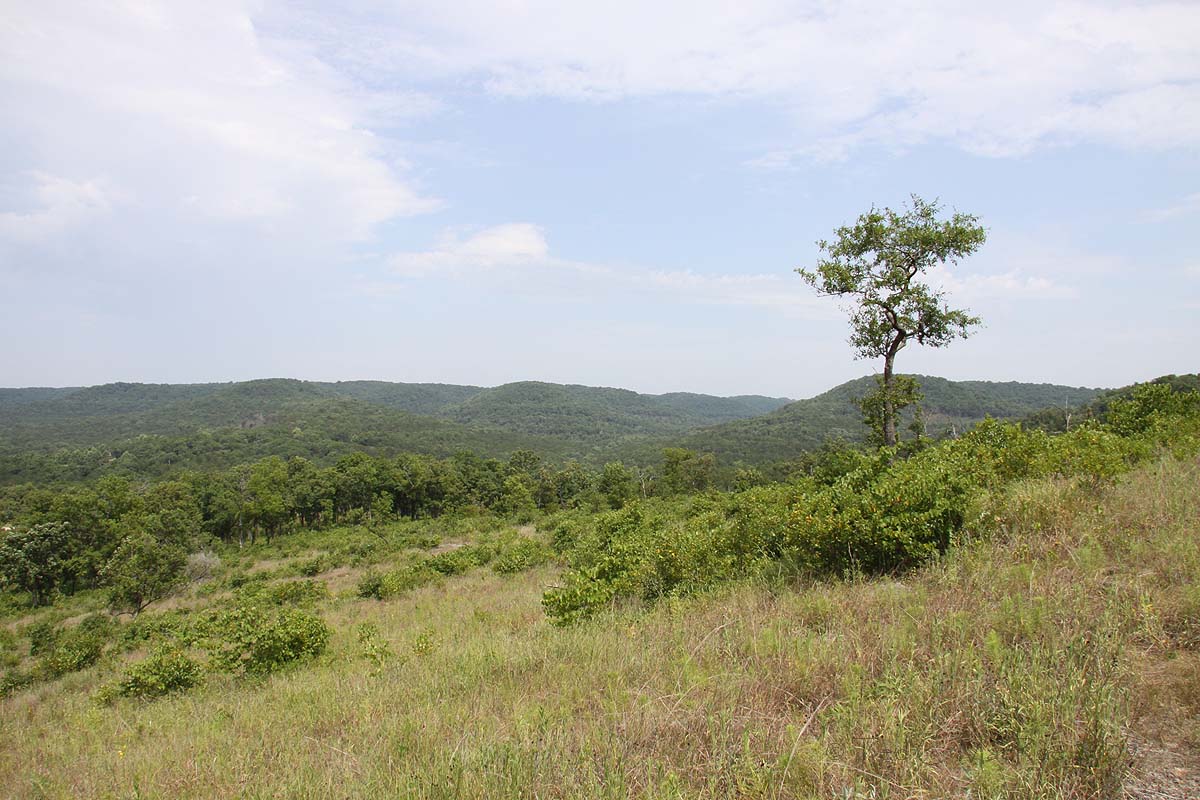
I’ve written a few posts in recent weeks highlighting some of the more interesting finds encountered during two visits this past July to the White River Hills region of extreme southwestern Missouri. It’s a land of extremes, with deeply dissected layers of limestone/dolomite bedrock supporting xeric glades, dry woodlands and riparian watercourses. The hilltop glades (“balds”), in particular, feature prominently in the region’s natural and cultural history and are the most extensive system of such habitat in Missouri. They support a number of plants and animals more characteristic of the grasslands of the south-central U.S., such as the recently featured Megaphasma denticrus and Microstylus morosum, North America’s longest insect and largest robber fly, respectively. Sadly, the glades in this region are much reduced in size and quality compared to their pre-settlement occurrence, primarily due to overgrazing and suppression of fire. These anthropogenic forces have combined to reduce overall vegetational diversity and accelerate encroachment by woody species (chiefly eastern red-cedar, Juniperus virginiana). Nevertheless, there still remain several high quality glade remnants in the area, and the public agencies charged with their conservation are increasingly utilizing mechanical removal of woody growth, controlled burns, and managed grazing in an effort to simulate the natural forces that mediated this landscape for thousands of years.

IMG_0871_1200x800

Chute Ridge Glade, Roaring River State Park, Barry Co., Missouri

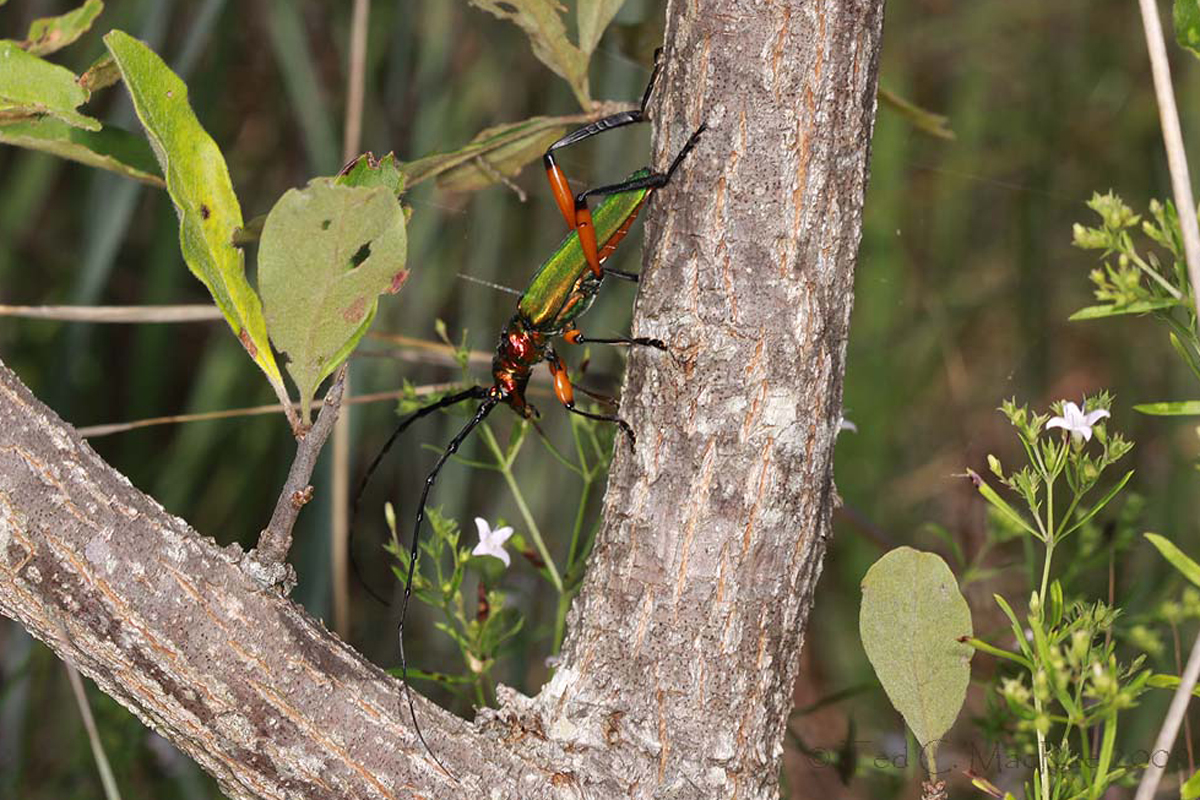
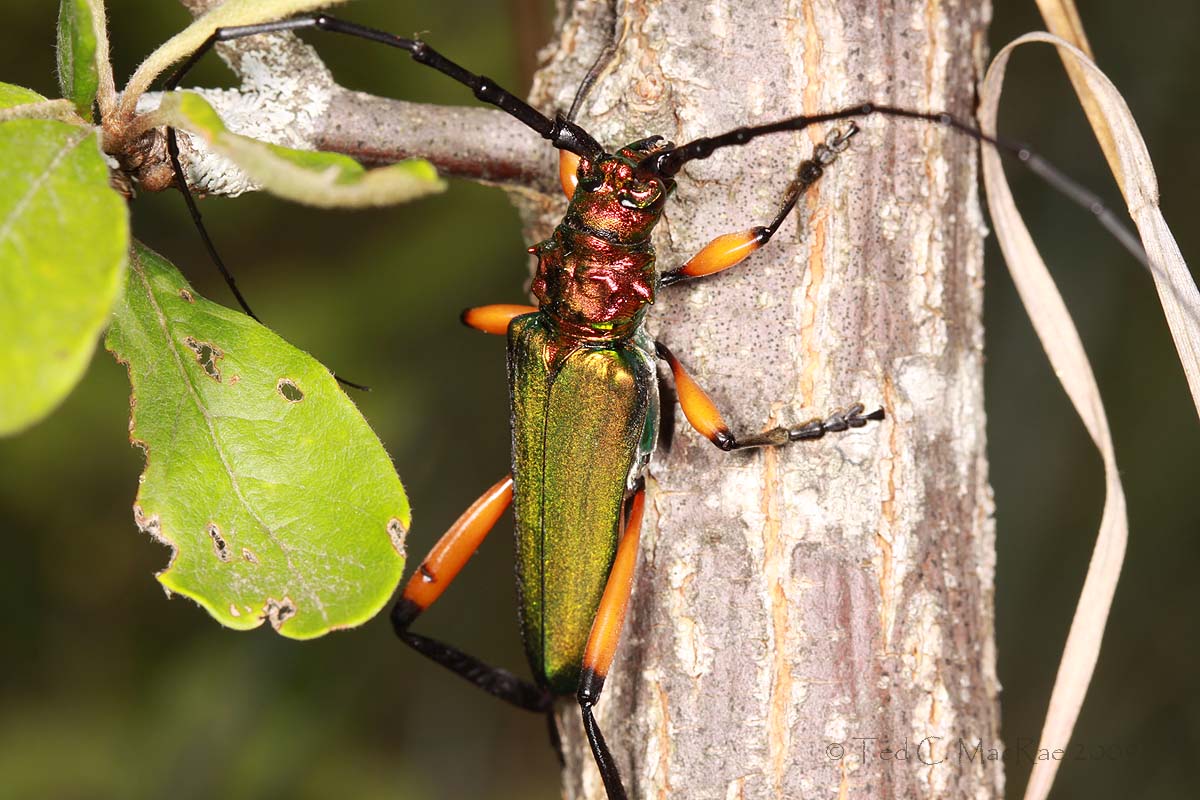
My reason for returning to the White River Hills this year was simple—find and photograph the magnificent longhorned beetle, Plinthocoelium suaveolens (family Cerambycidae). This species, occurring across the southern U.S. from Florida and Georgia west to New Mexico and Arizona, is truly one of North America’s most beautiful longhorned beetles due to its large size, brilliant iridescent green coloration, and super-elongate wildly-contrasting orange and black legs.  Until recently, this species was known in Missouri only from sporadic records across the southern part of the state (MacRae 1994). I knew of its association with gum bumelia (Sideroxylon lanuginosum [= Bumelia lanuginosa], also called gum bully and woolly buckthorn), which was first noted by Missouri’s first State Entomologist, C. V. Riley (1880) and later discussed in detail by Linsley and Hurd (1959) and Turnbow and Hovore (1979); however, my repeated searches over the years whenever I encoutered this plant came up empty.  A few years ago, Chris Brown and I were conducting a survey of tiger beetles in the White River Hills and noted the relatively common occurrence of bumelia on these glades.  Bumelia, like P. suaveolens, is one of only a few North American representatives of a largely tropical group, and it is one of the few woody species naturally adapted to the xeric conditions found on these glades.  Recalling the association of P. suaveolens with this plant, and also recalling that adults could be attracted to fermenting baits of the type described by Champlain and Knull (1932), we placed fermenting bait traps on several glades in the area and succeeded in trapping a number of individuals during the month of July.  When I began searching the bumelia trees at these glades, I found adults perching on the lower trunks of several trees. It was the first time I’d seen live individuals of this species in Missouri.  At the time I was not a photographer, and that experience became one of the many moments that I would later look back upon and think, “If only I’d taken a picture of that!”  Thus, at the end of June this year, having successfully found Cylindera celeripes in Missouri on the first day of a planned 3-week search, my attention immediately turned to the new goal of finding P. suaveolens and photographing it on its host plant.

IMG_0929_1200x800

Sideroxylon lanuginosum (gum bumelia) at Blackjack Knob, Taney Co., Missouri

I knew this wouldn’t be easy—the beetles were not abundant when I had last observed them, and those that I did find were quite wary to my approach.  Getting within striking distance with a net was one thing; doing so with a camera and macro lens would be another thing entirely.  In my first trip to the area (early July), I went to Chute Ridge Glade, a magnificently restored glade in Roaring River State Park where I had seen the greatest number of individuals before.  I was full of optimism on that first day as I zigzagged across the rough terrain from one bumelia tree to the next, but my optimism began to wane as I cautiously approached each tree and saw nothing.  Within an hour, I’d looked at every bumelia tree I could find on the glade and not even seen a beetle, much less attempted a photograph.  It would take a 2-hour drive along twisting back roads to reach the other sizeable glade complex where I had seen beetles before (Blackjack Knob in Taney County), and another hour of searching on several dozen trees would again yield nothing.  By now I was feeling rather frustrated—the day’s oppressive heat and humidity had taken its toll, and my 4.5-hour drive from St. Louis was looling like it would be for naught.  I had noted that the bumelia flowers were almost but not quite open yet—perhaps it was too early in the season still?  
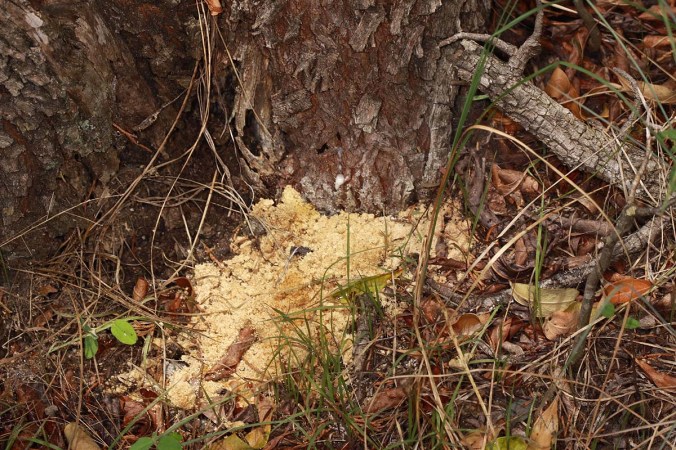
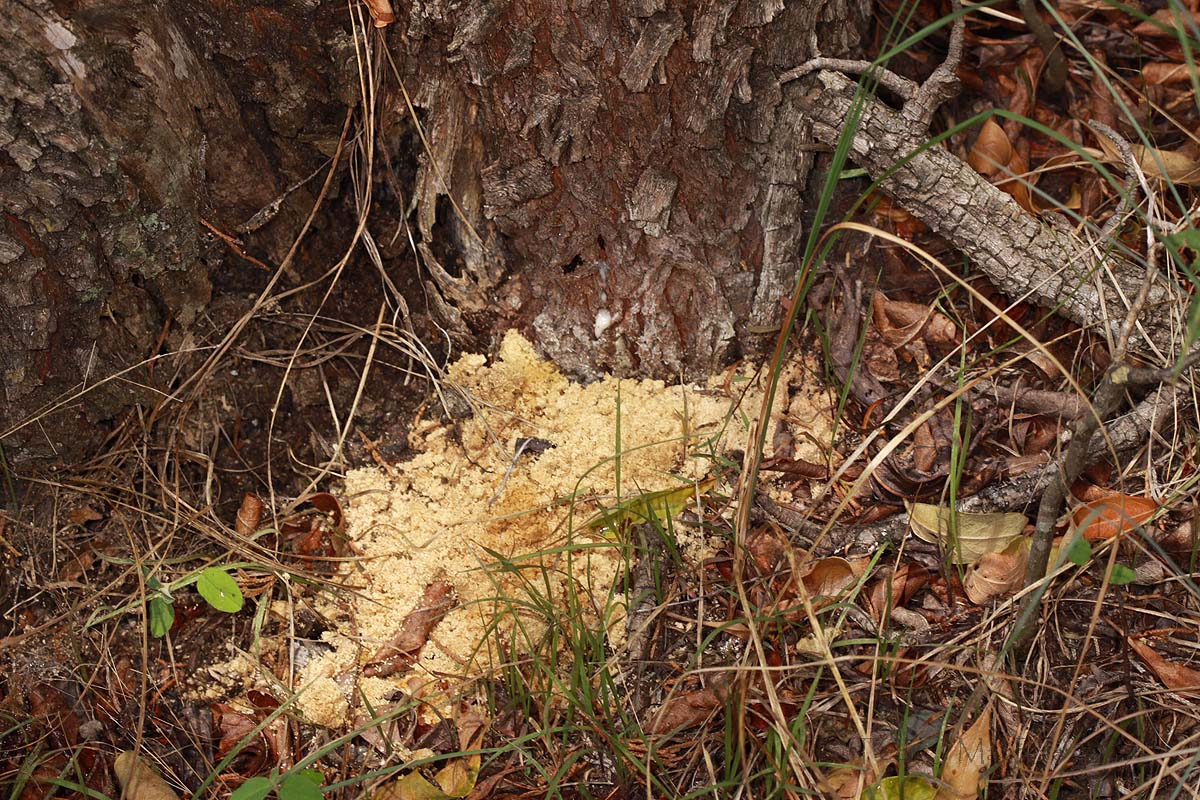
Plinthocoelium suaveolens larval frass pile at the base of living Sideroxylon lanuginosa

Plinthocoelium suaveolens larval frass pile at trunk base of living Sideroxylon lanuginosum

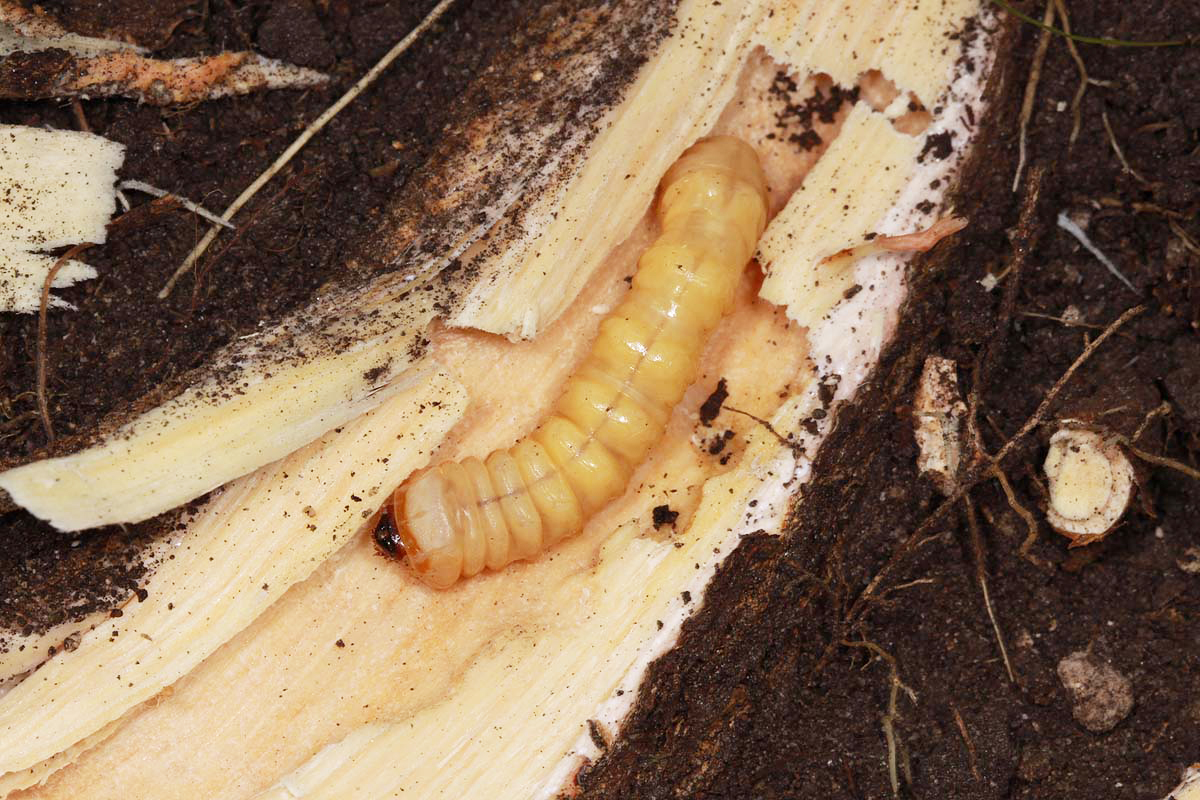
The remnant glades at Blackjack Knob are more extensive than those at Chute Ridge, so many more trees still awaited examination—if I could only muster the energy!  I trudged back to the truck, guzzled a nice, cold Powerade, and started off in another direction.  I looked at a number of trees and still had seen no sign of the beetle, but on one particular tree I noticed an enormous pile of sawdust on the ground at the base of the tree.  I looked at it more closely and saw that it had the rough, granular texture so characteristic of longhorned beetle larvae that like to keep their galleries clean, and its bright, moist  color suggested that it was being ejected by a larva tunneling through living wood.  I looked up into the tree above the pile to find where it was coming from but could find no ejection hole.  I checked the base of the trunk itself and still couldn’t find anything.  Then I started poking into the pile and felt a root.  Further poking revealed a soft spot on the root, and I immediately knew that I had found a P. suaveolens larval gallery—no other cerambycid species is known to bore in roots of living Sideroxylon, especially one as large as this based on the size of the frass pile.  I hurried back to the truck and grabbed my hatchet, returned to the tree, and scraped away the soil above the root to find an obvious ejection hole a few inches away from the base of the trunk.  I started chipped into the root at the ejection hole and found a large, clean gallery extending down the center of the root away from the trunk.  About 18” away from the trunk I found it—a large, creamy-white cerambycid larva.

Plinthocoelium suavelones larva in root of living Sideroxylon lanuginosa

Plinthocoelium suaveolens larva in root of living Sideroxylon lanuginosum

Plinthocoelium suavelones larva in root of living Sideroxylon lanuginosa

Plinthocoelium suaveolens larva in root of living Sideroxylon lanuginosum

Finding a P. suaveolens larva was gratifying, but it wasn’t what I had come here to do, which was photograph the adult. After placing the larva live in a vial for preservation later on (dropping into scalding water to “fix” the proteins and prevent discoloration when stored in 70% ethanol), I continued searching the trees for adults.  I found one tree on which the flowers were just barely beginning to open and collected a few of the pedestrian species of scarabs that are attracted to bumelia flowers in droves when fully open (e.g. Cotinis nitidus and Trigonopeltastes delta)—for the record.  There was still no sign of adult Plinthocoelium, and I was on the verge of calling it a day when I approached another tree and saw it!  I froze, then slowly geared up with the camera and started stalking slowly towards it.  It was not in a very convenient location, down low on the trunk and partially screened by foreground vegetation.  I got close enough to start attempting some shots—not ideally composed, but just to ensure that I had something before I tried to get any closer.  After the third shot, however, it became alarmed and started to flee, and I had no choice but to capture it for a “studio backup.”  That taste of success gave me the motivation to resume my search, but no additional beetles were seen before a dropping sun put an end to the day.

Plinthocoelium suaveolens on lower trunk of living Sideroxylon lanuginosum

Plinthocoelium suaveolens on lower trunk of living Sideroxylon lanuginosum

Not entirely satisfied with the shots that I’d gotten, I returned to Blackjack Knob the following day and also searched some of the extensive habitat at nearby Hercules Glades Wilderness.  I wouldn’t see another beetle the entire day, although encountering a nice series of Cicindela rufiventris (red-bellied tiger beetle) was some consolation for suffering the day’s oppressive heat and humidity.  I still had the live beetle, so I placed my hopes on getting better photographs of the beetle in confinement after returning home.  That would not come to pass—the beetle refused to sit obligingly on the stick I placed in the large screen cage, and instead clung to the cage itself.  For days I watched it, giving it honey-water for sustenance and waiting for an opportunity to photograph it on the stick on which it refused to sit.  It became clear to me that studio photographs, at least in the manner I was attempting, would not be possible.  Not entirely satisfied with having seen only a single beetle on my trip, and thinking that I may have been too early based on the flowering phenology of the bumelia host trees, I did what any dedicated entomologist would do—I made a second trip to the area two weeks later!

I didn’t mess with Chute Ridge Glade this time, instead making a beeline for Blackjack Knob right away.  Unfortunately, the weather was uncooperatively drizzley (I would have preferred hot and humid to rain!).  Nevertheless, daughter Madison and I made our way to the glades and began inspecting the trees that I had just examined two weeks earlier.  I noted immediately that the bumelias were now in full flower, and it wasn’t long before I saw the first adult flying into these flowers.  Exciting for sure, and this was a good sign to see an active adult despite the drizzly weather, but the situation of the beetle on a high branch left no possibility for photographs (and only with a rather acrobatic swing of my fully extended net handle amidst a jumble of dead branches was I able to capture it).  This same scenario would replay several times over the next two hours before rain finally drove us back to the car.  In total, we saw half a dozen active adults, but in each case they were seen flying to flowers on high branches and could not be photographed.  Despite that disappointment, I’ll never forget the spectacularity of seeing these beetles in flight—shimmering green and bold orange, with legs and antennae spread wide in all directions.  I was also fortunate to find another tree with a fresh frass pile at its base indicating an active larva.  This time, I cut the tree some inches above the ground and extracted the trunk base and root intact for transplanting into a large soil box upon my return home.  The appearance of new frass on the soil surface afterwards confirmed that I had gotten the root containing the larva and that it had survived the extraction and transplanting.  Hopefully I will be able to successfully rear this individual to adulthood.

Despite the rain, we then went back to Hercules Glades Wilderness to see if luck would follow suite there as it had at Blackjack Knob.  It didn’t, as rain continued to doggedly pursue us, but the day was not a total loss as daughter and I got in a nice 7-mile hike through some of Missouri’s most ruggedly scenic terrain and were rewarded with the sighting of a western pygmy rattlesnake.  The next day was sunny, much to our delight, and I considered going back to Blackjack Knob where we had seen a good number of adults the previous day.  In the end, I decided I’d played that card and rather than continue trying for photographs I’d rather see if the beetle could be found at another glade complex further to the east at Long Bald Glade Natural Area in Caney Mountain Conservation Area.  Things didn’t look promising, as I found bumelia trees occurring only sporadically across the main glade complex—with no sign of the beetles.  Nevertheless, we enjoyed the day and spent a bit of time chasing after some enormous robber flies that later proved to be Microstylum morosum, a new record for Missouri and a significant northeastern range extension.  I thought that would be the highlight of the day, but as we were heading back to the car I spotted a small glade relict on the other side of the road.  It was overgrown and encroached, apparently not receiving the same management attention as the glades in the main complex. Regardless, I went over to check it out and immediately spotted several bumelia trees amongst the red-cedars, and within minutes I saw a beetle—low on the trunk of a very small bumelia tree!  Once again I froze, then slowly geared up with the camera and began my ultra-cautious approach (remember, this was only my second photo chance after a combined four days in the field).  Like last time, I took one shot while still some distance away, then moved in for closer attempts.  Unlike last time, there was no bothersome vegetation cluttering the view, and when I moved in for closeups the beetle turned around, crawled up the trunk a short distance, and then paused.  I snapped off a small series of shots while it sat there, and then suddenly it became alarmed and flew away.  Though still not perfect, these photographs were better than the previous ones I had obtained (check out the pronotal armature in the last photo!), and the finding of this species at Long Bald Glades also represented a new county record.

Plinthocoelium suaveolens on trunk of living Sideroxylon lanuginosum

Plinthocoelium suaveolens on trunk of living Sideroxylon lanuginosum

Plinthocoelium suaveolens on trunk of living Sideroxylon lanuginosum

Plinthocoelium suaveolens on trunk of living Sideroxylon lanuginosum

Missouri populations are assignable to the nominotypical subspecies (southeastern U.S.), which is distinguished from subspecies plicatum (Texas, New Mexico, Arizona, and northern Mexico) by the bronze or cupreous tints and weak transverse rugae on the pronotum (Linsley 1964).  The distributional ranges of the two subspecies intermingle in northeastern Texas.

Photo details:
All photos: Canon 100mm macro lens on Canon EOS 50D
Photo 1 (Chute Ridge Glade): normal mode, ISO-400, 1/250 sec, f/16, natural light.
Photo 2 (Sideroxylon lanuginosum): landscape mode, ISO-100, 1/160 sec, f/6.3, natural light.
Photos 3 (P. suaveolens larval frass pile), 6—8 (P. suaveolens adult): manual mode, ISO-100, 1/250 sec, f/9-11, MT-24EX flash 1/2 power through diffuser caps (photo 7 slightly cropped).
Photos 4—5 (P. suaveolens larva): manual mode, ISO-100, 1/60 sec, f/14 (closeup f/25), MT-24EX flash 1/2 power through diffuser caps.

REFERENCES:

Champlain, A. B. and J. N. Knull.  1932.  Fermenting bait traps for trapping Elateridae and Cerambycidae (Coleop.).  Entomological News 43(10):253–257.

Linsley, E. G. 1964.  The Cerambycidae of North America. Part V. Taxonomy and classification of the subfamily Cerambycinae, tribes Callichromini through Ancylocerini.  University of California Publicatons in Entomology, 22:1—197, 60 figs., 1 pl.

Linsley, E. G. and P. D. Hurd, Jr.  1959.  The larval habits of Plinthocoelium suaveolens plicatum (LeConte).  Bulletin of the Southern California Academy of Sciences 58(1):27–33.

MacRae, T. C. 1994. Annotated checklist of the longhorned beetles (Coleoptera: Cerambycidae and Disteniidae) known to occur in Missouri. Insecta Mundi 7(4) (1993):223–252.

MacRae, T. C. and M. E. Rice. 2007. Distributional and biological observations on North American Cerambycidae (Coleoptera). The Coleopterists Bulletin 61(2): 227–263.

Riley, C. V.  1880.  Food habits of the longicorn beetles or wood borers.  The American Entomologist 3(10):237–239.

Turnbow, R. H. Jr. and F. T. Hovore.  1979.  Notes on Cerambycidae from the southeastern U. S.  Entomological News 90(5):219–229.

Copyright © Ted C. MacRae 2009

Add to FacebookAdd to NewsvineAdd to DiggAdd to Del.icio.usAdd to StumbleuponAdd to RedditAdd to BlinklistAdd to TwitterAdd to TechnoratiAdd to Furl

Ant-like Tiger Beetle

Fig. 1.  Adult female Cylindera cursitans

Fig. 1. Adult female Cylindera cursitans

One of the more recent of the 24 species of tiger beetles that we’ve collected in Missouri is Cylindera cursitans (Ant-like Tiger Beetle).  Although not yet formally recorded from the state, we’ve known about its occurrence here for some time now based on a single specimen deposited in the Enns Entomology Museum (University of Missouri).  With no more locality information to go on than the frustratingly vague “nr. Portageville,” my colleague Chris Brown and I made several attempts over the years to look for this species – eventually deciding that one particular spot where the highway stretched east of Portageville and dead-ended at the Mississippi River was the most likely collection site.  This locality, which we would come to call the “end of the hiway” spot (I suspect that every state with at least one tiger beetle aficionado has one or more so-named spots), proved to be a true tiger beetle “hot-spot,” with no less than 8 species of tiger beetles found along its sandy banks in our first few surveys.  However, C. cursitans was not among them, and success would only come with a little bit of serendipity when I received an email in 2007 from Kent Fothergill.  Kent explained that he had learned of me from my Missouri Tigers article (MacRae and Brown 2001), offered some comments about the tiger beetles that he had been finding since his recent move to southeast Missouri, and included full label data from the tiger beetles in the small collection of the Delta Research Center where his then-fianceé had secured a position as a research entomologist.  I wrote Kent back, thanked him for the data, and added this plea for assistance:

There is a single specimen of Cicindela cursitans in the UMC collection, it was collected in “nr. Portageville” on July 7, 1991.  We have tried several times without success to locate this species in Missouri – it’s the only species that we have not relocated.  If you have any interest in looking for it that would be great.  Attached is a pdf of recent paper describing its habits and biology in Nebraska.

Fig. 2.  Adult female Cylindera cursitans ovipositing into substrate.

Fig. 2. Adult female Cylindera cursitans ovipositing in moist sand/loam substrate.

Little did I know how catalytic that comment would be – the very next day I received an email from Kent not only stating that he found it, but that he found it at the “end of the hiway” spot where we thought it might be.  A digital photo confirmed its identity, and the that weekend I blasted down to meet Kent and see the beetle for myself.  I would see just two beetles that day, but both were at a new locality about one mile south of where Kent had originally spotted them.  Kent would later find them at yet another locality further north along the Mississippi River, and in 2008 the three of us (Kent, Chris, and myself) conducted an intensive survey of potential habitats in southeastern Missouri that identified additional populations both north and south of the original localities.  We concluded that populations of C. cursitans, were restricted in southeast Missouri to the ribbons of wet bottomland forest that occupy the narrow corridor between the Mississippi River and the levees that confine it. However, the populations appeared secure and likely did not require any immediate conservation measures to ensure their long-term survival within the state. 

Fig. 3.  Adult male Cylindera cursitans.

Fig. 3. Adult male Cylindera cursitans.

The bottomland forests that harbor C. cursitans in southeast Missouri (Fig. 3) contrast sharply with the wet meadow habitats reported for populations in Nebraska (Brust et al. 2005a). Within these habitats, the beetles themselves are very easily overlooked because of their small size and rapid running capabilities.  In addition, adult activity peaks in June and begin to wane in July.  The combination of these factors explains our initial difficulty in finding the beetle; however, with a proper search image and better understanding of its temporal occurrence and habitat preference, we have since found the beetles to be rather easily located.  A lingering question from last year’s survey is, how far north along the Mississippi River does C. cursitans occur? Furthermore, might the species also occur in northeast Missouri due to its proximity to the Nebraska populations?  Most of Missouri straddles a curious distributional gap that separates the bottomland forest dwelling populations in the southeast from the wet meadow dwelling populations in the upper Great Plains (Hoback and Riggins 2001). This has led some authors to suggest that the observed distribution represents two disjunct forms and potentially two species (Ron Huber, pers. comm.). Additional surveys of potential habitat further north along the Mississippi River and in northwest Missouri along the Missouri River could prove useful in confirming or refuting that suggestion. 

Fig. 3.  Habitat for Cylindera cursitans, along Mississippi River, vic. Donaldson Point Conservation Area, New Madrid Co., Missouri.

Fig. 4. Habitat for Cylindera cursitans, along Mississippi River, vic. Donaldson Point Conservation Area, New Madrid Co., Missouri.

While such surveys were not possible this year, long-time fieldmate Rich Thoma and I were able to visit the Southeastern Lowlands in June to examine a few habitats along the Mississippi River found a little further north of the northernmost extent of our 2008 survey area. We succeeded in finding another population at one of these sites near the northern limit of the Southeastern Lowlands.  The individuals shown here (Figs. 1-3) were collected from that location (extreme northeastern Mississippi Co.), confined on local sand/loam substrate, and photographed a few days later.  In one of the photos (Fig. 2), a female can be seen in the act of ovipositing into a hole dug into the substrate with her ovipositor.  The more observant readers might notice a strong resemblance between this species and another species to which I have devoted several posts, Cylindera celeripes (Swift Tiger Beetle).  These two species are, in fact, quite closely related and can be distinguished by characters of the elytra (posterior portion not or only slightly expanded and lateral white maculations complete in cursitans, distinctly expanded and maculations reduced in celeripes) (Pearson et al. 2006), habitat (cursitans in moist lowland sites, celeripes in dry upland sites), and distribution (southeast Nebraska/southwest Iowa is the only area where the distributions of these two species overlap, although C. celeripes has not been seen in Nebraska for nearly 100 years! (Brust et al. 2005b)).

Photo details:
Figs. 1-3: Canon 100mm macro lens with Kenco extension tubes (68mm) on Canon EOS 50D (manual mode), ISO-100, 1/250 sec, f/18, MT-24EX flash 1/2 power through diffuser caps.
Fig. 4: Panasonic DMC-FX3 (landscape mode), ISO-100, 1/25 sec, f/2.8, natural light.

REFERENCES:

Brust, M., W. Hoback and C. B. Knisley.  2005a.  Biology, habitat preference, and larval description of Cicindela cursitans LeConte (Coleoptera: Carabidae: Cicindelinae).  The Coleopterists Bulletin 59(3):379-390.

Brust, M. L., S. M. Spomer and W. W. Hoback.  2005b.  Tiger Beetles of Nebraska.  University of Nebraska at Kearney.  http://www.unk.edu (Version 5APR2005).


Hoback, W. W. and J. L. Riggins.  2001.  Tiger beetles of the United States.  Jamestown, ND: Northern Prairie Wildlife Research Center Online.  http://www.npwrc.usgs.gov/resource/distr/insects/tigb/index.htm (Version 12DEC2003).

MacRae, T. C., and C. R. Brown. 2001. Missouri Tigers. Missouri Conservationist 62(6):14–19.

Pearson, D. L., C. B. Knisley and C. J. Kazilek. 2006. A Field Guide to the Tiger Beetles of the United States and Canada. Oxford University Press, New York, 227 pp.

Copyright © Ted C. MacRae 2009

Add to FacebookAdd to NewsvineAdd to DiggAdd to Del.icio.usAdd to StumbleuponAdd to RedditAdd to BlinklistAdd to Ma.gnoliaAdd to TechnoratiAdd to Furl

A bit of housekeeping

I hope you’ll forgive the lack of pretty bug pictures and witty prose in today’s post – I have a few updates and adminstrative issues that I’d like to take care of.

Circus of the Spineless
This notice is a few days late, but Circus of the Spineless # 43 is up at Wanderin’ Weeta.  Susannah has done a great job of assembling blog posts on a diversity of invertebrates from anemones to annelids, bryozoans to barnacles, decapods to gastropods, and of course – insects.  In the latter group, all of the major orders are covered (including beetles by some guy that likes tiger beetles).

Expanded Blogroll
It has been quite a while since I last made mention of new additions to my ever-expanding blogroll.  I’m trying to maintain a fairly comprehensive list of blogs that either focus primarily on insects or feature compelling natural history discussions, and it seems that almost every week I find another one that either began recently or somehow escaped my earlier attention.  A few of these more recent additions deserve special mention for their interesting subjects, superior writing, quality photographic content, etc.

Rate My Posts
WordPress has a new widget that allows readers to rate the quality of posts.  I thought I would open myself up to this potential for praise or criticism and have activated this feature on this blog (and also my other blog, Bikes Bugs and Bones).  It’s a little jickery in that the “comments” link must be clicked in order to see the rating widget, which appears at the bottom of the post as 5 blank stars.  It’s a typical rating scale, with 1 star being the worst and 5 stars being the best.  I know a lot of readers don’t like to leave comments (although I heartily encourage them), but perhaps you would be willing to provide feedback in the form of a rating.  The ratings are completely anonymous – no IP addresses are recorded by the rating widget, so there is no way for me to know who voted or how.  Over time, as ratings accumulate for posts, I will be able to see what kinds of posts people really like (and which they really don’t).  This can be your way to contribute to the future direction of this blog!

  • 5 Stars = Excellent – use this for my very best pieces.
  • 4 Stars = Very Good – you really liked it, maybe just minor criticisms.
  • 3 Stars = Average – not bad, not great, it did the job.
  • 2 Stars = Fair – not one of my better pieces, a bad day perhaps.
  • 1 Star = Poor – well, let’s just hope I don’t get too many of these.

Editorial Duties
One of my long term goals is to be Managing Editor for an entomological journal.  Despite the volunteer nature of such a position, it’s not one that somebody can just walk into – dues must be paid.  I got a foot in the door a few years ago when I began serving as Coleoptera Subject Editor for The Pan-Pacific Entomologist, the journal of the Pacific Coast Entomological Society (we would welcome your manuscript dealing with western entomology in any aspect).  It has been an enjoyable experience, and I guess I’m doing a decent job since I was invited this summer to join the editorial team of the online journal Zootaxa.  This “mega-journal for zoological taxonomists in the world” has quickly become the leading journal for new taxa and taxonomic or nomenclatural acts, based on the coverage and indexing of Zoological Record since 2004.  This is possible only because of its team of 141 editors that cover the entire breadth of animal taxa – 17 of which (including me) handle the vast insect order Coleoptera.  Ever the glutton for punishment, I’ve also just accepted an invitation by the Webster Groves Nature Study Society to take over editorship of their monthly newsletter, Nature Notes.  I suppose the combination of these three editorial positions will let me know if I really want to pursue full editorship of a major journal at some point!

Okay, I can’t leave you without any kind of photograph – here are a couple of shots of Cicindela scutellaris, or festive tiger beetle. This male individual represents the stunningly beautiful nominotypical subspecies occupying the western part of the species’ range – it was photographed on sand exposures in shinnery oak shrubland habitat at Packsaddle Wildlife Management Area in extreme northwestern Oklahoma this past June.

IMG_0540_1200x800_enh

IMG_0547_1200x800

Photo details: Canon 100mm macro lens on Canon EOS 50D (manual mode), ISO-100, 1/250 sec, f/14-16, MT-24EX flash 1/4 power through diffuser caps.

Copyright © Ted C. MacRae

Add to FacebookAdd to NewsvineAdd to DiggAdd to Del.icio.usAdd to StumbleuponAdd to RedditAdd to BlinklistAdd to Ma.gnoliaAdd to TechnoratiAdd to Furl

The ubiquitous tiger beetle

Cicindela ubiquita

Cicindela ubiquita - ubiquitous tiger beetle

Back in early June as I began my exploration of The Nature Conservancy’s Four Canyon Preserve in northwestern Oklahoma, one of the very first insect species that I encountered was Cicindela ubiquita¹ (the ubiquitous tiger beetle).  This ubiquitous species is restricted to nearly the entire North American continent and is found only in just about any habitat you can imagine.  It seems to especially favor wet or dry areas in lowland or upland habitats with little or lots of vegetation.  At Four Canyon Preserve, it showed a distinct preference for dry upland sand and clay sites and wet bottomland sand sites.  I did not find it in wet bottomland clay sites – probably because no such habitat exists within the preserve.

¹ Originally described as Cicindela punctulata (punctured tiger beetle) by Olivier (1790).  This name has been accepted by virtually all subsequent authors and is still used in such recent works as Freitag (1999), Pearson et al. (2006), and Erwin and Pearson (2008).

IMG_0371_1200x800I had seen this species previously in Missouri on just about every collecting trip I’ve ever taken within that state.  Populations in Missouri seem to look exactly like the population here at Four Canyon Preserve but favor other habitats, including lawns, soybean fields, any dirt road, gravel parking lots, and cement sidewalks (although I have so far failed to find larval burrows in the latter, suggesting a greater level of habitat selectivity during the larval stage).  Based on examination of specimens in both my collection and that of the Enns Entomology Museum at the University of Missouri-Columbia, I can’t seem to find any county in Missouri where this beetle does not occur.

IMG_0372_1200x800An interesting feature of this species is that its adult activity period seems to exclude the winter months.  Thus far, I have only succeeded in finding active adults during those months when temperatures routinely surpass the freezing point (April through November).  It also apparently has been unable to colonize the Pacific Coast of North America – the reasons for this extreme selectivity will remain unclear until further research can be done.

Despite the common usage of the name Cicindela punctulata for this species, the following quotes are offered to support my contention that the valid name of this species should be Cicindela ubiquita:

The ubiquitous Cicindela (Cicindelidia) punctulata battling ants. — somatochlora.

This species and C. repanda are the most common and ubiquitous in the state. — Graves (1963).

C. punctulata punculata is almost ubiquitous in Colorado. — J. P. Schmidt

Notes: Abundant statewide; ubiquitous… — Mike Reese

this same pond were the ubiquitous C. repanda Dejean and C. punctulata Olivier. — Charlton and Kopper (2000).

Photo details: Canon 100mm macro lens on Canon EOS 50D, ISO 100, 1/250 sec, f/16, MT-24EX flash 1/4 power through diffuser caps.

REFERENCES:

Charlton, R. E. and B. J. Kopper.  2000.  An unexpected range extension for Cicindela trifasciata F. (Coleoptera: Carabidae: Cicindelinae).  The Coleopterists Bulletin 54(2):266-268.

Erwin, T. L. and D. L. Pearson. 2008. A Treatise on the Western Hemisphere Caraboidea (Coleoptera). Their classification, distributions, and ways of life. Volume II (Carabidae-Nebriiformes 2-Cicindelitae). Pensoft Series Faunistica 84. Pensoft Publishers, Sofia, 400 pp.

Freitag, R.  1999.  Catalogue of the tiger beetles of Canada and the United States.  National Research Council Canada, Ottawa, Ontario, 195 pp.

Graves, R. C.  1963.  The Cicindelidae of Michigan (Coleoptera).  American Midland Naturalist 69(2):492-507.

Olivier, G. A.  1790.  Entomologie ou histoire naturelle des insectos.  Paris, 2, 1-32.

Pearson, D. L., C. B. Knisley and C. J. Kazilek. 2006. A Field Guide to the Tiger Beetles of the United States and Canada. Oxford University Press, New York, 227 pp.

Copyright © Ted C. MacRae 2009

Add to FacebookAdd to NewsvineAdd to DiggAdd to Del.icio.usAdd to StumbleuponAdd to RedditAdd to BlinklistAdd to Ma.gnoliaAdd to TechnoratiAdd to Furl

The last tiger beetle

Our recent discovery of Cylindera celeripes (swift tiger beetle) in Missouri was arguably the most exciting moment that I and colleague/fieldmate Chris Brown have experienced since we first began surveying the tiger beetles of Missouri back in the year 2000.  It was the 24th species that we had recorded for the state and the latest of several for which we had searched through targeted surveys during the past few seasons.  Earlier surveys have already produced a new record for Cicindela trifasciata ascendens (ascendant tiger beetle), “rediscovered” Cylindera cursitans (ant-like tiger beetle) and Dromochorus pruinina (frosted dromo tiger beetle), precisely characterized the limited in-state distributions of Habroscelimorpha circumpicta johnsonii (Johnson’s tiger beetle) and Cicindela obsoleta vulturina (prairie tiger beetle), and generated copious distributional data for the remaining more generally distributed species.

Yet, there still remained one species that we had not managed to find ourselves – Ellipsoptera macra (sandy stream tiger beetle).  This species was recorded from a few localities along the Missouri River in northwestern Missouri by Willis (1967), and we have examined a small number of additional specimens in the Enns Entomology Museum.  According to the literature, this species occurs near the water’s edge on sandy habitats along large rivers – precisely the type of habitats in which we have encountered the closely related E. cuprascens (coppery tiger beetle), which we have found at several locations along the Missouri and Mississippi Rivers.  Each time we found E. cuprascens we expected/hoped to see E. macra as well but never did.  The reasons for this remained a mystery to us until I noted a comment on the Tiger Beetles of Nebraska website stating that blacklighting is usually more productive for this species than daytime collecting.  With its known occurrence in northwestern Missouri, our planned survey for C. celeripes in that part of the state this season offered a perfect opportunity to try to find this, the last tiger beetle species in Missouri that we had not yet collected ourselves.  Our plan was to search loess hilltop prairie habitats during the day for C. celeripes, then blacklight along the Missouri River at night to look for E. macra.  Both species seemed like longshots – we’d searched for each many times, and we were willing to spend several consecutive weekends from late June to mid-July on our survey so that we could claim that we had given it our best shot.  Of course, as you know, we succeeded in finding C. celeripes on the first day of our first weekend, and we would also enjoy the same success with E. macra later that evening.

Chris Brown looks for Ellipsoptera macra amongst the swarm.

Chris Brown braves the swarm to look for individuals of Ellipsoptera macra.

We setup two blacklights at a public fishing access along the Missouri River (explaining to some puzzled locals exactly what we were doing and why), turned the lights on, and sat back with pizza and merlot as we waited for things to start coming to the sheets.  We had been to this site before in previous years and found E. cuprascens here, suggesting that suitable habitat was present in the area.  Almost immediately a growing cloud of all manner of aquatic insects began swarming around the lights, landing on the sheets – and flying down our shirts and in our hair whenever we tried to approach!  I don’t blacklight as much as I did in my younger days, but even then I wasn’t much of a fan of blacklighting near water for precisely these reasons.  We hadn’t had the lights going for more than 15 minutes or so before we saw the first tiger beetle crawling on the bottom of the sheet below the light.  It looked like cuprascens, but I placed it live in a vial anyway for photographs the next morning.  Then there was another… and another…  Soon, they were coming in with regularity, and I quickly ran out of vials in which to keep live individuals separately.  I’ve never seen tiger beetles come to blacklights like this, but we still weren’t convinced they were E. macra until later that night when we got back to the hotel and had a chance to take a close look at them with good light.  There was no doubt about it – we had finally found E. macra in Missouri!

This species is very similar to E. cuprascens, but the elytra are not as shiny and with smaller, shallower punctures than the latter.  Some references mention a more recurved lower portion of the humeral lunule and a generally more green than bronze coloration (Pearson et al. 2006), but these characters were tenous at best with the specimens we had in hand (see photo below).  The best character we have found to separate the two species is by examining the female elytra – in E. macra the sutural apex is acute, while in E. cuprascens it is rounded (Willis 1967).  We returned to the site the next morning to see if we could find them during the day, and although we did manage to find a few, they were nowhere near as numerous as we had seen them at the blacklights the night before.  The following photograph is of an individual captured that evening and then “released” back into the field the following morning – they were quick to fly once released, and only after several individuals and trying the “lens cap” technique did we succeed in getting some good shots.

Ellipsoptera macra

Ellipsoptera macra

We didn’t get a chance to use blacklights in subsequent weekends to see if we could find E. macra in other localities along the Missouri and Mississippi Rivers – with E. macra and C. celeripes success already in hand, I quickly turned my attention to the White River Hills of southwestern Missouri and their gorgeous glade habitats to look for one of North America’s most beautiful cerambycid beetles, Plinthocoelium suaveolens (more on that in a future post).  However, I am confident that E. macra will be found at other spots in Missouri should we decide to look for them with blacklights.  Having encountered all 24 species of tiger beetles known from Missouri, I present here a checklist of those species.

CHECKLIST OF TIGER BEETLES IN MISSOURI
(classification and common names by Erwin and Pearson 2008)

Tribe CICINDELINI
Subtribe MEGACEPHALINA
Tetracha (s. str.) carolina carolina – Carolina Metallic Tiger Beetle
Tetracha (s. str.) virginica – Virginia Metallic Tiger Beetle

Subtribe CICINDELINA
Cicindela (s. str.) duodecimguttata – 12-spotted Tiger Beetle
Cicindela (s. str.) formosa generosa – Eastern Sand Tiger Beetle
Cicindela (s. str.) hirticollis shelfordi – Shelford’s Tiger Beetle
Cicindela (s. str.) limbalis – Common Claybank Tiger Beetle
Cicindela (s. str.) purpurea purpurea – Cowpath Tiger Beetle
Cicindela (s. str.) repanda – Bronzed Tiger Beetle
Cicindela (s. str.) scutellaris lecontei – LeConte’s Tiger Beetle
Cicindela (s. str.) sexguttata – Six-spotted Tiger Beetle
Cicindela (s. str.) splendida – Spendid Tiger Beetle
Cicindela (s. str.) tranquebarica tranquebarica – Oblique-lined Tiger Beetle
Cicindela (Cicindelidia) obsoleta vulturina – Prairie Tiger Beetle
Cicindela (Cicindelidia) punctulata punctulata – Punctured Tiger Beetle
Cicindela (Cicindelidia) rufiventris rufiventris – Eastern Red-bellied Tiger Beetle
Cicindela (Cicindelidia) trifasciata ascendens – Ascendant Tiger Beetle
Cylindera (s. str.) celeripes – Swift Tiger Beetle
Cylindera (s. str.) cursitans – Ant-like Tiger Beetle
Cylindera (s. str.) unipunctata – One-spotted Tiger Beetle
Dromochorus pruinina – Frosted Dromo Tiger Beetle
Ellipsoptera cuprascens – Coppery Tiger Beetle
Ellipsoptera lepida – Ghost Tiger Beetle
Ellipsoptera macra macra – Sandy Stream Tiger Beetle
Habroscelimorpha circumpicta johnsonii – Johnson’s Tiger Beetle

Photo details:
Blacklighting: Canon 17-85mm zoom lens on Canon EOS 50D (manual mode), ISO 100, 1/30 sec, f/11, on-camera flash.
Ellipsoptera macra: Canon 100mm macro lens on Canon EOS 50D (manual mode), ISO 100, 1/250 sec, f/14, MT-24EX flash 1/4 power w/ diffuser caps.

REFERENCES:

Erwin, T. L. and D. L. Pearson. 2008. A Treatise on the Western Hemisphere Caraboidea (Coleoptera). Their classification, distributions, and ways of life. Volume II (Carabidae-Nebriiformes 2-Cicindelitae). Pensoft Series Faunistica 84. Pensoft Publishers, Sofia, 400 pp.

Pearson, D. L., C. B. Knisley and C. J. Kazilek. 2006. A Field Guide to the Tiger Beetles of the United States and Canada. Oxford University Press, New York, 227 pp.

Willis, H. L.  1967. Bionomics and zoogeography of tiger beetles of saline habitats in the central United States (Coleoptera: Cicindelidae).  The University of Kansas Science Bulletin 47(5):145-313.

Copyright © Ted C. MacRae 2009

Add to FacebookAdd to NewsvineAdd to DiggAdd to Del.icio.usAdd to StumbleuponAdd to RedditAdd to BlinklistAdd to Ma.gnoliaAdd to TechnoratiAdd to Furl

Salt Plains National Wildlife Refuge

IMG_0687_1200x800

I’ve written quite a few posts about my June trip to northwestern Oklahoma. Four days at the ruggedly scenic Four Canyon Preserve and nearby Packsaddle Wildlife Management Area yielded a few interesting jewel beetles (though not many tiger beetles), but the followed two days in the red clay/gypsum hills just north of there were as successful a two-day period as I’ve ever had, with new localities for Cylindera celeripes (swift tiger beetle) and true field photographs of Dromochorus pruinina (frosted dromo tiger beetle¹). The next day was spent at nearby Salt Plains National Wildlife Refuge, just east of the red clay hills in Alfalfa Co. Salt Plains is best known for its Selenite Crystal Dig Area, where an estimated 30,000 annual visitors dig for Oklahoma’s State Crystal with its unique hour glass-shaped inclusion (the only known site where these crystals are found). A dominant feature of the refuge, however, is its 10,000 acre saline flat – left behind by the vast Permian seas that once covered the interior of the continent and the largest such salt flat in the Great Plains.  It was this feature that drew my interest.

¹ Common names according to Erwin and Pearson (2008).

IMG_0689_1200x800

I first visited Salt Plains a few years ago when fieldmate Chris Brown and I were near the end of a rather unproductive (yet still enjoyable) fall tiger beetle trip to the nearby Gypsum Hills of south-central Kansas (Cicindela pulchra had eluded us – for the time being!).  We noted the refuge on the map and decided to take a look – becoming instantly enamoured with the diversity of tiger beetles seen running on its barren, salt-encrusted mud flats.  I returned the following fall with long-time fieldmate Rich Thoma and Hardtner, KS resident “Beetle Bill” Smith, who introduced us to the refuge biologist so we could get permits to do some proper collecting.  Most of the tiger beetles we saw were widespread and familiar to me – Cicindela species proper such as C. formosa formosa (big sand tiger beetle), C. tranquebarica (oblique-lined tiger beetle), C. punctulata (punctured tiger beetle), and C. repanda (bronzed tiger beetle), but it was the creamy white Eunota togata globicollis (alkali tiger beetle) that had me swiping my net for the next hour or two.  Sadly, those were in my pre-photographer days, so I have no visual record of that species other than the pinned specimens in my collection.

My visit during this trip was completely unplanned.  After the mid-week’s thunderstorms chased me back to this part of the state, I thought this would be a nice contrast to the red clay/gypsum hills where I saw C. celeripes and D. pruinina.  In addition, the selection of tiger beetles active on the saline flats during this summer trip would likely be quite different from the fall/spring species I had seen on my previous two visits.  Trouble was, the unplanned nature of the visit also meant that I didn’t have a permit, but I was prepared to limit my activities to only photography in case I was unable to convince the refuge staff to renew my prior permit.  That eventuality was unnecessary, however, as the refuge biologist located my permit in a gray, dusty file cabinet and graciously typed up a new permit for me – good until next summer!  With that, I was off to SandPiper Trail and seven hours of stalking, netting, and photographing.  Some familiar faces were there again – C. formosa, C. repanda, C. punctulata, and C. tranquebarica (as they are almost everywhere), but I also encountered three beautiful species that I had not seen there before (one of which I had never seen previously).  Like E. togata, each of these species is an alkaline habitat specialist that makes its living only in these harsh, saline environments. They were not the easiest species to photograph, easily alarmed in the heat of the day, but the vast open spaces allowed me to follow their escape flights with relative ease, and one-by-one they gradually became accustomed to my presence and eventually allowed me to get at least one or two good shots.

Ellipsoptera nevadica knausii - Knaus' tiger beetle

Ellipsoptera nevadica knausii - Knaus' tiger beetle

Habroscelimorpha circumpicta johnsonii - Johnson's tiger beetle

Habroscelimorpha circumpicta johnsonii - Johnson's tiger beetle

Cicindela fulgida fulgida - crimson saltflat tiger beetle

Cicindela fulgida fulgida - crimson saltflat tiger beetle

Along with E. togata globicollis, these species bring the total number of species that I’ve observed at Salt Plains to eight – quite a hyperdiversity given the very small portion of the refuge that I’ve explored during my three visits.  Willis (1967) has observed as many as 11 species in a single habitat, and while this may seem to violate the principle of competitive exclusion (limiting the number of species that can occupy a given niche), careful observation reveals small but distinct partitionings of this harsh environment by the different species.  For example, C. fulgida was seen in the drier, more vegetated fringes around the flats, E. nevadica knausii was observed in moist, open areas near the water’s edge, and H. circumpicta johnsonii was more generally free ranging across the open salt surfaces.  Temporal separation combines with spatial separation to further subdivide the habitat – the latter two species occur as adults during summer, while E. togata globicollis and C. fulgida adult occurrence is primarily during spring and fall (the individual I saw was likely a stragler).  I have noted the same phenomenon with species occurring in clay habitats here in Missouri, with as many as six species seen at a single highway intersection in the White River Hills a few years ago.

Photo details:
Landscapes: Canon 17-85mm zoom lens on Canon EOS 50D (landscape mode), ISO 100, 1/50-60 sec, f/7.1-6.3, natural light.
Beetles: Canon 100mm macro lens on Canon EOS 50D (manual mode), ISO 100, 1/250 sec, f/14, MT-24EX flash 1/4 power w/ diffuser caps.

REFERENCES:

Erwin, T. L. and D. L. Pearson. 2008. A Treatise on the Western Hemisphere Caraboidea (Coleoptera). Their classification, distributions, and ways of life. Volume II (Carabidae-Nebriiformes 2-Cicindelitae). Pensoft Series Faunistica 84. Pensoft Publishers, Sofia, 400 pp.

Willis, H. L.  1967.  Bionomics and zoogeography of tiger beetles of saline habitats in the central United States (Coleoptera: Cicindelidae).  The University of Kansas Science Bulletin 47(5):145-313.

Copyright © Ted C. MacRae 2009

Add to FacebookAdd to NewsvineAdd to DiggAdd to Del.icio.usAdd to StumbleuponAdd to RedditAdd to BlinklistAdd to Ma.gnoliaAdd to TechnoratiAdd to Furl