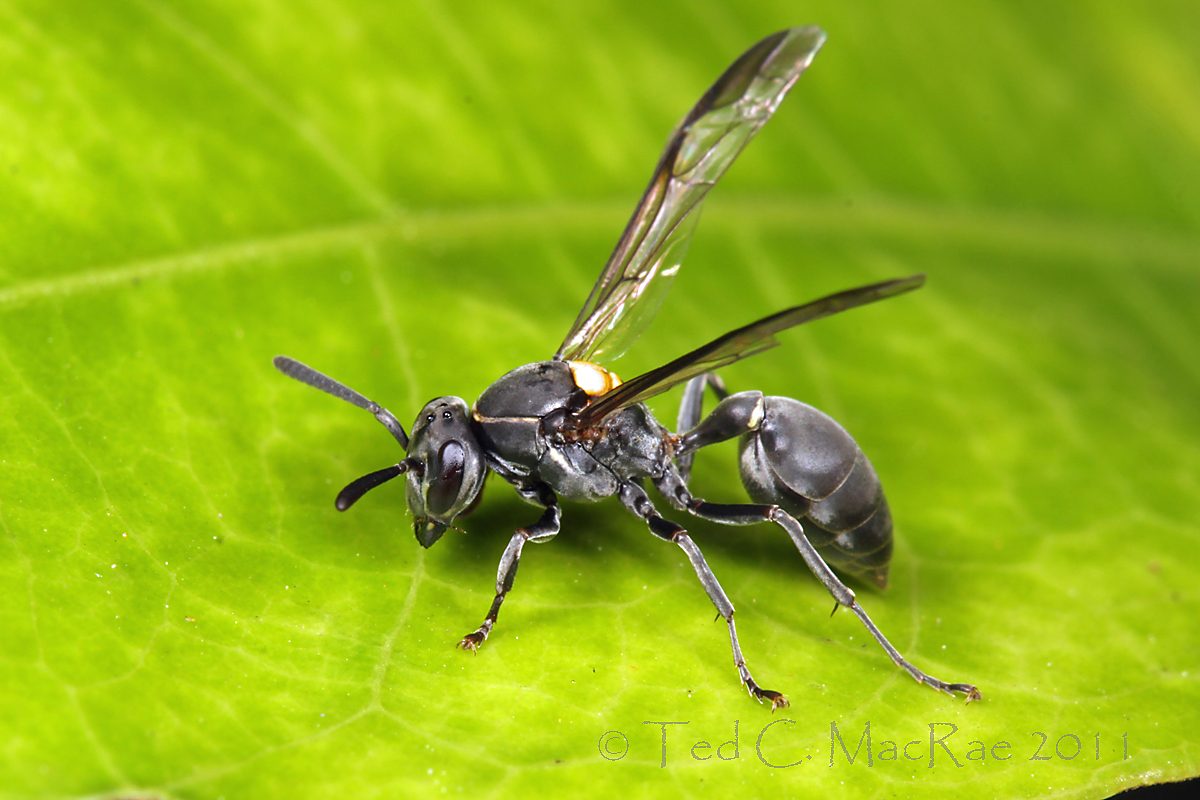
Itty bitty tiny little flies

Saturday was my birthday, and for most of my adult life it has been tradition to take the day off for the Annual-Birthday-First-Bug-Collecting-Trip-of-the-Year™.  At Missouri’s middlin’ latitudes, late April is normally a tad early—at least for the groups that interest me, but it’s less about serious bug collecting and more about kicking off the season in a bit of a special way.  Normally if my birthday falls on a weekend, as it did this year, I’ll take off the adjacent weekday instead (it’s not special if you can’t take off any time from work).  However, this year that wasn’t possible due to events at work far beyond my little sphere of influence (conspiracy #1), thus Saturday itself became the planned day.  My family and I celebrated Friday evening so I could have the whole day on Saturday, and as we ate we watched news reports of suspected tornadoes ripping through St. Louis just to our north and a little further south (conspiracy #2).  Forecasts called for rain continuing well into the following week (conspiracy #3), and for the first time in… well… ever, I had the feeling the ABFBCTOTY might be cancelled due to weather.  Waking the next morning, I turned on the television to see precipitation forecasts across the state (1″ in northwest Missouri to 6″ in southeast Missouri) amidst stunning chopper video footage of neighborhoods destroyed and lives turned upside down.

I stopped counting conspiracies and hugged my girls!

That evening, I turned on the mercury vapor lamp over the garage door for the first time since last year to see if anything might show up.  We live in a heavily wooded area of western St. Louis Co. featuring relatively intact mesic upland forest dominated by several oaks, hickories, and sugar maples that harbor a nice diversity of woodboring beetles and treehoppers (though I didn’t expect to see these on this night).  The night was cool and clammy—nothing but a few moths and flies showing up.  Some of the flies were quite small, and some were extraordinarily small—not more than 1 or 2 mm in length.  Tiny little specks of life!  I thought it might be fun to get in some practice time with the 65mm lens, and the sampling shown below represents a few of those taken with the lens maxed out at 5X (resulting in a frame width of ~5mm):

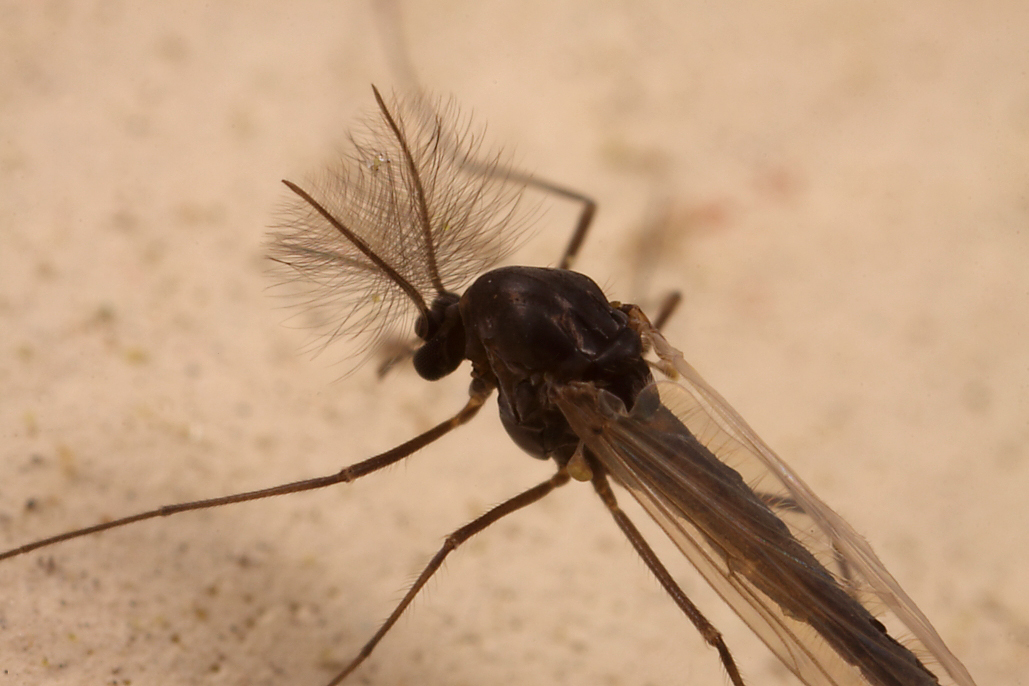
Male non-biting midge (Chironomidae) | St. Louis Co., Missouri

Female non-biting midge (Chironomidae) | St. Louis Co., Missouri

Moth fly (Psychodidae) | St. Louis Co., Missouri

Same individual as above, chased onto a finished wooden table to highlight its dense pilosity

Copyright © Ted C. MacRae 2011

Bichos Argentinos #8 – “Mosca de la Carne”


Here is the full-sized photo from which the “super-crop” featured in Super Crop Challenge #4 was taken.  As many of you guessed, this is a higher fly (order Diptera, suborder Brachycera) in the family Sarcophagidae, with the photo crop showing frontal portion of the head and its associated structures.  While dubbed “flesh flies” due to the necrophagic habits of a few of its included species, sarcophagids actually display diverse life histories that include a wide variety of coprophagous and parasitic species (Mulieri et al. 2010).  The fly was one of the many insects I photographed in early March in Buenos Aires, Argentina at La Reserva Ecológica Costanera Sur, where it was found perched on dead wood (I found several individuals of apparently the same species perched on dead wood as well – whether this is significant or chance I don’t know).


The presence of a ptilinal fissure and lunule and a dorsal seam on the antennal pedicel identify this as one of the calyptrate “muscoid” (schizopheran to be more correct) flies.  Within that group, my determination as a member of the family Sarcophagidae is based on its fairly large size, dull gray coloration with three longitudinal black strips on the mesonotum, notopleuron with two strong and two small setae (Calliphoridae have only two setae), and meron with a row of setae (lacking in Muscidae and related families).  Admittedly these characters aren’t visible in the cropped photo that I presented, so guessing the proper family was a bit of a crap shoot.  As noted by (de Carvalho and de Mello-Patiu 2008), species determination of sarcophagid flies is complicated by their fairly uniform chaetotaxy and lack of useful external characters, leaving male genitalia as the only reliable characters for identification.  No suitable key for identifying Neotropical genera yet exists and the elaboration of one will be very difficult without analysis of the male terminalia.  Dr. Luciano Patitucci (Consejo Nacional de Investigaciones Científicas y Técnicas, Buenos Aires, Argentina) suggested this is perhaps a species of Sarcophaga; however, in a recent faunal study of Sarcophagidae at the reserve, two species – Tricharaea (Sarcophagula) occidua and Oxysarcodexia varia – comprised nearly 90% of the flesh flies encountered (Mariluis et al. 2007).

A single individual is shown in the first two photos, while this mating pair was seen a little later.  Although they seem to represent the same species, I can’t be certain of this, and the photo itself is not the greatest due to the female (bottom) being slightly off-focus.  Nevertheless, I had to show it, because – really – who can resist photographs of fly nookie?! 

REFERENCES:

de Carvalho, C. J. B. and C. A. de Mello-Patiu.  2008.  Key to the adults of the most common forensic species of Diptera in South America.  Revista Brasileiro de Entomologia 52(3):390–406.

Mariluis, J. C., J. A. Schnack, P. R. Mulieri and J. P. Torretta. 2007. The Sarcophagidae (Diptera) of the coastline of Buenos Aires City, Argentina. Journal of the Kansas Entomological Society 80(3):243–251.

Mulieri, P. B., J. C. Mariluis and L. D. Patitucci.  2010.  Review of the Sarcophaginae (Diptera: Sarcophagidae) of Buenos Aires Province (Argentina), with a key and description of a new species.  Zootaxa 2575:1–37.

Addendum:

This challenge concludes the 2nd BitB challenge session, with a record 17 participants in this final challenge.  For a while it looked like HBG Dave would become our newest champion, but Session #1 champ Ben Coulter swooped in, flogged us with terminology (all of it correct and undeniable), and won two of the last three challenges to edge out Dave and, once again, take the overall victory. Make no mistake – Ben knows how to play this game!  Morgan Jackson took second in this challenge and claimed the final spot on the overall podium, while Troy Barlett and newcomer Heath Blackmon tied for third.  Other strong contenders during Session #2 included JasonC and Tim Eisele.  Ben – contact me to claim your loot (and your loot from session #1 is in the mail).

Here is the final points tally for Session #2:

Place Commentor BB#10 IDC#5 Bonus
3/7
IDC#6 IDC#7 SCC#4 Total
1 Ben Coulter       10   41 51
2 HBG Dave   13 2 4 8 17 44
3 Morgan Jackson   2     4 29 35
4 Troy Bartlett 2 10 2     20 34
5 JasonC   8   4   18 30
6 Tim Eisele 1 8   6 6 8 29
7           20 20
8 TGIQ   2       17 19
9 Christopher Taylor   2       15 17
10 Dave Hubble   15         15
11 James Trager  1 1 2     9 13
12 Gunnar           12 12
13
        1 9 10
14
Dennis Haines 
          9 9
15 Max Barclay       3   5 8
            8 8
17 Charley Eiseman   6         6
18 biozcw           5 5
19 Brady Richards       4     4
  Henry         4   4
21 John Oliver     2       2
 
Mike
          2 2
23 Christy Bills       1     1
  Tucker Lancaster       1     1

Copyright © Ted C. MacRae 2011

Bichos Argentinos #1 – Eristalinus taeniops

Eristalinus taeniops - a hover fly in the family Syrphidae

It figures that perhaps the most striking insect I saw at La Reserva Ecológica Costanera Sur in Buenos Aires, Argentina would be an introduced species, as the area itself is a man-made reconstruction of the wet Pampas grasslands endemic to coastal areas of the Rio de la Plata.  My identification of this fly as Eristalinus taeniops is based on its great resemblance to the many online photographs that exist from both South America and the U.S. and also the Old World where it is apparently native.  I found no more authoritative sources with which to confirm the ID, so this online comparative will have to do (muscophiles feel free to comment or correct). 

According to BugGuide, E. taeniops is a recent import to the U.S. from Africa, and in fact it has apparently successfully invaded much of the world.  I suppose most folks will be inclined to forgive the fly for all this because of its strikingly patterned eyes, which I would have dearly loved to have gotten in tight for a closeup.  This shot with the 100mm lens dialed in to the max (and only slightly cropped for composition), however, was the only one I managed – the fly bolted as I quickly tried to switch to the 65mm lens, and although I saw two more individuals afterwards, I couldn’t get anywhere close to them in the day’s heat.  Eyes notwithstanding, the species is a near perfect mimic of a honey bee, making one wonder what selective pressures drove the development of these fantastically contrasting eyes.

Copyright © Ted C. MacRae 2011

Frenatae 2011 Calendar

Ralph Holzenthal - Tabanidae. Adobe Illustrator, gradient mesh/Adobe Photoshop.

Even though we’re now in the latter part of February, I wanted to spread the word about a cool insect-themed calendar shown to me by a colleague during my recent trip to Brazil. Produced by Frenatae, the Graduate Student Entomology Club at the University of Minnesota, the calendar features original work by students using computer illustration techniques taught in a UMN course titled, ENT 5051, Scientific Illustration of Insects. The mastermind behind this course is Dr. Ralph W. Holzenthal, who – as can be seen by the stunning image above of a female (L) and male (R) Tabanus lineola – knows a thing or two about insect illustration! While the course covers traditional techniques such as pen & ink, pencil, watercolor, etc., its major emphasis is on computer-assisted techniques using Adobe Illustrator® and Photoshop®. This includes instruction on preparing full habitus color illustrations of insects on the computer. How I wish a course such as this had been available when I was in graduate school (of course, how I wish computers had been available when I was in graduate school!).

While Dr. Holzenthal’s illustrative skills are obvious, it’s also clear that he excels at teaching these skills to his students, as evidenced by this selection of my favorite images (not surprisingly, all beetles!) from the course website galleries:

Caitlin Krueger - Scarabaeidae

Martha Megarry - Scarabaeidae

Heather Cummins - Zopheridae

.
It should be pointed out that all of these Photoshop illustrations represent original artwork and not modified photographs!

I ordered my copy of the calendar as soon as I returned home from my trip. You can order one too by sending a check for $12 to the following address:

Frenatae
1980 Folwell Ave Rm 219
St Paul, MN 55108

My thanks to Dr. Holzenthal for allowing me to post this small selection of images from his website.

Copyright © Ted C. MacRae 2011

Brazil Bugs #10 – A mosca mais legal que eu já vi!

Nerius sp. (Diptera: Neriidae) - Campinas, São Paulo state, Brazil. ID by Fernando Carvalho-Filho.

I found this bizarre-looking fly outside of Campinas, Brazil (on the same tree as the Aetalion reticulatum that I showed earlier).  There were a few of them, and although they weren’t especially flighty they did have the annoying habit of constantly moving to the backside of whatever branch I tried to photograph them sitting on.  The tree (a small one with green, flexible wood and short, stout spines along the branches) was hanging on the edge of a hillside itself, so a period of careful branch-bending and precarious body-contortioning was required before I finally got one of the flies suitably placed within the viewfinder.  At the start and before all of my disturbance, they were perched head-downward and outward on the more vertically-oriented branches.

This fly is unlike any I’ve ever seen (or at least noticed), and I really had no clue to the family (or even superfamily).   I wish I could be happy just posting photos of interesting, though unidentified insects and be done with it, but something inside me doesn’t get much enjoyment out of that – I’m compelled to at least attempt an identification.  For my recent Brazilian exploits, I’ve found Flickr to be a useful tool in the identification arsenal – enter a search phrase such as “Brasil Diptera” and scan the results for any possible matches.  I don’t remember which particular phrase finally brought up a hit, but eventually I was clued into marsh flies of the family Sciomyzidae.  Another search for all Flickr photos tagged as such brought up several pages of more or less similar looking flies, including more than a few that were indeed very close matches.  My work seemed to be done.

Still, something about Sciomyzidae bothered me.  We’ve got sciomyzids here in the Midwest, and while there is certainly a resemblance, the overall gestalt of this and the similar appearing Flickr-ID’d flies just didn’t seem right.  So I opened up a broader search on Google images looking for more authoritative confirmation of the ID.  Eventually, I happened upon this photo by Brazilian photographer Enio Branco of a fly that, for all intents and purposes, looks exactly like mine.  The fly in that photo had been assigned to the family Neriidae (cactus flies), and further searching for information on the family in South America quickly turned up a recent faunal treatment of the family in the Brazilian Amazon (Carvalho-Filho and Esposito 2008).  According to that work, these distinctive flies can be distinguished from nearly all other acalyptrate flies by the antennal arista being situated apically on the postpedicel (third segment).  This character is readily visible on the fly in this photo and also on the similar appearing and apparently misidentified flies in the Flickr photos.¹  I figured I’d give the Amazonas key a go to see if an ID might be possible, but I immediately ran into trouble at the first couplet trying to decide if the antennal pedicel was elongate (Odontoloxozus peruanus), or if not whether the forecoxae were dark brown (Glyphidops spp.) or yellow (Nerius spp.) – they look light brown to me!  It’s entirely possible that this fly, photographed in southeastern Brazil, represents a species (or even genus) not included in the Amazonas key – hopefully one of the dipterophiles out there will be able to provide some insight.

¹ This could be an example of how one misidentified photo can create a growing pool of misidentified photos.  It serves to caution against accepting apparently solid IDs from open sources too quickly.

The most interesting feature of this fly (IMO) are the elongate head and legs with spinose forefemora.  Although appearing raptorial in design, apparently the males of this family engage in rather spectacular sexual combat, rearing up on their hind legs and striking each other with their forelegs or the ventral surfaces of their heads, even attempting to place each other in a head-lock.  I regret that I didn’t get the chance to witness such behavior.

Photo Details: Canon 50D w/ MP-E 65mm 1-5X macro lens (ISO 100, 1/200 sec, f/13), Canon MT-24EX flash w/ DIY oversized concave diffuser. Typical post-processing (levels, minor cropping, unsharp mask).

Update 02/07/11: I just received the following message from Fernando Carvalho-Filho, lead author of the Amazonas paper referenced above. Dr. Carvalho-Filho was kind enough to reply to my query regarding the identity of this fly as follows:

Dear Dr. Ted,

Thanks for the message. Congratulations, your photo is marvelous! Great macro. The best photo of a Neriidae that I have seen. Your webpage is very cool and has good pictures. In my opinion, the fly is a Nerius. It is difficult to determine the species, since they are separated based on the thorax color pattern.

Regards,
Fernando

My appreciation to Dr. Carhalho-Filho for his identification.

REFERENCE:

Carvalho-Filho, F. S. and M. C. Esposito.  2008.  Neriidae (Diptera: Schizophora) of the Brazilian Amazon: New records of genera and species, and key to species. Neotropical Entomology 37(1):58–62.

p.s. An early 2-pt lead in the new BitB Challenge series to whoever provides the most correct translation of the title – your prize for making it through the whole post!

Copyright © Ted C. MacRae 2011
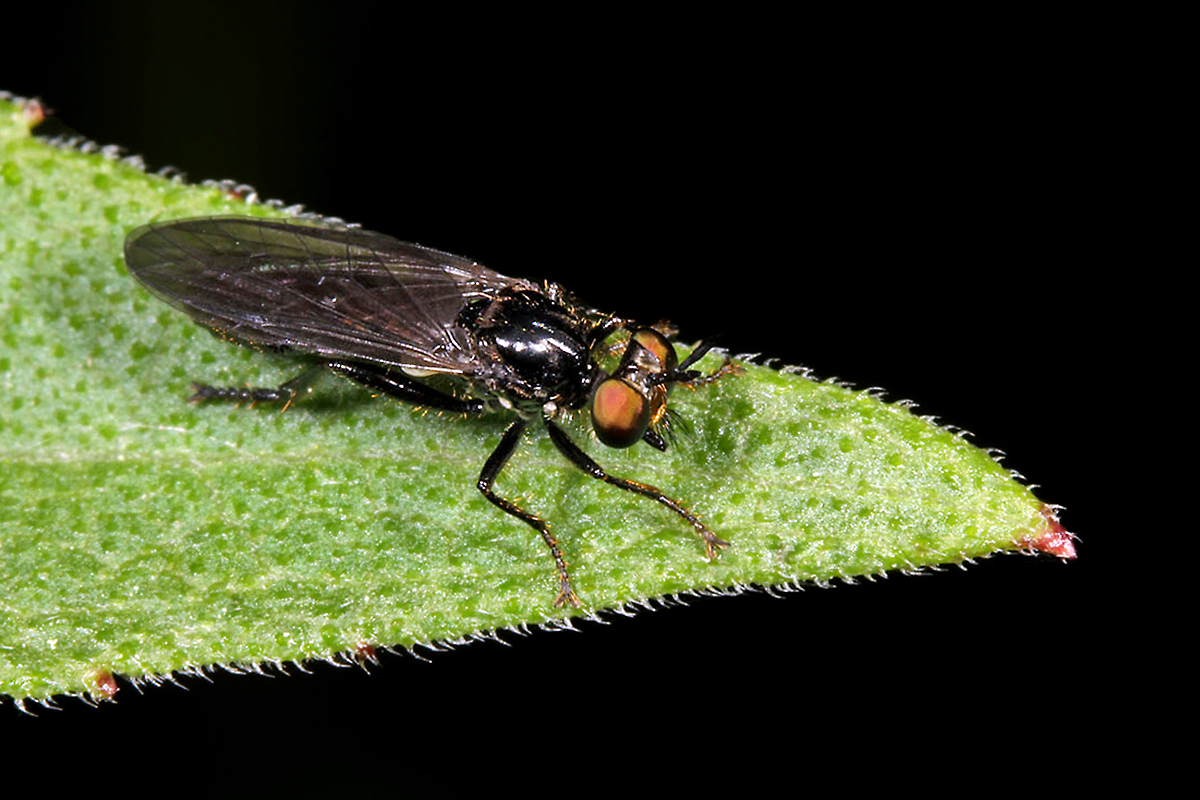
Brazil Bugs #6 – A mosca

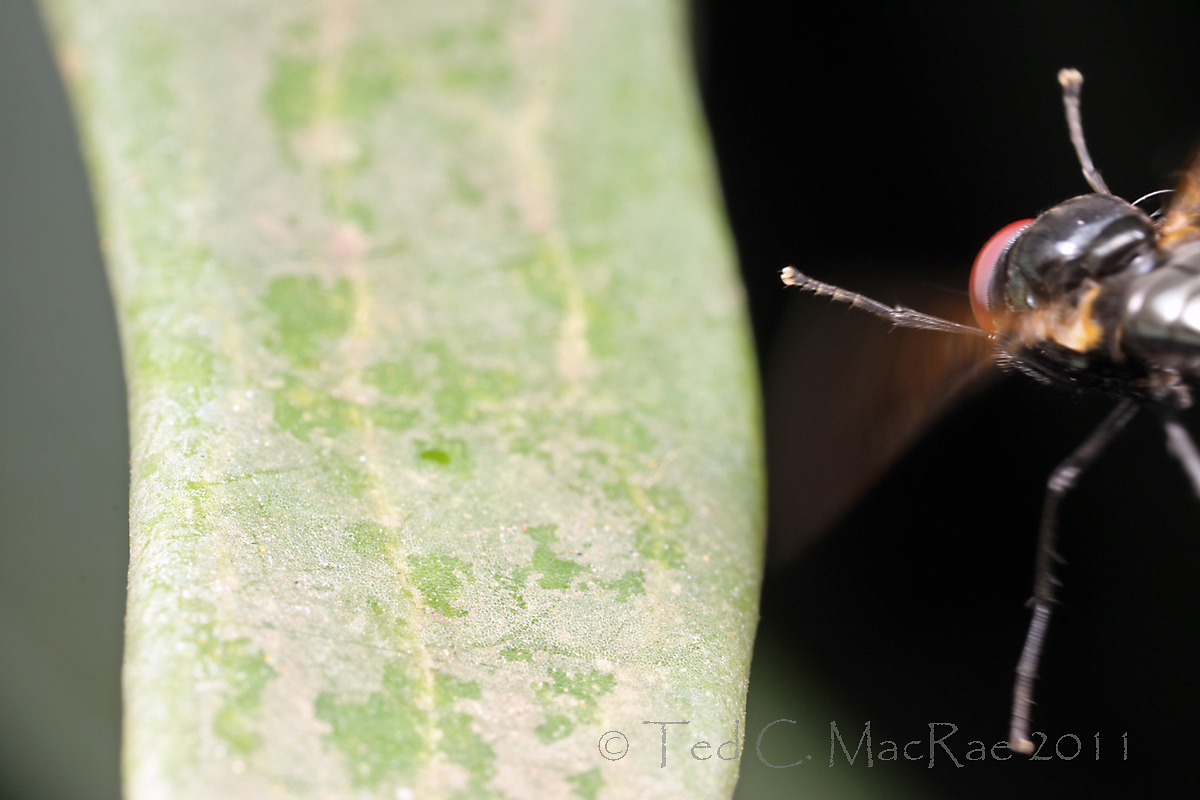
As I strolled the hotel grounds here in Campinas after work one day last week, I came upon a tree with several epiphytic orchids and a large staghorn fern (Platycerium sp.) mounted to its trunk.  On the tips of several of the fern’s leaves sat these peculiar looking flies – shining dark blue-black in color with a prominent red head.  I’m just guessing that they were some sort of blow fly (family Calliphoridae), although something about the look doesn’t seem quite right for the family (maybe because I’ve never seen Brazilian calliphorids before).  I found it interesting that they all oriented themselves head downward at the tip of the leaf on which they were sitting.  When I get intrigued by something, I want to photograph it, but in this case it was easier said than done.  They were small enough to require the 65mm lens, which means getting quite close, and every time I approached one it would fly away.  There were enough of them, however, that when one flew away I would just try another, and each fly would eventually return to the same leaf on which it had previously been sitting.  I spent some minutes scaring away fly after fly before I finally figured out the approach.  That, however, was only half the battle! 

When I finally started trying to take some shots, the pre-flash on the ETTL flash setting would scare the fly before I could complete the shutter snap, and I was getting only an empty frame where the fly had been sitting.  I thought about switching to manual flash but decided to keep working the fly and just see if I could get it accustomed to the flash.  The first photo in the series posted here is the first one in which I actually got part of the fly in the frame (I think he did a quick loop out and was actually returning to his spot when the shutter snapped).

I got closer in this one – the fly was just starting to take off as the shutter snapped (too bad I didn’t have better focus, or this could’ve been an interesting view).

Finally, I got the fly sitting still at the tip of the leaf.  This is when I started to get picky – I wasn’t too satisfied with the composition in this photo, and since he seemed to have become accustomed to the flash, I decided to take a few more shots to try to make sure I get one with good composition and focus.

Better composition this time, but the focus is still a bit off.  Unfortunately, this was my last shot at this guy, as he took off right afterward.  The thought taking the time to work another fly and get him accustomed first to me and then the flash didn’t appeal to me by this point – I was in Brazil, and there are so many other insects to photograph.  I decided good enough was good enough and continued my searches…

Copyright © Ted C. MacRae 2011

Brazil Bugs #2

A few more photographs from this past week in Campinas, Brazil.  It rained during the afternoon but stopped by the time I arrived back at the hotel, allowing me to stroll the lavishly landscaped grounds during the mild evening hours.  There is a pink-flowered shrub forming a hedge row in back of the hotel that is highly attractive to many types of insects.  The identity of the shrub remains a mystery to me, and most of the insects I’m finding on it I can recognize only to family – I’m hoping the hotel staff will be able to name the former and that the readers of this blog might be able to provide IDs for the latter.

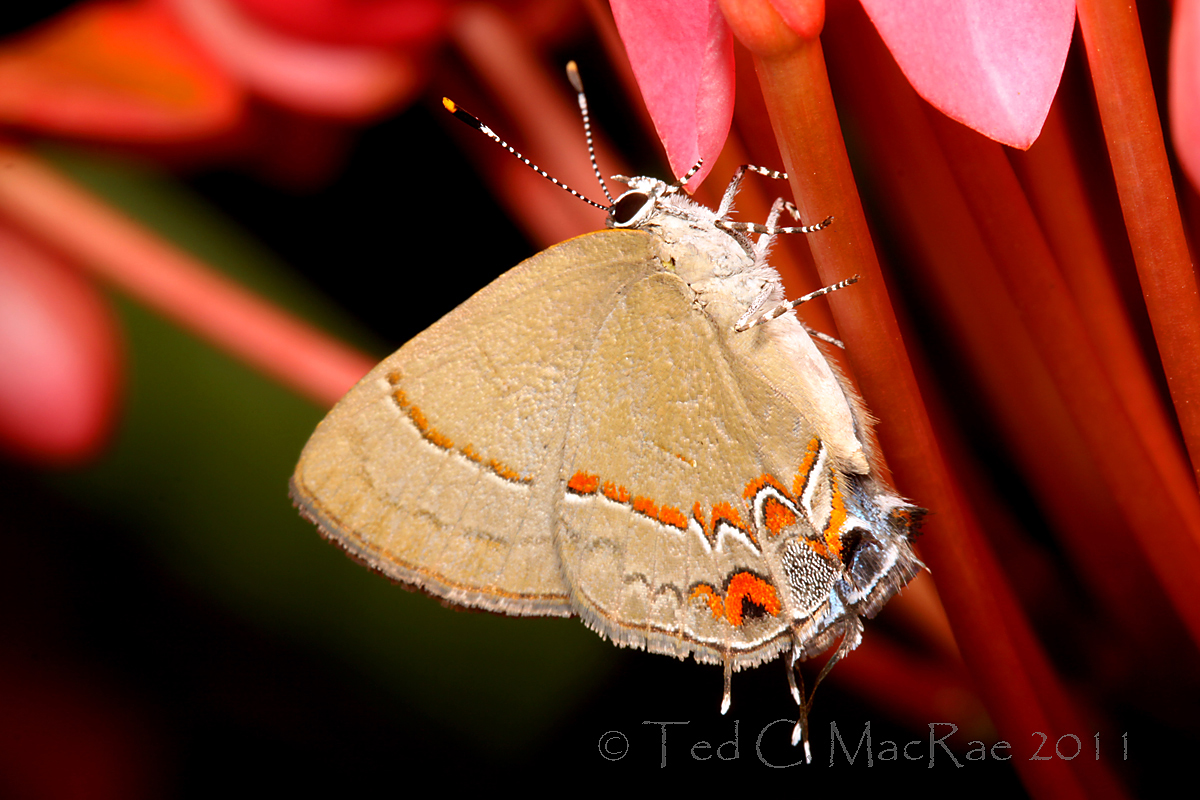
Calycopis sp. poss. origo (Lepidoptera: Lycaenidae). ID by Dave Hubble and Chris Grinter.

It took a bit of effort to find an unobstructed view of this hairstreak butterfly (family Lycaenidae) as it visited the flowers within the shrub.  Every time I tried to move foliage out of the way to get a good view, the butterfly became alarmed and flew to another part of the hedge row.  My antics drew the attention of a hotel worker, who was apparently interested enough in what I was doing to act as a spotter whenever the butterfly flew to help me relocate it.  Eventually I got a few shots that I was happy with, including the above.

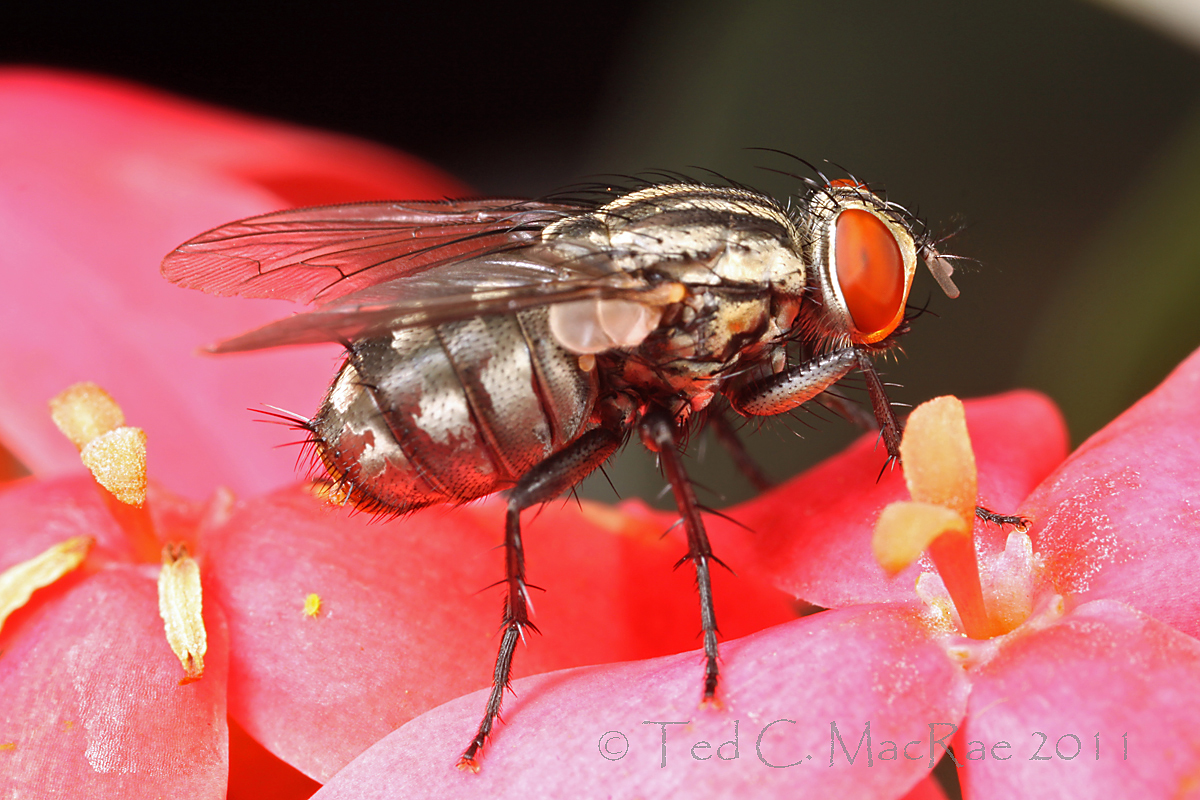
A flesh fly (Diptera: Sarcophagidae).

I presume this to be a type of flesh fly (family Sarcophagidae) based on the stout bristles and color pattern that seems typical for the family.  I like the striking contrast in coloration between the fly and the flower.  There are a few fly bloggers who I’m hoping might be able to give a better identification.

A potter/mason wasp? (Hymenoptera: Vespidae).

This appears to me to be some kind of potter or mason wasp (family Vespidae, subfamily Eumeninae) – it was a bit smallish at only about 12mm in length.  I hope one of the knowledgeable wasp bloggers out there (ahem… Eric?) can at least confirm this level of identification and perhaps the tribe or genus as well. 

Azya orbigera (Coleoptera: Coccinellidae). ID by Tucker Lancaster.

Every ladybird beetle (family Coccinellidae) I’ve ever seen is some variation of black and red/orange/yellow and has a smooth, glabrous appearance.  This beetle is cobalt blue with a dense pubescence over the dorsal surface, but it still seems to me to be some type of ladybird beetle.  It was a tiny little thing, so I suppose it could be one of the multitude of small beetle families with which I am unfamiliar.

Quedas sp.? (Hemiptera: Cicadidae).

This cast cicada exuvium was not on the shrub, but on a nearby tree at about eye level.  I really wish I could have seen the cicada that emerged from it, because this is certainly the biggest cicada exuvium I have ever seen.  I was about to simply label it “family Cicadidae” but seem to recall that cicada higher classification is in a bit of flux these days.  At any rate, given its great size I wonder if it might represent one of the giant cicadas in the genus Quesada.

I still have many more insect photographs from the past week and will certainly increase that number over the next week as well.  Stay tuned!

Copyright © Ted C. MacRae 2011
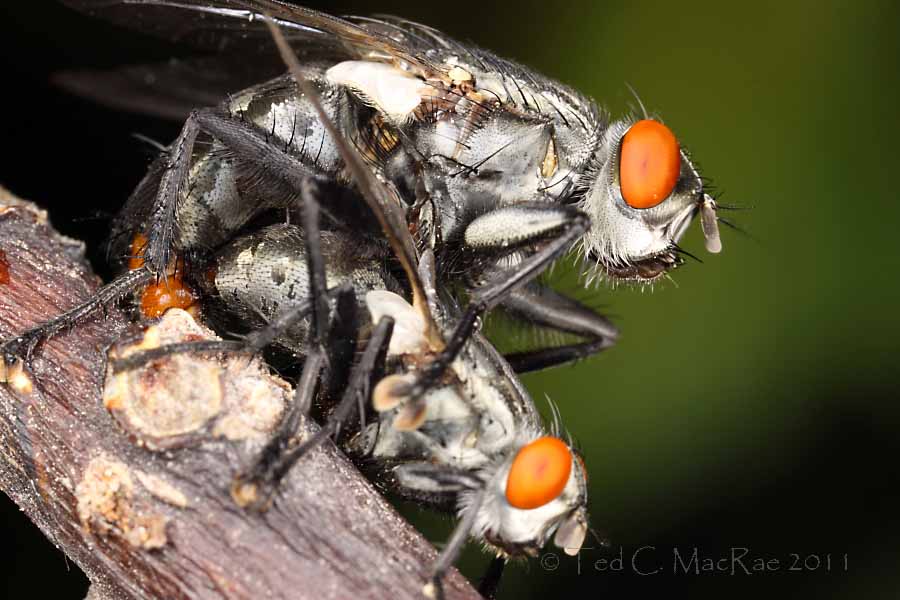
The marvelously monstrous Microstylum morosum

A few weeks ago, while waiting to begin my nocturnal hunt for the Great Plains giant tiger beetle (Amblycheila cylindriformis) in northwestern Oklahoma, I spent the daytime atop one of the red flat-topped mesas that meander through the area in nearby Gloss Mountain State Park.  Although my trip was all about seeing this giant of a tiger beetle in the wild for the first time (I could hardly wait for dusk to begin my search), I found enough splendid insects of other types atop the mesa to occupy my interest until that time.  One of these was the still-robust population of the Swift Tiger Beetle (Cylindera celeripes) that I discovered last summer and delighted in photographing yet again, while another was North America’s largest robber flyMicrostylum morosum!  I had just finished photographing one of the tiger beetles near the edge of the mesa when I turned and saw one of these impressively large flies sitting calmly on the ground nearby.

I first encountered this species last year in southwestern Missouri (a new state record!), so there was no question about its identity.  I also remembered how skittish they were and how difficult it was to get even the two mediocre photographs that I included in the resultant post.  Expecting the same, I kept my eye on the ground-sitter while preparing the camera and approached it with extreme caution.  To my surprise, it showed no sign of being alarmed or wanting to take flight.  I crouched down low and marveled at its monstrous impressiveness as I took frame after ever closer frame – eventually zeroing in on the head and its stunningly magnificent emerald-green eyes.

Satisfied that somewhere in the dozen and a half frames that I shot was at least one or two winners, I sat up and probed towards it with my finger to see how quickly it took flight.  It just sat there tenaciously until my touch caused it to finally take wing.  Winds were gusty atop the mesa, which may have accounted for its cooperativeness.  Standing up, I noted a few scattered eastern redcedars (Juniperus virginiana) in the mixed-grass prairie at the highest point of the mesa.  I recalled that robber flies are fond of “hilltopping” – a mating strategy whereby males fly to the highest point in their immediate landscape to defend a small territory or perch that provides a good vantage for spotting females and competing males (see Hilltopping by Eric Eaton at Bug Eric for a good discussion about this) – and my own experience with this species in Missouri and the way it tended to perch in the trees scattered across the upper part of the rocky, dolomite glade where I found them.  I wandered up to the redcedars, and as soon as I came close enough to one of them I saw another individual take flight – looking like some super-sized mosquito with it’s long legs spread wide as it clumsily flew to another tree.  As it turned out, I saw a number of individuals and mating pairs perching and flying among the trees on top of the mesa, each more spectacular than the previous.

Until recently, Microstylum morosum was considered a Texas-endemic.  However, Beckemeyer and Carlton (2000) documented this species to be much more broadly distributed in the southern Great Plains (from Texas up into Oklahoma and Kansas and west into New Mexico, Arizona, and Colorado), and Warriner (2004) recorded it shortly afterwards in Arkansas.  Although the species apparently occurs throughout Oklahoma (Beckemeyer and Carlton recorded from 13 counties across the state), my observation of it in Major County does seem to represent a new county record for the species.  There is another U.S. species in the genus, M. galactodes, and it has also been recorded from Oklahoma (the closest record is in nearby Woodward County).  However, it is easily distinguished by its generally smaller size, milky white wing membranes, reddish-brown body, and head and thoracic dorsum evenly covered with whitish pruinescence, while M. morosum has the wings and body black to brown and thoracic pruinescence restricted to the lateral margins (Beckemeyer and Carlton 2000).  I’m not sure I would have recognized that species for what it was had I seen it, but if it is anywhere near as impressive as M. morosum then I hope I have the fortune to find it someday as well.

Photo Details:
Landscape: Canon 50D w/ 17-85mm wide-angle lens (17mm), ISO 100, 1/100 sec, f/10, ambient light. Typical post-processing (levels, unsharp mask).
Insects: Canon 50D w/ 100mm macro lens, ISO 100, 1/250 sec, f/10 (photo 1), f/18 (photo 2), Canon MT-24EX flash (1/4 ratio) w/ Sto-Fen diffusers. Typical post-processing (levels, minor cropping, unsharp mask).

REFERENCES:

Beckemeyer, R. J. and R. E. Carlton.  2000. Distribution of Microstylum morosum and M. galactoides (Diptera: Asilidae): significant extensions to previously reported ranges.  Entomological News 111(2):84–96.

Warriner, M. D.  2004. First Arkansas record of the robber fly Microstylum morosum (Diptera: Asilidae).  The Southwestern Naturalist 49(1):83–84.

Copyright © Ted C. MacRae 2010

Add to FacebookAdd to DiggAdd to Del.icio.usAdd to StumbleuponAdd to RedditAdd to BlinklistAdd to TwitterAdd to TechnoratiAdd to Yahoo BuzzAdd to Newsvine

Email to a friend