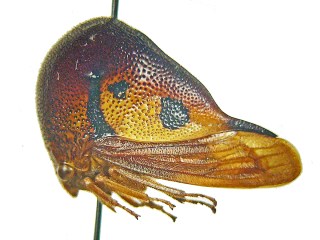
Traffic Jam Treehoppers

Sometimes photo opportunities come at the unlikeliest of times. A few weeks ago while traveling back to Corrientes, Argentina from neighboring Chaco Province, I came upon traffic at a standstill just a few kilometers from the towering Gral. Belgrano bridge that spans the massive Rio Paraná to link Chaco and Corrientes Provinces. People were already getting out of their cars and walking around, suggesting a wreck closer to (or on) the bridge had completely shut down the highway for the time being. Somebody said they heard it might be another 45 minutes before it could be opened. What to do now? It was the end of my last day after a week of insect collecting/photographing in the area, and the last thing I wanted to do was spend the evening sitting on a divided highway with nowhere to go and nothing remotely interesting to look at…

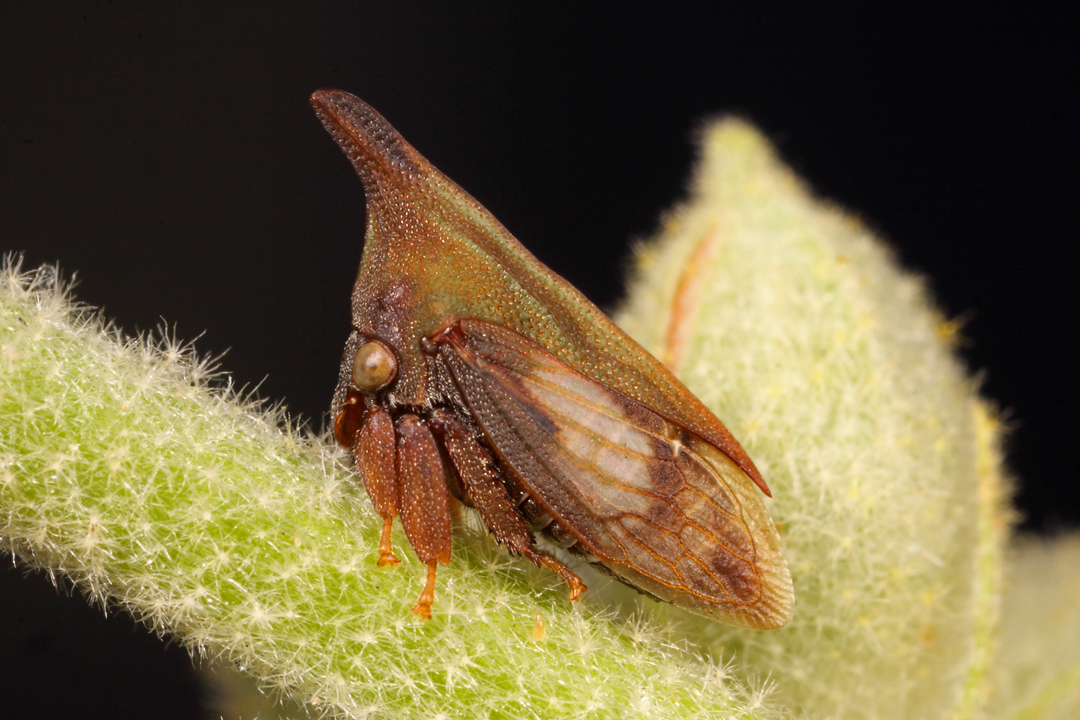
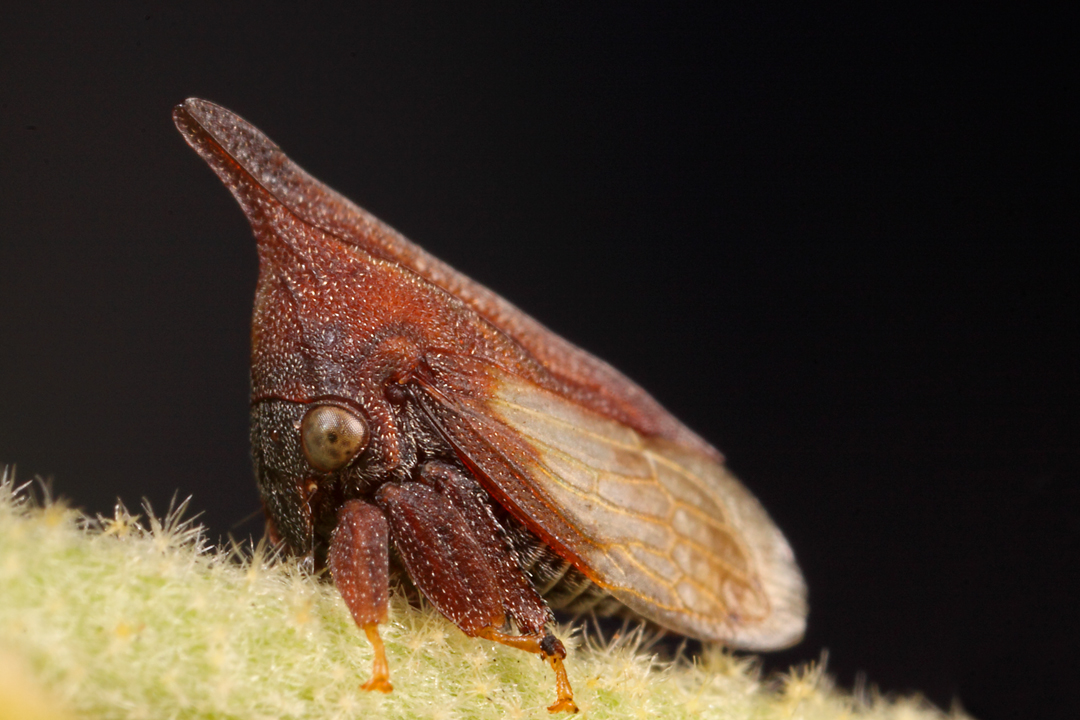
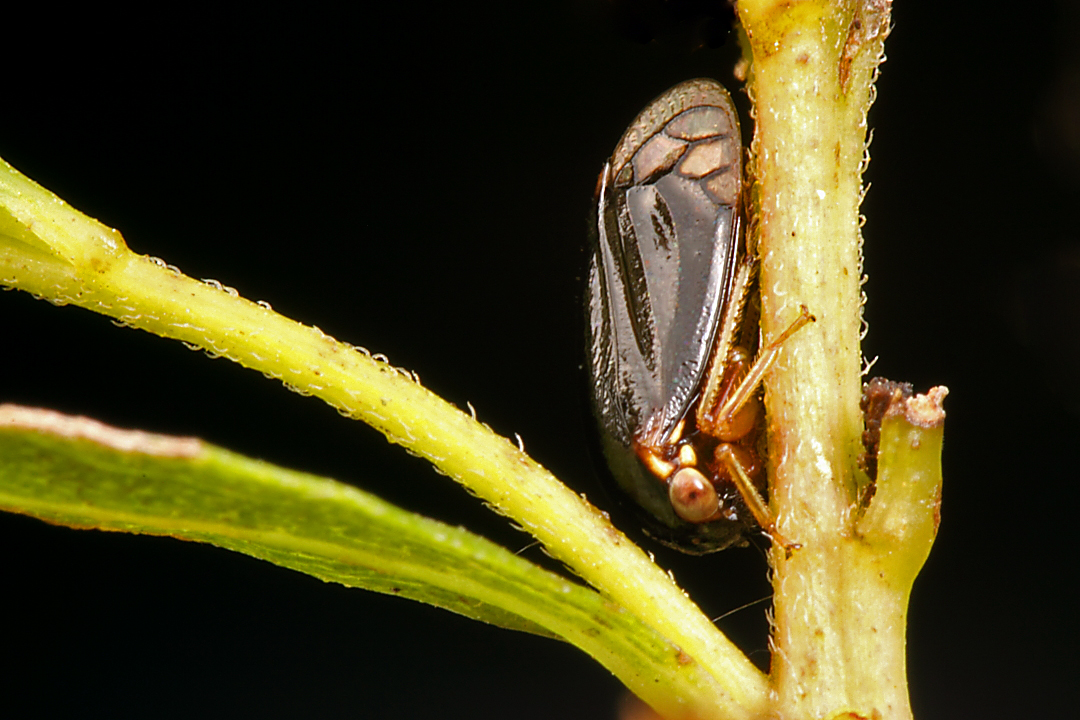
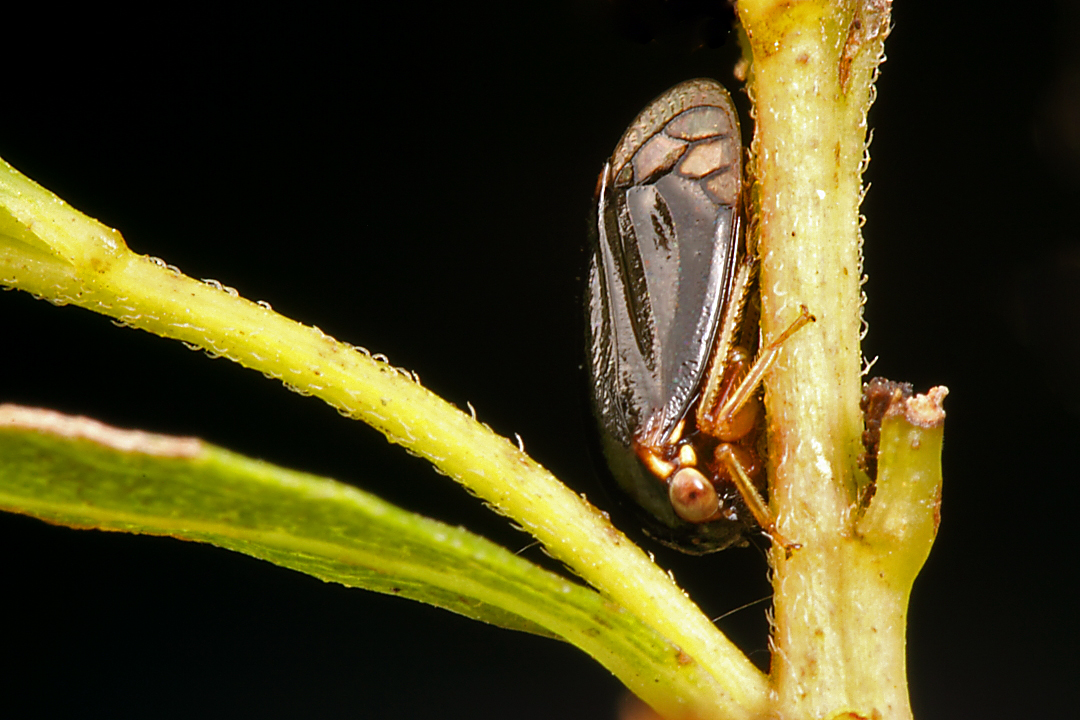
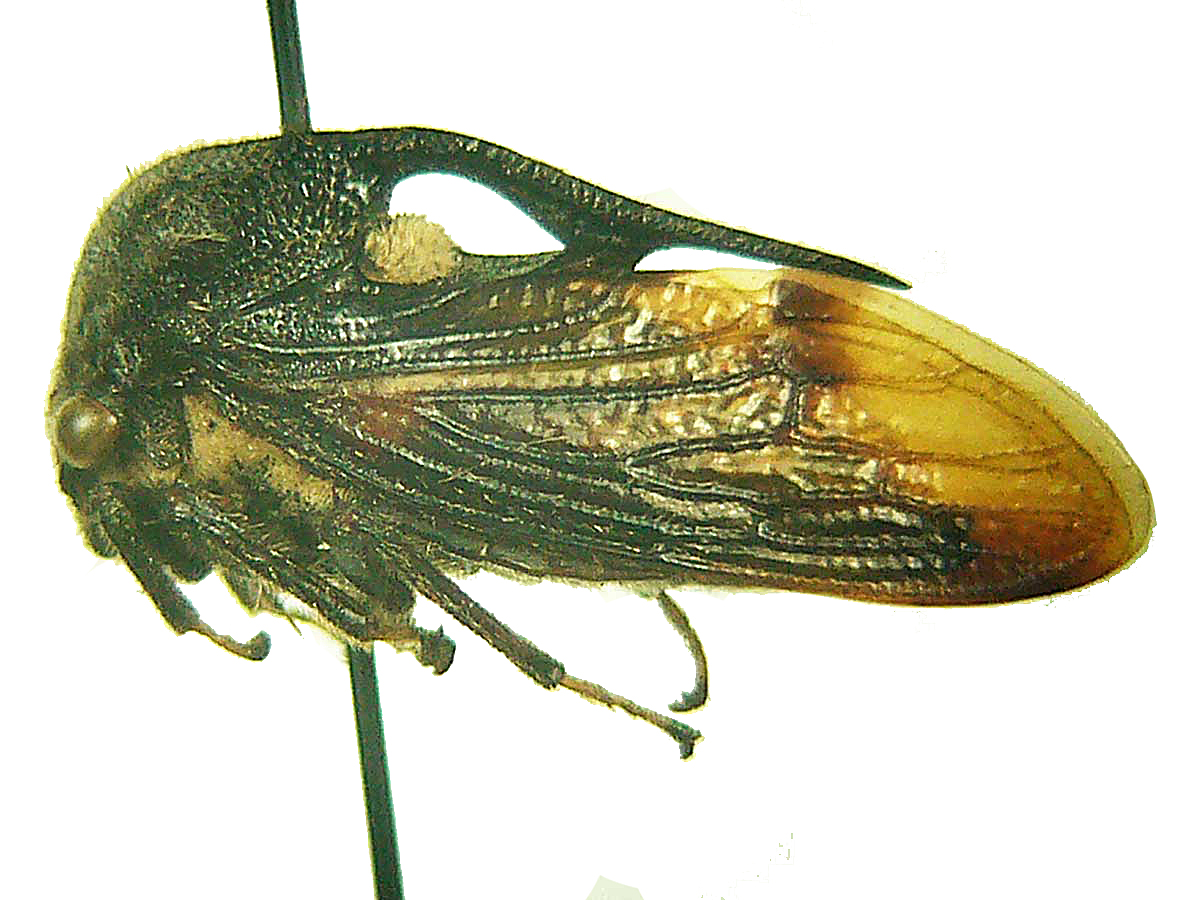
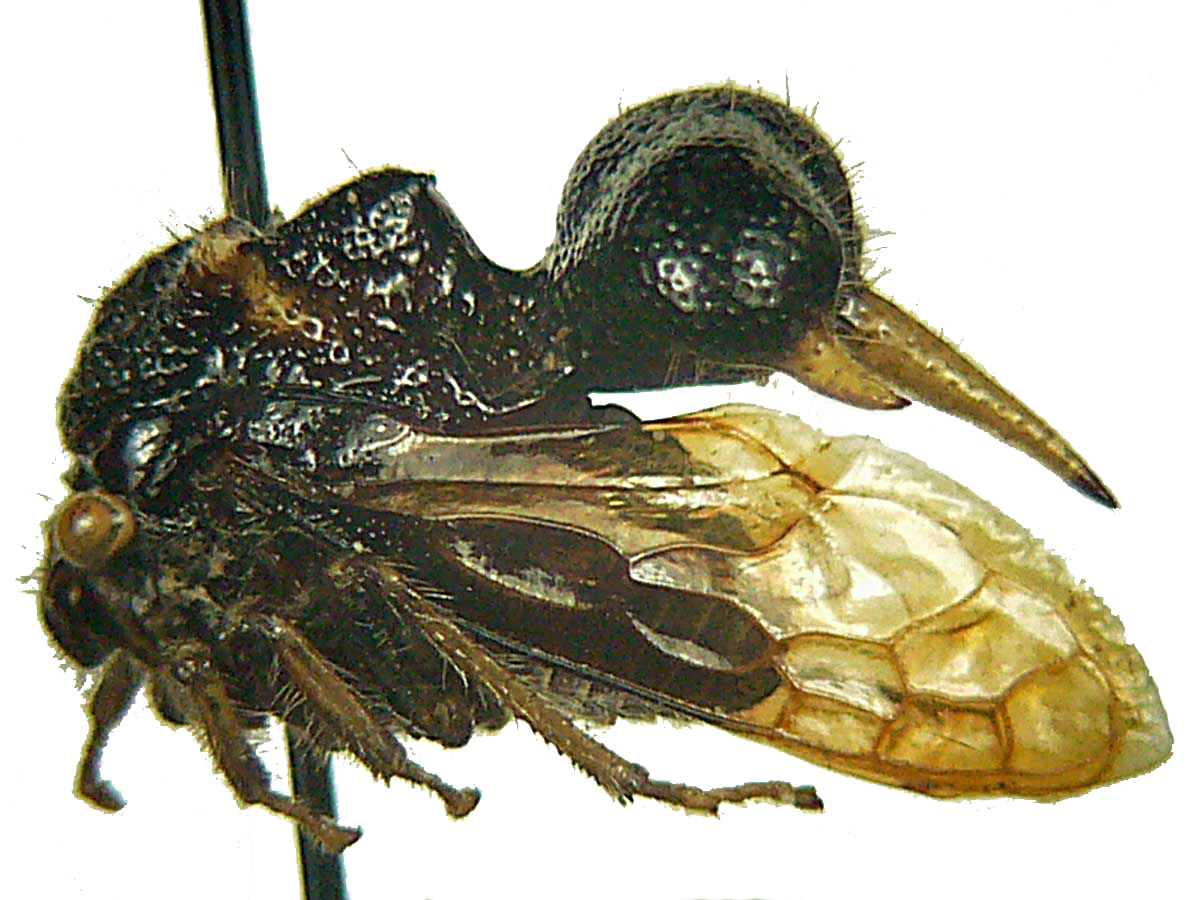
Enchenopa gracilis (Germar, 1821) | Chaco Province, Argentina

…or so I thought. While scanning the highway right-of-way to see if there might be anything possibly interesting to look at, I spotted a small clump of woody shrubs down the embankment and across the erosion gully before the fenceline. I looked around—everybody was out of their cars with the engines shut off, so I grabbed my camera (not really sure why) and started walking towards the shrubs while looking ahead every now and then for any sign that people were getting back in their cars and moving again. I reached the shrubs and saw they represented something in the mallow family (Malvaceae) due to their small, orange, über-staminate flowers. Immediately I spotted the familiar thorn-like shape of treehoppers in the tribe Membracini, probably a species of Enchenopa or related genus. I had been hoping to see more of these after photographing another species further south in Buenos Aires last year, but I hadn’t seen a single treehopper during the entire week. Fortunately I had my 65mm lens already on the camera, so I quickly snapped a few shots and collected a couple of specimens. Just as quickly as I had done that, I heard somebody yelling to me from the road above that people were getting back into their cars ahead. These few shots and specimens would have to do. (And, disappointingly, after spending the next hour creeping towards the bridge there wasn’t even a wreck to look at!)

As I did with those previous photos, I sent these to Andy Hamilton (Canadian National Collection, Ottawa), who forwarded them on to Dr. Albino Sakakibara (Universidad Federal de Parana, Brazil) and then reported back to me that:

My Brazilian colleagues…have been able to identify your “beautiful photos” as representing Enchenopa gracilis, a species that has been illustrated only once (in 1904), and certainly not by a photograph!

Another individual, this one with no trace of green colorationi and less distinctly marked wings.

The illustration referenced by Andy comes from Kellogg (1905—p. 169, fig. 239), and as he notes at BugGuide the problem with old illustrations is that many of them are either inaccurate or use obsolete names. Enchenopa gracilis does not occur in North America, thus the drawing in Kellogg (1905) probably does not actually represent this species. Nevertheless, a recent dissertation on the insect fauna associated with pigeon pea in Brazil (Azevedo 2006) shows several photographs of adults that agree nicely with these photos. Enchenopa gracilis actually seems to be a bit of a pest on that crop, and it has also been reported in association with a variety of other plants across several different families (Lopes 1995, Alves de Albuquerque et al. 2002). Interestingly, I could not find any species of the family Malvaceae recorded as a host for E. gracilis.

REFERENCES:

Azevedo, R. L. 2006. Entomofauna associada ao feijão guandu [Canjanus cajan (L.) Millspaugh] no recôncavo baiano. Ph.D. dissertation, Centro de Ciências Agrarias e Ambientais, Universidade Federal da Bahia, Cruz das Almas, 54 pp.

Alves de Albuquerque, F., F. C. Pattaro, L. M. Borges, R. S. Lima & A. V. Zabini. 2002. Insetos associados à cultura da aceroleira (Malpighia glabra L.) na região de Maringá, Estado do Paraná. Maringá 24(5):1245-1249.

Kellogg, V. L. 1905. American Insects. Henry Holt & Co., New York, 674 pp.

Lopes, B. C. 1995. Treehoppers (Homoptera, Membracidae) in southeastern Brazil: use of host plants. Revista Brasileira de Zoologia 1213:595-608.

Copyright © Ted C. MacRae 2012

Best of BitB 2011

Welcome to the 4th Annual BitB Top 10, where I get to pick my 10 (more or less) favorite photographs of the year. As an insect macrophotographer I still feel like a relative newcomer, although with three seasons under my belt fewer and fewer people seem to be buying it anymore. Granted I’ve learned a lot during that time, but the learning curve is still looking rather steep. I don’t mind—that’s the fun part! With that said, I present a baker’s dozen of my favorite photographs featured here during 2011. I hope they reflect the learnings I’ve had the past year and maybe show some progress over previous years (2009, 2008 and 2010).

One more thing—I’m including a special bonus for the first time in this year’s edition. Each of the photos shown below is linked to a 1680×1120 version that may be freely downloaded for use as wallpaper, printing in calendars, or any other use (as long as it’s personal and non-profit). It’s my way of saying thanks for your readership and support.


From  (posted 8 Jan). I’ve done limited photography with prepared rather than live specimens. However, the recreated aggressive-defensive posture of this greater arid-land katydid (Neobarrettia spinosa)—or “red-eyed devil”—was too striking to pass up. A clean background allows every spine and tooth to be seen with terrifying clarity.


From  (posted 6 Feb). I had never seen a cactus fly until I encountered this Nerius sp. I’m especially fond of the bizzarely-shaped head and un-fly-like spines on the front legs.


From  (posted 17 Feb). This photo of a fungus weevil, Phaenithon semigriseus, is one of the first where I nailed the focus right on the eye at such a magnitude of closeup (~3X) and also got the composition I was looking for. I didn’t notice at the time, but the beetle seems to be “smiling.”


From  (posted 28 Mar). One of the field techniques I’ve been practicing this year is actually holding the plant with the subject in one hand, resting the camera on my wrist and controlling it with the other hand, and manipulating the position of the plant to achieve a desired composition. It’s a difficult technique to master, but the results are worth it. The jumping spider, Euophrys sutrix, represents one of my earliest successful attempts with this technique.


From  (posted 30 Mar). This South American tree fruit weevil looks like it is sitting quite calmly on a branch. In reality, it never stopped crawling while I attempted to photograph it. Crawling subjects are not only difficult to focus on but also almost always have a “bum” leg. I achieved this photo by tracking the beetle through the lens and firing shots as soon as the center focus point flashed, playing a numbers game to ensure that I got at least one with all the legs nicely positioned. I’d have been even happier with this photo if I had not clipped the antennal tip.


From  (posted 4 May). Face shots of predatory insects are hard to resist, and in this one of the fiery searcher beetle, Calosoma scrutator, the angle of the subject to the lighting was perfect for showing off every ridge and tooth in its impressive mandibles.


From  (posted 10 May). I’ve taken plenty of lateral profile shots of tiger beetles, but I like this slightly panned out one especially because of the sense of scale and landscape created by the inclusion of the plantlets and the view over the small rise.


From  (posted 18 May). I found these Edessa meditabunda stink bug eggs on the underside of a soybean leaf in Argentina almost ready to hatch. The developing eye spots in each egg gives the photo a “cute” factor rarely seen in such super close-ups.


From  (posted 15 July). Some of my favorite insect photos are not only those that show the bug in all its glory, but also tell a story about its natural history. This nymphal lichen grasshopper, Trimerotropis saxatilis, is almost invisible when sitting on the lichens that cover the sandstone exposures in its preferred glade habitat. 


From  (posted 23 Aug). I know this is the second beetle face shot I’ve included in the final selections, but it was while photographing this rare Florida metallic tiger beetle, Tetracha floridana, in the middle of the night that I discovered the use of extension tubes to improve the quality of flash lighting (decreased lens to subject distance results in greater apparent light size). This is perhaps one of the best illuminated direct flash photographs that I’ve taken, and I also like the symmetry of the composition.


From  (posted 17 Sep). The three-cornered alfalfa hopper (Spissistilus festinus) is a common pest of alfalfa and soybean in the U.S. However, despite its abundance, I’ve never noticed the bizarre zig-zag pattern of the eyes until I took this photo. Even though both the insect and the background are green, there is sufficient value contrast to create a pleasing composition. Bumping up the ISO and a lower FEC setting prevented overblowing the light greens—easy to do with full flash macrophotography.


From  (posted 4 Oct). This longhorned beetle had settled in for the night on its Ericamera nauseosa host plant, allowing me to use higher ISO and lower shutter speed settings with a hand-held camera to achieve this very pleasing blue sky background, while retaining the sharpness of detail of the subject that comes from full-flash illumination. The blue sky background provides a more pleasing contrast with the colors of this particular beetle and flowers than the black background that is more typically seen with full-flash macrophotography.


From  (19 Dec). An uncommon underside view of these purple tree fungus (Trichaptum biforme) caps and use of flash illumination allows the colors to literally glow against the bright green lichens also growing on the tree. Keeping aperture at a moderate setting allows blurring of the caps further back, adding three-dimensionality to the photo and preventing it from looking ‘flat.’


Well, there you have it, and I hope you’ve enjoyed my selections. Please do tell me if you have a favorite among theses (and if there were other photos posted during 2011 that you think deserved making the final selections).

Copyright © Ted C. MacRae 2011

Crazy Eyes

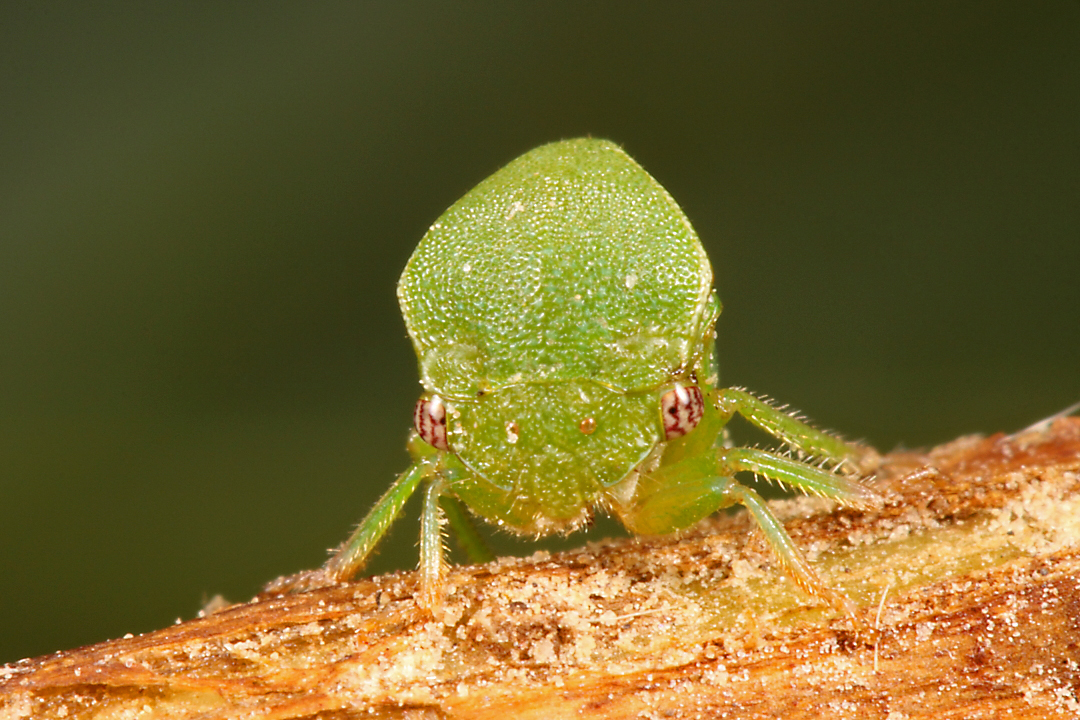
Spissistilus festinus | Stoneville, Mississippi

Spissistilus festinus (three-cornered alfalfa hopper) is one of the few truly economic pests in the otherwise bizarre and innocuous family Membracidae (treehoppers).  Its common name alludes to one of the crops it affects, but my encounters with this species are most often in soybean (I am, after all, a soybean entomologist).  Damage in this crop is caused by both adults and nymphs, whose piercing/sucking mouthparts cause girdling and breakage of the stem—often just a few inches above the soil.  This individual was seen during my travels last week in a soybean field in Stoneville, Mississippi, where numbers throughout the season were especially high this year.  Although I have seen innumerable S. festinus adults, I have never noticed their crazy, zig-zag patterned red and white eyes until I managed this closeup face shot (click on photo for best view).

This slightly cropped photo was taken with a 100mm macro lens and full extension tube set, resulting in slightly more than 2X magnification.  One of the lessons I took from was the need to pay more attention to background and value contrast.  By placing the subject a few inches in front of the dark green soybean foliage I was able to achieve a much more pleasing background than the typical black background one gets with full flash photos at high magnification.  Although both the subject and the background are green, there is still sufficient difference in shade to create contrast between them.  Light-green is one of the more difficult colors to work with when full flash is used with high shutter speeds and small apertures to maximize crispness and detail (in this case, 1/250 sec and f/16).  However, increasing ISO to 400 and lowering flash exposure compensation to -2/3 can reduce the amount of flash needed to illuminate the subject with such settings, making it easier to achieve a properly exposed and true-colored subject.

Copyright © Ted C. MacRae 2011

BugShot 2011 – Lesson 2

Most of my insect photography is done up close using fast shutter speeds (to prevent motion blur) and small apertures (to maximize depth of field).  This necessitates the use of full flash – the amount of light reaching the camera sensor at f/16 and 1/250 sec is not enough to show any image at all, much less one properly exposed.  Full flash photography has its own set of challenges, but for the most part it can be used to produce excellent closeup photographs of insects, even very small ones.  One thing that has always bothered me about full flash photography, however, is the “black background” effect when photographing an insect sitting up on a plant without something else in the immediate background to reflect light.  Not that I don’t like black backgrounds—they can be used to stunning effect with the right subject.  I just don’t want it to be my only option for insects that I photograph up off the ground. Of course, it is rather a simple matter to place something in the background that is close enough to reflect light but far enough away to remain out of focus, but what I really want to be able to do sometimes is have a blue sky.  I always thought this meant natural light, with its low f stops, slow shutter speeds, and the resulting motion blur and loss of depth of field. 

Of the many things I learned today, how to include a blue sky background in a closeup photograph at f/16 was my favorite.  This is accomplished by bumping up the ISO to 400 (to make the camera sensor more receptive to light) and decreasing the shutter speed to 1/60 sec.  Keeping the f stop high maintains the depth of field, but the increased ISO and decreased shutter speed allows sufficient light from a sky background to register on the sensor.  By themselves, however, these setting will still result in an underexposed subject, which is illuminated instead by fill flash.  Despite the slower shutter speed, there is no motion blur because the “effective” shutter speed for the subject is the duration of the flash pulse rather than the camera shutter speed—it’s like combining two exposure speeds in a single photograph, one for the background and another for the subject.

The following three photographs illustrate this principle—again, they are not technically perfect photos, but rather the result of quick experimentation to understand the principles involved.  Photo 1 is from yesterday’s post and illustrates what my typical settings have always been: ISO 160, f/16, and 1/250 sec.  It’s a decent photo of the treehopper, Acutalis tartarea; however, black is perhaps the least appropriate background to choose for this black species. Until now, it would have been my only option unless I tried arranging foliage in its background.  Photos 2 and 3 are of another individual of this species that I found today (fortunately in similar orientation to the individual photographed yesterday).  In both photos I kept the flash unit set to ETTL (adjusting FEC as appropriate for the shots).  In Photo 2 I bumped up the ISO to 400 but kept the shutter speed fast (1/200 sec)—you can see some effect in that the background is not truly black, having received some light from the blue sky.  It’s not enough, however, because the shutter speed was still too fast.  In Photo 3 the ISO remained at 400 but the shutter speed was also decreased to 1/60 sec.  The shutter staying open that long allows enough light from the sky to register on the sensor and, Voila!, we have a blue sky background that creates nice value contrast with the black subject.  The subject these photos is not terribly sharp, but that is just lack of focus—not motion blur from a slow shutter (sorry, I was just practicing settings rather than going for a perfect shot). All three photos were shot with the Canon 100mm macro lens + 68 mm of extension tube (total magnification ~2X).

''Typical'' insect macro settings: ISO 160, 1/250 sec, f/16

ISO increased to 400 (1/200 sec, f/16)

Shutter speed decreased to 1/60 (ISO 400, f/16)


Copyright © Ted C. MacRae 2011

BugShot 2011 – Lesson 1

I’m a lucky guy! First, I’m one of the fortunate attending this weekend’s BugShot insect photography workshop. Second, this first-of-a-kind event is being held only 13 miles from my home at Shaw Nature Reserve in Gray Summit, Missouri. Third, I was “adopted” by the BugShot instructors to assist in the event. Who are the instructors? None other than John Abbott from Austin, Texas—an expert on dragonfly biology and insect action photography, Thomas Shahan from Norman, Oklahoma—master of close-up arthropod (especially jumping spider) portraiture, and Alex Wild from Champaign-Urbana, Illinois—ant photographer extraordinaire and author of the most popular insect blog on the net.  In 2009 I picked up a digital SLR camera for the first time ever—in 2011 I am rubbing shoulders, discussing exposure and lighting, and enjoying social time with three of the country’s most accomplished insect macrophotographers (and some other very cool people as well).

I have come a long way, but I still have much to learn.  Intimate understanding of lighting, exposure, and the creative use of flash still eludes me—I can do a few things well, but there is much more I can’t do at all.  Today was my first time experimenting with the effect of lighting direction, i.e. taking the flash heads off their fixed position on the front of the lens and hand-holding them in different positions.  This simple technique can have dramatic effects on the look of a photograph, as illustrated by the following two photographs.  In the first, both flash heads of my Canon MT-24EX twin flash are attached to the front of the lens (as they have been for every single flash photograph I’ve ever taken up to this point).  In the second, only the right flash head remains attached to the lens, while the left head has been detached and is being hand-held directly above the subject (in this case, the treehopper Acutalis tartarea on Solidago sp.).  Technically they are not very good photographs, but they illustrate well the dramatic differences that can be achieved by varying the position of the flash heads.  Among other things, this is a technique that I will be exploring much over the coming weeks.

Both flash heads attached to front of lens.

Right flash head attached to front of lens; left flash head held directly above subject.

Copyright © Ted C. MacRae 2011

Bichos Argentinos #9 – Membracido

Enchenopa? sp. | Buenos Aires, Argentina

This treehopper that I photographed at La Reserva Ecológica Costanera Sur strongly resembles our North American species of Campylenchia due to the brown elytra and lack of any yellow markings on the pronotal crest.  However, the rounded lower margin of the frons (more apparent in the full-sized version of this photo) eliminates this genus as a possibility and suggests instead the closely related Enchenopa

I sent this and another photo to Andy Hamilton (Canadian National Collection of Insects, Arachnids and Nematodes) for his opinion.  Andy claims to be a hack when it comes to Neotropical Membracidae (focusing more on world Cercopidae and Holarctic Cicadellidae), but he is a much better hack than I!  In his reply, he mentions that a lot of work is still needed on tropical species and genera, and in fact none of our North American species of Enchenopa actually resemble the type-species from Brazil (Membracis monoceros).  Most of what we now consider Enchenopa will likely be referable back to the genus Membracis (type genus of the family), but where the species in the above photo will eventually fall remains anyone’s guess.

Copyright © Ted C. MacRae 2011

Brazil Bugs #15 – Formiga-membracídeos mutualismo

Of the several insect groups that I most wanted to see and photograph during my trip to Brazil a few weeks ago, treehoppers were near the top of the list.  To say that treehoppers are diverse in the Neotropics is certainly an understatement – South America boasts an extraordinary number of bizarre and beautiful forms that still, to this day, leave evolutionary biologists scratching their heads.  The development of this amazing diversity is a relatively recent phenomenon (thinking geological scale here), as there are no known membracid fossils prior to Oligo-Miocene Dominican and Mexican amber – well after the early Cretaceous breakup of Gondwanaland split the globe into the “Old” and “New” Worlds.  With its origins apparently in South America, numerous groups continued to spring forth – each with more ridiculous pronotal modifications than the last and giving rise to the dazzling diversity of forms we see today.  Even North America got in the evolutionary act, benefiting from northern dispersal from South America’s richly developing fauna via temporary land bridges or island stepping stones that have existed at various times during the current era and giving rise to the almost exclusively Nearctic tribe Smiliini (whose species are largely associated with the continent’s eastern hardwood forests).  Only the subfamily Centrotinae, with its relatively unadorned pronotum, managed to successfully disperse to the Old World, where it remains the sole representative taxon in that hemisphere.  With a few notable exceptions, treehoppers have virtually no economic importance whatsoever, yet they enjoy relatively active study by taxonomists, evolutionists, and ecologists alike – due almost completely to the bizarreness of their forms and unique mutualistic/subsocial behaviors.

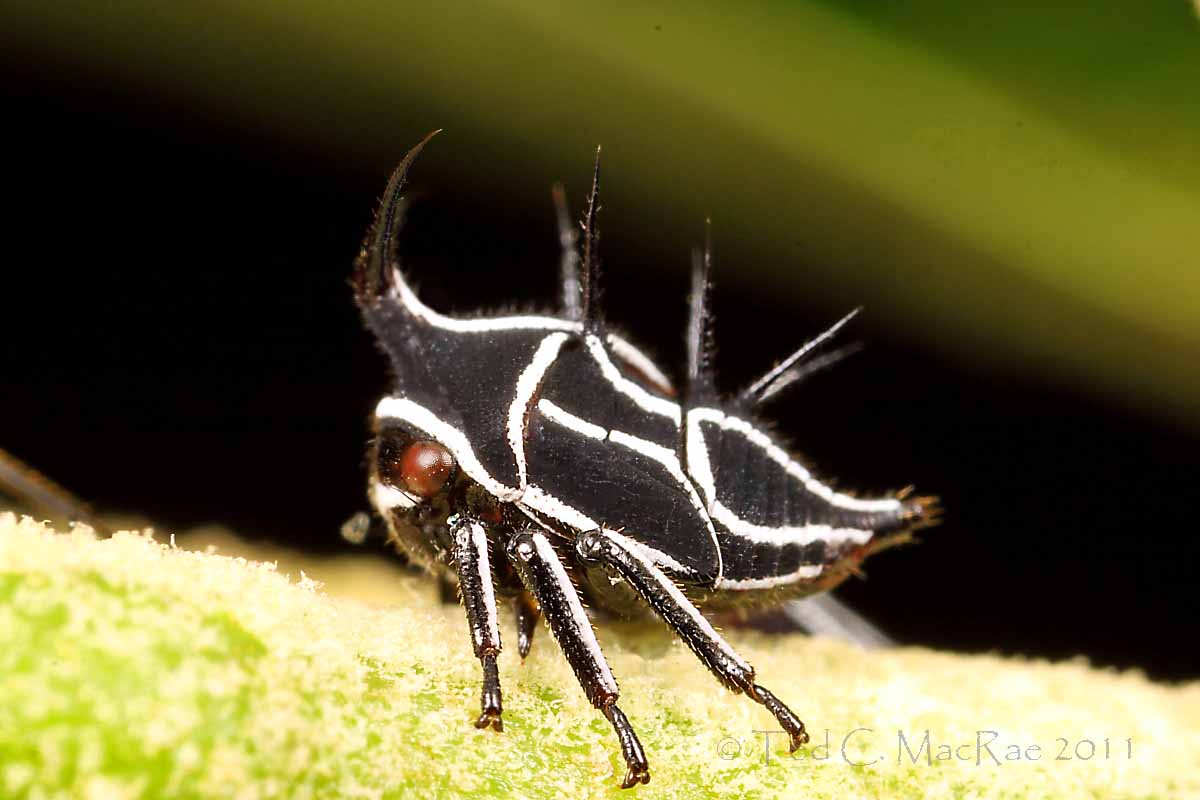
I did manage to find a few species of treehoppers during the trip (a very primitive species being featured in Answer to ID Challenge #4 – Aetalion reticulatum), and of those that I did find the nymphs in this ant-tended aggregation on a small tree in the rural outskirts of Campinas (São Paulo State) were perhaps the most striking in coloration and form.  Most were jet black, although a few exhibited fair amounts of reddish coloration, and all exhibited sharply defined white bands of wax and long erect processes on the pronotum, mesonotum, and abdomen.  I’ve seen a fair number of treehopper nymphs, but I did not recognize these as something I had seen before, and given the incomplete state of immature taxomony I feared an identification might not be possible.  Still (and I know this is probably beginning to sound like a broken record), I gave it the old college try.

I usually like to start simple and get more creative if the results aren’t satisfactory, so I went to my old friend Flickr and simply typed “Membracidae” as my search term.  Predictably, pages and pages of results appeared, and I began scanning through them to see if any contained nymphs at all resembling what I had.  After just a few pages, I encountered this photo with very similar-looking nymphs, and although no identification beyond family was indicated for the photo, I recognized the lone adult sitting with the nymphs as a member of the tribe Aconophorini – a diverse group distinguished from other treehoppers by their long, forward-projecting pronotal horn.  Luck was with me, because I happen to have a copy of the relatively recent revision of this tribe by Dietrich and Deitz (1991).  Scanning through the work, I learned that the tribe is comprised of 51 species assigned to three genera: Guayaquila (22 spp.), Calloconophora (16 spp.), and Aconophora (13 spp.).  The latter two genera can immediately be dismissed, as ant-interactions have not been recorded for any of the species in those two genera – clearly the individuals that I photographed were being tended by ants.  Further, the long, laterally directed apical processes of the pronotal horn, two pairs of abdominal spines, and other features also agree with the characters given for nymphs of the genus Guayaquila.  In looking at the species included in the genus, a drawing of a nymph that looked strikingly similar to mine was found in the species treatment for G. gracilicornis.  While that species is recorded only from Central America and northern South America, it was noted that nymphs of this species closely resemble those of the much more widely distributed G. xiphias, differing by their generally paler coloration.  My individuals are anything but pale, and reading through the description of the late-instar nymph of the latter species found every character in agreement.  A quick search of the species in Google Images was all that was needed to confirm the ID (at least to my satisfaction). 

In a study of aggregations of G. xiphias on the shrub Didymopanax vinosum (Araliaceae) in southeastern Brazil, Del-Claro and Oliveira (1999) found an astounding 21 species of associated ant species – a far greater diversity than that reported for any other ant-treehopper system.  The most frequently encountered ant species were Ectatomma edentatum, Camponotus rufipes, C. crassus, and C. renggeri, and after perusing the images of these four species at AntWeb I’m inclined to believe that the ants in these photos represent Camponotus crassus (although I am less confident of this ID than the treehoppers – corrections welcome!).  The authors noted turnover of ant species throughout the day in a significant portion of the treehopper aggregations that they observed, which they suggest probably reflects distinct humidity and temperature tolerances among the different ant species and that might serve to reduce interspecific competition among ants at treehopper aggregations.  Since treehopper predation and parasitism in the absence of ant mutualists can be severe, the development of multispecies associations by G. xiphias results in nearly “round-the-clock” protection that can greatly enhance their survival.

Update 3/3/11, 9:45 a.m.:  My thanks to Chris Dietrich at the Illinois Natural History Survey, who provided me in an email exchange some clarifying comments on the origins and subsequent dispersal of the family.  The first paragraph has been slightly modified to reflect those comments.

REFERENCES:

Del-Claro, K. and P. S. Oliveira. 1999. Ant-Homoptera interactions in a Neotropicai savanna: The honeydew-producing treehopper, Guayaquila xiphias (Membracidae), and its associated ant fauna on Didymopanax vinosum (Araliaceae). Biotropica 31(1):135–144.

Dietrich, C. H. and L. L. Deitz.  1991.  Revision of the Neotropical treehopper tribe Aconophorini (Homoptera: Membracidae).  North Carolina Agricultural Research Service Technical Bulletin 293, 134 pp.

Copyright © Ted C. MacRae 2011

Bizarre, beautiful extremes

No niche, it seems goes unfilled. Specialization is likely to be pushed to bizarre, beautiful extremes.–E. O. Wilson, The Diversity of Life

Wilson didn’t mention treehoppers specifically when he made the above quote, referring to the exuberance of extreme behavioral and morphological adaptations seen in the biota of the tropics, but he could have just as easily led off with them.  Treehoppers (order Hemiptera, family Membracidae) are well-known for their variety of oddly grotesque shapes resulting from a curiously inflated pronotum – presumably having evolved to resemble thorns and buds on their host plants, or the ants that vigorously defend numerous treehopper species in exchange for their sweet honeydew, or perhaps to aid in the dispersal of volatile sex pheromones (an attractive hypothesis but lacking experimental support). Despite inordinate attention in relation to their low economic importance, it remains that the pronotal modifications of many treehoppers are so bizarre that they continue to defy any logical explanation.

I must admit that, despite my passion for beetles, treehoppers were my first love.  (Well, actually anything that I could bring home from my solo wanderings in the urban woodlands and vacant lots near my childhood home and keep alive in a terrarium was my first true love, but from an academic standpoint, treehoppers were the first group to arouse my taxonomic interest as I began my transformation from child collector to serious student.) I had just begun graduate school in the Enns Entomology Museum under the late hemipterist Tom Yonke to conduct leafhopper host preference and life history studies, and although far more Cornell drawers in the museum contained Cicadellidae, it was the treehopper drawers that I found myself rifling through each afternoon after completing the day’s thesis duties. Despite their lesser number, the treehopper drawers had recently benefited from the attentions of a previous student, Dennis Kopp, whose efforts during his time at the museum concentrated on collecting treehoppers from throughout Missouri and culminated in the four-part publication, The Treehoppers of Missouri (1973-1974). I was enamored by these little beasts – specifically by their exaggerated pronotum – and started collecting them whenever I could on my forays around the state surveying for leafhoppers. They were closely enough related to leafhoppers to make them relevant to my work, only cooler – like leafhoppers on steroids! With The Treehoppers of Missouri as my bible and my desk located a half dozen footsteps from the largest treehopper collection within a several hundred mile radius, I delved into their taxonomy and, for a time, considered a career as a professional membracid taxonomist.

Fast forward nearly 30 years, and my involvement as a taxonomist is neither professional nor deals with membracids. Beetles have taken over as my focal taxon, and I conduct these studies strictly as an avocation. Still, I continue to collect treehoppers as I encounter them, and although such efforts have been largely opportunistic, I’ve managed to assemble a fairly diverse little collection of these insects as a result of my broad travels. Much of this has occurred in the New World tropics, and it is this region that is the center of diversity for the family Membracidae (fossil evidence suggests that subfamily diversification and subsequent New World radiation began during Tertiary isolation about 65 million years ago after South America separated from Africa, since only the primitive subfamily Centrotinae occurs in both the Old and the New Worlds – all other subfamilies are restricted the New World (Wood 1993)).  Every now and then, as I accumulate enough material to fill a Schmidt box, I sit down and study what I’ve collected, comparing it to my meager literature to attempt identifications.  For material I collect in eastern North America, this works fairly well, as there have been a number of publications covering different parts of this area.  Outside of this area, however, my only hope is to entice one of the few existing membracid specialists into agreeing to look at what I’ve accumulated and ask for their help in providing names, in exchange for which they will be granted retention privileges to benefit their research.

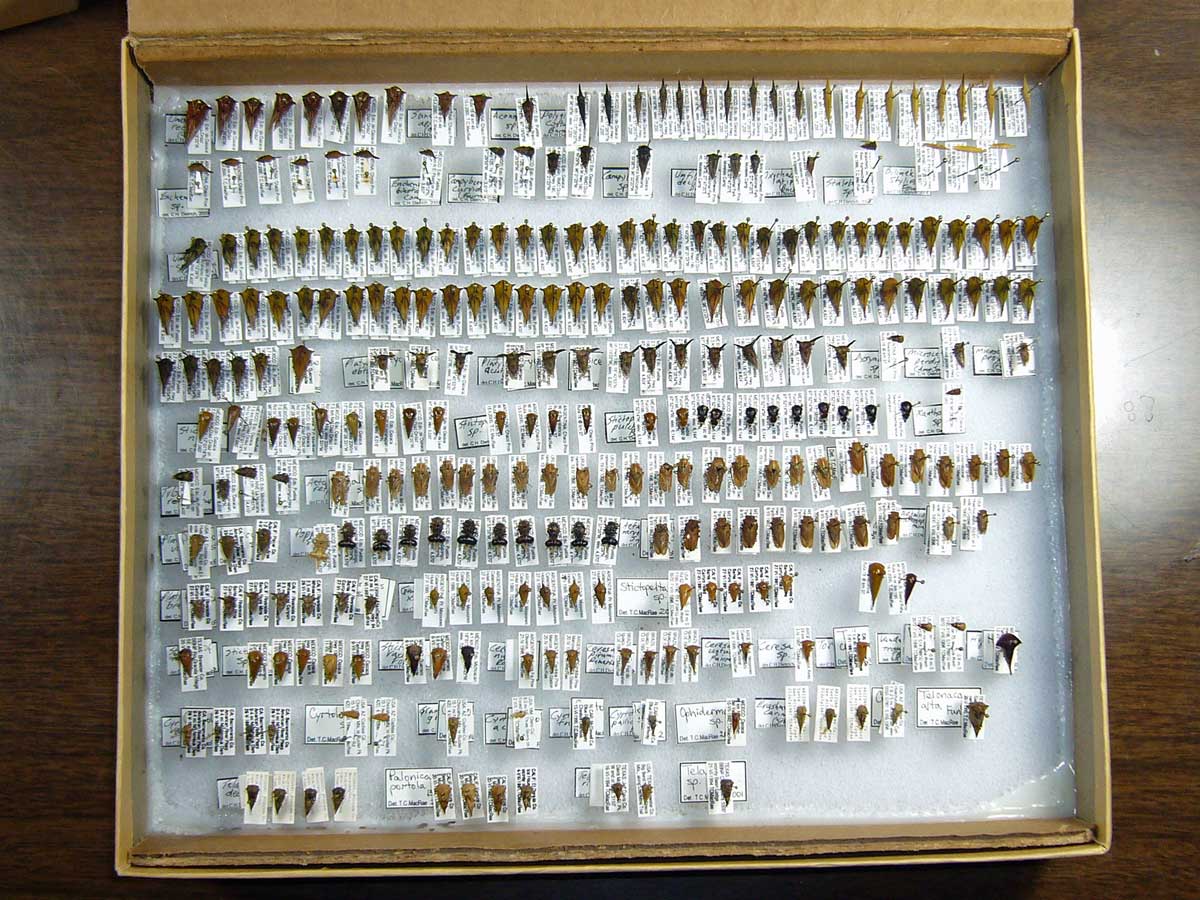
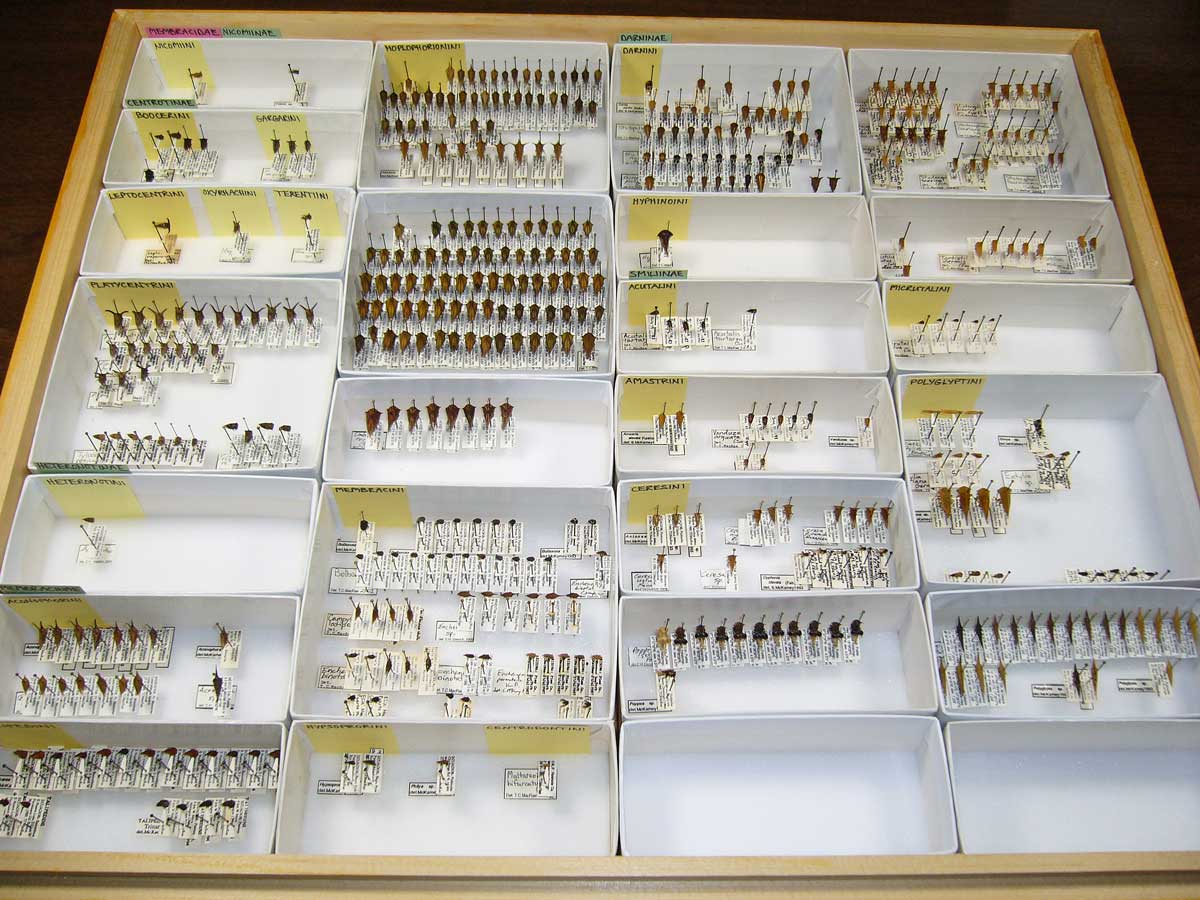
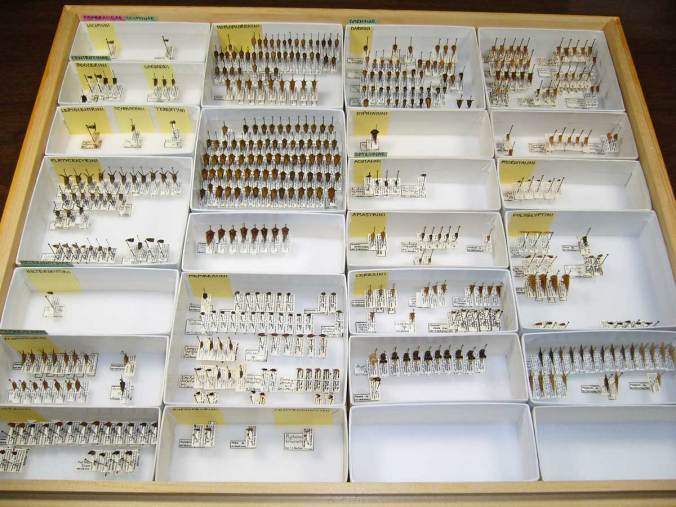
idd-treehoppersMost recently, I was able to convince Illinois Natural History Survey entomologist Chris Dietrich to take a look at the material I had accumulated during the past ten years or so, which included many specimens from Mexico and a smattering from other world areas, including South Africa. Chris did his doctoral work at North Carolina State University under “Mr. Membracid” himself, Lewis Deitz, and has since been conducting evolutionary and phylogenetic studies on Membracidae and the related Cicadomorpha. I recently received this material back from Chris (photo above), the majority of which he had been able to identify to species – only a few specimens in the more problematic genera were left with a generic ID.

Oaxaca)

Campylocentrus sp. (Mexico: Oaxaca)

Oaxaca)

Hyphinoe obliqua (Mexico: Oaxaca)
Puebla)

Poppea setosa (Mexico: Puebla)

Oaxaca)

Umbonia reclinata (Mexico: Oaxaca)

Puebla)

Umbonia crassicornis male (Mexico: Puebla)
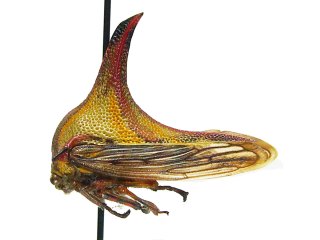
umbonia_crassicornis_female

Umbonia crassicornis female (Mexico: Puebla)

The selection of photos here show a sampling of some of the more interesting forms contained within this batch of newly identified material – all of which hail from southern Mexico. Campylocentrus sp. is an example of the primitive subfamily Centrotinae, distinguished among most membracid subfamilies by the exposed scutellum (not covered by the expanded pronotum).  Hyphinoe obliqua is an example of the largely Neotropical subfamily Darninae, while Poppea setosa represents one of the more bizarre ant-mimicking species of the subfamily Smiliinae.  Umbonia is a diverse genus in the subfamily Membracinae, occurring from the southern U.S. south into South America. Umbonia crassicornis is one of the most commonly encountered species in this genus, with the photos here showing the high degree of sexual dimorphism it exhibits.  As membracids go, these species are quite large (10 mm in length from frons to wing apex for Campylocentrus sp. and P. setosa, a slightly larger 11-13 mm for the others); however, the many smaller species in this family are no less extraordinarily ornamented.  I’ve also included a photo (below) of one of the drawers from the main collection after incorporating the newly identified material – this drawer represents about half of my treehopper collection, with the largely Nearctic tribe Smiliini and the primitive family Aetalionidae contained in another drawer. In all, the material contained one new subfamily, six new tribes, 13 new genera¹, and 30 new species for my collection. For those with an appetite for brutally technical text, a checklist of the species identified, arranged in my best attempt at their current higher classification, is appended below (any treehopper specialist who happens upon this should feel free to set the record straight on any errors). For each species, the country of origin (and state for U.S. specimens) is indicated along with the number of specimens, and higher taxa new to my collection are indicated with an asterisk(*). Don’t worry, I didn’t type this up just to post it here – it’s a cut/paste job from my newly updated collection inventory for Membracoidea. Happy reading!

¹Wildly off topic, and perhaps of interest only to me, but two of the genera represented in the material are homonyms of plant genera: Oxyrhachis is also a Madagascan genus of Poaceae, and Campylocentrus is a Neotropical genus of Orchidaceae. Scientific names of plants and animals are governed by separate ruling bodies (ICBN and ICZN, respectively), neither of which specifically prohibit (but do recommend against) creating inter-code homonyms. The number of such homonyms is surprisingly high – almost 9,000 generic names have been used in both zoology and botany (13% of the total in botany) (source).  Fortunately, there is only one known case of plant/animal homonymy fr BOTH genus- and species-level names – Pieris napi japonica for a subspecies of the gray-veined white butterfly (Pieridae) and Pieris japonica for the popular ornamental plant Japanese andromeda (Ericaceae).
treehopper_drawer
REFERENCES:

Kopp, D. D. and T. R. Yonke. 1973-1974. The treehoppers of Missouri: Parts 1-4. Journal of the Kansas Entomological Society 46(1):42-64; 46(3):375-421; 46(3):375-421; 47(1):80-130.

Wood, T. K. 1999. Diversity in the New World Membracidae. Annual Review of Entomology 38:409-435.
.


.
Superfamily MEMBRACOIDEA
Family MEMBRACIDAE
Subfamily CENTROTINAE

 *Tribe BOOCERINI
*Campylocentrus curvidens (Fairmaire) [Mexico] – 4
Campylocentrus sp. [Mexico] – 1

*Tribe GARGARINI
*Umfilianus declivus Distant [South Africa] – 3

*Tribe OXYRHACHINI
*Oxyrhachis latipes (Buckton) [South Africa] – 1

Tribe PLATYCENTRINI
Platycentrus acuticornis Stål [Mexico] – 11
Platycentrus obtusicornis Stål [Mexico] – 3
Platycentrus brevicornis Van Duzee [USA: California] – 7
Tylocentrus reticulatus Van Duzee [Mexico] – 4

*Tribe TERENTIINI
*Stalobelus sp. [South Africa] – 1

*Subfamily HETERONOTINAE

*Tribe HETERONOTINI
*Dysyncritus sp. [Argentina] – 1

Subfamily MEMBRACINAE

Tribe ACONOPHORINI
Aconophora sp. female [Mexico] – 1
*Guayaquila xiphias (Fabricius) [Argentina] – 7

Tribe HOPLOPHORIONINI
Platycotis vittata (Fabricius) [USA: Arizona, California] – 3
Umbonia crassicornis (Amyot & Serville) [Mexico] – 73
Umbonia reclinata (Germar) [Mexico] – 8

Tribe MEMBRACINI
Enchenopa binotata complex [Mexico] – 1
Enchenopa sp. [Argentina] – 6

Subfamily DARNINAE

Tribe DARNINI
Stictopelta nova Goding [Mexico] – 9
Stictopelta marmorata Goding [USA: Texas] – 1
Stictopelta pulchella Ball [Mexico] – 11
Stictopelta varians Fowler [Mexico] – 3
Stictopelta sp. [USA: Arizona, California] – 5
Stictopelta sp. [Mexico] – 5
Stictopelta spp. [Argentina] – 6
*Sundarion apicalis (Germar) [Argentina] – 2

*Tribe HYPHINOINI
*Hyphenoe obliqua (Walker) [Mexico] – 1

Subfamily SMILIINAE

Tribe AMASTRINI
Vanduzeea triguttata (Burmeister) [USA: Arizona] – 2

Tribe CERESINI
Ceresa nigripectus Remes-Lenicov [Argentina] – 3
Ceresa piramidatis Remes-Lenicov [Argentina] – 4
Ceresa ustulata Fairmaire [Argentina] – 1
Ceresa sp. female [Argentina] – 1
Poppea setosa Fowler [Mexico] – 11
Tortistilus sp. [USA: California] – 1

Tribe POLYGLYPTINI
*Bilimekia styliformis Fowler [Mexico] – 3
Polyglypta costata Burmeister [Mexico] – 18

Tribe SMILIINI
Cyrtolobus acutus Van Duzee [USA: New Mexico] – 1
Cyrtolobus fuscipennis Van Duzee [USA: North Carolina] – 1
Cyrtolobus pallidifrontis Emmons [USA: North Carolina] – 1
Cyrtolobus vanduzei Goding [USA: California] – 4
Cyrtolobus sp. [USA: Arizona] – 2
*Evashmeadea carinata Stål [USA: Arizona] – 4
*Grandolobus grandis (Van Duzee) [USA: Arizona] – 1
Ophiderma sp. [Mexico] – 1
Palonica portola Ball [USA: California] – 4
Telamona decora Ball [USA: Missouri] – 4
Telamona sp. [USA: Texas] – 1
*Telamonanthe rileyi Goding [USA: Texas] – 2
*Telonaca alta Funkhouser [USA: Texas] – 1
Xantholobus sp. [Mexico] – 1

Subfamily STEGASPINAE

Tribe MICROCENTRINI
Microcentrus perditus (Amyot & Serville) [USA: Texas] – 1
Microcentrus proximus (Fowler) [Mexico] – 1

Family AETALIONIDAE
Subfamily AETALIONINAE

Aetalion nervosopunctatum nervosopunctatum Signoret [Mexico] – 9
Aetalion nervosopunctatum minor Fowler [USA: Arizona] – 2
Aetalion reticulatum (Linnaeus) [Argentina, Uruguay] – 26

Copyright © Ted C. MacRae 2009

Add to FacebookAdd to NewsvineAdd to DiggAdd to Del.icio.usAdd to StumbleuponAdd to RedditAdd to BlinklistAdd to Ma.gnoliaAdd to TechnoratiAdd to Furl