2013 ESA World of Insects Calendar Selection

Today I received word from Richard Levine at the Entomological Society of America that one of my photos had been selected for the 2013 version of their famed World of Insects Calendar!

Excuse me for a moment please… (pumps fist, stirs the pot, does a very bad moon walk…)

Okay, I’m back. Honestly, this is an honor that I did not expect—at least not yet. Historically dominated by such giants in the world of insect macrophotography as Piotr Naskrecki,  Thomas Myers, and others, competition for ESA’s World of Insects Calendar is fierce. Last year more than 500 photographs were submitted for 13 slots (12 months and an introductory page) by 98 photographers from around the world. I was one of those photographers, though not selected (no surprise as I was a first-time submitter). However, I took great pleasure in seeing fellow bug blogger Adrian Thysse nab two of the 2012 slots, and I increased my resolve to try again for next year with a selection of eight mostly newer photographs.

At the suggestion of Dave Stone, I present each of those photos below along with a short description of why I submitted it. However, I’m not going to tell you which photo ultimately was selected—I thought it might be fun to see which photo you think was selected and why. As added incentive for guessing, I’m going to award 10 BitB Challenge points to each person who correctly picks the selected photograph. BitB Challenge Session #6 is coming down to the wire, so this could have a big impact on the overall standings.

The 2013 Calendar will become available for sale later this year (probably October) at the ESA website—last year’s version cost only $12 (discounted to $8 for ESA members, and free for those attending the annual meeting [which I will be attending this year]).


Megaphasma denticrus (Phasmida: Diapheromeridae) – giant walkingstick

From North America’s longest insect (21 Aug 2009).  This is one of my earlier super-closeup attempts. I liked the combination of blue and brown colors on the black background.


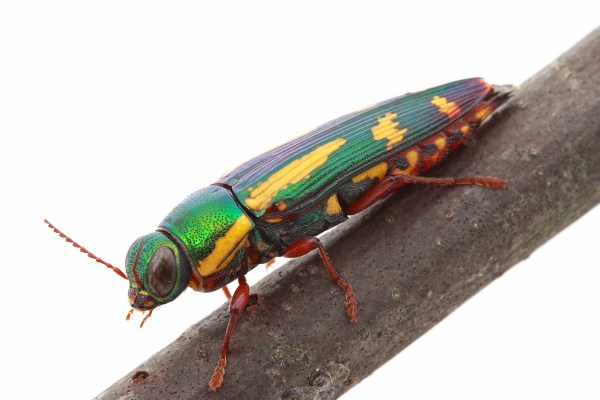
Buprestis rufipes (Coleoptera: Buprestidae) – redbellied Buprestis

From Special Delivery (13 July 2010).  The use of a white box shows off the brilliant (and difficult-to-photograph) metallic colors well, and I like the animated look of the slightly cocked head.


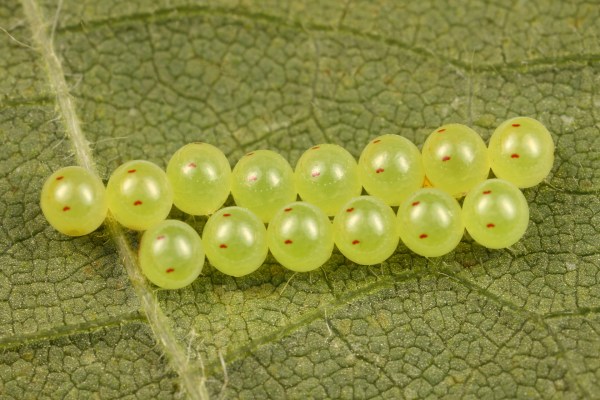
Edessa meditabunda (Hemiptera: Pentatomidae) – alquiche chico

From  (18 May 2011). I found these Edessa meditabunda stink bug eggs on the underside of a soybean leaf in Argentina almost ready to hatch. The developing eye spots in each egg gives the photo a “cute” factor rarely seen in such super close-ups.


Cicindela formosa generosa (Coleoptera: Carabidae: Cicindelinae) – eastern big sand tiger beetle

From  (10 May 2011). I like this slightly panned out view because of the sense of scale and landscape created by the inclusion of the plantlets and the view over the small rise.


Trimerotropis saxatilis (Orthoptera: Acrididae) – lichen grasshopper

From  (15 July 2011). Some of my favorite insect photos are not only those that show the bug in all its glory, but also tell a story about its natural history. This nymph is almost invisible when sitting on the lichens that cover the sandstone exposures in its preferred glade habitat. 


Tetracha floridana (Coleoptera: Carabidae: Cicindelinae) – Florida metallic tiger beetle

From  (23 August 2011). I used extension tubes to improve the quality of flash lighting (decreased lens to subject distance results in greater apparent light size), and I like the symmetry of the composition.


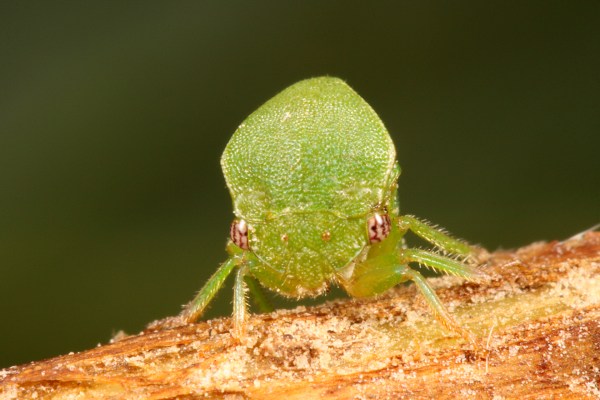
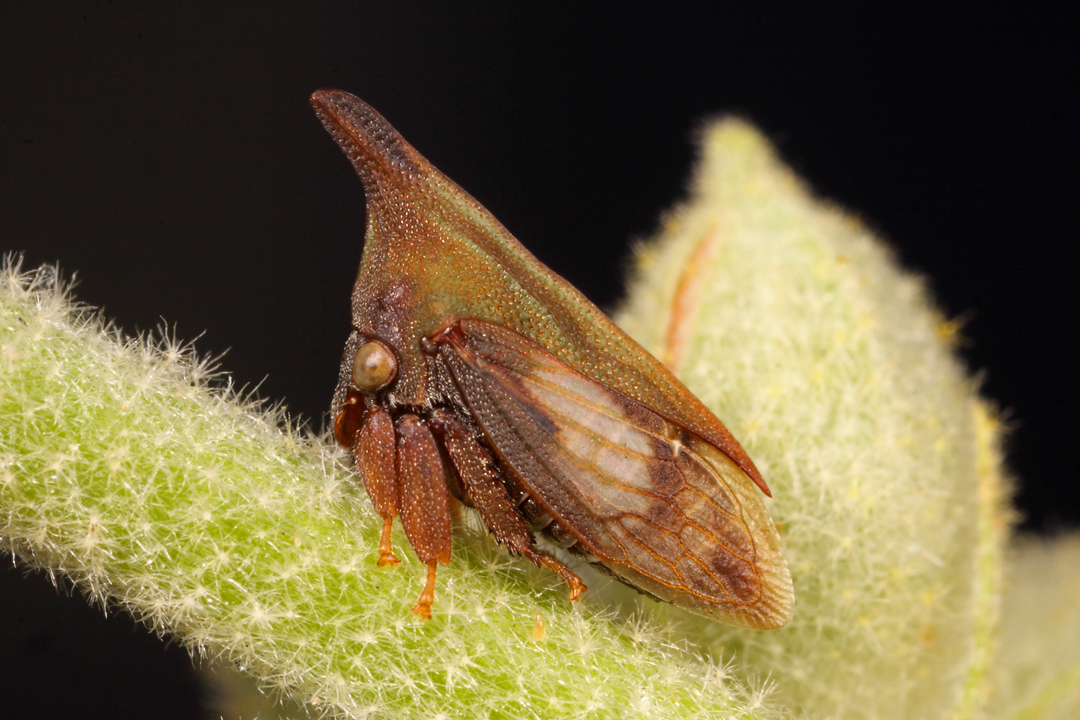
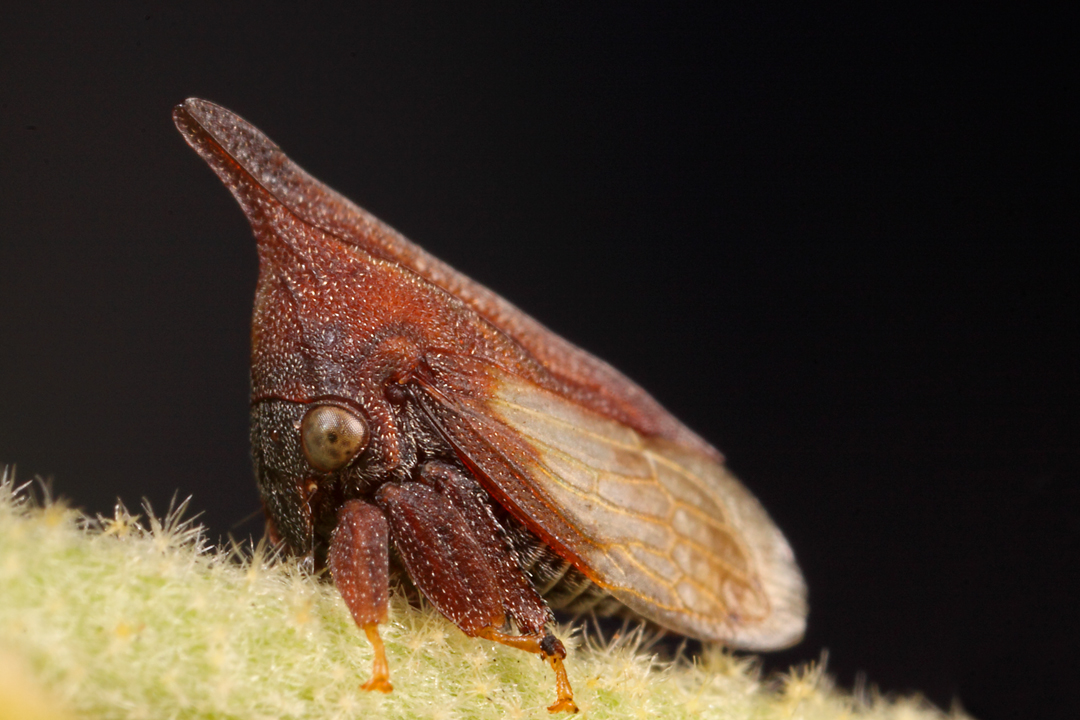
Spissistilus festinus (Hemiptera: Membracidae) – threecornered alfalfa hopper

From  (17 September 2011). Even though both the insect and the background are green, there is sufficient value contrast to create a pleasing composition, punctuated by the bizarre zig-zag pattern of the eyes.


Crossidius coralinus fulgidus (Coleoptera: Cerambycidae) – a rabbitbrush longhorned beetle

From  (4 October 2011). The blue sky background provides a pleasing contrast with the colors of this particular beetle and flowers.

Copyright © Ted C. MacRae 2012

Sea Grape Flatid – Petrusa epilepsis

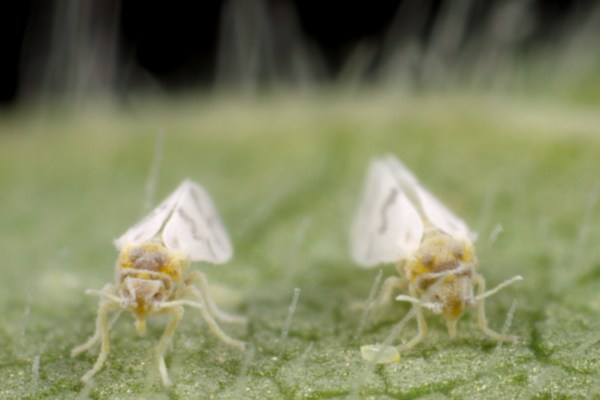
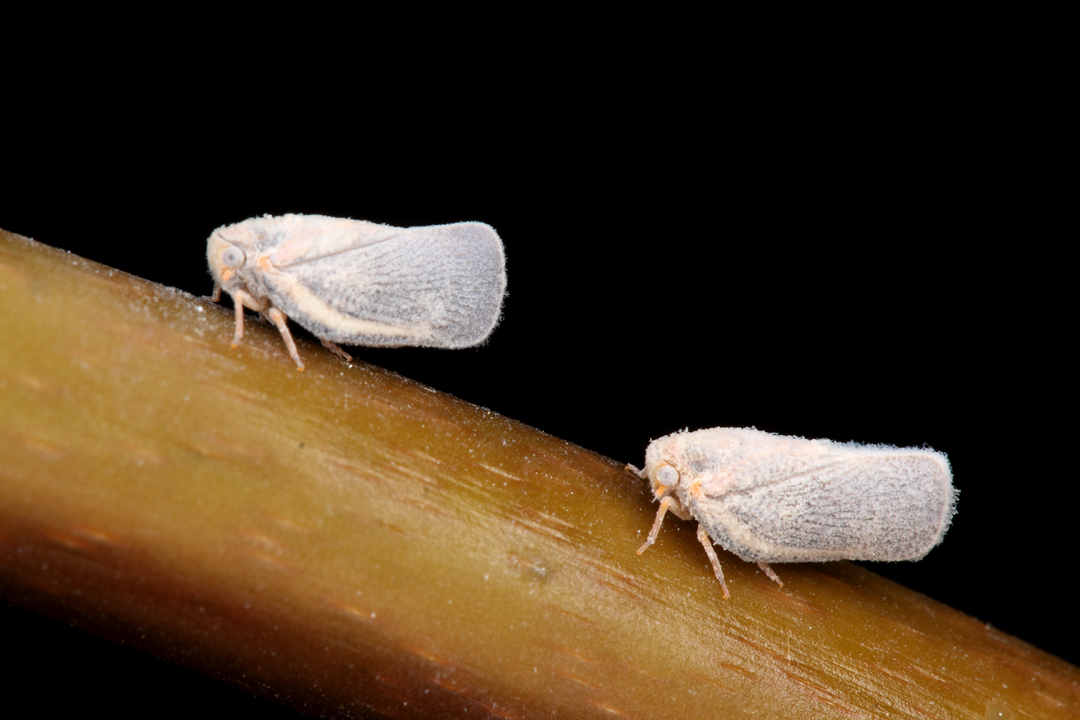
The argid sawfly Sericoceros krugii wasn’t the only insect I saw associated with seagrape (Coccoloba uvifera) during my May trip to Puerto Rico. While exploring the magnificent coastal sand dune system near Isabela (northwestern Puerto Rico), I encountered a tree with literally dozens of frosty, white “homopterans” on the reddish lower surface of its newly expanded leaves (the photo below shows them at only about half the density that I saw initially, as many became disturbed and left when I tried to photograph them). Clearly they were planthoppers in the superfamily Fulgoroidea, with their general shape wings held tent-like suggesting either the family Acanaloniidae or its close relatives in the family Flatidae.

Petrusa epilepsis adults on seagrape (Coccoloba uvifera) | vic. Isabela, Puerto Rico

A better look at the adults in the photos revealed the presence of numerous parallel cross-veins along the costal margin of the forewings, placing them squarely within the family Flatidae (species of Acanaloniidae have reticulate forewing venation without the parallel cross-veins). Wolcott (1948) lists a dozen or so species of flatids from Puerto Rico, roughly half of which belong to the subfamily Flatinae (wings held tent-like) and the other half belonging to the Flatoidinae (more flattened insects with wings held almost horizontal). The likeliest candidate seemed to be Ormenis marginata, which Wolcott describes as occurring in the “millions, vast clouds of them flying up from seagrape plants that one may disturb around Isabela…” I can’t say I saw “millions” of them, but certainly they were abundant on this one plant. My identification was kindly confirmed by Neotropical fulgoroid Lois O’Brien, who also noted that this species now goes under the name Petrusa epilepsis Kirkaldy.


This seems to be a species that could cause considerable problems should it ever find it’s way to the mainland U.S. Many flatids are famously infidel when it comes to host plants—Metcalfa pruinosa (citrus flatid planthopper) being perhaps the best known example. Petrusa epilepsis not only feeds on seagrape but has also become a pest of coffee (Coffea arabica), coco-plum (Chrysobalanus icaco), jasmin (Jasminum spp. ) and black mangrove (Avicennia germinans), with damage resulting not only from direct feeding but also the development of sooty mold that colonize the honeydew excreted by the bugs that covers the foliage of the plants they infest (Nieves-Rivera et al. 2002).

A particularly amusing passage by Wolcott was his observation that adults “with care may be chased around a stem by gentle pursuit with a lead pencil.” I can add that a finger works equally well, as I used precisely this technique to get the adults in these last two photos positioned precisely where I wanted them for the photographs. Let’s hope they are as easily kept within their current West Indies distribution and are not eventually unleashed as yet another exotic pest for agricultural producers in tropical and subtropical mainland America to deal with.

REFERENCES:

Nieves-Rivera, Á. M., T. A. Tattar & E. H. Williams, Jr. 2002. Sooty mould-planthopper association on leaves of the black mangrove, Avicennia germinans (L.) Stearn in southwestern Puerto Rico.  Journal 26:141–155.

Wolcott, G. N. 1948. Insects of Puerto Rico. The Journal of Agriculture of the University of Puerto Rico 32(1):1–223.

Copyright © Ted C. MacRae 2012

Out with the old (but on a good note)

This past March was the warmest on record here in Missouri and that made for some nice opportunities to get out and photograph. That said, my enthusiasm for macro photography has been somewhat tempered since my camera body is getting old and showing some signs that it might be on its last leg. The mere fact that I am still using a camera from 2004 may be your first indication that I am something less than a macro photography perfectionist and this is a reflection of the equipment that I first used when I began shooting macro. I started with Canon manual equipment in the mid-1990’s because I thought this would be the best way to learn photography. My stint with a used, and malfunctioning, Canon AE-1 was thankfully short. It was stolen as I returned from a photography trip to the Chiricahua Mountains, but I still lament that the thief made off with the spent rolls of film from the trip! The experience with the AE-1 pushed me towards higher quality, more professional equipment that would stand up to field conditions better. Next up was the Canon F1 and then the wonderfully solid Canon F1N followed later with the game-changing addition of a power winder. The latter was great since insects typically didn’t wait around for me to manually wind the film, refocus, and shoot. The real challenge though was getting the lighting right. At fist I often times had the camera on a tripod which resulted in too many missed shots, restricted what I could shoot, and it didn’t meet what I later realized was my overall goal of macro photography. What I wanted was to have the ability to take satisfactory macro images while not loading myself down with equipment that would detract from also being able to conduct research or simply observe/enjoy nature without trying to capture it on film. I still have a graveyard of old flashes, brackets, and bracket parts that I employed in various combinations to get suitable lighting though it is now clear that I was never able to get the perfect balance. That changed in 2001 when Canon introduced the new MT-24EX macro twin flash and I bought a 1V body. After testing the new system a minimal amount, I realized that macro photography was now made easy relative to what I had wrestled with over the years prior. I had the complete package—no bulky brackets, no hand holding flashes, more certainty of exposure, and quick field set-up. The twin flash allowed me to fire off just the minimal amount of light to obtain my desired depth of field and the flash had sufficient battery power at the lower flash output settings to essentially shoot consecutively without having to wait for the flash to power-up.

Well, at least I thought I had the perfect setup until Ted MacRae took up macro photography and soon demonstrated that options for continuous improvement exist even for this system.

In 2004 I sadly shelved the 1V body and went digital. I briefly used the Canon 10D, which seemed inadequate for various reasons, but then jumped on the newly released Canon 1D Mark II during that same year. It was more than I wanted to spend but there weren’t many options and the benefits were too much to pass up. Most notably, I was sick of buying film, scanning slides, and most of all my hand ached from cataloguing so many slides, i.e., writing a unique code on each slide prior to archiving it in plastic. The time savings alone made the 1D Mark II price palatable and I hoped that investing in a top notch, newly released body would help it remain relevant for a while. I never looked back.

That brings me to that warm day this past March when I settled in to photograph a toad bug, Gelastocoris oculatus (Heteroptera: Gelastocoridae), along the margin of an intermittent creek in Perry Co., Missouri.  As I mentioned above I felt like I was limping along with my dated 1D Mark II but I couldn’t pass up the opportunity to again photograph an individual of G. oculatus that so superbly blended in with its substrate (Figures 1 and 2).

Figure 1. Gelastocoris oculatus, 3.13.2012, Perry Co., MO

Figure 2. Gelastocoris oculatus, 3.13.2012, Perry Co., MO

As I have mentioned before I like to take multiple shots of a subject to help tell a story (yes, including the obligatory head-on close up that Ted always mentions). One important shot in the series can be a photograph from a distance to: 1) better see the subject in its surroundings which can give more insight into its natural history; 2) offer a more artistic view, or, in this case; 3) to show the effectiveness of its cryptic coloration. The actual close-up is great for detail but only gives the viewer an idea that the subject is similarly colored to its background but only a more distant shot really conveys how well the subject melts into the substrate. In this case, Figure 3 was the next progression towards that shot but I was stopped short that day partly due to my middle son falling in the creek and partly due to the apparent malfunctioning of the camera. As you can see, I wasn’t far enough away from the subject to capture what attracted me to the bug in the first place—how well it mimicked its background. In that sense the picture is disappointing because I didn’t finish the story. But on the other hand, the malfunctioning of the camera combined with its age, made it clear that it was now time for a new camera body. So I put on my best frustrated/disappointed face and presented my case to my wife, Jess. It was an easy sell since Jess is… well… at least 95% supportive of my photography. I’ll discuss the new body and the first images soon.

Figure 3. Gelastocoris oculatus, 3.13.2012, Perry Co., MO

Below are more of the variable faces of G. oculatus that I have come across over the years (Figs. 4 – 8). Gelastocoris oculatus is one of two species of Gelastocoris that we have in North America (Arnett 2000). Gelastocoris oculatus can be found continent-wide however G. rotundatus ranges only in the southwest. I love the origin of the family name which the online Merriam-Webster dictionary mentions is from the Greek “gelastos”+ “koris” which translates to “laughable bug”, no doubt due to its odd appearance. Both species are predators that live along the margins of water. Their predaceous nature is made clear by the appearance of their powerful forlegs clearly specialized for catching and securing prey. As you can see, I do not have a picture of their forlegs so I’ve got a great reason to again get down on their level with the new camera.

Figure 4. Gelastocoris oculatus, 5.23.2010, Perry Co., MO

REFERENCE:

Arnett, R.H. 2000. American Insects: A Handbook for the Insects of America North of Mexico. Boca Raton, Florida: CRC Press.

Copyright © Christopher R. Brown 2012

Traffic Jam Treehoppers

Sometimes photo opportunities come at the unlikeliest of times. A few weeks ago while traveling back to Corrientes, Argentina from neighboring Chaco Province, I came upon traffic at a standstill just a few kilometers from the towering Gral. Belgrano bridge that spans the massive Rio Paraná to link Chaco and Corrientes Provinces. People were already getting out of their cars and walking around, suggesting a wreck closer to (or on) the bridge had completely shut down the highway for the time being. Somebody said they heard it might be another 45 minutes before it could be opened. What to do now? It was the end of my last day after a week of insect collecting/photographing in the area, and the last thing I wanted to do was spend the evening sitting on a divided highway with nowhere to go and nothing remotely interesting to look at…

Enchenopa gracilis (Germar, 1821) | Chaco Province, Argentina

…or so I thought. While scanning the highway right-of-way to see if there might be anything possibly interesting to look at, I spotted a small clump of woody shrubs down the embankment and across the erosion gully before the fenceline. I looked around—everybody was out of their cars with the engines shut off, so I grabbed my camera (not really sure why) and started walking towards the shrubs while looking ahead every now and then for any sign that people were getting back in their cars and moving again. I reached the shrubs and saw they represented something in the mallow family (Malvaceae) due to their small, orange, über-staminate flowers. Immediately I spotted the familiar thorn-like shape of treehoppers in the tribe Membracini, probably a species of Enchenopa or related genus. I had been hoping to see more of these after photographing another species further south in Buenos Aires last year, but I hadn’t seen a single treehopper during the entire week. Fortunately I had my 65mm lens already on the camera, so I quickly snapped a few shots and collected a couple of specimens. Just as quickly as I had done that, I heard somebody yelling to me from the road above that people were getting back into their cars ahead. These few shots and specimens would have to do. (And, disappointingly, after spending the next hour creeping towards the bridge there wasn’t even a wreck to look at!)

As I did with those previous photos, I sent these to Andy Hamilton (Canadian National Collection, Ottawa), who forwarded them on to Dr. Albino Sakakibara (Universidad Federal de Parana, Brazil) and then reported back to me that:

My Brazilian colleagues…have been able to identify your “beautiful photos” as representing Enchenopa gracilis, a species that has been illustrated only once (in 1904), and certainly not by a photograph!

Another individual, this one with no trace of green colorationi and less distinctly marked wings.

The illustration referenced by Andy comes from Kellogg (1905—p. 169, fig. 239), and as he notes at BugGuide the problem with old illustrations is that many of them are either inaccurate or use obsolete names. Enchenopa gracilis does not occur in North America, thus the drawing in Kellogg (1905) probably does not actually represent this species. Nevertheless, a recent dissertation on the insect fauna associated with pigeon pea in Brazil (Azevedo 2006) shows several photographs of adults that agree nicely with these photos. Enchenopa gracilis actually seems to be a bit of a pest on that crop, and it has also been reported in association with a variety of other plants across several different families (Lopes 1995, Alves de Albuquerque et al. 2002). Interestingly, I could not find any species of the family Malvaceae recorded as a host for E. gracilis.

REFERENCES:

Azevedo, R. L. 2006. Entomofauna associada ao feijão guandu [Canjanus cajan (L.) Millspaugh] no recôncavo baiano. Ph.D. dissertation, Centro de Ciências Agrarias e Ambientais, Universidade Federal da Bahia, Cruz das Almas, 54 pp.

Alves de Albuquerque, F., F. C. Pattaro, L. M. Borges, R. S. Lima & A. V. Zabini. 2002. Insetos associados à cultura da aceroleira (Malpighia glabra L.) na região de Maringá, Estado do Paraná. Maringá 24(5):1245-1249.

Kellogg, V. L. 1905. American Insects. Henry Holt & Co., New York, 674 pp.

Lopes, B. C. 1995. Treehoppers (Homoptera, Membracidae) in southeastern Brazil: use of host plants. Revista Brasileira de Zoologia 1213:595-608.

Copyright © Ted C. MacRae 2012

“Cochinilla australiana” in Argentina

Icerya purchasi (''cochinilla australiana'') on citrus twig | western Buenos Aires Province, Argentina

After traveling through the northern provinces during late March and early April, I returned to my home base in western Buenos Aires Province for the last two weeks of my stay in Argentina. As soon as I could, I returned to the small grove of planted citrus trees on the station grounds where I had found a rather large, beautifully cryptic fulgorid nymph (see ““). Lois O’Brien had mentioned in her response to my query about the identity of the nymph that some species of Fulgoridae tend to live on the same tree for years and years—if I could go back to the tree on which I found the nymph perhaps I could find the adult. Sadly, no adults or additional nymphs were found, either on the original tree or any in its vicinity. What I did find, however, was this strange, cocoon-like structure on one of the branches of the tree. I had no idea what it was, having never seen anything quite like it, but I figured something—pupa, eggs, parasitoid, etc.—must be inside. I cut the piece of branch with the structure and tucked it inside a vial for later.

Egg case opened to reveal eggs and newly hatched nymphs

A little bit of searching online would have quickly told me what I was dealing with, but for some reason I felt the need to go ahead and start dissecting to see what was inside. It became obvious I was dealing with an egg mass when I peeled back the outer layers to reveal the cluster of red eggs inside, and very quickly I noticed that a few of the eggs had already hatched. The red nymphs had a decidedly “homopterous” look to them, and not much effort was required to figure out that I was looking at my very first “cottony cushion scale” insect.

Closer view of eggs - newly hatched nymph can be seen at bottom.

Icerya purchasi (Hemiptera: Monophlebidae) originally hails from Australia, but its preference for citrus and the realities of global commerce have resulted in its inevitable spread across the globe wherever citrus is grown (maybe I can be forgiven for having never before seen such a widespread insect—living most of my life in Missouri and northern California, I’ve not had much opportunity to visit citrus groves). The English common name clearly references the appearance the adult female, recognizable by the white, fluted egg sac shown here, while in Argentina it is called “cochinilla australiana”—literally meaning “Australian scale insect.”

Newly hatched nymphs are bright red with dark antennae and thin brown legs.

As I dissected the egg sac, a few of the newly hatched nymphs crawled out of the sac an onto the branch. Nymphs of this stage are referred to as “crawlers” because they are the dispersal stage. It’s a good name for these tiny little bugs, as the several that I tried to photograph never stopped moving. With the lens fully extended to 5X, it was difficult enough to just find them in the viewfinder, much less compose and focus with all the movement. It became a numbers game and test of patience—how many shots could I get fired off in the amount of time that I was willing to persist? Shown here are the few shots that I was the least displeased with.

First instar nymphs are the primary dispersal stage.

Crawlers disperse not only by crawling, but also by wind. One can imagine that such tiny insects could easily be picked up by the wind and carried long distances. However, I couldn’t help but notice the very long setae on the body and outer antennal segments (visible to greater or lesser degree in these photos) and think that perhaps they have some function in aiding wind dispersal. At the very least, aerial dispersal must be as important as crawling (if not more so) for colonization by this species—only adult males have wings (but they are rare), while egg-laying females (actually hermaphrodites) are completely sessile.

Do the long setae on the body and antennae of the nymph aid in wind dispersal?

The adult female and egg case may have confused me initially, but a ton of readers had no problem figuring out what it was. A record 24 people participated in this challenge, with all but five correctly guessing the species. Winning this challenge came down to bonus points for speed and uniqueness of additional information, and Christopher Taylor did this best to earn 17 pts and the win. Three others—Brady Richards, Mr. Phidippus and bicyclebug—each finished just 1 pt back of the win, but Sam Heads’ 15 pts keeps the overall lead in his possession. BitB Challenge Session #6 is young, but already a lot of people have a lot of points in the bank. It will be interesting to see how this session develops.

Copyright © Ted C. MacRae 2012

Inaugural “One-Shot Wednesday”

On many occasions I have considered making my own contributions to the “Wordless Wednesday” meme. Unfortunately, I find it impossible to post photos of insects and not be allowed to say anything about them. I suppose I could follow Dragonfly Woman‘s “Well-Nigh Wordless Wednesday” example, but that seems like horning in on somebody’s trademark. At last it finally occurred to me a meme that I could use for Wednesday’s that gets around these issues—”One-Shot Wednesday”! Ever photograph an insect and only get off a single shot? Not just one keeper from a series of photos, but only one single photo of the insect, like it or lump it! That’s what I’m talking about here. The subtext, of course, is that there was only that one chance to get everything right—exposure, focus, composition, lighting, etc. Obviously, it’s not my plan to show crappy photos as part of this meme, but rather that occasional instance where I only got off a single shot, and for the most part everything worked pretty well to produce a decent photograph. I would, of course, be more than happy to see this meme take off and spread throughout the insect blogging community, but if it doesn’t and it remains a BitB exclusive then that’s fine also.

Leptoglossus sp. | nr. Corrientes, Argentina

Here is contribution #1 in the meme: a leaf-footed bug (family Coreidae) feeding on flowers of Solidago chilensis  that I photographed a couple of weeks ago near Corrientes, Argentina. According to coreid-specialist Harry Brailovsky (Universidad Nacional Autónoma de México), the expanded hind tibiae place it in the large, mostly New World genus Leptoglossus. Which one, however, is a good question—according to Coreoidea Species File Online, ten species in the genus have been recorded in Argentina, but browsing through available images didn’t immediately turn up a good match for the individual shown in this photo.

I’ve often wondered about the purpose of the leaf-like expansions of the hind tibiae of coreids—which reach truly gargantuan proportions in some tropical species—and their adaptive significance. One can imagine they might serve as a “false target” for potential avian predators, and supporting this idea is the fact that the hind legs seem to break off rather easily when handled. It’s not rare to find individuals in the field missing one or even both hind legs.

Copyright © Ted C. MacRae 2012

Seeing the unseen

While trying to nab a cicada from the small trees planted on the grounds at our experiment station here in Fontezuela, Argentina, I happened to notice a bit of movement on one of the branches nearest to me (while the cicada flew off with a screech and a clatter). A closer look revealed what looked like a slight protuberance of the branch to be a nymphal planthopper (family Fulgoridae), and at ~15 mm in length a pretty good-sized one at that. I would have never noticed it had it not moved, so good was its camouflage, but I didn’t have the time to spend trying to photograph it right then and there. Instead, I popped it into a vial (you do always carry a vial with you, don’t you?) and continued my fruitless quest for cicadas.

Undet. fulgorid nymph | northwestern Buenos Aires Province, Argentina

Later that evening I placed it on a palm tree in the hotel courtyard (not really the appropriate host, but it was the only real tree available). I took the standard dorsal view photo, and while not as good a color match as the (still undetermined) tree upon which I found it one still gets a sense for how difficult it might have been to see this nymph flattened against the slightly greenish bark.

A lateral profile view makes the bug much more visible.

One thing I’ve learned from much better photographers than myself is to get down and low relative to the subject—even to the point of looking up at it if possible. This provides views that are far more interesting than the typical looking-down-from-above shots. In the case of this nymph, the above and following low-angle shots really brought it to life and emphasize its unusual form.

Even lower. How did I get the nymph to "prop" itself?

Of course, with the nymph on the side of a fairly large tree, one can only get so low. To get even lower, I placed the nymph on a small stick and used hand-holding and bracing techniques to get even lower. I took quite a few shots experimenting with composition, and the shots I ended up liking the best were frontal-oblique from slightly below bug-level with the stick rather sharply angled down and the bug slightly propped up on its front legs. Easier said than done—this nymph was loathe to stop crawling once I moved it to the stick and tended to be negatively geotactic (crawled upwards). As a result, every time I angled the stick downward it would turn around and start crawling the other way, and in any case when it did stop it tended to flatten itself against the branch. Through trial and error, I learned that if I braced my thumb and forefinger against its head/pronotum to stop its progress and held it in place for awhile it would stay put. I also learned that if I slightly blew on its face when it was flattened against the branch that it would prop itself upwards a bit. Thus, for this shot it was a matter of letting it crawl upwards almost to the end of the stick (to eliminate excess stick that poke into the camera with a frontal-oblique angle), bracing it for a moment, inverting the stick downward and pointing slightly towards the camera, and then blowing on its face a bit—simple, huh? The black transverse band on the lower face adds a lot of character to the shot.

The obligatory face-on shot

The face-on shot is a staple for me, but even with this shot the angle is important—angle the back of the stick down too much and you get the all black background (not in itself bad, just not what I wanted for this shot), angle it too high and too much of the back of the bug shows up as blurred clutter in the background). The foreward projecting “nose” of this nymph prevented me from getting both the tip of the nose and the eyes in focus (without using excessively small aperatures), so I opted for the latter (I’ve never seen a good face shot of an insect in which at least the eyes were not in focus).

Unfortunately, family-level identification is as good as it is going to get for this individual. I sent the photos to fulgorid expert Lois O’Brien, who eliminated several options but couldn’t narrow down further among several remaining possible genera (“Our ignorance of nymphs is abysmal…”). Her recommendation was to go back to the tree and try to find adults, and apparently some species tend to live on the same tree for years and years. I’ll be returning to Fontezuela later in April—hopefully the fall season will not have advanced to far by then.

Copyright © Ted C. MacRae 2012

Chicharra que canta, calor adelanta

Dorisiana drewseni - male singing

There is a species of cicada (“chicharra” in Spanish) that strikes me as quite common in the central Humid Pampas region of Argentina. I saw numerous individuals during March of last year at La Reserva Ecologica Costanera Sur (where these photos were taken), and again during the past week I’ve noted them abundantly in the trees around my base station in western Buenos Aires Province. Thanks to cicada expert Barry University’s Allen Sanborn (apparently himself an endangered species), I now know these to be the species Dorisiana drewseni (Stål, 1854), occurring in Argentina, Uruguay and southern Brazil (Aoli et al. 2010).

Dorisiana drewseni, female resting on thistle

As in North America, the song of the cicada is associated with the dog days of summer and their midday heat. “Chicharra que canta, calor adelanta” is a Spanish idiom that loosely translates to “Cicadas singing, heat follows”. March is late summer in Argentina, and the days can still be quite hot even at temperate latitudes (yesterday was 34°C, or 93°F). Despite being half-a-world away from St. Louis, the droning song of the cicada sounds a bit like home in late August. While I was at the Reserva last March I really wanted to photograph a male in the midst of song, but the above photo was the only shot I managed from several males. Singing males are extremely difficult to approach to within even a long-handled net’s reach—much less a camera lens’ focal distance. I think the only reason I was able to photograph the male above was because I approached him from slightly below and behind (though certainly still within the field of vision of those huge, bulging eyes). One shot was all I got, and off he flew, shrieking noisily as he crashed and thrashed through the foliage before reaching open air and completing his escape.

Females, on the other hand, seemed to be much more approachable (perhaps because they, unlike singing males, never do anything to draw attention to themselves). The female in the photo above was calmly sitting on a thistle-like plant at eye-level, never flinching at my approach (albeit cautious) and calmly staying put while I snapped a few photos. One look at her tattered wings, however, suggests that she had already seen better days and perhaps no longer had the strength to attempt to flee (maybe even expectedly awaiting predation at this point in her life).

A second female rests calmly on a tree branch

Not long after taking the photographs of the first female, I saw another female sitting on a tree branch. As I mentioned, females don’t call attention to themselves the way males do, so finding females is a bit more of a crapshoot—I only happened to see this one because she was on a tree branch at eye level with an unobstructed view hanging right next to the path I was following. Obviously much fresher and in better shape than the previous female, she nevertheless allowed me to get as close as I wanted, with the photographs above and below representing the two that I am happiest with.

That's one heck of a cibarial pump!

I haven’t had quite the same luck during the present trip in securing one of these—probably because my lone attempt so far was during the heat of the day on a day that was already warm enough. Come to think of it, I didn’t manage any of the above photographs last year until quite late in the afternoon when temperatures began to drop off a bit. We’ll see what the next few weeks brings—I am still committed to getting the money shot of a male in the midst of his song. Chicharra que canta, Ted adelanta!

REFERENCE:

Aoki, C., F. Santos Lopes & F. Leandro de Souza. 2010. Insecta, Hemiptera, Cicadidae, Quesada gigas (Olivier, 1790), Fidicina mannifera (Fabricius, 1803), Dorisiana viridis (Olivier, 1790) and Dorisiana drewseni (Stål, 1854): First records for the state of Mato Grosso do Sul, Brazil. Check List 6(1):162–163.

Copyright © Ted C. MacRae 2012