“Cochinilla australiana” in Argentina

Icerya purchasi (''cochinilla australiana'') on citrus twig | western Buenos Aires Province, Argentina

After traveling through the northern provinces during late March and early April, I returned to my home base in western Buenos Aires Province for the last two weeks of my stay in Argentina. As soon as I could, I returned to the small grove of planted citrus trees on the station grounds where I had found a rather large, beautifully cryptic fulgorid nymph (see ““). Lois O’Brien had mentioned in her response to my query about the identity of the nymph that some species of Fulgoridae tend to live on the same tree for years and years—if I could go back to the tree on which I found the nymph perhaps I could find the adult. Sadly, no adults or additional nymphs were found, either on the original tree or any in its vicinity. What I did find, however, was this strange, cocoon-like structure on one of the branches of the tree. I had no idea what it was, having never seen anything quite like it, but I figured something—pupa, eggs, parasitoid, etc.—must be inside. I cut the piece of branch with the structure and tucked it inside a vial for later.

Egg case opened to reveal eggs and newly hatched nymphs

A little bit of searching online would have quickly told me what I was dealing with, but for some reason I felt the need to go ahead and start dissecting to see what was inside. It became obvious I was dealing with an egg mass when I peeled back the outer layers to reveal the cluster of red eggs inside, and very quickly I noticed that a few of the eggs had already hatched. The red nymphs had a decidedly “homopterous” look to them, and not much effort was required to figure out that I was looking at my very first “cottony cushion scale” insect.

Closer view of eggs - newly hatched nymph can be seen at bottom.

Icerya purchasi (Hemiptera: Monophlebidae) originally hails from Australia, but its preference for citrus and the realities of global commerce have resulted in its inevitable spread across the globe wherever citrus is grown (maybe I can be forgiven for having never before seen such a widespread insect—living most of my life in Missouri and northern California, I’ve not had much opportunity to visit citrus groves). The English common name clearly references the appearance the adult female, recognizable by the white, fluted egg sac shown here, while in Argentina it is called “cochinilla australiana”—literally meaning “Australian scale insect.”

Newly hatched nymphs are bright red with dark antennae and thin brown legs.

As I dissected the egg sac, a few of the newly hatched nymphs crawled out of the sac an onto the branch. Nymphs of this stage are referred to as “crawlers” because they are the dispersal stage. It’s a good name for these tiny little bugs, as the several that I tried to photograph never stopped moving. With the lens fully extended to 5X, it was difficult enough to just find them in the viewfinder, much less compose and focus with all the movement. It became a numbers game and test of patience—how many shots could I get fired off in the amount of time that I was willing to persist? Shown here are the few shots that I was the least displeased with.

First instar nymphs are the primary dispersal stage.

Crawlers disperse not only by crawling, but also by wind. One can imagine that such tiny insects could easily be picked up by the wind and carried long distances. However, I couldn’t help but notice the very long setae on the body and outer antennal segments (visible to greater or lesser degree in these photos) and think that perhaps they have some function in aiding wind dispersal. At the very least, aerial dispersal must be as important as crawling (if not more so) for colonization by this species—only adult males have wings (but they are rare), while egg-laying females (actually hermaphrodites) are completely sessile.

Do the long setae on the body and antennae of the nymph aid in wind dispersal?

The adult female and egg case may have confused me initially, but a ton of readers had no problem figuring out what it was. A record 24 people participated in this challenge, with all but five correctly guessing the species. Winning this challenge came down to bonus points for speed and uniqueness of additional information, and Christopher Taylor did this best to earn 17 pts and the win. Three others—Brady Richards, Mr. Phidippus and bicyclebug—each finished just 1 pt back of the win, but Sam Heads’ 15 pts keeps the overall lead in his possession. BitB Challenge Session #6 is young, but already a lot of people have a lot of points in the bank. It will be interesting to see how this session develops.

Copyright © Ted C. MacRae 2012
Inaugural “One-Shot Wednesday”

On many occasions I have considered making my own contributions to the “Wordless Wednesday” meme. Unfortunately, I find it impossible to post photos of insects and not be allowed to say anything about them. I suppose I could follow Dragonfly Woman‘s “Well-Nigh Wordless Wednesday” example, but that seems like horning in on somebody’s trademark. At last it finally occurred to me a meme that I could use for Wednesday’s that gets around these issues—”One-Shot Wednesday”! Ever photograph an insect and only get off a single shot? Not just one keeper from a series of photos, but only one single photo of the insect, like it or lump it! That’s what I’m talking about here. The subtext, of course, is that there was only that one chance to get everything right—exposure, focus, composition, lighting, etc. Obviously, it’s not my plan to show crappy photos as part of this meme, but rather that occasional instance where I only got off a single shot, and for the most part everything worked pretty well to produce a decent photograph. I would, of course, be more than happy to see this meme take off and spread throughout the insect blogging community, but if it doesn’t and it remains a BitB exclusive then that’s fine also.

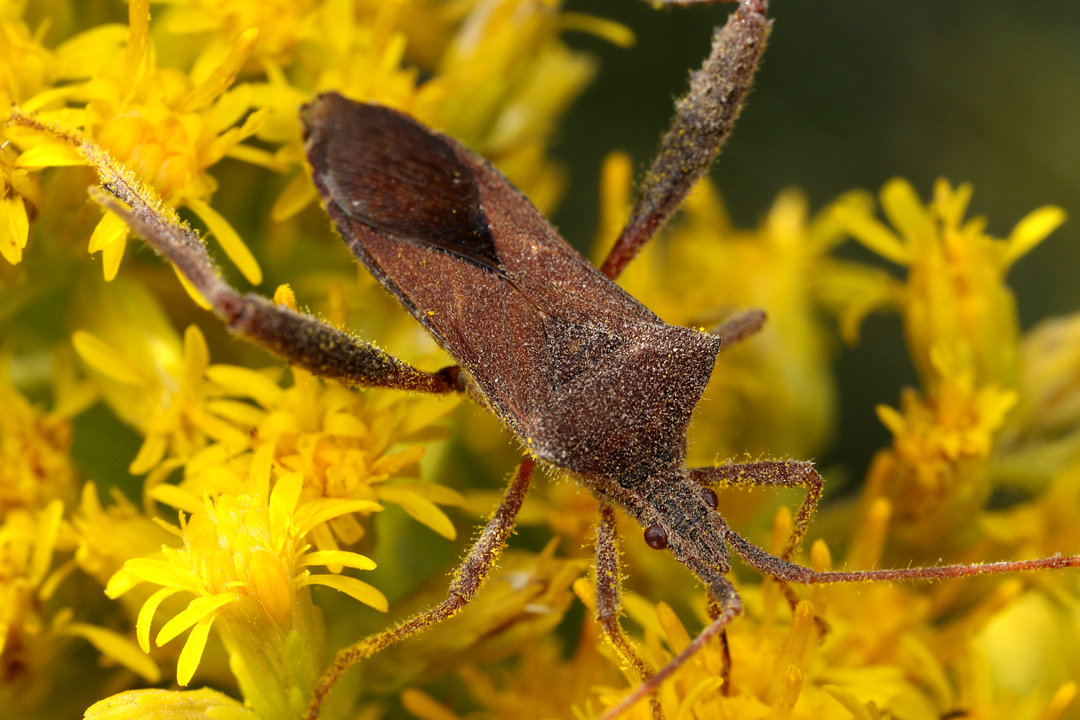
Leptoglossus sp. | nr. Corrientes, Argentina

Here is contribution #1 in the meme: a leaf-footed bug (family Coreidae) feeding on flowers of Solidago chilensis  that I photographed a couple of weeks ago near Corrientes, Argentina. According to coreid-specialist Harry Brailovsky (Universidad Nacional Autónoma de México), the expanded hind tibiae place it in the large, mostly New World genus Leptoglossus. Which one, however, is a good question—according to Coreoidea Species File Online, ten species in the genus have been recorded in Argentina, but browsing through available images didn’t immediately turn up a good match for the individual shown in this photo.

I’ve often wondered about the purpose of the leaf-like expansions of the hind tibiae of coreids—which reach truly gargantuan proportions in some tropical species—and their adaptive significance. One can imagine they might serve as a “false target” for potential avian predators, and supporting this idea is the fact that the hind legs seem to break off rather easily when handled. It’s not rare to find individuals in the field missing one or even both hind legs.

Copyright © Ted C. MacRae 2012

Seeing the unseen

While trying to nab a cicada from the small trees planted on the grounds at our experiment station here in Fontezuela, Argentina, I happened to notice a bit of movement on one of the branches nearest to me (while the cicada flew off with a screech and a clatter). A closer look revealed what looked like a slight protuberance of the branch to be a nymphal planthopper (family Fulgoridae), and at ~15 mm in length a pretty good-sized one at that. I would have never noticed it had it not moved, so good was its camouflage, but I didn’t have the time to spend trying to photograph it right then and there. Instead, I popped it into a vial (you do always carry a vial with you, don’t you?) and continued my fruitless quest for cicadas.

Undet. fulgorid nymph | northwestern Buenos Aires Province, Argentina

Later that evening I placed it on a palm tree in the hotel courtyard (not really the appropriate host, but it was the only real tree available). I took the standard dorsal view photo, and while not as good a color match as the (still undetermined) tree upon which I found it one still gets a sense for how difficult it might have been to see this nymph flattened against the slightly greenish bark.

A lateral profile view makes the bug much more visible.

One thing I’ve learned from much better photographers than myself is to get down and low relative to the subject—even to the point of looking up at it if possible. This provides views that are far more interesting than the typical looking-down-from-above shots. In the case of this nymph, the above and following low-angle shots really brought it to life and emphasize its unusual form.

Even lower. How did I get the nymph to "prop" itself?

Of course, with the nymph on the side of a fairly large tree, one can only get so low. To get even lower, I placed the nymph on a small stick and used hand-holding and bracing techniques to get even lower. I took quite a few shots experimenting with composition, and the shots I ended up liking the best were frontal-oblique from slightly below bug-level with the stick rather sharply angled down and the bug slightly propped up on its front legs. Easier said than done—this nymph was loathe to stop crawling once I moved it to the stick and tended to be negatively geotactic (crawled upwards). As a result, every time I angled the stick downward it would turn around and start crawling the other way, and in any case when it did stop it tended to flatten itself against the branch. Through trial and error, I learned that if I braced my thumb and forefinger against its head/pronotum to stop its progress and held it in place for awhile it would stay put. I also learned that if I slightly blew on its face when it was flattened against the branch that it would prop itself upwards a bit. Thus, for this shot it was a matter of letting it crawl upwards almost to the end of the stick (to eliminate excess stick that poke into the camera with a frontal-oblique angle), bracing it for a moment, inverting the stick downward and pointing slightly towards the camera, and then blowing on its face a bit—simple, huh? The black transverse band on the lower face adds a lot of character to the shot.

The obligatory face-on shot

The face-on shot is a staple for me, but even with this shot the angle is important—angle the back of the stick down too much and you get the all black background (not in itself bad, just not what I wanted for this shot), angle it too high and too much of the back of the bug shows up as blurred clutter in the background). The foreward projecting “nose” of this nymph prevented me from getting both the tip of the nose and the eyes in focus (without using excessively small aperatures), so I opted for the latter (I’ve never seen a good face shot of an insect in which at least the eyes were not in focus).

Unfortunately, family-level identification is as good as it is going to get for this individual. I sent the photos to fulgorid expert Lois O’Brien, who eliminated several options but couldn’t narrow down further among several remaining possible genera (“Our ignorance of nymphs is abysmal…”). Her recommendation was to go back to the tree and try to find adults, and apparently some species tend to live on the same tree for years and years. I’ll be returning to Fontezuela later in April—hopefully the fall season will not have advanced to far by then.

Copyright © Ted C. MacRae 2012

Chicharra que canta, calor adelanta

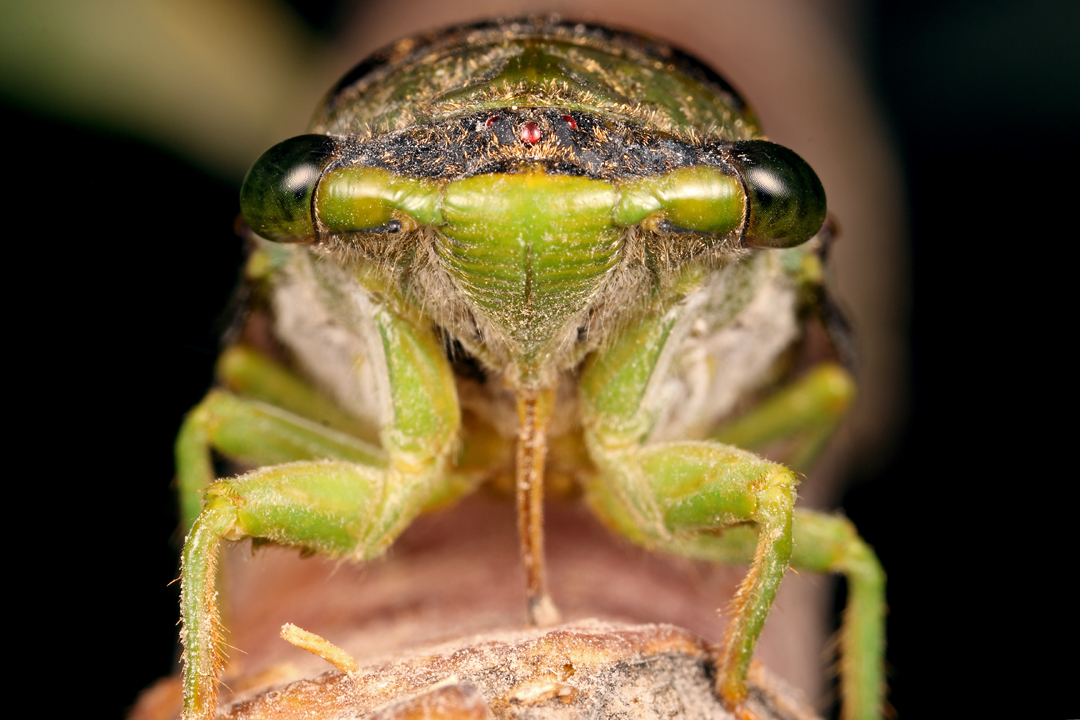
Dorisiana drewseni - male singing

There is a species of cicada (“chicharra” in Spanish) that strikes me as quite common in the central Humid Pampas region of Argentina. I saw numerous individuals during March of last year at La Reserva Ecologica Costanera Sur (where these photos were taken), and again during the past week I’ve noted them abundantly in the trees around my base station in western Buenos Aires Province. Thanks to cicada expert Barry University’s Allen Sanborn (apparently himself an endangered species), I now know these to be the species Dorisiana drewseni (Stål, 1854), occurring in Argentina, Uruguay and southern Brazil (Aoli et al. 2010).

Dorisiana drewseni, female resting on thistle

As in North America, the song of the cicada is associated with the dog days of summer and their midday heat. “Chicharra que canta, calor adelanta” is a Spanish idiom that loosely translates to “Cicadas singing, heat follows”. March is late summer in Argentina, and the days can still be quite hot even at temperate latitudes (yesterday was 34°C, or 93°F). Despite being half-a-world away from St. Louis, the droning song of the cicada sounds a bit like home in late August. While I was at the Reserva last March I really wanted to photograph a male in the midst of song, but the above photo was the only shot I managed from several males. Singing males are extremely difficult to approach to within even a long-handled net’s reach—much less a camera lens’ focal distance. I think the only reason I was able to photograph the male above was because I approached him from slightly below and behind (though certainly still within the field of vision of those huge, bulging eyes). One shot was all I got, and off he flew, shrieking noisily as he crashed and thrashed through the foliage before reaching open air and completing his escape.

Females, on the other hand, seemed to be much more approachable (perhaps because they, unlike singing males, never do anything to draw attention to themselves). The female in the photo above was calmly sitting on a thistle-like plant at eye-level, never flinching at my approach (albeit cautious) and calmly staying put while I snapped a few photos. One look at her tattered wings, however, suggests that she had already seen better days and perhaps no longer had the strength to attempt to flee (maybe even expectedly awaiting predation at this point in her life).

A second female rests calmly on a tree branch

Not long after taking the photographs of the first female, I saw another female sitting on a tree branch. As I mentioned, females don’t call attention to themselves the way males do, so finding females is a bit more of a crapshoot—I only happened to see this one because she was on a tree branch at eye level with an unobstructed view hanging right next to the path I was following. Obviously much fresher and in better shape than the previous female, she nevertheless allowed me to get as close as I wanted, with the photographs above and below representing the two that I am happiest with.

That's one heck of a cibarial pump!

I haven’t had quite the same luck during the present trip in securing one of these—probably because my lone attempt so far was during the heat of the day on a day that was already warm enough. Come to think of it, I didn’t manage any of the above photographs last year until quite late in the afternoon when temperatures began to drop off a bit. We’ll see what the next few weeks brings—I am still committed to getting the money shot of a male in the midst of his song. Chicharra que canta, Ted adelanta!

REFERENCE:

Aoki, C., F. Santos Lopes & F. Leandro de Souza. 2010. Insecta, Hemiptera, Cicadidae, Quesada gigas (Olivier, 1790), Fidicina mannifera (Fabricius, 1803), Dorisiana viridis (Olivier, 1790) and Dorisiana drewseni (Stål, 1854): First records for the state of Mato Grosso do Sul, Brazil. Check List 6(1):162–163.

Copyright © Ted C. MacRae 2012
Lord of the flies!

I happened upon a rather interesting scene last week in a soybean field in northern Argentina (Chaco Province). This assassin bug (family Reduviidae) had captured and was feeding on an adult stink bug of the species Piezodorus guildinii—an important pest of soybean in Argentina and Brazil (where it is known by the common names “chinche de la alfalfa” and “chinche verde pequeño”, respectively). Assassin bug predation is always interesting enough itself, but what made this scene especially fascinating was the large congregation of flies surrounding and even crawling upon the predator and its prey. I had not witnessed something like this before, but it seemed clear to me that the flies were engaging in kleptoparasitism—i.e, stealing food. I’ve gotten into the habit of keeping a full set of extension tubes mounted on the camera with my 100mm macro lens—this not only provides the most useful (for me) range of magnification but also serves as a convenient and easy-to-use field microscope. Through the viewfinder I could see that there were at least two markedly different types of flies involved—more abundant, small, brown flies that I presumed (incorrectly, as it turns out) to be some type of drosophilid (vinegar fly), and a few larger, black flies that were completely unfamiliar to me. The flies were apparently feeding on fluids from the stink bug prey but also crawled all over the assassin bug as it fed. The assassin bug seem unencumbered in its feeding by the presence of the flies, but periodically it would slowly wipe its forelegs over its head to dislodge flies that had settled onto it. Just as quickly as they flew away, however, they crawled back.

The assassin bug, on the other hand, I recognized as very likely a species of Apiomerus—a large, exclusively New World genus known in North America as “bee killers” for their habit of sitting on flowers and ambushing visiting bees for prey. The prey selection behaviors of these insects, however, are more generalist than the name implies, as can be seen by these photographs. To verify my generic ID and possibly obtain a species ID, I sent some of these photos to Dimitri Forero at the Heteropteran Systematics Lab at University of California-Riverside. Dimitri is revising portions of Apiomerus (e.g., Berniker et al. 2011) and working on a general phylogenetic hypotheses for the genus. In the past he has been quite helpful in fielding questions from me about these bugs, and within a few hours Dimitri replied to inform me that the assassin bug was, indeed, a member of the genus Apiomerus, likely representing the common, widespread species A. lanipes (ranging from Panama to Argentina), based on its coloration, locality, and relative size. Update 12 March, 3:07 pm—After seeing the last photo in this post (which I did not send to him initially), Dimitri wrote to say the ventral abdominal pattern was not characteristic of A. lanipes. He asked about its size, to which I replied that it was about the same length but maybe a little less robust than A. crassipes (eastern North America). He later added, “I now think that this is A. flavipennis Herrich-Schaeffer, 1848. It is very similar to A. lanipes, but a lot smaller (lanipes is really robust), and with the abdomen with black and white patches, whereas in lanipes the abdomen is always black. I checked some series of specimens that I have here and, I am pretty sure now of the ID. I have material from Argentina as well. In some specimens that coloration of the corium varies, but the original description says it is yellow with a “hairy” pronotum, which fits very nicely your photos.” Apiomerus flavipennis is known from Argentina and Southern Brazil only.

Quite unexpectedly, Dimitri also noted that at least some of the flies could belong to the family Milichiidae. He first became aware of these flies after seeing a photograph of Apiomerus showing something similar and suggested Milichiidae online as a possible source for more information. This remarkably informative  website by milichiid expert Irina Blake, who dubs species in the family as “freeloader flies”, is a model for how websites dealing with obscure insect taxa should be organized and populated (and features on the home page a great photo of ant-mugging flies taken by our favorite myrmecophile). At any rate, I forwarded my photos to Irina and within minutes received her response that the bigger black flies most probably represent the cosmopolitan Milichiella lacteipennis and the smaller flies a species of the family Chloropidae (of “dog pecker gnat” fame) in the subfamily Oscinellinae, noting that she has seen similar (or the same?) chloropids in other photos as well engaging in kleptoparasitism.

Not long after receiving the first reply from Dimitri, I got another message from him with a link to a very interesting paper by Eisner and colleagues (1991), who recorded freeloader flies in Florida preferentially attracted to stink bugs and leaf-footed bugs (family Coreidae) being preyed upon by the orb-weaving spider Nephila clavipes. Olfactory stimuli were already suspected to be involved in attraction of milichiids and also chloropids (Sivinski 1985); however, Eisner et al. (1991) experimentally demonstrated that milichiid attraction was tied to specific components of defensive sprays in several pentatomid and coreid species (including P. guildenii, the prey species in this series of photographs). The defensive sprays of the bugs were generally ineffective at preventing predation by the spiders (and apparently this is the case for A. lanipes and other reduviids as well), thus serving as a signal to milichiids and chloropids not only of the presence of a food source but perhaps also assisting search for mates in a density dependent fashion (Sivinsky 1985). Milichiid attraction to hymenopteran prey, richly endowed with integumental glands themselves, has also been documented; the Eisner study raises the question whether these types of prey are also detected from chemical cues.

REFERENCES:

Berniker, L., S. Szerlip, D. Forero and C. Weirauch. 2011. Revision of the crassipes and pictipes species groups of Apiomerus Hahn (Hemiptera: Reduviidae: Harpactorinae). Zootaxa 2949:1–113.

Eisner, T., M. Eisner & M. Deyrup. 1991. Chemical attraction of kleptoparasitic flies to heteropteran insects caught by orb-weaving spiders. Proceedings of the National Academy of Sciences of the United States of America 88:8194–8197.

Sivinski, J. 1985. Mating by kleptoparasitic flies (Diptera: Chloropidae) on a spider host. Florida Entomologist 68(1):216–222.

Copyright © Ted C. MacRae 2012

To the land of Gauchos

Today I leave for an extended stay in Argentina. Many have asked me if my trip is for work or fun, and my standard response has been, “It’s for work, and it will be fun!” For the next eight weeks, I’ll be helping out with field trials and speaking to farmers (while sampling a few Malbecs as well). Of course I would rather it be an 8-week collecting trip, but I consider myself fortunate even to have an opportunity such as this. I’ll pick up a few insects along the way, but what I really hope to bring back in large quantity is photographs.

It’s a little difficult to predict how reliable and consistent I’ll have internet access or the time to take advantage of it, so postings over the next few weeks may be a little less regular than what has become my usual custom. The trip is also heavily front-loaded with work activities as I get my bearings and spend time getting to know my new colleagues, so I’m not sure when I might have new photos to show here. Not to worry, I have plenty of material that I haven’t yet shown. Until then, I leave you with this photograph I took last November at  in Buenos Aires. These tiny bugs seem to be early-instar leaf-footed bug (family Coreidae) nymphs, their bright red and black coloration and aggregating behavior indicating ample chemical protection against predation.

Early-instar coreid nymphs | Buenos Aires, Argentina

Copyright © Ted C. MacRae 2012

Best of BitB 2011

Welcome to the 4th Annual BitB Top 10, where I get to pick my 10 (more or less) favorite photographs of the year. As an insect macrophotographer I still feel like a relative newcomer, although with three seasons under my belt fewer and fewer people seem to be buying it anymore. Granted I’ve learned a lot during that time, but the learning curve is still looking rather steep. I don’t mind—that’s the fun part! With that said, I present a baker’s dozen of my favorite photographs featured here during 2011. I hope they reflect the learnings I’ve had the past year and maybe show some progress over previous years (2009, 2008 and 2010).

One more thing—I’m including a special bonus for the first time in this year’s edition. Each of the photos shown below is linked to a 1680×1120 version that may be freely downloaded for use as wallpaper, printing in calendars, or any other use (as long as it’s personal and non-profit). It’s my way of saying thanks for your readership and support.


From  (posted 8 Jan). I’ve done limited photography with prepared rather than live specimens. However, the recreated aggressive-defensive posture of this greater arid-land katydid (Neobarrettia spinosa)—or “red-eyed devil”—was too striking to pass up. A clean background allows every spine and tooth to be seen with terrifying clarity.


From  (posted 6 Feb). I had never seen a cactus fly until I encountered this Nerius sp. I’m especially fond of the bizzarely-shaped head and un-fly-like spines on the front legs.


From  (posted 17 Feb). This photo of a fungus weevil, Phaenithon semigriseus, is one of the first where I nailed the focus right on the eye at such a magnitude of closeup (~3X) and also got the composition I was looking for. I didn’t notice at the time, but the beetle seems to be “smiling.”


From  (posted 28 Mar). One of the field techniques I’ve been practicing this year is actually holding the plant with the subject in one hand, resting the camera on my wrist and controlling it with the other hand, and manipulating the position of the plant to achieve a desired composition. It’s a difficult technique to master, but the results are worth it. The jumping spider, Euophrys sutrix, represents one of my earliest successful attempts with this technique.


From  (posted 30 Mar). This South American tree fruit weevil looks like it is sitting quite calmly on a branch. In reality, it never stopped crawling while I attempted to photograph it. Crawling subjects are not only difficult to focus on but also almost always have a “bum” leg. I achieved this photo by tracking the beetle through the lens and firing shots as soon as the center focus point flashed, playing a numbers game to ensure that I got at least one with all the legs nicely positioned. I’d have been even happier with this photo if I had not clipped the antennal tip.


From  (posted 4 May). Face shots of predatory insects are hard to resist, and in this one of the fiery searcher beetle, Calosoma scrutator, the angle of the subject to the lighting was perfect for showing off every ridge and tooth in its impressive mandibles.


From  (posted 10 May). I’ve taken plenty of lateral profile shots of tiger beetles, but I like this slightly panned out one especially because of the sense of scale and landscape created by the inclusion of the plantlets and the view over the small rise.


From  (posted 18 May). I found these Edessa meditabunda stink bug eggs on the underside of a soybean leaf in Argentina almost ready to hatch. The developing eye spots in each egg gives the photo a “cute” factor rarely seen in such super close-ups.


From  (posted 15 July). Some of my favorite insect photos are not only those that show the bug in all its glory, but also tell a story about its natural history. This nymphal lichen grasshopper, Trimerotropis saxatilis, is almost invisible when sitting on the lichens that cover the sandstone exposures in its preferred glade habitat. 


From  (posted 23 Aug). I know this is the second beetle face shot I’ve included in the final selections, but it was while photographing this rare Florida metallic tiger beetle, Tetracha floridana, in the middle of the night that I discovered the use of extension tubes to improve the quality of flash lighting (decreased lens to subject distance results in greater apparent light size). This is perhaps one of the best illuminated direct flash photographs that I’ve taken, and I also like the symmetry of the composition.


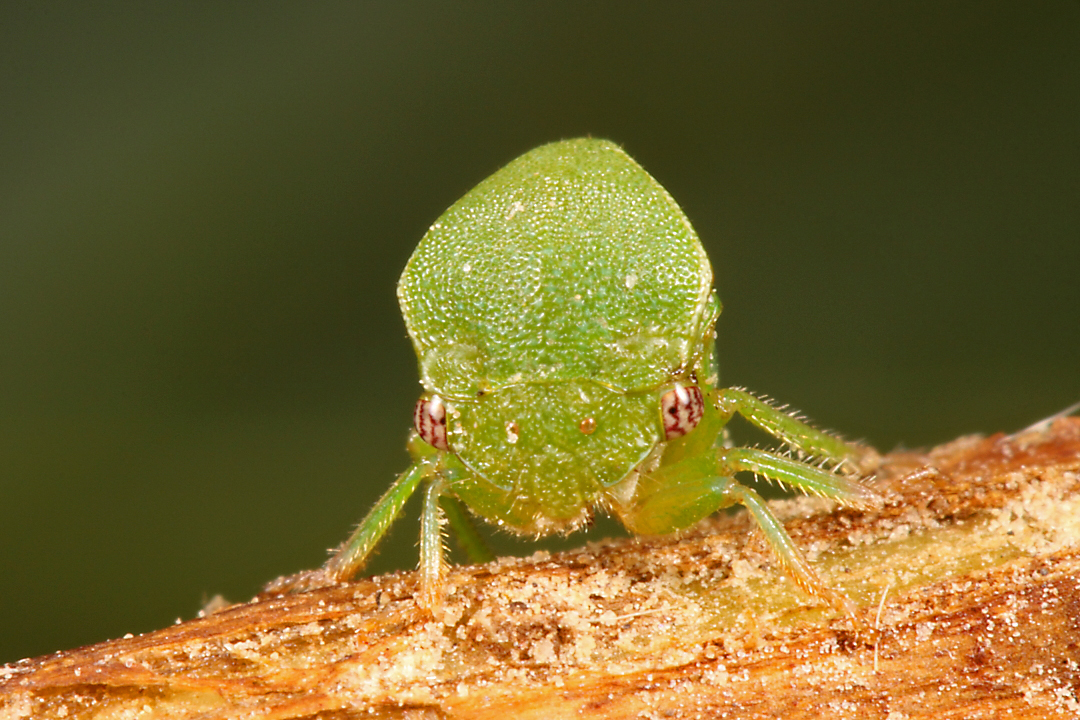
From  (posted 17 Sep). The three-cornered alfalfa hopper (Spissistilus festinus) is a common pest of alfalfa and soybean in the U.S. However, despite its abundance, I’ve never noticed the bizarre zig-zag pattern of the eyes until I took this photo. Even though both the insect and the background are green, there is sufficient value contrast to create a pleasing composition. Bumping up the ISO and a lower FEC setting prevented overblowing the light greens—easy to do with full flash macrophotography.


From  (posted 4 Oct). This longhorned beetle had settled in for the night on its Ericamera nauseosa host plant, allowing me to use higher ISO and lower shutter speed settings with a hand-held camera to achieve this very pleasing blue sky background, while retaining the sharpness of detail of the subject that comes from full-flash illumination. The blue sky background provides a more pleasing contrast with the colors of this particular beetle and flowers than the black background that is more typically seen with full-flash macrophotography.


From  (19 Dec). An uncommon underside view of these purple tree fungus (Trichaptum biforme) caps and use of flash illumination allows the colors to literally glow against the bright green lichens also growing on the tree. Keeping aperture at a moderate setting allows blurring of the caps further back, adding three-dimensionality to the photo and preventing it from looking ‘flat.’


Well, there you have it, and I hope you’ve enjoyed my selections. Please do tell me if you have a favorite among theses (and if there were other photos posted during 2011 that you think deserved making the final selections).

Copyright © Ted C. MacRae 2011

Crazy Eyes

Spissistilus festinus | Stoneville, Mississippi

Spissistilus festinus (three-cornered alfalfa hopper) is one of the few truly economic pests in the otherwise bizarre and innocuous family Membracidae (treehoppers).  Its common name alludes to one of the crops it affects, but my encounters with this species are most often in soybean (I am, after all, a soybean entomologist).  Damage in this crop is caused by both adults and nymphs, whose piercing/sucking mouthparts cause girdling and breakage of the stem—often just a few inches above the soil.  This individual was seen during my travels last week in a soybean field in Stoneville, Mississippi, where numbers throughout the season were especially high this year.  Although I have seen innumerable S. festinus adults, I have never noticed their crazy, zig-zag patterned red and white eyes until I managed this closeup face shot (click on photo for best view).

This slightly cropped photo was taken with a 100mm macro lens and full extension tube set, resulting in slightly more than 2X magnification.  One of the lessons I took from was the need to pay more attention to background and value contrast.  By placing the subject a few inches in front of the dark green soybean foliage I was able to achieve a much more pleasing background than the typical black background one gets with full flash photos at high magnification.  Although both the subject and the background are green, there is still sufficient difference in shade to create contrast between them.  Light-green is one of the more difficult colors to work with when full flash is used with high shutter speeds and small apertures to maximize crispness and detail (in this case, 1/250 sec and f/16).  However, increasing ISO to 400 and lowering flash exposure compensation to -2/3 can reduce the amount of flash needed to illuminate the subject with such settings, making it easier to achieve a properly exposed and true-colored subject.

Copyright © Ted C. MacRae 2011