Brazil Bugs #1

ID Challenge #3 update: I knew this would be a hard one, and so far nobody has figured this one out (only one commenter got the right order!).  I’ve released the comments gotten so far so you can see where things stand, and maybe with the additional information (and my pointing out an important clue) it will be enough for one of you to arrive at a full ID.  Further comments are still being moderated until I decide to close the challenge.  Right now the points are there for the taking!


This past Monday I embarked on an extended business trip to Brazil.  “Wow, Brazil!” – you say, and while getting to travel to an exotic tropical locality on my company’s dime definitely rocks, I do have to justify the trip by actually working.  Add that to the time involved with planes, automobiles, and hotel transfers, and there is precious little time for more esoteric activities such as photographing insects.  It is Brazil, however, and summer at that, so whatever time does become available over the next ten days, I’ll be on it!  I’m stationed in Campinas, about 2 hours north of São Paulo, and this evening I had my first opportunity to break out the camera and do a little exploring around the hotel grounds during the waning hours of daylight. I’m not normally one to take short walks just looking for any random insect to photograph, but hey – it’s Brazil!  I also don’t normally like to post photographs of insects without knowing much about them – especially their identity. But hey, it’s Brazil!  I think I’ll be lucky to figure out most things to family, although I might be able to drill down a little further on occasion.  With that prelude, I hope you’ll indulge me these random postings over the next 10 days or so, primarily photographs but perhaps accompanied by a little bit of text.

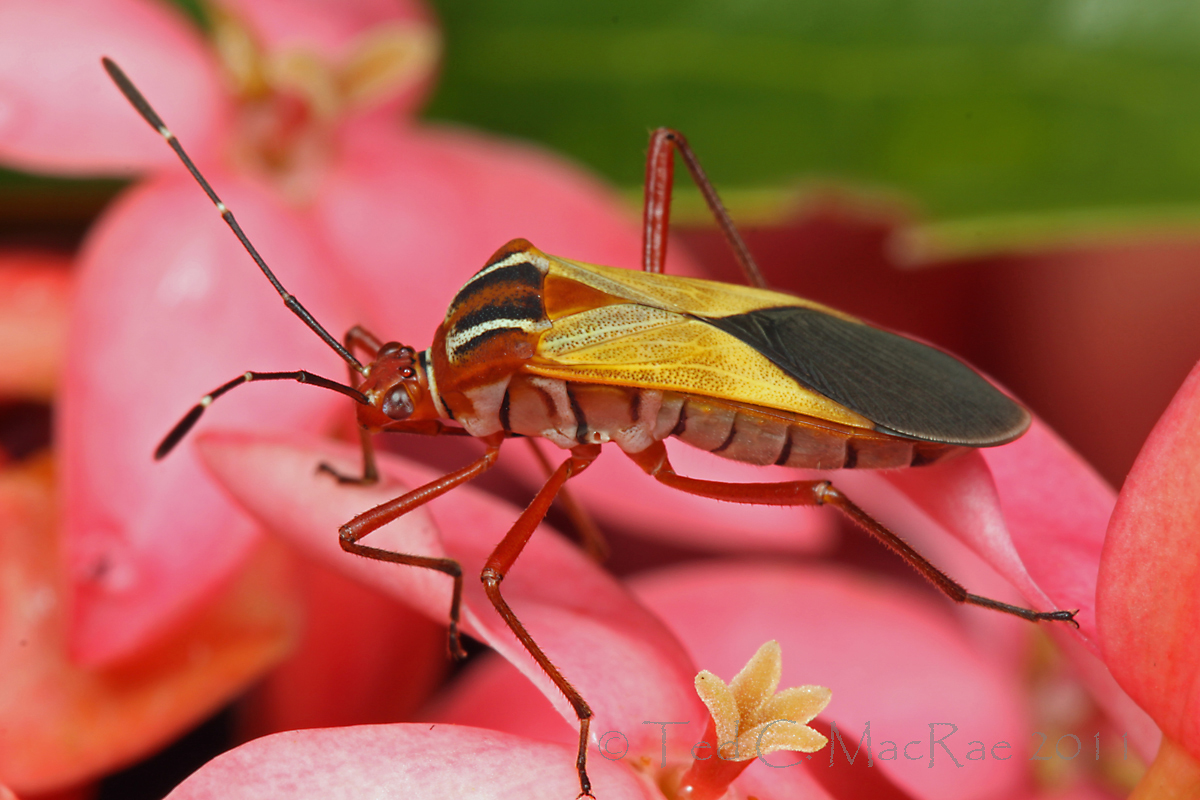
Coreidae?

At first I thought this was a member of the hemipteran family Pyrrhocoridae (red bugs), as some North American species have similar coloration; however, members of that family apparently lack ocelli, which this insect clearly possesses. This would seem to indicate instead some species of Lygaeidae (seed bugs), but the forewing membrane with numerous veins arising from a transverse basal vein and presence of what appears to be a distinct metathoracic scent gland opening suggest instead some “unleaf-footed” species of leaf-footed bug (Coreidae). Whatever its identity, I would imagine it is quite distasteful, based on what clearly seems to be aposematic coloration and the fact that there were numbers of these bugs hanging out quite conspicuously on these flowers.

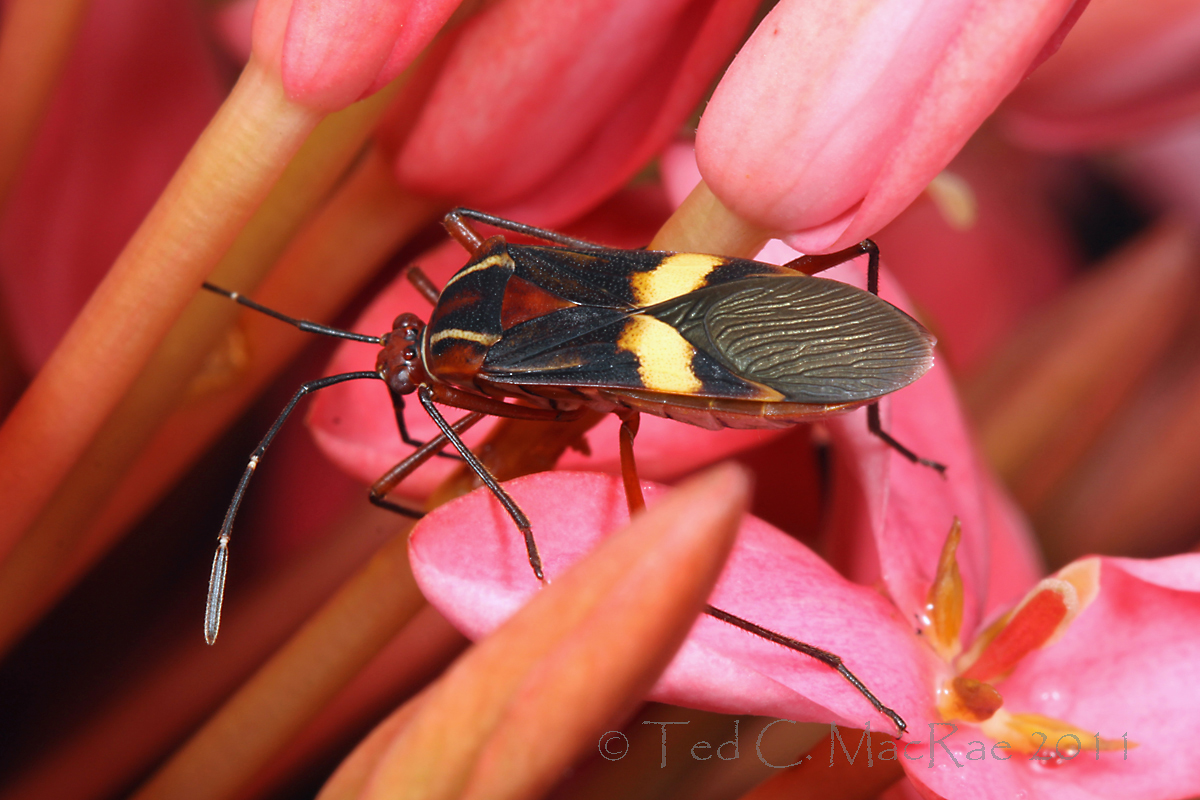
Same species?

This individual was differently colored than the others, but otherwise it seemed structurally and behaviorally identical.  Is it merely a highly melanized individual?  Maybe a case of sexual dimorphism, and I only saw this one individual of one of the sexes?  Maybe it truly is a different species – it is Brazil, afterall!

Pseudoplusia includens?

Daylight began to slip away much too soon, and I was about to pack it up when  I noticed some blurs at the flowers.  I realized that moths had begun to visit the flowers in the obscurity of dusk and became determined to photograph one, despite the fact that they never actually landed on the flowers but hovered in front of them instead.  It was quite difficult to even get them framed in the viewfinder, and on those few occasions when I managed to do this it was all but impossible to spend any time trying to focus – I used the lamp on the flash unit to help me see the moth, then just framed and quickly took the shot.  This one actually turned out not too bad – a little bit of blur in the wings but otherwise acceptable enough to let me tentatively identify it as Pseudoplusia includens (soybean looper).  Brazil is well on its way to becoming the world’s largest producer of soybean, and the caterpillars of these moths are enjoying the bounty!

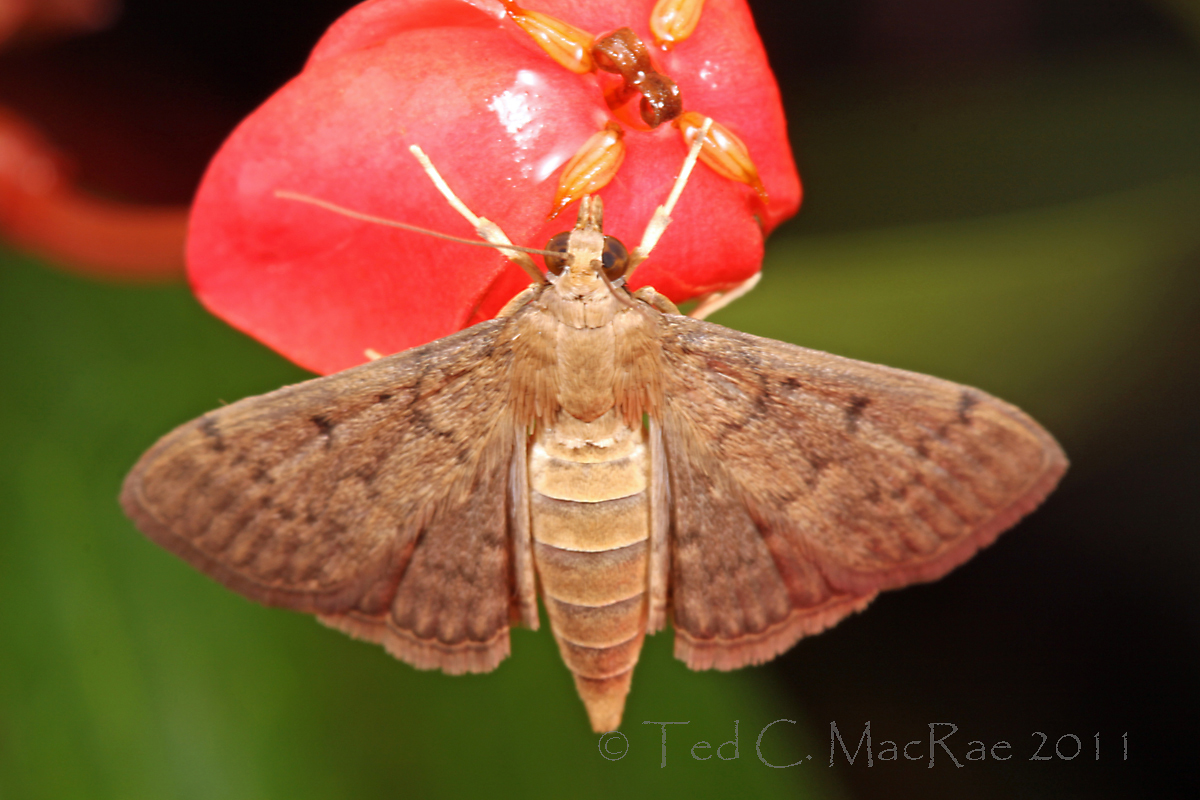
Family Crambidae, possibly Herpetogramma phaeopteralis (ID by Chris Grinter)

I saw one last moth before the final traces of daylight disappeared – I don’t have any idea about its identity, but it’s a pretty picture nonetheless.  It has the generic look of the large family Noctuidae, so that’s what I’m gonna go with until somebody tells me differently.  Edit 1/20/11 – Somebody just told me differently!  According to Chris Grinter, this is a species of Crambidae, possibly Herpetogramma phaeopteralis (tropical sod webworm).  Thanks, Chris!

I don’t know the name of the plant whose flowers these insects were visiting, but the hotel staff has promised to ask their gardener in the morning and let me know – now that’s service!

Copyright © Ted C. MacRae 2011

BitB Top 10 of 2010

Welcome to the 3rd Annual BitB Top 10, where I pick my 10 (more or less) favorite photographs of the year.  My goal for 2010 was to continue the progress that I began the previous year in my quest to become a bona fide insect macrophotographer.  I’m not in the big leagues yet, but I have gotten more comfortable with using my equipment for in situ field photographs and am gaining a better understanding of lighting and the use of flash.  I also began experimenting with different lighting techniques (e.g. white box) and diffusers and am putting more effort into post-processing techniques to enhance the final appearance of my photographs.  I invite you to judge for yourself how successful I’ve been toward those goals by comparing the following selections with those from 2009 and 2008 – constructive feedback is always welcome:


Best Tiger Beetle

Cicindela denverensis - green claybank tiger beetle

From ID Challenge #1 (posted December 23).  With numerous species photographed during the year and several of these dramatic “face on” shots, this was a hard choice.  I chose this one because of the metallic colors, good focus throughout the face, and evenly blurred “halo” of hair in a relatively uncluttered background.


Best Jewel Beetle

Buprestis rufipes - red-legged buprestis

From Special Delivery (posted July 13).  I didn’t have that many jewel beetles photos to choose from, but this one would have risen to the top no matter how many others I had.  The use of a white box shows off the brilliant (and difficult-to-photograph) metallic colors well, and I like the animated look of the slightly cocked head.


Best Longhorned Beetle

Desmocerus palliatus - elderberry borer

From Desmocerus palliatus – elderberry borer (posted November 18).  I like the mix of colors in this photograph, and even though it’s a straight dorsal view from the top, the partial dark background adds depth to the photo to prevent it from looking “flat.”


Best “Other” Beetle

Enoclerus ichneumoneus - orange-banded checkered beetle

From Orange-banded checkered beetle (posted April 22).  The even gray background compliments the colors of the beetle and highlights its fuzziness.  It was achieved entirely by accident – the trunk of the large, downed hickory tree on which I found this beetle happened to be a couple of feet behind the twig on which it was resting.


Best Non-Beetle Insect

Euhagenia nebraskae - a clearwing moth

From Euhagena nebraskae… again (posted October 21).  I photographed this species once before, but those photos failed to capture the boldness of color and detail of the scales that can be seen in this photo.


Best “Posed” Insect

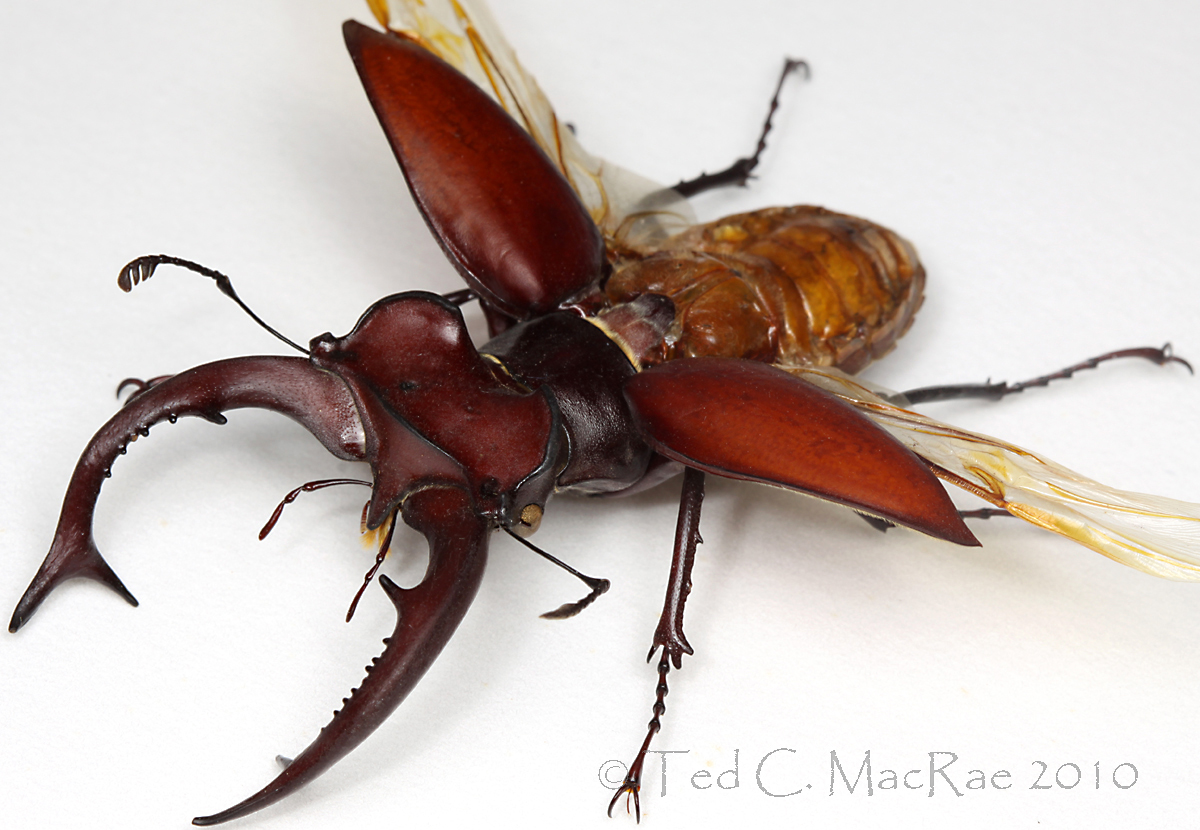
Lucanus elaphus - giant stag beetle

From North America’s largest stag beetle (posted December 30).  I’ve just started experimenting with photographing posed, preserved specimens, and in fact this male giant stag beetle represents only my second attempt.  It’s hard to imagine, however, a more perfect subject than this impressively stunning species.


Best Non-Insect Arthropod

Scolopendra heros - giant desert centipede

From North America’s largest centipede (posted September 7).  Centipedes are notoriously difficult to photograph due to their elongate, narrow form and highly active manner.  The use of a glass bowl and white box allowed me to capture this nicely composed image of North America’s most spectacular centipede species.


Best Wildflower

Hamamelis vernalis - Ozark witch hazel

From Friday Flower – Ozark Witch Hazel (posted March 26).  The bizarre form and striking contrast of colors with the dark background make this my favorite wildflower photograph for the year.


Best Non-Arthropod

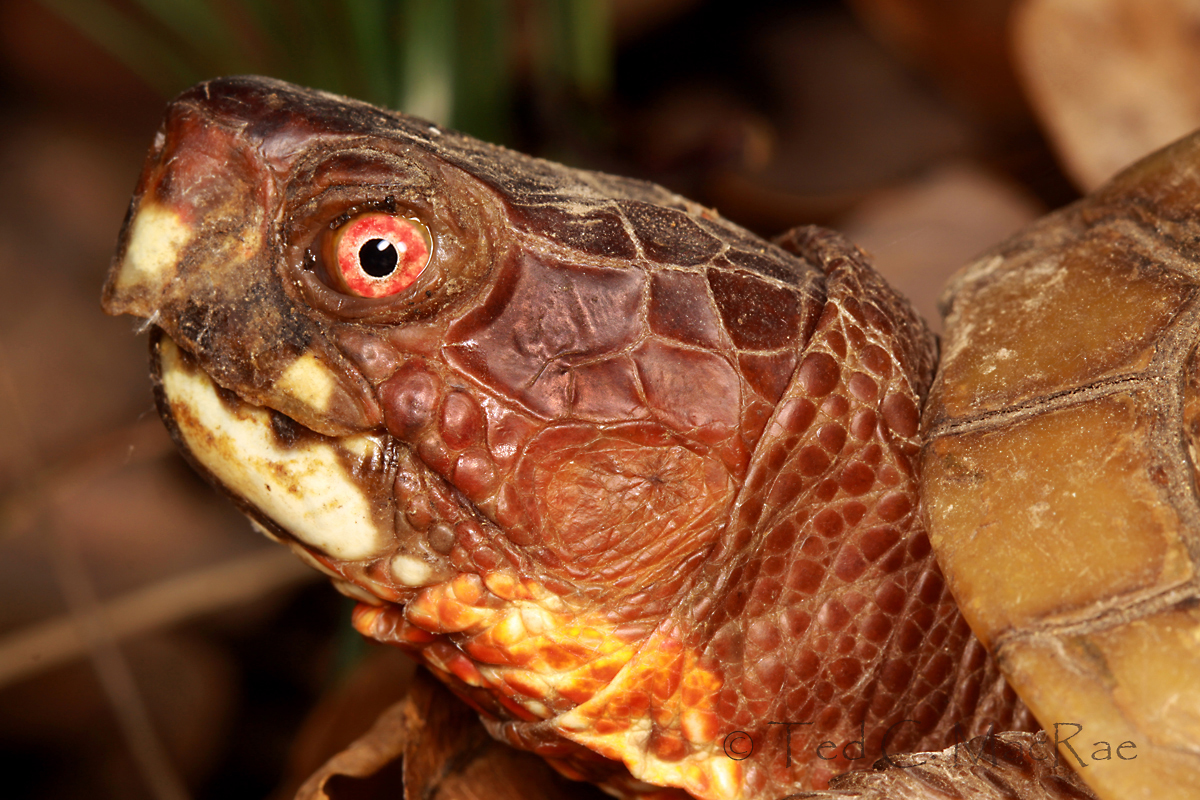
Terrapene carolina triunguis - three-toed box turtle

From Eye of the Turtle (posted December 10).  I had a hard time deciding on this category, but the striking red eye in an otherwise elegantly simple photograph won me over.  It was also one of two BitB posts featured this past year on Freshly Pressed.


Best “Super Macro”

Phidippus apacheanus - a jumping spider

From Jeepers Creepers, where’d ya get those multilayered retinae? (posted October 5).  I’m not anywhere close to Thomas Shahan (yet!), but this super close-up of the diminutive and delightfully colored Phidippus apacheanus is my best jumping spider attempt to date.  A new diffuser system and increasing comfort with using the MP-E lens in the field at higher magnification levels should allow even better photos this coming season.


Copyright © Ted C. MacRae 2011

Tiny little slivers of life

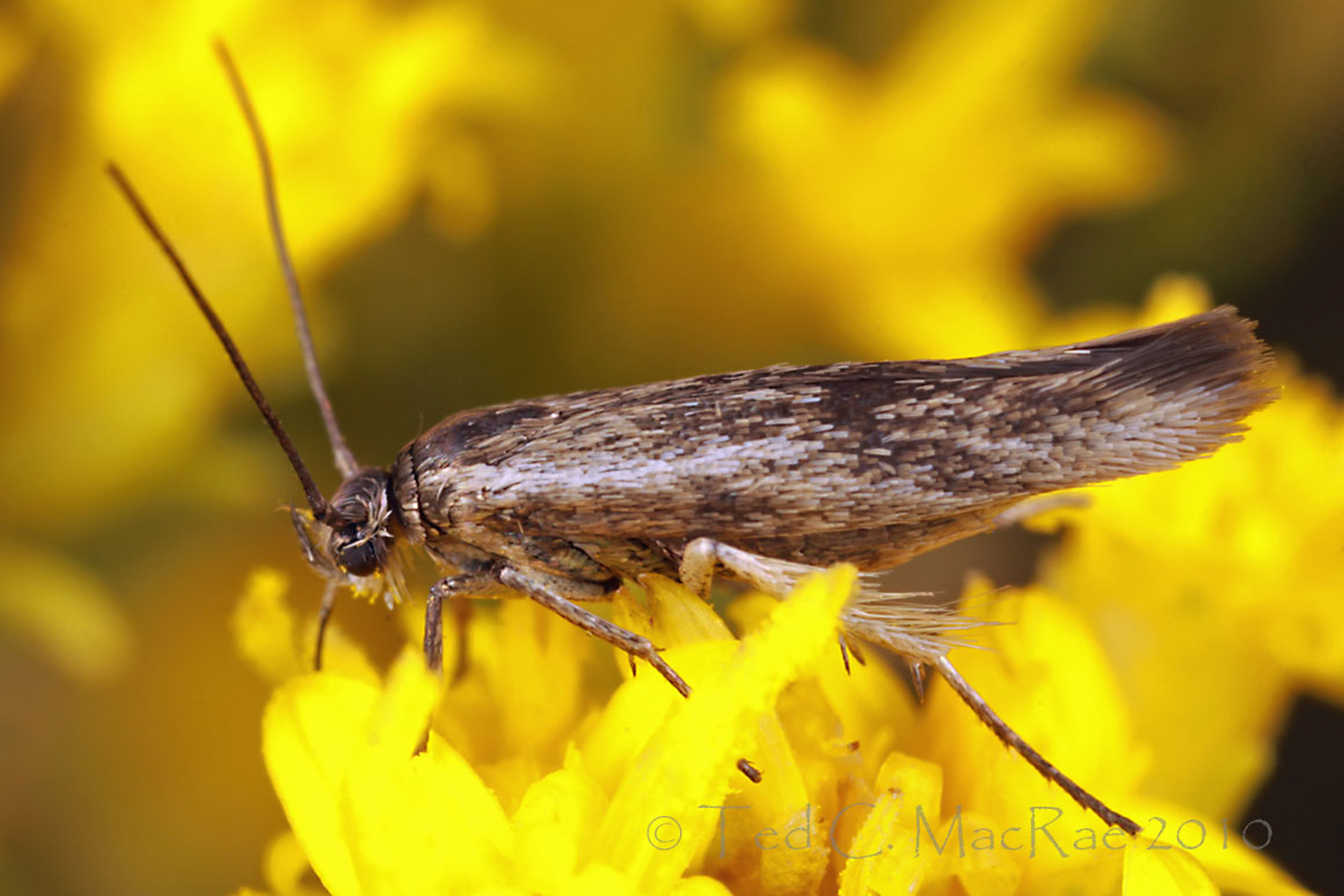
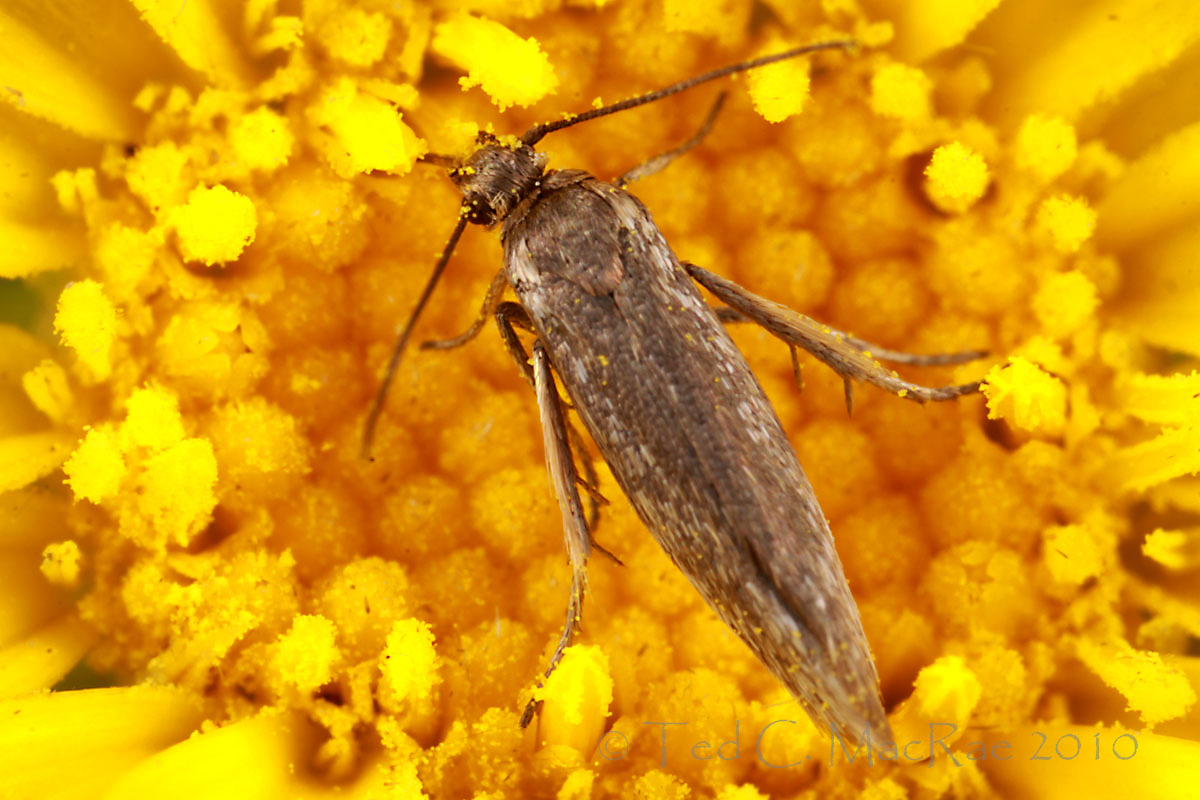
Day 1 of the 2010 Fall Tiger Beetle Trip™ had been an unqualified success.  Not only did we achieve our top goal of the trip – seeing good numbers of the recently discovered South Dakota population of Cicindela pulchra (beautiful tiger beetle), but we also saw C. nebraskana (prairie long-lipped tiger beetle) and a variety of other interesting insects in the nearby Nebraska Pine Ridge.  For Day 2, our destination was Monroe Canyon on the north face of the Pine Ridge escarpment, but on the way there we decided to check out some roadside clay banks in the town of Crawford.  Despite their appearance as perfect tiger beetle habitat, all we saw was a single individual of the normally ubiquitous C. purpurea audubonii (Audubon’s tiger beetle).  The area looked quite dry, and in fact there was little insect life of any kind present… or so I thought.  As I stood there looking out onto the embankment while deciding my next move, I glanced down at a nearby composit shrub with small yellow flowers.  These are often attractive to a variety of beetles (Crossidius longhorned beetles would be nice!), but I saw none.  I started to move on, but before I did I noticed some tiny little slivers of life moving about on the flowers.  Kneeling down to take a closer look, I saw that they were moths – in fact, they were some of the smallest moths that I had ever seen, and the shrub was covered with them.  Now, I may pride myself on my broad-based entomology knowledge, but when it comes to microlepidopterans there is a decided gap in that knowledge.  I really had no idea what they might be, but for some reason the combination of their unknown identity and tiny size became for me an irresistible photographic challenge (made truly challenging by the unrelenting prairie wind).  I’m fortunate that Chris also became distracted photographing something – any other collecting partner surely would have grown impatient waiting for me to finally be satisfied I’d gotten some good shots.

As far as I can tell, these moths represent something in the genus Scythris or perhaps Neoscythris.  These are the so-called flower moths, placed either in the family Scythrididae (Microleps.org and Moth Photographers Group) or subfamily Scythridinae of the Xylorictidae (BugGuide.net and Tree of Life).  According to Microleps.org, the life histories of relatively few scythridid species have been determined – the few that have showing a preference for feeding (usually internally, e.g., as leaf miners) on members of the Asteraceae.  There are images of several species of Scythrididae at the aforementioned sites; however, it’s a large group, and the individuals in these photos don’t appear to match any of the illustrated species.  Perhaps Chris Grinter or some other microlepidopterophile will chance upon this post and either confirm or further elucidate the identity of these individuals. 

Photo Details: Canon 50D w/ MP-E 65mm 1-5X macro lens (ISO 100, 1/250 sec, f/13), Canon MT-24EX flash w/ Sto-Fen + GFPuffer diffusers. Typical post-processing (levels, minor cropping, unsharp mask).

Copyright © Ted C. MacRae 2010

Euhagena nebraskae… again

Euhagena nebraskae - male

Earlier this year I showed a photograph of a mating pair of the clearwing moth (family Sesiidae) species, Euhagena nebraskae – seen last year in the Gypsum Hills of south-central Kansas on a cold, early-October day.  It was an okay photograph, made interesting primarily by nicely showing the high degree of sexual dimorphism seen in these moths.  Still, I wasn’t completely happy with the photo, wishing I had gotten a closer photograph of just the male with his highly bipectinate antennae and wispy, white thoracic tufts.  I got my wish on the first day of my recent fall tiger beetle collecting trip, seeing just this single male in the Pine Ridge area of northwestern Nebraska.  Despite the relatively warmer temperatures, he perched cooperatively atop a dried flower head and allowed me to photograph him to my heart’s content.

p.s. this one you really should click on to see the larger version, because the hair-like thoracic scales and flattened marginal scales on the wings are quite remarkable.

Photo Details: Canon 50D w/ 100mm macro lens (ISO 100, 1/250 sec, f/16), Canon MT-24EX flash w/ Sto-Fen + GFPuffer diffusers. Typical post-processing (levels, minor cropping, unsharp mask).

Copyright © Ted C. MacRae 2010

Guest Blogger: Dogbane for Dinner

Our guest blogger for today is Anne McCormack. I have known Anne (or known of her) for more than 25 years now, first as a long-time editor of Nature Notes, the journal of the Webster Groves Nature Study Society, and more recently on a personal basis as I, myself, have followed in her editorial footsteps. Anne is an astute naturalist whose breadth of knowledge spans not only botany but also entomology and ornithology, all of which she write about in her own blog at Gardening with Binoculars.


I planted Common Dogbane (Apocynum cannibinum) because some of my butterfly-watching friends reported numbers of juniper hairstreak butterflies on the patch of dogbane at Powder Valley Nature Center in Kirkwood. I assumed incorrectly that dogbane was a host plant for hairstreaks, and believing it to be little more than caterpillar food, I placed it in a hot, dry, narrow strip along the driveway. Ragged, caterpillar-chewed leaves wouldn’t be noticed there, and I forgot about it. After a few seasons, it was still a modest-sized clump, but the leaves were in great shape. In fact, it had grown into an attractive bush of airy, elegant lime-green foliage, wine-red stems, and tiny white flowers. It’s quite a contrast to its relative, Common Milkweed, growing next to it, which looks as if it were designed by Dr. Seuss—even before it gets chewed to bits. At this point I decided it was time to look it up and see why it had failed to support hordes of munching caterpillars. As you have already guessed, gentle reader, the Juniper Hairstreak’s host plant is juniper, not dogbane, but good old Common Dogbane is a great nectar plant. Now that Dogbane and I understand each other better, I can appreciate the amount of traffic its tiny white blooms bring in, like this Peck’s Skipper butterfly. Ants, butterflies, tiny native bees, honeybees, and this mason wasp are busy there all day long.

Along with several species of moth, it is the host plant for the Dogbane Beetle, which spends its larval stage devouring the roots and its adulthood dining on the leaves of Dogbane, and nothing but Dogbane. Dogbane Beetle can be confused with Japanese Beetle by beginners like myself, but unlike its fellow Coleopteran, Dogbane Beetle is harmless. That makes its iridescence all the more gorgeous, as shown in this wonderful photo by Courtnay Janiak. It’s a native insect that has shared a long evolutionary history with this under-appreciated native plant. American Indians valued it for its bark, which is tough but peels off in long strips. They plaited it for bowstrings and anything that called for twine; hence, its other common name, Indian Hemp. Don and Lillian Stokes, in their 2002 PBS show about bird watching, demonstrated how birds seek out the dry stems of this perennial, pulling off strips for nests in early spring. Nesting material can be hard to come by for birds in the tidy suburbs, so I don’t clean up the stems after frost. “Bane” in the name refers to the toxin cymarin in the plant’s leaves, though the plant would have to be covered in braunschweiger before my dog would be interested. Edgar Denison, in Missouri Wildflowers, translates the genus name Apocynum as “away dog.” The species name cannibinum refers to hemp. Its seedpods remind me of French green beans. These split at the end of the season, and the seeds fly away on fibers similar to milkweed seeds. Collect some and try this plant in your butterfly or native plant garden. Give it a spot where it’s easy to watch the colorful visitors.

Dogbane beetle (Chrysochus auratus) - Copyright © Courtnay Janiak

Copyright © Anne McCormack 2010

Add to FacebookAdd to DiggAdd to Del.icio.usAdd to StumbleuponAdd to RedditAdd to BlinklistAdd to TwitterAdd to TechnoratiAdd to Yahoo BuzzAdd to Newsvine

Email to a friend

Are we loving our prairies/glades/woodlands to death?

I had such high hopes for last weekend’s collecting trip – late May is boom time for insects across Missouri, we have had good moisture this spring, and I would be visiting some high-quality natural communities that I had not visited for a long time.  My stated goals (the jewel beetles, Agrilus impexus and A. frosti) were long shots – I knew that and would have been fine coming home without those species (which I did) had the the collecting been otherwise productive (which it was not).  Still, I’ve been doing this for a long time now, and I’ve learned to draw on my accumulated experience when things don’t go as planned to give myself the best shot at turning a bad collecting trip into a decent one when things don’t go as planned.  The itinerary with which I start is rarely the one that I actually follow, and this past weekend was a good example of such.

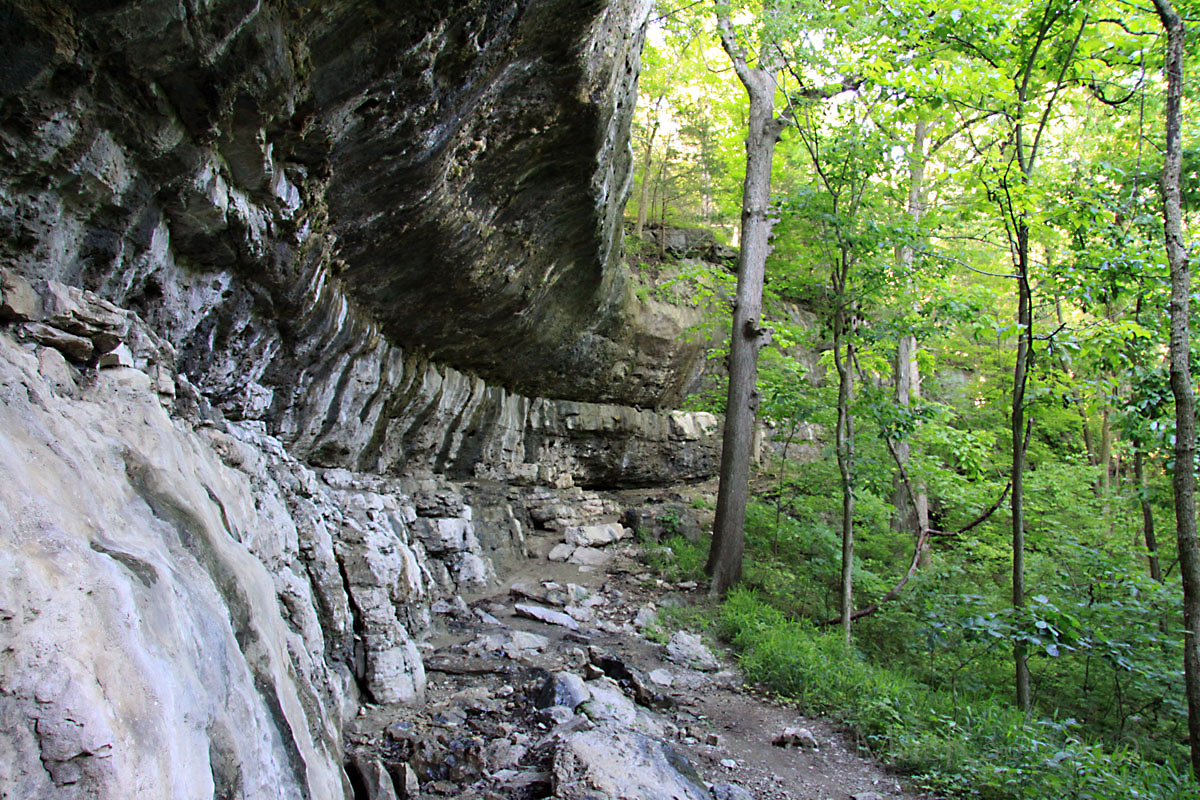
My first stop was Ha Ha Tonka State Park, one of Missouri’s premier parks, boasting high-quality chert, dolomite, and sandstone savanna interspersed with dolomite glades.  It is on these glades and savannas that I hoped to find Agrilus impexus, or failing that at least collect a nice diversity of other jewel beetles on the oaks and hickories of the savannas and surrounding woodlands.  However, it was with some reservation that I even came here after being told by my colleague at the Department of Natural Resources just 2 days before my trip that 75% of the park’s grasslands and woodlands had been burned within the past two years.  For an insect collector, this is never good news – in all my years of collecting insects, my experience in relatively recently-burned habitats has been consistent: collecting sucks!  I decided, however, to visit Ha Ha Tonka anyway because of the quality of the natural communities it contains, thinking perhaps I might be able to find pockets of unburned habitat supporting good insect populations.  This was not to be. I beat oak after oak in the savannas and woodlands – nothing!  I swept little bluestem and Indian grass in the glades – nothing!  The foliage was lush and green and the savanna and glade landscapes highly diverse – given the time of season the place should have been teeming with insect life, yet it almost seemed sterile. Were it not for a few Chrysobothris quadriimpressa jewel beetle adults that I found attracted to a recently wind-thrown black oak tree, I would not have seen any insects here at all.  It appeared my fears about park-wide depression of insect populations had been realized.  However, not one to waste a visit I decided to explore some of Ha Ha Tonka’s fascinating geological features.  Ha Ha Tonka contains one of Missouri’s best examples of karst geology, with complex structures formed from the collapse of a major cave system.  The Devil’s Promenade is one of the more spectacular examples of such, its horseshoe-shaped cliff representing the former interior walls of a now-collapsed cave.  As dusk approached, the day’s poor insect collecting caused me to abandon my plans to stay here and blacklight for nocturnal beetles.  Instead, I decided to break from the itinerary, drive further west and explore Lichen Glade Natural Area in the morning before heading to the Penn-Sylvania Prairie BioBlitz later that afternoon.

Devils Promenade, Ha Ha Tonka State Park

Lichen Glade Natural Area is a small area owned by The Nature Conservancy that boasts a high-quality sandstone glade surrounded by post oak/black jack oak forest.  My first visit to the area more than 20 years ago was during May, and it was one of the most productive collecting trips I’ve had with a number of Agrilus spp. (including A. frosti) beaten from post oak (Quercus stellata) along the woodland edge.  I didn’t visit again until fall of 2002, when Chris Brown, Rich Thoma and I found claybank tiger beetles (Cicindela limbalis) sunning on the exposed sandstone outcrops, and I made one more visit the following May to beat more insects off of post oak.  The Lichen Glade that I returned to this past weekend was a very different place from when I last visited – the surrounding woodlands had been extensively opened (I would guess within the past few years based on the size of the post oak resprouts), and fire had been used throughout the area.  Anticipation turned to frustration when no amount of beating of the woodland vegetation and sweeping of the glade vegetation turned up beetles in any appreciable numbers (or any insects for that matter) and two hours worth of effort yielded not a single buprestid beetle!

Sandstone glade community, Lichen Glade Natural Area

With resignation, I headed on over to Penn-Sylvania Prairie, where during the introduction to the BioBlitz I learned that nearly half of the 160-acre prairie was burned last December and all of it had been burned within the past few years.  I knew what I was going to find – nothing!  Okay, I shouldn’t say nothing, as there actually were some beetles present.  However, the numbers and diversity were low, with all of the species encountered representing common, widespread species.  Moreover, it was not just beetles – all of the invertebrate group leaders (which included experts on snails, ants, butterflies, and bees) reported low overall abundance and diversity in their groups of interest.  Only the vascular plants – the metric by which the value of prescribed burning is always assessed – showed high diversity, with 300 species of mostly native prairie plants recorded for the site.  It was a fun event, with probably ~75 attendees and a delicious pot luck dinner that evening; however, it would have been more enjoyable had there actually been a nice diversity of insects present to document for the preserve.

My comments may make it seem that I am against the use of prescribed burning.  This is not true – I understand the critical role that fire as a management technique plays in restoring and maintaining examples of Missouri’s historically fire-mediated landscape. Without fire and other processes to mimic natural disturbance factors, most of Missouri’s historical grasslands and woodlands suffer relentless encroachment by woody vegetation. However, the modern landscape is very different from the historical landscape, where fires of unpredictable scale, intensity, and frequency operated within a vastly larger scale to create a shifting mosaic of natural communities in various stages of ecological succession. Such processes cannot be recreated on today’s severely fragmented landscape, where the precious few remaining tracts of native habitat are relatively to extremely small and more often than not separated from each other by vast expanses of homogeneous and “inhospitable” habitat (e.g., agricultural, urbanized, or severely degraded lands).  It is in that context that I have great concerns about how aggressively fire has been used in recent years on our state’s natural areas and the impact this is having on insect populations – specialist and generalist alike.  Fire proponents will point to published studies that show little to no effect by the use of fire for managing small, isolated remnants on specialist insects (see review in Henderson 2010).  However, there are an equal number of studies that suggest such concerns are well-founded (see review in Panzer 2002). A consistent limitation in all of the studies that have been conducted is the lack of very large and long un-burned remnants.  Prescribed burning has been adopted so rapidly and pervasively that there just aren’t any significant un-burned remnants left to properly include as controls in such studies.  As a result, the insect fauna present at a given site at the start of such a study is already skewed towards those species that successfully recolonized the area post-burn.  At a minimum, the data to this point are inconclusive, and certainly the potential for impacts has not been given the consideration it warrants in designing fire-management plans for our own state’s prairies and glades. Furthermore, as rapidly and aggressively as fire has been adopted on our few, small, widely disjuct remnants, the opportunity for proper investigation of those potential effects may be gone.  A particularly egregious example of the lack of consideration being given to prairie invertebrates in designing fire management plans is shown in these photos of Iowa’s Sylvan Runkel State Preserve before and after a late May burn and the impact of that burn on a resident population of Nevada buck moths (Hemileuca nevadensis).

Here in Missouri, as in Iowa, it’s a problem of scale – the landscape is too fragmented and remnants too disjunct to manage based strictly on floristic response.   Populations of generalist insect species will recover, and even specialist species may be able to overcome such management practices if they are widely distributed and sufficiently mobile. But what about conservative species with low vagility, such as the swift tiger beetle (Cylindera celeripes) and our disjunct population of the frosted dromo tiger beetle (Dromochorus pruinina), flightless species restricted in Missouri to the few tiny remnants of loess hilltop prairie in northwestern Missouri and a single 2.5-mile stretch of roadside habitat in west-central Missouri?  Until directly relevant data, gathered here in Missouri, are forthcoming to suggest otherwise, I believe the most judicious use of fire possible should be practiced in restoring and maintaining our grasslands and woodlands.  In-season burns may have been a part of the historical landscape, but their use today has great potential to result in local extirpations and should be used only after the most careful consideration.  Leaving un-burned refugia within remnant habitats to accelerate recovery would also be prudent – yet many land managers disregard this practice because of its logistical difficulties. This is especially true in small parcels, yet it is precisely these remnants that have the most to gain from their use (or lose from not doing so!).  In the historical landscape, every burn was a patch burn – no matter what its size, there were always adjacent or proximal unburned habitat from which recolonization could occur.  Elk and bison, too, were integral components of the presettlement prairie landscape – their roamings caused intermittent, localized disturbances that were likely not only crucial to the tiger beetles that I study but may also have contributed to vegetational diversity through patch succession.  Techniques that mimic these natural disturbance factors include mowing, haying, and managed grazing.  They can be utilized to mimic those disturbances as well as delay woody encroachment, and their use in land management should be considered for their ecological value rather than deprioritized because of their relatively greater complexity and cost to implement. Mechanical removal and selective use of herbicides offer additional tools for addressing woody encroachment while minimizing potential impacts to insect populations. An effective management program that considers all of the flora and fauna of a remnant may not be possible unless all of these management tools are utilized, or at least properly considered. As my good friend James Trager said in a recent email (quoting Andrew Williams), habitat restoration “cannot rest on any single management practice, nor practicing it too extensively.”

REFERENCES:

Henderson, R. A.  2010. Influence of Patch Size, Isolation, and Fire History on Hopper (Homoptera: Auchenorrhyncha) Communities of Eight Wisconsin Prairie Remnants.  Wisconsin Department of Natural Resources, Research Report 189, 22 pp.

Panzer, R. 2002. Compatibility of prescribed burning with the conservation of insects in small, isolated prairie reserves. Conservation Biology, 16(5):1296-1307.

Copyright © Ted C. MacRae 2010

Add to FacebookAdd to DiggAdd to Del.icio.usAdd to StumbleuponAdd to RedditAdd to BlinklistAdd to TwitterAdd to TechnoratiAdd to Yahoo BuzzAdd to Newsvine

Email to a friend

The Moth and Me #11

The Moth and MeWelcome to issue #11 of The Moth and Me, the monthly carnival devoted to the “forgotten” lepidopterans. Most people – even entomologists – regard these as the lesser leps, denizens of the night, as if to hide their somber-colored drabness from the flashy brilliance of their rhopaloceran relatives. Of course, this simply isn’t true, as the contributions to this month’s issue well demonstrate. Butterflies may be among the largest insects on earth, but the largest lepidopteran in the world is a moth. They may also be as gaudily colored as the rainbow itself, but what butterfly is more colorful than the Urania day-flying moths (the genus name literally means, “The heavenly one”).   And, they may be almost universally accepted by a largely insect-indifferent public, but who among us does not think back to that first sight of a luna moth as the most stunning insect we had ever seen to that point.  Yes, moths are all that butterflies are, and for this month’s issue of TMaM, 15 contributions by nine writer’s show us why.

Family Saturniidae – Giant Silkworm & Royal Moths

Tales from the Butterfly Garden: LepcuriousLuna moths belong to the royal moths of the family Saturniidae, and as the name implies they are not the only stunningly beautiful member of the group. Kristen at Tales from the Butterfly Garden: Lepcurious writes about an encounter with the Sweetbay Silkmoth (Callosamia securifera).  Like other members of the family, larvae of this species are rather particular about the type of tree that they utilize for food, which in the case of this moth is sweetbay (Magnolia virginiana).  I’m a little too far north here in Missouri for this tree, so I have never seen this moth.  However, I have seen (and reared) some of its close relatives, the Promethia Silkmoth (Callosamia promethea) which hosts on several plant species and the Tulip-tree Silkmoth (Callosamia angulifera) which hosts on Tulip Tree (Liliodendron tulipifera).

Family Zygaenidae – Leaf Skeletonizer Moths

xenogereJason Hogle at xenogere is fond of the unusual and has a gift for finding it. In his post The Unmoth, Jason shows us a male grapeleaf skeletonizer (Harrisina americana) – not your typical moth!, The uniformly black color and bright red neck collar just screams “Don’t eat me – I’m poisonous”, and indeed species in this family are among the few insects capable of producing hydrogen cyanide!  As the name suggests, larvae skeletonize the leaves of both wild and cultivated grapes (Vitis spp.), as well as the related Virginia creeper (Parthenocissus quinquefolia).

Family Noctuidae – Noctuid Moths & Tiger Moths

Tales from the Butterfly Garden: LepcuriousRoyal moths are not the only stunningly colored moths that Kristen at Tales from the Butterfly Garden: Lepcurious has found in Florida, as she shows in this post on Oleander Moths (Syntomeida epilais) and a companion piece on its Oleander host plant.  This striking day-active moth, also called Uncle Sam Moth (for its red, white, and blue colors) and Polka-Dot Wasp Moth (for obvious reasons), may seem like an easy-to-spot target for would be predators, but its gaudiness is actually warning of the toxic chemicals it has sequestered in its body from the Oleander on which it fed as a larva.  Oleander contains the toxins oleandrin, a cardiac glycoside, and neandrin and is toxic if ingested.  Although oleander is an Old World exotic, oleander moths may also be found feeding on devil’s potato vine (Echites umbellata), which may have been their native Florida host before the introduction of oleander to the United States.

See TrailAside from the underwings (genus Catacola) and the recently incorporated tiger moths, Noctuids are typically thought of as the “basic brown moths” – relying on just the aforementioned groups to add a splash of color to the family’s otherwise drearyness.  Nothing could be further from the truth – check out the stunning Eight-spotted Forester (Alypia octomaculata) in this post by Matthew York at See Trail. Larvae of this beautiful little moth feed on ampelopsis, Virginia creeper, and other plants in the grape family (similar to the grape leaf skeletonizer above). “A great moth; brilliant color, diurnal…… and yes… Noctuid. Some moths, like people, don’t go with the trends.”

See TrailFor the most part, tiger moths shun the daytime in preference for the safety of the night. That does not mean, however, that they are any less colorful, as Matthew York at See Trail shows in his post Poor Grammia. Notarctia proxima, the Mexican Tiger Moth, and its relatives have had a bit of name shuffling over the years at the hands of taxonomists – formerly placed in the genera Grammia and Apantesis. Whatever name you call it, the striking white and black striped forewings give a clue about their common name of tiger moths, and the red, black-tipped abdomen not only add to its beauty, but belies the defensive compounds it surely contains.

Speaking of tiger moths and defensive compounds, watch the video that Chris Grinter at The Skeptical Moth included in his post Moth Perfume. In it, Chetone angulosa gives a striking display of a common defensive mechanism for the group – excreting hemolymph (sweating blood, so to speak!). So spectacularly does the moth do this that you can actually hear the hissing sound of the fluid being pumped from the body. Moreover, there seem to be at least a couple of active ingredients in the froth – one that smells like peppermint, and another that causes numbing of the tongue (as Chris can testify firsthand – he is a truly dedicated experimental naturalist!).

Karthik's JournalIn similar fashion to our North American species of underwing moths (Catocola spp.), the related Eudocima materna, one of the fruit-sucking moths of south India, uses its drab-colored forewings to hide its brilliantly colored hindwings, as Karthik at Karthik’s Journal shows us in his post Startling Displays.  This forms a double line of defense against would-be predators – the forewings blend marvelously into the color of the tree trunks upon which it rests during the day, camouflaging the insect and making it nearly invisible.  If this doesn’t work, a sudden flash of the hindwings may startle the predator just enough to allow the moth to take flight to another tree – where it instantly “disappears” as soon as it closes its wings.

Snails Eye ViewAustralia also has some very colorful fruit-piercing moths, and Bronwen Scott at Snails Eye View presents some beautiful photos of the particularly strikingly-colored Othreis iridescens. Like other members of the group, this Far North Queensland endemic feeds on fruit (Pycnarrhena novoguineensis and Hypserpa laurina, both Menispermaceae, in the case of this species), but as it is apparently the rarest of the primary fruitpiercing moth species in Australia it is not considered to be a pest (and Bronwen would cut it some slack even if it was!).

EntophileAdults are but only one of four life stages that all moths go through. If moths are the “forgotten” leps, then caterpillars are the “forgotten” moths. In many cases, the caterpillar stage cannot be recognized until it becomes a moth (and in some cases the caterpillars are completely unknown). Fortunately, Navy entomologist corycampora at Entophile recognized the caterpillar he found on his croton bush, which he features in the post Croton caterpillar, Achaea janata (Linnaeus), (Lepidoptera: Noctuidae). These “eating machines” can be just as fascinating to observe as their scaled adult counterparts, and while croton seems to be a preferred host in Hawaii, it apparently also feeds on castor beans (judging by its other common name, Castor Oil Semi-looper).

Family Notodontidae – Prominent Moths

the Marvelous in NatureOften dismissed as noctuids, the prominent moths tend to be fuzzier, more thickly-bodied moths that rest with their wings curled around their abdomen or tented over their back (rather than flat like noctuids and most other moths). TMaM organizer Seabrooke Leckie at the Marvelous in Nature has a love affair with prominents, and in her post Georgian Prominent, she features the nicely thick-bodied and fuzzy Georgian Prominent, Hyperaeschra georgica. The caterpillars of this widespread species feed on oak (Quercus spp.), thus, unless you live in the Pacific Northwest you stand a good chance of encountering this species – if you’re you’re willing to make the effort.

Family Psychidae – Bagworm Moths

xenogereMany of us are probably familiar with the evergreen bagworm moth (Thyridopteryx ephemeraeformis), whose large, cone-shaped bags almost look like fruit hanging from the evergreen bushes on which the caterpillars feed. But did you know there are other species of bagworms as well? Jason Hogle at xenogere does, and he compares and contrasts two of them in this duo of posts, Rainy day on the patio and The Other Bagworm. One huge and prominent, the other (Dahlica triquetrella) very small and oft unseen. One with all manner of plant matter stuck to its bag, the other usually mistaken for small bits of dirt or wood. Jason is so good, he can even determine the sex of the caterpillar inside the bag!

Family Sphingidae – Hawk Moths

Roundtop RumingsCarolyn at Roundtop Rumings is hoping that somebody can Name this moth, which she found on the door of her cabin in the forests of Pennsylvania. Don’t let her inability to name this moth fool you, however, for her post contains loads of information on exactly the kinds of characters one should take note of when trying to identify hawk moths. Large size and membership in a popularly studied group aren’t enough – what do the hindwings look like? Are there any spots on the abdomen? As a coleopterist, I hesitate to offer my relatively uninformed opinion on the exact genus and species for this moth, but I’m going to go out on a limb here and suggest maybe something in the genus Ceratomia, perhaps the waved sphinx (C. undulosa)?


I hope you have enjoyed this issue of The Moth and Me, and my sincere thanks go out to all of those who contributed!  The hosting slot for next month’s issue of TMaM is still open, but you can submit your contributions anyway to Seabrooke Leckie at the home site for inclusion in the June 2010 issue once a host is selected.  The submission deadline is June 13, with the issue appearing a few days later.  Perhaps you might like to host the June issue – hosting is not only fun, but also a great way to introduce readers to your site and generate a little traffic.  Contact Seabrooke at the home site if you’re interested – I’m sure she would love to hear from you.

Copyright © Ted C. MacRae 2010

Add to FacebookAdd to DiggAdd to Del.icio.usAdd to StumbleuponAdd to RedditAdd to BlinklistAdd to TwitterAdd to TechnoratiAdd to Yahoo BuzzAdd to Newsvine

Email to a friend

Friday Flower – Pawpaw

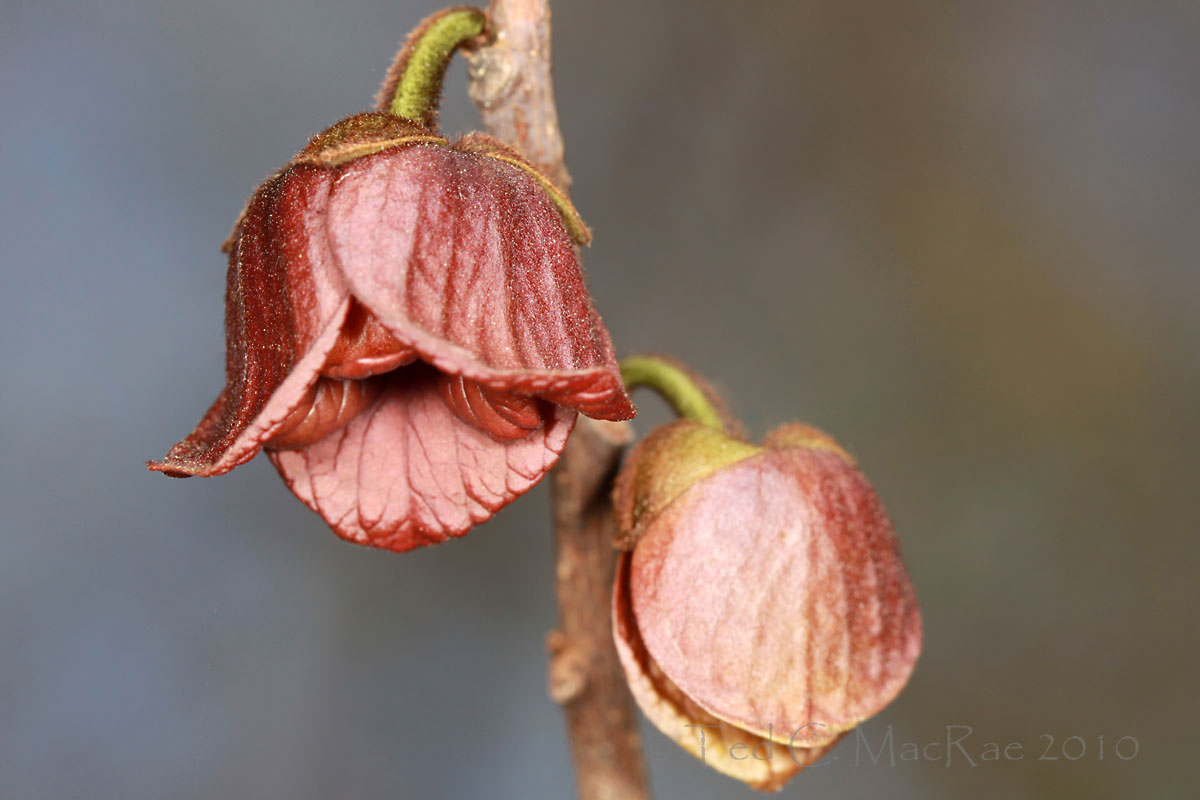
As my friend Rich and I stood in the verdent understory admiring the spectacular panicles of red buckeye punctuating the green lushness, a small brown flower on a leafless branch above me caught my eye.  “Pawpaw!” I exclaimed, perhaps partly in amazement that it took us awhile to notice the trees that were, in fact, all around us.  Pawpaw (Asimina triloba) is a member of the only temperate genus in the otherwise exclusively tropical and subtropical family Annonaceae (Custard Apple Family).  Although not nearly as restricted in occurrence in Missouri as the red buckeyes with which they were growing, they are nevertheless always a treat to see. Scattered throughout the state, they can be found growing in bottomland forests, ravines in mesic upland forests, along woodland streams, and at bases of bluffs (Yatskievych 2006).

Pawpaws are, of course, famous for their large edible fruits, sometimes called Indian bananas, Missouri bananas, Michigan bananas, [insert eastern state here] bananas, etc.  Technically, however, the pawpaw fruit is a berry, since it is derived from a single pistil and has multiple seeds embedded within the pulpy matrix.  I’ve not tried the fruit myself, not for lack of desire but rather an inability to find them when they ripen in fall before the birds and mammals get to them.  Some effort has been made to cultivate the plant for fruit production, but low fruit set seems to be a persistent problem due to reproductive self-incompatibility.

Pawpaw also famously serves as the larval food plant for the zebra swallowtail butterfly, Eurytides marcellus (family Papilionidae).  Beyond this, however, there seem to be not many insects associated with the plant.  I have collected dead wood of pawpaw in an effort to determine the species of wood-boring beetle species that are associated with it.  The only species I’ve reared is the longhorned beetle, Elaphidion mucronatum (whose common name “spined oak borer” belies the fact that it is one of the most polyphagous of all North American species), and two other longhorned beetles, Eupogonius pauper and Urgleptes querci (also highly polyphagous), have also been reported being reared from dead wood of this plant.  I have not associated any jewel beetles with pawpaw, nor have any such associations been reported in the literature.  It would appear that woodboring beetles are not fond of the soft, weak wood of pawpaw, perhaps due to the plant’s annonaceous acetogenins with known pesticidal qualities (Ratnayake et al. 1993) (acetogenins are also under investigation as anti-cancer drugs).  Other poisonous compounds, chiefly alkaloids, are found in various parts of the plant, especially the seeds and bark, and likely play a role in herbivore defense. Insect pollinators also seem to be infrequent, as I have not noted any insects on its flowers. Most members of the family are pollinated by beetles (Yatskievych 2006), but the meat-colored, downward-facing, not-so-sweet-smelling flowers of pawpaw suggest pollination by flies, perhaps those attracted to carrion.

REFERENCE:

Ratnayake, S., J.K. Rupprecht, W.M. Potter, and J.L. McLaughlin. 1993. Evaluation of the pawpaw tree, Asimina triloba (Annonaceae), as a commercial source of the pesticidal annonaceous acetogenins. p. 644-648. In: J. Janick and J.E. Simon (eds.), New Crops. Wiley, New York.

Yatskievych, G. 2006. Steyermark’s Flora of Missouri, Volume 2. The Missouri Botanical Garden Press, St. Louis, 1181 pp.

Copyright © Ted C. MacRae 2010

Add to FacebookAdd to DiggAdd to Del.icio.usAdd to StumbleuponAdd to RedditAdd to BlinklistAdd to TwitterAdd to TechnoratiAdd to Yahoo BuzzAdd to Newsvine

Email to a friend