Life at 8X—Guide to lepidopteran eggs on soybean

Most of you are aware of my passion for beetles, but in reality that is just my evenings-and-weekends gig. By day, I am an agricultural entomologist conducting research on insect pests of soybean. I’m not sure how many latent soybean entomologists there may be among readers of this blog, but for this installment of “Life at 8X” I thought it would be interesting to feature eggs of several of the more important lepidopteran species that infest soybean in the U.S. Soybean is primarily a New World crop, and of the many lepidopteran species that attack soybean on these two continents, most belong to the great family Noctuidae (owlet moths). The species shown here include the most important species in North America, and in some cases South America as well.

See this post for details on photographic technique; however, note that most of the photos in this post that were shot at 8X have been cropped slightly (~10–15%) for composition (should I call this post “Life at 9X”?).


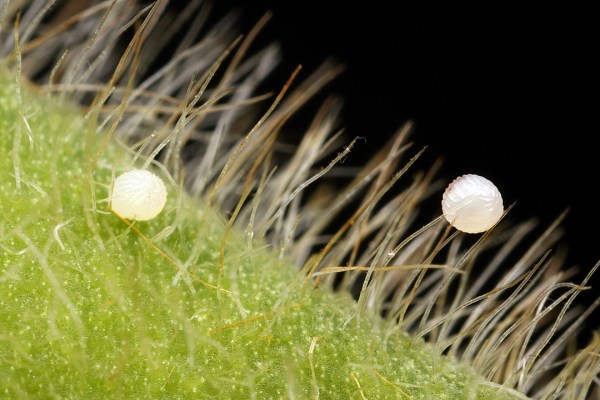
Anticarsia gemmatalis. Velvetbean caterpillar (“oruga de las leguminosas” in Argentina; “lagarta-da-soja” in Brazil) has long been the most important lepidopteran soybean pest throughout the New World. In North America its attacks are confined to the lower Mississippi River delta and southeastern Coastal Plain, but in South America nearly 100% of the soybean growing area is subject to attack. Eggs of this species are laid almost exclusively on leaf undersides throughout the canopy and are intermediate in size compared to the other species shown below (~7,000 eggs per gram). They are distinctive in their slightly flattened spherical shape and turn pinkish as they age and the developing larva takes form inside the egg.

Anticarsia gemmatalis—velvetbean caterpillar


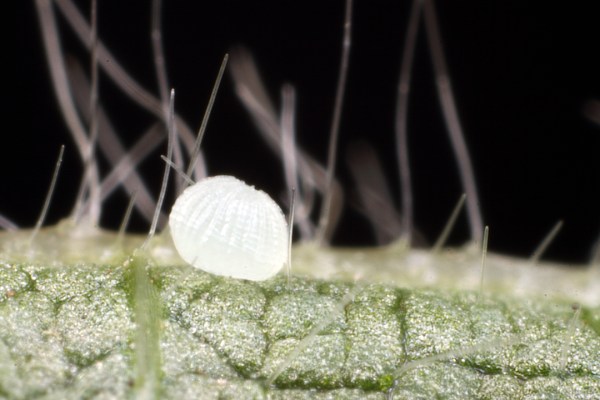
Chrysodeixis includens (=Pseudoplusia includens). Soybean looper (“oruga medidora falsa” in Argentina; “lagarta falsa-medideira” in Brazil) was until recently primarily a North American pest with the same southern occurrence as velvetbean caterpillar. In recent years, however, it has gained importance in Brazil and northern Argentina as well, with its impact magnified by the capacity to develop resistance against most of the insecticides that have been used to control it. The egg of this species is quite small (~10,000 eggs per gram) and are are irregularly spherical with a somewhat translucent, crystalline appearance. Like velvetbean caterpillar, eggs of this species are laid almost exclusively on the leaf undersides, but the moths exhibit a clear preference for the middle or upper canopy depending upon plant growth stage.

Chrysodeixis includens (= Pseudoplusia includens)—soybean looper


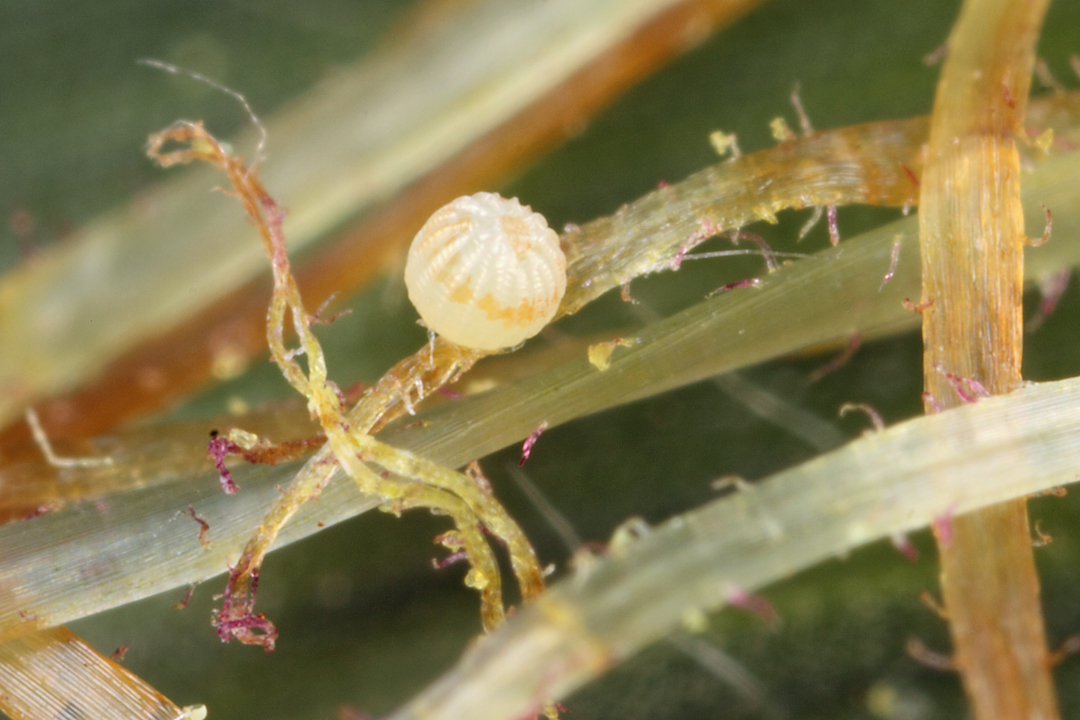
Helicoverpa zea. Soybean podworm is better known in other crops as corn earworm, cotton bollworm, or tomato fruitworm (a testament to its polyphagous nature), and in South America the common names are even more diverse depending on both crop and country (“gusano bellotero,” “gusano cogollero del algodón,” “gusano elotero,” “isoca de la espiga en maíz,” or simply “bolillero” in Argentina; “lagarta-da-espiga-do-milho” or “broca-grande-do-fruto in Brazil). While it has long been considered a secondary pest of soybean in North America, recent years have seen a marked increase in its incidence across the mid-south growing areas. Unlike the above two insects, larvae of this species feed not only on foliage but also directly on pods, typically breaching the pod wall and consuming the developing seeds inside. This method of feeding not only causes direct yield impacts but also affords some protection to larvae from insecticide applications.

Also unlike the first two insects, eggs of this species can be laid anywhere on the plant—leaves (upper or lower surface), petioles, stems, pods, and even flowers. The eggs are rather large compared to the other species shown here (~3,500 eggs per gram) and assume a distinctive barrel shape when laid on the leaf. The creamy-white coloration, often with a light brown ring below the apex, is also distinctive compared to the previous two species. Eggs laid on pods tend to be attached to trichomes (hairs) rather than the pod surface, in which case they take on an almost perfectly spherical shape.

Helicoverpa zea—soybean podworm

Helicoverpa zea eggs on soybean pod


Heliothis virescens. Like the previous species, tobacco budworm has only recently gained attention as a pest of soybean. This importance, however, seems to be confined to Brazil (where it is known as “lagarta-das-maçãs”), while in North America it is usually found in combination with H. zea at minor levels. This is bad news for South American farmers; like soybean looper, tobacco budworm has developed resistance to all the insecticides that have been used against it in significant quantities. The oviposition and feeding behaviors of this species are very similar to those of H. zea, with eggs again laid on all parts of the plant and being very similar in appearance to those of H. zea except their slightly smaller (approx. 5,000 eggs per gram). In practical terms, eggs and young larvae of H. virescens and H. zea can be reliably distinguished only through species-specific immunoassay (Greenstone 1995) or feeding disruption bioassay using a diagnostic concentration of Bacillus thuringiensis ( Bailey et al. 2001).

Heliothis virescens—tobacco budworm

Heliothis virescens eggs on soybean pod.

As with H. zea, H. virescens eggs laid on pods tend to be stuck to hairs and assume a spherical shape.

This H. virescens egg has apparently died—note the shriveling and uniform black coloration.


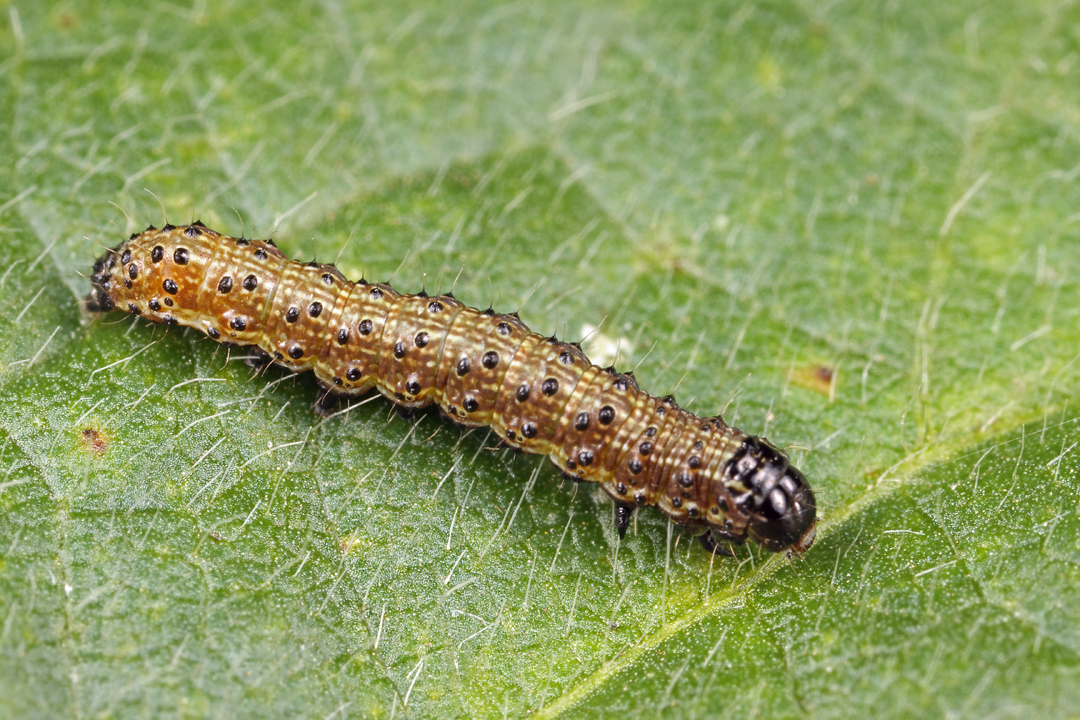
Spodoptera frugiperda. Fall armyworm is a minor pest of soybean that rarely reaches economically damaging levels. However, its incidence in South America (where it is called “oruga militar tarde in Argentina and “lagarta-militar” in Brazil) has increased somewhat with the adoption of no-till cultivation of soybean. The species prefers grass hosts, but when these are knocked down by applications of post-emergence herbicides the larvae then move onto the soybean plants and continue feeding. Unlike any of the above species, eggs are laid in distinctive masses that are covered by abdominal setae and wing scales for protection. These eggs are also small (~8,500 eggs per gram), exhibit much finer and more numerous ridges than the above species, and are often colored orange, pink, or light green.

Spodoptera frugiperda—fall armyworm

Individual eggs inside the mass are covered by abdominal setae and wing scales.


REFERENCES:

Bailey, W. D., C. Brownie, J. S. Bacheler, F. Gould, G. G. Kennedy, C. E. Sorenson & R. M. Roe. 2001. Species diagnosis and Bacillus thuringiensis resistance monitoring of Heliothis virescens and Helicoverpa zea (Lepidoptera: Noctuidae) field strains from the southern United States using feeding disruption bioassays. Journal of Economic Entomology 94 (1):76–85.

Greenstone, M. H. 1995. Bollworm or budworm? Squashblot immunoassay distinguishes eggs of Helicoverpa zea and Heliothis virescens (Lepidoptera: Noctuidae). Journal of Economic Entomology 88(2):213–218.

Copyright © Ted C. MacRae 2012

The “Big 3” of corn in Argentina

While leafcutter ants are one of the more unusual pests that Argentina corn farmers must deal with, the three most important confront farmers throughout the Western Hemisphere: stalk borers, earworms, and armyworms. In the U.S. the primary stalk boring pest of corn is the European corn borer (Ostrinia nubilalis), while in Argentina it is the sugarcane borer (Diatraea saccharalis). Corn earworm (Helicoverpa zea) and fall armyworm (Spodoptera frugiperda), on the other hand, are common to both countries. Here are some recent photos of the three species in Argentina – the first two on corn and the latter on soybean.

After you look at the photos, I have a funny story…

Diatraea saccharalis eggs ready to hatch | Buenos Aires Prov., Argentina

Helicoverpa zea egg on corn silk | Buenos Aires Prov., Argentina

Spodoptera frugiperda mid-instar larva on soybean | Buenos Aires Prov., Argentina

Learning to speak a foreign language via immersion can result in some embarrassingly funny moments. This afternoon I made an unplanned visit to the field with some colleagues. There has been much rain recently so the ground was rather muddy. Not having my boots with me, I picked my way through as best I could, and afterwards as I was cleaning the mud off my shoes, I commented (in Spanish) to one of my Argentine colleagues (a young female) that this was my only pair of clean shoes. I said everything okay but messed up the word for shoes—instead of saying “calzados” I said “calzones.”

In Argentina, calzones means “underwear.”

I’m really glad the shocked look on her face quickly gave way to hysterical laughter once she figured out what I was trying to say.

Copyright © Ted C. MacRae 2012

Return to La Reserva Ecológica Costanera Sur

Last March I discovered —a gem of natural beauty in the heart of Buenos Aires, Argentina.  Though its origins are semi-artificial, its biota a mix of native and introduced species, and its pathways continually choked with pedestrians and cyclists, for me it is a refuge—a place where I can spend an entire day looking for insects without ever retracing my footsteps.  Last Sunday after arriving in Buenos Aires, I couldn’t check into my hotel and change into my “bug collecting clothes” fast enough before making a beeline to the Reserve just a few blocks away.  I “discovered” a huge area on the east side of the Preserve that I hadn’t found during my last visit that was devoid of paved paths—and thus people—and spent the next several hours rummaging through the brush looking for insects to photograph.  Early November is early spring in Buenos Aires, and insect activity was still just beginning.  I did find a number of insects to photograph, though not as many as I had found during my early March visit.

This butterfly, which I regard as Actinote carycina (Yellow Lazy), was common around stands of a purple-flowered plant.  I watched this particular individual flit endlessly back and forth in front of one particular stand, rarely pausing long enough to allow a shot or two before resuming its patrols.  Vigorous aerial battles ensued every time another individual approached the stand, and although I can’t say for sure that it was this individual that always won, the same patrolling flight pattern resumed as soon as one of the contestants flew away.

Beetles were scarce, but I saw this particular species of Melyridae (presumably in the genus Astylus, and thus a close relative of Astylus atromaculatus or “spotted maize beetle”).  I don’t normally do random “bug-on-a-flower” photos, but I’ve recently become enamored with the use of “blue sky technique” for insect macrophotography and thought the red and black color of the beetle against the yellow flower it was feeding on was well suited for a blue background.  The beetle was quite small (only ~6 mm in length), thus requiring the 65mm 1–5X lens and full-flash illumination.  Normally this would result in a black background unless something is placed behind the subject, and I suppose I could just carry around a colored cards for placing behind subjects to get whatever color background I want.  However, there is something appealing to me in having the ability to achieve a blue sky by actually using the sky, despite the trickiness of the technique.  In this case, I  played with ISO settings of 400–640 and shutter speeds of 1/100 to 1/125 sec (settling at the high end of each range for this photo) to get the color of the sky true, then used low F.E.C. settings (-1 2/3 in this case) to temper the illumination of the subject.  I’m still not completely happy with the results—there is more motion blur in the photo than I would like, and I burned the yellows a little too much as well.  I think ISO800 and F.E.C. -2 or even lower would have given better results.  At any rate, this photo was the best of the bunch, and it will have to do.

Copyright © Ted C. MacRae 2011

“Sunflower looper” – Rachiplusia nu

Rachiplusia nu ''oruga medidora'' | Santa Fe Province, Argentina

With a planted area approaching 20 million hectares, soybean has become Argentina’s most important agricultural crop.  Most of the planted area is located within the so-called “Humid Pampas” region of central Argentina (Buenos Aires, Córdoba, Santa Fe and Entre Rios Provinces), but the crop continues to expand in the northestern part of the country as well (Chaco, Tucumán and Salta Provinces).  More than any other crop in Argentina (except perhaps cotton), soybean is attacked by a tremendous diversity of insects.  The most important of these are the defoliating Lepidoptera, primarily species in the family Noctuidae.  Anticarsia gemmatalis (velvetbean caterpillar) is the most consistent and widespread defoliator, but an increasingly important species in Argentina is Rachiplusia nu (“oruga medidora del girasol,” or sunflower looper).

Eggs are laid primarily on the undersides of leaves

Rachiplusia nu belongs to the noctuid subfamily Plusiinae, the larvae of which can be recognized by having three pairs of prolegs and the “looping” manner by which they walk.  Chrysodeixis includens¹ (soybean looper), much better known because of its status as a major pest of soybean in the southeastern United States (and of growing importance in Brazil as well), also belongs to this group, and in fact the larvae of the two species are quite similar in appearance.  While R. nu is the primary plusiine species affecting soybean in Argentina, C. includens has appeared with increased frequency on soybean in Argentina in recent years, primarily in the more northern, subtropical growing regions adjacent to those areas in Brazil where it is now a major pest of the crop.

¹ Although still widely referred to in the literature as Pseudoplusia includens, the genus Pseudoplusia was synonymized under Chrysodeixis some eight years ago by Goater et al. (2003).  More recently the synonymy was accepted and formally applied to the North American fauna by Lafontaine and Schmidt (2010). 

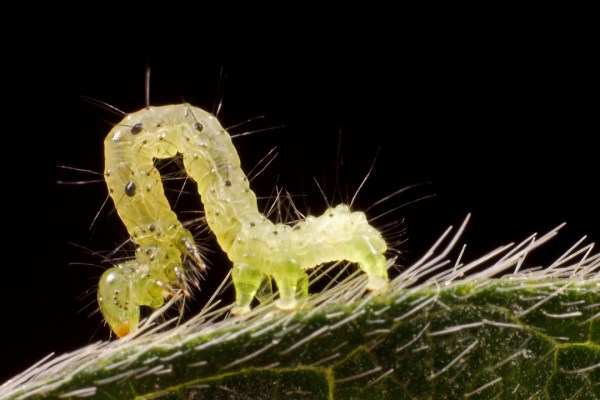
Neonate larva on soybean

Despite their similarity of appearance, larvae of the two species can be rather conclusively distinguished by the shape of their spinneret (Angulo and Weigert 1975).  This is not a very convenient character for use in the field, however, leading to misidentifications in areas where the two species co-occur.  This is not an insignificant problem, as the two species exhibit differing susceptibilities to pesticides labeled for their control (C. includens especially having become resistant to a number of pesticides).  The result is control failures and subsequent application of even more pesticides in an effort by farmers to protect their crops.  While not as conclusive as the shape of the spinneret, in my experience R. nu larvae (at least older larvae) tend to have a darker, smoky-blue cast to the color (compared to the bright yellow-green of C. includens) and rather distinct patches of tiny black asperites on the thoracic ventors that are not apparent in C. includens.

Younger larvae consume only the lower surface between veins, resulting in ''window paning''

As the common name implies, soybean is not the only crop attacked by R. nu.  Early season infestations tend to occur in alfalfa and flax, after which the populations spread to soybean and sunflower.  The latter crop especially is heavily attacked by this insect, primarily in the drier western regions in Córdoba Province.  Dry conditions seem to favor an increase in the populations of this species, while moist conditions promote increased incidence of pathogenic fungi that are very effective at suppressing R. nu larval populations.

Older larvae consume entire tissues but still avoid veins, resulting in a ''skeletonized'' appearance

Like many defoliating lepidopterans, eggs tend to be laid on the undersides of leaves, where the larvae begin feeding after they hatch.  Young larvae consume only the lower epidermal layer of the foliage between the veins, leading to an appearance in the foliage called “window paning”.  As they larvae grow they begin consuming the entire tissue layer but still preferentially avoid vascular tissue, resulting in a skeletonized appearance to the foliage.  A single larvae can consume more than 100 cm² of soybean foliage, which translates to several trifoliates.  As a result, it doesn’t take many larvae to cause significant loss of foliage on the plant.  Soybean has the ability to compensate for loss of foliage due to increased photosynthesis in lower foliage exposed by feeding in the upper part of the plant, but losses exceeding around 15% during the later reproductive stages of plant growth are enough to significantly reduce yields (and it is during these reproductive stages of growth that R. nu infestations tend to occur).

Rachiplusia nu adult | Buenos Aires Province, Argentina

Rachiplusia nu is the most widely distributed of three South American species in the genus, occurring in Argentina, Bolivia, Brazil, Chili, Paraguay, Peru and Uruguay, while a fourth species, R. ou, is widely distributed throughout North and Central America (Barbut 2008).  Unlike R. nu, its North American counterpart R. ou has not gained status as a pest of soybean or other crops.

In a BitB Challenge first, nobody was able to correctly ID the larva of this species beyond the level of subfamily.  This, despite the huge Argentina hint bomb that I dropped when I posted the challenge and my well-known vocation as a soybean entomologist.  I figured the answer would be forthcoming as quickly as one could Google the search phrase “Argentina soybean Plusiinae” (which, in fact, shows the following except for the very first result “Pseudoplusia includens is the most common soybean Plusiinae in the Americas (Herzog, 1980). Rachiplusia nu in southern Brazil, Uruguay and Argentina, and…” [emphasis mine]). Most participants guessed, predictably, soybean looper, while only a few were fooled into guessing Geometridae (the true loopers, and distinguished by having only two pairs of prolegs).  As a result, I’m not declaring a winner for ID Challenge #14, although the appropriate points will still be awarded (when I get around to assigning them, that is.  Hey, I’m working in Argentina right now—it was enough for me just to get this post out!).

REFERENCES:

Angulo, A. O. and G. T. H. Wiegert. 1975. Estados inmaduros de lepidópteros noctuidos de importance economica en Chile y claves para su determinación. Sociedad Biologico Concepción, Publicación Especial 1:1–153.

Barbut, J. 2008. Révision du genre Rachiplusia Hampson, 1913 (Lepidoptera, Noctuidae, Plusiinae). Bulletin de la Société entomologique de France113(4):445–452.

Goater, B., L. Ronkay and M. Fibiger. 2003. Noctuidae Europaeae. Vol. 10, Catocalinae, Plusiinae. Entomological Press, Sorø, 452 pp.

Lafontaine, J. D. and B. C. Schmidt. 2010. Annotated check list of the Noctuoidea (Insecta, Lepidoptera) of North America north of Mexico. ZooKeys 40: 1–239.

Copyright © Ted C. MacRae 2011

Brazil Bugs #16 – Royal Moth Larva

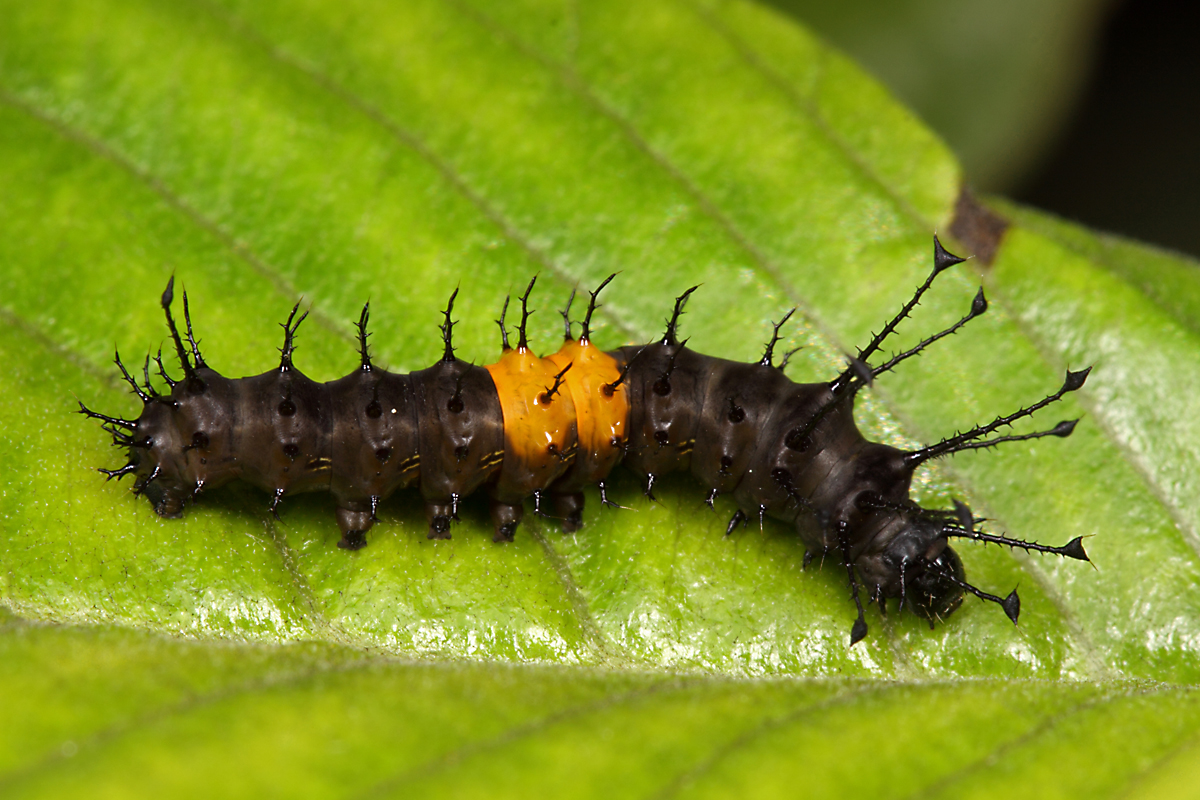
Citheronia laocoon? 1st instar larva | Campinas, Brazil

I was sure Super Crop Challenge #6 would be a win for the house, but Troy Bartlett scored an impressive points sweep by correctly deducing that the structures shown were the spines of an early instar caterpillar of “something akin to a hickory horned devil (Citheronia regalis).”  I found this caterpillar feeding on the foliage of a small tree in the Ciudad Universitaria (Distrito Barão Geraldo) area of Campinas, Brazil last January.  I must confess that I spent considerable time trying to identify it myself before I finally threw in the towel and called on the experts for help.  The spines made me think it must be some kind of nymphalid butterfly larva, although I had never seen such “fly swatter” clubs at the ends of the spines, so I sent the photo to Phillip Koenig, a local butterfly expert who has collected extensively in Ecuador.  He, too, was puzzled and forwarded the photo to Charley Eiseman, who himself didn’t know what to make of it and forwarded it on to Keith Wolfe, a lepidopterist who specializes in butterfly immatures.  After stumping his Brazilian contacts, Keith had the idea that perhaps it wasn’t a late-instar larva—as we all had assumed (this larva was a good 15–20 mm in length), but rather one in an early stadium.  A quick search of several standard websites revealed this to be the L1 or L2 larva of a species of Citheronia (Saturniidae, Ceratocampinae).  To support his ID, he provided links to larval photos of C. splendens (Arizona) and C. lobesis (Central America).  The L1 larva of both of these species bears the same “fly swatter” spines, and the latter is remarkably similar in color pattern as well.

In trying to determine what species of Citheronia occur in southeast Brazil, I came across this link with photos of a caterpillar from southern Brazil—the L1 looking nearly identical—that was eventually identified as the common Brazilian species C. laocoon.  Troy suggested C. brissotii—another good possibility as that species is found from southeastern Brazil through Uruguay to Argentina.  However, in perusing a number of online sources, it appears there are several other species of Citheronia that also occur in Brazil, so a species ID for the larva in this photo may not be possible.

Troy’s win vaults him into 3rd place in the current session overalls, but steady Tim Eisele took 2nd place with 6 pts and takes over the session lead.  Newcomer Roy rounds out the podium in 3rd place with 5 points.  Dave’s pity points are nothing to sneeze at, as they helped him retain sole possession of 2nd place in the overall standings (let that be a lesson to those who don’t play because they’re “stumped”!).  There will be at least two more challenges in the current session before a winner is crowned, so look for an opportunity to shake up the standings in the near future.

Copyright © Ted C. MacRae 2011

La Reserva Ecologica Costanera Sur

Reserva Ecológica Costanera Sur, Buenos Aires, Argentina.

I spent this past weekend in Buenos Aires, Argentina before embarking on a one-week whirlwind tour to visit field sites in several other parts of the country.  It was supposed to be a short rest stop, but I can do nothing of the sort when there are exotic lands to explore.  Despite its rank as the fourth largest city in South America and the location of my hotel in the heart of downtown, only a short walk was needed to arrive at Reserva Ecológica Costanera Sur, a 350-hectare park located on the banks of the Rio de la Plata.  Originating as a debris field from construction during the 1970s, sedimentation and subsequent revegetation have created a naturalistic setting reminiscent of the original wet Pampas grasslands that occurred in the area.

A system of levees with trails courses through the wet grasslands.

Coursing through the area is a system of levees topped with gravel walking/biking trails that have become flanked with woody vegetation.  Native species such as ceibo (Erythrina crista-galli) and palo borracho (Chorisia speciosa) are common, although exotics such as Canary palms (above photo) have also become established.  In total, more than 11 km of trails are available, and having as much time as I desired on Sunday to explore the area, I walked every one of them once (and some twice) for a total hike of close to 15 km (not counting my morning walk to the area and then back to my hotel during late afternoon).  I wouldn’t say the area was teeming with insects, and those that I did encounter are not too dissimilar from those I am more familiar with in North America.  However, this is the southern Neotropics, so just about everything I encountered was something I had not seen before.  I went photography-crazy, snapping more than 250 shots on the day (and keeping about 100).

Leptodactylus ocellatus (rana criolla).

This frog was the first thing I encountered, even before walking through the Reserve gates.  Using the galleries at this fan site I believe it to represent Leptodactylus ocellatus (rana criolla, or “Creole frog”).  He was a sad sight when I first saw him – dry and dusty on the sidewalk outside of the Reserve.  I passed him by at first thinking he must be dead, then came back when my conscious started complaining, only to find him still alive.  I bathed him in water from my bottle, which perked him up rather quickly (not to mention making him much more photogenic!).  After a few photos, he revived sufficiently to jump off the stone wall bordering the Reserve into the grassy marsh.  I had done my good deed for the day.

Leptodactylus ocellatus (rana criolla) - my attempt at a natural light closeup.

Parabuteo unicinctus unicinctus (Gavilán Mixto) (I think!).

Also just before entering the Reserve gates, I scared up this hawk who flew a short distance ahead and landed on a post facing me.  Now, I have never once in my life attempted to photograph a bird, and with my longest lens being only my 100mm macro I’m ill-equipped for such even if I wanted to.  However, the hawk did not fly too quickly as I cautiously re-approached, and when I was within range I decided to give it a try.  I carefully crouched to ready my equipment and then cautiously rose to take a shot, and right then the hawk decided to take off.  Not a great shot, of course, but not bad either – especially for a first bird shot ever, and good enough to give me some amount of confidence in my ID as Parabuteo unicinctus (Gavilán Mixto, or “Mixed Hawk” – known in the U.S. as Harris’ Hawk).

Riodina lysippoides (Danzarina Chica)

Insect activity was rather light for the first couple hours after I arrived, but as the day began to heat up so did the number and diversity of the insects that I encountered.  While I waited for activity to pick up, I saw this pretty little butterfly that seemed surely a type of metalmark (family Riodinidae) and that I later identified as Riodina lysippoides (Danzarina Chica, or “Smaller Dancer”).  Shortly after taking this photo, I encountered another photographer who was obviously after insects.  I approached him and introduced myself to see what he was looking for, and it was butterflies.  I showed him my photo, but he did not know the name of the butterfly, only commenting that it was “bastante común” (common enough).  I’m confident in my ID, but this North American beetle collector won’t be too embarrassed if one of you lepidopterists needs to provide a correction.  I did see one other photographer that day as well, presumably after birds based on the yard-long lens he was carrying, but I did not talk to him.  Otherwise, I got plenty of strange looks from the hordes of walkers, runners, bikers, and picnickers that had come out to enjoy this Carnival weekend Sunday!

Copyright © Ted C. MacRae 2011


Monday Moth – Polka-dot Wasp Moth

Syntomeida epilais - polka-dot wasp moth

It’s been a while since I’ve done a Monday Moth post, so I thought I’d feature one of the prettier specimens in my very limited Lepidoptera collection.  This is Syntomeida epilais (polka-dot wasp moth), one of four species in the genus that occurs in the United States.  This particular specimen was collected by me way back in the mid-1980s (I was not quite yet the discriminating beetle collector that I am now) in Everglades National Park (yes, I had a permit).  The bright, contrasting coloration obviously screams aposematism (warning coloration), and in fact the tissues of the adult moths of this species are chock-full of several cardiac glycosides sequestered by the larva from its now preferred food plant, oleander (Nerium oleander).  Add to it their somewhat wasp-like appearance, and there should be no question to any would-be predator that these moths are a bad idea.  Wasp moths are related at the tribal level to another group of wasp-like moths called maidens which are restricted to the Old World.  I featured one of these from South Africa last year in the post, Monday Moth – Simple Maiden (Amata simplex).

If the cardiac gycosides stored in the tissues of this moth aren’t enough to cause gastric distress, trying to digest the higher taxonomic history of this group surely will.  Back in my school days, this moth belonged to the family “Ctenuchidae.”  As best I understand it, this group was later subsumed into the tiger moth family “Arctiidae” – itself later subsumed within the borg of all moth families, the Noctuidae.  In the most recent classification I’ve found, the arctiine moths have been pulled back out of the Noctuidae and combined with the former “Lymantriidae” (propelled to infamy by the gypsy moth) to form the family Erebidae (Lafontaine and Schmidt 2010).  Are you ready to purge yet? It’s still not clear to me whether this latest incarnation represents a consensus monophyletic unit, but it really doesn’t matter – whenever I see wasp moths, maidens, and especially the ctenucha moths that are so common in my area on goldenrod flowers during the fall, “ctenuchid” will still be the first name that comes to my mind.

REFERENCE:

Lafontaine, J. D. and B. C. Schmidt.  2010.  Annotated check list of the Noctuoidea (Insecta, Lepidoptera) of North America north of Mexico.  ZooKeys 40:1–239.  doi: 10.3897/zookeys.40.414

Copyright © Ted C. MacRae 2011