A plea for comments on ICZN Case 3769

The latest issue of the Bulletin of Zoological Nomenclature contains Case 3769 (Bílý et al. 2018), in which my coauthors and I ask the International Commission on Zoological Nomenclature to declare the privately published pamphlet “Procrustomachia” as an unavailable work for nomenclatural purposes. This pamphlet, first issued in 2016, is authored, edited, and produced (I hesitate to use the word “published”) by a single individual—Roman B. Hołyński, who has used the pamphlet as a vehicle for describing new taxa of jewel beetles (family Buprestidae, order Coleoptera). Each issue of the pamphlet is presented in the form of a PDF file under the guise of the “Occasional Papers of the Uncensored Scientists Group” and distributed electronically by Hołyński himself via e-mail and uploaded to his personal page on the social network site ResearchGate. By the time our case went to press, Hołyński had described one new genus, eight new subgenera, 17 new species, and one new subspecies of jewel beetle—three additional new subgenera and five new species have been proposed since.

We are asking the Commission to declare the pamphlet as an unavailable work because it does not satisfy the requirements for publication of scientific names in zoology according to provisions in the International Code of Zoological Nomenclature (ICZN 1999) and its amendments (ICZN 2012), thus making the names published within them unavailable for nomenclatural purposes. The pamphlets do not qualify as valid electronic publications because 1) they are not deposited in a recognized archive and 2) the new names within them are not registered at ZooBank prior to electronic distribution. Both of these conditions must be met in order to qualify as valid electronically-issued works. As a result, the validity of the works can only be based on printed copies. Here also the pamphlet does not satisfy the ICZN requirement of “numerous identical and durable copies” for works issued as printed copies. No information is given in any of the volumes regarding where printed copies may be obtained, and our online searches have revealed only three institutions where printed issues have been deposited—the Polish National Library being the only one of the three that lists a complete set of issues. This gives grounds to assume that the initial print run is far too small to be considered a valid printed work for nomenclatural purposes.

There is a larger issue at stake than just the validity of “Procrustomachia” and the availability of the names proposed within it. Privately-produced pamphlets that ignore safeguards against modification and ensuring long-term availability to the scientific community represent a threat to the stability of taxonomic nomenclature. Such safeguards and the commonly accepted rules for publishing new names in zoology are likely to be ignored by irresponsible, very often commercial collectors, ambitious individuals, or poorly qualified amateurs. The ICZN needs a tougher approach regarding publication criteria for new names, for example, to be bound to peer-reviewed professional journals (both printed and electronic, but printed preferably) with international editorial boards including highly qualified taxonomists. If such approach is not implemented soon, we could be facing an avalanche of PC-printed “home-made” new names. A more detailed background and discussion of this issue was presented by Bílý & Volkovitsh (2017).

Comments on this case are invited for publication (subject to editing) in the Bulletin of Zoological Nomenclature. Send comments to the Secretariat, ICZN, Lee Kong Chian Natural History Museum, 2 Conservatory Drive, Singapore 117377, Republic of Singapore (e-mail: iczn@nus.edu.sg).

REFERENCES:

Bílý, S. & M. G. Volkovitsh. 2017. New unavailable names in Buprestidae (Coleoptera) and a short comment on the electronic publication of new names. Zootaxa 4243(2):371–372 [abstract].

Bílý, S., M. G. Volkovitsh & T. C. MacRae. 2018. Case 3769 – Proposed use of the plenary power to declare the pamphlet “Procrustomachia” as an unavailable work. Bulletin of Zoological Nomenclature 75(31 December 2018):220–224. ISSN 2057-0570 (online) [pdf].

ICZN (International Commission on Zoological Nomenclature). 1999. International Code of Zoological Nomenclature, 4th Edition. International Trust for Zoological Nomenclature, London, xxix + 306 pp. [online version].

ICZN (International Commission on Zoological Nomenclature). 2012. Amendment of Articles 8, 9, 10, 21 and 78 of the International Code of Zoological Nomenclature to expand and refine methods of publication. Bulletin of Zoological Nomenclature 69:161–169 [full text].

© Ted C. MacRae 2019

New Publications on Buprestidae and Cerambycidae

Crossidius hirtipes allgewahri

Crossidius hirtipes allgewahri LeConte, 1878

I’ve been busy processing photos and a preparing a write-up of an insect collecting trip to New Mexico this past June—look for a series of posts about the trip in the near future!

In the meantime, I’ve had a couple more publications come out since the end of last year—both as part of joint efforts to document beetle diversity at the state level. The first of these came out in vol. 71, no. 4 of The Coleopterists Bulletin (published 18 Dec 2018) and presents a checklist of the Cerambycidae of Idaho with notes on selected species. The citation is:

Rice, M. E., F. Merickel & T. C. MacRae. 2017. The longhorned beetles (Coleoptera: Cerambycidae) of Idaho. The Coleopterists Bulletin 71(4):667–678 [pdf].

The photo of Crossidius hirtipes allgewahri LeConte, 1878 (see above—which was actually photographed in Moffatt Co., Colorado and is, I think, the very first species of the genus that I photographed) also appeared in that article.

The second paper was just published a couple of weeks ago (20 June 2018) in vol. 72, no. 2 of The Coleopterists Bulletin (I am still waiting for my hard copy in the mail!). It presents an annotated checklist of the Buprestidae of Louisiana.

Carlton, C. E., T. C. MacRae, A. Tishechkin, V. L. Bayless & W. Johnson. 2018. Annotated checklist of the Buprestidae (Coleoptera) from Louisiana. The Coleopterists Bulletin 72(2):351–367 [pdf].

As always, a complete list of my publications with links to abstracts or pdfs can be found under “My Publications“.

© Ted C. MacRae 2018

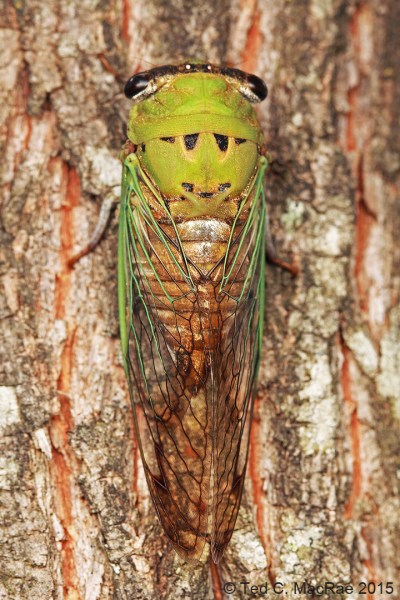
A “superb” southwestern Missouri cicada

Back in the summer of 2015, I made an early August trip to the White River Hills region of extreme southwestern Missouri. I was actually looking for one of Missouri’s more uncommon cerambycid beetles – Prionus pocularis, associated with shortleaf pine in the mixed hardwood/pine forests across the southern part of the state. I did not encounter the beetle in either my prionic acid-baited pitfall traps or at the ultraviolet lights I had set up the evening before, but while I was in the area I thought I would visit one of my favorite places in the region – Drury-Mincy Conservation Area in Taney Co. Sitting right on the border with Arkansas, the rolling hills of this area feature high-quality dolomite glades and post oak savannas. I’ve had some excellent collecting here in the past and hoped I would find something of interest this time as well. I didn’t arrive until after midnight, and since there are no hotels in the area I just slept in the car.

Neotibicen superbus

Neotibicen superbus

The next morning temperatures began to rise quickly, and with it so did the cacophony of cicadas getting into high gear with their droning buzz calls. As I passed underneath one particular tree I noticed the song was coming from a branch very near my head. I like cicadas, but had it been the song of a “normal” cicada like Neotibicen lyricen (lyric cicada) or N. pruinosus (scissor grinder cicada) I would have paid it no mind. It was, instead, unfamiliar and distinctive, and when I searched the branches above me I recognized the beautiful insect responsible for the call as Neotibicen superbus (superb cicada), a southwest Missouri specialty—sumptuous lime-green above and bright white pruinose beneath. I had not seen this spectacular species since the mid 1980s (most of my visits to the area have been in the spring or the fall rather than high summer), and I managed to catch it and take a quick iPhone photograph for documentation. A species this beautiful, however, deserves ‘real’ photos, so I spent the next couple of hours attempting to photograph an individual in situ with the big camera. Of course, this is much, much easier said than done, especially with this species—their bulging eyes give them exceptional vision, and they are very skittish and quick to take flight. Most of the individuals that I located were too high up in the canopy to allow a shot, and each individual that was low enough for me to approach ended up fluttering off with a screech before I could even compose a shot, much less press the shutter. Persistence paid, however, and I eventually managed to approach and photograph an unusually calm female resting – quite conveniently – at chest height on the trunk of a persimmon tree.

Sanborn-Phillips_2013_Fig-16

Source: Sanborn & Phillips (2013).

According to Sanborn & Phillips (2013, Figure 16 – reproduced above), Neotibicen superbus, is found in trees within grassland environments primarily in eastern Texas and Oklahoma, although records of it exist from each of the surrounding states – especially southern Missouri and northern Arkansas (Figure 16 below, Sanborn & Phillips 2013). Later the same day I would see the species abundantly again in another of the region’s dolomite glades – this one in Roaring River State Park further west in Barry Co., suggesting that dolomite glades are the preferred habitat in this part of its range. Interestingly, I think the Missouri records at least must be relatively recent, as Froeschner (1952) did not include the species in his synopsis of Missouri cicadas. This was all the information I had back in the 1980s when I first encountered the species in southwestern Missouri, its apparent unrecorded status in the state making it an even more exciting find at the time.

Neotibicen superbus

Neotibicen superbus

REFERENCES:

Froeschner, R. C.  1952. A synopsis of the Cicadidae of Missouri. Journal of the New York Entomological Society 60:1–14 [pdf].

Sanborn, A. F. & P. K. Phillips. 2013. Biogeography of the cicadas (Hemiptera: Cicadidae) of North America, north of Mexico. Diversity 5(2):166–239 [abstractpdf].

© Ted C. MacRae 2018

Cover Photo—The Coleopterists Bulletin 71(4)

The December 2017 issue of The Coleopterists Bulletin (vol. 71, no. 4) is hitting mailboxes now, and once again I have the honor of providing the cover photo. This one features an adult of the cactus beetle, Moneilema armata (Coleoptera: Cerambycidae) on its host, cholla (Opuntia imbricata). I photographed this beetle in June 2014 near Vogel Canyon in Otero Co., Colorado. Cactus beetles are notorious for hiding deep within the mass of spiny stems and branches of their hosts, making long forceps an absolute necessity for collecting them. Occasionally, however, they venture out onto more exposed parts of the plant—in this case, up near the tip of a stem and onto a nearly open flower bud, and the value contrast between the black beetle, green stem, pink flower, gold spines, and blue sky made for a truly lovely composition. If I have only one regret about the photo, it was the stiff southerly wind that kept blowing the beetle’s left antenna and preventing it from matching the perfectly symmetrical arc of the right antenna—a small complaint.

This is another example of the flash-illuminated subject with natural blue sky background technique that I have become so fond of, at least for diurnal insects resting on flowers and foliage. I learned this technique from John Abbott a few years earlier at the inaugural BugShot Workshop in Gray Summit, Missouri (just 15 miles from my home), and it has since become my default background and part of my signature style.

This is the fourth issue of The Coleopterists Bulletin to feature one of my photographs on the cover. The first was the June 2013 (vol. 67, no. 2) issue, featuring the stunning green weevil Eurhinus cf. adonis, and the very next issue (September 2013, vol. 67, no. 3) featured the jewel beetle Chrysobothris octocola. Two years later I had a photo on the cover of the March 2015 (vol. 69, no. 1) issue, a striking red and black longhorned beetle Crossidius coralinus fulgidus.

If you’re not one already, consider becoming a member of The Coleopterists Society (I’ve been one for 36 years now!). Their flagship journal, The Coleopterists Bulletin, is your one-stop shop for all things beetley—a quarterly fix of pure elytral ecstacy! Membership also includes online access to archives of past issues via JSTOR and BioOne.

© Ted C. MacRae 2018

Ellipsoptera lepida – ghost tiger beetle

In the early 2000s, Chris Brown and I were beginning our general survey of Missouri tiger beetles. Our goal was to characterize the occurrence and distribution of all species within the state. At the time, 22 species were known to occur in Missouri, and our work would uncover the presence of two more—one being a vagrant occurrence of the widespread Cicindelidia trifasciata ascendens (ascendent tiger beetle) (Brown & MacRae 2005); the other being the rare Cylindera celeripes (swift tiger beetle) (MacRae & Brown 2011). Of the species already known from the state, however, some were known from only a few records and hadn’t been seen in the field by either Chris or myself. One such species was Ellipsoptera lepida (ghost tiger beetle), an almost pure white species known to occur in deep, dry sand habitats over most of central North America (Pearson et al. 2015). At that time, I had still seen only the more common species in Missouri, and the combination of its name and unusual, mostly-white color put this species high on my “must see” list.

Ellipsoptera lepida (ghost tiger beetle)

My first experience would come quickly. In June 2001, Chris and I visited a recent addition to Weldon Spring Conservation Area on the north side of the Missouri River in St. Charles Co. called Darst Bottoms. The area at one time was productive farmland, but the “Great Floods” of 1993 and 1995 left deep deposits of sand over the area. While no longer suitable for agriculture, the process of succession allowed valuable wildlife habitat to develop, and the area was purchased and added to the Conservation Area. By the time of our visit in 2001, early succession had resulted in young forests of mostly eastern cottonwood (Populus deltoides) surrounding a vast central plain of white sand. Chris and I didn’t know what to expect on that first visit, both of us being in the early stages of our survey of Missouri tiger beetles, but we figured we would find something interesting.

Ellipsoptera lepida (ghost tiger beetle)

I still remember the moment I first saw E. lepida and realized what it was. We had already found Cicindela formosa generosa (eastern big sand tiger beetle)—the first time I had seen that species in Missouri outside the southeastern lowlands (we would eventually find it at many sites along the Missouri and Mississippi Rivers and a few smaller interior rivers)—and were searching for additional specimens. We were in a small opening adjacent to the larger central plain when I thought I saw something move near my feet. I stopped to look down but didn’t see anything, so I began walking again while scanning the ground ahead of me. Again, I thought I saw movement nearby and stopped to look, this time pausing a little longer and doing so a little more carefully. That’s when I saw it, and even though I had seen only photographs of the species and museum specimens I recognized it instantly for what it was and yelled out “lepida!” Chris came over to see for himself, and we marveled at the effectiveness of their camouflage—they seemingly were able to disappear right before our eyes even though we were looking right at them.

Sand plain habitat for Ellipsoptera lepida (ghost tiger beetle).

Over the next few years, Chris and I found the species at several sites along or not too distant from the Missouri and Mississippi Rivers—always on sand deposits deep enough to become dry. We never found them in great numbers, sometimes just single individuals while other sand residents were abundant, and not at all sites where we did find more reliable species such as C. f. generosa and C. tranquebarica (oblique-lined tiger beetle). Pearson et al. (2015) mention that despite the broad distribution of this species across central North America that its actual occurrence is rather spotty and localized and that it has disappeared from many sites where it was previously known to occur. This was our experience in Missouri as well, as many of the museum records we had gleaned for the species no longer appeared to support populations of the beetle. This is likely due, at least in part, to the ephemeral nature of the habitats on which the species depends, at least those along the big rivers that are vulnerable to revegetation and succession back to bottomland forest.

Ellipsoptera lepida (ghost tiger beetle)

Of course, all of this occurred long before I took up insect macrophotography in 2009, and while I had managed to photograph most of the tiger beetle species in Missouri in the years that followed, E. lepida was one that I continued to lack. In the summer of 2015 I decided to rectify that situation and, when the time was right, returned to Darst Bottoms in hopes of finding and photographing this species. Imagine my surprise when I hiked into the area and, instead of young cottonwood stands surrounding a vast, barren sand plain, I found mature cottonwood forests surrounding a thickly vegetated sand prairie with only isolated patches of barren sand. Needless to say, with such little suitable habitat for the beetles they were neither abundant nor even common. In fact, the only evidence I found that told me they were still there at all was coyote scat containing unmistakable remains of the adult beetles. Skunked on my first effort, I decided to try another spot where we had seen good populations of the beetle—Overton Bottoms Conservation Area along the Missouri River in Cooper and Monteau Counties in central Missouri, now Overton Bottoms South Unit and part of the Big Muddy National Wildlife Area. Like Darst Bottoms, this area had experienced revegetation and succession in the decade+ since my previous visit; however, unlike the former there still remained a vast central plain that, while vegetated, was sparsely vegetated enough to continue providing suitable habitat for the beetle. It took some work, but I eventually found the beetles localized in one part of the sand plain (see photograph ), and there were enough of them out at the time of my visit that I succeeded in getting the series of photographs shown in this post.

Ellipsoptera lepida (ghost tiger beetle)

I have fond memories of all 24 tiger beetle species in Missouri—each one presenting a unique collection of experiences that will fuel my love affair with the group for years to come. With E. lepida, the jubilance and excitement of that first, unexpected encounter remains near the top of the list for me.

REFERENCES:

Brown, C. R. & T. C. MacRae. 2005. Occurrence of Cicindela (Cicindelidia) trifasciata ascendens (Coleoptera: Cicindelidae) in Missouri. Cicindela 37(1–2):17–19 [pdf].

MacRae, T. C. & C. R. Brown. 2011. Historical and contemporary occurrence of Cylindera (s. str.) celeripes (LeConte) (Coleoptera: Carabidae: Cicindelinae) and implications for its conservation. The Coleopterists Bulletin 65(3):230–241 [pdf].

Pearson, D. L., C. B. Knisley, D. P. Duran & C. J. Kazilek. 2015. A Field Guide to the Tiger Beetles of the United States and Canada. 2nd Edition. Oxford University Press, New York, 264 pp. [Oxford description].

© Ted C. MacRae 2017

Cicindela scutellaris flavoviridis (chartreuse tiger beetle)

In previous posts I have discussed some Texas subspecies of Cicindela scutellaris (festive tiger beetle) and C. formosa (big sand tiger beetle)—two widespread and geographically variable species that occur broadly across eastern North America and that segregate into several distinctive and geographically restricted subspecies (Pearson et al. 2006). With the former species, I actually found two of its Texas subspecies, the second being C. s. flavoviridis (dubbed the “chartreuse tiger beetle” by Erwin & Pearson, 2008). This subspecies occurs in a narrow band from north-central Texas south to central Texas and apparently does not intergrade with rugata (which I featured previously) to the east (Pearson et al. 2006) and minimally with subspecies lecontei to the north (Vaurie 1950).

Cicindela scutellaris flavoviridis

Cicindela scutellaris flavoviridis

This beautiful subspecies usually lacks maculations, at most possessing two tiny ivory white spots along the outer edge of the elytra, and the shining metallic upper body surface is the most stunning shade of greenish-yellow, or chartreuse, color that I have ever seen. It shares with C. s. rugata a more wrinkled pronotum and smoother head than other C. scutellaris subspecies, but the latter is distinguished by its darker blue to blue-green dorsal coloration. Vaurie (1950) regarded C. s. flavoviridis to be intermediate between rugata and scutellaris but more closely related to the latter due to their shared yellow/coppery reflections on the elytra. Cicindela s. flavoviridis can also be confused with immaculate forms of C. sexguttata (six-spotted tiger beetle), but the latter is less robust with a more tapered posterior, and both sexes of C. sexguttata have a whitish labrum—in all C. scutellaris subspecies only males have a white labrum and females have a dark/black labrum.

Cicindela scutellaris flavoviridis

Cicindela scutellaris flavoviridis

Like all of the other C. scutellaris subspecies, this one occurs in deep, dry sand habitats such as dunes, blowouts, and road cuts. I found this population along a tributary of the Red River known as Cobb Hollow” in Montegue Co., Texas in early October 2015, where they occurred in small numbers on deep sand bars alongside the small creek. I actually made two visits to this site one week apart—failing the first time in my efforts to obtain good, in situ field photographs but succeeding on the second visit.

Cicindela scutellaris flavoviridis

Cicindela scutellaris flavoviridis

I am quite satisfied with these photos, especially the first one above that gives a good lateral view of an adult striking an interesting pose on sloped sand, although I would have liked to have gotten at least one with some foliage in the photo to add a bit of perspective. Nevertheless, having now succeed in photographing the four “western” subspecies of C. scutellaris (rugata and flavoviridis in Texas, nominate scutellaris in the Great Plains, and yampae in northwestern Colorado), I am now motivated to get good photographs of the three “eastern” subspecies: lecontei proper (there are populations in northern Missouri), rugifrons along the North Atlantic coast, and unicolor in the southeastern U.S. (although I have photographed an interesting lecontei × unicolor intergrade population in southern Missouri).

REFERENCES:

Erwin, T. L. & D. L. Pearson. 2008. A Treatise on the Western Hemisphere Caraboidea (Coleoptera). Their classification, distributions, and ways of life. Volume II (Carabidae-Nebriiformes 2-Cicindelitae). Pensoft Series Faunistica 84. Pensoft Publishers, Sofia, 400 pp [Amazon descriptionbook review].

Pearson, D. L., C. B. Knisley & C. J. Kazilek. 2006. A Field Guide to the Tiger Beetles of the United States and Canada. Oxford University Press, New York, 227 pp. [Oxford description].

Vaurie, P. 1950. Four new subspecies of the genus Cicindela (Coleoptera, Cicindelidae). American Museum Novitates 1458:1–6 [AMNH Digital Library pdf].

© Ted C. MacRae 2017

New paper: Buprestidae from El Limón de Cuauchichinola, Mexico

A new paper (of which I am a co-author), published in the latest issue of The Pan-Pacific Entomologist, gives the results of a systematic survey of Buprestidae in a tropical deciduous forest at El Limón de Cuauchichinola, municipality of Tepalcingo, in Morelos, Mexico. Four subfamilies, 12 tribes, 19 genera, and 73 species were recorded, with the genera Agrilus Curtis, 1825, Chrysobothris Eschescholtz, 1829, and Acmaeodera Eschscholtz, 1829 having the greatest number of species. We estimate that only 68% of buprestid species occurring in the forest were recorded. An appendix lists the species, of which eight represent new records for the Sierra de Huautla Biosphere Reserve and two represent new records for the state of Morelos.

Corona-López, A. M., Reza-Pérez, E. V., V. H. Toledo-Hernández, A. Flores-Palacios, T. C. MacRae, R. L. Westcott, H. A. Hespenheide & C. L. Bellamy. 2017. Diversity of Buprestidae (Coleoptera) from El Limón de Cuauchichinola, Tepalcingo, Morelos, Mexico. The Pan-Pacific Entomologist 93(2):71–83 [pdf].

© Ted C. MacRae 2017

Cicindela formosa pigmentosignata (the “reddish-green sand tiger beetle”)

In my last post, I discussed Cicindela scutellaris rugata, the so-called “wrinkled fetiger beetle” (Erwin & Pearson 2008)—one of several geographically restricted subspecies of a more widespread and geographically variable species. This was not the only goal of the day, however, as I was also hoping to see a second geographically restricted subspecies—Cicindela formosa pigmentosignata, the “reddish-green sand tiger beetle (Erwin & Pearson 2008). The parent species of these two species show remarkably similar patterns of distribution, habits, and diversification—both occur most commonly as nominotypical subspecies in the Great Plains but have also expanded eastward and diverged there and around the periphery of their range into a number of distinctive subspecies; both favor deep, dry sand habitats without standing water; and both exhibit a “spring/fall” life history where sexually immature adults emerge in fall, pass the winter in burrows, and emerge again in spring ready to mate and lay eggs. In fact, these two species are so inextricably linked to each other that throughout most of their range, where one is found usually so is the other, and where one is represented by a distinctive subspecies so is the other. The main exception to this is in the far southeastern U.S., where C. scutellaris has established as the subspecies C. s. unicolor in sandy forest openings but C. formosa has not.

Cicindela formosa pigmentosignata

Cicindela formosa pigmentosignata W. Horn, 1930—Van Zandt Co., Texas

Cicindela formosa currently contains five recognized subspecies (Pearson et al. 2006)—the nominate subspecies (big sand tiger beetle) found west of Missouri (and which I’ve photographed in Nebraska), C. f. generosa (eastern sand tiger beetle) found in Missouri (photographed here and here) and further east, C. f. gibsoni (Gibson’s sand tiger beetle) found in Colorado and Manitoba (the consubspecificity of these two widely disjunct populations currently being the subject of debate), C. f. rutilovirescens (Mescalero sand tiger beetle) found in New Mexico (and which I’ve seen and collected a single specimen, but before my days as a photographer), and this one: C. f. pigmentosignata from eastern Texas and neighboring areas of Arkansas and Louisiana. Rumpp (1986) proposed that the parent species, C. formosa, radiated in central North America, adapting to barren sand conditions, dispersing along sand hills and major river systems into other areas, and ultimately diverging into the currently recognized subspecies.

Cicindela formosa pigmentosignata

Adults commonly exhibit “shade seeking” behavior during the hotter parts of the day.

As with C. s. rugata, I found this subspecies in a couple of old, rural cemeteries in eastern Texas (Henderson and Van Zandt Counties)—the photos shown here are from the second locality and were taken during the afternoon in the heat of the day. Because of this the beetles were quite wary and difficult to approach, but they also exhibited much more photogenic behaviors related to thermoregulation such as stilting and shade seeking. As I stalked the beetles through the deep, dry sand trying to get photographs, I was reminded yet again of why I love this species of tiger beetle so much—their bulk; their bulging eyes; their long, looping escape flights that end with a comical bounce and tumble, only to end up on their feet and facing their pursuer. These beetles are loaded with personality and behavioral charisma, and this particular subspecies with its brilliant and almost completely immaculate reddish-purple elytra and vividly contrasting blue-green legs and sides was an especially treasured sight to behold (especially after failing in my first attempt to find it back in 2012).

Cicindela formosa pigmentosignata

“Stilting” is another thermoregulatory behavior designed to raise the body up off the hot sand.

I am reasonably satisfied with these photos, although I would have liked to have gotten at least one without some part of the beetle obscured by foliage. That said, I now prefer some foliage in my tiger beetle photos, as I think it adds a bit of perspective, and when it is in the context of thermoregulatory behavior so much the better. And so, having now gotten good field photographs of this subspecies I am motivated more than ever to return to the Mescalero Sand Dunes in New Mexico and find and photograph C. f. rutilovirescens to complete my photographic “collection” of subspecies of the sand tiger beetle. Of course, by then I will probably be sufficiently dissatisfied with my existing photos of the other subspecies (already so with those of C. f. gibsoni due to excessively cropped compositions) that I will want to do the same with each of them as well. Such is the curse—and the blessing—of the insect photographer!

REFERENCES:

Erwin, T. L. & D. L. Pearson. 2008. A Treatise on the Western Hemisphere Caraboidea (Coleoptera). Their classification, distributions, and ways of life. Volume II (Carabidae-Nebriiformes 2-Cicindelitae). Pensoft Series Faunistica 84. Pensoft Publishers, Sofia, 400 pp [Amazon descriptionbook review].

Pearson, D. L., C. B. Knisley & C. J. Kazilek. 2006. A Field Guide to the Tiger Beetles of the United States and Canada. Oxford University Press, New York, 227 pp. [Oxford description].

Rumpp, N. L. 1986. Two new tiger beetles of the genus Cicindela from western United States (Cicindelidae: Coleoptera). Bulletin of the Southern California Academy of Sciences 85(3):139–151 [Biodiversity Heritage Library pdf].

© Ted C. MacRae 2016