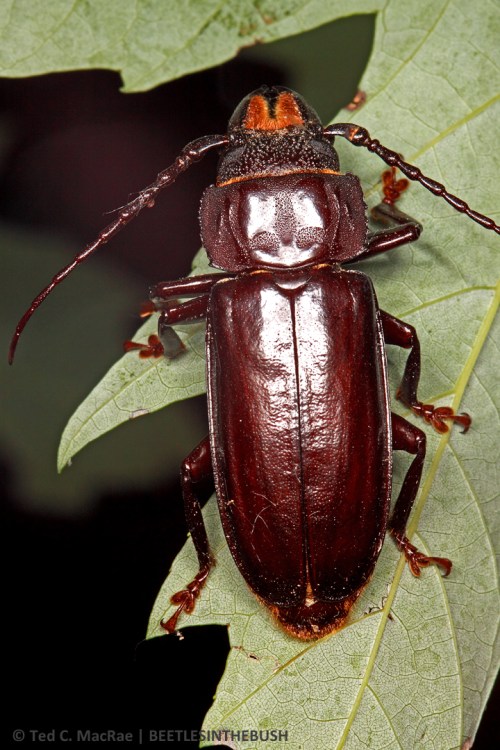
One-shot Wednesday: Mallodon dasystomus

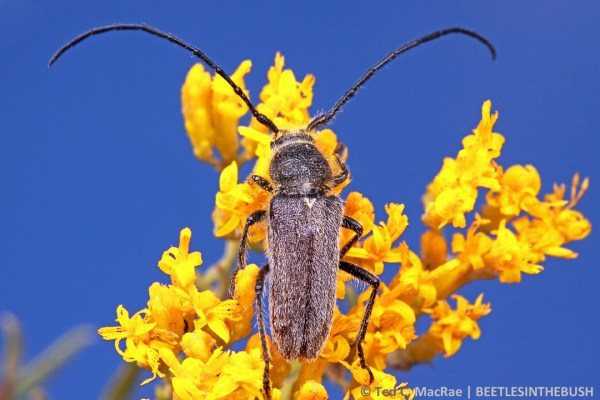
Mallodon dasystomus | southeast Missouri (Mississippi Co.)

Mallodon dasystomus | southeast Missouri (Mississippi Co.)

Today’s (slightly belated) edition of “One-shot Wednesday” features a beetle that I saw just about this time last year while blacklighting along the Mississippi River in the southeastern lowlands of Missouri. Mallodon dasystomus¹ is a prionid longhorned beetle (family Cerambycidae, subfamily Prioninae) that is sometimes called the “hardwood stump borer”. It is perhaps one of the most widely distributed members of its group, occurring across the southern tier of the U.S. down through Mexico and Central America as far as northern South America.

¹ Until recently the specific epithet was consistently misspelled in most of the literature as “dasytomus“. A closer look at the Greek root words dasus (δασύς), meaning “hairy”, and stoma (στόμα), meaning “mouth”, shows the misspelling to be nonsensical. I, myself, am guilty of using the wrong spelling in my checklist of Missouri longhorned beetles (MacRae 1994), although I can claim to have been “going with the flow”.

Despite the beetle’s wide geographical range, I searched for it both eagerly and unsuccessfully during the 1980s as I was gathering data for my checklist of Missouri longhorned beetles (MacRae 1994). I eventually published that checklist and included the species on the basis of a few specimens seen in other collections, but I never encountered it for myself until some years later during a visit to Cave Creek Canyon in southeast Arizona. As noted by Linsley et al. (1961), this species is common there and is associated with large, partially dead Arizona sycamores (Platanus wrightii). Although nearly 20 years ago, I still recall seeing the large beetles crawling high up on the trunks and sitting in their emergence holes with only their massively-mandibled heads protruding as they tantalizingly waved their antennae about.

That experience would directly lead to my eventually finding this species for myself in Missouri. Shortly after returning to the state in the mid-90s, I was driving along a road in the state’s southeastern lowlands when I passed a very large, half-dead American sycamore (Platanus occidentalis). Even at a speed of 40 mph I could see the large emergence holes that immediately reminded me of what I had seen in Arizona, so I hit the brakes, made a quick U-turn, and came back to look at the tree a little more closely. I was convinced the holes were made by this species, and my hunch was proven when I eventually found several beetle carcasses on the ground around the base of the tree. I returned the following weekend with a chainsaw, cut several one-cubic-foot sections of wood from the dead portion of the massive tree’s trunk (with landowner permission), and eventually reared a nice series of adults from the wood. Having uncovered the association of this species with sycamore in the state, I was able to find the species also in several other locations in southeastern Missouri, but I have not managed to find the species in any areas north of the southeastern lowlands in Missouri despite the common occurrence of the host tree.

The beetle in the above photograph landed on the foliage of a large silver maple (Acer saccharinum) next to the ultraviolet light I had setup in wet bottomland forest along the Mississippi River, and wanting to ensure that I got at least one in situ photo of the beetle that is where I shot it. I did try to move it to the trunk of a large, dead sycamore nearby for a more realistically representative photo of how these beetles are usually encountered, but the beetle became quite agitated when I moved it and my considerable patience was never rewarded. I popped it into a vial in hopes of photographs the next morning, but conditions were not to the beetle’s liking and it expired before I had another chance to photograph it. Just the other night I setup a blacklight in a spot not too far from where I saw this beetle in hopes of getting another chance to photograph it. That effort was not successful, but I did find a longhorned beetle species that I had not seen in nearly 30 years! I was successful in photographing that species but (please excuse the teaser) will save those photos for a future post.

REFERENCES:

Linsley, E. G., J. N. Knull & M. Statham. 1961. A List of Cerambycidae from the Chiricahua Mountain Area, Cochise County, Arizona (Coleoptera). American Museum Novitates 2050:1–34 [full text, pdf].

MacRae, T. C. 1994. Annotated checklist of the longhorned beetles (Coleoptera: Cerambycidae and Disteniidae) known to occur in Missouri. Insecta Mundi 7(4) (1993):223–252 [pdf].

© Ted C. MacRae 2014

Black is beautiful!

Most species in the genus Crossidius exhibit varying amounts of yellow/red/orange coloration on the body. However, one species—Crossidius ater—dispenses with such adornments and remains all-black throughout its expansive range across the Great Basin and surrounding areas. Despite this, they are no less pretty than their more gaudily colored relatives. The adults in these photos were seen on flowers of yellow rabbitbrush (Chrysothamnus viscidiflorus) at two locations in White Pine County, Nevada on 30 August 2013 (all photos w/ natural sky background).

Crossidius ater | 7.2 mi SW NV318 on US6, White Pine Co., Nevada.

Crossidius ater | 7.2 mi SW NV318 on US6, White Pine Co., Nevada.

Crossidius ater | Ely,  1.2 mi S Jct US6/50/93, White Pine Co., Nevada.

Crossidius ater | Ely, 1.2 mi S Jct US6/50/93, White Pine Co., Nevada.

Crossidius ater | Ely,  1.2 mi S Jct US6/50/93, White Pine Co., Nevada.

Crossidius ater | Ely, 1.2 mi S Jct US6/50/93, White Pine Co., Nevada.

© Ted C. MacRae 2014

Why I went to Georgia

Call me biased, but for my money few groups of beetles can match the maddening combination of beauty and difficult taxonomy of jewel beetles (family Buprestidae) (I can already hear the protestations of weevil and scarab workers). In the case of jewel beetles, much of the difficulty is due to a propensity for hyperdiverse genera. For example, in North and Central America more than half of the nearly 2,000 described species belong to just three genera—AcmaeoderaChrysobothris, and Agrilus. It’s enough to make many a casual coleopterist throw their hands in the air and ship their specimens off to “specialists” for identification. This is, strangely, for me part of their attraction. Any reasonably serious effort to study jewel beetles over a period of time is sure to uncover a wealth of new data, from previously unknown hosts associations and distributions to the alpha taxonomist’s raison d’être—new species!

Chrysobothris seminole

Chrysobothris seminole on its host, Chrysoma pauciflosculosa.

One of the more problematic jewel beetle groups is the “Chrysobothris femorata species-group”. For many years, these abundant and conspicuous members of forest and landscape ecosystems have confounded collectors, foresters, and extension entomologists alike. A recent revision of the group by Stan Wellso and Gary Manley (Wellso & Manley 2007) has done much to improve the situation through the description of several new species and clarification of the hosts, distributions, and identifying characters of previously known species. I have benefited more than many from their work, since during the 25 years leading up to that work I had collected large numbers of specimens assignable to this group and was fortunate to have this material examined by Stan and Gary and included in the type series of most of the new species they described. Having in my collection series of nearly all of the known species in this group greatly facilitates identification of specimens received for identification and the recognition of any new species that might come my way. Notice, however, that I said “nearly” all of the known species—there were two species described in that work that I did not have examples of; C. seminole from Georgia and Florida and C. mescalero from New Mexico and west Texas. Happily, I can now say that only C. mescalero is still missing from my collection.

Chrysomoa pausiflosculosa

Chrysomoa pausiflosculosa (woody goldenrod) | Emanuel Co., Georgia.

Chrysobothris seminole is unique in the group by its association not with deciduous hardwood trees, but rather the stems and root crowns of living woody goldenrod (Chrysomoa pauciflosculosa), a member of the aster family (Asteraceae). This plant is not a true goldenrod (genus Solidago), although they are in the same family, but is named such for the profusion of yellow inflorescences that appear during fall and resemble those of goldenrod. However, unlike goldenrod, woody goldenrod is a perennial plant with a woody root crown and stems from which new growth emerges each year. Woody goldenrod is restricted to coastal dunes and sand scrub habitats in the U.S. southeastern coastal plain, although the beetle itself has only been found in a few locations in Florida and southeastern Georgia. The beetle was first collected in numbers by Roy Morris and Edwin Donaldson, who reared adults from woody goldenrod root crowns they had collected in an effort to rear adults of another wood-boring beetle; this one in the family Cerambycidae and also undescribed and restricted to woody goldenrod. That beetle was recently described as Crossidius grahami Morris & Wappes, 2013.

Chrysobothris seminole

Adults are found primarily on lower stems of living plants.

In late May of this year, I made the 13½-hour drive from St. Louis to Emanuel Co., Georgia to visit the type locality of C. seminole and try my hand at finding this species. Along the way I met up with two excellent beetle collectors in Tennessee; Joshua Basham and Nadeer Youssef. Josh and Nadeer are among the few people who have succeeded in collecting this species, having visited the type locality during the previous two years and managing to collect a small series of adults. Their experience proved to be invaluable, as we saw only three individuals during our two days in the area. Josh saw the first soon after we arrived at the type locality and was kind enough to let me see it in situ on its host plant and make the collection, and Nadeer was equally kind to give me the third individual we saw. Our consensus was that a combination of early timing and lack of rain was the reason for their scarcity, and to hedge our bets we collected a number of plants that showed evidence of buprestid (as well as cerambycid) larval workings in the lower stems and root crowns to attempt rearing additional specimens. Because of their scarcity, I kept the adults alive and photographed them later that night in a more secure “studio” setting, and while this species has been photographed before I do believe that the photographs presented here are the only photos of live individuals.

Sand scrub habitat | Emanuel Co., Georgia.

Sand scrub habitat | Emanuel Co., Georgia.

In addition to its unique host plant association and restricted distribution, C. seminole can be distinguished from other members of the C. femorata species-group by both sexes having the frons and clypeus uniformly brown (in most other species of the group the frons and clypeus are variously colored, often brightly so in males of the species). The one other species with both males and females also exhbiting a uniformly brown frons and clypeus is C. mescalero (now the only species still lacking in my collection), which Wellso & Manley (2007) distinguished from C. seminole by having three distinct elytral costae (C. seminole has two indistinct costae), its indistinct elytral foveae (in C. seminole the foveae are distinct), and its southwestern distribution and association with oaks. I suppose now I’ll have to start making plans for a June/July visit to sand dune habitats in New Mexico and west Texas sometime in the near future.

REFERENCES:

Morris, R. F., II & J. E. Wappes. 2013. Description of a new Crossidius LeConte (Coleoptera: Cerambycidae: Cerambycinae: Trachyderini) from southern Georgia with comments on its biology and unusual distribution. Insecta Mundi 0304:1–7 [pdf].

Wellso, S. G. & G. V. Manley. 2007. A revision of the Chrysobothris femorata (Olivier, 1790) species group from North America, north of Mexico (Coleoptera: Buprestidae). Zootaxa 1652:1–26 [abstract].

© Ted C. MacRae 2014

Who likes mole crickets?

Who likes mole crickets?

Who likes mole crickets?

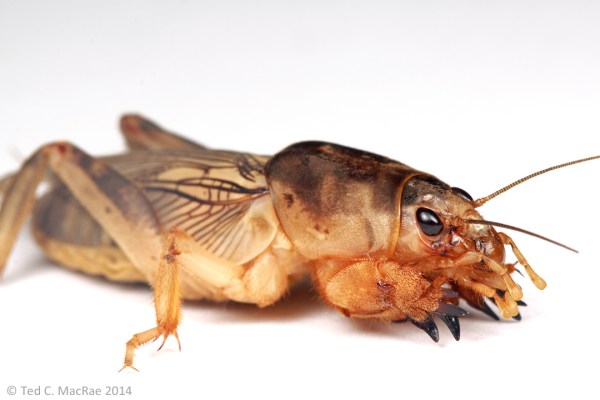
Scapteriscus borellii

I do!

On a recent collecting trip to southeastern Georgia, we spent the night in Swainsboro. We found a hotel and went to the restaurant across the street for dinner. It was dark by the time we got back to the hotel, and since it was a rather warm, muggy night we did what any entomologist worth his salt would do on such a night—creep around the parking lot and building perimeter checking the lights for insects. Late May is still a tad early for checking lights, but among the small assortment of insects we did find were these slim, active insects known as mole crickets (family Gryllotalpidae). Not true crickets, though related, and certainly not moles, these odd-looking critters are immediately distinguishable by their mole-like, fossorial (digging) front legs—a remarkable example of convergence between members of two completely separate animal phyla.

Scapteriscus borellii (southern mole cricket) | Emanuel Co., Georgia.

Scapteriscus borellii (southern mole cricket) | Emanuel Co., Georgia.

Rather than fiddle with them out in the parking lot, I decided to bring them inside for studio photographs on a clean, white background. The widely separated tibial dactyls (literally, “shin fingers”) of the digging feet identify them as Scapteriscus borellii, or southern mole cricket. Despite their name they are an exotic insect, having originally come from much further south (southern South America) and arriving in the U.S. early in the 20th century. While true crickets jump, mole crickets run—and fast! They also, however, have the comical tendency to play dead for a moment when disturbed before bolting to safety. I was able to use this behavior to my advantage while taking photographs—every time he began running, all I had to do was cover him up with a bottle cap. After only a few seconds I was able to remove the cap and take a shot or two before he got the nerve to try to bolt again.

© Ted C. MacRae 2014

One-shot Wednesday: pale green assassin bug

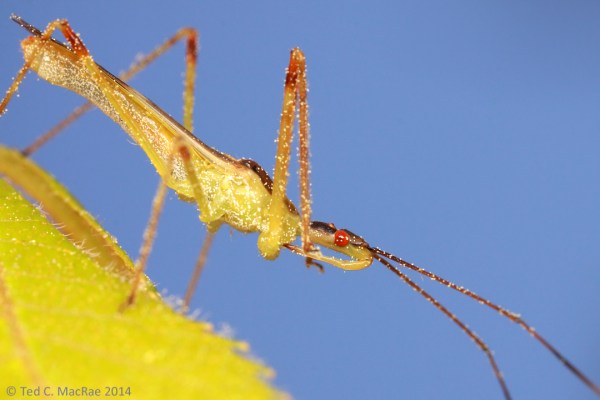
Zelus luridus (pale green assassin bug) | Howell Co., Missouri.

Zelus luridus (pale green assassin bug) | Howell Co., Missouri.

As my friend Rich and I set out a week ago Sunday on the final stretch in our quest to hike the 350-mile Ozark Trail in its entirety, I saw this slender, green assassin bug (family Reduviidae) sitting on a tender young leaf of an oak sapling. I already had my camera out but had outfitted with the 65-mm, 1–5× macro lens in anticipation of small beetles that I wanted to photograph on dogwood flowers. Nevertheless, it was still a bit on the cool side, making me think I might yet succeed in getting off some super-closeup shots of this delicate predator. I managed to carefully snip the leaf from the sapling and move the bug up close to the camera for a nice, blue-sky background shot, but one shot is all I got—as soon as the shutter clicked the bug took flight and left me with this single photo. As I have observed to usually be the case, the body of this individual is thickly covered with debris, which I take to be pollen from the abundant oaks at the height of their flowering period.

I’ve seen this species regularly over the years during my springtime forays in upland, oak-hickory Ozark forests. I presume the species is Zelus luridus, based on an online synopsis of the genus Zelus in eastern North America. As true bugs go, assassin bugs are undeniably cool—sometimes large, often colorful, and pure predators! Interestingly, these bugs have adopted a rather diverse array of strategies to assist their predaceous habits, mostly involving modifications of the front legs. Some involve a more typical raptorial design (similar to mantids) with chelate surfaces or even spines on the femora and tibiae, while others have developed flexible, cushion-like structures on the tips of the tibiae to aid in prey handling (Weirauch 2006). Gross morphological modifications, however, are not the only strategy employed by assassin bugs—some groups use secretions either to paralyze or immobilize their prey. Species in the genus Zelus employ the latter strategy—essentially using their front legs as “sticky traps”. The sticky substance is derived from glands on the front legs and is used to coat numerous, microscopically branched setae on the legs called “sundew setae” in reference to the similarity of appearance and function with insectivorous sundew plants. Interestingly, sundew setae have also been found on other parts of the body, at least in first-instar Z. luridus nymphs, leading to speculation that they may also serve some other function besides prey capture. Perhaps these setae explain why most individuals I see are so debris-covered, as with the pollen-laden individual above.

REFERENCE:

Weirauch, C. 2006. Observations on the sticky trap predator Zelus luridus Stål (Heteroptera, Reduviidae, Harpactorinae), with the description of a novel gland associated with the female genitalia. Denisia 19, zugleich Kataloge der OÖ. Landesmuseen
Neue Serie 50:1169–1180 [pdf].

© Ted C. MacRae 2014

“Picudo negro” (black weevil) on soybean in Argentina

During my recent tour of soybean fields in Argentina, I traveled north to Tucumán Province and met with entomologists at the Estación Experimental Agroindustrial Obispo Columbre (“Obispo Columbre Agricultural Experiment Station”). This provincial station, established more than 100 years ago (1909), conducts research on agricultural and production technology for the Tucumán agricultural region. Focus crops include sugarcane, citrus, and grain—primarily soybean, corn, wheat, and dry beans, with research activities ranging from basic biological studies on emerging pests (such as Rhyssomatus subtilis, featured here) and Helicoverpa armigera (recently discovered in Brazil and now in northern Argentina) to resistance monitoring for transgenic crop target pests such as Spodoptera frugiperda, Helicoverpa zea, and Diatraea saccharalis.

Rhysommatus subtilis is a significant regional pest of soybean in Tucumán Province.

Figure 1. Rhysommatus subtilis is a significant regional pest of soybean in Tucumán Province.

In recent years the laboratory has had a dedicated effort to characterize the biology and economic impact of R. subtilis on soybean (Fig. 1). Although practically limited to soybean growing regions in Tucumán Province, this insect has increased greatly in importance within that area in recent years along with two other weevils: Sternechus subsignatus (picudo grande, or “big weevil”) and Promecops carinicollis (picudo chico, or “little weevil”) (Casmús et al. 2010). Of the three species, S. subsignatus is perhaps the most serious because of its stem boring habit that can result in stand loss, while P. carinicollis is the least because its feeding is largely limited to leaves. Rhyssomatus subtilis is intermediate in importance, primarily due to larval feeding within developing pods.

Adults feed by clipping leaf petioles. The impact is minor, but it is a characteristic sign of adult presence.

Figure 2. Adults feed by clipping leaf petioles. The impact is minor but signals adult presence.

I have not yet seen S. subsignatus in soybean fields in the area, but I saw P. carinicollis during last year’s tour (see this post) and encountered R. subtilis at several locations during this year’s tour. Rhyssomatus subtilis presence in soybean can be detected even before the adults are noticed by the occurrence of clipped leaflets (Fig. 2), which is caused by adults feeding on leaf petioles.

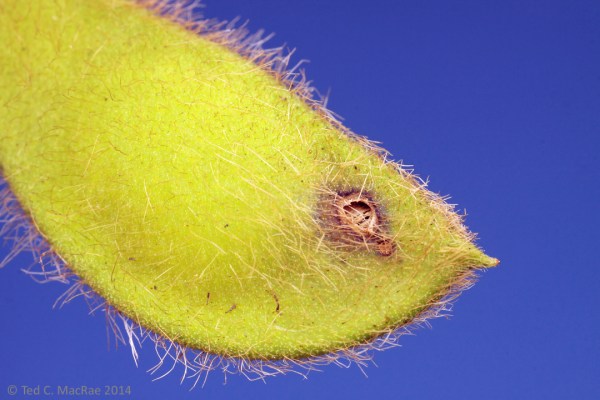
Adult females chew a small hole into the wall of the developing pod, not to feed but for oviposition

Figure 3. Adult females chew small holes into developing pods, not to feed but for oviposition.

Leaf feeding has little if any impact on the crop; however, as the crop enters pod development stages of growth adult females begin chewing small holes in the pod walls (Fig. 3), not for feeding but for oviposition. Eggs are laid singly in the pod (Fig. 4), with larvae (Fig. 5) feeding on the developing seeds within.

Eggs are laid singly inside the pod.

Figure 4. Eggs are laid singly inside the pod.

This manner of feeding by the larva not only directly impacts yield but also hampers efforts to control active infestations by preventing contact with foliar-applied insecticides. Eventually the larvae mature, exit the pod, and drop to the soil where they burrow, pupate, and emerge as adults during the next cropping season while plants are still in early to mid-vegetative stages of growth.

This neonate larva has just hatched and will feed within the pod on developing seeds.

Figure 5. This neonate larva has just hatched and will feed within the pod on developing seeds.

Management techniques include rotation with grass crops to reduce populations (the weevil is oligophagous on soybean and dry beans), use of insecticide seed treatments to control adults during early vegetative stages of growth, and subsequent use of foliar insecticide applications if adults remain after the effect of seed treatments begins to diminish.

REFERENCE:

Casmús, A., M. G. Socías, L. Cazado, G. Gastaminza, C. Prado, E. Escobar, A. Rovati, E. Willink, M. Devani & R. Avila. 2010. El picudo negro de la vaina de soja en el NOA. Estación Experimental Agroindustrial Obispo Columbre, Tucumán, Argentina, 8 pp.

Copyright © Ted C. MacRae 2014

The importance of post-processing

One of the most frustrating realizations I had when I began photographing insects was the fact that photographs didn’t come out of the camera “ready-to-go”—i.e., they still needed to be processed to some degree to make them look good. Even worse, this required processing is to large degree subjective based on the taste of the individual photographer, and as such a “quick manual” describing the exact process in a way that beginners can understand doesn’t exist. Essentially, I didn’t know that when I decided to become an insect photographer, that I would also have to become proficient at photo processing. This frustrates me a lot less now because I’ve finally worked out a process for doing this that works for me and that I am comfortable with, and having done so I also realize that every photographer has to go through this process for themselves to make their photographs look the way they want them to look. That said, I wish I’d had access to some easy tutorials when I was trying to figure out the process that could have saved me some stumbling time before arriving at a process I liked. With that in mind, I thought I would share a quick overview of how I deal with post-processing in the hopes that somebody else mind find a useful tip or two here as they try to figure out their own process. This is not meant to be an exhaustive description of all the post-processing tools that I might use, but rather the typical adjustments that are needed for almost all of the photographs that I take. To illustrate the process, I use a rather basic shot of a cricket that I photographed last week in northeastern Missouri. You can click on each photo to access a larger and better see the issues discussed and resulting enhancements.

Straight from the camera (JPG converted from original RAW file).

The photo above is basically how the shot came out of the camera. These days I shoot only in RAW format, as this allows the maximum amount of data to be retained regardless of how many times the file is accessed. The image above is a JPG converted directly from the unaltered RAW file, and you can see that it looks rather flat and could benefit from levels and color adjustments as well as sharpening and some general “cleaning up” of sensor dust artifacts and debris on the subject. Since I use a Canon body, I have the Digital Photo Professional software that came with the camera, and I also have Photoshop Elements. For my purposes, I’ve found it most convenient to do certain enhancements directly to the RAW file in DPP, generate a TIFF format version of the file from the edited RAW file, and then do the final enhancements to the TIFF file. Since TIFF is also a “loss-less” format, I can then use the enhanced TIFF to generate JPGs of whatever size and resolution on an as-needed basis without worrying about data loss in the full-sized, fully enhanced version of the photo. I think this is preferable to shooting JPGs directly or generating them directly from the RAW file because JPGs are not loss-less files, and as a result every time a JPG is accessed or modified there is a loss of data. Sure, you can go back to the original RAW file and generate a new JPG, but any enhancements made after the first conversion will have to be repeated. Another advantage to making adjustments in DPP is that they are reversable—the original, unaltered RAW file can always be recovered without the need to create multiple backups representing different stages of enhancement.

After initial processing (JPG converted from edited RAW file).

So, what enhancements do I do in DPP? First I open the tool palette and adjust the white balance—in this case it was a full flash photo, so I select “Flash” from the drop-down menu. Then I select the RGB tab and adjust the upper and lower levels on the histogram. The general approach is to cut off data-lacking areas at either extreme, but there is also a lot of subjectivity in deciding what “looks right”. I then open the Stamp Tool (I find cloning adjustments easier and more effective in DPP than in PS) and clone out dust marks in the background (I know, I need to clean my sensor) and debris on the subject. On that last point, there are purists who will argue that this is an “unnatural” alteration. I take a much less conservative position on such alterations, since in my opinion the entire photograph itself is the result of interpretation—not just of the photographer, but of the equipment used and settings chosen. If debris on the subject is an important aspect of the subject’s natural history, then it should remain. However, in most cases, dirt flecks on the subject are not an important part of the story and provide an unnecessary detraction from the aesthetic appearance of the photo. If any cropping is necessary I prefer to do this also in DPP since this is reversible should I change my mind at some point in the future. The second photo above shows what the image looks like after this initial round of post-processing in DPP. At this point, the RAW file is ready to be converted to TIFF format for final post-processing in PS.

After additional processing in Photoshop (jpg converted from edited TIFF).

After additional processing in Photoshop (jpg converted from edited TIFF).

Because I’ve done much of the levels adjustment and cloned out any flaws in DPP, the original TIFF needs only minor adjustments. I generally like to start with “Autocorrect” and see what it does, as this function usually does a good job of toning down highlights and shadows and especially giving a more natural color to blue sky backgrounds such as in this photo. If I don’t like the result from Autocorrect, I hit Ctrl+Z and adjust levels and color manually until I like the result. I find that most photos still benefit from a little bit of brightening and increased contrast (usually ~10% each), and this often also serves to add a little color saturation that is generally sufficient but can sometimes be too much. If the latter occurs, it’s an easy matter to adjust the saturation back down a little bit. After the levels and color are fully adjusted the only thing left to do is apply unsharp mask to sharpen up the photo and bring out the detail—remember to zoom the image to 100% to get the best view of how the settings affect the appearance of the photo, as the settings that you will need depend greatly on the size of the image. Once these adjustments are made, I save a new version of the file (I like to append the file name with “_enh”). The third photo above represents the final enhanced version, and it is this file that I will use to generate JPGs of whatever size I need on an as-needed basis. The original TIFF can be retained if desired, but since an identical version can always be generated anew from the enhanced RAW file this is not essential.

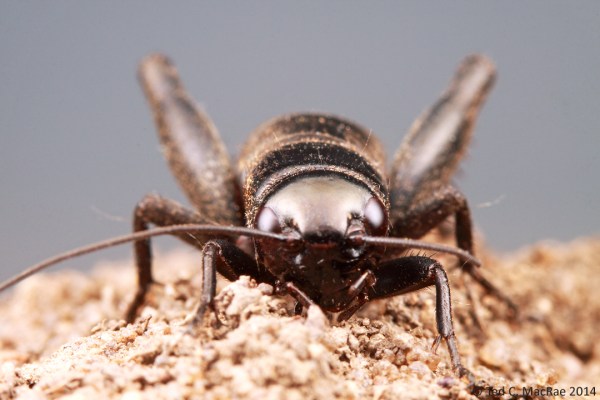
The head slightly narrower than the pronotum and early spring occurrence of this large nymph make me think this is the northern woods cricket (Gryllus vernalis).

The head slightly narrower than the pronotum and early spring occurrence of this large nymph in northeastern Missouri make me think this is the northern wood cricket (Gryllus vernalis).

I hope you’ve found one or tips of use in this little tutorial, which I end with the above frontal portrait of the subject shown in the previous photos. Based on its all black color, the head slight narrower than the pronotum, and its early spring occurrence as a late-instar nymph in northern Missouri, I take this to be a northern wood cricket, Gryllus vernalis, but of course I am open to being corrected by somebody more knowledgeable about crickets than I.

Copyright © Ted C. MacRae 2014
Not all soybean caterpillars are ‘ugly’!

Although photographs of beetles dominate this site (they are my true love, after all), I am nevertheless an agricultural entomologist by day and, as such, find occasion to post photos of the insects I encounter in my area of expertise—soybean. I think by and large those soybean insects—especially the caterpillars—don’t generate as much interest as the beetles that I feature. I guess this is understandable—caterpillars of the agricultural pest variety seem generally unable to compete with the visual and behavioral charisma exhibited by jewel beetles, tiger beetles, tortoise beetles, etc. Here, however, is an example of a soybean caterpillar that is as beautiful as any beetle you will find—the larva of the silver-spotted skipper, Epargyreus clarus (Lepidoptera: Hesperiidae). Not only are the colors to die for, but that comically big head makes for a truly laughable frontal portrait!

Epargyreus clarus (silver-spotted skipper) late-instar larva on soybean | Baton Rouge, Louisiana

Epargyreus clarus (silver-spotted skipper) late-instar larva on soybean | Baton Rouge, Louisiana

This particular individual was found last September in a soybean field near Baton Rouge, Louisiana (amazingly, this is the first insect I have featured from Louisiana). Silver-spotted skippers feed on a wide variety of plants in the family Fabaceae (of which soybean is a member), but their occurrence on soybean rarely reaches levels that cause any economic impact. Normally the caterpillars hide during the day in a silken nest constructed by folding over a leaflet or tying adjacent leaflets together, emerging only at night to feed.

What a pretty face!

What a pretty face!

I suppose the orange spots on the head are intended to serve as false eye spots—for some reason the larger the eyes the more a potential predator seems to take pause before deciding to eat something. The actual eyes can be seen along the outer edge of the orange spot as a row of simple ocelli—incapable of forming sharp images and serving as little more than light and motion detectors. I can’t even begin to speculate on the function of the curious asperate/rugose texture of the head!

Copyright © Ted C. MacRae 2014