Eye to eye to eye to eye with a tiger beetle larva

After the past few years of hunting tiger beetles, I’ve learned not only how to find the larval burrows but—at least for most of the species occurring in Missouri—how to identify the larvae in the field. While conclusive identifications rely upon morphological characters, a preliminary field ID is often possible based on a combination of burrow size, placement, soil type and knowledge of which species are likely to occur in a given habitat. Tiger beetle larvae don’t have the same aesthetic appeal to many people that the adults have, and for this reason many species remain undescribed in the larval stage—even the well-studied North American fauna has only about 60% of its species with the larval stages described (Pearson et al. 2006). Nevertheless, the ability to find, collect and rear tiger beetle larva remains an important part of my studies because it not only expands my survey power (most tiger beetles have more restricted temporal occurrence as adults than as larvae) but can also lead to novel findings such as previously undescribed larvae and unknown parasitoid associations.

Tetracha virginica 3rd instar larva | Mississippi Co., Missouri

Tetracha virginica 3rd instar larva | Mississippi Co., Missouri

This larva was dug from its burrow in bottomland forest habitat in the southeastern lowlands of Missouri. However, before I even saw the larva I knew it belonged to the genus Tetracha and probably represented the species T. virginica (Virginia Metallic Tiger Beetle, according to Erwin & Pearson 2008). How did I know this? First, the size of the burrow (~8 mm in diameter) excluded all but one other non-Tetracha species known to occur in Missouri—Cicindelidia obsoleta vulturina (Prairie Tiger Beetle), a species known to occur only in the dry, rocky, dolomite glades in the White River Hills region of extreme southwestern Missouri. Secondly, while T. carolina (Carolina Metallic Tiger Beetle) is also found in southeastern Missouri, that species has been associated almost exclusively with treeless habitats—at least in southeastern Missouri (K. Fothergill, personal communication). Since the burrow from which this individual was dug was found in wet, bottomland forest, chances were high that it instead represented T. virginica.

Simple, thorn-like outer hooks with much smaller inner hooks distinguish Tetracha larvae from other tiger beetle genera.

Simple, thorn-like outer hooks with much smaller inner hooks distinguish larvae of Tetracha.

Notwithstanding the circumstantial evidence, there are morphological characters that also distinguish both the genus and the species of this larva. Of primary importance are the hooks and setae on the prominent “hump” of the fifth abdominal segment. This hump is braced against the vertical wall of the larval burrow as it sits at the entrance waiting for passing prey. Once the prey is seized, the hump armature provides traction against the burrow wall, preventing the struggling prey from pulling the tiger beetle larva out of its burrow (where it would not only be ineffectual as a predator but also highly vulnerable to predation itself). Tiger beetle larvae can often be distinguished at the generic level by the shape and size of the main hooks. Tetracha larvae have four hooks—two outer and two inner—that are simple and thorn-like, with the inner hooks much smaller than and placed much closer to the outer hooks than to each other (other genera either have six hooks, or they have the outer pair 1) highly curved or 2) the inner pair larger and nearly as close to each other as to the outer hooks). There are also fine details of the pattern of the setae (smaller hairs) on the hump that identify this larva as T. virginica, but the presence of numerous hairs over the surface of the abdominal segments is a much easier character to see in the field (see first photo).
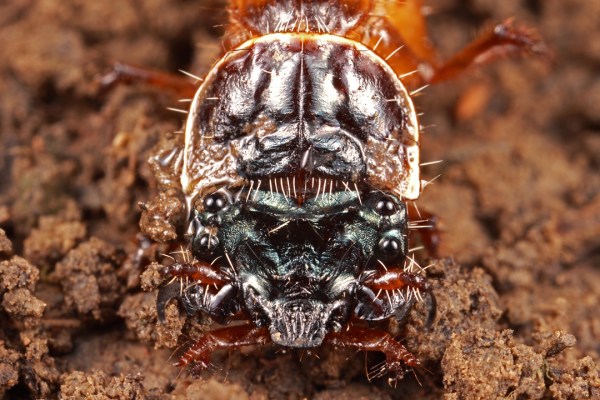
Note the white-margined pronotum and nearly equal sized simple eyes.

Note also the white-margined pronotum and nearly equal sized simple eyes.

Finally, there is that head—two pairs of large, simple eyes sitting behind gaping, cocked jaws that give them an oh so alien aspect! An often metallic, shield-like pronotum sitting behind the head, both used in concert to seal the burrow entrance as the larva lies in wait, serve to complete the alien ensemble but also offer clues to the larva’s identity. All larvae of Tetracha and closely related genera bear a distinctive rim of white around the pronotal margin, making them instantly recognizable even while still sitting in their burrow. Also useful is the relative size of the eyes, which in the case of Tetracha the second pair of eyes are nearly as large as the first pair (Amblycheila and Omus have the second pair distinctly smaller than the first, while Cicindela and related genera also have the eyes more nearly equal-sized).

P.S. This is what I was photographing when my friend Kent Fothergill surreptitiously took this photograph of me!

REFERENCES:

Erwin, T. L. and D. L. Pearson. 2008. A Treatise on the Western Hemisphere Caraboidea (Coleoptera). Their classification, distributions, and ways of life. Volume II (Carabidae-Nebriiformes 2-Cicindelitae). Pensoft Series Faunistica 84. Pensoft Publishers, Sofia, 400 pp.

Pearson, D. L., C. B. Knisley and C. J. Kazilek. 2006. A Field Guide to the Tiger Beetles of the United States and Canada. Oxford University Press, New York, 227 pp.

Copyright © Ted C. MacRae 2012

An elegant Eocene fly

IMG_1864_enh_720x1080

USA: Colorado, Garfield, Hwy 139, Douglas Pass.

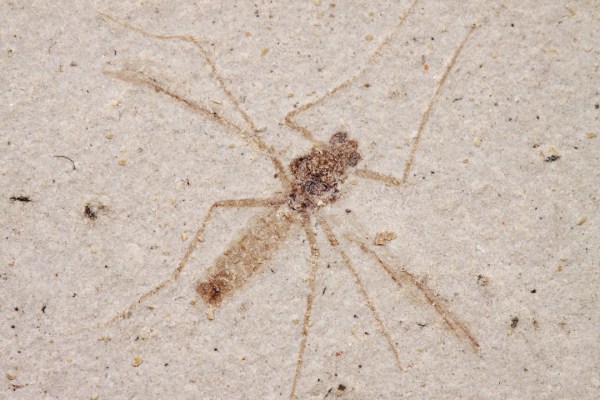
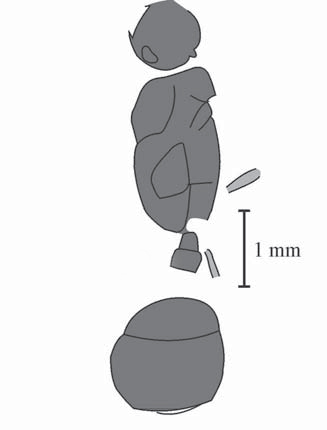
Here is one of the more elegantly preserved specimens among the collection of Green River Formation fossil insects that I am photographing. It is obviously a fly (order Diptera), but I don’t agree with the preliminary identification of “Mosquito?” as indicated on its label. Rather, I think it is one of the fungus gnats—also members of the suborder Nematocera and, thus, closely related to mosquitos (family Culicidae), but with distinctly elongate coxae (bases of the legs) and lacking the elongated proboscis that mosquitos use for sucking blood. It’s hard to decide between Mycetophilidae (fungus gnats sensu stricto) or Sciaridae (dark-winged fungus gnats), which differ in whether the eyes meet above the antennae (Sciaridae) or not (Mycetophilidae). However, Borrer & White (1970) mention that species of the former are generally less than 5 mm in length, while the latter range from 5–10 mm. This specimen measures 4.15 mm from the front of the head to the tip of the abdomen, so  maybe that is evidence supporting Sciaridae (although perhaps there were smaller mycetophilids 50 mya than today).

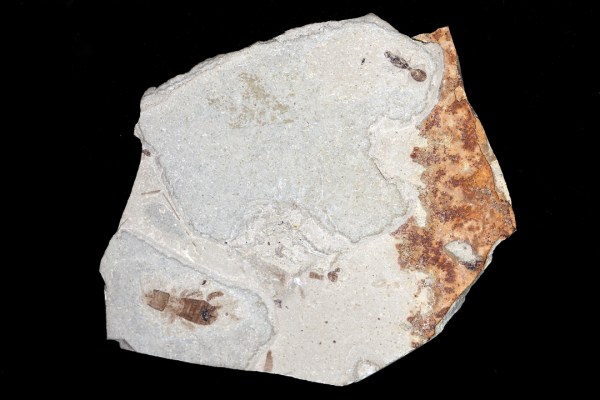
Here is a view of the whole fossil, measuring approximately 50 mm on each side:

IMG_1937_enh_1080x720

REFERENCE:

Borrer, D. J. & R. W. White. 1970. A Field Guide to the Insects of America North of Mexico. Houghton Miffton Company, Boston, 404 pp.

Copyright © Ted C. MacRae 2012

Beautiful box of Buprestidae

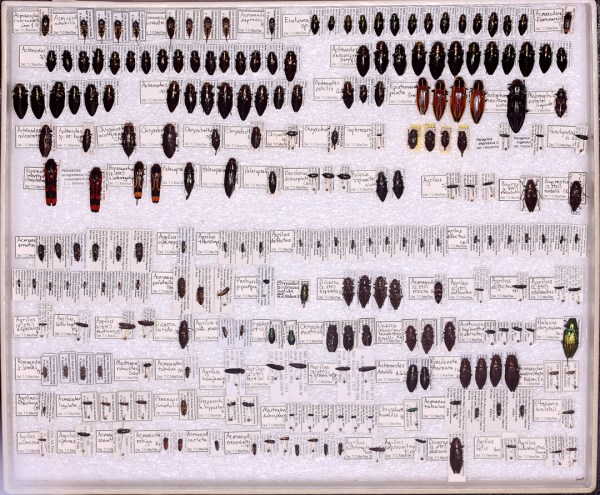
I’ve been working on identifying Buprestidae accumulated from a variety of sources over the past year—mostly exchanges and gifts, before beginning the processing specimens collected during this past season. Once identified, and combined with specimens gleaned from material submitted by other collectors for identification (I generally only retain examples of species that are poorly represented in my collection or specimens that represent and will serve as vouchers for significant new distributional records), they make for a very pretty box of Buprestidae! It’s kind of nice to keep them collected together like this for a little while, but I’ll soon incorporate them into the main collection where they will more securely protected and to free up the temporary box now containing them for new material as it moves through the process of labeling and identification. (Incidentally, I think I might like to do a series a posts over this winter covering my version of the specimen curation process).

There are some very cool Buprestidae in this box—88 species in all, that originated from a remarkable variety of locations across the U.S., Mexico/Central America, and South America. Do you see any species of particular interest?

236 specimens representing 88 species of Buprestidae

236 specimens representing 88 species of Buprestidae

Copyright © Ted C. MacRae 2012

The gloriously dichromatic Dasymutilla gloriosa

I have a small collection of velvet ants (family Mutillidae) that I’ve accumulated over the years—not through active collection but more as bycatch from my beetle hunting operations. Velvet ants are, of course, not ants at all, but wasps, and as such the females are—like their winged relatives—quite capable of delivering a painful sting if mishandled. They also tend to be seen running rather frenetically across the ground, making them difficult to guide into a collection vial or grab with forceps. You’ve gotta really want ’em if you want to collect them. Still, even though I don’t study them I find them interesting enough to pick up on occasion, and with most groups outside of my area of focus the hope is that eventually they will end up in the hands of somebody who actively studies the group. Such is now the case with my mutillid collection, which will be shipped this week to another collector specializing in the group. In return I will be filling some holes in European representation of my collection of Cerambycidae.

Dasymutilla gloriosa, female | Brewster Co., Texas

Dasymutilla gloriosa, female | Brewster Co., Texas

Without question, the most interesting mutillid species that I’ve encountered is Dasymutilla gloriosa. All mutillids are sexually dimorphic, as only the males are winged, but most also tend to be sexually dichromatic to a greater or lesser degree. No species I am aware of takes this to the same level as D. gloriosa! The males (photo below) are rather typically colored compared to other species in the genus, but the females (photo above) are densely covered with long, strikingly white hairs. While this would seem to make them quite conspicuous, the true effect is the exact opposite as they easily confused with fuzzy plant seed. For this reason they are commonly called thistledown velvet ants. I encountered the female in west Texas in 2003 while walking a mountain trail and at first thought it was the fuzzy seed of a creosote bush (Larrea tridentata) being blown by the wind—except there was no wind! It took me a little while looking closely at it before I could figure out what it actually was. This is the only female of this species that I’ve seen in the wild, and I’ll be a little sad to see it sent to another location.

Dasymutilla gloriosa, male | Riverside Co., California

Dasymutilla gloriosa, male | Riverside Co., California

The male also is the only one I’ve encountered—or at least taken the trouble to collect. I would have never suspected this male, which I collected in southern California in 1991, was the same species as the female that I collected many years later. My thanks to Kevin Williams, who provided the identifications for both of these specimens.

Also called the ''thistledown velvet ant''

Also called the ”thistledown velvet ant”

Copyright © Ted C. MacRae 2012

Dainty, delicate, little fairies

Adela caeruleella | Wayne Co., Missouri

Ever since I saw Chris Grinter’s beautiful photographs, I have wanted to see (and possibly photograph) the tiny little moths known as fairy moths (family Adelidae, formerly considered a subfamily of Incurvariidae). These dainty, delicate, little moths are characterized by their unusually long antennae—especially the males, which can have their antennae up to three times the length of the forewings. This past April I got my wish as my father and I hiked the Shut-ins Trail at Sam A. Baker State Park in Missouri’s southeastern Ozark Highlands.

Females have the antennae ”only” twice as long as the forewings…

Chris was fortunate to see a number of individuals representing at least two species, presumably all males (based on the extraordinary length of their antennae) that were engaged in some rather interesting territorial behaviors. I, on the other hand, saw only this single individual (presumably a female) who seemed content enough to calmly nectar the golden Alexander, Zizia aurea (Apiaceae), flowers on which I found it. This was fine by me, as the dense woodland setting where I saw it wasn’t very conducive to photographing the moth. I wanted a clean, bright background to highlight the moths dark metallic luster, so I snipped the flower (carefully!) on which the moth was nectaring and held it up to the small patch of bright blue sky visible from the trail to take these photos.

…and the basal half distinctly thickened.

I presume this individual represents the species Adela caerueleella based on comparison with online photos. According to Powell (1969) this species is widespread across the eastern U.S. and has been recorded on flowers of American bittersweet, Celastrus scandens (Celastraceae). Microleps.org notes the species is most frequently found along deciduous forest trails and shows a preference for flowers of black snakeroot, Sanicula marilandica (Apiaceae). My late April observation is consistent with the April and May activity period noted by Powell (1969) and late May period for central Illinois noted by Microleps.org.

REFERENCE:

Powell, J. A. 1969. A synopsis of Nearctic adelid moths, with descriptions of new species (Incurvariidae). Journal of the Lepidopterists’ Society 23:211–240.

Copyright © Ted C. MacRae 2012
Book Announcement: Field Guide to the Jewel Beetles (Coleoptera: Buprestidae) of Northeastern North America

It’s not often that I anticipate the release of a book as much as I have with the soon-to-be-released Field Guide to the Jewel Beetles (Coleoptera: Buprestidae) of Northeastern North America. Fortunately, the wait is now almost over—Morgan Jackson, author of Biodiversity in Focus and co-author of the book, has just announced its planned released in early 2013. Even better, he has provided a sneak peak at its contents that is as smartly designed as the book itself.

Obviously, as a serious student of the family Buprestidae, this book would make it into my bookshelf no matter what, and I plan to do a more detailed review of the book once I have a copy permanently in my hands. However, I can tell you that I am already very impressed with the design of the book and the quality of the product. I was fortunate to meet up with Morgan at last month’s Entomological Society of America meetings in Knoxville, Tennessee, and Morgan kindly allowed me to leaf through the carefully guarded copy he had with him (it was difficult handing it back to him). The Prezi preview for the book covers some of the more important features that will set this book apart from other field guides, but worthy of special mention are: 1) the minimum/maximum size silhouette figure in the upper left-hand corner of each species treatment—a tremendously useful feature, 2) inclusion of the both the author and date of the original description of the species (to keep us more taxonomically inclined happy), 3) super high quality dorsal and lateral habitus photographs and of additional key features to aid in identification, 4) geographical range maps coded to show both presumed and recorded ranges, and 5) keys to all treated species, richly augmented with high quality photographs.

There is another reason I am so excited about this book, and that is the authors chose my photograph of Buprestis rufipes (red-legged buprestis), one of North America’s most striking jewel beetle species, to grace the cover of the book. I also provided specimens of a number of uncommonly encountered species which were used for the photographs in their respective species treatments.

Quite remarkably, this book will be available at NO COST—including free shipping anywhere! As a consequence, the book will not be available from commercial book and literature sources. You can request your copy by emailing your mailing address to Morgan at morgandjackson@gmail.com. I don’t know how many copies of the book are being printed, but I have a feeling that supplies will not last long, and in the coming years one will have to beg/borrow/steal from a kindly old colleague to get a copy (you can have my copy when you pry it from my cold, dead fingers!).

Copyright © Ted C. MacRae 2012
Life at 8X: MPMI Cover


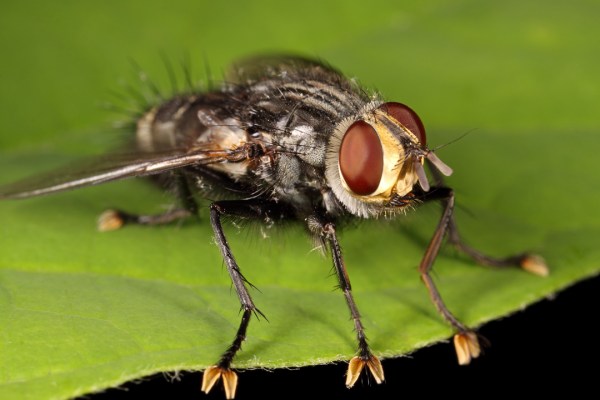
The January 2013 issue of Molecular Plant-Microbe Interactions (volume 26, number 1) is now online. Why do I mention this? You may recall the cover photos of the soybean aphid, Aphis glycines, from my post —one of a series of posts I’ve done featuring insects photographed at 8X life-size.

MPMI is a publication of The American Phytopathological Society, and I have Dr. Gustavo MacIntosh at Iowa State University to thank for the appearance of these photos on the cover of this Special Focus Issue. Dr. MacIntosh is Associate Professor of Biochemistry, Biophysics and Molecular Biology and studies hormone-based defense mechanisms in soybeans. In a paper appearing in this special issue, Dr. MacIntosh and co-author Matthew Studham published the results of a study that suggests soybean aphids are able to “short-circuit” soybean defense mechanisms, making it easier for other pests (e.g., soybean cyst nematode) to colonize infested plants as well. Their study revealed large differences in transcription profiles of soybean varieties with and without an endogenous resistance gene (Rag1) in response to aphid infestation and suggested that the aphids are able to circumvent the defense response in susceptible plants by triggering activation of abscissic acid (normally associated with abiotic stress responses) as a “decoy” strategy (Studham & MacIntosh 2013). Plants infested with aphids have been shown to also become more susceptible to soybean cyst nematode—even varieties with genetic resistance to nematodes (McCarville et al. 2012). Dr. MacIntosh saw my photos when I posted them here and asked permission to submit them as candidates for the cover of the MPMI issue in which his paper was to appear.

Dr. Macintosh hopes that his research will enable the development of soybean varieties that will be more resistant to aphids and other pests.

REFERENCE:

McCarville, M. T., M. O’Neal, G. L. Tylka, C. Kanobe & G. C. MacIntosh. 2012. A nematode, fungus, and aphid interact via a shared host plant: implications for soybean management. Entomologia Experimentalis et Applicata 143(1):55–66 [DOI: 10.1111/j.1570-7458.2012.01227.x].

Studham, M. E. & G. C. MacIntosh. 2013. Multiple Phytohormone Signals Control the Transcriptional Response to Soybean Aphid Infestation in Susceptible and Resistant Soybean Plants. Molecular Plant-Microbe Interactions 26(1):116–129 [DOI: 10.1094/MPMI-05-12-0124-FI].

Copyright © Ted C. MacRae 2012
One Bad Beetle

Almost every tiger beetle trip that I take has a mix of gimmes and stretch goals. That’s alright—it’s impossible to find everything every time out, and if I eschewed the common and was happy only when I found something truly rare, then I would probably find myself rather unsatisfied most of the time. For the stretch goals, however, “success” can mean many things—obviously the best case scenario is to find it in good enough numbers to allow responsible collection of an adequate series and photograph enough individuals in situ to ensure that at least a few shots will have the focus, lighting, and composition that I want. Success can also be something less than that—maybe I find only a few and don’t get a very good series, or I have trouble getting field shots and am not happy with the shots I got…or worse I don’t even get field shots! The least successful version of “success” is when I end up with just one single beetle, and the only photographs I get are very ordinary-looking shots of that one beetle in confinement. Like what happened with Cicindela decemnotata (Badlands Tiger Beetle).

IMG_3717_1080x720

Soda Lake, Wyoming—we searched theses areas of alkaline exposures but never found beetles…

Chris Brown and I knew this species would be a stretch goal when we added “Soda Lake, Wyoming” to the itinerary of our 7th Annual Fall Tiger Beetle Trip™ (location “H” on this map). Cicindela decemnotata is the westernmost representative (Rocky Mountains from the northwestern Great Plains and northern Great Basin north to Yukon) of a group of species that seem to be closely related and resemble each other in their green coloration varying degrees of red on the head, pronotum and elytra and their variably developed white elytral markings (Pearson et al. 2006). Cicindela limbalis, C. splendida and C. denverensis occur as a partially allopatric species complex further east in the Great Plains, while C. sexguttata, C. patruela and C. denikei occupy more forested regions even further to the east. On this trip we were focusing on Great Plains tiger beetles and the dune specialists of the Yampa River Valley of northwestern Colorado. Our drive from northwestern Nebraska to the Yampa Valley would skirt the eastern edge of C. decemnotata‘s distribution, so we decided to stop by Soda Lake where Matt Brust had seen the species in previous years.

IMG_3721_1080x720

…until we started searching these small ridges of exposed sandy soil.

It took most of the morning to reach the spot, so by the time we arrived we were anxious to get out and start searching the sage brush habitat. For me it was an unfamiliar landscape—at that time my northwesternmost push for tiger beetles yet, and like many western habitats it seemed vast and unending. We were optimistic, however, because it just “looked” like good tiger beetle habitat, with ribbons of alkaline flats weaving through open brush. Of course, as time passes and one starts to recognize that they are again searching ground already covered with no sign of beetles, optimism begins to wane and searches become more deliberate. We were there for almost an hour before I heard Chris call out. He had abandoned the alkaline flats—obvious habitat it would seem—and started looking upon some slightly sandier low ridges a little further to the south. I hustled to where he was standing, and we both looked at the beetle, calmly sitting on the sand, as we deliberated our next move. Should we try to photograph it? It seemed not at all skittish—but what if we failed, it got away, and then we never saw another one? We played it safe, netted it (easily), and placed it in a vial for transfer to a container of native soil should further efforts at finding and photographing the species fail. It was perhaps another 45 minutes before we saw another beetle—I don’t know if it was just a less cooperative individual or the heat of the day had kicked in, but as soon as I started my approach it was gone. We saw another not long after, but same story. Finally we saw one last beetle that seemed to tolerate my approach to the point that I even began looking for it in the view finder—at which point it promptly zipped away. This small prospect of success only served to prolong our vain searching before we eventually we accepted defeat and tried to be happy with the single individual that we had caught and the photographs that we would take of it in its artificial home.

Cicindela decemnotata

Cicindela decemnotata (Badlands Tiger Beetle) | Soda Lake, Wyoming

Part of me really doesn’t like showing photographs of confined tiger beetles—not for any philosophical reasons, but because I just don’t like the way they look. Rarely do they exhibit the elegant stilting and other thermoregulatory behaviors that place them in much more pleasing postures when photographed in situ. Rather, they often have a “hunkered down” look that says “I’m not happy and I don’t want to be here, so I’m not going to smile for the camera!” Since these photos were taken, I have learned a few tricks to deal with confined beetles and achieve more aesthetically pleasing photographs—these include the use of much larger arenas, allowing the beetles more time to accommodate to their environs, and elevating the substrate relative to the camera (maybe a subject for a future post). In the end, however, they are still confined and can’t be passed off as anything but that.

The bold white markings, media band sharply angled and not reaching the edge of the elytra, and ''greasy'' appearance distinguish this species.

The bold white markings, media band sharply angled and not reaching the edge of the elytra, and ”greasy” appearance distinguish this species.

As an aside, tiger beetle pros Barry Knisley, Ryan Woodcock and Mike Kippenhan have recently published the results of an impressive study of this species in which a combination of morphological and molecular evidence support the recognition of four subspecific entities—three described as new (Knisley et al. 2012). The molecular analyses not only support the subspecific distinctions postulated from morphology but also suggest that populations have undergone rapid phylogenetic radiation in the recent geological past. Much of the area occupied by C. decemnotata was covered by an ice shield during the most recent glaciations and, thus, has opened up for colonization only during the past 10,000 years (Pearson and Vogler 2001). The molecular analyses showed a relatively low amount of genetic divergence within C. decemnotata populations, which combined with marked morphological differences suggests recent and rapid radiation—most likely in the wake of glacial recession. A similar situation has been observed with members of the Cicindela maritima species-group, which occupy much the same range as C. decemnotata and, presumably, have experienced similar selection pressures in the recent geological past.

REFERENCES:

Knisley, C. B., M. R. Woodcock & M. G. Kippenhan. 2012. A morphological and mtDNA analysis of the badlands tiger beetle, Cicindela (s. str.) decemnotata Say, 1817 (Coleoptera: Carabidae: Cicindelinae) with the description of three new subspecies. Insecta Mundi 0214:1–49.

Pearson, D. L., C. B. Knisley & C. J. Kazilek. 2006. A Field Guide to the Tiger Beetles of the United States and Canada. Oxford University Press, New York, 227 pp.

Pearson, D. L. and A. P. Vogler.  2001. Tiger Beetles: The Evolution, Ecology, and Diversity of the Cicindelids.  Cornell University Press, Ithaca, New York, 333 pp.

Copyright © Ted C. MacRae  2012