Our recent discovery of Cylindera celeripes (swift tiger beetle) in Missouri was arguably the most exciting moment that I and colleague/fieldmate Chris Brown have experienced since we first began surveying the tiger beetles of Missouri back in the year 2000. It was the 24th species that we had recorded for the state and the latest of several for which we had searched through targeted surveys during the past few seasons. Earlier surveys have already produced a new record for Cicindela trifasciata ascendens (ascendant tiger beetle), “rediscovered” Cylindera cursitans (ant-like tiger beetle) and Dromochorus pruinina (frosted dromo tiger beetle), precisely characterized the limited in-state distributions of Habroscelimorpha circumpicta johnsonii (Johnson’s tiger beetle) and Cicindela obsoleta vulturina (prairie tiger beetle), and generated copious distributional data for the remaining more generally distributed species.
Yet, there still remained one species that we had not managed to find ourselves – Ellipsoptera macra (sandy stream tiger beetle). This species was recorded from a few localities along the Missouri River in northwestern Missouri by Willis (1967), and we have examined a small number of additional specimens in the Enns Entomology Museum. According to the literature, this species occurs near the water’s edge on sandy habitats along large rivers – precisely the type of habitats in which we have encountered the closely related E. cuprascens (coppery tiger beetle), which we have found at several locations along the Missouri and Mississippi Rivers. Each time we found E. cuprascens we expected/hoped to see E. macra as well but never did. The reasons for this remained a mystery to us until I noted a comment on the Tiger Beetles of Nebraska website stating that blacklighting is usually more productive for this species than daytime collecting. With its known occurrence in northwestern Missouri, our planned survey for C. celeripes in that part of the state this season offered a perfect opportunity to try to find this, the last tiger beetle species in Missouri that we had not yet collected ourselves. Our plan was to search loess hilltop prairie habitats during the day for C. celeripes, then blacklight along the Missouri River at night to look for E. macra. Both species seemed like longshots – we’d searched for each many times, and we were willing to spend several consecutive weekends from late June to mid-July on our survey so that we could claim that we had given it our best shot. Of course, as you know, we succeeded in finding C. celeripes on the first day of our first weekend, and we would also enjoy the same success with E. macra later that evening.

Chris Brown braves the swarm to look for individuals of Ellipsoptera macra.
We setup two blacklights at a public fishing access along the Missouri River (explaining to some puzzled locals exactly what we were doing and why), turned the lights on, and sat back with pizza and merlot as we waited for things to start coming to the sheets. We had been to this site before in previous years and found E. cuprascens here, suggesting that suitable habitat was present in the area. Almost immediately a growing cloud of all manner of aquatic insects began swarming around the lights, landing on the sheets – and flying down our shirts and in our hair whenever we tried to approach! I don’t blacklight as much as I did in my younger days, but even then I wasn’t much of a fan of blacklighting near water for precisely these reasons. We hadn’t had the lights going for more than 15 minutes or so before we saw the first tiger beetle crawling on the bottom of the sheet below the light. It looked like cuprascens, but I placed it live in a vial anyway for photographs the next morning. Then there was another… and another… Soon, they were coming in with regularity, and I quickly ran out of vials in which to keep live individuals separately. I’ve never seen tiger beetles come to blacklights like this, but we still weren’t convinced they were E. macra until later that night when we got back to the hotel and had a chance to take a close look at them with good light. There was no doubt about it – we had finally found E. macra in Missouri!
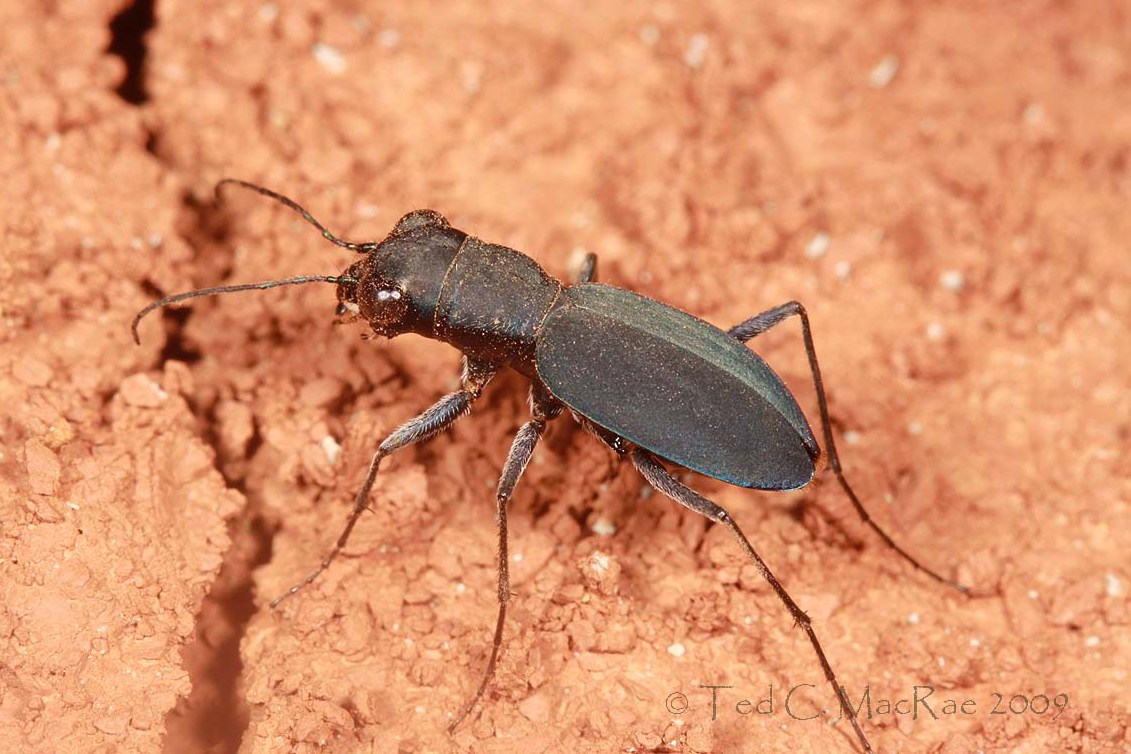
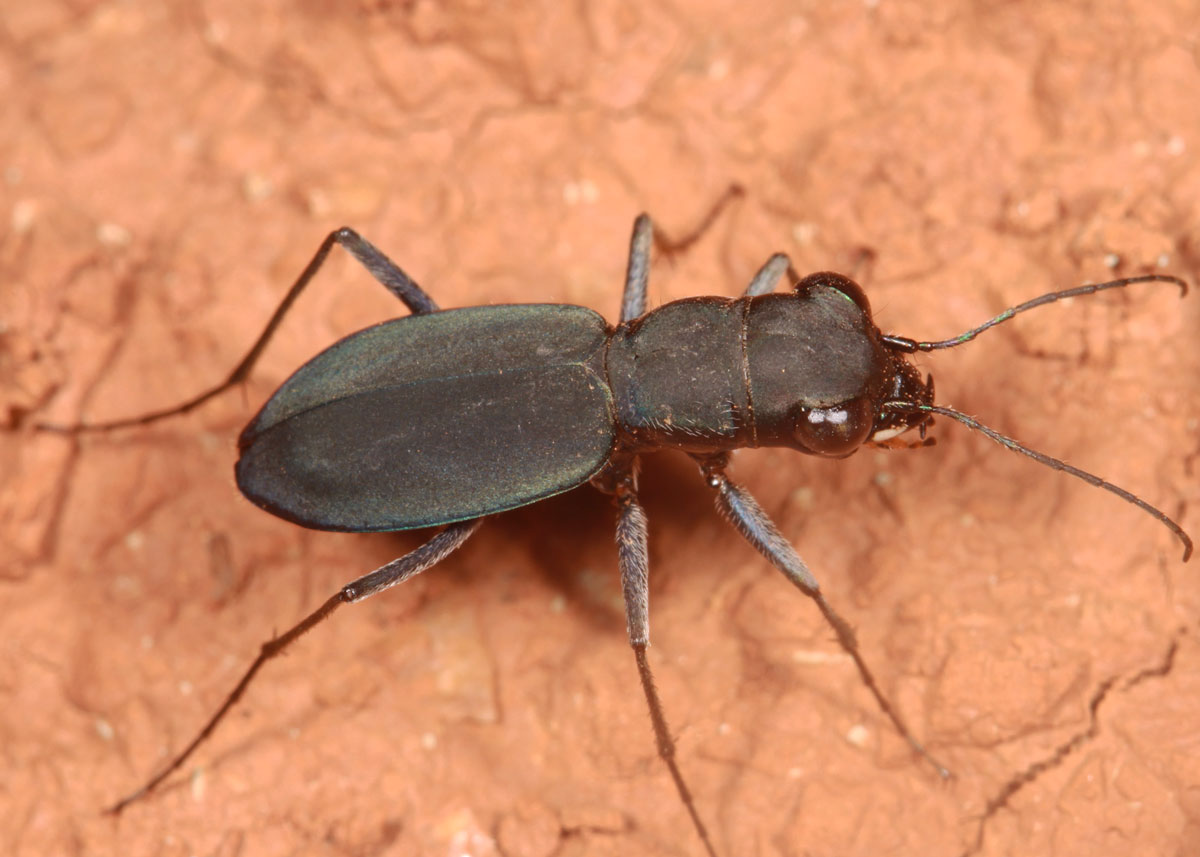
This species is very similar to E. cuprascens, but the elytra are not as shiny and with smaller, shallower punctures than the latter. Some references mention a more recurved lower portion of the humeral lunule and a generally more green than bronze coloration (Pearson et al. 2006), but these characters were tenous at best with the specimens we had in hand (see photo below). The best character we have found to separate the two species is by examining the female elytra – in E. macra the sutural apex is acute, while in E. cuprascens it is rounded (Willis 1967). We returned to the site the next morning to see if we could find them during the day, and although we did manage to find a few, they were nowhere near as numerous as we had seen them at the blacklights the night before. The following photograph is of an individual captured that evening and then “released” back into the field the following morning – they were quick to fly once released, and only after several individuals and trying the “lens cap” technique did we succeed in getting some good shots.

Ellipsoptera macra
We didn’t get a chance to use blacklights in subsequent weekends to see if we could find E. macra in other localities along the Missouri and Mississippi Rivers – with E. macra and C. celeripes success already in hand, I quickly turned my attention to the White River Hills of southwestern Missouri and their gorgeous glade habitats to look for one of North America’s most beautiful cerambycid beetles, Plinthocoelium suaveolens (more on that in a future post). However, I am confident that E. macra will be found at other spots in Missouri should we decide to look for them with blacklights. Having encountered all 24 species of tiger beetles known from Missouri, I present here a checklist of those species.
CHECKLIST OF TIGER BEETLES IN MISSOURI
(classification and common names by Erwin and Pearson 2008)
Tribe CICINDELINI
Subtribe MEGACEPHALINA
Tetracha (s. str.) carolina carolina – Carolina Metallic Tiger Beetle
Tetracha (s. str.) virginica – Virginia Metallic Tiger Beetle
Subtribe CICINDELINA
Cicindela (s. str.) duodecimguttata – 12-spotted Tiger Beetle
Cicindela (s. str.) formosa generosa – Eastern Sand Tiger Beetle
Cicindela (s. str.) hirticollis shelfordi – Shelford’s Tiger Beetle
Cicindela (s. str.) limbalis – Common Claybank Tiger Beetle
Cicindela (s. str.) purpurea purpurea – Cowpath Tiger Beetle
Cicindela (s. str.) repanda – Bronzed Tiger Beetle
Cicindela (s. str.) scutellaris lecontei – LeConte’s Tiger Beetle
Cicindela (s. str.) sexguttata – Six-spotted Tiger Beetle
Cicindela (s. str.) splendida – Spendid Tiger Beetle
Cicindela (s. str.) tranquebarica tranquebarica – Oblique-lined Tiger Beetle
Cicindela (Cicindelidia) obsoleta vulturina – Prairie Tiger Beetle
Cicindela (Cicindelidia) punctulata punctulata – Punctured Tiger Beetle
Cicindela (Cicindelidia) rufiventris rufiventris – Eastern Red-bellied Tiger Beetle
Cicindela (Cicindelidia) trifasciata ascendens – Ascendant Tiger Beetle
Cylindera (s. str.) celeripes – Swift Tiger Beetle
Cylindera (s. str.) cursitans – Ant-like Tiger Beetle
Cylindera (s. str.) unipunctata – One-spotted Tiger Beetle
Dromochorus pruinina – Frosted Dromo Tiger Beetle
Ellipsoptera cuprascens – Coppery Tiger Beetle
Ellipsoptera lepida – Ghost Tiger Beetle
Ellipsoptera macra macra – Sandy Stream Tiger Beetle
Habroscelimorpha circumpicta johnsonii – Johnson’s Tiger Beetle
Photo details:
Blacklighting: Canon 17-85mm zoom lens on Canon EOS 50D (manual mode), ISO 100, 1/30 sec, f/11, on-camera flash.
Ellipsoptera macra: Canon 100mm macro lens on Canon EOS 50D (manual mode), ISO 100, 1/250 sec, f/14, MT-24EX flash 1/4 power w/ diffuser caps.
REFERENCES:
Erwin, T. L. and D. L. Pearson. 2008. A Treatise on the Western Hemisphere Caraboidea (Coleoptera). Their classification, distributions, and ways of life. Volume II (Carabidae-Nebriiformes 2-Cicindelitae). Pensoft Series Faunistica 84. Pensoft Publishers, Sofia, 400 pp.
Pearson, D. L., C. B. Knisley and C. J. Kazilek. 2006. A Field Guide to the Tiger Beetles of the United States and Canada. Oxford University Press, New York, 227 pp.
Willis, H. L. 1967. Bionomics and zoogeography of tiger beetles of saline habitats in the central United States (Coleoptera: Cicindelidae). The University of Kansas Science Bulletin 47(5):145-313.
Copyright © Ted C. MacRae 2009






 Beetles In The Bush