Where do BitB readers come from (and why I like Facebook better than Twitter and Google+)?

I’m not obsessed with blog stats, but every now and then it’s interesting to take a look and see what information I can glean from them. One of the stats provided by WordPress is “Referrers”—which sites readers came from. This is good information to know, as it can help guide decisions on which sites to put effort into as a referral site. It was precisely this stat that caused me to leave Google+ some months ago. I tried G+ for a time as an alternative to Facebook, cross-posting links to new posts and occasionally posting separate photos to maintain a consistent level of activity. But after several months I decided the interactions I was having on G+ weren’t very satisfying—no conversations about the subjects like what happens on Facebook, just brief comments of the “Nice shot” variety. Moreover, my WordPress Referrer stats showed virtually no traffic coming from G+. This was puzzling, as I found myself continually being added to G+ circles (thousands eventually, which in itself seemed very “spammish” to me), but since there was no automatic mechanism for linking new posts on G+ (like there is for Facebook and Twitter), I decided the tiny amount of traffic it drove was not worth the effort. I stopped posting to G+ (yet continued to be added to circles, which made me even more suspicious and eventually led me to deleting my G+ account altogether).

As my involvement with G+ waned, I became more involved with Twitter. I get Twitter—really, I do, although I had trouble getting it at first. It’s quick, it’s fun… it’s a great way to keep tabs on a lot of people who like to post links to things I am interested in. Nevertheless, I still find myself having trouble staying consistently involved with Twitter. My problem is the 140-character limit—again, I’m more interested in conversation than quips, and in this regard Facebook is a much less limiting—and thus more enjoyable—venue for interacting with like-minded individuals. I also find Twitter to be rather clumsy when it comes to sharing photos compared to Facebook’s more elegant (Google+ inspired?) model. If I can’t converse on Twitter the way I’d like to, then all I really have left to use Twitter for is to provide links to new posts on BitB. A few hundred followers may be modest, but one would still think it enough to drive a fairly good amount of traffic to the blog. Curiously, recent review of Referrer stats show this not to be the case. Over the past 30 days, only 43 visitors have come to BitB from Twitter—less than 1.5 per day! WordPress enables automatic linking of new posts on Twitter, so it doesn’t really take any effort on my part to maintain the account, but I still have to wonder if such little return warrants even this amount of effort.

Of course, search engines—primarily Google—reign supreme in driving traffic to BitB, with the past 30 days yielding 6,180 visits. But among non-search engine sites, where do most of my readers come from? Facebook! In the past 30 days, 232 visitors have clicked on a link to BitB through Facebook—either on my own page or that of somebody else who liked a post on BitB and provided a link to it. Considering how much fun I have on Facebook aside from providing links to posts on BitB—whether it be quick photos of experiences as they happen, enjoying photographs of other expert insect macrophotographers, or involvement in multi-party conversations about the finer points of insect taxonomy—the fact that it also drives a large amount of traffic to BitB almost seems like a bonus. People like to make fun of Facebook, and the recent exodus of many bug bloggers to Twitter and G+ cannot be ignored, but for me Facebook continues to be the supreme medium for online interaction.

I realize this a one-case study and don’t intend to generalize my experience to others. It does, however, raise some interesting questions. Why are Facebook users so much more likely to click on my links that Twitter or G+ users? What prompted thousands of G+ users to add me to their circles but almost none of them to actually click through to my content? Is my experience typical? Any insight on these questions would be appreciated.

I should also mention another significant referrer for BitB—Alex Wild. Combined stats from his Myrmecos and Compound Eye blogs over the past 30 days resulted in a cool 99 BitB referrals. While this is not quite at the same level as Facebook, it is remarkable for an individual blogger to be the source of so much traffic for my blog. I doubt Alex himself is responsible for all of these visits (although I’m sure he checks in from time to time), rather it is likely that a portion of the enormous reader base he has uses his sites as jumping off points for other bug blogs they like. No other bug blogger, and not even WordPress Reader or Blogger themselves, comes close to sending as much traffic to BitB as does Alex Wild. So, Alex… thank you!

Copyright © Ted C. MacRae 2013

A Tale of Two Blogs

In April 2012, I wrote a post called “Is blogging dead?” – Another view in response to Alex‘s previous day’s post (Is Blogging Dead?). While Alex acknowledged that blogging provided an early social network structure now better served by Facebook and Google+, he also maintained that there still remained a dedicated contingent for whom blogging best served their needs. As a committed blogger myself, I really wanted to share Alex’s optimism—but I just couldn’t. Something told me that blogging was at a crossroads, and the future wasn’t rosy. Why did I feel this way? My site stats didn’t suggest trouble ahead—from February 2009 (shortly after I moved Beetles in the Bush to WordPress) until April 2012, site visits—and presumably readership—had increased steadily (see chart below based on weekly stats, with the periodic surges due to posts I wrote that got picked up by Freshly Pressed). Not like one of the big blogs, of course, but still not bad for a natural history blog aimed at a specialty audience. Rather, it was the decline of comments and coincident increase in the use of Twitter, Facebook, G+, etc. as the platforms of choice for social interaction among those for whom blogs previously fulfilled that need. To me it seemed inevitable—why invest in clicking through to individual blogs and reading a 500- to 1,500-word post when one could read several hundred 140-character headlines, quipping an equally short reply to as many of them as desired, all on one site. Maximum interaction, maximum information (depending on your definition of “information”), minimum fuss.

Site stats - February 2009 to April 2012. Site stats – February 2009 to April 2012.

Ironically, almost immediately after I wrote that post the decline that I predicted began with my own blog. The chart below shows BitB site stats (again, on a weekly basis), picking up where the above chart left off until the end of March 2013. As precipitously as site visits rose during the previous three years, they declined during the following one year. There are those who contend that “People who say blogging is dead either already have a blog that died, or they have no blog at all.” That may be true now, at least based on site stats and the now rather low frequency of comments, but it most certainly was not the case when I first voiced this opinion last year. In fact, that a Google search of “Is blogging dead” can turn up nearly 100,000 search results (with quotation marks!) shows that a whole lot of people are still asking the question.

Site stats – April 2012 to March 2013.

This is not to say that blogs cannot still be successful. I suggest that the platform has matured, undergone consolidation and weeded out the weakest contributors. By weak, I don’t mean poor quality of content, but rather lack of ability or resources to frequently and consistently provide that content and target it to a relatively large audience. Early adopters who carved out a niche and built a strong brand had the best chance of surviving this maturation, and among the specialty blogs dealing with natural history and entomology it seems those who act as clearing houses for information from across the discipline, serve as an interface for commercial/educational ventures, or focus on the “bizarre” or contentious are most likely to attract and retain followers. Of course, an alternate hypothesis is that my writing suddenly got boring and my photos suck—take your pick.

As for what this means for Beetles in the Bush, I’m not really sure yet. During the past month (and for the first time since I started writing this blog in earnest), I’ve backed off on what until then had been a very consistent 2–3 posts per week schedule. Quite clearly, this will not help if my goal is to find some way to reverse the downward trend, as frequency of posts ranks almost as high as quality of content in keeping a blog successful. I used to tell myself that I would write regardless of who was reading, because it was something I needed to do (and enjoyed doing) for myself, and I truly believe that was the case when I said it. But perhaps I’ve now gotten what I needed out of the blog—my writing skills are far superior to when I started; I can sit down and pound out not only a blog post, but research reports, status updates, manuscripts, etc. in record time. I used to agonize over every word; now it seems my fingers can hardly keep up with the words as they pour out of my mind. If one of my goals when I started blogging was to make myself a better writer (and it was), then in that regard I have succeeded. I’m also now a vastly more knowledgeable entomologist, having taken the time to learn a lot more not just about beetles, but insects across many taxa, the habitats in which they live, the ecological communities they are a part of, and the landscapes that harbour them. For the first time, I consider myself not just an entomologist, but a natural historian in the truest sense of the word. Nevertheless, I can’t imagine not writing for BitB, but I think now the impulse to write a post will be based much more on inspiration and less so on the calendar. I truly hope that the reduced posting frequency doesn’t further accelerate the decline, but if it does then that is the only possible outcome.

Copyright © Ted C. MacRae 2013

Battle of the Bug Blogs

Something tells me that one of our bug blogging professors has charged this semester’s crop of students to go out and figure out what makes a good bug blog. My, how classwork assignments have changed since I was in grad school! Sort of a modern-day twist on the old ‘critic a journal paper’ assignment.

At any rate, apterobittacus seems to think I write a pretty good post, but eremoblatta thinks Crystal does it a little bit better (despite the taxonomic affinity between the subject of my critiqued post and the blog author’s pseudonym)! Nice job, kids—interesting reads that actually made me stop and think a little bit about how I present things here.

Copyright © Ted C. MacRae 2013

ID Challenge #21

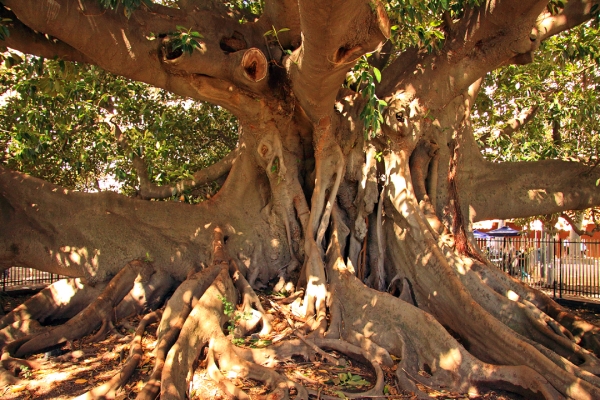
Time for another installment of BitB Challenge Session #7. This one is going to be a bit different from previous versions—can you identify the tree in the photo? Not the scientific name, not the common name, but the actual name of this particular tree. Include its location and any cultural significance it may have (both historical and current) and you’ll be well on your way towards winning this challenge. Points structure will be decided after I see what kind of response I get (this is also a test to see if anyone still reads this blog).

Good luck!

IMG_2332_enh_1080x720

Copyright © Ted. C. MacRae 2013

These bugs rock!

IMG_2624_enh_1080x720
These stones were given to me recently by a local insect enthusiast who is an admitted collector of all things natural history. According to him, the stones were among numerous items that he was allowed to “salvage” many decades earlier from the home of a similarly inclined individual from the previous generation. He has stored these and other items in his home ever since but now finds himself in the mood to distribute the items he has spent a lifetime collecting. Beyond this, I know nothing of the provenance of these stones or even if they represent something truly artifactual versus just the classroom efforts of a more contemporary school child. I’ll welcome any opinions that may be had, but even if none are received these stones will nicely decorate some little corner of my “museum”—hopefully for decades to come.

IMG_2606_enh_1080x720

IMG_2608_enh_1080x720

IMG_2610_enh_1080x720

Copyright © Ted C. MacRae

Fun at Salinas Grandes

IMG_2507_enh_1080x726
My colleagues and I greatly enjoyed our visit to the Salinas Grandes salt flats in Catamarca Province, but there was a moment of tension between Federico and Agustín. You see, Federico is only 12″ tall, so we have to keep a close eye on him to make sure he doesn’t get himself into any trouble. Apparently he had wandered off too far for Agustín’s comfort, leading to a bit of a scolding. Despite his small size, however, Federico took it all in stride and stayed close for the remainder of our visit.

Copyright © Ted C. MacRae 2013

Greetings from Argentina

Perhaps some have noticed that things have been relatively quiet of late here at Beetles in the Bush. I have been hard at work in South America for the past couple of weeks, first in Brazil and now in Argentina. Posting should return to normal when I return to the U.S. next week; however, in the meantime I thought it might be a good idea to show just how hard I have been working:

Salinas Grandes, Provincia de Catamarca, Argentina

Salinas Grandes, Provincia de Catamarca, Argentina

Copyright © Ted C. MacRae 2013