Carnival of Evolution #22

In my fifth blog carnival hosting gig, I am honored and priviledged to present Carnival of Evolution #22.  I’ve always considered this to be the most cerebral of the blog carnivals that I follow, and this month’s submissions have once again lived up to the high standards that I have come to expect – 26 submissions by 19 of the best evolution bloggers out there.  I suggest we all pour ourselves a glass of brandy, settle into our armchairs, and enjoy an evening of thought-provoking erudition.

Human & Primates

Andrew Bernardin at 360 Degree Skeptic presents an evolutionary psychology piece in his post, Less Visible Forms of Social Power | 360 Degree Skeptic. Are humans an exuberantly affiliative species, like the bonobo, or is our nature essentially hierarchical? Or both? (Not to mention the impressively variety of forms that hierarchies can take.)

There’s a new kid on the blog, and Chadrick Lane jumps right into fray with his inaugural post at The Ancestral Mind.  In Ancestral Mind in the Twitterverse: Discovering the information age through evolution, he recounts the magical feeling of visiting the Smithsonian Natural History Museum’s David H. Koch Hall of Human Origins, prompting him to ask “How is it that we have gone from a common ancestor with chimpanzees to a blogging, social networking, moon walking, singing and dancing species in just around 6 million years?” An impressive first post!

I was sure I’d receive multiple submissions dealing with the news of a potential new extinct human species, deduced from mitochondrial DNA sequence generated from a 40,000 year old finger bone found in a cave in a region of Siberia from which the remains of modern humans and Neanderthals have also been found.  David Winter, however, enjoys a monopoly on this topic with his post, Does a forty thousand year old finger point to another human species? at The Atavism.  David reminds us that inferring species boundaries is a tricky business, and the mtDNA sequences are not, in and of themselves, proof that the finger belonged to a member of a third human species.  In fact, it might be a Neanderthal after all – how?  David explains why.

At The Primate Diaries, Eric Michael Johnson discusses Cultural Transmission in Chimpanzees.  The origin, maintenance, and transmission of cultural traits in human populations is both a fascinating and difficult subject for anthropologists.  Though lacking obvious cultural traditions such as clothing or cuisine, nonhuman primates also have culture.  An example is the Kibale Forest chimpanzees, which use sticks to get at honey in fallen logs, while Budongo Forest chimpanzees use chewed leaves as sponges to collect the same thing.  Findings of a study to understand why some societies have more unique cultural traits than others, recently published in PLoS ONE, suggest this may have something to do with the number of females (with impressionable youngsters) present within a given society.

From Madeleine Begun Kane at Mad Kane’s Humor Blog comes this gem in her post, South African Pinot’s Too Pricey? Blame The Baboons:

Though South African wine can be fine,
There’s a threat to each grape growing vine.
Cuz baboons enjoy feeding
On grapes. Their fave eating
Is prized pinot noir — that’s the whine.

Adaptations

Jason Goldman at The Thoughtful Animal presents a post on a FIFTY YEAR LONG study of captive silver foxes in Russia in his post, The Russian Fox Study.  It is his favorite study of animals EVER, perhaps because the experimental foxes were more eager to hang out with humans, whimpered to attract attention, and sniffed and licked their caretakers. They wagged their tails when they were happy or excited.  Does that sound like Fido?

At Mauka to Makai, Kelsey Abbott discusses a male beetle (yeah, beetles!) with a penis so long and flexible that he has to sling it over his shoulder to keep it safe in her post Shouldering: Penis Extraction in Rove Beetles.  As titillating as it sounds, the post is really about the behavioral adaptations that this male rove beetle has employed to deal with such extreme genitalia.  The male is highly motivated (in the evolutionary sense) to follow a specific “penis extraction protocol” carefully, otherwise it will end up in a tangled mess (shudders!) and his chances with other ladies will be shot.

Zen Faulkes at NeuroDojo discusses a paper in PloS ONE by Sol et al. (2010) in his post Are big brains better for long trips? He notes that the authors found, as expected, that migratory birds tended to have smaller (and, thus, more energetically efficient) brains than non-migratory birds.  However, what is the direction of causality?  Read it and find out.

At Out walking the dog, Melissa Cooper discusses Mastodons in Manhattan: How the Honey locust Tree Got Its Spikes, noting that the formidible thorns of the honey locust tree are remnants of its co-evolution with giant herbivores – namely the browsing mastodons and woolly mammoths that roamed North America (including Manhattan) until somewhere between 6,000 and 11,000 years ago. The mastodons are gone, but the tree has not yet lost the adaptation, which now seemingly function only to puncture truck tires rather than deter proboscidean tongues.

Evolution of Sex

Genetic tests have revealed the secret sex life of a tiny poison dart frog species that lives in the Peruvian rain forests, GrrlScientist discusses at Living the Scientific Life in the post, Made for Each Other: Evolution of Monogamy in Poison Frogs.  Remarkably, it turns out that these frogs are monogamous, but the reason is surprising: it’s all about the size of the pools that their tadpoles mature in. This is the best evidence yet that just a single cause can affect evolution of a major life history trait, e.g. a species’ mating system.  GrrlScientist also discusses new research that shows evidence for cryptic mate choice in Gulf pipefish in her post, Size Matters — Bigger is Better, Even for Male Pipefish at Maniraptora: Tastes Like Chicken. This is supported by two observations. First, males that mate with larger (“more desirable”) females raise broods that have a higher survivorship. Second, embryo success in consecutive broods is negatively correlated. These observations show that males preferentially invest their limited resources into raising broods produced by “more desirable” females.

Microorganisms

At Skeptic Wonder, Psi Wavefunction recounts the excitement of getting to ramble on about protists for a whole twenty minutes in her post, Excavates and Rhizarians: A talk for phylogeny course.  Presentations on each taxon included!  She then admits a certain weakness for ciliates – not just for their insane cell and genomic organisation, or their bizzarely complicated morphology, or even their epi- and endosymbionts.  No, what really tickles her about this group is that many of them WALK!  See how in her post, Sunday Protist — Aspidisca: Walking ciliates with scrambled genomes

Shuna Gould at Lab Rat looks at the evolution of two-component sensor (TCS) systems in her post, How The Animal Lost Its Sensor, and discusses a few reasons why they may no longer be present in animals.  Widely used by bacteria to detect and respond to changes in both their outside and internal environments, but only nominally used by archaea and hardly at all by eukaryotes, it may be that TCSs originated in bacteria and spread by horizontal gene transfer to both archaea and eukaryotes.  Once eukaryotes developed a nuclear membrane, no further transfers took place, while in bacteria TCSs continued to diversify.

Biology

“There’s more to eggshells than meets the eye,” says GrrlScientist at Living the Scientific Life in her post, presents Ancient DNA Isolated from Fossil Eggshells May Provide Clues to Eggstinction of Giant Birds.  An international team of scientists just published a paper demonstrating for the first time that fossil eggshells are a rich source of ancient DNA.  Using a newly developed method, the team isolated ancient DNA from a 19,000-year-old emu eggshell, an extinct species of giant moa, the enigmatic elephant bird from Madagascar, and two other extinct species. However, attempts to isolate DNA from a 50,000-year-old flightless Australian Thunderbird failed because the DNA was too fragmented.  No – cloning these long-extinct birds is not likely.

Origins

At Evolving Thoughts, John Wilkins wonders how replicators  can evolve (replicators being genes, or if not then any part or section of a process that meets Dawkin’s criteria of longevity, fecundity and copying-fidelity) in his post, Thermodynamics, and the origin of replicators « Evolving Thoughts.  However, John takes exceptions with Dawkin’s view on the origin of replicators: “to posit that some molecule just acquired the capacity to replicate is to posit a scientific miracle. It’s a bit like suggesting that a molecule might just acquire the ability to act as a transistor. I do not like scientific miracles – they strike me as an admission of failure.”

Lucas at Thoughtomics admits he is an animal.  In his post, On the Origin of Animals, he discusses a Nature paper published last month by a team of researchers that used the conserved expression of mircoRNAs to piece together information about the most recent common ancestor of all Bilateria – the great-great grandmother of almost all animals, expected to have lived somewhere between 600 and 550 million years ago.  Since the evolution of Bilateria coincides with the evolution of many complex tissue types, microRNAs have the potential to be a great source of evidence for their evolution, and the team found microRNAs that were more or less specific for almost any tissue type present across the range of taxa studied.   Move over HOX genes!

Evolutionary Theory

With a book titled, What Darwin Got Wrong, it might surprise you to learn that lead author Jerry Foder is a teacher of philosophy and not evolution.  The premise of the book is that the “theory of natural selection” – as Foder calls it – cannot be true, but Bjørn Østman at Pleiotropy, in his post, The damned field of biology and the cursed theory of evolution, considers it to be nothing but “non peer-reviewed tripe”.  Listen to the hour-long interview with Foder if you don’t have time to read his book and decide for yourself.

In addition to her unicellular musings above, Psi Wavefunction at Skeptic Wonder also argues In defense of constructive neutral evolution – Part I.  This is the first of a 3-part post that addresses neutral evolution and its (mis)understanding compared to the flashier but probably overused explanations of adaptive evolution.  “In short, selection acts probabilistically, not absolutely”.

Population dynamics of cheaters are interesting, since cheaters generally benefit when their numbers are low but don’t when they become too numerous.  Lucas Brouwers at Thoughtomics discusses a paper that studied cheaters among bacteria in his post, Wolves, Bacteria and Cheaters.  Population dynamics between cheaters and cooperators are much easier to study in prokaryotes than in animals, since genes and molecules involved in the cooperative behaviour are more easily identified and manipulated.  Read what the authors of the study found…

At Culturing Science – biology as relevant to us earthly beings, Hannah Waters discusses two organisms that don’t fit into the 5-Kingdom classification that we all (at least the older among us) grew up with in her post, Photosynthetic Evolution: how 2 organisms gained or lost the ability to eat sunshine. The first is about microorganisms that were once photosynthetic — and thus evolved with the cyanobacteria and plants — but no longer go through photosynthesis.  The second is about a sea slug that has developed the ability to photosynthesize, or harvest energy from the sun.  Imagine the stories that all the other uncategorized protists out there have to tell!

At Deep Thoughts and Silliness, Bob O’Hara reviews a paper by Venditti et al. (2009, Nature) in his post, Branch Lengths and Species, that looks at the time between speciation events (i.e. the time a species spends as a single species, before it splits) as a way to infer something about the processes that lead to speciation.  The authors conclude that speciation is a random event: there is nothing intrinsic to the species (such as its age) that makes it more or less likely to speciate.  However, Bob has some methodological concerns about the paper – I’ll let him explain!

Alexander Bisignano at The Chromosome Chronicles discusses the potential that in silico models of evolution have over in vivo models in his post, Modeling Evolution in vitro and in silico.  In the computer, DNA can be substituted for by self replicating computer code that undergoes changes/rearrangement. Resources can be simulated by computer memory or RAM. The actions of competing and reproducing are executed by self-replicating code as they compete to take up more of the computer’s memory.  These in silico models of evolution allow for many generations to occur within a short period of time, thereby bypassing the main impediment to the study of in vivo models; however, whether these digital organisms are real beings will require more thought and ethical debate.

Eric Michael Johnson at The Primate Diaries discusses a paper by Harvard Medical School physician and researcher J. Wes Ulm that investigates the legacy of ideas that formed the basis of laissez-faire social Darwinism in his post, Social Darwinism and the “Cachet of the Cutthroat”. Despite their misuse by conservatives and economists for the past century and a half, Darwin’s ideas may be exactly what are needed to address some of our dire political and economic problems. 

Politics & Science

“Embargoes do not serve the best interests of science or scientists because they deny access to embargoed literature to those people — science blog writers — who are most likely to invest the greatest amount of time and energy into writing the story accurately and in an engaging way for the public,” says GrrlScientist at Living the Scientific Life in her post Goddam, But I Hate Embargoes.  “Since a fair number of science blog writers are scientists themselves, they have the knowledge to present these stories to the public and they also have a vested interest in making sure the science is being reported clearly and accurately. Even if embargoes are a necessary evil — and I remain unconvinced that they are — how they’re applied and dealt with is certainly not uniform, and pretending otherwise is just plain disingenuous.”

Announcements

GrrlScientist reminds us about her new twitter feed that announces science, environment, nature and medical blog carnivals to the public by providing links to the twitter feed and email for carnival hosts/managers to send URLs to.  She is seeking community comments for how to make this feed work most effectively for this community.

I hope you’ve enjoyed this edition of Carnival of Evolution. The May edition of will be hosted at Evolution: Education and Outreach – posts can be submitted using this handy blog carnival submission form.  You can find past issues at the home site and blog carnival index pageNOTE: hosts are needed for June and beyond – if you’ve never hosted a blog carnival, here’s your chance.  If you have, you know how to do it, so why not share your expertise.  Send an email to Bjørn if you’re interested.

Copyright © Ted C. MacRae 2010

Technorati tags: , .

Add to FacebookAdd to DiggAdd to Del.icio.usAdd to StumbleuponAdd to RedditAdd to BlinklistAdd to TwitterAdd to TechnoratiAdd to Yahoo BuzzAdd to Newsvine

Email to a friend

Up the Glacial Staircase

During last year’s visit to Lake Tahoe, we attempted to hike Eagle Falls Trail, one of Lake Tahoe’s most scenic and popular trails.  Beginning at the Hwy 89 trailhead above Emerald Bay, this trail climbs a dramatic ‘glacial staircase’ with steep, narrow gorges connecting a series of deep lakes and meadows.  Each of these lakes, and indeed Emerald Bay itself, was formed as a result of glaciers that carved Lake Tahoe’s granite shores until as recently as 10,000 years ago – leaving behind scars of incomparable beauty.  Eagle Lake perches atop one of these steps – only a short, one-mile hike up the trail but rising nearly 2,000 feet above the trailhead.  Summer hikers have trouble enough dealing with this elevation gain, but winter hikers – as we learned last year –  find it impossible without the assistance of snowshoes.  The first steep section just short of Upper Eagle Falls would prevent any further progress, leaving me with only a teasing view up the gorge and a commitment to try again on our next visit.

There was even more snow this year than last – a good 4-6′ it appeared, but our rented snowshoes made this irrelevant (even desirable), and the four of us began the arduous task of climbing the snow-laden slopes all the way up to Eagle Lake.  It was a family affair, so the pace was dictated by 10-yr old Madison, who got us to Eagle Lake – serenely beautiful and frozen solid – in a leisurely 1 hour 45 minutes.  The hike back down the gorge passed more quickly (almost too quickly) but provided spectacular views of Emerald Bay and Lake Tahoe below. Those of you with an interest in the geological history of Lake Tahoe may refer to my earlier posts, Lake Tahoe, California (Mar 2008) and Born of Glaciers (Mar 2009).  The rest of you may just enjoy these pretty pictures.

View of Upper Eagle Falls - it was here where our hike last year would end.

View back down the gorge from bridge over Upper Eagle Falls.

Looking back down at Emerald Bay from Eagle Falls Trail.

Further up the trail, one looks back upon this spectacular view of Jake's Peak.

Eagle lake lies at 8,500' elevation (frozen lake surface visible through trees left).

Copyright © Ted C. MacRae 2010

Add to FacebookAdd to DiggAdd to Del.icio.usAdd to StumbleuponAdd to RedditAdd to BlinklistAdd to TwitterAdd to TechnoratiAdd to Yahoo BuzzAdd to Newsvine

Email to a friend

Lampetis drummondi larva?

Back in February, I learned that Mark Volkovitsh (Zoological Institute, Russian Academy of Science, St. Petersburg) would be visiting Chuck Bellamy (California Department of Food and Agriculture) in Sacramento the very week that I was planning to be in Lake Tahoe. Chuck and Mark are two of the worlds leading specialists in Buprestidae, or jewel beetles, and have worked together on a number of projects dealing with the taxonomy and systematics of buprestid beetles. Mark, in particular, has focused on describing the larval forms of buprestids (“white wormy things,” as my wife calls them) and using larval morphology to supplement adult morphology in phylogenetic analyses. I’m not anywhere near being in their league in terms of authority in the family – a comparative dabbler, really – but for some reason they’ve both seen fit to accept me into the fraternity. I’ve been fortunate to spend time in the field with each of them, as well as visit them at their respective institutions.  When I learned of Mark’s coincident visit, I couldn’t resist the chance to make the 2-hour drive from Lake Tahoe to Sacramento and spend the day with Mark and Chuck at the CDFA and discuss things buprestological.  The wife and kids were fine with that, since her brother also lives in Sacramento, and it would be a chance for them to do some sight-seeing before we all got together for dinner.  Upon arriving at CDFA, I also met Andy Cline, a nitidulid specialist at the CDFA (re-met actually, turns out we’d met some years back), and the four of us went out for an animated lunch at a nearby restaurant over some of the most delicious barbeque that I’ve ever tasted.

L-R: Mark Volkovitsh (Russia), Chuck Bellamy (CDFA), me, Andy Cline (CDFA)

After lunch, I was most interested in discussing with Mark some buprestid larvae that I had collected in Big Bend, Texas in 2004. My colleague Chris Brown and I were hiking a low desert trail west of Rio Grande Village when we encountered a large, uprooted Goodding willow (Salix gooddingii) tree laying on the river bank. Wilting leaves were present on some of its branches, suggesting that the half-dead had been washed to its current location by the river during a recent flood. At the base of the trunk where the main roots projected, I noticed what appeared to be frass (the sawdust that wood boring beetle larvae eject after eating it – that’s right, grub poop!) under the edge of the bark at the live/dead wood interface. I used my knife to cut away some of the bark and immediately encountered a huge buprestid larvae. Its enormous size is matched only by a few desert southwest species: Polycesta deserticola, which breeds commonly in oak and is known from willow, but breeds only in dead, dry branches; and Gyascutus planicosta, whose larvae are restricted to the living roots of Atriplex and a few other asteraceous shrubs.  Clearly, it could not be either of these species.  The only other desert southwest buprestids large enough to produce a larva this large (~50 mm) are Lampetis drummondii and L. webbii. However, the larvae of both of these species are unknown, as is basic information regarding what hosts they utilize for larval development. Lampetis webbii is quite rare, but L. drummondii is, in fact, one of the most conspicuous and commonly encountered buprestid species in the desert southwest – that fact that its larva has remained unknown suggests that it utilizes living wood, probably feeding below the soil line.  Thus, I immediately began to suspect that the larva might represent this species – a truly exciting development. 

As I continued digging into the wood, I encountered a second, somewhat smaller larva in a neaby gallery, and further digging revealed another clue about its identity in the form of fragments of a dead adult beetle – all brilliant blue/green in color (identical to the color of L. drummondi), and the largest (the base of an elytron, or wing cover) showing the same pattern of punctation exhibited by L. drummondi adults. I placed the two larvae individually in vials with pieces of the host wood; however, I knew there was little chance that either larva, requiring living tissue upon which to feed, would complete its development once removed from its host gallery.  They did survive for a time after my return to St. Louis, but when the largest larva became lethargic, I decided to go ahead and preserve them.  I sent the photograph below (taken by Chris) of the living larvae to Mark, who confirmed that it did indeed appear to be a species of Lampetis, based on its large size and the narrowly V-shaped furcus on the pronotal shield (typical for members of the tribe to which Lampetis belongs). 

Buprestid larva (prob. Lampetis drummondi) under bark of Salix gooddingii at trunk base - Big Bend National Park, Texas. Photo by Christopher R. Brown.

Considering the complete lack of published information on the larval biology of Lampetis drummondi and the several lines of evidence that these larvae, in fact, represent that species, it would be worthwhile to publish a description of the larva.  However, formal description requires dissection, and I did not know how to do this.  Mark, on the other hand, has dissected literally hundreds of buprestid larvae, including representatives of nearly every genus for which larvae are known.  He is the buprestid larva expert, and what a thrill it was for me to learn how to do this from the Master himself, using the larger of these two probable Lampetis larvae as the subject.  While we were dissecting the larva, we compared its features to those published for the European species Lampetis argentata (Danilevsky 1980) – the only member of the genus for which the larva is known – and confirmed their similarity and the larva’s likely close relationship to that species.  Coincidentally, the larva of L. argentata develops in living roots of saxaul (Haloxylon) – a genus of large shrubs/small trees (family Amaranthaceae) that grows in the deserts of Central Asia.  It thus appears that Lampetis species may, as a general rule, utilize living wood below the soil line for larval development, explaining why the larva of only one (now two) of the nearly 300 species in the genus worldwide has been found.

REFERENCES:

Danilevsky, M. L. 1980. Opisanie zlatki Lapmetis [sic] argentata (Coleoptera, Buprestidae) – vreditelya saksaula [Description of the larva of Lapmetis [sic] argentata (Coleoptera, Buprestidae) – the pest of HaloxylonZoologicheskii Zhurnal 59:791–793.

Copyright © Ted C. MacRae 2010

Add to FacebookAdd to DiggAdd to Del.icio.usAdd to StumbleuponAdd to RedditAdd to BlinklistAdd to TwitterAdd to TechnoratiAdd to Yahoo BuzzAdd to Newsvine

Email to a friend

Friday Flower – Ozark Witch Hazel

Spring is beginning its “march” across the nation, and in typical fashion the month started out with the promise of pleasant weather but is throwing a few tantrums before giving way to April. For most folks in the lower Midwest, spring began a week or so ago when daffodils began popping up from nowhere and dotting the suburban and semirural landscapes with their yellow smiles. Forsythia are also set to burst forth, their appearance temporarily put on hold by this latest cold/wet snap, but when they do most people here will be satisfied that spring has finally come. For me, spring comes much earlier, and it’s not planted ornamentals that mark its beginning, but native trees.  Silver maples (Acer saccharinum) and American elms (Ulmus americana) are first, bursting open in the very first warm days of early March.  These are followed by the sugar maples (A. saccharum) and red maples (A. rubrum) that are in full bloom now, which will themselves give way to the redbuds (Cercis canadensis) and serviceberrys (Amelanchier arborea) that will close out the month before flowering dogwood (Cornus florida) dominates the area’s understories in April.

There is one tree in this part of the country, however, that shows its amazing blooms in January and February while winter’s grip is still strong.  Ozark witch hazel (Hamamelis vernalis) is restricted to the Ozark Highlands of Missouri and Arkansas, where it grows along the rocky creeks and streams that dissect this ancient landscape.  I have long wanted to see its striking blooms, but despite my many wintertime hikes throughout the Ozarks, I have never found myself in the right place at the right time – until a few weeks ago when I hiked the Mina Sauk Trail at Taum Sauk Mountain State Park.  I found these plants growing below Mina Sauk Falls and along Taum Sauk Creek below, and even though it was the first weekend of March (and the very first warm day of the season), many of the plants had already passed their peak bloom.  Fortunately, I was able to find these several plants with flowers still in good shape.

There is only one other species in the genus – eastern witch hazel (Hamamelis virginiana).  Although distributed widely across eastern North America, it is restricted in Missouri to these same St. Francois Mountains where I saw H. vernalis.  The two species are very similar by the characteristics of their foliage but can be easily distinguished by floral characters.  Hamamelis virginiana blooms in fall rather than winter, and its flowers, while nearly twice the size, rarely show the amount of red on the inner calyx that is seen in this species.  Hamamelis vernalis flowers are also quite fragrant, having what has been described as a “vanilla” scent.  The photographs here show the rather unusual color range of the flowers of this species, which can vary from orange to deep red to deep yellow.  I suspect that flower color also changes with age, in that petals are initially deep red and later fade to yellow, as in the photo below.  It’s difficult to explain why H . vernalis is restricted to the Ozark Highlands while H. virginiana occurs so broadly, but the Ozarks are a well-known refugium for a number of other plants and animals, especially Ice Age relicts.

Sitting on a rhyolite ledge overlooking Taum Sauk Creek as I ate lunch, I wondered about the pollination biology of a plant that flowers during winter.  It was a warm day – certainly an unusual occurrence during the period in which this plant flowers – and even still it was too early in the season for a lot of insect activity.  I watched one of the nearby plants as I ate to see what insects came to the flowers, and for a time all I saw were a couple of European honey bees.  Clearly, the plant did not evolve in association with this now ubiquitous insect.  I continued watching, and at last I saw a native insect visiting the flowers – a large species of hover fly (family Syrphidae), perhaps something in the genus Helophilus.  After taking a few more photographs (unfortunately, none of the fly), another of the same species visited the plant.  Flies in general are famous for appearing during warm days in winter, and I wonder if the unusually extended bloom period of this species is intended to take advantage of those few, unpredictable days during winter when temperatures are sufficient for flies to become active.

Photo Details: Canon 100mm macro lens on Canon EOS 50D
Photo 1: ISO 100, 1/200 sec, f/11, MT-24EX flash w/ Sto-Fen-Puffer diffusers.
Photo 2: ISO 200, 1/200 sec, f/5.6, ambient light.
Photo 3: ISO 100, 1/60 sec, f/9, flash w/o diffusers.
Photo 4: ISO 200, 1/250 sec, f/5.6, ambient light.

Copyright © Ted C. MacRae 2010

Add to FacebookAdd to DiggAdd to Del.icio.usAdd to StumbleuponAdd to RedditAdd to BlinklistAdd to TwitterAdd to TechnoratiAdd to Yahoo BuzzAdd to Newsvine

Email to a friend

Lake Tahoe – 2010 Preview

How does an entomologist/wannabe botanist-ecologist-geologist-cyclist-nature photographer spend his time on a family vacation?

  • Thursday evening to Saturday late afternoon:
    – Drive from St. Louis to Lake Tahoe.  In between driving shifts:
    – Complete manuscript on Cylindera cursitans surveys
    – Complete manuscript on Dromochorus pruinina surveys.
    – Arrive late afternoon, quick 1-hr bike ride before dark.
  • Sunday:
    – Cross-country skiing with the family: Spooner Lake (~6 miles).
    – Sight-seeing: Sand Harbor Overlook on the east shore.
    – Hang out at the hot tub with the family and a glass of wine.
  • Monday:
    – Drive to Sacramento with the family.
    – Visit buprestid-colleagues Chuck Bellamy (CDFA) and Mark Volkovitsh (Russian Academy of Science).
    – Private lesson from Mark on how to dissect buprestid larvae for taxonomic description.
    – Dinner with my favorite brothers-in-law.
    – Drive back to Lake Tahoe.
  • Tuesday:
    – Snowshoe hike with the family: Emerald Bay to Eagle Lake and back (2 miles, 1,900′ of climbing).
    – Bike ride: South Lake Tahoe to Bliss State Park and back (33 miles, 1,100′ of climbing).
  • Wednesday:
    – Bike ride: all the way around Lake Tahoe (72 miles, 3,500′ of climbing).
    – Hang out at the hot tub with the family and a glass of wine.
  • Thursday:
    – Botanizing and hiking with daughter Madison at Mt. Rose (4 miles, 1,300′ feet of climbing).
    – Hang out at the hot tub with the family and a glass of wine.
  • Friday:
    – Alpine skiing with the family at Heavenly Ski Resort.
    – Join a 2-hour ski tour with US Forest Service rangers discussing natural and cultural history of Lake Tahoe.
    – Hang out at the hot tub with the family and a glass of wine.
  • Saturday morning to Sunday night:
    – Drive from Lake Tahoe back to St. Louis.  In between driving shifts:
    – Process/file photographs from trip (~250).
    – Complete reports for 2009 collecting permits.
    – Complete new applications for 2010 permits.
    – Begin manuscript on Cylindera celeripes conservation status.
  • Monday:
    – Return to work mentally refreshed!

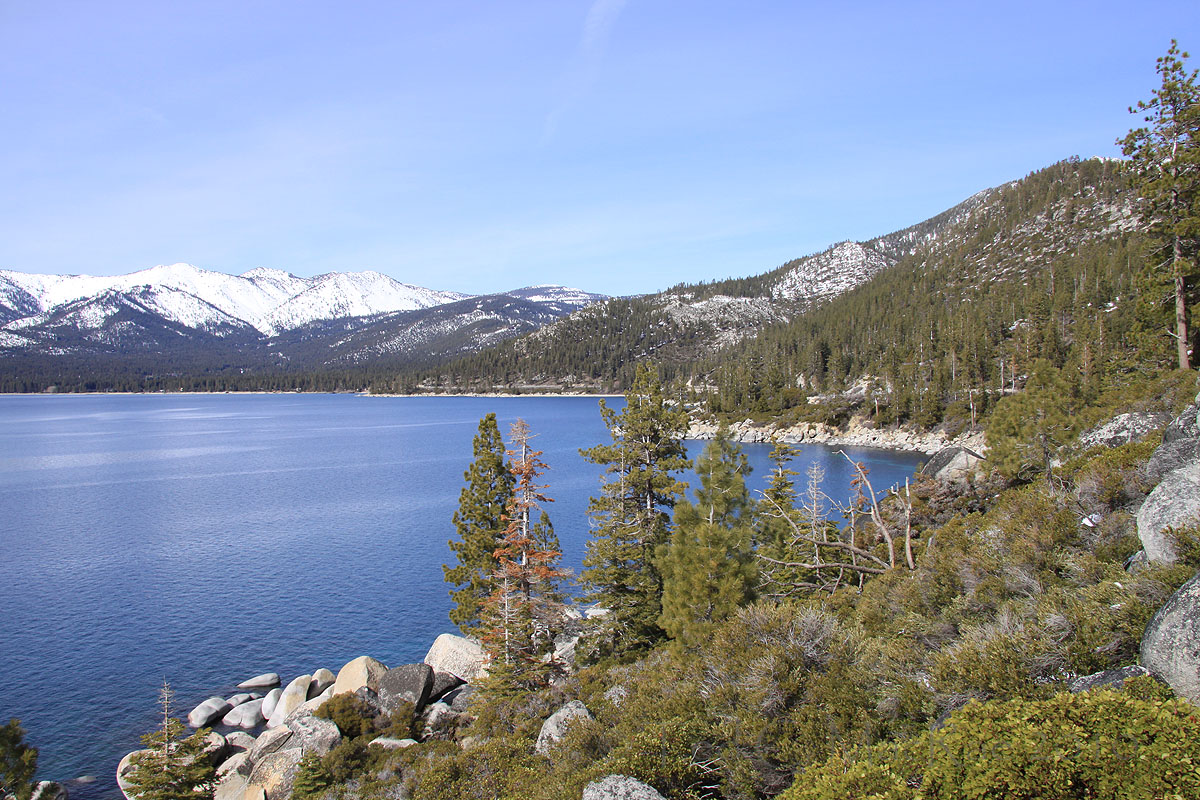
I’ve already shared a bit of the trip with a view of Mt. Rose from 7,000′ and ensuing pismire quagmire.  Today I share some views of one of the most scenic of lakeside spots on the east shore – Sand Harbor Overlook.  I featured this spot in this post from last year’s trip due to its stunning beauty, and this year I was no less impressed.  I still had that same, annoying, afternoon sun to deal with (next year I’ve resolved to get here during the morning) but managed to get some passable photographs.  The one above is my favorite, and I hope you enjoy the following as well. (p.s. if someone knows how to fix a sun-blown sky in Photoshop Elements, please let me know).

Copyright © Ted C. MacRae 2010

Add to FacebookAdd to DiggAdd to Del.icio.usAdd to StumbleuponAdd to RedditAdd to BlinklistAdd to TwitterAdd to TechnoratiAdd to Yahoo BuzzAdd to Newsvine

Email to a friend

Pismire Puzzle

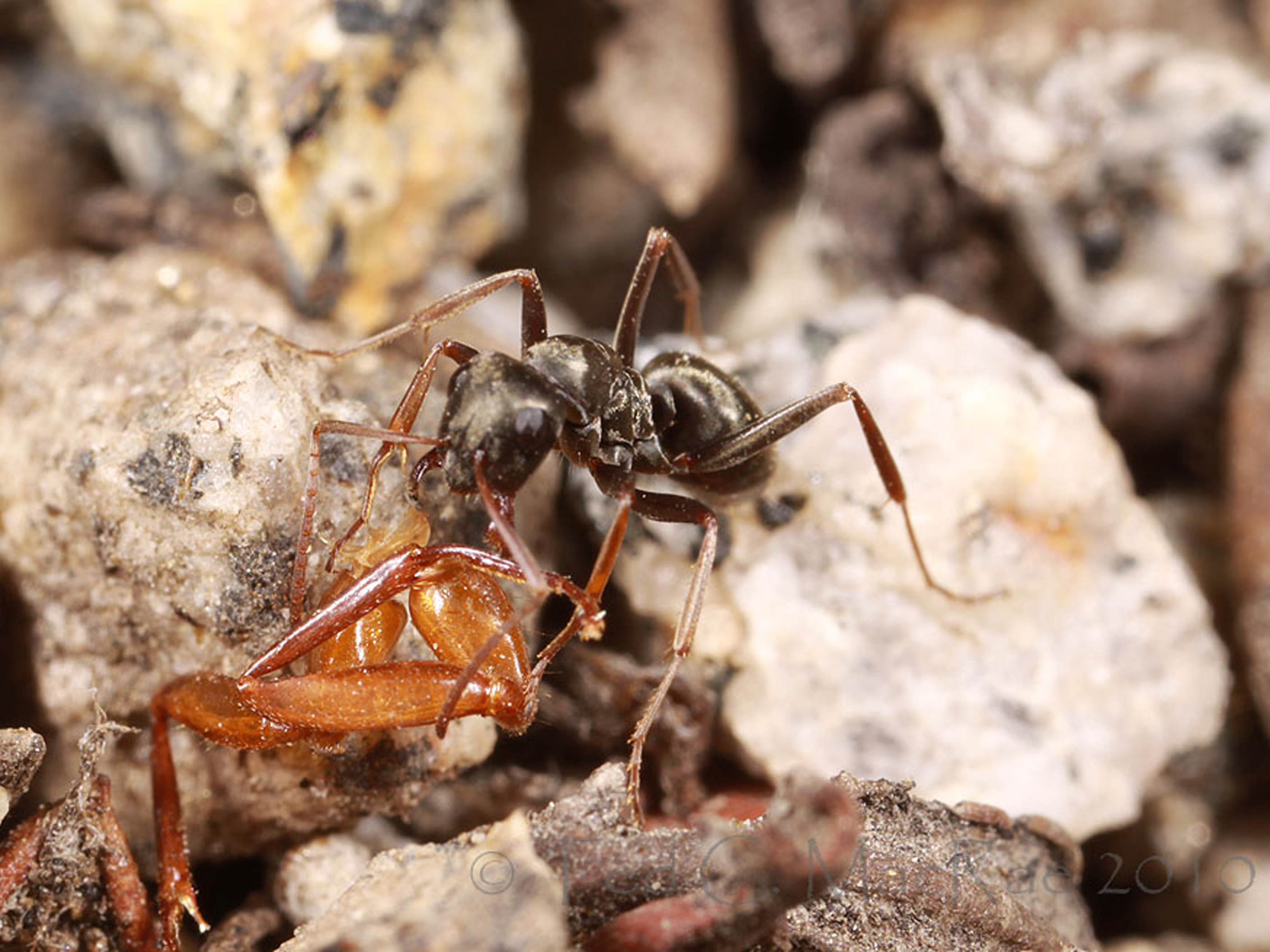
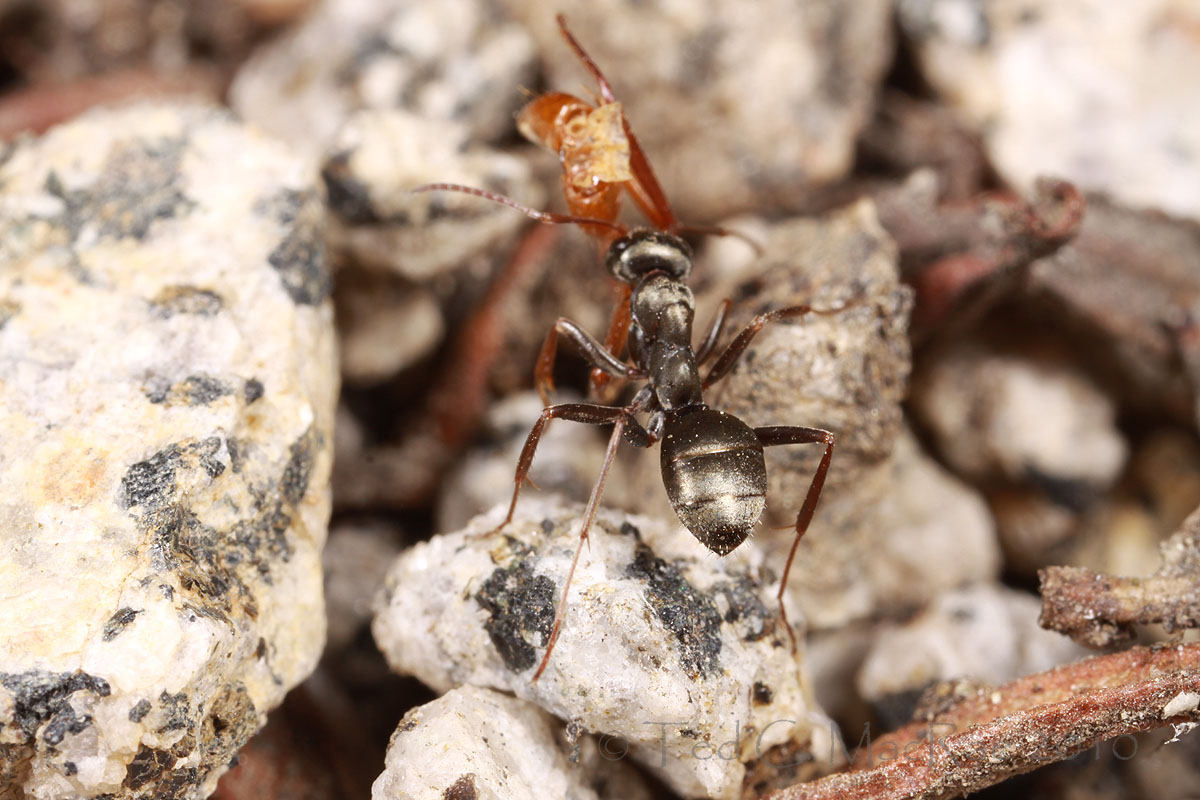
I returned home from a much-needed vacation late last night, and even though it was a family trip I have much to share from the past 10 days. However, I must remain coy about where I was for the time being so that I may present this little quiz:

Who am I?

I had planned to post this yesterday, but the best title I could come up with – “Monday Myrmecine Mystery” – was just too similar to a Monday tradition on another blog that we’ve all grown to love.  (Also, I just couldn’t get to it.)  No longer constrained by an M-themed title, I came up with this alternative¹ that I hope will make the 12-year old boy in each of us giggle aloud.

¹ Pismire (from pissemire) is an archaic name of Scandinavian origin for ant. Derived from pisse urine (referring to the smell of formic acid) + mire ant.

What am I doing?

I expect members of the Formicine Guild will jump all over this, so I should probably make this quiz about more than just the name of the ant (which I don’t know, so does that make this an illegal quiz?).  Maybe I should offer double points to non-myrmecologists for a proper ID (but then, I would need the consensus of the myrmecologists – perhaps a conflict of interest?).

Why do I do this?

I could also offer points for correctly guessing what the ant is carrying – which again I wasn’t able to figure out, so I guess points will have to be awarded for the most plausible explanation.  What I do know is the ant carried this carcass while meandering aimlessly over the same patch of ground – occasionally stopping very briefly to dig its jaws into it before resuming its wanderings.  I followed the ant for about 10 minutes, and it never left an area of about 1 square foot – no nest nearby that I could see, no direction to its travels, no apparent purpose to its labors.

This is where I live.

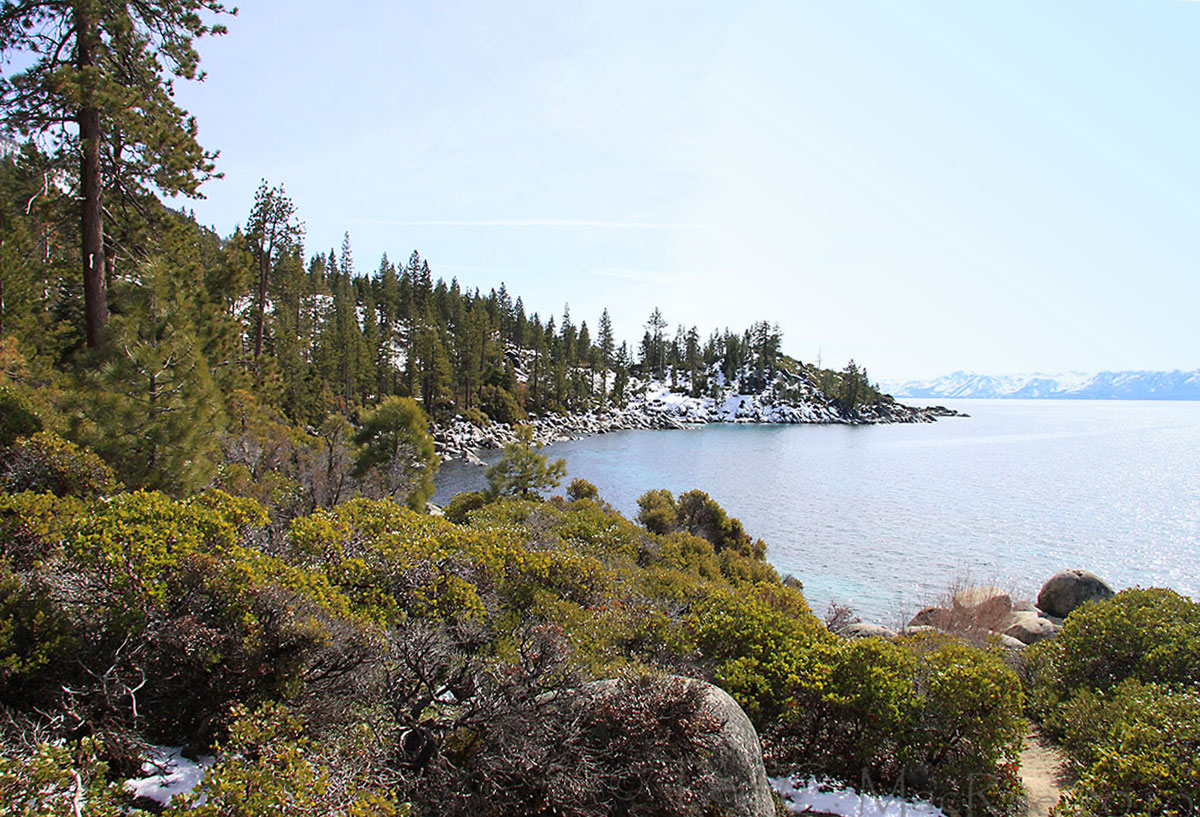
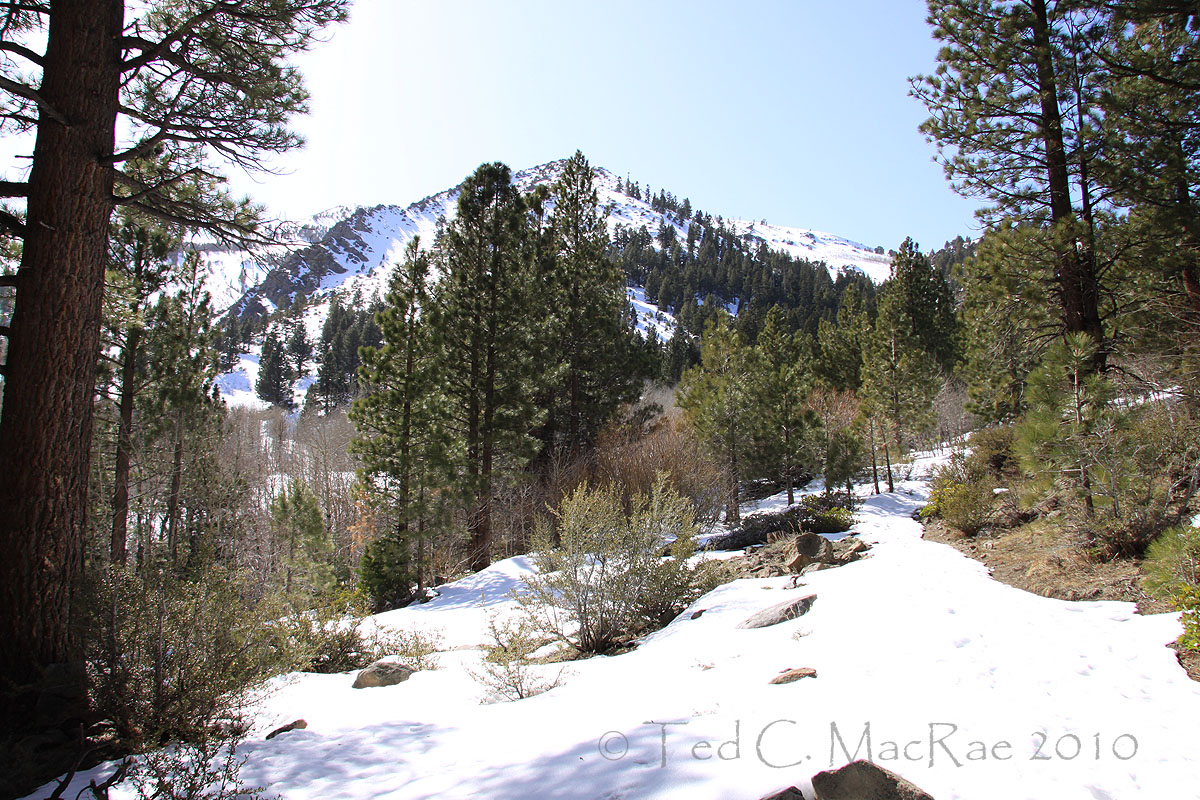
I most definitely know where I was, so firm points are on offer for correctly guessing the answer to that question – either on the basis of the ant ID or the above photograph of its habitat.  Yes, that is snow on the ground – lots of it!

Copyright © Ted C. MacRae 2010

Add to FacebookAdd to DiggAdd to Del.icio.usAdd to StumbleuponAdd to RedditAdd to BlinklistAdd to TwitterAdd to TechnoratiAdd to Yahoo BuzzAdd to Newsvine

Email to a friend

The Inexorable March of Spring!

Granted, the progress of spring seems to advance in halting baby steps with occasional falls onto its muddy bottom, rather than as a determined forward march, but spring is welcome, no matter how it arrives. When little green tips start poking up and there’s a bit of that “spring smell” in the air, I simply must get out and catch up on the status of Nature — the old-fashioned way (she doesn’t have a Facebook account). Over the last week, I’ve gone forth in search of signs that everything else living is about as tired of winter as I am, and wants to get this spring show on the road! There is already so much happening, I can’t recount it all here — A partial list of unphotographed notables: owls breeding; hawks nesting; woodcocks doing their silly, repetitive and almost invisible (because it’s nearly dark) courtship displays; wood ducks on forest ponds; year-round resident songbirds reestablishing territories; spring peepers, chorus frogs, wood frogs and southern leopard frogs singing, especially in the fishless ponds; winter crane flies and midges swarming in sun flecks in the woods; wild filberts, silver and red maples flowering, etc…

Formica pallidefulva sniffs the spring air


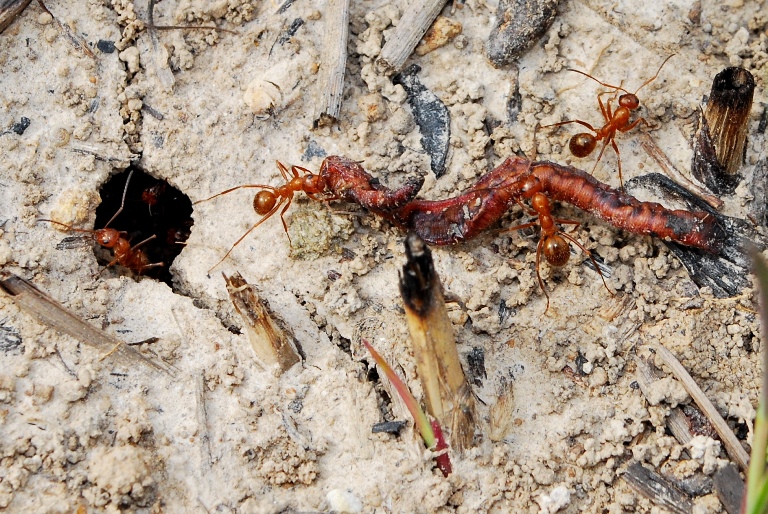
Of course, I look for the first ants out at this time of year, though with the exception of 10 March, when the temperature exceeded 70F, they haven’t been notably active. However, that afternoon I encountered, among others, a worker of Formica pallidefulva poking its head out cautiously to sniff the spring air. This is one of my favorite local ants — largish (5-6mm), abundant, active in daylight even when it’s hot, usually shiny bronzy red to red-brown, usually with a darker gaster (the apparent abdomen of ants) around here, but ranging from a beautiful reddish gold (in the deep South) to almost pure black-coffee brown (New England and southern Canada) across its wide geographic occurrence (Rocky Mountain foothills of Wyoming to New Mexico, all the way east to Québec and Florida). It has the added charm of being the host species to a wide range of social-parasitic and dulotic (“slave-making”) ants both in its own and in another closely related genus, with which it lives in temporary or permanent mixed colonies (as with the Polyergus illustrated in my last post). The image below of these ants bringing home a charred earthworm was taken almost one year ago, as one of Shaw Nature Reserve’s prairie areas was beginning to resprout after a prescribed burn a few weeks earlier. Ants will take their food raw or cooked!

Formica pallidefulva with charred earthworm


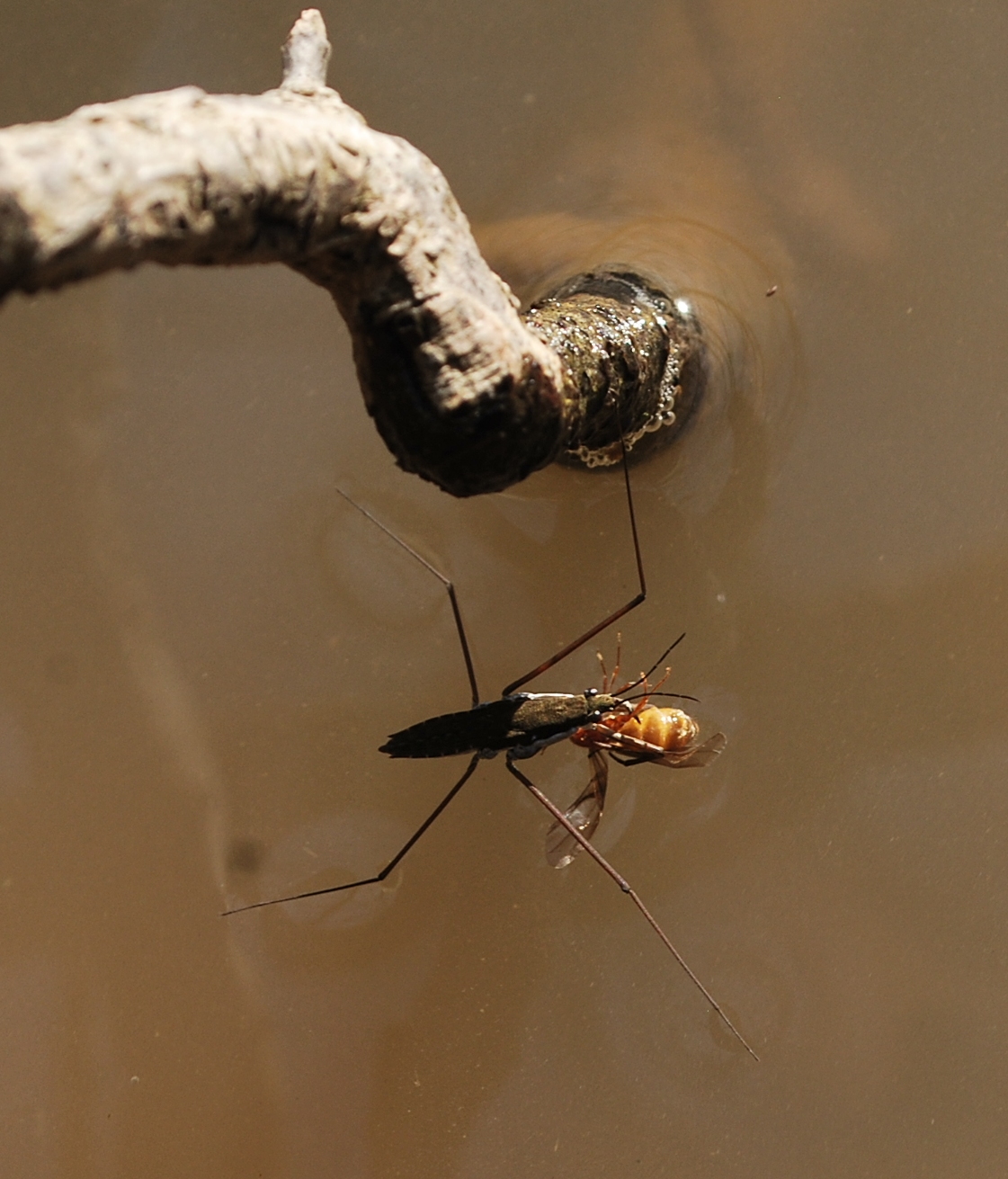
Prenolepis imparis alate in the clutches of a gerrid

Another ant I mentioned last time I was with you, Prenolepis imparis, has the distinction of being the only ant in our fauna that has mating flights while there is still a good chance of frost in the forecast for the next few weeks. In this picture of a mating pair at  BugGuide, note the size difference that inspires their name “imparis”, Latin for disparate. Any time after mid-February when it is sunny and not too windy, and the temperature rises above 65F, the winged males and females reared the preceeding fall, fly out to partake of a grand insectan orgy. Typically, they have big flights on the first couple of appropriately warm days, then some smaller ones (i.e., fewer individuals participating) over the next few weeks. The flying males look like gnats, bobbing up and down in drifting swarms, a few feet off the ground over a shrub, near a woodland edge or in a sunny opening. (One of my co-workers got into the midst of a group of such swarms once when we were conducting a prescribed burn in a wooded area, and I recall her commenting she “felt like Pigpen with all the little bugs flying around”!) The much larger, golden-brown females lift slowly off the ground, fly ploddingly (or is it seductively?) through the male swarms, are there mobbed by the tiny fellows, and then glide away and slightly downward, mating in flight with the winner of the males’ tussling. Rather clumsy fliers, the females do not always land in a good spot, as occurred to this hapless one that ended up as a feast for a water strider. Those that survive break off their wings, dig a burrow, seal themselves in, and raise a small brood of workers on food produced in their own bodies (like say, milk in mammals or “cropmilk” in doves and some other birds.)

But lest you to think I only have eyes for ants, I feel indeed fortunate to have encountered a tarantula this week, of the same species as Ted recently posted and I didn’t even have to go to Oklahoma for it. This bedraggled individual was at the mouth of its completely flooded burrow in what is most often a very dry habitat — a dolomite glade. Stunned and muddy at the time, my guess is this creature, belonging to a resilient and ancient lineage, will dry off, clean up, and saunter away as soon as she warms up.

Aphonopelma hentzi in flooded burrow


And speaking of emerging from flooded burrows, how about this handsome fellow, a male three-toed box turtle, his sex revealed by his bright orange and red markings, coming up for a breather? In truth, it was perhaps only just warm enough to make him need air, but not really enough so for him to be up and about, so he just sat there, nearly immobile, looking pretty, notwithstanding mud and leaves glued onto his shell.

Male box turtle emerges


Copyright © James C. Trager 2010

Add to FacebookAdd to DiggAdd to Del.icio.usAdd to StumbleuponAdd to RedditAdd to BlinklistAdd to TwitterAdd to TechnoratiAdd to Yahoo BuzzAdd to Newsvine

Email to a friend

March moths, herps, and beetles

Nature blog carnival time used to be restricted to the beginning of each month – a mensual fix of inverts, birds, berrys, and trees.  Those stalwarts still greet each new month in rough synchrony, but lately a new crop of upstart nature blog carnivals has appeared, all vying to fill that former mid-month lull.  Covering mothsherps, and beetles, they cater to a more specialized audience (despite their subject matter being as diverse as any of the original carnivals).   New editions of these mid-month carnivals are hot off the press, just in time to stock up on fresh reading material for the weekend.

Jason Hogle is my hero!  Intellect, perspective, and artistic talent combine at xenogere to produce some of the most visually and spiritually compelling nature writing available.  In The Moth and Me #9 – the wingless one, Jason unleashes his considerable talents on 15 contributions, weaving them seamlessly into a beautiful story about a wingless moth and its place in The Creation.  Read it and be spellbound, then (after getting over your jealousy of his writing talents) visit the posts for more lepidopterous prose.

John from Kind Of Curious got the lucky draw by hosting House of Herps #4 – St. Patrick’s Edition on St. Patrick’s Day. John notes the ophiological connection to St. Patrick – famed for driving the snakes out Ireland (today seen as an allegory for his conversion of many of the Irish to Christianity) – and then provides scientific reasons for the lack of snakes in Ireland. Nine other contributions round out a menagerie of posts covering snakes, turtles, salamaders, frogs, and toads.

For An Inordinate Fondness (AIF) #2, Amber and AJ at Birder’s Lounge have cleverly adopted a musical theme to honor the coleopterological origin behind the name of the music group, “The Beatles” – complete with song snippets and the irreverent perspective that we have come to expect and adore in their writings. Buzz on over, listen to the music, and let their prose whet your appetites before visiting this month’s eleven contributions.

Copyright © Ted C. MacRae 2010

Add to FacebookAdd to DiggAdd to Del.icio.usAdd to StumbleuponAdd to RedditAdd to BlinklistAdd to TwitterAdd to TechnoratiAdd to Yahoo BuzzAdd to Newsvine

Email to a friend