During the past year or so I’ve followed up my longer (one week or more) insect collecting trips with a synoptic “iReport”—so named because they are illustrated exclusively with iPhone photographs. It may come as a surprise to some, but iPhones actually take pretty good pictures (especially if you pay attention to their strengths and weaknesses), and their small, compact size makes it easy to take lots of photos while trying to use time in the field wisely. I find the iPhone to be a great tool for documenting the general flavor of a trip and for taking quick photos of subjects before getting out the big rig. I will, of course, feature photographs taken with the ‘real’ camera in future posts.
For this trip, I teamed up with Jeff Huether for the third time since 2012. Our quarry for this trip was longhorned beetles (family Cerambycidae) in the genus Prionus. Larvae of these beetles are subterranean, with some species feeding on roots of woody plants and others on roots of grasses and other herbaceous plants. Among the latter are an array of species occurring in the Great Plains, many of which have been very uncommonly collected. However, in recent years lures have been produced that are impregnated with prionic acid—the principal component of sex pheromones emitted by females in the genus. Originally produced for use in commercial orchards (which are sometimes attacked by P. laticollis in the east and P. californicus in the west), these lures are proving themselves to be useful for us taxonomist-types who wish to augment the limited amount of available material of other, non-economic species in the genus. While Prionus was our main goal, rest assured that I did not pass on the opportunity to find and photograph other beetles of interest.
I began the trip by driving from St. Louis to Wichita, Kansas to meet up with Jeff, who had flown there from his home in upstate New York. Our plan was to visit sites in southeastern Colorado and northeastern New Mexico, where several of the Prionus spp. that we were looking for were known to occur. Before doing this, however, we stopped in Hardtner, Kansas to see “Beetle Bill” Smith and tour his amazing natural history tribute, Bill and Janet’s Nature Museum.

“Beetle Bill” Smith, founder of Bill & Janet’s Nature Museum, Hardtner, Kansas.
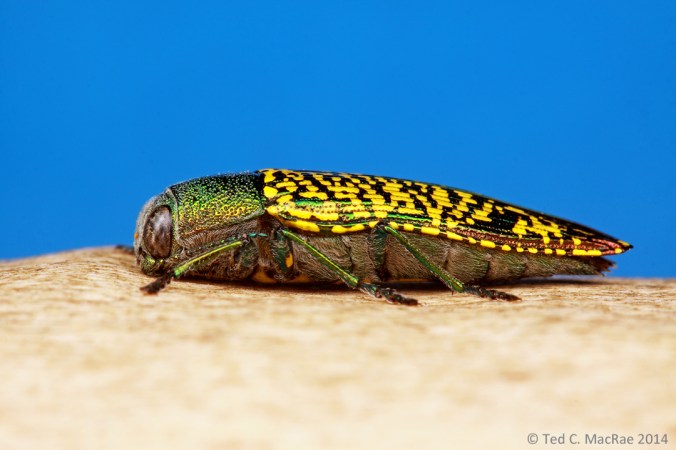
After the tour (and a delicious lunch at his house of fried crappie prepared by his wife Janet), we headed west of town and then south just across the state line into Oklahoma to a spot where Bill had found a blister beetle (family Meloidae) that Jeff was interested in finding. During lunch I mentioned a jewel beetle (family Buprestidae) that I had looked for in the area several times, but which had so far eluded me—Buprestis confluenta. Emerald green with a dense splattering of bright yellow flecks on the elytra, it is one of North America’s most striking jewel beetles and is known to breed in the trunks of dead cottonwoods (Populus deltoides). Bill mentioned that he had collected this species at the very spot where we were going, and when we arrived I was enticed by the sight of a cottonwood grove containing several large, dead standing trunks—perfect for B. confluenta.

Buprestis spp. love large, dead, barkless cottonwood trunks.
I searched for more than one hour without seeing the species, though I did find a few individuals of the related (and equally striking) B. rufipes on the trunks of the large, dead trees. Once that amount of time passes I’m no longer really expecting to see what I’m looking for, but suddenly there it was in all of its unmistakable glory! It would be the only individual seen despite another hour of searching, but it still felt good for the first beetle of the trip to be one I’d been looking for more than 30 years!
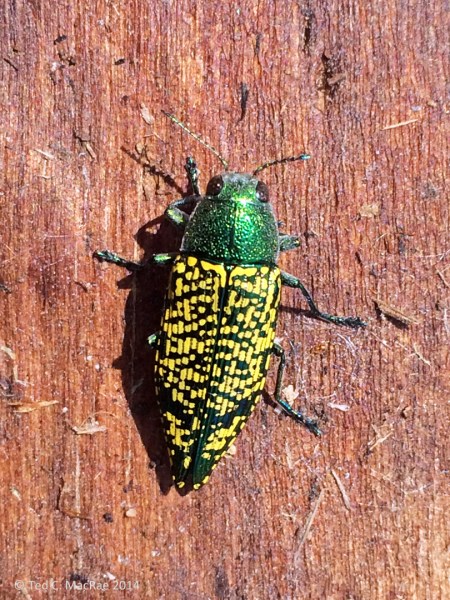
Buprestis confluenta, on the trunk of a large, dead cottonwood (Populus deltoides) | Woods Col., Oklahoma| USA: Oklahoma
I usually wait until near the end of a collecting trip to take the requisite selfie, but on this trip I was sporting new headgear and anxious to document its maiden voyage. My previous headgear of choice, a vintage Mambosok (impossible to get now), finally disintegrated after 20 years of field use, and on the way out-of-town I picked up a genuine Buff® do-rag. I know many collectors prefer a brim, but I don’t like they way brims limit my field of vision or get in the way when I’m using a camera. Besides, I’m usually looking down on the ground or on vegetation, so sun on my face is not a big issue. And do I be stylin’ or wut?

A “selfie” makes the trip official.
We made it to our first locality in southeast Colorado by noon the next day—the vast, dry grasslands north of Las Animas. Jeff had collected a blister beetle of interest here on an earlier trip, but as I looked out across the desolate landscape I wondered what on Earth I could find here that would be even remotely interesting to me.
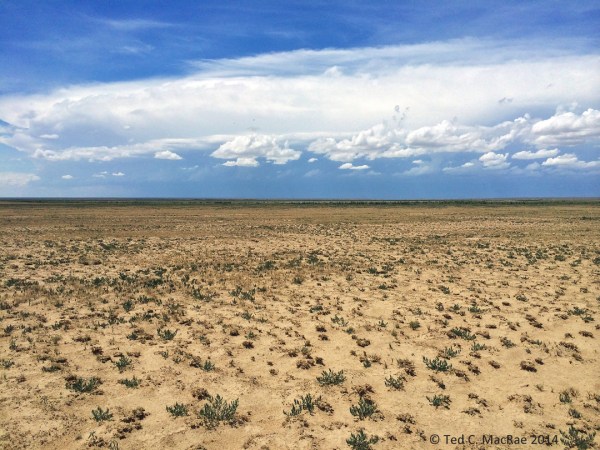
Shortgrass prairie habitat for Prionus integer.
Letting Jeff have some time to look for his blister beetle, I started down the roadside and after a short time found a live female Prionus sp. (later determined to represent P. integer). The only female Prionus I had ever collected before was P. heroicus, a giant species out in Arizona, and that was almost 30 years ago, so I wasn’t immediately sure what it was. Eventually I decided it must be Prionus, and a quick stop to kick the dirt while Jeff looked for his beetle turned into an intense search for more Prionus that surely were there. I did find two male carcasses shortly thereafter, and then nothing more was seen for the next hour or so.

Prionus integer male (found dead) | Bent Co., Colorado
During the time that I was searching, however, I started noticing strange burrows in the ground. I excavated a few—they were shallow but contained nothing. Nevertheless, they matched the size of the beetles perfectly—surely there was a connection?
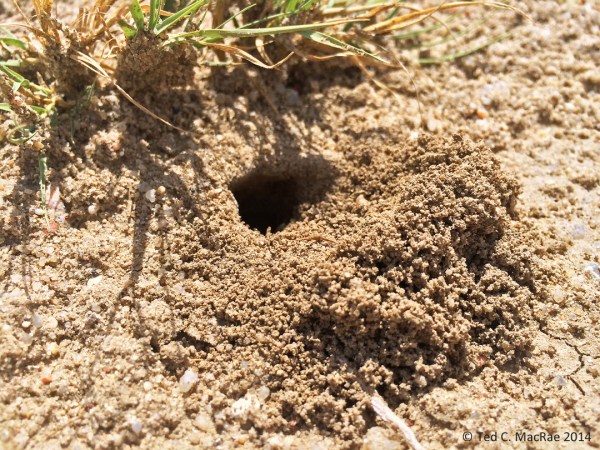
Prionus integer adult burrow.
I wondered if Jeff knew about the beetles occurring here, but when I showed him what I had found the surprised look on his face told me this was not the case. I showed him the burrows, and we both agreed they had to be connected. I got the shovel out of the truck and walked back to the area where I had seen the live female, then sunk the shovel deep into the ground next to one of the burrows and pried up a chuck of the soil containing the burrow in its entirety. As we broke apart the soil another female was revealed, and we immediately decided to set out some traps baited with prionic acid lures. We expected the beetles to become active during dusk, so we went into town to get something to eat and then check out another nearby locality before returning to the site at dusk. While we were gone it rained heavily at the site, so we weren’t sure if or how this would affect beetle activity and their possible attraction to the traps. However, as we approached the site (slipping and sliding on the muddy 2-track), we could actually see beetles crawling on the road from afar. What we found when we got out of the car was nothing short of mind-blowing—the beetles were everywhere, crawling on the road, crawling through the grass, and overflowing in the flooded traps! The vast majority were males, as expected, but we also found a fair number of the much more rarely collected females. This was significant, as the chance to observe mating and oviposition behavior made the encounter far more informative than if we had only found and collected the much more numerous males.

Prionus integer mating pair.
The following day we headed south into northeastern New Mexico to look at some shortgrass prairie sites near Gladstone (Union Co.) where two species of Prionus had been collected in recent years: P. fissicornis (the lone member of the subgenus Antennalia) and P. emarginatus (one of eight species in the poorly known subgenus Homaesthesis, found primarily in the Great Plains and Rocky Mountains). Fresh off of our experience the previous day, we were on the lookout for any suspicious looking “burrows” as we checked the roadsides at several spots in the area but found nothing, and while a few blister beetles piqued the interest of Jeff at one site, the complete absence of woody vegetation or flowering plants in general in the stark grassland landscape made the chances of me finding any other woodboring beetles remote. Eventually I became distracted by the lizards that darted through the vegetation around us, including this lesser earless lizard (Holbrookia maculata) and a collared lizard (better photos of both forthcoming).

Holbrookia maculata (lesser earless lizard) | Union Co., New Mexico.
Despite no clues to suggest that Prionus beetles were active in the area, we set out some traps at two sites with soil exposures that seemed similar to those seen the day before. As Jeff set the last pair of traps in place, my distraction with saurian subjects continued with a dusty hognose snake (Heterodon nasicus gloydi). While photographing the animal I looked down to my side, and what did I see but a male Prionus fissicornis crawling through the vegetation! I called out to Jeff, and for the next half an hour or so we scoured the surrounding area in a failed attempt to find more. We would not be back until the next morning to check the traps, so our curiosity about how abundant the beetles might be would have to wait another 18 hours. We cast an eye towards the north and watched late afternoon thunderstorms roll across the expansive landscape and decided to check out the habitat in nearby Mills Rim.

Thunderstorms over shortgrass prairie.
The rocky terrain with oak/pine/juniper woodlands at Mills Rim was a dramatic contrast to the gently rolling grasslands of the surrounding areas. We came here mostly out of curiosity, without any specific goal, but almost immediately after getting out of the car a huge Prionus male flew up to us—almost surely attracted by the scent of the lures we were carrying. Within a few minutes another male flew in, and then another. Because of their huge size and occurrence within oak woodland habitat, we concluded they must represent P. heroicus, more commonly encountered in the “Sky Islands” of southeastern Arizona. We stuck around to collect a few more, but as dusk approached we returned to the surrounding grasslands to set out some lures to see if we could attract other Prionus species. The frontal system that had waved across the landscape during the afternoon had left in its wake textured layers of clouds, producing spectacular colors as the sun sank inexorably below the horizon.

Sunset over shortgrass prairie.
This attempt to collect grassland Prionus beetles would not be successful, and as dusk progressed we became distracted collecting cactus beetles (Moneilema sp., family Cerambycidae) from prickly pear cactus plants (Opuntia sp.) before darkness ended our day’s efforts. This did not mean, however, that all of our efforts were done—there are still night active insects, and in the Great Plains what better nocturnal insect to look for than North America’s largest tiger beetle, the Great Plains giant tiger beetle (Amblycheila cylindriformis, family Cicindelidae—or subfamily Cicindelinae—or supertribe Cicindelitae, depending on who you talk to)?! We kept our eyes on the headlamp illuminated 2-track as we drove back to the highway and then turned down another road that led into promising looking habitat. Within a half-mile of the highway we saw one, so I got out to pick it up and then started walking. I walked another half-mile or so on the road but didn’t see anything except a few Eleodes darkling beetles (family Tenebrionidae), then turned around and walked the habitat alongside the road on the way back. As I walked, tiny little rodents—looking like a cross between a mouse and a vole—flashed in and out of my headlight beam as they hopped and scurried through the vegetation in front of me. Most fled frantically in response to my attempted approach, but one, for some reason, froze long enough under my lamp to allow me this one photo. When I posted the photo on my Facebook page, opinions on its identity ranged from kangaroo rat (Dipodomys sp.) silky pocket mouse (Perognathus flavus) to jumping mouse (Zapus sp.). Beats me.
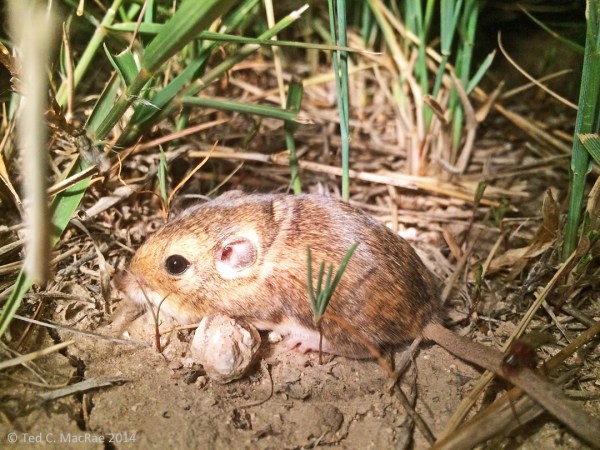
Kangaroo rat? Silky pocket mouse? Jumping mouse? | Union Co., New Mexico.
Almost as if by command, it rained during the early evening hours where we had set the traps, and the following morning we were rewarded with traps brimming with Prionus fissicornis males. Not only were the traps full, but males were still running around in the vicinity, and we even found a few females, one of which was in the act of ovipositing into the soil at the base of a plant.

Prionic acid-bated traps w/ Prionus fissicornis males.
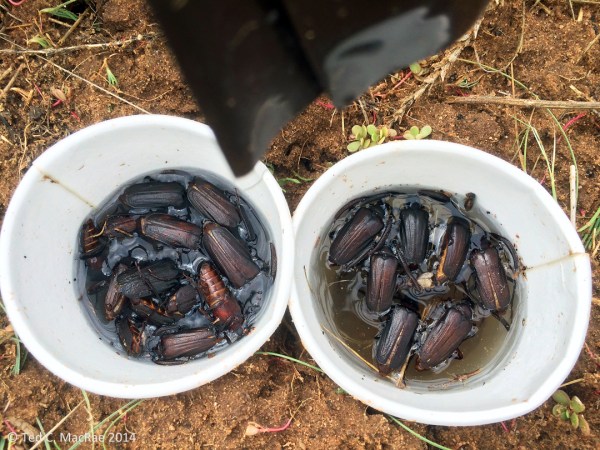
Prionic acid-bated traps w/ Prionus fissicornis males.
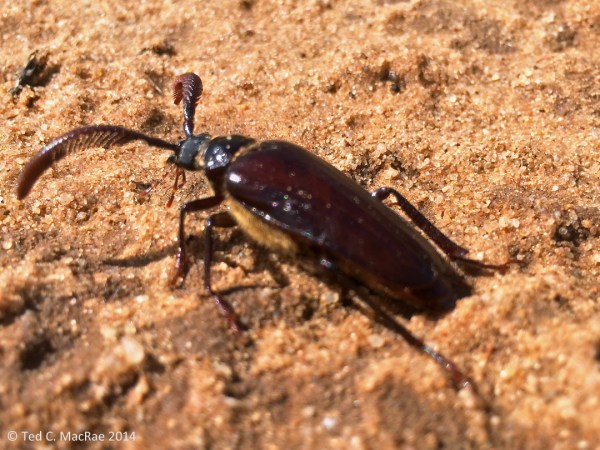
Prionus fissicornis male | Harding Co., New Mexico.

Prionus fissicornis oviposition hole.
Eventually P. fissicornis activity subsided, and we decided to go back to the area around Mills Rim to see what beetles we might find in the woodland habitats. We also still were not sure about the Prionus beetles we had collected there the previous day and whether they truly represented P. heroicus. The scrubby oaks and conifers screamed “Beat me!”, and doing so proved extraordinarily productive, with at least a half-dozen species of jewel beetles collected—including a nice series of a rather large Chrysobothris sp. from the oaks that I do not recognize and a single specimen of the uncommonly collected Phaenops piniedulis off of the pines.
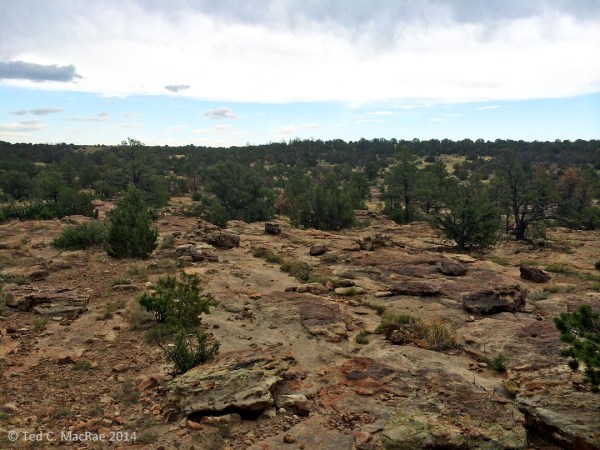
Oak/juniper woodland at Mills Canyon, habitat for Prionus heroicus.
Not only is the scenery at Mills Rim Campground beyond spectacular, it also boasts some of the most adoringly cute reptiles known to man—such as this delightfully spiky horned lizard (I prefer the more colloquial name “horny toad”!). I’m probably going to regret not having photographed this fine specimen with the big camera.
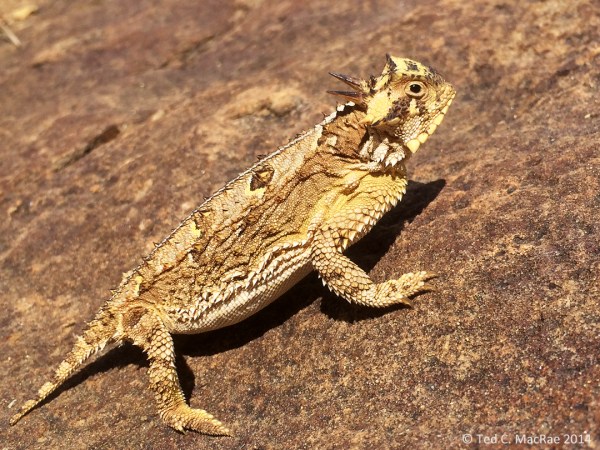
Phrynosoma cornutum (Texas horned lizard) | Harding Co., New Mexico.
Fresh diggings beside a rock always invite a peek inside. You never know who might be peeking out.
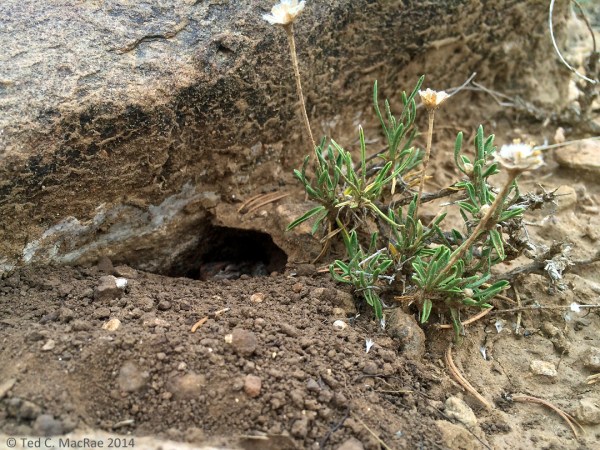
Who’s home?

Peek-a-boo!
The trip having reached the halfway point, we debated whether to continue further south to the sand dunes of southern New Mexico (with its consequential solid two-day drive back to Wichita) or turn back north and have the ability to collect our way back. We chose the latter, primarily because we had not yet had a chance to explore the area around Vogel Canyon south of Las Animas, Colorado. We had actually planned to visit this area on the day we encountered P. integer in the shortgrass prairie north of town, and a quick visit before going back to check the traps that evening showed that the area had apparently experienced good rains as shown by the cholla cactus (Cylindropuntia imbricata) in full bloom.

Cylindropuntia imbricata | Otero Co., Colorado.
Whenever I see cholla plants I can’t help myself—I have to look for cactus beetles (Moneilema spp.). It had rained even more since our previous visit a few days ago, and accordingly insects were much more abundant. Several Moneilema adults were seen on the cholla, one of which I spent a good bit of time photographing. The iPhone photo below is just a preview of the photos I got with the big camera (which also included some very impressive-sized cicadas—both singing males and ovipositing females). The cactus spines impaled in the camera’s flash control unit serve as a fitting testament to the hazards of photographing cactus insects!
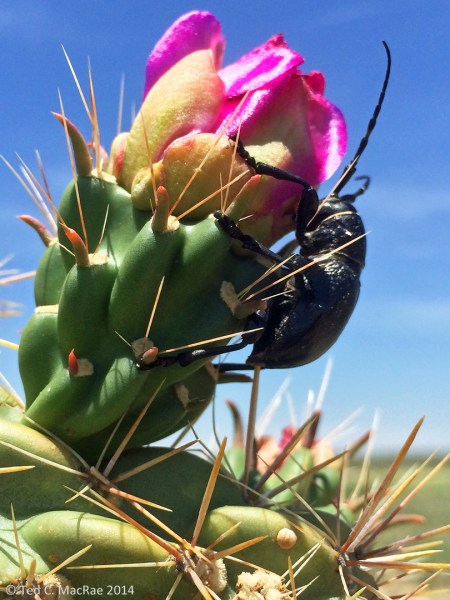
Moneilema sp. on Cylindropuntia imbracata } Otero Co., Colorado.
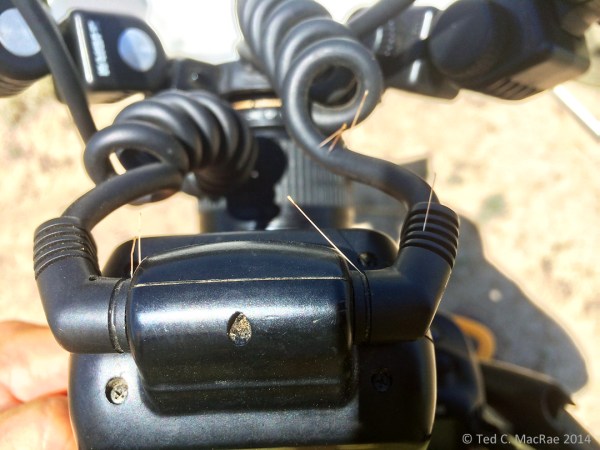
The hazards of photographing cactus beetles.
Later in the afternoon we hiked down into the canyon itself, and while insects were active we didn’t find much out of the ordinary. We did observe some petroglyphs on the sandstone walls of the canyon dating from the 1200s to the 1700s—all, sadly, defaced by vandals. Despite the rather uninspiring collecting, we stayed in the area for two reasons: 1) Jeff wanted to setup blacklights at the canyon head in hopes of collecting a blister beetle that had been caught there on an earlier trip, and 2) I had noted numerous Amblycheila larval burrows in the area (and even fished out a very large larva from one of them) and wanted to search the area at night to see if I could find adults. Jeff was not successful in his goal, and for a time I thought I would also not succeed in mine until we closed up shop and started driving the road out of the canyon. By then it was after 11 p.m. and we managed to find about a half-dozen A. cylindriformis adults. This was now the third time that I’ve found adults of this species, and interestingly all three times I’ve not seen any beetles despite intense searching until after 11 p.m and up until around midnight.

Lithographs on canyon wall | Mills Canyon, Colorado.
The next morning we found ourselves with two days left in the trip but several hundred miles west of Wichita, where I needed to drop Jeff off for his flight back home before I continued on home to St. Louis. I had hoped we could make it to the Glass Mountains just east of the Oklahoma panhandle to see what Prionus species might be living in the shortgrass prairies there (and also to show Jeff this remarkable place where I’ve found several new state records over the past few years). As we headed in that direction, I realized our path would take us near Black Mesa at the western tip of the Oklahoma pandhandle, and having been skunked on my first visit to the area last year due to dry conditions but nevertheless intrigued by its very un-Oklahoma terrain and habitat I suggested we stop by the area and have a look around before continuing on to the Glass Mountains. We arrived in the area mid-afternoon and headed straight for a rock outcropping colonized by scrub oak (Quercus sp.) and pinyon pine (Pinus sp.)—very unusual for western Oklahoma—that I had found during my previous trip.

The area around Black Mesa couldn’t be more unlike the perception that most people have of Oklahoma.
I wanted to beat the oaks for buprestids—surely there would be a state record or two just sitting there waiting for me to find them, but as I started walking from the car towards the oaks the approach of a loud buzz caught my attention. I turned around to see—would you believe—a large Prionus beetle circling the air around me and was fortunate to net it despite its fast and agile flight. I hurried back to the car to show Jeff what I had found; we looked at each other and said, “Let’s collect here for a while.” The beetle had apparently been attracted to the lures in the car, so we got them out, set them up with some traps, and went about beating the oaks and watching for beetles to fly to the lure. Sadly, no jewel beetles were collected on the oaks, although I did find evidence of their larval workings in some dead branches (which were promptly collected for rearing). Every once in a while, however, a Prionus beetle would fly in, apparently attracted to the lure but, curiously, never flying directly to it and falling into the trap. Many times they would land nearby and crawl through the vegetation as if searching but never actually find the trap. However, just as often they would approach the trap in flight and not land, but rather continue circling around in the air for a short time and before suddenly turning and flying away (forcing me to watch forlornly as they disappeared in the distance). Based on their very large size, blackish coloration and broad pronotum, we surmised (and later confirmed) these must also be P. heroicus, despite thinking (and later confirming) that the species was not known as far east as Oklahoma. Not only had we found a new state record, but we had also recorded a significant eastern range extension for the species. And to think that we only came to Black Mesa because I wanted to beat the oaks!

Prionus heroicus male

Proof that Prionus heroicus males can bite hard enough to draw blood!
We each collected a nice series of the beetles, and despite never witnessing the beetles actually going to the traps a few more were found in the traps the next morning after spending the night in a local bed & breakfast. I also found a dove’s nest with two eggs hidden in the vegetation, and as we were arranging for our room at the bed & breakfast a fellow drove up and dropped off a freshly quarried dinosaur footprint (the sandstone, mudstone, and shale deposits around Black Mesa are the same dinosaur fossil bearing deposits made more famous at places like Utah’s Dinosaur National Monument).

Dove’s nest w/ eggs.
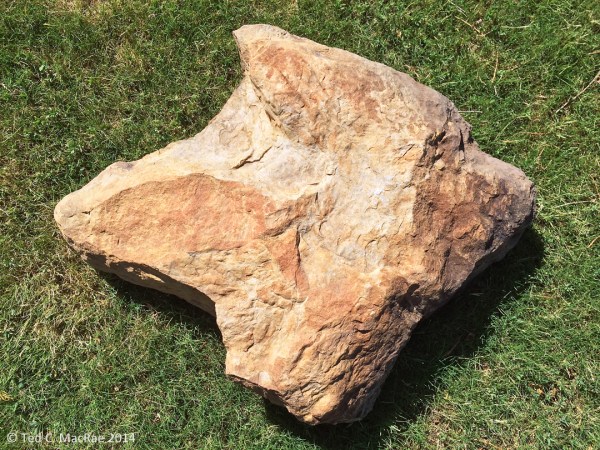
Freshly quarried dinosaur fossil footprint
By the way, if you ever visit the area, the Hitching Post at Black Mesa is a great place to stay. A longhorn skull on the barn above an authentic 1882 stagecoach give a hint at the ambiance, and breakfast was almost as good as what my wife Lynne can do (almost! 🙂 ).

Longhorn skull on barn at our Bead and Breakfast.
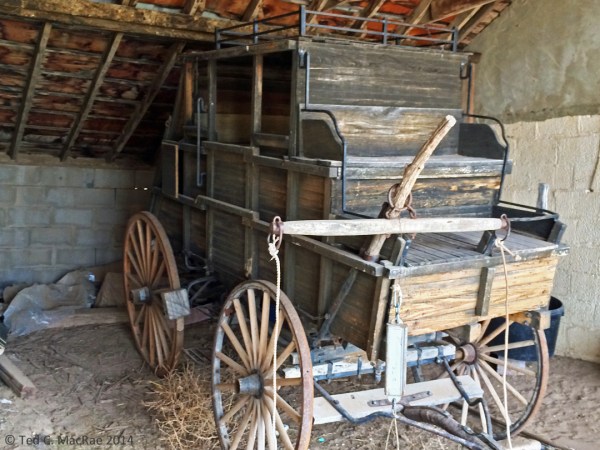
132-year-old stagecoach – model!
After breakfast we contemplated the long drive that lay between us and our arrival in Wichita that evening—our longer than expected stay in the area had virtually eliminated the possibility to collect in the Glass Mountains. Nevertheless, there was one more thing that I wanted to see before we left—the dinosaur footprints laying in a trackway along Carrizo Creek north of the mesa. I only knew they were in the area based on a note on a map, but as there were no signs our attempt to find them the previous day was not successful. Armed with detailed directions from the B&B owners, however, we decided to give it one more shot. Again, even after we found the site I didn’t see them immediately, I suppose because I was expecting to see distinct depressions in dry, solid rock. Only after the reflections of light from an alternating series of small puddles—each measuring a good 10–12″ in diameter—did I realize we had found them. Recent rains had left the normally dry creek bed filled with mud, with the footprints themselves still filled with water.

Dinosaur tracks | vic. Black Mesa, Oklahoma.
It is not surprising that I would be so excited to find the tracks, but what did surprise me was the effect they had on me. Seeing the actual signs of near mythical beasts that lived an incomprehensible 100 million years ago invites contemplation and reminds us that our time here on Earth has, indeed, been short!
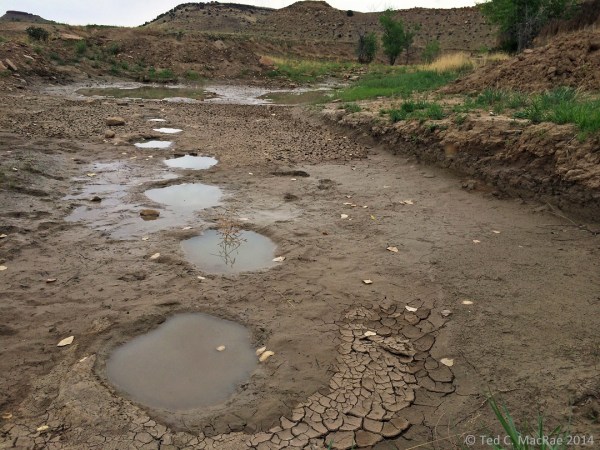
Dinosaur tracks | vic. Black Mesa, Oklahoma.
By this time, we had no choice but to succumb to the long drive ahead. We did manage to carve out a short stop at the very first locality of the trip in an effort to find more Buprestis confluens (finding only a few more B. rufipes), but otherwise the day was spent adhering to our goal of reaching Wichita before nightfall. Jeff was home and sipping tea before lunchtime the next day, while I endured one more solid day of driving before making it back to St. Louis in time for dinner with the family. At that point, the trip already could have been considered a success, but how successful it ultimately ends up being depends on what beetles emerge during the next season or two from these batches of infested wood that I collected at the various spots we visited.
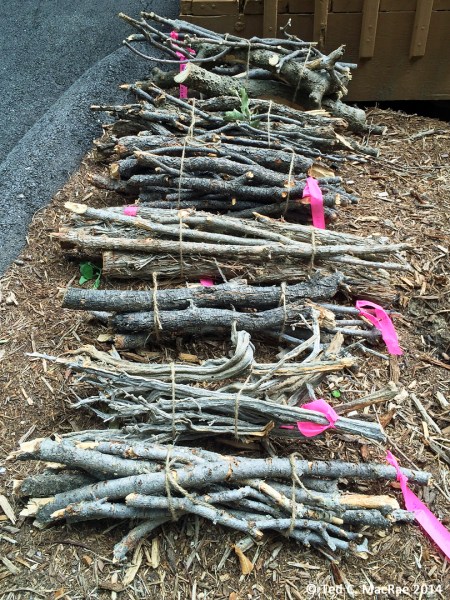
Wood collected for rearing wood-boring beetles.
If you like this Collecting Trip iReport, you might also like the iReports that I posted for my 2013 Oklahoma and 2013 Great Basin collecting trips as well.
© Ted C. MacRae 2014