Another new record for northwestern Oklahoma

You would think that finding two new state records on the first day of my June collecting trip to northwestern Oklahoma would be fortune enough—it is rare to get two new state records on an entire trip even! As a result, I spent all morning and the early part of the afternoon working the mesquite (Prosopis glandulosa) and red-cedar (Juniperus virginiana) that dotted the barren flats at Gloss Mountain State Park to ensure good voucher series of Plionoma suturalis and Chrysobothris quadrilineata. Around 2 pm I decided I’d worked the flats as well as I could and turned my attention to the park’s main attraction, a large, gypsum-capped, red clay mesa rising 150 to 200 feet above the flats below.

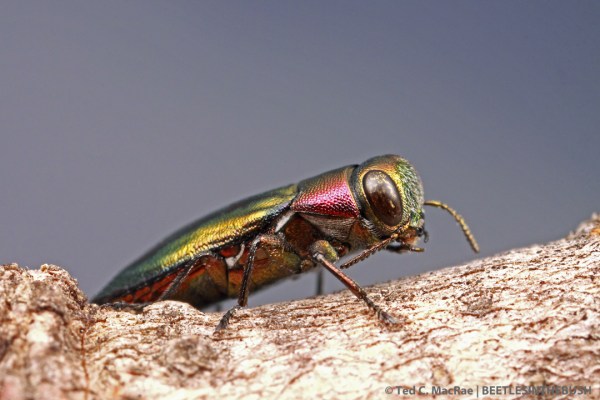
Paratyndaris prosopis on dead hackberry (Celtis sp.) | Gloss Mountain State Park, Oklahoma

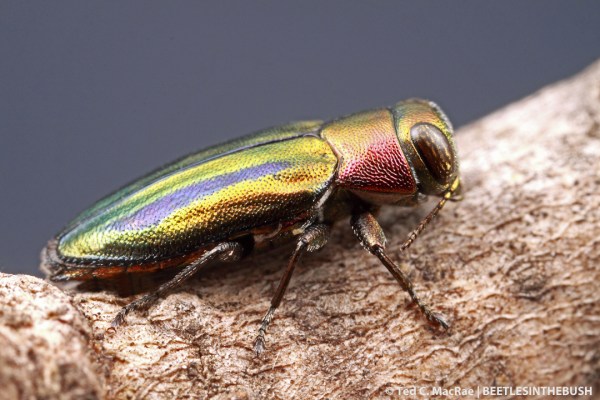
Paratyndaris prosopis on dead hackberry (Celtis sp.) | Gloss Mountain State Park, Major Co., Oklahoma

Red-cedar occurs on top of the mesa as well as the flats¹, but otherwise the mesa top supports a different assemblage of woody vegetation. Gone is the mesquite, a relatively “thirsty” plant that uses extraordinarily long taproots to reach subterranean water tables. In its place are western soapberry (Sapindus saponaria), hackberry (Celtis sp., poss. C. laevigata var. texana), and American elm (Ulmus americana). The soapberry was what I was most interested in, as this plant is a known host for several very uncommonly encountered species of jewel beetles in the genus Agrilus that are more commonly encountered in Texas. Hackberry also is a good host for a variety of jewel beetles, with somewhat different species occurring in Texas versus more eastern areas in the country. Perhaps, I thought, some of these Texas species could be found here as well.

¹ While native to Oklahoma, eastern red-cedar was restricted in pre-settlement times to areas not subject to fire. It is now considered an invasive species in many areas as a result of long-term fire suppression and the effects of intense cattle grazing. In the morning while I was collecting in the flats (and before I had started working the red-cedars to see what beetle was causing the branch dieback), a park ranger stopped by and asked if I knew of any way to “get rid of the cedars.” He didn’t seem very satisfied with my standard answer of mechanical removal and prescribed burning at regular intervals. He then asked about the branch dieback that was so common in the trees, and I told him I thought it was a beetle. With almost desperate optimism he said, “maybe the beetle can finish them off.” I didn’t share his optimism but didn’t say anything either.

Paratyndaris prosopis

I focused most of my early efforts on the soapberry, but nothing was landing on the beating sheet, so I then turned my attention to the hackberry. Most branches were yielding a few Agrilus spp. with each whack, but they seemed to be only commonly occurring species such as A. paracelti and A. lecontei (in this area the population should be assignable to subspecies lecontei). One can almost get “lulled to sleep” in such situations, eventually not expecting to see something different, but after working a number of trees I whacked a particularly “punky” dead branch of a tree and saw the unmistakable outline of a chunky little jewel beetle that I immediately recognized as Paratyndaris prosopisParatyndaris is a largely southwestern and Mexican genus of beetles that are often not well represented in collections. Paratyndaris prosopis is the only species known to venture north and east beyond Texas, but this is based on only three records: one in Red Oak, Oklahoma by the late Karl Stefan (an indefatigable collector of beetles in Latimer Co.), another at Magazine Mountain, Arkansas (a single specimen given to me by my friend Doug LeDoux), and a third from Oktibbeha Co., Mississippi (Nelson & Bellamy 2004). While not a new state record, I knew its occurrence in Major Co., Oklahoma represented a northward extension to its known range (and also opening the possibility that it might even occur as far north as Kansas). They were not common—I worked every hackberry tree I could find on the mesa and got just three specimens on the first day and a few more when I went back the next morning. However, at the end of the trip I returned to Gloss Mountain and managed to get a nicer series of close to a dozen specimens. While hackberry trees can be found in several patches on the mesa, the beetles seemed to be limited to one small area.

Paratyndaris prosopis

The occurrence of this species on hackberry and not mesquite is interesting. The type specimen was cut from a dead branch of mesquite (Skinner 1903)—hence, the species epithet, but all subsequently recorded host associations have been on oak (Quercus spp.) (Nelson 1987, Nelson & Westcott 1976), including a single specimen that I reared from a dead Q. vaseyana branch collected in the Davis Mountains, Texas. No oak occurs in the Gloss Mountains, but mesquite is common in the flats, yet it is clear from the number of specimens collected on hackberry and nothing else that the species, at least in this area, is utilizing that plant as a host. Also of interest is the date of collection—June 2, which is a full week earlier than the previous early record of June 9 (especially interesting when one considers that these are the northernmost specimens known).

REFERENCE:

Nelson, G. H. 1987. Additional notes on the biology and distribution of Buprestidae (Coleoptera) in North America, II. The Coleopterists Bulletin 41(1):57–65.

Nelson, G. H. & C. L. Bellamy. 2004. A revision of the genus Paratyndaris Fisher, 1919 (Coleoptera: Buprestidae: Polycestinae). Zootaxa 683:1–80.

Nelson, G. H. & R. L. Westcott. 1976. Notes on the distribution, synonymy, and biology of Buprestidae (Coleoptera) of North America. The Coleopterists Bulletin 30(3):273–284.

Skinner, H. 1903. Notes on Buprestidae (Coleoptera) with descriptions of new species. Entomological News 14:236–239.

Copyright © Ted C. MacRae 2013
Bee Assassin on Coneflower

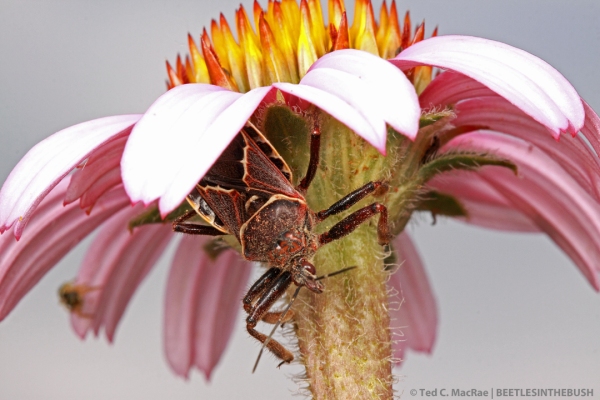
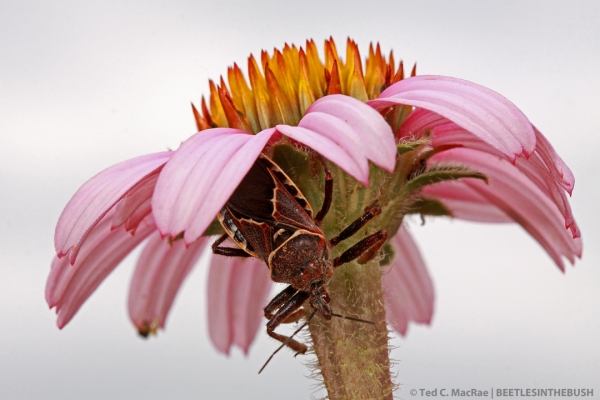
Bee assassin (Apiomerus spissipes) on coneflower (Echinacea sp.) | Gloss Mountain State Park, Major Co., Oklahoma

Apiomerus spissipes? on coneflower (Echinacea sp.) | Gloss Mountain State Park, Major Co., Oklahoma

While looking for longhorned beetles on prickly pear cactus (Opuntia macrorhiza) at Gloss Mountains State Park, I saw a coneflower that didn’t look quite right—there was nothing on the top, but there seemed to be something on the underside. I knelt down cautiously and peered underneath the blossom to find this bee assassin (family Reduviidae, genus Apiomerus) lurking under the petals. As a collector with eyes always looking for signs of insects, I’ve trained myself to look for both the obvious and the non-obvious, yet  this brightly colored insect still almost completely escaped my notice. I can imagine that a bee with little room in its mind for anything but collecting pollen would be easy pickings for such a stealthy predator.

Apiomerus spissipes

The coloration of this individual seems to best match specimens representing the species Apiomerus spissipes, which ranges broadly and abundantly across the Great Plains (Berniker et al. 2011). The location of Gloss Mountain State Park in western Oklahoma places it almost smack in the middle of the recorded distribution for this species, which is largely replaced further east by the closely related but generally darker A. crassipes. Interestingly, very few Oklahoma specimens were available for examination by Berniker and colleagues during their study, a fact that once again demonstrates the need for continued collecting in even “well-collected” states like Oklahoma.

REFERENCE:

Berniker, l., S. Szerlip, D. Forero & C. Weirauch. 2011. Revision of the crassipes and pictipes species groups of Apiomerus Hahn (Hemiptera: Reduviidae: Harpactorinae). Zootaxa 2949:1–113.

Copyright © Ted C. MacRae 2013

Mexico 1992—Gang of Ten

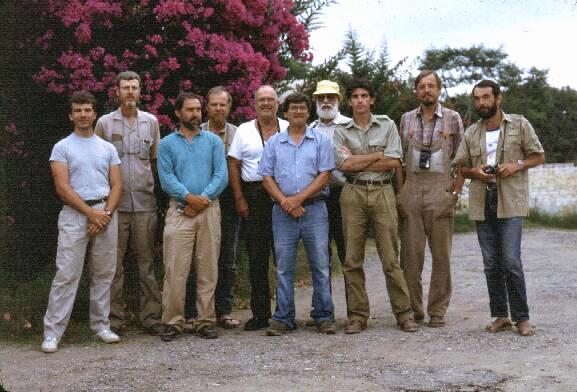
As a young collector attracted to woodboring beetles, my interests were split evenly between the families Buprestidae and Cerambycidae. In those early days, I actively sought the counsel of experts in both families, looking for help with identifications. Most were more than gracious with their help, and receiving their letters and return shipments of beetles I had sent for their examination was a highlight of each winter season. There was one man, however, whose letters and parcels I looked forward to receiving more than any other—the late, great Gayle Nelson. More than just a report of identifications, Gayle’s letters were also rich with advice, suggestions and encouragement—he became my first mentor. I coauthored my first published paper on Buprestidae with Gayle (Nelson & MacRae 1990), and when I moved to California in 1990 I had the chance to meet him in person and accompany him on a collecting trip to the great southern Californian deserts. Talk about learning from the master! In the meantime I had also struck up correspondence with long-time buprestophiles Rick Westcott and Chuck Bellamy. I guess between the three of them they saw some potential in me, as shortly after my move to California they invited me to join the upcoming World Buprestid Workers Gathering—a 2-week collecting trip in southern Mexico scheduled for July 1992. While not all of the world’s buprestid workers were able to make this trip, a majority of the heaviest hitters from the U.S. and Europe were there. The photo below is the only one I’m aware of in which all ten participants are present, and while I felt like a midget amongst giants at the time, I’ve enjoyed more or less regular correspondence with most of the participants of that trip over the many years that have since passed.

Huahuapan de Leon, Oaxaca, Mexico - July 1992 (L to R): Ted MacRae, Rick Westcott, Hans Mühle, Chuck Bellamy, Gayle Nelson, Byrd Dozier, Dave Verity, Kim Pullen, Svata Bílý, Mark Volkovitsh (photographer unknown).

Huahuapan de Leon, Oaxaca, Mexico—July 1992 (left to right): Ted MacRae, Rick Westcott, Hans Mühle, Chuck Bellamy, Gayle Nelson, Byrd Dozier, Dave Verity, Kim Pullen, Svata Bílý, Mark Volkovitsh.

That trip remains one of the best insect collecting trips I’ve ever experienced (although there are many others now that also bear that distinction). Gayle, Dave Verity and I started in the state of Guerrero and worked our way down into Oaxaca, where we met up with the others and collected together as one large group before Chuck, Rick and I split off and returned for more collecting in Guerrero. I don’t remember how many species I collected—somewhere in the neighborhood of 60 or so, but I’ll never forget finding the first specimens of what would eventually be described as Oaxacanthaxia nigroaenea Nelson & MacRae 1994. We found it at the type locality (near Tehuantepec) of what was then the only known species in the genus, O. viridis Bellamy 1990, that represented an apparently relictual line of buprestids with affinities to certain Old World genera. While that was the only new species that I described from the trip, several described by others are based at least in part on material that I collected. Another highlight of the trip was the “big, dead tree” in Cañón del Zopilote, Guerrero (literally, a big, dead tree), the high branches of which yielded several specimens of Polycesta cortezii Thomson 1878 and one Jelinekia barri (Nelson 1975). Sadly, I wasn’t much of a journal-keeper in those days, so most of the memories that remain from that trip are just snippets in time. Nevertheless, whenever I look at specimens collected on that trip I am usually able to recall the circumstances of its collection, and I recently had the chance to go through much of this material in detail again, as many of the specimens collected represented newly documented state occurrences and adult host plants. These records can now be found in a newly published paper by me and Chuck in which two new species of Actenodes collected during subsequent trips are described (MacRae & Bellamy 2013).

REFERENCES:

MacRae, T. C. & C. L. Bellamy. 2013. Two new species of Actenodes Dejean (Coleoptera: Buprestidae) from southern Mexico, with distributional and biological notes on Buprestidae from Mexico and Central America. The Pan-Pacific Entomologist 89(2):102–119.

Nelson, G. H. & T. C. MacRae. 1990. Additional notes on the biology and distribution of Buprestidae (Coleoptera) in North America, III. The Coleopterists Bulletin 44(3):349–354.

Nelson, G. H. & T. C. MacRae. 1994. Oaxacanthaxia nigroaenea Nelson and MacRae, a new species from Mexico (Coleoptera: Buprestidae). The Coleopterists Bulletin 48(2):149–152.

Copyright © Ted C. MacRae 2013

Haldeman’s shieldback katydid (Pediodectes haldemani)

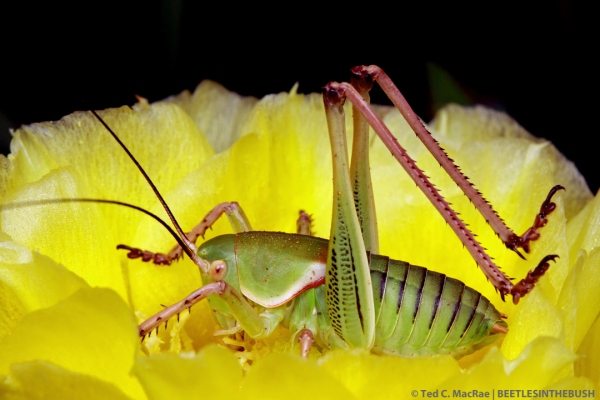
During my visit to Gloss Mountain State Park (Woodward Co., Oklahoma) this past June, I found an area of prickly pear cactus (Opuntia macrorhiza) on the west flats below the main mesa. A few days earlier I had seen cactus beetles in the genus Moneilema (family Cerambycidae) associated with these plants at another nearby location, so I began checking the plants to look for any sign of these beetles. Sadly I did not find any, but the plants were in full bloom and were being visited by flower longhorns in the genus Typocerus (mostly just T. octonotatus). After having collected a small series, I approached one particular cactus plant and found this enormous katydid sitting inside the flower. Katydids normally secrete themselves in a more cryptic manner, using foliage backdrops with which they can blend owing to their green coloration. This particular katydid, however, not only lacked the leaf-like wings that many species possess but also exhibited rather strikingly contrasting dark red markings over its body that made it quite conspicuous as it sat in the yellow flower. I approached carefully so as not to spook it and took a few photographs, but as I did so it became apparent to me that it did not find my actions alarming and would allow me to take whatever photographs I wished.

Pediodectes haldemani in flower of Opuntia phaecantha | Gloss Mountains State Park, Woodward Co., Oklahoma

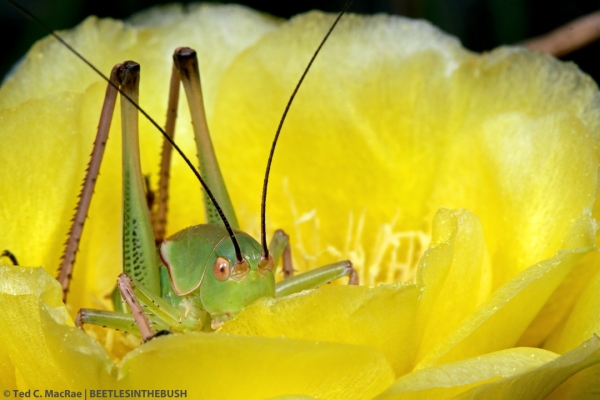
Pediodectes haldemani on Opuntia macrorhiza | Gloss Mountain State Park, Woodward Co., Oklahoma

Almost whatever photographs, that is. I really wanted to get a super-close, full-frontal shot of the face, but it sat unbudgingly in the flower with its face buried in the stamens and masked by the inner petals of the flower. I could have tried peeling away the petal, but I was sure that fiddling my fingers that close to its face would spook it, and even if I did manage to peel back the petal then I would still have stamens blocking the view that I wanted. In the end, I decided that this slightly more distant shot of the whole body was a pleasing enough composition.

Pediodectes haldemani

Peek-a-boo!

I presume this individual represents Haldeman’s shieldback katydid (Pediodectes haldemani) in the family Tettigoniidae. This is not surprising, since the type locality of the species (Barber Co., Kansas) is just a few miles to the north and right smack dab in the middle of the Great Plains distribution of the species. BugGuide mentions that species identification from photos alone can be difficult in the genus Pediodectes, as color patterns vary individually and with age, and also since adults are wingless it can be difficult to tell if an individual is a nymph or adult. Nevertheless, distribution maps in Singing Insects of North America show three species that can potentially occur in this part of Oklahoma, and the photos shown here are a dead ringer for P. haldemani. I am also apparently not the first person to photograph this species at Gloss Mountain State Park.

Copyright © Ted C. MacRae 2013

The perfectly polyphagous Chrysobothris purpureovittata

Chrysobothris purpureovittata on Celtis sp. | Gloss Mountains State Park, Woodward Co., Oklahoma

Chrysobothris purpureovittata Horn 1886 | Gloss Mountains State Park, Woodward Co., Oklahoma

Many species of jewels beetles in North America are known for having some degree of host specificity. This is especially true of species in the genus Chrysobothris, whose members are often restricted to a particular family, genus, or even species of host plant. There are some, however, that are not so fastidious in their choice of host plant, and perhaps the best example of such is the species Chrysobothris purpureovittata. This pretty and not uncommonly collected species has been associated with well over two dozen species of deciduous trees representing 21 genera in eleven plant families.

Chrysobothris purpureovittata

Interestingly, the extent of this species’ polyphagy has not been fully appreciated until recently. At the time of Fisher’s (1942) revision of North American species, the only recorded larval hosts were elm (Ulmus sp.) and plum (Prunus sp.). Numerous adult hosts—i.e., plants on which adults had been collected only—were recorded in subsequent years, first by Vogt (1949) in south Texas and later by Nelson et al. (1982) from other locations. However, it was not until my Missouri jewel beetle survey (MacRae 1991) and subsequent “notes papers” by me and colleagues (MacRae & Nelson 2003, MacRae 2006, Wellso & Jackman 2006) that the true diversity of larval hosts became known. A majority of the larval host records are from the Ulmaceae, including several species of hackberry (Celtis tenuifoliaC. laevigataC. ehrenbergia, C. reticulata) and cedar elm (Ulmus crassifolia), suggesting that despite its polyphagous nature there is some preference for members of this plant family. On my recent early June trip to northwestern Oklahoma, I encountered this species at several localities as abundantly as I can ever recall, with nearly all of them beaten from hackberry.

Chrysobothris purpureovittata

Chrysobothris purpureovittata is distributed primarily in the central and south-central U.S., with records from Indiana west to Kansas and south to Mississippi and northern Mexico. A population at the western edge of its distribution (Cloudcroft, Otero Co., New Mexico) associated with mountain mahogany (Cercocarpus montanus) was recently described as a separate subspecies (C. purpureovittata cercocarpi) by Westcott & Nelson (2000)—it is distinguished from nominotypical populations by the entirely red pronotum and uniformly dark elytra.

Chrysobothris purpureovittata

REFERENCES:

Fisher, W. S. 1942. A revision of North American species of buprestid beetles belonging to the tribe Chrysobothrini. U. S. Department of Agriculture, Miscellaneous Publication 470, 1–275.

MacRae, T. C. 1991. The Buprestidae (Coleoptera) of Missouri.  Insecta Mundi 5(2):101–126.

MacRae, T. C. 2006. Distributional and biological notes on North American Buprestidae (Coleoptera), with comments on variation in Anthaxia (Haplanthaxiaviridicornis (Say) and A. (H.) viridfrons Gory. The Pan-Pacific Entomologist 82(2):166–199.

MacRae, T. C. and G. H. Nelson. 2003. Distributional and biological notes on Buprestidae (Coleoptera) in North and Central America and the West Indies, with validation of one species. The Coleopterists Bulletin 57(1):57–70.

Nelson, G. H., D. S. Verity & R. L. Westcott. 1982. Additional notes on the biology and distribution of Buprestidae (Coleoptera) of North America. The Coleopterists Bulletin 35(2) [1981]:129–152.

Vogt, G. H. 1949. A biologically annotated list of the Buprestidae of the Lower Rio Grande Valley, Texas. Annals of the Entomological Society of America 42(2):192–202.

Wellso, S. G. & J. A. Jackman. 2006. A new species of Anthaxia (Haplanthaxia) Reitter (Coleoptera: Buprestidae) and new North American buprestid distributional and host records. The Pan-Pacific Entomologist 82(2):262–268.

Westcott, R. L. & G. H. Nelson. 2000. Descriptions of two new species of Acmaeodera Eschscholtz, and two new subspecies of Agrilus Curtis and Chrysobothris Eschscholtz (Coleoptera: Buprestidae) in North America, with detailed notes on others. The Coleopterists Bulletin 54(3):300–312.

Copyright © Ted C. MacRae 2013
Relaxed comment moderation policy

During the first few years of writing this blog, I maintained an open comment policy with few restrictions on who could comment. In November 2011, however, I began experiencing a flood of spam comments, and as a result I had to implement a new comment policy that included comment moderation for new commenters and the requirement for all commenters to include their name (shown publicly) and e-mail address (not shown publicly). My hope was that the change would end the hundreds of spam comments I was getting each day while minimizing the inconvenience to those leaving valid comments.

Fortunately, the spate of spam has abated, and I think now I can relax the comment requirements. I think such measures do much to inhibit comments, as many people simply find it easier to leave comments at links on outreach sites (e.g. Facebook) rather than the post itself if they have to enter extra information in addition to the comment itself. Remote comments such as this are, of course, appreciated, but my greatest pleasure is in seeing and partaking in the conversations that develop on-site in the direct comments. I also realize that many people simply are not comfortable divulging their name and providing their e-mail address, no matter how secure the site is proclaimed to be. As a result, beginning today I have removed all comment moderation and the requirement to include name and e-mail address when leaving a comment. This means that anonymous comments are once again welcome. By eliminating as many barriers as possible to free, open communication, it is my hope that readers will not only find leaving comments here easy, but also feel comfortable doing so.

Copyright © Ted C. MacRae 2013

The ever-increasing diversity of Oklahoma beetles

My idea to return to Oklahoma’s Gloss Mountains this spring actually began taking shape during last year’s fall visit to the area, when I found a single Chrysobothris octocola adult on a dead mesquite (Prosopis glandulosa) branch. While common across the southwestern U.S. in association with this plant, its occurrence in the Gloss Mountains represented a northeastern range extension and new state record for Oklahoma! On that same trip I also collected an interesting beetle in the family Rhipiphoridae representing the species Toposcopus wrightii—also not previously recorded in the literature from Oklahoma. Combined with finding Acmaeodera macra here the previous year, it was becoming clear to me that area held good potential for other more typically southwestern species of wood boring beetles. Although I had by then visited the area several times, most of these visits were more focused on tiger beetles rather than wood boring beetles. If I could find such interesting species of wood boring beetles when I wasn’t focused on them, imagine what I might find if I timed a visit in late spring when such species should be at their peak of adult activity.

Chrysobothris quadrilineata | Gloss Mountains State Park, Major Co., Oklahoma

Chrysobothris quadrilineata | Gloss Mountains State Park, Major Co., Oklahoma (new state record).

Of course, success came quickly during this early June visit. I immediately found C. octocola common on the mesquite and would collect a nice series of voucher specimens before the day was over, and the second species I encountered, also on mesquite, was the longhorned beetle Plionoma suturalis—another new state record! I spent a bit of time working the mesquite, and when I had collected a sufficient series of both species, I turned my attention to the eastern red-cedars (Juniperus virginiana) in the area. Actually, I had had my eye on the red-cedars since last fall, when I noticed that nearly every tree had dead branches mixed in amongst the living branches. Closer examination revealed the workings of jewel beetle larvae in all of these dead branches, and a few larvae typical of the genus Chrysobothris were cut from one of the branches. A common species in the Great Plains associated with Juniperus is C. ignicollis, but these larvae looked rather big to represent that species, so I bundled up some dead branches and brought them back home for rearing but forgot to check on them before I left on this trip. At any rate, I walked up to one of the red-cedars, placed my beating sheet under a dead branch, gave the branch a whack with the handle of my net, and onto the sheet fell a rather robust Chrysobothris that I didn’t immediately recognize. I knew it wasn’t C. ignicollis, a much smaller species that I have collected on numerous occasions, so I thought maybe it could be C. texana, another western Juniperus-associate that I’ve collected less commonly. Still, the robust body and broad, distinct elytral and pronotal ridges had me second guessing that identification (especially after I found some individuals that looked more like what I remembered C. texana looking like). Over the next two days I beat hundreds (literally!) of dead juniper branches, finding many C. ignicollis but every now and then getting also one of these big, robust individuals.

Chrysobothris quadrilineata

Adults were beaten from dead branches on live Juniperus virginiana (new adult host).

After returning home, I checked my heavily annotated copy of Fisher (1942) and quickly determined the robust specimens as representing C. quadrilineata—a rather uncommon species and one that I’d never collected before. Described by LeConte in 1860 from New Mexico and recorded early in the 20th century from Arizona, Nevada and California, it has in more recent years been found to occupy a rather wide distribution across the western U.S., including Texas (Barr & Westcott 1976), Colorado, Oregon, South Dakota (Nelson et al. 1982), and Utah (Nelson 1987). Notice one state that is not in that list—Oklahoma! That’s right, another new state record! I later found photographs of this species on BugGuide taken in the very same area a year earlier (7 June 2012).

Chrysobothris quadrilineata

Adults also emerged from dead J. virginiana branches collected Sept. 2012 (first reported larval host).

When I returned home, I also checked the rearing cans and found several adults had emerged from the branches I collected last September. The only host associations that have been recorded for this species are adults collected on Juniperus californica (Linsley & Ross 1940) and J. pachyphloea [= J. deppeana] (Barr & Westcott 1976). Thus, J. virginiana not only represents a new host record for the species but is also the first known larval host. Considering how broadly distributed across the western U.S. this species is, it seems likely that it utilizes a number of Juniperus spp. throughout its range.

REFERENCES:

Barr, W. F. & R. L. Westcott. 1976. Taxonomic, biological and distributional notes of North American Chrysobothris, with description of a new species from California (Coleoptera: Buprestidae).  The Pan-Pacific Entomologist 52(2):138–153.

Fisher, W. S. 1942. A revision of North American species of buprestid beetles belonging to the tribe Chrysobothrini. U. S. Department of Agriculture, Miscellaneous Publication 470, 1–275.

Linsley, E. G. & E. S. Ross. 1940. Records of some Coleoptera from the San Jacinto Mountains, California.  The Pan-Pacific Entomologist 16(2):75–76.

Nelson, G. H. 1987. Additional notes on the biology and distribution of Buprestidae (Coleoptera) in North America, II.   The Coleopterists Bulletin 41(1):57–65.

Nelson, G. H., D. S. Verity & R. L. Westcott. 1982. Additional notes on the biology and distribution of Buprestidae (Coleoptera) of North America.  The Coleopterists Bulletin 35(2) [1981]:129–152.

Copyright © Ted C. MacRae 2013

Registration is now open for my ESA Webinar

Just released from ESA (Entomological Society of America):

Approaching the Unapproachable: Tips and Tricks for Field Photography of Wary Insects presented by Ted MacRae.  Learn valuable field photography techniques from Ted MacRae, Senior Research Entomologist at Monsanto Company.  Ted specializes in photographing tiger beetles in their natural habitats. These colorful beetles are fast runners and powerful fliers, making them among the more difficult insects to approach. Ted will describe some of the techniques that he uses to obtain close-up and macro photographs of these beautiful beetles and also techniques for field photography of other insects as well.

There’s no cost and you learn right from your desktop, laptop, or smart-phone.  This 60 minute webinar takes place August 8 at 2 PM  Eastern Time (US Time) and will be a great investment of your time.

Register for the live Webinar, August 8th at 2 PM Eastern Time (US Time).

Unable to attend, an archive of the presentation will be available at http://www.entsoc.org/students/esa-webinar-series for ESA members only.

Make a list of your pressing questions on this topic, as we’ll allow plenty of time for you to participate in the Q & A portion of the session. You may also send in questions prior to the event and this will assure you that the presenter will address your queries.

After registering you will receive a confirmation email containing information about joining the Webinar.

System Requirements
PC-based attendees
Required: Windows® 7, Vista, XP or 2003 Server

Macintosh®-based attendees
Required: Mac OS® X 10.5 or newer