Big, Bold and Beautiful—Redux

Cicindela formosa generosa | Scott Co., Missouri

Cicindela formosa generosa (Eastern Big Sand Tiger Beetle) | Scott Co., Missouri

Strange as it may seem to residents of the western U.S. or coastal areas in the east, one of my favorite sights in Missouri is dry sand! It’s a true rarity in our limestone/dolomite dominated state, a result of nearly continuously exposed land for the past several hundred million years. Only along the state’s bigger rivers, where relatively recent alluvial events have yet to be completely eroded by the passage of time, can significant sand deposits be found. It is in these habitats that one of my favorite of Missouri’s tiger beetles, Cicindela formosa generosa (Eastern Big Sand Tiger Beetle), can be found. In much of the state, tiny slivers of sand dry enough to support populations of these beetles occur sporadically along the Missouri and Mississippi Rivers and their larger tributaries. More extensive deposits, however, are found in several wide, low ridges of sand in the southeastern lowlands of the state—relatively recent alluvial deposits from the last glacial maximum. Sadly, in a region originally blanketed by tupelo/gum/cypress swamp, such relatively dry areas were the first to fall to the plow, and subsequent drainage of the surrounding swamps further promoted a near complete  conversion of the entire region to agriculture.

She's got legs up to her neck!

She’s got legs up to her neck!

Still, tiny remnants of original habitat remain—generally parcels of land that were either too dry and sandy or persistently undrainable. Such parcels now form the basis of Missouri’s system of preserves in southeast Missouri. As tiny as they are and representing only a few percent of their original extent, these parcels now serve a critical role in preserving some of Missouri’s most endangered natural communities. Among these is Sand Prairie Conservation Area in Scott Co., featured several times now on this blog (). The sand here is extraordinarily dry, due not only to its depth but also the low organic content—factors that made the land unfarmable and, ultimately, allowed it to escape the conversion that befell the surrounding areas and eventually become a preserve. I have visited Sand Prairie many times in recent years, and although I now know its plants and animals well, there are some that I never tire of seeing—plants like clasping milkweed (Asclepias amplexicaulis), one of my favorite of Missouri’s milkweeds, and animals like C. formosa generosa!

Bold white markings and a chunky body make this one of Missouri's most distinctive tiger beetles.

Bold white markings and a chunky body make this one of Missouri’s most distinctive tiger beetles.

Last weekend I visited Sand Prairie once again, and I was happy to see C. formosa generosa as plentiful as I have ever seen it. I have photographed this species on several occasions, most recently two years ago at a site very near my house. Those last photographs are probably as good as I can ever expect (and in fact one of them even made this year’s ESA calendar), so barring some unusual color form or interesting natural history observation I have little reason to continue taking photographs of it. Nevertheless, I’m trying out a new diffuser, which was all the excuse I needed to try my hand again with this big, beautiful species. I was once again reminded of why of I love this tiger beetle so much—their bulk, their bulging eyes, their long, looping escape flights that end with a comical bounce and tumble, only to end up on their feet and facing their pursuer. These beetles are loaded with personality and behavioral charisma. It was an unseasonably warm and humid day, so my opportunities to photograph them were limited. I hope these few that I present here impart some of that personality.

Individuals from Missouri often show a hint of the red coloration that characterizes populations further west.

Missouri individuals often show a hint of the red coloration that characterizes populations further west.

Copyright © Ted C. MacRae 2013

Oversized, double-concave diffuser for MT-24EX twin flash

IMG_2865_enh_1080X720

Megaloxantha bicolor palawanica, photographed with oversized, double-concave diffuser

This jewel beetle is, of course, Megaloxantha bicolor palawanica me beetle on several occasions while testing out different diffuser designs for my Canon MT-24EX twin flash unit. In the most recent one, I had tried combining SoftBoxes with my oversized concave diffuser and was pleased enough with the result that I thought I might try it in the field. Well, let’s just say the extensions for the flash heads and SoftBoxes attached to them was far too clumsy for field use, and I abandoned the idea after just a couple of hours. Back to the drawing board.

Despite the problems with using the SoftBoxes in the field, I still wasn’t ready to give up on the idea of double diffusion, and I had also learned that extending my oversized diffuser out over the subject (leaving it “open”) produced better lighting than curling it back (as I had been doing). Curling the diffuser back only served to turn it into a convex diffuser, which results in more specular highlighting because the center of the diffuser is closer to the subject than the edges. A concave diffuser provides more even lighting because all parts of the diffuser are roughly the same distance from the subject. Just about that time, I saw a DIY diffuser design by Piotr Nascrecki that, in principle, resembled Alex Wild‘s tent diffuser. It was, however, much larger—like mine, and thus amenable for use with a 100mm macro lens (the macro lens I use most commonly). This resemblance to Alex’s diffuser did make me notice one missing feature—double diffusion layers. That’s when I thought, why not do the same with an oversized diffuser rather than fussing with separate diffusers attached to the flash heads? I had some Bogen Imaging filter sheets on hand (#129 Heavy Frost), so I picked up some 1-mm steel wire at the hardware store, found a Bic pen in the drawer that I could cut in half, and built the diffuser as shown in Piotr’s post. I then secured a second filter sheet above the first sheet by taping the two together along their sides, being sure to ‘bow’ the upper sheet above the bottom sheet to achieve the double diffusion effect. Here is the result (please excuse the iPhone shots):

Oversized double diffuser for Canon MT-24EX twin flash.

Canon 50D with MT-24EX twin flash and oversized, double-concave diffuser.

IMG_0939_enh_1080X720

Better view of the double diffusion layers and Piotr’s “Bic pen” attachment system.

I have big hopes that this will finally be the diffuser I’ve been looking for. For as quick a test shot as the jewel beetle photo above was, the lighting is great and the colors are vibrant—both achieved with typical post-processing. My only complaint is the slightly greater “hot spot” intensity in the lower parts of the highlights in the eyes. This is due to the flash heads sitting near the base of the diffuser, and (as Piotr recommends) a second set of Kaiser shoes will allow me to move the flash heads not only more towards the center of the diffuser but also further above it to help spread out the light throw and even out the highlights. I’ll need to play around positioning the flashes to figure out the best positions depending on the size and distance of the subject—sitting up higher as they are puts them more on “top” than in “front” of the subject, so they will need to be directed downward more than I am used to doing. Even more important, however, is field usability, and I really think this diffuser will prove to be convenient and easy to use in the field—no more gawky arms attached to the camera, the diffuser attaching quickly and easily and, just as importantly, coming off easily and storing flat in the backpack, and large enough to do the job while not so oversized that it gets in the way. Piotr says this diffuser also works well with the 65mm macro lens, so I will certainly be testing that out as well.

Copyright © Ted C. MacRae 2013
A Tale of Two Blogs

In April 2012, I wrote a post called “Is blogging dead?” – Another view in response to Alex‘s previous day’s post (Is Blogging Dead?). While Alex acknowledged that blogging provided an early social network structure now better served by Facebook and Google+, he also maintained that there still remained a dedicated contingent for whom blogging best served their needs. As a committed blogger myself, I really wanted to share Alex’s optimism—but I just couldn’t. Something told me that blogging was at a crossroads, and the future wasn’t rosy. Why did I feel this way? My site stats didn’t suggest trouble ahead—from February 2009 (shortly after I moved Beetles in the Bush to WordPress) until April 2012, site visits—and presumably readership—had increased steadily (see chart below based on weekly stats, with the periodic surges due to posts I wrote that got picked up by Freshly Pressed). Not like one of the big blogs, of course, but still not bad for a natural history blog aimed at a specialty audience. Rather, it was the decline of comments and coincident increase in the use of Twitter, Facebook, G+, etc. as the platforms of choice for social interaction among those for whom blogs previously fulfilled that need. To me it seemed inevitable—why invest in clicking through to individual blogs and reading a 500- to 1,500-word post when one could read several hundred 140-character headlines, quipping an equally short reply to as many of them as desired, all on one site. Maximum interaction, maximum information (depending on your definition of “information”), minimum fuss.

Site stats - February 2009 to April 2012. Site stats – February 2009 to April 2012.

Ironically, almost immediately after I wrote that post the decline that I predicted began with my own blog. The chart below shows BitB site stats (again, on a weekly basis), picking up where the above chart left off until the end of March 2013. As precipitously as site visits rose during the previous three years, they declined during the following one year. There are those who contend that “People who say blogging is dead either already have a blog that died, or they have no blog at all.” That may be true now, at least based on site stats and the now rather low frequency of comments, but it most certainly was not the case when I first voiced this opinion last year. In fact, that a Google search of “Is blogging dead” can turn up nearly 100,000 search results (with quotation marks!) shows that a whole lot of people are still asking the question.

Site stats – April 2012 to March 2013.

This is not to say that blogs cannot still be successful. I suggest that the platform has matured, undergone consolidation and weeded out the weakest contributors. By weak, I don’t mean poor quality of content, but rather lack of ability or resources to frequently and consistently provide that content and target it to a relatively large audience. Early adopters who carved out a niche and built a strong brand had the best chance of surviving this maturation, and among the specialty blogs dealing with natural history and entomology it seems those who act as clearing houses for information from across the discipline, serve as an interface for commercial/educational ventures, or focus on the “bizarre” or contentious are most likely to attract and retain followers. Of course, an alternate hypothesis is that my writing suddenly got boring and my photos suck—take your pick.

As for what this means for Beetles in the Bush, I’m not really sure yet. During the past month (and for the first time since I started writing this blog in earnest), I’ve backed off on what until then had been a very consistent 2–3 posts per week schedule. Quite clearly, this will not help if my goal is to find some way to reverse the downward trend, as frequency of posts ranks almost as high as quality of content in keeping a blog successful. I used to tell myself that I would write regardless of who was reading, because it was something I needed to do (and enjoyed doing) for myself, and I truly believe that was the case when I said it. But perhaps I’ve now gotten what I needed out of the blog—my writing skills are far superior to when I started; I can sit down and pound out not only a blog post, but research reports, status updates, manuscripts, etc. in record time. I used to agonize over every word; now it seems my fingers can hardly keep up with the words as they pour out of my mind. If one of my goals when I started blogging was to make myself a better writer (and it was), then in that regard I have succeeded. I’m also now a vastly more knowledgeable entomologist, having taken the time to learn a lot more not just about beetles, but insects across many taxa, the habitats in which they live, the ecological communities they are a part of, and the landscapes that harbour them. For the first time, I consider myself not just an entomologist, but a natural historian in the truest sense of the word. Nevertheless, I can’t imagine not writing for BitB, but I think now the impulse to write a post will be based much more on inspiration and less so on the calendar. I truly hope that the reduced posting frequency doesn’t further accelerate the decline, but if it does then that is the only possible outcome.

Copyright © Ted C. MacRae 2013
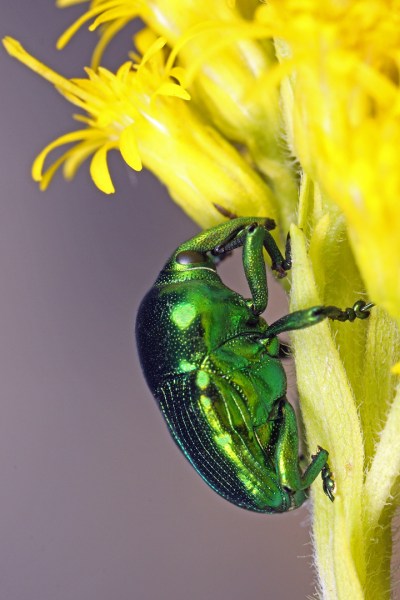
Giving me the weevil eye!

The order Coleoptera (beetles) is, of course, the largest single group of animals on earth, and by most accounts the Curculionidae (weevils) and their close relatives are the largest family-level group within the order. At 60,000 species and counting, weevils account for approximately one out of every 20 described life forms, and as a result their diversity of forms, colors and life histories are as staggering as their numbers. Among the small slice of the group that I have seen, Megabaris quadriguttatus is without question the most colorful, but species in the related genus Eurhinus (both genera belong to the curculionid subfamily Bardinae, which I point out here for reasons discussed below) must rank as among the shiniest of all weevils. Twenty-three species, all colored brilliant metallic green, blue, purple or red, are known from this exclusively Neotropical genus (Vaurie 1982), one of which has also recently established in southern Florida (Ulmer et al. 2007). The individual featured in this post was seen April 2012 in northern Argentina near La Escondida (Chaco Province) and compares well with Eurhinus adonis (ID courtesy Charles O’Brien, Green Valley, AZ). Vaurie (1982) records that species from southern Brazil, Bolivia, Paraguay and Argentina (although only from Missiones Province in the latter) and says that nothing is known of its biology.

Giving me the weevil eye!

Eurhinus cf. adonis on Solidago chilensis | Chaco Province, Argentina

This is certainly among the most challenging insects that I’ve ever photographed. Overblown specular highlights are a constant challenge in flash macrophotography of bright, shiny, metallic beetles, and yellow flowers are prone to blown highlights as well. Add on top of that my desire for a blue sky rather than the typical black background and the usual difficulties of hand-held, field photography of an actively moving subject, and you’ve got a quadruple challenge. Adequate diffusion of the flash is critical, and although the diffusers I was using at the time weren’t perfect, they were enough in combination with intentional underexposure of the photograph to further minimize the chance of blown highlights (underexposed photographs can be relatively easily “fixed” during post-processing, as all of the information is still there, while overexposed photographs can rarely be fixed because the information is gone). Bumping up the ISO (in this case 400) also helps—higher sensitivity to light by the sensor not only allows light from the sky to register and create a blue background, but also further reduces flash duration and the risk of blown highlights. No amount of camera settings, however, can address the final challenge—getting the subject well composed and in focus within the frame. For that, the three “P”s (patience, practice, and persistence) are the only advice I can offer.

Eurhinus cf. adonis on Solidago chilensis flowers | Chaco Province, Argentina.

What’s in a name? That which we call a Eurhinus by any other name would be as shiny!

This genus of weevils was involved in one of the more interesting nomenclatural problems that I’ve encountered. The genus was originally given the name Eurhin by Illiger in 1807, but Schönherr in 1824 changed it to Eurhinus—believing (incorrectly) that Eurhin was not a properly formed name. Unfortunately, the name Eurhinus had already been used by Kirby in 1819 for a different genus of weevils in the subfamily Apioninae. The rules of zoological nomenclature, of course, prohibit the same name being used for two different genera, and several attempts were made during the following years to provide a replacement name for Schönherr’s Eurhinus. None gained acceptance, however, and eventually Schönherr in 1833—still considering justified his correction of Eurhin to Eurhinus—proposed the name Eurhynchus for Kirby’s Eurhinus. Remarkably, the name Eurhynchus also had been used previously (for a genus of birds). Nevertheless, the change gained acceptance, and both of Schönherr’s names remained in use for the next century and a half—Eurhinus in the subfamily Baridinae and Eurhynchus in the subfamily Apioninae, with both credited to Schönherr. Strict application of the rules of nomenclature would require that the name Eurhinus be transferred back to the apionine genus and credited to Kirby and the name Eurhin resurrected for the baridine genus and credited to Illiger. However, as pointed out by Zimmerman & Thompson (1983) this would not only destroy more than a century’s worth of nomenclatural stability but also complicate the formation of family-group names such as tribes—since the two original names each have the same root (Eurhin-), tribal names based on them would be identical (Eurhinini). To resolve these issues, a formal application was submitted to the International Commission of Zoological Nomenclature (ICZN) to preserve  Schönherr’s long accepted usage of Eurhinus and Eurhynchus. To do this, the ICZN would not only have to declare Schönherr’s correction of Eurhin to Eurhinus justified, but also suppress the original use of the name Eurhynchus (as a genus of birds) in order to allow Schönherr’s subsequent use for the apionine genus to stand. Fortunately, suppressing the first use of Eurhynchus had no impact on stability, since an older name was already in use for the genus of birds and the younger name had not been used since its original description. The authors of the application also noted the support of several contemporary weevil specialists (including Charles O’Brien) and that Patricia Vaurie, in her revision of the genus one year earlier (Vaurie 1982), had used the original name Eurhin with reluctance on the then-correct advice of her contemporaries. It was a classic case of priority versus stability, and while the ICZN typically is rather conservative in favoring priority, they were clearly swayed in this case by the interests of stability and impact on formation of family-group names.

REFERENCES:

Ulmer, B. J., R. E. Duncan, J. Prena & J. E. Peña. 2007. A weevil, Eurhinus magnificus Gyllenhal (Insecta: Coleoptera: Curculionidae). University of Florida, IFAS Publication #EENY-417/IN751, 6 pp.

Vaurie, P. 1982. Revision of Neotropical Eurhin (Coleoptera, Curculionidae, Baridinae). American Museum Novitates 2753:1–44.

Zimmerman, E.C. & R. T. Thompson. 1983. On family group names based upon Eurhin, Eurhinus and Eurhynchus (Coleoptera). Bulletin of Zoological Nomenclature 40:45–52.

Copyright © Ted C. MacRae 2013

Group mimicry in Cerambycidae… and more

During last year’s extended visit to Argentina, I had the chance to spend the early part of April in the northern province of Chaco. Though much of this hot, arid plain has been converted to agriculture, remnants of thorn forest remain along fence rows and in small patches of Chaco Forest. Despite the decidedly tropical latitude of the region, however, the profuse bloom of Chilean goldenrod, Solidago chilensis, along these fence rows during the Argentine autumn is reminiscent of crisp fall days here in the eastern U.S., and like the goldenrod here the ubiquitous stands of yellow blossoms stretching across the Chaco Plain are equally attractive to a multitude of insects. Among those insects are the Cerambycidae, or longhorned beetles, and while the eastern U.S. cerambycid fauna of goldenrod boasts only a few (albeit spectacular) species in the genus Megacyllene, the Argentine cerambycid fauna that I found on these flowers included at least three species in various genera belonging to two different tribes.

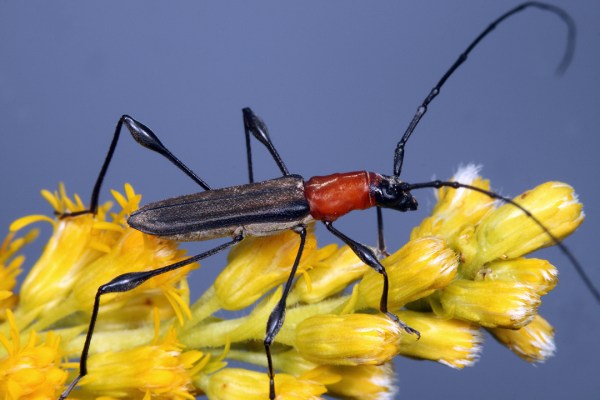
Rhopalophora collaris (Germar 1824) | Chaco Province, Argentina

Rhopalophora collaris (Germar 1824) | Chaco Province, Argentina

Two of the species I saw are shown here, and their similarity of appearance is no coincidence, as both belong to the tribe Rhopalophorini (coming from the Greek words rhopalon = club and phero = to bear, in reference to the distinctly clavate, or club-shaped, legs exhibited by nearly all members of the tribe). In fact, a great many species in this tribe exhibit the same general facies—slender in form and black in coloration with the head and/or pronotum red to some degree. Since all of these species are diurnal (active during the day) and frequently found on flowers, one can assume that the members of this tribe represent an example of what Linsley (1959) called ‘group mimicry.’ In this simple form of Batesian mimicry (harmless mimic with protected model), a group of related species within a genus or even a tribe have a general but nonspecific resemblance to those of some other group of insects—in this case presumably small, flower-visiting wasps. Although the tribe is largely Neotropical, the nominate genus Rhopalophora does extend northward with one eastern U.S. representative, R. longipes. Among the numerous species occurring in South America, the individuals I saw in Argentina can be placed as R. collaris due to the relative lengths of their antennal segments and uniquely shaped pronotum (Napp 2009).

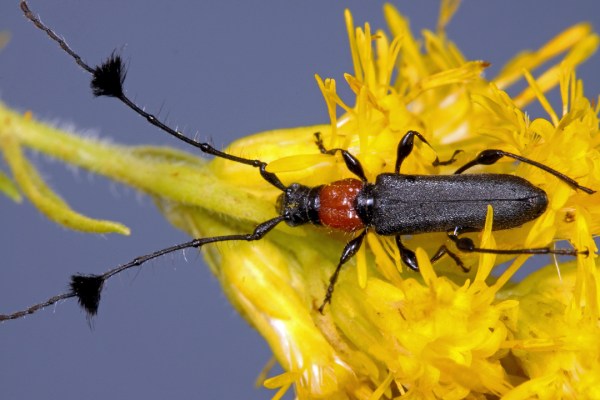
Cosmisoma brullei (Mulsant 1863) | Chaco Province, Argentina

Cosmisoma brullei (Mulsant 1863) | Chaco Province, Argentina

The second species could easily be mistaken for another species of Rhopalophora were it not for the distinct tufts of hair surrounding the middle of the antennae. These tufts immediately identify the beetle as a member of the large, strictly Neotropical genus Cosmisoma (derived from the Greek words kosmos = ornament and soma = body, a direct reference to the tufts adorning the antennae of all members of this genus). Three species of the largely Brazilian genus are known from Argentina, with the black and red coloration of this individual easily identifying it as C. brullei (Bezark 2o13). In the years since this genus was described, additional related genera have been described that bear remarkably similar tufts of hair not on the antennae, but on the elongated hind legs. The great, 19th century naturalist Henry Walter Bates “tried in vain to discover the use of these curious brush-like decorations” (Bates 1863), and nearly a century later Linsley (1959) conceded that their function still remained unknown. Antennal tufts are actually quite common in Cerambycidae, especially in Australia, and while experimental evidence continues (to my knowledge) to be completely lacking, Belt (2004) records observing “Coremia hirtipes” (a synonym of C. plumipes) flourishing its leg tufts in the air (presumably in a manner similar to waving of antennae) and, thus, giving the impression of two black flies hovering above the branch on which the beetle was sitting. This seems also to suggest a function in defense, with the tufts perhaps serving as a distraction to potential predators in much the same way that many butterflies have bright spots near the tail to draw the predator’s attention away from the head.

REFERENCES:

Bates, H. W. 1863. The Naturalist on the River Amazons. Murray, London, 2 vols.

Belt, T. 2004. The Naturalist in Nicaragua. Project Guttenberg eBook.

Bezark, L. G. 2009. A Photographic Catalogue of the Cerambycidae of the World. Available at http://plant.cdfa.ca.gov/byciddb/

Linsley, E. G. 1959. Ecology of Cerambycidae. Annual Review of Entomology 4:99–138.

Napp, D. S. 2009. Revisão das espécies sul-americanas de Rhopalophora (Coleoptera: Cerambycidae). Zoologia (Curitiba) 26(2):343–356.

Copyright © Ted C. MacRae 2013

Battle of the Bug Blogs

Something tells me that one of our bug blogging professors has charged this semester’s crop of students to go out and figure out what makes a good bug blog. My, how classwork assignments have changed since I was in grad school! Sort of a modern-day twist on the old ‘critic a journal paper’ assignment.

At any rate, apterobittacus seems to think I write a pretty good post, but eremoblatta thinks Crystal does it a little bit better (despite the taxonomic affinity between the subject of my critiqued post and the blog author’s pseudonym)! Nice job, kids—interesting reads that actually made me stop and think a little bit about how I present things here.

Copyright © Ted C. MacRae 2013

And the results are in…

I recently entered my first photo contest, a local competition sponsored by the Webster Groves Nature Study Society (of which I have been a member for ~30 years), and although the competition was limited to its few hundred members there were some serious cash prizes on offer. Being a noob at photo contests and a still relative newcomer to photography in general, I wasn’t sure what to expect. I thought my photos might be good enough to compete, but I also knew I would be going up against some long-time and very skilled nature photographers. The basic rules were a maximum of two submissions in no more than three of the following categories:

  • Botany
  • Entomology
  • Ornithology
  • Landscapes/habitats

Since I’ve only photographed two birds ever, I decided to submit entries to each of the other three categories. It was an interesting competition—the judges (each category had a panel of three consisting of a WNGSS board member, a natural history expert, and a photography expert) had a chance to see all of the photographs prior to the event (held last night) and select the top ten from each category, but the rest of the judging was done live at the event. Eventually, from each category a 1st place, 2nd place, and 3rd place photo was selected. The 12 winning photographs were then displayed in a continuous loop, and everybody attending the event was allowed to vote for one grand prize winner. The grand prize winner had to receive more than 50% of the vote, so a few runoff rounds were required to decide the final winner.

How did it go for me? I had a pretty good night, with three winning photographs:

Entomology—3rd place

Cicindela repanda (Bronze Tiger Beetle) | St. Louis Co., Missouri

Cicindela repanda (Bronze Tiger Beetle) | St. Louis Co., Missouri

Botany—2nd place

Hamammelis vernalis (Ozark witch hazel) | Iron Co., Missouri

Hamammelis vernalis (Ozark witch hazel) | Iron Co., Missouri

Entomology—1st place

Arctosa littoralis (beach wolf spider) | Lewis Co., Missouri

It was a thrill for me to learn that, out of the six photographs I submitted (and I really didn’t think my two landscape submissions were competitive to begin with), three were among the 12 final prize winners. That also made them eligible for the grand prize, but in this case I didn’t really expect the larger membership (which has a lot of birders) would really take to my closeup insect photographs. To my surprise, the first round of voting produced four finalists—two of which were my insect photos! The first runoff vote eliminated one photo—but not either of mine, and the second runoff eliminated one more photo—but again neither of mine. I had won the grand prize without yet knowing which photo would be the winner! In the end, the tiger beetle took the top prize. Personally, I was happy about that, because even though the photo took only 3rd place in the entomology competition, I thought it was the stronger of the two photos based on composition, the time and effort it took to work the beetle to finally “get the shot” (not that the wolf spider photo didn’t also take a lot of effort to get that close), and the natural history behavior that it captured (stilting and sun-facing for thermoregulation). I know blog commenting is becoming passé, but if you have any particular thoughts about these photos, good or bad, I would love to hear from you.

Overall I would have to say that, winner or not, participating in a photo competition was an extraordinary learning opportunity for me as I try to hone my craft. Listening to the comments of the judges in all of the categories, both on the natural history and the technical aspects of the photographs, gave me a lot of insight into how I might further improve my technique and take photographs that can be appreciated on both technical and artistic grounds. More importantly, the cash was nice, but the motivation to keep trying that I got out of the experience was priceless!

Copyright © Ted C. MacRae 2013
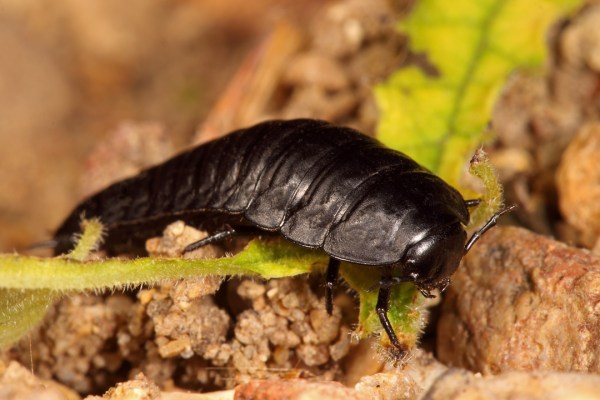
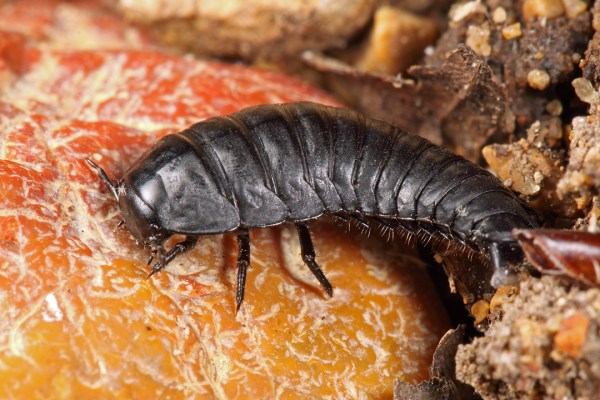
Ceti Eel offspring?

Nicrophila americana

Nicrophila americana (American carrion beetle) larva | Sam A. Baker State Park, Wayne Co., Missouri.

If this creature was a tad bit slimier, you might think it had just been plucked from underneath the armor of an adult Ceti Eel and was looking to slip inside the ear of Chekov or some other human to wrap itself around the unsuspecting victim’s cerebral cortex. In reality, this creature lives not on Ceti Alpha V., but right here on earth, and while it’s natural history may not include making human hosts “extremely susceptible to suggestion“, it does include an appetite for dead flesh and the maggots that try to compete for it. Say hello to the larva of Nicrophila americana (American carrion beetle), a member of the family Silphidae (carrion and burying beetles) (not to be confused with the endangered Nicrophorus americanus, or American burying beetle). Like most beetles, the larvae can be difficult to recognize as such due to its very different form compared to the adult. However, the one-segmented tarsi, distinct head, presence of chewing mouthparts, and presence of spiracles along the sides of the body give the clues to its identity.

Necrophila americana

While not the offspring of a Ceti Eel, its habits are almost as… er, disgusting!

The genus name (literally meaning “attracted to corpses“) is a perfect descriptor of this beetle’s natural history. Adults are attracted to animal carcasses, where they lay their eggs and prey on maggots (fly larvae) as they hatch to give a competitive advantage to their own larvae once they hatch. The larvae also will eat maggots and other larvae within the carcass, along with the carcass itself. This larva had completed its development and was searching the ground for a suitable spot to dig a burrow for pupation and eventual emergence as an adult.

Copyright © Ted C. MacRae