Euhagena nebraskae… again

Euhagena nebraskae - male

Earlier this year I showed a photograph of a mating pair of the clearwing moth (family Sesiidae) species, Euhagena nebraskae – seen last year in the Gypsum Hills of south-central Kansas on a cold, early-October day.  It was an okay photograph, made interesting primarily by nicely showing the high degree of sexual dimorphism seen in these moths.  Still, I wasn’t completely happy with the photo, wishing I had gotten a closer photograph of just the male with his highly bipectinate antennae and wispy, white thoracic tufts.  I got my wish on the first day of my recent fall tiger beetle collecting trip, seeing just this single male in the Pine Ridge area of northwestern Nebraska.  Despite the relatively warmer temperatures, he perched cooperatively atop a dried flower head and allowed me to photograph him to my heart’s content.

p.s. this one you really should click on to see the larger version, because the hair-like thoracic scales and flattened marginal scales on the wings are quite remarkable.

Photo Details: Canon 50D w/ 100mm macro lens (ISO 100, 1/250 sec, f/16), Canon MT-24EX flash w/ Sto-Fen + GFPuffer diffusers. Typical post-processing (levels, minor cropping, unsharp mask).

Copyright © Ted C. MacRae 2010

An Inordinate Fondness #9

Welcome to An Inordinate Fondness, the monthly blog carnival devoted to beetles.  I started this carnival nine months ago, hosting the inaugural issue at the home site before sending it out into the big, wide world.  Seven very capable bloggers have hosted it since, each giving it their own special flavor.  This month, AIF makes its first appearance here at BitB, and even though we have begun to enter the colder months of the year here in North America, blog posts about beetles continue unabated.  Featured here are 14 coleocentric posts that have appeared within the past month – I hope you enjoy reading them as much as I did.


Adaptation


Ever heard of the life/lunch dichotomy?  Greg Laden discusses it in his post Strange insect encounter: Carrion Beetle with Mites at Greg Laden’s Blog.  You might think this heavy load of tiny mites would be a big problem for the carrion beetle that they cover, but in reality the beetle’s life depends upon them.  Read Greg’s post to find out why.

Amber Coakley at Birder’s Lounge presents some great photographs of the white-cloaked tiger beetle (Cicindela togata) in Tiger Beetle at Oklahoma’s Salt Plains NWR.  These are not just any tiger beetle, but among the most halophilic (salt-tolerant) of species in North America.  Read her post, view the desolation, and marvel that these beetles find a way to make a living in the vast salt plains.

Color

No North American beetle collector can call themselves such until they’ve seen Arizona’s stunningly-colored Chrysina scarabs in the wild.  Art Evans at What’s Bugging You? reminisces on his first experience with these beetles while providing a marvelous summary of the different species in REFLECTIONS ON ARIZONA’S JEWEL SCARABS-Part 1.  Once again, the siren call of Arizona beckons me.

Other Arizona beetles are famous not only for their exquisite colors, but also the radical change they undergo after the beetle reaches adulthood.  Find out how this happens in Color-changing Leaf Beetles, by Margarethe Brummermann at Arizona: Beetles Bugs Birds and more.

Mimicry

No, that is not an ant, but a beetle – a tiger beetle to be exact.  Troy Bartlett at Nature Closeups found these beetles in Brazil and discusses how they not only look like ants, but move and behave like them as well in Caraça Tiger Beetles.  Oh, how I would dearly love to see some of these tiger beetles for myself!

Closer to home, Shelly Cox at MObugs presents a timely post on the locust borer, Megacyllene robiniae in Locust Borer.  One of a small number of longhorned beetle species that mimic wasps, Shelly gives a complete summary of the life history and habits of this fall-active species.

Mimicry, of course, is not always of the Batesian type where the mimic is harmless – Mullerian mimics are themselves distasteful to predators but share similar warning coloration and patterns to reinforce that fact to any would-be predators.  In Insect of the week – number 39 at NC State Insect Museum, the net-winged beetle Dictyoptera aurora is featured as an example of such.  Find out its taxonomic history, natural history, habitat, distribution, and the diagnostic characters needed to distinguish this species from other net-winged beetles.

Fauna

Flower chafers of the scarab genus Euphoria are among the most colorful species in the family, and Arizona has more than its share of them as Margarethe Brummermann shows in The Euphoria species of Arizona, USA at Arizona: Beetles Bugs Birds and more.  I thought I had done a pretty good job of finding these beetles during past visits to Arizona, so you can imagine my surprise when I learned that there are ten species there (I have only encountered four).  Margarethe’s post has plenty of info to help me find those I still lack.

When it comes down to it, collecting trips are the heart of this pursuit we call coleopterology.  Estan Cabigas at Salagubang recounts a recent trip in A short collecting trip at Epol, Davao City.  He notes that while new species in groups of interest are not always expected, camaraderie in the field with like-minded people can more than make up for that.  Read the post to learn about what he found.

Pests

Honey bees have had more than their share of problems lately, with Colony Collapse Disorder adding to the multitude of other pests and pathogens these industrious little hymenopterans must deal with.  In Answer to the Monday Night Mystery: Small Hive Beetle (Aethina tumida), Alex Wild at Myrmecos shows some spectacular photographs of one of these other pests, with an appearance far more pleasing than the result of their infestations in honey bee hives.

The white-fringed weevil, Naupactus leucoloma, is not quite as serious a pest as the small hive beetle, and Dave Ingram recounts his encounter with this beetle feeding Amongst the Lily Seeds at Dave Ingram’s Natural History Blog.  Originally from South America but introduced worldwide, this beetle has made meal of many a plant species.

Development

In his post Micromalthus debilis, Heath Blackmon at Coleopterists Corner discusses a beetle with one of the oddest reproductive strategies and unusual genetic systems within the order Coleoptera.  A flowchart is actually required to understand the many different developmental pathways and larval phenotypes that are encountered in this species.  If you’re not yet familiar with paedogenesis or thelytokous, arrhenotokous, and amphiterotokous parthenogenesis, then this is the post for you!

Culture

Few other insects besides beetles have been used so widely as inspiration for and objects of art.  In Reflections on Beetle Art, Jonathan Neal at Living With Insects Blog discusses this and other cultural uses of beetles, including the dazzling artwork of Christopher Marley that was featured recently on a popular Sunday TV magazine.

Mike Bok’s AIF #8 last month at Arthopoda featured clever versions of classic Beatles (the music group) images with real beetles (the insects).  While his artwork was original, the connection between the two has obviously been made by others (including Amber with AIF #2).  Ever the good sport, Mike features yet another Abbey Road album cover in Further unintentional unoriginality.

This month’s contributors:

The November issue of AIF will be hosted by University of Texas graduate student Heath Blackmon at Coleopterists Corner (could there be a more appropriate carnival for Heath’s first hosting gig?).  Submit your submission using this handy submission form by November 15, and look for the issue to appear a few days later.

Copyright © Ted C. MacRae 2010

A “leafless” leaf-footed bug

Merocoris distinctus feeding on flower stem of Coreopsis lanceolata.

This is Merocoris distinctus, a true bug in the family Coreidae whose members are usually recognized by their distinctive flattened hind tibiae (and hence the common name, leaf-footed bugs). This diminutive species, however, lacks that character, instead sporting strangely curved hind tibiae along with club-shaped (incrassate) hind femora. It’s a chunky little species – much smaller than the typical leaf-footed bugs seen across North America, and is most often encountered in grassland habitats where it feeds on herbaceous plants such as goldenrod, Solidago spp. (Slater and Baranowski 1978). This individual was seen probing the upper flower stem of lanceleaf tickseed, Coreopsis lanceolata, during May of last year at Shaw Nature Reserve in east-central Missouri. I’m not sure how well the life history of this species is understood, but I did find one interesting record of twelve individuals feeding gregariously on a dead chicken (Engelhardt 1912)! Apparently, feeding on carrion and other extra-phytophagous foods such as bird droppings and dung is a not uncommon practice among the Coreidae and closely related Alydidae (Adler and Wheeler 1984).

I kind of lucked out with this shot – I’d just gotten my new camera two weeks earlier and can’t say I really knew what I was doing at this point. I had first noticed and photographed the bug sitting on top of the flower but totally blew the exposure due to the flower’s bright yellow color.  My clumsy approach also caused the insect to move under the flower, where I watched it settle down and begin feeding before trying another shot. The dorsal surface of this species is mottled gray and brown, allowing the bug to blend in with most backgrounds. The underside of the body, however, is thickly matted with white hair, providing a very nice contrast with the black background that I stumbled upon achieved in this photo to emphasize the distinctive appearance of this often-overlooked insect.

Photo Details: Canon 50D w/ 100mm macro lens (ISO 100, 1/250 sec, f/14), Canon MT-24EX flash (1/4 ratio), undiffused. Typical post-processing (levels, minor cropping, unsharp mask).

REFERENCES:

Adler, P. H. and A. G. Wheeler.  1984. Extra-phytophagous food sources of Hemiptera Heteroptera: Bird droppings, dung, and carrion.  Journal of the Kansas Entomological Society 57(1):21-27.

Engelhardt, G. P. 1912. A hemipteron on carrion.  Journalof the New York Entomological Society 20:294.

Slater, J. A. and R. M. Baranowski. 1978. How to Know the True Bugs. W. C. Brown Company Publishers, 256 pp.

Copyright © Ted C. MacRae 2010

Saltatorial sidetracks

One thing I’ve realized during these past several years of fall collecting is that there are more than just tiger beetles to capture my interest as the field season enters its final days.  The late season floral burst of goldenrods (Solidago spp.) and tall thoroughwort (Eupatorium altissimum) brings forth a multitude of bees, flies, wasps, and soldier beetles.  Megacyllene robiniae, the locust borer (family Cerambycidae), is also a pleasant, if not pedestrian sight on the goldenrod as well, but if one is lucky to find goldenrod near a patch of Amorpha fruticosa (indigo bush), then its larger, more boldly marked and infinitely more exciting congener M. decora (indigo borer) might also be seen.  Nothing, however, seems to match the diversity and abundance during fall of the great order Orthoptera – grasshoppers, katydids, and crickets.  This is particularly true in the Ozark glades and Great Plains grasslands where I’ve spent the majority of my fall collecting time.  Perhaps it is because of their size – for the most part they are relatively large insects compared to the beetles I normally study, or maybe it is their pervasive reliance on sound – singing in the grass, rasping in the trees, snapping their wings in flight.  Bold and conspicuous, they demand attention.

Increasingly, I’m finding these fall hoppers harder and harder to resist, especially grasshoppers of the family Acrididae.  Until now I don’t think I’ve given grasshoppers their due respect – compared to my beetles they always seemed so… primitive.  No horns, no jeweled, metallic sculpturing, no over-sized jaws, no unique morphological specializations of any kind other than enlarged, saltatorial (modified for jumping) hind legs – they sport the quintessential ‘general’ insect body plan (open up any college introductory entomology textbook, and what do you see illustrated in the general morphology chapter… a grasshopper!).  Even their movements seemed to me somehow mechanical and robotic.  I always brushed them off as just basic insects, unrefined and uninteresting.

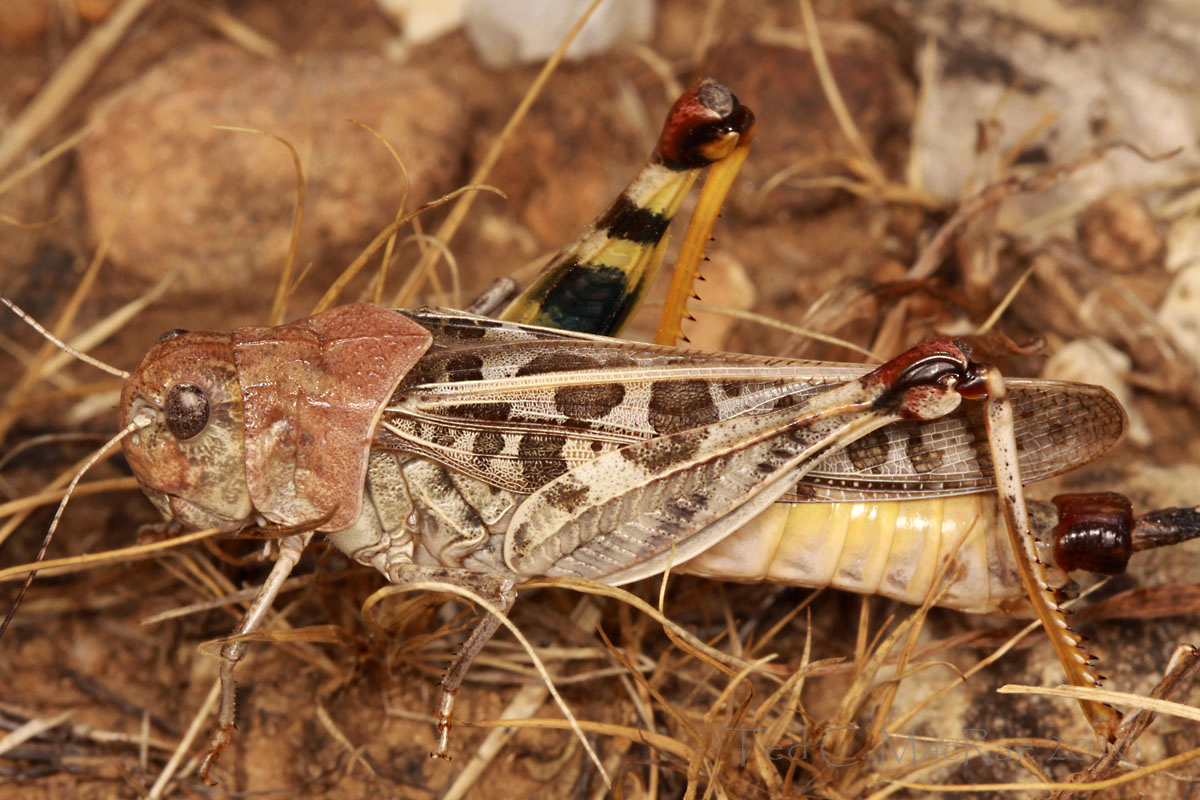
Of course, they are anything but uninteresting – in fact, orthopterans as a whole are among the most popular of insect groups if the number of recently published field guides is any indication.  One of these is The Grasshoppers (Orthoptera: Acrididae and Romaleidae) of Nebraska (2008), authored by Matthew L. Brust and colleagues, and a copy of which I received as a gift from the senior author during my recent collecting trip to Nebraska and surrounding areas.  According to this book, the grasshopper in these photographs is Hippiscus ocelote – the wrinkled grasshopper, a large, handsomely robust species distinguished by the single cut in the pronotum and its surface sculpturing, the orange hind tibia, and the triple-banded and basally blue inner surface of the hind femur.  The species is generally brownish throughout, but this particular individual – seen in the White River Hills of southwestern Missouri in early September – sported a decidedly reddish head and pronotum that contrasted beautifully with its spotted wings and forced me to stop searching for tiger beetles and spend some time photographing it.

There are many reasons why I should not let myself get interested in grasshoppers – they’re big and take up a lot of space (a premium in most private collections such as mine), and by any standard my interests are already spread too thin.  Still, I think it is better to have too many interests than not enough, and a Schmidt box or two full of some of the more interesting grasshoppers that I’ve encountered – properly curated and identified – wouldn’t take too much away from my beetle efforts.  I already have a few specimens of Trimerotropis saxatilis (lichen grasshopper) from Missouri’s igneous glades and the related T. latifasciata (broad-banded grasshopper) from Oklahoma’s Glass Mountains, so a small assortment of other notable species in addition to them couldn’t hurt, right?

Photo Details: Canon 50D w/ 100mm macro lens (ISO 100, 1/250 sec, f/16-f/20), Canon MT-24EX flash (1/2 ratio) w/ Sto-Fen + GFPuffer diffusers. Typical post-processing (levels, minor cropping, unsharp mask).

REFERENCE:

Brust, M. L., W. W. Hoback and R. J. Wright.  2008. The Grasshoppers (Orthoptera: Acrididae and Romaleidae) of Nebraska.  University of Nebraksa-Lincoln Extension, 138 pp.

Copyright © Ted C. MacRae 2010

Missouri’s disjunct population of Cicindela obsoleta vulturina

Although I’ve been collecting insects since I was a kid (and seriously for nearly three decades), it has only been in more recent years that fall has become an important part of the collecting season for me. With the notable exception of Fall 1978, when the Systematic Entomology course I was enrolled in sent me on a frantic quest to become one of the few undergraduate members of the exclusive “200 family” club (I got 205!), I long viewed fall as a time to hang up the net and begin the winter-long process of mounting, labeling, and curating the hundreds – sometimes thousands – of specimens I had collected earlier in the year during spring and summer.  This has primarily been a reflection of my taxonomic interest – woodboring beetles in the families Buprestidae and Cerambycidae, which occur at their overwhelmingly greatest abundance and diversity throughout most of North America during spring and summer but are found only sparingly later in the season.  Tiger beetles (family Cicindelidae) changed all that, and when I first began serious study of the group around 10 years ago, I found the combination of gorgeous weather and multitude of “spring/fall” species that emerge briefly during fall an irresistible siren call to the field. I’ve not looked back, and the Annual Fall Tiger Beetle Collecting Trip™ is now an established and eagerly anticipated event.

Cicindela obsoleta vulturina - the prairie tiger beetle (Blackjack Knob, Taney Co., Missouri).

No species embodies all that I love about fall tiger beetle collecting more than Cicindela obsoleta vulturina, the prairie tiger beetle. I first learned of the occurrence in Missouri of this large, dark green species back in 2000, when I saw a single specimen in the Enns Entomology Museum collected in Protem, Taney Co.  I was just beginning my tiger beetle studies and would later learn what the Tiger Beetle Guild already knew – that the occurrence of this species in Missouri was restricted to cedar glade habitats in the White River Hills region in the extreme southwestern part of the state, and that the population occurring there and in adjacent northern Arkansas was disjunct by 300+ miles from the main population in Texas and Oklahoma.  I couldn’t wait to see it for myself and eventually enlisted the help of Eric Eaton, living in the area at the time, and asked him to let me know if he saw a large green tiger beetle after the late summer rains began.  That September, I got a message from Eric saying that he had seen just such a beast not far from his home, and the following weekend he and I would enjoy the chance to meet each other in person and the splendor of the season while finding this marvelous species at several locations in the area.  Thus began my love affair with this species, and for several years I returned to the area each fall to document additional localities for this and other tiger beetle species occurring in the area.
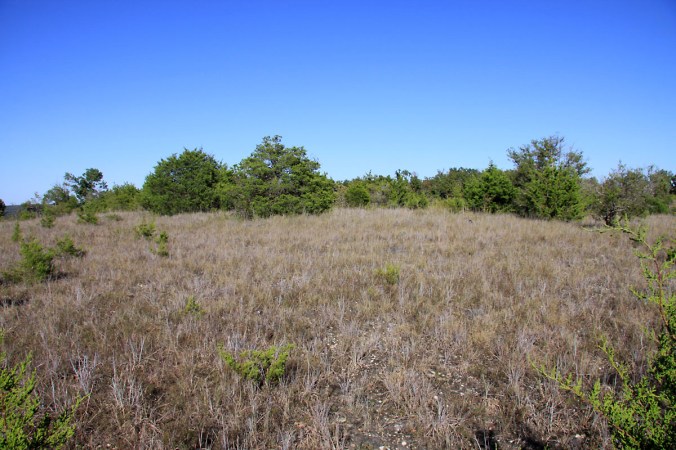
Blackjack Knob is part of an extensive xeric dolomite prairie complex (commonly referred to as cedar glades, though the term is not precisely accurate) in the White River Hills subsection of the Ozark Highlands, providing habitat for prairie tiger beetles and other typically southwestern plants and animals.

In fact, until a few weeks ago it had been several years since I had last seen this species in the field.  I did make an attempt to see it again last year but returned home from that early October trip unsuccessful, cold and wet.  Thus, when tiger beetle enthusiast Steve Spomer mentioned to me earlier this summer that he wanted to see our Missouri population, I jumped at the chance to coordinate our visits this fall and show him some of my favorite sites.  The Patron Saint of Cicindela was smiling down upon us that day, as perfect timing and sunny skies combined to bring adults out in an abundance that I’d not seen in any of my previous visits.  I would take advantage of this rare opportunity and spend the next day in the area as well, documenting a number of new localities along the northern and eastern edge of its known distribution, including a far eastern extension of its range to Caney Mountain Conservation Area in Ozark Co. where we had long suspected the beetle to occur but failed in all previous attempts to find it.

Steve Spomer and yours truly at Cane Creek Rd. site.

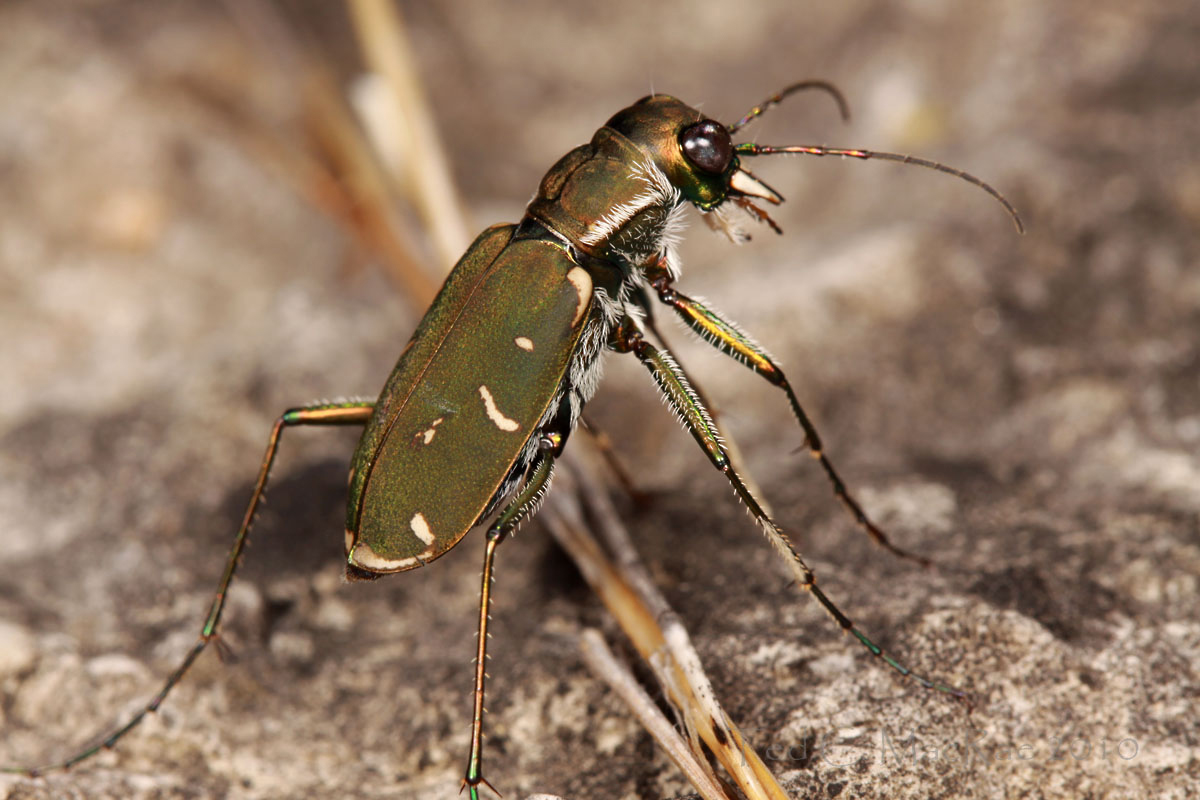
The prairie tiger beetle is the easternmost subspecies of the large grassland tiger beetle, which along with its other included subspecies covers a geographic range covering most of Texas, New Mexico, and eastern Arizona and extending up through western Oklahoma and Kansas into eastern Colorado.  Individuals of subspecies vulturina, occurring primarily in eastern/central Texas, are distinguished from the other subspecies (nominate in western Texas and eastern New Mexico north into Colorado, santaclarae in New Mexico and Arizona, and neojuvenilis in south Texas) by their generally black to olive-green coloration and reduced, narrow elytral markings, typically with an inverted “V” at mid-elytron.  The Missouri/Arkansas disjunct population is interesting from several standpoints:

  • Individuals mostly dark olive-green – no black individuals.
  • Elytral maculations more completely developed.
  • Adults active in late summer/early fall rather than summer.

These features, in particular coloration and maculation, have fueled speculation that this isolated population might be subspecifically distinct (Pearson et al. 2006).  A recent review of material from throughout its range found these color characters of limited use in unequivocally diagnosing individuals from the Missouri and Arkansas population as a separate subspecific taxon (Mawdsley 2009); however, a molecular systematics approach ultimately may be needed to resolve the status of this population.  Presumably, the Missouri/Arkansas disjunct population represents a hypsithermal relict, left behind when the return of cooler, moister conditions caused a retreat of the formerly more expansive grasslands to their current position.  If true, then the Missouri/Arkansas population has been isolated from the parent population for ~6,000 years.  I suspect that the late summer/early fall adult phenology is an adaptation to local precipitation patterns, relying on more predictable late summer rains to trigger adult emergence after the generally droughty months of July and August.  In this regard it differs fundamentally from the true “fall” species, which emerge briefly in the fall as sexually immature adults before overwintering and re-emerging in the spring for mating and oviposition.  These Missouri/Arkansas disjuncts do not re-emerge in spring, but instead mate and lay eggs in the fall before the onset of cold weather.  The eggs hatch as well (based on my growth chamber observations of this species), so winter also is passed as a larva – either as newly-hatched 1st instars, or as later instars that hatched during the previous year(s) – rather than as adults.

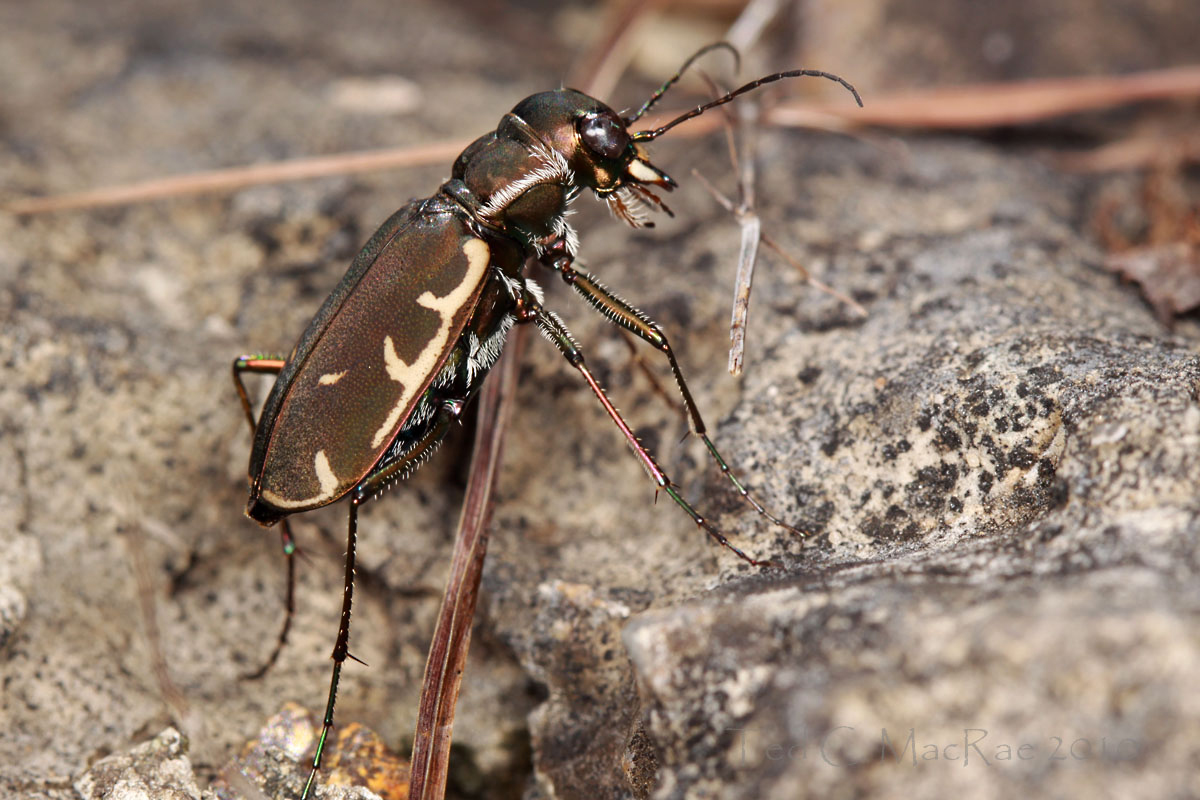
I have noted considerable variation in the coloration and maculations of individuals in this population.  The individual in the first photograph above is typical of the population – dark olive-green with thin but nearly complete maculations.  That individual comes from Blackjack Knob (Taney Co.), which is near the heart of the White River Hills region.  However, the degree to which the maculations are developed is variable, ranging from rather incomplete to even more fully developed due to the presence of a marginal connection.  Additionally, a few individuals can be found that show greater or lesser suffusion of brown on the head, pronotum, and elytra.  At another location in the county closer to the northern distributional limit (Hwy 160/Cane Creek Rd.), this brown suffusion is more common and variably expressed from minimal to nearly complete.  The photographs below show five individuals from this site expressing differing degrees of brown as well as the variable macular development seen throughout the population:
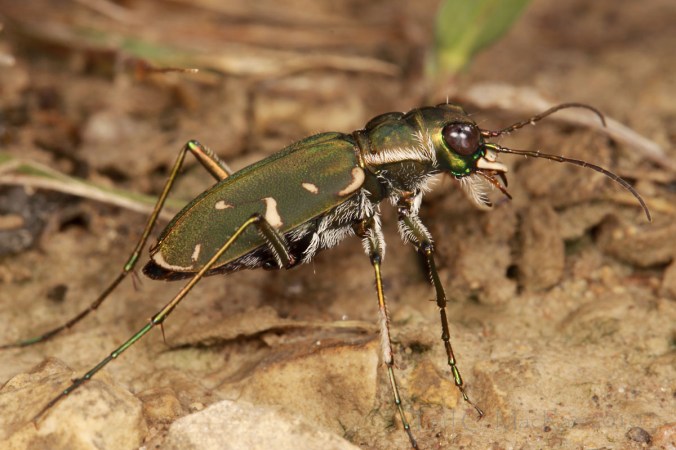
Male (Hwy 160/Cane Creek Rd.) - green w/ trace brown, marginal band incomplete, median band complete.


Female (Hwy 160/Cane Creek Rd.) - green w/ slight brown, marginal band complete, median band incomplete.


Male (Hwy 160/Cane Creek Rd.) - green w/ moderate brown, marginal band incomplete, median band incomplete.
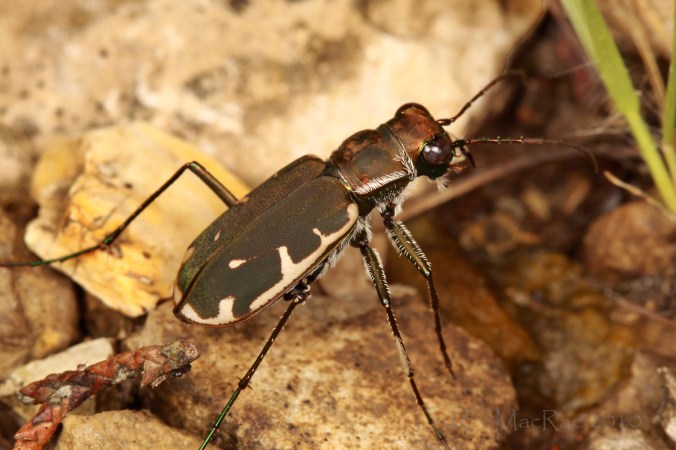

Male (Hwy 160/Cane Creek Rd.) - green w/ heavy brown, marginal band complete, median band complete.
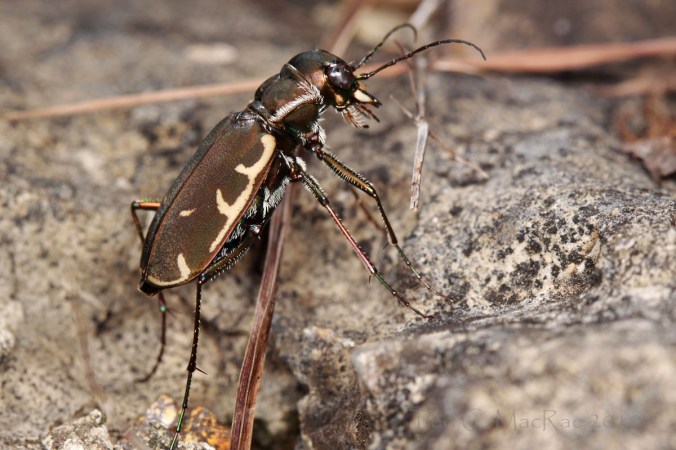

Female (Hwy 160/Cane Creek Rd.) - completely brown, marginal band complete, median band incomplete.

There is another site even further north in the county (Merriam Woods), which I found for the first time on this trip and, to my knowledge, represents the northernmost extent of the population in Missouri.  At this site, nearly all of the individuals show coppery-brown coloration with almost no hint of green.  These fully brown individuals seem to represent an appearance that is completely unlike that seen in any other part of the range of the species.  The individual in the photo below typifies the appearance of the beetles seen at this site:

Male (Merriam Woods) - brown, marginal band incomplete, median band complete.

I’m less familiar with coloration of the population further south in Arkansas, although in my limited collecting in that area I recall that most individuals I encountered exhibited the dark olive-green coloration typical of individuals at Blackjack Knob and other more southern sites in Missouri.  Thus, there seems to a clinal element to variability in coloration in the Missouri/Arkansas disjunct population.  I suspect that the unique coloration of the beetles in this population is related to the soils with which they are associated.  Light gray Jefferson City-Cotter dolomite bedrock forms the core of the White River Hills landscape and is exposed extensively in the glades that dominate its knobs and slopes.  These exposures are weather-stained black and overlain by thin, black soils that support dark, green-black lichens amongst the sparse vegetation, as seen in the following photographs taken at the newly identified northeasternmost site at Caney Mountain Conservation Area:

Thinly soiled dolomite exposures punctuate the glades in the White River Hills. Prairie tiger beetles are found in these exposures.
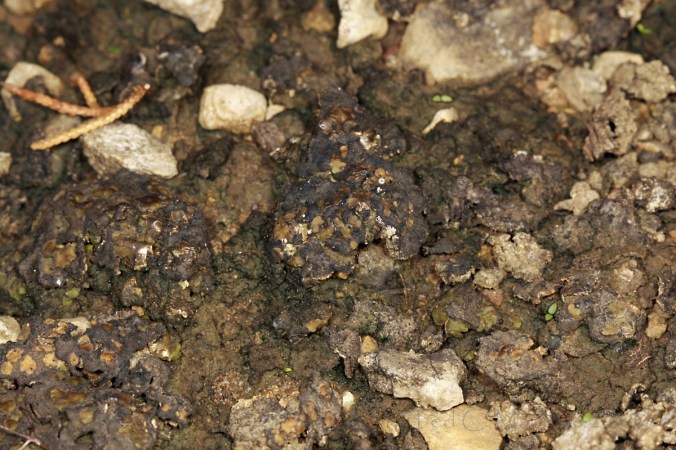

Dark green-black lichens encrust the thin black soils overlaying the dolomite exposures. Prairie tiger beetle adult coloration closely matches the coloration of the lichens and soil.

The glades and dolomite exposures where these beetles are found in the White River Hills and the dry oak woodlands that surround them have a characteristic look that is not seen once one leaves the area, and I have found many new sites for the beetle in the northern and eastern fringes of the region by stopping at locations where the roadside exposures had the right “look.”  The variation in maculation and coloration seen in this population may be an indication that the population is still adapting to local conditions since becoming isolated from main population.

Currently, I have 3rd-instar larvae that I collected from their burrows at Blackjack Knob (adults mostly green) and Merriam Woods (adults mostly brown) and hope the rear them to adulthood next year.  If I succeed in getting virgin adults from the two sites, I think it would be interesting to do some single-pair crossings and rear the progeny to see how coloration is expressed.  A long term project, for sure, as these beetles probably require at least two seasons to reach adulthood, but rearing them is fun!  A more difficult, yet far more interesting, project would be to secure virgin adults from the mostly black main population in Texas – or even the bright green, thickly-maculated santaclarae subspecies from Arizona – to see how interbreeding them with these Missouri disjuncts would affect coloration and maculation in their progeny – they could be some of the most unusual appearing large grassland tiger beetles ever seen (not to mention their tongue-twisting taxonomic moniker of Cicindela (Cicindelidia) obsoleta vulturina [Missouri disjunct] x obsoleta santaclarae!).  Timing would be a difficulty, since the Texas and Arizona populations exhibit a more normal summer adult phenology, but it would be worth a try if I could secure a source of larvae for rearing.  Anybody?

A male sports his impressive pair of choppers.

Photo Details (insects): Canon 50D w/ 100mm macro lens (ISO 100, 1/250 sec, f/13-22), Canon MT-24EX flash (1/4-1/2 ratio) w/ Sto-Fen + GFPuffer diffusers. Typical post-processing (levels, minor cropping, unsharp mask).

REFERENCES:

Mawdsley, J. R.  2009. Geographic variation in U. S. populations of the tiger beetle Cicindela obsoleta Say (Coleoptera: Cicindelidae).  Insecta Mundi 0094:1–10.

Pearson, D. L., C. B. Knisley and C. J. Kazilek. 2006. A Field Guide to the Tiger Beetles of the United States and Canada. Oxford University Press, New York, 227 pp.

Copyright © Ted C. MacRae 2010

Jeepers Creepers, where’d ya get those multilayered retinae?

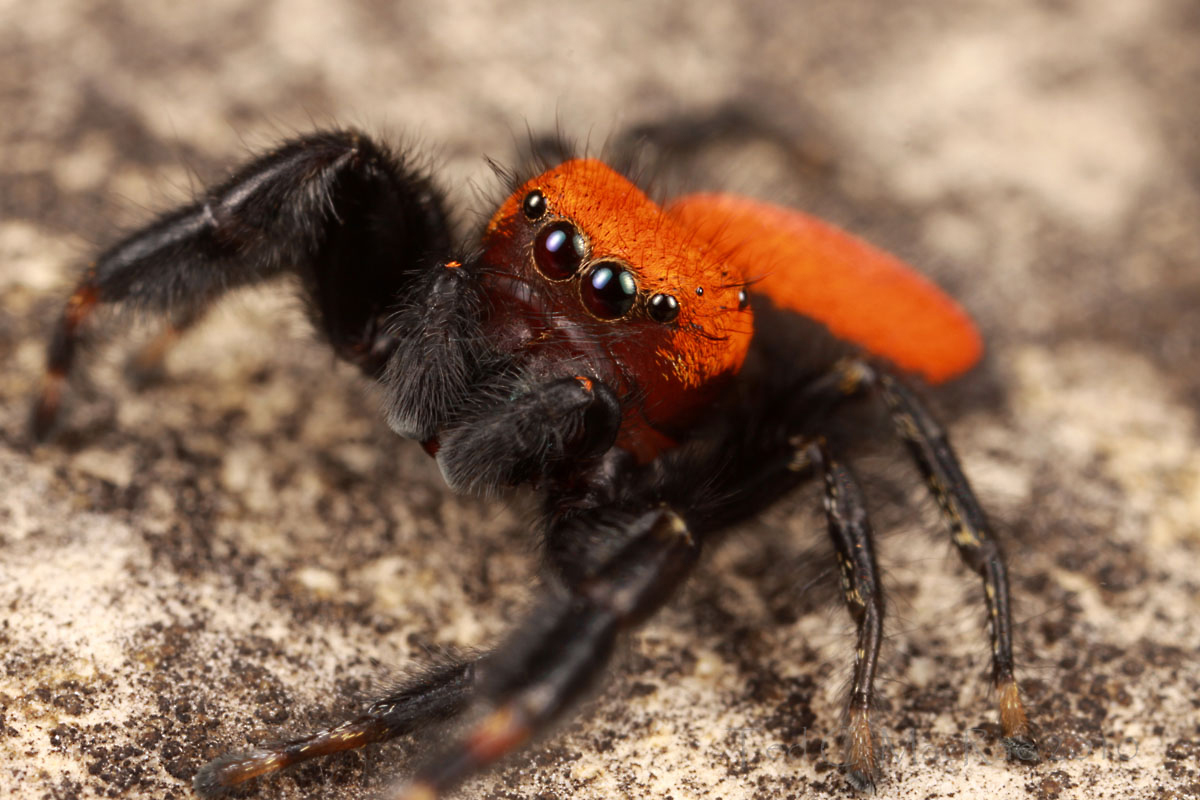
A few weeks ago I was fortunate to get a chance to blast down to the White River Hills in extreme southwestern Missouri.  Cicindela obsoleta vulturina (prairie tiger beetle) was my quarry – I had made arrangements to meet up with fellow cicindelophile Steve Spomer (principal author of Tiger Beetles of South Dakota & Nebraska, Spomer et al. 2008) and show him a few of the better sites I had found for this species.  We would have good success due to gorgeous fall weather and perfect timing, and the next day I would be fortunate to extend its known distribution further north and east.  Still, the beetles are not early risers, and I found myself that second morning with some time on my hands while waiting for these sleepy-heads to arise from their slumber and begin their foraging activities.  As I trolled the thinly soiled dolomite exposures of a new site I had identified the previous day, a spot of red jerking erratically through the sparse vegetation caught my eye, and looking closer I was delighted to see this small but brilliantly colored jumping spider (family Salticidae) trying to evade my gaze.

Jumping spiders are perhaps the most diverse of all spider families, but it is their extraordinary visual capabilities and complex predatory and courtship behaviors that they are best known for.  Popular as research subjects, to the rest of us they are simply endearing little animals.  Some of the largest and most colorful jumping spiders belong to the genus Phidippus, which is also one of the most diverse genera in the family and boasts some 60 species in the continental United States (Edwards 2004).  The genus is characterized by details of the eye placement and carapace shape (Richman 1978) but can often be recognized by their relatively large size, numerous erect hairs, and conspicuous iridescent chelicerae just below the front eyes.  The species can be quite difficult to identify, especially the females, but I feel reasonably confident that this individual is a male of the widespread species P. apacheanus.

I wasn’t always so confident – browsing images on BugGuide left me confused after finding images of P. apacheanus and P. cardinalis males that looked almost identical. However, further digging reveals P. apacheanus is characteristically a more intense red, while P. cardinalis is more orangey with lighter bristles which may appear silvery.  Also, P. cardinalis often displays makings on the abdomen – generally a light line running around the anterior part of the abdomen and sometimes tiny light spots on the dorsum – that are absent in P. apacheanus.  (This begs the question as to whether some of the BugGuide photos may be misidentified?)  Another Phidippus species that might be confused with P. apacheanus is P. clarus; however, that species has a black cephalothorax and bright abdominal markings.  According to Herschel RaneyP. apacheanus is most often seen in fall.

This was a very difficult subject to photograph.  He refused to come out in the open, preferring to duck and peek from behind whatever vegetation he could find.  Realizing that my desire to photograph him without any manipulation would be a lesson in futility, I used my finger to prod him towards and onto a small, flat, lichen-encrusted rock, where he would look at me with ever-increasing alarm and try to flee at the approach of the camera.  Lots of failed shots were discarded in the field before I finally got a few I thought I could live with (which, I think, are a decided improvement over my first jumping spider photos).  As I zoomed in for the closeups, I saw for the first time the shimmering of his multilayered retinae moving in the depths of his primary medial eyes.  The retina is the darkest part of the eye, thus, when the eye is at its darkest the spider is looking straight at you!

Photo Details: Canon 50D w/ MP-E 65mm 1-5X macro lens (ISO 100, 1/250 sec, f/13), Canon MT-24EX flash (1/8 ratio) w/ Sto-Fen + GFPuffer diffusers. Typical post-processing (levels, minor cropping, unsharp mask).

REFERENCES:

Edwards, G. B.  2004. Revision of the jumping spiders of the genus Phidippus (Araneae: Salticidae). Occasional Papers of the Florida State Collection of Arthropods 11:i-viii, 1-156, 350 figs.

Richman, D. B.  1978. Key to the jumping spider (salticid) genera of North America.  Peckhamia 1(5):77–81.

Spomer, S. M., M. L. Brust, D. C. Backlund and S. Weins.  2008. Tiger Beetles of South Dakota & Nebraska. University of Nebraska, Department of Entomology, Lincoln, 60 pp.

Copyright © Ted C. MacRae 2010

Quick Business…

I’ll have a “real” post ready shortly, but I wanted to make a quick note of a few items that have popped up recently:

  • Cylindera celeripes – this, of course, is the swift tiger beetle, a quite rare species of tiger beetle that I’ve been studying for the past two years.  I am preparing a manuscript (now in its final stages) that will review the species’ historical occurrence, document the new records I’ve accumulated for it, and discuss its potential conservation status.  I’ve gotten specimen label data from university collections in IA, KS, NE, OK, and TX (known range of the beetle) and from a number of private tiger beetle collectors.  However, I would like to make the story as complete as possible and am looking for any other repositories that might contain additional specimens.  If you know of such in your local university museum (other than those in the states listed above), I would appreciate knowing about them and getting ahold of their label data.
  • The Southern Fried Science Network has just launched a new group blog called Journeys, which they hope will serve as a central hub for writing about scientific field work and expeditions.  It’s a unique concept where contributors will post updates, stories, discoveries, and observations in the course of conducting their fieldwork.  The site has already been populated with a number of expedition logs (including a couple of my own).  I’m anxious to see if this takes off, as its field-work focus is right up my alley.  A link has been added to my sidebar under the heading “Field Work”.
  • Every now and then, someone asks me why I collect insects.  More specifically, they want to know why I must collect the insects that I find, rather than simply observing them in the field, making notes, and then letting them go on their merry ways.  Some are truly curious, while others adopt the more judgmental stance that collecting insects now is akin to the days of ornithology when birds were observed not through binoculars, but through rifle scopes before being shot!  I have a standard set of responses to this question, mostly dealing with difficulty of field identification, incomplete taxonomy, vouchering of scientific data, etc.  However, next time I am asked the question, I am going to provide a link to this post, a guest contribution by myrmecologist Benoit Guenard on Alex Wild’s Myrmecos.  I can only imagine what Benoit is going through, now realizing that he had found and photographed just the second and third known specimens of a truly rare North American ant, only to let them go because he didn’t realize what they were at the time.

Copyright © Ted C. MacRae 2010

“Colorfull Cockroach” discovered in Panama

I won’t call this a taxonomy fail, since Patrick is clearly not a taxonomist, or even the first person to confuse a beetle with a cockroach.  Nevertheless, I was amused at Patrick’s amazement with the “colorfull cockroach” that he found and his palpable excitement that it might be a new discovery.

Well, I was amazed about this type of cockroach so, I would like to know if it is a cockroach or what because I know you guys will be also interested about checking out this type of bug.
Thanks please answer fast 🙂
Maybe is a new kind of cockroach not discovered yet.

Fortunately, the folks at What’s That Bug were able to correctly identify this as Euchroma gigantea (giant metallic ceiba borer), a beetle in the family Buprestidae (and the largest such species in the Western Hemisphere).  An interesting note about this photo is that it shows the beetle with some – but not all – of the green pulverulence (dusty coating) that these beetles exhibit over the elytra upon emergence from their host tree.  This coating is quickly worn off as the beetle goes about its activities, and most museum specimens of the species lack it completely – giving the beetle a purplish appearance as seen on the left elytron of the beetle in this photo.  Even handling a freshly-emerged specimen to mount it on an insect pin would likely result in loss of much of the coating, so it is quite difficult to preserve specimens in their lime-green dusty state.

Copyright © Ted C. MacRae 2010