To the land of Gauchos

Today I leave for an extended stay in Argentina. Many have asked me if my trip is for work or fun, and my standard response has been, “It’s for work, and it will be fun!” For the next eight weeks, I’ll be helping out with field trials and speaking to farmers (while sampling a few Malbecs as well). Of course I would rather it be an 8-week collecting trip, but I consider myself fortunate even to have an opportunity such as this. I’ll pick up a few insects along the way, but what I really hope to bring back in large quantity is photographs.

It’s a little difficult to predict how reliable and consistent I’ll have internet access or the time to take advantage of it, so postings over the next few weeks may be a little less regular than what has become my usual custom. The trip is also heavily front-loaded with work activities as I get my bearings and spend time getting to know my new colleagues, so I’m not sure when I might have new photos to show here. Not to worry, I have plenty of material that I haven’t yet shown. Until then, I leave you with this photograph I took last November at  in Buenos Aires. These tiny bugs seem to be early-instar leaf-footed bug (family Coreidae) nymphs, their bright red and black coloration and aggregating behavior indicating ample chemical protection against predation.

Early-instar coreid nymphs | Buenos Aires, Argentina

Copyright © Ted C. MacRae 2012

Pollen Bath

Spintherophyta (?) sp. in flower of Abutilon pauciflorum | Buenos Aires, Argentina

One of the smallest insects I saw during my latest visit to  (Buenos Aires, Argentina) was this tiny leaf beetle (family Chrysomelidae) feeding in the flower of a malvaceous plant that I take to be Abutilon pauciflorum. At only ~4 mm in length, it could have easily gone unnoticed had I not noticed there were several feeding in flowers in a small, localized area. The best I could come up with for an ID was subfamily Chrysomelinae due to their globular shape, although the small size didn’t seem right. Turns out I’d forgotten to consider the Eumolpinae, which also contains globular species that are usually much smaller than those in the Chrysomelinae, and according to leaf beetle specialists Shawn Clark and Ed Riley this is likely a member Spintherophyta or a closely related genus.

Covered with tasty, sticky pollen!

Although there are only four species of Spintherophyta in North America (Schultz 1976), and of those only S. globosa is widespread and commonly encountered, the diversity of the genus explodes in the Neotropics (Blackwelder 1946 lists 71 species). Accordingly, neither Shawn nor Ed were brave enough to venture a guess as to which species this might represent. I should probably defer to their good sense, but part of me wonders if that coppery pronotum might suggest S. cupricollis—one of only two species in the genus listed by Blackwelder (1946) for Argentina.

REFERENCE:

Blackwelder, R.E. 1946. Checklist of the coleopterous insects of Mexico, Central America, the West Indies, and South America. Bulletin of the U. S. National Museum 185:551-1492.

Schultz, W. T. 1976. Review of the genus Spintherophyta (Coleoptera: Chrysomelidae) in North America north of Mexico. Annals of the Entomological Society of America 69(5):877–881.

Copyright © Ted C. MacRae 2012

Hover fly on mallow flower

I’ve mentioned before my reluctance to take random “bug on a flower” photos, but the colors of this hover fly (family Syrphidae) and the mallow flower (Malvaceae, possibly Abutilon pauciflorum) on which it was sitting were enough to capture my interest—a rare offering from this blog to dipterophiles. Even though I’m a beetle man, I’ve had reasonably good success identifying the varied insects across several orders and families that I’ve photographed at the Reserve. This one, however, has me a little stumped. I searched the syrphid gallery at Diptera.com but didn’t find a good match, the most similar being the Old World species Episyrphus balteatus. My best guess is something in the tribe Syrphini. Morgan? Keith? Phoridae?

Photographed last month at  in Buenos Aires.

Copyright © Ted C. MacRae 2011

Cycloalexy in tortoise beetle larvae

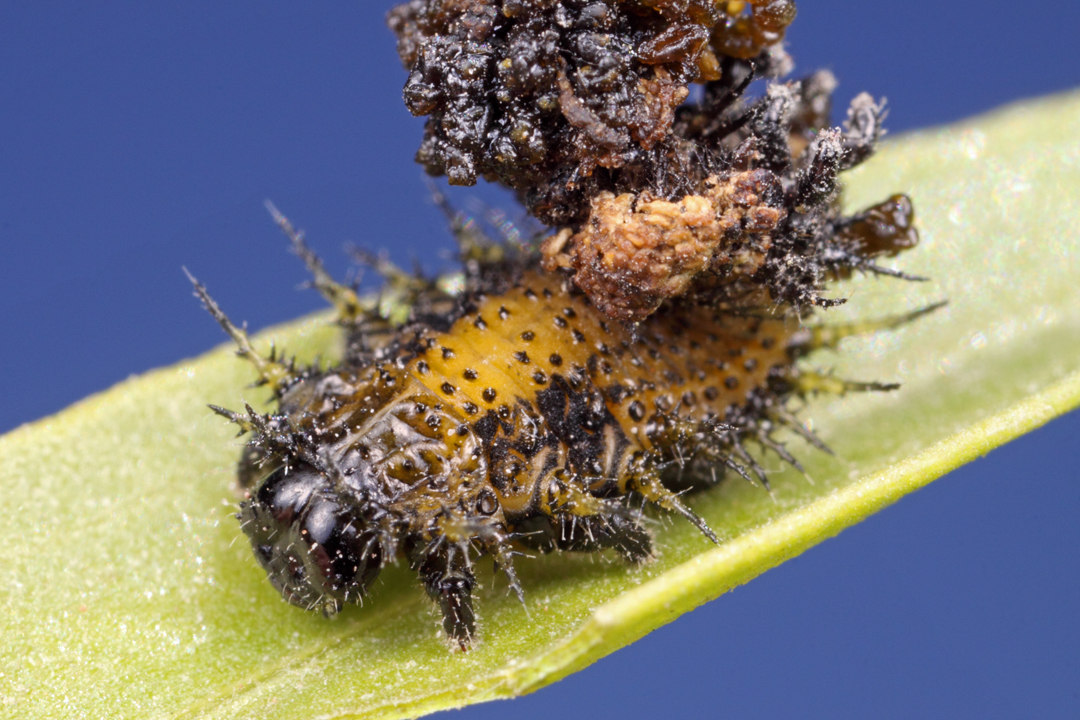
One of the first insects I encountered during my visit this past November to  in Buenos Aires, Argentina were these tiny beetle larvae grouped together on a single leaf of an unidentified shrub.  The presence of fringed lateral appendages and exuvial-fecal debris masses held by caudal appendages immediately identifies them as larvae in the leaf beetle subfamily Cassidinae, known commonly in North America as “tortoise beetles” due to the appearance of the adults.  With nearly 3,000 species distributed throughout the world, tortoise beetles are easily recognizable as a group; however, species identifications can be much more difficult, especially in the Neotropics where the group reaches its greatest diversity (Borowiec and Świętojańska 2002–2011). Identification of larvae can be even more challenging, as the larvae of many species remain unknown, and I was unable to find adults in association with the larvae to aid my identification.

Anacassis sp. (poss. exarata) early-instar larvae on Baccharis salicifolia | Buenos Aires, Argentina

Nevertheless, host plant can be an important clue to leaf beetle identity, as most species in the family limit their feeding to a single plant genus or group of related plant genera. The shrub on which the beetles were feeding looked familiar to me, and while perusing a list of plants that have been recorded from the Reserve (Burgueño 2005) I had an “Aha!” moment when I spotted the asteraceous genus Baccharis. I decided the plant must represent Baccharis salicifolia because of its narrowly lanceolate, willow-like leaves with fine apical serrations (Cuatrecasas 1968) (see first photo). The only tortoise beetles known to feed on Baccharis are species in the genus Anacassis (McFadyen 1987), several species of which are known from Argentina, and one (Anacassis exarata) looking very much like the larvae in these photos.

Note the circular, heads-directed-inward orientation of all larvae around the periphery

The manner in which these early-instar (perhaps even newly hatched) larvae were feeding as a group while working their way down the length of the leaf towards its base is not something I had observed before. Larvae of most tortoise beetles are solitary feeders (Borowiec and Świętojańska 2002–2011), and I was further intrigued by the deliberate circular formation that the larvae had assumed.  The larvae around the periphery were all facing inward, tightly packed against each other and with their exuvial-fecal debris masses directed outward. Additional larvae were seen inside the circular formation. As I manipulated the leaf for photographs, the larvae would occasionally raise their debris masses up and outward, presumably a defensive reaction to disturbance and a perceived threat. It was clear to me that the larvae had deliberately “circled their wagons” for defensive purposes.

Close body contact allows exuvial-fecal debris masses to form a protective barrier against predators

In fact, this type of defensive strategy has been reported in a number of South American cassidines, as summarized by Jolivet et al. (1990), who coined the term “cycloalexy” (from the Greek κύκλος = circle, and αλεξω = defend) to describe such strategies. Cycloalexy can either be “heads in, tails out” or vice versa and is usually associated with other repellent activities such as coordinated threat movements, regurgitation, or biting. The strategy is intended to provide protection from predators such as ants and true bugs and parasitioid wasps, although some parasitoids seem to have thwarted the strategy by depositing their eggs where they can be ingested (thus avoiding direct confrontation with the prey). Cycloalexy has been described primarily among chrysomelid beetles and tenthredinoid hymenopterans (sawflies); however, examples from a few other insect orders (e.g., Diptera, Neuroptera, Lepidoptera) are known as well (Jolivet 2008).  All known cycloalexic insects are subsocial in the larval stage and often also exhibit maternal protection of eggs or newly hatched larvae.

This and several other older larvae had become solitary, presumably protected in part by greater size

In addition to this single group of early instar larvae, I noted also a few larger individuals—all of whom were feeding on the plant in a more solitary fashion. Presumably as the larvae grow larger they are more able to defend themselves, or perhaps larger larvae simply demand more “elbow room” because of the larger amounts of leaf tissue they require for feeding. If cycloalexy is beneficial for small cassidine larvae but less so for larger larvae, perhaps this behavior is actually more common than is currently realized.

REFERENCES:

Borowiec, L., and J. Świętojańska. 2002–2011. Cassidinae of the world – an interactive manual (Coleoptera: Chrysomelidae). http://www.biol.uni.wroc.pl/cassidae/katalog%20internetowy/index.htm [accessed 3 Dec 2011].

Burgueño, G. 2005. Manejo de la vetación en reservas naturales urbanas de la region metopolitana de Buenos Aires. Aves Argentinas, Asociación Ornitológica del Plata, Proyecto Reservas Naturales Urbanas, 16 pp.

Cuatrecasas, J. 1968. Notas adicionales, taxonómicas y corológicas, sobre Baccharis. Revista de la Academia Colombiana de Ciencias Exactas, Físicas y Naturales 13(50):201–226.

Jolivet, P. 2008. Cycloalexy. In: J. L. Capinera [Ed.], Encyclopedia of Entomology, Springer Science+Business Media B.V.

Jolivet, P., Vasconcellos-Neto, J., and Weinstein, P. 1991. Cycloalexy: A new concept in the larval defense of insects. Insecta Mundi 4(1–4) (1990):133–141.

McFadyen, P. J. 1987. Host-specificity of five Anacassis species [Col.: Chrysomelidae] introduced into Australia for the biological control of Baccharis halimifolia [Compositae]. Entomophaga 32(4):377–379.

Copyright © Ted C. MacRae 2011

Zygogramma Desmogramma leaf beetles in Argentina


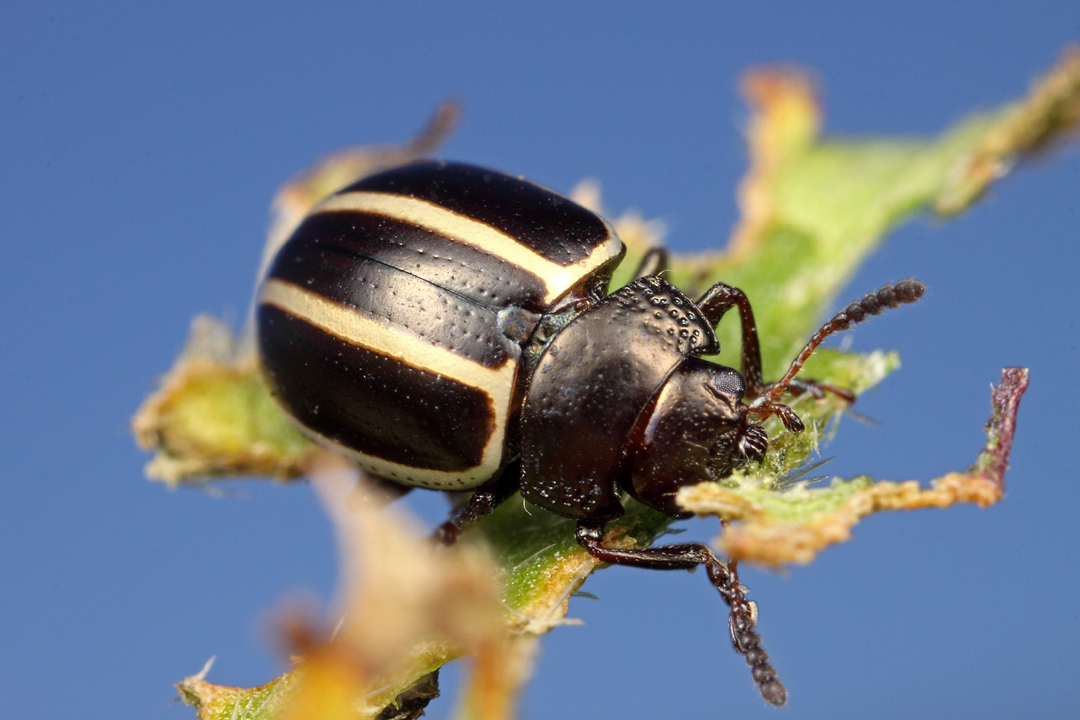
The east end of  in Buenos Aires offers a quiet contrast to the more populated central and western areas. Few people leave the levee-trail system that surrounds the famous wetlands and pampas grass stands in those latter areas; however, those that do find in the east a mosaic of pastures and young woodlands that offer a greater diversity of sights and invite a more leisurely pace. November is spring in Buenos Aires, and as such there were a number of plants beginning to bloom in the Reserve. One plant I found blooming in abundance in one small part of the east area was a member of the family Malvaceae that I take to be Abutilon pauciflorum, a few of which were being devoured by these leaf beetles (family Chrysomelidae).


These beetles are clearly members of the subtribe Doryphorina within the nominate subfamily, looking very similar to the North American species Zygogramma suturalis (ragweed leaf beetle) or the vittate species of Calligrapha (subgenus Bidensomela), e.g. Calligrapha bidenticola. Both of these genera are represented in Argentina, and at first I was inclined to believe the beetles belonged to the latter genus since its Central and South American members are associated almost exclusively with malvaceous plants (North American species of Calligrapha have adapted to plants in several other families). However, a view of the tarsus in the last photo suggests that the claws are joined at the base, a character that immediately separates members of the genus Zygogramma from the genus Calligrapha (species of Doryphora also have fused tarsal claws but exhibit a completely different gestalt). Eight species of Zygogramma have been recorded from Argentina, but I wasn’t able to find photographs of any that look reasonably similar to the individuals in these photos.  The identification will have to remain, frustratingly, non-specific.

Update 12/6/11: I just received an email from Shawn Clark (Brigham Young University, Provo, Utah) saying that he suspects the beetles belong to the genus Desmogramma. This genus is distinguished from both Zygogramma and Calligrapha by having the prosternum sharply angled upward anterior to fore coxae or mesosternum with a distinct horn directed anteriorly (Flowers 2004) and the claws widely separated and unarmed. Unfortunately, neither character is visible in these photos. Three species of Desmogramma are recorded from Argentina, and the coloration of these individuals resembles that described by Stål (1862) for D. striatipennis (D. semifulva and D. nigripes have the 3rd, 5th and 9th elytral interstices light).


These photographs represent continued efforts with the so-called ‘blue sky background’ technique that I’ve been trying to perfect as an alternative to the black background one typically gets in insect macrophotography with full-flash illumination of the subject. All of these photos were taken at ISO 640 using an MP-E 65mm lens at f/13 with 1/160 sec (1st photo) or 1/125 sec (2nd and 3rd photos) exposure and F.E.C. -1. These are similar settings to those used in my previous and not as satisfactory attempt, but this time the results were much better. Not only is the color of the sky spot-on blue, but these photos have much better detail than the previous. In this case, I believe “locking'” the subject relative to the lens to prevent motion blur was the key—I used my left hand to hold the leaf with the beetle towards the bluest area of the sky, rested the camera lens on my left wrist, used my fingers to fine tune the leaf position as I looked through the viewfinder, and held my breath!

REFERENCE:

Flowers, R. W. 2004. The genera of Chrysomelinae (Coleoptera: Chrysomelidae) in Costa Rica. Revista de Biología Tropical 52(1):77–83.

Stål, C. 1862. Monographie des Chrysomélides l’Amérique. C. A. Leffler, Upsal, 365 pp.

Copyright © Ted C. MacRae 2011

Return to La Reserva Ecológica Costanera Sur

Last March I discovered —a gem of natural beauty in the heart of Buenos Aires, Argentina.  Though its origins are semi-artificial, its biota a mix of native and introduced species, and its pathways continually choked with pedestrians and cyclists, for me it is a refuge—a place where I can spend an entire day looking for insects without ever retracing my footsteps.  Last Sunday after arriving in Buenos Aires, I couldn’t check into my hotel and change into my “bug collecting clothes” fast enough before making a beeline to the Reserve just a few blocks away.  I “discovered” a huge area on the east side of the Preserve that I hadn’t found during my last visit that was devoid of paved paths—and thus people—and spent the next several hours rummaging through the brush looking for insects to photograph.  Early November is early spring in Buenos Aires, and insect activity was still just beginning.  I did find a number of insects to photograph, though not as many as I had found during my early March visit.

This butterfly, which I regard as Actinote carycina (Yellow Lazy), was common around stands of a purple-flowered plant.  I watched this particular individual flit endlessly back and forth in front of one particular stand, rarely pausing long enough to allow a shot or two before resuming its patrols.  Vigorous aerial battles ensued every time another individual approached the stand, and although I can’t say for sure that it was this individual that always won, the same patrolling flight pattern resumed as soon as one of the contestants flew away.

Beetles were scarce, but I saw this particular species of Melyridae (presumably in the genus Astylus, and thus a close relative of Astylus atromaculatus or “spotted maize beetle”).  I don’t normally do random “bug-on-a-flower” photos, but I’ve recently become enamored with the use of “blue sky technique” for insect macrophotography and thought the red and black color of the beetle against the yellow flower it was feeding on was well suited for a blue background.  The beetle was quite small (only ~6 mm in length), thus requiring the 65mm 1–5X lens and full-flash illumination.  Normally this would result in a black background unless something is placed behind the subject, and I suppose I could just carry around a colored cards for placing behind subjects to get whatever color background I want.  However, there is something appealing to me in having the ability to achieve a blue sky by actually using the sky, despite the trickiness of the technique.  In this case, I  played with ISO settings of 400–640 and shutter speeds of 1/100 to 1/125 sec (settling at the high end of each range for this photo) to get the color of the sky true, then used low F.E.C. settings (-1 2/3 in this case) to temper the illumination of the subject.  I’m still not completely happy with the results—there is more motion blur in the photo than I would like, and I burned the yellows a little too much as well.  I think ISO800 and F.E.C. -2 or even lower would have given better results.  At any rate, this photo was the best of the bunch, and it will have to do.

Copyright © Ted C. MacRae 2011

“Puente de la Mujer”

One of my favorite sites in the heart of Buenos Aires, I’ve never actually seen Puente de la Mujer (“Womans Bridge”) lit up at night until this trip.  A short distance to the north lies Rio de la Plata and La Reserva Ecológica Costanera Sur (“South Coast Ecological Reserve), where I spent the majority of the day this past Sunday.  Yes, more photographs of “bichos Argentinos” forthcoming.

Copyright © Ted C. MacRae 2011

“Sunflower looper” – Rachiplusia nu

Rachiplusia nu ''oruga medidora'' | Santa Fe Province, Argentina

With a planted area approaching 20 million hectares, soybean has become Argentina’s most important agricultural crop.  Most of the planted area is located within the so-called “Humid Pampas” region of central Argentina (Buenos Aires, Córdoba, Santa Fe and Entre Rios Provinces), but the crop continues to expand in the northestern part of the country as well (Chaco, Tucumán and Salta Provinces).  More than any other crop in Argentina (except perhaps cotton), soybean is attacked by a tremendous diversity of insects.  The most important of these are the defoliating Lepidoptera, primarily species in the family Noctuidae.  Anticarsia gemmatalis (velvetbean caterpillar) is the most consistent and widespread defoliator, but an increasingly important species in Argentina is Rachiplusia nu (“oruga medidora del girasol,” or sunflower looper).

Eggs are laid primarily on the undersides of leaves

Rachiplusia nu belongs to the noctuid subfamily Plusiinae, the larvae of which can be recognized by having three pairs of prolegs and the “looping” manner by which they walk.  Chrysodeixis includens¹ (soybean looper), much better known because of its status as a major pest of soybean in the southeastern United States (and of growing importance in Brazil as well), also belongs to this group, and in fact the larvae of the two species are quite similar in appearance.  While R. nu is the primary plusiine species affecting soybean in Argentina, C. includens has appeared with increased frequency on soybean in Argentina in recent years, primarily in the more northern, subtropical growing regions adjacent to those areas in Brazil where it is now a major pest of the crop.

¹ Although still widely referred to in the literature as Pseudoplusia includens, the genus Pseudoplusia was synonymized under Chrysodeixis some eight years ago by Goater et al. (2003).  More recently the synonymy was accepted and formally applied to the North American fauna by Lafontaine and Schmidt (2010). 

Neonate larva on soybean

Despite their similarity of appearance, larvae of the two species can be rather conclusively distinguished by the shape of their spinneret (Angulo and Weigert 1975).  This is not a very convenient character for use in the field, however, leading to misidentifications in areas where the two species co-occur.  This is not an insignificant problem, as the two species exhibit differing susceptibilities to pesticides labeled for their control (C. includens especially having become resistant to a number of pesticides).  The result is control failures and subsequent application of even more pesticides in an effort by farmers to protect their crops.  While not as conclusive as the shape of the spinneret, in my experience R. nu larvae (at least older larvae) tend to have a darker, smoky-blue cast to the color (compared to the bright yellow-green of C. includens) and rather distinct patches of tiny black asperites on the thoracic ventors that are not apparent in C. includens.

Younger larvae consume only the lower surface between veins, resulting in ''window paning''

As the common name implies, soybean is not the only crop attacked by R. nu.  Early season infestations tend to occur in alfalfa and flax, after which the populations spread to soybean and sunflower.  The latter crop especially is heavily attacked by this insect, primarily in the drier western regions in Córdoba Province.  Dry conditions seem to favor an increase in the populations of this species, while moist conditions promote increased incidence of pathogenic fungi that are very effective at suppressing R. nu larval populations.
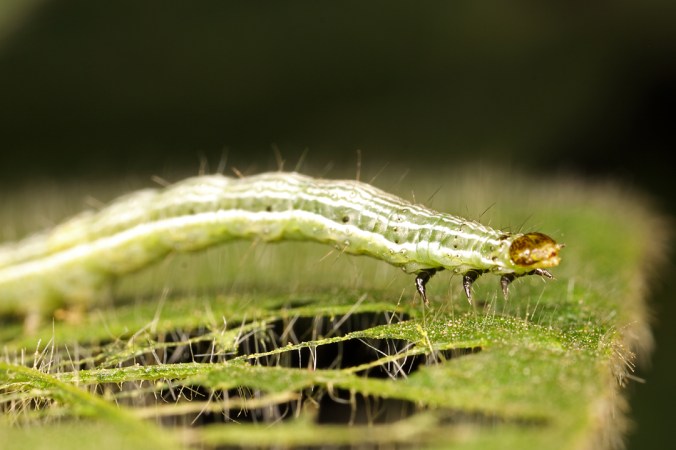
Older larvae consume entire tissues but still avoid veins, resulting in a ''skeletonized'' appearance

Like many defoliating lepidopterans, eggs tend to be laid on the undersides of leaves, where the larvae begin feeding after they hatch.  Young larvae consume only the lower epidermal layer of the foliage between the veins, leading to an appearance in the foliage called “window paning”.  As they larvae grow they begin consuming the entire tissue layer but still preferentially avoid vascular tissue, resulting in a skeletonized appearance to the foliage.  A single larvae can consume more than 100 cm² of soybean foliage, which translates to several trifoliates.  As a result, it doesn’t take many larvae to cause significant loss of foliage on the plant.  Soybean has the ability to compensate for loss of foliage due to increased photosynthesis in lower foliage exposed by feeding in the upper part of the plant, but losses exceeding around 15% during the later reproductive stages of plant growth are enough to significantly reduce yields (and it is during these reproductive stages of growth that R. nu infestations tend to occur).

Rachiplusia nu adult | Buenos Aires Province, Argentina

Rachiplusia nu is the most widely distributed of three South American species in the genus, occurring in Argentina, Bolivia, Brazil, Chili, Paraguay, Peru and Uruguay, while a fourth species, R. ou, is widely distributed throughout North and Central America (Barbut 2008).  Unlike R. nu, its North American counterpart R. ou has not gained status as a pest of soybean or other crops.

In a BitB Challenge first, nobody was able to correctly ID the larva of this species beyond the level of subfamily.  This, despite the huge Argentina hint bomb that I dropped when I posted the challenge and my well-known vocation as a soybean entomologist.  I figured the answer would be forthcoming as quickly as one could Google the search phrase “Argentina soybean Plusiinae” (which, in fact, shows the following except for the very first result “Pseudoplusia includens is the most common soybean Plusiinae in the Americas (Herzog, 1980). Rachiplusia nu in southern Brazil, Uruguay and Argentina, and…” [emphasis mine]). Most participants guessed, predictably, soybean looper, while only a few were fooled into guessing Geometridae (the true loopers, and distinguished by having only two pairs of prolegs).  As a result, I’m not declaring a winner for ID Challenge #14, although the appropriate points will still be awarded (when I get around to assigning them, that is.  Hey, I’m working in Argentina right now—it was enough for me just to get this post out!).

REFERENCES:

Angulo, A. O. and G. T. H. Wiegert. 1975. Estados inmaduros de lepidópteros noctuidos de importance economica en Chile y claves para su determinación. Sociedad Biologico Concepción, Publicación Especial 1:1–153.

Barbut, J. 2008. Révision du genre Rachiplusia Hampson, 1913 (Lepidoptera, Noctuidae, Plusiinae). Bulletin de la Société entomologique de France113(4):445–452.

Goater, B., L. Ronkay and M. Fibiger. 2003. Noctuidae Europaeae. Vol. 10, Catocalinae, Plusiinae. Entomological Press, Sorø, 452 pp.

Lafontaine, J. D. and B. C. Schmidt. 2010. Annotated check list of the Noctuoidea (Insecta, Lepidoptera) of North America north of Mexico. ZooKeys 40: 1–239.

Copyright © Ted C. MacRae 2011