Arizona collectors: Have you seen this beetle?

Placoschema dimorpha (male) | lower Madera Canyon, Arizona

Placoschema dimorpha (male) | lower Madera Canyon, Arizona

If you are a collector of beetles in Arizona, you should be on the lookout for longhorned beetles (family Cerambycidae) resembling the specimen in the above photos. Determined as Placoschema dimorpha Chemsak & Hovore, in Eya 2010 by Jeff Huether, the specimen was collected by Jeff’s son Mark Huether on 15 July 2013 as they roadside collected longhorned beetles and scarabs in lower Madera Canyon (Pima Co.). They were searching mainly on Baccharis, although there were very few flowers open at the time. It is not known what plant the specimen was collected from, but Jeff notes that it was collected around 2 pm in the heat of the day.

Placoschema dimorpha was described from just a handful of specimens (3 males and 4 females), all in Mexico, and is the only member of the genus. As a result, the above collection represents the first record of both the genus and the species in the U.S. New U.S. records for popularly collected groups like longhorned beetles are always noteworthy, and in this case its occurrence in southeast Arizona—well scrutinized for decades by legions of beetle collectors—is all the more remarkable. Perhaps its tiny size (the above specimen measures only ~10 mm) and somber coloration—unusual for the tribe Trachyderini with its mostly large and colorful members—have somehow contributed to it being overlooked until now. Others might be quick to cite climate change and recent expansion of its range northward into the U.S. as a possible explanation; however, it should be noted that the type specimens, despite being few in number, were collected from a rather large area across central and northern Mexico in the states of Chihuahua, Durango, Hidalgo, and Mexico.

While this specimen agrees very well with the original description of P. dimorpha, it does differ from the male paratype figured in that work in that the lateral margins of the elytra are red only in the basal half rather than completely to the apex. As the species name implies, females are colored differently, with the elytra entirely reddish or at most a darker fascia (may be incomplete) across the apical three-fourths.

My sincere thanks to Jeffrey Huether for allowing me to photograph this specimen and present these notes in advance of more formal documentation in peer-reviewed literature.

REFERENCE:

Eya, B. K. 2010. New Mexican and Central American genera and species of Trachyderini (Coleoptera, Cerambycidae, Cerambycinae). Les cahiers Magellanes 108:1–21.

Copyright © Ted C. MacRae 2013

Sometimes the best collecting…

Anambodera sp. (prob. undescribed) | Nothing, Arizona

As a practicing (albeit non-professional) taxonomist, I spend a goodly amount of time examining specimens collected not only by me, but by others as well. I’ve mentioned before the benefits of doing this—both to the collector, who gets names for the specimens in their collection, and to my own research in being able to cast a broader net in my search for new distributions and host associations within my two primary focus groups—Buprestidae and Cerambycidae. Such information remains surprisingly incomplete for these two popularly collected groups of beetles, and every few years I assemble whatever records that I’ve accumulated to that point for publication in the form of a “notes” paper (e.g., Nelson and MacRae 1990, Nelson et al. 1996, MacRae and Nelson 2003, MacRae 2006, MacRae and Rice 2007). Occasionally I encounter species that I have not yet collected myself (although with ~70% of Nearctic species now represented in my collection, this is becoming more and more infrequent), and in most such cases the collector graciously allows me to keep an example or two (leading to the saying, “Sometimes the best collecting is in other people’s collections!” ☺). The ultimate find, however, is a specimen or series of specimens that represent an undescribed species. Yes, even amongst North America Buprestidae and Cerambycidae there are many species still awaiting discovery (imagine the situation with other families of beetles, many receiving far less attention than these two popular groups).

The beetle shown here, a member of the genus Anambodera, represents one such species. This individual is part of a small series collected in Nothing, Arizona this past summer by Paul Kaufman, an indefatigable amateur beetle collector who has routinely over the years provided fodder for my research in the way of new state records and, more recently, new larval host records through rearing. While the key characters that separate Anambodera from the closely related and exorbitantly speciose genus Acmaeodera (front margin of epistoma not reflexed or plate-like, front angles of pronotum rounded in side view, suture between 1st and 2nd abdominal sterna visible, etc.—see Barr 1972), the coarse elytral punctation and heavily sculptured and bronzed pronotal surface are classic gestalt for Anambodera and unlike any of the small, vittate species of Acmaeodera that they resemble. This specimen keys to A. gemina, but it clearly differs from that species in a number of characters. Anambodera is restricted to western North America, and species tend to be poorly represented in collections due to their more cryptic habits (unlike Acmaeodera, most tend not to visit flowers, but are instead found alighting on rock surfaces or bare soil). As a result, the genus is still incompletely known and in bad need of revision. Dennis Haines and George Walters are working on such a revision and have already found several undescribed species among material collected in Arizona—I’m sure they will be pleased to include these specimens in their study as well.

My sincere thanks to Paul Kaufman for faithfully sending to me for examination his “catch” at the end of each season and allowing me to publish information gleaned from the included specimens. Keep it up, Paul!

REFERENCES:

Barr, W. F. 1972. New genera and species of North American Buprestidae. Occasional Papers of the Biological Society of Nevada 39:1–13.

MacRae, T. C. 2006. Distributional and biological notes on North American Buprestidae (Coleoptera), with comments on variation in Anthaxia (Haplanthaxia) viridicornis (Say) and A. (H.) viridfrons Gory. The Pan-Pacific Entomologist 82(2):166–199.

MacRae, T. C., and G. H. Nelson. 2003. Distributional and biological notes on Buprestidae (Coleoptera) in North and Central America and the West Indies, with validation of one species. The Coleopterists Bulletin 57(1):57–70.

MacRae, T. C. and M. E. Rice. 2007. Distributional and biological observations on North American Cerambycidae (Coleoptera). The Coleopterists Bulletin 61(2):227–263.

Nelson, G. H., and T. C. MacRae. 1990. Additional notes on the biology and distribution of Buprestidae (Coleoptera) in North America, III. The Coleopterists Bulletin44(3):349–354.

Nelson, G. H., R. L. Westcott and T. C. MacRae. 1996. Miscellaneous notes on Buprestidae and Schizopodidae occurring in the United States and Canada, including descriptions of previously unknown sexes of six Agrilus Curtis (Coleoptera). The Coleopterists Bulletin 50(2):183–191.

Copyright © Ted C. MacRae 2011
 

Call for paratypes!

Acmaeodera n. sp. (Santa Cruz Co., Arizona)

Earlier this year, I featured this small jewel beetle in the genus Acmaeodera (family Buprestidae).  It was collected a few years ago in southeastern Arizona by my hymenopterist friend Mike Arduser, who over the years has given me a great variety of buprestid and cerambycid beetles that he has encountered on flowers while collecting representatives of his chosen specialty – apoid bees (bee specialists are often great collectors of flower visiting insects across many taxa!).  This particular specimen is perhaps the most exciting of all of those, as it appears to represent an undescribed species.  Unfortunately, it is the only specimen known, and describing new species based on a single specimen in a genus such as Acmaeodera – diverse, variable, and with ill-defined species limits – is not advisable.  I have enlisted the help of a few insect collectors to try to find more specimens of this species to allow proper description; however, so far no additional specimens have turned up.  The summer monsoons have begun this season in southeast Arizona, thus the next few weeks will once again provide the opportunity to encounter this beetle.  I am hoping that this post, with precise locality data, information on the circumstances of its collection, and photographs of the beetle and its habitat, will prompt any entomologists reading this to scour the mountains of Arizona during the next month (or the accumulation of undetermined material in their collections) in the hopes of encountering additional specimens to allow formal description of this species.

Label data for the specimen are as follows: “ARIZONA Santa Cruz Co. | Atacosa Mountains | along Ruby Road [E of #100 Trailhead], 6,000 ft. | August 2, 2003 10-1200 [hrs] | Aloysia flwrs – Arduser”.  The first person to search for additional specimens was my friend Paul Kaufman, who searched for the beetle in August 2007.  Here is what he had to say afterwards:

Well, we found the site based on the GPS readings you gave me.  We could not find any of the Aloysia in that location, but there were some other leguminous plants with white flowers a-buzz with bees.  No beetles however.  The area has had a fire burn through it in fairly recent history – several years maybe?  It’s hard to tell, but that could have changed things a bit.  Anyway, we drove west on Ruby Rd a few tenths of a mile and did find a drainage full of Aloysia!  This was the only location along Ruby Rd where we found any growing.  Three of us checked it very carefully uphill and downhill from the road (rough scrambling).  There were lots of bees, flies and leps, but no beetles!

The following year, North American Acmaeodera guru Rick Westcott himself went to search for this species – also without success.  He wrote:

If you remain in touch with the collector of the latter, please ask him if he got it up on the pinyon-juniper zone, or were there just oaks and junipers?  If he was at 6000′, I am quite certain there had to be pinyon.  The trail (#100) starts on the Ruby Road at 4700′ and goes to the lookout that is at 6200′.  I decided not to go to the latter, but I was close.  I did not see any flowers that were suitable for Acmaeodera, let alone did I see an Aloysia bush.  Much of the area had been burnt, though some years ago.

I sent this information to Mike Arduser, who replied as follows:

It appears now that I  must have  misinterpreted the elevation on my topo map and carried that error onto the label, because though I walked up almost to the lookout I did not do any collecting up that high. My collecting (hand net and malaise traps) was done adjacent to Ruby Rd., then upslope approximately 100 meters or so, all of it east of the #100 trailhead (which is where I parked). The only woody plants in the immediate vicinity I noted were Aloysia (in narrow rocky drainages) and a legume (forget the genus at the moment). However, I think there were a few oaks scattered around (I believe there was one where I parked). There was no evidence of fire at the time I was there.

Mike also sent me the photo shown here taken near the collection site (if nothing else, the spectacular scenery makes a visit to this place seem like a good idea), noting:

Attached is a photo from the Atacosa Mtns. Area where the new buprestid was found – the photo was taken about 100ft. elev.  above the collection site and about a ¼ mile to the west.

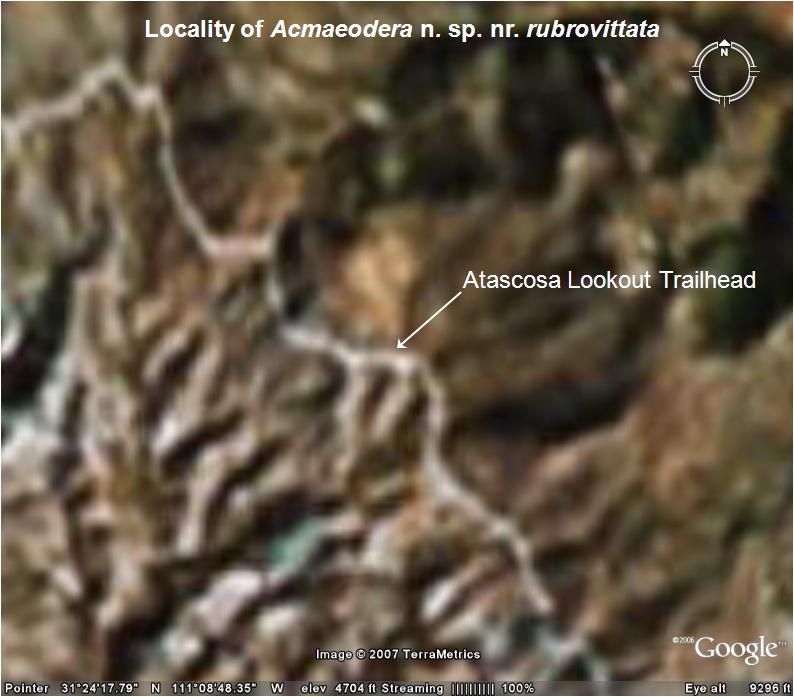
I’ve included a Google Map at left that shows the location of the Atascosa Lookout (#100) Trailhead.  It’s not the best overhead photo, but it does give an idea of the landscape relief and rather precisely pinpoints its location via GPS coordinates in the lower lefthand corner.  If the beetle truly does occur at lower elevations (~4,700′), then it is probably not terribly specific about this particular locality.  Perhaps it is a Mexican species that only occasionally makes it into the U.S. depending on the season. The repeated comments about apparent fire in the area by Paul and Rick suggest potential vegetational differences in the area from the time the beetle was collected compared to their subsequent visits. Although the single specimen was collected on Aloysia flowers, it is also possible that the species does not actually show a particular preference for this plant – although it does seem likely that it visits flowers of some type.  The only way to answer these questions is by finding more specimens!

Copyright © Ted C. MacRae 2010

Add to FacebookAdd to DiggAdd to Del.icio.usAdd to StumbleuponAdd to RedditAdd to BlinklistAdd to TwitterAdd to TechnoratiAdd to Yahoo BuzzAdd to Newsvine

Email to a friend

Acmaeodera carlota in northern Arizona

Acmaeodera carlota Fall – Coconino Co., Arizona

This is another of the interesting species that I encountered during my examination of material submitted for identification this past winter.  Acmaeodera carlota is one of 149 species/subspecies in North America belonging to this very difficult genus (recall my recent post, Aaack!-maeodera), and as with so many of its congeners it wasn’t described until after the last revision of the genus more than a century ago (Fall 1899).  Obviously, the genus badly needs another revision – or at least a revised key – so that the known species can be identified with some degree of confidence without having to send specimens to a specialist. There have been a handful of buprestid workers in recent decades who may have been able to accomplish this daunting task, but to date none have been willing to embrace this considerable challenge.

As far as is known, A. carlota occurs only in Arizona.  Fall (1932) described this species from a few specimens collected from cactus blossoms near Globe, Arizona (~90 miles east of Phoenix).  Since then, the only specific information recorded about this species was by Westcott et al. (1979), who reported adults cut from wood of Quercus dumosa near Sunflower (~60 miles northwest of the type locality) and collected from flowers in west-central Arizona near Wikieup.  Fall’s original description leaves much to be desired (as is the case for nearly all original descriptions prior to the last 50 years or so), and to this point no images have been published in the literature or appeared on the web.  This particular specimen was found in a batch of material sent to me by cerambycid-enthusiast Jeff Huether (the same batch containing the previously discussed Acmaeodera robigo), and the only reason I was able to identify it was by comparing it to a specimen given to me by the late Gayle Nelson, who collected the species near Wikieup after its occurrence was reported there by Westcott and colleagues.  The interesting thing about this specimen is that it was collected near Page, Arizona – nearly 200 miles north of any of the previous known localities and just south of the Utah border.  In suspect this species occurs even more broadly and is not, as the limited records suggest, restricted to Arizona.

Acmaeodera carlota belongs to a group of species that I loosely refer to as the A. tubulus-species group.  It is not clear that all of the species are actually closely related, but they do all resemble each other in their small size (<8 mm), general appearance (i.e., black with confused yellow maculations on the elytra), and inclusion in the so-called ‘Truncatae’ group (a subdivision of the genus established by 19th Century coleopterist George Horn to include those species having the prosternal margin nearly straight and not retracted from the sides). Within the Truncatae, the species in the tubulus-species group are distinguished by lacking a subapical crest on the last ventral segment and general appearance.  Only three species were known at the time of Fall’s revision (conoidea, neglecta, and tubulus); however, an additional eight species have been described since (carlota, ligulata, neoneglecta, opuntiae, parkeri, sabinae, starrae, and thoracata).  I have collected many of these species in my travels across the southwestern U.S. and lack only starrae and thoracta in my collection (the latter is known only from the type).  In the case of A. carlota, note the rather flattened dorsal surface that is densely clothed with long, stiff, dark, suberect hairs; the coarsely, contiguously punctate pronotum; and the subrugose, slightly irregular elytral intervals, which serve to distinguish this species from others in the group.

The group’s namesake, Acmaeodera tubulus, is widespread and common across the eastern U.S., making it relatively easy to identify. However, the remaining species of the tubulus-species group are limited to the south-central and southwestern U.S., and the lack of available identification keys and suitable descriptions makes them nearly impossible to identify except by comparison with determined specimens. As a result, I have built a key to the species in the Acmaeodera tubulus-species group that I use to assist in my own identifications.  The key is based on distinguishing characters given in the original descriptions (if any) and augmented by my examination of the material at my disposal.  I invite users to test the key with their own material and let me how well it works.

My sincere appreciation to Jeff Huether for allowing me to retain this specimen in my collection as a voucher for the range extension that it represents.

REFERENCES:

Fall, H. C.  1899.  Synonpsis of the species of Acmaeodera of America, north of Mexico.  Journal of the New York Entomological Society 7(1):1–37 [scroll to “Journal of the New York Entomological Society”, “v. 7 1899”, “Seq 12”].

Fall, H. C.  1932.  Four new Buprestidae from Arizona.  The Pan-Pacific Entomologist, 8(2) (1931):81-84.

Westcott, R. L., W. F. Barr, G. H. Nelson, and D. S. Verity.  1979.  Distributional and biological notes notes on North and Central American species of Acmaeodera (Coleoptera: Buprestidae).  The Coleopterists Bulletin, 33(2):169-181.

Copyright © Ted C. MacRae 2010

Add to FacebookAdd to DiggAdd to Del.icio.usAdd to StumbleuponAdd to RedditAdd to BlinklistAdd to TwitterAdd to TechnoratiAdd to Yahoo BuzzAdd to Newsvine

Email to a friend


A Tiger Beetle Aggregation

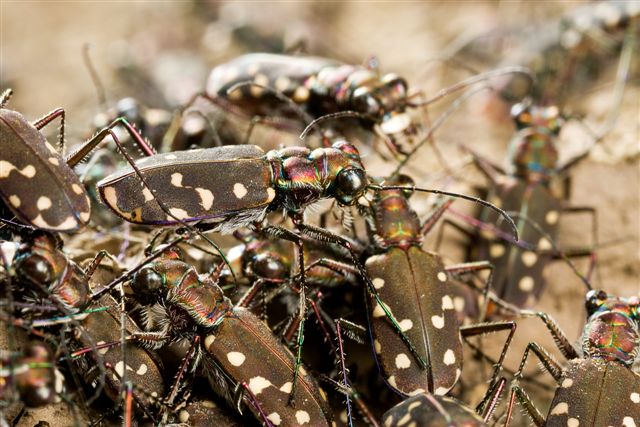
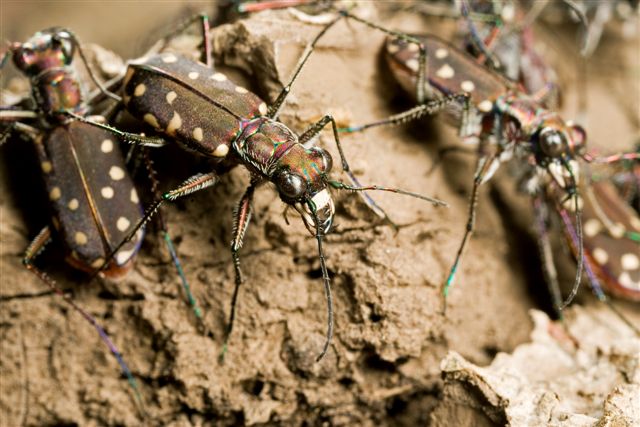
Not long ago, I received an interesting series of photographs from Joe Warfel, a nature photographer and macro specialist based in Massachussetts.  Joe traveled to Arizona last July, where he photographed an aggregation of Cicindela (Cicindelidia) sedecimpuntata (Western Red-bellied Tiger Beetle¹) near a small pool in the bottom of a dry creek bed at night.  Joe estimates that there may have been as many as 200 to 300 beetles per square meter in the aggregation, most of which were just “hanging out” and with only occasional individuals mating or feeding on moths that had been attracted to his headlamps.

¹ Found in the Sonoran and Chihuahuan Deserts of the southwestern U.S. and south through Mexico to Costa Rica. U.S. and northern Mexican populations are assigned to the nominate subspecies, while more southern populations are classified into four additional subspecies (Erwin and Pearson 2008).

Western Red-bellied Tiger Beetles are among the first tiger beetles to appear prior to the summer monsoons in the Sonoran Desert.  The species is famous for its daytime aggregations of as many as several thousand individuals, which congregate along the drying waterways and prey upon stranded tadpoles and other aquatic organisms (Pearson et al. 2006).  Joe noted that he has seen these aggregations many times before during the daytime at small pools and mudflats, with beetles usually mating and feeding frantically.  However, the aggregation shown in these photographs differs from those daytime aggregations by the relative inactivity of the beetles and the fact that they were congregated on dry ground rather than the moist areas that they frequent during the daytime.  In these respects, it seems to more resemble a communal nocturnal roost such as has been reported for several species of Odontocheila in South America.  In those cases, up to 70 beetles have been found resting on the foliage of low shrubs, apparently as an adaptation to avoid predation by multiplying chemical defense effectiveness as well as awareness of approaching enemies (Pearson and Vogler 2001 and references therein).  Cicindela sedecimpunctata is primarily a diurnal species (i.e., it is active during the daytime), though individuals are often attracted to lights at night, and adults of most diurnal species have been reported spending the night protected in burrows or under detritus and vegetation.  I am not aware of communal nocturnal roosts as a reported behavior for C. sedecimpunctata or any other North American tiger beetle species.

It is a bit ironic to think of tiger beetles – voracious predators that they are – as prey, but they must have many of their own predators to deal with since most species employ multiple antipredator mechanisms. In addition to the communal roosting behavior seen in these photos, a second antipredator characteristic exhibited by this species can be seen in their bright orange abdomen.  The abdomen is fully exposed only during flight, seemingly implying a “flash coloration” function for the bright color that disappears upon landing, momentarily confusing potential predators.  However, Pearson (1985) experimentally determined that orange abdomens in tiger beetles actually have an aposematic function in protecting them from predation against robber flies.  Most tiger beetle species with an orange abdomen also release a combination of benzaldehyde and cyanide² when captured (any tiger beetle collector is familiar with the characteristic “fruity” smell of a tiger beetle releasing benzaldehyde).  Pearson painted the abdomen of paper tiger beetles models either orange or black and endowed them with or without a drop of fresh benzaldehyde.  When presented on a tether to robber flies in the field, orange-abdomened models with benzaldehyde triggered significantly fewer attacks from robber flies than any other combination.  Interestingly however, vertebrate predators (lizards and birds) were not deterred by the defense chemicals or by the orange abdomen, perhaps explaining why only some and not all tiger beetle species produce defense chemicals and have bright orange abdomens (Pearson and Vogler 2001).

² Tiger beetles, thus, join millipedes as being among the few invertebrates that are capable of producing cyanide.

My sincere thanks to Joe Warfel for allowing me to use his photographs. More of his work can be seen at Eighth-Eye Photography.  Joe also recently had several images published in American Scientist magazine (November/December 2009 issue) for an article on harvestmen.  Check out the jaws on that juvenile!

REFERENCES:

Erwin, T. L. and D. L. Pearson. 2008. A Treatise on the Western Hemisphere Caraboidea (Coleoptera). Their classification, distributions, and ways of life. Volume II (Carabidae–Nebriiformes 2–Cicindelitae). Pensoft Series Faunistica 84. Pensoft Publishers, Sofia, 400 pp.

Pearson, D. L.  1985.  The function of multiple anti-predator mechanisms in adult tiger beetles (Coleoptera: Cicindelidae).  Ecological Entomology 10:65–72.

Pearson, D. L., C. B. Knisley and C. J. Kazilek. 2006. A Field Guide to the Tiger Beetles of the United States and Canada. Oxford University Press, New York, 227 pp.

Pearson, D. L. and A. P. Vogler.  2001. Tiger Beetles: The Evolution, Ecology, and Diversity of the Cicindelids.  Cornell University Press, Ithaca, New York, 333 pp.

Copyright © Ted C. MacRae 2010

Add to FacebookAdd to DiggAdd to Del.icio.usAdd to StumbleuponAdd to RedditAdd to BlinklistAdd to TwitterAdd to TechnoratiAdd to Yahoo BuzzAdd to Newsvine

Email to a friend

Aaack!-maeodera

Warning: post contains hardcore, taxonomic, sciencey geekiness!

Just as there is seasonality in the lives of insects, there is seasonality in the work of those who study them.  For the collector/taxonomist, everything revolves around the collecting season — time spent on anything else is time not available for collecting. As a result, I spend a good deal of my time during the summer in the field and on its associated planning and organizing activities, leaving the winter months for processing and identifying collected specimens, incorporating them into the permanent collection, generating reports to fulfill permit requirements, and ultimately preparing manuscripts for publication — the raison d’être.  Winter is also the time when I identify specimens sent to me by other collectors.  I do this not only because I’m such a nice guy (at least I hope I am), but also because such material often contains species I haven’t seen before or that represent new distributions and host plant associations that I can use to augment the results of my own studies.  Such work has occupied much of my time during the past several weeks, and I now find myself close to finishing the last of the nearly dozen batches of beetles sent to me since the end of last winter.

Of the three groups of beetles that I actively study — jewel beetles, longhorned beetles, and tiger beetles — it is the jewel beetles that are taxonomically the most challenging.  Tiger beetles can often be indentified in the field (especially with the publication of Pearson et al. (2006), or “the Bible” among cicindelophiles), and North American longhorned beetles have been reasonably well worked by a strong contingent of both professional and amateur taxonomists over the past several decades.  Jewel beetles on the other hand, despite their dazzling colors and popularity with collectors, continue to befuddle even the most dedicated collectors due to their extreme variability and poorly-defined species limits.  Of the 822 species and subspecies known from North America, fully three-fifths of them belong to one of just three hyperdiverse genera — Acmaeodera, Agrilus, and Chrysobothris.  No recent taxonomic treatments are available for any of these genera, thus, identifying species belonging to them requires access to primary literature, a well-represented and authoritatively-identified reference collection, and extraordinary patience!  This is particularly true of the genus Acmaeodera, the North American members of which were last treated collectively more than a century ago (Fall 1899) (at which time less than half of the current 149 species/subspecies were known to science).  The recent explosion of web-based images has helped matters (a particularly useful site for those interested in North American Acmaeodera is Acmaeoderini Orbis, with its galleries of Harvard type specimens and BugGuide photos); however, images are still lacking for many species, and others are not easily distinguished from the images that do exist.

Acmaeodera robigo Knull (Val Verde Co., Texas)

It is precisely this taxonomic challenge, however, that makes the group so interesting to me.  Opportunities for discovery abound, as basic information is incomplete or totally lacking for many species regarding their geographical ranges and life histories.  One of the species I encountered in a batch of material sent to me by cerambycid-specialist Jeff Huether contained three specimens that I eventually determined to represent Acmaeodera robigo.  Josef Knull (1954) first described this species from specimens collected at Lake Corpus Christi in south Texas, and nothing more was recorded about the species until Nelson et al. (1996) reported a single specimen cut from its pupal cell in the base of Dalea formosa (Fabaceae) at White River Lake in far northern Texas — a range extension of almost 500 miles!  Obviously, I didn’t have this species in my collection, and it was only after a series of eliminations that led me to the original description (and confirmation of my ID by Nearctic Acmaeodera-guru Rick Westcott based on the photos shown here) did I know for sure what it was.  These specimens were collected at Seminole Canyon State Historic Park, thus, extending into west Texas the species’ known range, and they exhibit variability in the elytral markings and punctation that was not noted in the original description.  While only an incremental increase in our knowledge of this species, collectively such increases lead to greater understanding of the genus as a whole, and Jeff’s generosity in allowing me to retain examples of the species increases my U.S. representation of the genus to 130 species/subspecies (87%).

Acmaeodera n. sp. (Santa Cruz Co., Arizona)

The opportunity for discovery is not limited to range extensions and new host records, but includes new species as well.  A few years ago I received a small lot of specimens collected in Arizona by my hymenopterist-friend Mike Arduser (hymenopterists, especially those interested in apoid bees, are excellent “sources” of Acmaeodera, which they encounter frequently on blossoms while collecting bees).  Among the material he gave to me was the single specimen shown here that immediately brought to my mind Acmaeodera rubrovittata, recently described from Mexico (Nelson 1994) and for which I had collected part of the type series.  Comparison of the specimen with my paratypes, however, showed that it was not that species, and after much combing through the literature I decided that the specimen best fit Acmaeodera robigo (despite being collected in Arizona rather than Texas and not matching the original description exactly).  This was before I had true A. robigo with which to compare, so I sent the specimen to Rick Westcott for his opinion.  His reply was “good news, bad news” — the specimen did not represent A. robigo, but it didn’t represent any known species either!  While the prospect of adding a new species to the U.S. fauna is exciting, basing a description on this single specimen would be ill-advised.  Only through study of series of individuals can conclusions be made regarding the extent of the species’ intraspecific variability and its relation to known species.  Until such specimens are forthcoming, the specimen will have to sit in my cabinet bearing the label “Acmaeodera n. sp.”  For all of you collector-types who live in or plan to visit southeastern Arizona, consider this a general call for potential paratypes!  The specimen was collected in early August on flowers of Aloysia sp. near the Atascosa Lookout Trailhead on Ruby Road in Santa Cruz Co.

REFERENCES:

Fall, H. C.  1899.  Synonpsis of the species of Acmaeodera of America, north of Mexico.  Journal of the New York Entomological Society 7(1):1–37.
[scroll to “Journal of the New York Entomological Society”, “v. 7 1899”, “Seq 12”]

Knull, J. N. 1954. Five new North American species of Buprestidae (Coleoptera). Ohio Journal of Science 54:27–30.

Nelson, G. H. 1994. Six new species of Acmaeodera Eschscholtz from Mexico (Coleoptera: Buprestidae). The Coleopterists Bulletin 48:272–282.

Nelson, G. H., R. L. Westcott and T. C. MacRae. 1996. Miscellaneous notes on Buprestidae and Schizopodidae occurring in the United States and Canada, including descriptions of previously unknown sexes of six Agrilus Curtis (Coleoptera). The Coleopterists Bulletin 50(2):183–191.

Pearson, D. L., C. B. Knisley and C. J. Kazilek. 2006. A Field Guide to the Tiger Beetles of the United States and Canada. Oxford University Press, New York, 227 pp.

Copyright © Ted C. MacRae 2010

Add to FacebookAdd to DiggAdd to Del.icio.usAdd to StumbleuponAdd to RedditAdd to BlinklistAdd to TwitterAdd to TechnoratiAdd to Yahoo BuzzAdd to Newsvine

Email to a friend

Tragidion confusion

Back in October, I discussed a recent review of the cerambycid genus Tragidion, authored by Ian Swift and Ann Ray and published in the online journal Zootaxa.  These gorgeous beetles mimic the so-called “tarantula hawks” (a group of large, predatory wasps in the family Pompilidae) and have been difficult to identify due to poorly-defined species limits, wide range of geographic variation, unusually high sexual dimorphism, and apparent potential for hybridization in areas of geographic overlap. Swift and Ray (2008) recognized seven North American and four Mexican species, including two newly described species and another raised from synonymy. It was an excellent work that provided much needed clarity based on examination of types and included detailed descriptions and dorsal habitus photographs of all species and separate keys to males and females to facilitate their identification. Unfortunately, my summary caused some confusion regarding species that occur in the deserts of southern Arizona, southern New Mexico and western Texas. In this post, I’ll clarify that confusion and provide details for distinguishing these species.

Formerly, it was thought that two species of Tragidion inhabited this region, with populations exhibiting smooth elytra and breeding in dead stalks of Agave and Yucca (Agavaceae) representing T. armatum and those exhibiting ribbed elytra and breeding in dead branches of a variety of woody plants representing T. annulatum. This concept dates back to the landmark monograph of the Cerambycidae of North America by Linsley (1962). Swift and Ray (2008) noted that Linsley’s concept of T. annulatum was based on an erroneously labeled type specimen, and that true T. annulatum referred to populations in California and Baja California (for which other names – now suppressed – were being used). This left the AZ/NM/TX populations attributed to T. annulatum without a name. The previously suppressed name T. densiventre was found to refer to populations inhabiting lowland habitats and breeding in Prosopis and Acacia (Fabaceae), but those occurring in montane habitats and breeding in Quercus (Fagaceae) represented an as yet undescribed species, for which the name T. deceptum was given. I included Swift and Ray’s figure of T. deceptum in my post – but mistakenly included the male of T. densiventre alongside the female of T. deceptum!

This error may never had been noticed, had it not been for the discriminating eyes of BugGuide contributor, Margarethe Brummermann. Margarethe is currently collecting photographs for a field guide to Arizona beetles and had photographed a male and female of a “ribbed” species in Montosa Canyon. Using the illustration of T. deceptum” in my post, Margarethe concluded her specimens represented T. deceptum and asked me to confirm her ID. When I told her the specimens represented T. densiventre, her confusion was understandable (given that her male appeared identical to the T. deceptum” male in my post). Further query on her part prompted me to do a little digging, and I discovered my error. The figure in my post has since been corrected – both that figure and a figure from Swift and Ray (2008) showing the male and female of T. densiventre are included below, along with additional information to allow their identification.

tragidion_densiventre

Tragidion densiventre Casey, 1912

Tragidion densiventre was formerly synonymized under T. auripenne (a rare species known from the four corners region of northern Arizona, southern Utah, southwestern Colorado, and northwestern New Mexico). Males of T. densiventre can be distinguished by their longer antennae, tawny-tan elytra and distinctly red-brown head, legs, and scape, while females have shorter antennae and the elytra red-orange. Both males and females of this species are distinguished from T. deceptum by their five elytral costae that curve inward toward the suture and extend to near the elytral apices, as well as their relatively narrower basal black band. Females of this species may be further distinguished from T. deceptum by their all black (or nearly so) antennae. Tragidion densiventre is found predominantly in xeric lowland desert habitats in Arizona, New Mexico, and west Texas (as well as northern Mexico). Larvae have been recorded developing in dead Prosopis glandulosa and Acacia greggii, and adults have been observed aggregating on sap oozing from stems of Baccharis sarothroides (Asteraceae) and flowers of larval host plants. Although the biology of this species has not been described in detail, it is likely that the observations of Cope (1984) for T. auripenne refer to this species. This is the classic T.annulatum” commonly observed in the desert southwest.

Tragidion deceptum

Tragidion deceptum Swift & Ray, 2008

Tragidion deceptum superficially resembles T. densiventre due to its ribbed elytra; however, it is actually more closely related to the Mexican species T. carinatum. Like T. densiventre, the males exhibit longer antennae and tawny-tan elytra, while females have shorter antennae and orange-red elytra. However, the head, legs and scape of males are black, as in females of the species, rather than red-brown as in males of T. densiventre. Females exhibit distinctly annulated antennae, in contrast to the all black antennae of T. densiventre. Both males and females are distinguished from T. densiventre by the elytral costae – only four rather than five, not incurved towards the suture and extending only to the apical one-third of the elytra. In addition, the basal black band is very broad – exceeding the scutellum by 2 × its length. This species is similarly distributed across the desert southwest as T. densiventre but occurs in more montane habitats, where it breeds in recently dead branches of several species of Quercus. Like T. densiventre, adults are often found feeding and aggregating on Baccharis sarothroides, and in a few lower canyons bordering desert habitats in the Huachuca Mountains of southeastern Arizona this species and T. densiventre have been collected feeding alongside each other on the same Baccharis plants. Tragidion deceptum is one of several species in the genus (along with T. coquus in eastern North America) that have been collected using fermenting molasses traps (more on this in a future post).

REFERENCES:

Cope, J. 1986. Notes on the ecology of western Cerambycidae. The Coleopterists Bulletin, 38:27–36.

Linsley, E. G. 1962. The Cerambycidae of North America. Part III. Taxonomy and classification of the subfamily Cerambycinae, tribes Opsimini through Megaderini. University of California Publicatons in Entomology, 20:1-188, 56 figs.

Swift, I. and A. M. Ray. 2008. A review of the genus Tragidion Audinet-Serville, 1834 (Coleoptera: Cerambycidae: Cerambycinae: Trachyderini). Zootaxa, 1892:1-25.

Copyright © Ted C. MacRae 2009

Add to FacebookAdd to NewsvineAdd to DiggAdd to Del.icio.usAdd to StumbleuponAdd to RedditAdd to BlinklistAdd to Ma.gnoliaAdd to TechnoratiAdd to Furl

New species and a review of the genus Tragidion

ResearchBlogging.orgSpecies of Tragidion are among the larger and more attractive cerambycids in North America, making them popular among collectors. Their bright orange and black coloration clearly functions in mimicking spider wasps (family Pompilidae) in the genera Pepsis and Hemipepsis – the so-called “tarantula hawks.” Unfortunately, species of Tragidion have been difficult to identify due to a high degree of morphological similarity between species, wide range of variation across geographic areas within species, unusually high sexual dimorphism and dichromatism, and apparent potential for hybridization in areas of geographic overlap. This has confounded efforts to delimit species boundaries, resulting in a confusing assortment of names whose proper application has eluded even the most esteemed of North America’s cerambycid taxonomists. Recently, some much needed clarity was provided by Ian Swift and Ann M. Ray in the journal Zootaxa. Their taxonomic review of Tragidion – the first systematic treatment of the entire genus – recognizes seven species in North America and another four restricted to Mexico. Two species – T. agave from California and Baja California and T. deceptum from montane areas of the southwestern U.S. and northern Mexico (both pictured) – are described as new, and a third – T. densiventre from desert areas of the southwestern U.S. and northern Mexico – is raised from synonymy under T. auripenne. Four new synonymies are also proposed, and dorsal habitus photographs and a key to all species are provided. Life history information is limited for most species of Tragidion. One species – T. coquus – occurs broadly across the eastern and central U.S., where it breeds in a variety of dead hardwoods, especially oak. Several species occur in the southwestern U.S. and northern Mexico – some are found in xeric lowland desert habitats, where they breed in dead branches of Prosopis glandulosa and Acacia greggii (T. densiventre) or dead flower stalks of Yucca and Agave (T. agave and T. armatum), while a fourth (T. deceptum) is found in more montane habitats mining the heartwood of recently dead branches of Quercus. Adults of another species in California and Baja California, T. annulatum, are strongly attracted to brushfires and burning vegetation, and individuals have been observed landing on still-burning and smoldering shrubs, causing their legs and abdomens to melt to the surface of the branches. At several post-burn sites, the melted bodies of this species were common on the charred branches of their hosts, and females have been observed ovipositing on woody shrubs that have been burned. This species likely plays an important role in the decomposition of burned woody material in coastal areas of California. The remaining U.S. species – T. auripenne – is known from only a handful of specimens collected in xeric habitats in the Four Corners region of the southwestern U.S. It’s life history, as well as those of the four strictly Mexican species, remains essentially unknown.

Tragidion agaveTragidion agave Swift & Ray 2008, ♂ & ♀ – California & Baja California. Tragidion deceptumTragidion deceptum Swift & Ray 2008, ♂ & ♀ – southwestern U.S. and northern Mexico.

REFERENCE: Swift, I., Ray, A. M. (2008). A review of the genus Tragidion Audinet-Serville, 1834 (Coleoptera: Cerambycidae: Cerambycinae: Trachyderini) Zootaxa, 1892, 1-25