A belated Happy Birthday

It seems that November 24th came and went without me even realizing that BitB turned six years old that day! Six years—wow, has it really been that long? I guess forgetting birthdays officially puts me in the old-timer camp (both as a person and as a blogger). No fanfare or celebration. Instead, I blithely wrote my 778th post (Q: How do you photograph cactus beetles?) and carried on as usual.

I guess it’s too late now to make a big deal of it, but I will make the observation that November 2013, with its 15 posts, was one of my heaviest blogging months ever (the most since 18 posts in December 2012 and the overall high of 21 in April 2010). This may come as a surprise to those who have heard me grouse periodically about the decline of blogging, both of my blog in particular and as a platform in general. It’s a different world than it was when I started BitB—Twitter and Facebook have taken over much of the social interaction that used to take place on blogs, relegating the latter primarily to satisfying a small but persistent niche demand for long-content. Throughout the course of these changes, however, motivation to blog still comes to me consistently and often. Mostly it seems to be an internal need to express myself, but the occasional and very much appreciated feedback in the form of comments and emails also helps. So, with that, thank you for the past six years, and here’s looking at the next six!

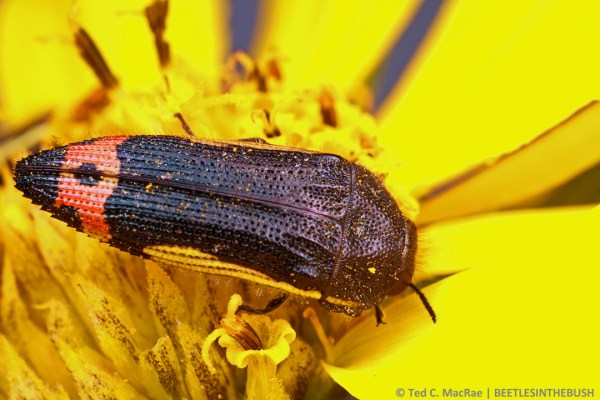
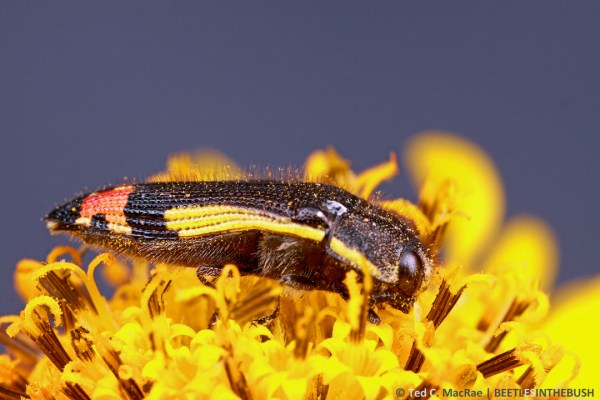
Enough blather—here are a few colorful net-winged beetles in the genus Calopteron (family Lycidae) to help with the celebration. They were photographed in northern Argentina (Chaco Province) in April 2012 while visiting flowers of Chilean goldenrod (Solidago chilensis). I’m not sure if they represent more than one species, as the taxonomy of the genus in the Neotropics appears to be very poorly known at this time—if so it would seem there exists in this area a mimicry complex that is ripe for study.

Calopteron sp. on flowers of Solidago chilensis| Chaco Province, Argentina

Calopteron sp. on flowers of Solidago chilensis | Chaco Province, Argentina

Calopteron sp. on flowers of Solidago chilensis| Chaco Province, Argentina

Calopteron sp. on flowers of Solidago chilensis | Chaco Province, Argentina

Calopteron sp. on flowers of Solidago chilensis| Chaco Province, Argentina

Calopteron sp. on flowers of Solidago chilensis | Chaco Province, Argentina

Copyright © Ted C. MacRae 2013

Pedantic Sunday: Blister beetles don’t suck

Nemognatha cribraria cribraria on flower head Chrysothamnus viscidiflorus | Millard Co., Utah

Nemognatha cribraria cribraria on flowers of Chrysothamnus viscidiflorus | Millard Co., Utah

The beetle featured in today’s photo is the blister beetle (family Meloidae), Nemognatha cribraria cribraria. The genus Nemognatha and its relatives in the subfamily Nemognathinae are distinctive due to the greatly elongated adult mouthparts that are modified for feeding on flowers. Specifically, parts of the maxillae, or second pair of mouthparts (behind the mandibles) are elongated to allow access to nectar in flowers with deep corollas, while the fairly standard-issue chewing mandibles are used for feeding on pollen. As pointed out by Enns (1956) in his revision of the North American members of the genus, the length of the maxillae seems to be related to the particular kind of flower preferred for feeding by the various nemognathine species, with species exhibiting longer maxillae adapted to feeding on flowers with deeper corollas. In the photo above, the elongated maxillae can be seen tucked underneath the adult and appear to be nearly half the length of the body—other species in the genus have the maxillae as long as the body, or in the case of a Mexican species (N. chrysomeloides) even longer than the body (Enns 1956).

The proboscis-like mouthparts of nemognathine blister beetles are often depicted in entomological texts as an amazing example of sucking mouthparts in Coleoptera, the vast majority of which possess strictly chewing mouthparts. Borrer et al. 1976, White 1983, Downie & Arnett 1996, and Pinto & Bologna 2002 all mention that the mouthparts are modified into an elongated proboscis for “sucking” nectar, and it has been suggested that nectar uptake occurs through a median food canal, formed by concavities on the inner surfaces when the two structures are locked together into a functional unit. However, Wilhemi & Krenn (2012) used scanning electron microscopy and micro computerized tomography to study the elongated mouthparts of three meloid genera: Nemognatha and Gnathium and Leptopalpus. They demonstrated that neither the elongated galeae of Nemognatha and Gnathium nor the elongated maxillary palpi of Leptopalpus formed a median food canal through which nectar is sucked. Furthermore, the filiform galeae of Nemognatha and Gnathium are densely covered with long bristles, suggesting that nectar uptake in these two genera is accomplished by capillary action along the bristles of the proboscis. In all three genera nectar transport is likely aided by musculature around the mouth.

REFERENCES:

Borrer, D. J., D. M. DeLong & C. A. Triplehorn. 1976. An Introduction to the Study of Insects, Fourth Edition. Holt, Rinehart and Winston, xii + 852 pp.

Downie, N. M. & R. H. Arnett, Jr. (Eds.). 1996. The Beetles of Northeastern North America. Volume II: Polyphaga: Series Bostrichiformia through Curculionoidea. The Sandhill Crane Press, Gainesville, Florida, x + 891–1721.

Enns, W. R. 1956. A revision of the genera Nemognatha, Zonitis, and Pseudozonitis (Coleoptera, Meloidae) in America north of Mexico, with a proposed new genus. The University of Kansas Science Bulletin 37, part 2(17):685–909 [Biodiversity Heritage Library].

Pinto, J. D. & M. A. Bologna. 2002. Chapter 111. Meloidae Gyllenhal 1810, pp. 522–529. In: R. H. Arnett, Jr., et al. (Eds.). American Beetles, Volume 2. CRC Press, Gainesville, xiv + 861 pp.

White, R. E. 1983. A Field Guide to the Beetles of North America. The Peterson Field Guide Series, Houghton Mifflin Co., Boston, xii + 368 pp.

Wilhelmi, A. P. & H. W. Krenn. 2012. Elongated mouthparts of nectar-feeding Meloidae (Coleoptera). Zoomorphology [abstract].

Copyright © Ted C. MacRae 2013

A winter longhorned beetle

According to the calendar it’s still autumn; however, in practical terms winter has settled in across much of the U.S. For those of us who study wood-boring beetles in the families Buprestidae (jewel beetles) and Cerambycidae (longhorned beetles), our time for collecting ended long ago. Adults of most species are active in spring and early summer, although some species don’t really make their appearance until summer is in full swing and a few rather distinctive species in genera such as Crossidius and Megacyllene make their appearance exclusively during fall. There is one longhorned beetle, however, that can actually be encountered in its greatest numbers during the dead of winter—Rhagium inquisitor, or the “ribbed pine borer.”

Rhagium inquisitor | Reynolds Co., Missouri

Rhagium inquisitor overwintering adult | Reynolds Co., Missouri

Rhagium inquisitor is unique among North American cerambycids in several respects. Most species in the family overwinter as mature or immature larvae, the former triggered to pupation by the first warm days of late winter and early spring in preparation for emergence as adults a few weeks later. Rhagium inquisitor, on the other hand, pupates during late summer and fall and then transforms to the adult before winter sets in (Linsley & Chemsak 1972), passing the winter in this stage and emerging during the earliest days of spring. Also unique among North American cerambycids is the place of pupation—directly under the bark. This contrasts with most other species, which either feed and pupate within the sapwood or feed under the bark but then bore into the sapwood for pupation. The species breeds exclusively in the trunks of dead conifers, with pines (Pinus spp.) especially favored, and as a result one can easily encounter the adults by peeling back the bark of dead pines during winter. Pupation takes place within distinctive rings of frass and coarse, fibrous wood shavings, prepared by the larva prior to pupation, so even when adults and larvae are not present the occurrence of this species can be determined by the occurrence of their pupation rings.

Adults overwinter in cells lined with frass and fibrous wood shavings.

Adults overwinter in cells lined with frass and fibrous wood shavings.

Not only are the overwintering and pupation habits of this species unique, but the adults themselves are distinctive from all other North American cerambycids (Yanega 1996) in their appearance—”big-shouldered” build, heavily “ribbed” elytra, and unusually short antennae (that are anything but “longhorned”). Lastly, the species is distributed not only in the boreal forests of North America, but Europe and Asia as well. The species is extremely variable in size and sculpturing, which combined with its Holarctic distribution has led to an unusually high number of synonyms. In fact, much of the North American literature prior to Linsley & Chemsak (1972) concluding that the North American and Eurasian forms represented the same species refers to this species as R. lineatum.

REFERENCES:

Linsely, E. G. & J. A. Chemsak. 1972. Cerambycidae of North America, Part VI, No. 1. Taxonomy and classification of the subfamily Lepturinae. University of California Publications in Entomology 69:viii + 1–138, 2 plates.

Yanega, D. 1996. Field Guide to Northeastern Longhorned Beetles (Coleoptera: Cerambycidae). Illinois Natural History Survey Manual 6: x + 1–174 [preview].

Copyright © Ted C. MacRae 2013

Q: How do you photograph cactus beetles?

A: Very carefully!

This past June I went out to one of my favorite spots in northwestern Oklahoma—Alabaster Caverns State Park in Woodward Co. The park, of course, is best known for its alabaster gypsum cavern—one of the largest such in the world—and the large population of bats that occupies it. Truth be told, in my several visits to the park during the past few years I have never been inside the cavern. The draw for me is—no surprise—it’s beetles. On my first visit in 2009 I found what is now known to be one of the largest extant populations of the rare Cylindera celeripes (swift tiger beetle), previously considered by some to be a potential candidate for listing on the federal endangered species list, and last year I found the northernmost locality of the interesting, fall-active jewel beetle Acmaeodera macra. This most recent visit was the earliest in the season yet, and as I walked the trails atop the mesa overlying the cavern I noticed numerous clumps of prickly pear cactus (Opuntia macrorhiza) dotting the landscape.
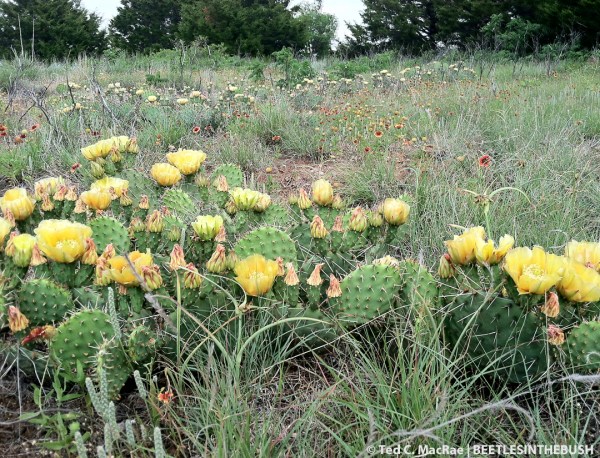
Opuntia phaecantha | Alabaster State Park, Woodward Co., Oklahoma

Opuntia macrorhiza | Alabaster Caverns State Park, Woodward Co., Oklahoma

Whenever I see prickly pear cactus anywhere west of Missouri I immediately think of cactus beetles—longhorned beetles in the genus Moneilema. A half-dozen species of these relatively large, bulky, clumsy, flightless, jet-black beetles live in the U.S., with another dozen or so extending the genus down into Mexico and Baja California, and all are associated exclusively with cactus, primarily species of the genus Opuntia. It wasn’t long before I found one, and deliberate searching among the cactus clumps produced a nice series of beetles representing what I later determined as M. armatum. The resemblance between Moneilema spp. and darkling beetles of the genus Eleodes is remarkable, not only in their appearance but also in their shared defensive habit of raising the abdomen when disturbed. The genus has been related taxonomically to the Old World genus Dorcadion, but Linsley & Chemsak (1984) regard the loss of wings and other morphological modifications to represent convergence resulting from the environmental constraints imposed by root-feeding, subterranean habits in arid environments and other situations where flightlessness is advantageous.

Moneilema armatum adult.

Moneilema armatum adult in situ on Opuntia macrorhiza pad.

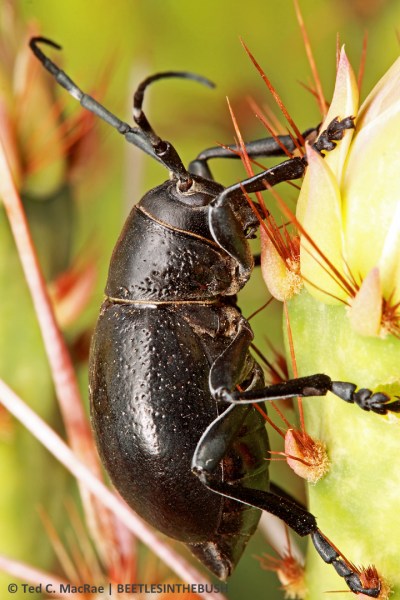
I have encountered Moneilema beetles a number of times out west, including this species in Texas where it is most common, but since I have only been photographing insects for the past few years this was my first  chance to capture cactus beetle images as well as specimens. The above shot, taken with my iPhone, was straightforward enough, but I wanted some real photographs of the beetle—i.e., true close-up photos taken with a dedicated macro lens. I quickly learned that this would be highly problematic—those cactus spines are long and stiff and vicious, and these beetles are no dummies! Clearly their ability to adapt to such a terrifyingly well-defended plant has had a lot to do with the evolution of their slow, clumsy, flightless, you-don’t-scare-me demeanor. Normally when I photograph insects I do a little pruning or rearranging of nearby vegetation to get a clear, unobstructed view of the subject, and sometimes this also involves “pushing” my way into the vegetation to get the most desirable angle on the subject for the sake of composition. Not so here! In my first attempt, all I could think to do was locate a beetle sitting in repose and try to position myself in some way so that the beetle was within the viewfinder and the cactus’ spines were not impaled within my arms! The photo below shows the only shot out of several that I even considered halfway acceptable, but clearly the spines obstructing the view of the beetle were not going to be to my liking.

First attempt - looking down into plant where beetle was first sitting.

First attempt – looking down into plant where beetle was first sitting.

What to do? The beetle was behaving fairly well (i.e., it was not bolting for cover upon my approach), so I pulled out a pair of long forceps (that I carry with me for just such cases) and used them to gently prod the beetle into a more exposed position. The beetle crawled up onto one of the unopened cactus flower buds and perched momentarily, and I thought I had my winner photograph. I crouched down again, was able to get a little bit closer to the beetle than before, and fired a few shots. Looking at them in the preview window, however, left me still dissatisfied—the beetle was no longer obstructed, but the background was still jumbled, messy and dark, making it difficult for the dark-colored beetle to stand out. I would need to think of something else.

Second attempt - looking down on beetle after coaxing it up.

Second attempt – looking down on beetle after coaxing it up.

I actually take a lot of my photos with the insects sitting on plant parts that have been detached from the plant. This allows me to hold the plant in front of whatever background I choose and micro-adjust the position of the insect in the viewfinder for the best composition. This is “easier” (a relative term) with a shorter lens (think MP-E 65-mm) because the lens-to-subject distance matches almost perfectly the distance between my wrist and my fingers, allowing me to rest the camera lens on my wrist while holding the plant part with my fingers to “fix” the lens-to-subject distance. These beetles, however, are much too big for the MP-E 65-mm, so I had to use my longer 100-mm macro lens. The longer lens-to-subject distance does not allow resting the lens on my wrist, so I must come up with other ways of bracing myself and the subject to minimize movement. Detaching the pad on which the beetle was resting (and if you’ve never tried to detach an Opuntia cactus pad from its parent plant while trying not to disturb a beetle sitting on it, I can tell you it is not an easy thing), I also discovered that the pad was quite heavy and that holding it with the same forceps that I had used to prod the beetle (because of its vicious spines) was yet another unanticipated difficulty. I decided the best way to deal with it would be to get down on one knee in front of the plant, rest my arm on my other knee with the cactus pad extending out in front of me, and photograph the beetle with the plant as close in the background as possible to achieve a lighted and colored background that would help the beetle stand out. Following are examples of those attempts.

Third attempt - holding detaching pad with forceps for better view.
Third attempt – holding detaching pad with forceps for better view.

Detached allows even better close-ups.

Detached allows even better close-ups.

Better for sure, especially the latter, closer one. Still, I wasn’t satisfied—the backgrounds still just had too much clutter that detracted from the beetle and complicated the lighting. I decided to go for broke—why not go for the blue sky background, the cleanest, most natural and aesthetically pleasing background possible! This actually was my first thought when I saw the beetles, but I could never find one on a high enough plant that was growing in a situation where I was able to crouch low enough to get the angle with the sky in the background. By this time my arm was quite weak from holding the heavy cactus pad and squeezing the forceps firmly, and as I contemplated how I could possibly hold the pad up towards the sky and take the shots without being able to rest the camera on my arm I had an idea. Why not rest my arm on the camera? Specifically on top of the flash master unit atop the camera. I adjusted the camera settings for blue sky background, positioned the cactus pad in the forceps so that the pad (and beetle) were hanging down from the forceps but still in an upright position, pointed the camera to the brightest part of the sky (a few degrees from the sun), and then held the cactus pad out in front of the camera with my arm resting on the flash master unit. It worked! My arm still got tired quickly and needed frequent breaks, and I had to do a number of takes to get the exposure settings and composition I was looking for, but the photo below represents my closest approach to what I envisioned when I first knelt down to photograph these beetles. A clear view of the beetle, on its host plant, with lots of nice value contrast between beetle, plant and background.
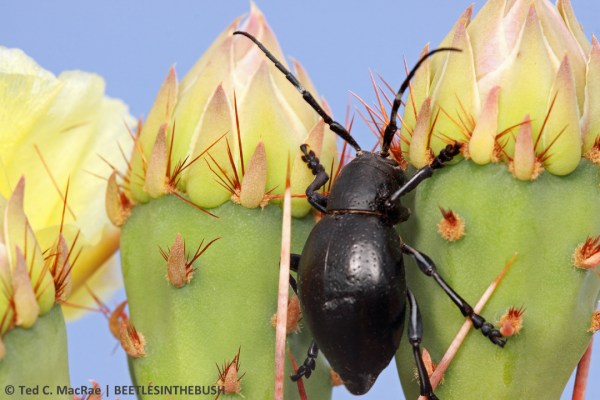
Fourth attempt - holding detached pad up against sky for cleaner background.

Fourth attempt – holding detached pad up against sky for cleaner background.

Once I had the technique figured out, I was able to get some really close-ups shots as well, still, however, with enough blue sky in the background to make it clean and pretty…

Zooming in with sky background gives a nice, clean close-up.

Zooming in with sky background gives a nice, clean close-up.

…as well as playing with some unusual compositions that one can afford to try only after they are confident they have gotten the required shots. I am particularly fond of the following photo, in which the beetle appears to be “peeking” from behind its well-defended hiding place on its host plant.

Having a little fun with the close-ups - he's peaking!

Having a little fun with the close-ups – he’s peaking!

If you have any experiences photographing these or other such “well-defended” insects (without resorting to the white box!) I would love to hear about them.

REFERENCE:

Linsley, E. G. and J. A. Chemsak. 1984. The Cerambycidae of North America, Part VII, No. 1: Taxonomy and classification of the subfamily Lamiinae, tribes Parmenini through Acanthoderini. University of California Publications in Entomology 102:1–258 [preview].

Copyright © Ted C. MacRae 2013

The “Dagger Butt Weevil”

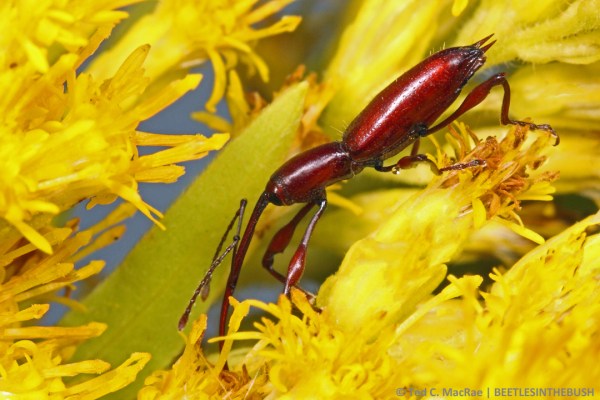
In April 2012 I spent some time in northern Argentina collecting insects, and while collecting was not that great (late in the season after a protracted drought) I saw enough of interest to make it a worthwhile effort. Among the insects that I saw were two species of weevil (family Curculionidae)—one being Eurhinus c.f. adonis () and the other this one, also kindly identified by Charles O’Brien as Erodiscus obidensis (Monte 1944). Both of them were found on flowers of Solidago chilensis growing along the roadside near La Escondida in Chaco Province; however, the two weevils are almost complete opposites in terms of coloration and body form—E. adonis brilliant metallic green and robust chunky, and E. obidensis chestnut-colored and elongate slender.

Erodiscus obidensis (Monte) | Chaco Province, Argentina | Apr 2012

Erodiscus obidensis (Monte) | Chaco Province, Argentina | Apr 2012

An obvious feature of E. obidensis are its two stout spines located at the apices of the elytra. I presume that these serve a defensive purpose to protect them against potential avian or reptilian predators. However, if elytral spines are all that is needed for such then why are these structures not found widely across the order Coleoptera—certainly the potential is there, as many beetles exhibit very small spines at the elytral apices. With enough selection pressure one can easily imagine that larger spines would be selected for. Either the spines also/instead serve some other purpose, or development of spines is more energetically expensive than I am imagining.

What purpose those daggers?

What purpose those daggers?

Compared to most of the insects that I have featured on this blog, I wasn’t able to find much information on this species. It was originally described as Atenistes attenuatus var. obidensis from Óbidos in the Brazilian state of Pará (Monte 1944) and is listed as such in the Blackwelder (1947) catalogue. However, my weevil literature is sparse compared to the other beetle groups with which I am more familiar, and I found nothing else in searches on the web as well. It apparently is already known from Argentina, as it is listed at the website Curculionidae de Argentina (but without any photos). As far as I could tell, these are the first photos of the species to be posted to the web, at least with the associated name. Since so little seems to be known about this weevil, I take it upon myself to give it a common name, and I can’t think of a more amusing and fun-to-say name than the “dagger butt weevil” in reference to its distinctive apical spines.

REFERENCES:

Blackwelder, R. E. 1947. Checklist of the coleopterous insects of Mexico, Central America, the West Indies, and South America. Part 5. Bulletin of the U. S. National Museum 185:765–925 [pdf].

Monte, O. 1944. Sobre coleópteros Otidocephalinae. Revista Entomologia, Rio de Janeiro 15(3):318–320 [abstract].

Copyright © Ted C. MacRae 2013

Sunday scarab: Phileurus valgus

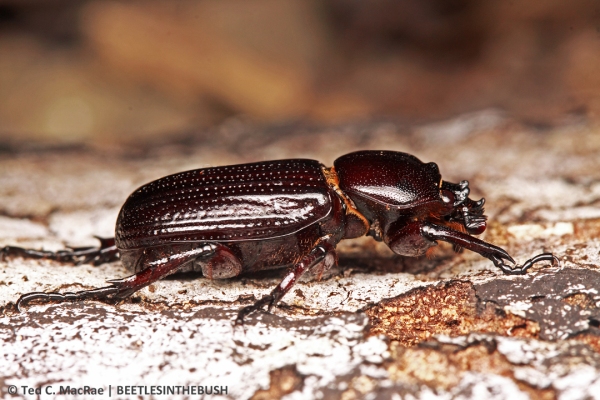
Phileurus valgus (Linnaeus) | Otter Slough Conservation Area, Stoddard Co., Missouri

Phileurus valgus (Linnaeus) | Otter Slough Conservation Area, Stoddard Co., Missouri

Few beetles enjoy more popularity than the scarabs (family Scarabaeidae)¹, and within that group certainly the members of the subfamily Dynastinae are the most popular of all due to their often enormous size and presence of highly developed horns on the head and pronotum. The largest beetles in the U.S. (at least, by weight)—the Hercules beetles, genus Dynastes—belong to this subfamily, and in the tropical regions of the New World members of the genus Megasoma (literally meaning “giant body”) are among the heaviest-bodied beetles in the world (ironically, the title spot goes to members of the genus Goliathus in the subfamily Cetoniinae). Of course, almost without exception in the insect world exceptions apply, and not all dynastine scarabs are large, heavy-bodied beetles. In fact, members of the genus Cyclocephala are often mistaken for May beetles (subfamily Melolonthinae), while members of the genus represented by the species featured in this post—Phileurus—are sometimes mistaken for smallish “bess beetles” (Odontotaenius disjunctus) in the family Passalidae due to their flattened and parallel-sided body.

¹ Except maybe tiger beetles, jewel beetles, and longhorned beetles (wink!).

This species resembles and is sometimes mistaken for the common "bess bug."

This species resembles and is sometimes mistaken for the common “bess bug.”

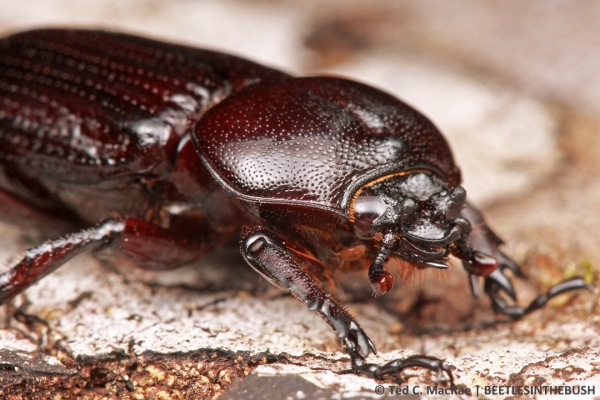
Phileurus is a primarily Neotropical genus, with only two species ranging north into the United States and one, P. valgus, occurring broadly in the eastern United States. Despite its broad distribution, P. valgus seems to be more common in the southern part of the country and has been recorded under bark of decaying wood and attracted to lights. Saylor (1948) notes that Richter reared a specimen from a larvae collected in a cavity of a dead basswood (Tilia sp.) tree, and adults have also been reared from larvae collected in a blackjack oak (Quercus marilandica) snag (Taber & Fleenor 2005). The individual featured here was one of several that I found under the lower trunk bark of a large, standing, dead pin oak (Q. palustris) tree growing in a wet, bottomland forest in the Mississippi Alluvial Plain of extreme southeastern Missouri. I have seen this species from time to time over the years—never abundantly—but these are the first that I have seen in a situation other than being attracted to lights. The bark was quite loose and covered wood that was soft and well-decayed, and three adults were found embedded within a granular frass-filled gallery directly beneath the bark. One can presume that larvae could also have been found within the wood had I done a little digging.

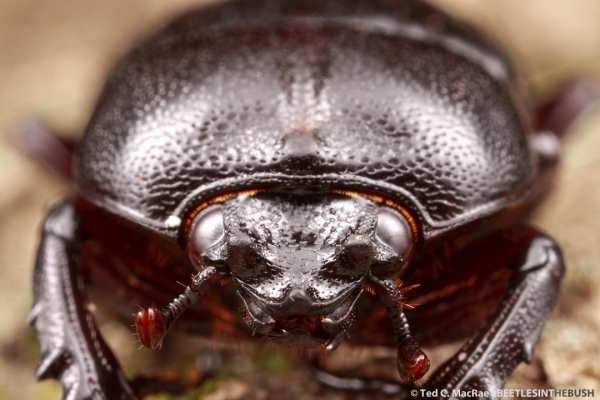
The head of this species is adorned with three small cephalic tubercles.

The head of this species is adorned with three small cephalic and one pronotal tubercles.

Taber & Fleenor (2005) also note that adults of this species possess structures known to be used by other beetles for sound production, but they did not say whether they have heard this beetle making sounds. I have never heard sounds from these beetles when handling them, either. This contrasts with true bess beetles, which stridulate to make a “kissing” sound when handled.

REFERENCES:

Saylor, L. W. 1948. Synoptic revision of the United States scarab beetles of the subfamily Dynastinae, No. 4: Tribes Oryctini (part), Dynastini, and Phileurini. Journal of the Washington Academy of Sciences 38(5):176–183.

Taber, S. W. & S. B. Fleenor. 2005. Invertebrates of Central Texas Wetlands. Texas Tech University Press, Lubbock, 322 pp. [preview].

Copyright © Ted C. MacRae 2013

ESA Insect Macrophotography Workshop

Today is the last day of the Entomological Society of America (ESA) Annual Meeting in Austin, Texas, and it has been an action packed week for me. Annual meetings such as this serve several purposes. In addition to seeing talks on a variety of subjects—in my case covering subjects ranging from insect resistance management to scientific outreach to beetle systematics—they also offer the chance to establish new connections with other entomologists that share common interests and reinforce existing ones. Of course, a major part of my interest in entomology revolves around insect macrophotography, and in recent years ESA has begun to cater to the entomological photographer contingent within the society. Last year’s meetings featured a macrophotography symposium titled, “Entomologists Beyond Borders” (for which I was one of the invited speakers), and this year featured an Insect Macrophotography Workshop led by Austin-based entomologist/photographer Ian Wright. Having done this for a few years now I figured a lot of the workshop might be review for me, but I still have much to learn and am willing to accept new ideas from any source. Besides, the workshop involved a field trip to a local habitat to try out our insect photography skills, and for a field junkie like me time in the field at an otherwise all-indoor event spanning close to a week is always welcome. The location of the meetings in Austin this year made this possible, as even in mid-November there still remain insects out and about that can be photographed if the weather cooperates (and it did).

This will be a somewhat different post than what I usually post here. Rather than featuring photos of a certain species and using them as a backdrop for a more detailed look at their taxonomy or natural history, I’m just going to post all the photos that I ended up keeping from the field trip portion of the workshop with just a comment or two about each. We went to the city’s nearby waste-water treatment facility, the grounds of which are wild and woolly enough to provide habitat for insects, and spent about an hour and a half seeing what we could find. For myself, it was a chance to photograph some insects I’ve not normally tried to photograph (i.e., dragonflies, ambush bugs) and get more practice on my blue sky technique. I did appreciate the chance to spend some time talking to Ian during while we traveled to the site and back, and I also ended up helping other participants with their camera equipment questions and technique suggestions. With that, here are the photos I took—I’ll be curious to see what readers think of this post format versus my more typical style.

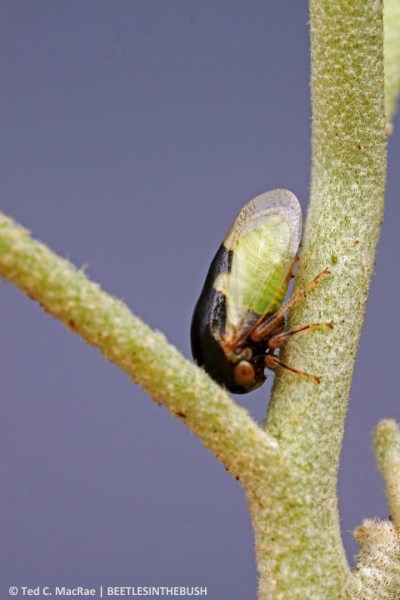
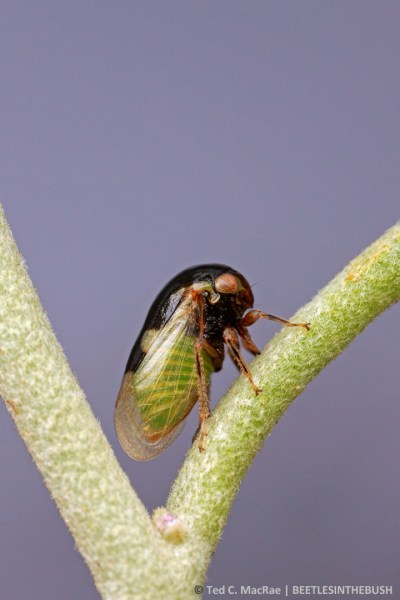
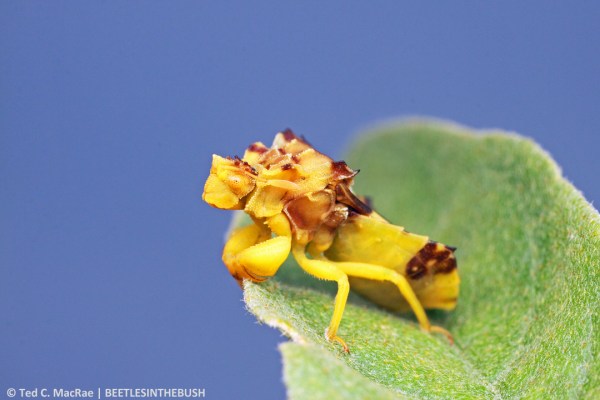
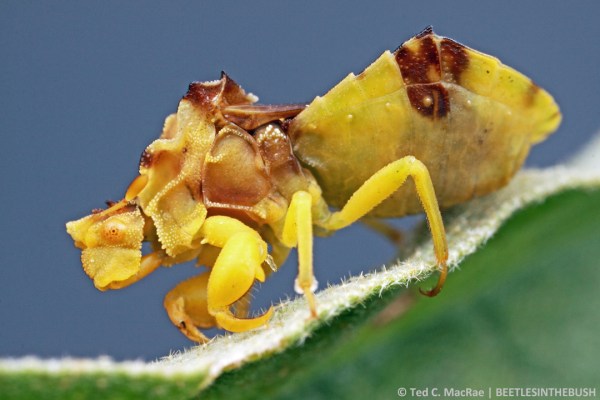
Micrutalis calva

Micrutalis calva (Hemiptera: Membracidae) on silverleaf nightshade (Solanum elaeagnifolium).

Micrutalis calva

This species of treehopper is restricted to herbaceous plant hosts.

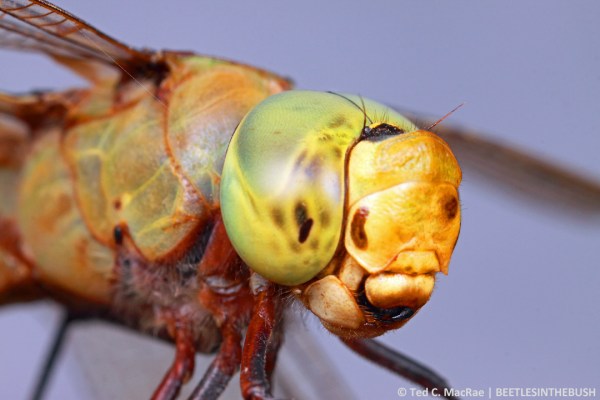
Anax junius

Anax junius (Odonata: Aeshnidae), one of the darner species of dragonfly.

Anax junius

This adult was perched on a dead twig tip and seemed to be “asleep.”

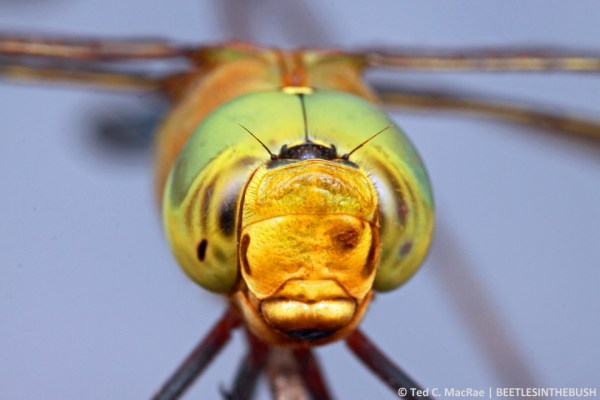
Anax junius

I clipped the perch and held it up for these “in-your-face” shots – it then awoke with a start and flew off.

Phymata sp.

Phymata sp. (Hemiptera: Reduviidae), one of the so-called “jagged ambush bugs.”

Phymata sp.

Formerly a separate family, ambush bugs are now combined with assassin bugs (family Reduviidae).

Acmaeodera flavomarginata

Acmaeodera flavomarginata (Coleoptera: Buprestidae).

Acmaeodera flavomarginata

This is one of a few species of jewel beetle in the southcentral US that are active during the fall.

Mecaphesa sp.

Mecaphesa sp. (Araneae: Thomisidae), one of the crab spiders

Mecaphesa sp.

Cryptic coloration allows the spider to lurk unseen by potential insect prey visiting the flower.

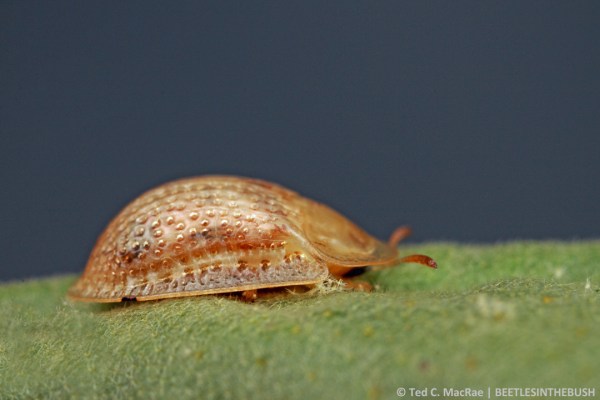
Gratiana pallidula

Gratiana pallidula (Coleoptera: Chrysomelidae) on silverleaf nightshade (Solanum eleagnifolium).

Gratiana pallidula

A type of tortoise beetle, adults “clamp” down against the leaf as a defense against predators.

Copyright © Ted C. MacRae 2013

The Darwin Beetle

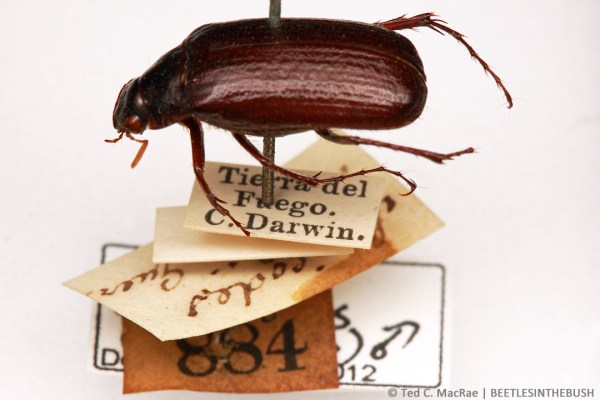
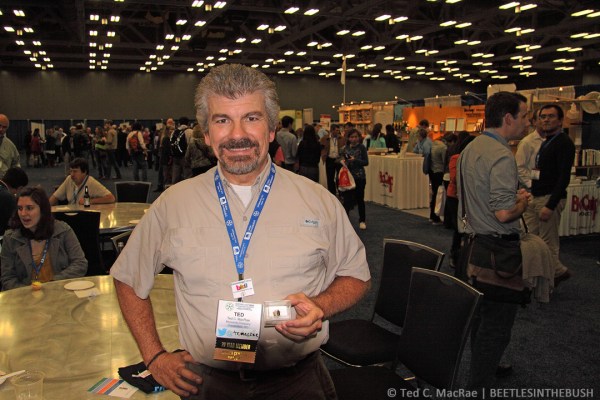
Like most modern biologists, Charles Darwin ranks high on my short list of intellectual/entomological heroes. Actually, with all due respect to others on the list—Carl Linnaeus, Alfred Russell Wallace, John Lawrence LeConte, and others, Darwin sits at #1. His theory of evolution, offered more than 150 years ago to a powerfully skeptical world, continues to provide the basic framework for modern biology (as Theodosius Dobzhansky said in his 1973 paper in American Biology Teacher, “Nothing in biology makes sense except in the light of evolution”). Thus, when Max Barclay recently posted on Facebook a photograph of a beetle collected by Charles Darwin himself, it reminded me that I have yet to visit Down House in Kent (the home of Charles Darwin) or to see anything personally touched by the man whose legacy I revere more than any other. Little did I know that Max did not post the photo from The Natural History Museum in London, but from Austin, Texas where he and I were each arriving for the annual meetings of the Entomological Society of America. When I commented on his post how I would love to see a beetle collected by Darwin someday, Max replied that he had the specimen with him and that he would bring it to the meetings for me to see (and I quote, “Most fun it has had since it flew to 22-year-old Charles Darwin’s gas lamp in Tierra Del Fuego in December 1832”). Can you imagine my anticipation?! True to his word, Max found me at the opening reception, came up from behind me, and placed  the plastic, see-through box housing the specimen on the table in front of me. I recognized it instantly, but still seeing “C. Darwin” on the label almost felt like I’d just met the man himself. I asked Max if it was okay to open the box, to which he agreed, and I even dared to grab the pin head and re-position the specimen for photographs. Call me crazy, but it was as spiritual an experience as I’ve had since, well… “Mrs. Ples” stood before me!

At any rate, here is the “Darwin Beetle,” followed by proof that I really got to hold it!

Sericoides glacialis (Fabricius), collected at Tierro del Fuego in 1832 by Charles Darwin.

Scarab beetle collected at Tierro del Fuego in 1832 by Charles Darwin. Identified as Sericoides glacialis (Fabricius) by Andrew B. T. Smith in 2012 after standing for many years as ‘Sericodes Reichii Guer.’

Holding the ''Darwin Beetle''

Holding the ”Darwin Beetle”

Copyright © Ted C. MacRae 2013